| Courrier-Convoyeur Ligne |
Type |
Earliest |
Latest |
Transit? |
Notes |
Château-du-Loir au Mans |
III |
none seen |
none seen |
|
Railway or Tramway? |
| La Chartre Line |
|
|
|
|
|
La Chartre au Mans |
II |
10/04 |
09/07 |
|
|
Le Mans à La Chartre |
II |
07/05 |
08/07 |
Yes |
|
La Chartre au Mans |
III |
05/08 |
04/25 |
Yes |
|
Le Mans à La Chartre |
III |
08/08 |
11/26 |
Yes |
|
| |
|
|
|
|
|
La Chartre-s/LL au Mans 1⁰ |
III |
09/28 |
08/34 |
|
s/LL= s/LE LOIR |
Le Mans à La Chartre-s/LL 1⁰ |
III |
?/? |
|
|
One seen, c.1930 |
| |
|
|
|
|
|
La Chartre-s/LL au Mans 2⁰ |
III |
04/28 |
?/34 |
|
|
| La Flèche Line |
|
|
|
|
|
La Flèche au Mans (tram) |
III |
08/17 #? |
09/32 |
|
|
Le Mans à La Flèche (tram) |
III |
08/19 |
02/27 |
|
|
Courrier-Convoyeur Ligne |
Type |
Earliest |
Latest |
Transit? |
Notes |
La Flèche au Mans (rail) |
III |
Dates just |
of the pre- |
tram use |
See article for other. |
La Flèche au Mans (rail) |
III |
05/08 |
09/17 |
|
Latest seen 08/36 |
Le Mans à La Flèche (rail) |
III |
05/08 |
12/08 |
|
|
| Mamers Line (& branch) |
|
|
|
|
|
Mamers au Mans incl. branch |
II |
08/01 |
08/28 |
|
|
ditto: just on La Ferté branch |
II |
07/05 |
08/28 |
|
|
Le Mans à Mamers incl.branch |
II |
12/11 |
06/22 |
|
* possible 03/06 seen |
ditto: just on La Ferté branch |
II |
none seen |
none seen |
|
|
Mamers au Mans incl. branch |
III |
11/31 |
08/34 |
|
|
ditto: just on La Ferté branch |
III |
none seen |
none seen |
|
|
Le Mans à Mamers incl.branch |
III |
none seen |
none seen |
|
|
ditto: just on La Ferté branch |
III |
none seen |
none seen |
|
|
| Mayet Line |
|
|
|
|
|
Mayet au Mans |
II |
08/03 |
02/17 |
Yes |
|
Le Mans à Mayet |
II |
08/02 |
11/20⊕ |
Yes |
⊕ or 03/14-see text |
Mayet au Mans |
III |
07/15 |
06/21 |
|
|
Le Mans à Mayet |
III |
06/17 |
07/19 |
|
|
| St. Denis d'Orques Line |
|
|
|
|
|
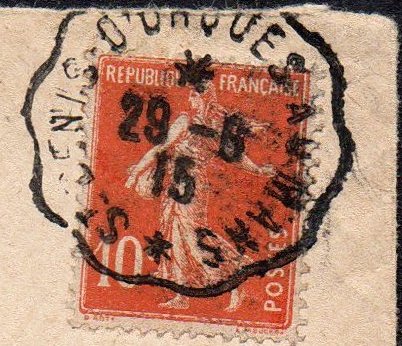
St. Denis d'Orques au Mans |
III |
06/15 |
06/28 |
|
|
Le Mans à St.Denis d'Orques |
III |
07/21 |
04/23 |
|
|
Courrier-Convoyeur Ligne |
Type |
Earliest |
Latest |
Transit? |
Notes |
#? : With the possible concurrent use of the La Flèche au Mans CCL by train and tram during the entire period of tramway operation, the initial date for the tramway use of this CCL is particularly hard to pinpoint.
⊕ : Type II reappeared some years after the Type III had been introduced; see text in the Mayet section.
 However, the philatelic sections (3, 4 & 7) can be read as stand-alone subjects without significant loss of context and links to them are provided in the left panel.
Principal Abbreviations used in this Article:
CCL = courrier-convoyeur-ligne (a TPO operated by a single postal employee, a 'mail-guard'). We frequently use CCL as a short form for 'CCL cancellation', as will be apparent when seen in context.
T.S. : La Compagnie des Tramways de la Sarthe. There were periodic amendments to the ownership, the administrative arrangements, the scope of the network and the nomenclature but, other than the State authority which underpinned the order of closure of the remains of the T.S. network in 1947, they have minimal impact on the content of this article and we have chosen simply to use T.S. throughout.
However, the philatelic sections (3, 4 & 7) can be read as stand-alone subjects without significant loss of context and links to them are provided in the left panel.
Principal Abbreviations used in this Article:
CCL = courrier-convoyeur-ligne (a TPO operated by a single postal employee, a 'mail-guard'). We frequently use CCL as a short form for 'CCL cancellation', as will be apparent when seen in context.
T.S. : La Compagnie des Tramways de la Sarthe. There were periodic amendments to the ownership, the administrative arrangements, the scope of the network and the nomenclature but, other than the State authority which underpinned the order of closure of the remains of the T.S. network in 1947, they have minimal impact on the content of this article and we have chosen simply to use T.S. throughout.
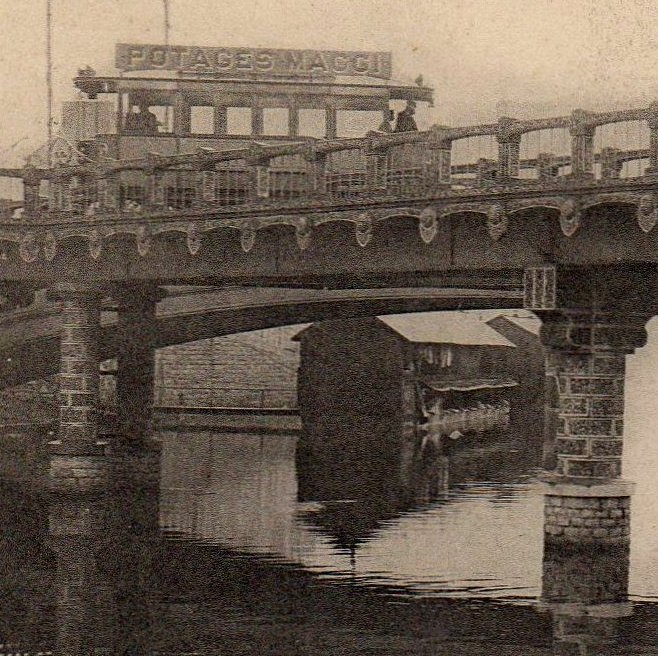
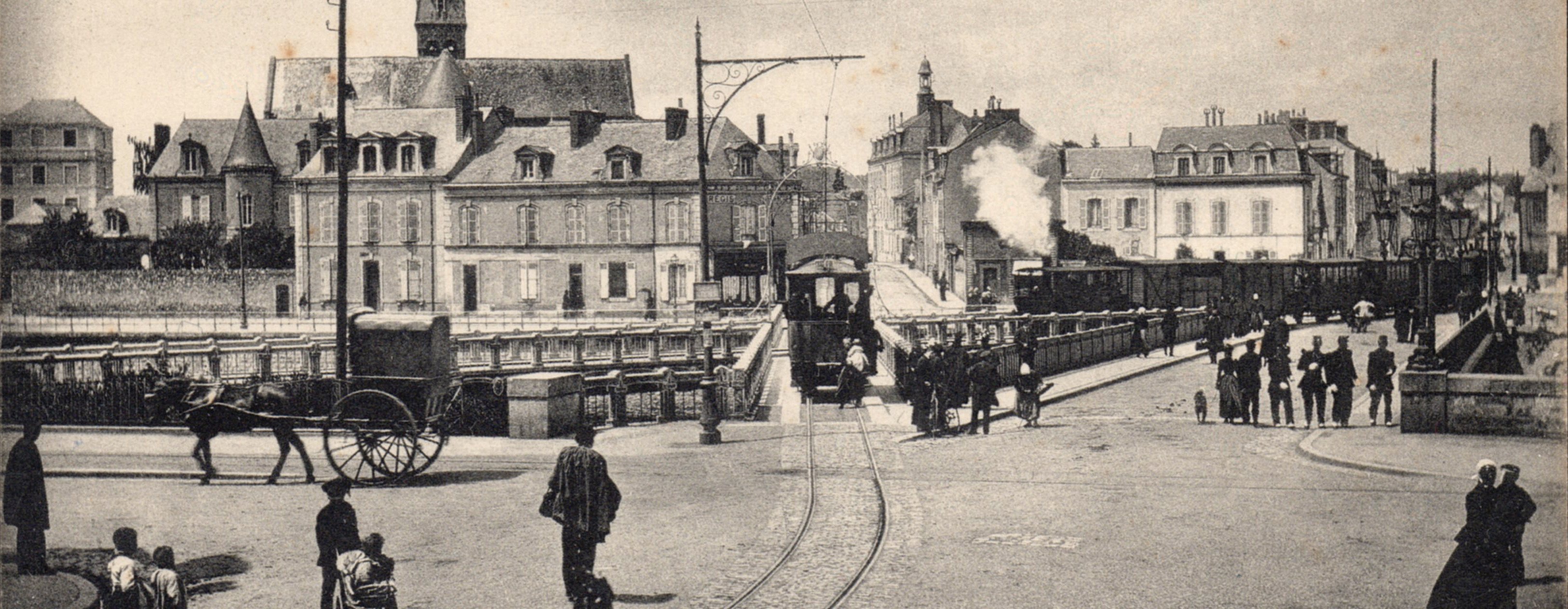 Above, the extraordinary Pont en X of which a huge number of postcards exist. The single tracks of the two rail systems were both of one-metre gauge and intersected on the Pont en X by means of a diamond crossing above the middle of the River Sarthe.
This is an early image showing a city tram giving way on the bridge to a steam tram of the T.S. arriving from St Denis d'Orques. The same view exists on another edition of this postcard with undivided back, which fixes the date of the photograph to the period 1898-1903.
Note: The Le Mans to Ségrie T.S. services, introduced in 1915, also travelled over the Pont en X but by this date the city tram route over the bridge had been abandoned.
The Pont-en-X was not only eye-catchingly different but also a highly practical solution. It was a notably elegant structure of international renown and was much loved by the people of Le Mans. We have considered a possible alternative solution: a sharp turn by St Denis d'Orques T.S. trams onto the Pont Yssoir road bridge which might just have been feasible for a metre-gauge operation. However, the T.S. trams would have needed to share tracks with the city electric trams on the bridge, requiring points at both ends, whilst also sharing the bridge with other road users. This would have been an unattractive operating procedure, even with the road traffic volumes of 1898.
Above, the extraordinary Pont en X of which a huge number of postcards exist. The single tracks of the two rail systems were both of one-metre gauge and intersected on the Pont en X by means of a diamond crossing above the middle of the River Sarthe.
This is an early image showing a city tram giving way on the bridge to a steam tram of the T.S. arriving from St Denis d'Orques. The same view exists on another edition of this postcard with undivided back, which fixes the date of the photograph to the period 1898-1903.
Note: The Le Mans to Ségrie T.S. services, introduced in 1915, also travelled over the Pont en X but by this date the city tram route over the bridge had been abandoned.
The Pont-en-X was not only eye-catchingly different but also a highly practical solution. It was a notably elegant structure of international renown and was much loved by the people of Le Mans. We have considered a possible alternative solution: a sharp turn by St Denis d'Orques T.S. trams onto the Pont Yssoir road bridge which might just have been feasible for a metre-gauge operation. However, the T.S. trams would have needed to share tracks with the city electric trams on the bridge, requiring points at both ends, whilst also sharing the bridge with other road users. This would have been an unattractive operating procedure, even with the road traffic volumes of 1898.
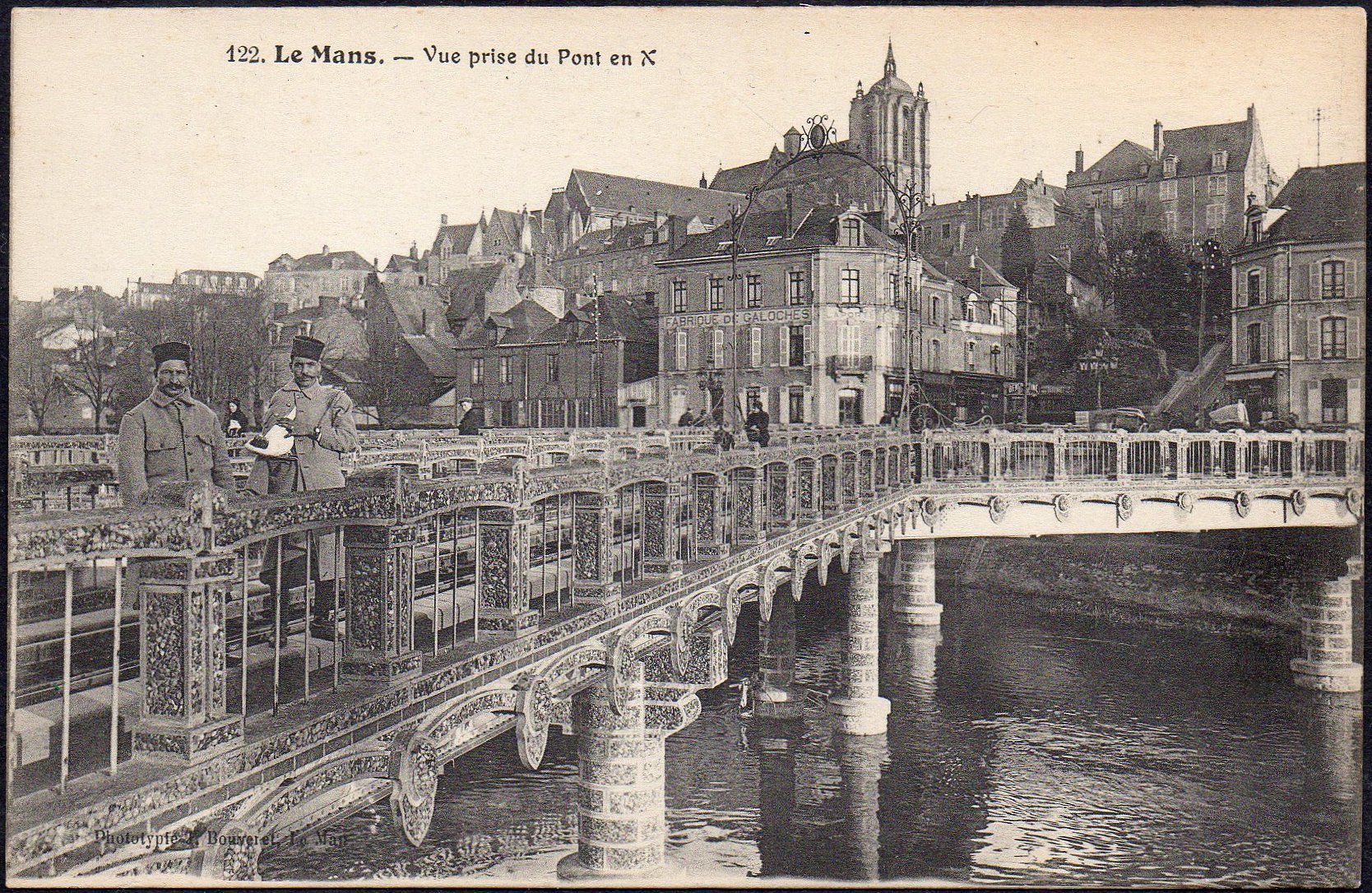 Two soldiers standing on the arm of the bridge that carried the electric trams. Note the overall delicacy of the structure, its superb embellishment with fine tracery, and the stylish pillars.
The pillars of the bridge, a metre in diameter, were of reinforced concrete decorated with multi-coloured mosaics. The bridge decks were also in reinforced concrete, with flamboyant projections and guard-rails, these too covered in mosaics, which largely concealed their metallic framework. The use of mosaic would have given longevity to the bright colours whilst the additional construction costs would perhaps have been offset over time by the reduction in maintenance costs for the ironwork. One can understand easily the enduring enthusiasm for this eye-catching combination of functionality and elegance.
The departmental tram network radiated out from Le Mans in all directions, typically to a distance of about 50-60 kms, further when including some of the branch lines. It would grow, by its peak, to an impressive network covering over 250 track miles (400+ kms) of a mostly rural nature, served at one time by up to 40 steam locomotives.
As a convenient shorthand, for the rest of this article, despite the introduction later of diesel railbuses / autorails on some Tramways de la Sarthe (T.S.) passenger services, we shall often employ the expressions 'electric trams' and 'steam trams' in order to distinguish between the electric city trams in Le Mans and the trams on the far larger T.S. network.
The T.S. hub was the Gare Centrale, located in the heart of Le Mans and probably more convenient for most passengers than the railway station about a kilometre to the south. The Gare Centrale was a substantial structure; allied with its large train shed, it presented an imposing centre of operations. At its zenith, in addition to an important freight business, the T.S. station in Le Mans handled 30-40 movements of passenger trams per day, with very busy morning and evening peaks.
Two soldiers standing on the arm of the bridge that carried the electric trams. Note the overall delicacy of the structure, its superb embellishment with fine tracery, and the stylish pillars.
The pillars of the bridge, a metre in diameter, were of reinforced concrete decorated with multi-coloured mosaics. The bridge decks were also in reinforced concrete, with flamboyant projections and guard-rails, these too covered in mosaics, which largely concealed their metallic framework. The use of mosaic would have given longevity to the bright colours whilst the additional construction costs would perhaps have been offset over time by the reduction in maintenance costs for the ironwork. One can understand easily the enduring enthusiasm for this eye-catching combination of functionality and elegance.
The departmental tram network radiated out from Le Mans in all directions, typically to a distance of about 50-60 kms, further when including some of the branch lines. It would grow, by its peak, to an impressive network covering over 250 track miles (400+ kms) of a mostly rural nature, served at one time by up to 40 steam locomotives.
As a convenient shorthand, for the rest of this article, despite the introduction later of diesel railbuses / autorails on some Tramways de la Sarthe (T.S.) passenger services, we shall often employ the expressions 'electric trams' and 'steam trams' in order to distinguish between the electric city trams in Le Mans and the trams on the far larger T.S. network.
The T.S. hub was the Gare Centrale, located in the heart of Le Mans and probably more convenient for most passengers than the railway station about a kilometre to the south. The Gare Centrale was a substantial structure; allied with its large train shed, it presented an imposing centre of operations. At its zenith, in addition to an important freight business, the T.S. station in Le Mans handled 30-40 movements of passenger trams per day, with very busy morning and evening peaks.
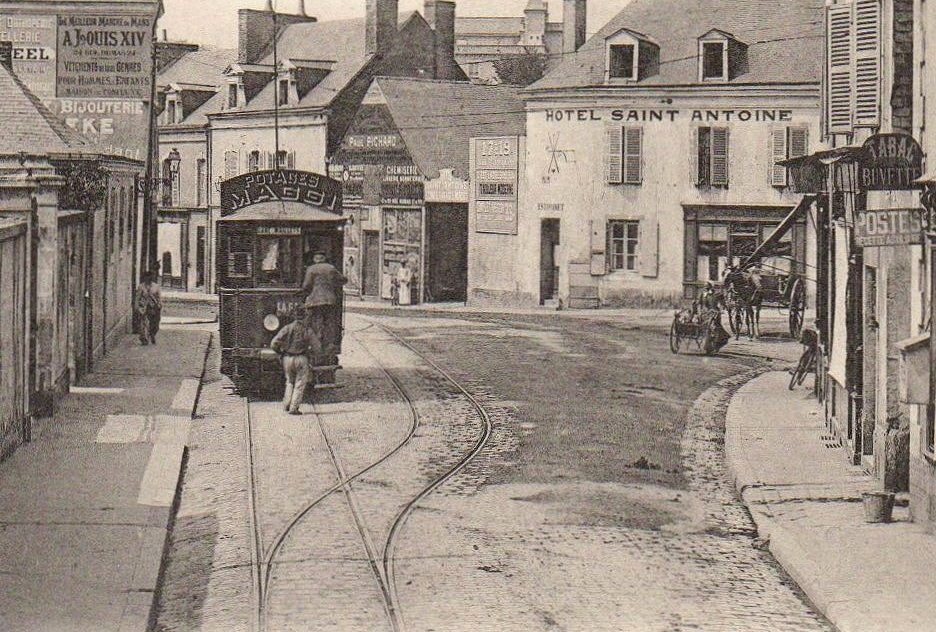
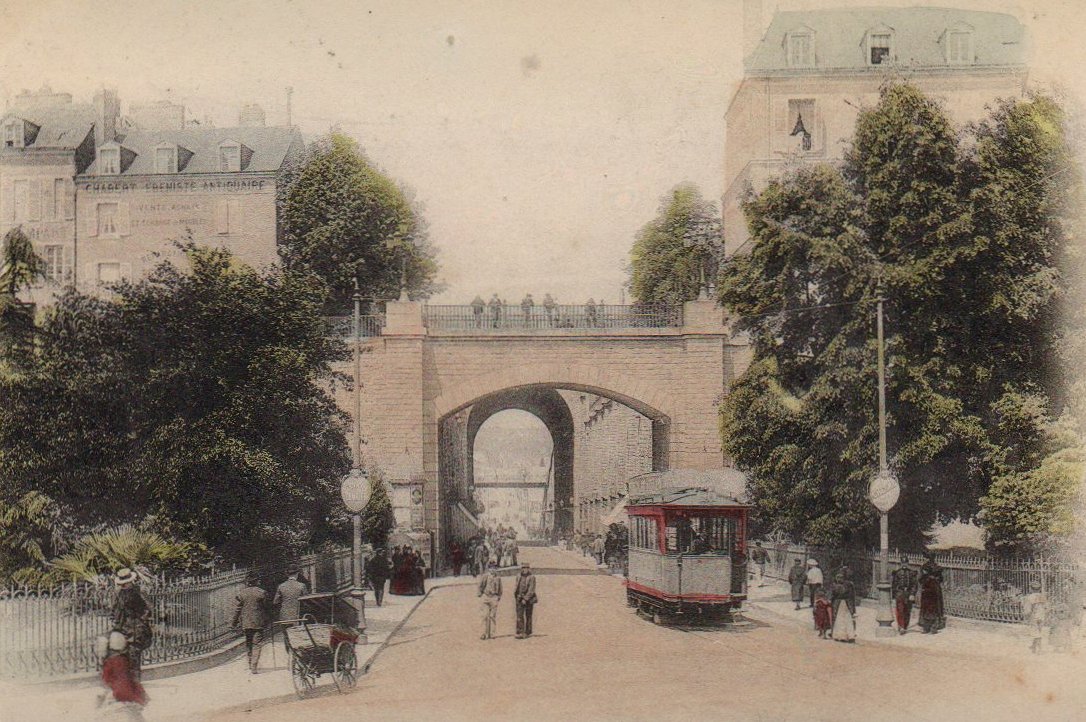 Left : A Line 1 tram at the Maillets terminus with its crew preparing it for the return to the (main line) railway station.
Right : A city tram on Ligne 2, exiting the tunnel near the cathedral. The Pont en X is behind the tram, at the bottom of the hill. This image is from an early postcard, sent in November 1899, the second year of operation of the electric trams.
The first T.S. service, opened in 1882, operated between Le Mans and Le Grand-Lucé, extended later to La-Chartre-sur-le-Loir. Initially its terminus in Le Mans was close to the railway station. However, as the vision to create a substantial tramway network for the département took shape, it was clear that a single terminus in the city for all the T.S. services would have many advantages. The site chosen for what would be named the 'Gare Centrale' was alongside the River Sarthe in the port area.
Left : A Line 1 tram at the Maillets terminus with its crew preparing it for the return to the (main line) railway station.
Right : A city tram on Ligne 2, exiting the tunnel near the cathedral. The Pont en X is behind the tram, at the bottom of the hill. This image is from an early postcard, sent in November 1899, the second year of operation of the electric trams.
The first T.S. service, opened in 1882, operated between Le Mans and Le Grand-Lucé, extended later to La-Chartre-sur-le-Loir. Initially its terminus in Le Mans was close to the railway station. However, as the vision to create a substantial tramway network for the département took shape, it was clear that a single terminus in the city for all the T.S. services would have many advantages. The site chosen for what would be named the 'Gare Centrale' was alongside the River Sarthe in the port area.
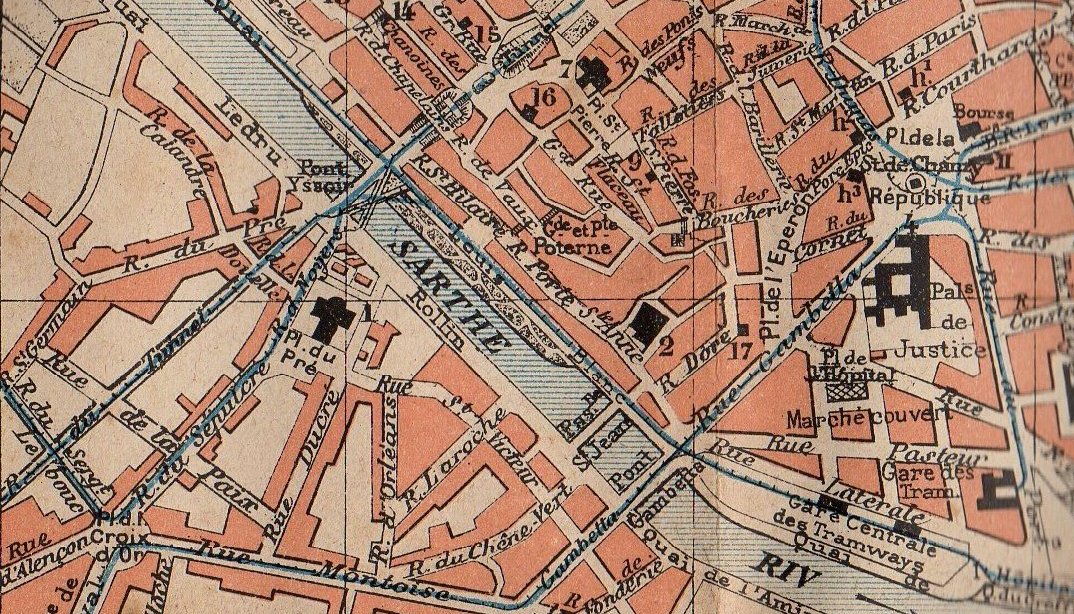 The map above dates from around 1905, although we think it may be an earlier map which has been rather crudely (and inaccurately) amended to include the Pont en X. Inconveniently, both the steam trams and electric trams are shown in blue on the map.
The Gare Centrale des Tramways de la Sarthe is at bottom right and the blue line passing through the Gare Centrale is solely for its steam trams, departing in both directions. The line at extreme bottom right would be that of the La Chartre service, extended to here from its previous terminus near the main-line station; this track also carried the Mayet line, opened in 1897. Despite being the first into Le Mans, the La Chartre trams were not the first users of the Gare Centrale; in 1888, that distinction went to the trams arriving from the opposite direction on the St. Denis d'Orques service. It would, though, be another ten years until the trams could be seen simmering under the large train shed and their passengers could pass through the impressive halls of an imposing new station.
For around a decade, the St. Denis d'Orques steam trams left the Gare Centrale via a gateway onto the end of the Rue Gambetta where they turned left, travelled across the Pont Gambetta and continued along the Rue Montoise. On the map, you can just see a tiny connecting spur from the exit of the Gare Centrale onto the Pont Gambetta, but we suspect this had already been lifted by the time this map was printed.
When the new T.S. line to Mamers opened (1897), tracks were set in the roadway along Quai Louis Blanc. It was not until completion of the Pont en X the following year that the St. Denis d'Orques services were re-routed along this new track, sharing it with the Mamers services as far as the Pont en X, where the lines diverged.
The map above dates from around 1905, although we think it may be an earlier map which has been rather crudely (and inaccurately) amended to include the Pont en X. Inconveniently, both the steam trams and electric trams are shown in blue on the map.
The Gare Centrale des Tramways de la Sarthe is at bottom right and the blue line passing through the Gare Centrale is solely for its steam trams, departing in both directions. The line at extreme bottom right would be that of the La Chartre service, extended to here from its previous terminus near the main-line station; this track also carried the Mayet line, opened in 1897. Despite being the first into Le Mans, the La Chartre trams were not the first users of the Gare Centrale; in 1888, that distinction went to the trams arriving from the opposite direction on the St. Denis d'Orques service. It would, though, be another ten years until the trams could be seen simmering under the large train shed and their passengers could pass through the impressive halls of an imposing new station.
For around a decade, the St. Denis d'Orques steam trams left the Gare Centrale via a gateway onto the end of the Rue Gambetta where they turned left, travelled across the Pont Gambetta and continued along the Rue Montoise. On the map, you can just see a tiny connecting spur from the exit of the Gare Centrale onto the Pont Gambetta, but we suspect this had already been lifted by the time this map was printed.
When the new T.S. line to Mamers opened (1897), tracks were set in the roadway along Quai Louis Blanc. It was not until completion of the Pont en X the following year that the St. Denis d'Orques services were re-routed along this new track, sharing it with the Mamers services as far as the Pont en X, where the lines diverged.
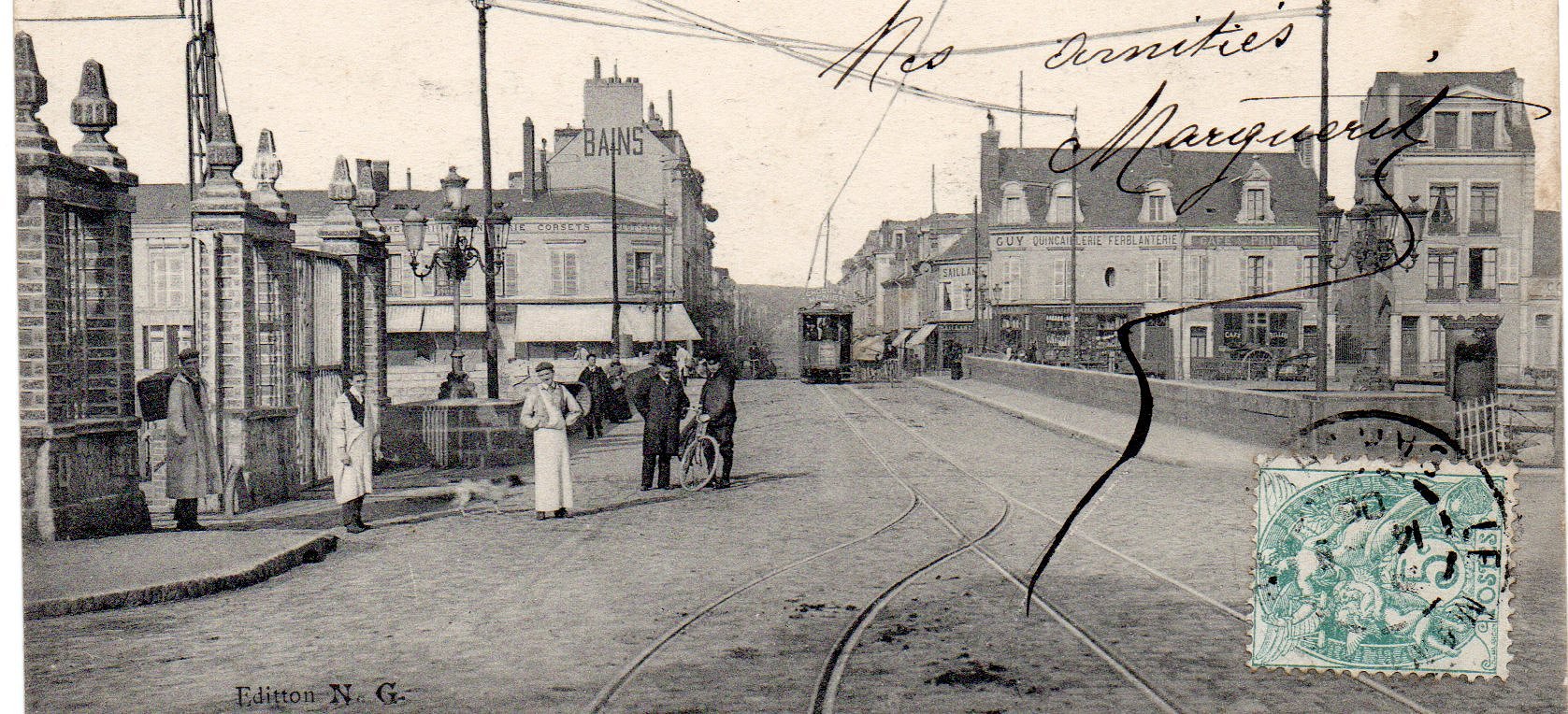
 Left : A view of the Pont Gambetta around 1905 showing a city tram. On the left are the gates into the Gare Centrale, with what are probably porters at the gates. The points in the foreground are part of a passing loop for the city trams, not for T.S. trams leaving the Gare Centrale. There is no sign of the old spur leading out from the station gates over the Pont Gambetta, mentioned above.
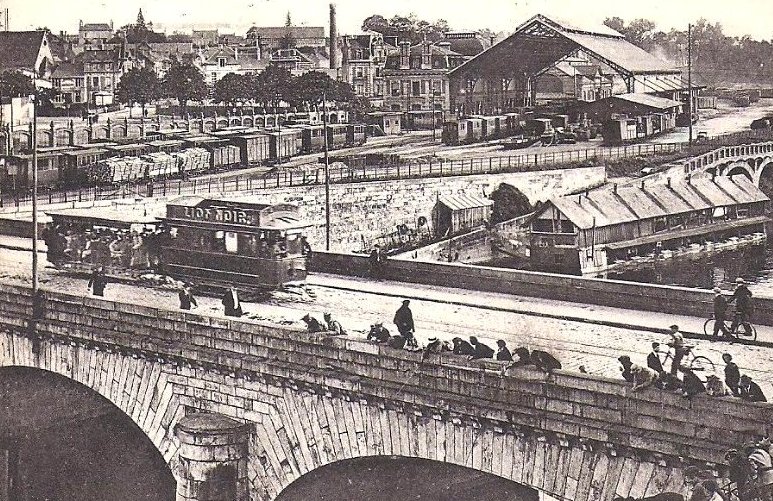
Right : A view from the other end of the Pont Gambetta, showing a well-filled city tram (with trailer car), around 1905. In the background is the train shed of the Tramways de la Sarthe's Gare Centrale with its extensive sidings, housing both passenger carriages and goods trucks.
Left : A view of the Pont Gambetta around 1905 showing a city tram. On the left are the gates into the Gare Centrale, with what are probably porters at the gates. The points in the foreground are part of a passing loop for the city trams, not for T.S. trams leaving the Gare Centrale. There is no sign of the old spur leading out from the station gates over the Pont Gambetta, mentioned above.
Right : A view from the other end of the Pont Gambetta, showing a well-filled city tram (with trailer car), around 1905. In the background is the train shed of the Tramways de la Sarthe's Gare Centrale with its extensive sidings, housing both passenger carriages and goods trucks.
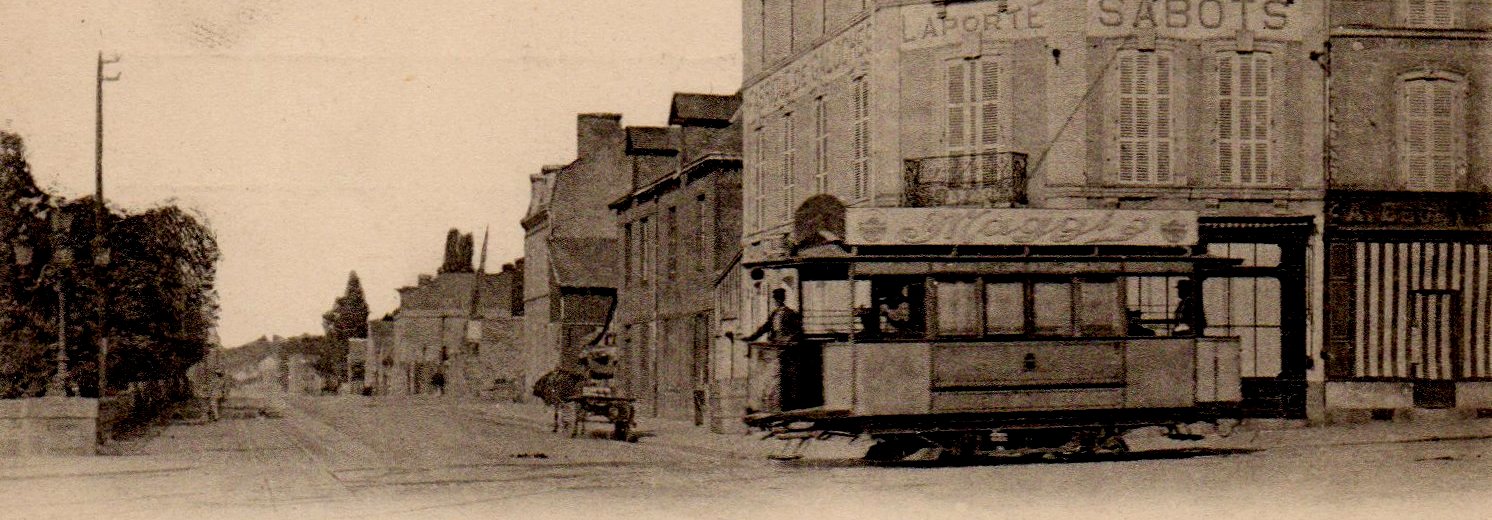 Above : After much searching, we found a view looking down Quai Louis Blanc in the direction of the Pont en X. The photographer would have had his back to the gates shown in the view above. Based on the 'undivided back' of this rather scarce postcard, this photograph will have been taken in the period 1898-1903, probably around 1901/02.
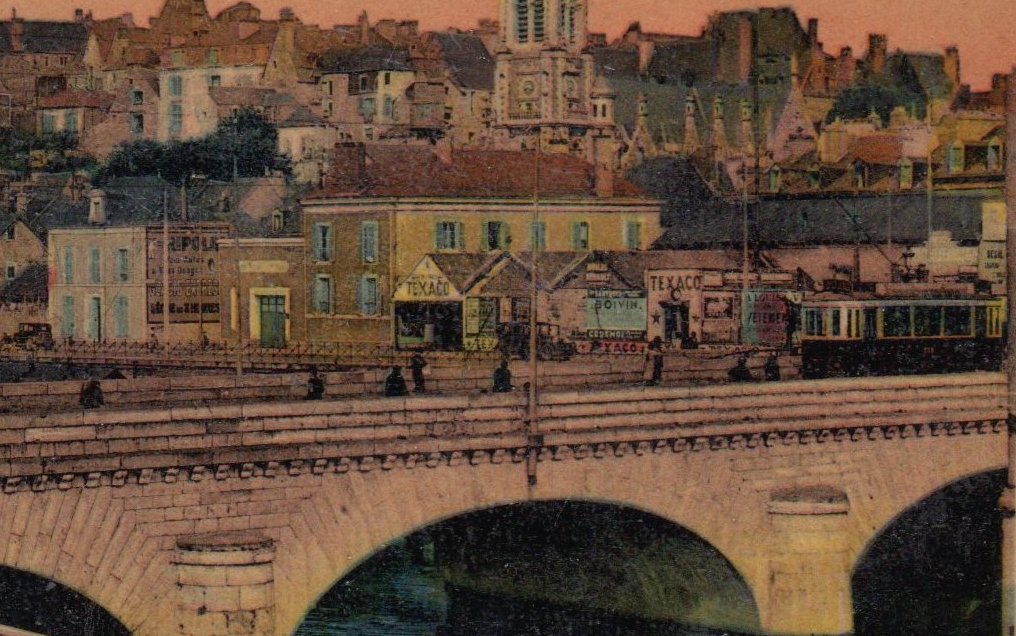
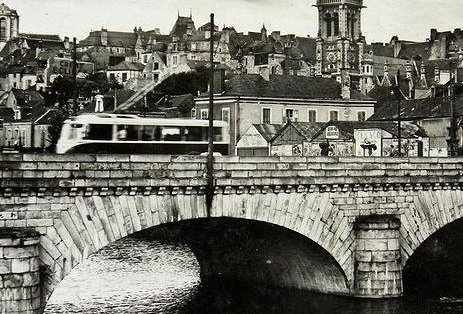 Left: A more modern tram on the Pont Gambetta, captured on film perhaps in the early 1930s.
Right : As the century progressed, some tram routes were taken over by trolleybuses, profiting from the existing overhead structures installed for the trams; one is seen here, again on the Pont Gambetta.
Left: A more modern tram on the Pont Gambetta, captured on film perhaps in the early 1930s.
Right : As the century progressed, some tram routes were taken over by trolleybuses, profiting from the existing overhead structures installed for the trams; one is seen here, again on the Pont Gambetta.
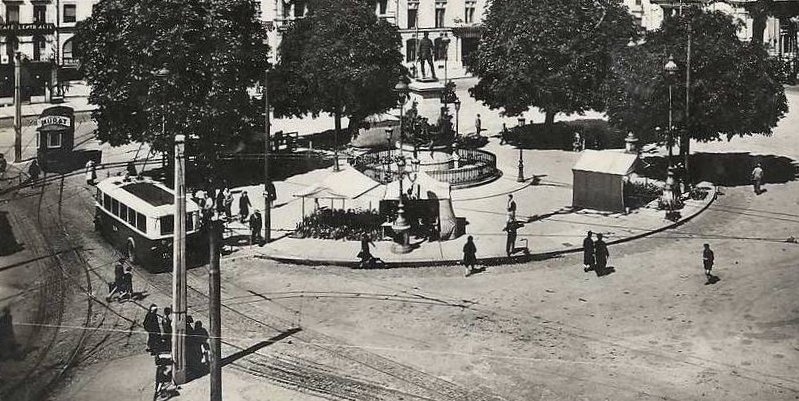 La Place de la République with a view uniting City tram and City trolleybus, we think probably photographed just after the end of WWII. There were limited locations and a relatively short period of time during which these modes of transport would have been seen together.
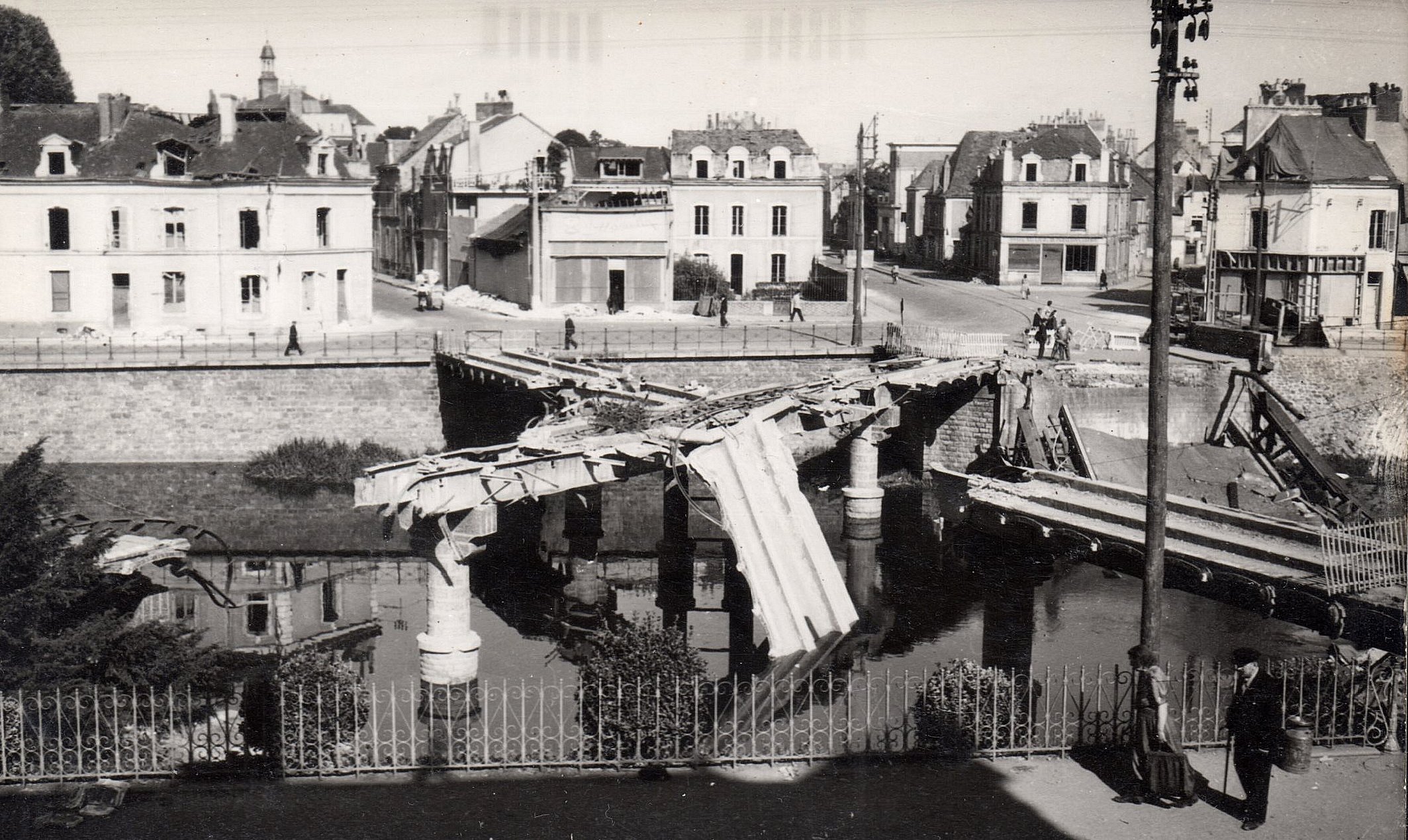
When the electric tram services started in 1898, there were three routes in Le Mans, only one of which, Ligne 2, used the Pont en X. However, the section of Ligne 2 that used the bridge was poorly patronised and from 1914 the route was heavily modified, after which city trams never crossed the bridge again. The steam trams, however, continued to use it until it was destroyed by retreating German troops on August 8th, 1944, as was the Pont Yssoir alongside.
Even though the Pont en X had ceased, since 1914, to possess a compelling raison d'être for 50% of its structure, its demise was nevertheless deeply mourned. The steam trams to St Denis were re-introduced after the war, but it is unclear to us how they reached the Gare Centrale, which the timetable suggests they did. If the Pont Yssoir was re-built promptly, or at least a temporary structure erected there, tracks embedded in that bridge would have been a possibility.
Operational Rules : During the Belle Epoque when city trams were in service over the Pont en X, operating rules were straightforward. The city's trams had instructions to come to a halt ahead of the diamond crossing above the river before proceeding. One presumes that they also had to give way at the threshold of the Pont en X to the Mamers line steam trams on the Quai Louis Blanc which also crossed the city tram tracks.
We note that T.S. timetables show request stops on the Mamers line (0.6 kms from the Gare Centrale) and on the St Denis d'Orques / Ségrie services (0.9 kms from the Gare Centrale), both called 'Pont Yssoir'. Comments in an article about the journey from Le Mans to Mamers, lead us to think that the stop for the Mamers trams was just before the points preceding the Pont en X, whereas the St Denis trams crossed the bridge and had their stop on the other side of the river.
.
La Place de la République with a view uniting City tram and City trolleybus, we think probably photographed just after the end of WWII. There were limited locations and a relatively short period of time during which these modes of transport would have been seen together.
When the electric tram services started in 1898, there were three routes in Le Mans, only one of which, Ligne 2, used the Pont en X. However, the section of Ligne 2 that used the bridge was poorly patronised and from 1914 the route was heavily modified, after which city trams never crossed the bridge again. The steam trams, however, continued to use it until it was destroyed by retreating German troops on August 8th, 1944, as was the Pont Yssoir alongside.
Even though the Pont en X had ceased, since 1914, to possess a compelling raison d'être for 50% of its structure, its demise was nevertheless deeply mourned. The steam trams to St Denis were re-introduced after the war, but it is unclear to us how they reached the Gare Centrale, which the timetable suggests they did. If the Pont Yssoir was re-built promptly, or at least a temporary structure erected there, tracks embedded in that bridge would have been a possibility.
Operational Rules : During the Belle Epoque when city trams were in service over the Pont en X, operating rules were straightforward. The city's trams had instructions to come to a halt ahead of the diamond crossing above the river before proceeding. One presumes that they also had to give way at the threshold of the Pont en X to the Mamers line steam trams on the Quai Louis Blanc which also crossed the city tram tracks.
We note that T.S. timetables show request stops on the Mamers line (0.6 kms from the Gare Centrale) and on the St Denis d'Orques / Ségrie services (0.9 kms from the Gare Centrale), both called 'Pont Yssoir'. Comments in an article about the journey from Le Mans to Mamers, lead us to think that the stop for the Mamers trams was just before the points preceding the Pont en X, whereas the St Denis trams crossed the bridge and had their stop on the other side of the river.
.
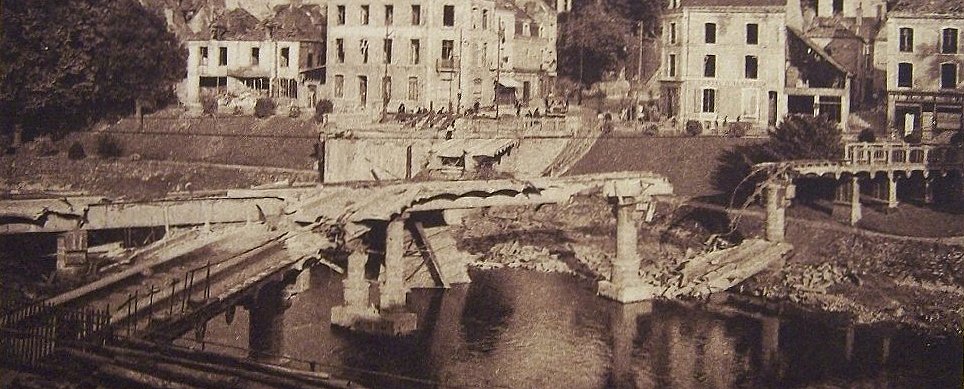 The sad end of the famous bridge, blown up on August 8th 1944, looking across towards the tunnel. The Pont Yssoir beyond is also wrecked.
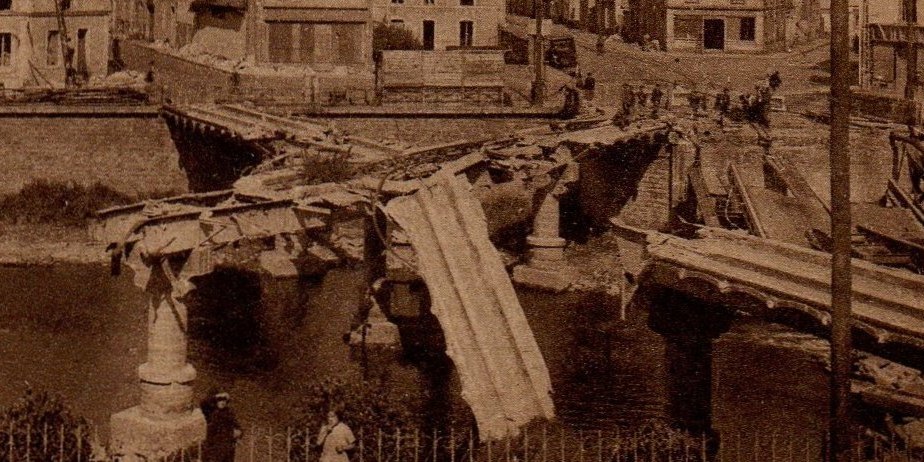
 Left : A very similar view to the above, this time a sepia postcard posted in September 1946.
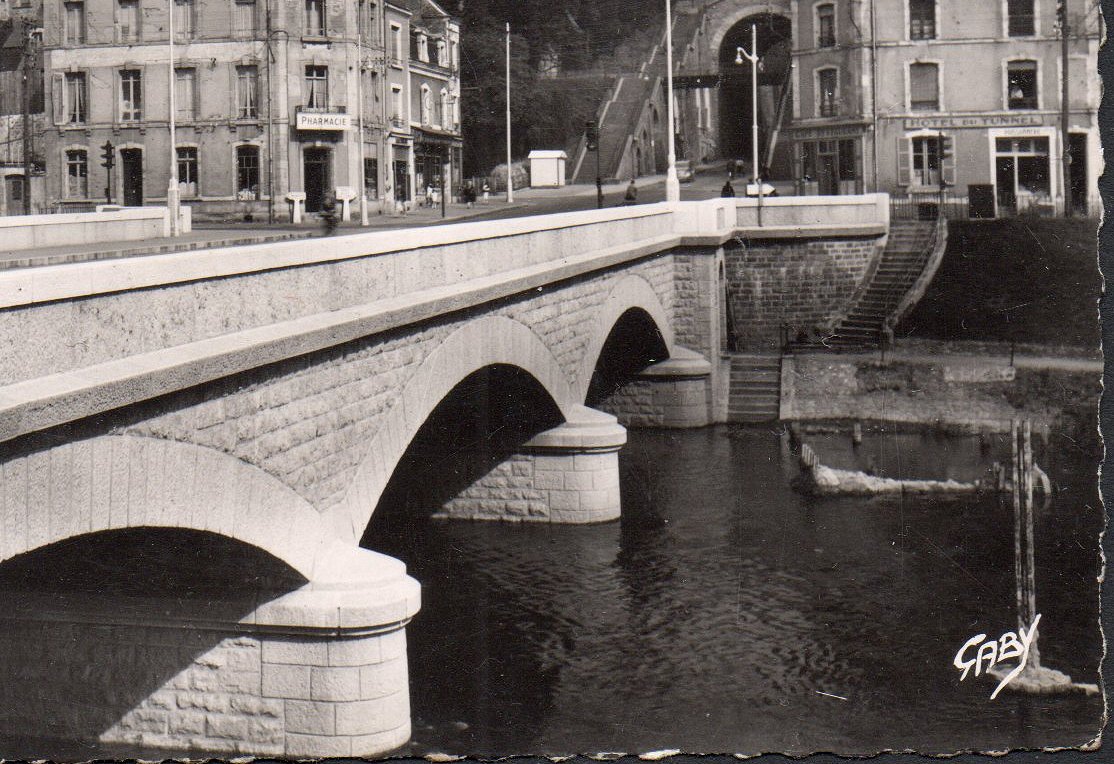
Right: Part of a post-war view of the new Pont Yssoir from a postcard sent in October 1952, but date of photograph unknown. Note the remains in mid-river of one of the iron legs of the Pont en X, now exposed without its concrete coating. This would appear to be part of one of the two columns that were located below the diamond crossing. Compare with the third and fourth images of the circular tour of the bridge in our Appendix article.
By the time of the destruction of the Pont en X in 1944, services on the Ségrie line had already been withdrawn and the only remaining T.S. trams still using the Pont en X were those to/from St. Denis d'Orques. After the bridge had been destroyed, the emergency arrangements for the reintroduction of this service proved to be extremely short-lived, the whole service being withdrawn from January 1st 1947. With that closure, the only T.S. services still operating were those from Le Mans to Mamers, Le Mans to La Chartre-sur-le-Loir and St. Calais, plus a single return service to La Ferté-Bernard, but all these routes soon succumbed as well, closed by decree just two months later.
The electric trams fared very little better, withdrawn themselves later in 1947. Gradually, from the 1930s onwards, they had been replaced on some routes, probably due to the difficulties of operating on roads more and more congested with motor vehicles around which they could not, of course, manoeuvre. Some of the trams were replaced by buses but, as we have seen in images higher up, trolleybuses with their moderate ability to skirt around obstacles proved a capable alternative for a while. The economics of their introduction were no doubt made more appealing by the existence of overhead structures originally constructed for the City trams.
Left : A very similar view to the above, this time a sepia postcard posted in September 1946.
Right: Part of a post-war view of the new Pont Yssoir from a postcard sent in October 1952, but date of photograph unknown. Note the remains in mid-river of one of the iron legs of the Pont en X, now exposed without its concrete coating. This would appear to be part of one of the two columns that were located below the diamond crossing. Compare with the third and fourth images of the circular tour of the bridge in our Appendix article.
By the time of the destruction of the Pont en X in 1944, services on the Ségrie line had already been withdrawn and the only remaining T.S. trams still using the Pont en X were those to/from St. Denis d'Orques. After the bridge had been destroyed, the emergency arrangements for the reintroduction of this service proved to be extremely short-lived, the whole service being withdrawn from January 1st 1947. With that closure, the only T.S. services still operating were those from Le Mans to Mamers, Le Mans to La Chartre-sur-le-Loir and St. Calais, plus a single return service to La Ferté-Bernard, but all these routes soon succumbed as well, closed by decree just two months later.
The electric trams fared very little better, withdrawn themselves later in 1947. Gradually, from the 1930s onwards, they had been replaced on some routes, probably due to the difficulties of operating on roads more and more congested with motor vehicles around which they could not, of course, manoeuvre. Some of the trams were replaced by buses but, as we have seen in images higher up, trolleybuses with their moderate ability to skirt around obstacles proved a capable alternative for a while. The economics of their introduction were no doubt made more appealing by the existence of overhead structures originally constructed for the City trams.
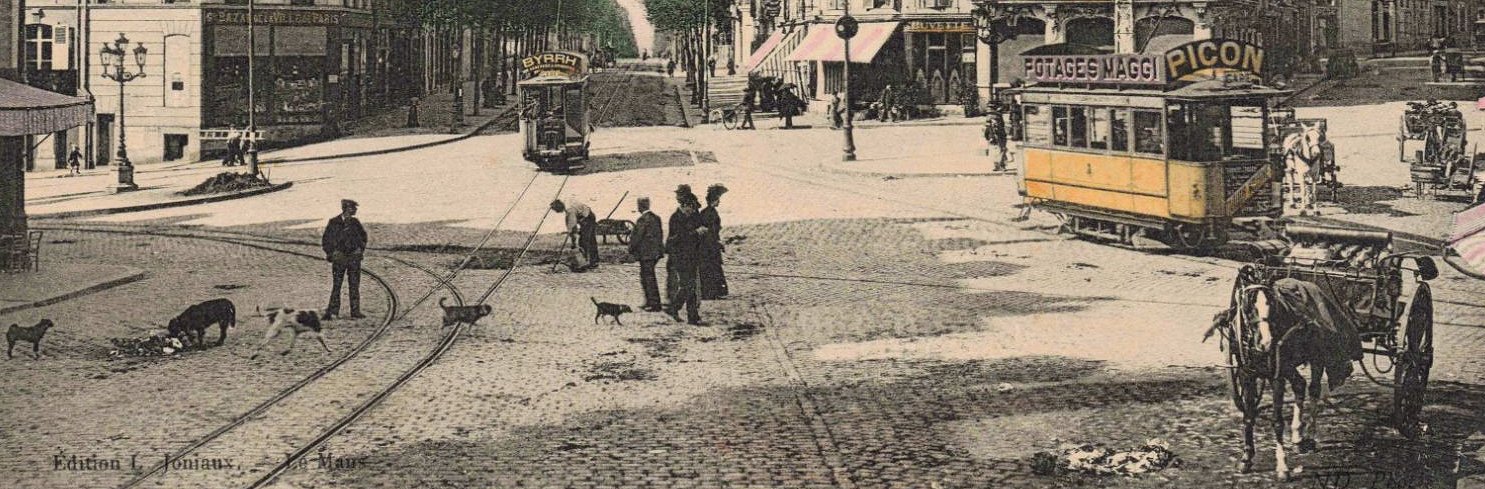 Le Mans, Place Thiers.
General Note: Excluding Scandinavia, generally, for about 50 years after WWII, the further east you travelled in Europe, the more public transport was operated by electricity in urban areas. On the western side of the continent, when trams and trolleybuses were life-expired, and often even when they were not, the motor bus was embraced with alacrity and so it was for Le Mans, their trolleybuses gone by the end of the 1960s.
The internal combustion engine has, of course, since proved to be a major problem itself and 21st century modernization, against a background of growing climate awareness, has seen a resurgence of more sustainable forms of public transport. In the City of Le Mans, as in many other cities looking for 21st century green solutions, they have turned to an ideal high-volume passenger transport solution . . . yes, the electric tram. Le Man's new urban tramway system opened on November 17th 2007, 60 years, almost to the day, after the old network had ceased to operate. A map of the current tram routes can be viewed here (opens in a new tab) and images of the modern trams are readily available online.
.
Le Mans, Place Thiers.
General Note: Excluding Scandinavia, generally, for about 50 years after WWII, the further east you travelled in Europe, the more public transport was operated by electricity in urban areas. On the western side of the continent, when trams and trolleybuses were life-expired, and often even when they were not, the motor bus was embraced with alacrity and so it was for Le Mans, their trolleybuses gone by the end of the 1960s.
The internal combustion engine has, of course, since proved to be a major problem itself and 21st century modernization, against a background of growing climate awareness, has seen a resurgence of more sustainable forms of public transport. In the City of Le Mans, as in many other cities looking for 21st century green solutions, they have turned to an ideal high-volume passenger transport solution . . . yes, the electric tram. Le Man's new urban tramway system opened on November 17th 2007, 60 years, almost to the day, after the old network had ceased to operate. A map of the current tram routes can be viewed here (opens in a new tab) and images of the modern trams are readily available online.
.
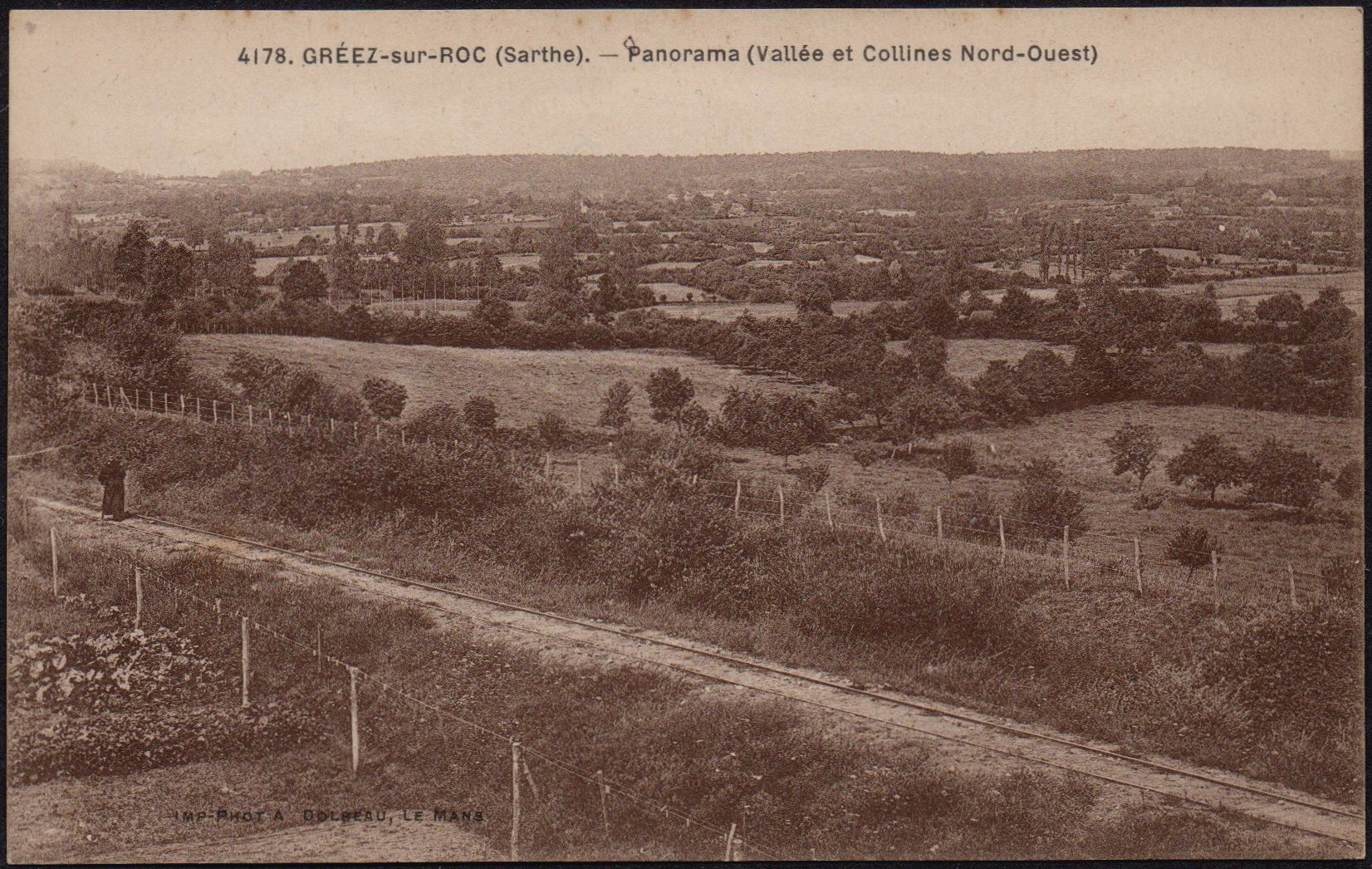 Gréez-sur-Roc : A small town on the Montmirail extension, something of a white elephant. As postcards go, this one was probably as uncommercial as the line itself.
Vestiges of the T.S. System : Very little evidence remains today of any part of the very extensive T.S. network, so lightly engineered was it, due to the favourable topography. Compared to some départements, the proportion of Sarthois tramways that were laid alongside roads was not very high and stretches of isolated cross-country track were always unlikely to inspire photographers.
In terms of financial vulnerability for the T.S., La Sarthe had few large towns; much of the population was in Le Mans. One notes also that the stations were often inconveniently located at the outskirts of small towns and villages and that the average speeds were low, a combination which only works well when you are the sole form of mechanised transport on offer.
Gréez-sur-Roc : A small town on the Montmirail extension, something of a white elephant. As postcards go, this one was probably as uncommercial as the line itself.
Vestiges of the T.S. System : Very little evidence remains today of any part of the very extensive T.S. network, so lightly engineered was it, due to the favourable topography. Compared to some départements, the proportion of Sarthois tramways that were laid alongside roads was not very high and stretches of isolated cross-country track were always unlikely to inspire photographers.
In terms of financial vulnerability for the T.S., La Sarthe had few large towns; much of the population was in Le Mans. One notes also that the stations were often inconveniently located at the outskirts of small towns and villages and that the average speeds were low, a combination which only works well when you are the sole form of mechanised transport on offer.
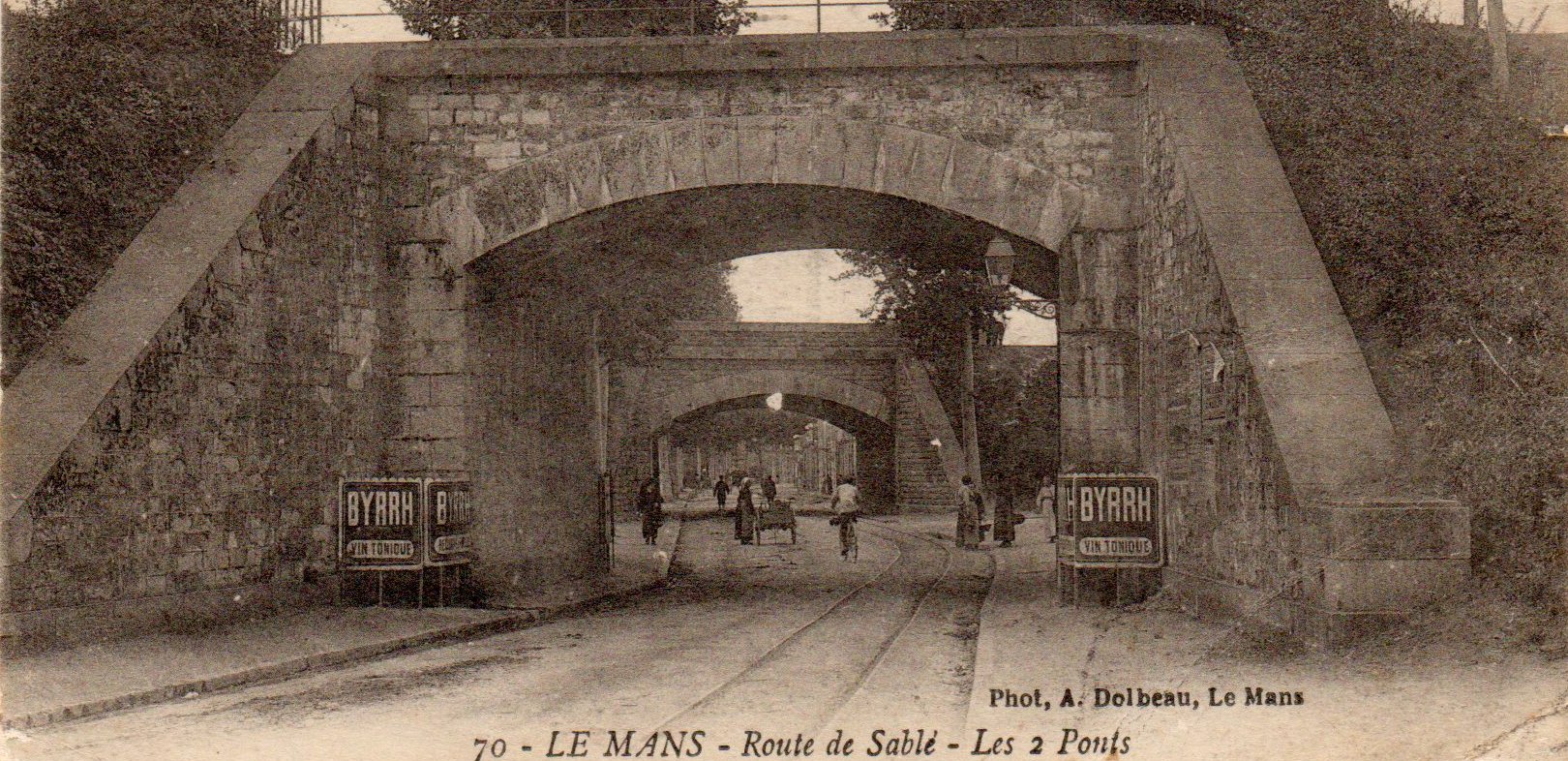 Rails sunk in the streets were, of course, unavoidable within the confines of Le Mans. The rare, and atmospheric, postcard view above oozes of a bygone era. The card was posted in 1922 but the photograph may well have been taken much earlier. This location, in the suburbs of Le Mans, was on the Mayet line and even in its heyday, only a handful of (steam-hauled) passenger trams each day, and perhaps an occasional freight tram, would have briefly disturbed the rhythms of daily life here.
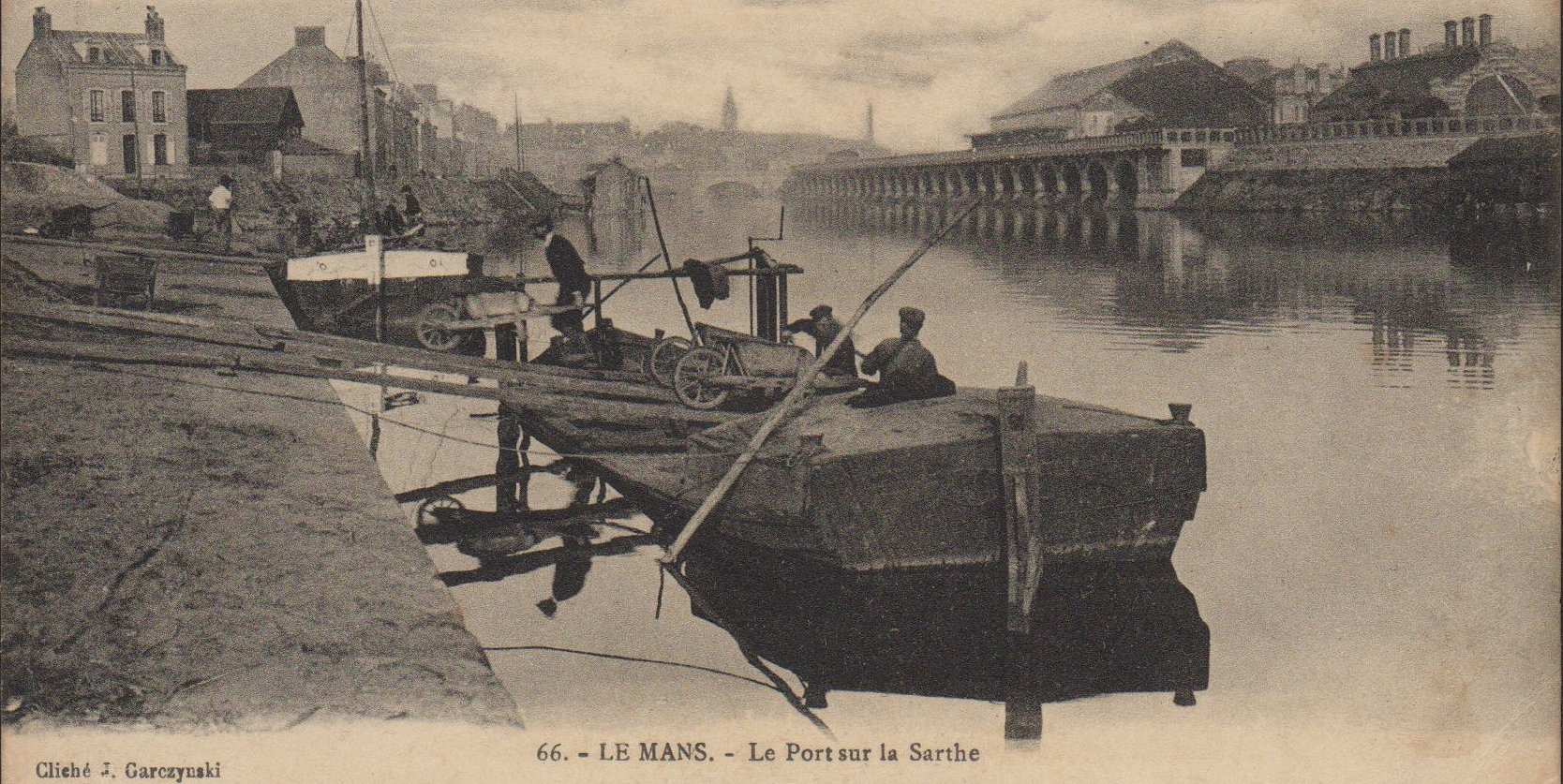 The Port and, opposite, the train shed of the Gare Centrale. Our next view is from the other bank of La Sarthe.
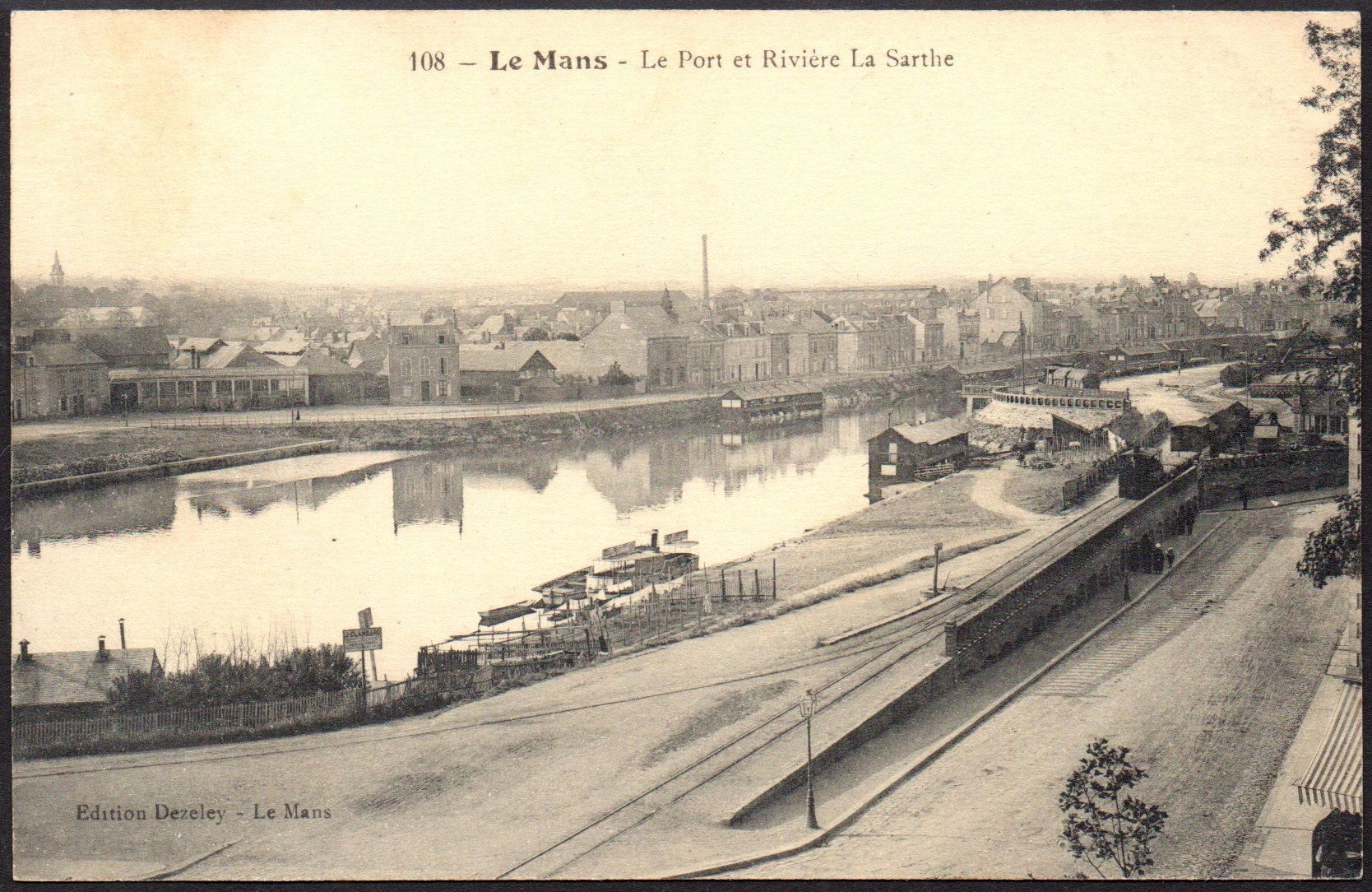 Above: Within Le Mans, this article has a strong focus on the Pont en X and the services that used it. However, the postcard view above shows the other exit from the Gare Centrale with the station just out of picture (at top right). The tracks in the foreground diverge at this point. Those heading across the river here were used by trams to Mayet and to La Flèche, viz. broadly southbound. Trams heading SSE for Château-du-Loir or SE / ESE to La Chartre and Saint-Calais continued straight ahead as far as Changé where they diverged.
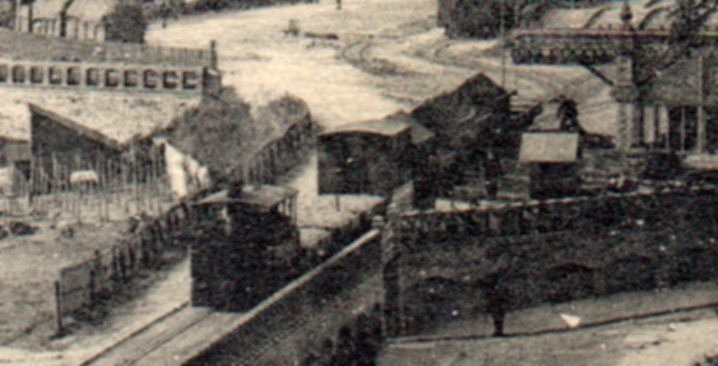 The close-up image from the same postcard shows a steam tram locomotive either on a freight departure or, perhaps more likely, on a shunting manoeuvre.
.
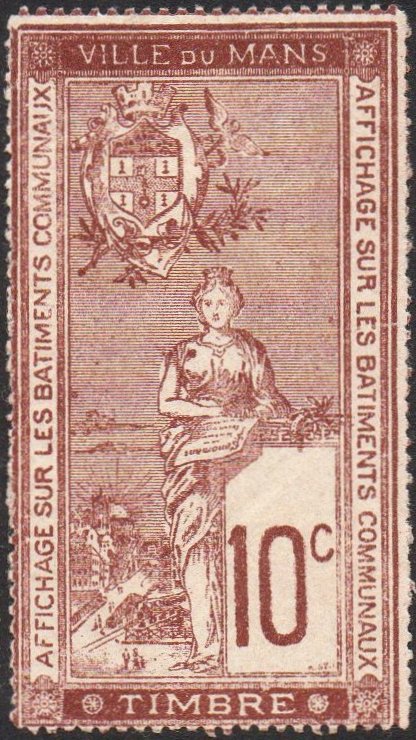
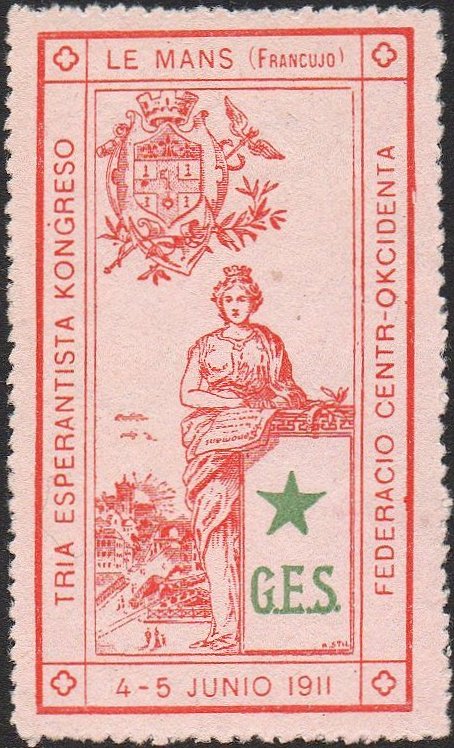
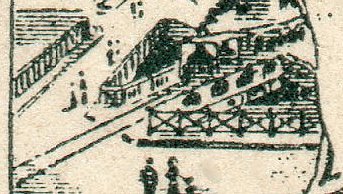
In Section 5, we return to examine further aspects of the T.S. network, including the politics, the finances and the network beyond the city. However, we turn now to the Le Mans revenue stamps of 1901, which show a steam tram on the Pont en X, albeit not very clearly. These 1901 fiscals in turn provided the source material for some 1911 Esperanto cinderellas.
.
The close-up image from the same postcard shows a steam tram locomotive either on a freight departure or, perhaps more likely, on a shunting manoeuvre.
.
In Section 5, we return to examine further aspects of the T.S. network, including the politics, the finances and the network beyond the city. However, we turn now to the Le Mans revenue stamps of 1901, which show a steam tram on the Pont en X, albeit not very clearly. These 1901 fiscals in turn provided the source material for some 1911 Esperanto cinderellas.
.
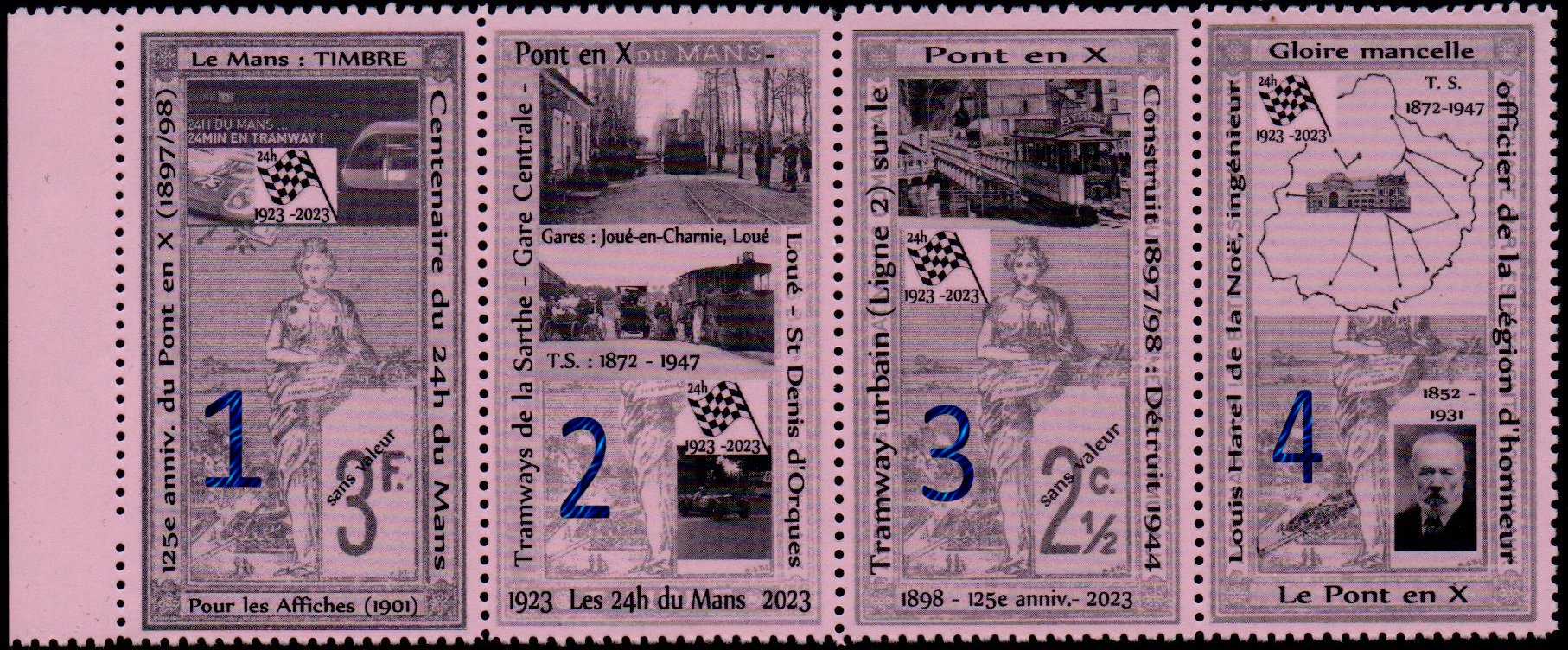 The 1901 and 1911 stamps are described next but the modern cinderellas in the designs shown above are covered in the Appendix, a separate webpage, accessible via the link in the left panel
.
The 1901 and 1911 stamps are described next but the modern cinderellas in the designs shown above are covered in the Appendix, a separate webpage, accessible via the link in the left panel
.
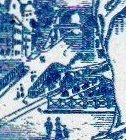
 Left : A steam tram on the Pont en X heading out of the city towards St. Denis d'Orques. Image is a detail from the blue proof shown below.
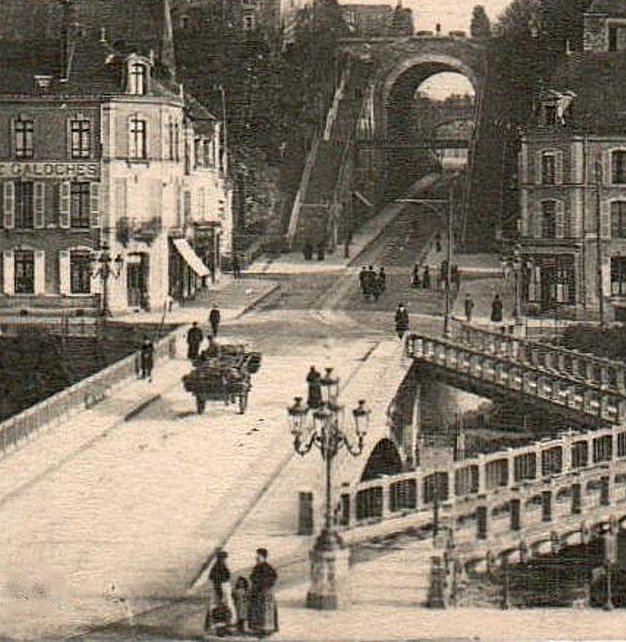
Right : Partial reproduction of a fairly similar (postcard) view of the Pont en X, but without a steam tram, circa 1900.
The only catalogue listings to which we have access are those in the 1915 Forbin Revenue Catalogue and the Catalogue S.F.P.F. sur les Timbres Fiscaux Locaux et Spéciaux de la France. Our own discoveries about these stamps, whilst broadly in line with the catalogue listings, diverge at one or two points. This is, we think, unsurprising, as few people get to handle more than a small number of these stamps.
From Forbin's 1915 edition, it is clear that local revenue stamps were uncommon in France at that period. Le Mans was one of only eleven cities / towns by around 1912/14 to have issued any revenue stamps at all. Each of those eleven towns only issued revenues for ONE specific taxation purpose but, interestingly, six of them chose 'Affixing Posters to a Public Building' as their 'money-raiser'.
Terminology : Philatelists use the term 'poster stamp' very broadly to include many types of non-postal vignettes / labels / stamps, but especially those promoting a product or event. Despite the purpose for which these 1901 stamps were produced, a tax on affixing posters, they should absolutely NOT be described as 'poster stamps' but as Revenue Stamps or Fiscal Stamps instead.
The term 'fiscal stamp', in English, tends to be used especially for a tax stamp affixed so as to seal a retail product, notably tobacco or alcohol, but it is frequently used, almost interchangeably, with the term 'revenue stamp' by many philatelists. In French, one would use the term 'timbre fiscal' for both.
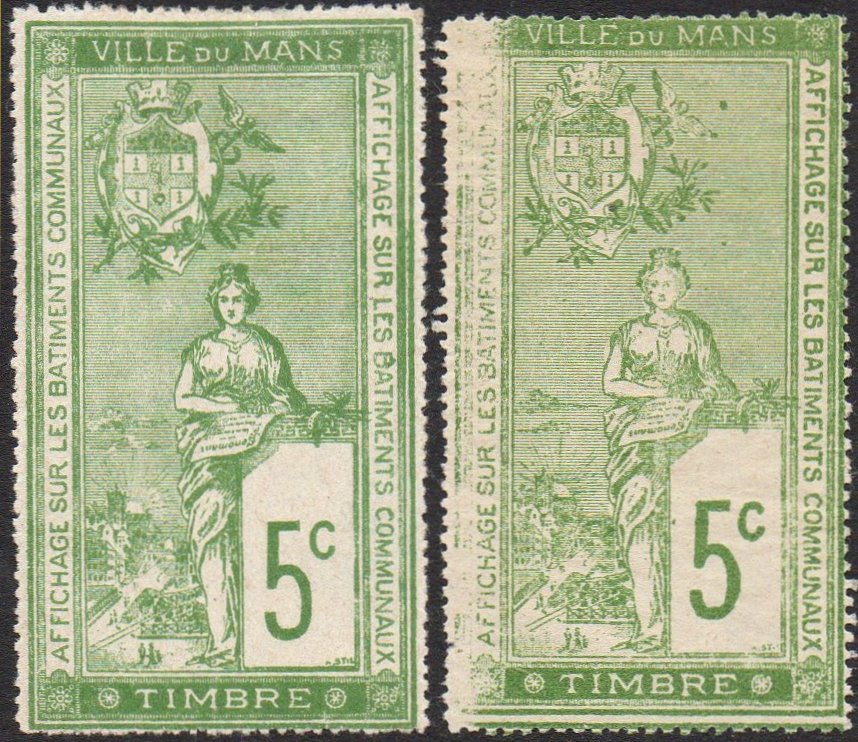
Forbin lists seven values for the Le Mans revenues, with a date of issue of 1901 and a perforation of 13½. Various imperforate proofs / colour trials and essays also exist. Both the issued perforated stamps and the
Left : A steam tram on the Pont en X heading out of the city towards St. Denis d'Orques. Image is a detail from the blue proof shown below.
Right : Partial reproduction of a fairly similar (postcard) view of the Pont en X, but without a steam tram, circa 1900.
The only catalogue listings to which we have access are those in the 1915 Forbin Revenue Catalogue and the Catalogue S.F.P.F. sur les Timbres Fiscaux Locaux et Spéciaux de la France. Our own discoveries about these stamps, whilst broadly in line with the catalogue listings, diverge at one or two points. This is, we think, unsurprising, as few people get to handle more than a small number of these stamps.
From Forbin's 1915 edition, it is clear that local revenue stamps were uncommon in France at that period. Le Mans was one of only eleven cities / towns by around 1912/14 to have issued any revenue stamps at all. Each of those eleven towns only issued revenues for ONE specific taxation purpose but, interestingly, six of them chose 'Affixing Posters to a Public Building' as their 'money-raiser'.
Terminology : Philatelists use the term 'poster stamp' very broadly to include many types of non-postal vignettes / labels / stamps, but especially those promoting a product or event. Despite the purpose for which these 1901 stamps were produced, a tax on affixing posters, they should absolutely NOT be described as 'poster stamps' but as Revenue Stamps or Fiscal Stamps instead.
The term 'fiscal stamp', in English, tends to be used especially for a tax stamp affixed so as to seal a retail product, notably tobacco or alcohol, but it is frequently used, almost interchangeably, with the term 'revenue stamp' by many philatelists. In French, one would use the term 'timbre fiscal' for both.
Forbin lists seven values for the Le Mans revenues, with a date of issue of 1901 and a perforation of 13½. Various imperforate proofs / colour trials and essays also exist. Both the issued perforated stamps and the 
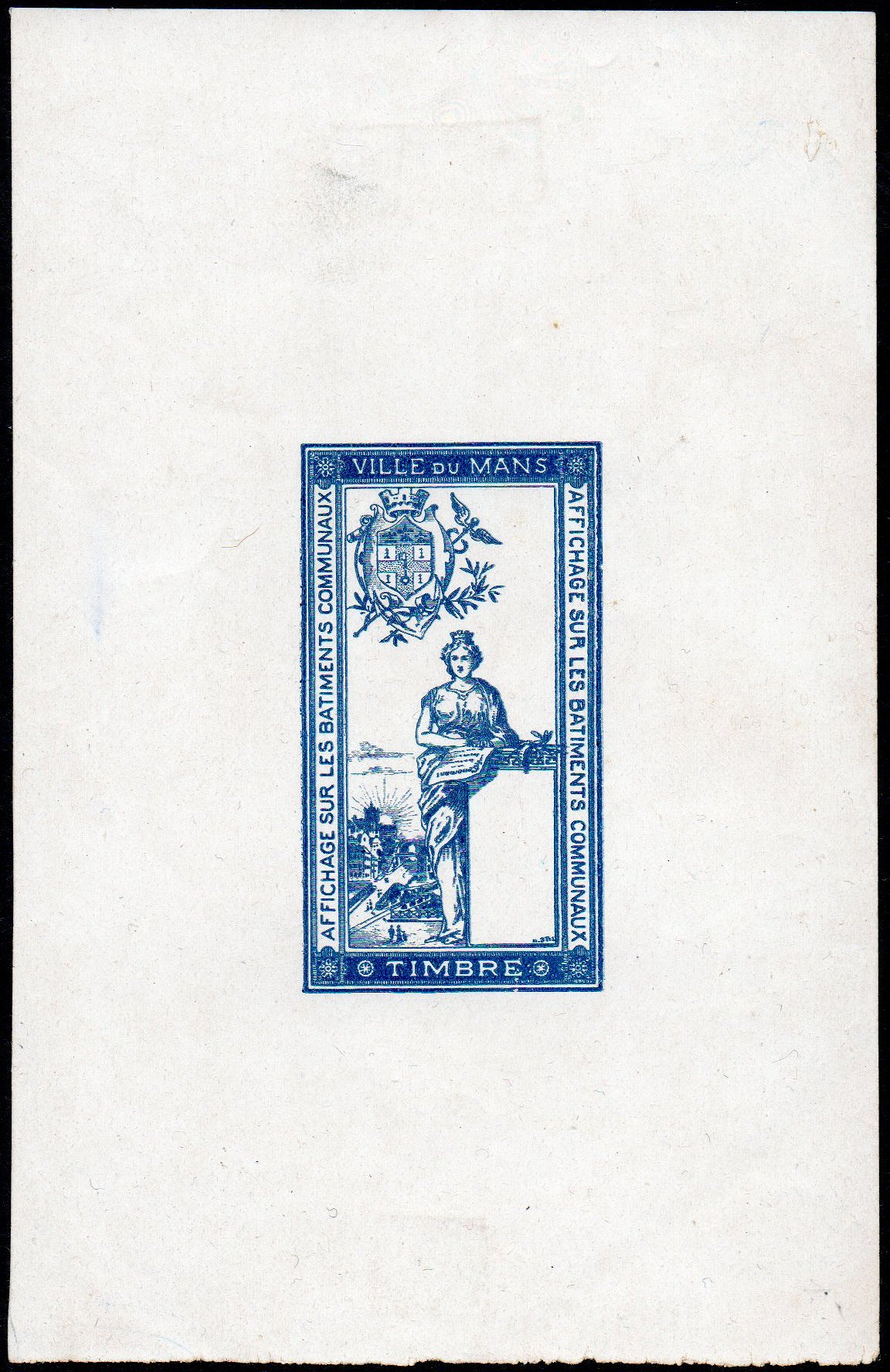
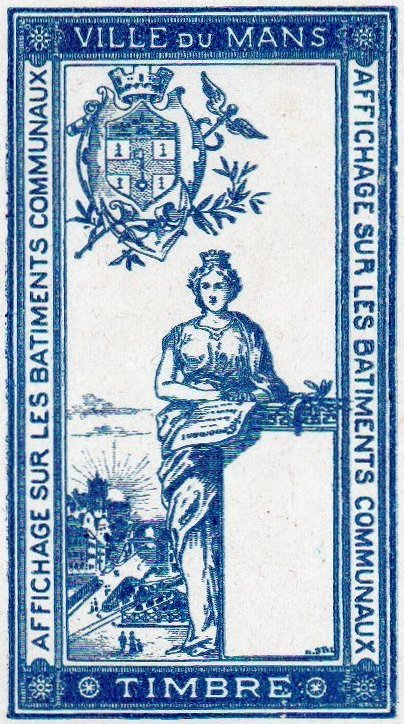 Left: A printers' essay sheetlet/2 (a working proof) in grey on thick glazed paper.
Centre & Right: Undenominated proof sheet on glazed paper, slightly thicker than the issued stamps + detail scan from it.
Printers' essays, which were struck individually by the printer to assess progress on the design, were typically printed on ordinary paper, but other papers conveniently to hand might be used as well. Late-stage, high quality, trial pulls of the stamp may have served either as essays or as proofs for final approval prior to printing. The blue sheetlet is more likely to fall into the latter category, being printed on high grade paper. It has the sharpest definition of the design of any proof or issued stamp that we have seen.
Undenominated Essay sheetlet/2 in Grey on thick glazed paper [ . ]
Undenominated Proof sheetlet/1 in Slate-Blue (bleu ardoise) [ . ]
Left: A printers' essay sheetlet/2 (a working proof) in grey on thick glazed paper.
Centre & Right: Undenominated proof sheet on glazed paper, slightly thicker than the issued stamps + detail scan from it.
Printers' essays, which were struck individually by the printer to assess progress on the design, were typically printed on ordinary paper, but other papers conveniently to hand might be used as well. Late-stage, high quality, trial pulls of the stamp may have served either as essays or as proofs for final approval prior to printing. The blue sheetlet is more likely to fall into the latter category, being printed on high grade paper. It has the sharpest definition of the design of any proof or issued stamp that we have seen.
Undenominated Essay sheetlet/2 in Grey on thick glazed paper [ . ]
Undenominated Proof sheetlet/1 in Slate-Blue (bleu ardoise) [ . ]
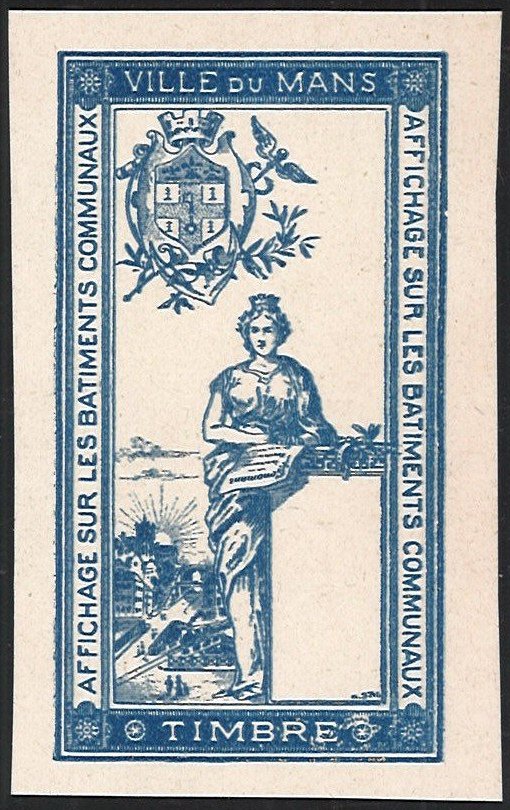
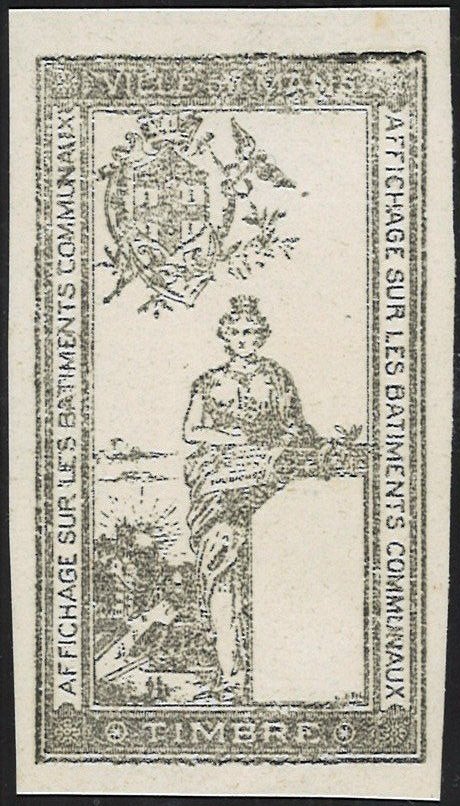
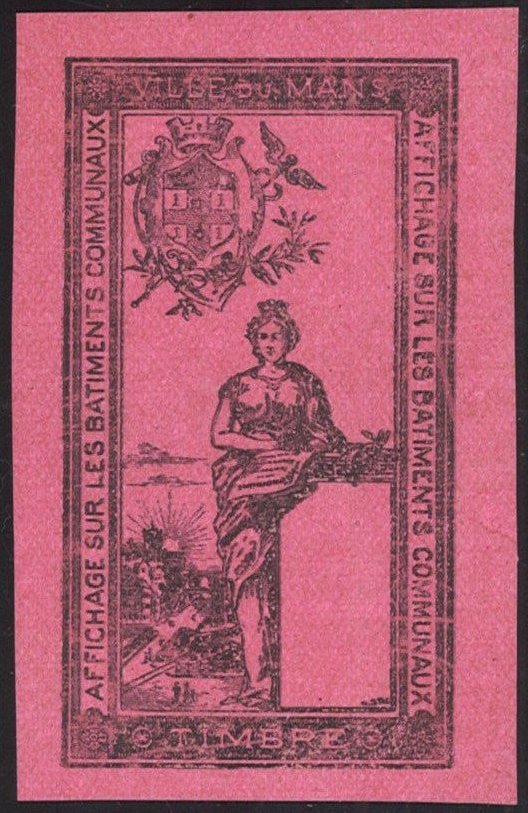 Essays on ordinary paper:
Essay in Blue / white - undenominated [ . ]
Essay in Grey / ivory - undenominated [ . ]
Essay in Black / magenta - undenominated [ . ]
All these proofs have an 'unshaded tunnel mouth', a feature that is not typical of the issued stamps, except for the 5c value. This feature is examined in our studies of the 5c value (Imperf & Perf) further down.
We do not know in which other colours these essays and undenominated proofs were printed. We invite readers to share their knowledge with us (and other collectors) by sending us information (ideally with a scan), so that we can add them to this article.
Essays on ordinary paper:
Essay in Blue / white - undenominated [ . ]
Essay in Grey / ivory - undenominated [ . ]
Essay in Black / magenta - undenominated [ . ]
All these proofs have an 'unshaded tunnel mouth', a feature that is not typical of the issued stamps, except for the 5c value. This feature is examined in our studies of the 5c value (Imperf & Perf) further down.
We do not know in which other colours these essays and undenominated proofs were printed. We invite readers to share their knowledge with us (and other collectors) by sending us information (ideally with a scan), so that we can add them to this article.
 :
Nous ne savons pas dans quelles autres couleurs ces essais et épreuves, sans valeur faciale dans le cartouche, ont été imprimés. Nous invitons les lecteurs à partager leurs connaissances avec nous (et d'autres collectionneurs) en nous envoyant des scans que nous pourrons ajouter à cet article.
.
:
Nous ne savons pas dans quelles autres couleurs ces essais et épreuves, sans valeur faciale dans le cartouche, ont été imprimés. Nous invitons les lecteurs à partager leurs connaissances avec nous (et d'autres collectionneurs) en nous envoyant des scans que nous pourrons ajouter à cet article.
.
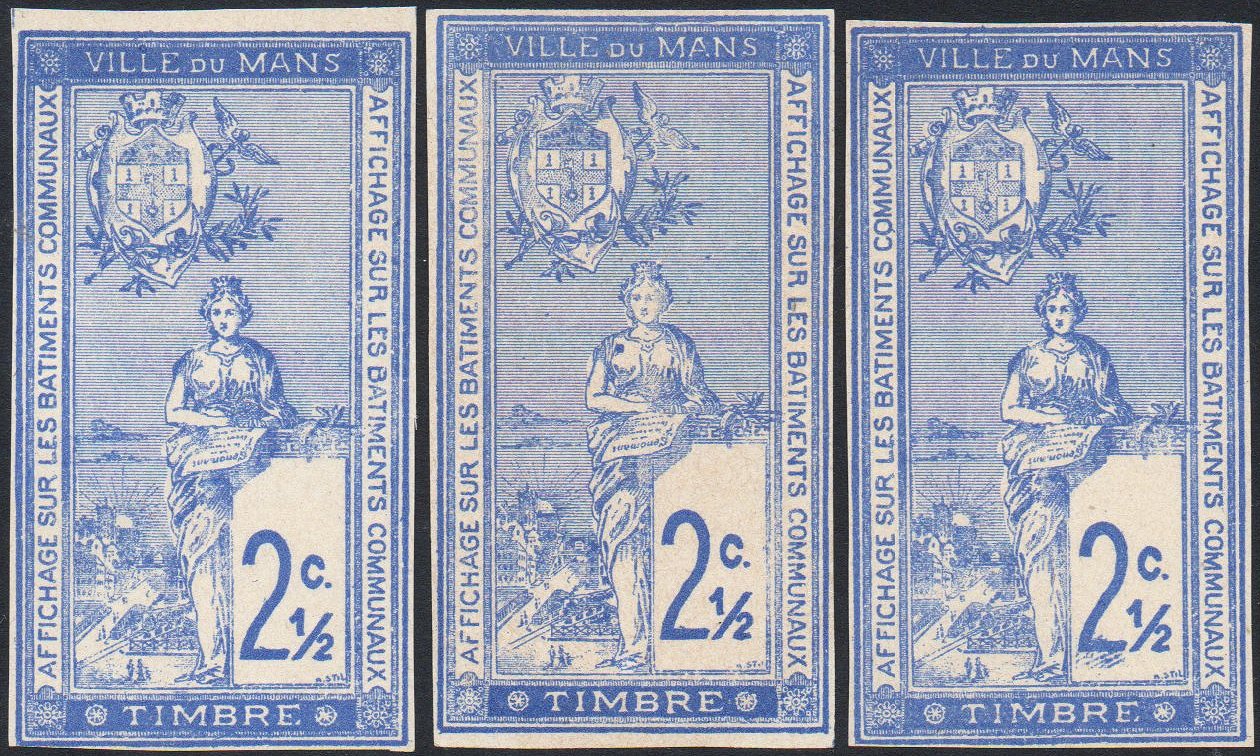


 Variety (2nd stamp) : Brooch Flaw: Many values of both the perforated stamps and imperforate proofs (with the exception of undenominated proofs) exist with and without a large spot on Marianne's right shoulder; we describe it as a 'brooch flaw'.
Variety (3rd stamp) : Shading under figure of value : We have seen this only on a single stamp, the 2½c illustrated above.
Variety (4th stamp) : Letter 'c' close to figure '2': see note below.
Variety (2nd stamp) : Brooch Flaw: Many values of both the perforated stamps and imperforate proofs (with the exception of undenominated proofs) exist with and without a large spot on Marianne's right shoulder; we describe it as a 'brooch flaw'.
Variety (3rd stamp) : Shading under figure of value : We have seen this only on a single stamp, the 2½c illustrated above.
Variety (4th stamp) : Letter 'c' close to figure '2': see note below.
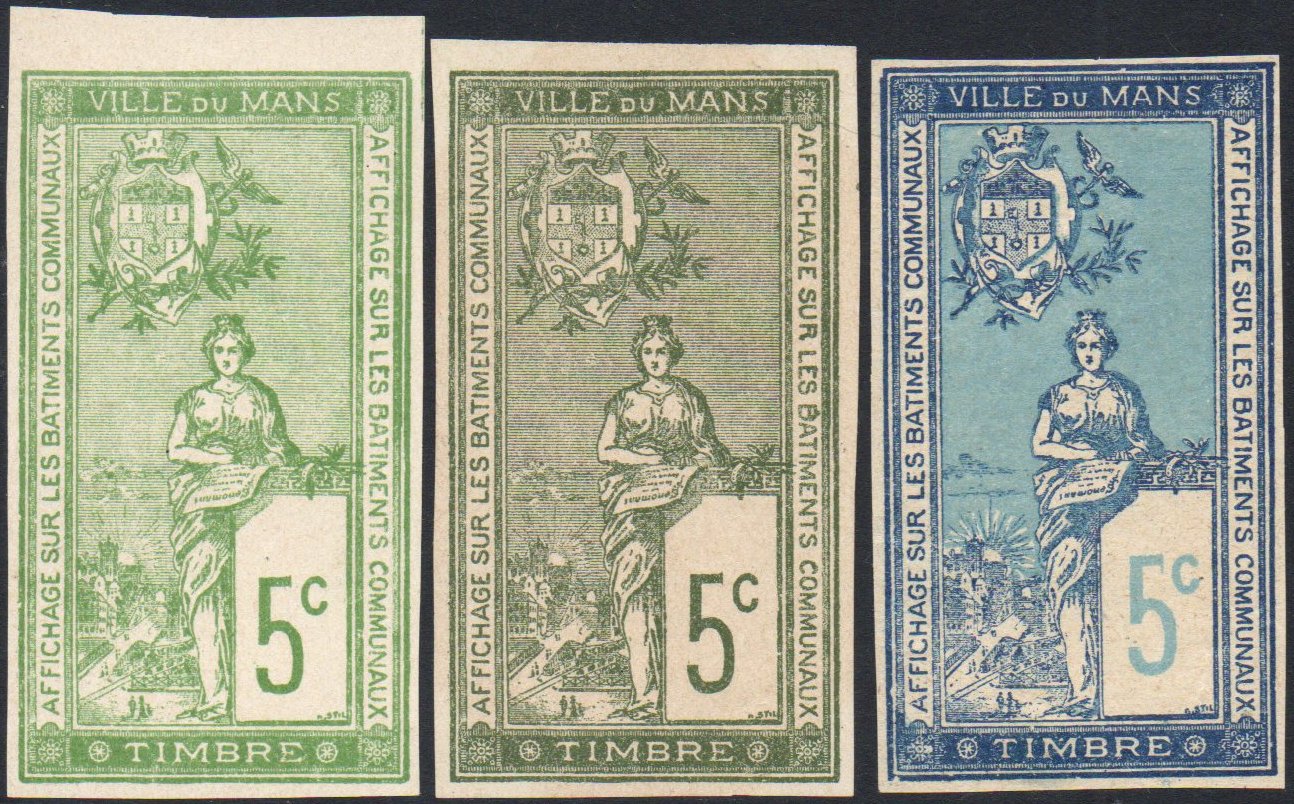
 Three colour proofs and a comparative scan of tunnel mouths on two stamps.
The 5c stands out in at least two ways:
1. It is the only value for which we have not seen an example with the 'brooch' flaw.
2. It is the only value on which we have seen the tunnel mouth in the background unshaded.
In total, we have examined 9 examples (Perf or Imperf) of the 5c and nine have the brooch flaw. On these same nine stamps, seven have an unshaded tunnel entrance and only two (both perforated) have lines of shading.
Three colour proofs and a comparative scan of tunnel mouths on two stamps.
The 5c stands out in at least two ways:
1. It is the only value for which we have not seen an example with the 'brooch' flaw.
2. It is the only value on which we have seen the tunnel mouth in the background unshaded.
In total, we have examined 9 examples (Perf or Imperf) of the 5c and nine have the brooch flaw. On these same nine stamps, seven have an unshaded tunnel entrance and only two (both perforated) have lines of shading.
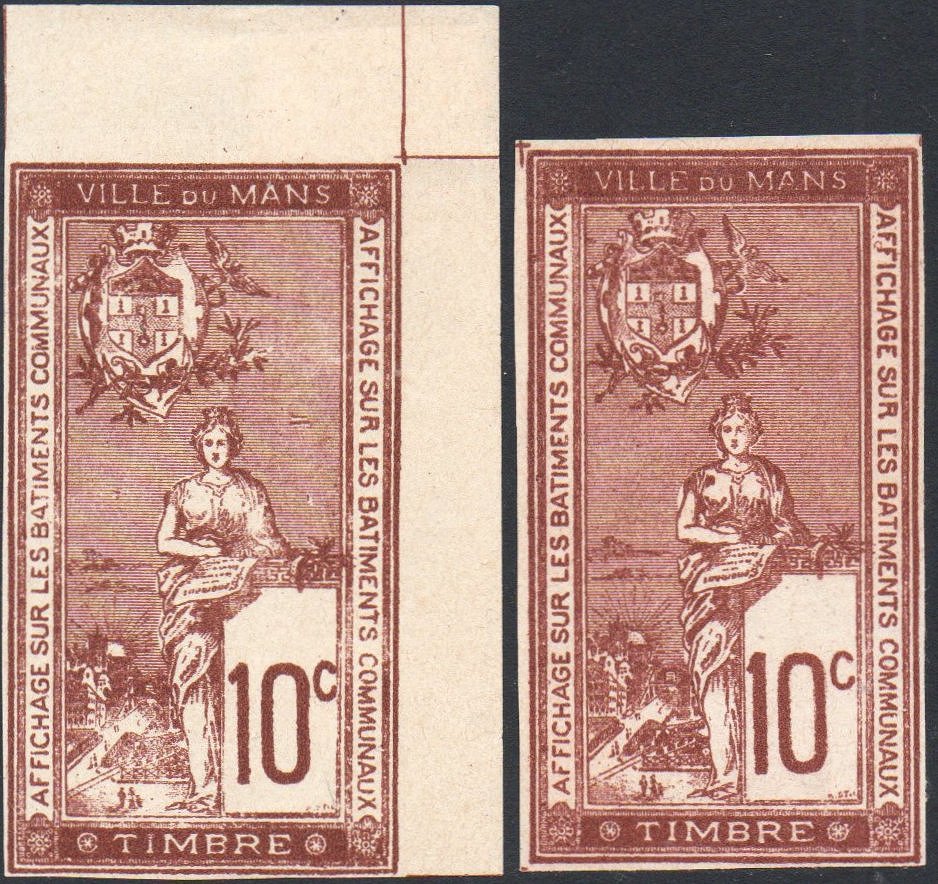 The 10c proof with and without brooch flaw. Both the perf stamps and the proofs are found in shades between red-brown and chestnut. The imperforate stamps seem to have a slightly more intense application of the colour but the range across them all is fairly narrow.
.
The 10c proof with and without brooch flaw. Both the perf stamps and the proofs are found in shades between red-brown and chestnut. The imperforate stamps seem to have a slightly more intense application of the colour but the range across them all is fairly narrow.
.
 .
.
 .
.
 .
.
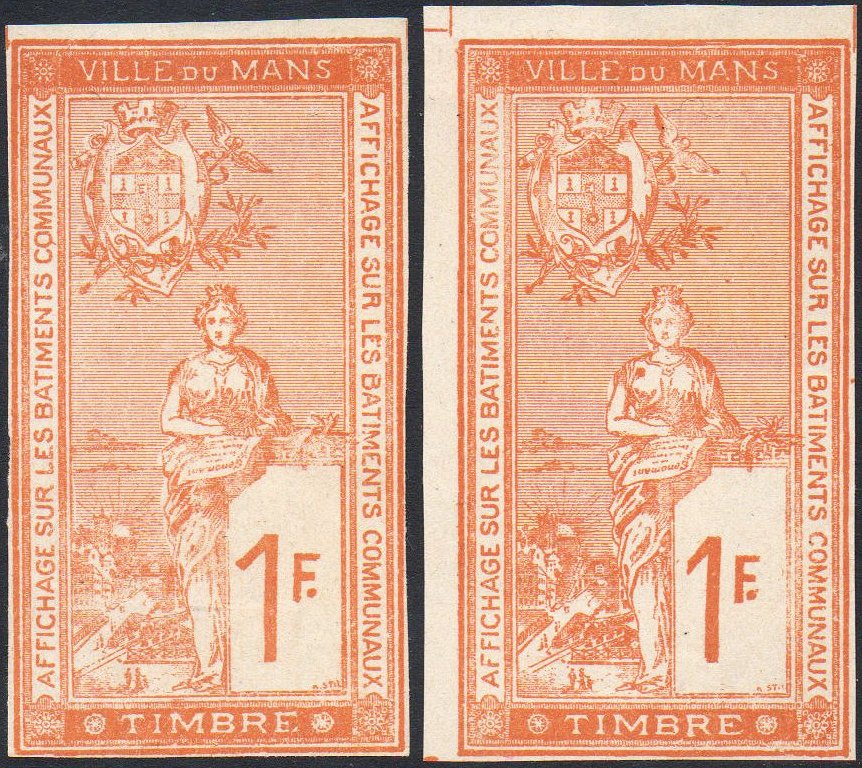
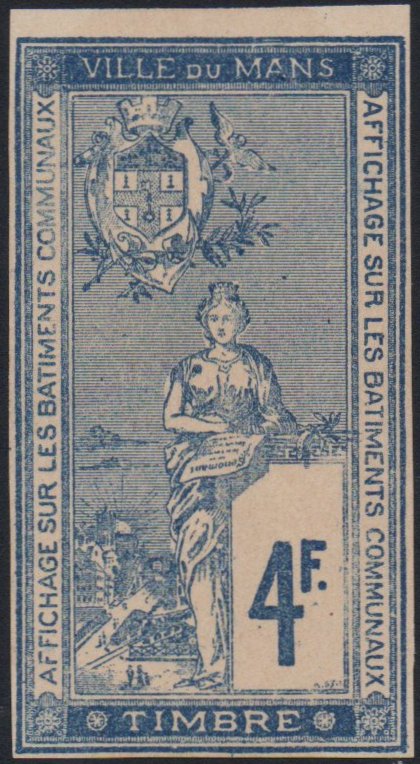 The curiously-proportioned value cartouche required elongated figures of value, the most unusual being the figure '4'.
.
The curiously-proportioned value cartouche required elongated figures of value, the most unusual being the figure '4'.
.
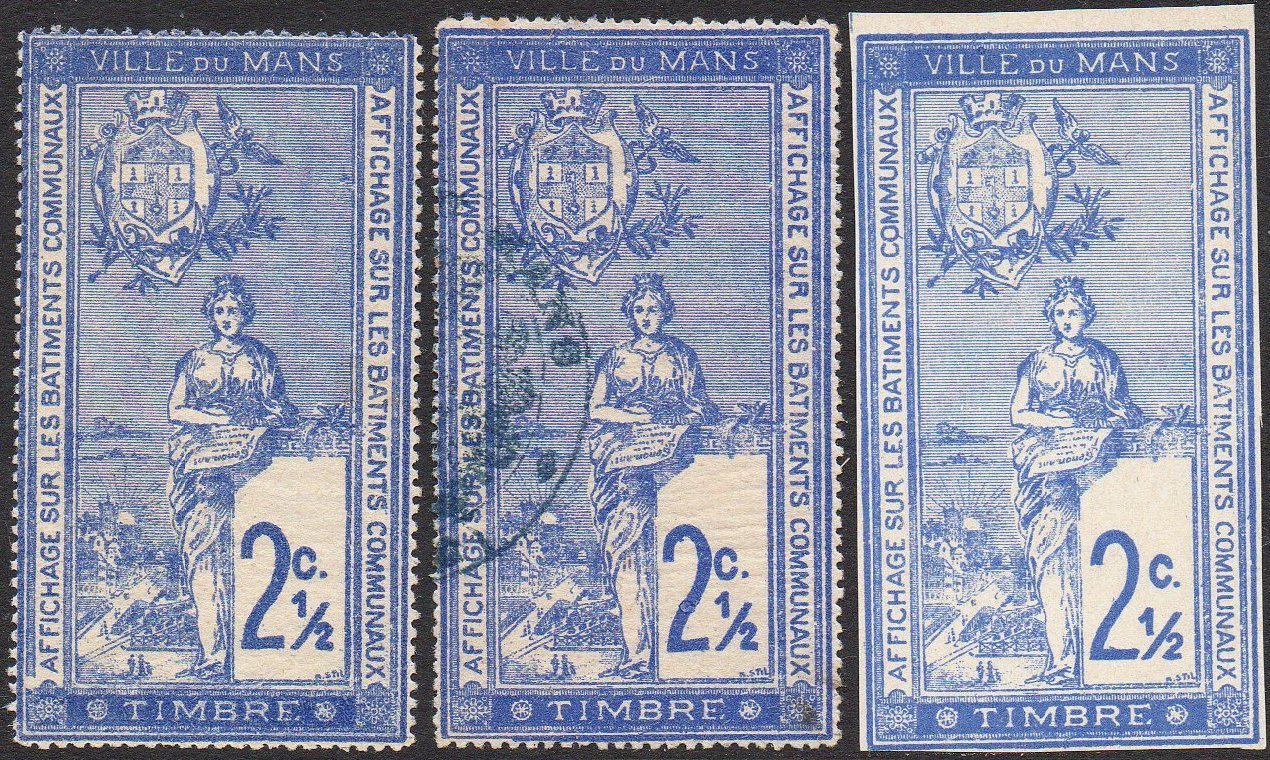
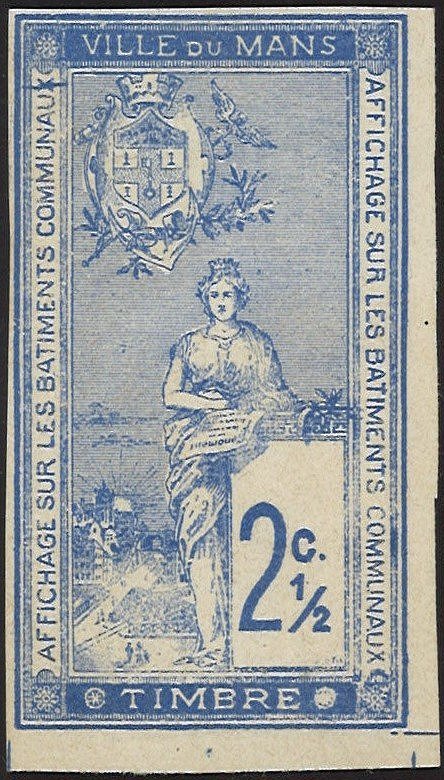
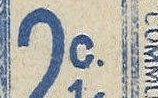
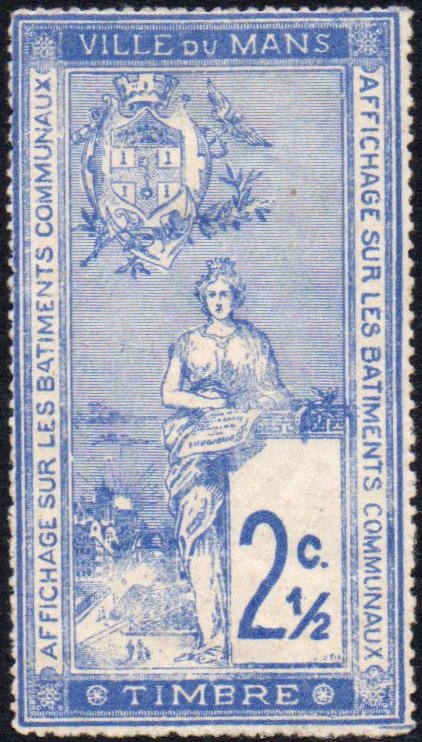 All but one of the perforated examples that we have seen of the 2½c have the '2' and 'c' almost touching. The third stamp above, imperforate, has the '2' and 'c' spaced about 1 mm, a feature typical of the imperforate examples of this value that we have seen. The fourth stamp is the only perforated stamp that we have seen with this spacing. It is also from a printing from a worn plate, most noticeable in the area of the Pont en X. The cancellation shown is standard for these stamps.
Please note that these comments on what appears to be the normal spacings of the '2' and the 'c' are based on uncomfortably small sample sizes, both for the perf and imperf stamps.
.
All but one of the perforated examples that we have seen of the 2½c have the '2' and 'c' almost touching. The third stamp above, imperforate, has the '2' and 'c' spaced about 1 mm, a feature typical of the imperforate examples of this value that we have seen. The fourth stamp is the only perforated stamp that we have seen with this spacing. It is also from a printing from a worn plate, most noticeable in the area of the Pont en X. The cancellation shown is standard for these stamps.
Please note that these comments on what appears to be the normal spacings of the '2' and the 'c' are based on uncomfortably small sample sizes, both for the perf and imperf stamps.
.
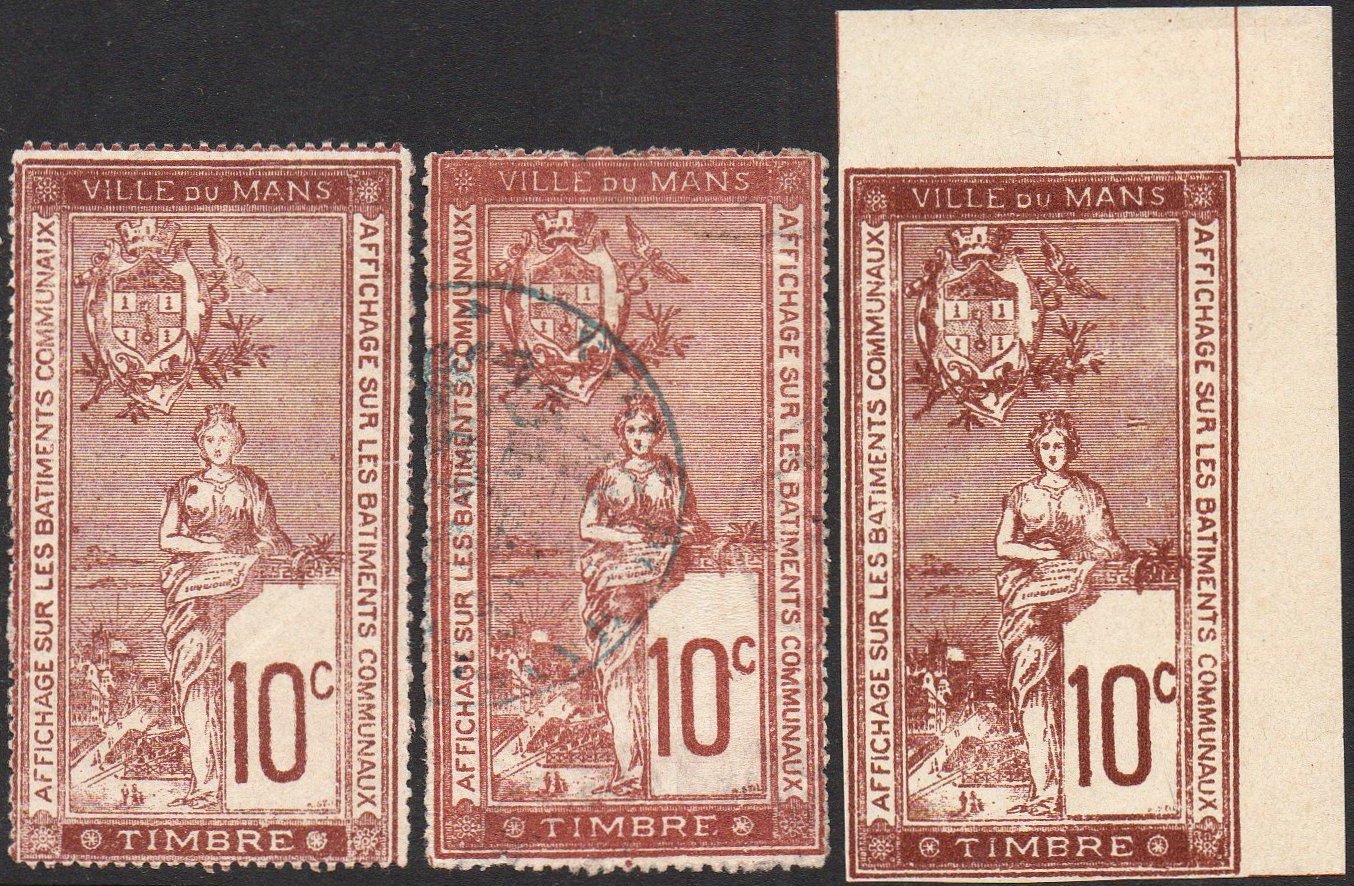 We have made a single scan of three examples (2 Perf, 1 Imperf) to show the gentle range of shades on this issue. The perforated stamps have less intense colours than the imperforate proofs.
.
We have made a single scan of three examples (2 Perf, 1 Imperf) to show the gentle range of shades on this issue. The perforated stamps have less intense colours than the imperforate proofs.
.
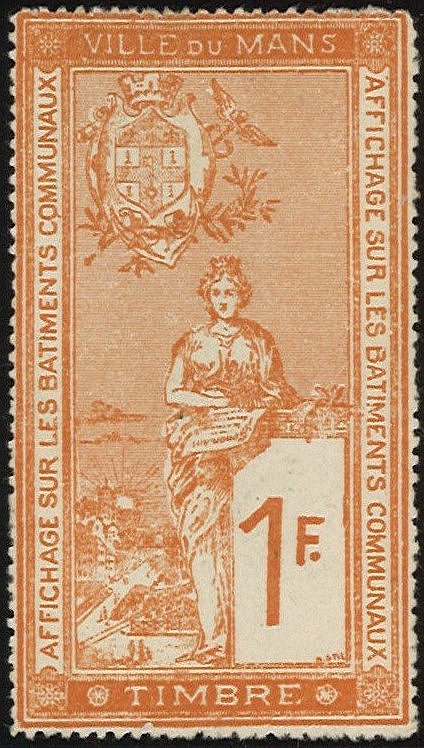
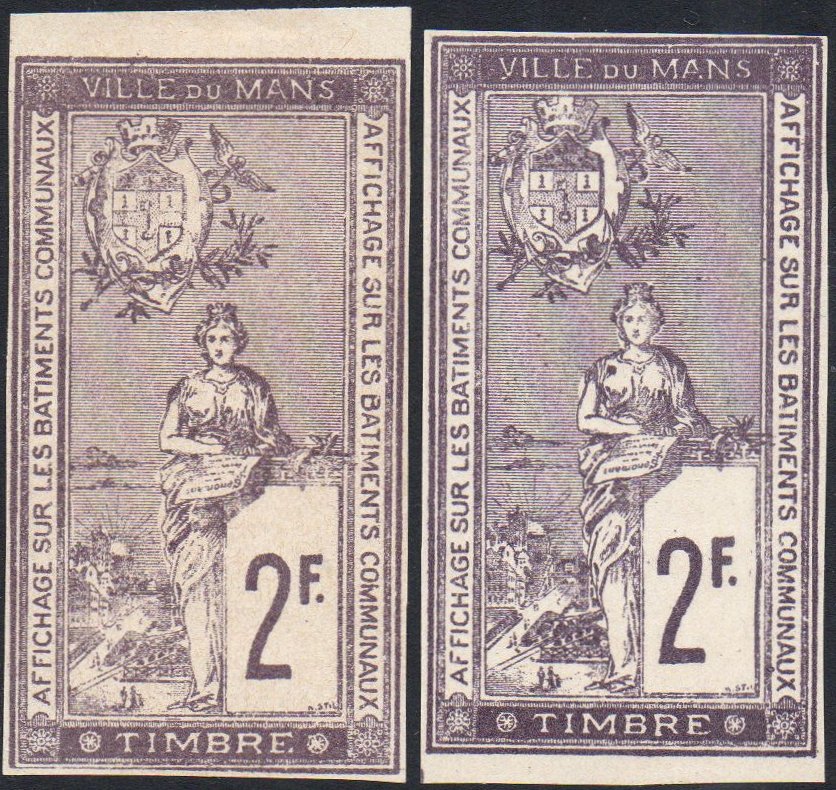
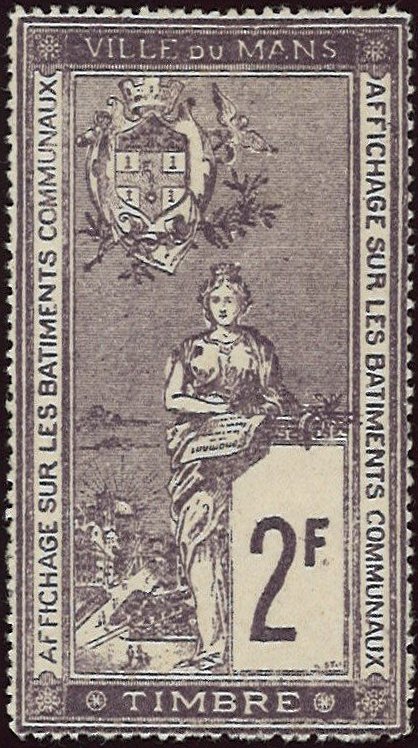 2 Frs. Greyish-Violet [ . ] not seen
- ditto - Brooch Flaw [ . ] seen
.
3 Francs : Perf 13½ :
2 Frs. Greyish-Violet [ . ] not seen
- ditto - Brooch Flaw [ . ] seen
.
3 Francs : Perf 13½ :
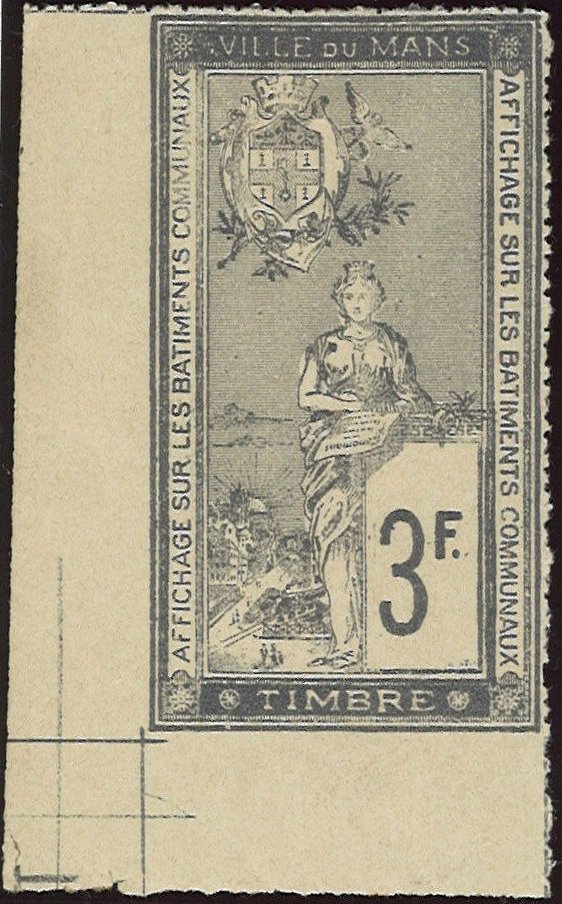 3 Frs. Grey [ . ] not seen
- ditto - Brooch Flaw [ . ] seen
.
4 Francs : Perf 13½ :
3 Frs. Grey [ . ] not seen
- ditto - Brooch Flaw [ . ] seen
.
4 Francs : Perf 13½ :
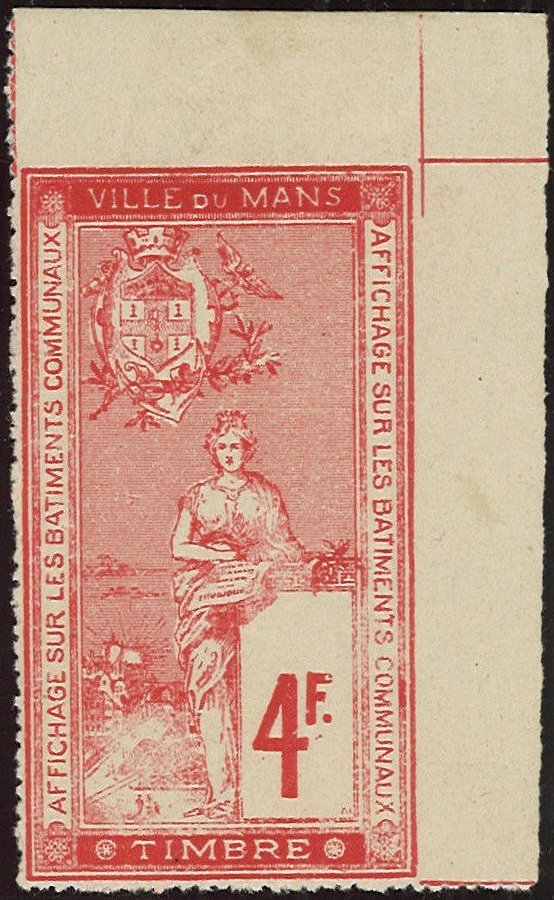 4 Frs. Rose-Red [ . ]
- ditto - Brooch Flaw [ ? ]
.
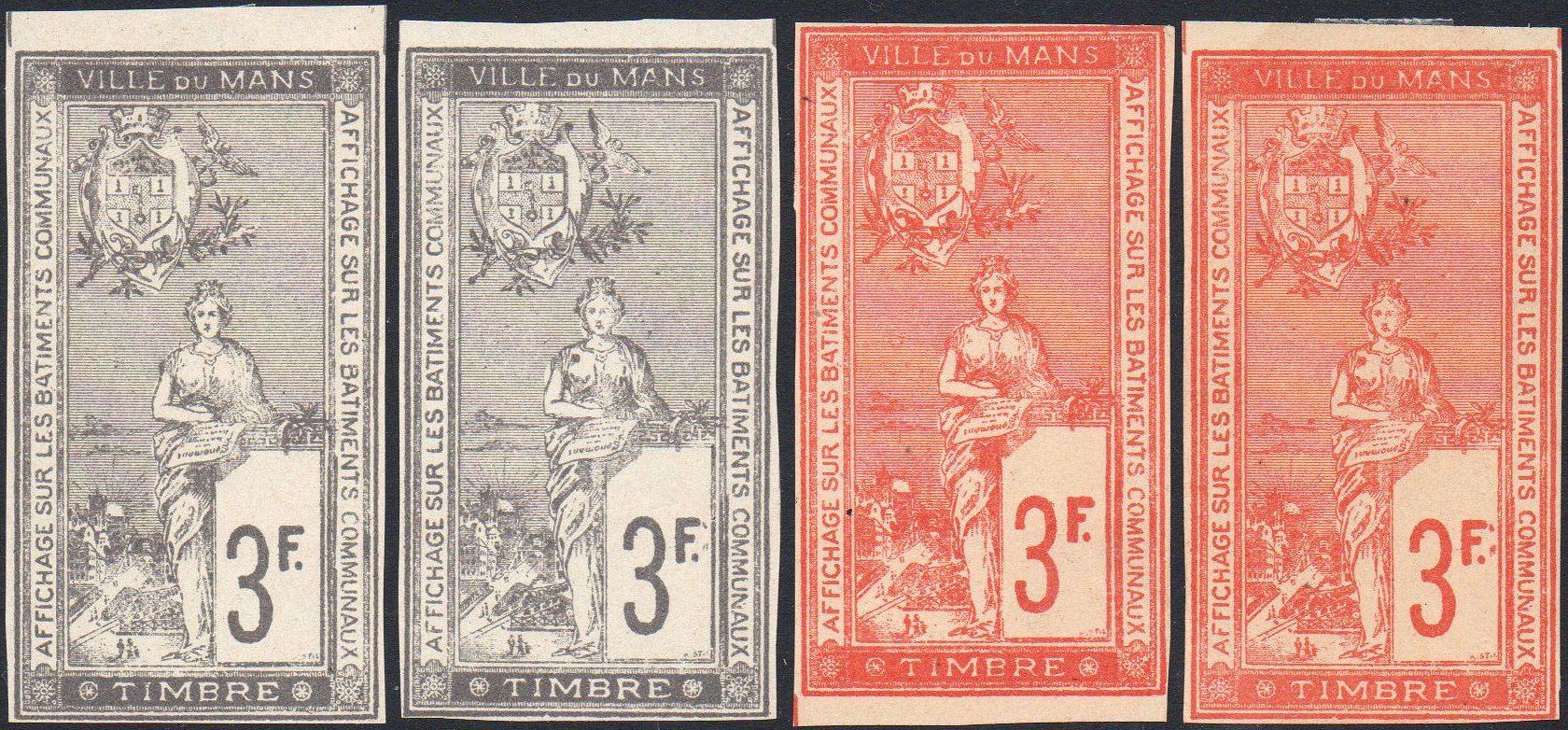
According to Forbin, due to the sheet layout, none of the 3Fr or 4Fr values are found perforated on all sides and this is supported by what we have seen - and may hint at these two top values being printed in much smaller sheets. It would appear that none of the outer edges of the sheet were perforated. All the centime values that we have seen are perforated all round.
One may speculate as to whether the 3Fr and 4Fr were perhaps printed on the SAME sheet, with small panes of each value separated by a wide gutter. On a small print run, it would be more economical to destroy the 50% of stamps in the wrong colour than to make a second printing plate.
Purpose & Usage of these Revenue Stamps:
Any citizen had the right to post PAPER posters on public buildings on payment of the fee (2½c, 5c, 7½c or 10c, dependant upon the poster's size). More permanent non-paper posters were, again based on size, subject to fees of 1Fr, 2Fr, 3Fr or 4Fr. Such posters were presumably produced almost exclusively by businesses, rather than the public. The fees for these were for a full year. The paper rates do not appear to have had time limitations imposed upon them but, assuming they were displayed outdoors, their natural life span is likely to have been quite short.
Publications:
La Société Française de Philatélie Fiscale published a new edition of their catalogue which includes the Le Mans revenue stamps in 2022. We think it helpful to advise that the Yvert catalogue of 'Timbres Socio-Fiscaux', rather unexpectedly in view of its general description of contents, does NOT include locals such as these Le Mans 'Affiches' stamps.
.
4 Frs. Rose-Red [ . ]
- ditto - Brooch Flaw [ ? ]
.
According to Forbin, due to the sheet layout, none of the 3Fr or 4Fr values are found perforated on all sides and this is supported by what we have seen - and may hint at these two top values being printed in much smaller sheets. It would appear that none of the outer edges of the sheet were perforated. All the centime values that we have seen are perforated all round.
One may speculate as to whether the 3Fr and 4Fr were perhaps printed on the SAME sheet, with small panes of each value separated by a wide gutter. On a small print run, it would be more economical to destroy the 50% of stamps in the wrong colour than to make a second printing plate.
Purpose & Usage of these Revenue Stamps:
Any citizen had the right to post PAPER posters on public buildings on payment of the fee (2½c, 5c, 7½c or 10c, dependant upon the poster's size). More permanent non-paper posters were, again based on size, subject to fees of 1Fr, 2Fr, 3Fr or 4Fr. Such posters were presumably produced almost exclusively by businesses, rather than the public. The fees for these were for a full year. The paper rates do not appear to have had time limitations imposed upon them but, assuming they were displayed outdoors, their natural life span is likely to have been quite short.
Publications:
La Société Française de Philatélie Fiscale published a new edition of their catalogue which includes the Le Mans revenue stamps in 2022. We think it helpful to advise that the Yvert catalogue of 'Timbres Socio-Fiscaux', rather unexpectedly in view of its general description of contents, does NOT include locals such as these Le Mans 'Affiches' stamps.
.
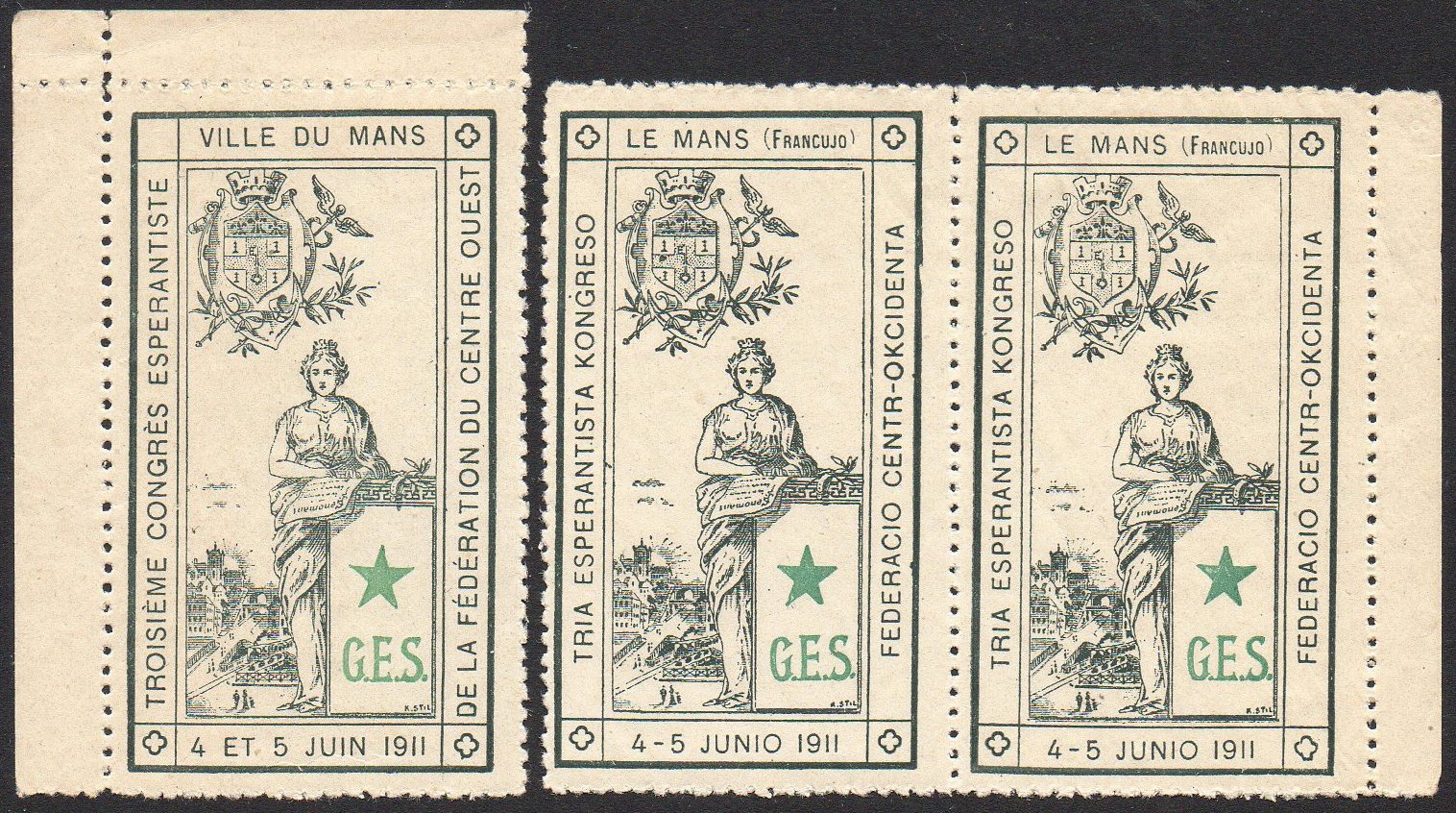
 There are two types, border inscription in French (left stamp above), and in Esperanto (as in the pair). These poster stamps are Perforated 11½. We have only seen the one pair, horizontal with both in Esperanto, as shown above.
In addition to the Green/ivory printings, there appear to be about five or six different papers used for stamps
There are two types, border inscription in French (left stamp above), and in Esperanto (as in the pair). These poster stamps are Perforated 11½. We have only seen the one pair, horizontal with both in Esperanto, as shown above.
In addition to the Green/ivory printings, there appear to be about five or six different papers used for stamps 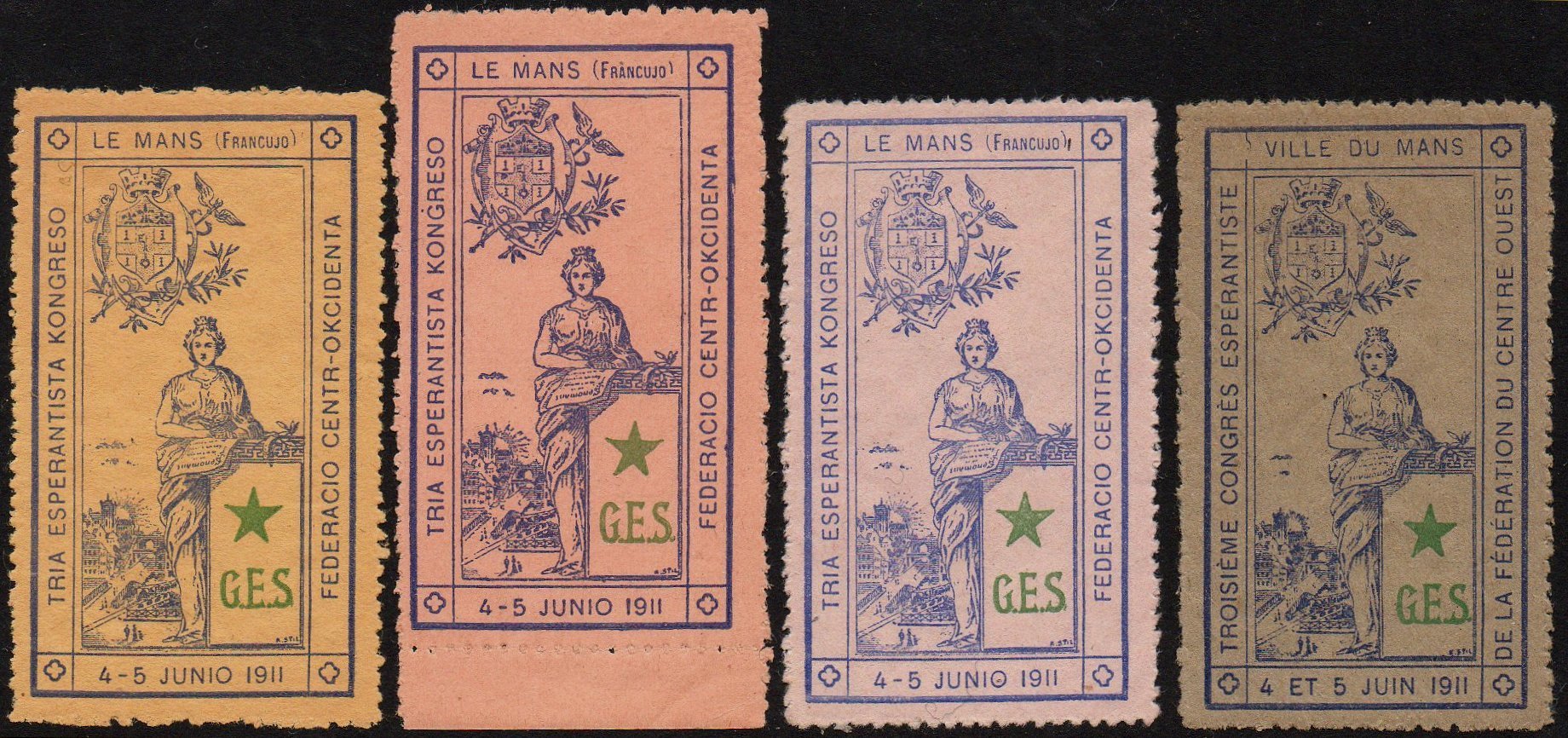
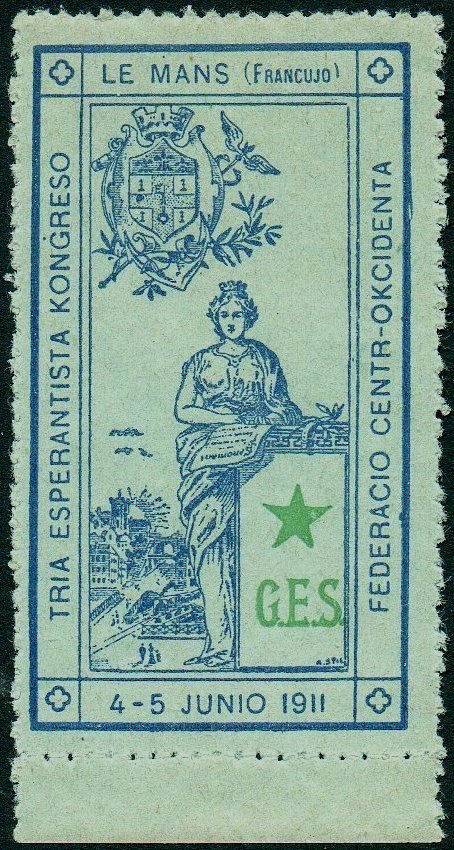
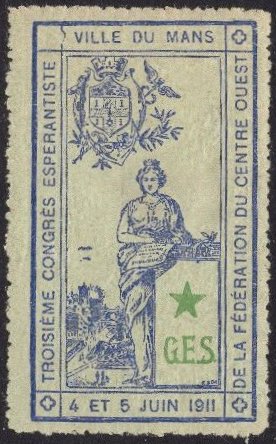
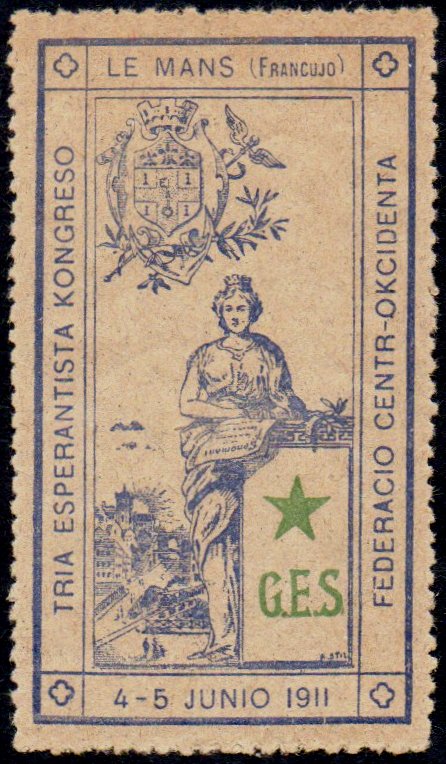 1911 Esperanto in Blue / brownish-yellow . [ Fr ]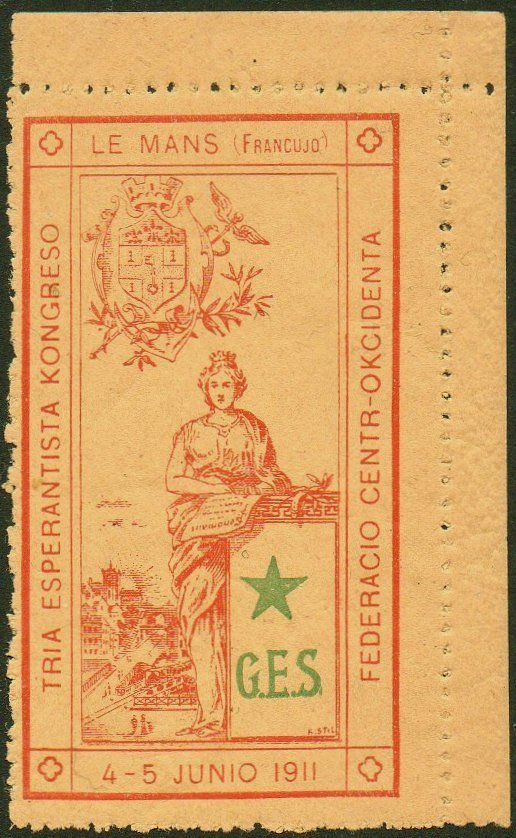
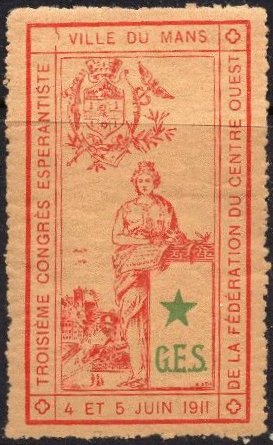
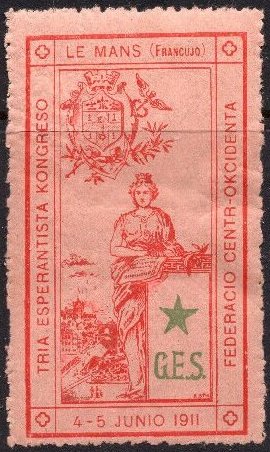
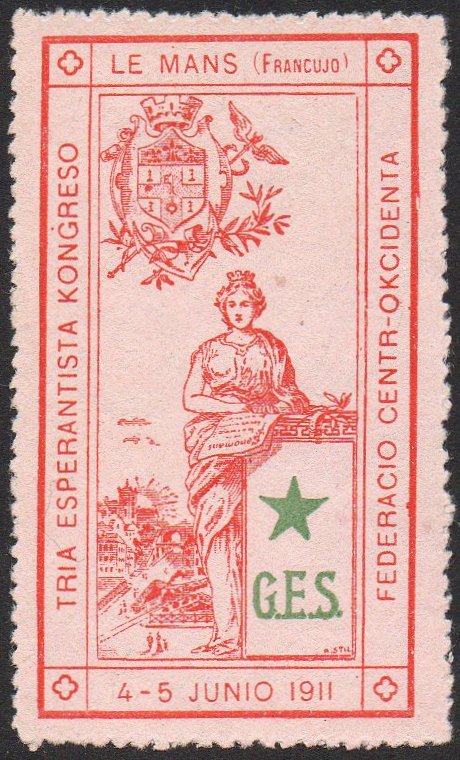
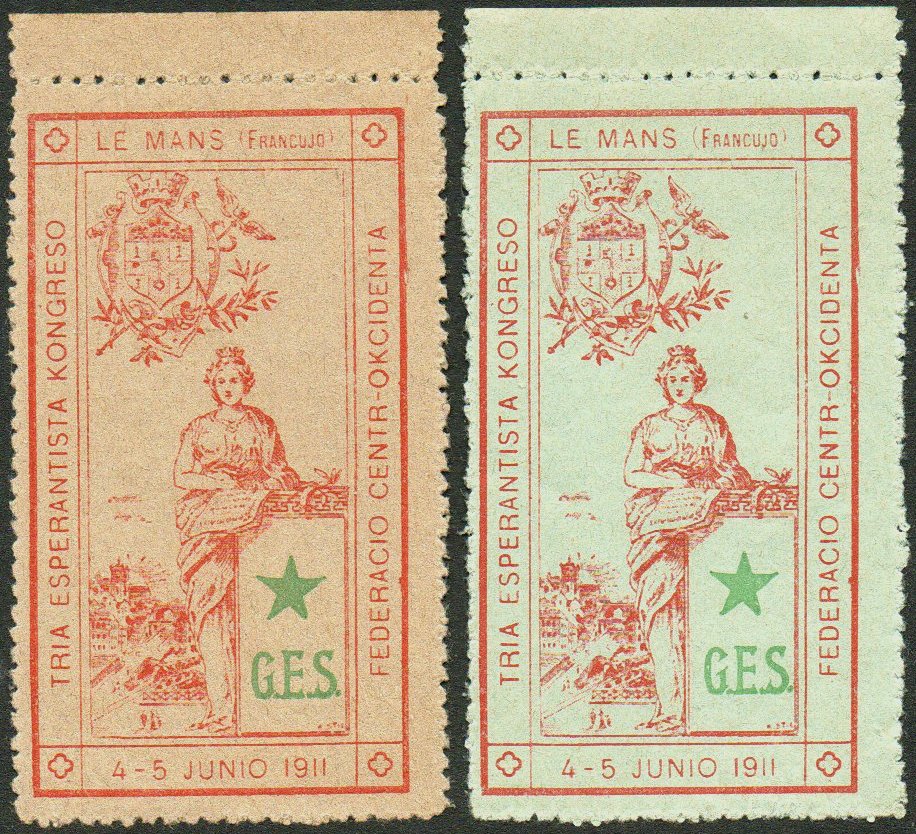 1911 Esperanto in Red / yellow .
 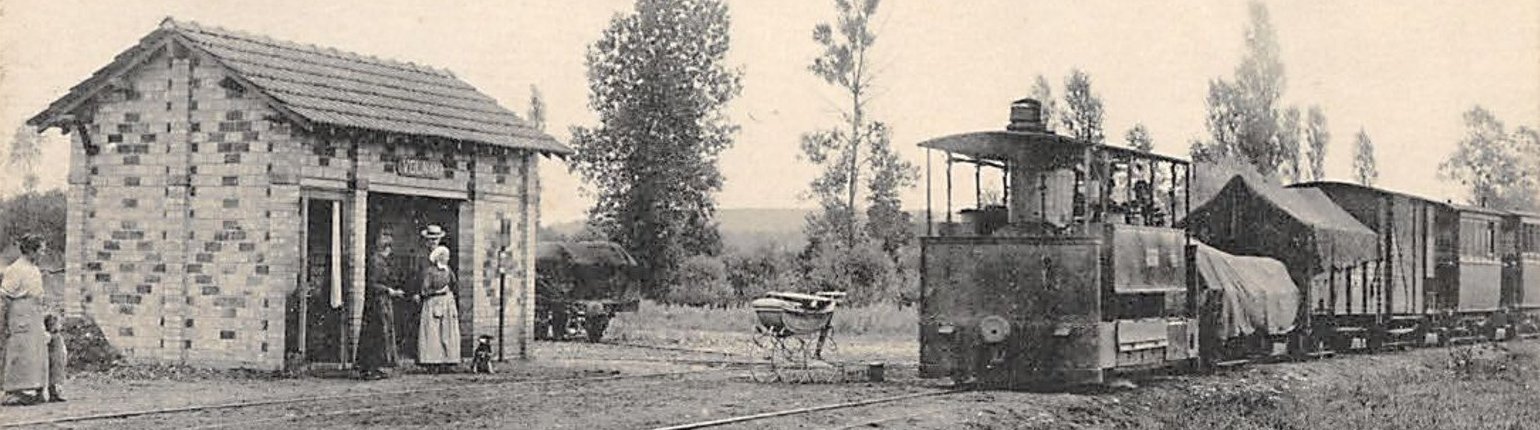 A typical rural tramway scene in La Sarthe in the early years of the 20th century, here the 'Gare de Volnay', south-east of Le Mans, with a mixed train approaching. Volnay was on the line from Le Mans to La Chartre-sur-le-Loir.
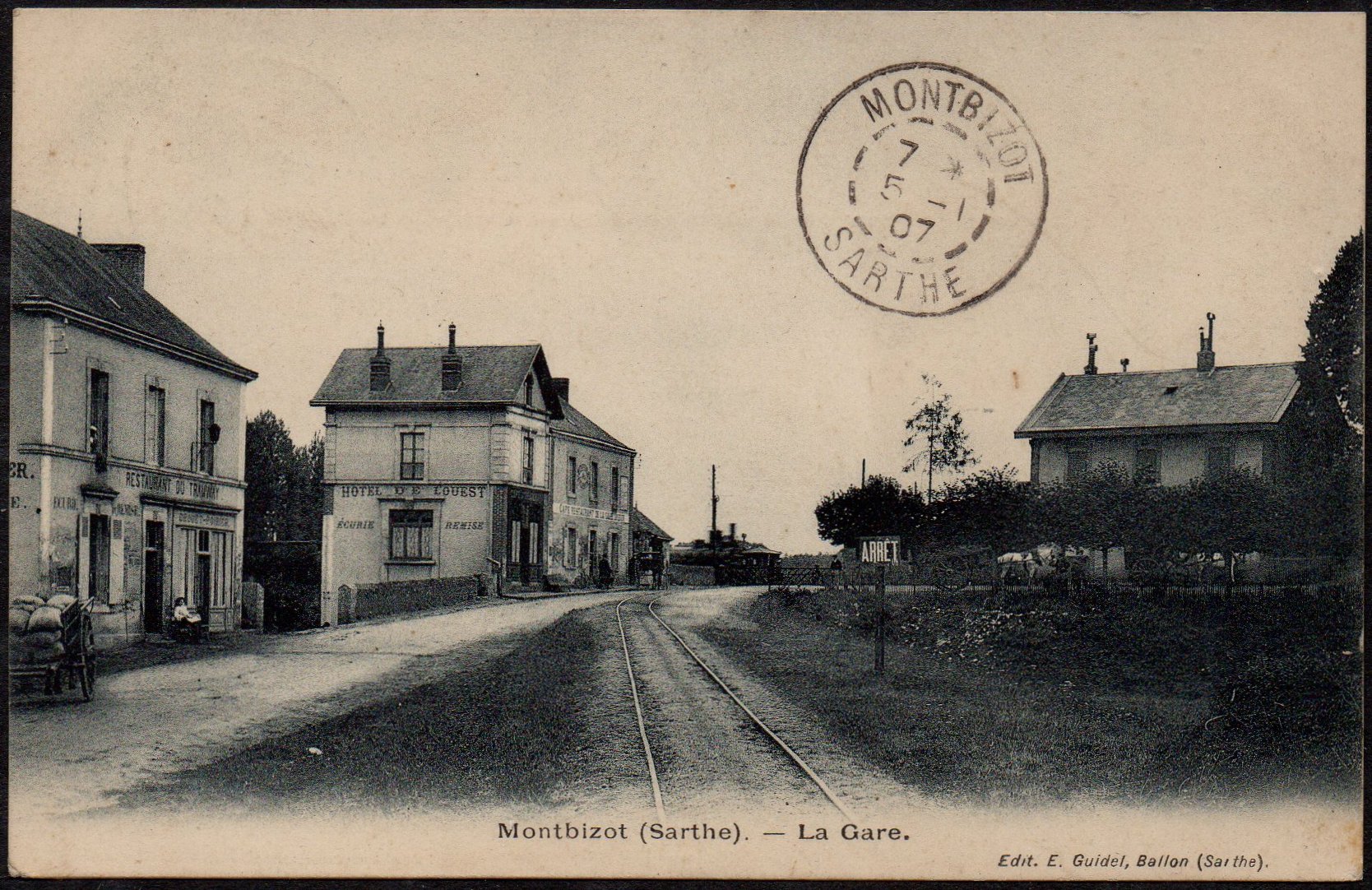
 Top image : Montbizot station (to right of view) and a train of the 'big railway' on the level crossing (centre). The T.S. tracks and 'Tram Stop' board are in the foreground. The Restaurant du Tramway and Hotel de L'Ouest (presumably referring to the railway Compagnie de l'Ouest ) complete the fortuitously all-encompassing composition of this history-laced view.
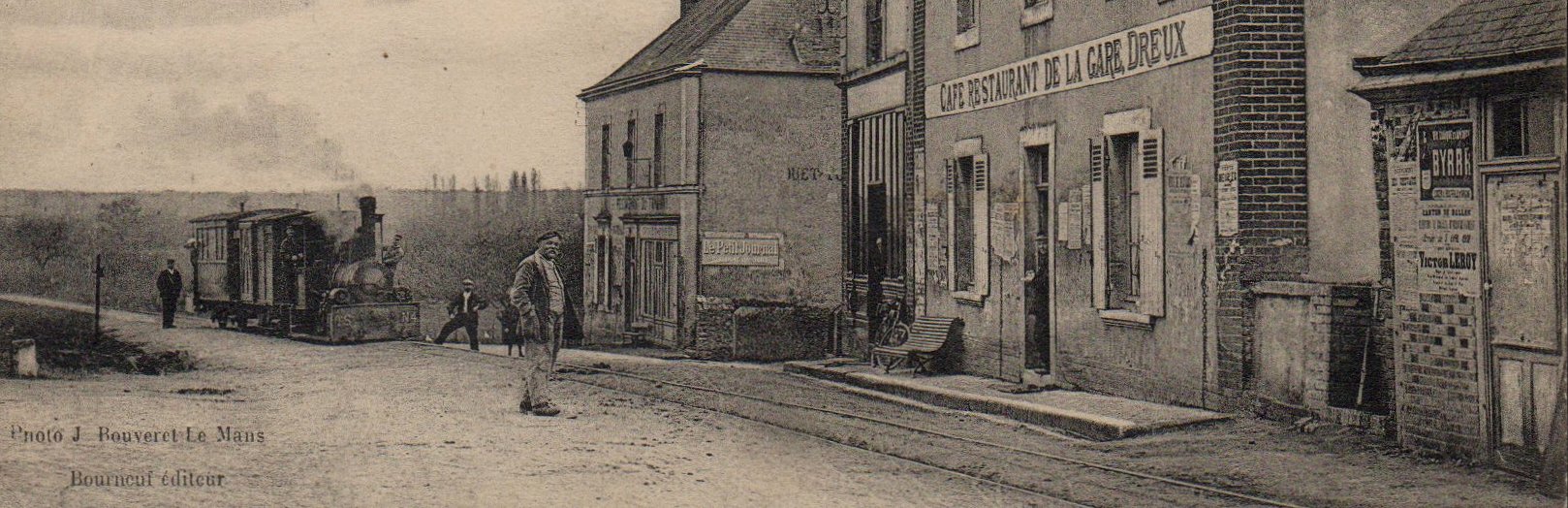
Top image : The same location but looking back from the level crossing. The locomotive may well be the same one as appears in the image of Ballon a little lower down. The tramway's alignment in the two views is quite different, a change made, we think, between about 1905 and 1909.
Note: A third view of Montbizot (at the other end of town) can be found in the Appendix article.
A Google 360-degree view of the same location today can be accessed here (opens in a new tab). There is unusually little change after such a time interval. The station still boasts a service of around a dozen trains each way per day and, with astonishing symmetry, although all Tramways de la Sarthe operations ended in 1947, this first-ever section of that network, which was first introduced principally to serve the Chappée foundry in 1882, was retained - and for the same industrial user, the Chappée foundry.
Freight here continued without a break, complete with the necessary gauge-change transhipment facilities between metre-gauge and standard-gauge at the Gare de Montbizot. This surviving stump of the network continued to be operated by steam tram engine well into the 1950s before being replaced by diesel power. The line finally closed in 1969, bringing to an end 87 years of trams rumbling along the length of the main thoroughfare of Montbizot.
.
The Tramways de la Sarthe : Overview :
In general on the T.S., the journey time to most terminus destinations from Le Mans was around three hours one way, much of it rural and on low-grade track. Three or four full-distance return steam trams per day were provided on some routes prior to 1914 but post-WWI services were progressively reduced, sometimes limited to a single return tram over the whole length of the route per day, supplemented by additional trams on the better-patronised sections. Some of the passenger services on the T.S. were dieselised to effect economies but, as the century progressed, parts of the system inevitably closed in the face of road competition both for passengers and freight.
Top image : Montbizot station (to right of view) and a train of the 'big railway' on the level crossing (centre). The T.S. tracks and 'Tram Stop' board are in the foreground. The Restaurant du Tramway and Hotel de L'Ouest (presumably referring to the railway Compagnie de l'Ouest ) complete the fortuitously all-encompassing composition of this history-laced view.
Top image : The same location but looking back from the level crossing. The locomotive may well be the same one as appears in the image of Ballon a little lower down. The tramway's alignment in the two views is quite different, a change made, we think, between about 1905 and 1909.
Note: A third view of Montbizot (at the other end of town) can be found in the Appendix article.
A Google 360-degree view of the same location today can be accessed here (opens in a new tab). There is unusually little change after such a time interval. The station still boasts a service of around a dozen trains each way per day and, with astonishing symmetry, although all Tramways de la Sarthe operations ended in 1947, this first-ever section of that network, which was first introduced principally to serve the Chappée foundry in 1882, was retained - and for the same industrial user, the Chappée foundry.
Freight here continued without a break, complete with the necessary gauge-change transhipment facilities between metre-gauge and standard-gauge at the Gare de Montbizot. This surviving stump of the network continued to be operated by steam tram engine well into the 1950s before being replaced by diesel power. The line finally closed in 1969, bringing to an end 87 years of trams rumbling along the length of the main thoroughfare of Montbizot.
.
The Tramways de la Sarthe : Overview :
In general on the T.S., the journey time to most terminus destinations from Le Mans was around three hours one way, much of it rural and on low-grade track. Three or four full-distance return steam trams per day were provided on some routes prior to 1914 but post-WWI services were progressively reduced, sometimes limited to a single return tram over the whole length of the route per day, supplemented by additional trams on the better-patronised sections. Some of the passenger services on the T.S. were dieselised to effect economies but, as the century progressed, parts of the system inevitably closed in the face of road competition both for passengers and freight.
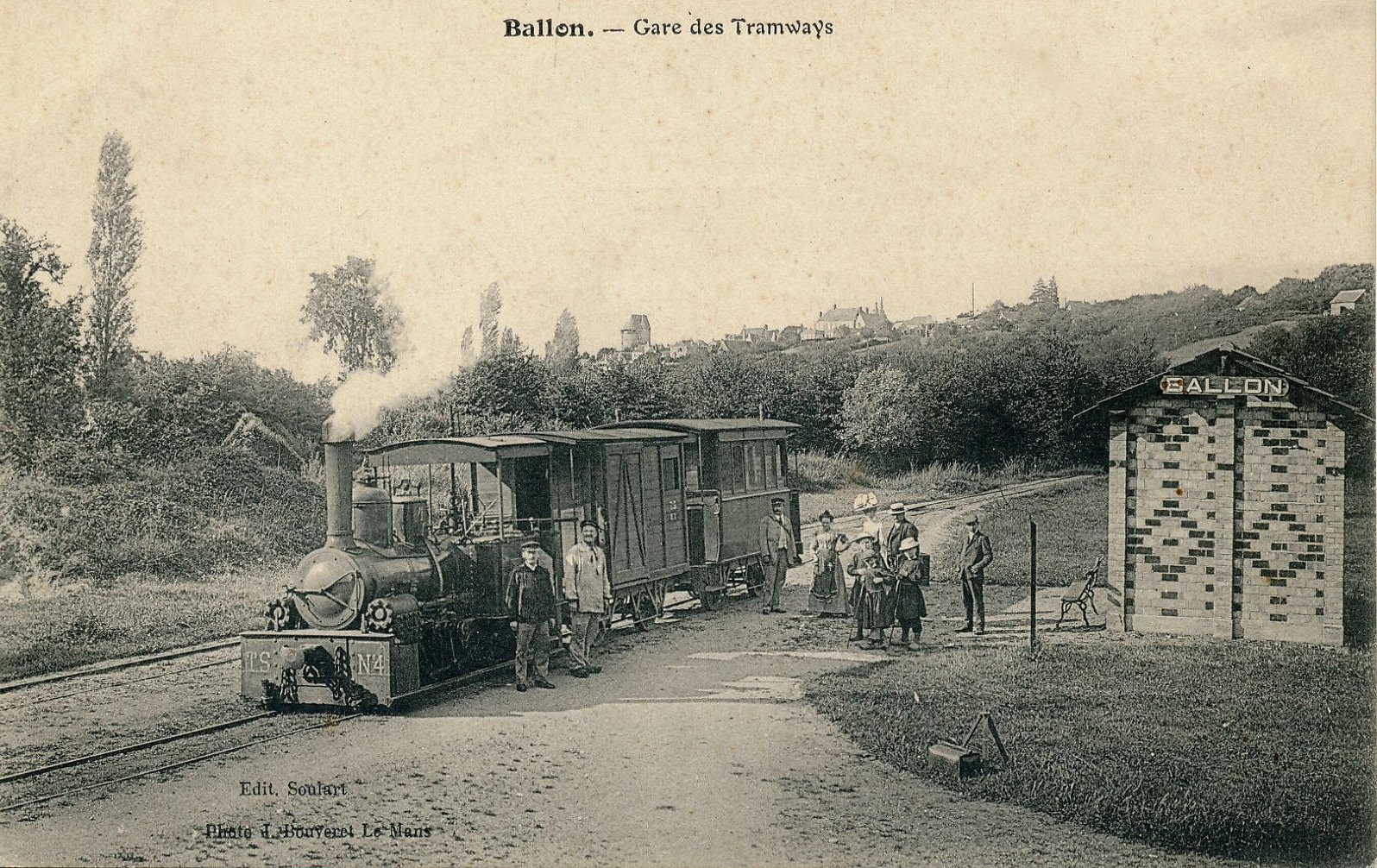
 Left: A charming view of a tiny mixed train at an outlying station, Ballon, on the T.S. network. The locomotive has T.S. No. 4 painted on its buffer beam and is certainly one of the smaller locomotives of the company. Fortunately for their finances, the company generally had more substantial trams than this operating on their system.
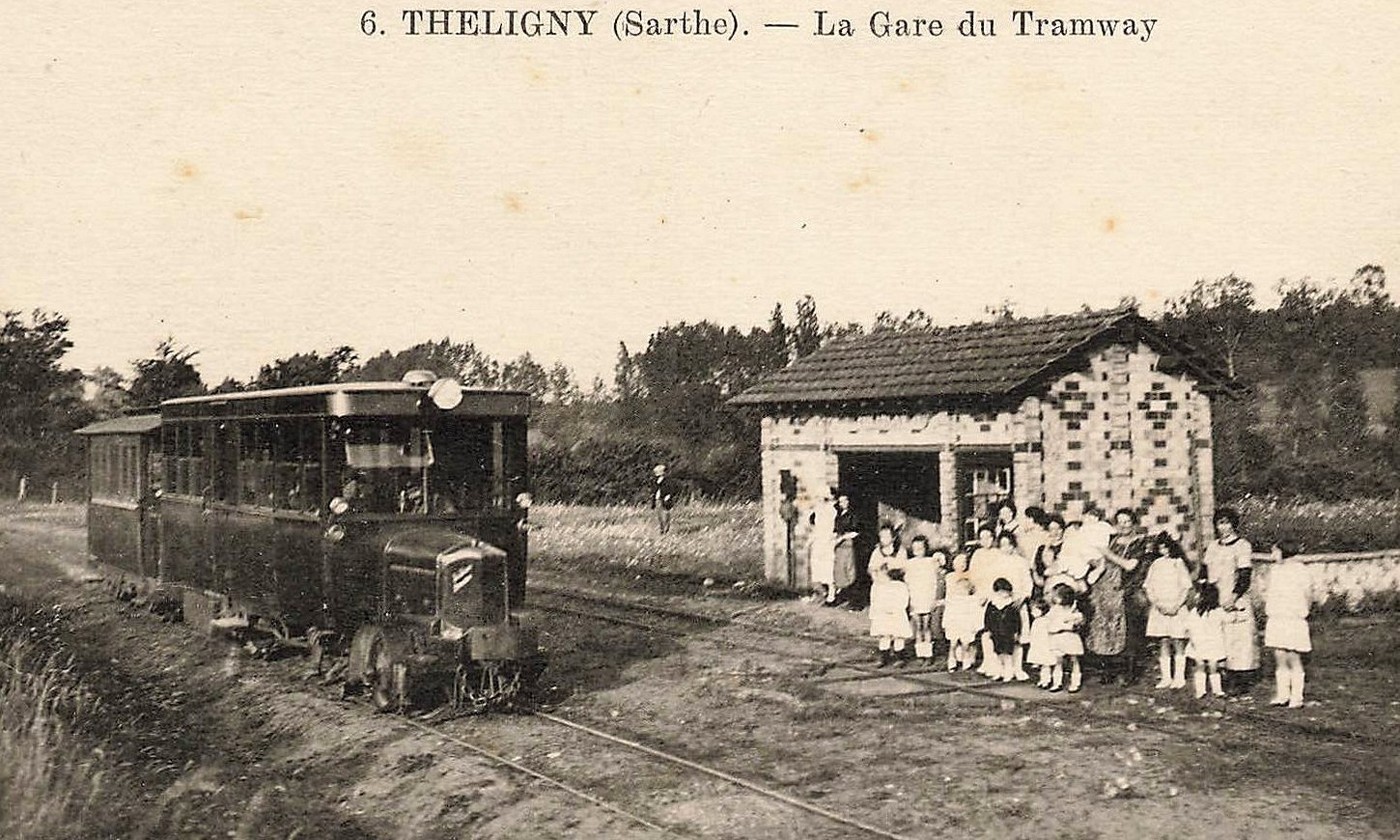
Right: A diesel railbus / autorail and trailer at Théligny, between La Ferté-Bernard and Montmirail, a short-lived extension south-east from La Ferté-Bernard operational only from 1916-1921 and 1924-1933.
Even though early diesels were somewhat underpowered, on the more lightly-loaded passenger services they could provide significant cost savings. Views of diesel-powered T.S. services are rare, principally because, in the period after the Great War when their numbers were growing steadily, they tended to operate in remote locations of little commercial potential for postcard producers who, in any case, found the demand for their cards declining overall.
A second major war in 20 years, along with the German Occupation, severely damaged the whole economy. On the T.S., as elsewhere, both rolling stock and infrastructure suffered the ravages and reduced maintenance of wartime and the post-WWII period was exceptionally difficult. With good management and local authority support, the T.S. managed to keep afloat and the system looked as though it might have some sort of future.
Far removed from the scene, though, it seems that the national government saw the future of local transport as the preserve of the motor vehicle alone and roadside trams had no place in the vision. A decree arrived from Paris to that effect and the last T.S. tram ran on March 1st 1947, the network having survived the war by less than 1000 days. Thus, by a stroke of a distant administrative pen, 65 years of local, public narrow-gauge rural rail transport for Le Mans and its hinterland came to an abrupt end.
Left: A charming view of a tiny mixed train at an outlying station, Ballon, on the T.S. network. The locomotive has T.S. No. 4 painted on its buffer beam and is certainly one of the smaller locomotives of the company. Fortunately for their finances, the company generally had more substantial trams than this operating on their system.
Right: A diesel railbus / autorail and trailer at Théligny, between La Ferté-Bernard and Montmirail, a short-lived extension south-east from La Ferté-Bernard operational only from 1916-1921 and 1924-1933.
Even though early diesels were somewhat underpowered, on the more lightly-loaded passenger services they could provide significant cost savings. Views of diesel-powered T.S. services are rare, principally because, in the period after the Great War when their numbers were growing steadily, they tended to operate in remote locations of little commercial potential for postcard producers who, in any case, found the demand for their cards declining overall.
A second major war in 20 years, along with the German Occupation, severely damaged the whole economy. On the T.S., as elsewhere, both rolling stock and infrastructure suffered the ravages and reduced maintenance of wartime and the post-WWII period was exceptionally difficult. With good management and local authority support, the T.S. managed to keep afloat and the system looked as though it might have some sort of future.
Far removed from the scene, though, it seems that the national government saw the future of local transport as the preserve of the motor vehicle alone and roadside trams had no place in the vision. A decree arrived from Paris to that effect and the last T.S. tram ran on March 1st 1947, the network having survived the war by less than 1000 days. Thus, by a stroke of a distant administrative pen, 65 years of local, public narrow-gauge rural rail transport for Le Mans and its hinterland came to an abrupt end.
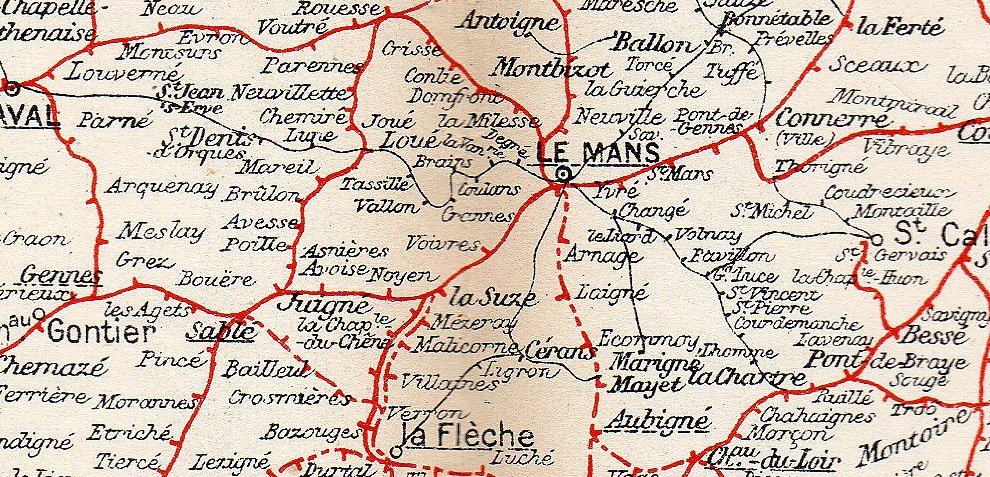 ** A c.1914 map showing the railways around Le Mans. The thin black lines show the narrow-gauge lines of the Tramways de la Sarthe network. However, one of these thin lines (St. Calais-Thorigné-Connerré-Bonnétable & northbound) shows a secondary railway, rather than a T.S. tramway.
** The red lines are standard-gauge railways, several of which have also passed into history.
** The T.S. route to Mamers beyond Bonnétable (top right) is off the edge of the map, as is the connection (at La Détourbe) from that line to La Ferté(-Bernard). However, the town of 'La Ferté' is on the map and a tiny section of that T.S. branch line arriving there from the north is just visible.
** A few kilometres south-east of Le Mans, a tramway branch heads almost due south from Changé to Marigné. At this time, Marigné was the terminus of the line which would eventually be extended via Jupilles (opened in 1920) to Château-du-Loir, this target town finally reached only in 1922.
Had the political climate been different after WWII, the Compagnie de la Sarthe might well have been able to keep parts of its system operational for another decade. It is fair to assume that the rise in road transport would have finished off the T.S. eventually, as it did to rural roadside tramways, and indeed many rural railways, across most of Europe. The Pont en X, though, had it not been destroyed in the war, would almost certainly still be with us today as a monument, so strong was the local affinity with it.
** A c.1914 map showing the railways around Le Mans. The thin black lines show the narrow-gauge lines of the Tramways de la Sarthe network. However, one of these thin lines (St. Calais-Thorigné-Connerré-Bonnétable & northbound) shows a secondary railway, rather than a T.S. tramway.
** The red lines are standard-gauge railways, several of which have also passed into history.
** The T.S. route to Mamers beyond Bonnétable (top right) is off the edge of the map, as is the connection (at La Détourbe) from that line to La Ferté(-Bernard). However, the town of 'La Ferté' is on the map and a tiny section of that T.S. branch line arriving there from the north is just visible.
** A few kilometres south-east of Le Mans, a tramway branch heads almost due south from Changé to Marigné. At this time, Marigné was the terminus of the line which would eventually be extended via Jupilles (opened in 1920) to Château-du-Loir, this target town finally reached only in 1922.
Had the political climate been different after WWII, the Compagnie de la Sarthe might well have been able to keep parts of its system operational for another decade. It is fair to assume that the rise in road transport would have finished off the T.S. eventually, as it did to rural roadside tramways, and indeed many rural railways, across most of Europe. The Pont en X, though, had it not been destroyed in the war, would almost certainly still be with us today as a monument, so strong was the local affinity with it.
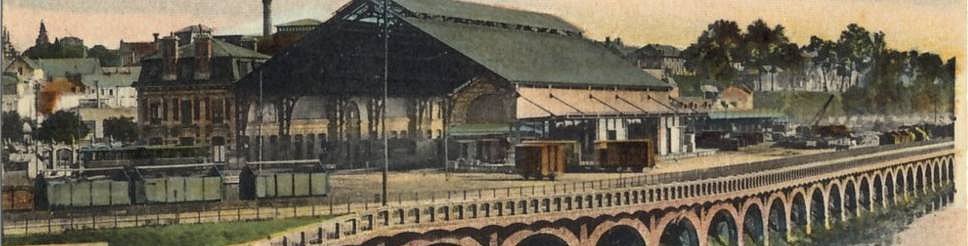
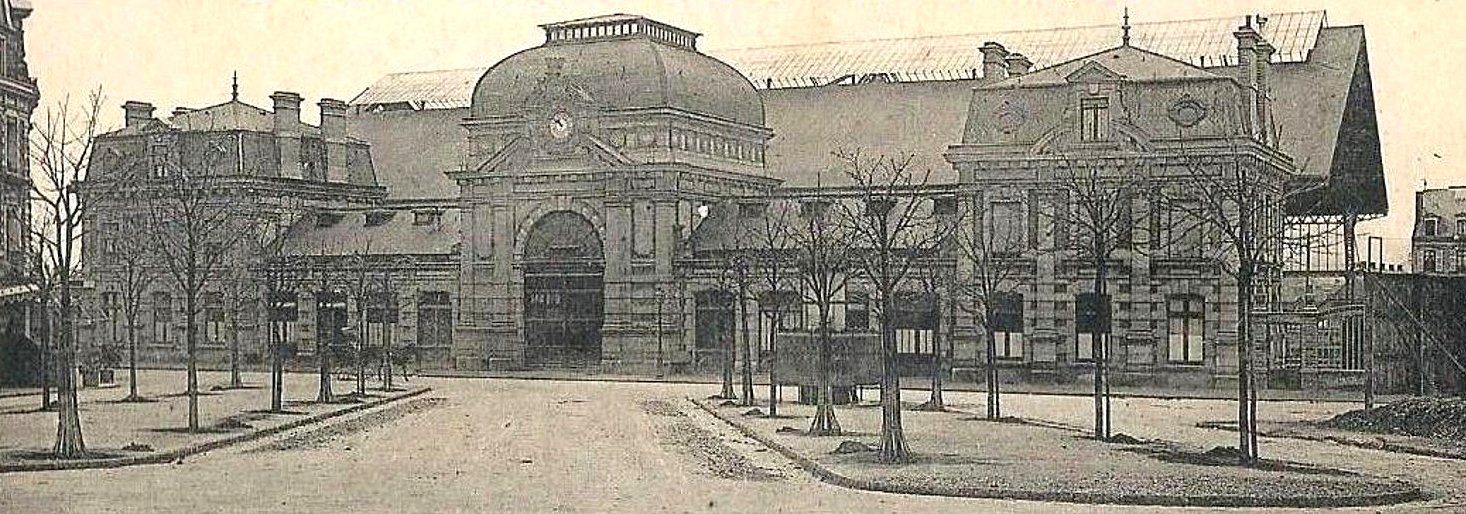 Le Mans : Gare (Centrale) des Tramways de la Sarthe : Interior and Exterior views. These are amazingly bold (and costly) structures for an essentially local, and mainly rural, 'tramway' company, reflecting the confidence with which many large enterprises were imbued in the latter part of the 19th century.
Unfortunately, the Gare Centrale was one of so many structures that failed to survive the modernisation drive after World War II. In addition to its magnificent station building, which handled many hundreds of passengers an hour at peak times, it had five covered platforms and a further nine tracks for other movements, surely one of the most impressive tramway stations in the world. In today's world, more attuned to industrial and historical heritage, one could well imagine the site being acquired by a supermarket and the station internally re-purposed, with the train shed providing a covered car park.
However, it should be pointed out that examples of what may be perceived as 'architectural vandalism' in the destruction of many fine buildings and structures was by no means limited to France at this period. It was a common trend in the drive for 'modernisation' in much of Europe in the 1950s and 1960s.
The Gare Centrale was designed and built by the same tour de force as the Pont en X, the inspirational Louis Harel de la Noë (1852-1931), who is seen as a groundbreaker for a style that elegantly married the use of classic building materials to the functional advantages of reinforced concrete. This masterpiece of a station was largely completed by 1898, the same year as the Pont en X.
Le Mans : Gare (Centrale) des Tramways de la Sarthe : Interior and Exterior views. These are amazingly bold (and costly) structures for an essentially local, and mainly rural, 'tramway' company, reflecting the confidence with which many large enterprises were imbued in the latter part of the 19th century.
Unfortunately, the Gare Centrale was one of so many structures that failed to survive the modernisation drive after World War II. In addition to its magnificent station building, which handled many hundreds of passengers an hour at peak times, it had five covered platforms and a further nine tracks for other movements, surely one of the most impressive tramway stations in the world. In today's world, more attuned to industrial and historical heritage, one could well imagine the site being acquired by a supermarket and the station internally re-purposed, with the train shed providing a covered car park.
However, it should be pointed out that examples of what may be perceived as 'architectural vandalism' in the destruction of many fine buildings and structures was by no means limited to France at this period. It was a common trend in the drive for 'modernisation' in much of Europe in the 1950s and 1960s.
The Gare Centrale was designed and built by the same tour de force as the Pont en X, the inspirational Louis Harel de la Noë (1852-1931), who is seen as a groundbreaker for a style that elegantly married the use of classic building materials to the functional advantages of reinforced concrete. This masterpiece of a station was largely completed by 1898, the same year as the Pont en X.
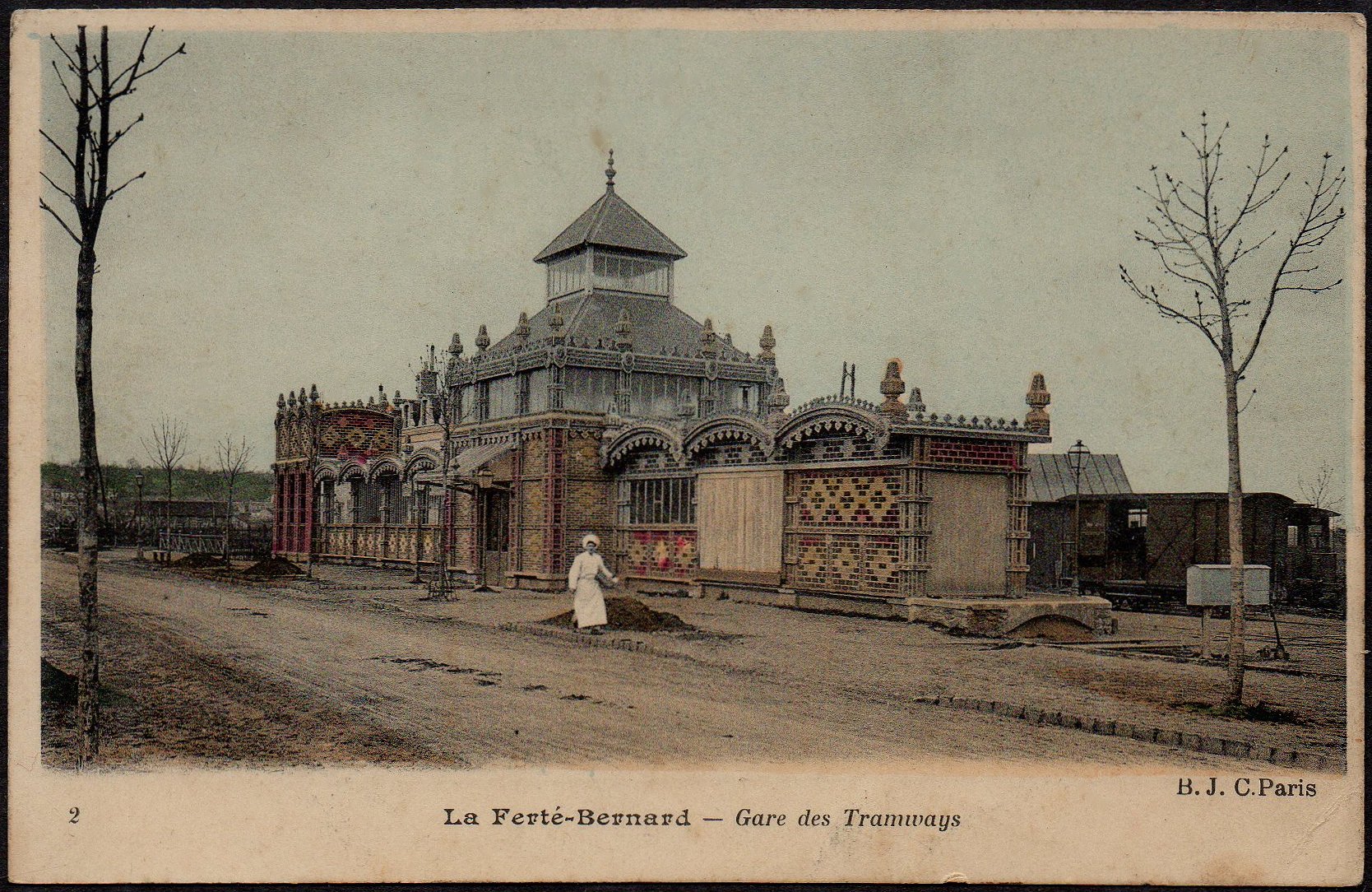
 The station (left image above) was demolished in 1949/50. Whilst there are substantial vestiges of the tramways that Harel de la Noë built in the Côtes-du-Nord (today's Côtes-d'Armor) around Saint-Brieuc, there are few significant reminders today of the major tramway network that once spread out from Le Mans to most corners of the département. The former tramway bridge over the River Sarthe at Fillé with its elegant arch is an exception.
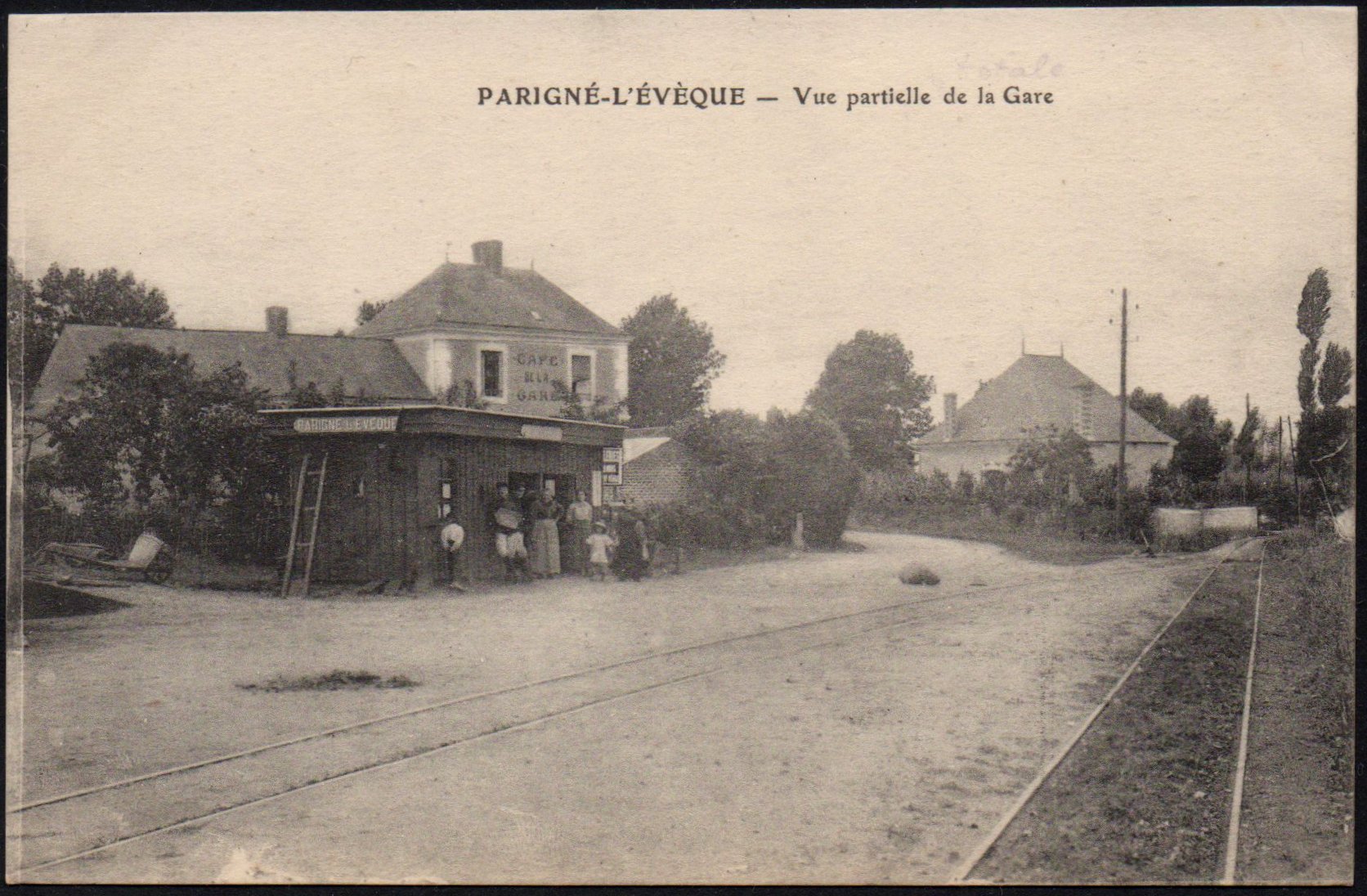
The right-hand image above shows the passenger station at Parigné l'Evêque on the La Chartre line. This was not one of the smaller places the T.S. served but the passenger provisions are nevertheless quite basic.
The station (left image above) was demolished in 1949/50. Whilst there are substantial vestiges of the tramways that Harel de la Noë built in the Côtes-du-Nord (today's Côtes-d'Armor) around Saint-Brieuc, there are few significant reminders today of the major tramway network that once spread out from Le Mans to most corners of the département. The former tramway bridge over the River Sarthe at Fillé with its elegant arch is an exception.
The right-hand image above shows the passenger station at Parigné l'Evêque on the La Chartre line. This was not one of the smaller places the T.S. served but the passenger provisions are nevertheless quite basic.
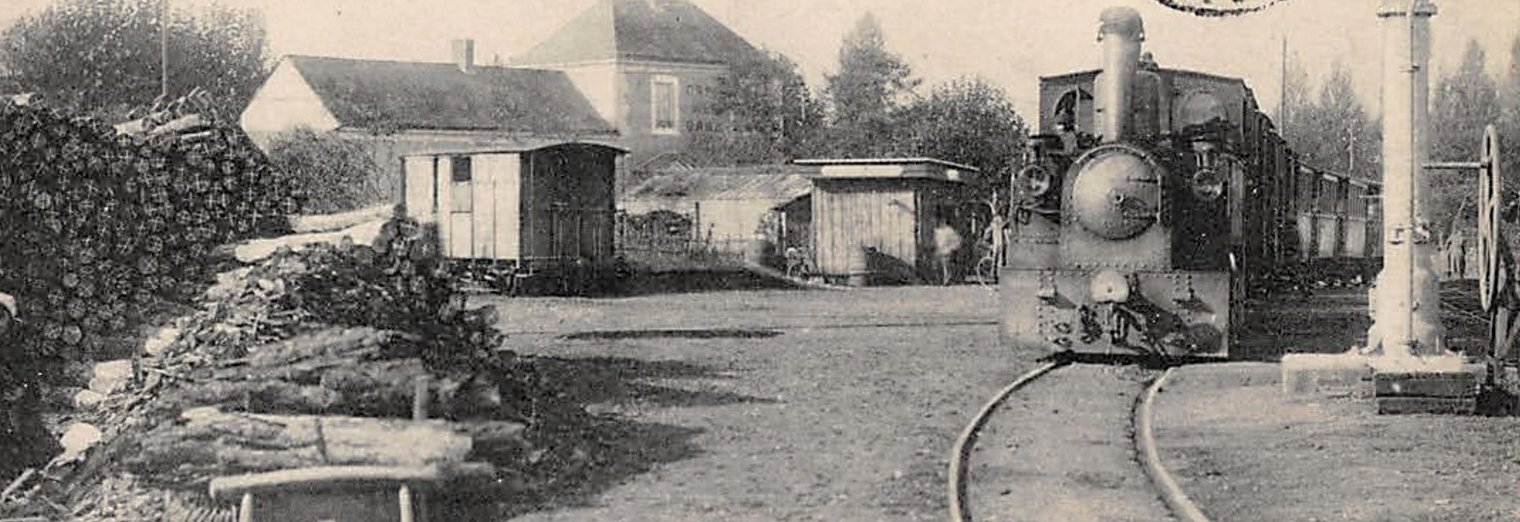 Still at Parigné l'Evêque, this view of the station shows the financially more important 'freight end' of the station, with sidings and a loading dock. Again, though, the infrastructure is essentially insubstantial. Unlike heavily-engineered railways with their numerous embankments, cuttings and tunnels, in general the tramways in La Sarthe had only a very light footprint. Consequently, within a short time of a line's closure, much of the evidence of their former existence could simply evaporate from the landscape.
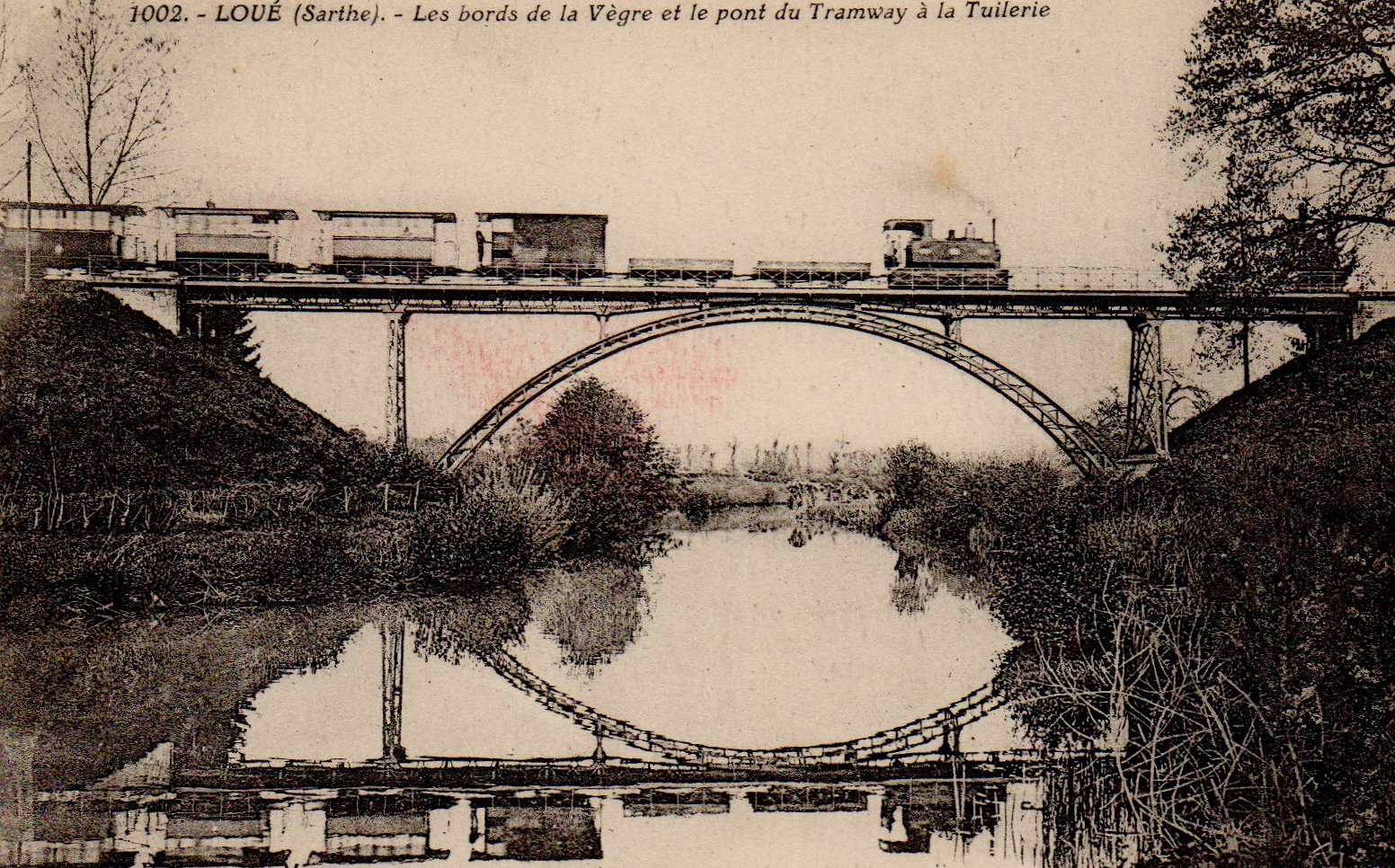 Whilst de la Noë may be best known for his imaginative use of reinforced concrete, a state-of-the-art material for which the first commercially-viable version was only patented by Hennebique in 1892, he was more than competent in a wide range of materials and styles. Above is an elegant (late 1880s) de la Noë bridge on the St. Denis d'Orques line, one of his earliest works for the T.S.
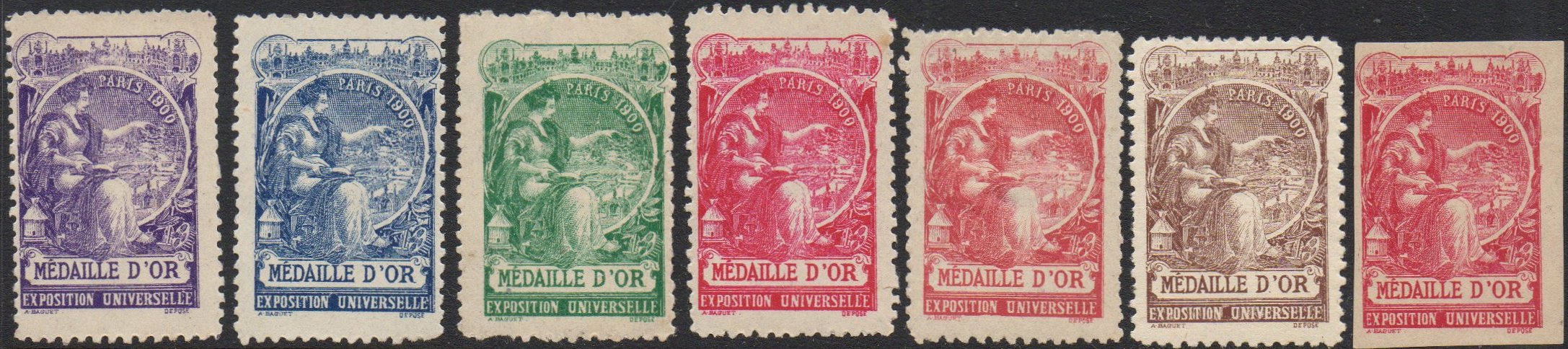 There were innumerable vignettes produced for the Paris Expo of 1900. We have illustrated above just one design in its 'Gold Medal' version, shown in the normal five colours in which they were printed for general promotional purposes. The second stamp in red above is on a different paper and in a different shade, we think from a different printing. These vignettes are usually perforated but imperforate examples can be found.
Additionally, these stamps can be found with the medal winners' names added to the design, usually in the same five colours. For this design we have seen Gold and Silver Medal examples but we do not recall seeing one for the Bronze Medal.
We have not, to date, found one mentioning Harel de la Noë and we think it unlikely that any were produced. We suspect winners in the various categories were 'invited' to order (and pay for) stamps celebrating their awards, rather than being awarded them. If this is so, those most likely to place orders would have been companies, doing so for promotional purposes, rather than individuals.
In the Appendix (at the foot of Section 3), you will find further selected scans of vignettes for this Grand Exposition, mostly examples printed with the winners' names. Overall it is a huge study subject. Almost unbelievably, there were more than 83,000 exhibitors at Paris 1900! Exhibitors were divided by type into 18 groups of exhibitors, sub-divided into 121 classes. We recommend Wikipedia for further general background reading.
.
Returning to de la Noë's structures, special mention is due the stunning Viaduc de Souzin in north-western France near Saint-Brieuc, destroyed in 1995 due to its dangerous condition. It was a huge and flamboyant two-tier masterpiece that carried narrow-gauge 'departmental' railway trains / trams, which were totally dwarfed by the structure. We show it twice, along with two more of his railway viaducts in the same area:
There were innumerable vignettes produced for the Paris Expo of 1900. We have illustrated above just one design in its 'Gold Medal' version, shown in the normal five colours in which they were printed for general promotional purposes. The second stamp in red above is on a different paper and in a different shade, we think from a different printing. These vignettes are usually perforated but imperforate examples can be found.
Additionally, these stamps can be found with the medal winners' names added to the design, usually in the same five colours. For this design we have seen Gold and Silver Medal examples but we do not recall seeing one for the Bronze Medal.
We have not, to date, found one mentioning Harel de la Noë and we think it unlikely that any were produced. We suspect winners in the various categories were 'invited' to order (and pay for) stamps celebrating their awards, rather than being awarded them. If this is so, those most likely to place orders would have been companies, doing so for promotional purposes, rather than individuals.
In the Appendix (at the foot of Section 3), you will find further selected scans of vignettes for this Grand Exposition, mostly examples printed with the winners' names. Overall it is a huge study subject. Almost unbelievably, there were more than 83,000 exhibitors at Paris 1900! Exhibitors were divided by type into 18 groups of exhibitors, sub-divided into 121 classes. We recommend Wikipedia for further general background reading.
.
Returning to de la Noë's structures, special mention is due the stunning Viaduc de Souzin in north-western France near Saint-Brieuc, destroyed in 1995 due to its dangerous condition. It was a huge and flamboyant two-tier masterpiece that carried narrow-gauge 'departmental' railway trains / trams, which were totally dwarfed by the structure. We show it twice, along with two more of his railway viaducts in the same area:
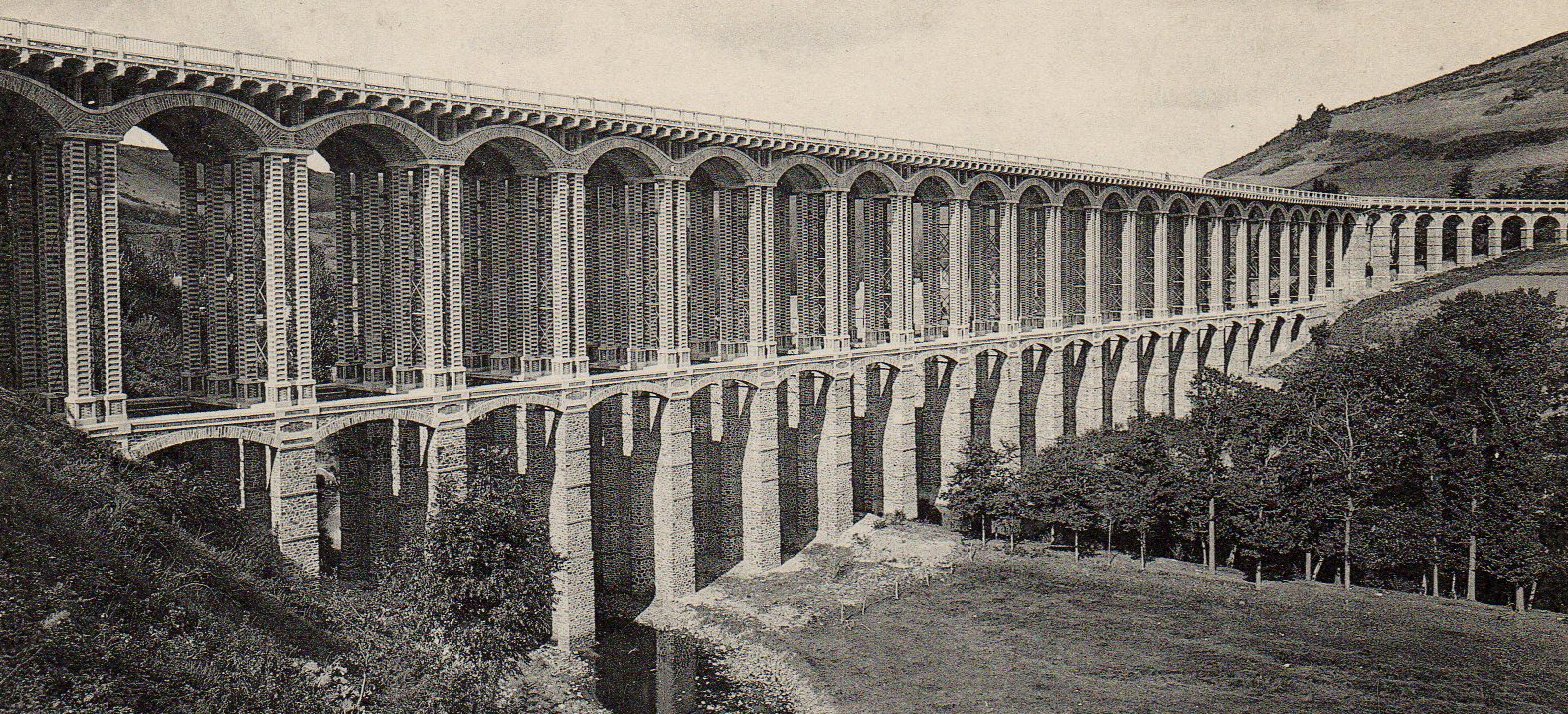
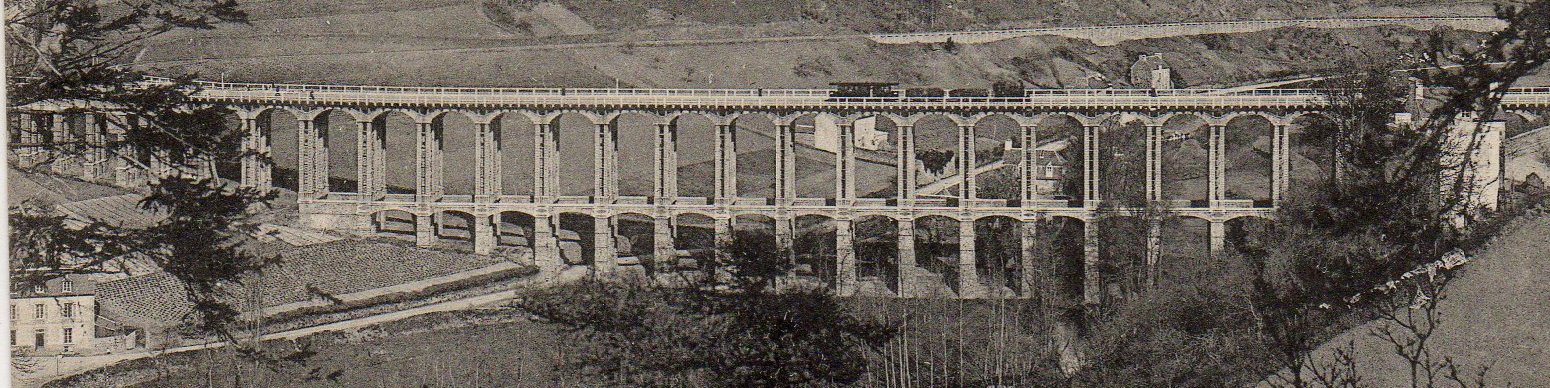
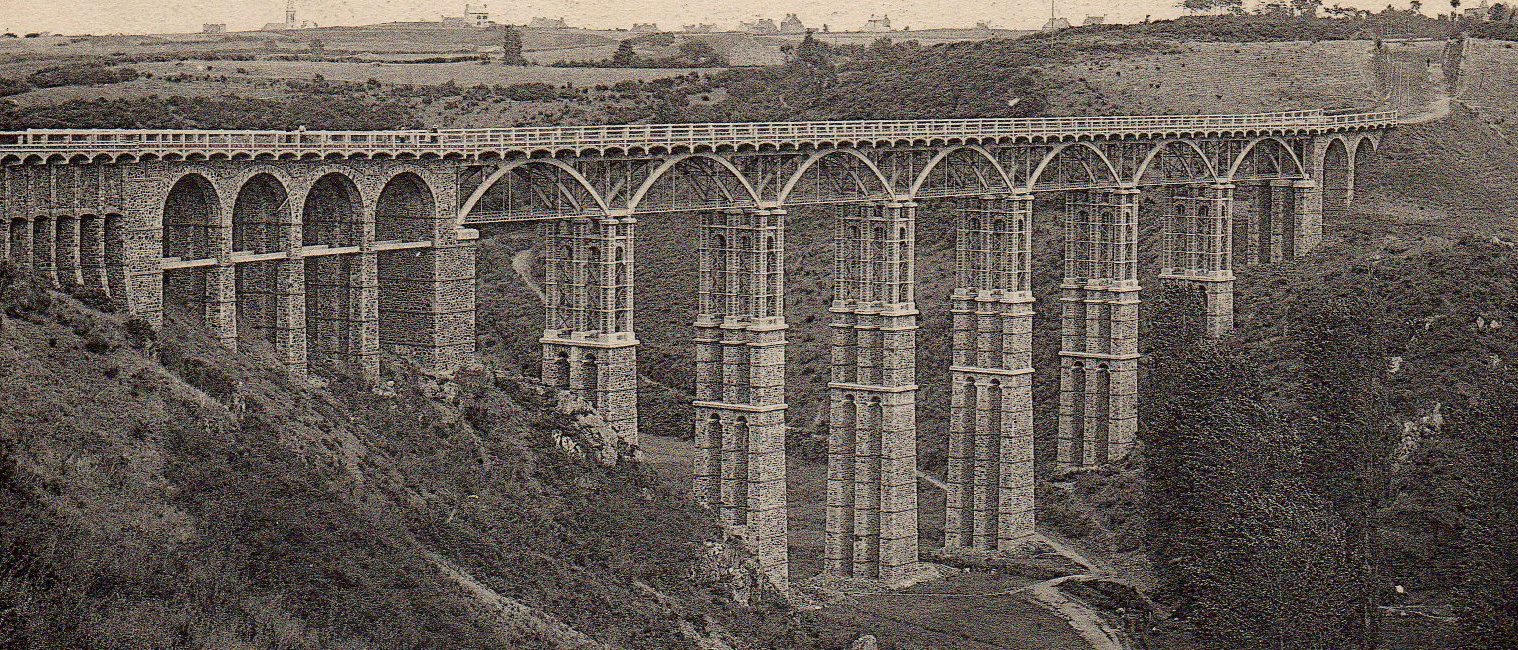
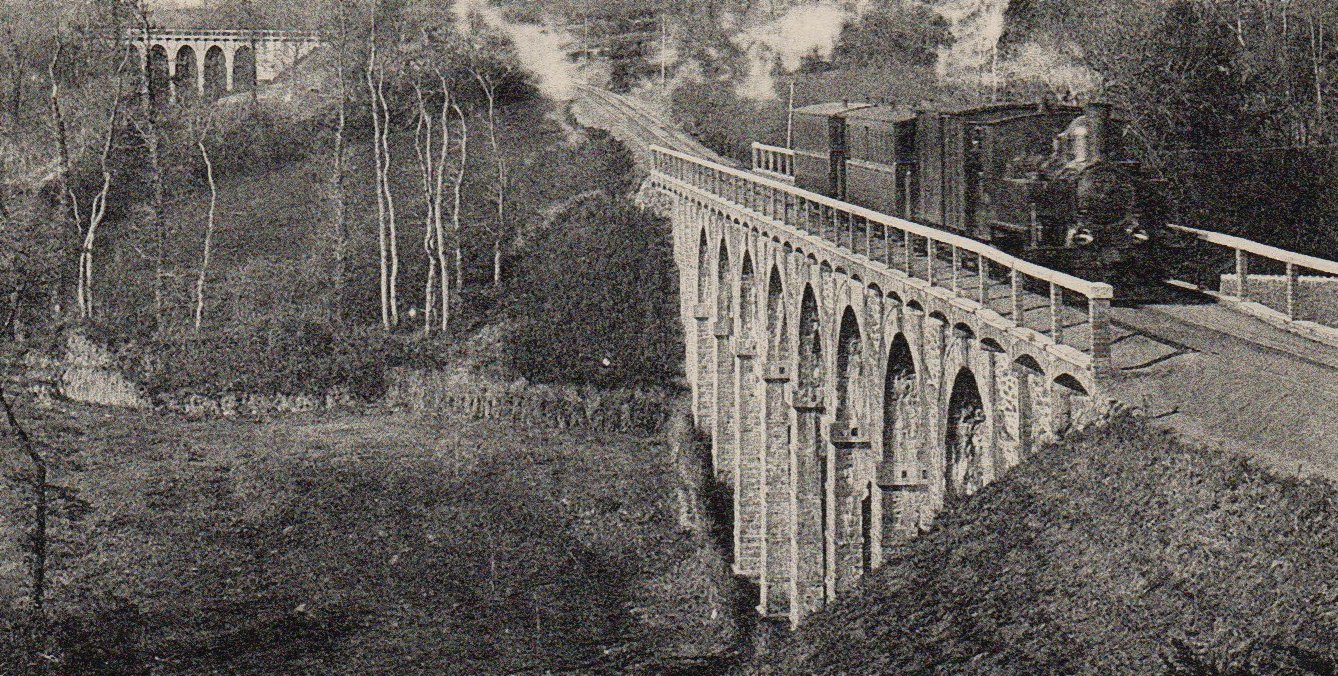 1 & 2. Saint-Brieuc, Viaduc de Souzin. 3. Saint-Brieuc, Viaduc de Toupin. 4. Etables, Viaduc du Ponto.
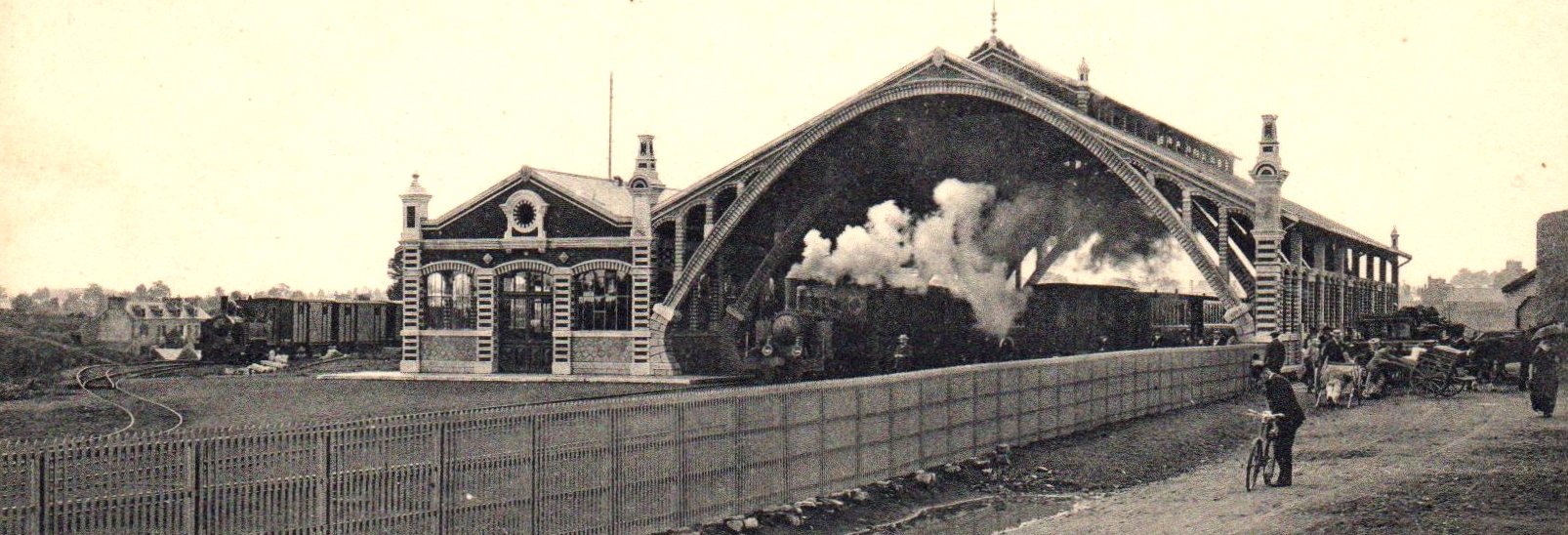 The fine (and imposing) station de la Noë produced for the departmental railways in St Brieuc.
.
The fine (and imposing) station de la Noë produced for the departmental railways in St Brieuc.
.
-detail.jpg) Nogent-le-Bernard between Mamers and Bonnétable with a 'Mamers au Mans' travelling post office cancellation (1912). A very similar view of this station, but probably taken well over 20 years later, is provided near the foot of Section 4 in the Appendix Article and is almost melancholic by comparison.
This section examines solely the courrier-convoyeur-ligne (CCL) cancellations to / from Le Mans which appear to have been operated by Tramways de la Sarthe services rather than the railways, which generally carried the majority of travelling post office mail.
Most T.S. services from Le Mans terminated at or near a provincial railway station, often one with an important CCL hub. This may at times have been highly advantageous for La Poste, but not for later researchers, trying to establish whether, or perhaps between what dates, the mails were carried on a railway or tramway service.
The routes that we reviewed are shown below. Services operated by T. S. Trams are shown in RED; those we believe to have been Railway operations are in BLUE.
Nogent-le-Bernard between Mamers and Bonnétable with a 'Mamers au Mans' travelling post office cancellation (1912). A very similar view of this station, but probably taken well over 20 years later, is provided near the foot of Section 4 in the Appendix Article and is almost melancholic by comparison.
This section examines solely the courrier-convoyeur-ligne (CCL) cancellations to / from Le Mans which appear to have been operated by Tramways de la Sarthe services rather than the railways, which generally carried the majority of travelling post office mail.
Most T.S. services from Le Mans terminated at or near a provincial railway station, often one with an important CCL hub. This may at times have been highly advantageous for La Poste, but not for later researchers, trying to establish whether, or perhaps between what dates, the mails were carried on a railway or tramway service.
The routes that we reviewed are shown below. Services operated by T. S. Trams are shown in RED; those we believe to have been Railway operations are in BLUE.
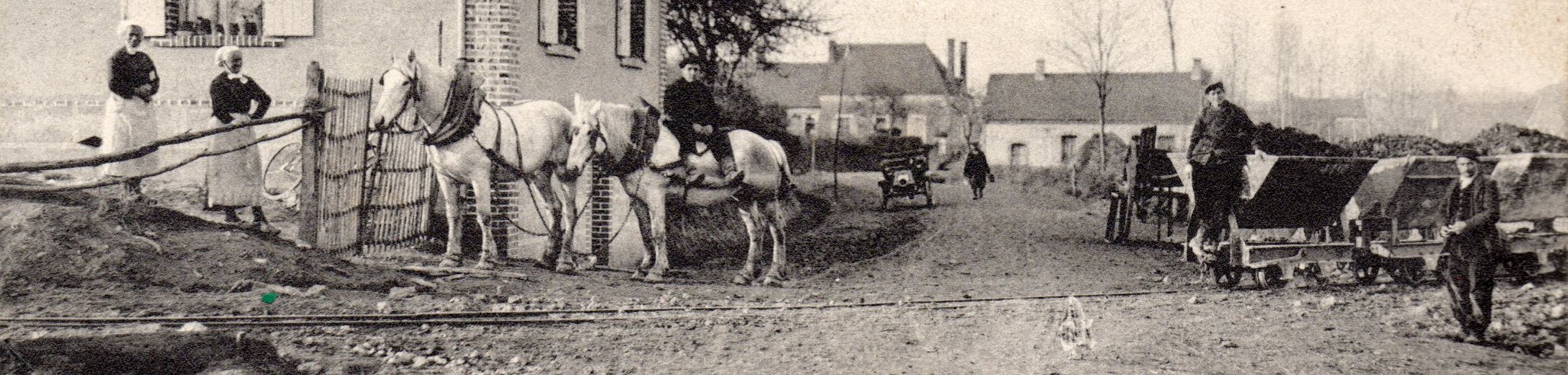 La Rue Saint-Georges in Tresson, a village on the tramway between Le Grand-Lucé and Saint-Calais. The dumper trucks appear to be of a much narrower gauge than the T.S. tramway. We do not know whether or not this little line had any trans-shipment facilities which might have brought income to the T.S.
To modern eyes, much of the scene seems to conjure up an almost timeless old world, but the motor car in the background, probably the photographer's, points to it being a snapshot of what was to prove a very brief period in history, la Belle Epoque. This unhurried and largely self-sustaining lifestyle, so far only gently touched by the new age of the motor vehicle and electricity, will soon be blown away by violent winds of change.
.
The Courrier-Convoyeur Cancellation:
In brief, the 'courrier-convoyeur' system involved a single mail-guard travelling on a regular train (or tram) in what literature often calls his 'compartment'. On the T.S. system and, to an unresearched extent, elsewhere in France, a van (fourgon) appears to be a more accurate designation. Convoyeur employees were typically equipped with two cancellers, one for each direction, displaying the date and the two ends of the line on which they were working. In the Appendix article (link in left panel), we discuss the duties of the CCL postal workers and the postal vans (attached to trains or trams) in which they operated, with pictorial examples from across France.
If required, a general introduction to the differences between 'ambulant', 'courrier-convoyeur-station' (CCS) and 'courrier-convoyeur-ligne' (CCL) cancellations can be found in our Monaco article; it may be accessed here (opens in a new tab).
It may well be that a previous reporter has already established authoritatively which CCL cancellations in La Sarthe were of tramway origin but we have not found such information. With one exception, 'Château-du-Loir au Mans', on which we have no information at all, we are confident that we have now identified which CCL services were operated by the Compagnie des Tramways de la Sarthe.
For each of those lines, we found it both informative and interesting to note the earliest and latest dates for each 'Type' of postmark (Types II and/or III) that we have seen. In addition to providing this information in our section on each tramline, there is a summary table of cancellation dates for all lines towards the foot of the page.
La Rue Saint-Georges in Tresson, a village on the tramway between Le Grand-Lucé and Saint-Calais. The dumper trucks appear to be of a much narrower gauge than the T.S. tramway. We do not know whether or not this little line had any trans-shipment facilities which might have brought income to the T.S.
To modern eyes, much of the scene seems to conjure up an almost timeless old world, but the motor car in the background, probably the photographer's, points to it being a snapshot of what was to prove a very brief period in history, la Belle Epoque. This unhurried and largely self-sustaining lifestyle, so far only gently touched by the new age of the motor vehicle and electricity, will soon be blown away by violent winds of change.
.
The Courrier-Convoyeur Cancellation:
In brief, the 'courrier-convoyeur' system involved a single mail-guard travelling on a regular train (or tram) in what literature often calls his 'compartment'. On the T.S. system and, to an unresearched extent, elsewhere in France, a van (fourgon) appears to be a more accurate designation. Convoyeur employees were typically equipped with two cancellers, one for each direction, displaying the date and the two ends of the line on which they were working. In the Appendix article (link in left panel), we discuss the duties of the CCL postal workers and the postal vans (attached to trains or trams) in which they operated, with pictorial examples from across France.
If required, a general introduction to the differences between 'ambulant', 'courrier-convoyeur-station' (CCS) and 'courrier-convoyeur-ligne' (CCL) cancellations can be found in our Monaco article; it may be accessed here (opens in a new tab).
It may well be that a previous reporter has already established authoritatively which CCL cancellations in La Sarthe were of tramway origin but we have not found such information. With one exception, 'Château-du-Loir au Mans', on which we have no information at all, we are confident that we have now identified which CCL services were operated by the Compagnie des Tramways de la Sarthe.
For each of those lines, we found it both informative and interesting to note the earliest and latest dates for each 'Type' of postmark (Types II and/or III) that we have seen. In addition to providing this information in our section on each tramline, there is a summary table of cancellation dates for all lines towards the foot of the page.
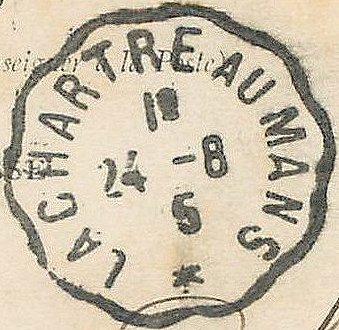
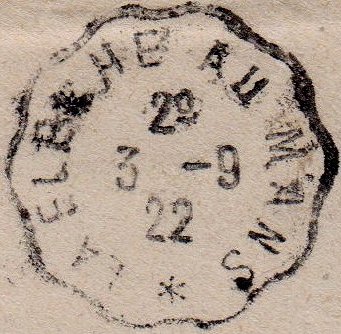


 Pothion Cancellation styles: Left to Right : Types III, III, II, II & III from our five featured lines. Illustrations are to scale.
For those not familiar with the Pothion catalogue, we provide a detailed description of the CCL postmark 'Types', as per Pothion, in Section 1 of the Appendix Article (link in left panel).
Although some T.S. trams operated from the 1880s to 1947, we have so far not found any verified CCL cancellation on their services that is not in the period 1901-1934, but these dates should not be perceived as written in stone. Nevertheless, 1932-1934 (or thereabouts) seems to represent the swansong of the tramway CCL in La Sarthe; we suspect that advances in road vehicles and in the quality of the roads themselves may by then have reached a stage where postal efficiency, in terms of both speed and cost, made road transport a better option. One wonders also whether the fact that many stations on the T.S. network were built some distance from the town (and village) centres, and hence from the local post office, would have made the trams particularly vulnerable to the motor vehicle alternative.
Observation shows that a large proportion of letters and cards sent from towns along a tram's route were cancelled by the date-stamp of the town, not on the tram. The evidence also points to only a minimal amount of un-postmarked mail being loaded onto the trams in Le Mans and the same seems to be true of at least two country termini, Mamers and Mayet. It may also be true of the town of La Flèche but, due to dual railway/tramway usage of that CCL, the picture is far from clear.
Pothion Cancellation styles: Left to Right : Types III, III, II, II & III from our five featured lines. Illustrations are to scale.
For those not familiar with the Pothion catalogue, we provide a detailed description of the CCL postmark 'Types', as per Pothion, in Section 1 of the Appendix Article (link in left panel).
Although some T.S. trams operated from the 1880s to 1947, we have so far not found any verified CCL cancellation on their services that is not in the period 1901-1934, but these dates should not be perceived as written in stone. Nevertheless, 1932-1934 (or thereabouts) seems to represent the swansong of the tramway CCL in La Sarthe; we suspect that advances in road vehicles and in the quality of the roads themselves may by then have reached a stage where postal efficiency, in terms of both speed and cost, made road transport a better option. One wonders also whether the fact that many stations on the T.S. network were built some distance from the town (and village) centres, and hence from the local post office, would have made the trams particularly vulnerable to the motor vehicle alternative.
Observation shows that a large proportion of letters and cards sent from towns along a tram's route were cancelled by the date-stamp of the town, not on the tram. The evidence also points to only a minimal amount of un-postmarked mail being loaded onto the trams in Le Mans and the same seems to be true of at least two country termini, Mamers and Mayet. It may also be true of the town of La Flèche but, due to dual railway/tramway usage of that CCL, the picture is far from clear.
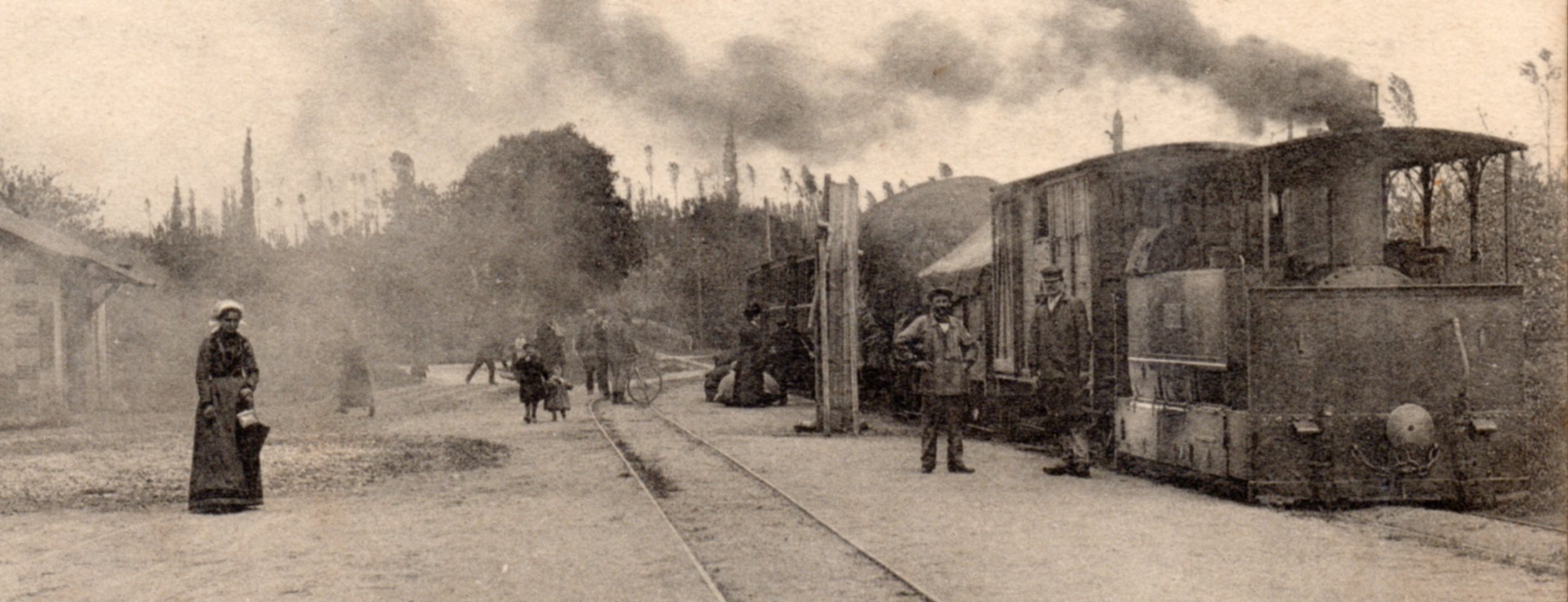 Gare de Coulans on the St Denis d'Orques line (card posted Sept. 1914, image cropped).
Direction of Travel:
In general, when CCL markings are found on branch-line
Gare de Coulans on the St Denis d'Orques line (card posted Sept. 1914, image cropped).
Direction of Travel:
In general, when CCL markings are found on branch-line 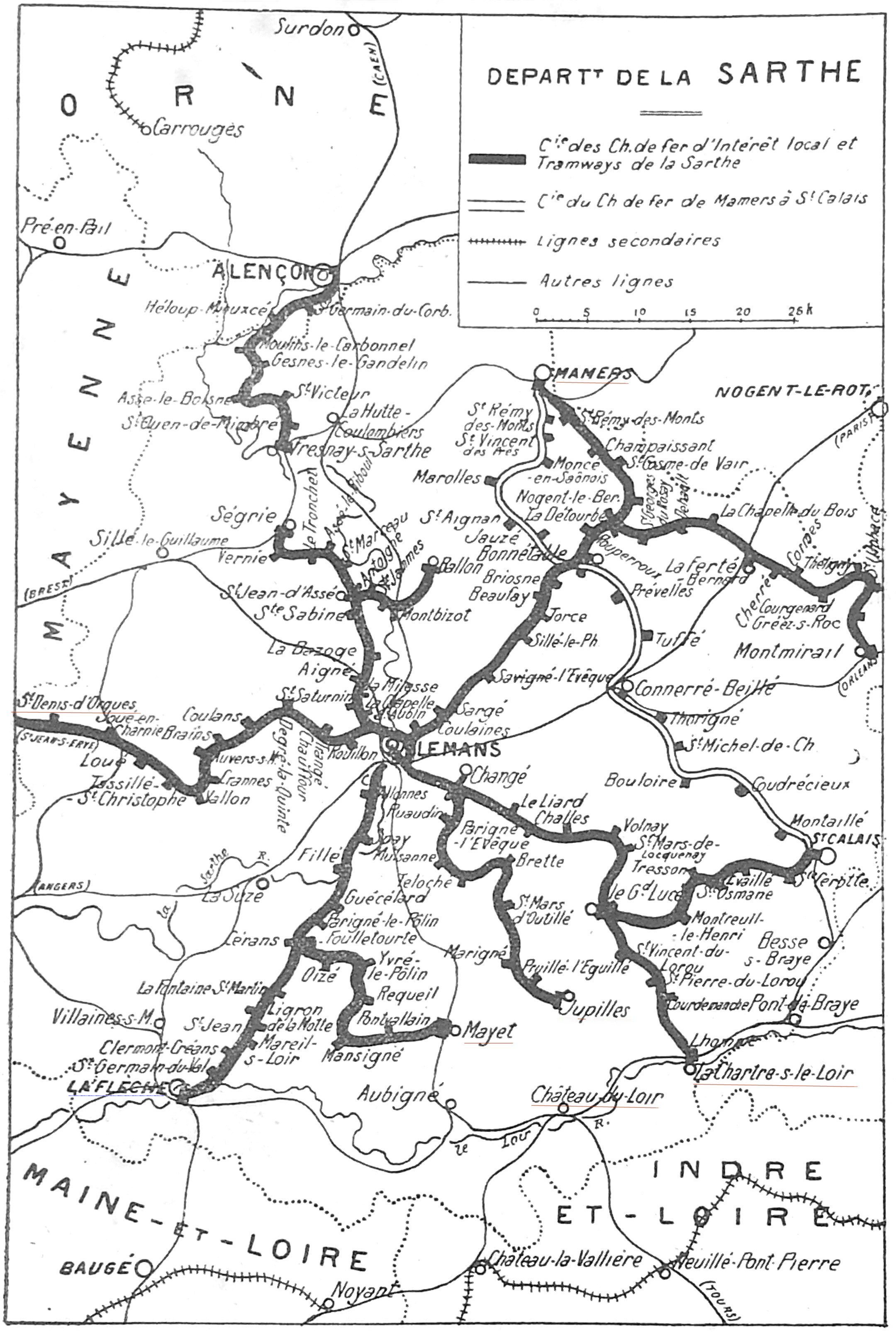 Map Source: Wikipedia page on the Tramways de la Sarthe (opens in new tab) T.S. lines are in bold.
** One line is incomplete: The tramline towards the bottom centre, terminating on the map at Jupilles, had a short-lived extension to Château-du-Loir between the wars which probably dates this map to c.1920/21. Our map higher up showed this same line open only as far as Marigné.
** Note 1 : The St Denis d'Orques line was extended to Saint-Jean-sur-Erve where it shared a station with the departmental railways of the Département of Mayenne but the CCL service was not extended beyond St. Denis.
** Note 2 : Just to the west of the tramline running north from La Flèche is the thin line of the railway running from La Flèche through Villaines-sous-M(alicorne) and La Suze to Le Mans. We have identified apparent railway and tramway usage of the La Flèche au Mans CCL.
Seen from Le Mans, the approximate compass points of the T.S. CCL services are:
Map Source: Wikipedia page on the Tramways de la Sarthe (opens in new tab) T.S. lines are in bold.
** One line is incomplete: The tramline towards the bottom centre, terminating on the map at Jupilles, had a short-lived extension to Château-du-Loir between the wars which probably dates this map to c.1920/21. Our map higher up showed this same line open only as far as Marigné.
** Note 1 : The St Denis d'Orques line was extended to Saint-Jean-sur-Erve where it shared a station with the departmental railways of the Département of Mayenne but the CCL service was not extended beyond St. Denis.
** Note 2 : Just to the west of the tramline running north from La Flèche is the thin line of the railway running from La Flèche through Villaines-sous-M(alicorne) and La Suze to Le Mans. We have identified apparent railway and tramway usage of the La Flèche au Mans CCL.
Seen from Le Mans, the approximate compass points of the T.S. CCL services are:
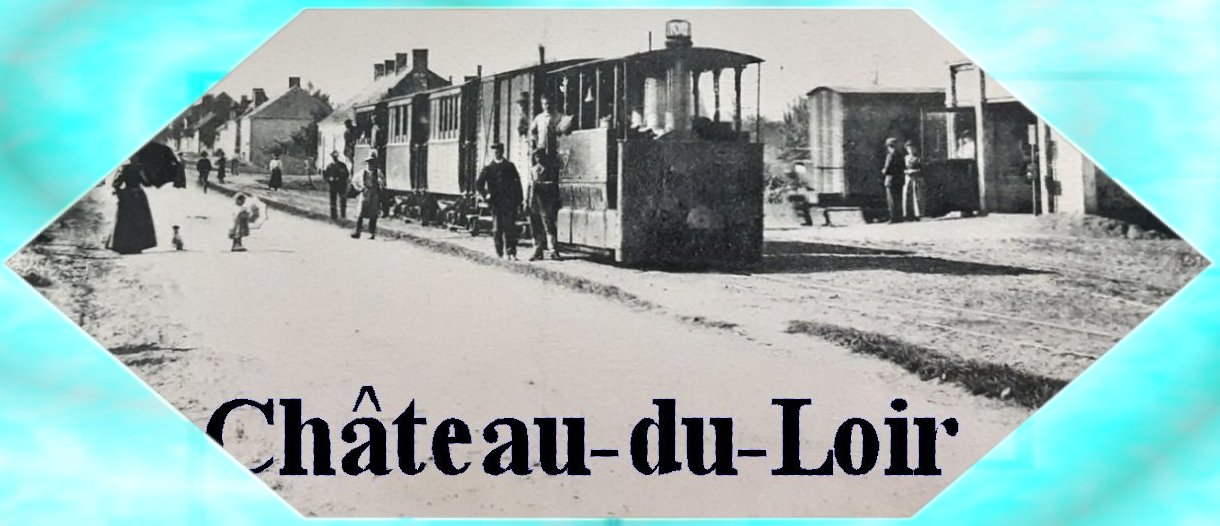 This view, used here and below to separate the CCL sections, shows the Gare de Guécélard on the Mayet line. Note the head sticking out of the 'fourgon' just behind the tram engine. We think this is likely to be the mail-guard.
The Château-du-Loir CCL is provisionally included here, whilst we continue to seek examples of it - and/or information about it.
Notes about the modern era and the
This view, used here and below to separate the CCL sections, shows the Gare de Guécélard on the Mayet line. Note the head sticking out of the 'fourgon' just behind the tram engine. We think this is likely to be the mail-guard.
The Château-du-Loir CCL is provisionally included here, whilst we continue to seek examples of it - and/or information about it.
Notes about the modern era and the 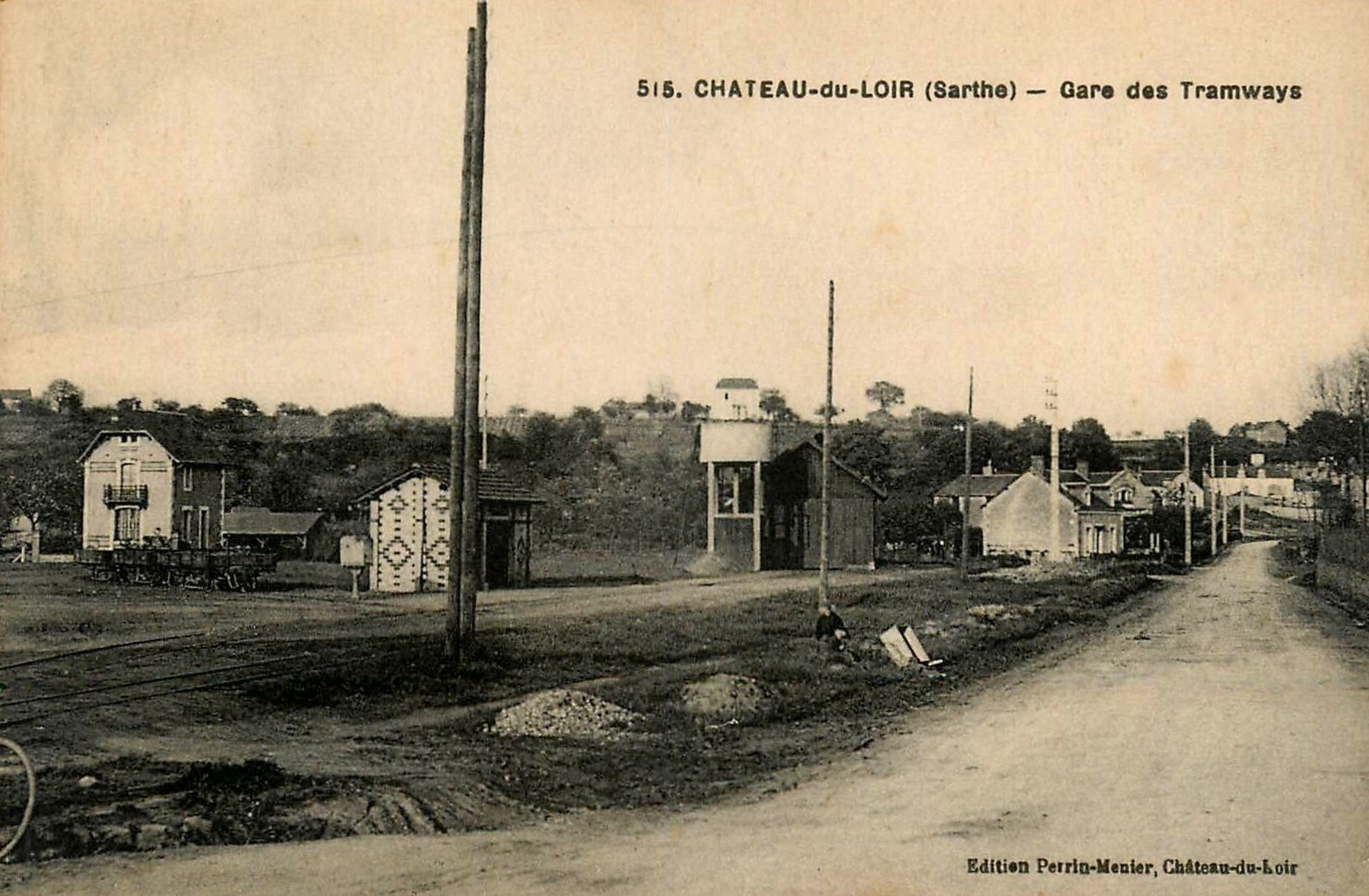 Above is a rare postcard view of the short-lived Tramways de la Sarthe station at Château-du-Loir, which despite appearances here, was, we believe, almost adjacent to the main railway station. Usually, there were three or four passenger trams each way on this line per day, but only two traversed the whole route (taking 3½ hours for the approximately 55 kms).
If this was a Tramways de la Sarthe CCL, this cancellation could only have been in use for the period 1922-32 - and perhaps for only a brief part of this decade. There are no recorded CCL cancellations in Pothion from any of the progression of terminus stations on the line, requiring for example 'Marigné au Mans' or 'Jupilles au Mans' cancellers to be produced. La Poste could have introduced these between 1913 and 1920 as the branch was extended, if it was dissatisfied with existing postal arrangements in that area, but appears not to have done so.
Château-du-Loir au Mans Type III [ . ] (possibly tramway, possibly railway).
.
Above is a rare postcard view of the short-lived Tramways de la Sarthe station at Château-du-Loir, which despite appearances here, was, we believe, almost adjacent to the main railway station. Usually, there were three or four passenger trams each way on this line per day, but only two traversed the whole route (taking 3½ hours for the approximately 55 kms).
If this was a Tramways de la Sarthe CCL, this cancellation could only have been in use for the period 1922-32 - and perhaps for only a brief part of this decade. There are no recorded CCL cancellations in Pothion from any of the progression of terminus stations on the line, requiring for example 'Marigné au Mans' or 'Jupilles au Mans' cancellers to be produced. La Poste could have introduced these between 1913 and 1920 as the branch was extended, if it was dissatisfied with existing postal arrangements in that area, but appears not to have done so.
Château-du-Loir au Mans Type III [ . ] (possibly tramway, possibly railway).
.
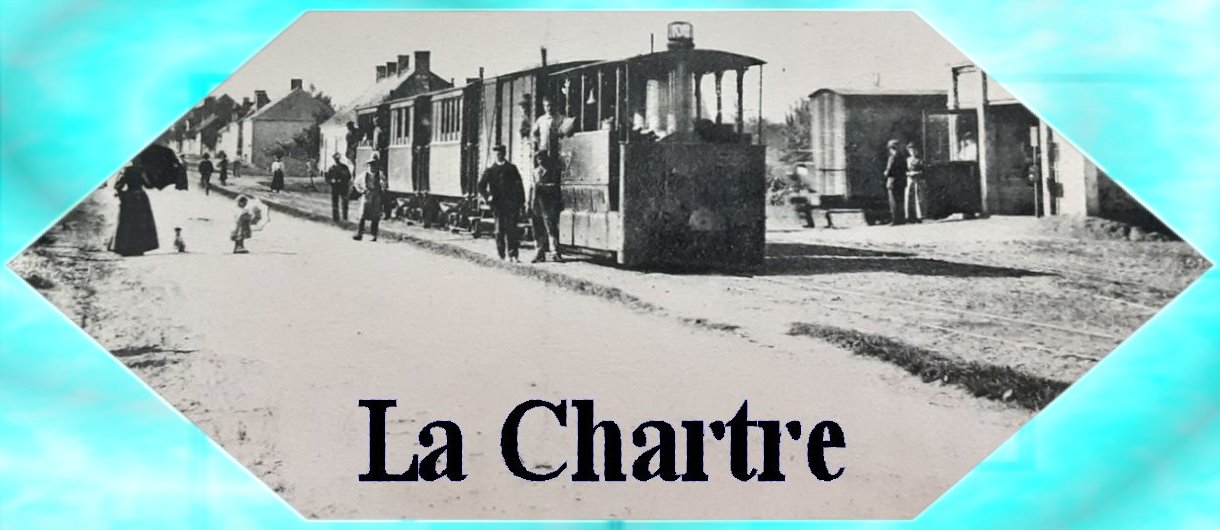
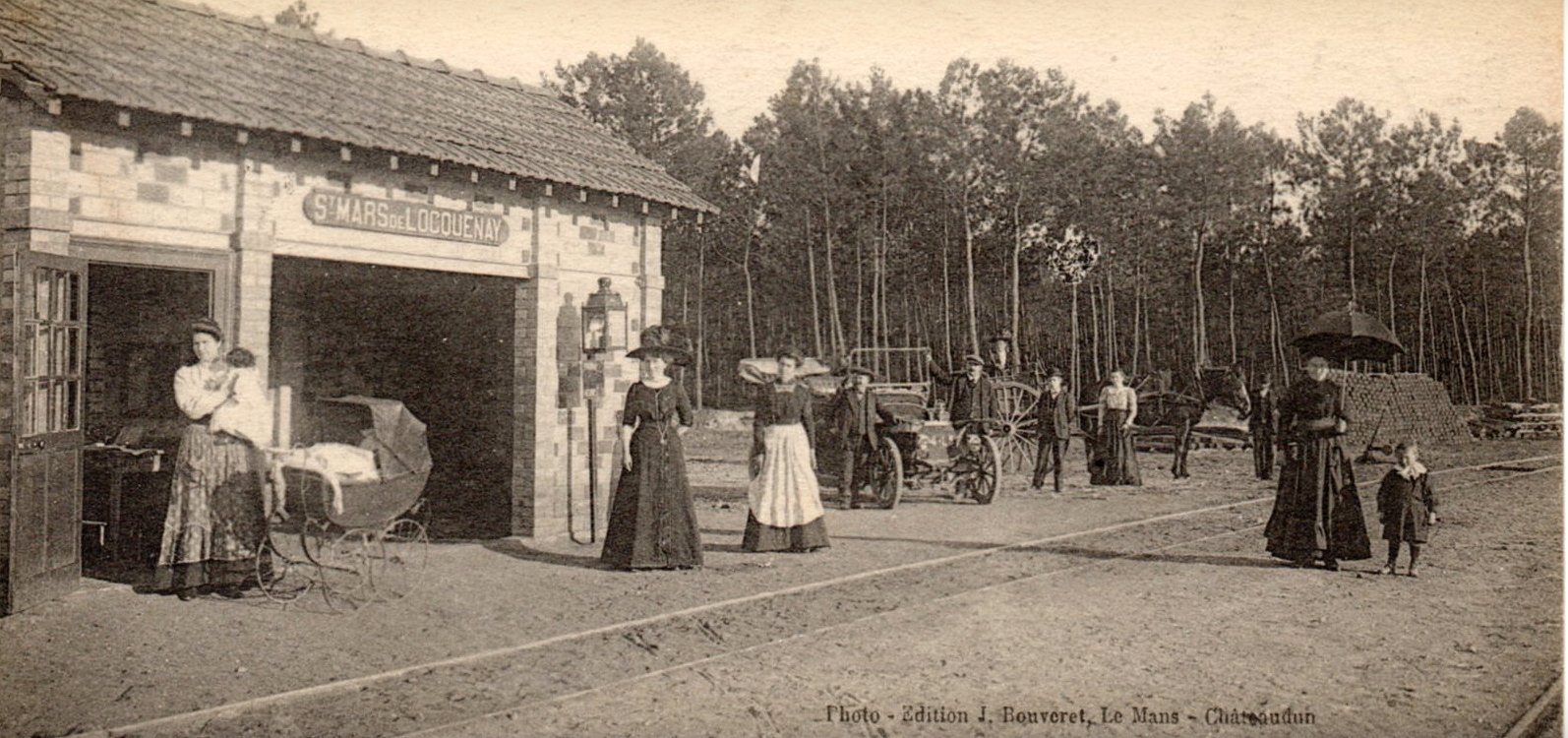 An uncommon and beautifully-framed photo of the station at St-Mars-de-Locquenay, probably taken around 1912-1914 . The card was sent to Maastricht in The Netherlands in 1917 and is postmarked with a Type III La Chartre au Mans CCL, with censor marking.
In terms of passenger-only trains, there were in general three through services on this line in each direction until the early-mid 1930s. Not all would have had a postal fourgon . By the mid-1930s, the service had been reduced to only one passenger tram each way over the full length of the line, a change in timetable which (we suspect) mirrors the cessation of all postal traffic on the line. There were, however, several additional trams in this later period but only between Le Mans and Le-Grand-Lucé. This economisation in services is seen elsewhere on the T.S. system at around the same time, in addition to complete line closures.
Then in, and immediately after, World War II we return to a service of between two and five trams each way over the whole route. This reversal of fortune for the trams, albeit short-lived, may well have been a direct result of a shortage of private road vehicles, and especially of (rationed) petrol, during that period.
.
An uncommon and beautifully-framed photo of the station at St-Mars-de-Locquenay, probably taken around 1912-1914 . The card was sent to Maastricht in The Netherlands in 1917 and is postmarked with a Type III La Chartre au Mans CCL, with censor marking.
In terms of passenger-only trains, there were in general three through services on this line in each direction until the early-mid 1930s. Not all would have had a postal fourgon . By the mid-1930s, the service had been reduced to only one passenger tram each way over the full length of the line, a change in timetable which (we suspect) mirrors the cessation of all postal traffic on the line. There were, however, several additional trams in this later period but only between Le Mans and Le-Grand-Lucé. This economisation in services is seen elsewhere on the T.S. system at around the same time, in addition to complete line closures.
Then in, and immediately after, World War II we return to a service of between two and five trams each way over the whole route. This reversal of fortune for the trams, albeit short-lived, may well have been a direct result of a shortage of private road vehicles, and especially of (rationed) petrol, during that period.
.
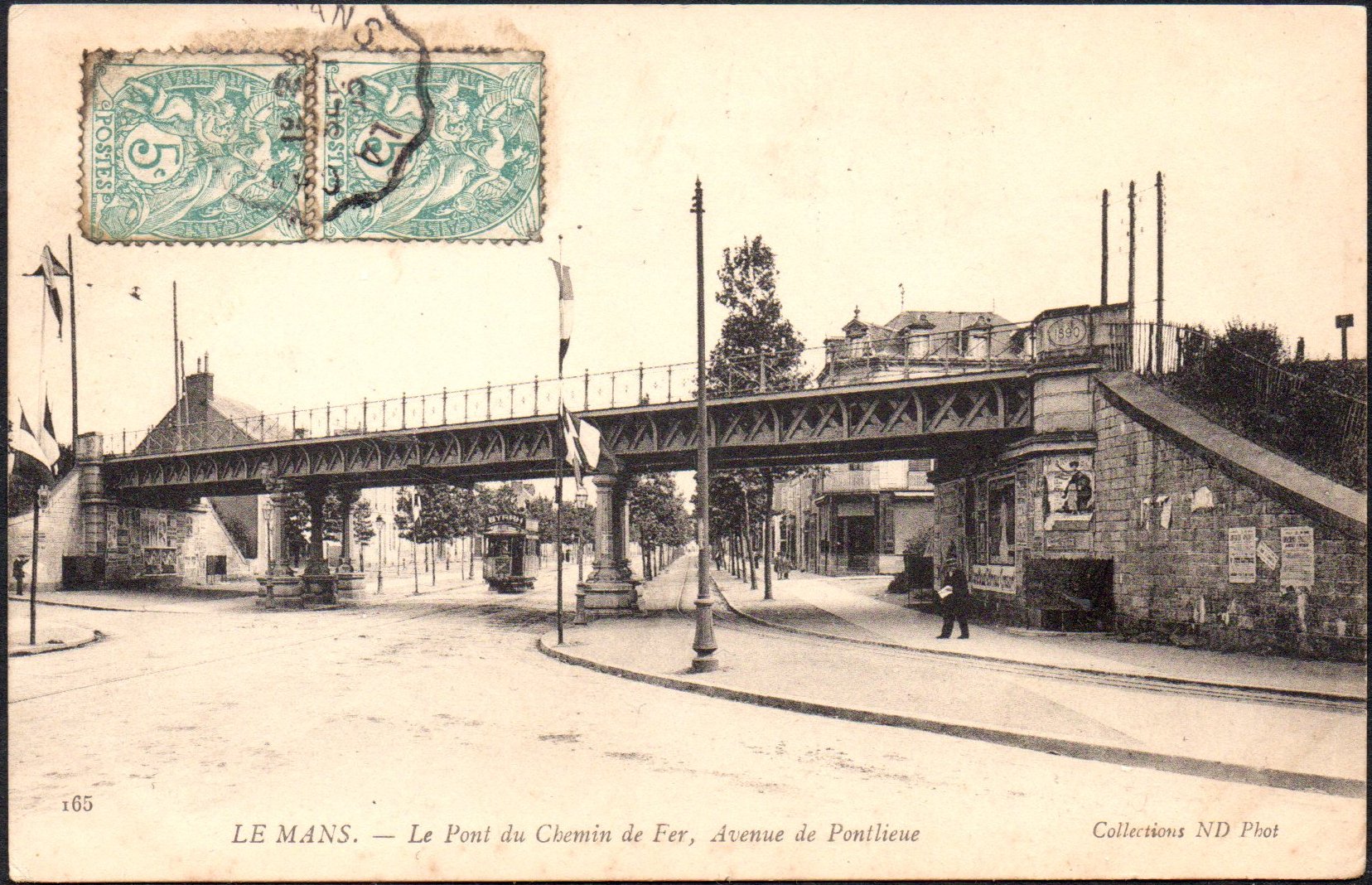
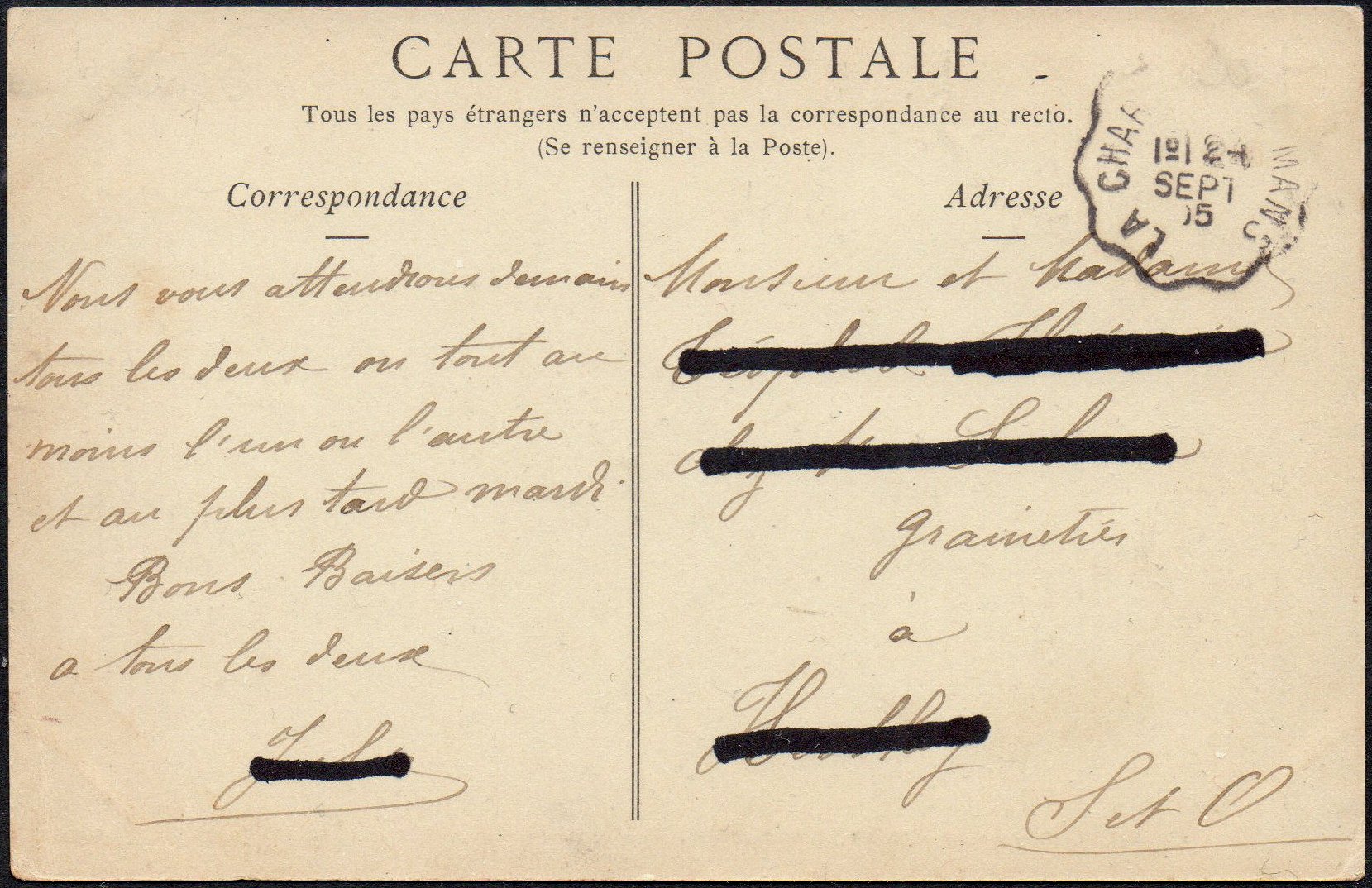 Even in 1905, Pontlieue was a suburb of Le Mans, not a satellite village. The apparent application of the CCL at Pontlieue is unexpected but the card was both urgent and sent on a Sunday (Sept. 24th), which may have influenced the sender's actions. The gist of the message: We are expecting at least one of you tomorrow, failing which Tuesday at the latest).
The bridge carries the mainline railway. The city tram is on track originally laid in the roadway for the T.S. steam trams. However, in order to free up this track for the electric trams, a replacement new line for the T.S. services was laid within the right-hand pavement area; one rail is visible on the card.
Observation: The barring out of names and/or addresses on mail more than a century old has, in our opinion, very little merit.
Even in 1905, Pontlieue was a suburb of Le Mans, not a satellite village. The apparent application of the CCL at Pontlieue is unexpected but the card was both urgent and sent on a Sunday (Sept. 24th), which may have influenced the sender's actions. The gist of the message: We are expecting at least one of you tomorrow, failing which Tuesday at the latest).
The bridge carries the mainline railway. The city tram is on track originally laid in the roadway for the T.S. steam trams. However, in order to free up this track for the electric trams, a replacement new line for the T.S. services was laid within the right-hand pavement area; one rail is visible on the card.
Observation: The barring out of names and/or addresses on mail more than a century old has, in our opinion, very little merit.
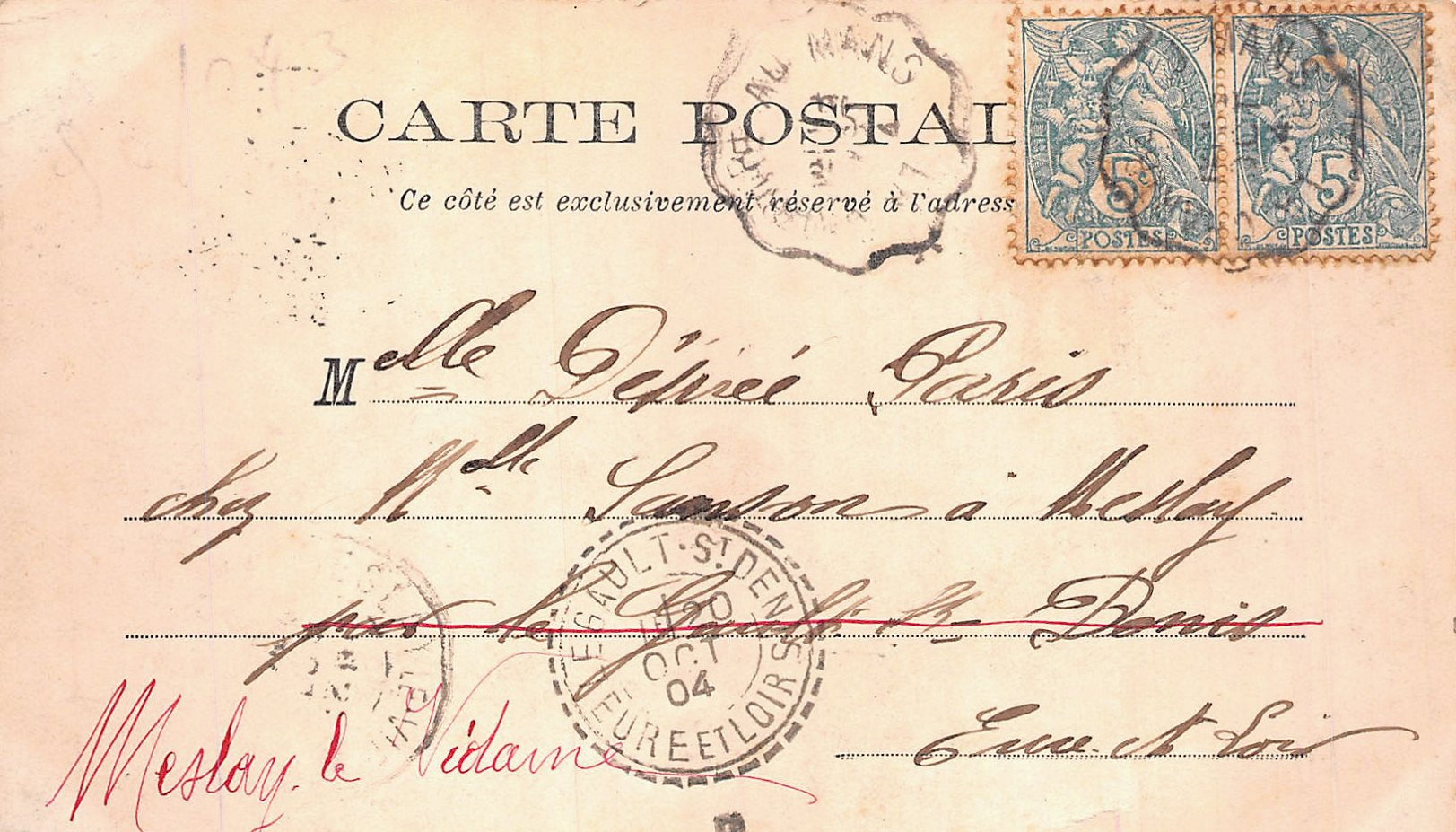
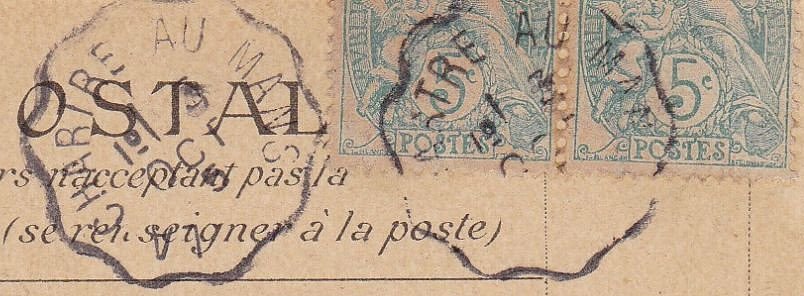 Left : The earliest date we have seen for this cancellation, October 19th, 1904.
Right: This October 1905 'La Chartre au Mans' CCL is on a postcard of Challes, sent to Paris.
Left : The earliest date we have seen for this cancellation, October 19th, 1904.
Right: This October 1905 'La Chartre au Mans' CCL is on a postcard of Challes, sent to Paris.
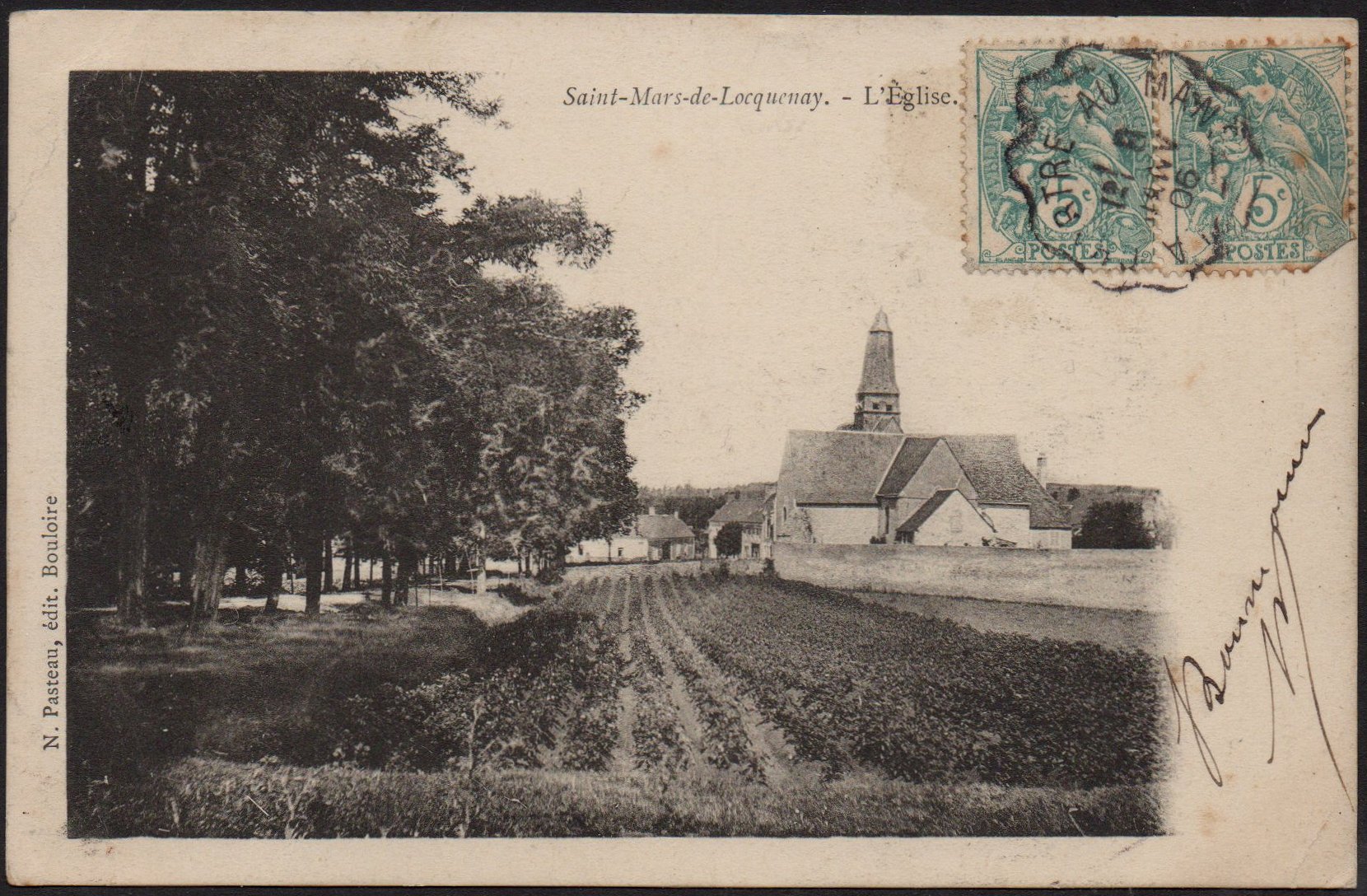
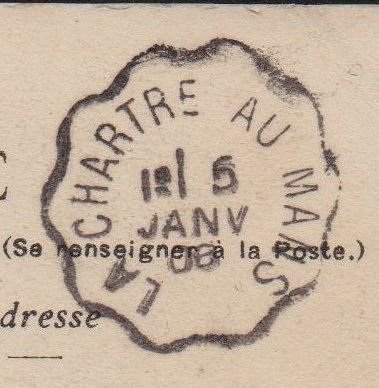 Type II, January 5th, 1906. It is on a postcard of Saint-Mars-de-Locquenay and addressed to Paris.
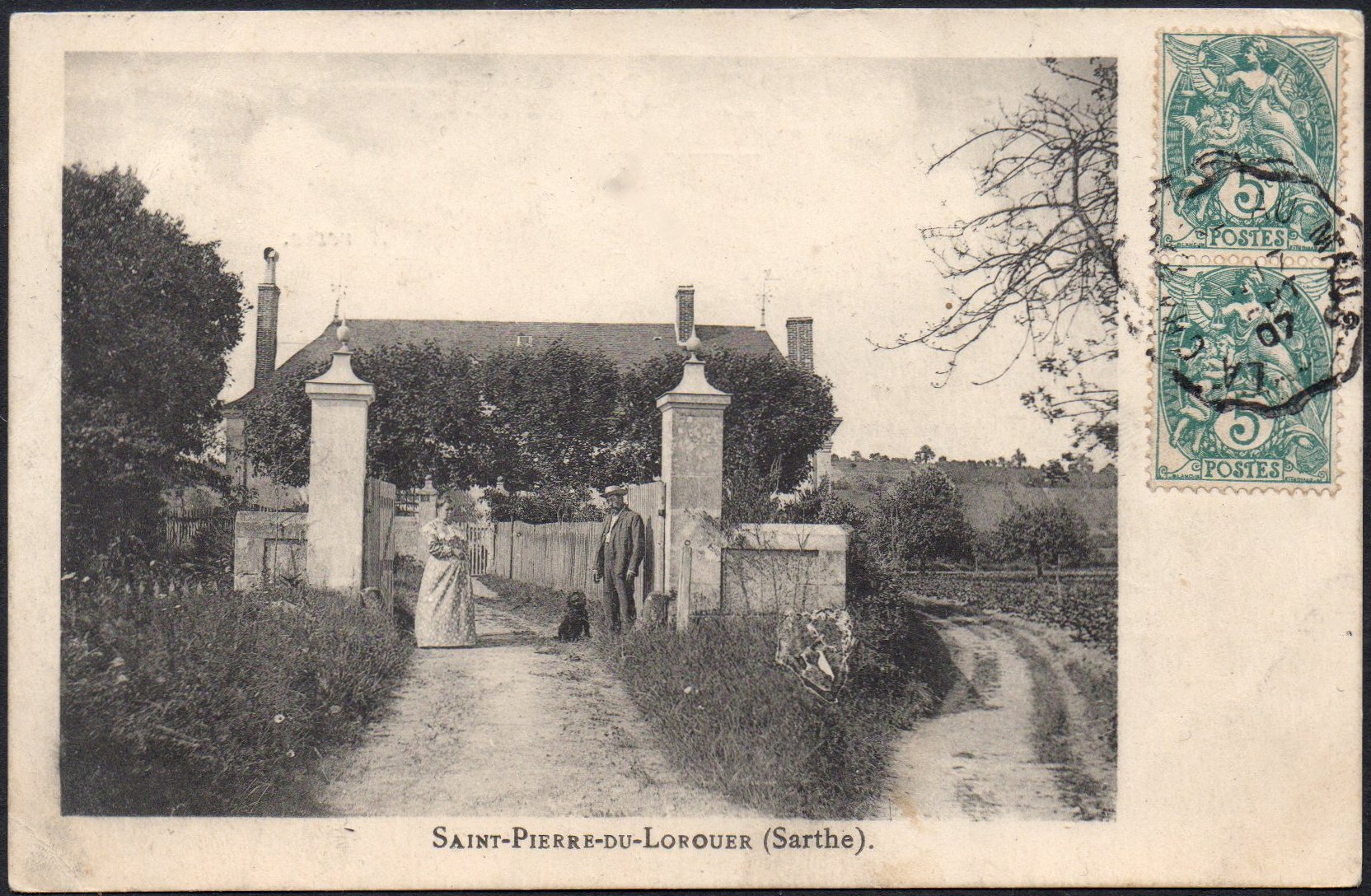
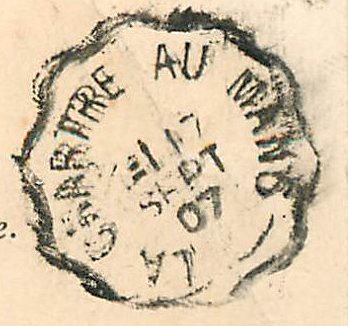 A late usage of the Type II canceller in the Le Mans direction, September 17th 1907.
.
Type II : Direction >> Le Mans à La Chartre
A late usage of the Type II canceller in the Le Mans direction, September 17th 1907.
.
Type II : Direction >> Le Mans à La Chartre
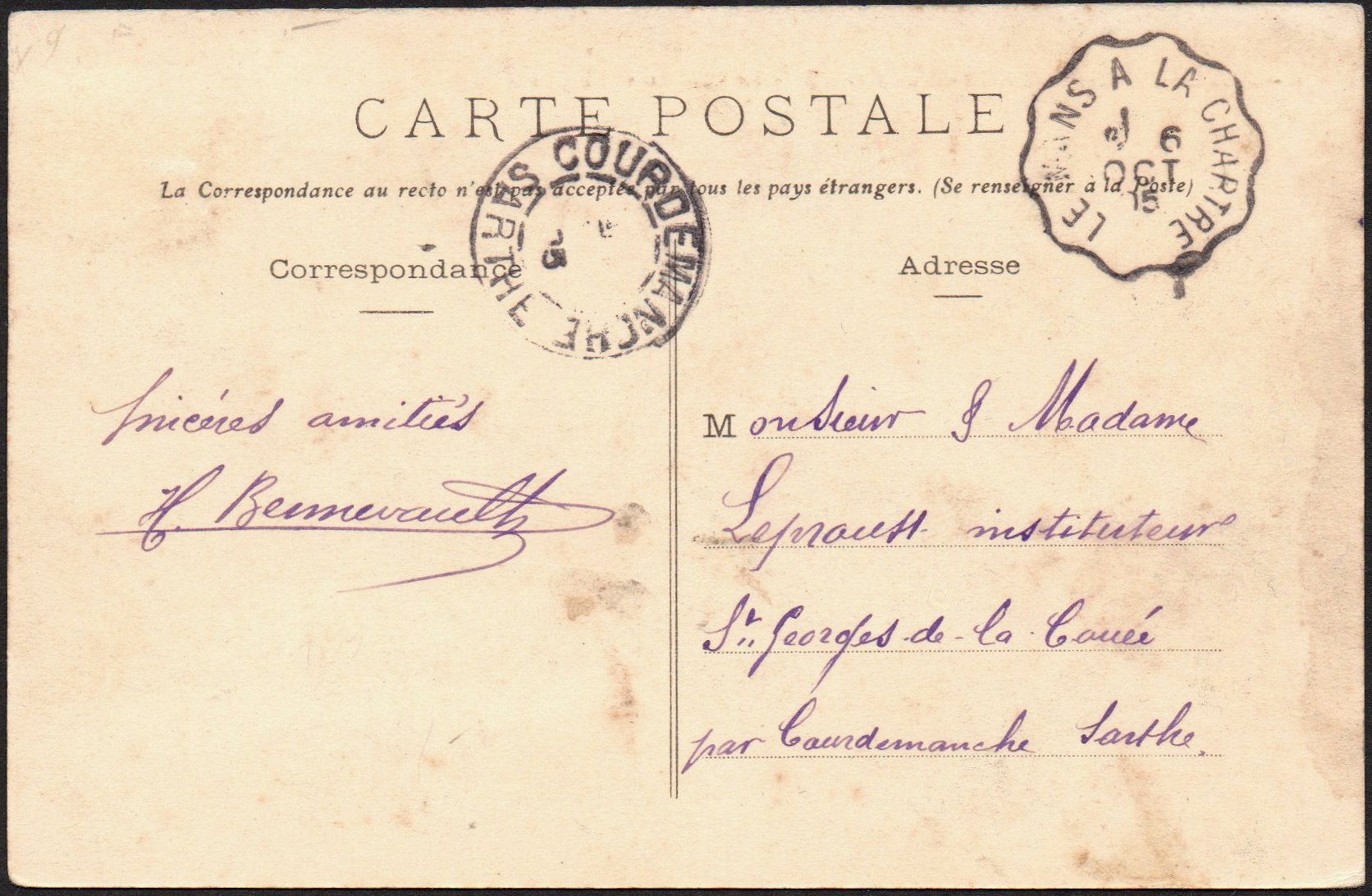 Front (partial) and Back: Sillé-le-Guillaume is north-west of Le Mans near the boundary with Mayenne and on the main line from Brest to Paris. The stamp bears the daytime cancellation of that ambulant service. The card was transferred in Le Mans to the tramway, on which a 'transit' CCL marking was applied on the same October day in 1905 to Courdemanche.
Transit markings are very scarce on T.S. services; indeed, we have not encountered any on some lines. We surmise that they were perhaps required solely on mail which could be routed on the tramway in either direction. The Mayet line appears to have needed them the most and we explore possible reasons why this may have been so in that section.
Front (partial) and Back: Sillé-le-Guillaume is north-west of Le Mans near the boundary with Mayenne and on the main line from Brest to Paris. The stamp bears the daytime cancellation of that ambulant service. The card was transferred in Le Mans to the tramway, on which a 'transit' CCL marking was applied on the same October day in 1905 to Courdemanche.
Transit markings are very scarce on T.S. services; indeed, we have not encountered any on some lines. We surmise that they were perhaps required solely on mail which could be routed on the tramway in either direction. The Mayet line appears to have needed them the most and we explore possible reasons why this may have been so in that section.
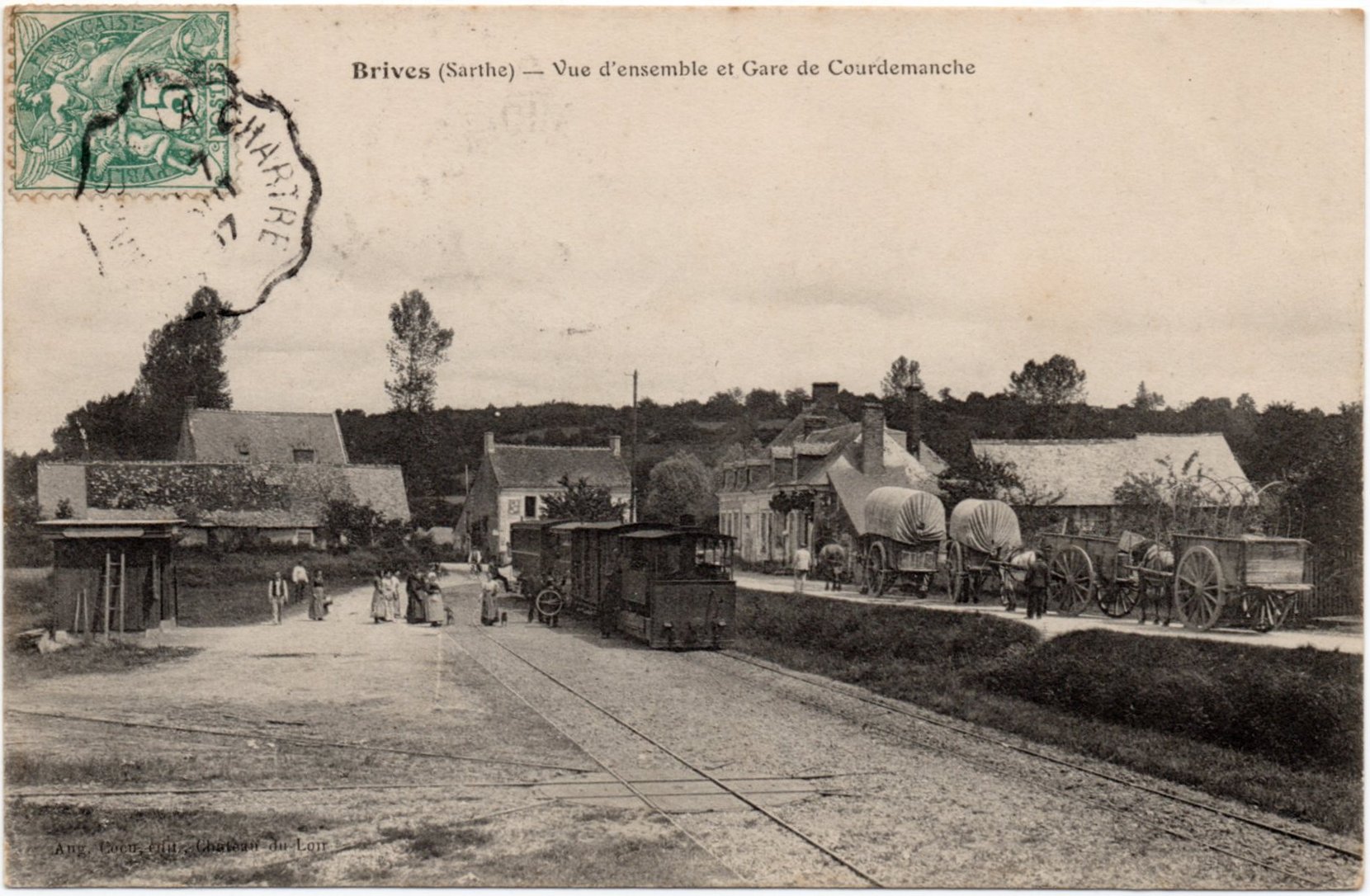
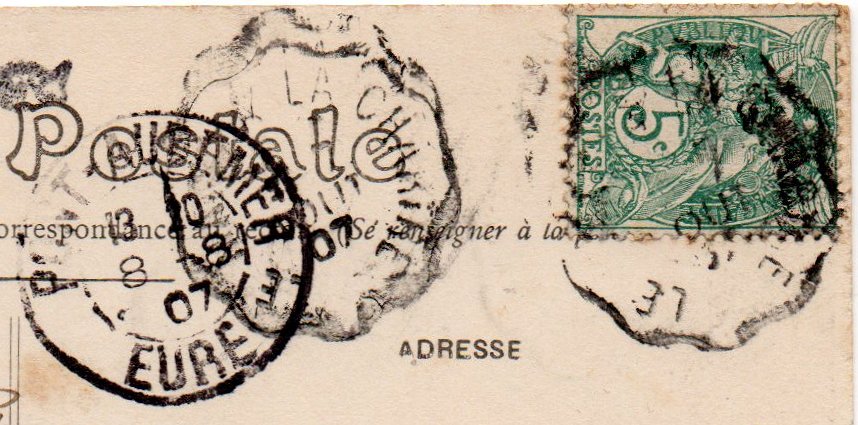 A late usage of the Type II canceller in the La Chartre direction, very scarce. It is on a beautifully-composed postcard view of the Gare de Courdemanche / Brives, sent to Pont Audemer (Eure) on August 7th 1907.
Type II CCL cancellers on this route were replaced relatively quickly with their Type III counterparts and, consequently, are notably scarcer in both directions.
La Chartre au Mans Type II [ . ] (earliest : 10/04 --> latest 09/07)
.
Le Mans à La Chartre Type II [ . ] (earliest 07/05 --> latest 08/07)
Le Mans à La Chartre Type II : TRANSIT : [ . ]
.
Type III : First Format : Direction >> La Chartre au Mans
A late usage of the Type II canceller in the La Chartre direction, very scarce. It is on a beautifully-composed postcard view of the Gare de Courdemanche / Brives, sent to Pont Audemer (Eure) on August 7th 1907.
Type II CCL cancellers on this route were replaced relatively quickly with their Type III counterparts and, consequently, are notably scarcer in both directions.
La Chartre au Mans Type II [ . ] (earliest : 10/04 --> latest 09/07)
.
Le Mans à La Chartre Type II [ . ] (earliest 07/05 --> latest 08/07)
Le Mans à La Chartre Type II : TRANSIT : [ . ]
.
Type III : First Format : Direction >> La Chartre au Mans
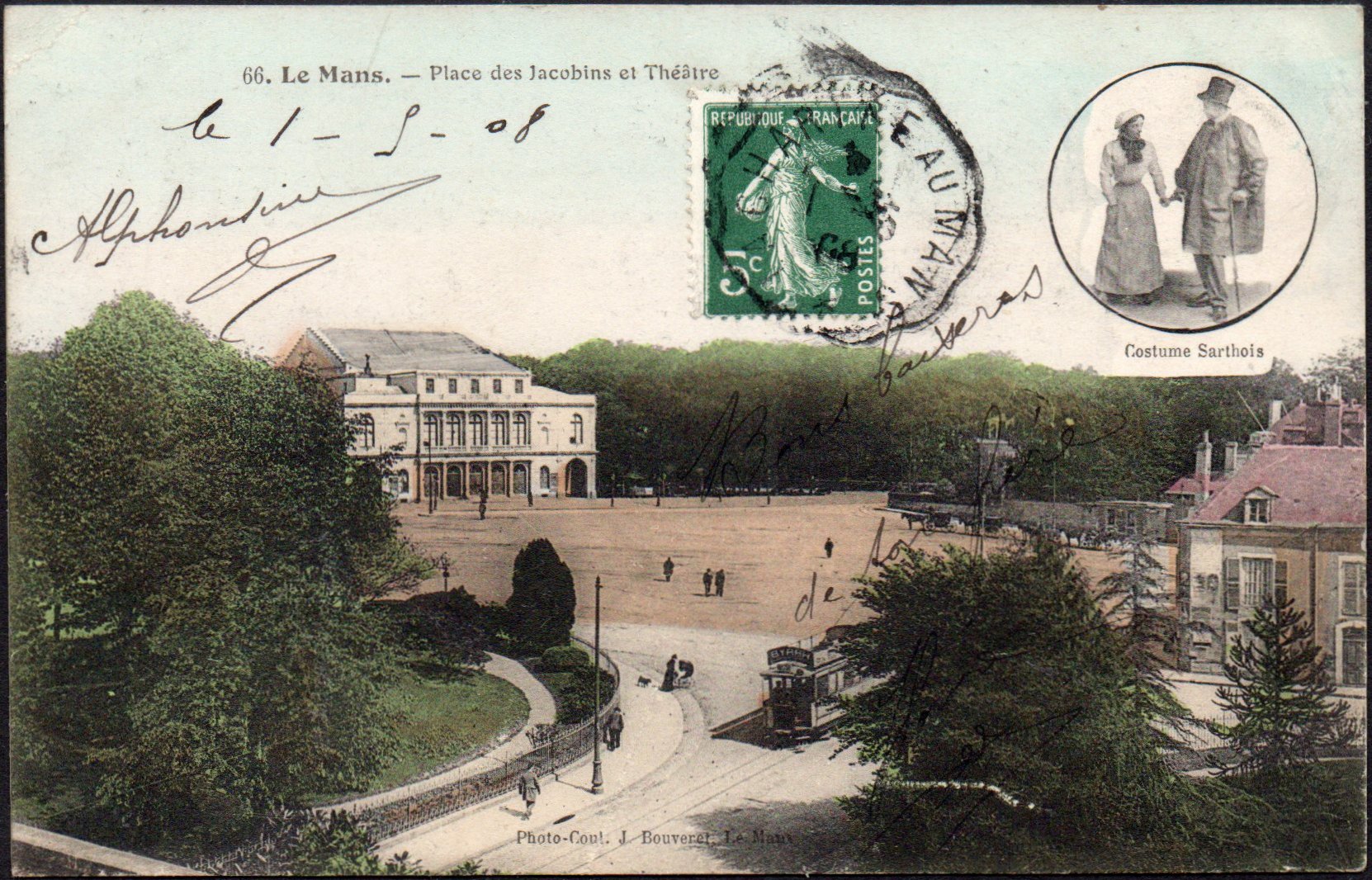
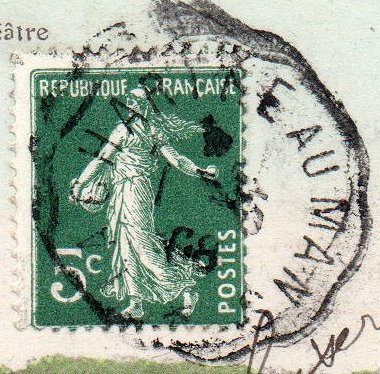 Early usage of the Type III towards Le Mans, May 1908. A Le Mans postcard but presumably not posted there.
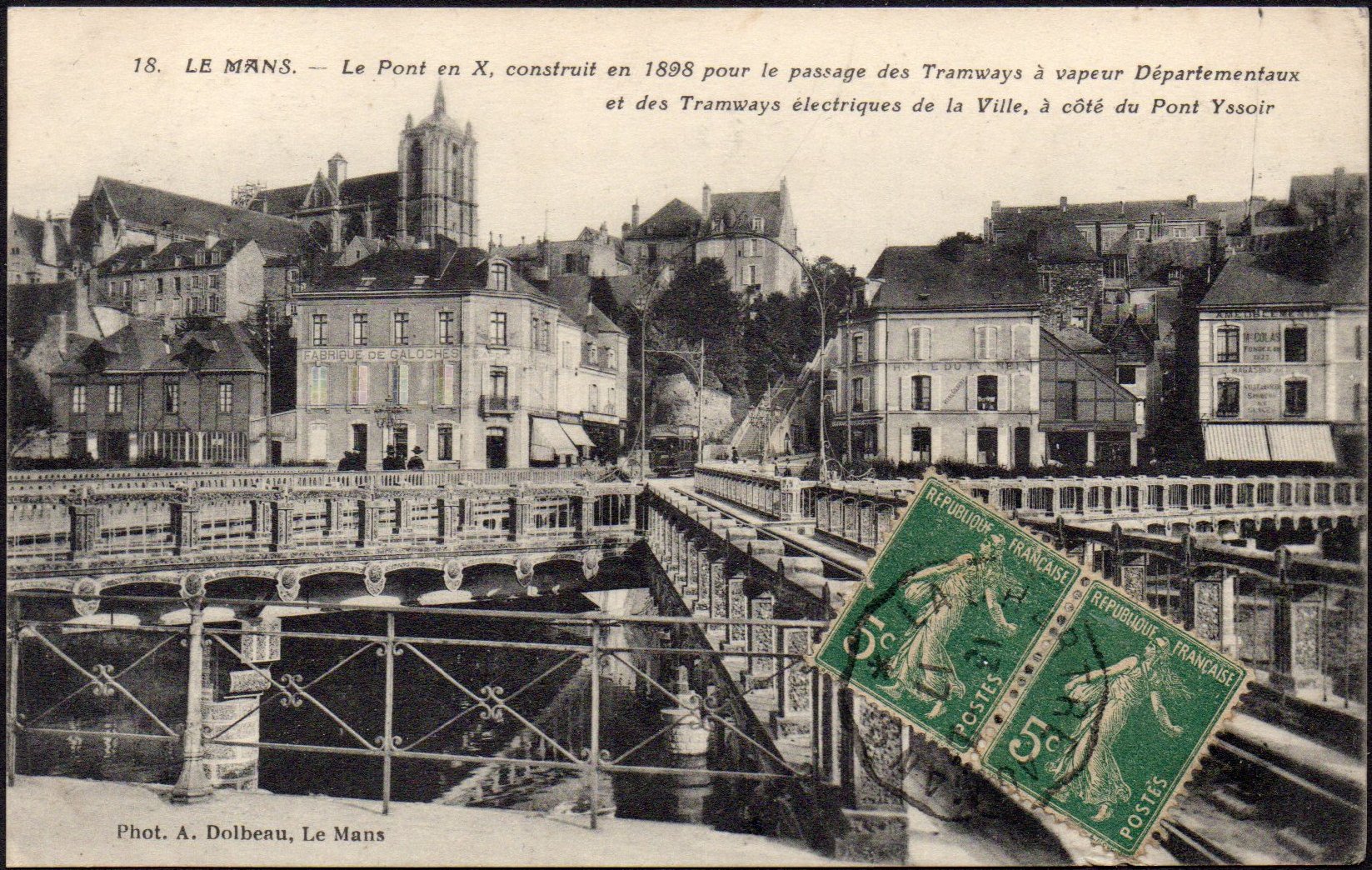
 Postcards such as this with the card's point of origin, Challes, serendipitously provided to us by the sender, attest to the likelihood that this was a tramway CCL. Challes, 20 kilometres from the Gare Centrale, was served only by the tramway.
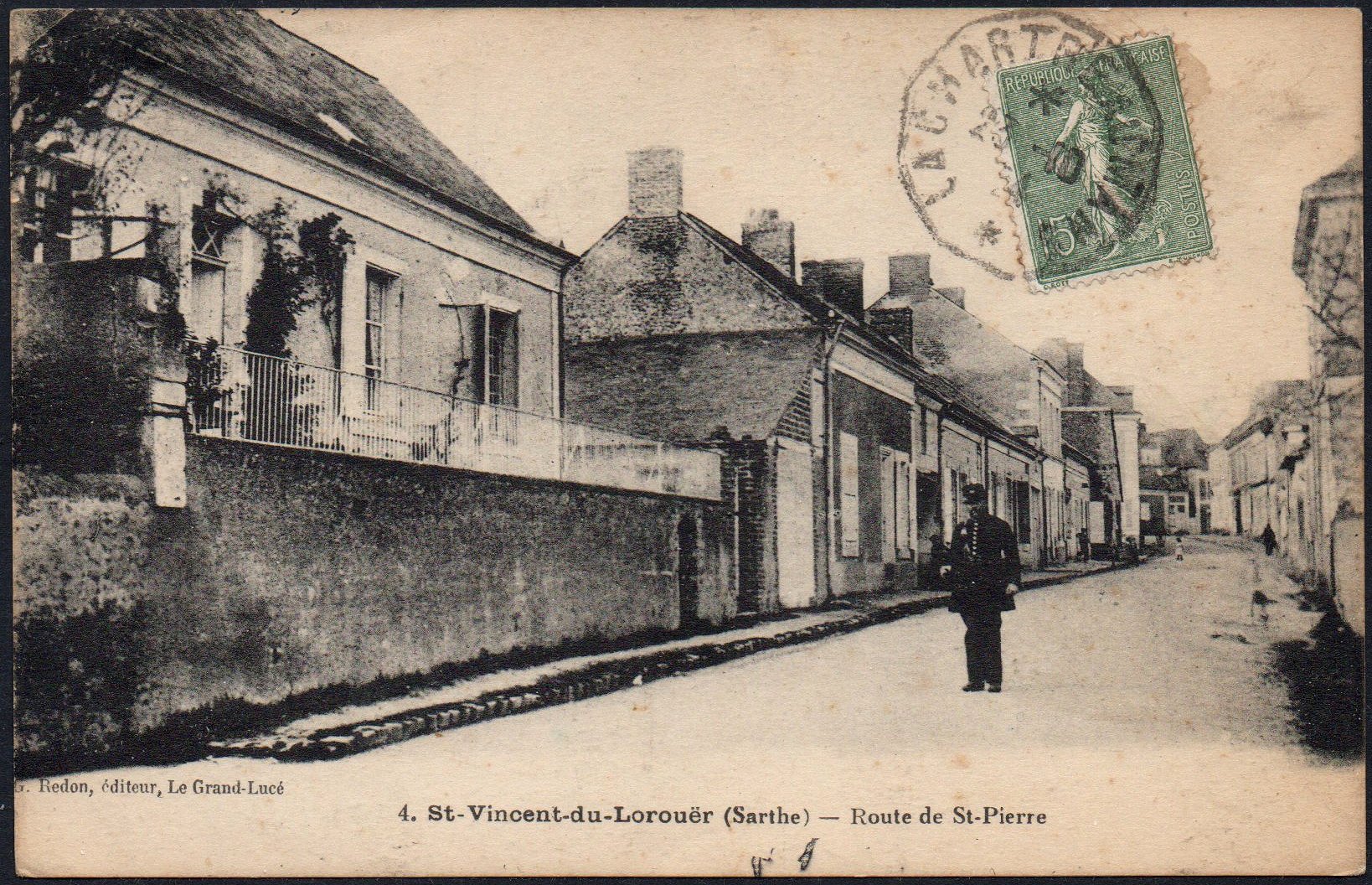
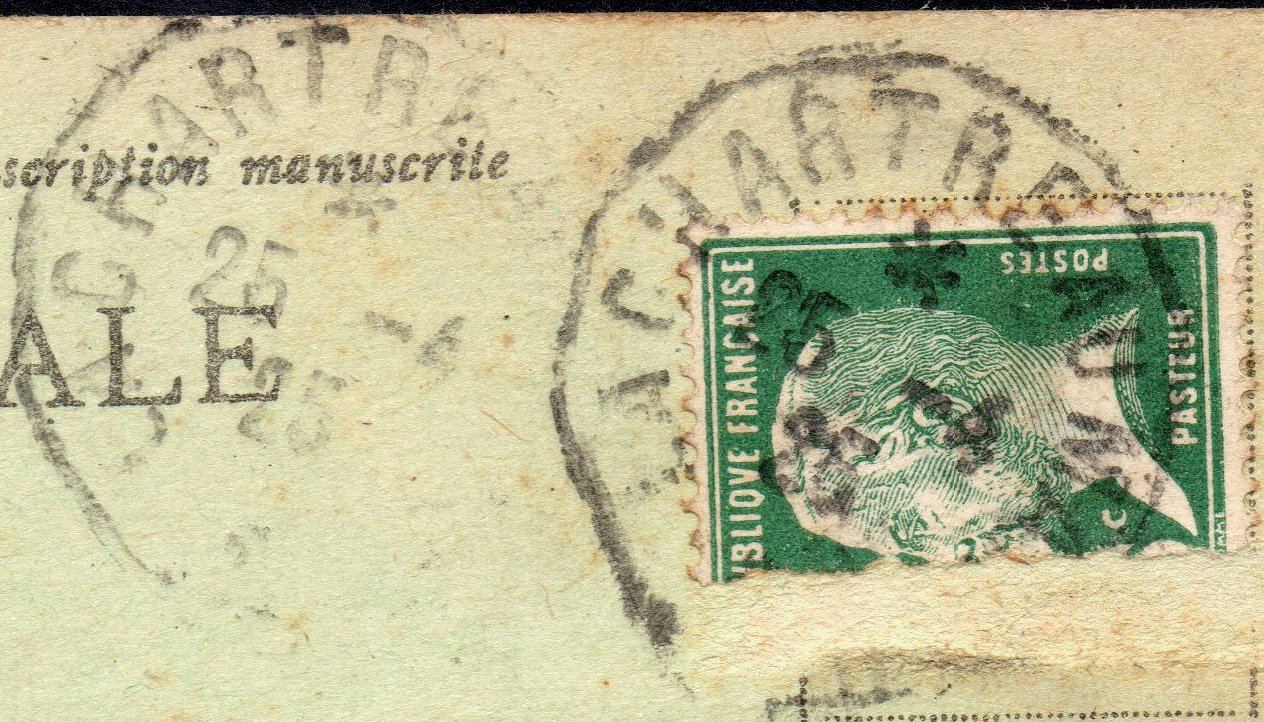 Left: La Chartre au Mans Type III on a card of St-Vincent-du-Lorouër; posted in 1924; it is much sharper in appearance than many at this period. To its right, an April 1925 example on a card of Villaines-sous-Lucey, the latest in this format we have so far seen in this direction. We suspect, though, that it remained in use for about two more years.
We display one further example of the La Chartre au Mans Type III but it is shown in the next section, immediately below, juxtaposed to a card in the opposite direction.
.
Type III : Direction >> Le Mans à La Chartre
Left: La Chartre au Mans Type III on a card of St-Vincent-du-Lorouër; posted in 1924; it is much sharper in appearance than many at this period. To its right, an April 1925 example on a card of Villaines-sous-Lucey, the latest in this format we have so far seen in this direction. We suspect, though, that it remained in use for about two more years.
We display one further example of the La Chartre au Mans Type III but it is shown in the next section, immediately below, juxtaposed to a card in the opposite direction.
.
Type III : Direction >> Le Mans à La Chartre
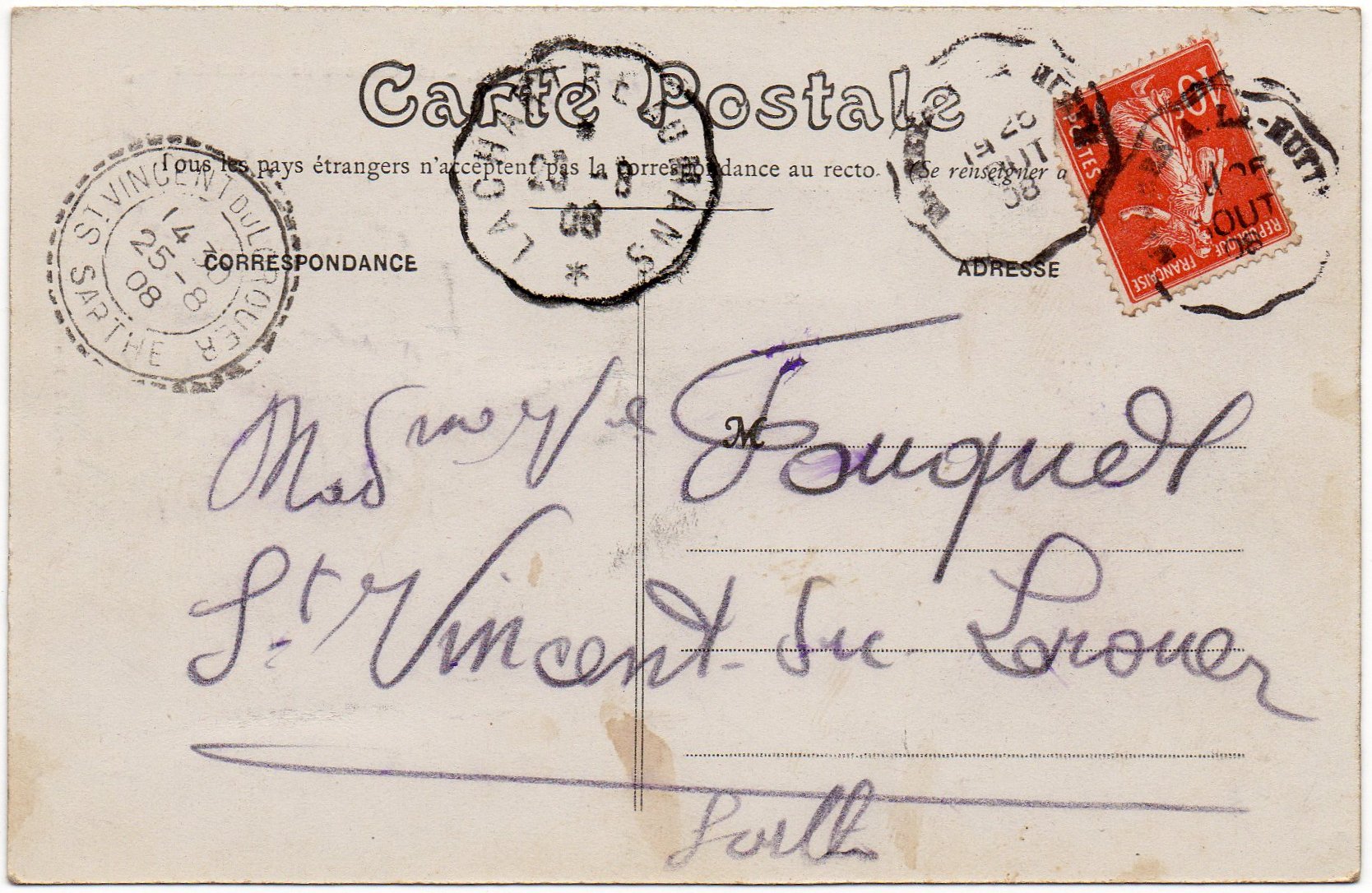
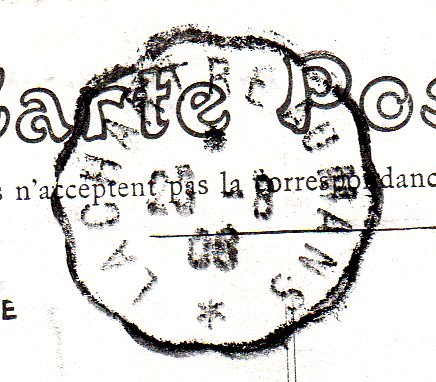 The cards immediately above and below have the same addressee in St Vincent-du-Lorouër. The first card, above, precise point of origin unknown, has taken a circuitous route, first postmarked with a CCL Type 1 from Mamers to La Hutte (a railway CCL). La Hutte is north of Le Mans.
The card has then travelled on from La Hutte, presumably by train and by-passing Le Mans, southwards to La Chartre before heading back north on the T.S. service as far as St. Vincent, all accomplished on the same day.
The cards immediately above and below have the same addressee in St Vincent-du-Lorouër. The first card, above, precise point of origin unknown, has taken a circuitous route, first postmarked with a CCL Type 1 from Mamers to La Hutte (a railway CCL). La Hutte is north of Le Mans.
The card has then travelled on from La Hutte, presumably by train and by-passing Le Mans, southwards to La Chartre before heading back north on the T.S. service as far as St. Vincent, all accomplished on the same day.
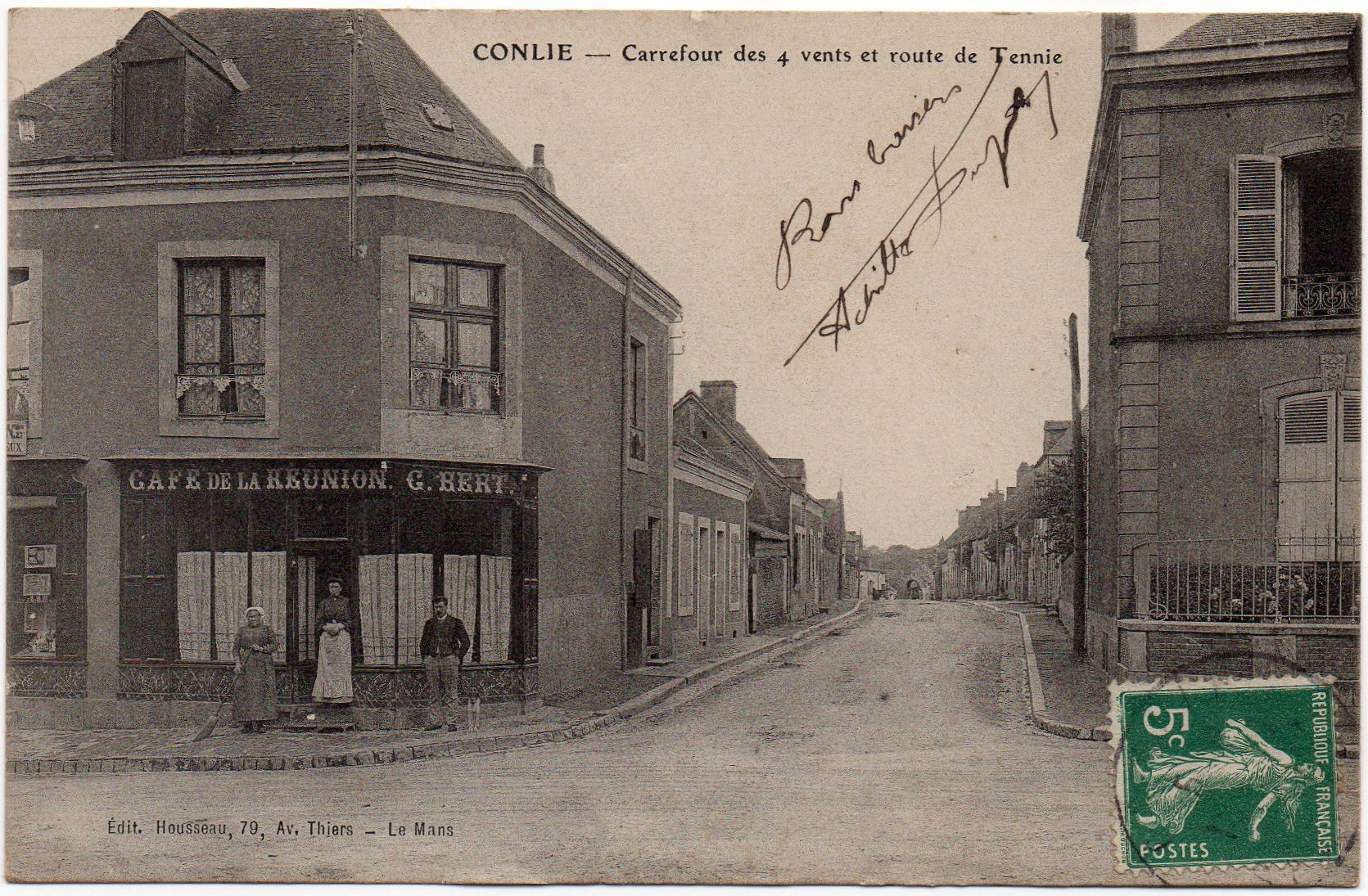
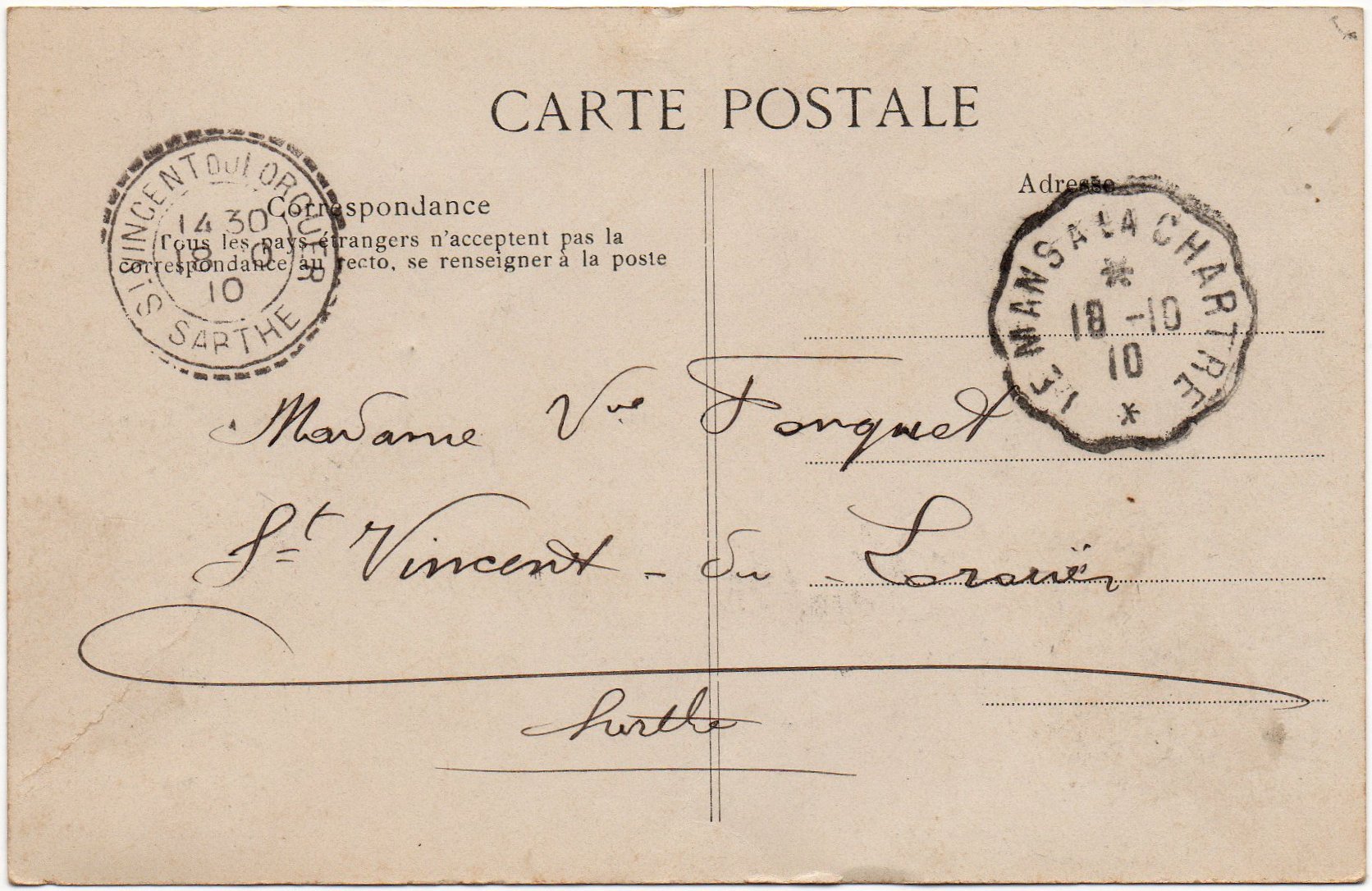 Front & Back views : On this card, travelling the other way on the La Chartre line, the departure point appears to be Conlie (the cancellation on the 5c stamp is indecipherable). Conlie is a town north-west of Le Mans, and Le Mans was presumably the next port-of-call for the card.
How the card was transferred there from the mainline railway station to the T.S's Gare Centrale about a kilometre away is not known to us, but it acquired the 'outward' transit marking 'Le Mans à La Chartre' (Type III).
The fact that both cards above probably started their journey north of Le Mans but reached Saint-Vincent-du-Lorouër on trams travelling in opposite directions, seems to provide a good indication as to why transit markings are occasionally found on this line. The requirement for a transit mark probably applied only to mail transferred to the trams at the terminus stations.
Front & Back views : On this card, travelling the other way on the La Chartre line, the departure point appears to be Conlie (the cancellation on the 5c stamp is indecipherable). Conlie is a town north-west of Le Mans, and Le Mans was presumably the next port-of-call for the card.
How the card was transferred there from the mainline railway station to the T.S's Gare Centrale about a kilometre away is not known to us, but it acquired the 'outward' transit marking 'Le Mans à La Chartre' (Type III).
The fact that both cards above probably started their journey north of Le Mans but reached Saint-Vincent-du-Lorouër on trams travelling in opposite directions, seems to provide a good indication as to why transit markings are occasionally found on this line. The requirement for a transit mark probably applied only to mail transferred to the trams at the terminus stations.
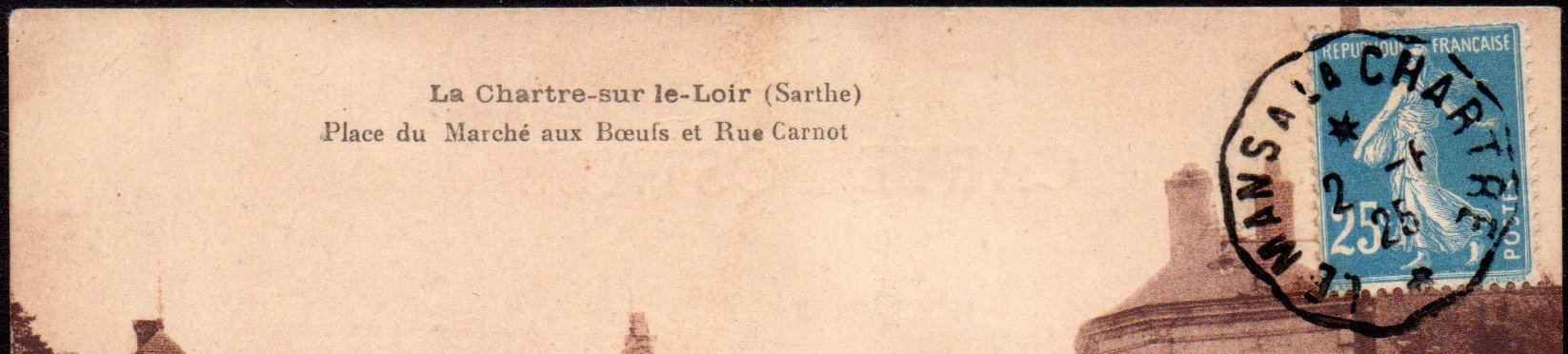 This is a slightly mysterious item, a card of La Chartre, addressed to the Rue Gambetta in Le Mans, which was adjacent to La Gare Centrale in that city, yet with the cancellation for a tram outward-bound from Le Mans. The simplest explanation might be that it was postmarked with the wrong canceller. Whatever the case, it has provided us with a very fine, sharp June 1925 strike of the 'outward' Type III.
Postcard views of intermediate towns on this tramline that we have seen with this cancellation (in all its forms) include: Changé; Challes; Le Grand-Lucé; Parigné l'Evêque; St-Georges-de-la-Couée; St Mars de Loquenay and St-Vincent-du-Lorouër.
This is a slightly mysterious item, a card of La Chartre, addressed to the Rue Gambetta in Le Mans, which was adjacent to La Gare Centrale in that city, yet with the cancellation for a tram outward-bound from Le Mans. The simplest explanation might be that it was postmarked with the wrong canceller. Whatever the case, it has provided us with a very fine, sharp June 1925 strike of the 'outward' Type III.
Postcard views of intermediate towns on this tramline that we have seen with this cancellation (in all its forms) include: Changé; Challes; Le Grand-Lucé; Parigné l'Evêque; St-Georges-de-la-Couée; St Mars de Loquenay and St-Vincent-du-Lorouër.
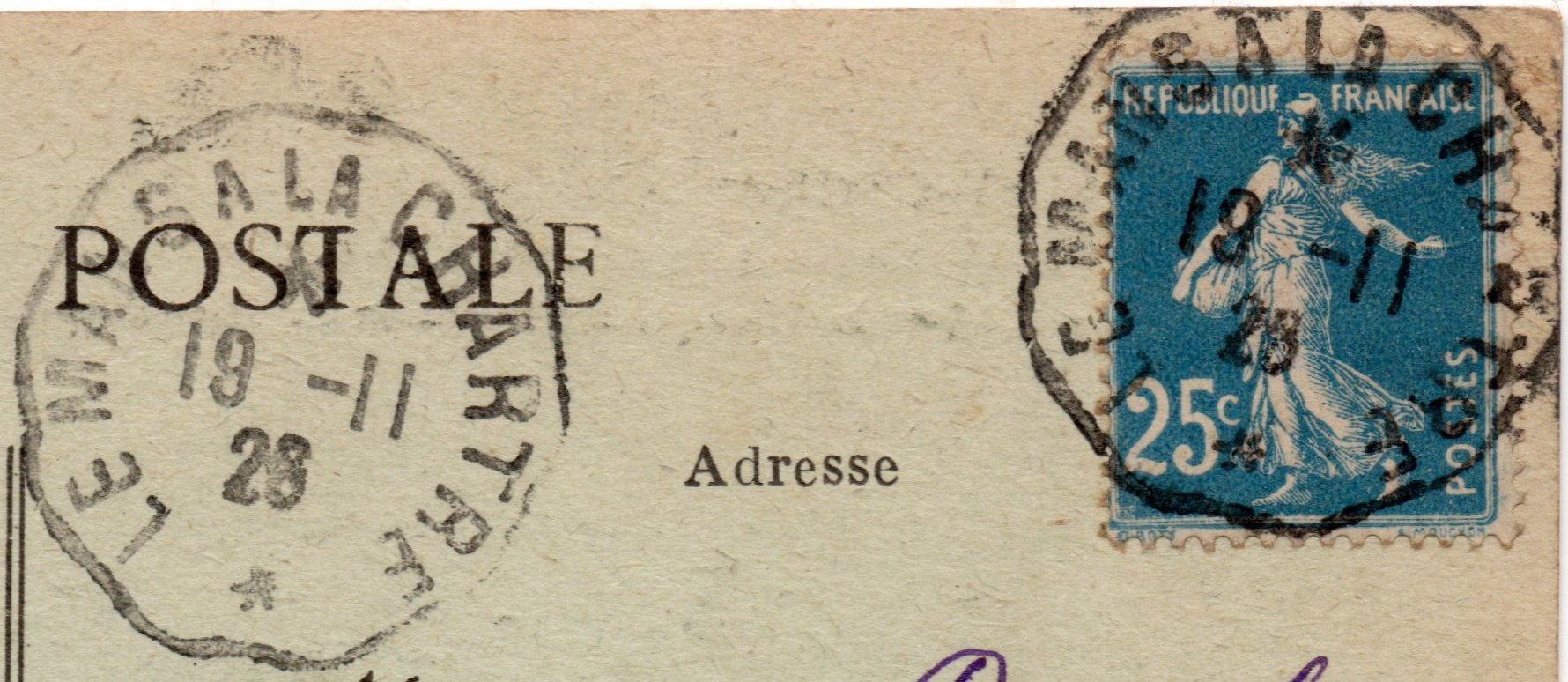 Late Usage: The postcard above provides the latest date for a Type III 'Le Mans à La Chartre' that we have so far seen. We think it is dated 1926 rather than 1928, but it is not 100% clear. The postcard is of Saint-Georges-de-la-Couée.
La Chartre au Mans Type III [ . ] (earliest : 05/08 --> latest 04/25)
La Chartre au Mans Type III : TRANSIT : [ . ]
.
Le Mans à La Chartre Type III [ . ] (earliest : 08/08 --> latest 11/26)
Le Mans à La Chartre Type III : TRANSIT : [ . ]
.
Late Usage: The postcard above provides the latest date for a Type III 'Le Mans à La Chartre' that we have so far seen. We think it is dated 1926 rather than 1928, but it is not 100% clear. The postcard is of Saint-Georges-de-la-Couée.
La Chartre au Mans Type III [ . ] (earliest : 05/08 --> latest 04/25)
La Chartre au Mans Type III : TRANSIT : [ . ]
.
Le Mans à La Chartre Type III [ . ] (earliest : 08/08 --> latest 11/26)
Le Mans à La Chartre Type III : TRANSIT : [ . ]
.
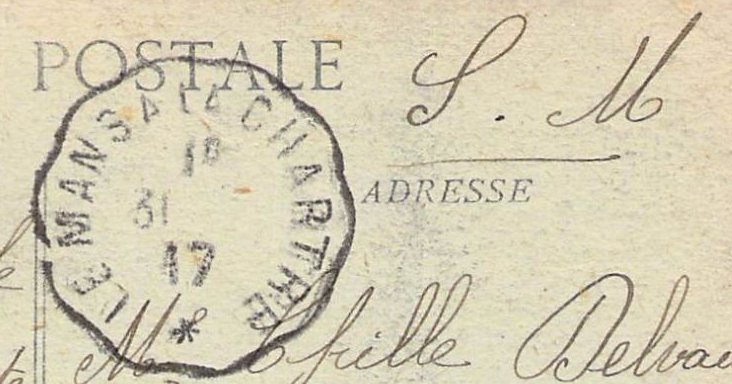
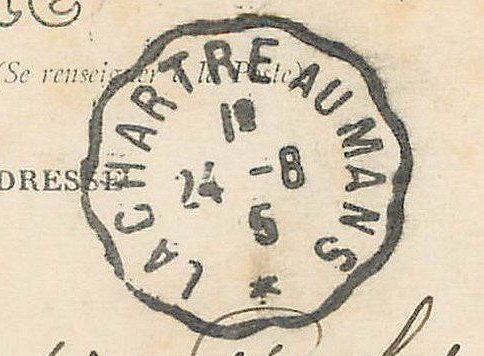
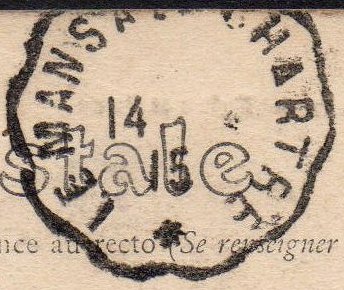 Left : An example of a service number replacing the top asterisk on a Type III CCL in 1917.
Centre : A similar example in the opposite direction. The year is incomplete and almost certainly should read (19)15.
Right : An example with, apparently, a blank field at the top, a card sent from Saint-Vincent-du-Lorouër on April 14th 1915 by a civilian to a soldier. The card once had an adhesive which has been removed.
At this period, La Sarthe, which was well away from The Front, clearly contained a significant array of army camps, hospitals and recovery centres. These generated a large number of stampless postcards from the département with manuscript F.M. (Franchise Militaire) or S.M. (Service Militaire) markings.
The La Chartre line CCLs are interesting in many ways. The short-lived Type II has a duty/service number, as is standard on Type II cancels, but as soon as the Type III is introduced, the top field in the new style contains either an asterisk or a blank field, suggesting that there was only one service and no need to add superfluous numbers.
However, all but one of the CCL on this line that we have seen between (October) 1914 and 1918 have either a 1⁰, which appears much the more common, or 2⁰ service identifier. One, shown above, has a blank field. By the 1920s, we are back to an asterisk. This suggests that the start of the war in July 1914 led quickly to the doubling of the CCL services on this line, most likely due to the presence of the numerous army camps in the area.
.
Left : An example of a service number replacing the top asterisk on a Type III CCL in 1917.
Centre : A similar example in the opposite direction. The year is incomplete and almost certainly should read (19)15.
Right : An example with, apparently, a blank field at the top, a card sent from Saint-Vincent-du-Lorouër on April 14th 1915 by a civilian to a soldier. The card once had an adhesive which has been removed.
At this period, La Sarthe, which was well away from The Front, clearly contained a significant array of army camps, hospitals and recovery centres. These generated a large number of stampless postcards from the département with manuscript F.M. (Franchise Militaire) or S.M. (Service Militaire) markings.
The La Chartre line CCLs are interesting in many ways. The short-lived Type II has a duty/service number, as is standard on Type II cancels, but as soon as the Type III is introduced, the top field in the new style contains either an asterisk or a blank field, suggesting that there was only one service and no need to add superfluous numbers.
However, all but one of the CCL on this line that we have seen between (October) 1914 and 1918 have either a 1⁰, which appears much the more common, or 2⁰ service identifier. One, shown above, has a blank field. By the 1920s, we are back to an asterisk. This suggests that the start of the war in July 1914 led quickly to the doubling of the CCL services on this line, most likely due to the presence of the numerous army camps in the area.
.
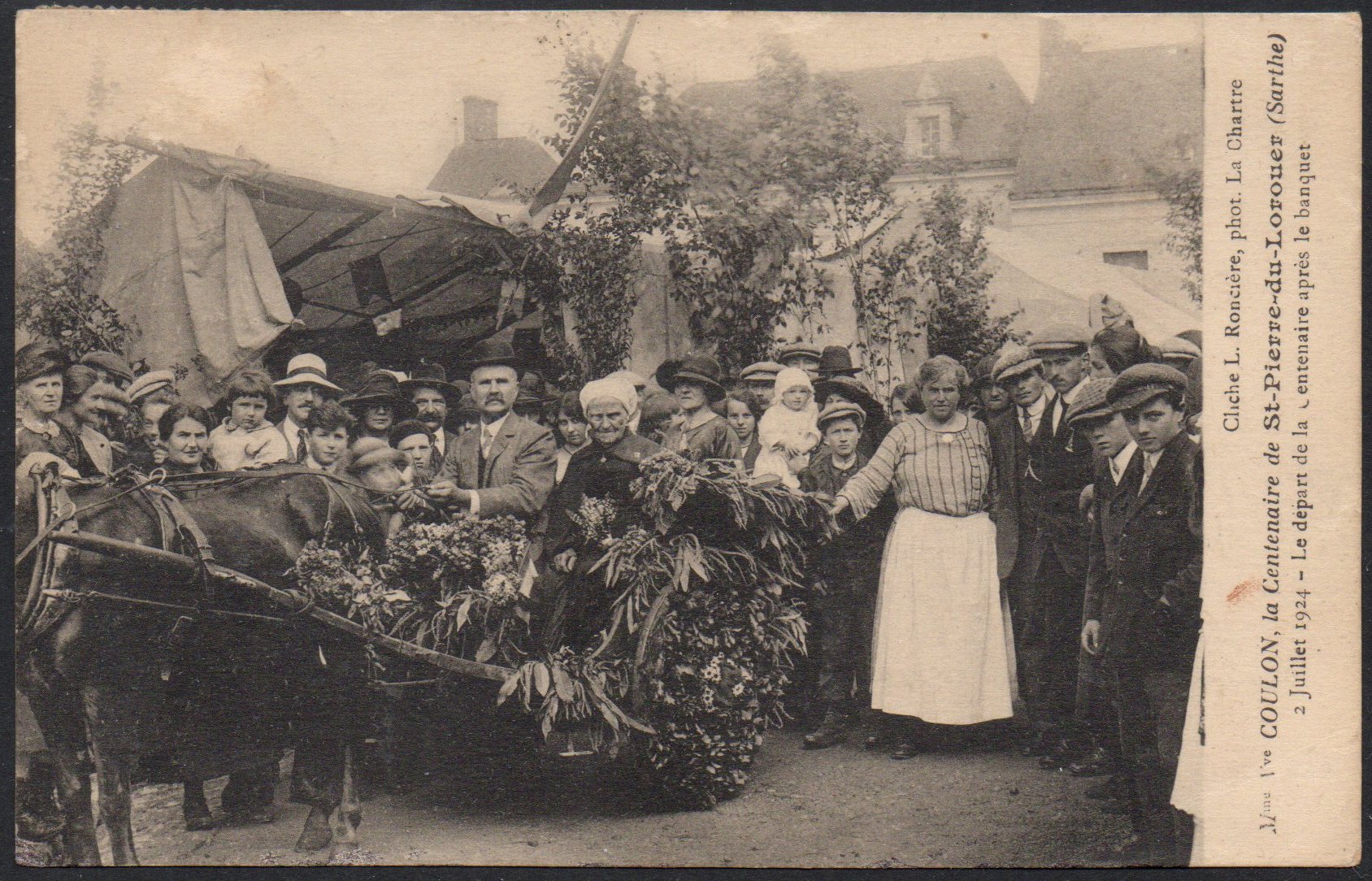
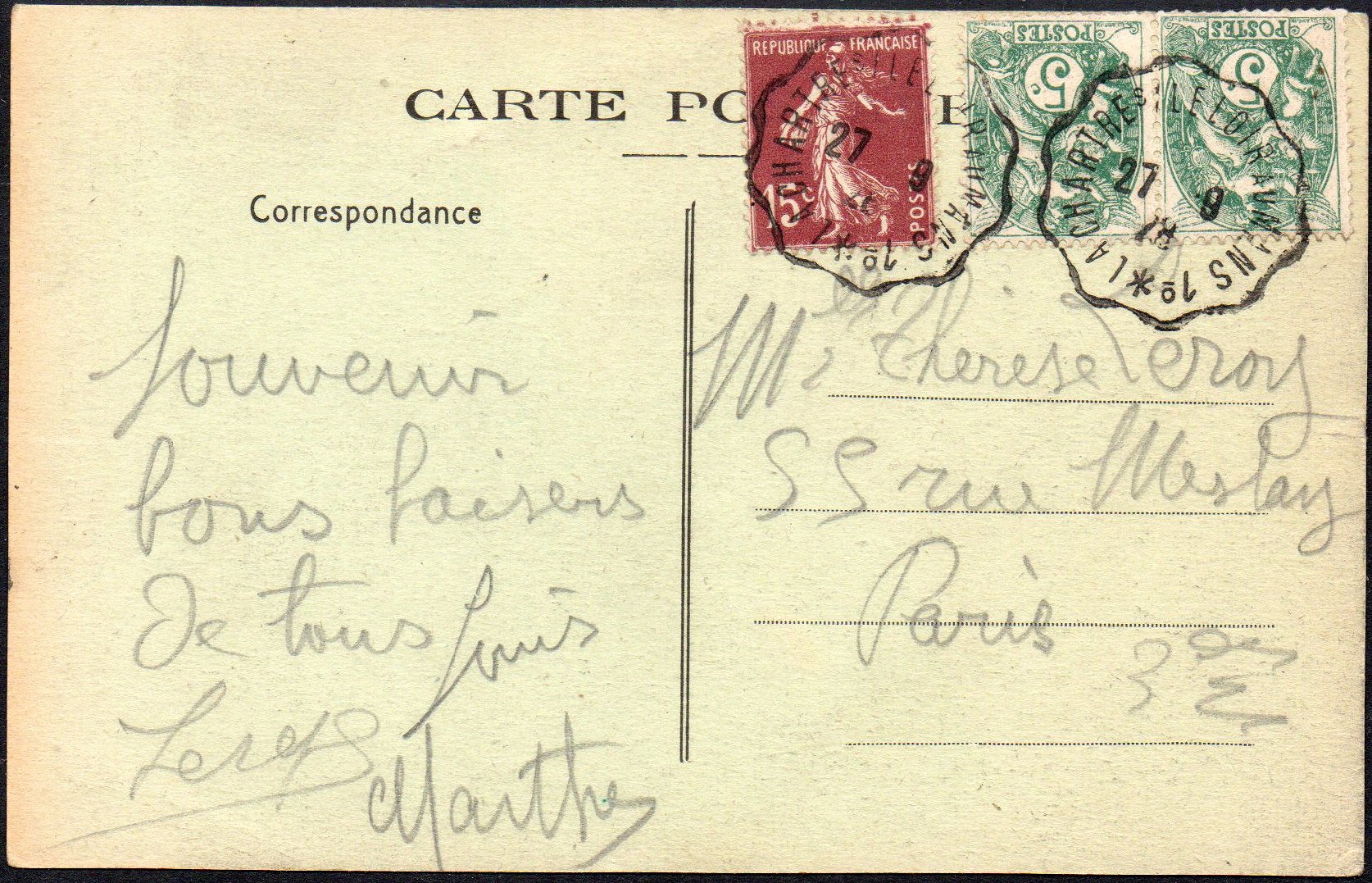
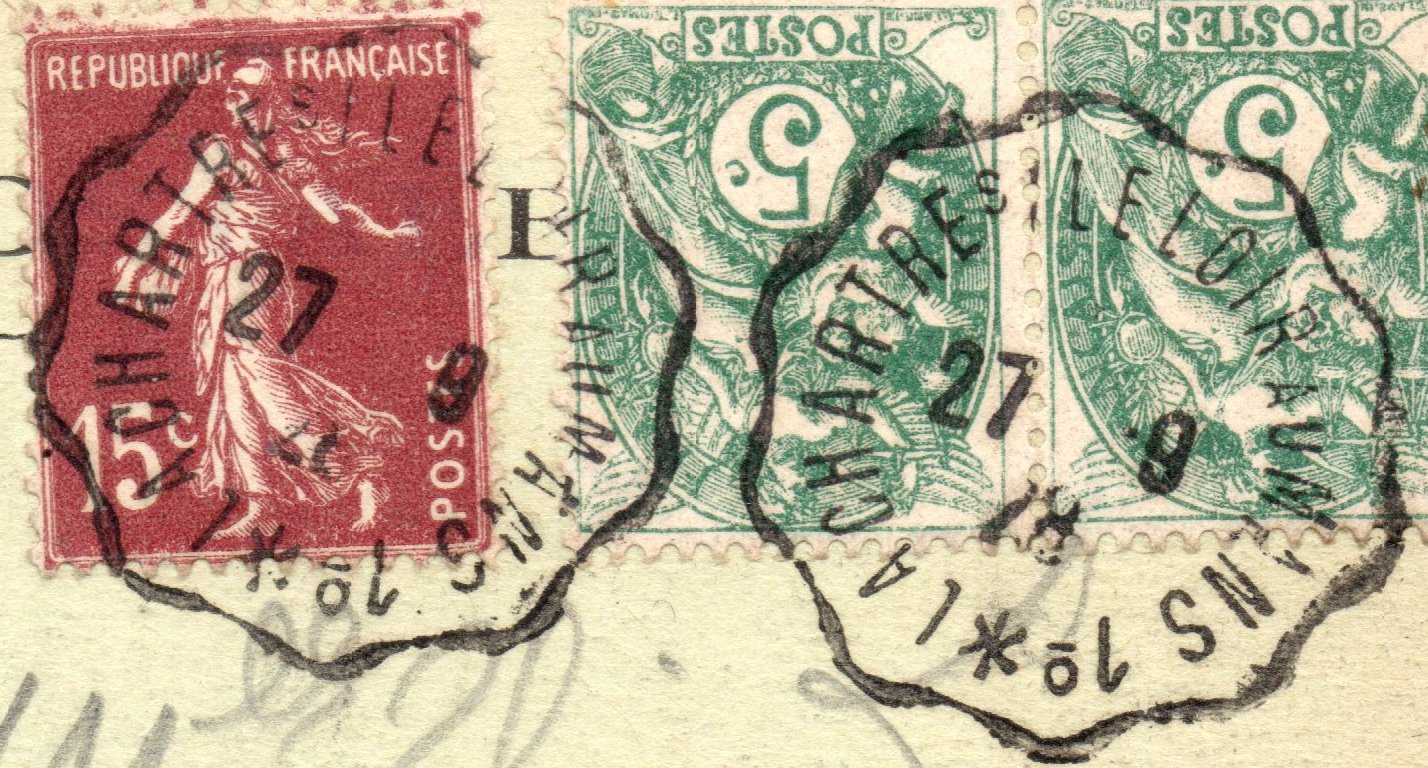
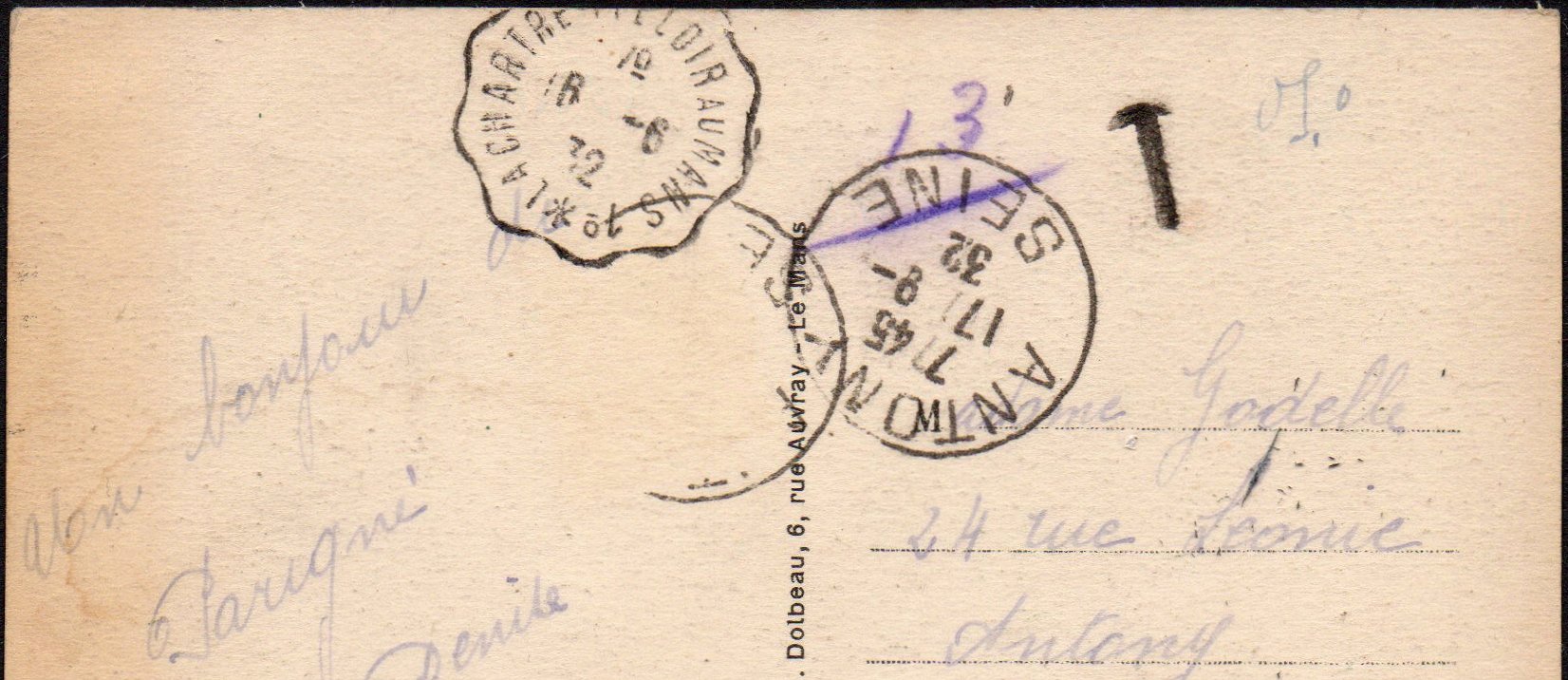
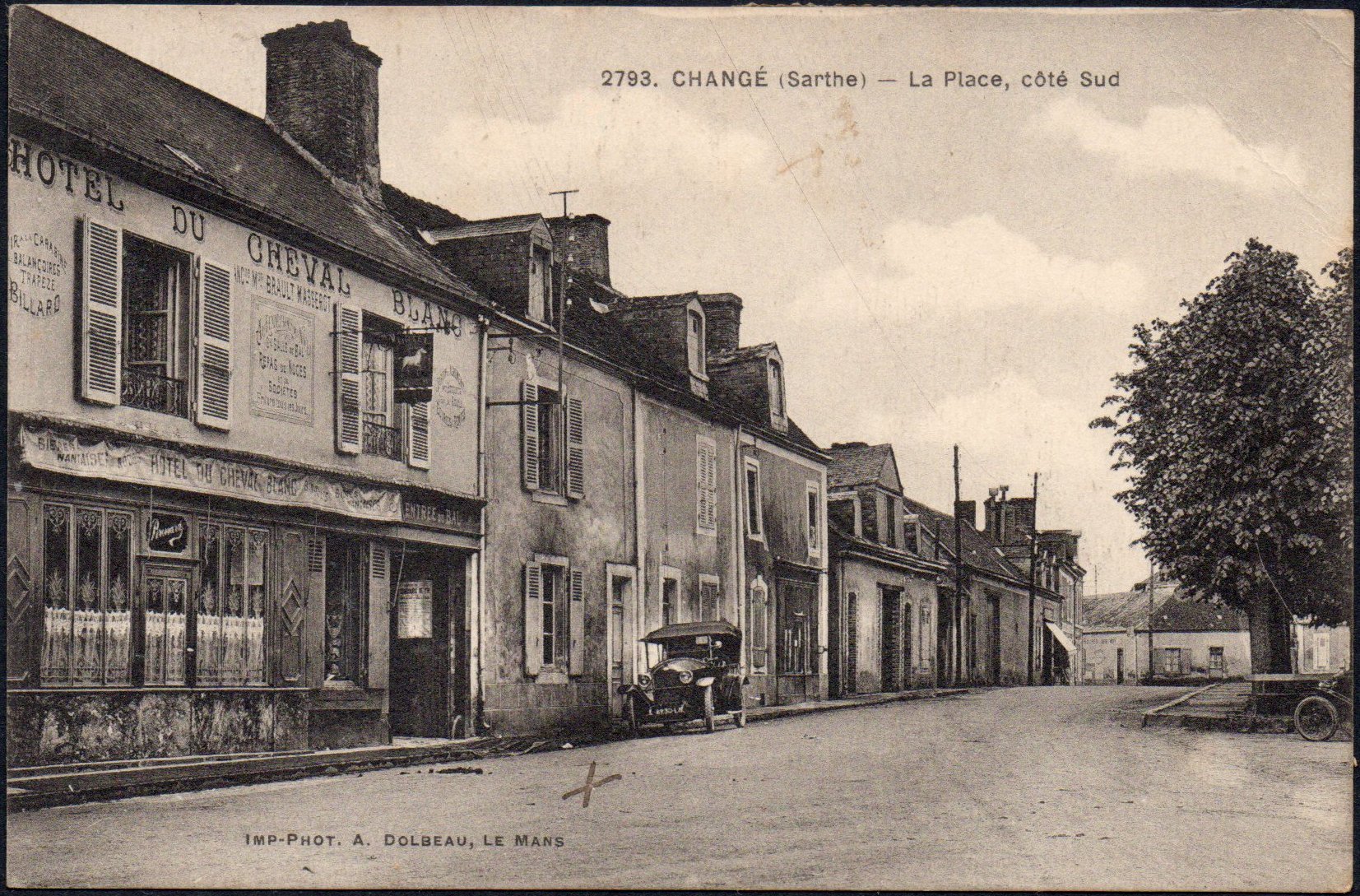
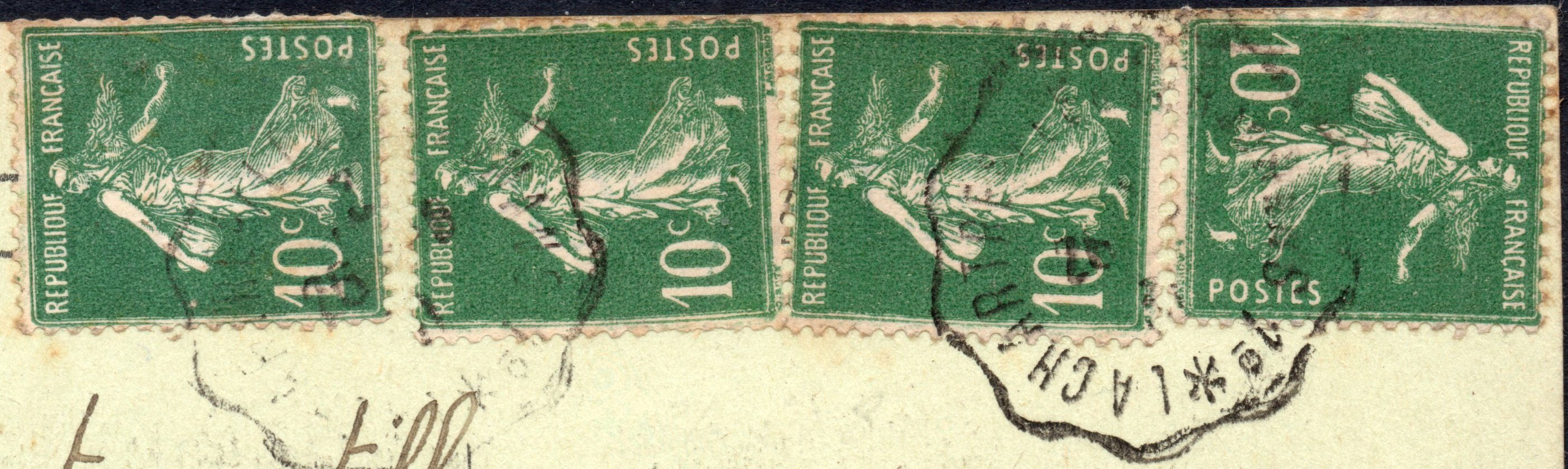 A clear example of the 1⁰ suffix although the date is much less clear but appears to be 1931. The card is addressed to Noisy-le-Sec. The service/duty number at top is, unexpectedly, a ' 2 ', casting some doubt on the significance of the functions within these postmarks of the '1⁰' and '2⁰' on the outer circle and on the inner typeface. The '2' has not only been inserted upside down but also has a break in the downstroke of the figure '2', a twin feature to which we return in the next section.
Changé, five miles from Le Mans, was the junction station on the La Chartre line for the T.S. branch to Château-du-Loir, which was still fully operational in 1931. Whether a Château-du-Loir au Mans CCL service on the trams ever called here, or ever even existed, remains a mystery as we publish this.
A clear example of the 1⁰ suffix although the date is much less clear but appears to be 1931. The card is addressed to Noisy-le-Sec. The service/duty number at top is, unexpectedly, a ' 2 ', casting some doubt on the significance of the functions within these postmarks of the '1⁰' and '2⁰' on the outer circle and on the inner typeface. The '2' has not only been inserted upside down but also has a break in the downstroke of the figure '2', a twin feature to which we return in the next section.
Changé, five miles from Le Mans, was the junction station on the La Chartre line for the T.S. branch to Château-du-Loir, which was still fully operational in 1931. Whether a Château-du-Loir au Mans CCL service on the trams ever called here, or ever even existed, remains a mystery as we publish this.
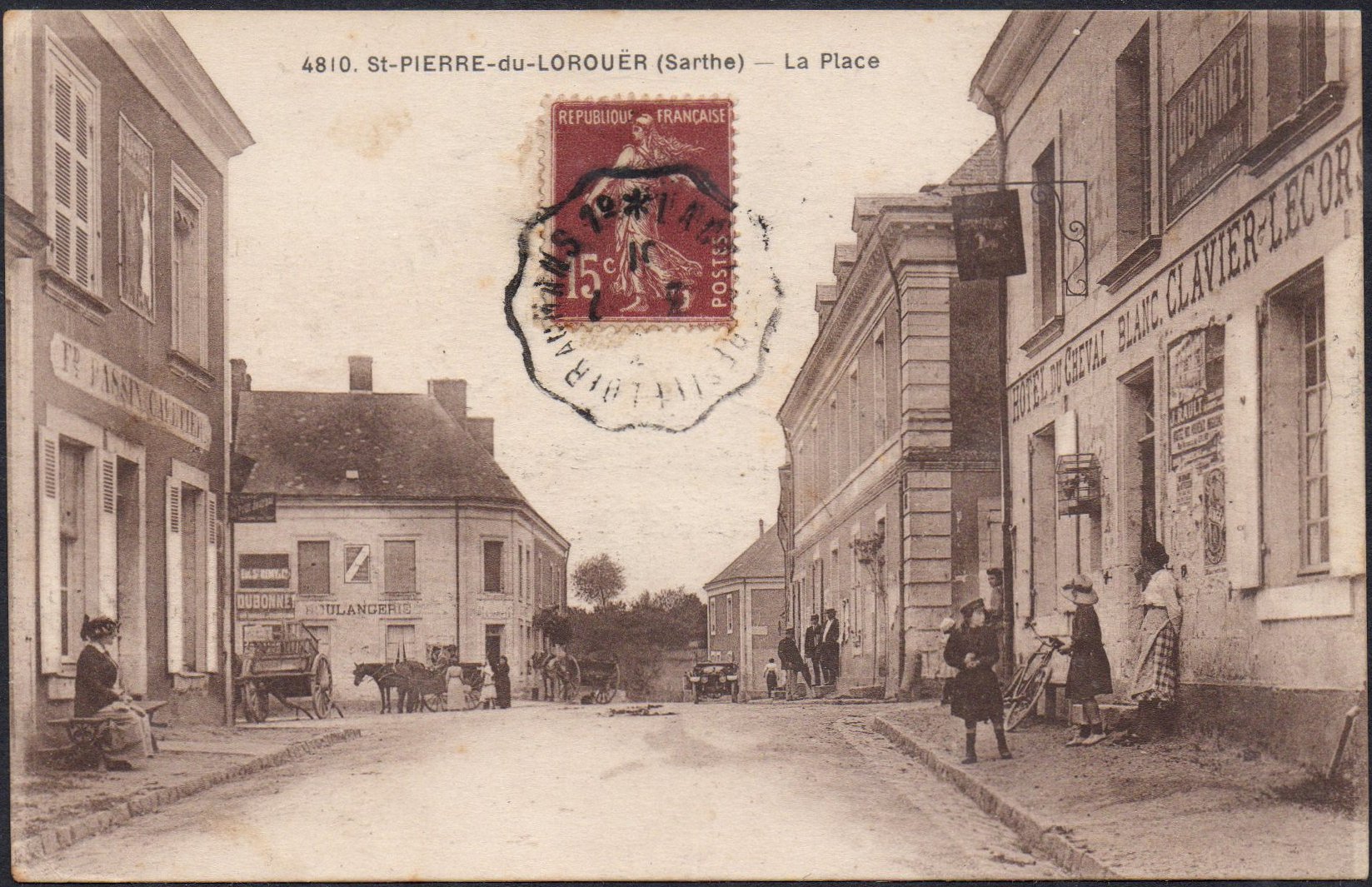
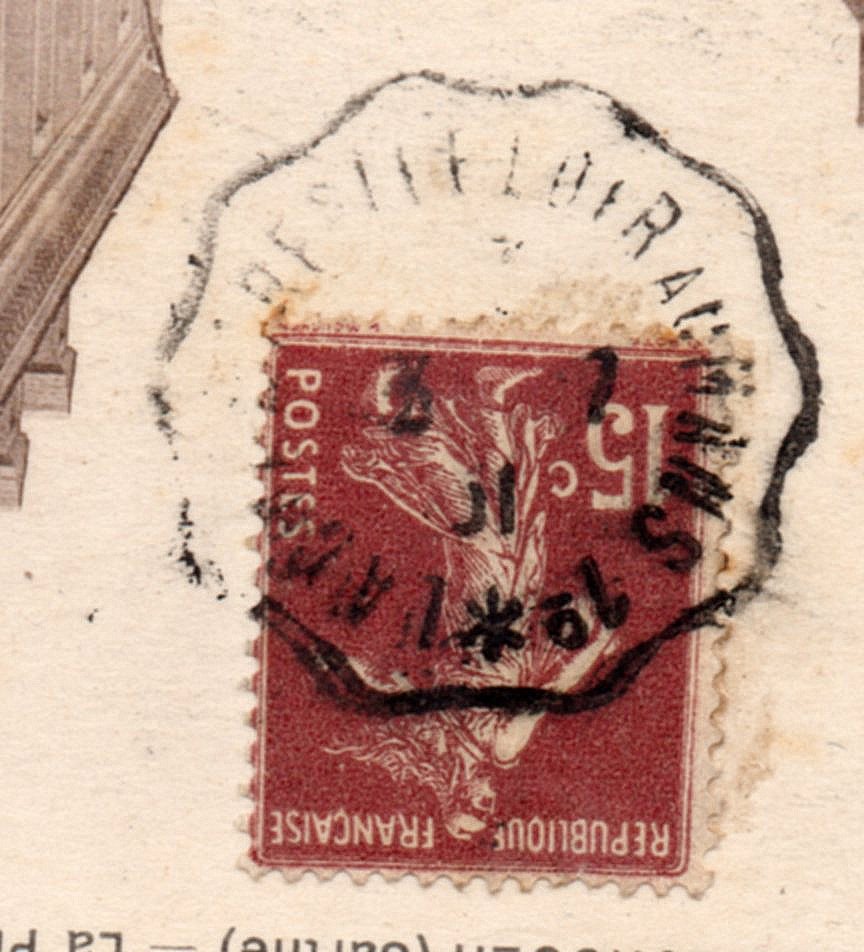 A pleasing view of St-Pierre-du-Lorouër with a fine strike of this CCL - with sufficient detail to date it, 1931. The card was sent to Loir-et-Cher and carries an 'economy' 5-word message. The 15c rate (for cards with up to 5 words of greeting) applied in the periods March 1924-May 1926 and April 1930-July 1932.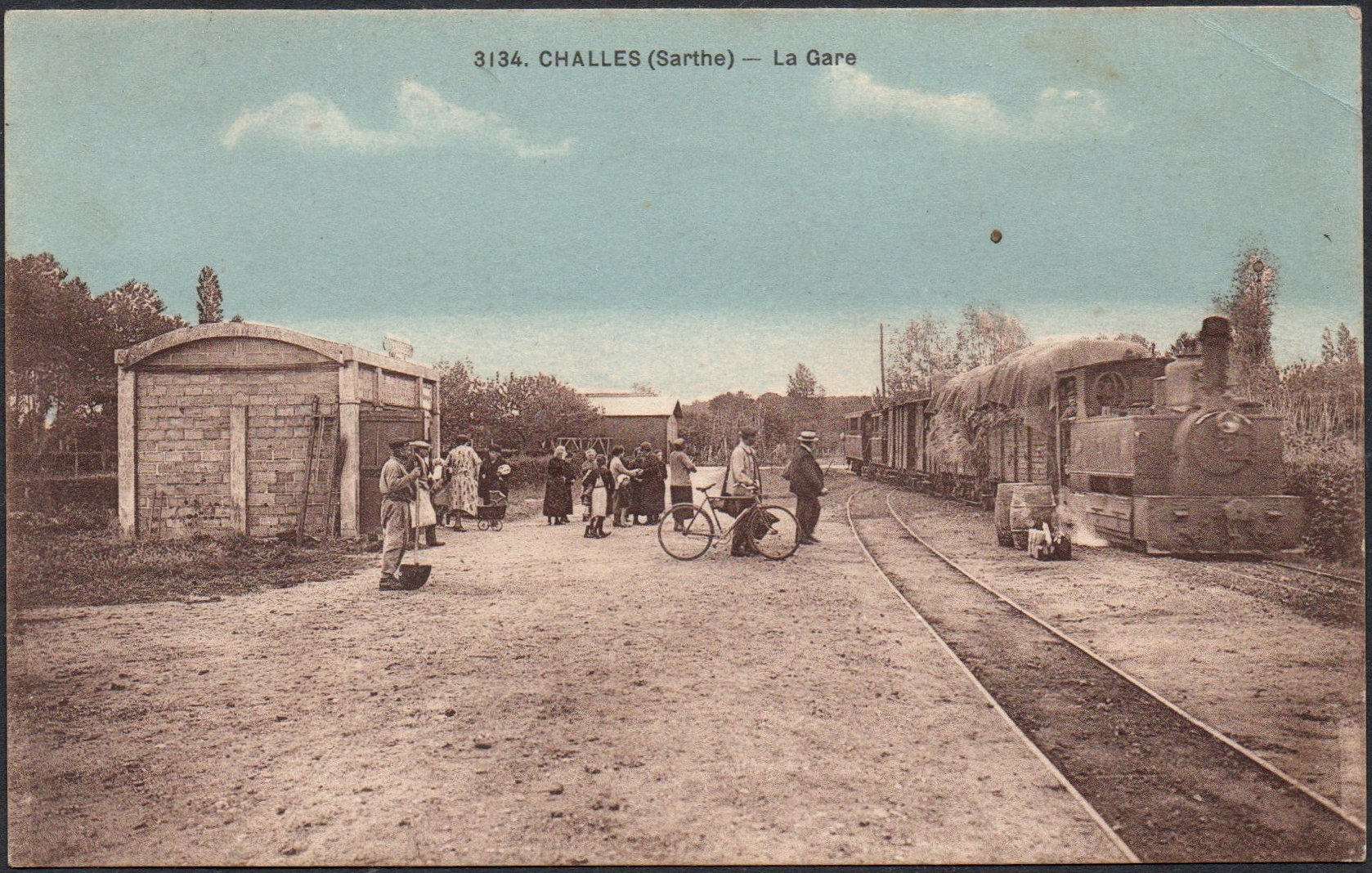
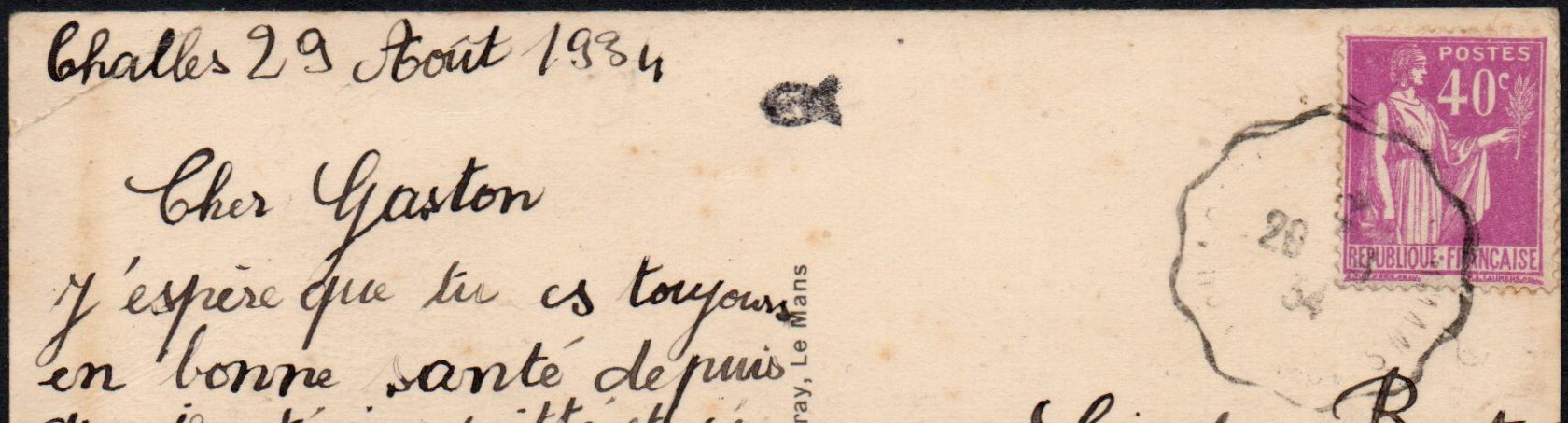
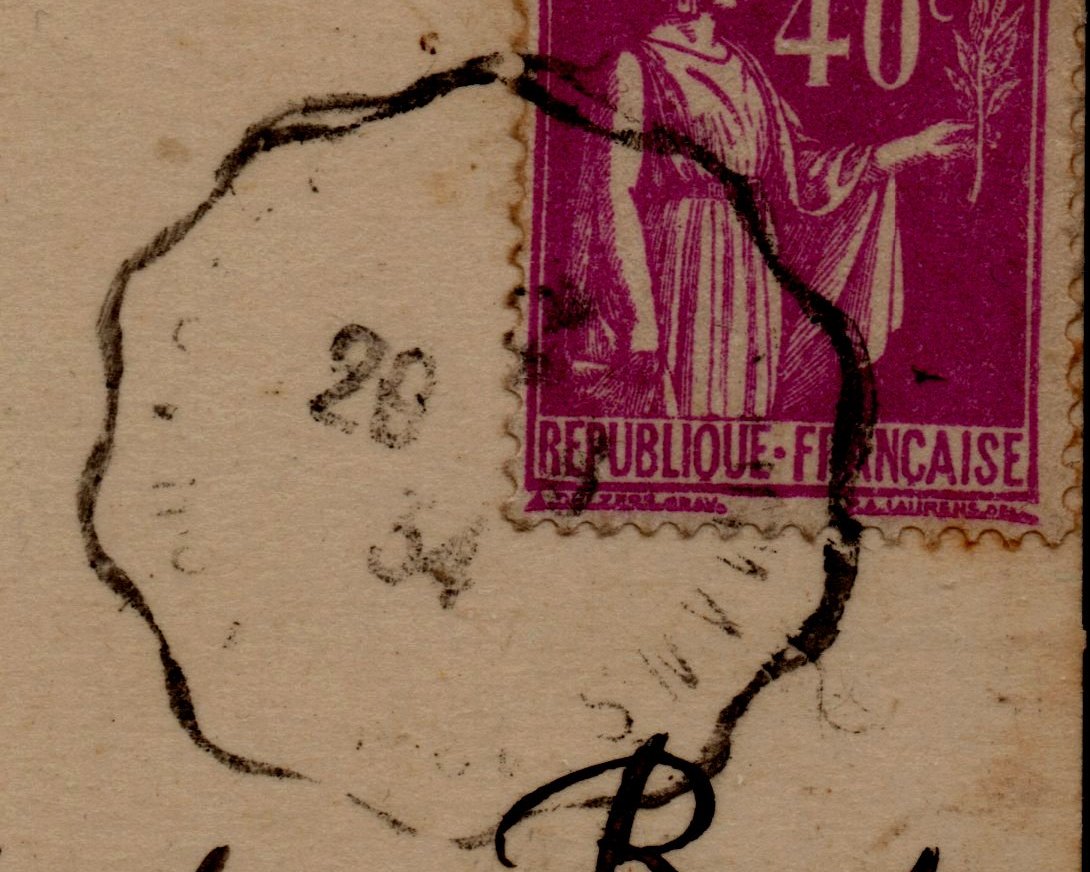
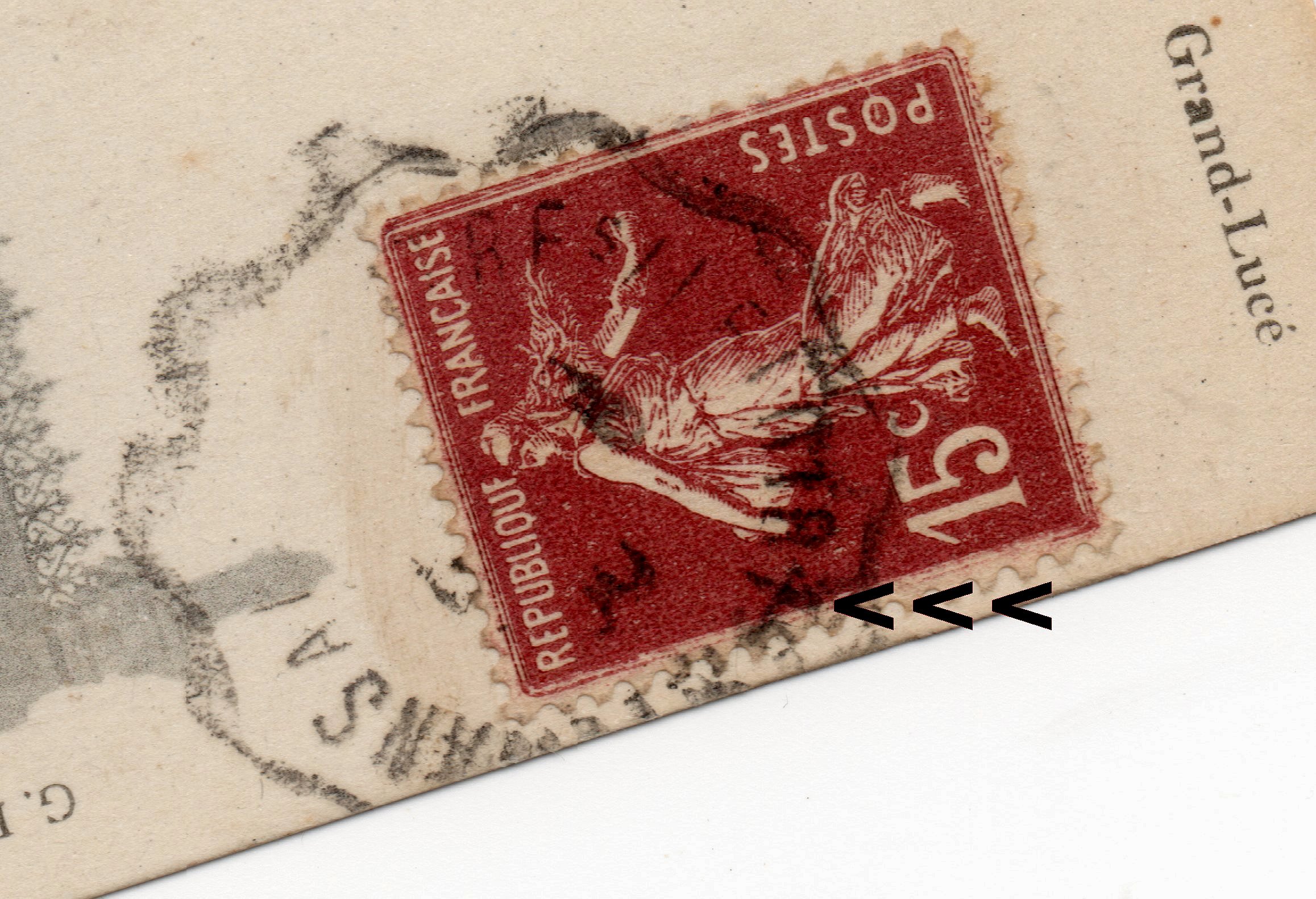 A partial cancellation but there is sufficient inking for identification purposes although the year is far than clear; it probably shows the '0' of '30' for the year. The 15c franking is consistent with the card's five-word message.
This is the only example we have seen of this postmark outward from Le Mans and it is clearly very scarce. We have 'arrowed' the figure '1' of 1⁰ in the postmark. There is a faint, partial outline of a second cancellation (a much weaker strike of the same postmark) which has left inking not only across the top of 'LOI', but also through the following 'R 1'. The ⁰ has been underlined by it.
Note: Whilst identification of the suffix can be reassuring, it is unnecessary in this direction as there is no record of a Le Mans à La Chartre-s/le Loir 2⁰ CCL.
La Chartre-s/le Loir au Mans 1⁰ Type III [ . ] (earliest : -/30? --> latest 08/34)
We have seen a further August 1934 cancellation but do not know whether it is with a 1⁰ or 2⁰ canceller. It is illustrated towards the foot on this section.
Le Mans à La Chartre-s/le Loir 1⁰ Type III [ . ] (only one : ?/30 probably)
.
A partial cancellation but there is sufficient inking for identification purposes although the year is far than clear; it probably shows the '0' of '30' for the year. The 15c franking is consistent with the card's five-word message.
This is the only example we have seen of this postmark outward from Le Mans and it is clearly very scarce. We have 'arrowed' the figure '1' of 1⁰ in the postmark. There is a faint, partial outline of a second cancellation (a much weaker strike of the same postmark) which has left inking not only across the top of 'LOI', but also through the following 'R 1'. The ⁰ has been underlined by it.
Note: Whilst identification of the suffix can be reassuring, it is unnecessary in this direction as there is no record of a Le Mans à La Chartre-s/le Loir 2⁰ CCL.
La Chartre-s/le Loir au Mans 1⁰ Type III [ . ] (earliest : -/30? --> latest 08/34)
We have seen a further August 1934 cancellation but do not know whether it is with a 1⁰ or 2⁰ canceller. It is illustrated towards the foot on this section.
Le Mans à La Chartre-s/le Loir 1⁰ Type III [ . ] (only one : ?/30 probably)
.
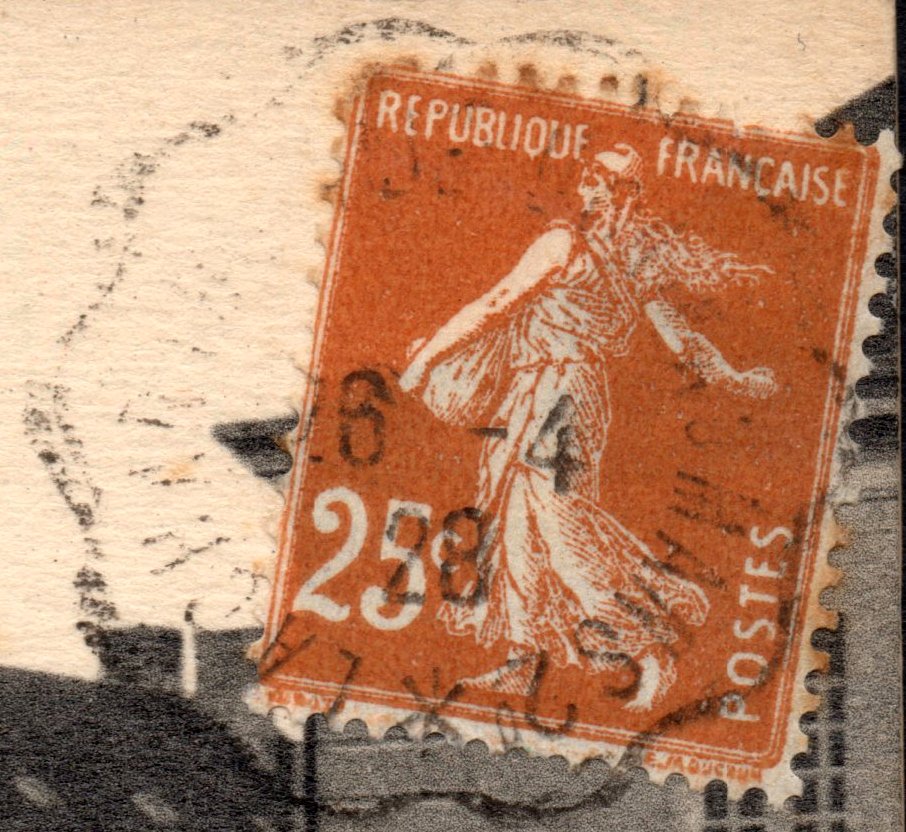
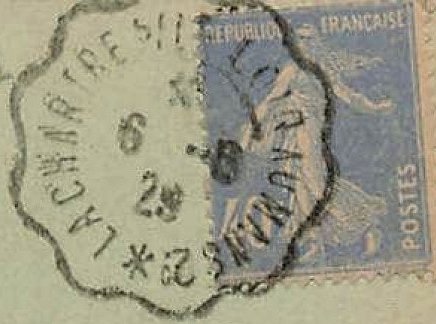
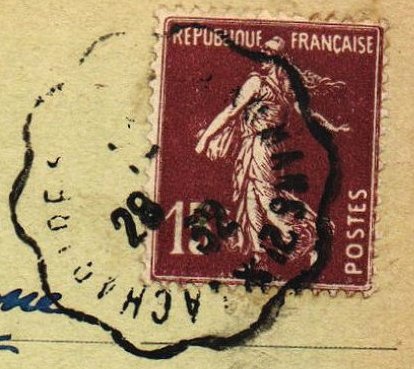 The 1928 cancellation on a card of Le Grand-Lucé (left) is the earliest we have seen with either a 1⁰ or 2⁰ suffix.
The 1929 cancellation (centre) is probably June, possibly August, and is on a card of Saint-Mars-de-Locquenay.
The 1932 cancellation (right) is on a Parigné l'Evèque postcard, the month unreadable. The top line of moveable typeface hints at a 1⁰ but we believe it is a partially struck inverted 2⁰.
The 1928 cancellation on a card of Le Grand-Lucé (left) is the earliest we have seen with either a 1⁰ or 2⁰ suffix.
The 1929 cancellation (centre) is probably June, possibly August, and is on a card of Saint-Mars-de-Locquenay.
The 1932 cancellation (right) is on a Parigné l'Evèque postcard, the month unreadable. The top line of moveable typeface hints at a 1⁰ but we believe it is a partially struck inverted 2⁰.
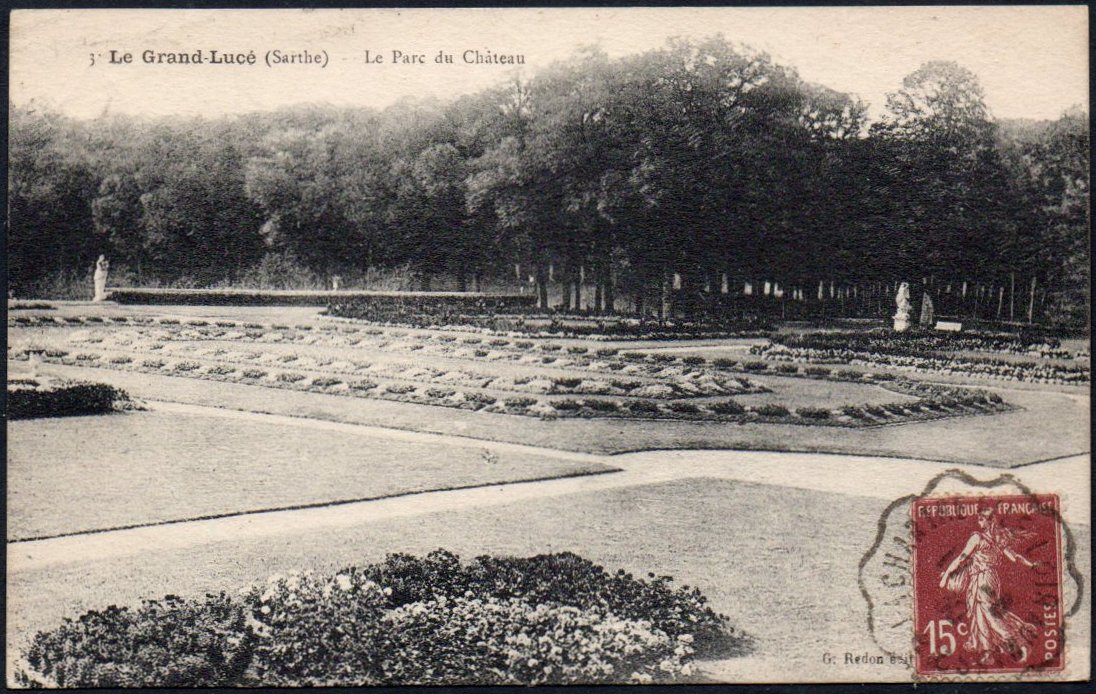
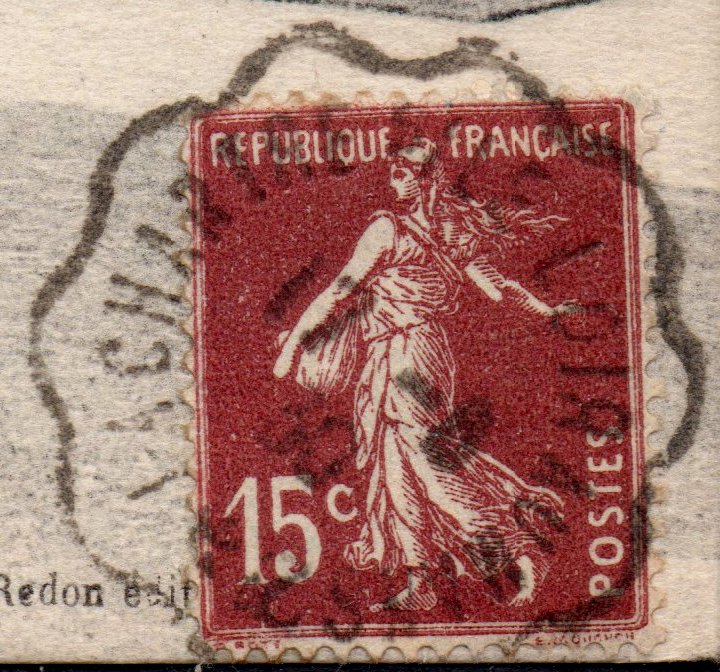
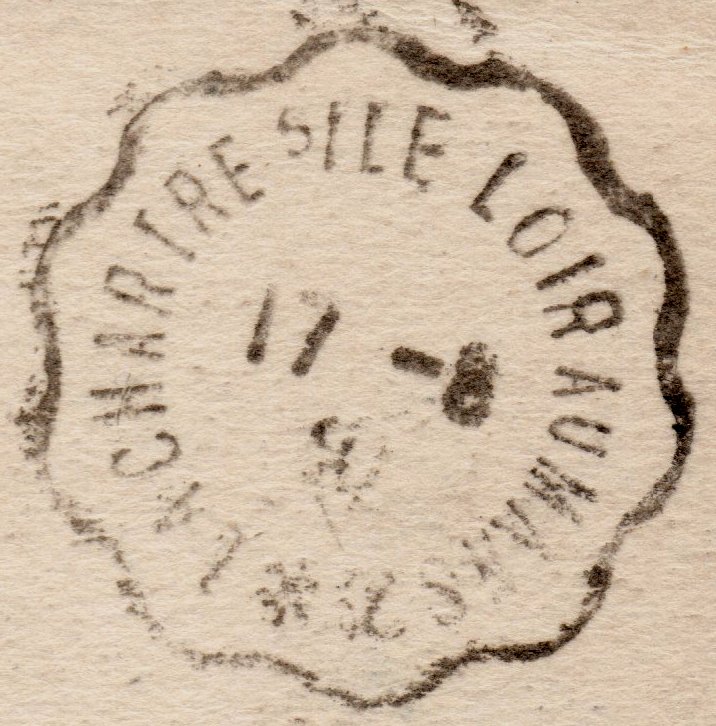 A card of Le Grand Lucé, postmarked (on both sides) in August 1930. Note the blank field at the top.
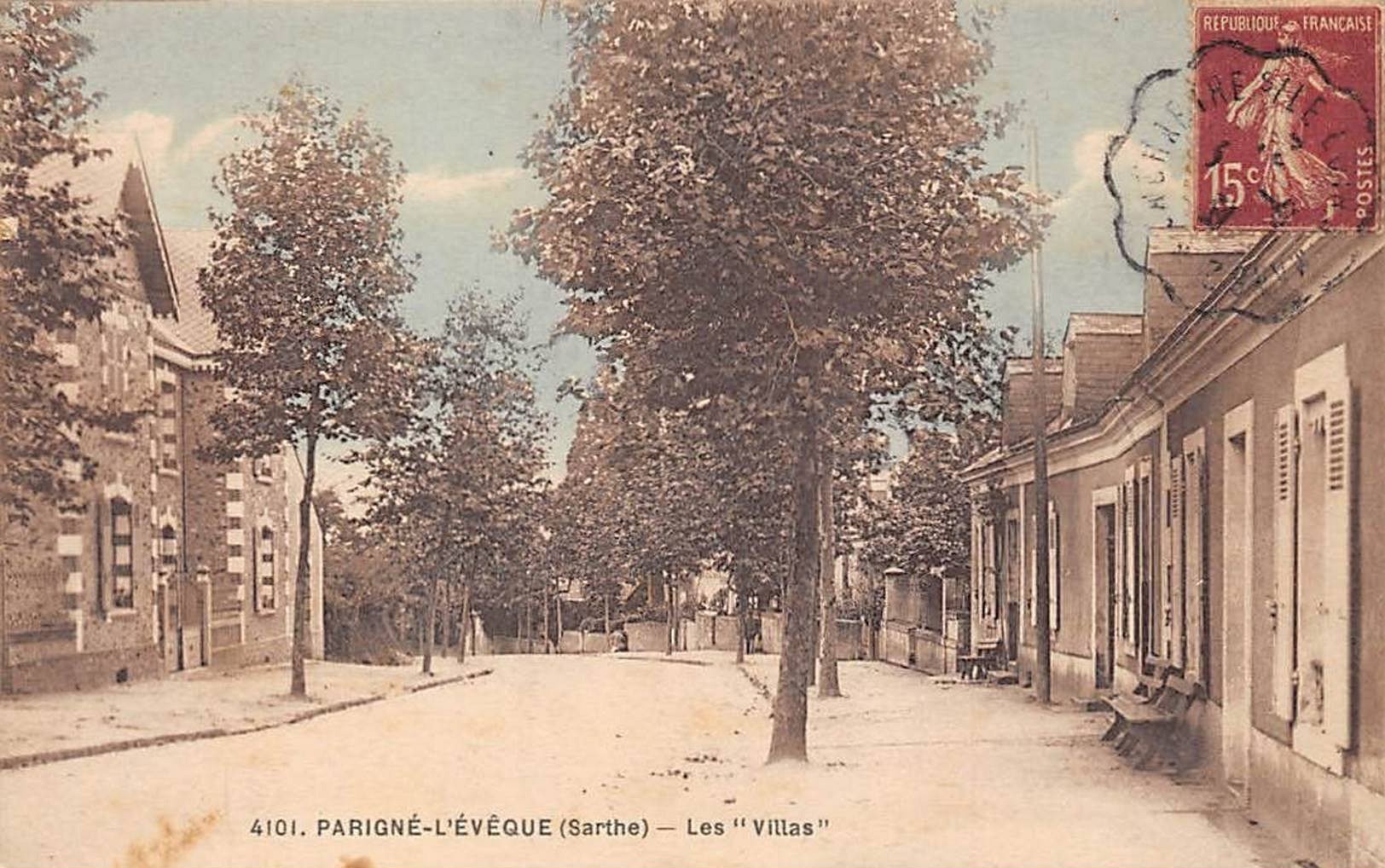 The date on the postmark above (09/31) is just legible and supported by the sender helpfully dating their message.
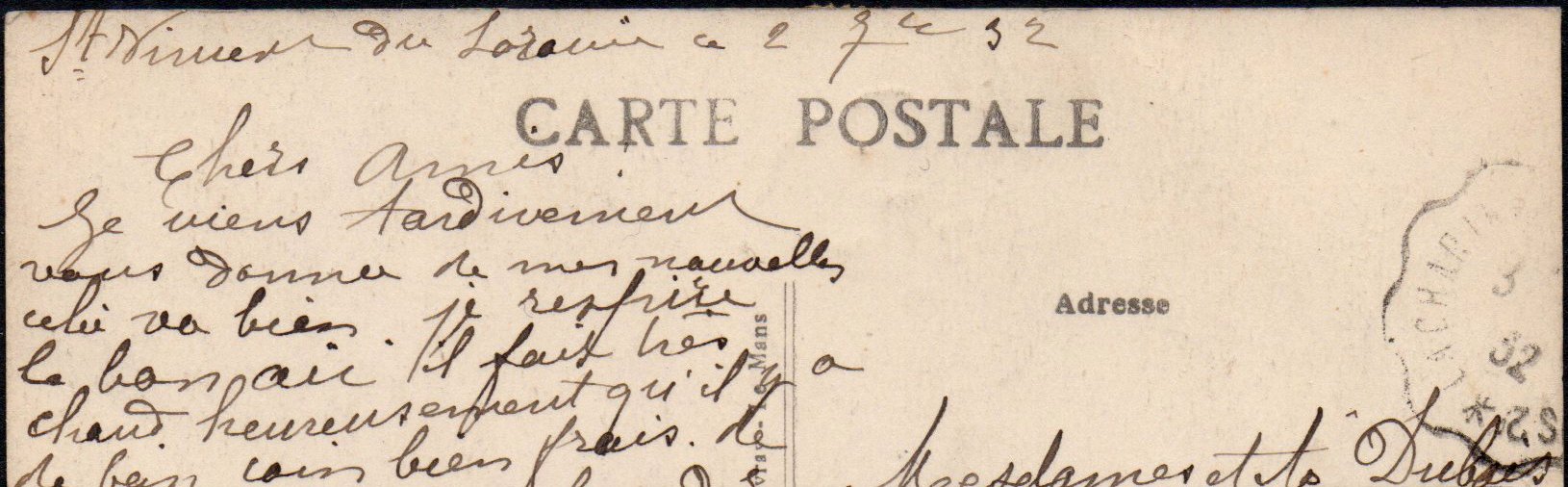
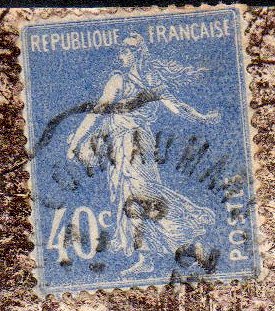 Front and back of a postcard of the Forêt de Bercé written (and presumably posted) in Saint-Vincent-du-Lorouër in early September 1932. This is the latest fully identifiable usage of the '2⁰' suffix that we have seen.
Later Usage: We have, however, seen a '2⁰' suffix which must be later than 1932 on a card of Le Grand-Lucé. The year on the CCL is not completely certain, but the date of issue of the 40c 'Peace design' stamp in Magenta was January 1933. It remained in use for several years, probably until the 'Mercury design' 40c stamp appeared in February 1939.
Use of Postage Stamps in dating mail.
Whilst stamps can be very useful in establishing the earliest possible date for a postal item, they are typically much less helpful in establishing latest usage. Members of the public or small post offices may still be holding old stamps long after a new design has been introduced.
Front and back of a postcard of the Forêt de Bercé written (and presumably posted) in Saint-Vincent-du-Lorouër in early September 1932. This is the latest fully identifiable usage of the '2⁰' suffix that we have seen.
Later Usage: We have, however, seen a '2⁰' suffix which must be later than 1932 on a card of Le Grand-Lucé. The year on the CCL is not completely certain, but the date of issue of the 40c 'Peace design' stamp in Magenta was January 1933. It remained in use for several years, probably until the 'Mercury design' 40c stamp appeared in February 1939.
Use of Postage Stamps in dating mail.
Whilst stamps can be very useful in establishing the earliest possible date for a postal item, they are typically much less helpful in establishing latest usage. Members of the public or small post offices may still be holding old stamps long after a new design has been introduced.

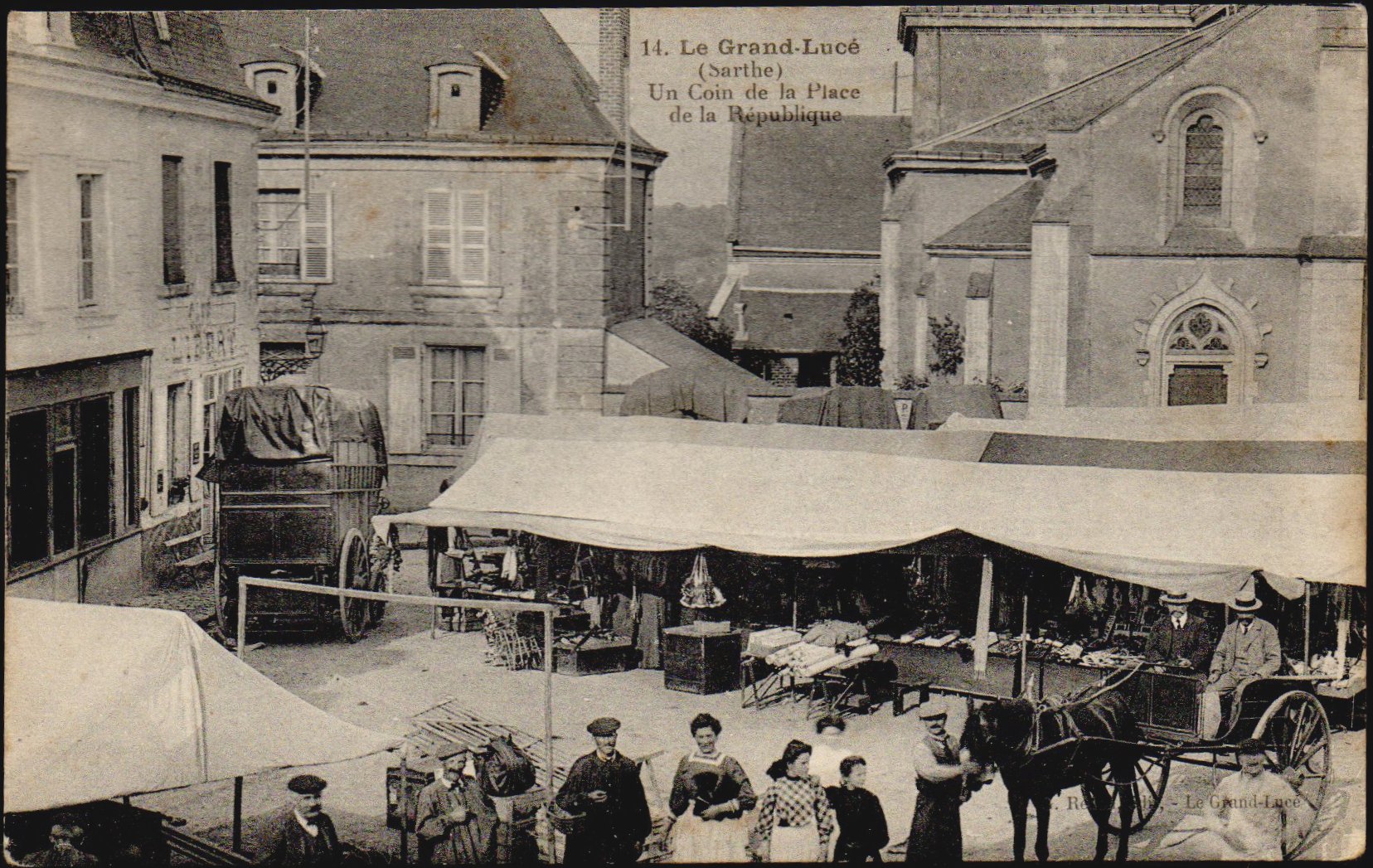
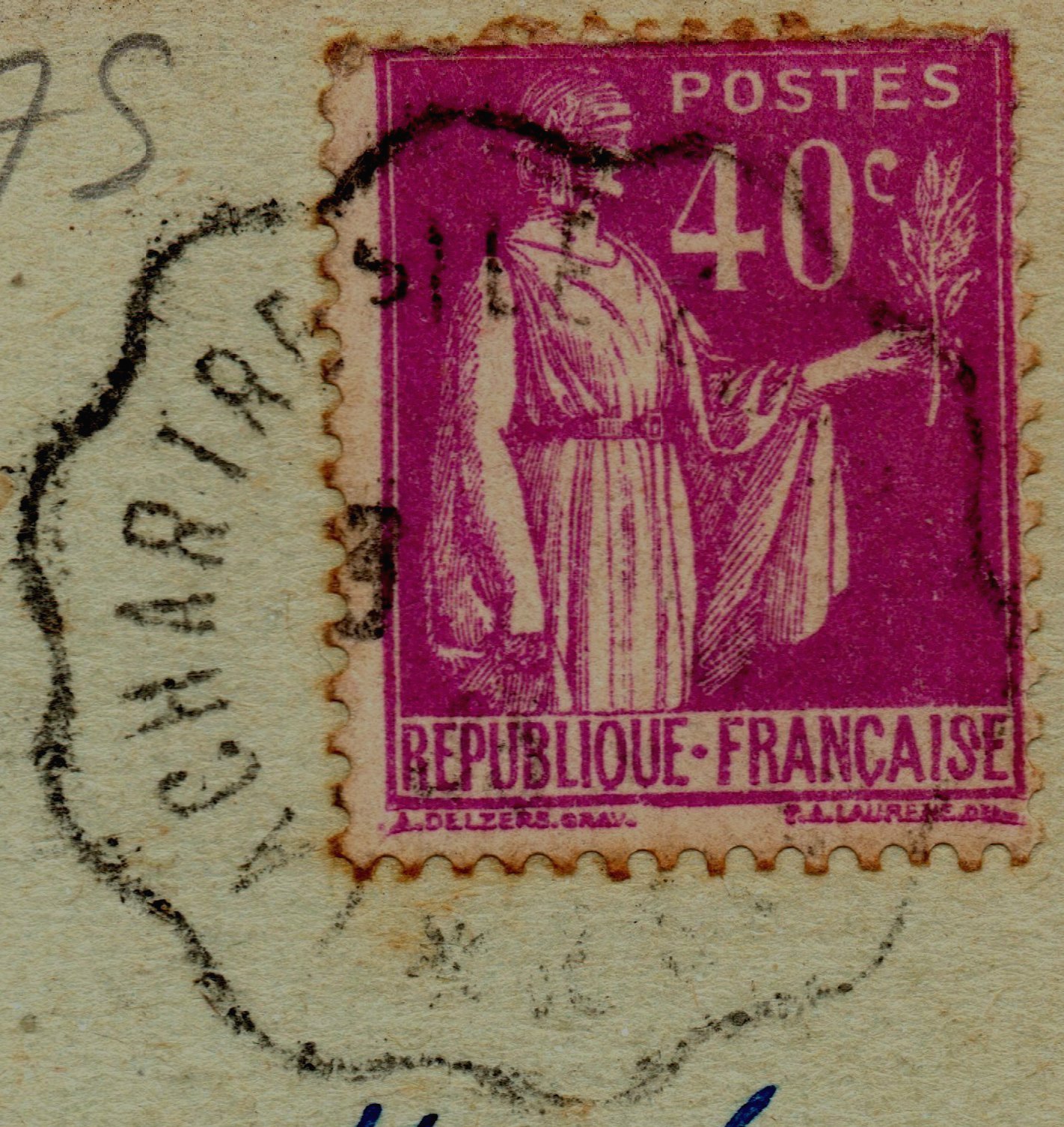 The suffix '2⁰' is faint but discernible. We are 90% confident that the year (very faint) reads '34' with the base of the '3' passing through the base of 'RE' of 'REPUBLIQUE', the downstroke of the figure'4' through the 'B' of 'REPUBLIQUE' and the diagonal stroke of the '4' through the 'U'. We have darkened the scan of the stamp to display this better. We have put this forward in the check-list as the latest usage that we have found so far, albeit with some reservations as to its accuracy. The month cannot be identified.
La Chartre-s/le Loir au Mans 2⁰ Type III [ . ] (earliest 04/28; latest ?/34)
The postmark in the opposite direction, Le Mans à La Chartre-s/le Loir 2⁰, is not listed by Pothion, nor have we seen one.
.
A further August 1934 cancellation, mentioned earlier, but with the 1⁰ or 2⁰ indecipherable, is shown below.
Late Usage : Indeterminate Suffix numeral:
The suffix '2⁰' is faint but discernible. We are 90% confident that the year (very faint) reads '34' with the base of the '3' passing through the base of 'RE' of 'REPUBLIQUE', the downstroke of the figure'4' through the 'B' of 'REPUBLIQUE' and the diagonal stroke of the '4' through the 'U'. We have darkened the scan of the stamp to display this better. We have put this forward in the check-list as the latest usage that we have found so far, albeit with some reservations as to its accuracy. The month cannot be identified.
La Chartre-s/le Loir au Mans 2⁰ Type III [ . ] (earliest 04/28; latest ?/34)
The postmark in the opposite direction, Le Mans à La Chartre-s/le Loir 2⁰, is not listed by Pothion, nor have we seen one.
.
A further August 1934 cancellation, mentioned earlier, but with the 1⁰ or 2⁰ indecipherable, is shown below.
Late Usage : Indeterminate Suffix numeral:
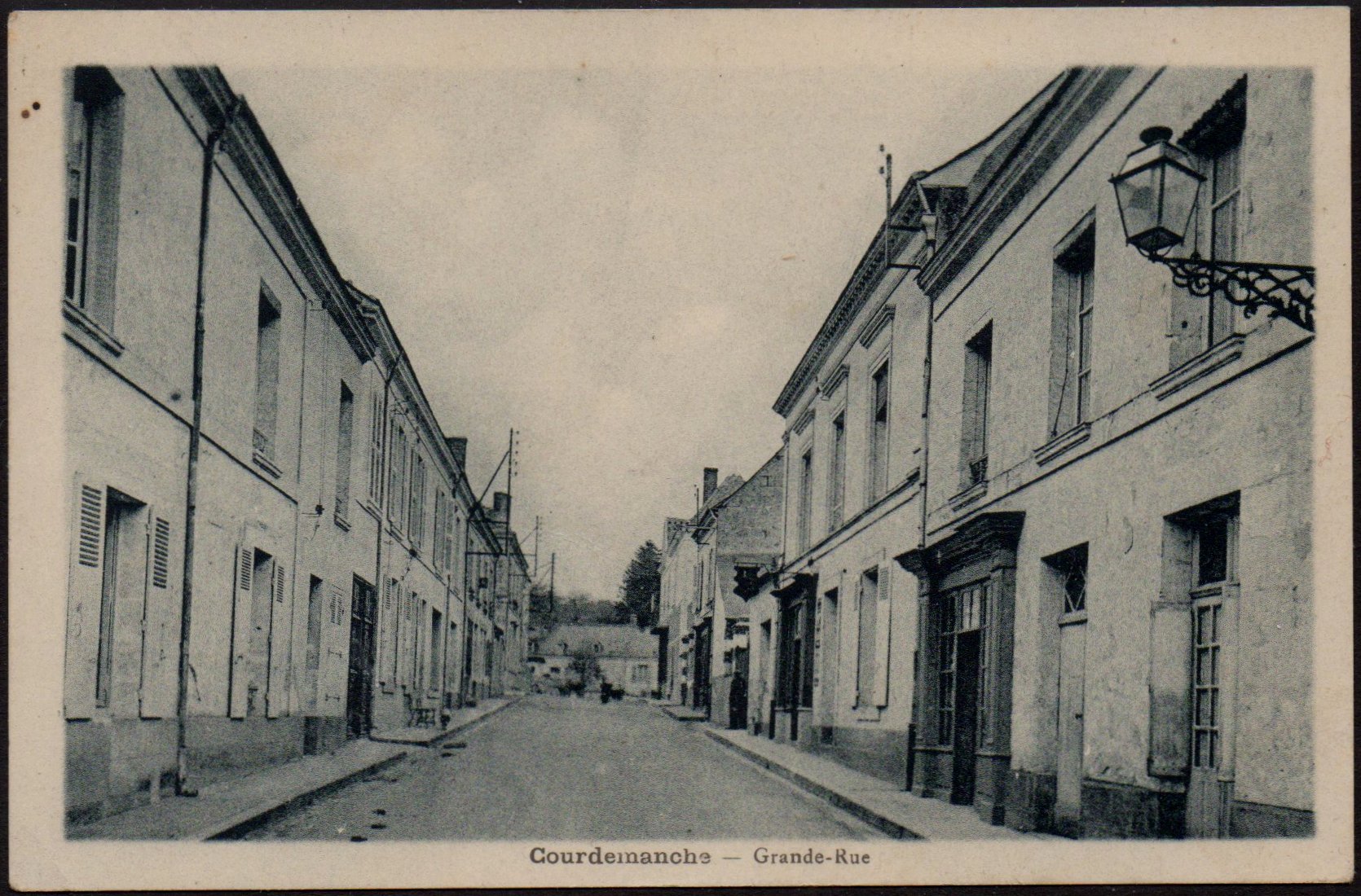
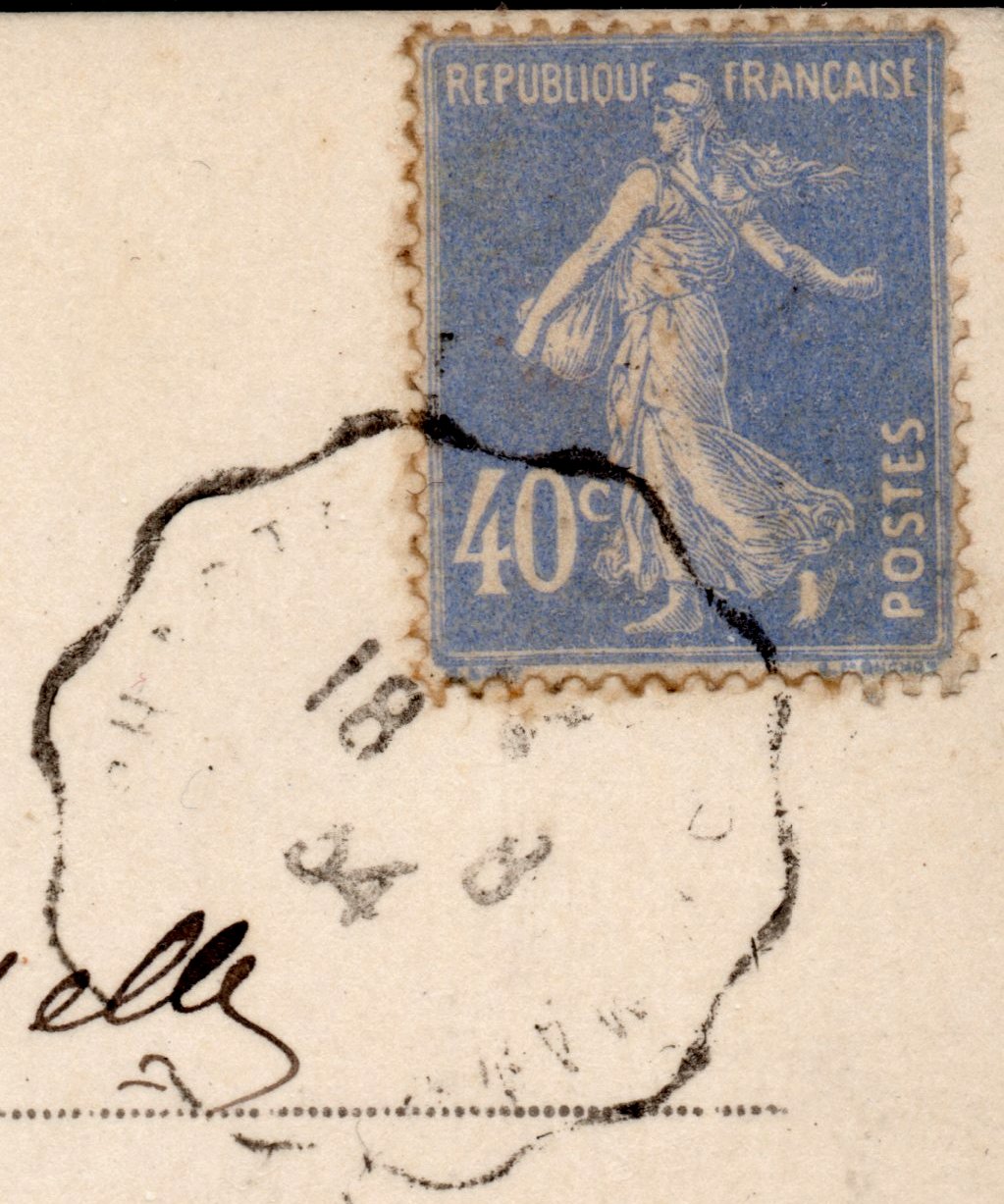 We are satisfied that a fine strike on the 40c Blue would read 'La Chartre-s/le Loir au Mans 1⁰
 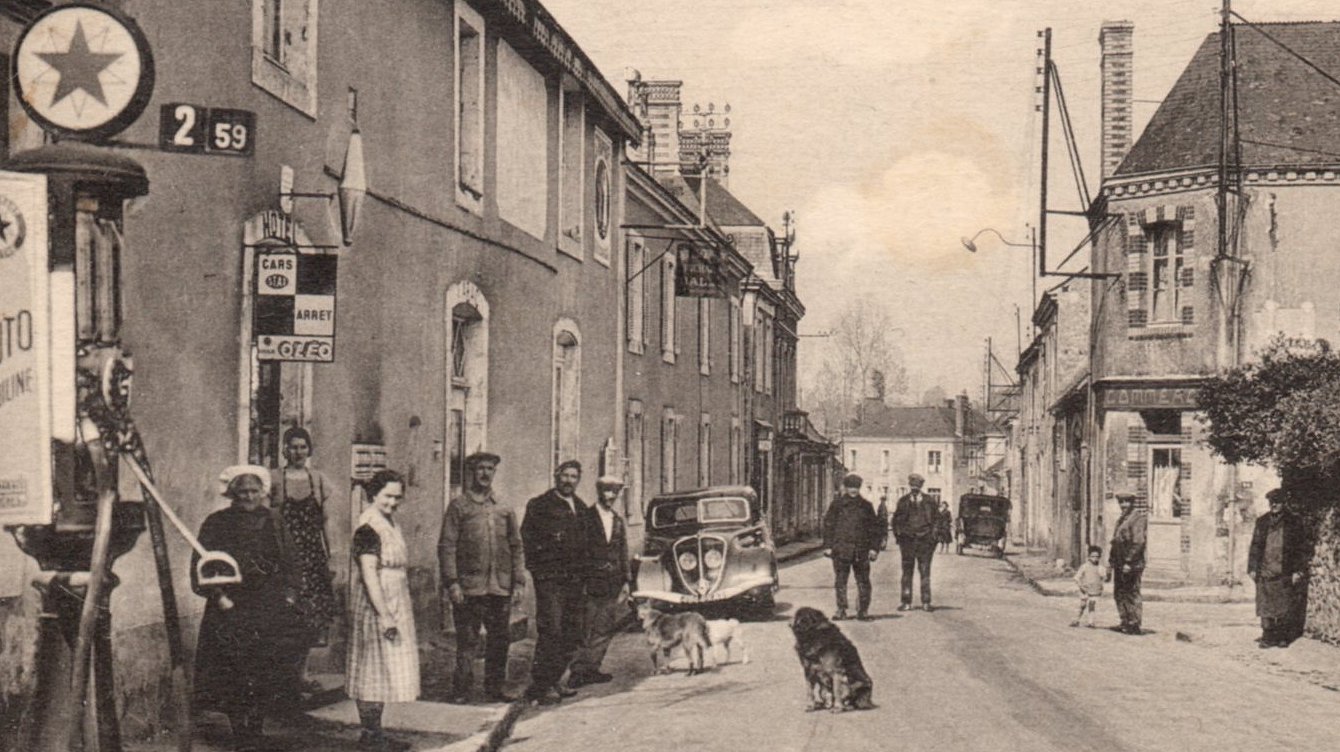 A view from the mid-late 1930s (card posted in 1938) : The CCL service has been withdrawn but the trams have another decade to run, if not always very frequently. The motor vehicles, petrol pump and the Arrêt de Cars (bus stop) located conveniently in the middle of the town, represent the ever-increasing competition.
.
A view from the mid-late 1930s (card posted in 1938) : The CCL service has been withdrawn but the trams have another decade to run, if not always very frequently. The motor vehicles, petrol pump and the Arrêt de Cars (bus stop) located conveniently in the middle of the town, represent the ever-increasing competition.
.
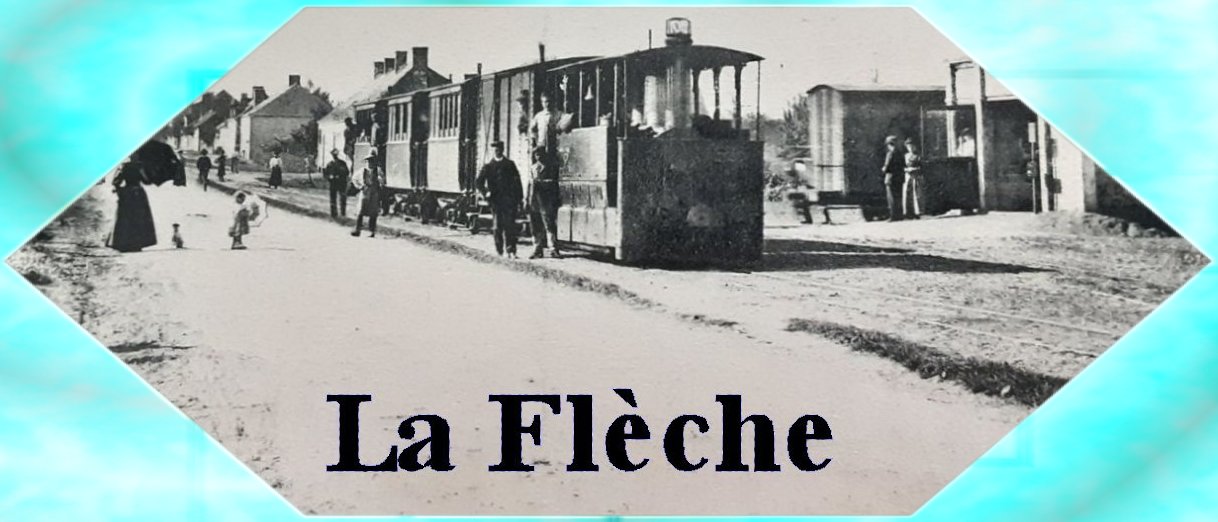
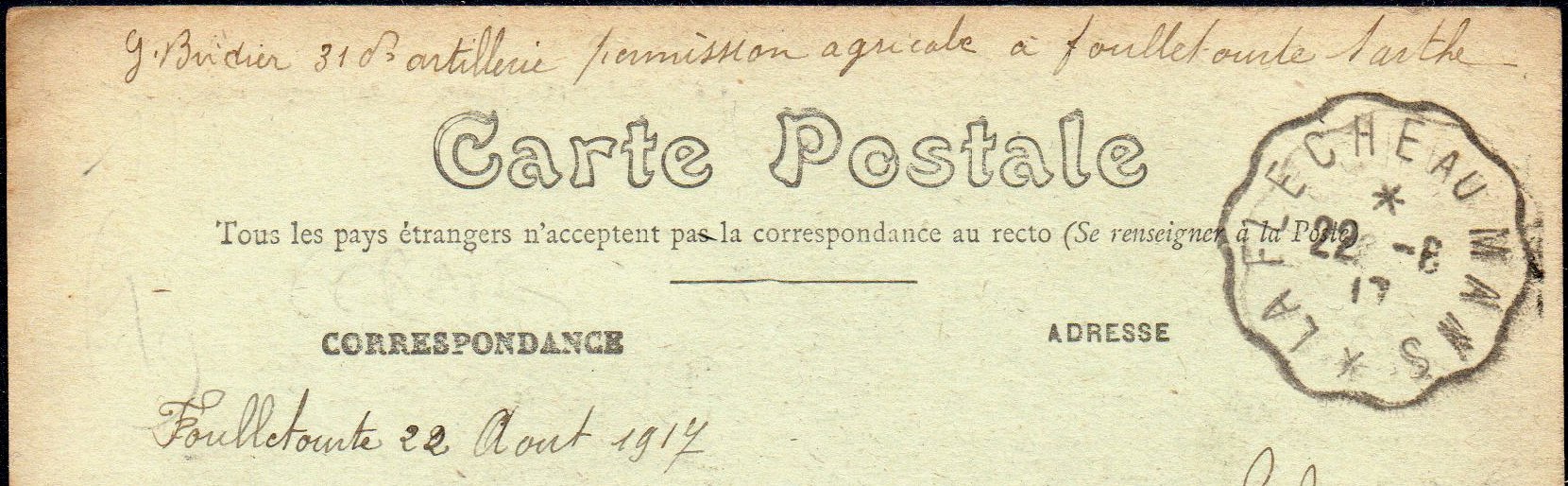
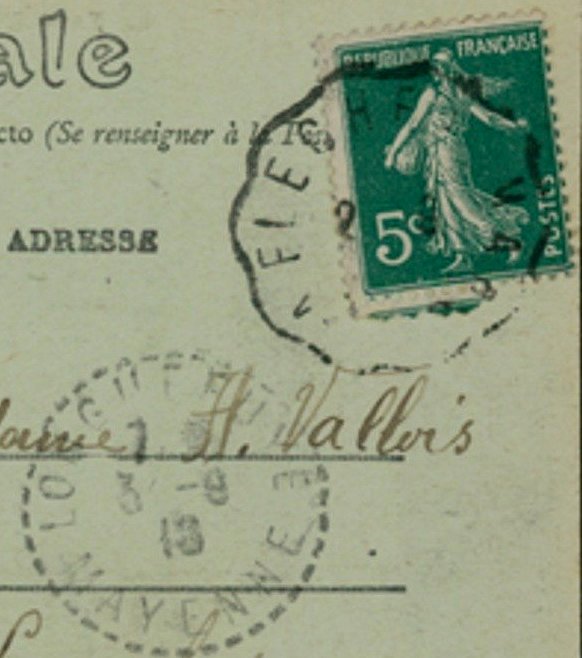 Left : A postcard of Foulletourte, the date (August 1917) and the place confirmed by the sender in manuscript. The sender declares himself at the top of the card as a soldier of the 31st Artillery (regiment?) on agricultural leave at Foulletourte, which would render him entitled to free postage. The card is unfranked. This is, though, the only 1917 example we have seen which appears to be 'tramway' whilst we have seen an apparent railway CCL a month later from Mézeray.
Right : A postcard of La-Fontaine-Saint-Martin sent in September 1918. Both cards above are cancelled La Flèche au Mans and we think it very likely these are both early examples of this CCL applied on a tram.
Indeed, based on the cancellations above and on other mail from Foulletourte in 1917 and La Fontaine-Saint-Martin in 1918, we think this provides a good approximation of the starting date for a courrier-convoyeur operation by the Tramways de la Sarthe from La Flèche to Le Mans, although the discovery of good evidence for commencement of the CCL service a little earlier would not surprise us.
Left : A postcard of Foulletourte, the date (August 1917) and the place confirmed by the sender in manuscript. The sender declares himself at the top of the card as a soldier of the 31st Artillery (regiment?) on agricultural leave at Foulletourte, which would render him entitled to free postage. The card is unfranked. This is, though, the only 1917 example we have seen which appears to be 'tramway' whilst we have seen an apparent railway CCL a month later from Mézeray.
Right : A postcard of La-Fontaine-Saint-Martin sent in September 1918. Both cards above are cancelled La Flèche au Mans and we think it very likely these are both early examples of this CCL applied on a tram.
Indeed, based on the cancellations above and on other mail from Foulletourte in 1917 and La Fontaine-Saint-Martin in 1918, we think this provides a good approximation of the starting date for a courrier-convoyeur operation by the Tramways de la Sarthe from La Flèche to Le Mans, although the discovery of good evidence for commencement of the CCL service a little earlier would not surprise us.
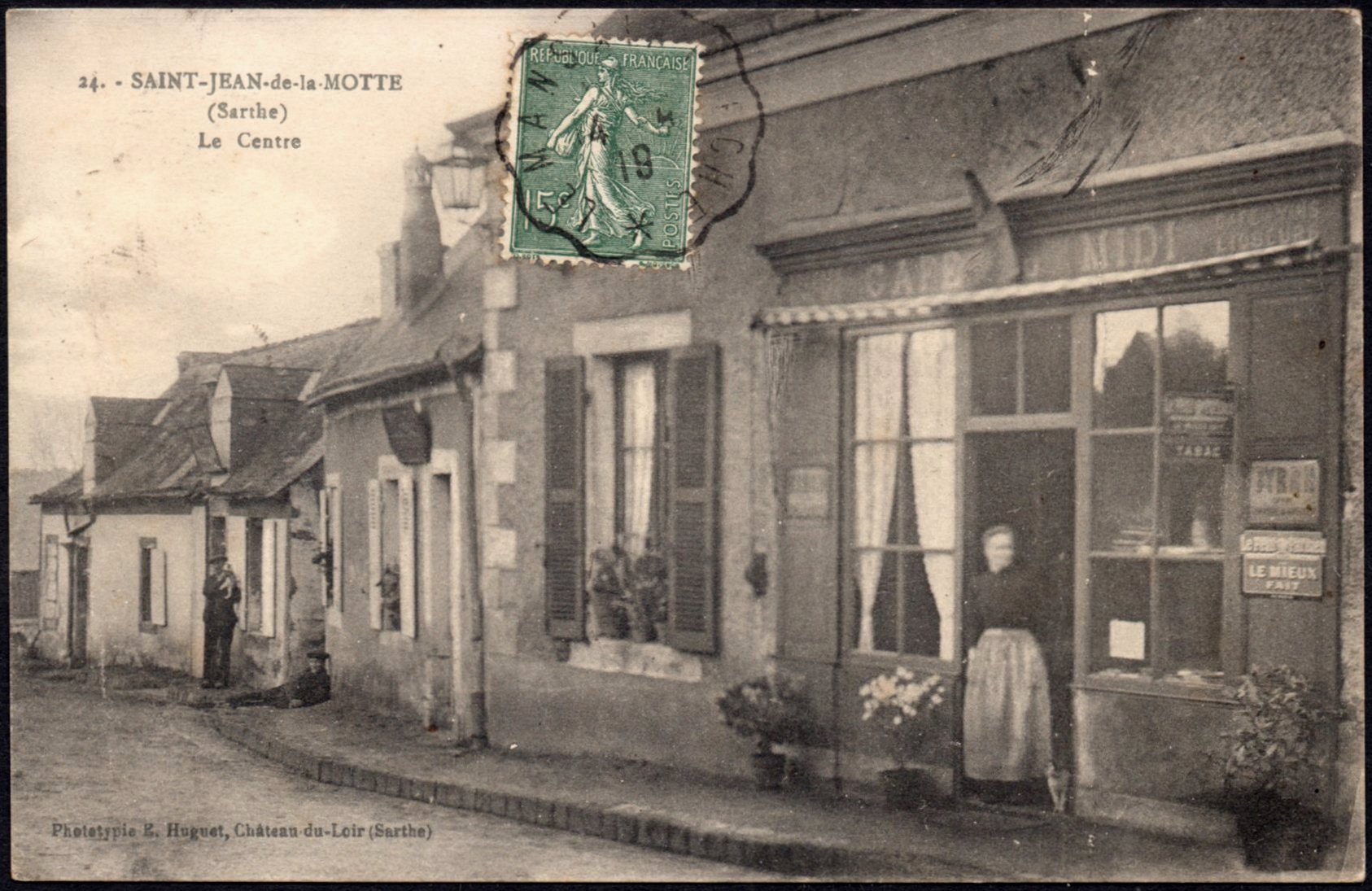
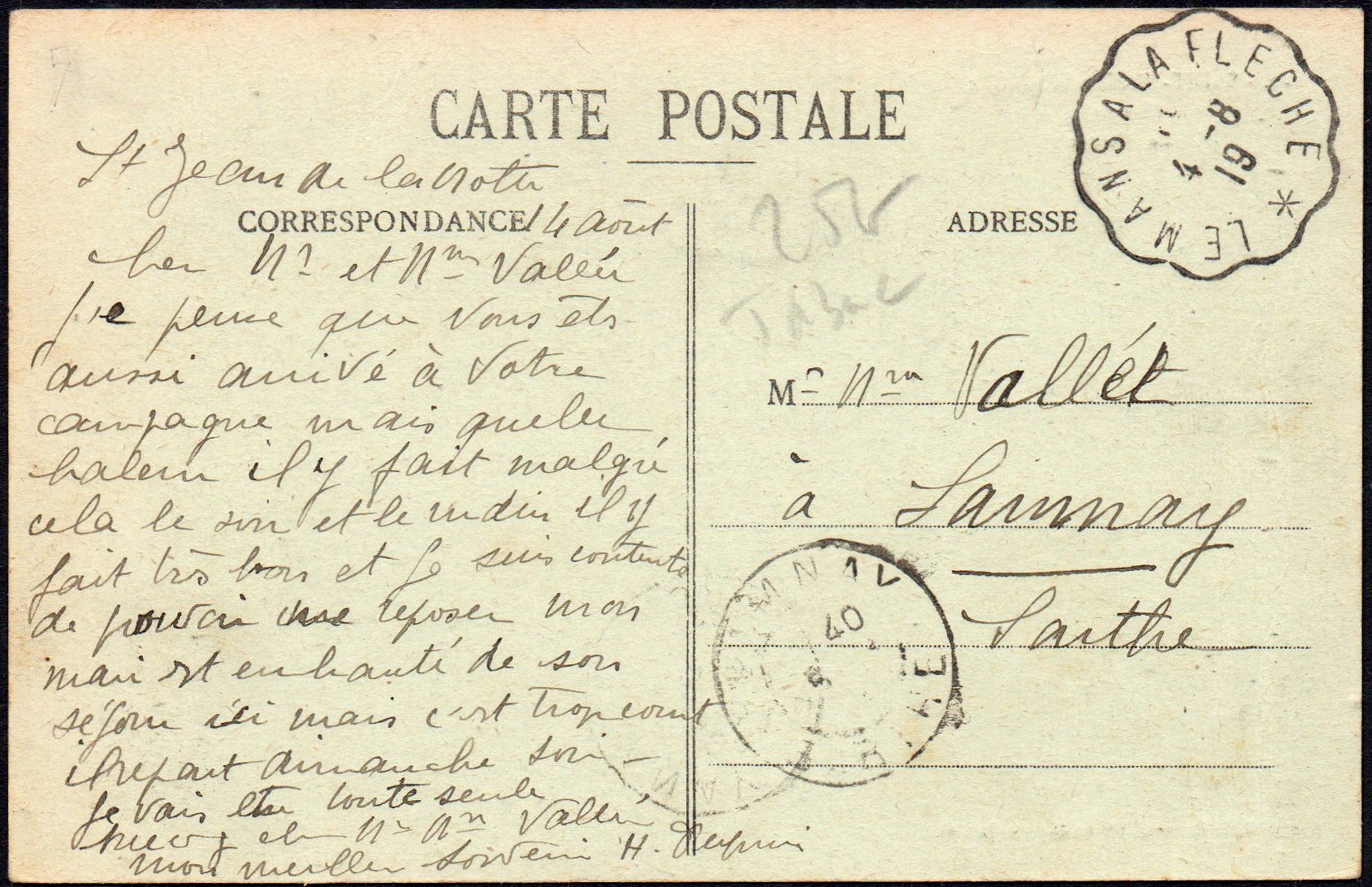 This fine postcard, which the sender locates as emanating from St-Jean-de-la-Motte, strongly suggests tramway usage of this CCL in the much scarcer 'outward' direction from Le Mans during the early years of its operation. St-Jean-de-la-Motte was a tramway station approximately midway between Cérans-Foulletourte and La Flèche. Lamnay, the card's destination, is just south of La Ferté-Bernard. This is currently the earliest date that we have seen of a likely tramway usage of the CCL in this direction.
The closure date of the tramway CCL is much easier to narrow down. It seems probable, from what we have seen, to have operated up until, or very close to, the closure of the La Flèche to Foulletourte section of the tramline at the end of 1932. We have no evidence to suggest that a shortened CCL service on the remaining open section of the tramway between Foulletourte and Le Mans was introduced, nor was the Mayet au Mans CCL apparently revived. However, passenger and freight traffic on the tramway from Cérans-Foulletourte to Le Mans was retained and continued until 1946.
This fine postcard, which the sender locates as emanating from St-Jean-de-la-Motte, strongly suggests tramway usage of this CCL in the much scarcer 'outward' direction from Le Mans during the early years of its operation. St-Jean-de-la-Motte was a tramway station approximately midway between Cérans-Foulletourte and La Flèche. Lamnay, the card's destination, is just south of La Ferté-Bernard. This is currently the earliest date that we have seen of a likely tramway usage of the CCL in this direction.
The closure date of the tramway CCL is much easier to narrow down. It seems probable, from what we have seen, to have operated up until, or very close to, the closure of the La Flèche to Foulletourte section of the tramline at the end of 1932. We have no evidence to suggest that a shortened CCL service on the remaining open section of the tramway between Foulletourte and Le Mans was introduced, nor was the Mayet au Mans CCL apparently revived. However, passenger and freight traffic on the tramway from Cérans-Foulletourte to Le Mans was retained and continued until 1946.
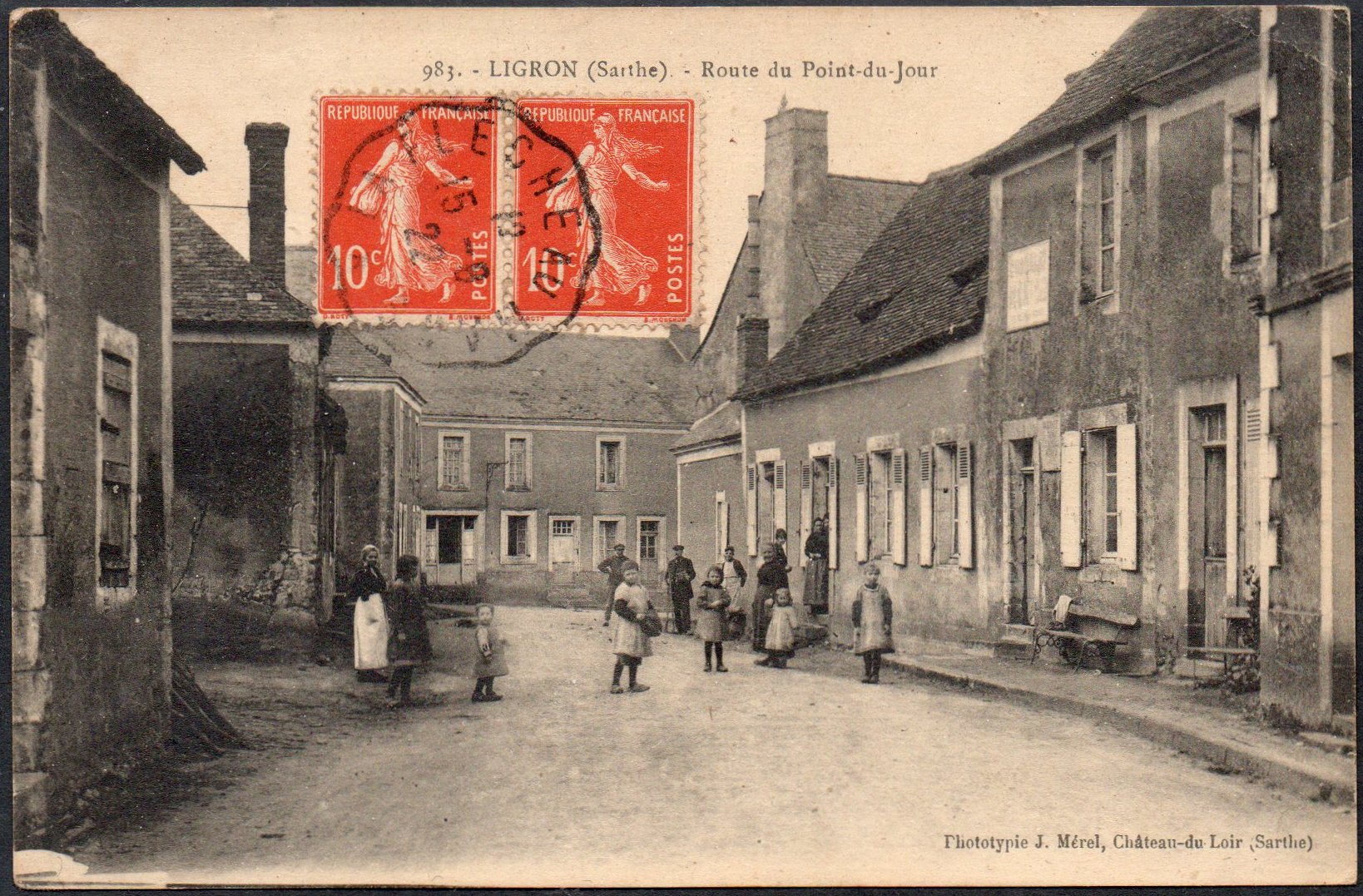
 A card sent to the Var département in August 1922 from La Touche, a hamlet just east of Ligron - and closer to the tram station than Ligron itself. It is not at all unlikely that the sender handed this card over in person at the station.
The counting of words (in so far as names were concerned) and the July 1922 to March 1924 postcard rates applicable to the length of a message are both a little unclear to us; this card could perhaps have been adequately franked at the 10c, rather than 20c, rate.
A card sent to the Var département in August 1922 from La Touche, a hamlet just east of Ligron - and closer to the tram station than Ligron itself. It is not at all unlikely that the sender handed this card over in person at the station.
The counting of words (in so far as names were concerned) and the July 1922 to March 1924 postcard rates applicable to the length of a message are both a little unclear to us; this card could perhaps have been adequately franked at the 10c, rather than 20c, rate.
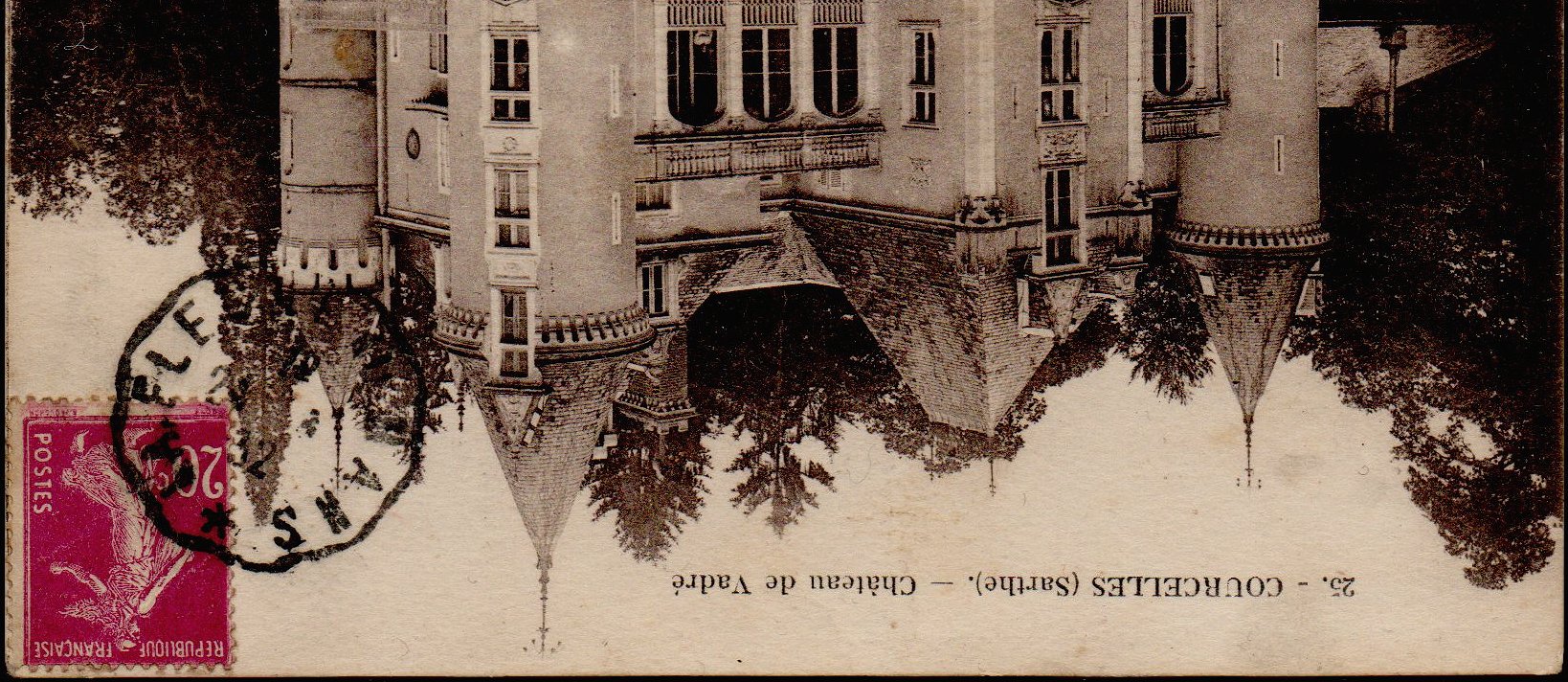 The Château de Vadré near Courcelles, is four times closer to the former tramway station in Ligron than it is to the former railway station in Villaines-sous-Malicorne, lending weight to this being a tramway cancellation. The month is not certain, possibly April, but the year is clearly 1932, the final year of operation of the tramway on the Cérans-Foulletourte to La Flèche section.
Based on material we have seen, Foulletourte generated the most numerous examples of the tramway CCL. However, we have seen examples from virtually every station on the line, for example, a fair number of examples from Fillé and occasional examples from Parigné-le-Pôlin, Spay, La Fontaine St. Martin, Ligron, St. Jean de la Motte, Mareil-sur-Loir and Clermont-Créans.
The Château de Vadré near Courcelles, is four times closer to the former tramway station in Ligron than it is to the former railway station in Villaines-sous-Malicorne, lending weight to this being a tramway cancellation. The month is not certain, possibly April, but the year is clearly 1932, the final year of operation of the tramway on the Cérans-Foulletourte to La Flèche section.
Based on material we have seen, Foulletourte generated the most numerous examples of the tramway CCL. However, we have seen examples from virtually every station on the line, for example, a fair number of examples from Fillé and occasional examples from Parigné-le-Pôlin, Spay, La Fontaine St. Martin, Ligron, St. Jean de la Motte, Mareil-sur-Loir and Clermont-Créans.
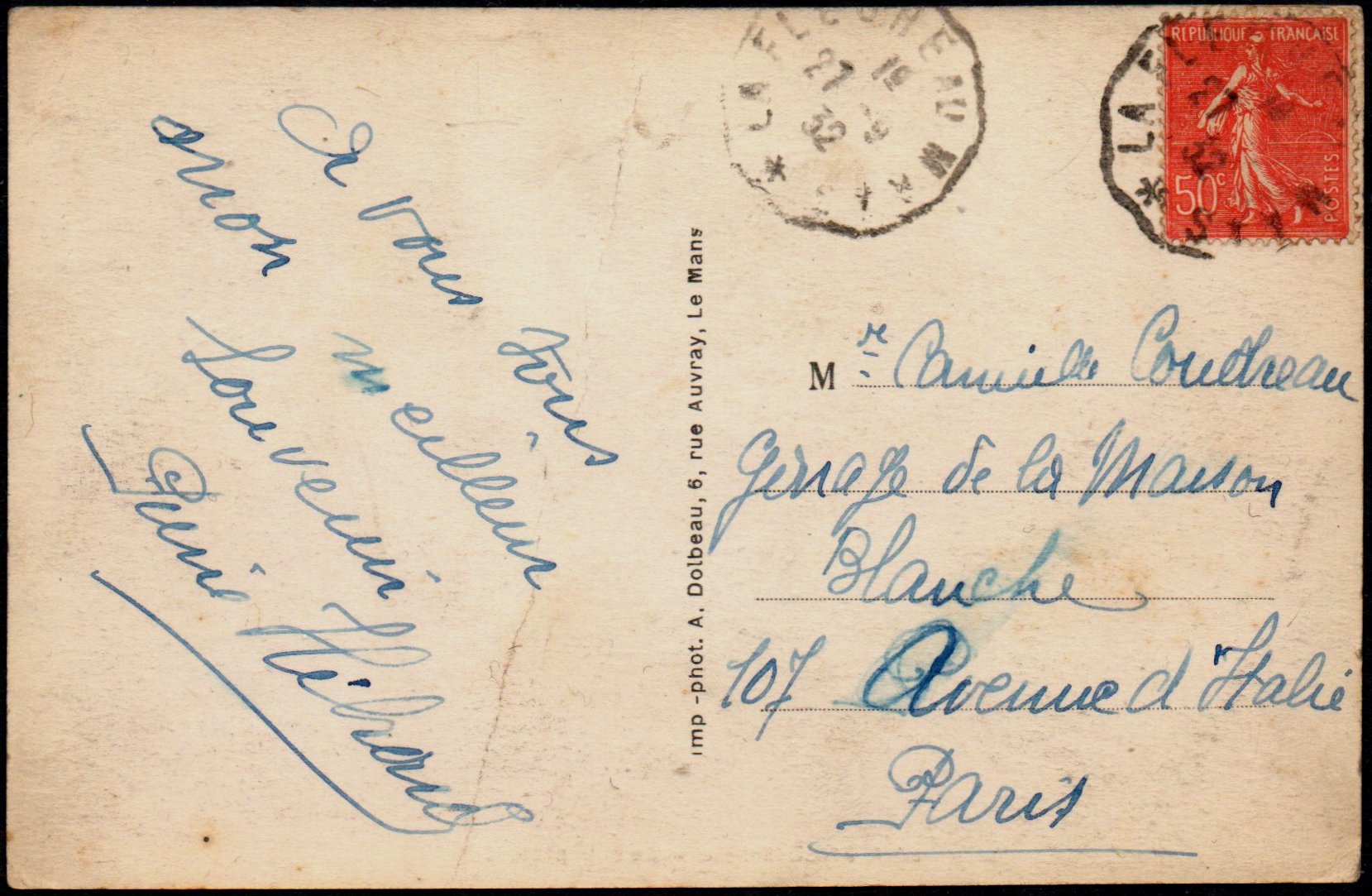
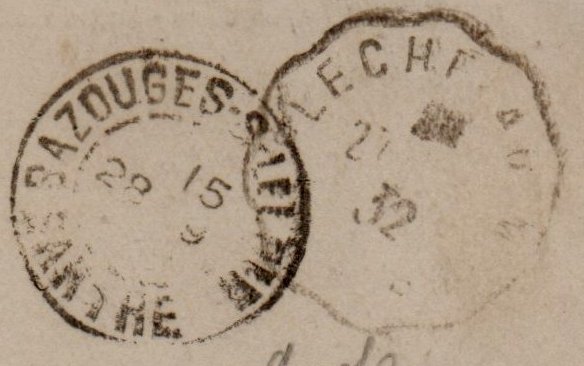 Left : A card of Fillé on the tramway, 27 Sept 1932.
Right : Postmark-only detail from a card of Malicorne on the railway, 27 Sept 1932. The stamp is on the view-side. The month is gleaned from the arrival backstamp.
This is the latest CCL we have seen with the La Flèche au Mans CCL that is very probably 'tramway' in origin and it is also the card, mentioned above, which was sent on the same date as one from Malicorne - and hence apparently on the railway.
More scans of the 'railway' card from this date are shown in the Appendix article (Section 4).
As the railway and tramway CCLs appear to have run concurrently at some period(s), we have looked for variations in the service number of the canceller which might identify whether a postmark was applied on a tram or a train. At the beginning of the railway-only period, a star is often found at the very top of the moveable type in the postmark. We suspect a single card (of 1917) with a star in the place of a service number may be a tramway cancel, but that would be an exception.
Left : A card of Fillé on the tramway, 27 Sept 1932.
Right : Postmark-only detail from a card of Malicorne on the railway, 27 Sept 1932. The stamp is on the view-side. The month is gleaned from the arrival backstamp.
This is the latest CCL we have seen with the La Flèche au Mans CCL that is very probably 'tramway' in origin and it is also the card, mentioned above, which was sent on the same date as one from Malicorne - and hence apparently on the railway.
More scans of the 'railway' card from this date are shown in the Appendix article (Section 4).
As the railway and tramway CCLs appear to have run concurrently at some period(s), we have looked for variations in the service number of the canceller which might identify whether a postmark was applied on a tram or a train. At the beginning of the railway-only period, a star is often found at the very top of the moveable type in the postmark. We suspect a single card (of 1917) with a star in the place of a service number may be a tramway cancel, but that would be an exception. 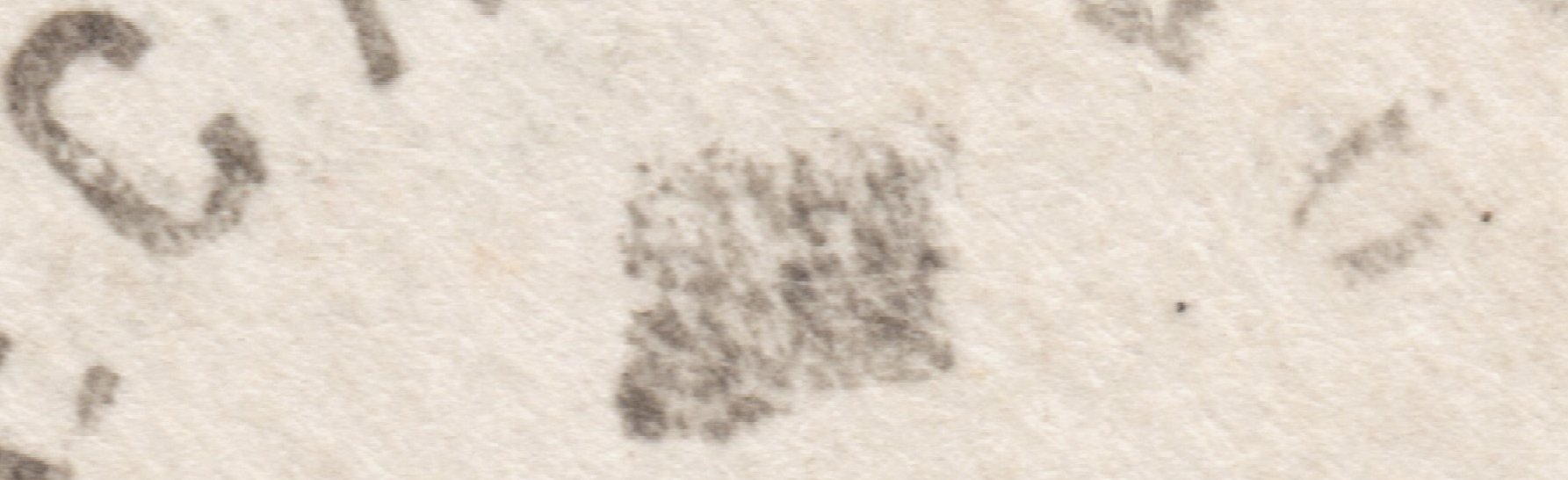 Despite our failure to discern a clear pattern, it seems reasonable to assume that La Poste would have chosen to create a clear distinction between mail carried on the railway and mail on the tramway. There may, possibly, have been periodic procedural changes, especially on the railway, understood at the time but difficult to identify now. However, by far the most difficult research element is that, within the joint train/tram period, one cannot be certain whether an item of mail travelled on the train of the tram, due to their geographic proximity.
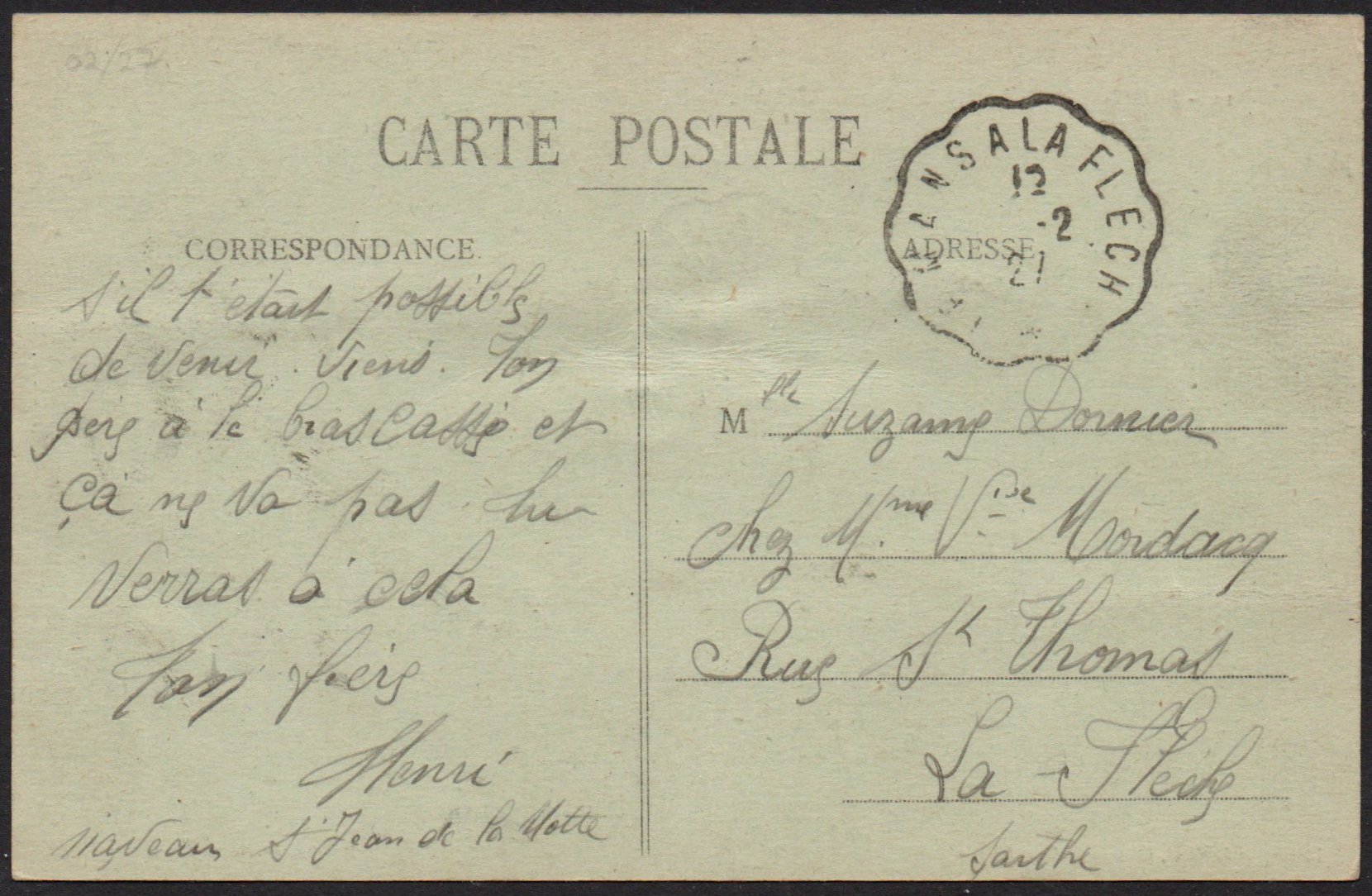
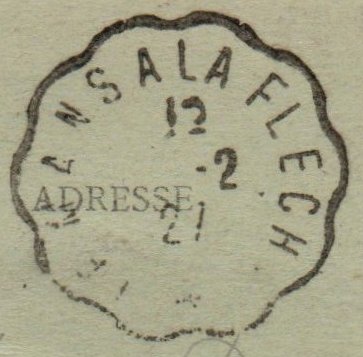
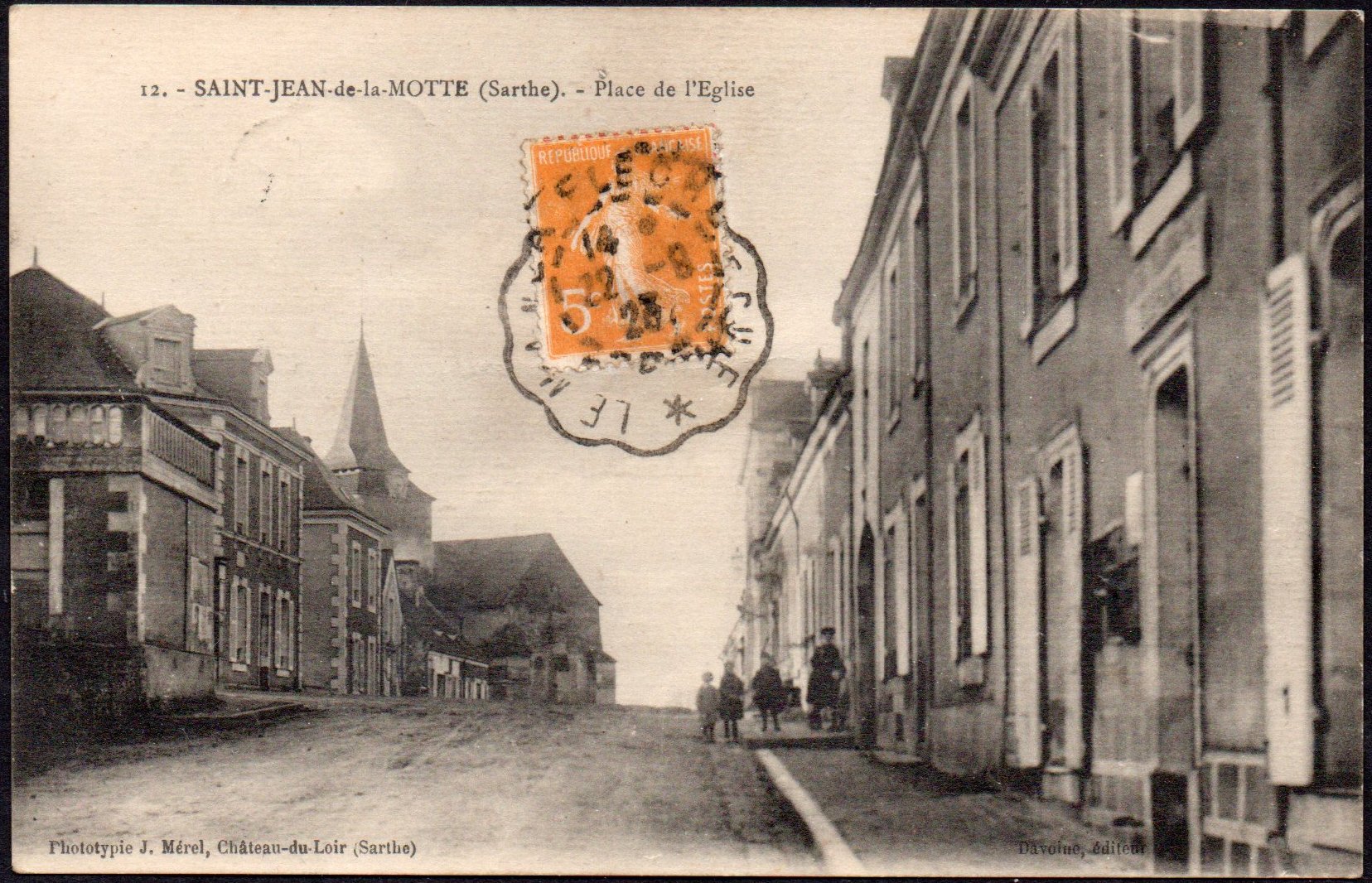
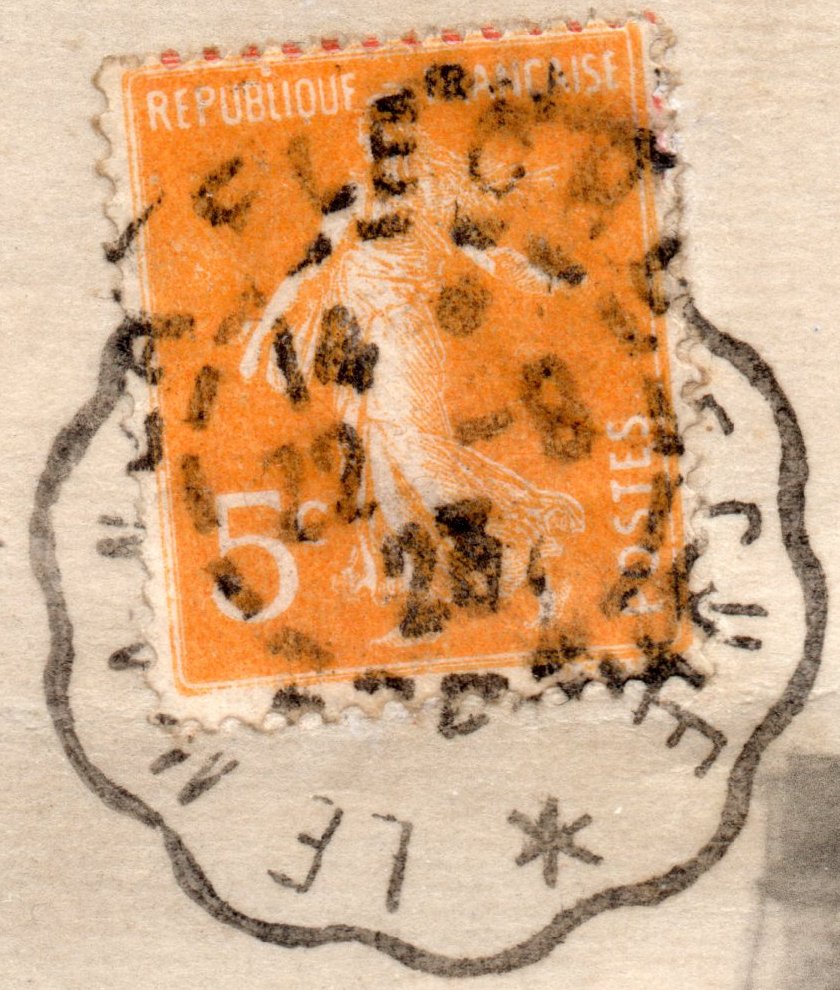 Four views of the front and back of the same card revealing a little chicanery - easily exposed. A stamp collector appears to have tried (not very successfully) to remove the original postage stamp, almost certainly a 40c Vermilion, a stamp introduced in 1926; the top of the remains of that stamp can just be seen protruding in the detail scan. This left some ugly damage on the front and a later owner covered it up with a 5c Yellow, hopelessly inadequate postage for 1927 when the correct rate for a postcard with more than a 5-word message was 40c.
They at least managed to find a locally used stamp to fill the gap and we have a La Flèche town cancel from 1923 surrounded by the remainder of a second strike of the CCL. The cancellation on the message side, though, can be trusted and is the latest CCL we have seen to date in the Le Mans à La Flèche direction, February 1927.
Four views of the front and back of the same card revealing a little chicanery - easily exposed. A stamp collector appears to have tried (not very successfully) to remove the original postage stamp, almost certainly a 40c Vermilion, a stamp introduced in 1926; the top of the remains of that stamp can just be seen protruding in the detail scan. This left some ugly damage on the front and a later owner covered it up with a 5c Yellow, hopelessly inadequate postage for 1927 when the correct rate for a postcard with more than a 5-word message was 40c.
They at least managed to find a locally used stamp to fill the gap and we have a La Flèche town cancel from 1923 surrounded by the remainder of a second strike of the CCL. The cancellation on the message side, though, can be trusted and is the latest CCL we have seen to date in the Le Mans à La Flèche direction, February 1927.
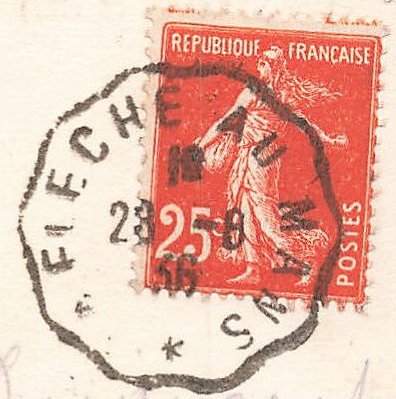 La Fléche au Mans : Railway [ . ] After 1932
Le Mans à La Fléche : Railway [ . ] After 1932 (not seen)
.
La Fléche au Mans : Railway [ . ] After 1932
Le Mans à La Fléche : Railway [ . ] After 1932 (not seen)
.
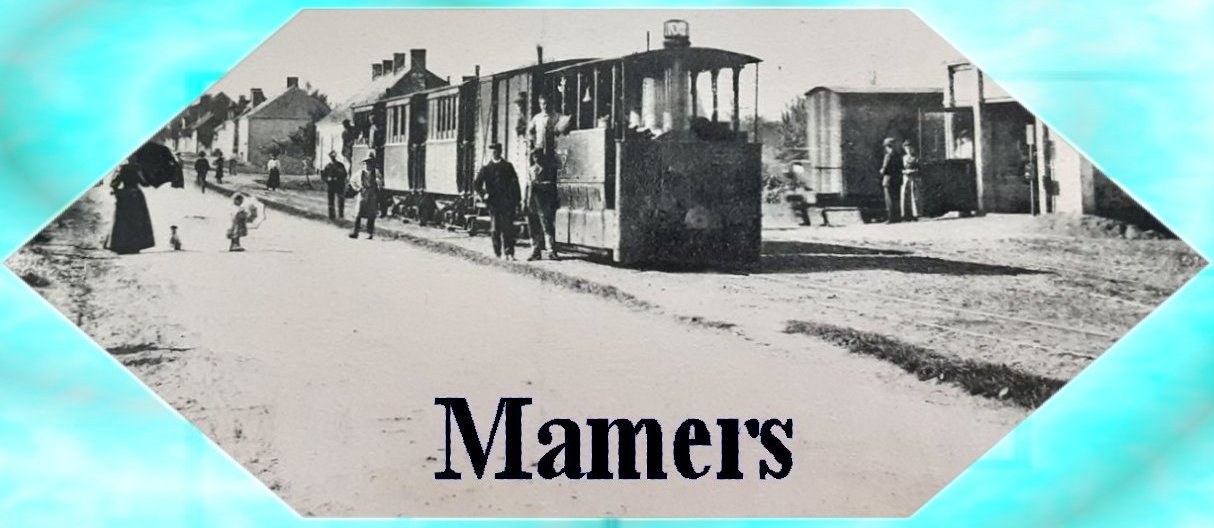
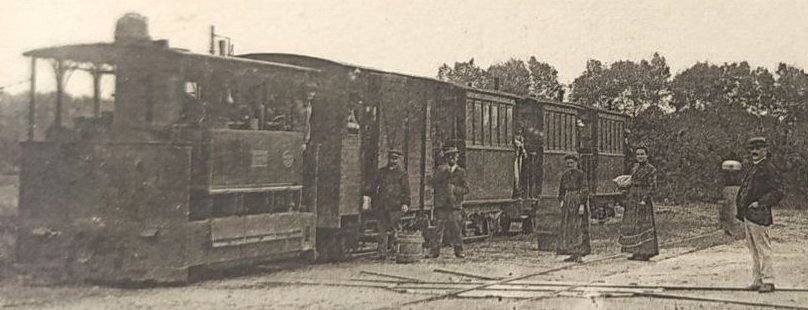 Gare de Beaufay, a postcard we have seen used in 1913 and in the late 1920s: is 'the postwoman' in the picture? . .
. . At Beaufay, the postwoman arrives late at the station due to a ten-fold increase in outgoing mail and the tram, although not obliged to do so, waits for her; she is very well-liked and the chef-de-train would not wish her to get into trouble. Signatures for registered letters are rapidly exchanged between her and the Convoyeur and the tram departs.
At the next station, Briosne, due to it being the last day to send off for a special offer in the Chasseur Français, there is the same huge increase in outgoing mail but the postman here was prepared for it and meets the tram on time.
At La Détourbe, our raconteur reveals, mails were transferred during the stop between the Convoyeur on our train and a Convoyeur of the branch line tram for La Ferté-Bernard, an intriguing revelation, which required some new research revealing that ..... yes, indeed, one can find several examples of the Mamers line CCL cancellation on mail originating from the towns on the T.S. line between La Détourbe and La Ferté-Bernard - and no evidence that any bespoke CCL cancellation was ever produced for, or used on, the branch-line.
Beyond La Ferté-Bernard, the branch-line was extended to Montmirail during WWI and that extension was operational from 1916-1921 and 1924-1932. We checked a large selection of mail from all the stations on this extension and unearthed a fair number of courrier-convoyeur cancellations on several CCL routes - but none with the Mamers-Le Mans line CCL. It therefore appears very unlikely that the convoyeur fourgon ever ran operationally beyond La Ferté-Bernard.
Gare de Beaufay, a postcard we have seen used in 1913 and in the late 1920s: is 'the postwoman' in the picture? . .
. . At Beaufay, the postwoman arrives late at the station due to a ten-fold increase in outgoing mail and the tram, although not obliged to do so, waits for her; she is very well-liked and the chef-de-train would not wish her to get into trouble. Signatures for registered letters are rapidly exchanged between her and the Convoyeur and the tram departs.
At the next station, Briosne, due to it being the last day to send off for a special offer in the Chasseur Français, there is the same huge increase in outgoing mail but the postman here was prepared for it and meets the tram on time.
At La Détourbe, our raconteur reveals, mails were transferred during the stop between the Convoyeur on our train and a Convoyeur of the branch line tram for La Ferté-Bernard, an intriguing revelation, which required some new research revealing that ..... yes, indeed, one can find several examples of the Mamers line CCL cancellation on mail originating from the towns on the T.S. line between La Détourbe and La Ferté-Bernard - and no evidence that any bespoke CCL cancellation was ever produced for, or used on, the branch-line.
Beyond La Ferté-Bernard, the branch-line was extended to Montmirail during WWI and that extension was operational from 1916-1921 and 1924-1932. We checked a large selection of mail from all the stations on this extension and unearthed a fair number of courrier-convoyeur cancellations on several CCL routes - but none with the Mamers-Le Mans line CCL. It therefore appears very unlikely that the convoyeur fourgon ever ran operationally beyond La Ferté-Bernard.
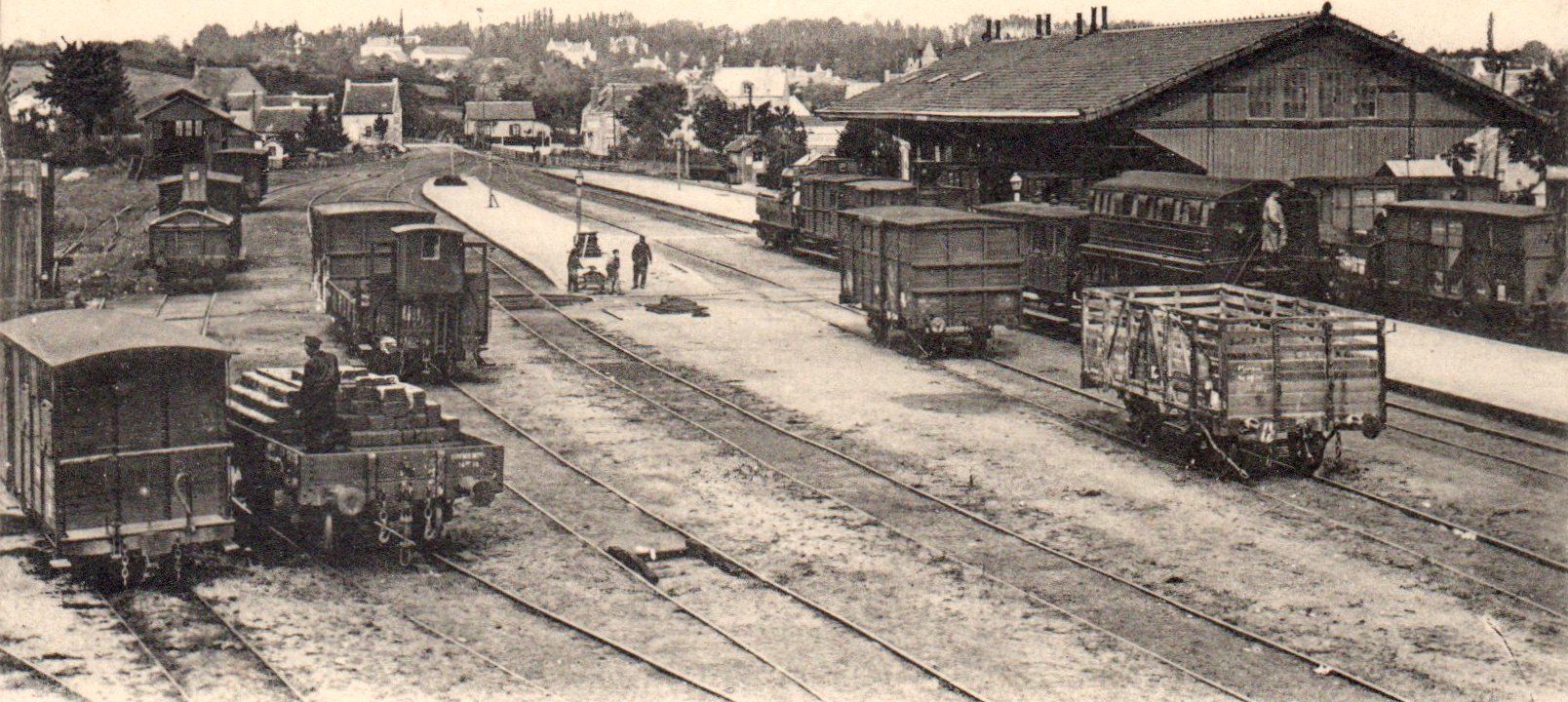 At the extreme left of the postcard view above is a metre-gauge track with a T.S. van, at what may have been a point of transfer for goods between narrow and standard gauge. It is, though, very rudimentary if this was the extent of the facilities.
There were numerous railway-operated CCL to/from Mamers but we have not seen an obvious example of mail from that town being loaded onto T.S. trams. Nevertheless, the Type II 'Mamers au Mans' is probably the commonest of all the tramway CCL in La Sarthe, with significant quantities of mail observed from many stations along the route which required the application of the convoyeur's handstamp.
By contast, the Type II in the opposite direction, 'Le Mans à Mamers', as well as the Type III in the 'Mamers au Mans' direction (the latter nearly always poorly struck, it seems) are both scarce. Even rarer, it seems, is the Type III 'Le Mans à Mamers', which is listed in Pothion. However, we have tried without success to unearth a single example of it.
At the extreme left of the postcard view above is a metre-gauge track with a T.S. van, at what may have been a point of transfer for goods between narrow and standard gauge. It is, though, very rudimentary if this was the extent of the facilities.
There were numerous railway-operated CCL to/from Mamers but we have not seen an obvious example of mail from that town being loaded onto T.S. trams. Nevertheless, the Type II 'Mamers au Mans' is probably the commonest of all the tramway CCL in La Sarthe, with significant quantities of mail observed from many stations along the route which required the application of the convoyeur's handstamp.
By contast, the Type II in the opposite direction, 'Le Mans à Mamers', as well as the Type III in the 'Mamers au Mans' direction (the latter nearly always poorly struck, it seems) are both scarce. Even rarer, it seems, is the Type III 'Le Mans à Mamers', which is listed in Pothion. However, we have tried without success to unearth a single example of it.
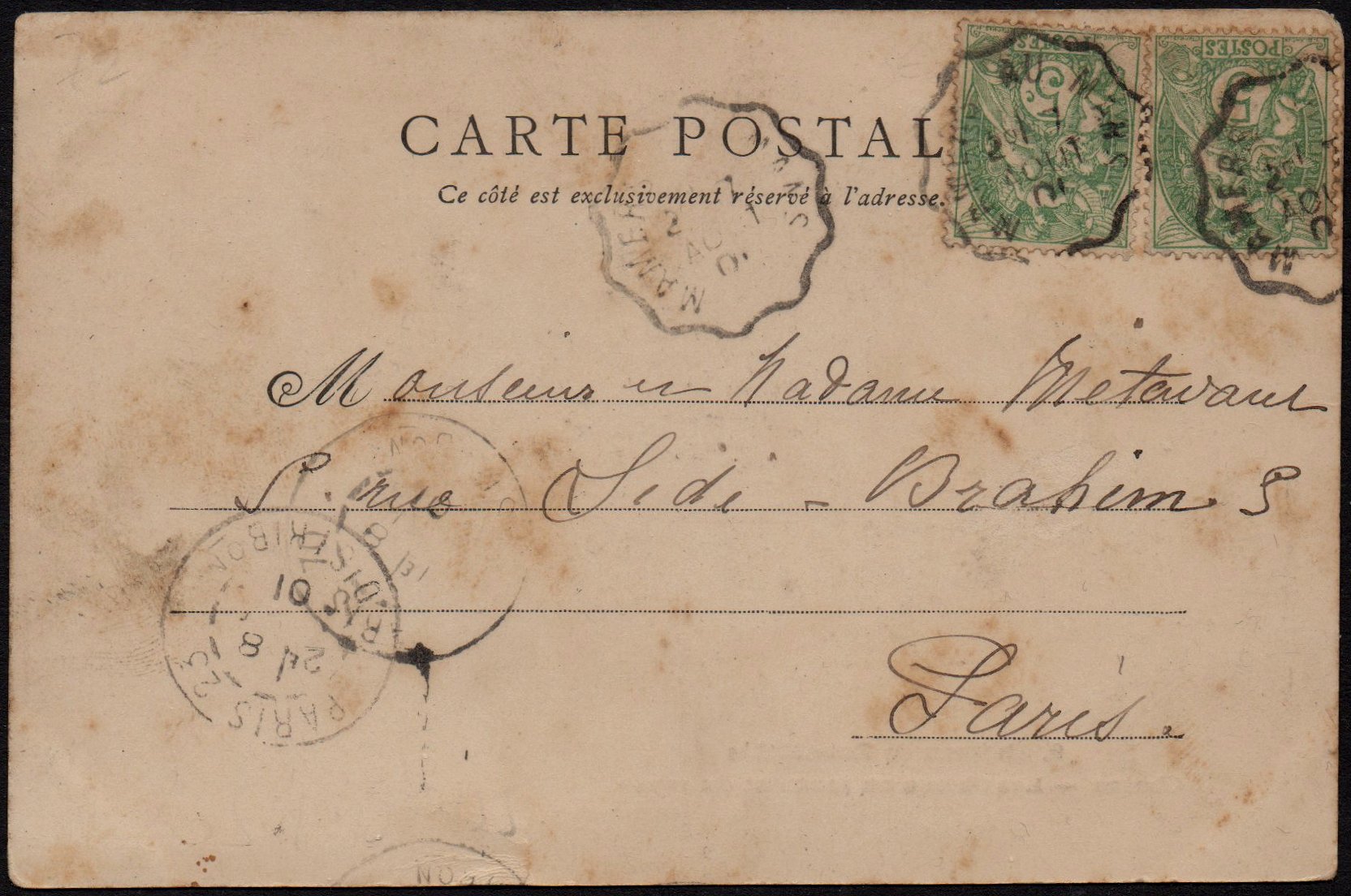
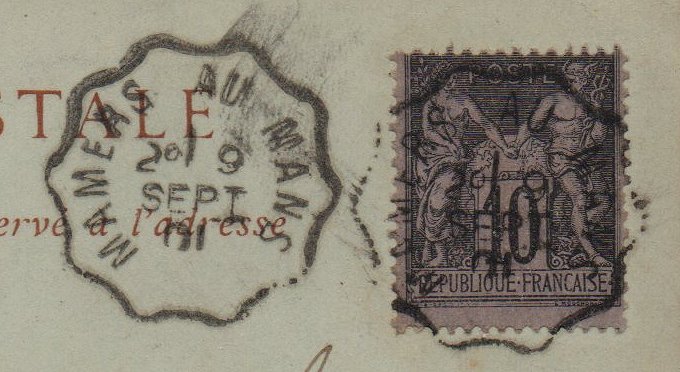 Left: A card of Bonnétable with the earliest example of a T.S. CCL we have seen (on any line),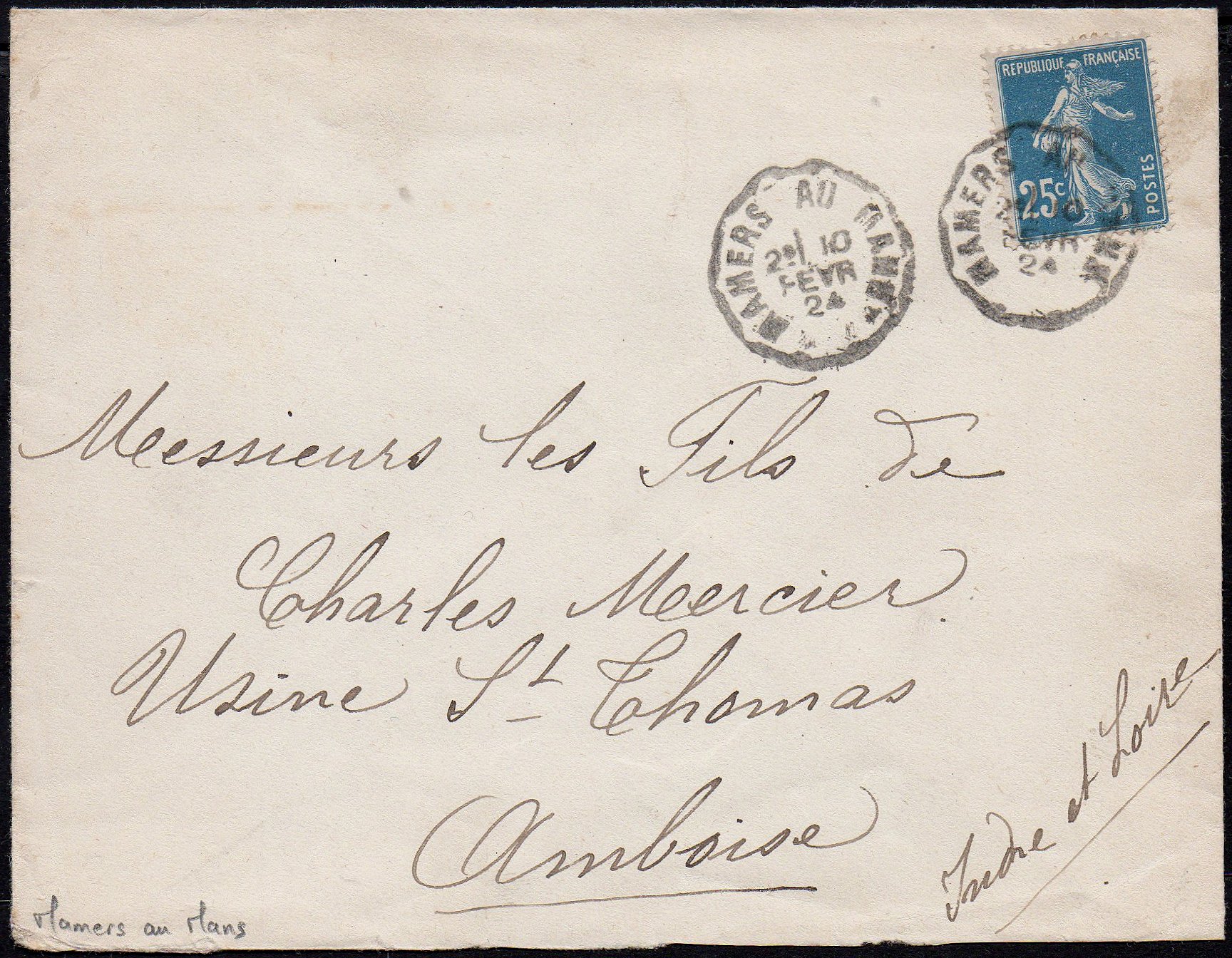
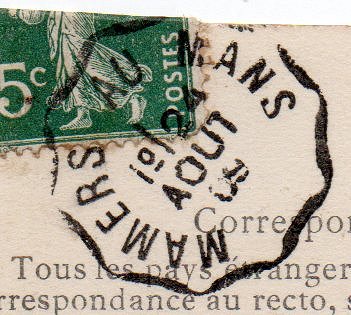 A 1924 envelope and a detail scan from a 1909 postcard. The variations in appearance of this Type II CCL, which was in use for over 25 years, is particularly noticeable here. The 1909 strike is on a postcard of the Château de la Perrigne, Saint-Corneille (near Savigné-l'Evêque)
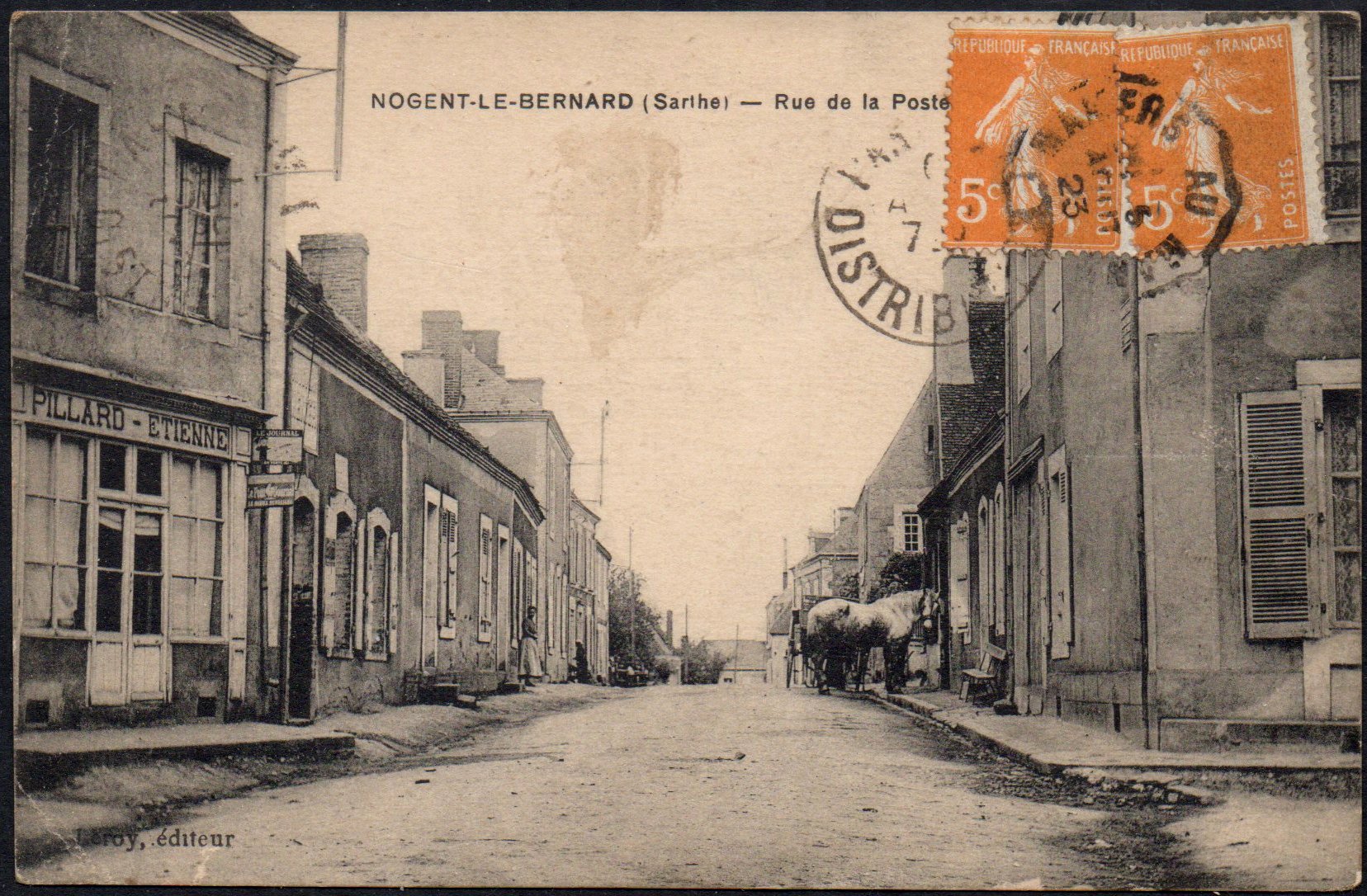
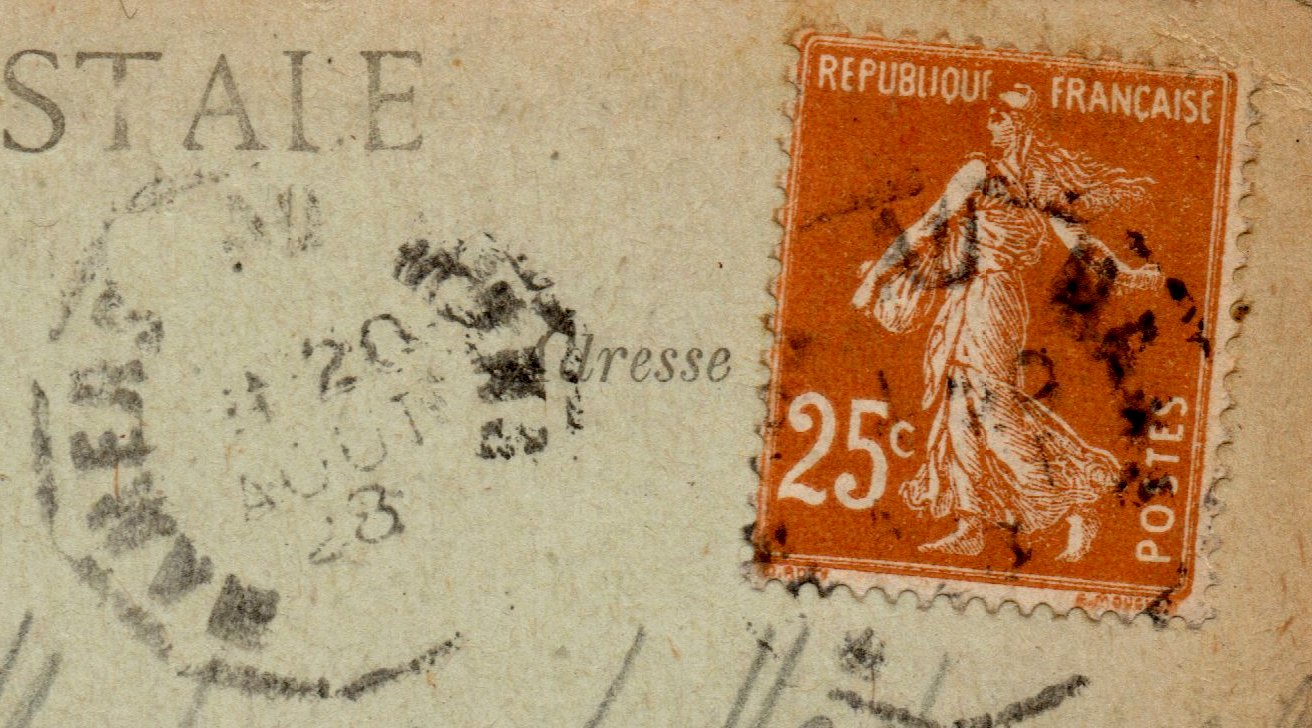 Left: An August 1923 postcard of Nogent-le-Bernard, sent to Paris (3-word message, correctly franked 10c)
Right: This 1928 cancellation, on a postcard of the village of Saint-Antoine-de-Rochefort (on the branch-line), is currently the latest use of a Type II Mamers-line cancellation that we have seen. This postcard has an additional significance, the routing instruction added by the sender. The card is covered in detail in our Appendix article, in Section 3(b).
Left: An August 1923 postcard of Nogent-le-Bernard, sent to Paris (3-word message, correctly franked 10c)
Right: This 1928 cancellation, on a postcard of the village of Saint-Antoine-de-Rochefort (on the branch-line), is currently the latest use of a Type II Mamers-line cancellation that we have seen. This postcard has an additional significance, the routing instruction added by the sender. The card is covered in detail in our Appendix article, in Section 3(b).
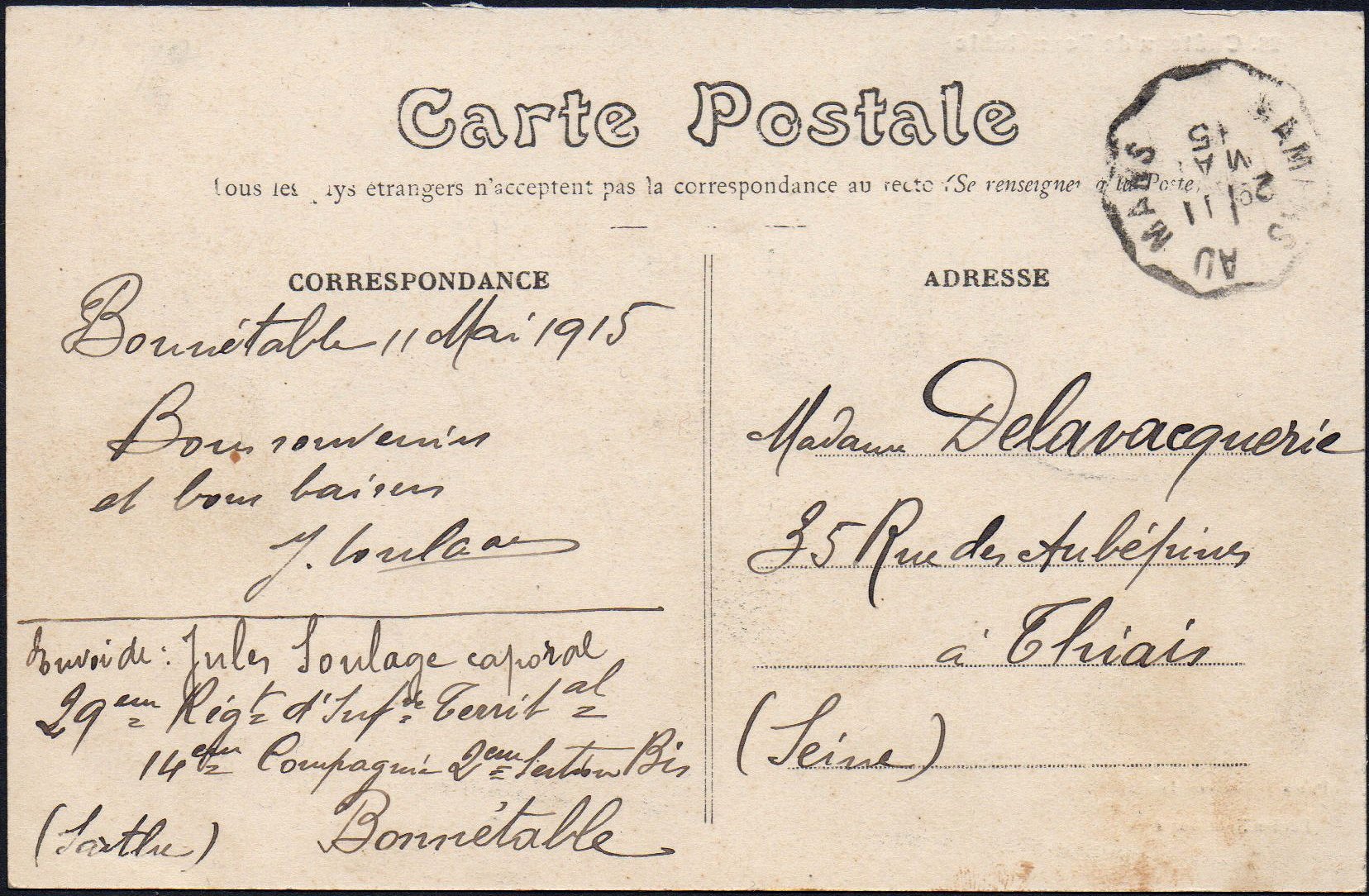 A military free frank example from 1915 on a Bonnétable postcard. Rather than the more typical F.M. manuscript or regimental handstamp to claim the entitlement to free postage, the sender has provided his full name, regiment and company.
.
Le Mans à Mamers (Type II):
This is a much scarcer cancellation than is perhaps generally appreciated. For each Type II CCL we have seen in the Mamers direction, we have probably seen more than thirty examples of the Type II in the Le Mans direction. We display most of the CCL towards Mamers that we have seen.
A military free frank example from 1915 on a Bonnétable postcard. Rather than the more typical F.M. manuscript or regimental handstamp to claim the entitlement to free postage, the sender has provided his full name, regiment and company.
.
Le Mans à Mamers (Type II):
This is a much scarcer cancellation than is perhaps generally appreciated. For each Type II CCL we have seen in the Mamers direction, we have probably seen more than thirty examples of the Type II in the Le Mans direction. We display most of the CCL towards Mamers that we have seen.
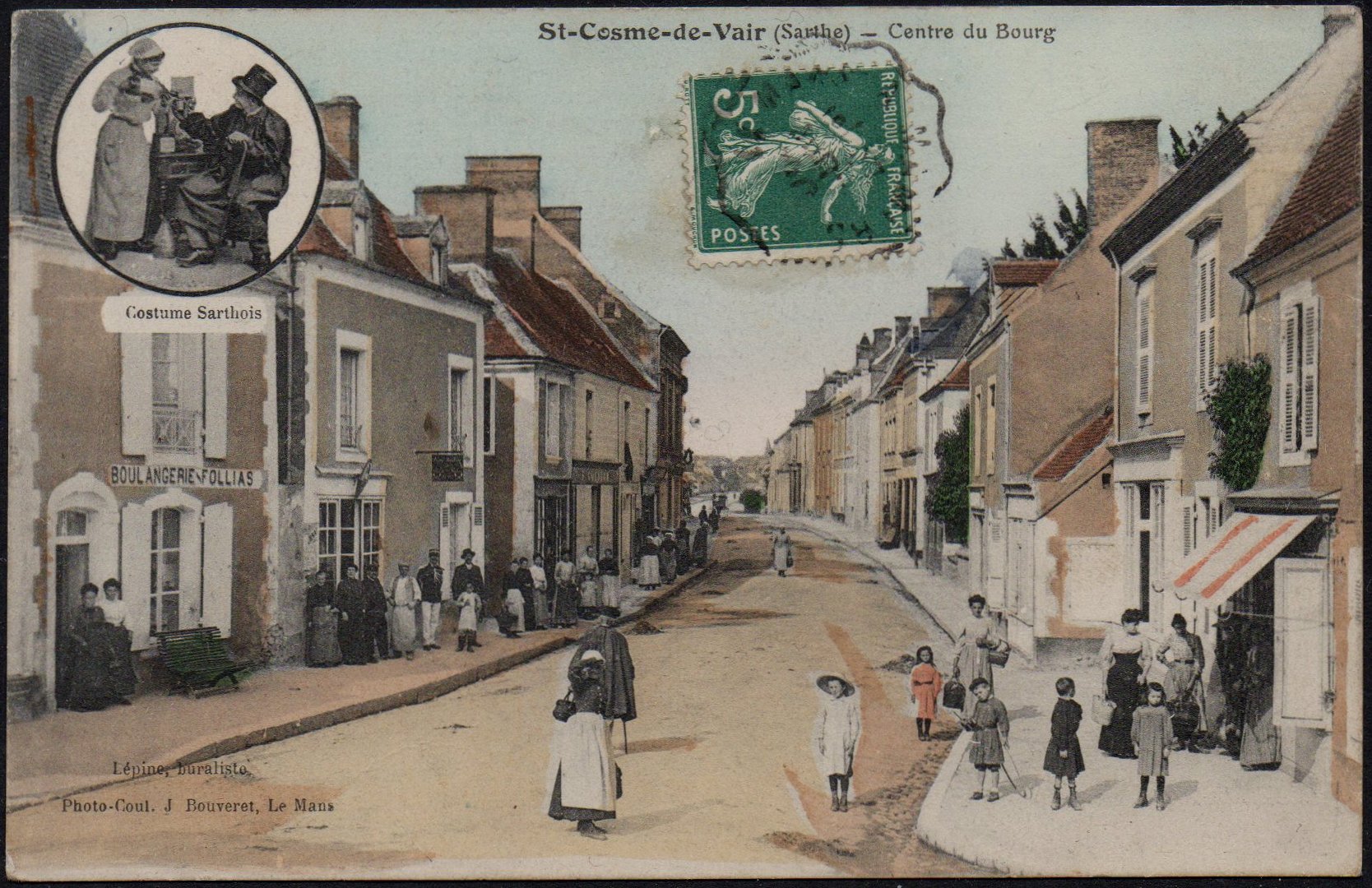 The year in this postmark is poorly struck but may well be (19)06. Some support for this date comes from the cancellations we have seen on other examples of the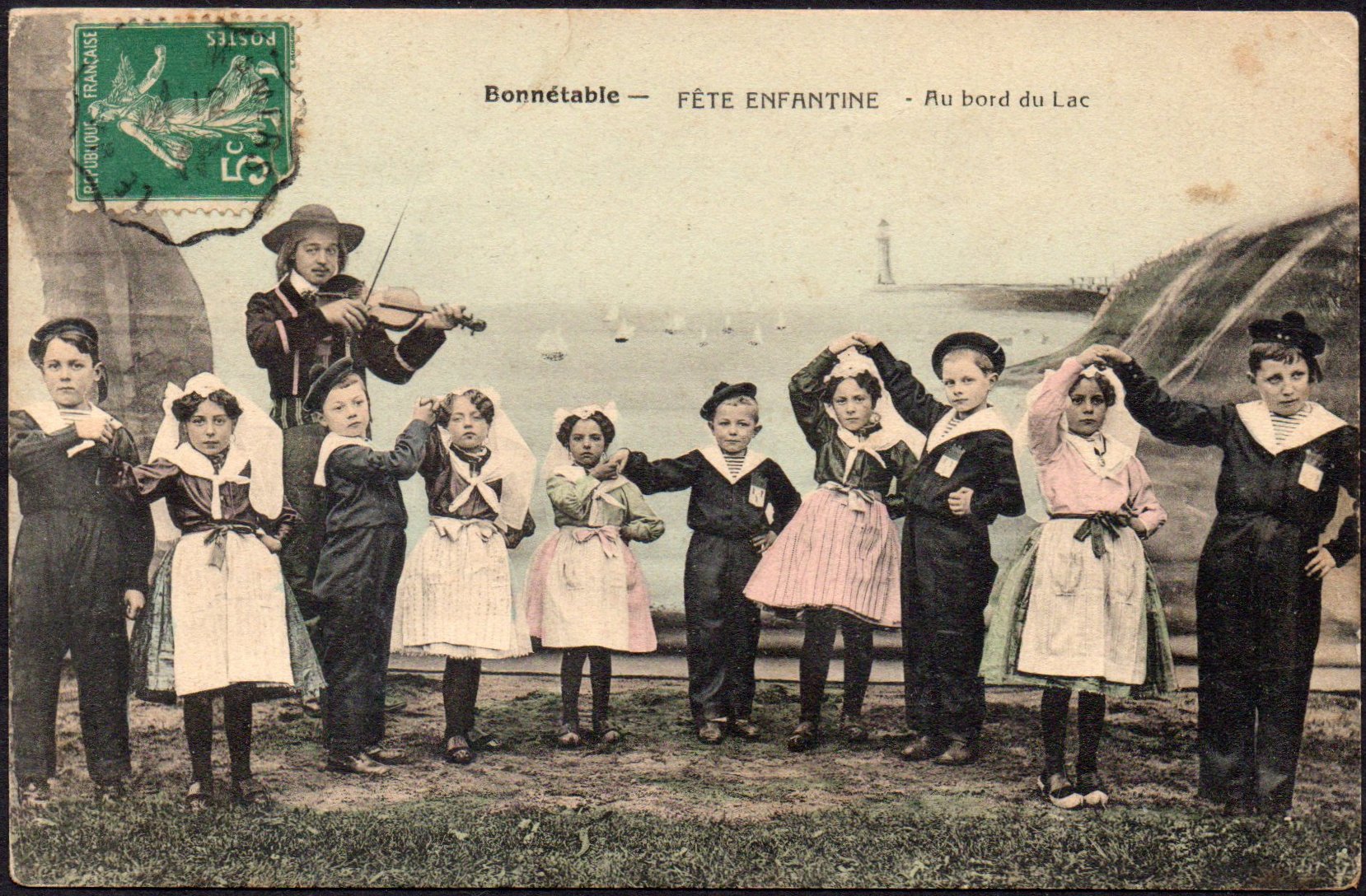
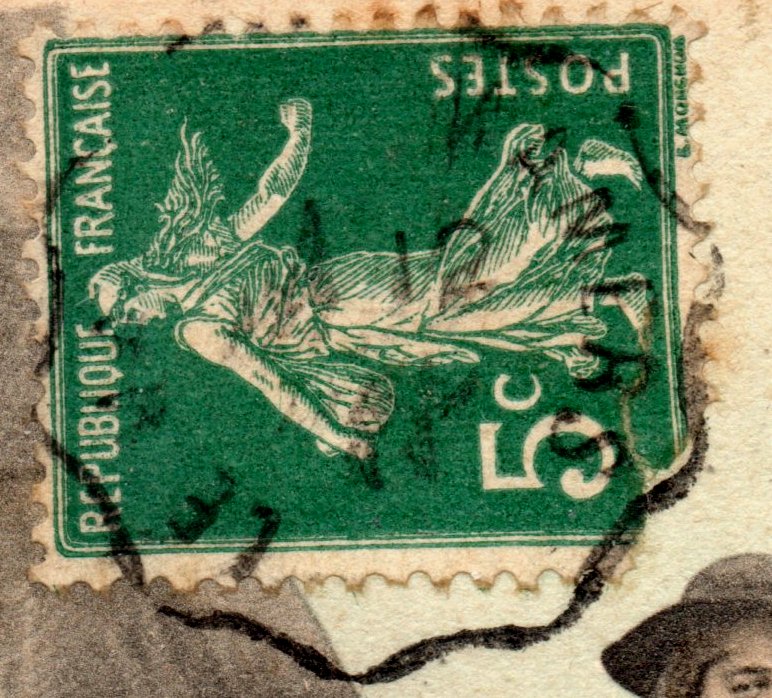
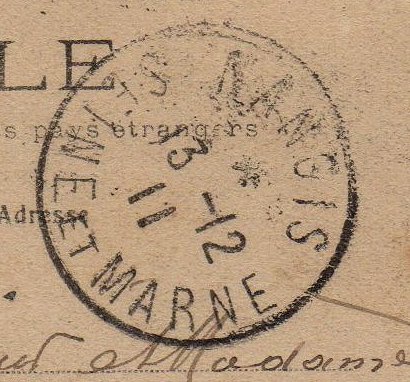 December 12th 1911 Le Mans à Mamers Type II on a rarely-seen postcard (Bonnétable, Fête Enfantine), sent to Nangis.
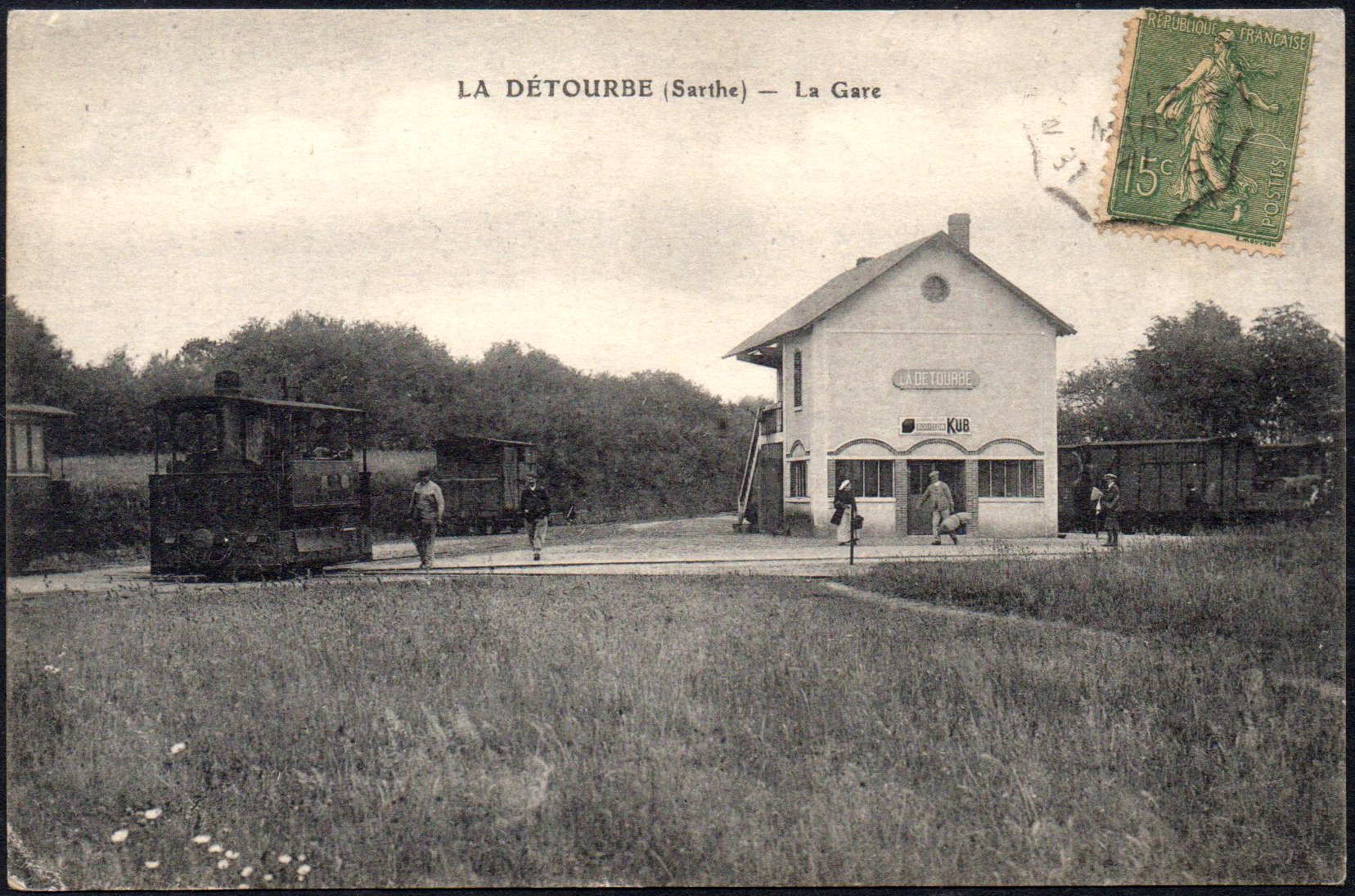
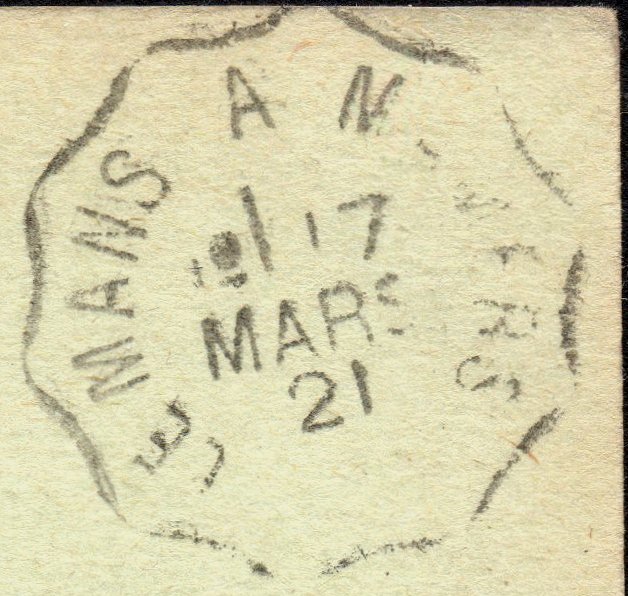 A view of the isolated junction station, La Détourbe, on the Le Mans-Mamers T.S. line, where the La Ferté-Bernard branch diverged. Here we pause to savour an atmospheric dip into history; this was a lonely rural spot before the tramway arrived and has now returned to its former peaceful solitude. This seems to show the La Ferté-Bernard branch-line tram-engine running around its train, probably before the arrival of one or, more likely, two main-line trams at the junction. Click here for a bird's eye view today (opens in a new tab; you will need to zoom in {+} once in order to reveal the name 'La Détourbe'). The card sports a fine second strike of the scarce Le Mans à Mamers cancellation (Type II) on the back.
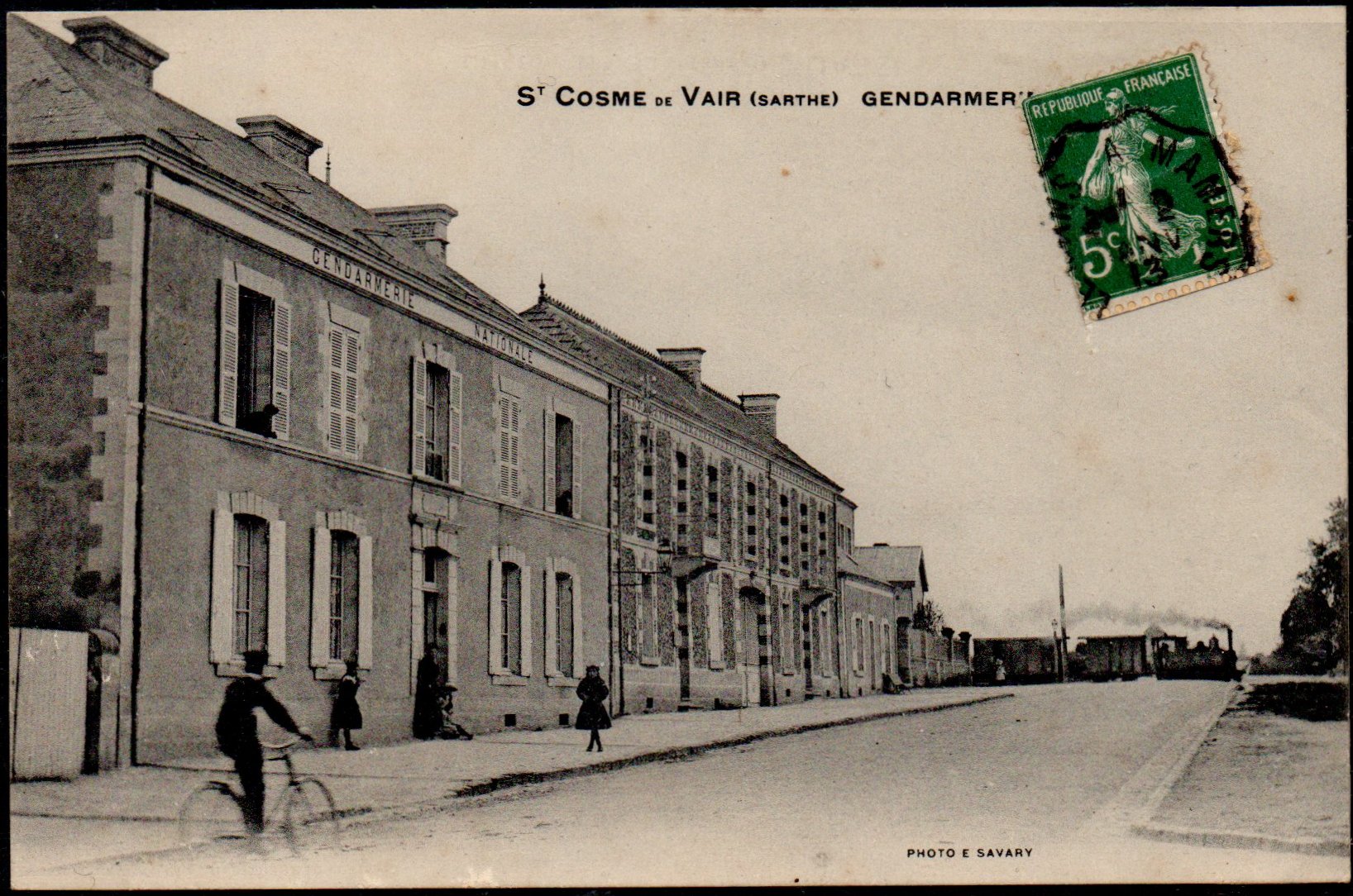
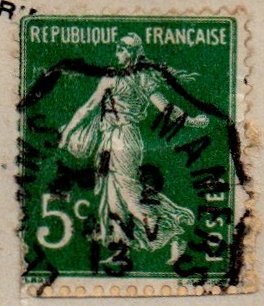 The stamp has been glued onto the postcard whilst already affixed to a piece of card. The cancellation is authentic as well as being geographically accurate and within a proper date range for the postcard.
Postcards often evoke nostalgia. Although the two principal buildings in this view have since been re-purposed, one can still stand (on the Avenue Eugène-Gourdeau) where the photographer once stood and gaze on the former Gendarmerie and adjacent Post Office, but virtually all trace of the trams which ran here for 49 years (1898-1947) have faded away.
The stamp has been glued onto the postcard whilst already affixed to a piece of card. The cancellation is authentic as well as being geographically accurate and within a proper date range for the postcard.
Postcards often evoke nostalgia. Although the two principal buildings in this view have since been re-purposed, one can still stand (on the Avenue Eugène-Gourdeau) where the photographer once stood and gaze on the former Gendarmerie and adjacent Post Office, but virtually all trace of the trams which ran here for 49 years (1898-1947) have faded away.
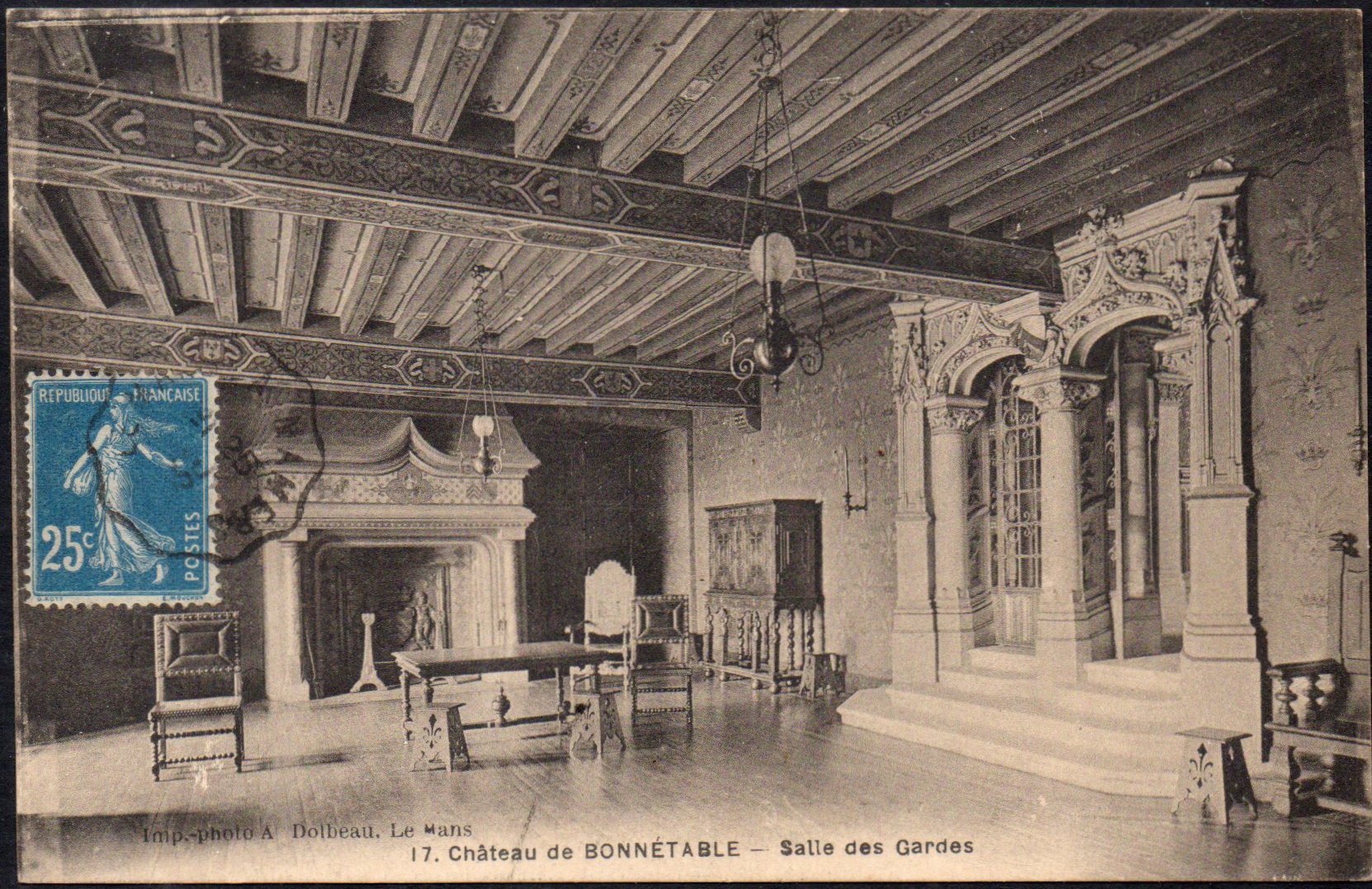
 The latest 'Le Mans à Mamers' Type II we have so far unearthed, June 25th 2022. The full date is established with the aid of the arrival backstamp the following day at Villemaur-sur-Vanne, Aube.
.
Mamers au Mans Type II [ . ] (Earliest : 08/01 --> Latest : 08/28)
Le Mans à Mamers Type II [ . ] ( Earliest : 12/11 --> Latest : 06/22 )
A possible earlier date, 03/06, also seen.
.
Type
The latest 'Le Mans à Mamers' Type II we have so far unearthed, June 25th 2022. The full date is established with the aid of the arrival backstamp the following day at Villemaur-sur-Vanne, Aube.
.
Mamers au Mans Type II [ . ] (Earliest : 08/01 --> Latest : 08/28)
Le Mans à Mamers Type II [ . ] ( Earliest : 12/11 --> Latest : 06/22 )
A possible earlier date, 03/06, also seen.
.
Type 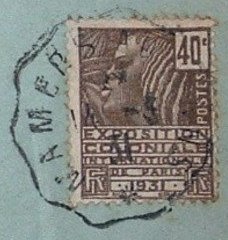
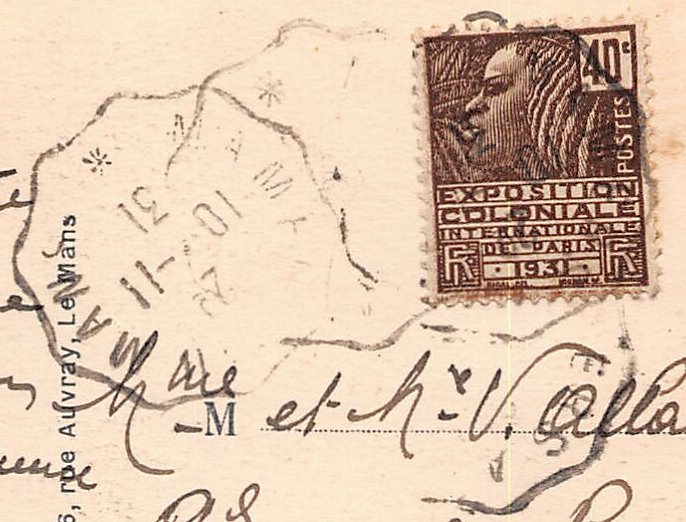
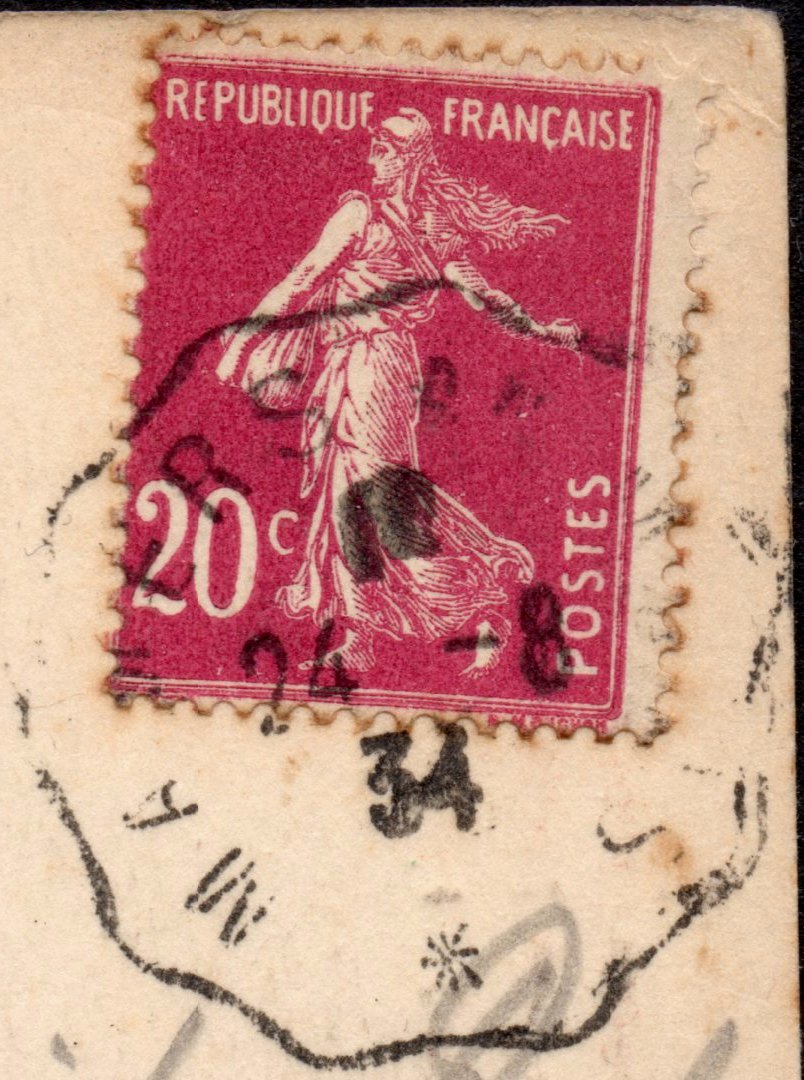 Left & Centre: 1931 cancellations on postcards of Bonnétable, one sent to Clichy (Paris).
Right: August 1934 on a postcard showing Sarthe costumes. A poor strike but sufficient to identify the route.
Note:
At present, August 1934 is the latest date we have seen for any Tramways de la Sarthe CCL cancellation.
.
Mamers au Mans Type III [ . ] (Earliest : 11/31 --> Latest : 08/34)
Le Mans à Mamers Type III [ . ] recorded in Pothion, not seen by us.
We should like to express our thanks to Keith Downing for his advice and for his help in supplying additional information for this article, especially in relation to the T.S. Mamers-line services.
.
Left & Centre: 1931 cancellations on postcards of Bonnétable, one sent to Clichy (Paris).
Right: August 1934 on a postcard showing Sarthe costumes. A poor strike but sufficient to identify the route.
Note:
At present, August 1934 is the latest date we have seen for any Tramways de la Sarthe CCL cancellation.
.
Mamers au Mans Type III [ . ] (Earliest : 11/31 --> Latest : 08/34)
Le Mans à Mamers Type III [ . ] recorded in Pothion, not seen by us.
We should like to express our thanks to Keith Downing for his advice and for his help in supplying additional information for this article, especially in relation to the T.S. Mamers-line services.
.
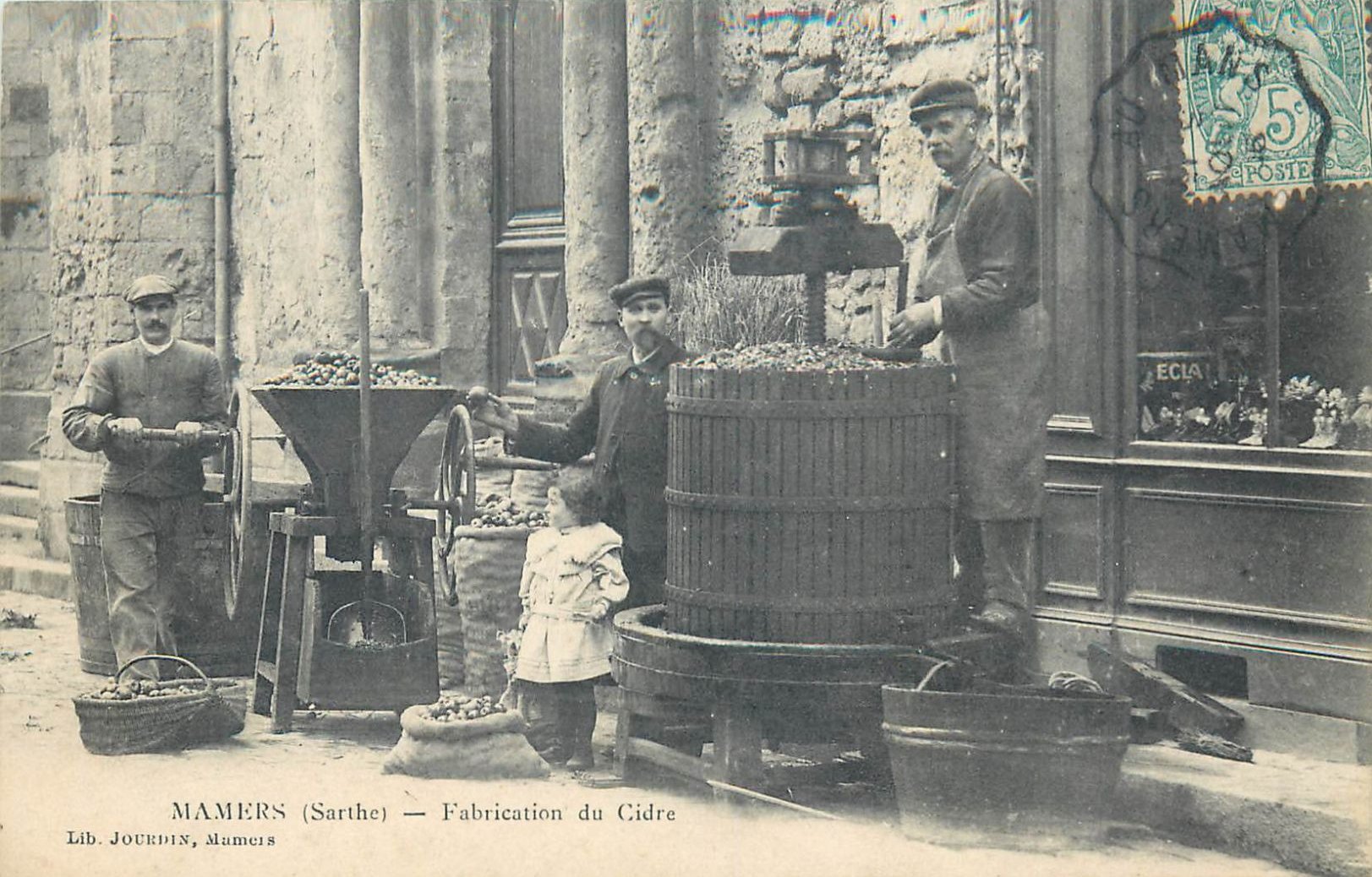
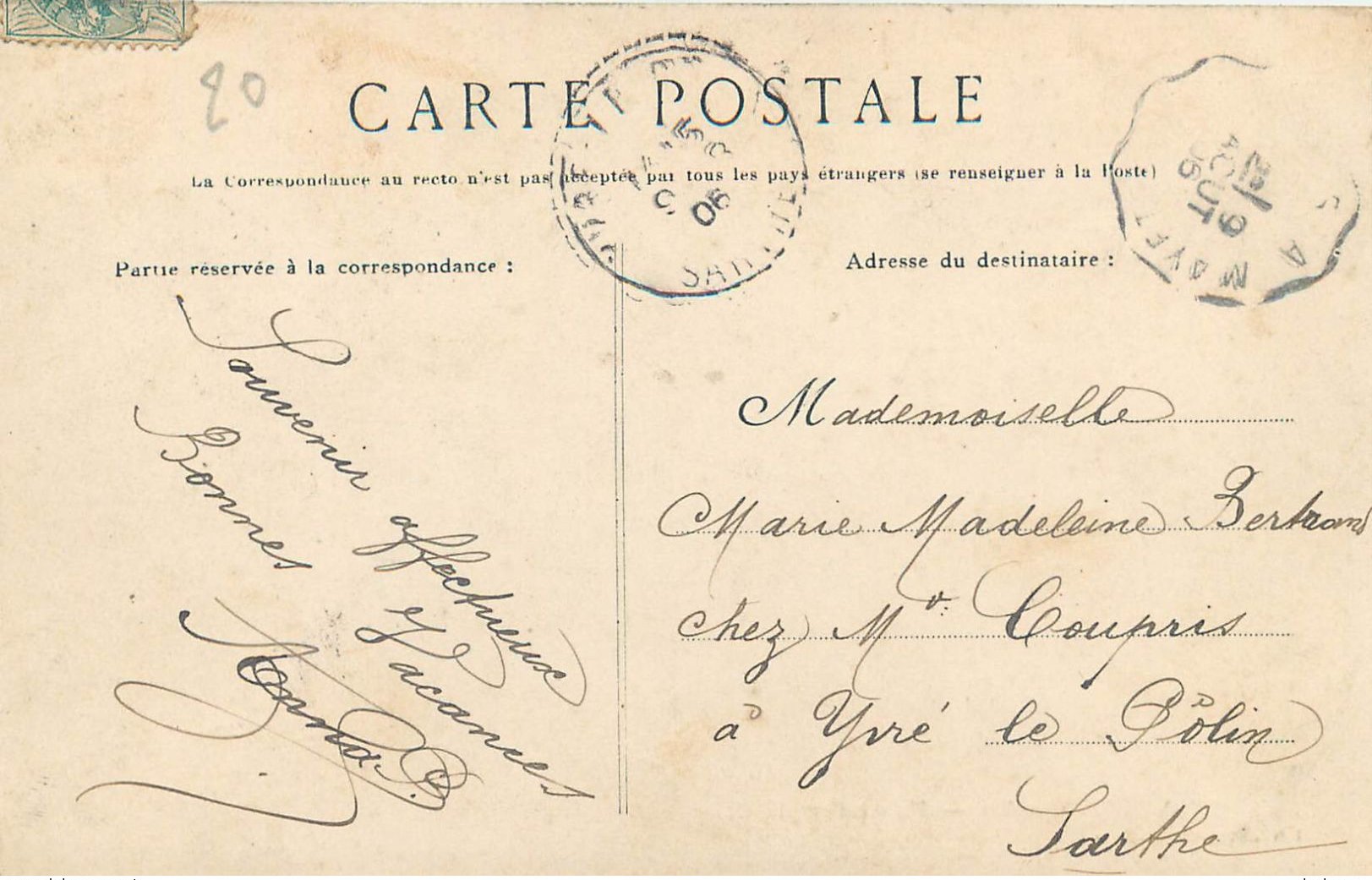 Firstly, cards of the town of Mamers with a TS cancellation are very unusual, although it may not have been posted there. The postmark on the front is the departure mark, Mamers au Mans, but there is a transit mark on the back, poorly defined, but it can only be 'Le Mans à Mayet. This is totally consistent with its destination, Yvré-le-Pôlin. There is nothing to indicate whether it passed directly between TS trams at the Gare Centrale or travelled via the sorting office in Le Mans. We do not recall seeing any other card or envelope bearing two T.S. cancellations on different lines.
For the La Ferté-Bernard au Mans Railway CCL and the Tramways del la Sarthe 'Mamers au Mans' BRANCH-LINE cancellations click here (for Section 3 of the Appendix article, opens in a new tab)
If you have already read the Mayet line section below, click here to ..StD..jump to the St. Denis d'Orques CCL.
.
Firstly, cards of the town of Mamers with a TS cancellation are very unusual, although it may not have been posted there. The postmark on the front is the departure mark, Mamers au Mans, but there is a transit mark on the back, poorly defined, but it can only be 'Le Mans à Mayet. This is totally consistent with its destination, Yvré-le-Pôlin. There is nothing to indicate whether it passed directly between TS trams at the Gare Centrale or travelled via the sorting office in Le Mans. We do not recall seeing any other card or envelope bearing two T.S. cancellations on different lines.
For the La Ferté-Bernard au Mans Railway CCL and the Tramways del la Sarthe 'Mamers au Mans' BRANCH-LINE cancellations click here (for Section 3 of the Appendix article, opens in a new tab)
If you have already read the Mayet line section below, click here to ..StD..jump to the St. Denis d'Orques CCL.
.
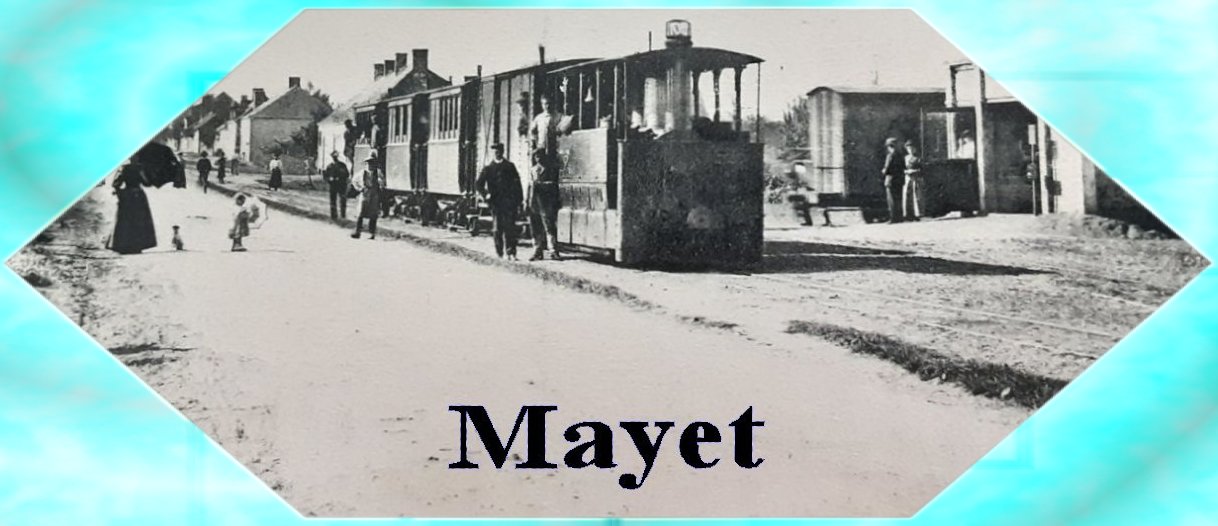
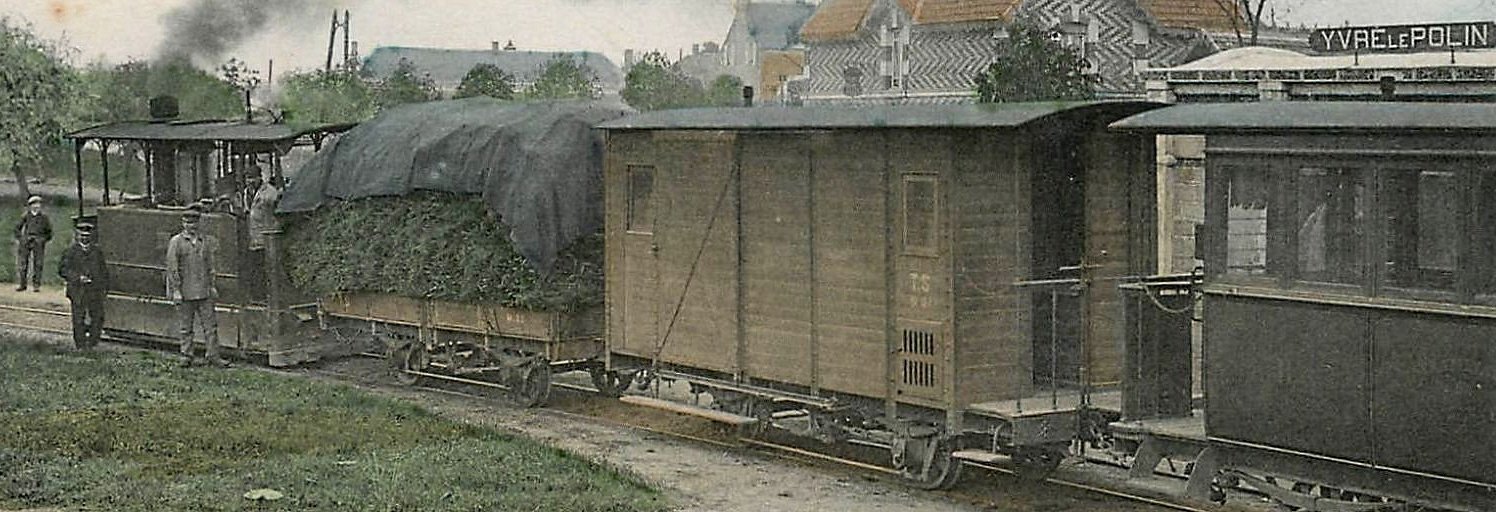 Yvré-le-Pôlin on the Mayet line; the fourgon depicted here was probably for use by the mail-guard (courrier-convoyeur). Unlike TPO (Ambulant) carriages, which are typically marked 'POSTES', this would not appear to have been the practice for convoyeurs' compartments.
We note that there are two doors into the van. Whilst we have generally left an impression in this article that the entire fourgon was for the use of La Poste, we have not ruled out that the van may have been partitioned, thus providing some useful private (and secure) space for tramway personnel as well.
This is a hand-coloured card; the vehicle liveries may, or may not, be authentic, but seem plausible.
There is a direct railway line from Mayet to Le Mans but everything, especially the locations of postcard views along the tramway's route that bear the CCL cancel, points to this being a tramway mail service. The tramline's history is curious. It opened from Mayet through to Le Mans, via Cérans-Foulletourte, in 1897. A new line opened southwards from Cérans-Foulletourte to La Flèche (-Ville) in 1914, after which the Tramways de la Sarthe's services progressively favoured this new line, increasingly casting the Cérans-Foulletourte to Mayet section into the role of a branch-line. The La Flèche au Mans CCL service operated by the Tramways de la Sarthe was introduced during The Great War.
A study of numerous postmarks provides a fairly clear pattern to the CCL cancellers used between Le Mans and Cérans-Foulletourte. We have not found a Mayet line cancellation applied at stations between Cérans-Foulletourte and Le Mans after 1916, nor have we found a La Flèche line cancellation applied between Cérans-Foulletourte and Le Mans before 1917. Total precision with dates from mail alone is not possible, but there appears to be a point around 1916/17 when the La Flèche trams and La Flèche CCL became the 'main-line'. There may have been a brief overlap with both tramway services operating and both CCL being in use over the Cérans-Foulletourte to Le Mans section, but we currently think it unlikely. A map is included below.
Yvré-le-Pôlin on the Mayet line; the fourgon depicted here was probably for use by the mail-guard (courrier-convoyeur). Unlike TPO (Ambulant) carriages, which are typically marked 'POSTES', this would not appear to have been the practice for convoyeurs' compartments.
We note that there are two doors into the van. Whilst we have generally left an impression in this article that the entire fourgon was for the use of La Poste, we have not ruled out that the van may have been partitioned, thus providing some useful private (and secure) space for tramway personnel as well.
This is a hand-coloured card; the vehicle liveries may, or may not, be authentic, but seem plausible.
There is a direct railway line from Mayet to Le Mans but everything, especially the locations of postcard views along the tramway's route that bear the CCL cancel, points to this being a tramway mail service. The tramline's history is curious. It opened from Mayet through to Le Mans, via Cérans-Foulletourte, in 1897. A new line opened southwards from Cérans-Foulletourte to La Flèche (-Ville) in 1914, after which the Tramways de la Sarthe's services progressively favoured this new line, increasingly casting the Cérans-Foulletourte to Mayet section into the role of a branch-line. The La Flèche au Mans CCL service operated by the Tramways de la Sarthe was introduced during The Great War.
A study of numerous postmarks provides a fairly clear pattern to the CCL cancellers used between Le Mans and Cérans-Foulletourte. We have not found a Mayet line cancellation applied at stations between Cérans-Foulletourte and Le Mans after 1916, nor have we found a La Flèche line cancellation applied between Cérans-Foulletourte and Le Mans before 1917. Total precision with dates from mail alone is not possible, but there appears to be a point around 1916/17 when the La Flèche trams and La Flèche CCL became the 'main-line'. There may have been a brief overlap with both tramway services operating and both CCL being in use over the Cérans-Foulletourte to Le Mans section, but we currently think it unlikely. A map is included below.
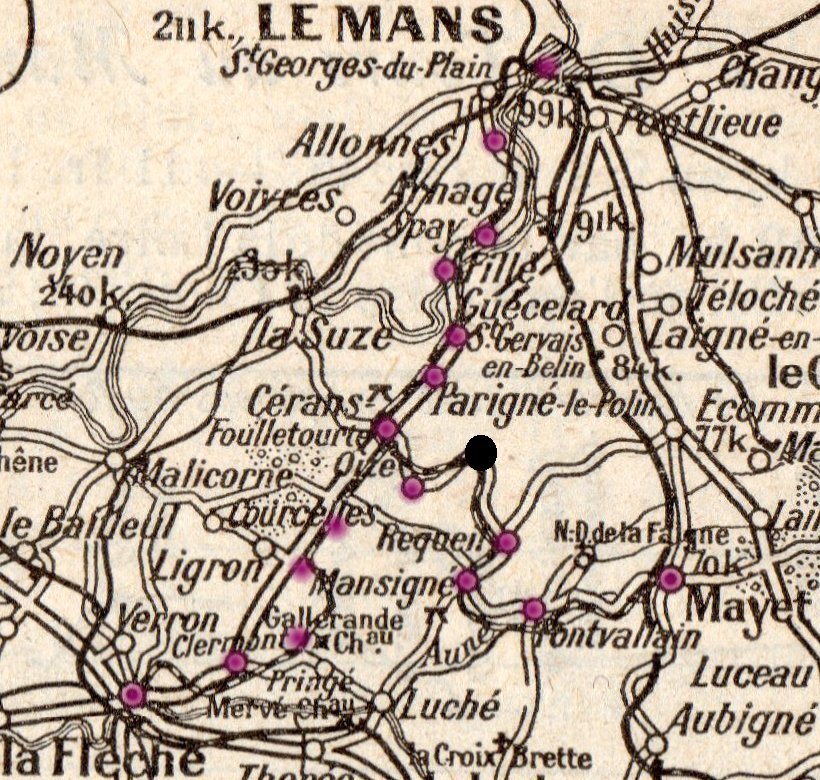 The c. 1918 map above shows all the stations between Le Mans and Mayet, marked in violet, other than Yvré-le-Pôlin which is not on the original map but which we have marked now with a large black circle.
Tramlines are shown with alternate white and black flashes, railways with solid black lines. The mapmaker has added the recently-opened tramline from Cérans-Foulletourte to La Flèche but without its stations; we have put in marks for a few stations to highlight the route. The railway line (solid black line) at Mayet is the Le Mans - Tours line.
There is more to the story between these two cancellations than a simple changeover from one CCL service to another around 1916/17. The Mayet line CCL cancellation continued to be used concurrently with the La Flèche line CCL from 1916/17 until about 1921 but, in these four or five years, the Mayet line CCL seems to have been applied
The c. 1918 map above shows all the stations between Le Mans and Mayet, marked in violet, other than Yvré-le-Pôlin which is not on the original map but which we have marked now with a large black circle.
Tramlines are shown with alternate white and black flashes, railways with solid black lines. The mapmaker has added the recently-opened tramline from Cérans-Foulletourte to La Flèche but without its stations; we have put in marks for a few stations to highlight the route. The railway line (solid black line) at Mayet is the Le Mans - Tours line.
There is more to the story between these two cancellations than a simple changeover from one CCL service to another around 1916/17. The Mayet line CCL cancellation continued to be used concurrently with the La Flèche line CCL from 1916/17 until about 1921 but, in these four or five years, the Mayet line CCL seems to have been applied 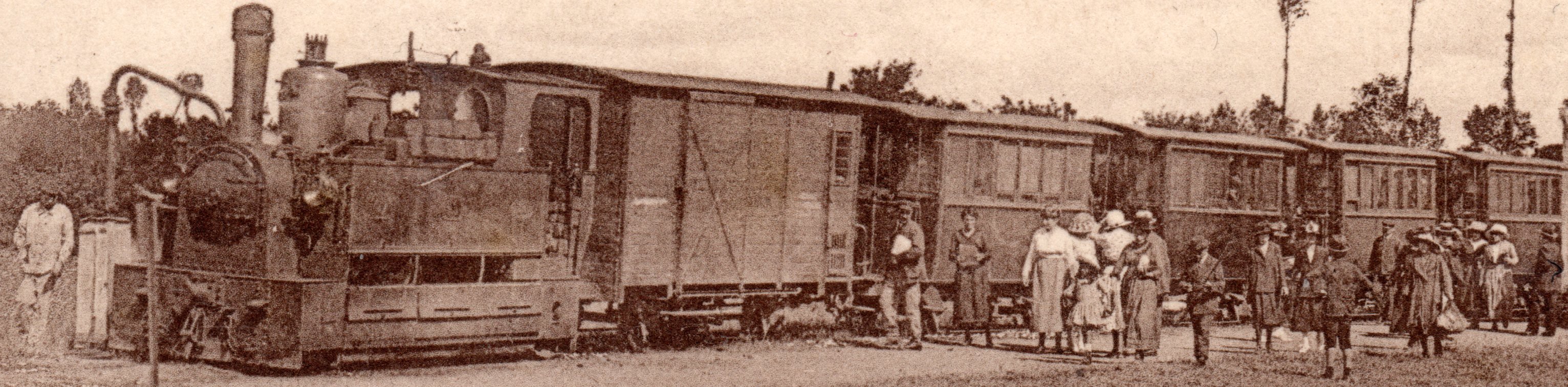 This wonderful study of the Gare de Fillé seems to show the courrier-convoyeur by the entrance to his fourgon postal immediately behind the locomotive, whilst we think the local post-mistress is standing alongside him, both of them carrying a small quantity of mail. The guard of the tram appears to be beside the third passenger coach.
There is a curious pencilled comment on the back of this (uncirculated) card in rather imprecise French: 'gare a (sic) colis qui les remets au chemin de fer au Mans', which translates as 'goods / parcel station which delivers them to the railway in Le Mans'. Perhaps the owner of the card thought the trams unfit for passenger transport?! We have only seen one used example of this card, posted in 1921, but we are inclined to date this view to the period before the Great War.
Based on the assumption that there were
This wonderful study of the Gare de Fillé seems to show the courrier-convoyeur by the entrance to his fourgon postal immediately behind the locomotive, whilst we think the local post-mistress is standing alongside him, both of them carrying a small quantity of mail. The guard of the tram appears to be beside the third passenger coach.
There is a curious pencilled comment on the back of this (uncirculated) card in rather imprecise French: 'gare a (sic) colis qui les remets au chemin de fer au Mans', which translates as 'goods / parcel station which delivers them to the railway in Le Mans'. Perhaps the owner of the card thought the trams unfit for passenger transport?! We have only seen one used example of this card, posted in 1921, but we are inclined to date this view to the period before the Great War.
Based on the assumption that there were 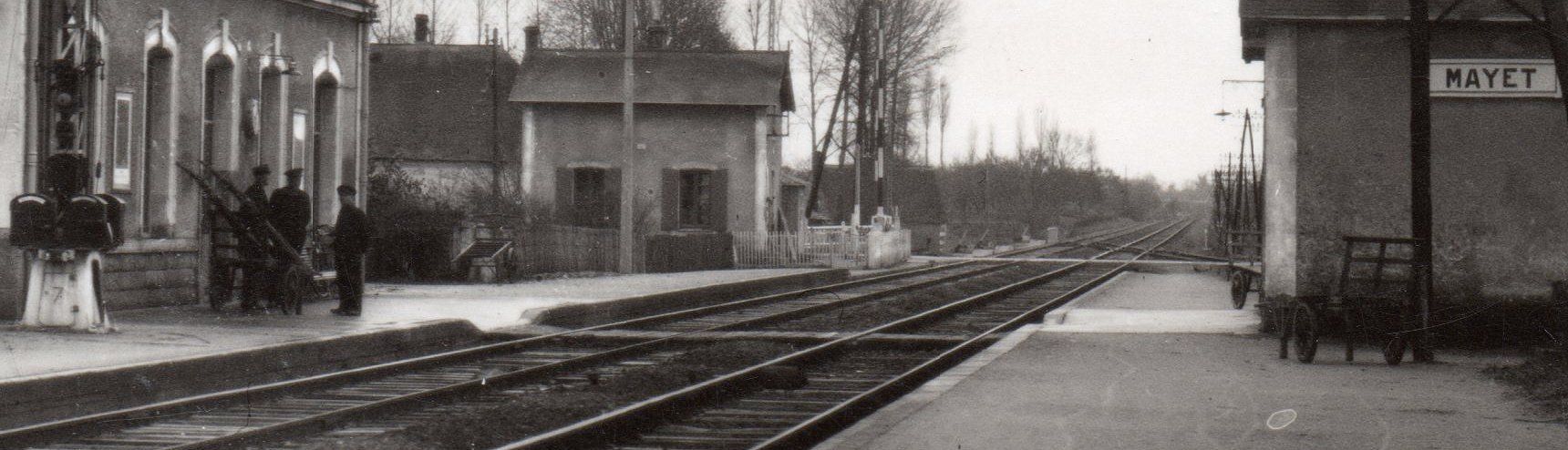
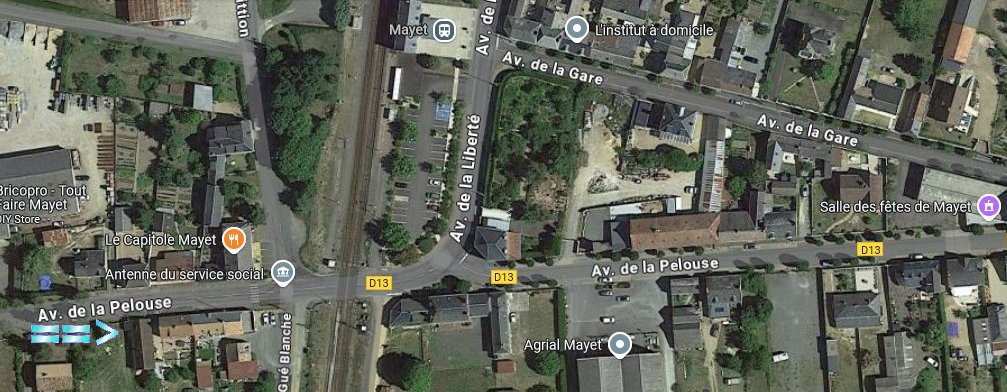 We cannot find an image of the tramway station at Mayet. The top image above is from a circa 1950s postcard of the railway station on the Le Mans-Tours line. The level crossing is visible beyond the platform.
The lower image is a 2024 Google Earth view. From this point, the town centre and post office are nearly 1 km to the east (to the right in this view). However, the T.S. line, arriving from the west, did not get any closer to the town centre than a few steps short of the level crossing. We have marked (with a blue arrow) this location of the former Tramways de la Sarthe terminus station, conveniently located for trans-shipments with the railway.
Any procedure that may have existed for handling mail between the tramway and the railway at Mayet is unknown to us. All the mail may have been taken to the Mayet Post Office for re-sorting but, equally, it could have been transferred directly between the trains and the trams by postal personnel once or twice a day.
We cannot find an image of the tramway station at Mayet. The top image above is from a circa 1950s postcard of the railway station on the Le Mans-Tours line. The level crossing is visible beyond the platform.
The lower image is a 2024 Google Earth view. From this point, the town centre and post office are nearly 1 km to the east (to the right in this view). However, the T.S. line, arriving from the west, did not get any closer to the town centre than a few steps short of the level crossing. We have marked (with a blue arrow) this location of the former Tramways de la Sarthe terminus station, conveniently located for trans-shipments with the railway.
Any procedure that may have existed for handling mail between the tramway and the railway at Mayet is unknown to us. All the mail may have been taken to the Mayet Post Office for re-sorting but, equally, it could have been transferred directly between the trains and the trams by postal personnel once or twice a day.
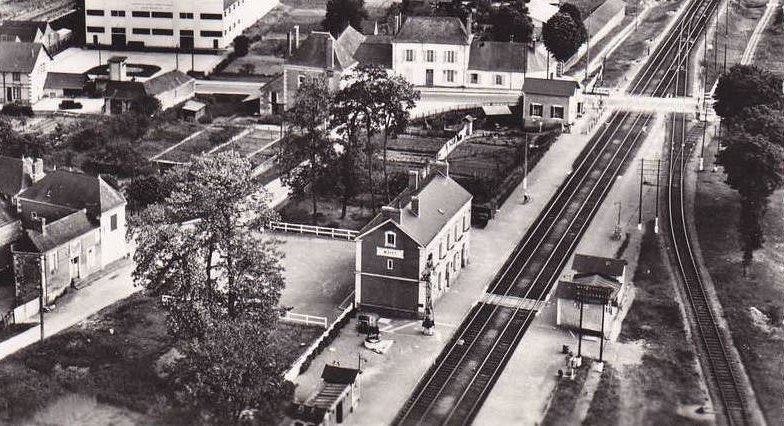 Unfortunately, we do not know the date of this aerial view of the railway station at Mayet, but it is quite likely to be post-war (WWII) - and it is intriguing. The principal siding, on the right, has a short spur to its right that leads to a gate. The tracks appears to come to an end at the gate but may once have crossed the road. Was this spur established long before this picture was taken in order to provide a transfer siding between the railway and the tramway? Certainly, arrangements for trans-shipment of freight (and presumably mail) from metre-gauge to standard-gauge existed elsewhere on the T.S. network. As often in this article, we have more questions than answers.
After the Mayet Line CCL:
On January 1st 1933, over a decade after the last evidence seen by us of any use of the Mayet line CCL, the line from La Flèche to Cérans-Foulletourte was axed. The Mayet line was cut back to Mansigné, resulting in the closure of the T.S. passenger stations at Pontvallain and Mayet.
Despite the closure of the La Flèche to Cérans-Foulletourte section, the trams from Le Mans were not extended from Cérans-Foulletourte to Mansigné and this section continued to be worked only as a branch line, and with a truly minimal service. This last remnant of what, around 1916/17, had become the Mayet branch-line, Mansigné to Cérans-Foulletourte, only survived a little longer, closing in 1935. Trams continued to run from Cérans-Foulletourte to Le Mans until 1946 but, after 1932, there is no new CCL cancellation reported for the surviving section and we have found no evidence that any of the trams ran with a courrier-convoyeur on board thereafter.
Please Note: Frequently in this article, for each tramline we have described and listed CCL firstly inwards towards Le Mans, followed by the outward equivalent. This Mayet line section does
Unfortunately, we do not know the date of this aerial view of the railway station at Mayet, but it is quite likely to be post-war (WWII) - and it is intriguing. The principal siding, on the right, has a short spur to its right that leads to a gate. The tracks appears to come to an end at the gate but may once have crossed the road. Was this spur established long before this picture was taken in order to provide a transfer siding between the railway and the tramway? Certainly, arrangements for trans-shipment of freight (and presumably mail) from metre-gauge to standard-gauge existed elsewhere on the T.S. network. As often in this article, we have more questions than answers.
After the Mayet Line CCL:
On January 1st 1933, over a decade after the last evidence seen by us of any use of the Mayet line CCL, the line from La Flèche to Cérans-Foulletourte was axed. The Mayet line was cut back to Mansigné, resulting in the closure of the T.S. passenger stations at Pontvallain and Mayet.
Despite the closure of the La Flèche to Cérans-Foulletourte section, the trams from Le Mans were not extended from Cérans-Foulletourte to Mansigné and this section continued to be worked only as a branch line, and with a truly minimal service. This last remnant of what, around 1916/17, had become the Mayet branch-line, Mansigné to Cérans-Foulletourte, only survived a little longer, closing in 1935. Trams continued to run from Cérans-Foulletourte to Le Mans until 1946 but, after 1932, there is no new CCL cancellation reported for the surviving section and we have found no evidence that any of the trams ran with a courrier-convoyeur on board thereafter.
Please Note: Frequently in this article, for each tramline we have described and listed CCL firstly inwards towards Le Mans, followed by the outward equivalent. This Mayet line section does 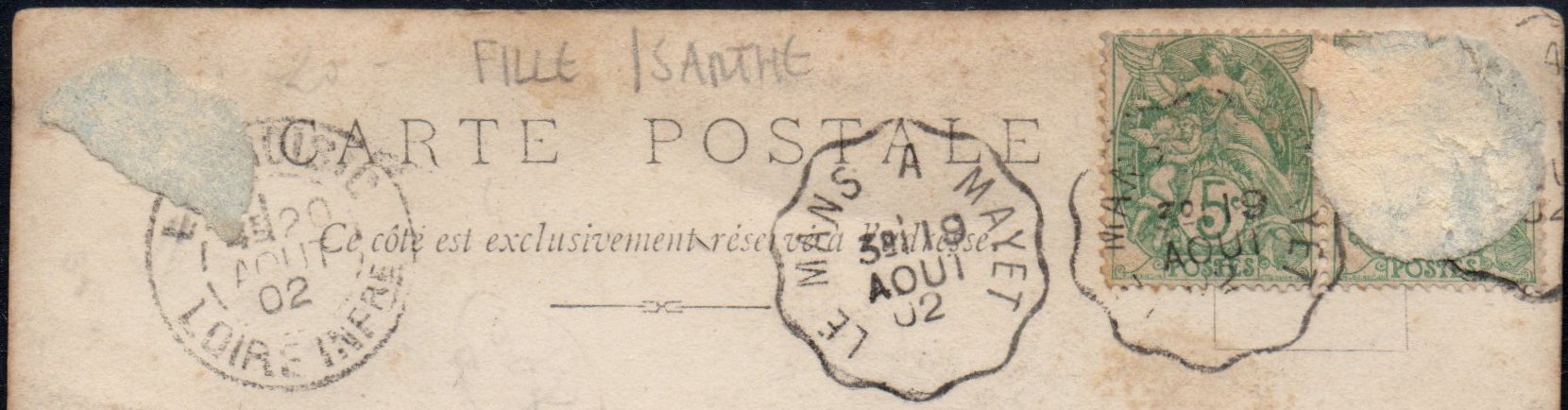 The earliest use of this canceller that we have seen in either direction. A previous collector was clearly more interested in the card's charming little sepia vignette of the river at Fillé than in the philately.
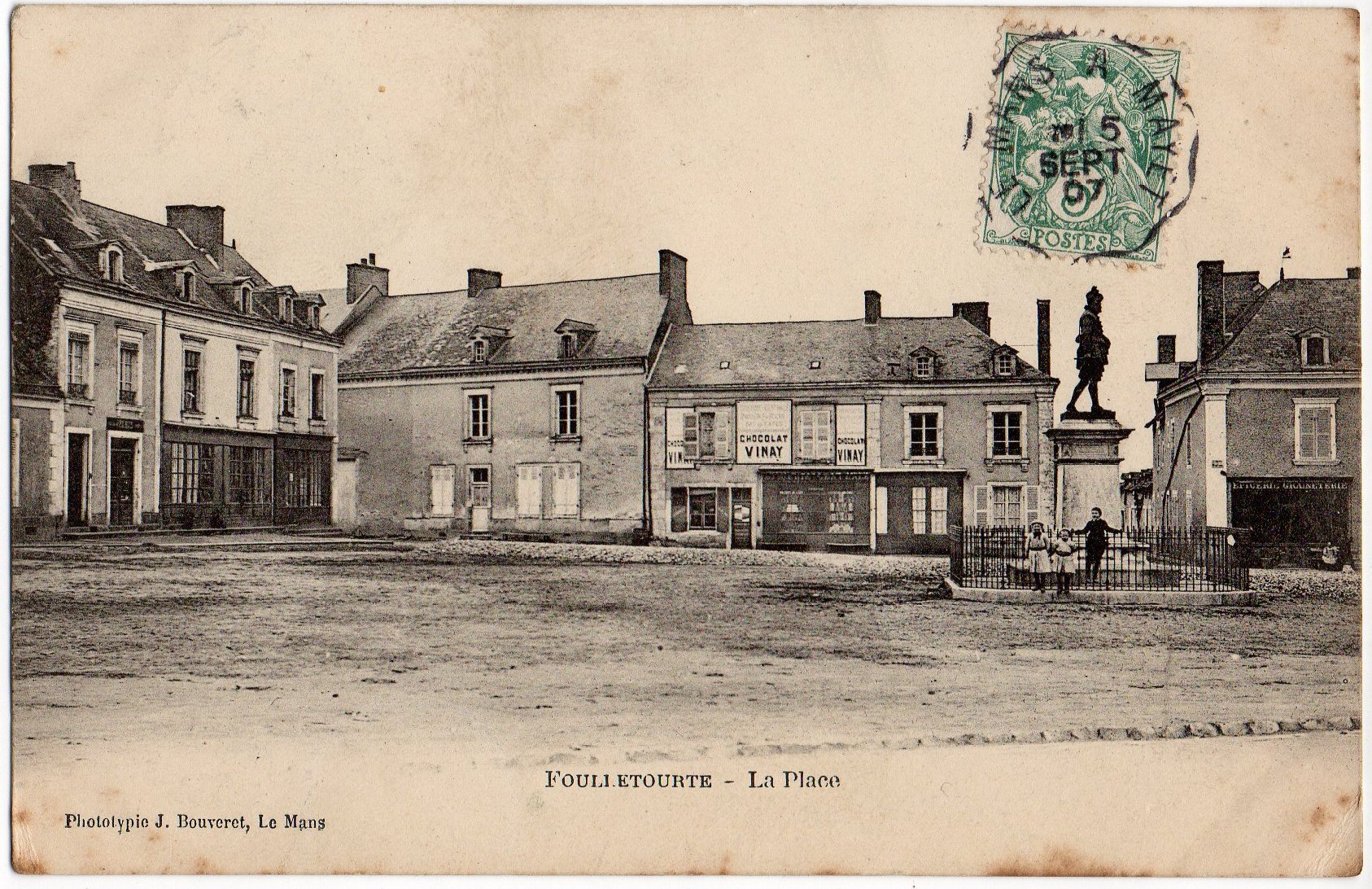
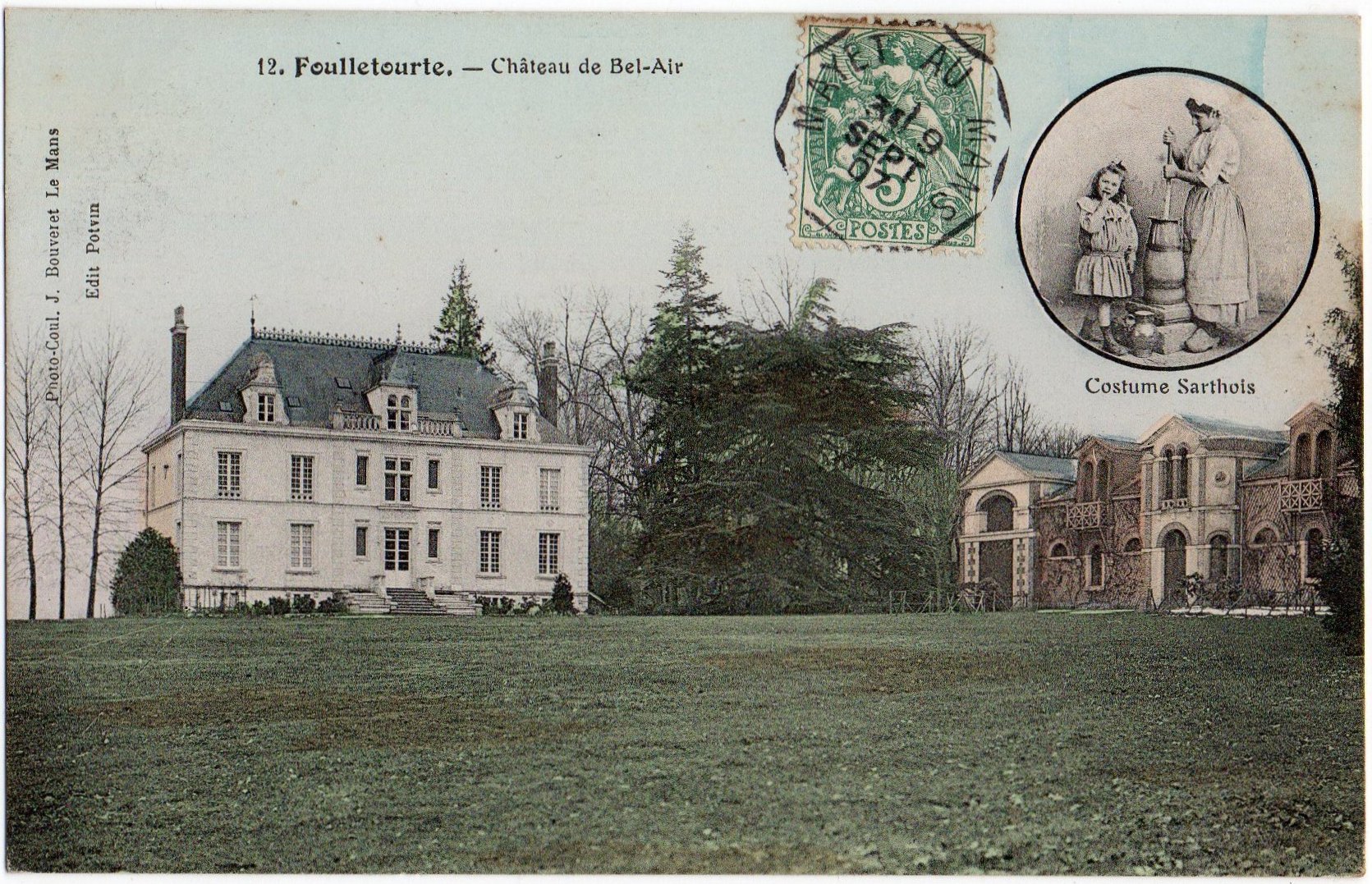
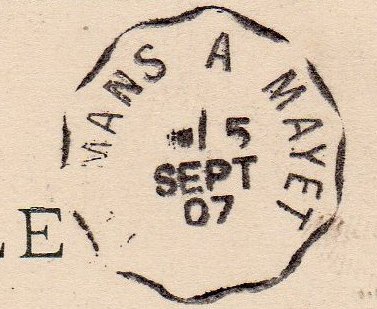
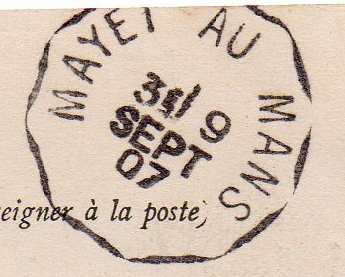 Two postcards from the same correspondence sent, one assumes from Foulletourte, to Paris, the first with Le Mans à Mayet cancellations on front and back, then a similar card but with a Mayet au Mans CCL. The cancellations shown are all Type 2.
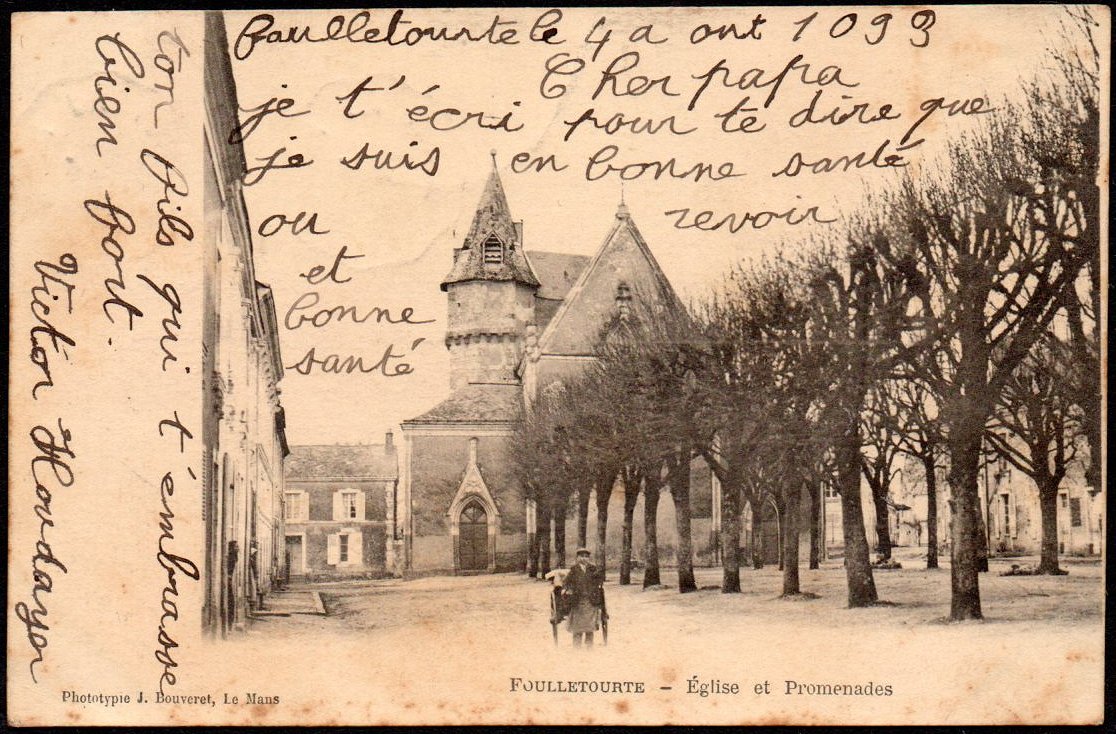
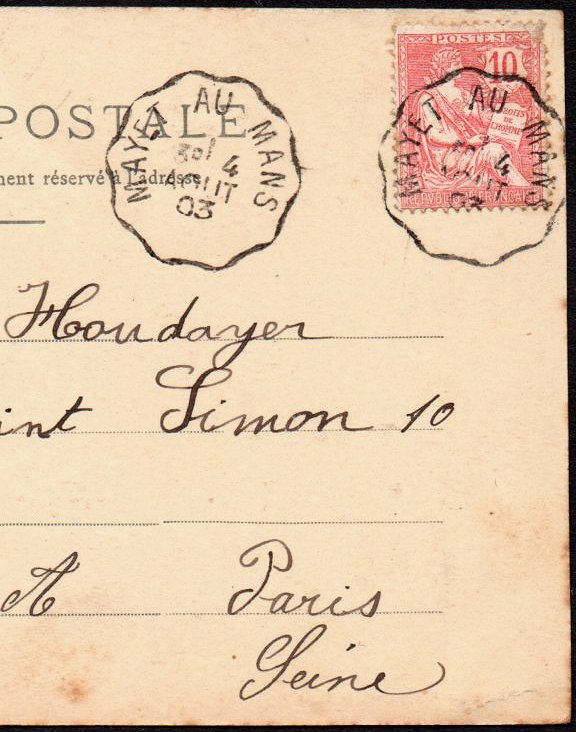 Front and back of the earliest Mayet au Mans Type II seen, both the card and sender mentioning Foulletourte, sent on August 4th 1903, or according to the (young?) sender, August 4th 1093!
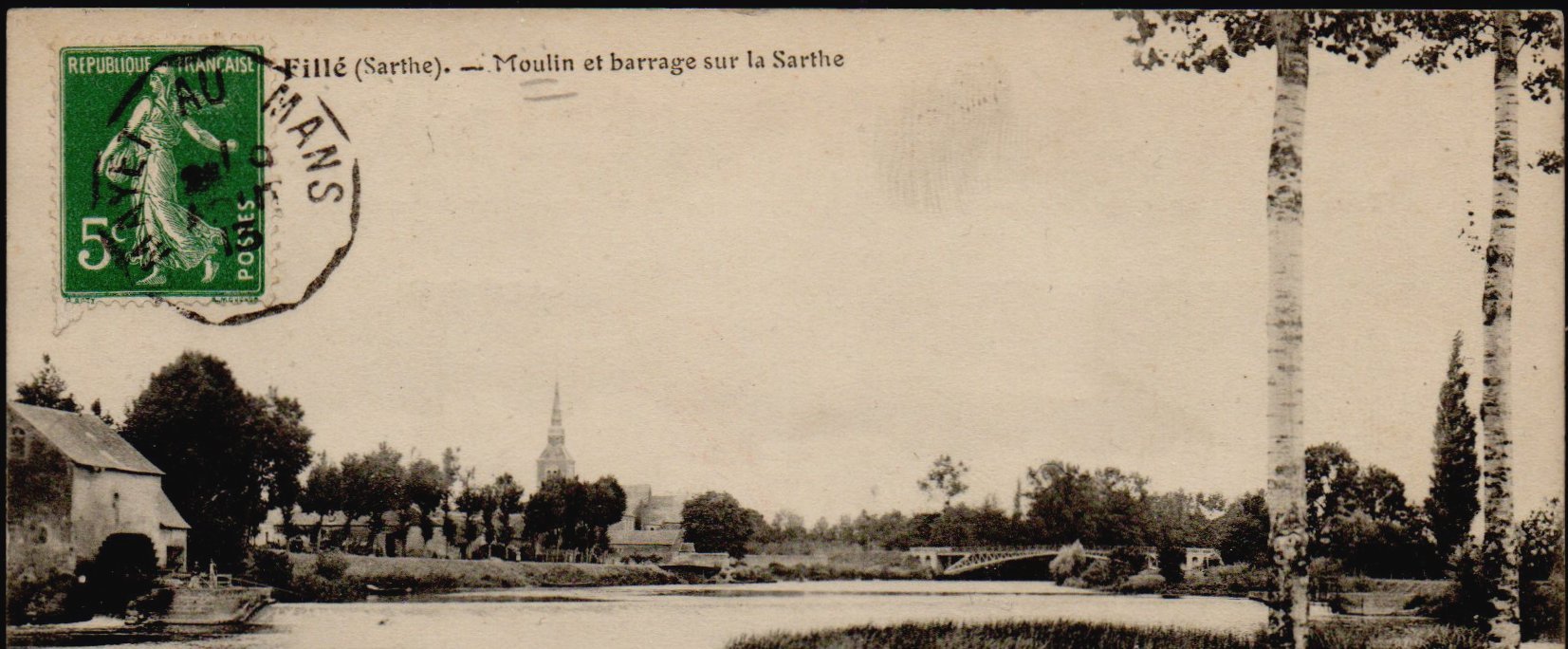
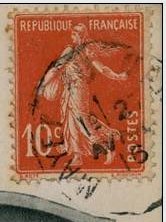 Left: A postcard of Fillé on the Mayet line, 14 kms (and nearly 50 minutes!) from the Gare Centrale, August 1913. The message, for a recipient in Nancy, did not exceed 5 words and is therefore correctly franked at the 5c rate. This 5-word rate was unchanged from its introduction in 1899 until 1922, astonishing to modern users of the postal service!
Right: Concurrent use of Type II and Type III in the Mayet au Mans direction: A late use of the Mayet au Mans Type II (April 27th 1916) on a card of Fillé. Compare, below, with an April 24th 1916 example of the Type III.
This next comment is copied from the introduction higher up to the styles of CCL postmark:
Left: A postcard of Fillé on the Mayet line, 14 kms (and nearly 50 minutes!) from the Gare Centrale, August 1913. The message, for a recipient in Nancy, did not exceed 5 words and is therefore correctly franked at the 5c rate. This 5-word rate was unchanged from its introduction in 1899 until 1922, astonishing to modern users of the postal service!
Right: Concurrent use of Type II and Type III in the Mayet au Mans direction: A late use of the Mayet au Mans Type II (April 27th 1916) on a card of Fillé. Compare, below, with an April 24th 1916 example of the Type III.
This next comment is copied from the introduction higher up to the styles of CCL postmark: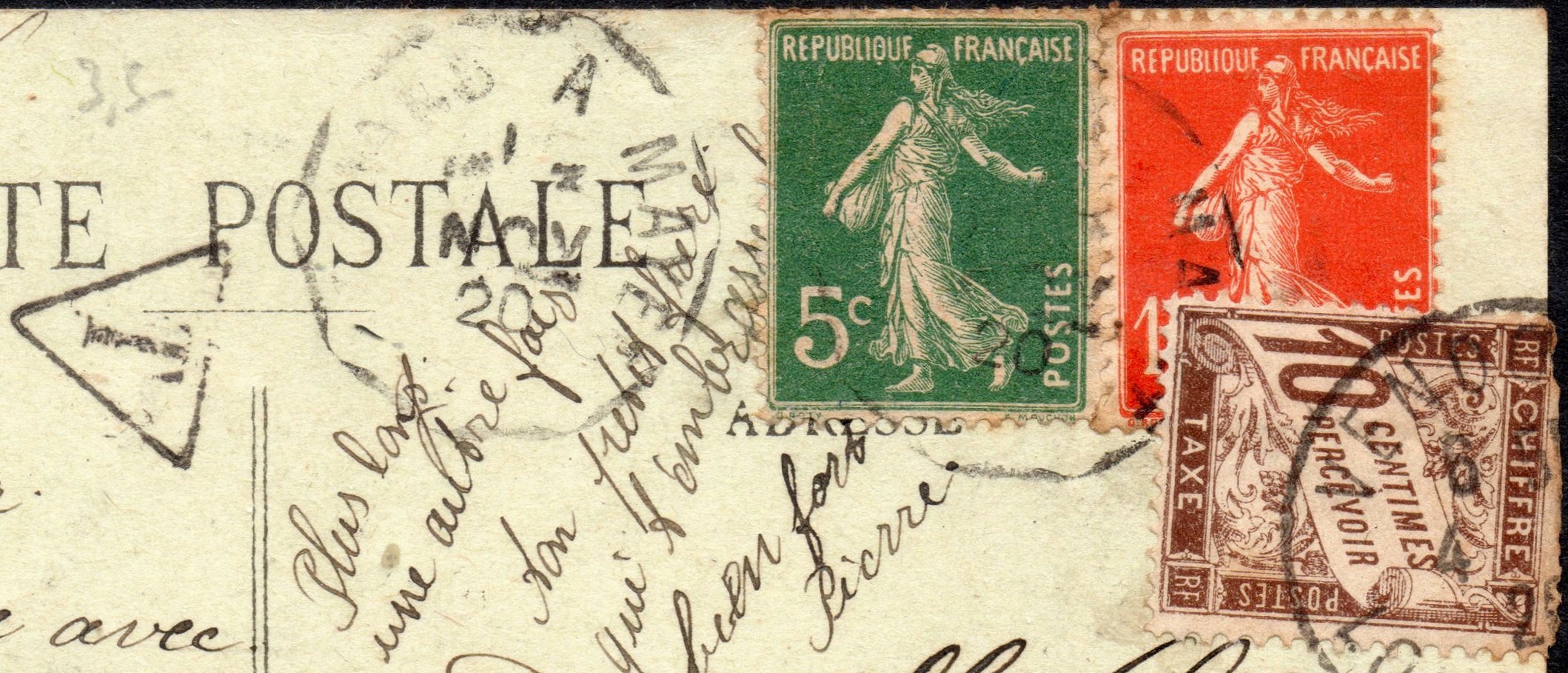 A card of Pontvallain, CCL Type II Le Mans à Mamers 3 NOV 1920, underpaid 5c as the message exceeds 5 words, postage due (and an arrival backstamp) of Vendome / Loir et Cher November 4th 1920.
This very late usage of the Type II falls in the period in which there was the branch-line CCL service operating just between Cérans-Foulletourte and Mayet. We do not currently think this reversion to a Type II, or perhaps its concurrent use with the Type III, was deliberate in order to distinguish the manner in which the mail had been handled on the branch-line. It seems more likely that it was either a simple error or a short-term replacement for a lost or damaged Type III, but more purposeful explanations are possible.
.
A card of Pontvallain, CCL Type II Le Mans à Mamers 3 NOV 1920, underpaid 5c as the message exceeds 5 words, postage due (and an arrival backstamp) of Vendome / Loir et Cher November 4th 1920.
This very late usage of the Type II falls in the period in which there was the branch-line CCL service operating just between Cérans-Foulletourte and Mayet. We do not currently think this reversion to a Type II, or perhaps its concurrent use with the Type III, was deliberate in order to distinguish the manner in which the mail had been handled on the branch-line. It seems more likely that it was either a simple error or a short-term replacement for a lost or damaged Type III, but more purposeful explanations are possible.
.
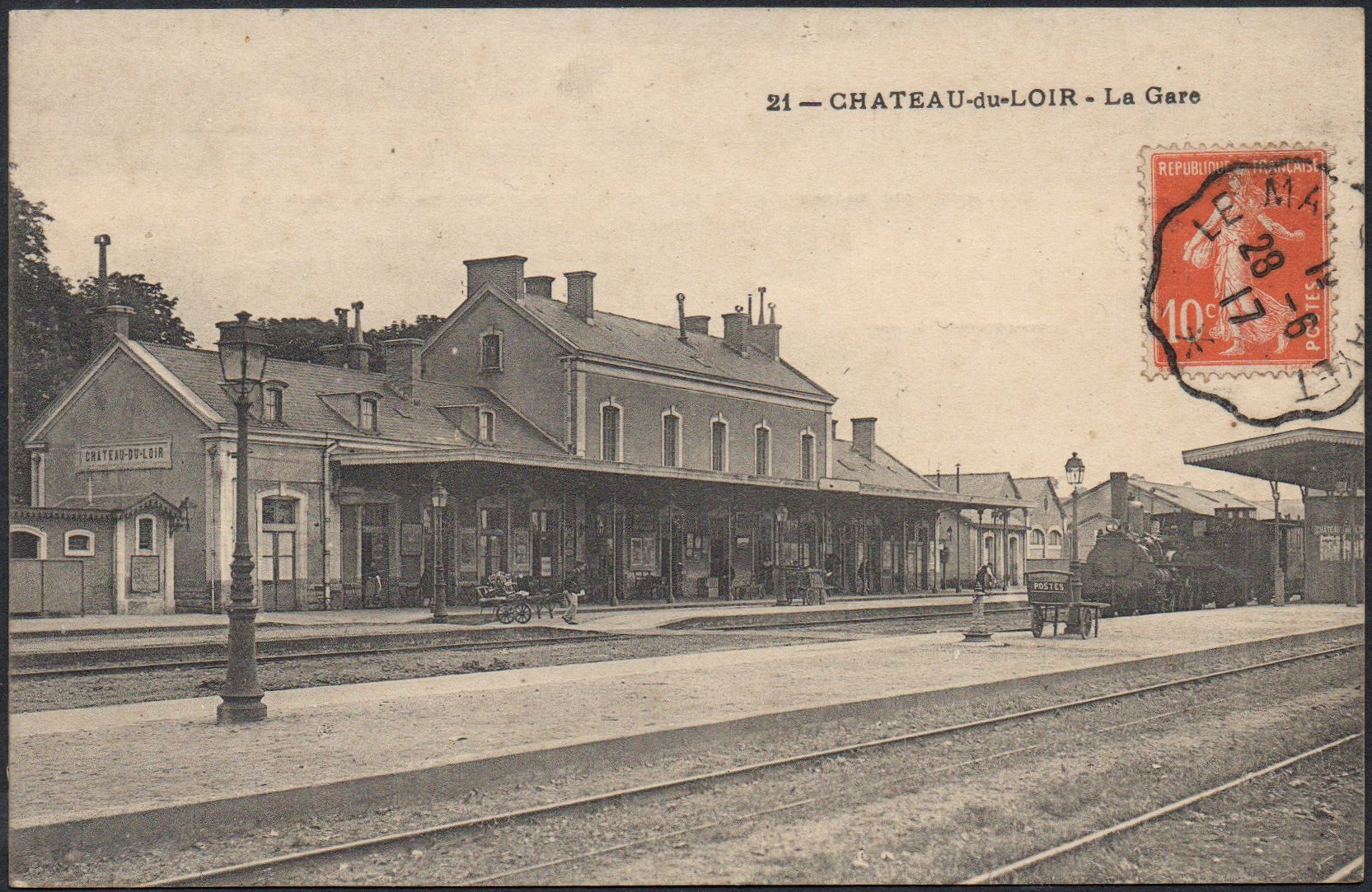
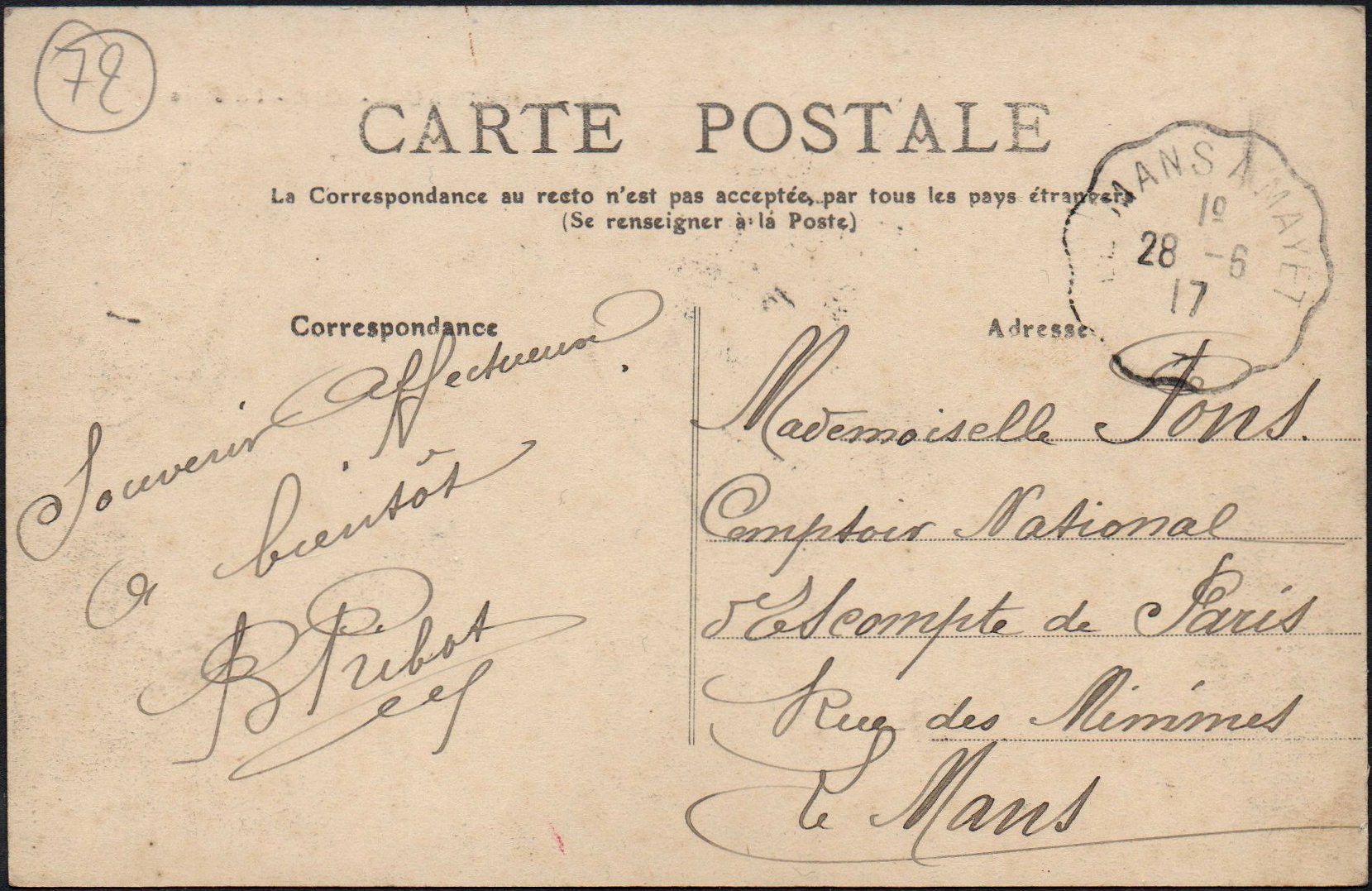 This is the earliest example we have seen of a Type III in the Mayet direction - and slightly mysterious as, no matter where it was posted, it would appear to have travelled in the wrong direction. However, bi-directional dispatch of the mails all along the Mayet tramline seems to have been commonplace.
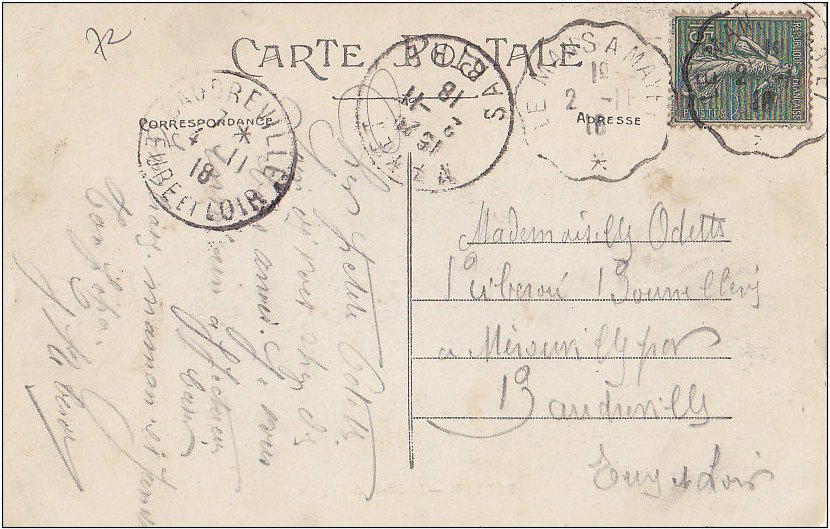 The view on the picture side shows the church in Requeil, a village between Foulletourte and Mayet on the tramway.
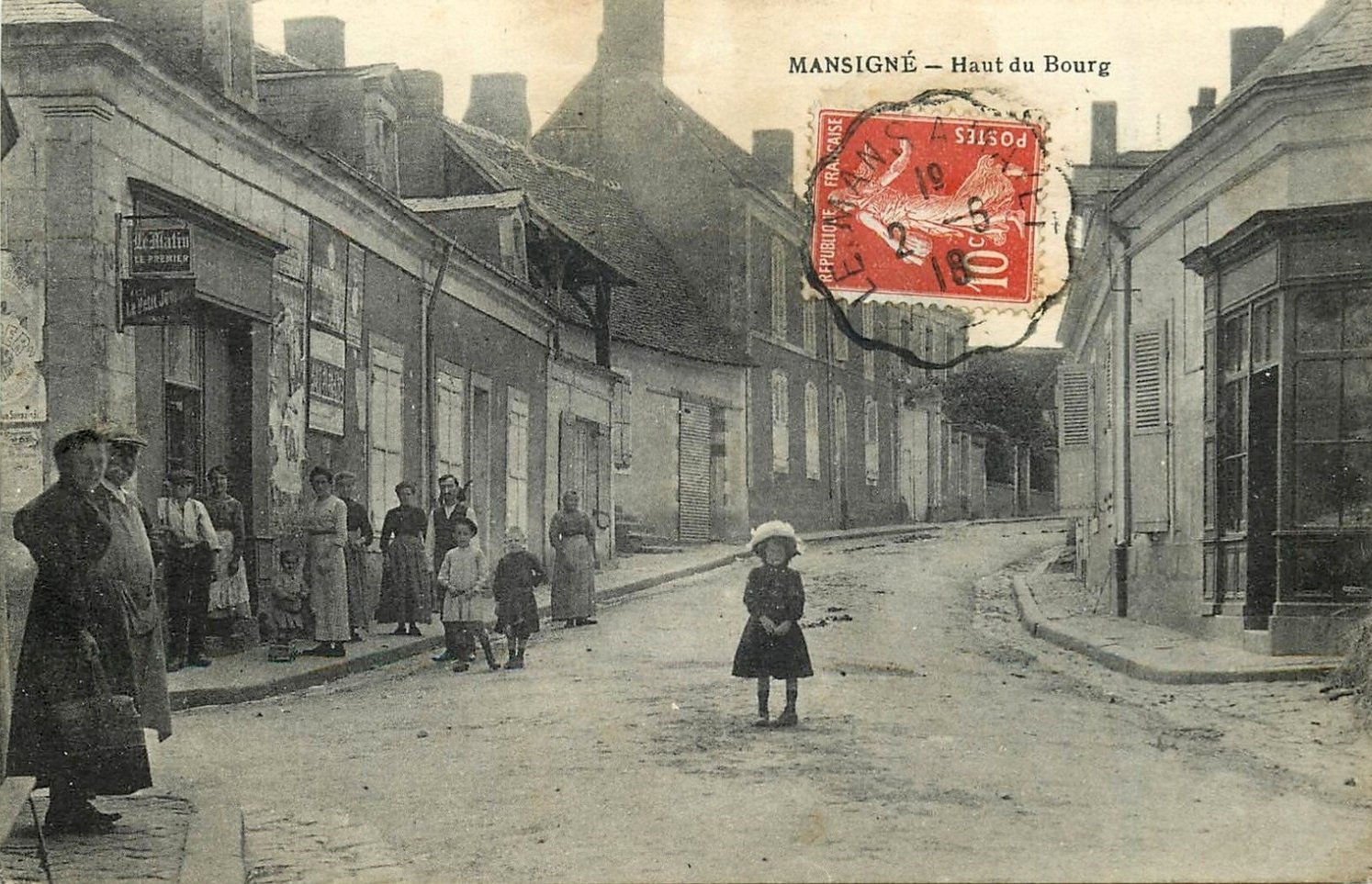
 Left: A June 1918 example, Type III : Mansigné between Cérans-Foulletourte and Mayet. As the tramway closed by stages, it became the country terminus of this branch-line between 1933 and 1935.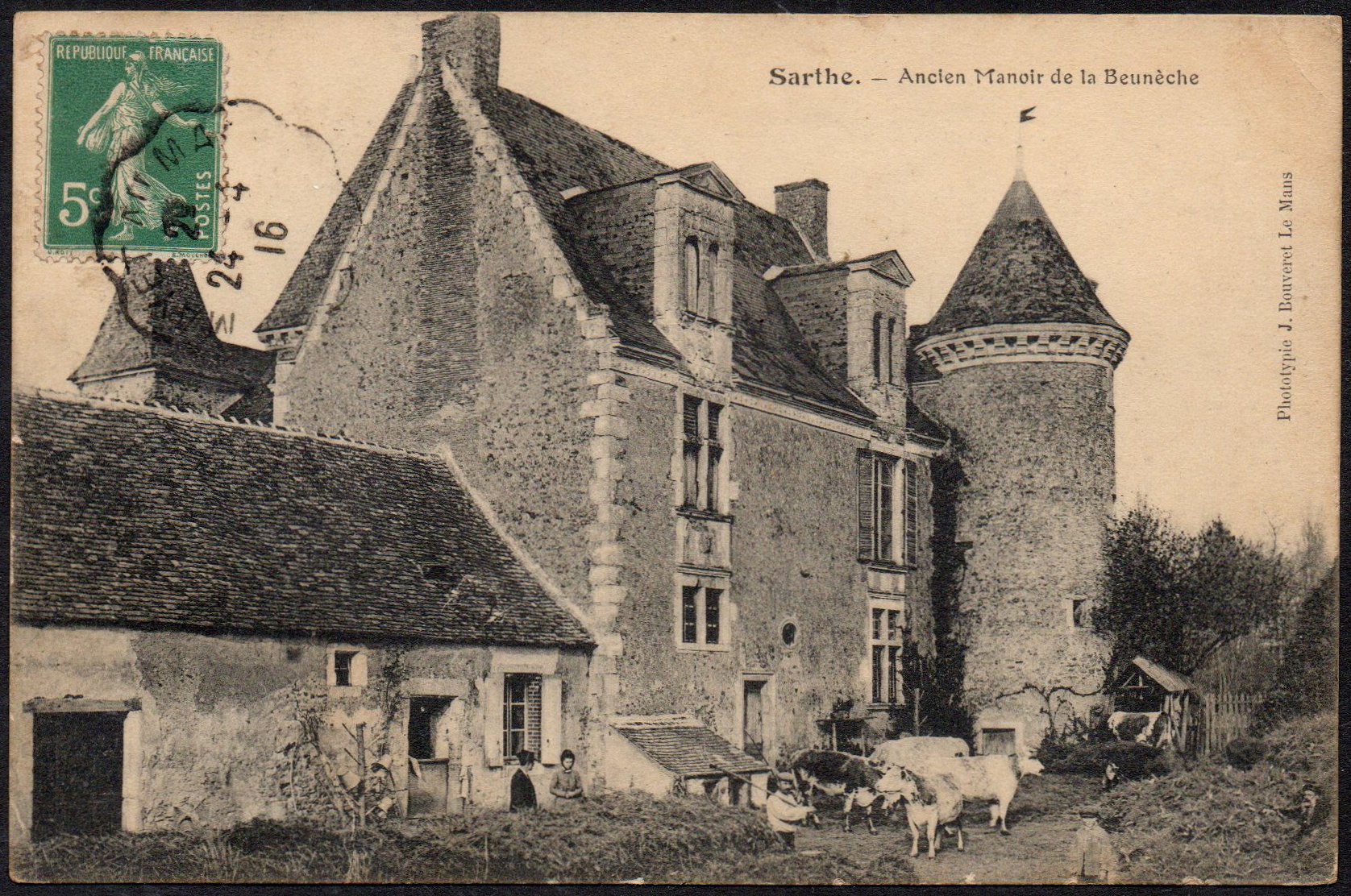
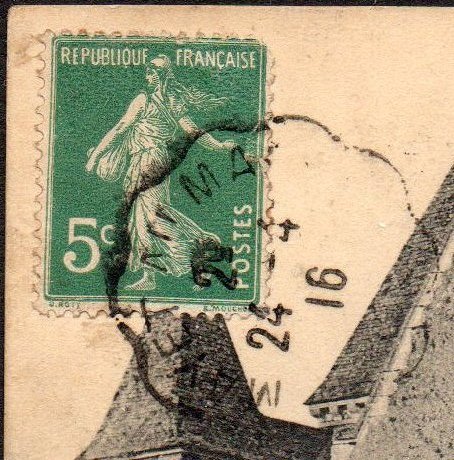 Although the Manoir de la Beunèche is typically associated with Roëzé, which is on the railway between La Suze and Le Mans, it was marginally nearer the tramway station at Fillé, which is probably where this was posted. This would indicate that the through tram carrying the Mayet-Le Mans CCL fourgon still operated in April 1916.
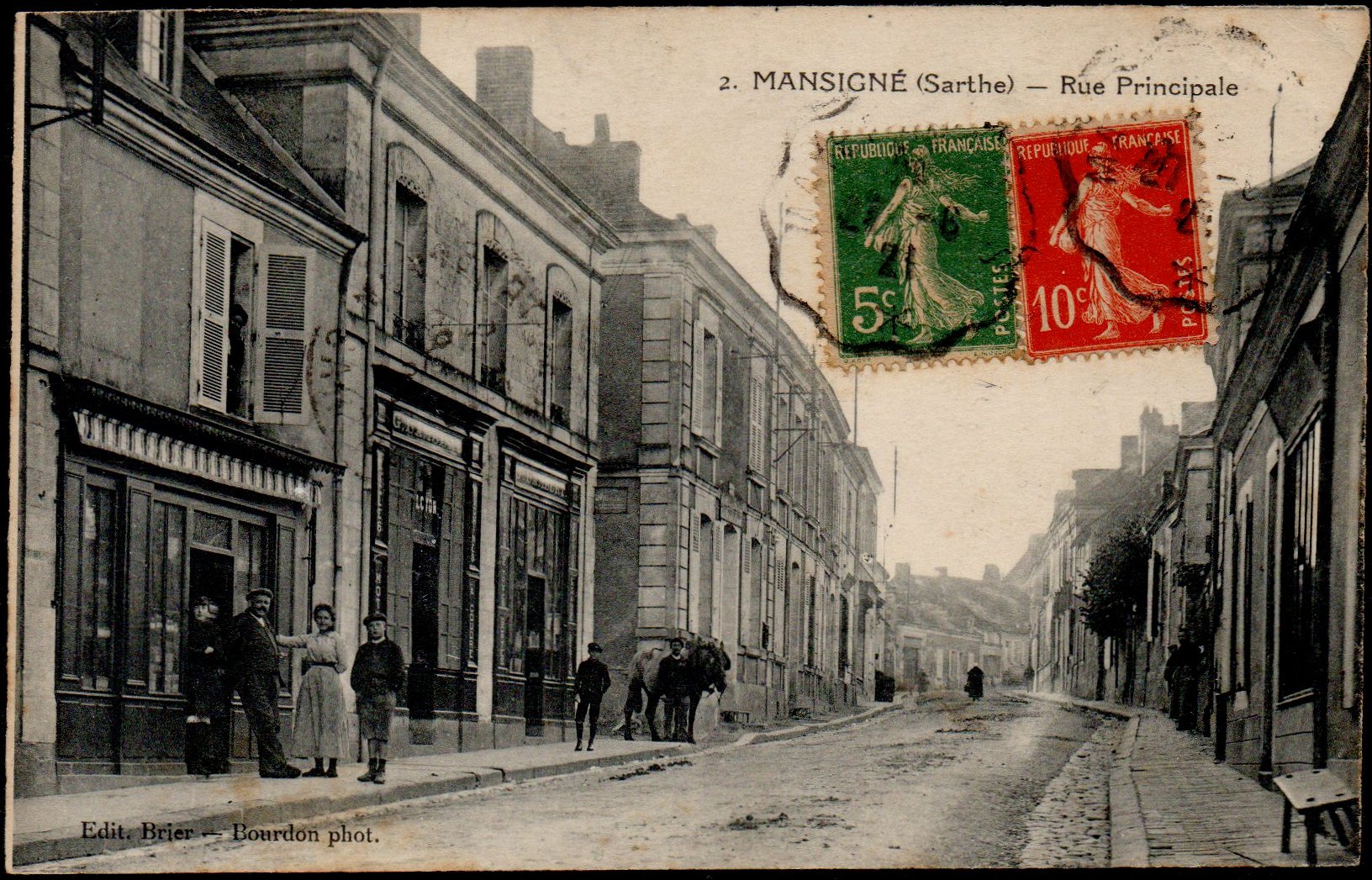
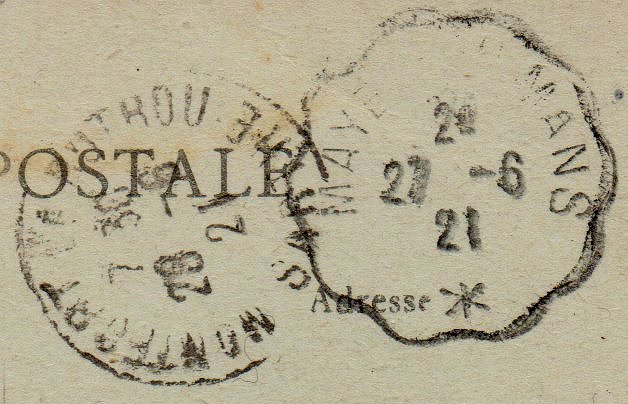 Front & Back: The latest use of this cancellation that we have seen in either direction, June 1921, from Mansigné on the branch-line. Sent to Pont de Gennes (Sarthe), aka Montfort-le-Gesnois, with a 5-word greeting and correct 15c franking.
A further example of concurrent use of Types II and III in the Mayet au Mans direction, around the 1915-1917 period:
Front & Back: The latest use of this cancellation that we have seen in either direction, June 1921, from Mansigné on the branch-line. Sent to Pont de Gennes (Sarthe), aka Montfort-le-Gesnois, with a 5-word greeting and correct 15c franking.
A further example of concurrent use of Types II and III in the Mayet au Mans direction, around the 1915-1917 period:
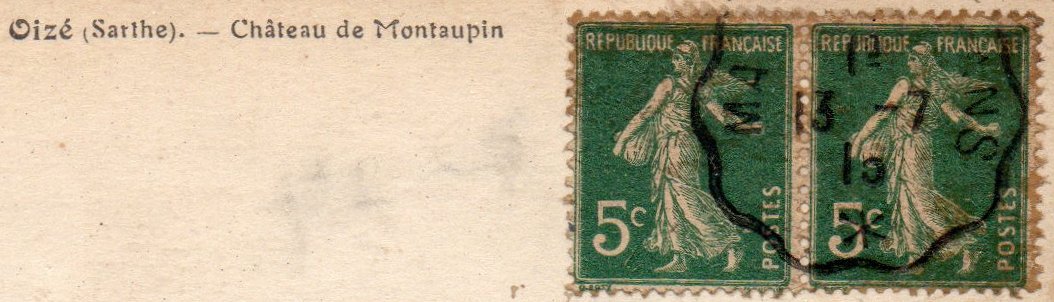
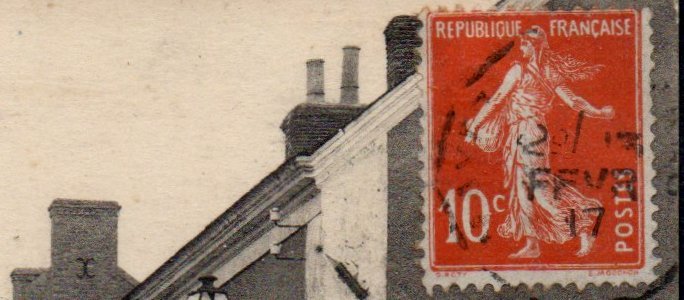
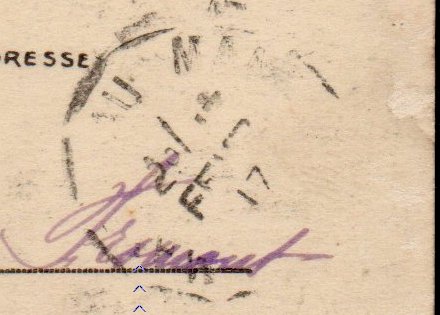 The top line above shows the earliest Type III Mayet au Mans we have seen, from Oizé in July 1915 but the second line shows scans of the CCL on the front and back of a Requeil card from February 1917, reverting to a Type II.
.
Le Mans à Mayet Type III [ . ] (Earliest : 06/17 --> Latest : 07/19 *!!*)
Mayet au Mans Type III [ . ] (Earliest : 07/15 --> Latest : 06/21)
*!!* : There is a later Le Mans à Mayet cancellation (11/20) but on a Type II (as described amongst the Type II higher up).
.
The top line above shows the earliest Type III Mayet au Mans we have seen, from Oizé in July 1915 but the second line shows scans of the CCL on the front and back of a Requeil card from February 1917, reverting to a Type II.
.
Le Mans à Mayet Type III [ . ] (Earliest : 06/17 --> Latest : 07/19 *!!*)
Mayet au Mans Type III [ . ] (Earliest : 07/15 --> Latest : 06/21)
*!!* : There is a later Le Mans à Mayet cancellation (11/20) but on a Type II (as described amongst the Type II higher up).
.
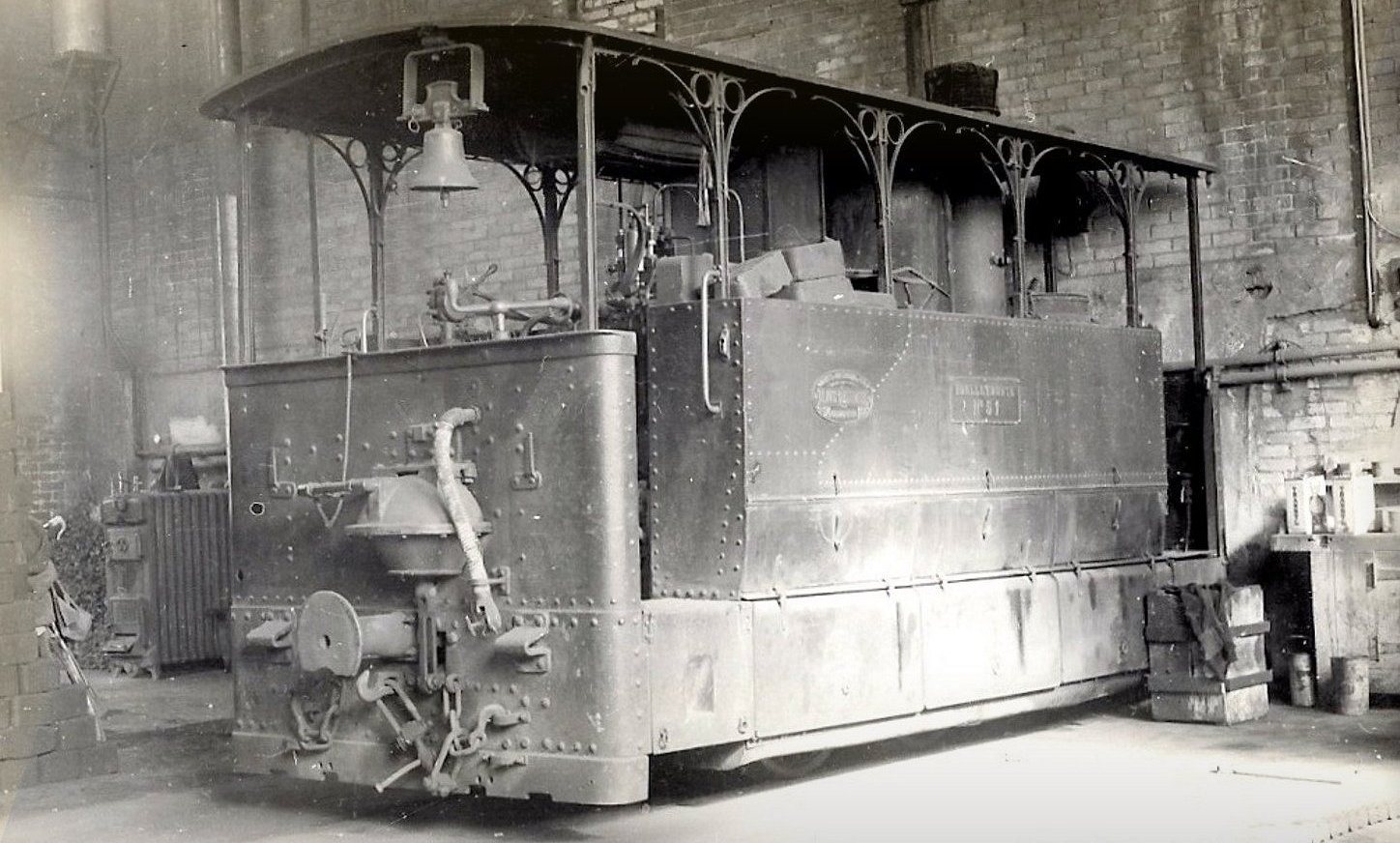
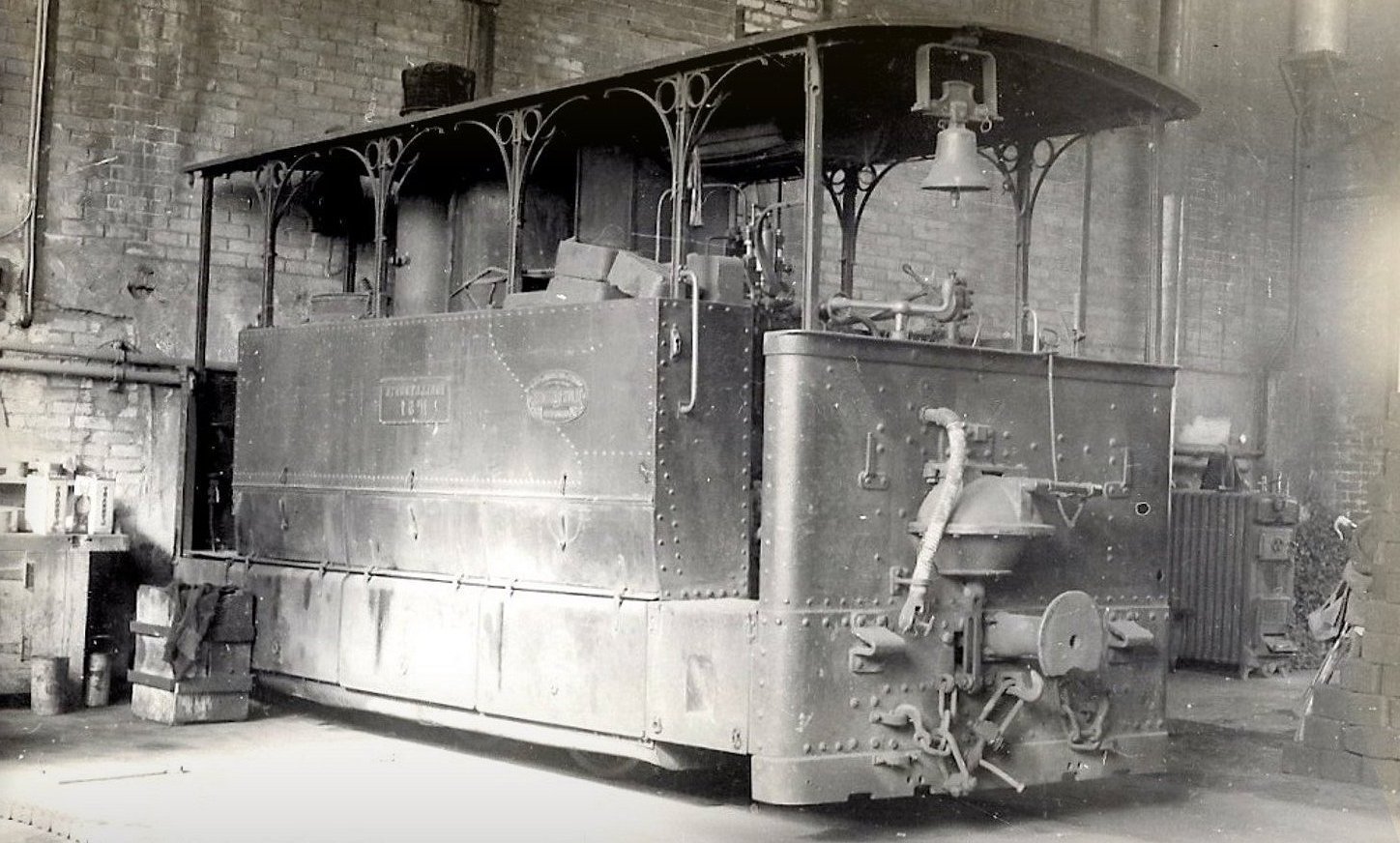
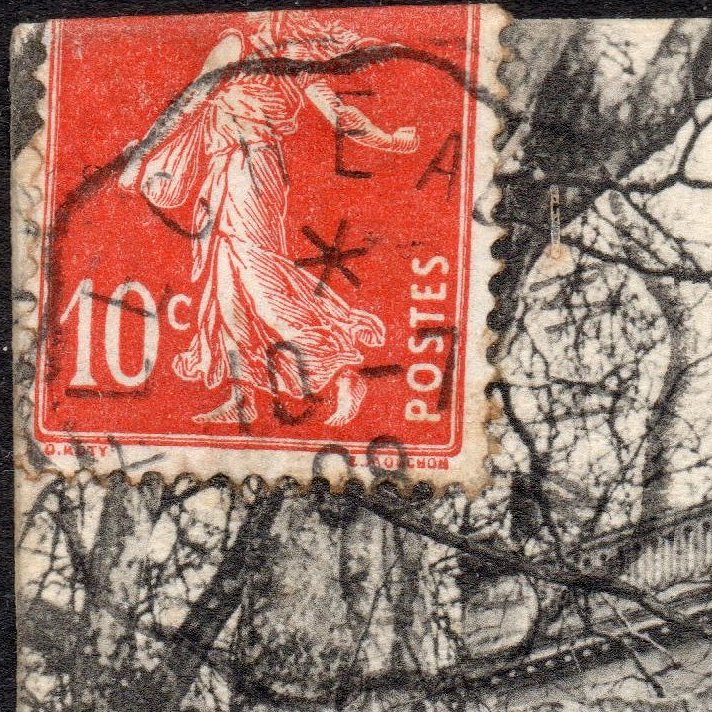
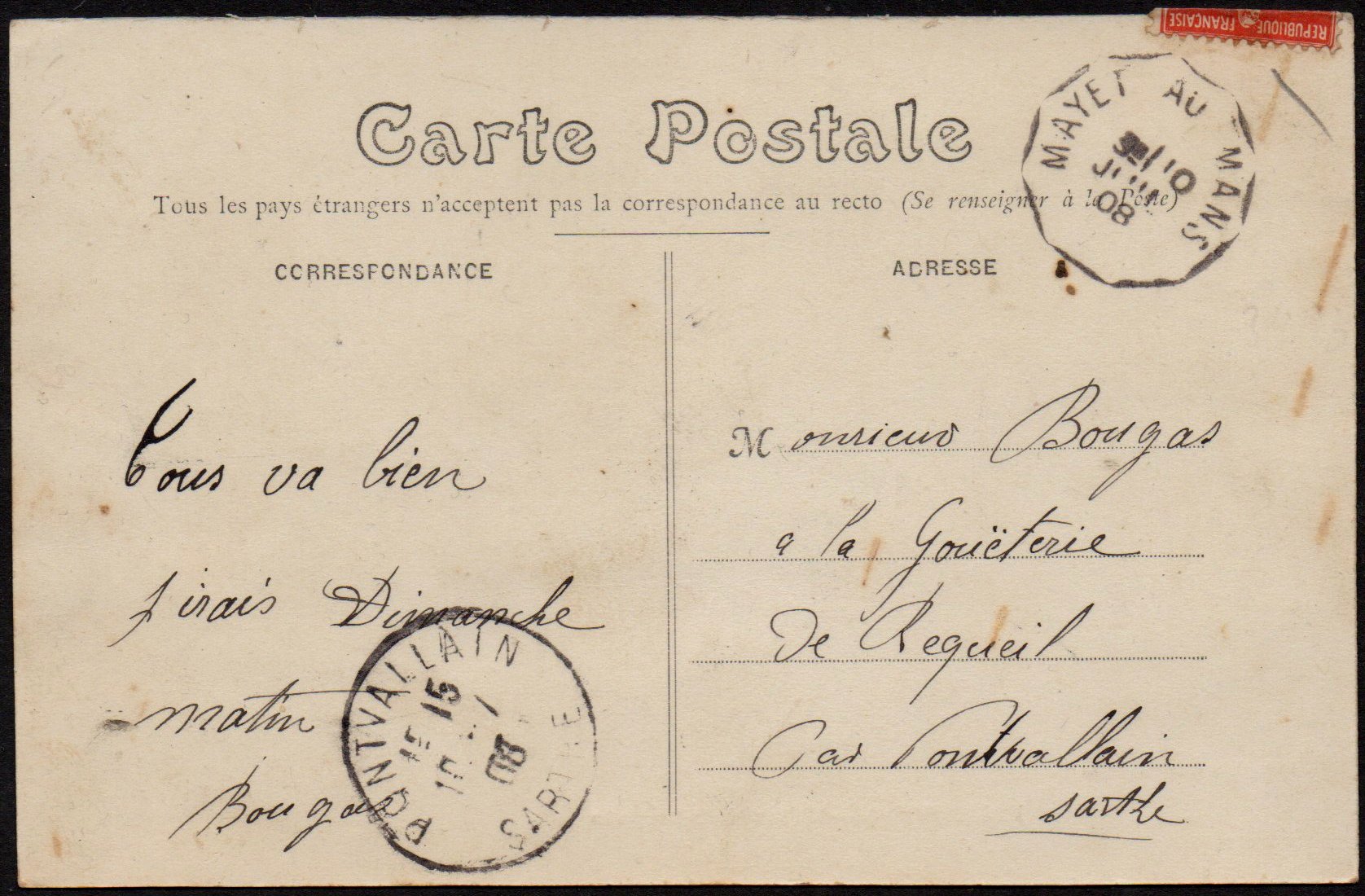 The detail scan is from the front of a postcard of Roëzé, sent in 1908 and cancelled with the La Flèche au Mans CCL, which at that period was a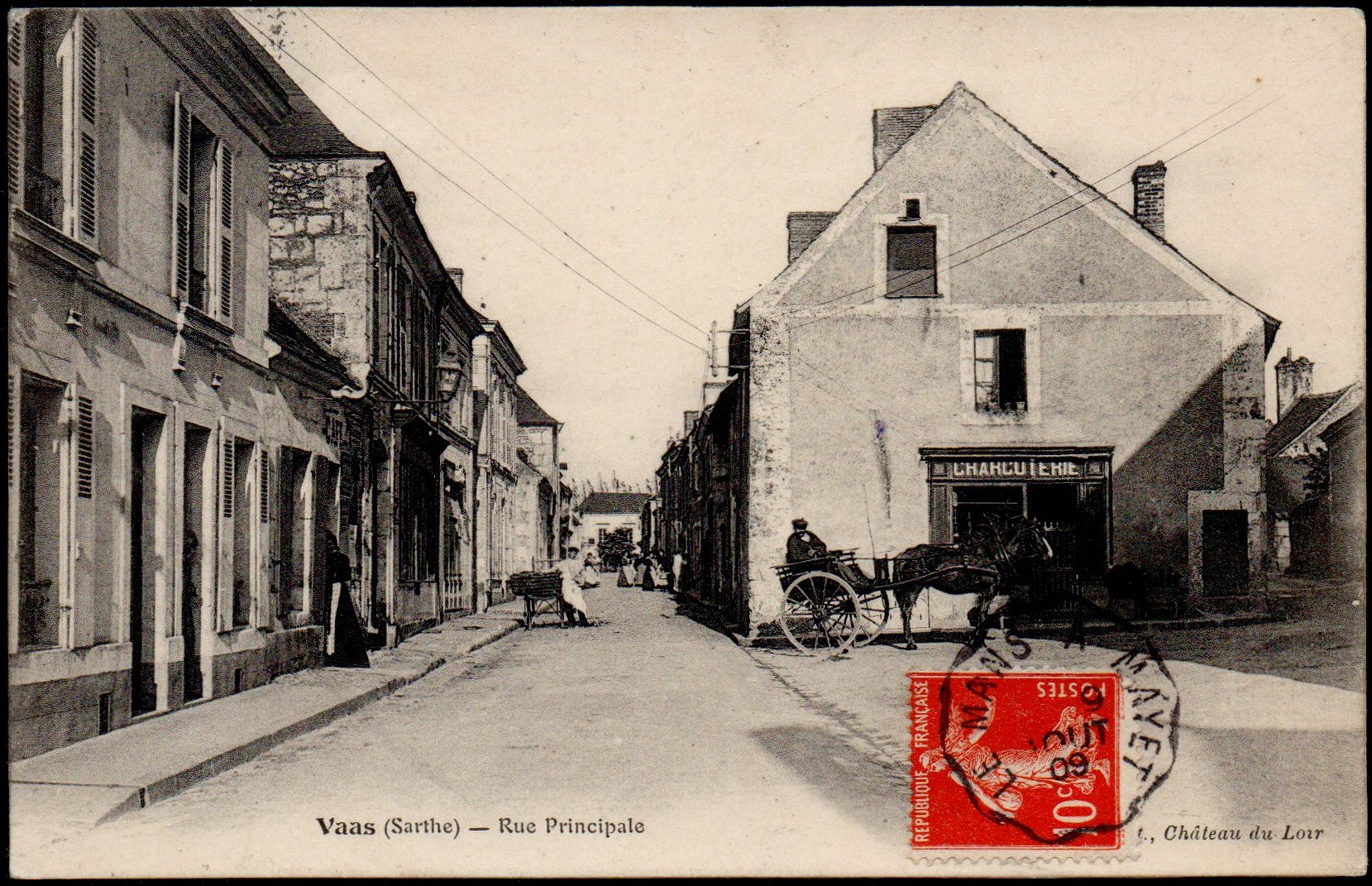

 The routing instruction reads 'Melle Jamin à Requeil. Par Ponvallain (sic), Sarthe', Pontvallain being one of the two stations between Requeil and Mayet. The card travelled as per Madeleine's wishes.
.
Analysis by
The routing instruction reads 'Melle Jamin à Requeil. Par Ponvallain (sic), Sarthe', Pontvallain being one of the two stations between Requeil and Mayet. The card travelled as per Madeleine's wishes.
.
Analysis by 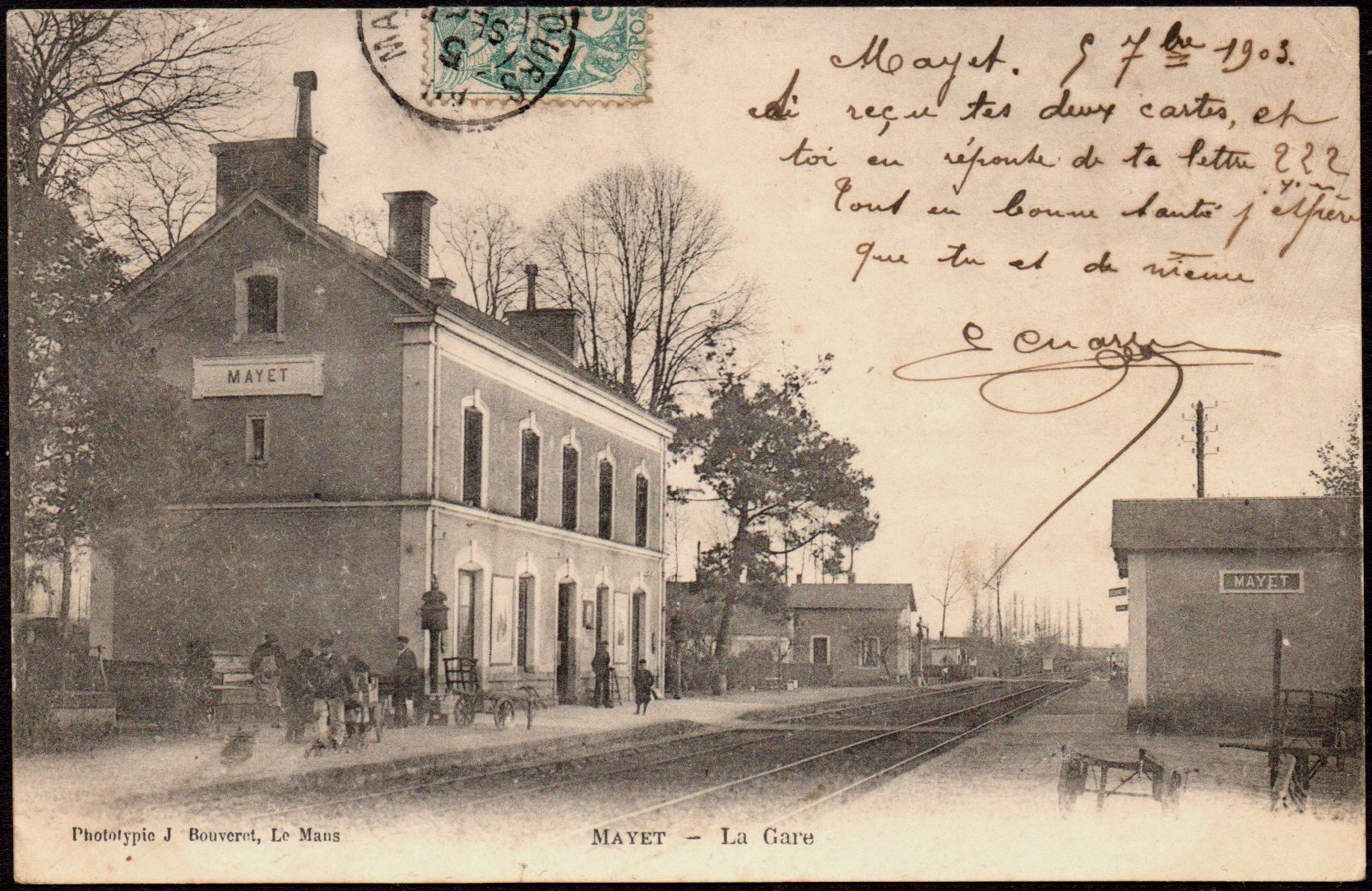
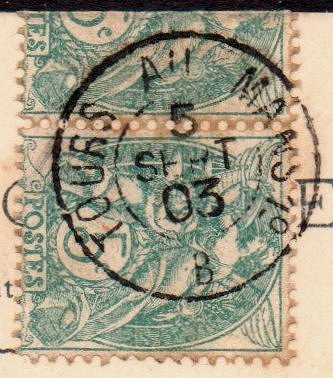 This is a night-time ambulant, Tours au Mans1⁰, which would appear to have called at Mayet. This plethora of ambulant and courrier-convoyeur services would clearly have made the railway the optimum carrier for almost all of the mail to or from Mayet.
Section 7 concludes below with the St. Denis d'Orques line. However, if you followed our suggestion to read about the Mayet line before the La Flèche line, you might prefer to return there now (Link : LaF ).
.
This is a night-time ambulant, Tours au Mans1⁰, which would appear to have called at Mayet. This plethora of ambulant and courrier-convoyeur services would clearly have made the railway the optimum carrier for almost all of the mail to or from Mayet.
Section 7 concludes below with the St. Denis d'Orques line. However, if you followed our suggestion to read about the Mayet line before the La Flèche line, you might prefer to return there now (Link : LaF ).
.
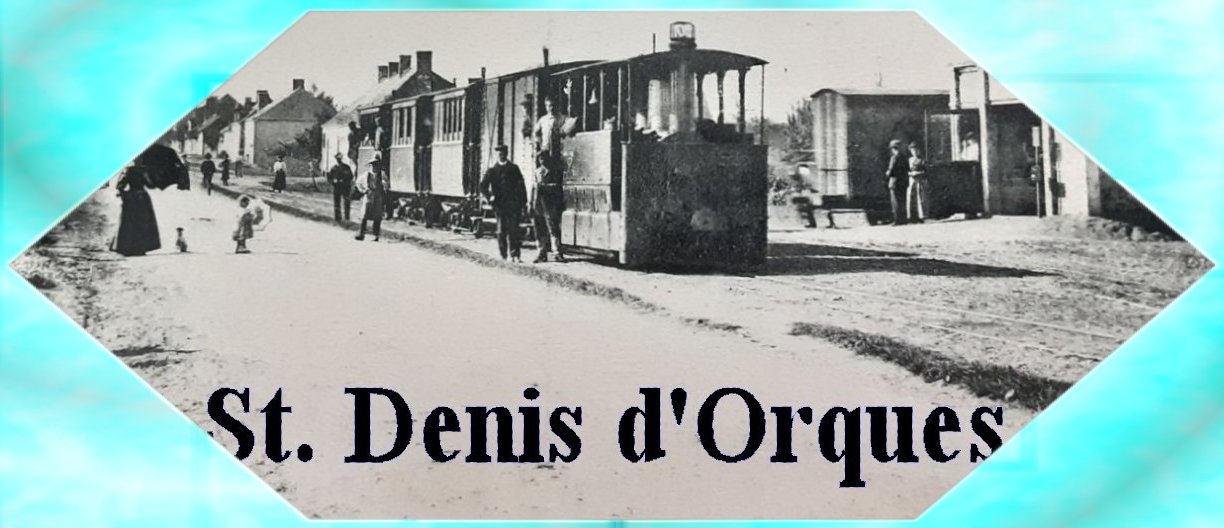
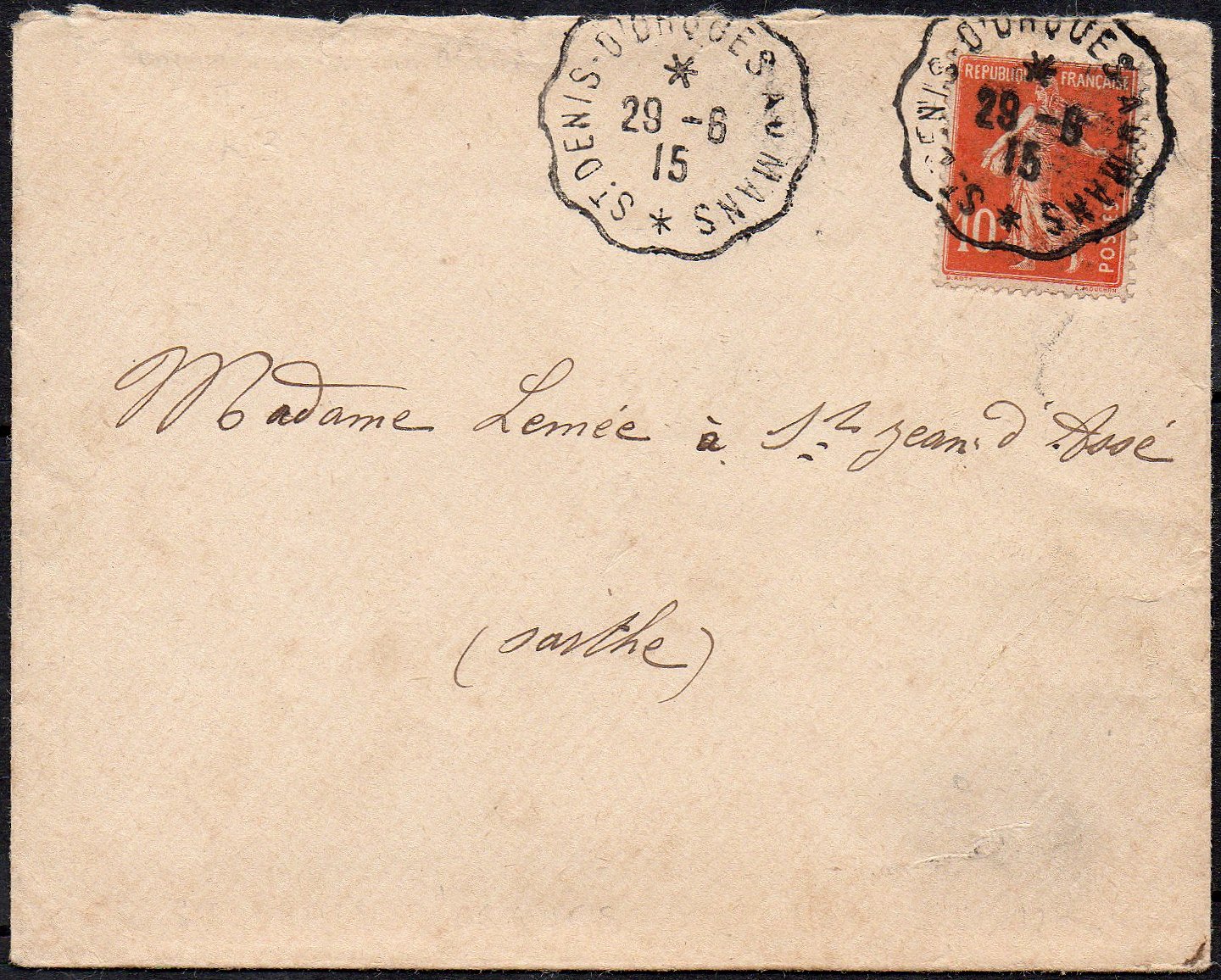
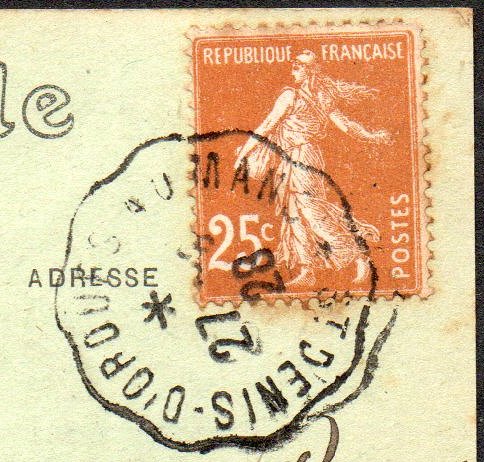 Left : Clean strikes on a 1915 letter sent from St Denis d'Orques, receiving mark (on back) next day at St Jean d'Assé.
Right : A June 1928 example of the same cancellation on a postcard of Fay sent to Villaines-sous-Malicorne, Sarthe (north of La Flèche). The 25c franking is correct for this card, which has a message not exceeding 5 words.
Left : Clean strikes on a 1915 letter sent from St Denis d'Orques, receiving mark (on back) next day at St Jean d'Assé.
Right : A June 1928 example of the same cancellation on a postcard of Fay sent to Villaines-sous-Malicorne, Sarthe (north of La Flèche). The 25c franking is correct for this card, which has a message not exceeding 5 words.
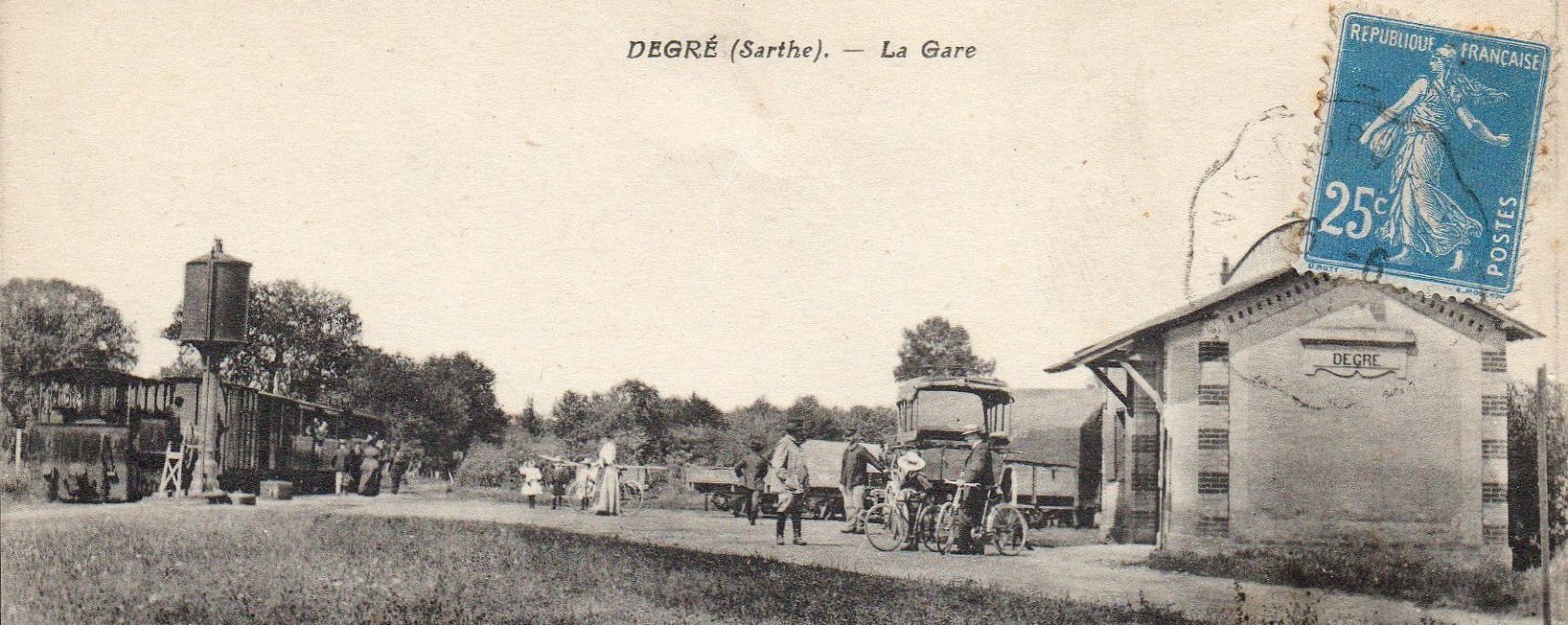 Detail from a postcard of the Gare de Degré, the stamp cancelled by a faint St. Denis d'Orques au Mans (posting date unclear). Presumably posted at Degré, a station about 12kms (about half-an-hour on the tram) from Le Mans.
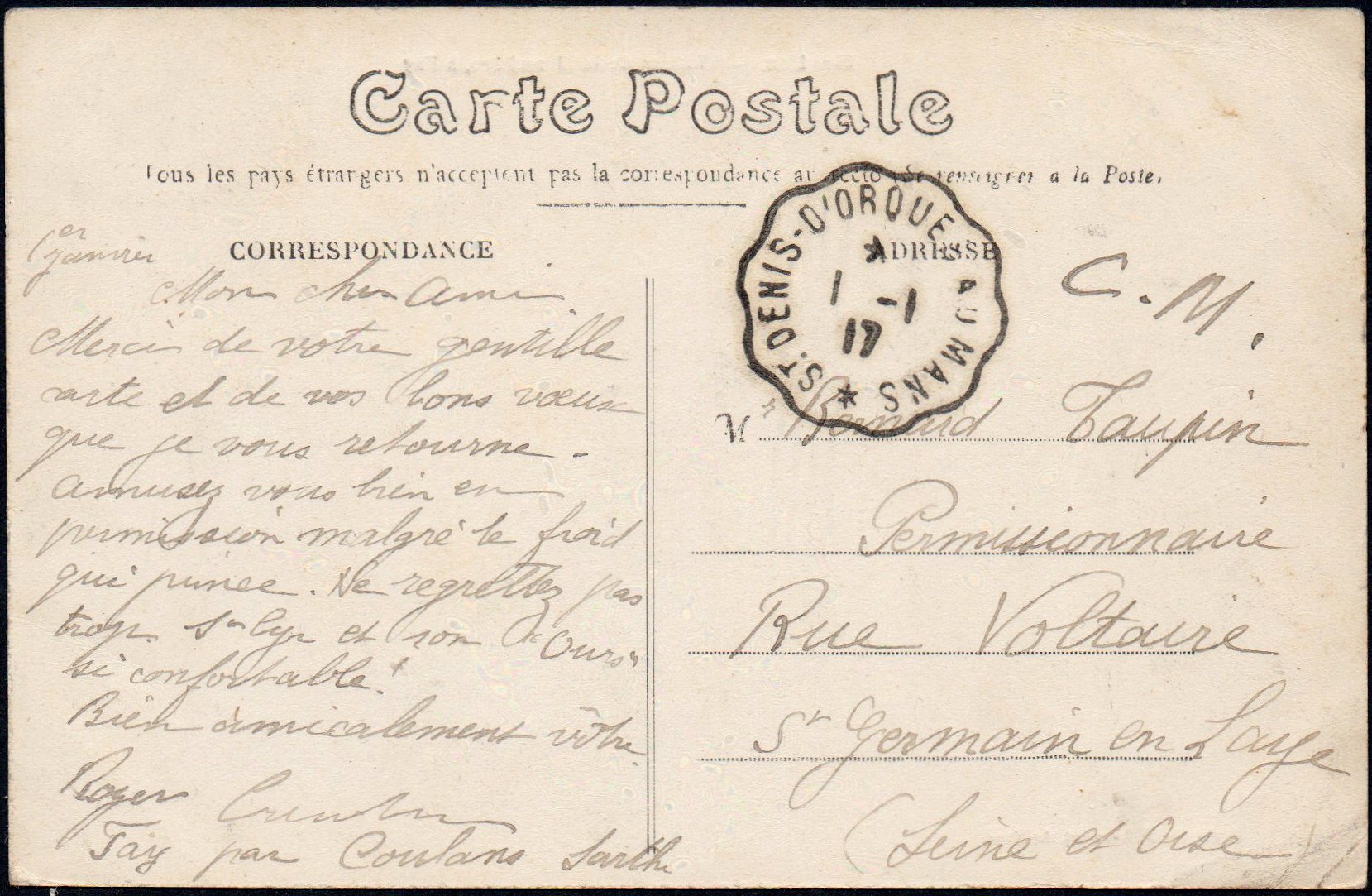 Examples of franchise militaire seem to be scarce on this line. This fine strike, applied on New Year's Day 1917, is on a postcard of the Château in Fay and is most likely to have started its tramway journey at Rouillon or Trangé-Chauffour.
.
Le Mans à St Denis d'Orques :
Examples of franchise militaire seem to be scarce on this line. This fine strike, applied on New Year's Day 1917, is on a postcard of the Château in Fay and is most likely to have started its tramway journey at Rouillon or Trangé-Chauffour.
.
Le Mans à St Denis d'Orques :
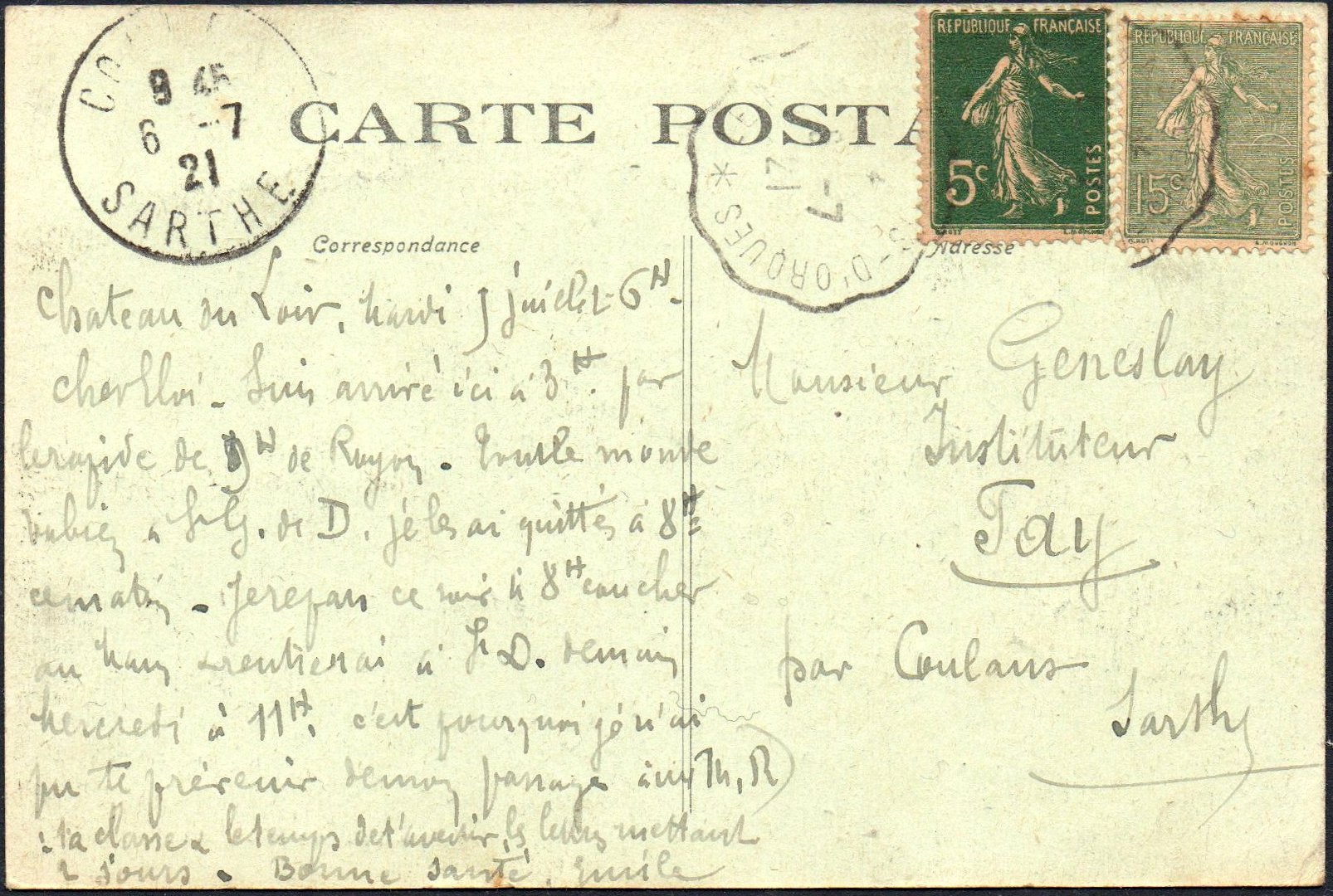 The postcard shows a view near Château-du-Loir but the first postmark, which cancelled the stamps, was applied on the tram from Le Mans to St Denis d'Orques on July 6th, 1921. This, outward from Le Mans, is much the scarcer of the two directions for this CCL. The recipient, Mr. Geneslay, was a teacher.
Often, postal markings are the only useful source for comment. On some very early mail, routings could be specified by the sender, for example, the naming of a specific steamship by which the sender wishes the letter to travel. The card above, though, is quite exceptional in that the sender has
The postcard shows a view near Château-du-Loir but the first postmark, which cancelled the stamps, was applied on the tram from Le Mans to St Denis d'Orques on July 6th, 1921. This, outward from Le Mans, is much the scarcer of the two directions for this CCL. The recipient, Mr. Geneslay, was a teacher.
Often, postal markings are the only useful source for comment. On some very early mail, routings could be specified by the sender, for example, the naming of a specific steamship by which the sender wishes the letter to travel. The card above, though, is quite exceptional in that the sender has 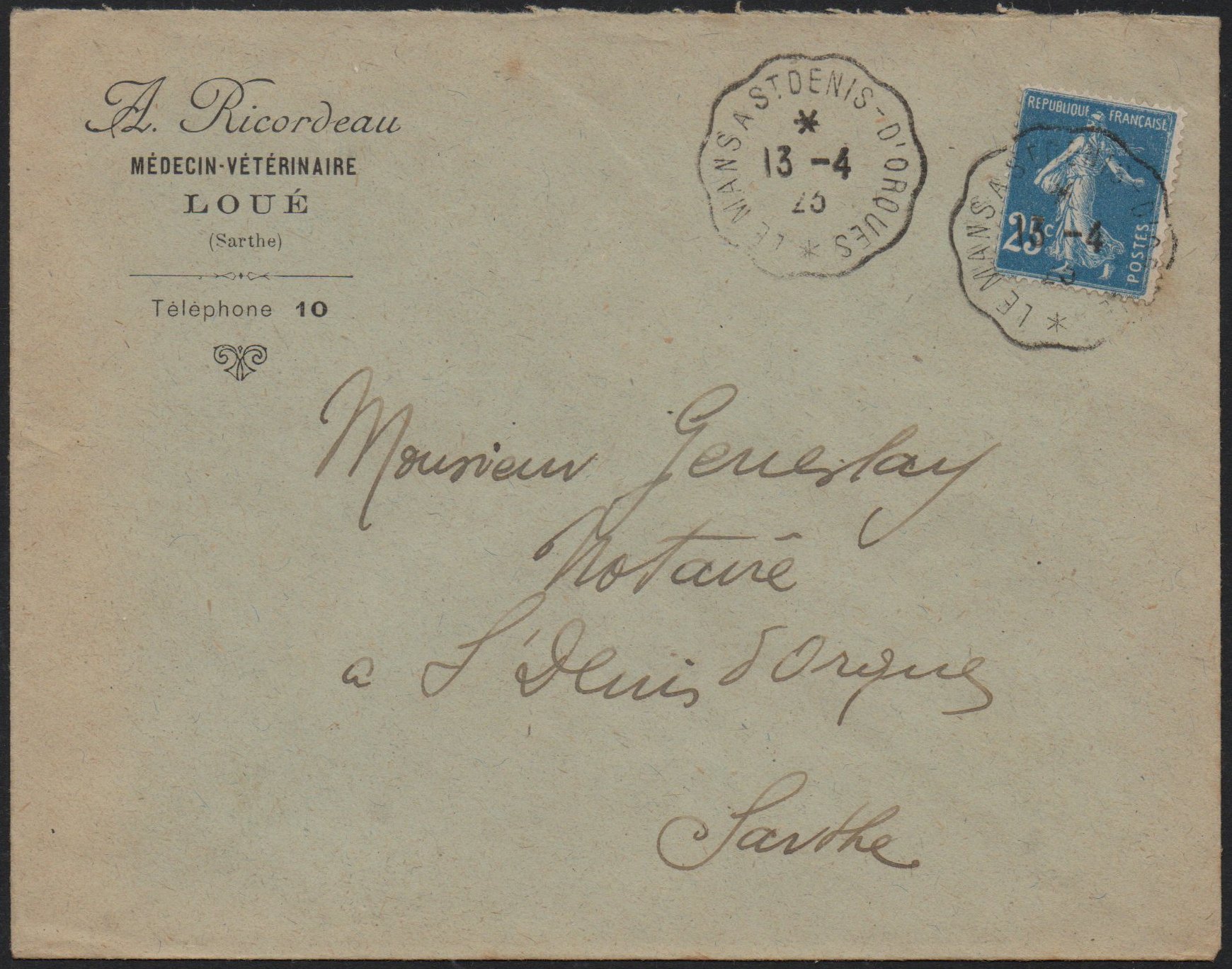
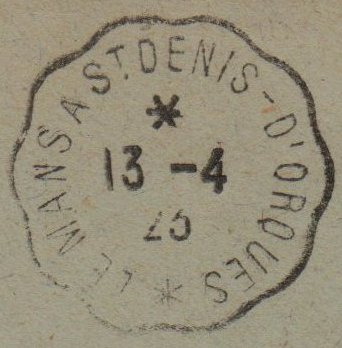 A further, and very fine, example of the uncommon 'outwards' cancellation from Le Mans on a letter from a vet in Loué. It is unusual not only in its direction of travel but in its routing. All other examples that we have seen of a CCL on mail apparently originating at Loué have received a cancellation from the railway which served Loué. One speculates that it may have been urgent and handed to the tramway CCL clerk at Loué in person. It is backstamped on arrival at St Denis d'Orques at 09.40 on the same date, probably thus saving a day.
Curiously, this letter is also addressed to a Mr. Geneslay, in this case, though, a notary.
St Denis d'Orques au Mans Type III [ . ] (Earliest : 06/15 --> Latest : 06/28)
Le Mans à St Denis d'Orques Type III [ . ] (Earliest : 07/21 --> Latest : 04/23)
.
That concludes our best estimation of the likely tramway cancellations for La Sarthe. Please bear in mind that these have been selected essentially by a process of deduction, not from public or previously-published records that we have encountered. If you are able to add / correct / improve the listing, please let us know.
A further, and very fine, example of the uncommon 'outwards' cancellation from Le Mans on a letter from a vet in Loué. It is unusual not only in its direction of travel but in its routing. All other examples that we have seen of a CCL on mail apparently originating at Loué have received a cancellation from the railway which served Loué. One speculates that it may have been urgent and handed to the tramway CCL clerk at Loué in person. It is backstamped on arrival at St Denis d'Orques at 09.40 on the same date, probably thus saving a day.
Curiously, this letter is also addressed to a Mr. Geneslay, in this case, though, a notary.
St Denis d'Orques au Mans Type III [ . ] (Earliest : 06/15 --> Latest : 06/28)
Le Mans à St Denis d'Orques Type III [ . ] (Earliest : 07/21 --> Latest : 04/23)
.
That concludes our best estimation of the likely tramway cancellations for La Sarthe. Please bear in mind that these have been selected essentially by a process of deduction, not from public or previously-published records that we have encountered. If you are able to add / correct / improve the listing, please let us know.
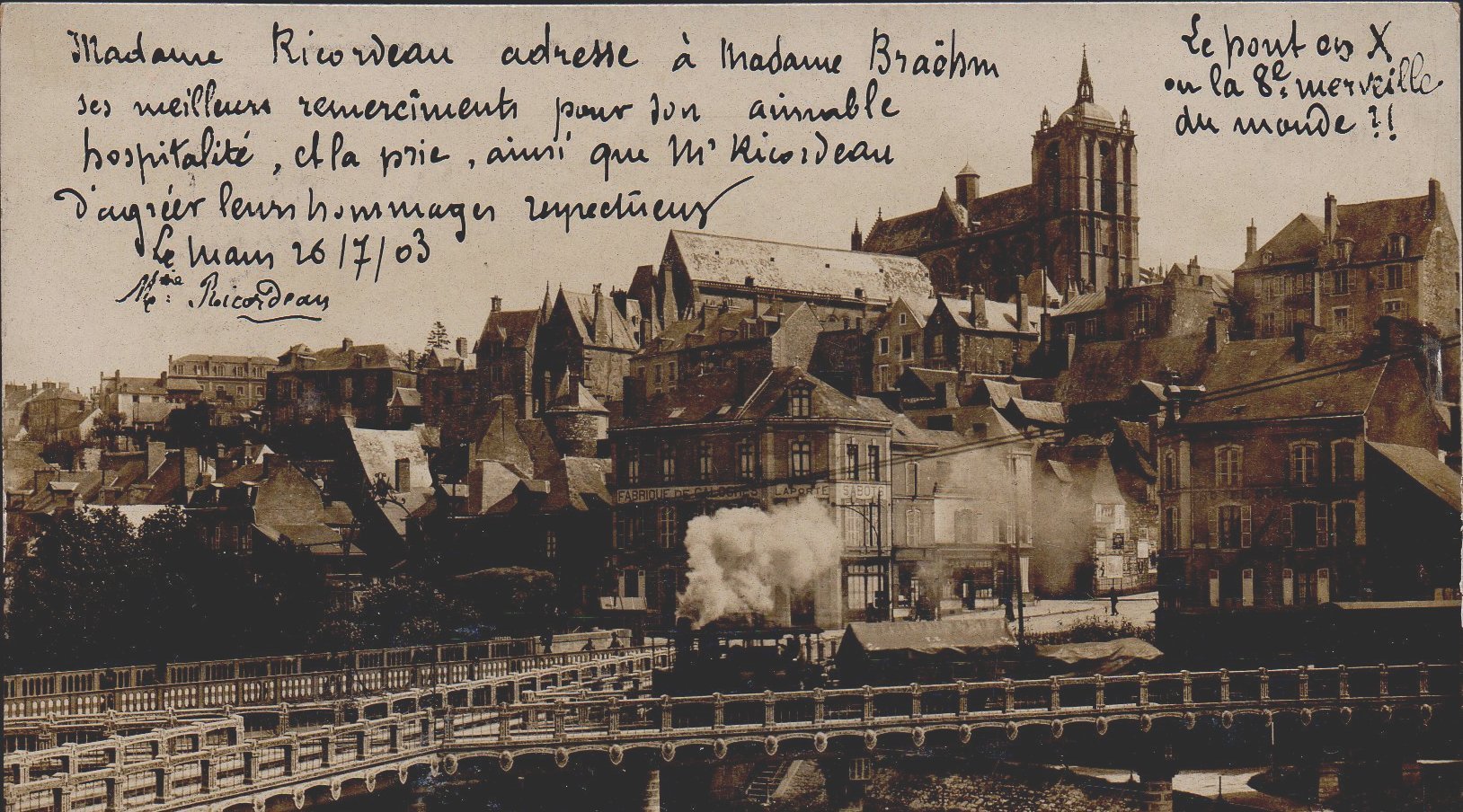 We close this, the main article, with a final view of the Pont en X with a T.S. goods (or possibly mixed) service heading out of Le Mans, unfortunately a very dark printing. It carries a 'thank you' in highly formal language sent in July 1903. At top right, the writer gives an interesting insight into the reverence with which this bridge was apparently held. It translates as :
'The Pont en X or the 8th Wonder of the World?!' ... The Appendix article contains many more views of this bridge.
.
We close this, the main article, with a final view of the Pont en X with a T.S. goods (or possibly mixed) service heading out of Le Mans, unfortunately a very dark printing. It carries a 'thank you' in highly formal language sent in July 1903. At top right, the writer gives an interesting insight into the reverence with which this bridge was apparently held. It translates as :
'The Pont en X or the 8th Wonder of the World?!' ... The Appendix article contains many more views of this bridge.
.