Appendix to the Pont en X / Tramways de la Sarthe article :
This webpage contains just the appendix to our main article. The main article has already examined the following:
~~ The old trams in Le Mans & Le Pont en X
~~ The Tramways de la Sarthe (T.S.) network
~~ The stations and tramway infrastructure produced under the guiding hand of Harel de la Noë
~~ The Revenue stamps of Le Mans showing the Pont en X
~~ Esperanto cinderella stamps showing the Pont en X
~~ The travelling post office (courrier-convoyeur) cancellations applied on the T.S. trams.
< < ----- : The main article can be accessed via the link in the left panel.
.
The Contents of this webpage (the Appendix) are:
1. A few examples of CCL services in France (all railway and outside La Sarthe)
2. Courrier-Convoyeur-Ligne : Railway : Bonnétable à Mamers
3(a). Courrier-Convoyeur-Ligne : Railway : La Ferté-Bernard au Mans
3(b). Courrier-Convoyeur-Ligne : TRAMWAY : Mamers line CCL used on the La Ferté-Bernard branch-line
4. Courrier-Convoyeur-Ligne : Railway : La Flèche au Mans (For Tramway use of this CCL, see main article)
5. Modern cinderellas based on the Pont en X & the old Tramways de la Sarthe network.
. - . A few postcards bearing Sarthe CCL for sale
. - . A display of additional 1900 Foire de Paris cinderellas.
6. A photographic circumnavigation of the Pont en X.
Principal Abbreviations used in this Article:
CCL = courrier-convoyeur-ligne (a TPO operated by a single postal employee, a 'mail-guard'). We frequently use CCL as a short form for 'CCL cancellation', as will be apparent when seen in context.
T.S. : La Compagnie des Tramways de la Sarthe.
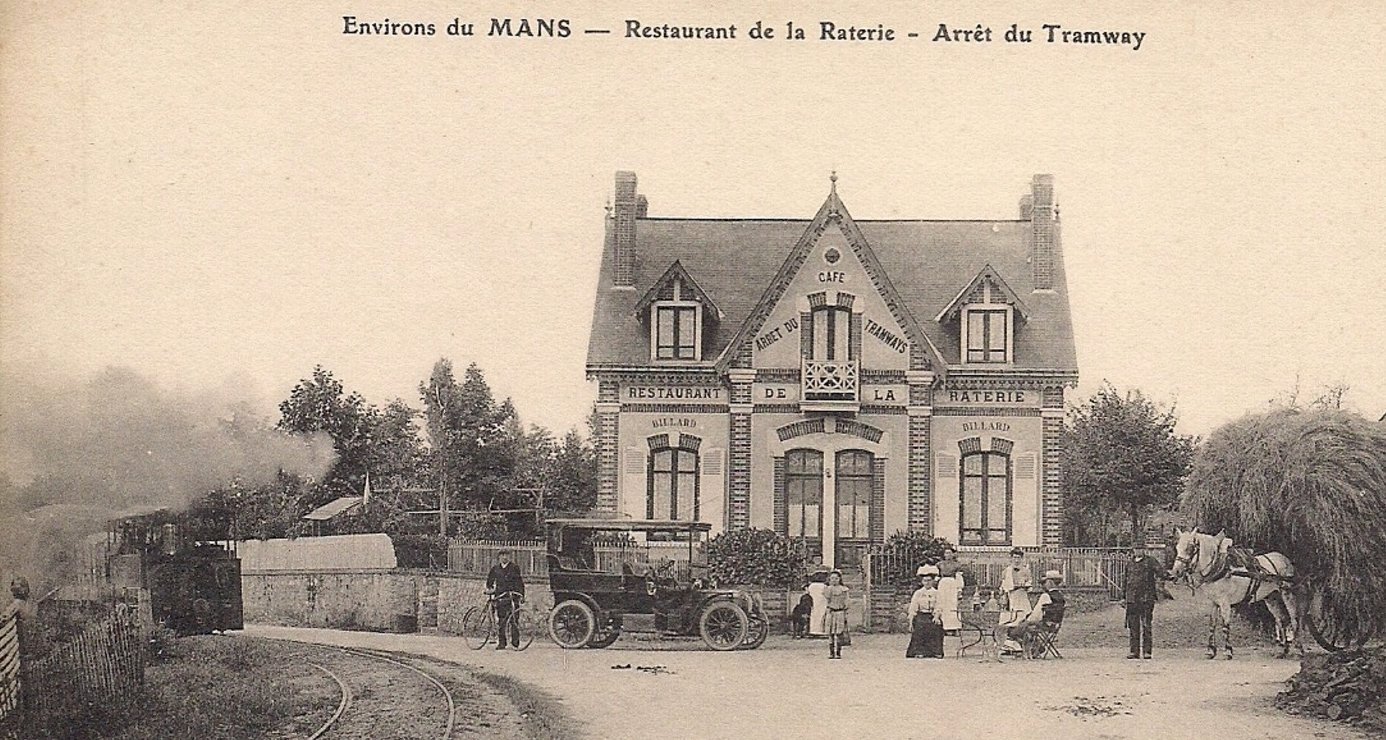 Nostalgia: 'La Raterie' (Allonnes) on the Mayet line, an evocative rural scene less than 5 kms from the Gare Centrale in Le Mans, one of the Tramways de la Sarthe lines on which a tramway CCL (courrier-convoyeur-ligne) service clearly operated. The accommodation for postal staff on the trams was no doubt quite spartan by modern standards, but for a few decades this was an efficient and cost-effective way of moving the mails.
.
1. The Courrier-Convoyeur in France : Some examples of railway-operated services, as most indeed were.
Nostalgia: 'La Raterie' (Allonnes) on the Mayet line, an evocative rural scene less than 5 kms from the Gare Centrale in Le Mans, one of the Tramways de la Sarthe lines on which a tramway CCL (courrier-convoyeur-ligne) service clearly operated. The accommodation for postal staff on the trams was no doubt quite spartan by modern standards, but for a few decades this was an efficient and cost-effective way of moving the mails.
.
1. The Courrier-Convoyeur in France : Some examples of railway-operated services, as most indeed were.
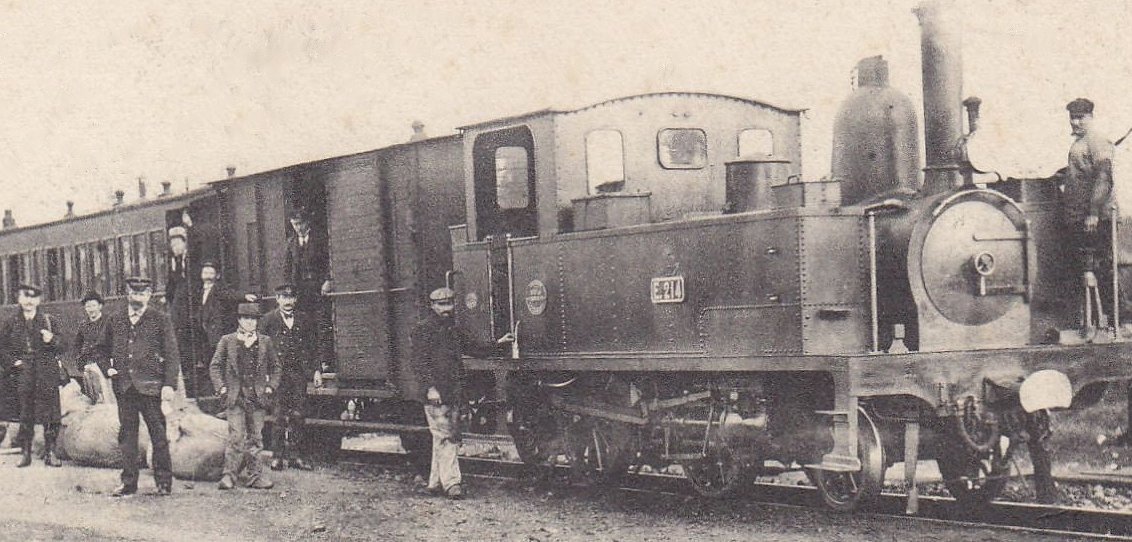 A train at Gourin, Morbihan with what appears to be a postal van and post-bags. It is possible that the man at extreme left is a postal employee who has met the train and that the man standing in the doorway of the van may be the convoyeur who has carried, or is about to carry, the mails onward. There was at least one CCL service at this station, Gourin to Lorient.
A mail-guard's Duties, working environment & the handling of mails.
We have searched extensively, and unsuccessfully, for an image that is clearly of a convoyeur's workspace within a train or tram anywhere in France. Whilst the concept of the CCL and its operative's broad duties can be easily grasped, very little information about the exact details of his duty period seems to be readily available in print. At Le Mans and perhaps at a limited number of other T.S. termini in towns which had sorting facilities, multiple bags of mail would have been loaded onto the T.S. mail van (fourgon) for delivery around the département along the route; this mail would already have been postmarked and sorted into bags for each station. We imagine that most of the mail loaded onto the tram at intermediate stations would also have been cancelled (by the local post office) and bagged for delivery to the terminus station.
There may possibly have been a posting box at the station, perhaps emptied by the postman meeting the tram. We are not aware that there were any posting boxes in the side of the fourgon for the public to use, but people could no doubt have handed mail to the CCL clerk at the stations in person. It may be that, at rural stations remote from post offices, the local postman collected outgoing mail on his rounds which he took directly to the station. It seems to us that, typically, only these types of mail would have needed cancelling on the tram.
Mail Security :
There must presumably be some surviving literature on how CCL postal clerks should maintain the security of the mails for which they were responsible, but we have not found any. Based on images we have seen and the text of a journey on the Mamers line in the main article, it appears that the courrier-convoyeur never left the vicinity of his van and would be met by other postal employees at stations for the exchange of mails, with registered mail requiring an exchange of signatures. One imagines the van could, if necessary, be securely locked by the travelling postman.
A train at Gourin, Morbihan with what appears to be a postal van and post-bags. It is possible that the man at extreme left is a postal employee who has met the train and that the man standing in the doorway of the van may be the convoyeur who has carried, or is about to carry, the mails onward. There was at least one CCL service at this station, Gourin to Lorient.
A mail-guard's Duties, working environment & the handling of mails.
We have searched extensively, and unsuccessfully, for an image that is clearly of a convoyeur's workspace within a train or tram anywhere in France. Whilst the concept of the CCL and its operative's broad duties can be easily grasped, very little information about the exact details of his duty period seems to be readily available in print. At Le Mans and perhaps at a limited number of other T.S. termini in towns which had sorting facilities, multiple bags of mail would have been loaded onto the T.S. mail van (fourgon) for delivery around the département along the route; this mail would already have been postmarked and sorted into bags for each station. We imagine that most of the mail loaded onto the tram at intermediate stations would also have been cancelled (by the local post office) and bagged for delivery to the terminus station.
There may possibly have been a posting box at the station, perhaps emptied by the postman meeting the tram. We are not aware that there were any posting boxes in the side of the fourgon for the public to use, but people could no doubt have handed mail to the CCL clerk at the stations in person. It may be that, at rural stations remote from post offices, the local postman collected outgoing mail on his rounds which he took directly to the station. It seems to us that, typically, only these types of mail would have needed cancelling on the tram.
Mail Security :
There must presumably be some surviving literature on how CCL postal clerks should maintain the security of the mails for which they were responsible, but we have not found any. Based on images we have seen and the text of a journey on the Mamers line in the main article, it appears that the courrier-convoyeur never left the vicinity of his van and would be met by other postal employees at stations for the exchange of mails, with registered mail requiring an exchange of signatures. One imagines the van could, if necessary, be securely locked by the travelling postman.
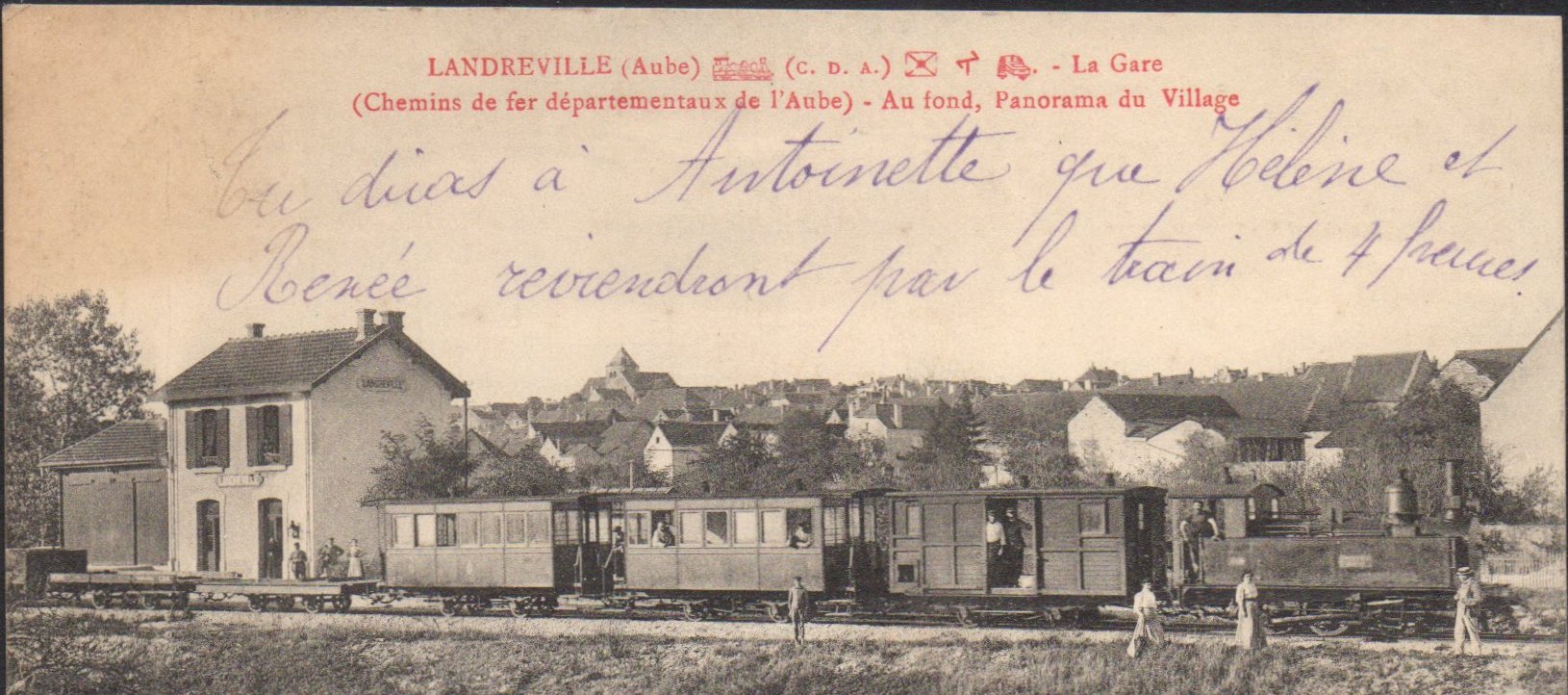
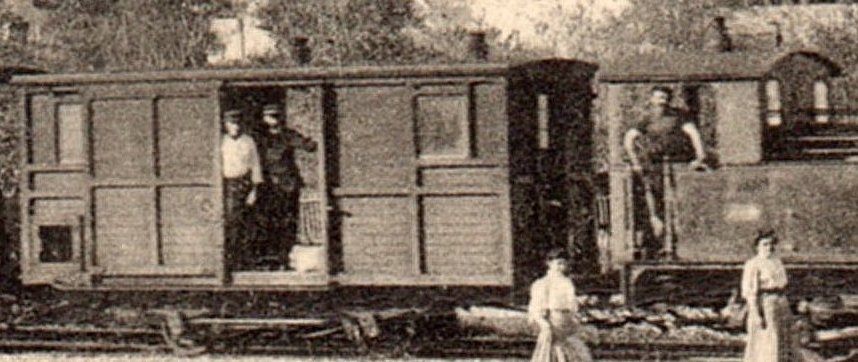 A further view of a likely postal clerk in the doorway of a fourgon, perhaps together with a local postman. This is the Gare de Landreville, Aube on the secondary railway Polisot-Landreville-Essoyes-Cunfin. A Cunfin to Polisot CCL operated on this line, Type II recorded in both directions. Another CCL service is recorded solely between Essoyes and Polisot and only in this direction (Type II). Driver, passengers, station staff and a few locals are also keen to be in this atmospheric, animated view.
The Pothion catalogue : Courrier-Convoyeur (Ligne) Listing :
Although an extensive network of ambulants and courrier-convoyeurs had been established on standard-gauge lines in La Sarthe for many years by the time the T.S. services were introduced, La Poste was never slow to take advantage of new opportunities. The large number of new local lines that emerged between the 1890s and 1914 (with a few more additions in the early 1920s) provided the post office with numerous opportunities to make significant improvements both to operating costs and the delivery and/or collection times in many rural areas.
A further view of a likely postal clerk in the doorway of a fourgon, perhaps together with a local postman. This is the Gare de Landreville, Aube on the secondary railway Polisot-Landreville-Essoyes-Cunfin. A Cunfin to Polisot CCL operated on this line, Type II recorded in both directions. Another CCL service is recorded solely between Essoyes and Polisot and only in this direction (Type II). Driver, passengers, station staff and a few locals are also keen to be in this atmospheric, animated view.
The Pothion catalogue : Courrier-Convoyeur (Ligne) Listing :
Although an extensive network of ambulants and courrier-convoyeurs had been established on standard-gauge lines in La Sarthe for many years by the time the T.S. services were introduced, La Poste was never slow to take advantage of new opportunities. The large number of new local lines that emerged between the 1890s and 1914 (with a few more additions in the early 1920s) provided the post office with numerous opportunities to make significant improvements both to operating costs and the delivery and/or collection times in many rural areas.
The Pothion CCL catalogue is the obvious starting point in any analysis, with its extensive and excellent listing of France's CCL cancellations. Pothion distinguishes the three main types (I, II & III) of CCL cancellation that were produced and the dates of introduction of these three types are instructive.
There is no evidence of a Type I canceller being used on a T.S. service, nor would we expect to find one. Depending on the tramway's dates of operation, one could expect to find either Type II or Type III cancellations on T.S. services - or both.
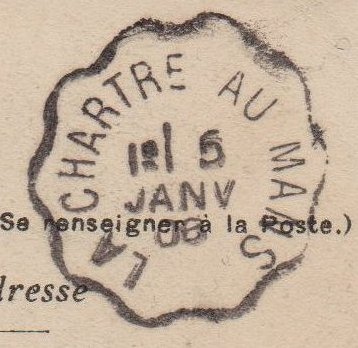
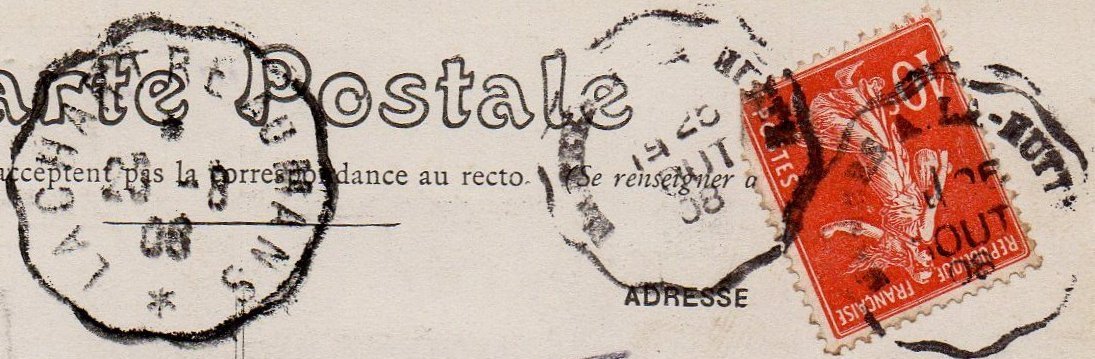 Left-to-Right: CCL Types II, III & I. The Mamers à La Hutte Type I is a railway, not tramway, cancellation.
Type I , not found on T.S. cancellations, has the smallest (scalloped) circle and elegant baton lettering. The central part of the cancellation had movable type.
Type II, has a larger circle and plain lettering. The central section is the same as for the Type I, with the day of the month still on the top line and the month in letters. The 1⁰ here identifies the duty/service.
On all but one T.S. line, the duty/service numbers are limited to the 1⁰ and 2⁰. The exception is the Mayet line where for the first few years at least, we have only encountered 2⁰ and 3⁰ - and almost all of them are 3⁰.
Type III, has a still larger circle and an asterisk at bottom centre. The date is now shown entirely with numerals, the day and month on the same line, the year below. At the top, there is often another asterisk but in some cases a service number is found; occasionally the field is left entirely blank. We have not attempted to list separately each such detail difference in the Type III style but we have added comments on the subject where we have observed a possible pattern.
Below we give the (nation-wide) dates for the introduction of the three CCL Types. In many cases, replacement cancellers were only produced when older-style ones needed replacing due to wear.
The Type I canceller was introduced in 1877 and replaced the courrier-convoyeur-station system of cancellation.
The Type II canceller was first introduced in 1886.
The Type III canceller, a style that would remain largely unchanged for decades, was introduced in 1904.
To provide an example of the type of overlapping usage encountered, the Mamers au Mans Type II canceller - in the 1886 style and produced circa 1901 - was not replaced by a 1904-style Type III canceller until some time between 'August 1928' and 'November 1931', despite the Type II showing distinct signs of wear (thickening of both the letters and the outer ring) by the early 1920s.
(Note: These two 'latest-known' and 'earliest-known' limits may be updated in the main article over time, but amending them in this paragraph may be overlooked).
.
Historical Images of Railway / Tramway Courrier-Convoyeur 'compartments' and travelling postal clerks.
Returning now to La Sarthe, the tramway fourgons that we have seen have few windows and were, we suspect, rather dark and lonely, as well as an uncomfortable duty turn. It is possible that the fourgons were sectioned off to provide separate space both for the tram controller/guard and for the courrier-convoyeur, although we currently think that the fourgon was typically used entirely for mail purposes.
Huge columes of mail were handled at the railway station in Le Mans but there may have been other postal hubs in the City too. We have no information on how the mails were carried to and from the T.S. Gare Centrale. In the years prior to the Great War, we notice that trams on all three of the then-active CCL routes (La Chartre, Mamers and Mayet) show a tram arriving at the Gare Centrale in Le Mans within a very short time period, 11.50 to midday. A St. Denis d'Orques tram was also scheduled to arrive at around the same time. The St. Denis CCL service seems to have been established later than the others but was certainly active by 1915, perhaps as a solution to wartime shortages of road vehicles and fuel.
It would, theoretically, have been possible to group several postal fourgons into a single postal tram once or twice a day and then transfer the mails between the Gare Centrale and a sorting hub, ideally one with its own metre-gauge siding leading to a reception platform. Taking loaded fourgons directly to and from a sorting hub could have provided significant savings in terms of postal speed, manpower costs and reduced damage to the mails which every movement of heavy bags incurs. However, we can (at least for now) only speculate.
The La Chartre T.S. line passed in front of the main railway station in Le Mans, so this was one possible hub which was quite easily accessible, but we have not seen any evidence of a spur from the tramline into the railway station in images or on maps. A surviving 'working timetable' during the heyday of courrier-convoyeur services on the T.S. could be a most useful resource.
Left-to-Right: CCL Types II, III & I. The Mamers à La Hutte Type I is a railway, not tramway, cancellation.
Type I , not found on T.S. cancellations, has the smallest (scalloped) circle and elegant baton lettering. The central part of the cancellation had movable type.
Type II, has a larger circle and plain lettering. The central section is the same as for the Type I, with the day of the month still on the top line and the month in letters. The 1⁰ here identifies the duty/service.
On all but one T.S. line, the duty/service numbers are limited to the 1⁰ and 2⁰. The exception is the Mayet line where for the first few years at least, we have only encountered 2⁰ and 3⁰ - and almost all of them are 3⁰.
Type III, has a still larger circle and an asterisk at bottom centre. The date is now shown entirely with numerals, the day and month on the same line, the year below. At the top, there is often another asterisk but in some cases a service number is found; occasionally the field is left entirely blank. We have not attempted to list separately each such detail difference in the Type III style but we have added comments on the subject where we have observed a possible pattern.
Below we give the (nation-wide) dates for the introduction of the three CCL Types. In many cases, replacement cancellers were only produced when older-style ones needed replacing due to wear.
The Type I canceller was introduced in 1877 and replaced the courrier-convoyeur-station system of cancellation.
The Type II canceller was first introduced in 1886.
The Type III canceller, a style that would remain largely unchanged for decades, was introduced in 1904.
To provide an example of the type of overlapping usage encountered, the Mamers au Mans Type II canceller - in the 1886 style and produced circa 1901 - was not replaced by a 1904-style Type III canceller until some time between 'August 1928' and 'November 1931', despite the Type II showing distinct signs of wear (thickening of both the letters and the outer ring) by the early 1920s.
(Note: These two 'latest-known' and 'earliest-known' limits may be updated in the main article over time, but amending them in this paragraph may be overlooked).
.
Historical Images of Railway / Tramway Courrier-Convoyeur 'compartments' and travelling postal clerks.
Returning now to La Sarthe, the tramway fourgons that we have seen have few windows and were, we suspect, rather dark and lonely, as well as an uncomfortable duty turn. It is possible that the fourgons were sectioned off to provide separate space both for the tram controller/guard and for the courrier-convoyeur, although we currently think that the fourgon was typically used entirely for mail purposes.
Huge columes of mail were handled at the railway station in Le Mans but there may have been other postal hubs in the City too. We have no information on how the mails were carried to and from the T.S. Gare Centrale. In the years prior to the Great War, we notice that trams on all three of the then-active CCL routes (La Chartre, Mamers and Mayet) show a tram arriving at the Gare Centrale in Le Mans within a very short time period, 11.50 to midday. A St. Denis d'Orques tram was also scheduled to arrive at around the same time. The St. Denis CCL service seems to have been established later than the others but was certainly active by 1915, perhaps as a solution to wartime shortages of road vehicles and fuel.
It would, theoretically, have been possible to group several postal fourgons into a single postal tram once or twice a day and then transfer the mails between the Gare Centrale and a sorting hub, ideally one with its own metre-gauge siding leading to a reception platform. Taking loaded fourgons directly to and from a sorting hub could have provided significant savings in terms of postal speed, manpower costs and reduced damage to the mails which every movement of heavy bags incurs. However, we can (at least for now) only speculate.
The La Chartre T.S. line passed in front of the main railway station in Le Mans, so this was one possible hub which was quite easily accessible, but we have not seen any evidence of a spur from the tramline into the railway station in images or on maps. A surviving 'working timetable' during the heyday of courrier-convoyeur services on the T.S. could be a most useful resource.
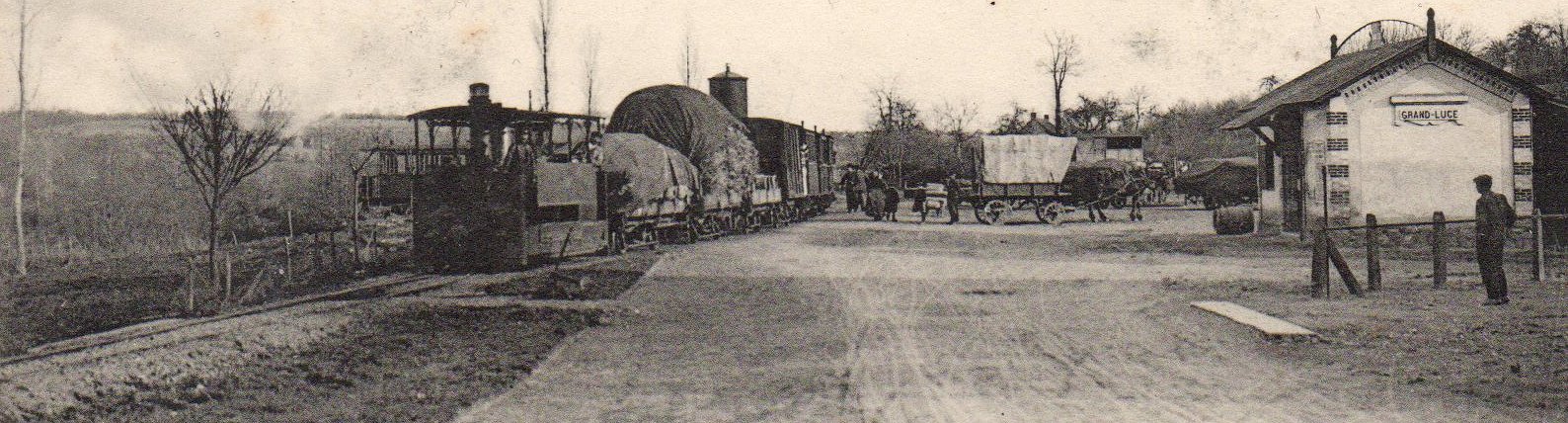 A mixed tram at Le-Grand-Lucé on the La Chartre line but, based on the undivided back of the postcard, the image dates from before the La Chartre CCL was introduced. There is no fourgon of the type we associate with the mails in the tram's formation. This is one of many T.S. stations not ideally located for passengers or mail handling. When you are the sole provider, this is of little business consequence but, over time, improvements to road surfaces and to road vehicles which could serve the centres of towns and villages would render the tram less and less competitive.
In memoriam : the Mail-Guard:
Especially around the period from the 1890s to the 1920s, convoyeur services heavily outnumbered ambulant services across France, yet literature and detail images of them are in very short supply. Any photographs nearly always concentrate on the more 'glamorous' ambulants. Despite the thousands of convoyeur services (on trains and trams) that were part of an everyday routine for decades and hardly a secret, the post office employees who manned these vital services seem to have passed into history virtually unseen, their existence barely recorded except through the many postmarks that they left behind - and a few postcard views in which they are, typically, just an incidental feature.
A mixed tram at Le-Grand-Lucé on the La Chartre line but, based on the undivided back of the postcard, the image dates from before the La Chartre CCL was introduced. There is no fourgon of the type we associate with the mails in the tram's formation. This is one of many T.S. stations not ideally located for passengers or mail handling. When you are the sole provider, this is of little business consequence but, over time, improvements to road surfaces and to road vehicles which could serve the centres of towns and villages would render the tram less and less competitive.
In memoriam : the Mail-Guard:
Especially around the period from the 1890s to the 1920s, convoyeur services heavily outnumbered ambulant services across France, yet literature and detail images of them are in very short supply. Any photographs nearly always concentrate on the more 'glamorous' ambulants. Despite the thousands of convoyeur services (on trains and trams) that were part of an everyday routine for decades and hardly a secret, the post office employees who manned these vital services seem to have passed into history virtually unseen, their existence barely recorded except through the many postmarks that they left behind - and a few postcard views in which they are, typically, just an incidental feature.
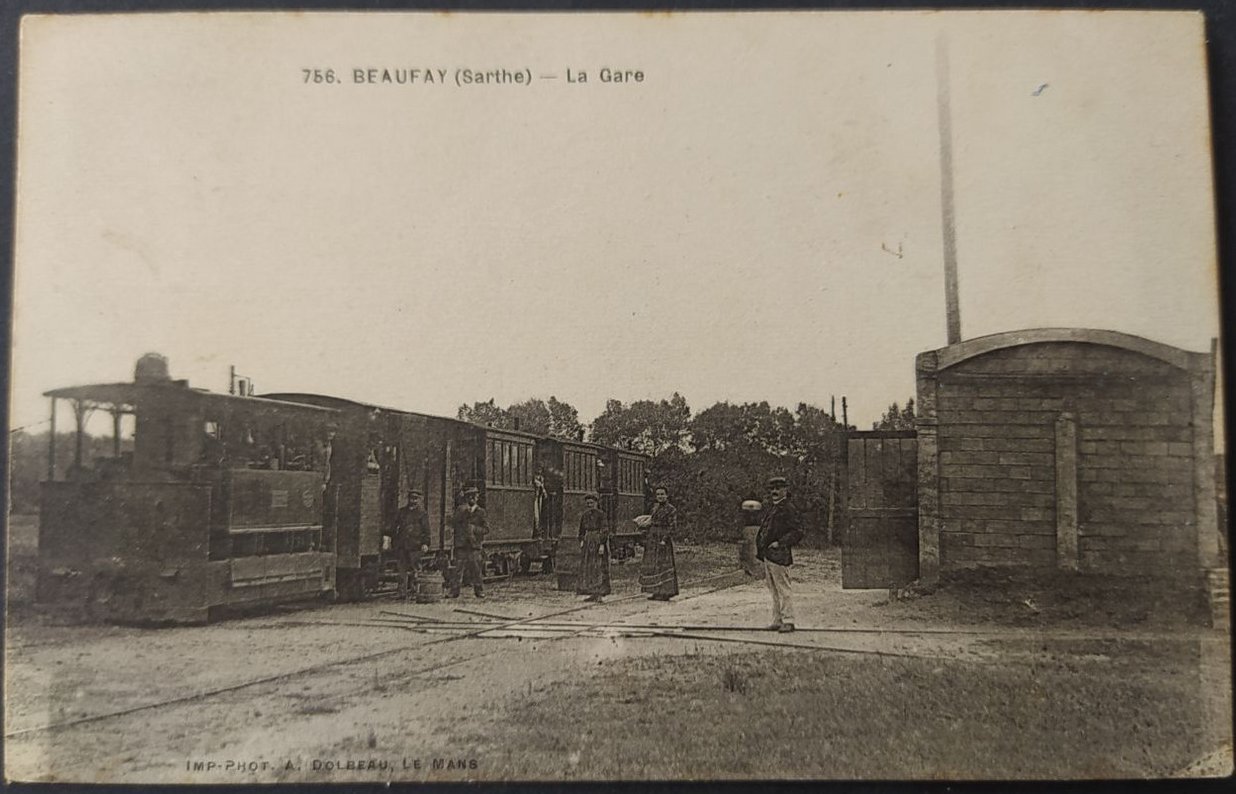
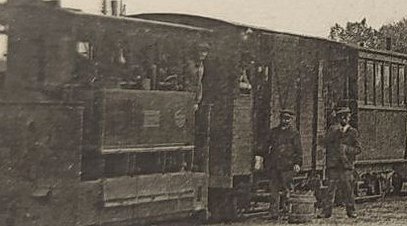 A detail from this postcard of Beaufay on the Mamers line has already appeared in the main article. We think the large image above shows the convoyeur leaning out of the front window of the fourgon (van) immediately behind the tram engine.
A brief look at images from one or two other départements may be instructive:
A detail from this postcard of Beaufay on the Mamers line has already appeared in the main article. We think the large image above shows the convoyeur leaning out of the front window of the fourgon (van) immediately behind the tram engine.
A brief look at images from one or two other départements may be instructive:
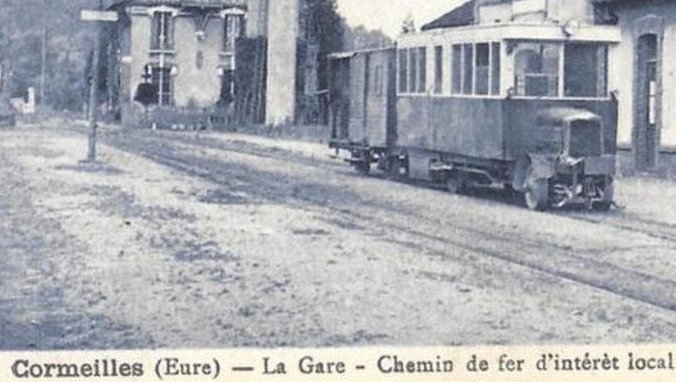 This is neither in La Sarthe, nor is it a tramway, but a metre-gauge (light) railway line of local interest in l'Eure, often called a tramway locally. A courrier-convoyeur service (Type III cancellation) operated from Cormeilles to Glos-Montfort on this local railway. This is an interesting view, the passenger railbus supplemented by a van which looks very well suited to convoyeur operations, although other explanations are not hard to conjure up.
For the minor railways and tramway companies, any contract with La Poste would no doubt have been financially significant for them, the importance of it increasing with the passage of time as the freight and passenger income declined inexorably in the face of road competition.
This is neither in La Sarthe, nor is it a tramway, but a metre-gauge (light) railway line of local interest in l'Eure, often called a tramway locally. A courrier-convoyeur service (Type III cancellation) operated from Cormeilles to Glos-Montfort on this local railway. This is an interesting view, the passenger railbus supplemented by a van which looks very well suited to convoyeur operations, although other explanations are not hard to conjure up.
For the minor railways and tramway companies, any contract with La Poste would no doubt have been financially significant for them, the importance of it increasing with the passage of time as the freight and passenger income declined inexorably in the face of road competition.
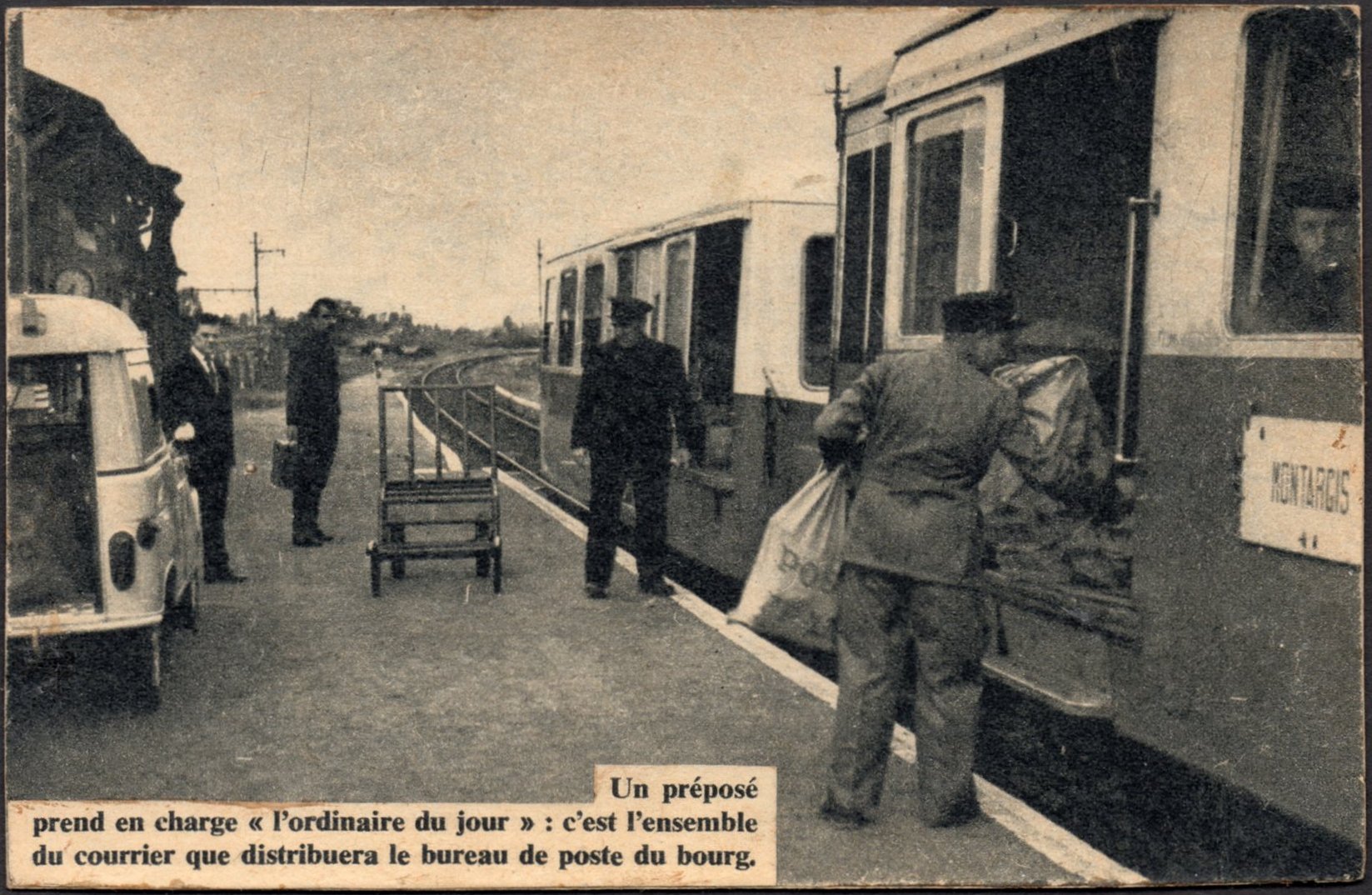 Much more modern, perhaps the 1970s. The image is either a newspaper or magazine cut-out. Montargis was a major hub for many CCL routes. The station here, with the mailbags being off-loaded for local delivery, is unidentified.
.
Courriers-Convoyeurs-Ligne : La Sarthe : Distinguishing Railway from Tramway.
In the main article, we list those CCL in La Sarthe which we believe to have been tramway operations. There were two CCL routes which, based solely on termini, might easily be presumed to be Tramways de la Sarthe CCL services. However, our studies strongly suggest that they were solely railway operations:
Bonnétable à Mamers
La Ferté-Bernard au Mans (reviewed here alongside examples of the T.S. Mamers-line CCL cancellations used on its branch-line to La Ferté-Bernard).
Additionally, one CCL appears to have been used both by trains and trams:
La Flèche au Mans: Its usage as a Railway CCL is covered here. The tramway use is covered in the main article.
Somewhere between railways and tramways in legal status, though definitely railways in essence, were four local interest / secondary railways (lignes de chemin de fer secondaire) in La Sarthe. They were authorised under the provisions of the 1865 law on the 'voies ferrées d'intérêt local' and were built to standard gauge (4ft 8½ ins.; 1,435 mms).
La Flèche - La Suze
La Flèche - Sablé
Château-du-Loir - Saint-Calais
Mamers - Bonnétable - Connerré - Saint-Calais
Two of these secondary railways impact on this article, albeit in different ways:
** The La Flèche à La Suze railway line (via Malicorne) formed part of the railway-operated La Flèche au Mans CCL route and impacts significantly on the story of the tramway-operated La Flèche au Mans CCL route via Cérans-Foulletourte.
** The Mamers - Bonnétable - Connerré - Saint-Calais railway line generated a number of different CCL cancellations covering different sections of the route. The splendid postcard below of the Gare de Montaillé shows a train at the first station out of Saint-Calais:
Much more modern, perhaps the 1970s. The image is either a newspaper or magazine cut-out. Montargis was a major hub for many CCL routes. The station here, with the mailbags being off-loaded for local delivery, is unidentified.
.
Courriers-Convoyeurs-Ligne : La Sarthe : Distinguishing Railway from Tramway.
In the main article, we list those CCL in La Sarthe which we believe to have been tramway operations. There were two CCL routes which, based solely on termini, might easily be presumed to be Tramways de la Sarthe CCL services. However, our studies strongly suggest that they were solely railway operations:
Bonnétable à Mamers
La Ferté-Bernard au Mans (reviewed here alongside examples of the T.S. Mamers-line CCL cancellations used on its branch-line to La Ferté-Bernard).
Additionally, one CCL appears to have been used both by trains and trams:
La Flèche au Mans: Its usage as a Railway CCL is covered here. The tramway use is covered in the main article.
Somewhere between railways and tramways in legal status, though definitely railways in essence, were four local interest / secondary railways (lignes de chemin de fer secondaire) in La Sarthe. They were authorised under the provisions of the 1865 law on the 'voies ferrées d'intérêt local' and were built to standard gauge (4ft 8½ ins.; 1,435 mms).
La Flèche - La Suze
La Flèche - Sablé
Château-du-Loir - Saint-Calais
Mamers - Bonnétable - Connerré - Saint-Calais
Two of these secondary railways impact on this article, albeit in different ways:
** The La Flèche à La Suze railway line (via Malicorne) formed part of the railway-operated La Flèche au Mans CCL route and impacts significantly on the story of the tramway-operated La Flèche au Mans CCL route via Cérans-Foulletourte.
** The Mamers - Bonnétable - Connerré - Saint-Calais railway line generated a number of different CCL cancellations covering different sections of the route. The splendid postcard below of the Gare de Montaillé shows a train at the first station out of Saint-Calais:
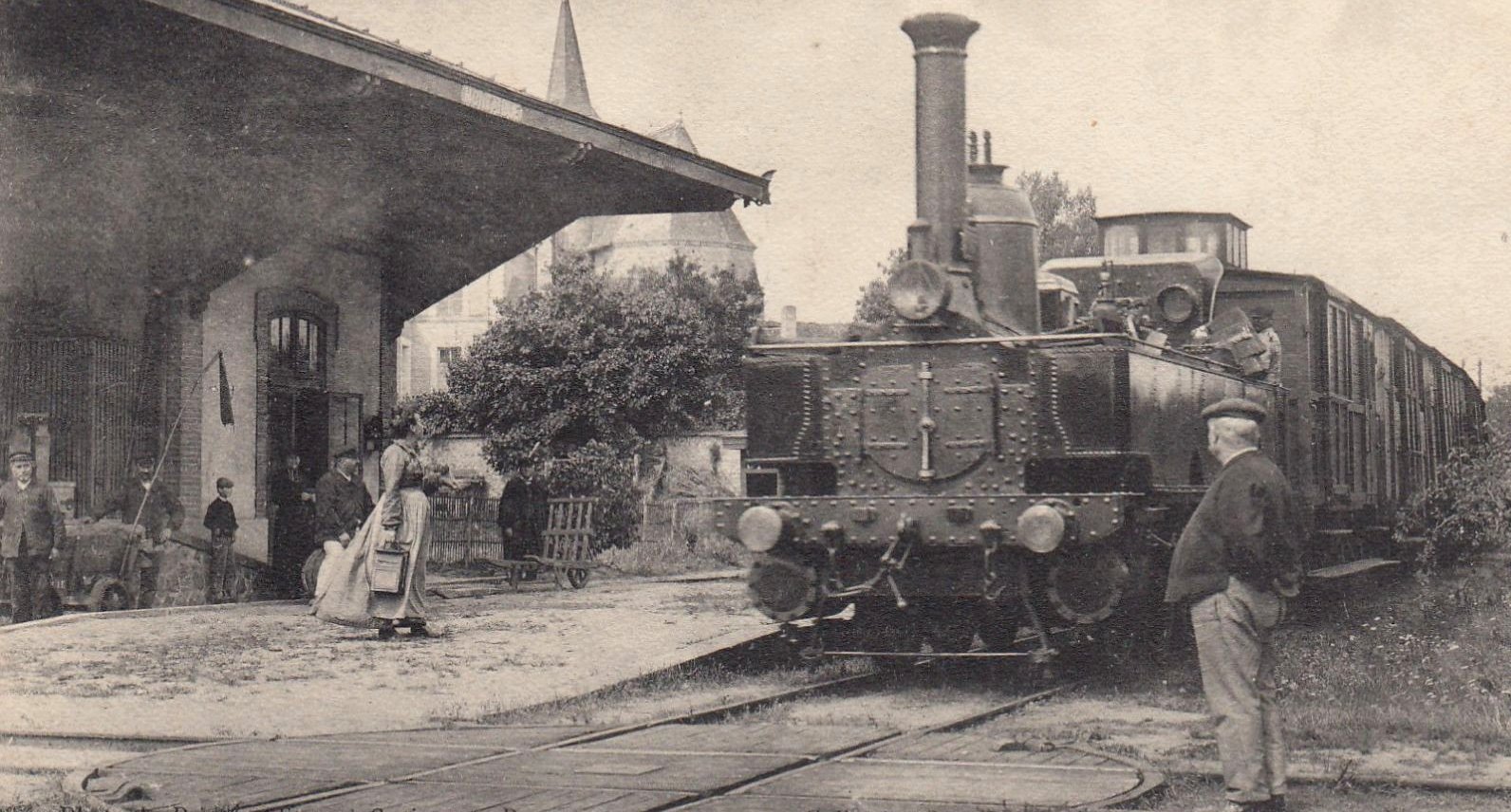 However, it was the other end of this secondary railway which generated the CCL cancellation of interest to us here: Bonnétable à Mamers (only in that direction). Whilst this could theoretically have been used, at certain periods, on part of the Le Mans à Mamers tramline, we are almost certain that it was only ever used on the secondary railway. We provide support for this view next.
.
2.
Bonnétable à Mamers: (very doubtful Tramways de la Sarthe usage).
We provide one example (below) of the clear evidence of the secondary railway use of this cancellation prior to the 1898 opening of the tramway to Mamers. Note the fine strike of the postmark, not uncommon on this railway. The quality of tramway cancellations is typically much more mixed, probably due to the low grade, bone-shaking track on which the trams would often have travelled.
Note: We have noticed on all the examples of this particular CCL, and on one other CCL issued for this secondary railway (Connerré à Mamers), that the font size is unusually large for a Type II, but we have no explanation for this. Type III cancellations on the same railway have standard-size letters (an example seen on a postcard of Bonnétable mailed in 1932 is shown a little lower down).
However, it was the other end of this secondary railway which generated the CCL cancellation of interest to us here: Bonnétable à Mamers (only in that direction). Whilst this could theoretically have been used, at certain periods, on part of the Le Mans à Mamers tramline, we are almost certain that it was only ever used on the secondary railway. We provide support for this view next.
.
2.
Bonnétable à Mamers: (very doubtful Tramways de la Sarthe usage).
We provide one example (below) of the clear evidence of the secondary railway use of this cancellation prior to the 1898 opening of the tramway to Mamers. Note the fine strike of the postmark, not uncommon on this railway. The quality of tramway cancellations is typically much more mixed, probably due to the low grade, bone-shaking track on which the trams would often have travelled.
Note: We have noticed on all the examples of this particular CCL, and on one other CCL issued for this secondary railway (Connerré à Mamers), that the font size is unusually large for a Type II, but we have no explanation for this. Type III cancellations on the same railway have standard-size letters (an example seen on a postcard of Bonnétable mailed in 1932 is shown a little lower down).
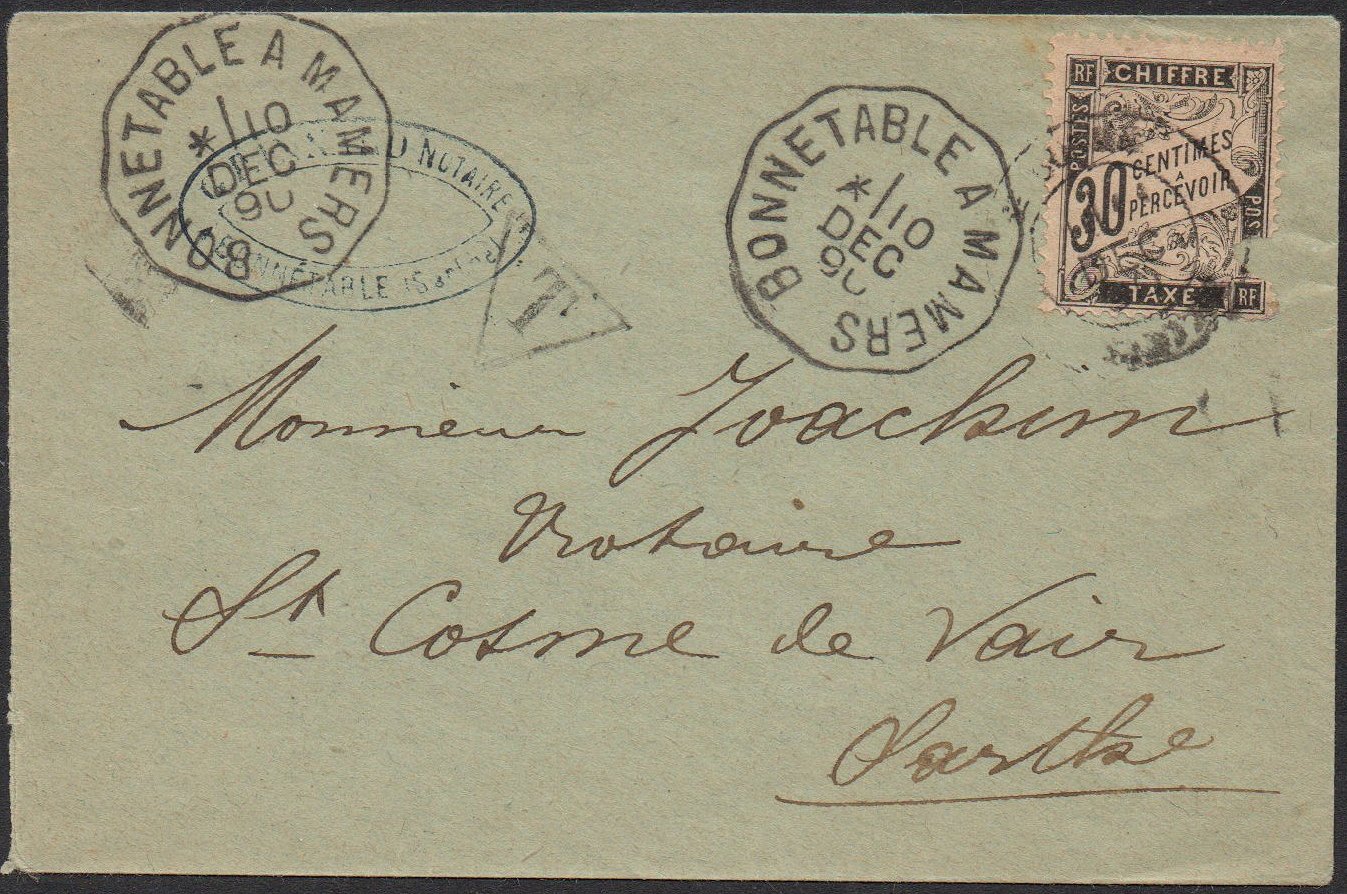
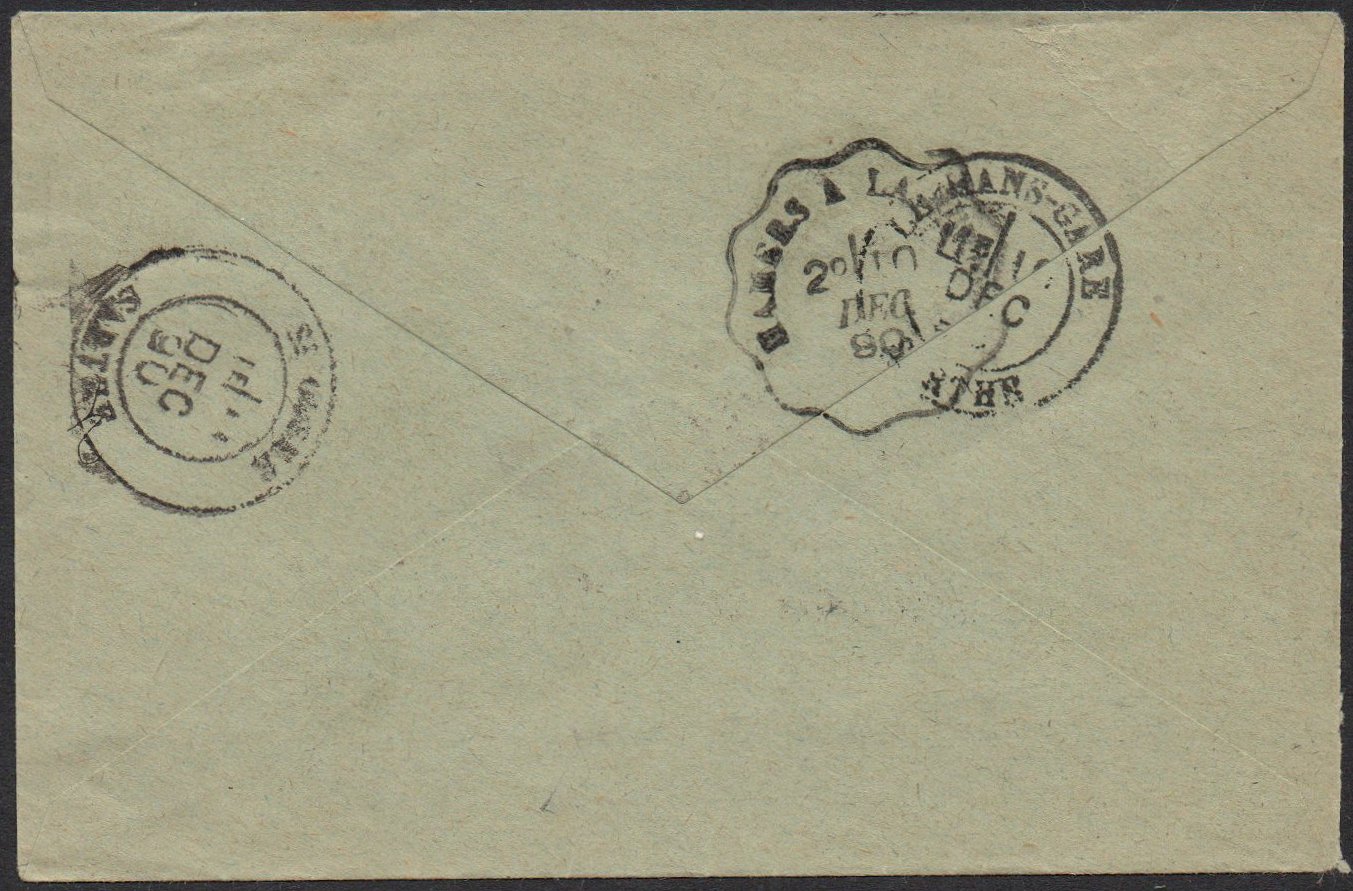
 This unfranked envelope (two scans), sent from one notary to another, appears to have followed a roundabout route from Bonnétable to St.-Cosme-de-Vair, a town only 15 kms distant. Just over a decade later, it was a journey which could have been made on the tramway in around 40 minutes, although we think it unlikely that such a postal arrangement was ever introduced as standard.
The route in 1890 appears to have been by secondary railway (Bonnétable à Mamers), then by mainline railway (Mamers à La Hutte), then sorted at Le Mans-Gare before being delivered to St. Cosme the next day. There is a clear preference in La Sarthe for sending mail to Le Mans for triage, often when much less direct. Thereafter, the letter may well have travelled back by train, most likely to Mamers for eventual delivery by road to St. Cosme. At this point the 30c Postage Due appears to have been applied by the post office which would collect the fee. The letter rate from 1878 to 1906 was 15c, any underfranking being charged double.
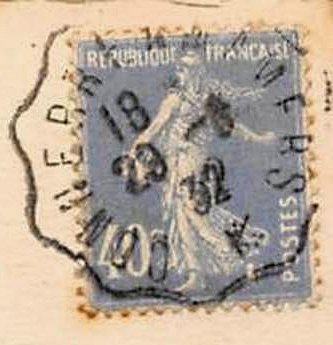
The scan of the 40c Blue shows a Type III cancellation of the secondary railway (Connerré à Mamers) with letters now in the standard font for a CCL.
.
This unfranked envelope (two scans), sent from one notary to another, appears to have followed a roundabout route from Bonnétable to St.-Cosme-de-Vair, a town only 15 kms distant. Just over a decade later, it was a journey which could have been made on the tramway in around 40 minutes, although we think it unlikely that such a postal arrangement was ever introduced as standard.
The route in 1890 appears to have been by secondary railway (Bonnétable à Mamers), then by mainline railway (Mamers à La Hutte), then sorted at Le Mans-Gare before being delivered to St. Cosme the next day. There is a clear preference in La Sarthe for sending mail to Le Mans for triage, often when much less direct. Thereafter, the letter may well have travelled back by train, most likely to Mamers for eventual delivery by road to St. Cosme. At this point the 30c Postage Due appears to have been applied by the post office which would collect the fee. The letter rate from 1878 to 1906 was 15c, any underfranking being charged double.
The scan of the 40c Blue shows a Type III cancellation of the secondary railway (Connerré à Mamers) with letters now in the standard font for a CCL.
.
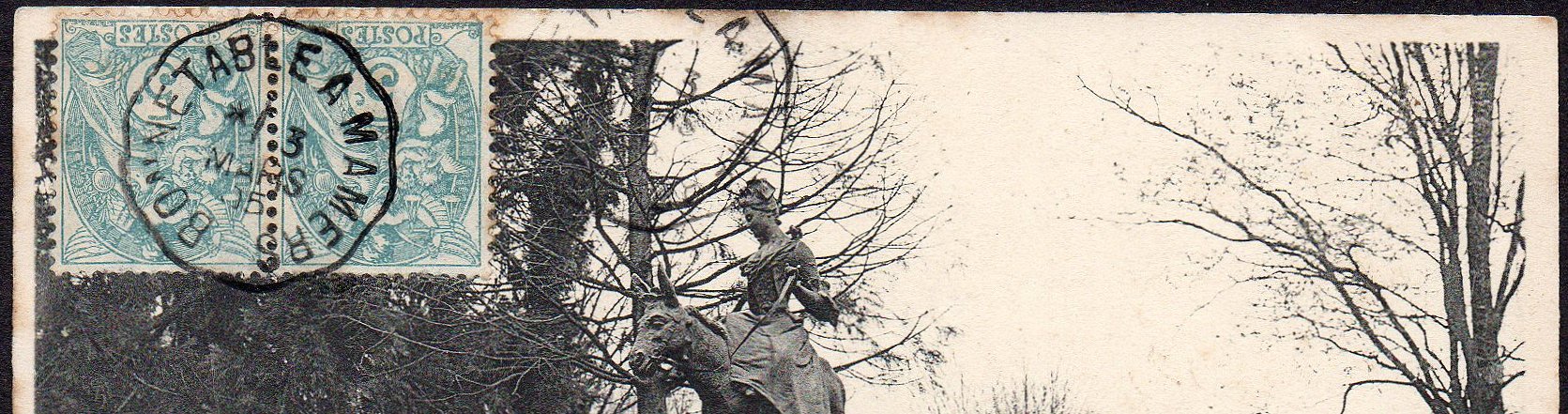 A 1905 example of the CCL, a period when both trams and trains carried mail between these towns. Based on a large sample size, however, there is overwhelming evidence in favour of it being solely used on the railway at all periods.
We have access to some old passenger timetables for the T.S. services and have found no additional trams running solely between Bonnétable and Mamers. We even considered trans-shipment of mail between tram and train (or vice-versa) at Bonnétable but this would not have been straightforward, as a (virtual) visit to the former site of the tramway halt shows:
Google street view today (opens in a new tab)
Comments on the Google View: The tram was on the road here and had merely a request stop at this point, next to the railway bridge, whose abutments have survived. There is a footpath up the railway embankment to the now-closed railway station about 150 metres away. It seems highly improbable that any trans-shipment of mail would have been made here, both for logistical and security reasons. This is further supported by the fact that, in the description (in our main Sarthe article) of a journey from Le Mans to Mamers on a tram carrying a mail-guard, the writer notes that the tram did not even stop at this request stop, yet at numerous other stations along the line mailbags were exchanged.
Occasional examples of the Bonnétable à Mamers cancellation are found during the tramway's period of operation which, based on the image on a postcard, appear to have been consigned to the postal service at a station which was only on the tramway route, such as the postcards illustrated below. However, there is no proof that these cards were sold and/or posted in Nogent-le-Bernard or at La Détourbe. In terms of all the mails cancelled with the Bonnétable à Mamers CCL, the proportion that appear to emanate from locations solely on the T.S. tramway is far smaller than one might reasonably expect to encounter if the cancellation had been in use on T.S. trams.
A 1905 example of the CCL, a period when both trams and trains carried mail between these towns. Based on a large sample size, however, there is overwhelming evidence in favour of it being solely used on the railway at all periods.
We have access to some old passenger timetables for the T.S. services and have found no additional trams running solely between Bonnétable and Mamers. We even considered trans-shipment of mail between tram and train (or vice-versa) at Bonnétable but this would not have been straightforward, as a (virtual) visit to the former site of the tramway halt shows:
Google street view today (opens in a new tab)
Comments on the Google View: The tram was on the road here and had merely a request stop at this point, next to the railway bridge, whose abutments have survived. There is a footpath up the railway embankment to the now-closed railway station about 150 metres away. It seems highly improbable that any trans-shipment of mail would have been made here, both for logistical and security reasons. This is further supported by the fact that, in the description (in our main Sarthe article) of a journey from Le Mans to Mamers on a tram carrying a mail-guard, the writer notes that the tram did not even stop at this request stop, yet at numerous other stations along the line mailbags were exchanged.
Occasional examples of the Bonnétable à Mamers cancellation are found during the tramway's period of operation which, based on the image on a postcard, appear to have been consigned to the postal service at a station which was only on the tramway route, such as the postcards illustrated below. However, there is no proof that these cards were sold and/or posted in Nogent-le-Bernard or at La Détourbe. In terms of all the mails cancelled with the Bonnétable à Mamers CCL, the proportion that appear to emanate from locations solely on the T.S. tramway is far smaller than one might reasonably expect to encounter if the cancellation had been in use on T.S. trams.
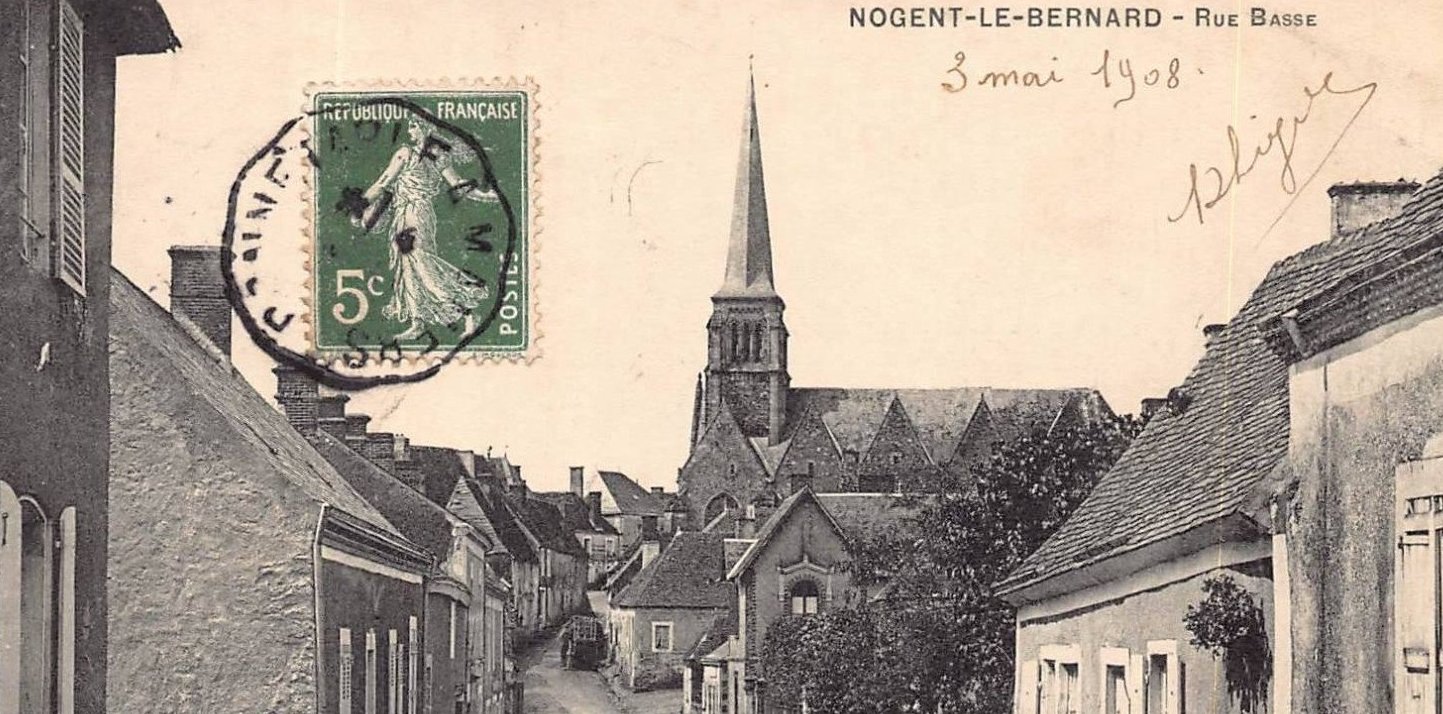 Nogent-le-Bernard was only served by the trams, and they were running in 1908, but we think it very likely that this card was posted at Bonnétable, not in Nogent.
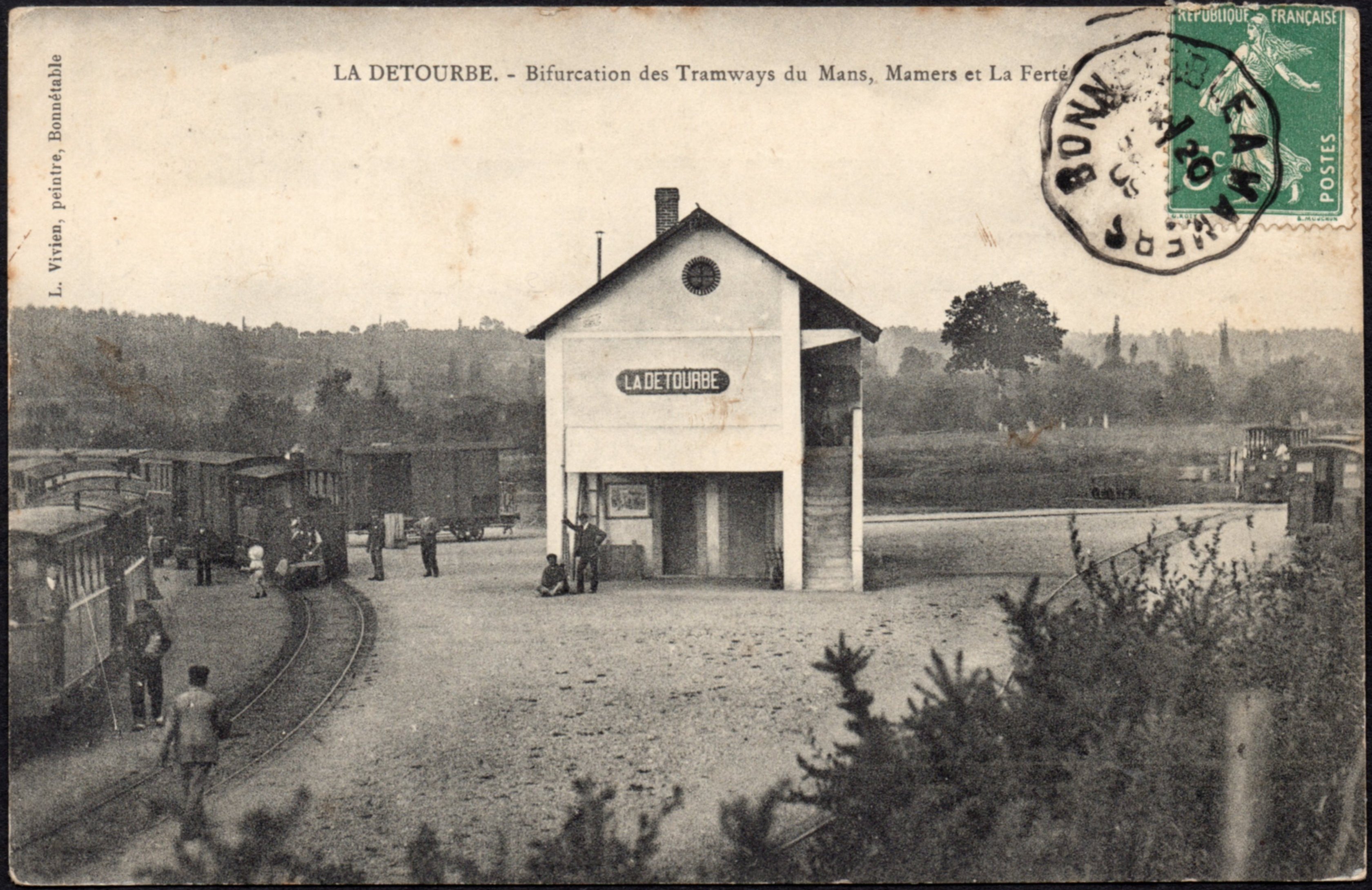 This is a fascinating and scarce card (printed in Bonnétable). We think the tram at extreme right is running around its branch-line train before its return to La Ferté-Bernard whilst the two trains at left are the main-line services, the right-hand train probably being the Le Mans-bound service from Mamers.
Of all the Bonnétable à Mamers CCL cancellations we have seen, the item above is the most plausible that might reasonably be thought to have been postmarked on the trams but there is very little to support that beyond the thought that the card may have been purchased at La Détourbe. We suspect that the card was posted in Bonnétable before being carried from there on the railway. All other cards that we have seen of La Détourbe with a tramway cancellation, several in number, bear the Mamers au Mans or Le Mans à Mamers CCL.
Bonnétable à Mamers Type II [ . ] (almost certainly railway only at all periods and recorded in one direction only)
.
.
3(a).
La Ferté-Bernard au Mans - (almost certainly a railway CCL only)
Section 3 (a & b) first expands a little on the tramway connections at La Détourbe, then addresses the La Ferté-Bernard au Mans CCL and its obvious railway use. In section 3(b), we provide examples of the tramway application of the Mamers-line CCL on the branch and theorise on the regulations pertaining to its use.
In the main, T.S. timetables show no direct trams between La Ferté-Bernard and Le Mans, only some branch-line return journeys by the trams between La Ferté-Bernard and La Détourbe, However, we know from a journey described in the main article that an exchange of mails took place between T.S. Mamers-line (main-line) and branch-line mail-guards at La Détourbe. Main-line trams typically stopped for around 5-8 minutes. The branch-line train would generally have arrived first and waited until both up and down main-line services had called at the station before it returned to La Ferté-Bernard.
During much of the period in which the mails were carried, timetables show up and down main-line trams and the branch tram all converging at La Détourbe either twice or three times per day. Over time, however, the service on the branch-line was greatly reduced while services on the main-line were revised, providing fewer trams making the full journey between Mamers and Le Mans but these were supplemented by some shorter journeys along the more heavily-populated sections of the line.
We show a little further down examples of Mamers-line tramway CCL being applied to mail that was almost certainly posted along the T.S. branch-line. By contrast, we have no evidence at all that the La Ferté-Bernard au Mans CCL was ever used on T.S. trams, nor have we even seen a single example of it from towns and villages along the tramway branch-line at any period.
It is to the railway use of this La Ferté-Bernard au Mans cancellation that we now (briefly) turn. We have not searched as extensively for this CCL and, to date, have only encountered four examples, all of them within a very small window, 1952-1955. A selection are shown below.
This is a fascinating and scarce card (printed in Bonnétable). We think the tram at extreme right is running around its branch-line train before its return to La Ferté-Bernard whilst the two trains at left are the main-line services, the right-hand train probably being the Le Mans-bound service from Mamers.
Of all the Bonnétable à Mamers CCL cancellations we have seen, the item above is the most plausible that might reasonably be thought to have been postmarked on the trams but there is very little to support that beyond the thought that the card may have been purchased at La Détourbe. We suspect that the card was posted in Bonnétable before being carried from there on the railway. All other cards that we have seen of La Détourbe with a tramway cancellation, several in number, bear the Mamers au Mans or Le Mans à Mamers CCL.
Bonnétable à Mamers Type II [ . ] (almost certainly railway only at all periods and recorded in one direction only)
.
.
3(a).
La Ferté-Bernard au Mans - (almost certainly a railway CCL only)
Section 3 (a & b) first expands a little on the tramway connections at La Détourbe, then addresses the La Ferté-Bernard au Mans CCL and its obvious railway use. In section 3(b), we provide examples of the tramway application of the Mamers-line CCL on the branch and theorise on the regulations pertaining to its use.
In the main, T.S. timetables show no direct trams between La Ferté-Bernard and Le Mans, only some branch-line return journeys by the trams between La Ferté-Bernard and La Détourbe, However, we know from a journey described in the main article that an exchange of mails took place between T.S. Mamers-line (main-line) and branch-line mail-guards at La Détourbe. Main-line trams typically stopped for around 5-8 minutes. The branch-line train would generally have arrived first and waited until both up and down main-line services had called at the station before it returned to La Ferté-Bernard.
During much of the period in which the mails were carried, timetables show up and down main-line trams and the branch tram all converging at La Détourbe either twice or three times per day. Over time, however, the service on the branch-line was greatly reduced while services on the main-line were revised, providing fewer trams making the full journey between Mamers and Le Mans but these were supplemented by some shorter journeys along the more heavily-populated sections of the line.
We show a little further down examples of Mamers-line tramway CCL being applied to mail that was almost certainly posted along the T.S. branch-line. By contrast, we have no evidence at all that the La Ferté-Bernard au Mans CCL was ever used on T.S. trams, nor have we even seen a single example of it from towns and villages along the tramway branch-line at any period.
It is to the railway use of this La Ferté-Bernard au Mans cancellation that we now (briefly) turn. We have not searched as extensively for this CCL and, to date, have only encountered four examples, all of them within a very small window, 1952-1955. A selection are shown below.
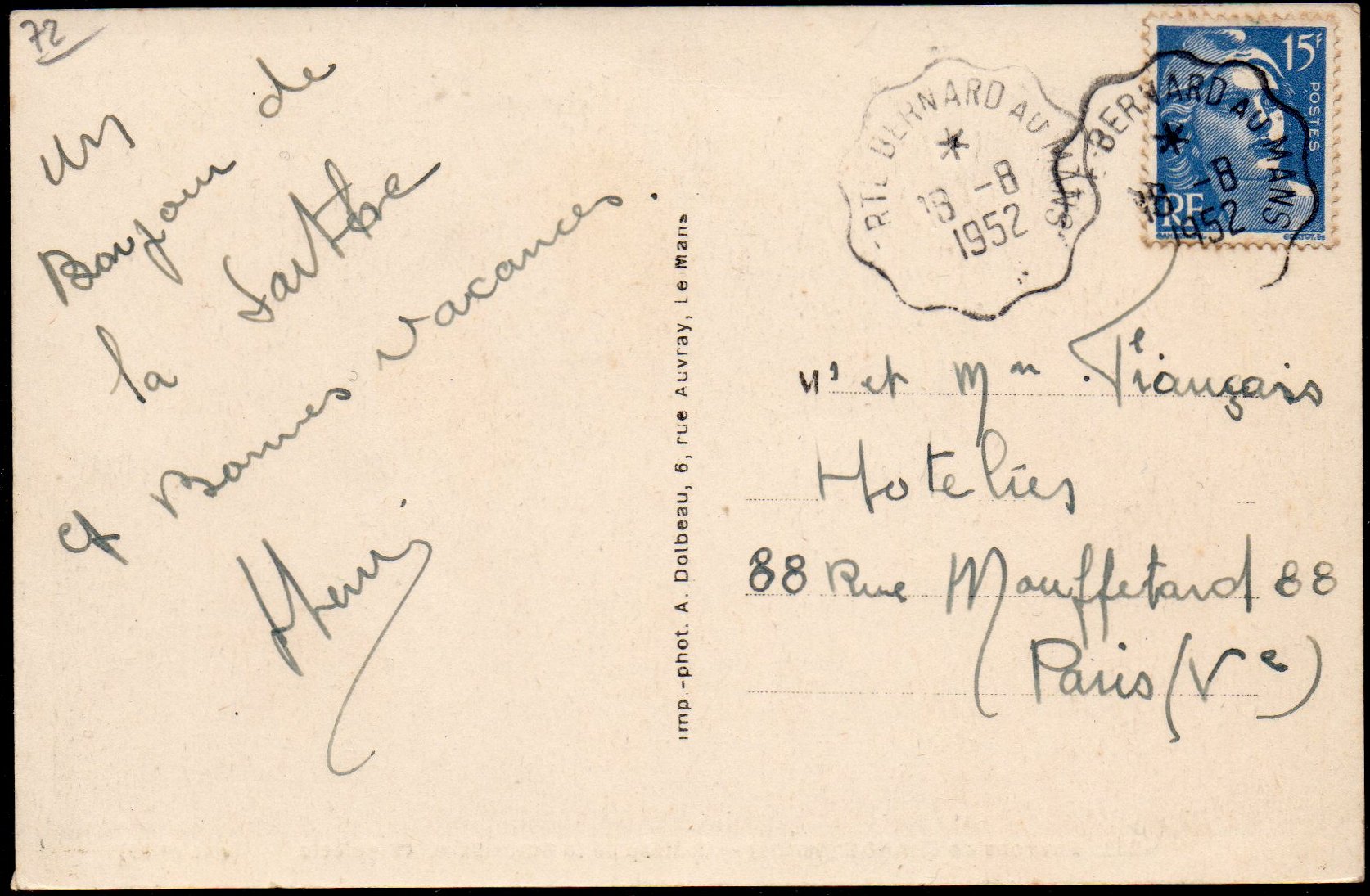
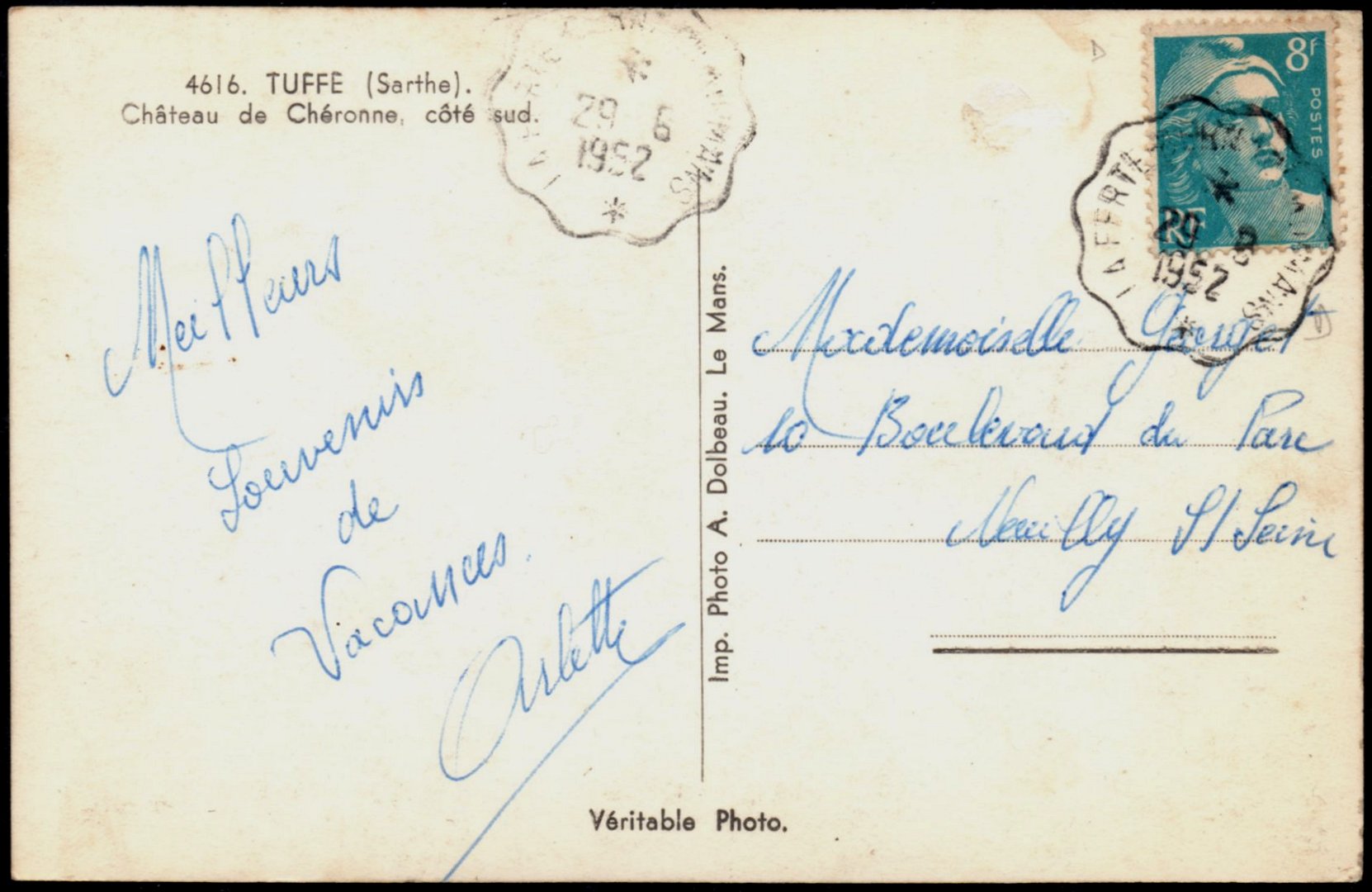
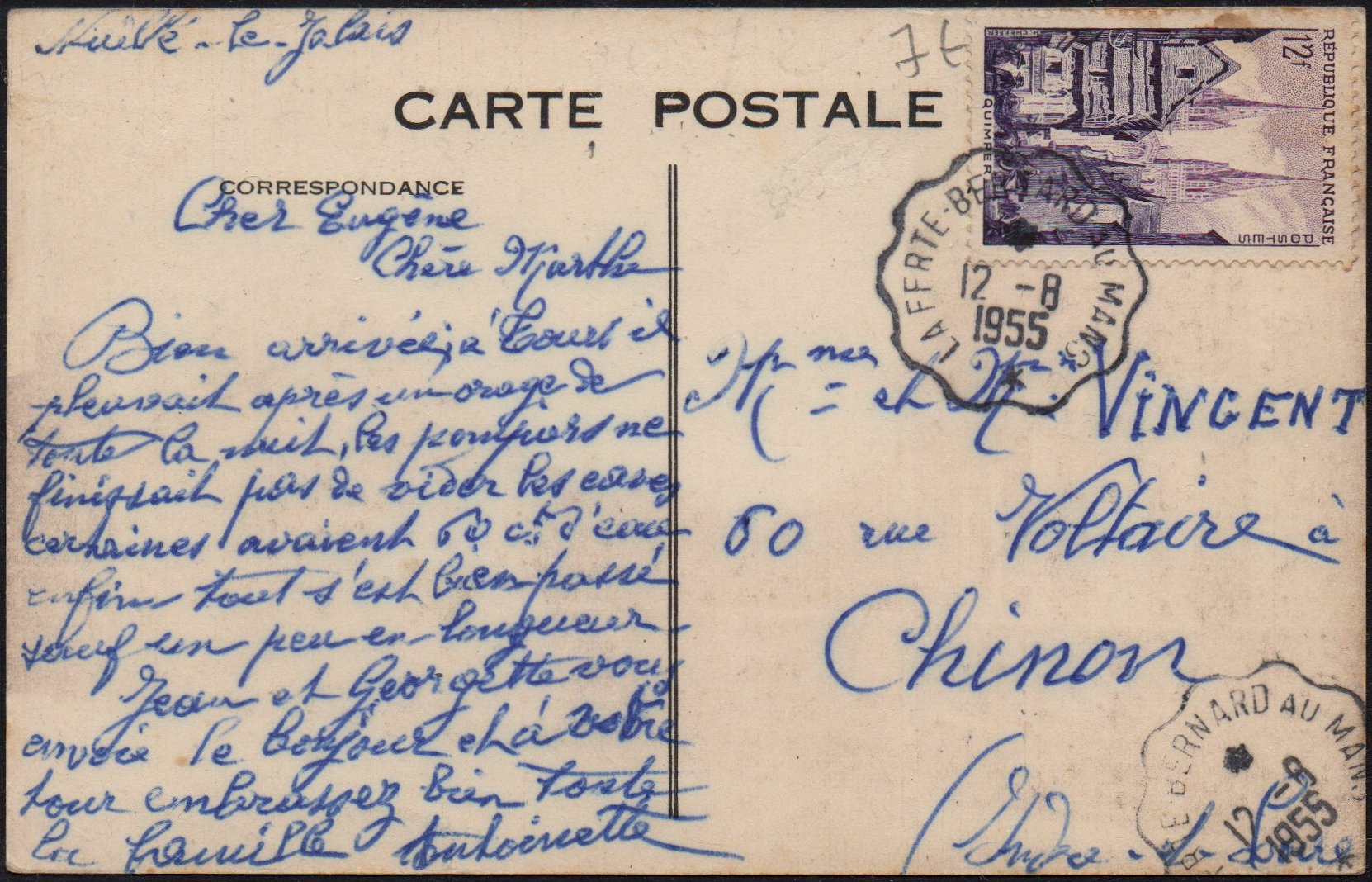
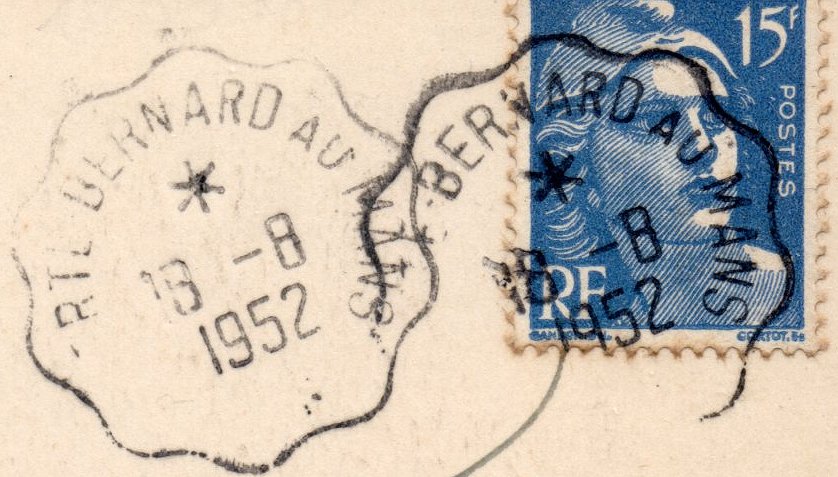
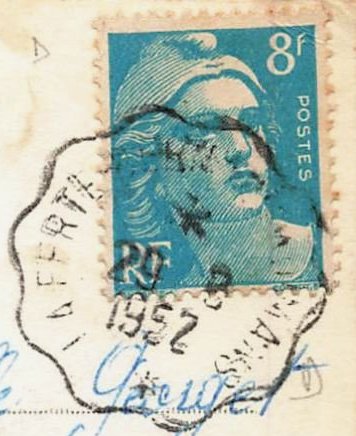
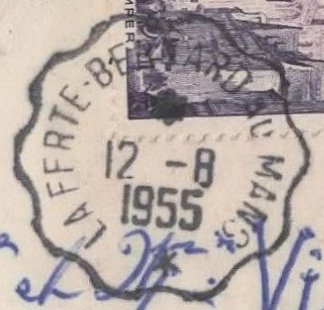 We have seen two August 1952 examples of this postmark, the card sent on the 18th is of Changé, but presumably posted elsewhere, the card of the 29th is of Tuffé. We have also seen (not illustrated) a 1954 example from Tuffé.
The 1955 card was sent from Nuillé-le-Jalais.
Our article does not seek to analyse in depth any of the railway CCL except 'La Flèche au Mans', as this CCL was used by both railway and tramway. We have noticed, though, extensive use of the 'Paris au Mans' CCL on mail from La Ferté and from stations along the mainline railway between La Ferté and Le Mans in earlier decades.
By contrast, despite looking at quite a large volume of mail emanating from La Ferté-Bernard, we have yet to find an example from that town bearing the 'La Ferté-Bernard au Mans' CCL. All the examples we have seen have come from relatively minor towns in the vicinity of the main railway line to Le Mans.
La Ferté-Bernard au Mans Type III [ . ] (almost certainly 'railway' at all periods and only in one direction)
.
3(b). Mamers-line cancellations on the Tramways de la Sarthe's La Détourbe à La Ferté-Bernard branch-line.
All stations on the T.S. branch-line:
La Détourbe : Saint-Georges-du-Rosay : Déhault : La Chapelle-du-Bois : St Antoine-de-Rochefort : La Ferté-Bernard
The precise text from the article reporting that bags of mail were exchanged at La Détourbe is:
'Notre postier a terminé ses échanges avec l'ambulant de la ligne de Montmirail.'
{'Our postman (has) completed his exchanges with the TPO (-employee) of the Montmirail line.'} The use of the term 'ambulant' is imprecise but, so far as we know, our reporter was not a philatelist.
The article was published in 1930 but appears to be based on a report of a journey from Le Mans to Mamers much earlier, most likely one made shortly before the First World War. The article seemingly adds modern (1930) commentary. The extension of the T.S. line from La Ferté-Bernard to Montmirail was opened only in 1916, temporarily closed from 1921-1924 and re-opened from 1924-1932. A writer in 1930 might well describe this as the Montmirail line at La Détourbe, for so it was then.
To summarise for those who have not read 3(a), there is clear evidence of railway use of the La Ferté-Bernard au Mans CCL in the 1950s but we have found no example of use of the La Ferté-Bernard au Mans CCL at any time in the period in which the Tramways de la Sarthe were operating a courrier-convoyeur service, viz. c.1901-1934. To date, indeed, we have not even found an example from any time in the tramway era, viz. up to 1947.
We have seen two August 1952 examples of this postmark, the card sent on the 18th is of Changé, but presumably posted elsewhere, the card of the 29th is of Tuffé. We have also seen (not illustrated) a 1954 example from Tuffé.
The 1955 card was sent from Nuillé-le-Jalais.
Our article does not seek to analyse in depth any of the railway CCL except 'La Flèche au Mans', as this CCL was used by both railway and tramway. We have noticed, though, extensive use of the 'Paris au Mans' CCL on mail from La Ferté and from stations along the mainline railway between La Ferté and Le Mans in earlier decades.
By contrast, despite looking at quite a large volume of mail emanating from La Ferté-Bernard, we have yet to find an example from that town bearing the 'La Ferté-Bernard au Mans' CCL. All the examples we have seen have come from relatively minor towns in the vicinity of the main railway line to Le Mans.
La Ferté-Bernard au Mans Type III [ . ] (almost certainly 'railway' at all periods and only in one direction)
.
3(b). Mamers-line cancellations on the Tramways de la Sarthe's La Détourbe à La Ferté-Bernard branch-line.
All stations on the T.S. branch-line:
La Détourbe : Saint-Georges-du-Rosay : Déhault : La Chapelle-du-Bois : St Antoine-de-Rochefort : La Ferté-Bernard
The precise text from the article reporting that bags of mail were exchanged at La Détourbe is:
'Notre postier a terminé ses échanges avec l'ambulant de la ligne de Montmirail.'
{'Our postman (has) completed his exchanges with the TPO (-employee) of the Montmirail line.'} The use of the term 'ambulant' is imprecise but, so far as we know, our reporter was not a philatelist.
The article was published in 1930 but appears to be based on a report of a journey from Le Mans to Mamers much earlier, most likely one made shortly before the First World War. The article seemingly adds modern (1930) commentary. The extension of the T.S. line from La Ferté-Bernard to Montmirail was opened only in 1916, temporarily closed from 1921-1924 and re-opened from 1924-1932. A writer in 1930 might well describe this as the Montmirail line at La Détourbe, for so it was then.
To summarise for those who have not read 3(a), there is clear evidence of railway use of the La Ferté-Bernard au Mans CCL in the 1950s but we have found no example of use of the La Ferté-Bernard au Mans CCL at any time in the period in which the Tramways de la Sarthe were operating a courrier-convoyeur service, viz. c.1901-1934. To date, indeed, we have not even found an example from any time in the tramway era, viz. up to 1947.
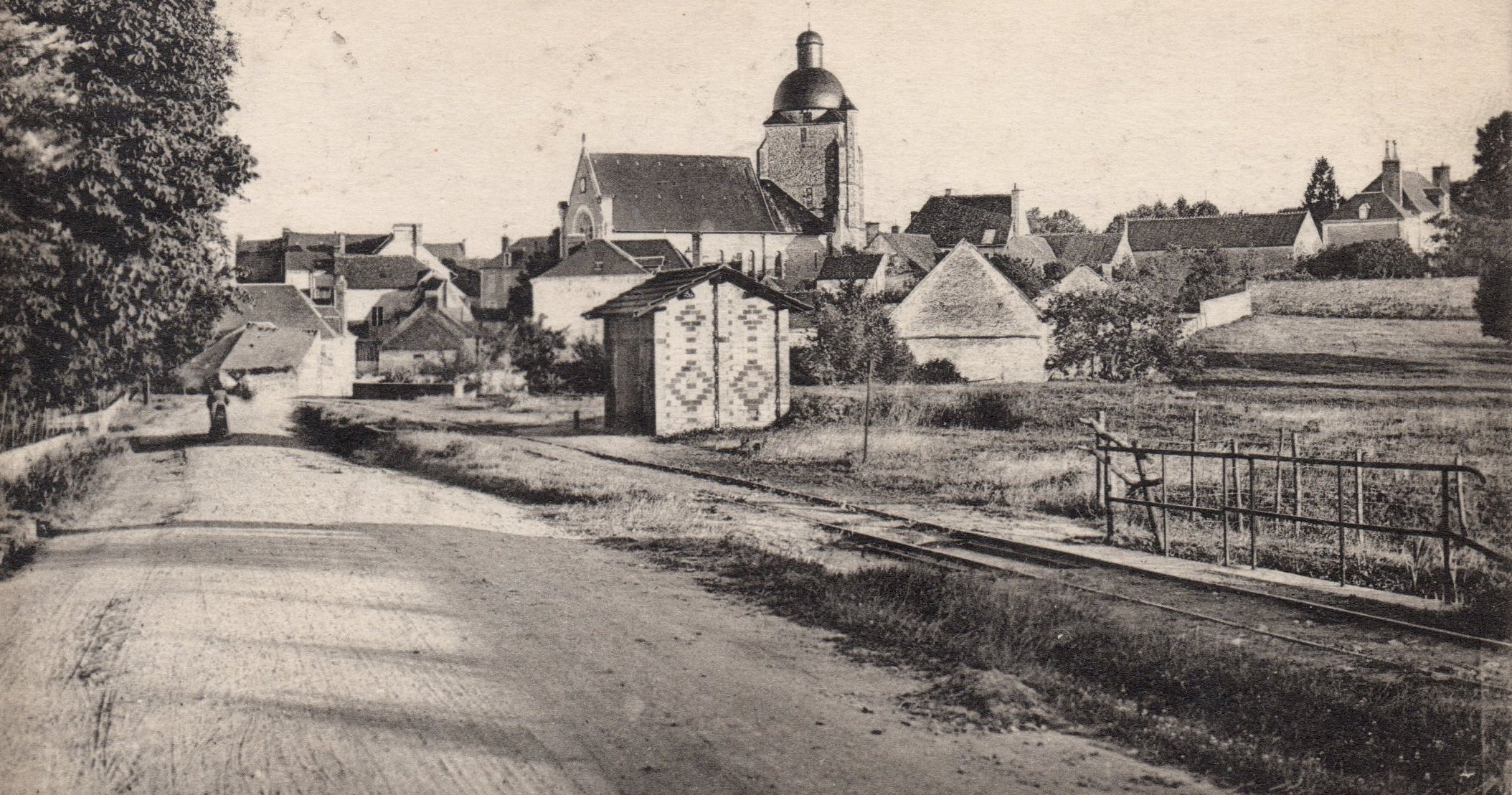 The Gare de Cherré just outside La Ferté-Bernard on the branch-line extension to Montmirail, a little-photographed line. We do not believe there was ever a CCL service on this extension.
Establishing a theory for the postal arrangements and cancellations used on mail loaded at the T.S. branch-line stations, has proved far from straightforward.
We made two serendipitous philatelic acquisitions, both with directional instructions from the sender. They are illustrated further down. Although insufficient in themselves to make bold claims, they do provide some insight into possible operational arrangements. One of them, a card sent from Déhault with an instruction 'par La Ferté-Bernard' and which received that town's arrival backstamp on the same day suggests that the CCL in direction 'Mamers au Mans' was applied on trams travelling towards la Ferté on the branch-line.
The use of the same 'Mamers au Mans' CCL for most mail in the opposite direction would seem entirely logical, as Le Mans, the major sorting hub in La Sarthe, seems the natural direction for mail sent onward from La Détourbe. We have yet to discover any example of the 'Le Mans à Mamers' CCL being used on mail emanating from the branch-line stations, although we have seen an example from La Détourbe itself.
Whilst this would seem to indicate that all branch-line mail, irrespective of direction of travel, received uniquely the 'Mamers au Mans' cancellation, it should be born in mind that the 'Le Mans à Mamers' CCL is a scarce one from anywhere on the Mamers line and that, consequently, our failure to unearth a 'Le Mans à Mamers' CCL applied on the branch-line cannot be considered as conclusive evidence.
One operational possibility was for the CCL clerk on the branch-line to cancel mail based on his intentions with that item of mail at La Détourbe, for example only applying the 'Le Mans à Mamers' CCL to mail he planned to hand over to his colleague on the Mamers-bound service at La Détourbe. However, our second serendipitous acquisition had a sender's instruction to send the postcard in the Mamers direction, not towards Le Mans. However, the card was still cancelled 'Mamers au Mans'. We return to this card later.
In terms of mail-guard comforts, we sought to verify that a fully-equipped fourgon would always have been provided on the branch-line. We concluded that one very probably was, based not only on a small number of postcard images but, above all, in consideration of the volume of mail that might be carried, its security and the sheer practicality of cancelling stamps on the branch-line without a proper working space for the mail-guard.
The Gare de Cherré just outside La Ferté-Bernard on the branch-line extension to Montmirail, a little-photographed line. We do not believe there was ever a CCL service on this extension.
Establishing a theory for the postal arrangements and cancellations used on mail loaded at the T.S. branch-line stations, has proved far from straightforward.
We made two serendipitous philatelic acquisitions, both with directional instructions from the sender. They are illustrated further down. Although insufficient in themselves to make bold claims, they do provide some insight into possible operational arrangements. One of them, a card sent from Déhault with an instruction 'par La Ferté-Bernard' and which received that town's arrival backstamp on the same day suggests that the CCL in direction 'Mamers au Mans' was applied on trams travelling towards la Ferté on the branch-line.
The use of the same 'Mamers au Mans' CCL for most mail in the opposite direction would seem entirely logical, as Le Mans, the major sorting hub in La Sarthe, seems the natural direction for mail sent onward from La Détourbe. We have yet to discover any example of the 'Le Mans à Mamers' CCL being used on mail emanating from the branch-line stations, although we have seen an example from La Détourbe itself.
Whilst this would seem to indicate that all branch-line mail, irrespective of direction of travel, received uniquely the 'Mamers au Mans' cancellation, it should be born in mind that the 'Le Mans à Mamers' CCL is a scarce one from anywhere on the Mamers line and that, consequently, our failure to unearth a 'Le Mans à Mamers' CCL applied on the branch-line cannot be considered as conclusive evidence.
One operational possibility was for the CCL clerk on the branch-line to cancel mail based on his intentions with that item of mail at La Détourbe, for example only applying the 'Le Mans à Mamers' CCL to mail he planned to hand over to his colleague on the Mamers-bound service at La Détourbe. However, our second serendipitous acquisition had a sender's instruction to send the postcard in the Mamers direction, not towards Le Mans. However, the card was still cancelled 'Mamers au Mans'. We return to this card later.
In terms of mail-guard comforts, we sought to verify that a fully-equipped fourgon would always have been provided on the branch-line. We concluded that one very probably was, based not only on a small number of postcard images but, above all, in consideration of the volume of mail that might be carried, its security and the sheer practicality of cancelling stamps on the branch-line without a proper working space for the mail-guard.
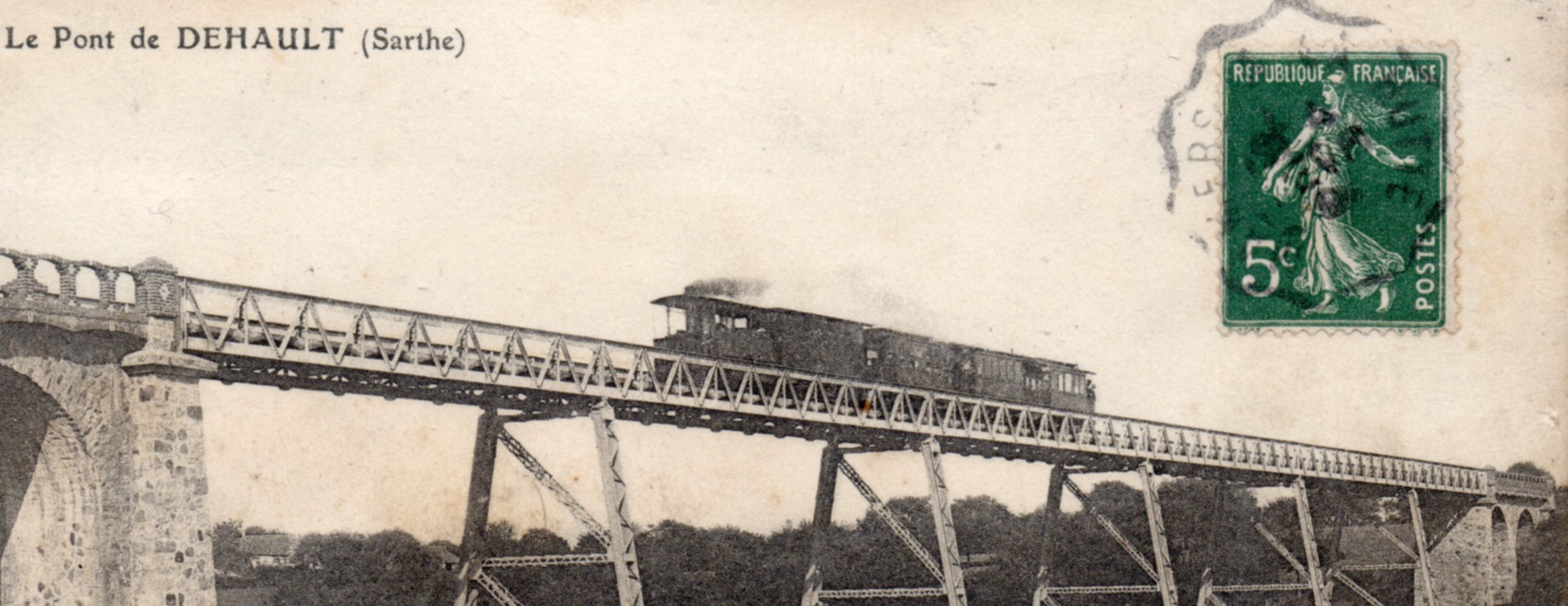
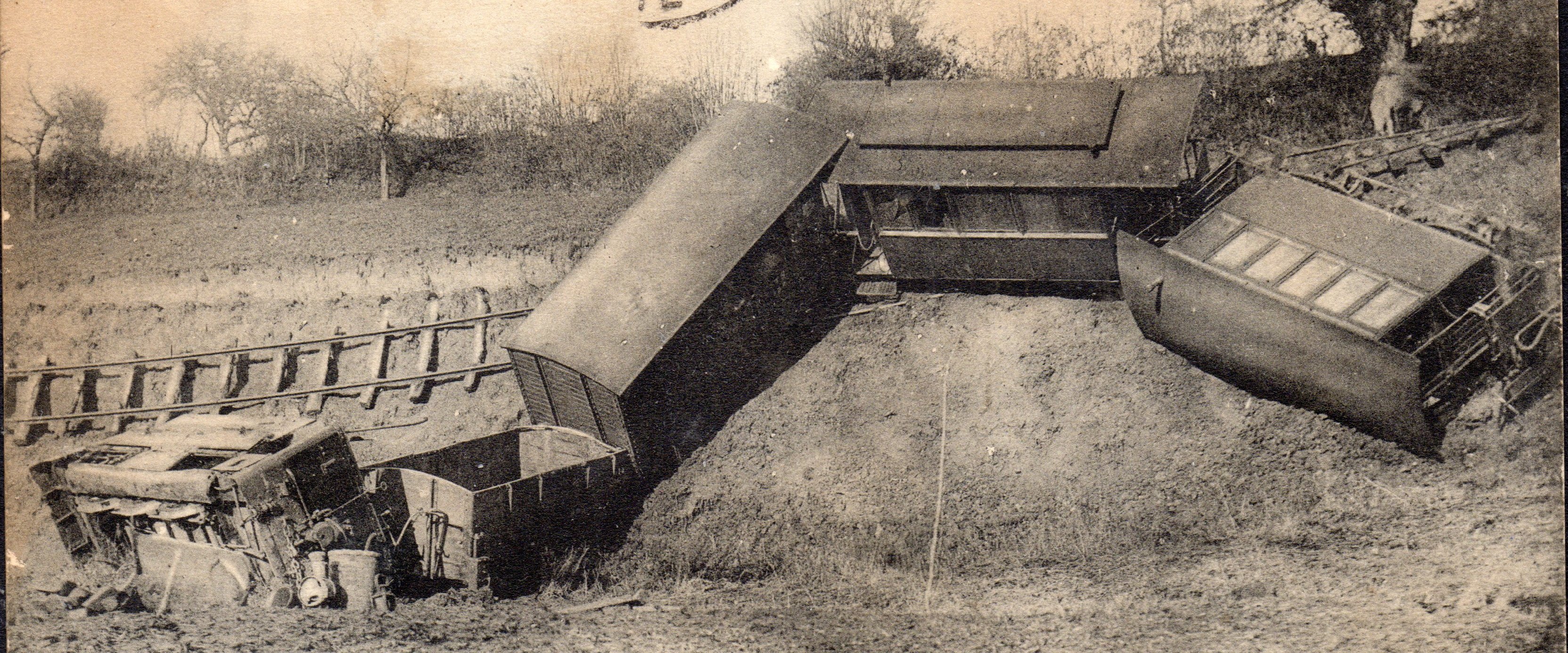 Both images are of Déhault on the branch-line and show a van in the formation (or indeed the 'deformation' in the lower image). Both could well be postal fourgons, although the images are not very clear. Note: The CCL cancellation on the top card is Mamers à La Hutte (a frequently-encountered railway CCL).
On January 20th 1910, heavy rains caused the tramway embankment to collapse. The driver and fireman of the tram were killed, the guard and at least one passenger seriously injured. Reports do not mention any postal employee but, if there was a convoyeur in the van in the picture, we can see that his would have been a vehicle in which one might well escape serious injury in this accident.
The next two cards shown are the two serendipitous philatelic acquisitions already mentioned, both with directional instructions from the sender.
Both images are of Déhault on the branch-line and show a van in the formation (or indeed the 'deformation' in the lower image). Both could well be postal fourgons, although the images are not very clear. Note: The CCL cancellation on the top card is Mamers à La Hutte (a frequently-encountered railway CCL).
On January 20th 1910, heavy rains caused the tramway embankment to collapse. The driver and fireman of the tram were killed, the guard and at least one passenger seriously injured. Reports do not mention any postal employee but, if there was a convoyeur in the van in the picture, we can see that his would have been a vehicle in which one might well escape serious injury in this accident.
The next two cards shown are the two serendipitous philatelic acquisitions already mentioned, both with directional instructions from the sender.
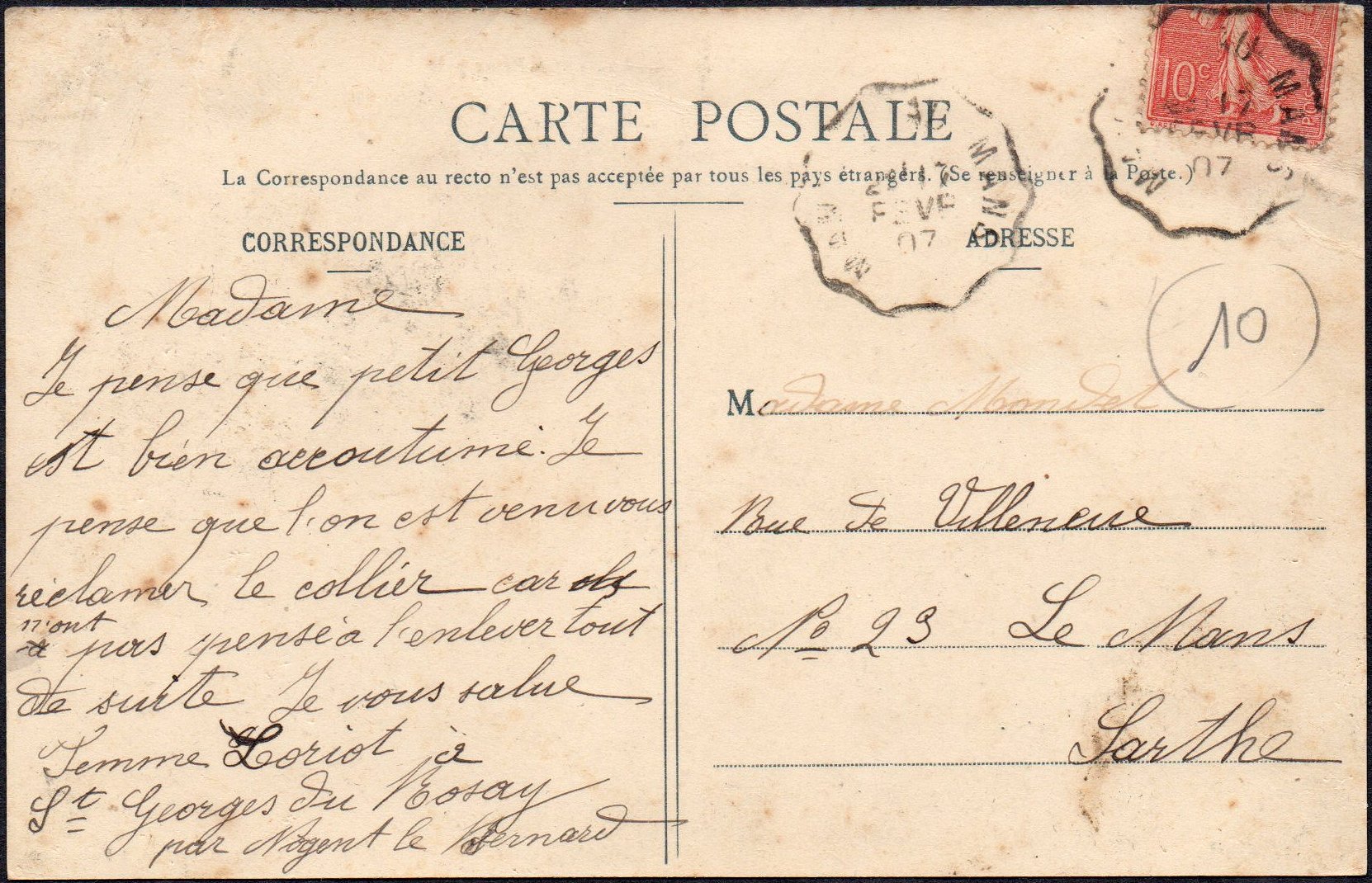
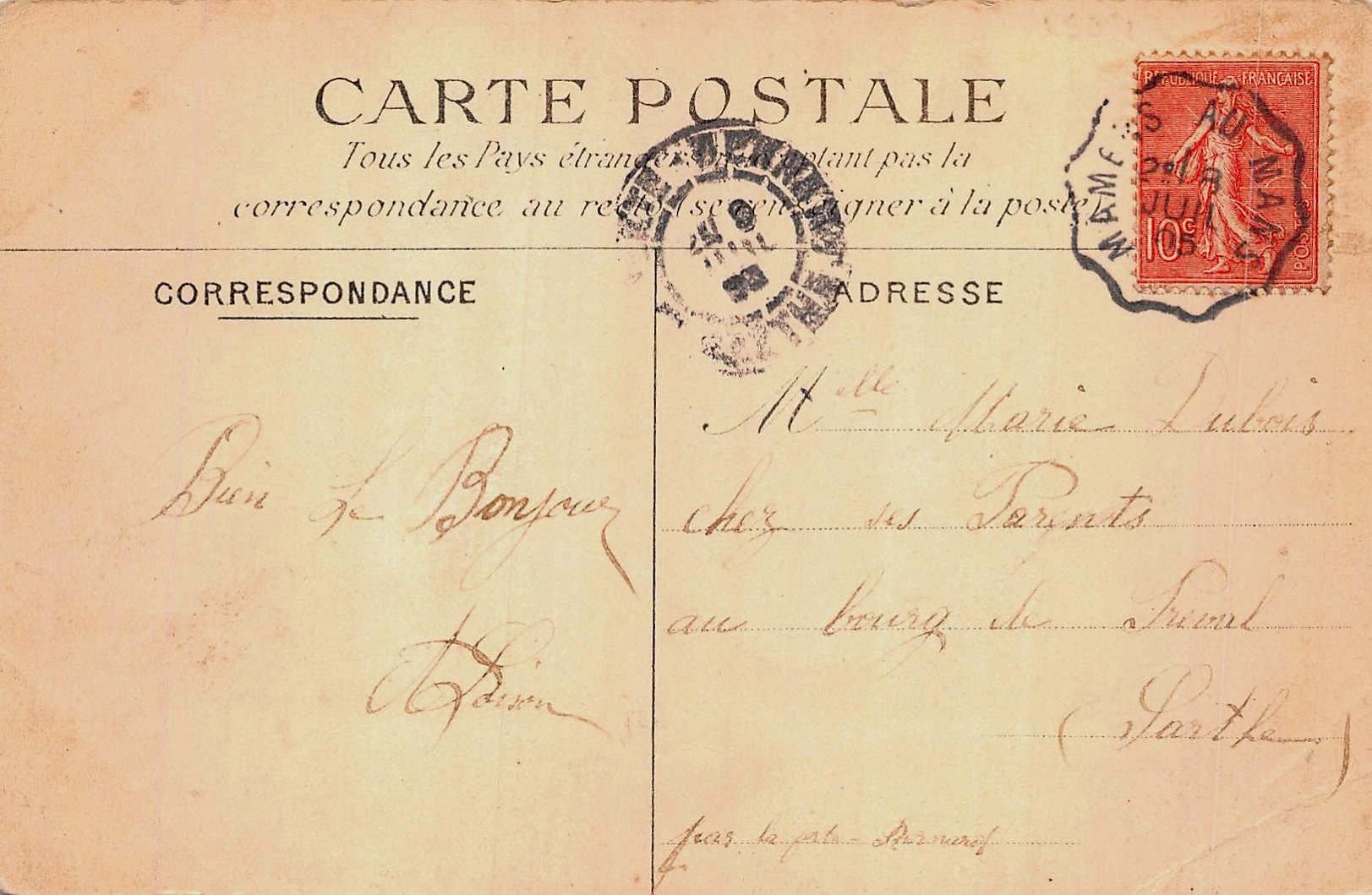
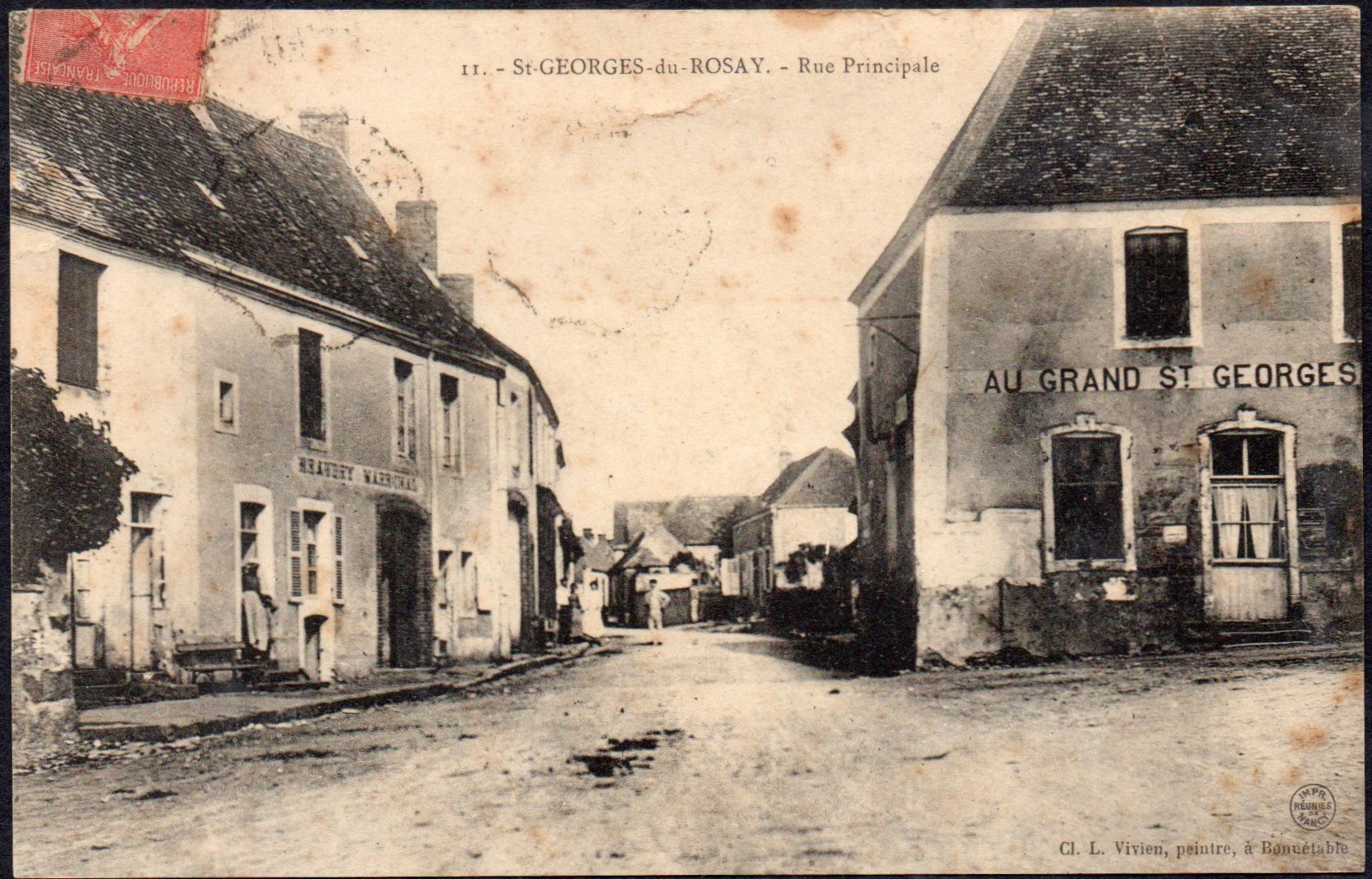 The postmark reads MAMERS AU MANS / 17 FEVR 1907 and the card was almost certainly posted on the branch-line. Despite the card's destination being Le Mans, the sender has finished the message 'à St Georges du Rosay' (which we take to be the sender's location) and, on the final line, 'par Nogent le Bernard' (via Nogent-le-Bernard), which is unexpected and curious. From the junction station at La Détourbe, Nogent-le-Bernard is in the Mamers direction on the T.S. main-line, not the Le Mans direction (see map below).
We would point out that we cannot be sure that the branch-line convoyeur ever read that instruction, incorporated in the main body of the message, rather than above it or in the address space, in the 6 minutes a tram took to travel between St-Geoges-du-Rosay and La Détourbe.
The postmark reads MAMERS AU MANS / 17 FEVR 1907 and the card was almost certainly posted on the branch-line. Despite the card's destination being Le Mans, the sender has finished the message 'à St Georges du Rosay' (which we take to be the sender's location) and, on the final line, 'par Nogent le Bernard' (via Nogent-le-Bernard), which is unexpected and curious. From the junction station at La Détourbe, Nogent-le-Bernard is in the Mamers direction on the T.S. main-line, not the Le Mans direction (see map below).
We would point out that we cannot be sure that the branch-line convoyeur ever read that instruction, incorporated in the main body of the message, rather than above it or in the address space, in the 6 minutes a tram took to travel between St-Geoges-du-Rosay and La Détourbe.
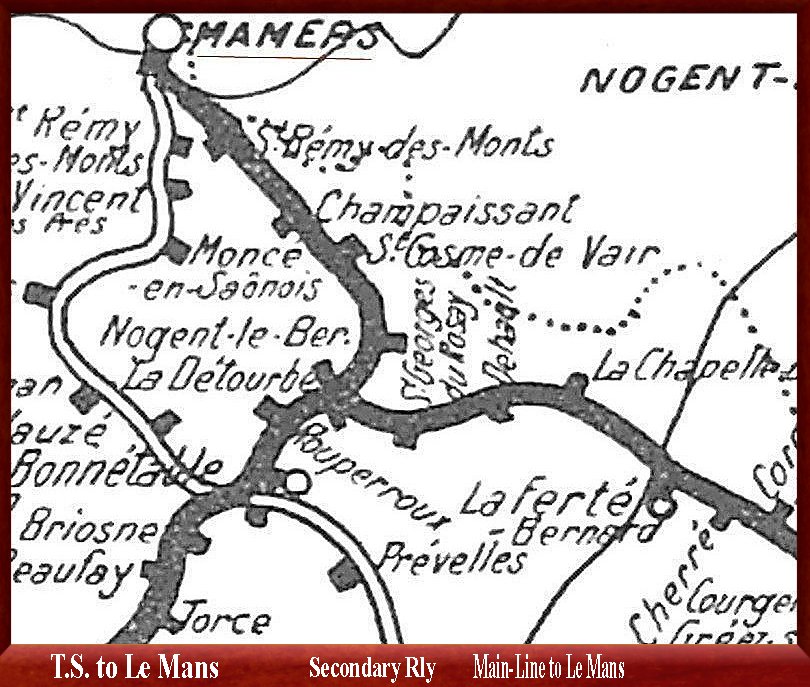 Source: Wikimedia. The T.S. lines are thick; part of the extension to Montmirail beyond La Ferté-Bernard is visible. The thin black main-line is from Paris to Le Mans. Part of the secondary railway Mamers - Bonnétable - Connerré - Saint Calais is also shown (double-lined on map).
With regard to the sender's instruction, we have seen a similar instruction on the Mayet branch-line regarding a card's direction of travel, suggesting that the sender was well-informed about optimum routing. In the Mayet line case, it may well have been related to the time of day at which an item was sent; after all, if one route was always the best way, why mention it at all? However, in the case of our Mamers-line card above, its counter-intuitive routing instruction was sufficiently unexpected that it made us question what had seemed a natural assumption, viz. that the best routing to Le Mans for mail at La Détourbe was straight down the tramway to the Gare Centrale.
It could be the case that sending the mails from La Détourbe to Mamers and transferring them there onto a Le Mans-bound train, thus bringing the mail-bags straight into the Gare du Mans would, at least at certain times of day or in certain eras, have been a better choice. However, there is no CCL 'Mamers au Mans' for the railway, so it would have needed to travel by two railway CCL to reach Le Mans. On the other hand, there would have been other options at Mamers, a town for which we know of at least seven different railway CCL cancellations at various periods, Angers, Bonnétable, Connerré, Evreux, La Hutte, Laigle & La Loupe.
We have had sight of fewer than twenty items of mail bearing legible cancellations from the La Ferté branch-line. Drawing firm conclusions from this sample size seems unwise. On balance, we currently tend towards the view that most mail transferred at La Détourbe probably went by tram to the Gare Centrale but the picture remains, to use an oxymoron, distinctly nebulous!
Source: Wikimedia. The T.S. lines are thick; part of the extension to Montmirail beyond La Ferté-Bernard is visible. The thin black main-line is from Paris to Le Mans. Part of the secondary railway Mamers - Bonnétable - Connerré - Saint Calais is also shown (double-lined on map).
With regard to the sender's instruction, we have seen a similar instruction on the Mayet branch-line regarding a card's direction of travel, suggesting that the sender was well-informed about optimum routing. In the Mayet line case, it may well have been related to the time of day at which an item was sent; after all, if one route was always the best way, why mention it at all? However, in the case of our Mamers-line card above, its counter-intuitive routing instruction was sufficiently unexpected that it made us question what had seemed a natural assumption, viz. that the best routing to Le Mans for mail at La Détourbe was straight down the tramway to the Gare Centrale.
It could be the case that sending the mails from La Détourbe to Mamers and transferring them there onto a Le Mans-bound train, thus bringing the mail-bags straight into the Gare du Mans would, at least at certain times of day or in certain eras, have been a better choice. However, there is no CCL 'Mamers au Mans' for the railway, so it would have needed to travel by two railway CCL to reach Le Mans. On the other hand, there would have been other options at Mamers, a town for which we know of at least seven different railway CCL cancellations at various periods, Angers, Bonnétable, Connerré, Evreux, La Hutte, Laigle & La Loupe.
We have had sight of fewer than twenty items of mail bearing legible cancellations from the La Ferté branch-line. Drawing firm conclusions from this sample size seems unwise. On balance, we currently tend towards the view that most mail transferred at La Détourbe probably went by tram to the Gare Centrale but the picture remains, to use an oxymoron, distinctly nebulous!
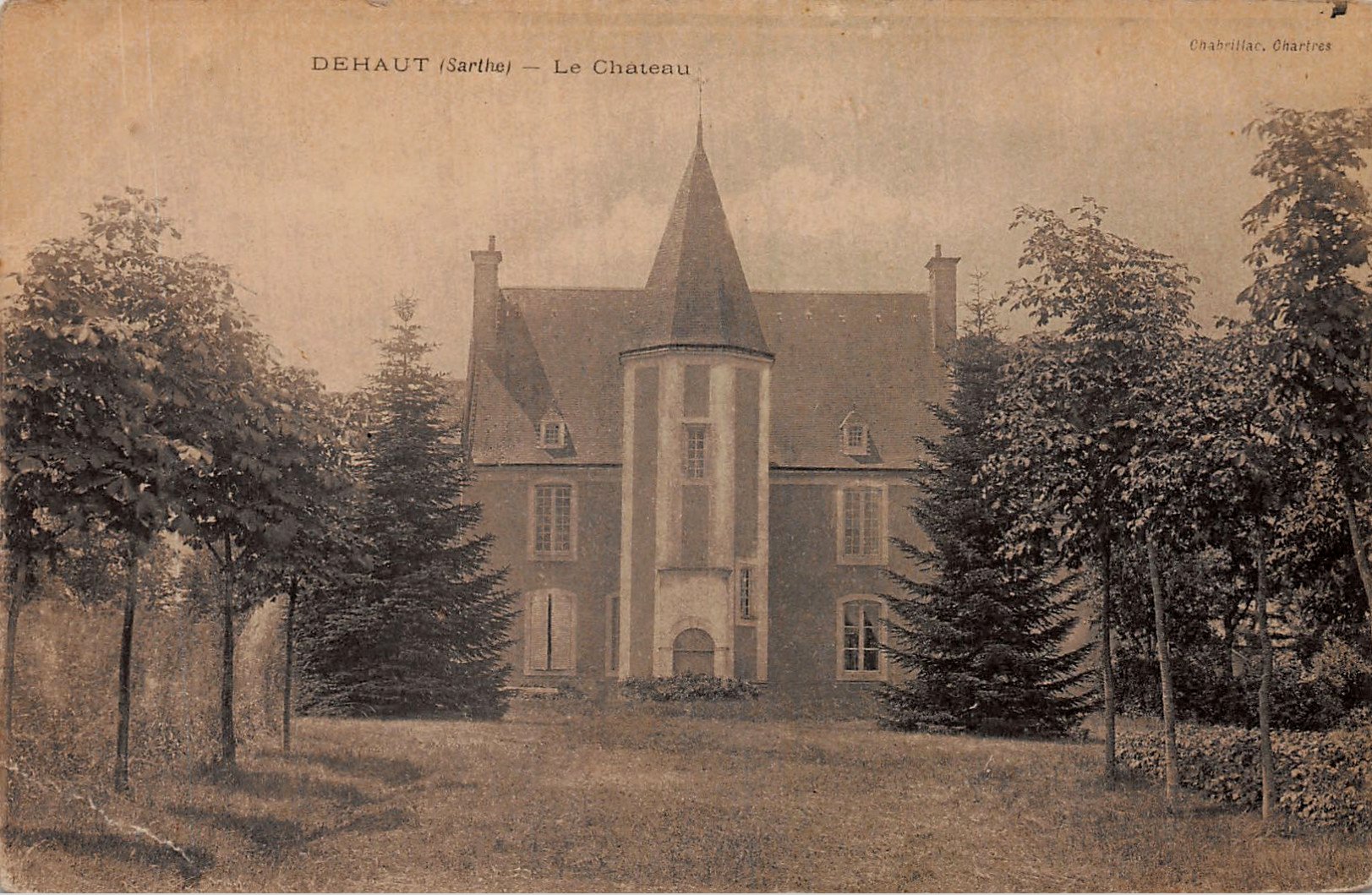
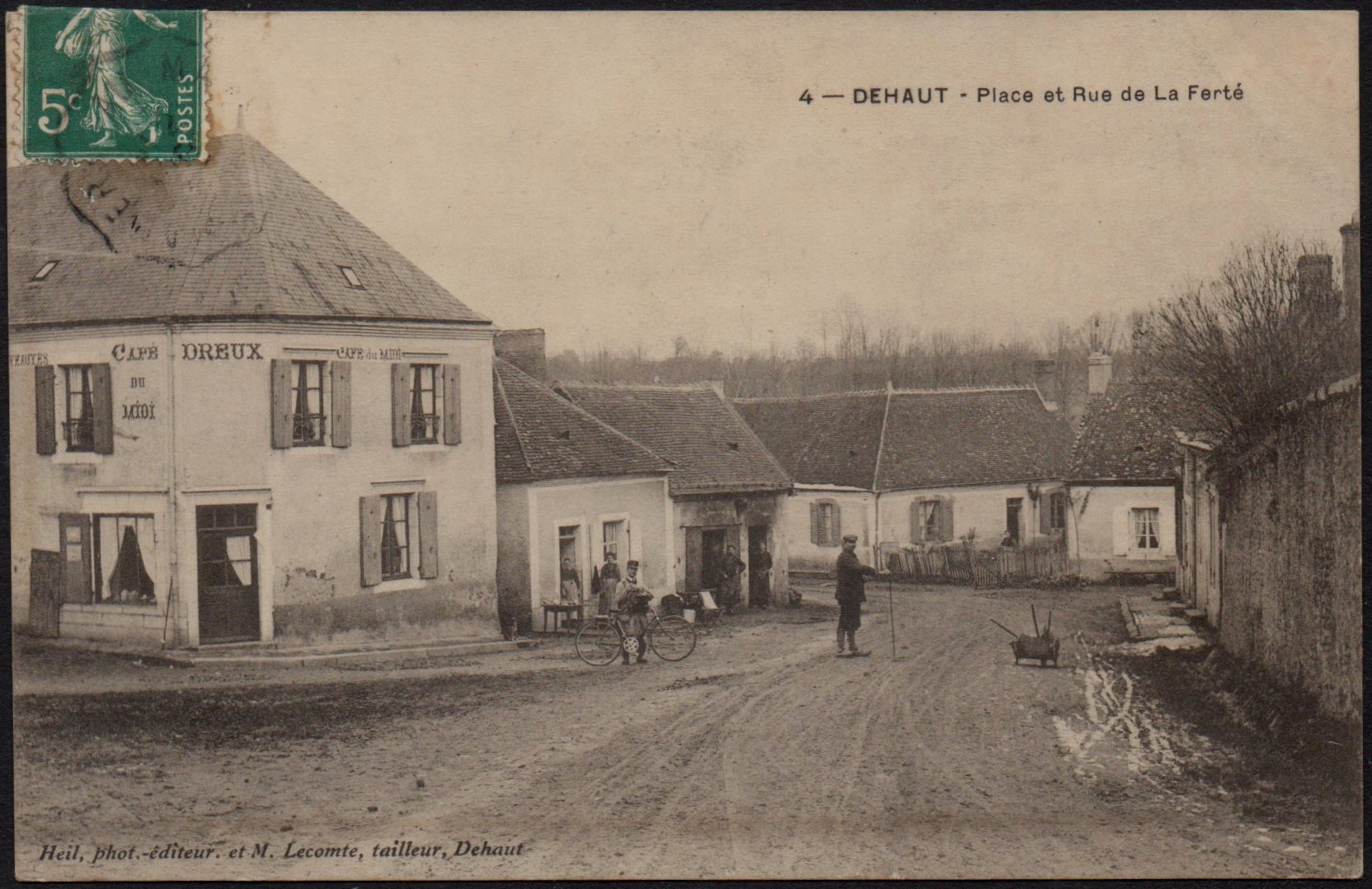
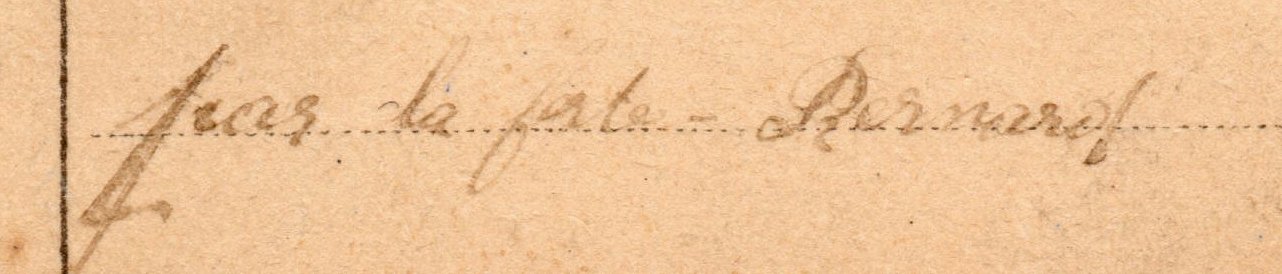 This is our other serendipitous philatelic find and the earliest example of the Mamers-line CCL we have so far found on mail apparently posted on the branch-line, this card from Déhault (mis-spelt on postcard). It was sent on July 8th 1905 to Préval with the last line to the address: 'par la ferte-Bernard'.
This card seems to have been handed over for delivery to the nearby Préval either at St. Antoine-de-Rochefort (site of the Gare de La Ferté-Bernard) or at the T.S. La Ferté-Bernard terminus in the town. We review these options, briefly, a little lower down.
More examples of the branch-line use of the 'Mamers au Mans' CCL:
This is our other serendipitous philatelic find and the earliest example of the Mamers-line CCL we have so far found on mail apparently posted on the branch-line, this card from Déhault (mis-spelt on postcard). It was sent on July 8th 1905 to Préval with the last line to the address: 'par la ferte-Bernard'.
This card seems to have been handed over for delivery to the nearby Préval either at St. Antoine-de-Rochefort (site of the Gare de La Ferté-Bernard) or at the T.S. La Ferté-Bernard terminus in the town. We review these options, briefly, a little lower down.
More examples of the branch-line use of the 'Mamers au Mans' CCL:
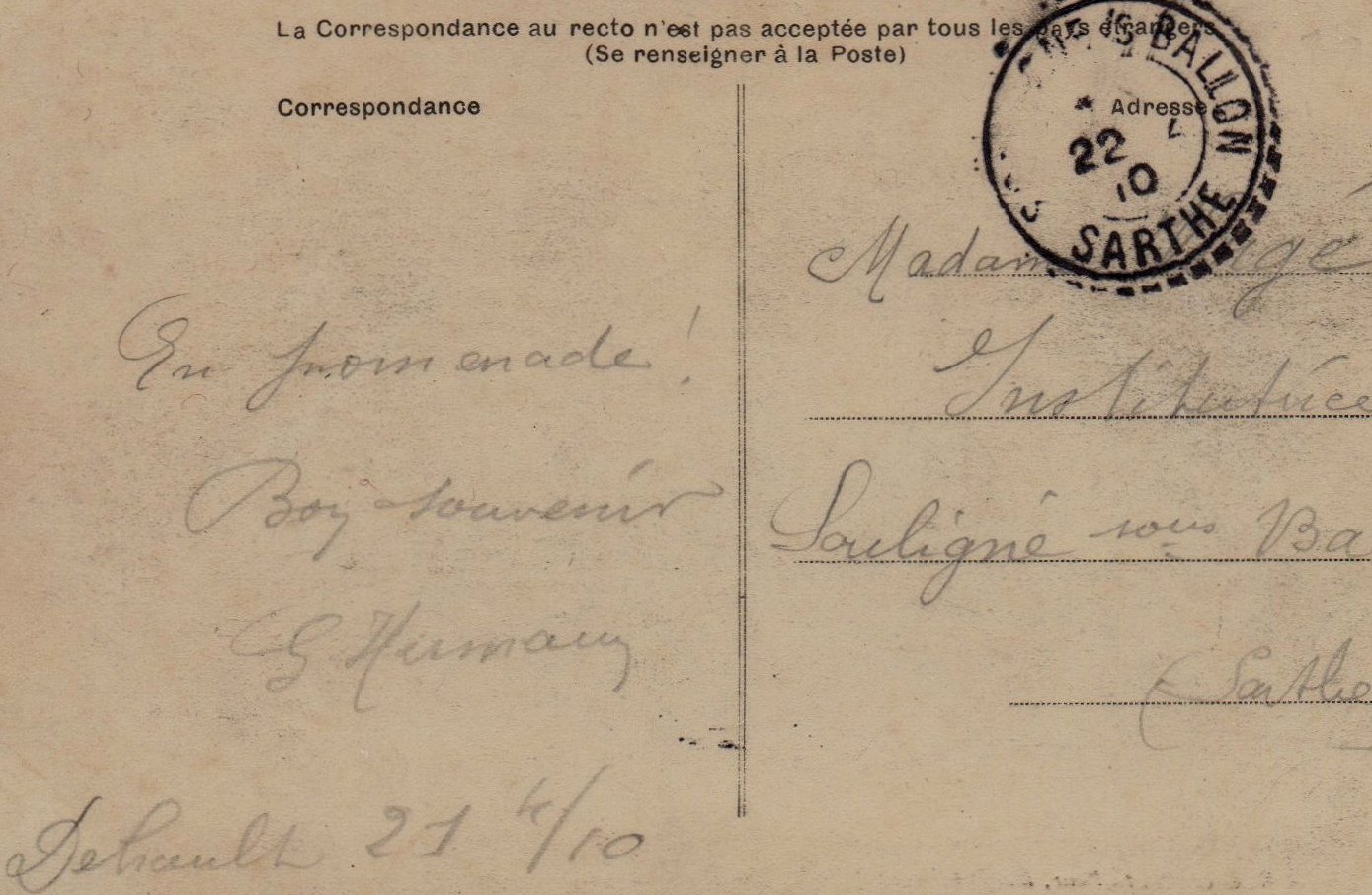 Poor but just legible Mamers au Mans CCL (1910) on another postcard of Déhault (again mis-spelt on card), including the postman in this scene. The message indicates the card was sent from Déhault, whose station was perhaps 2 kms from the town. How the mails were met / transferred between station and town in not known to us. (Only part of back of card shown).
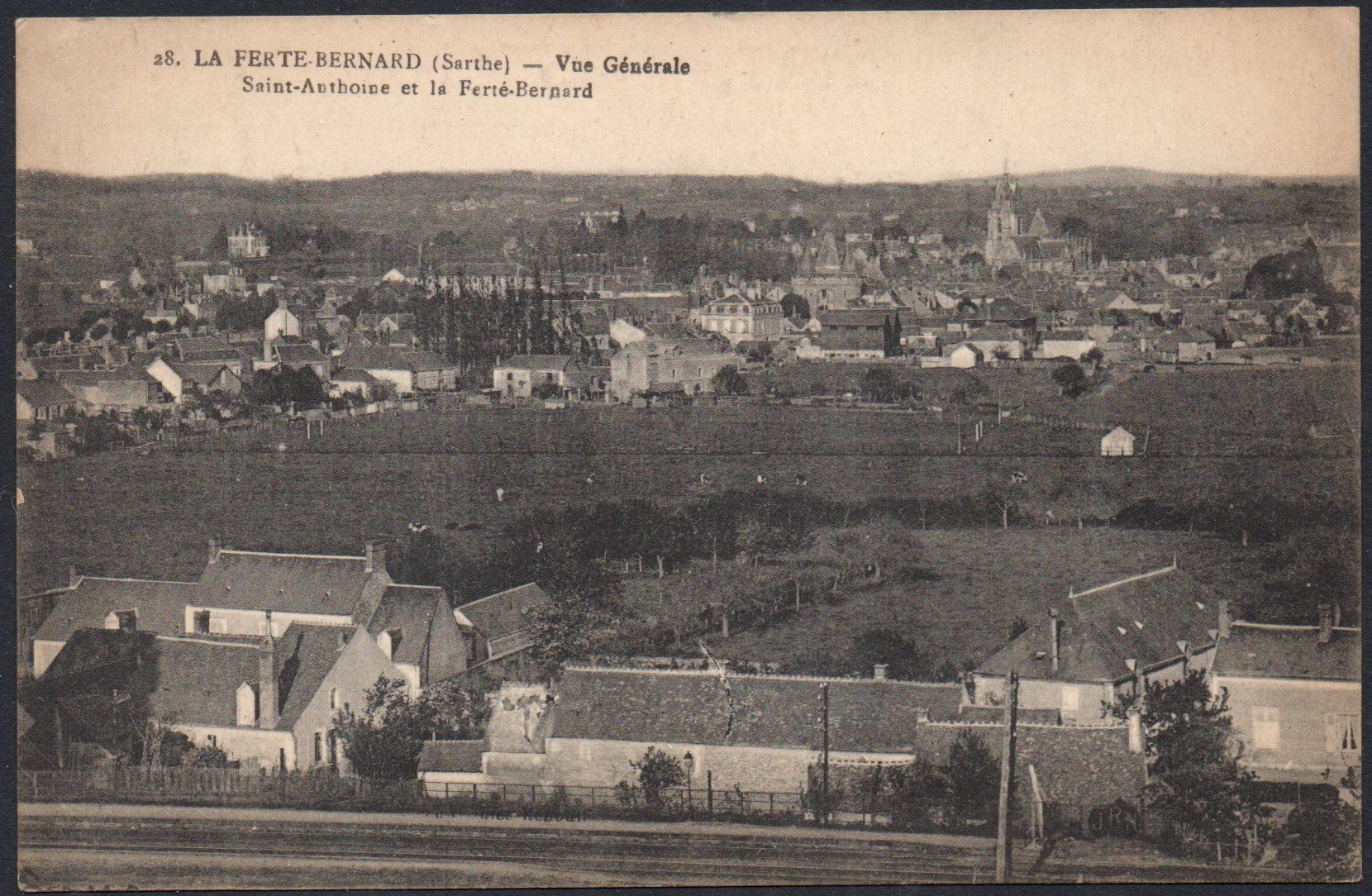
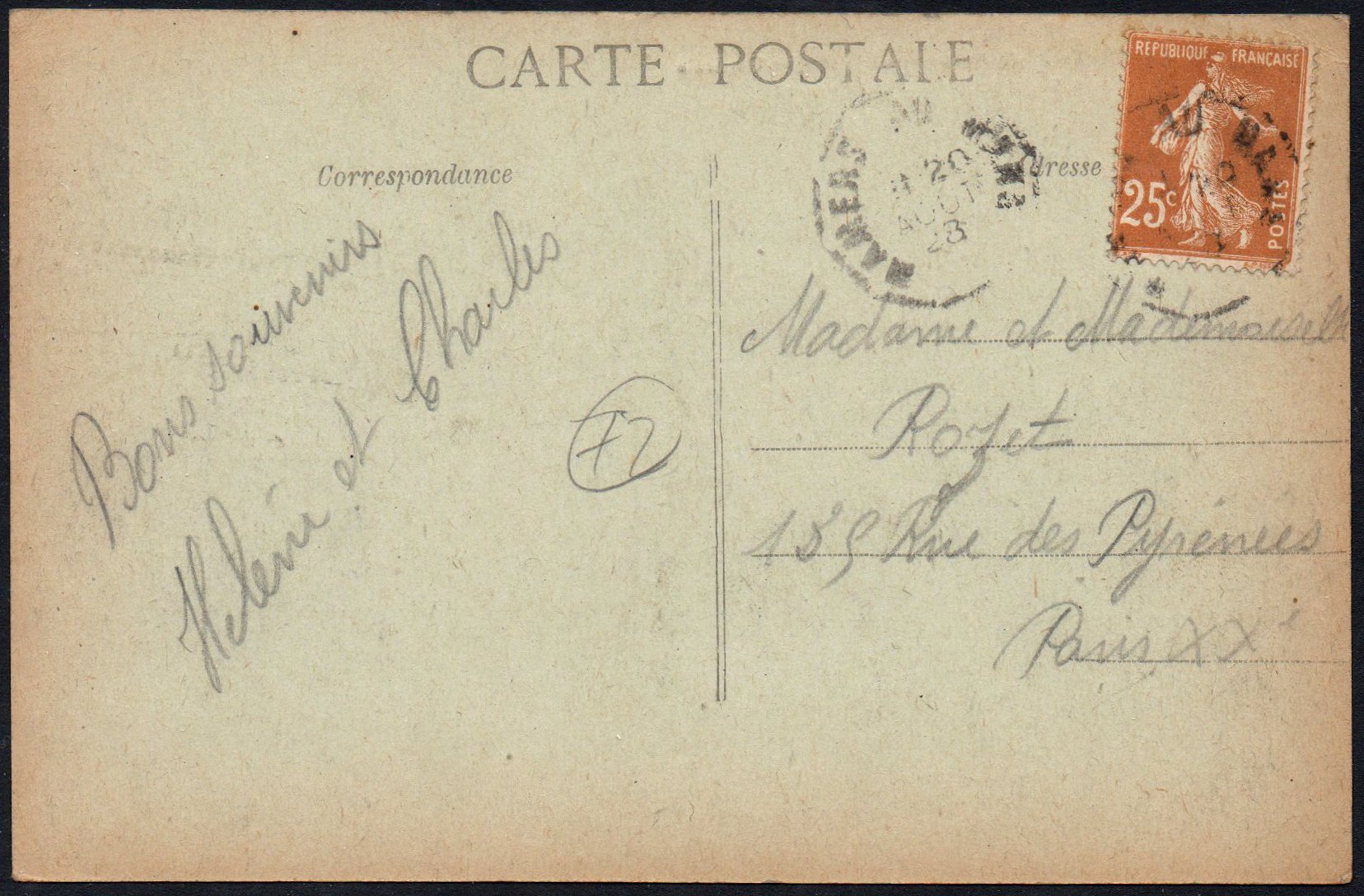 St. Antoine-de-Rochefort, location of the Gare de La Ferté-Bernard: The postmark reads MAMERS AU MANS / 20 AOUT 1928 and is, so far, the only card in the immediate vicinity of La Ferté-Bernard that we have seen with a Mamers au Mans CCL.
By the time the tramline opened, St Antoine de Rochefort had been administratively united with La Ferté-Bernard for many years but the railway station was still separated from the town, whose name it bore, by a few fields. The section of the tramline from the station to the town centre was laid alongside a new road and, as is normal, the gap was soon in-filled by buildings. At the terminus, the Tramways de la Sarthe chose to endow the town with the exotic station, later demolished, which is illustrated in the main Sarthe article. We think this terminus would have been much more suitable for transferring mail than St. Antoine where the tramway, we think, only stopped in the roadway outside the railway station.
Distribution by station of Mamers-line CCL apparently posted along the branch-line:
The Saint-Antoine card above is currently the latest (08/28) we have seen apparently used on the branch-line and is also the latest Mamers-line Type II we have encountered. On the branch-line with at least the year readable, we have seen the one above from St. Antoine, 4 examples from La-Chapelle-du-Bois, 3 from Déhault and 6 from St.Georges-du-Rosay.
Note: Revisions to 'earliest/latest known dates' of each canceller given in the 'dates' table in the main Sarthe article may not always have been copied to here.
St. Antoine-de-Rochefort, location of the Gare de La Ferté-Bernard: The postmark reads MAMERS AU MANS / 20 AOUT 1928 and is, so far, the only card in the immediate vicinity of La Ferté-Bernard that we have seen with a Mamers au Mans CCL.
By the time the tramline opened, St Antoine de Rochefort had been administratively united with La Ferté-Bernard for many years but the railway station was still separated from the town, whose name it bore, by a few fields. The section of the tramline from the station to the town centre was laid alongside a new road and, as is normal, the gap was soon in-filled by buildings. At the terminus, the Tramways de la Sarthe chose to endow the town with the exotic station, later demolished, which is illustrated in the main Sarthe article. We think this terminus would have been much more suitable for transferring mail than St. Antoine where the tramway, we think, only stopped in the roadway outside the railway station.
Distribution by station of Mamers-line CCL apparently posted along the branch-line:
The Saint-Antoine card above is currently the latest (08/28) we have seen apparently used on the branch-line and is also the latest Mamers-line Type II we have encountered. On the branch-line with at least the year readable, we have seen the one above from St. Antoine, 4 examples from La-Chapelle-du-Bois, 3 from Déhault and 6 from St.Georges-du-Rosay.
Note: Revisions to 'earliest/latest known dates' of each canceller given in the 'dates' table in the main Sarthe article may not always have been copied to here.
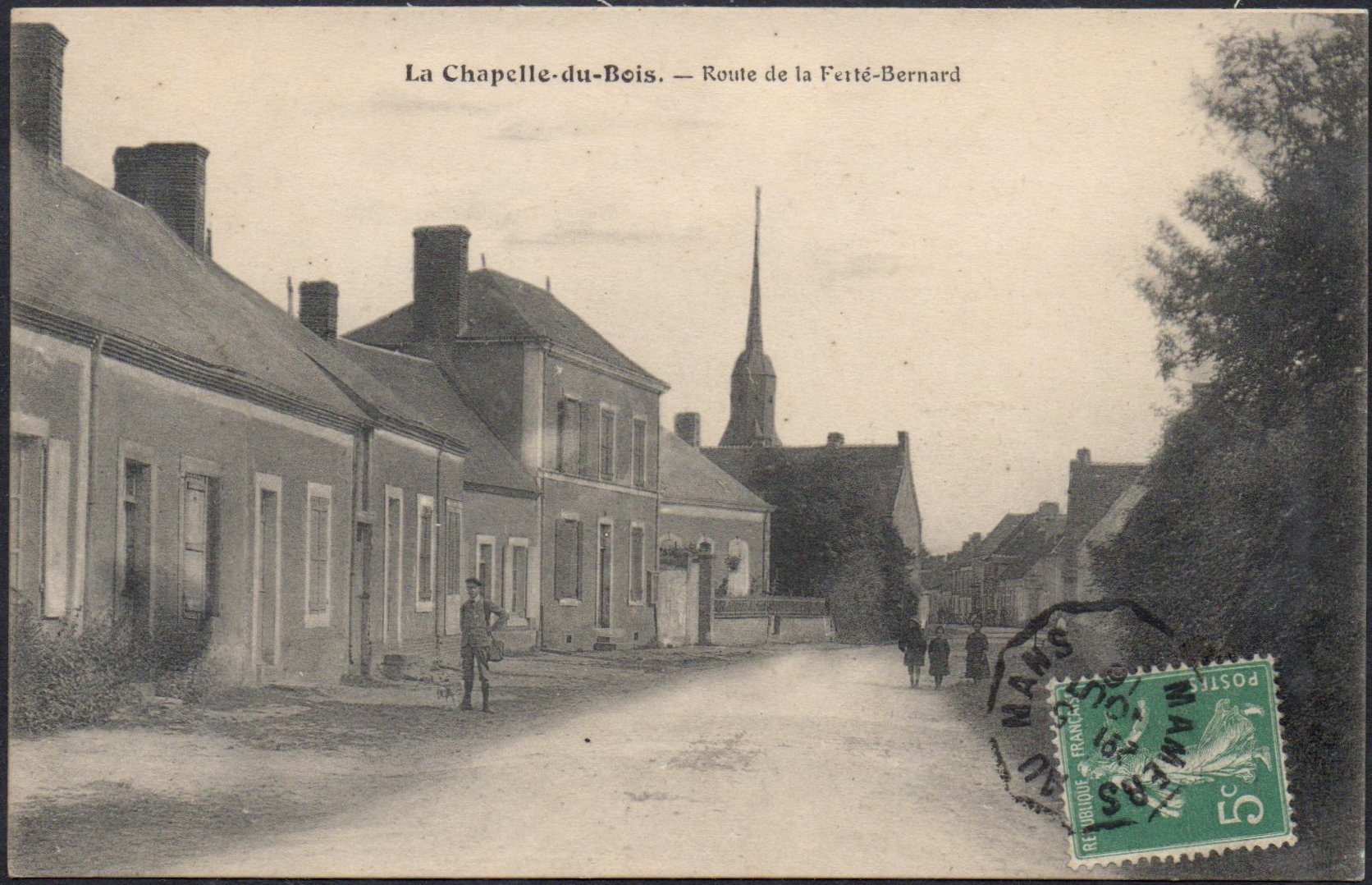
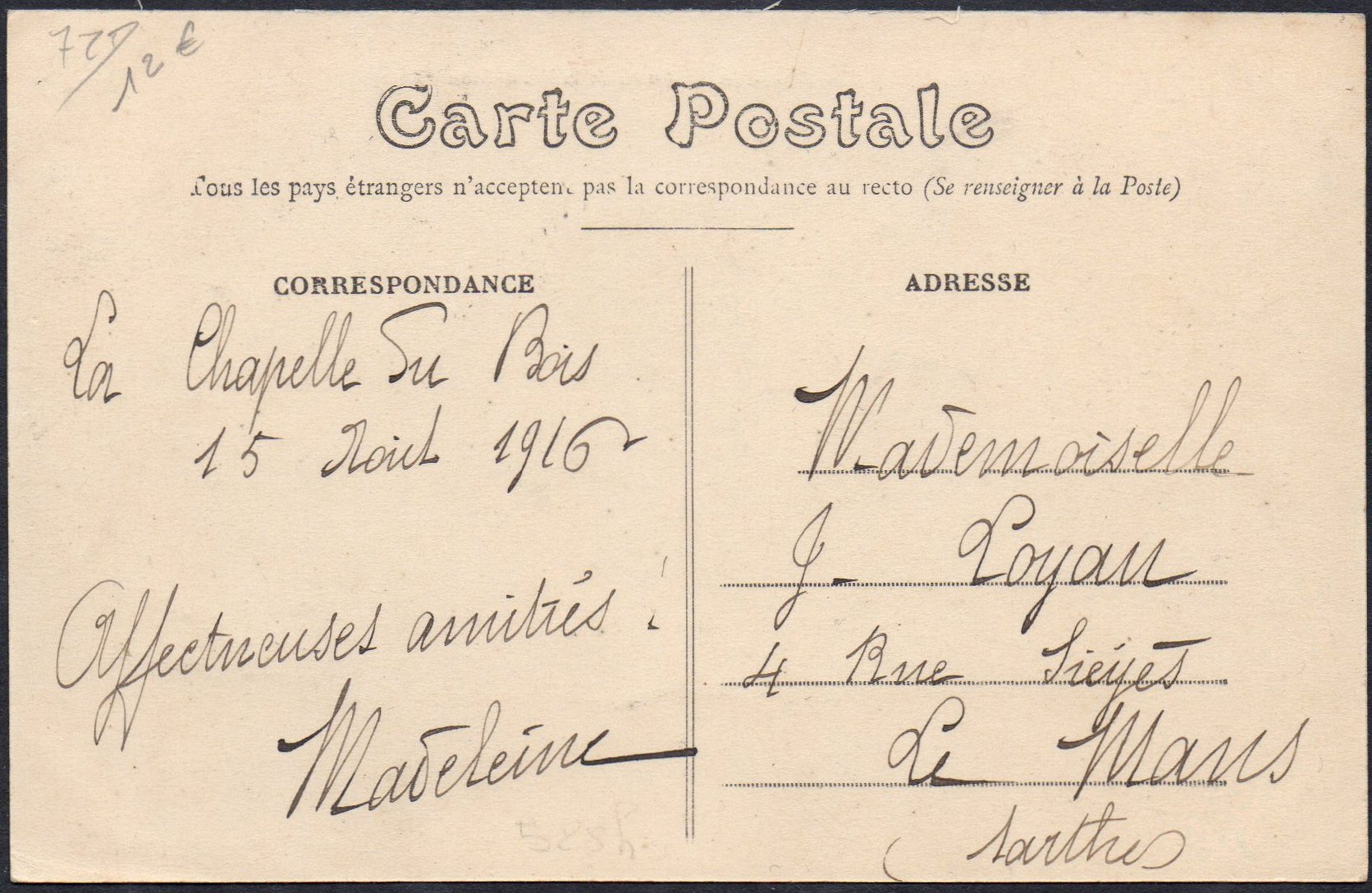 An exceptionally fine strike for the tramway, Mamers au Mans 15/8/1916. There is a missing '1' in '15' as revealed by the sender's message. The text helpfully confirms that the card was almost certainly posted in La-Chapelle-du-Bois.
Branch-line extension : La Ferté-Bernard à Montmirail : Open 1916-1921 & 1924-1932
It seems very likely that satisfactory postal arrangements along the route of the new section of tramway would already have been in place by 1916. There is no reported CCL cancellation in Pothion for the tramway's extension to Montmirail but then there was not even one which identified separately the T.S. branch from La Détourbe to La Ferté-Bernard, which ran for decades. A further pointer against any T.S. CCL being employed between La Ferté-Bernard and Montmirail is that, with only an occasional exception, there were no through trams from La Détourbe to Montmirail, with the branch-line and its later extension typically being run as two separate services to/from La Ferté-Bernard.
.
4. La Flèche au Mans
An exceptionally fine strike for the tramway, Mamers au Mans 15/8/1916. There is a missing '1' in '15' as revealed by the sender's message. The text helpfully confirms that the card was almost certainly posted in La-Chapelle-du-Bois.
Branch-line extension : La Ferté-Bernard à Montmirail : Open 1916-1921 & 1924-1932
It seems very likely that satisfactory postal arrangements along the route of the new section of tramway would already have been in place by 1916. There is no reported CCL cancellation in Pothion for the tramway's extension to Montmirail but then there was not even one which identified separately the T.S. branch from La Détourbe to La Ferté-Bernard, which ran for decades. A further pointer against any T.S. CCL being employed between La Ferté-Bernard and Montmirail is that, with only an occasional exception, there were no through trams from La Détourbe to Montmirail, with the branch-line and its later extension typically being run as two separate services to/from La Ferté-Bernard.
.
4. La Flèche au Mans
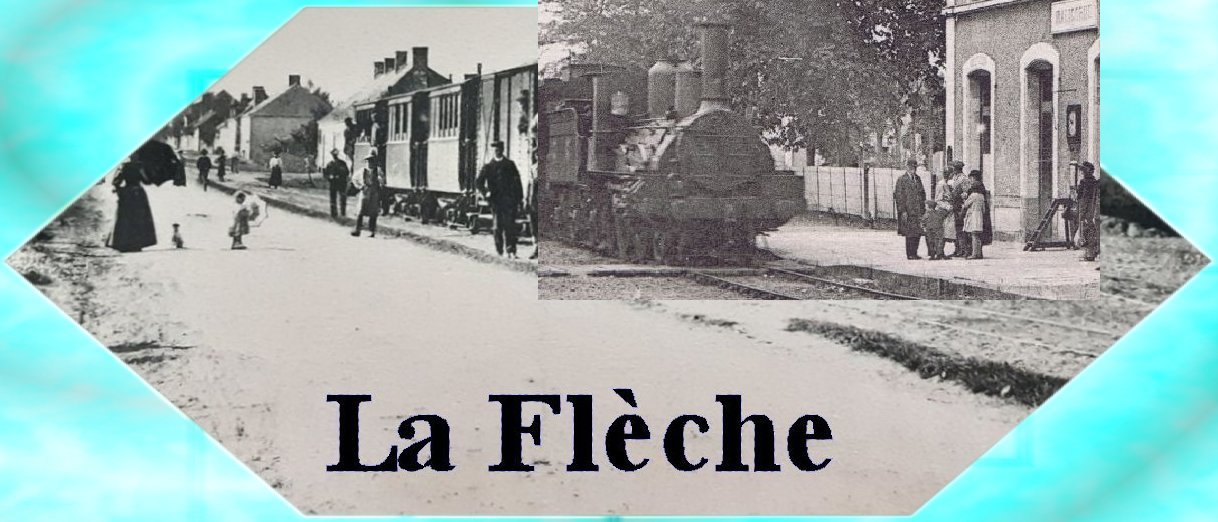 A little amateur photomontage: We have 'borrowed' the section divider used in the main article but have superimposed the railway locomotive and station building of the Gare de Malicorne in place of the tram engine at Guécélard on the original postcard.
A La Flèche au Mans (and return) CCL was in use prior to the tramway's extension to La Flèche. The CCL service appears to have travelled on the former single-track railway line that linked La Flèche with the main line at La Suze, and from there onwards to Le Mans by the main line. On the southern section up to La Suze, we have seen several La Flèche au Mans CCL on local postcards, for example from Villaines-sous-Malicorne.
North of La Suze towards Le Mans on the main line, a few more examples of likely railway usage of the La Flèche au Mans CCL can be found, for example on mail apparently from Roëzé although this town's proximity to the tramway at Fillé is not helpful when hypothesizing on the carrier. It is worth noting that the main line from La Suze to Le Mans was also traversed by the 'Angers au Mans' CCL and this CCL is much more commonly found on mail from stations north of La Suze than is the La Flèche CCL.
A little amateur photomontage: We have 'borrowed' the section divider used in the main article but have superimposed the railway locomotive and station building of the Gare de Malicorne in place of the tram engine at Guécélard on the original postcard.
A La Flèche au Mans (and return) CCL was in use prior to the tramway's extension to La Flèche. The CCL service appears to have travelled on the former single-track railway line that linked La Flèche with the main line at La Suze, and from there onwards to Le Mans by the main line. On the southern section up to La Suze, we have seen several La Flèche au Mans CCL on local postcards, for example from Villaines-sous-Malicorne.
North of La Suze towards Le Mans on the main line, a few more examples of likely railway usage of the La Flèche au Mans CCL can be found, for example on mail apparently from Roëzé although this town's proximity to the tramway at Fillé is not helpful when hypothesizing on the carrier. It is worth noting that the main line from La Suze to Le Mans was also traversed by the 'Angers au Mans' CCL and this CCL is much more commonly found on mail from stations north of La Suze than is the La Flèche CCL.
As we write this in 2024, we have discovered that new steps have been taken in creating a 'voie verte' out of the former railway line La Flèche - Villaines-sous-Malicorne - Malicorne(-sur-Sarthe) - Mézeray - La Suze with the removal of more sections of the old tracks, still in situ even though the line closed in 1990.
There is inevitably some repetition here, albeit re-phrased, from the main article. This CCL appears to have been used variously both on the trains and on the trams. It started life solely on the railway, we think up until about 1917. With the opening of the tramway, mail appears to have travelled between La Flèche and Le Mans by both tram and train, perhaps (and most likely) throughout the period of tramway operations. Tramway use of the CCL in this period is much commoner than railway use.
The tramway closed at the end of 1932 and the CCL appears to have still been in use on the tramway well into its final year of operation. After the tramway closed, there is evidence of continued use (or renewed use, if it had previously been suspended) of the railway CCL. Examples in that post-tram period are surprisingly hard to find. Our check-list for the early (pre-tram) railway use, already provided on the main webpage, is repeated below.
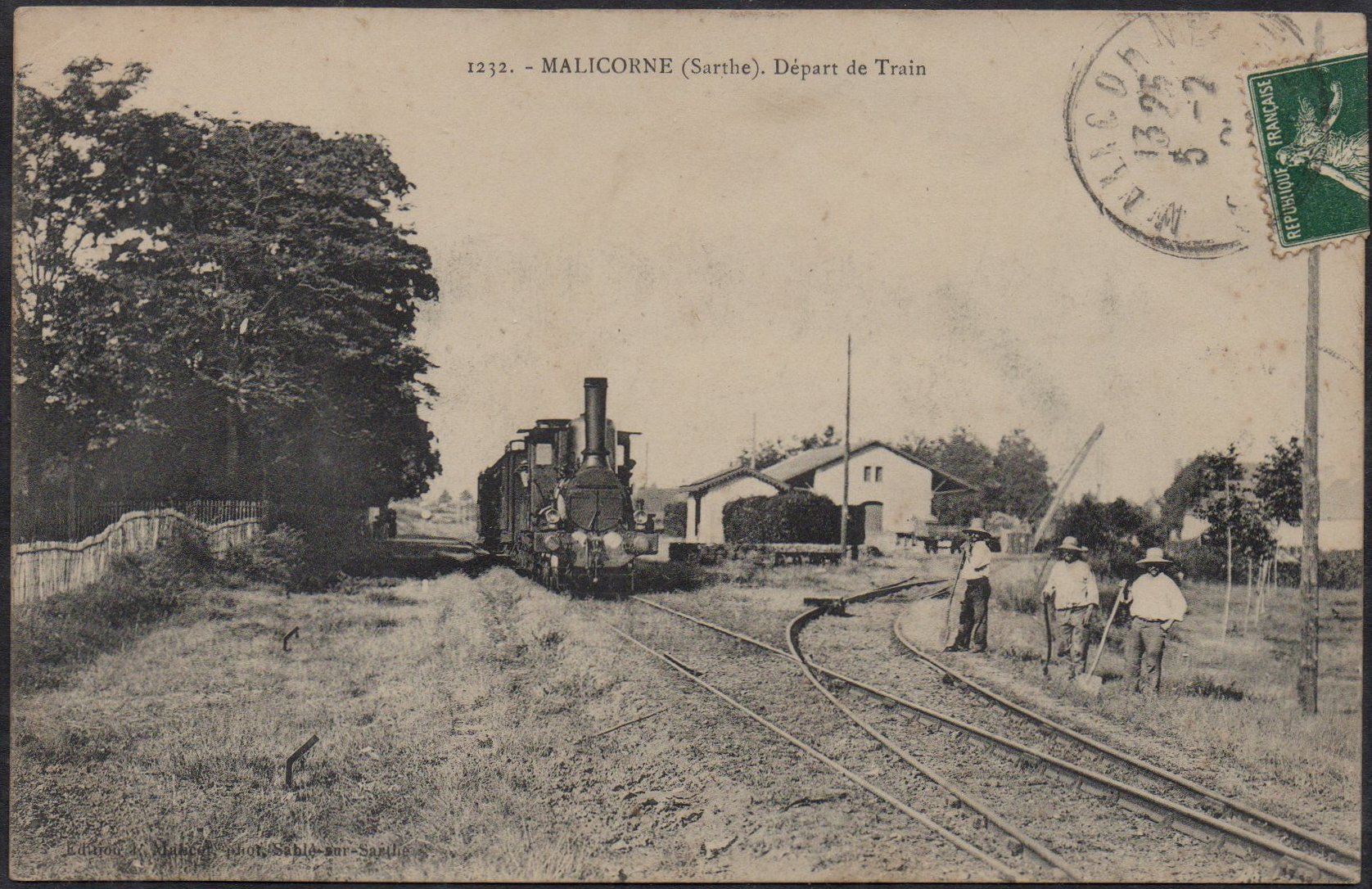 We include the image above solely because it seems to be rare and is, we think, a view worth sharing.
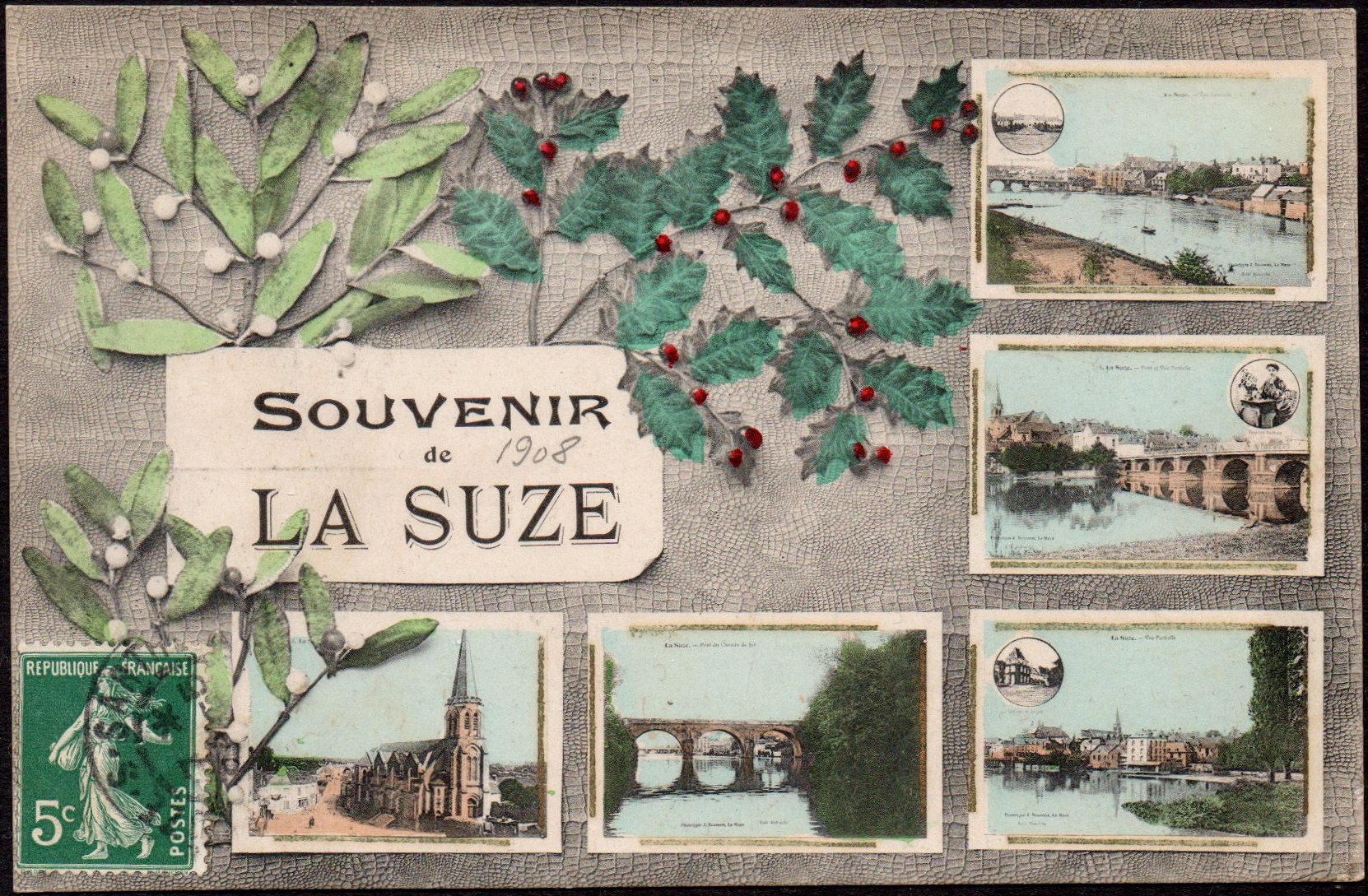
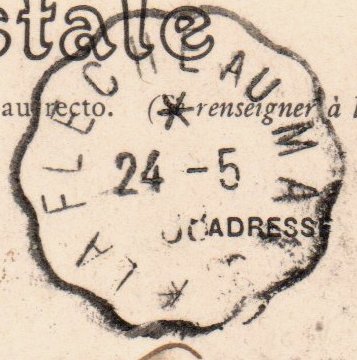 This is one of the earliest uses we have so far seen of the La Flèche au Mans CCL, May 1908. Curiously, it is a transit mark on a La Suze postcard, addressed to the Paris area, already with its stamp cancelled in La Suze.
In the main article, we identified the likely circumstances requiring the application of a transit CCL marking on the trams. We have not sought to investigate this railway use of a transit marking.
This is one of the earliest uses we have so far seen of the La Flèche au Mans CCL, May 1908. Curiously, it is a transit mark on a La Suze postcard, addressed to the Paris area, already with its stamp cancelled in La Suze.
In the main article, we identified the likely circumstances requiring the application of a transit CCL marking on the trams. We have not sought to investigate this railway use of a transit marking.
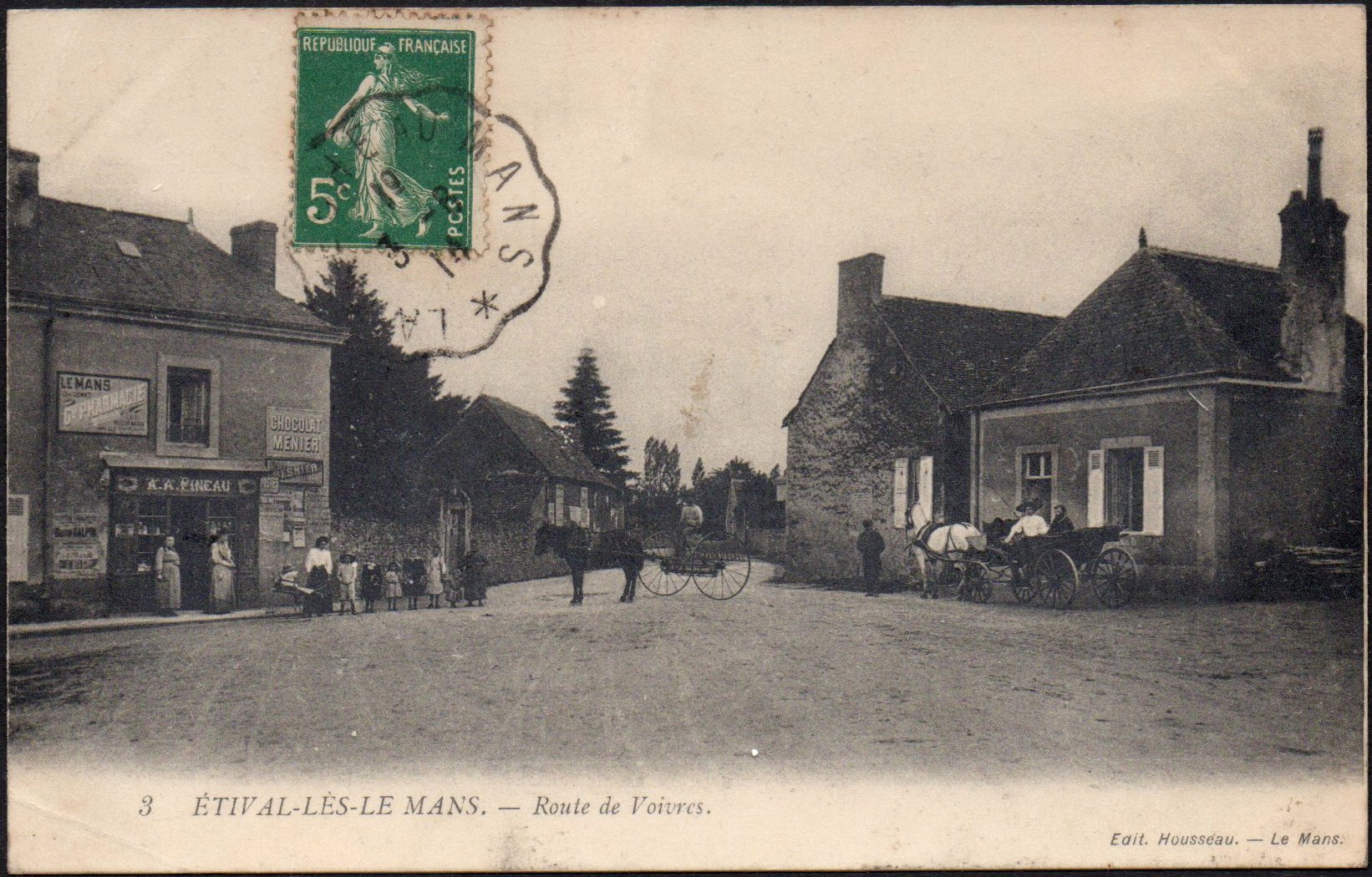
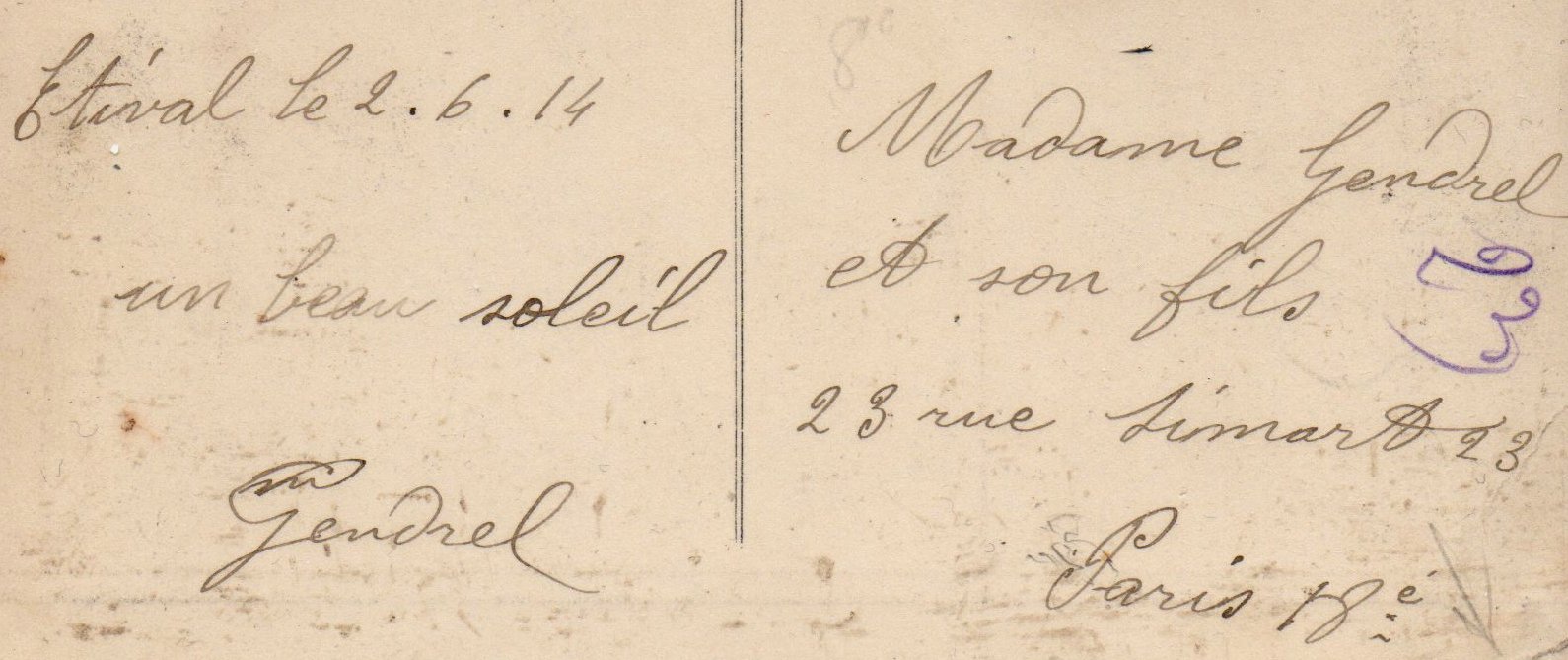 A June 1914 railway use of the CCL from Etival-lès-Mans, an uncommon point of origin for this cancellation.
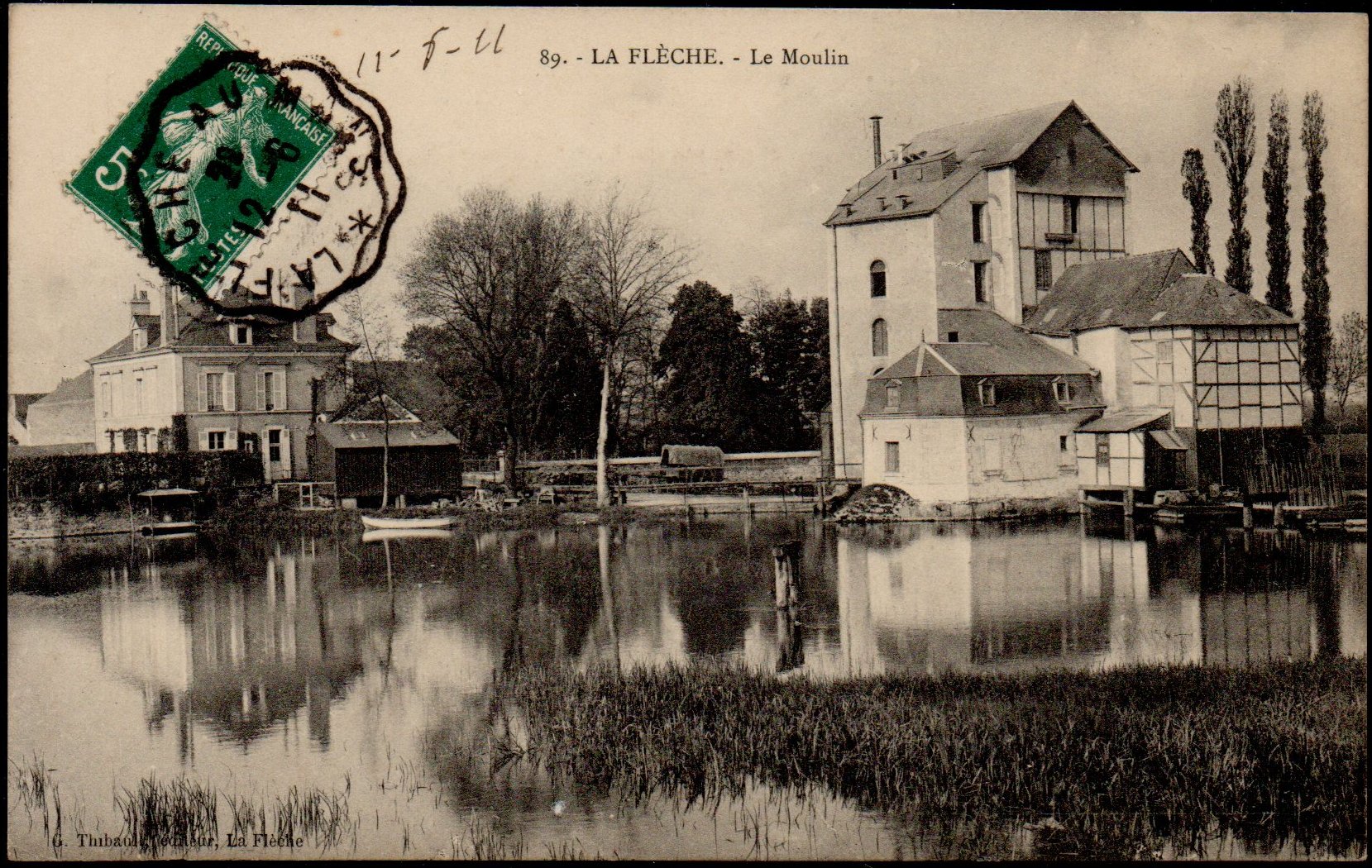
 Left : La Flèche au Mans on a La Flèche postcard, June 1911, to Versailles.
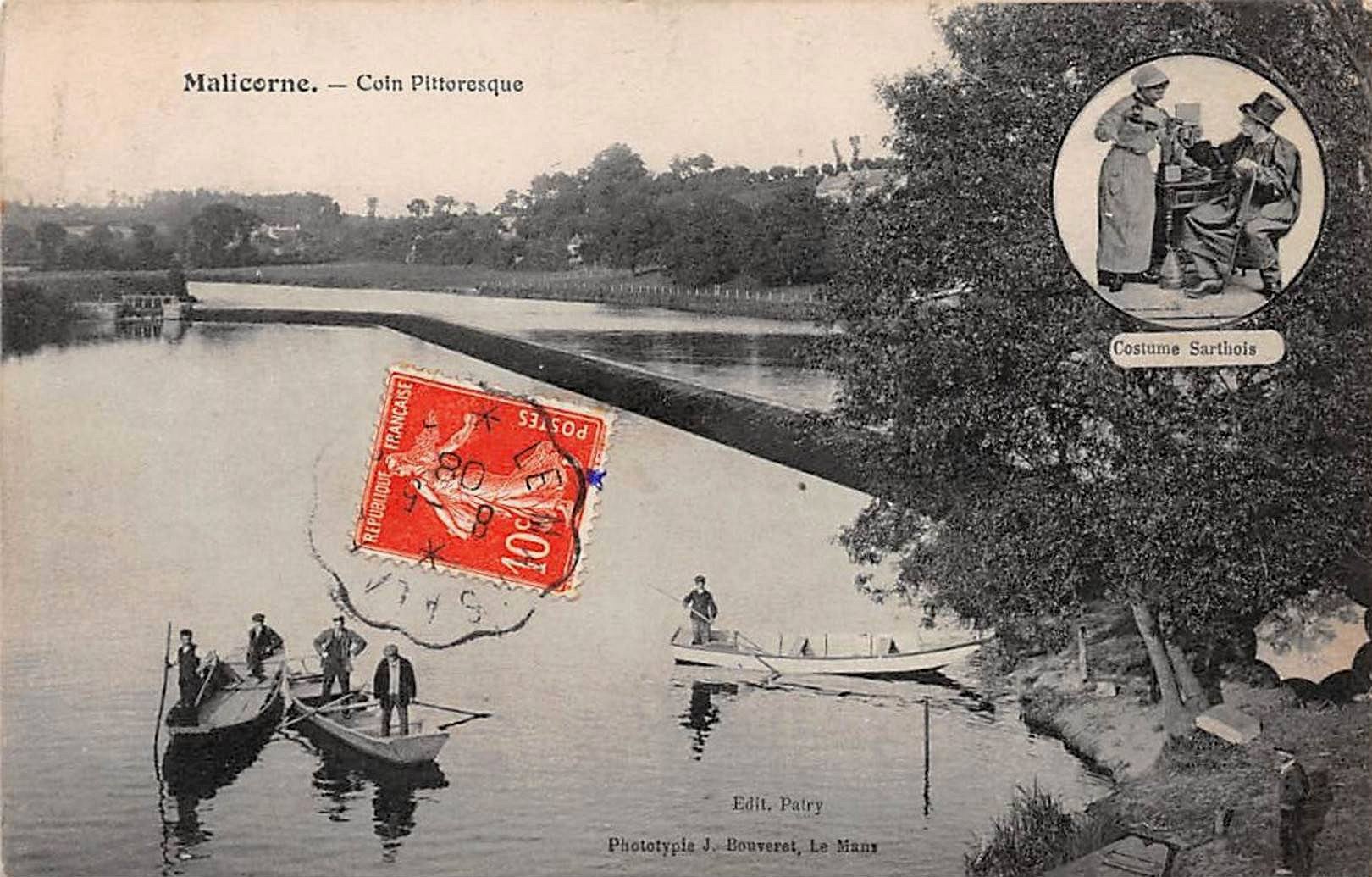
Right : The earliest 'outbound', viz. Le Mans à La Flèche CCL, that we have seen, May 8th 1908 on a card of Malicorne.
Left : La Flèche au Mans on a La Flèche postcard, June 1911, to Versailles.
Right : The earliest 'outbound', viz. Le Mans à La Flèche CCL, that we have seen, May 8th 1908 on a card of Malicorne.
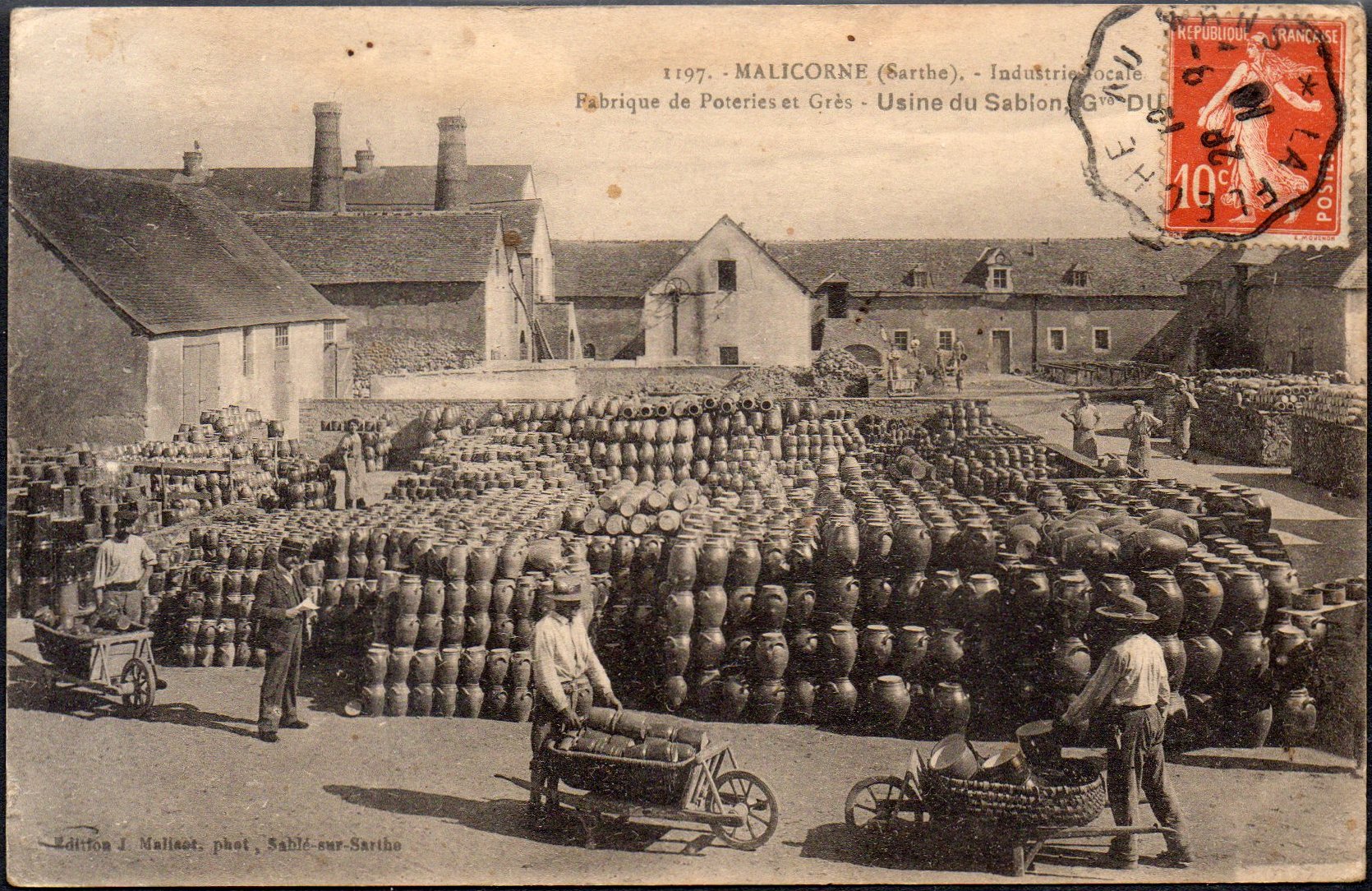
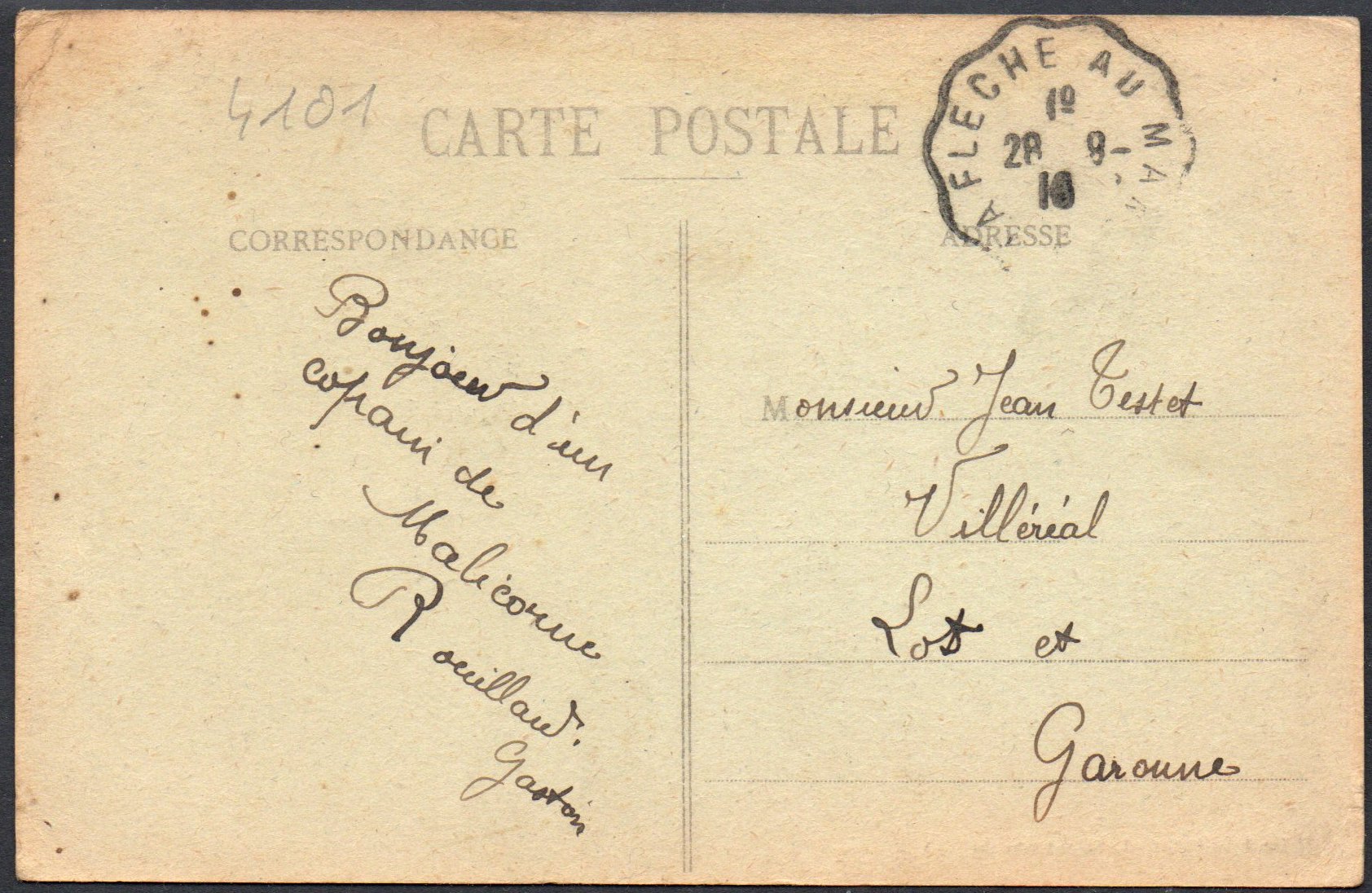
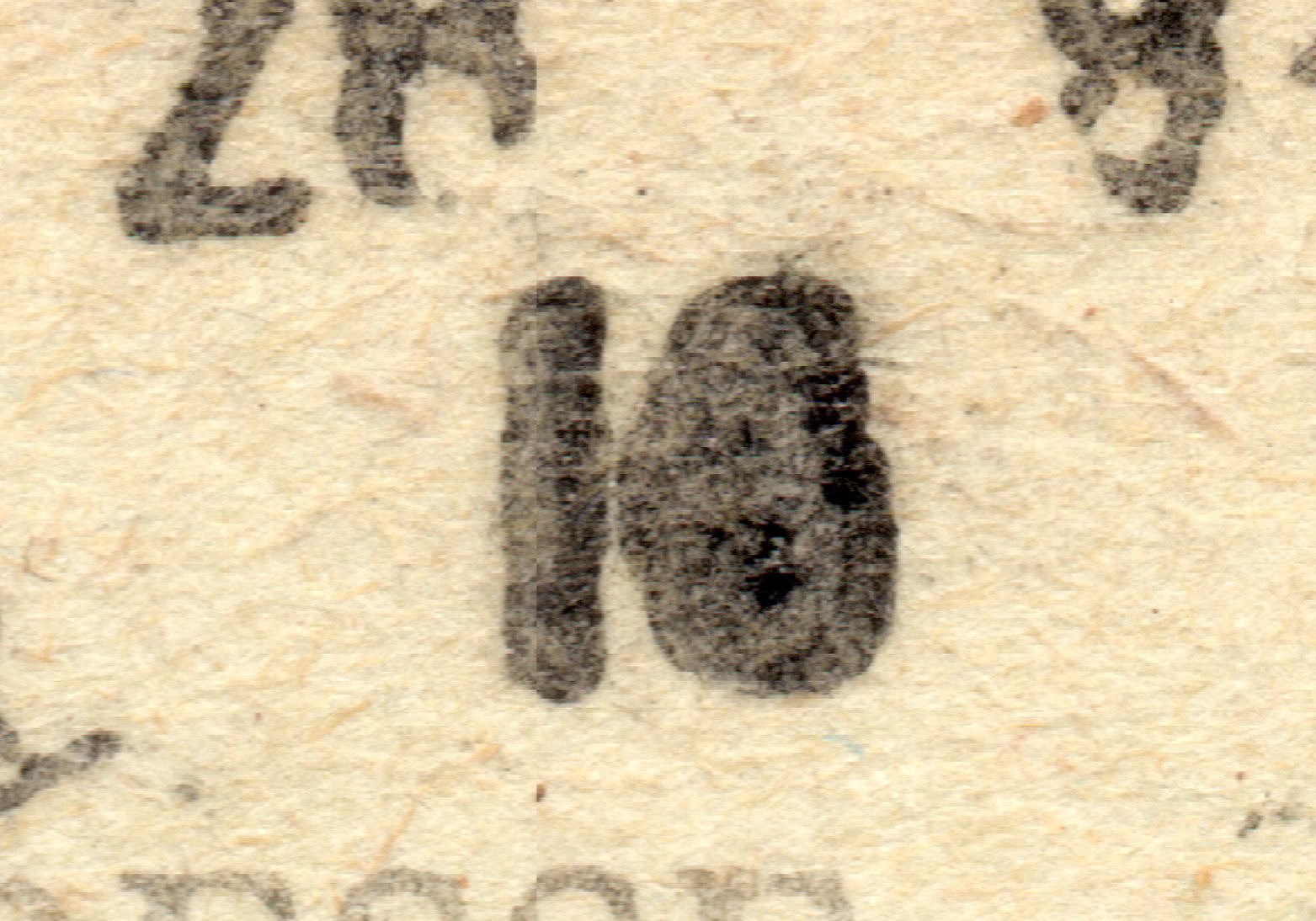 A postcard of Malicorne posted in August 1916 with sender's greeting 'Bonjour d'un copain de Malicorne'. The year is heavily inked but decipherable as 1916 (third scan). Malicorne was about 11 kms from the nearest point on the tramline and we have no good evidence for tramway use of the CCL in 1916, so this is very probably a railway cancellation at the end of the (first) rail-only period.
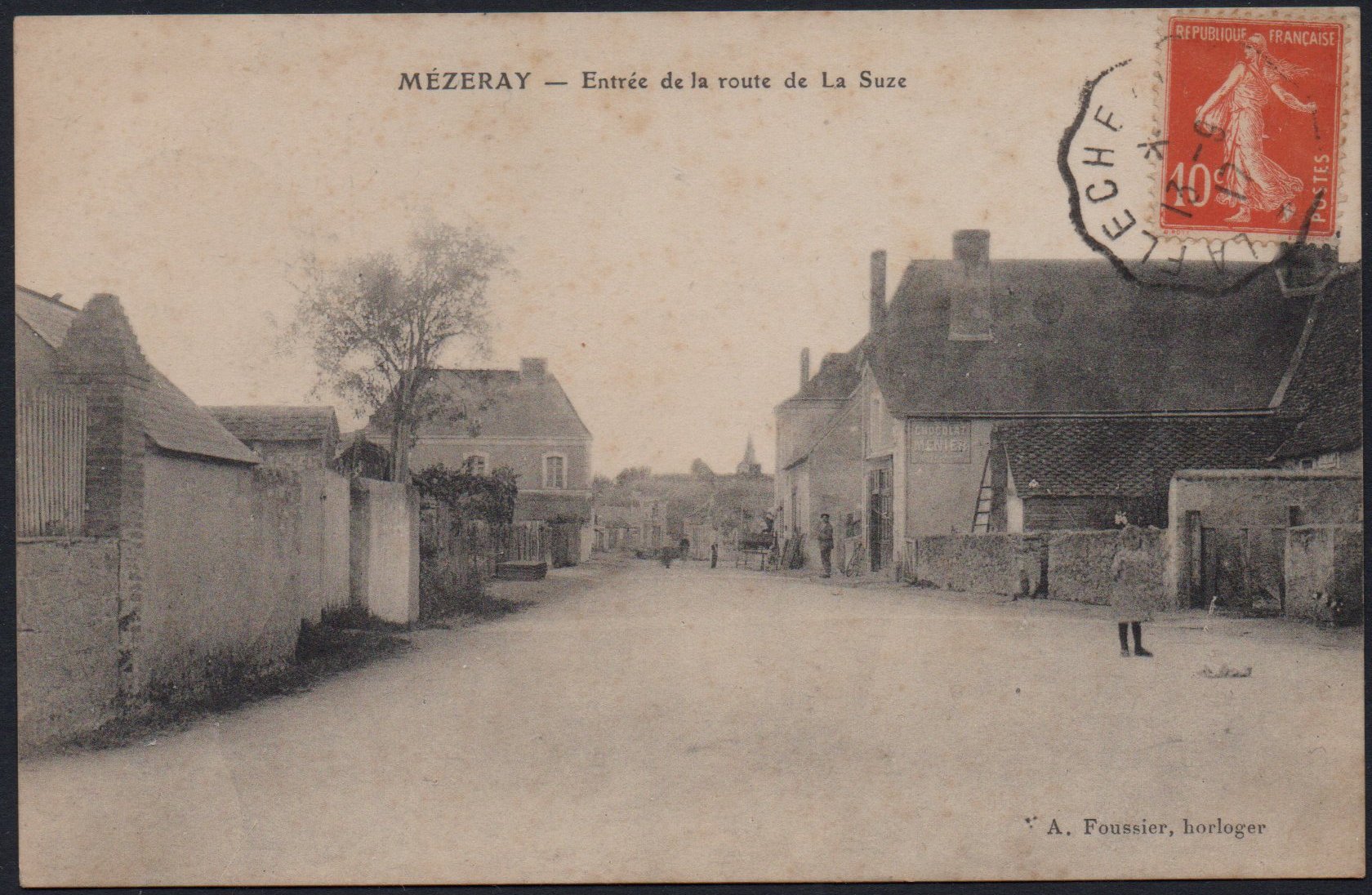
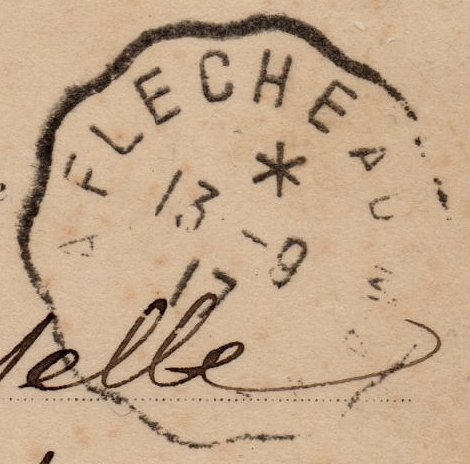 A September 2017 strike of the CCL on a card of Mézeray, most likely applied on the railway. We have seen a Foulletourte card which seems more likely to have been applied on the tramway a month earlier (illustrated in main article). Both cards have a star (*) at the top of the postmark, but we remain unsure as to whether this is, in fact, a significant clue.
La Fléche au Mans : Railway [ . ] Earliest seen 05/08; latest seen possibly pre-trams: 08/16 09/17?
Le Mans à La Fléche : Railway [ . ] Earliest seen 05/08; latest (pre-trams) railway seen : 12/08
.
The Joint Rail / Tram Period:
A September 2017 strike of the CCL on a card of Mézeray, most likely applied on the railway. We have seen a Foulletourte card which seems more likely to have been applied on the tramway a month earlier (illustrated in main article). Both cards have a star (*) at the top of the postmark, but we remain unsure as to whether this is, in fact, a significant clue.
La Fléche au Mans : Railway [ . ] Earliest seen 05/08; latest seen possibly pre-trams: 08/16 09/17?
Le Mans à La Fléche : Railway [ . ] Earliest seen 05/08; latest (pre-trams) railway seen : 12/08
.
The Joint Rail / Tram Period:
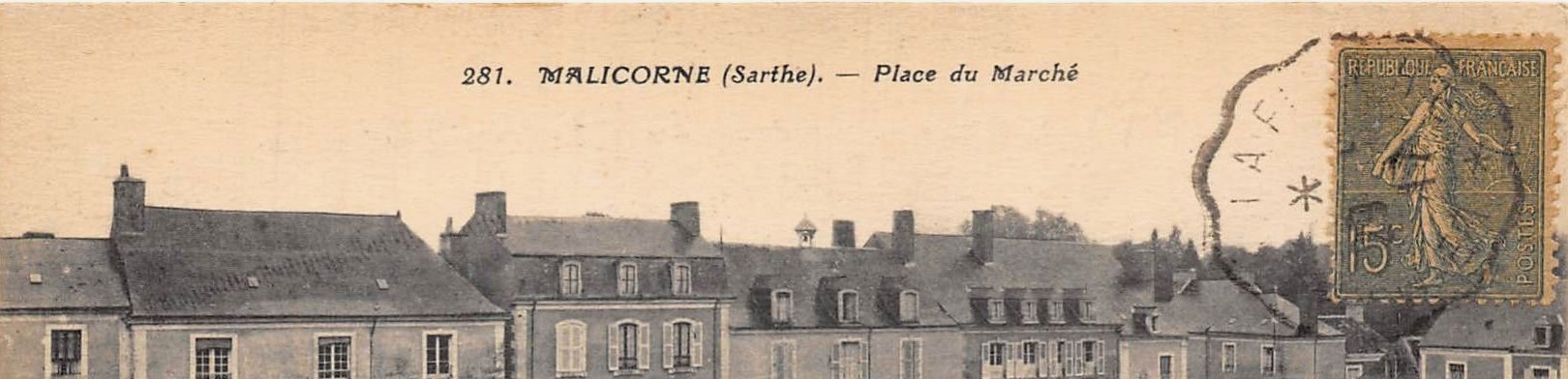
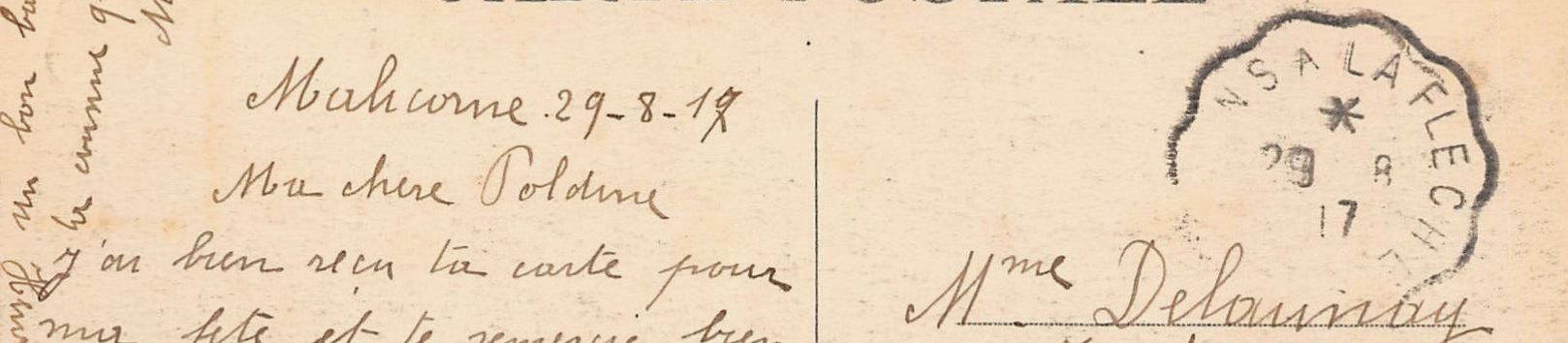 An August 1917 use of the CCL, detail of front and back of the postcard shown, with a high probability that it was sent from Malicorne on the railway.
The new tramway route from La Flèche to Le Mans via Cérans-Foulletourte started operating in 1914, initially only from La Flèche-Ville but, as already mentioned, we have struggled to find any evidence of the CCL being introduced on the tramway before 1917 and, as we explain further down in this section, even the examples seen for this date do not provide a watertight case. The evidence for a tramway operation becomes increasingly more solid from 1919. However, the absence (to date) of any Mayet-line CCL cancellations on the Le Mans - Cérans-Foulletourte section after 1916 leads us currently to favour 1917 as being the first year of operation of the tramway CCL on the La Flèche route, albeit with reservations.
There was a long delay in completing the last kilometre or so of the tramway to La Flèche-Gare, but it finally opened in 1921. This could have affected the movement of the mails on the tramway and/or the railway but, so far, we have not seen any philatelic material which even hints at new procedures being introduced.
As this appendix article is concerned with the railway operation, we show below two examples from Malicorne, in 1921 and 1925, which would seem to have been applied on the railway during a period of dual tramway / railway use of this CCL cancellation. The 1925 date is acquired from the arrival postmark, since the year on the CCL cancellation is defective.
An August 1917 use of the CCL, detail of front and back of the postcard shown, with a high probability that it was sent from Malicorne on the railway.
The new tramway route from La Flèche to Le Mans via Cérans-Foulletourte started operating in 1914, initially only from La Flèche-Ville but, as already mentioned, we have struggled to find any evidence of the CCL being introduced on the tramway before 1917 and, as we explain further down in this section, even the examples seen for this date do not provide a watertight case. The evidence for a tramway operation becomes increasingly more solid from 1919. However, the absence (to date) of any Mayet-line CCL cancellations on the Le Mans - Cérans-Foulletourte section after 1916 leads us currently to favour 1917 as being the first year of operation of the tramway CCL on the La Flèche route, albeit with reservations.
There was a long delay in completing the last kilometre or so of the tramway to La Flèche-Gare, but it finally opened in 1921. This could have affected the movement of the mails on the tramway and/or the railway but, so far, we have not seen any philatelic material which even hints at new procedures being introduced.
As this appendix article is concerned with the railway operation, we show below two examples from Malicorne, in 1921 and 1925, which would seem to have been applied on the railway during a period of dual tramway / railway use of this CCL cancellation. The 1925 date is acquired from the arrival postmark, since the year on the CCL cancellation is defective.
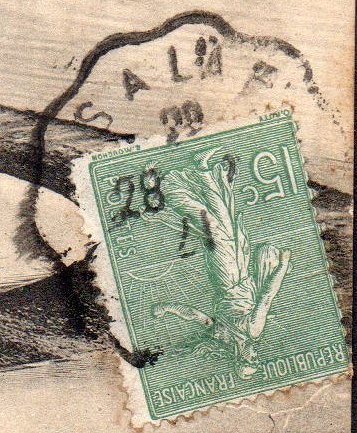
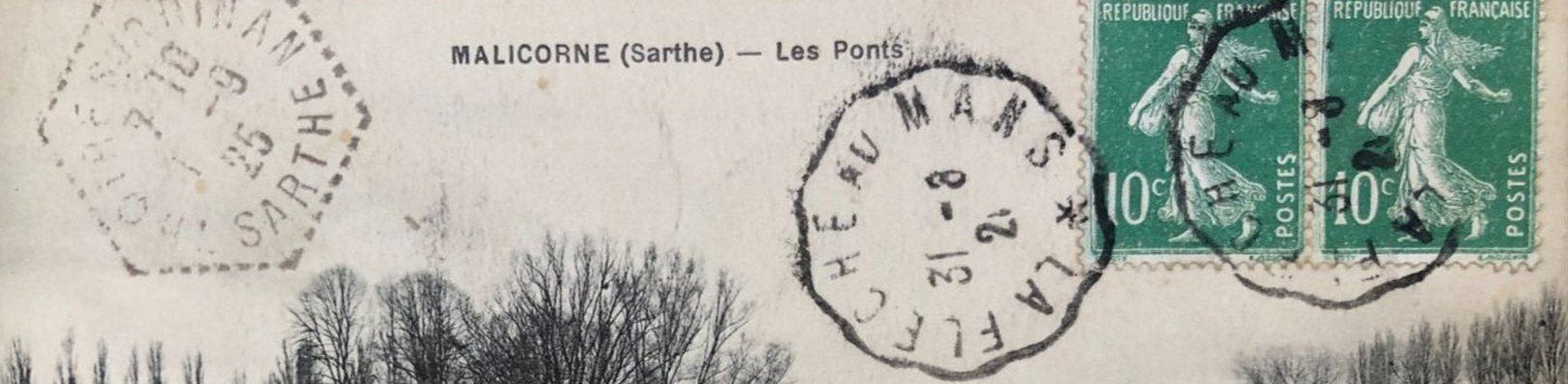 Left : Le Mans à La Flèche, 1921, on a postcard of Malicorne.
Right: La Flèche au Mans, again a Malicorne card, this time from 1925.
Left : Le Mans à La Flèche, 1921, on a postcard of Malicorne.
Right: La Flèche au Mans, again a Malicorne card, this time from 1925.
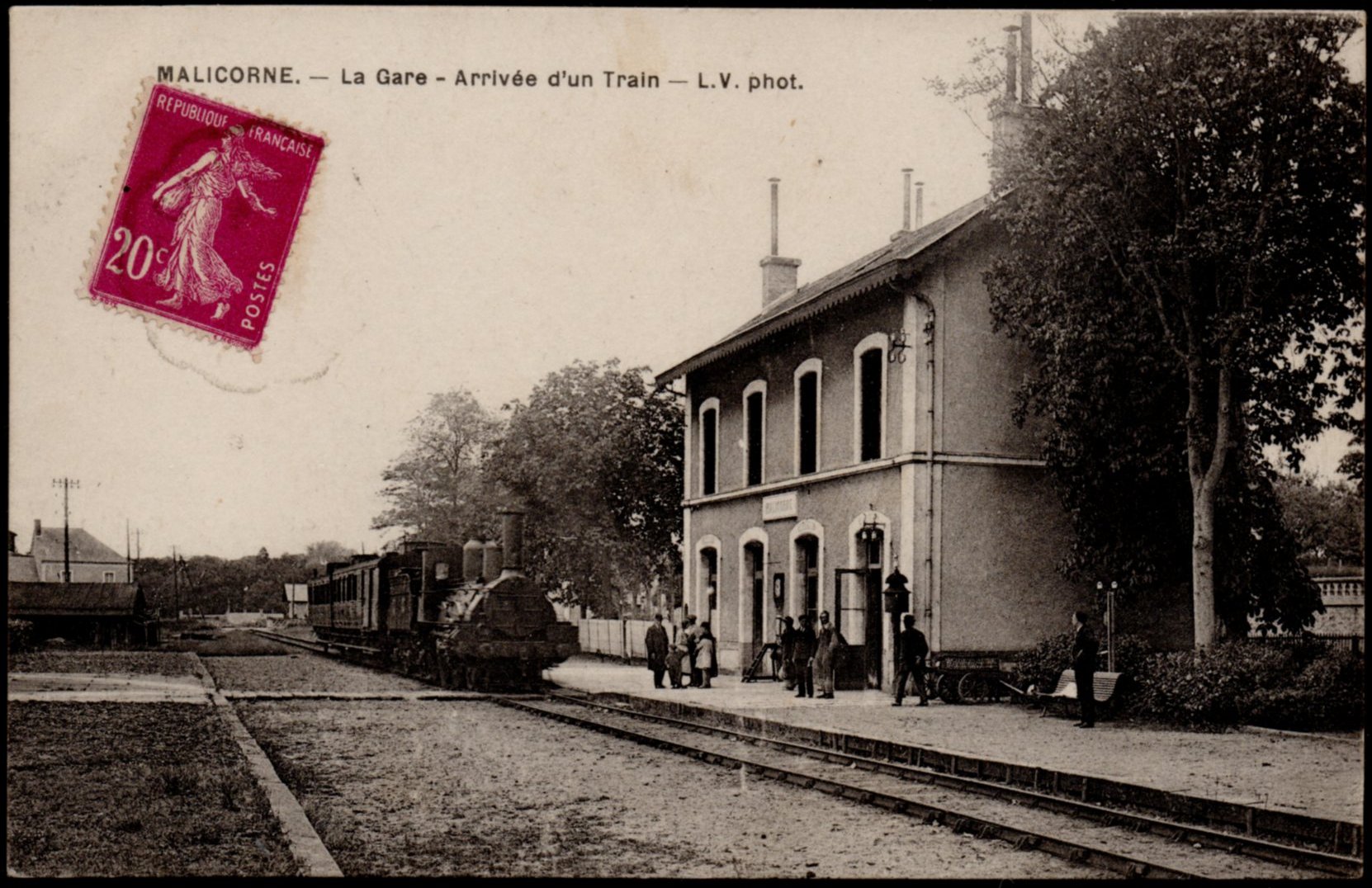
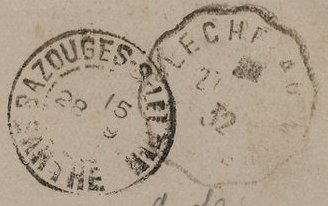
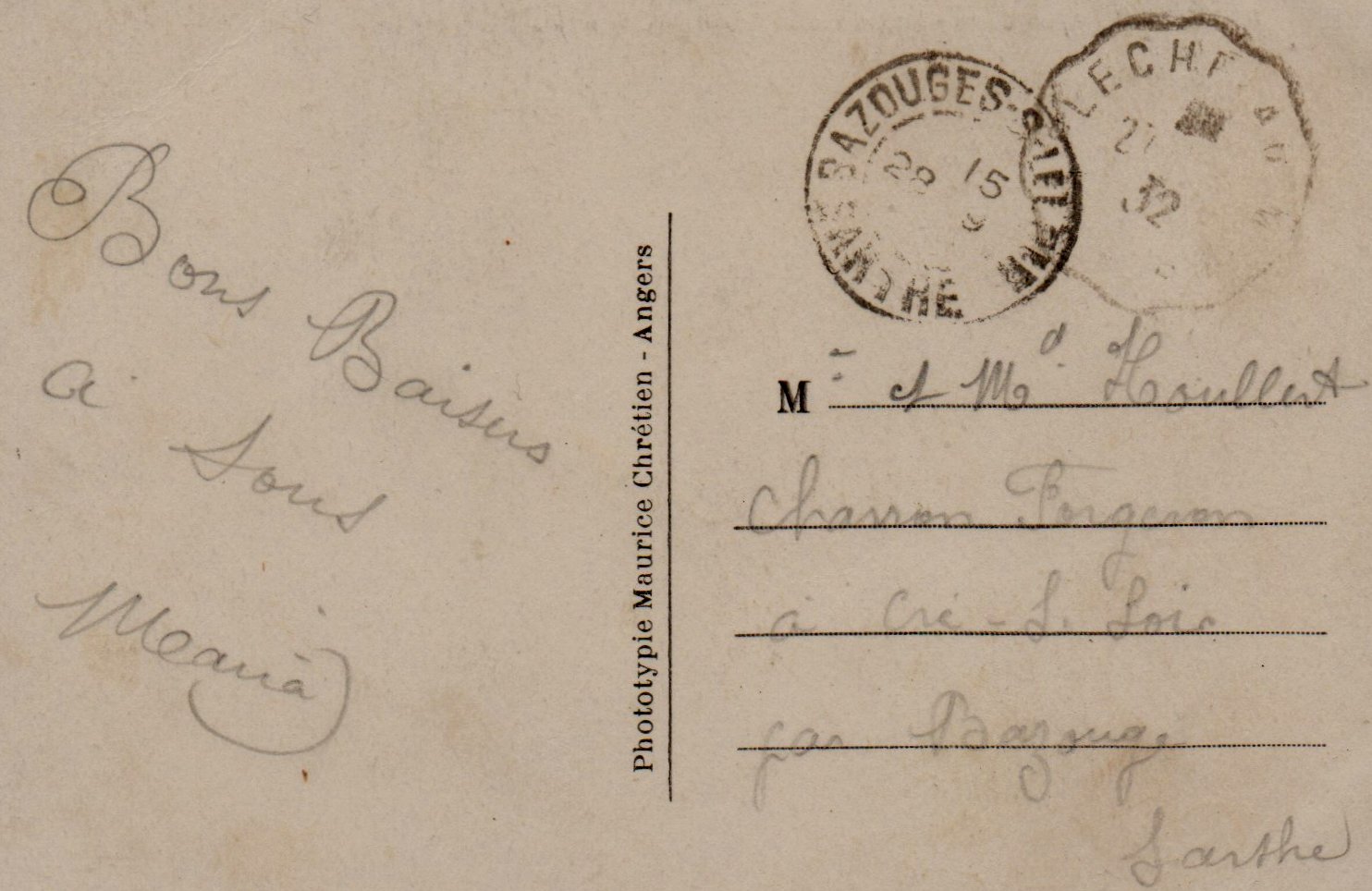 Note: The station image above is the source of the railway element of our photomontage section heading.
In the main article, in the La Flèche au Mans tramway section, we examined the CCL on the card above, which was presumably cancelled on the railway, against a card of Fillé which appears to have been cancelled on the tramway. The intriguing link between the two cards is that they were posted on the same date, September 27th 1932, a potential source of enlightenment in distinguishing between a railway CCL and a tramway CCL.
As the main article concludes, however, whilst we see some patterns, these have so far provided only limited insight.
.
La Flèche line : Railway from 1933:
We have not searched extensively for railway use of the cancellation after the closure of the tramway on January 1st 1933 but, even so, how little we have found (currently only one example) has surprised us. Please bear in mind, though, that we have spent far less time searching for probable railway examples of the La Flèche au Mans CCL from towns along the railway line than we have for probable tramway CCL from towns along the tram-line.
Note: The station image above is the source of the railway element of our photomontage section heading.
In the main article, in the La Flèche au Mans tramway section, we examined the CCL on the card above, which was presumably cancelled on the railway, against a card of Fillé which appears to have been cancelled on the tramway. The intriguing link between the two cards is that they were posted on the same date, September 27th 1932, a potential source of enlightenment in distinguishing between a railway CCL and a tramway CCL.
As the main article concludes, however, whilst we see some patterns, these have so far provided only limited insight.
.
La Flèche line : Railway from 1933:
We have not searched extensively for railway use of the cancellation after the closure of the tramway on January 1st 1933 but, even so, how little we have found (currently only one example) has surprised us. Please bear in mind, though, that we have spent far less time searching for probable railway examples of the La Flèche au Mans CCL from towns along the railway line than we have for probable tramway CCL from towns along the tram-line.
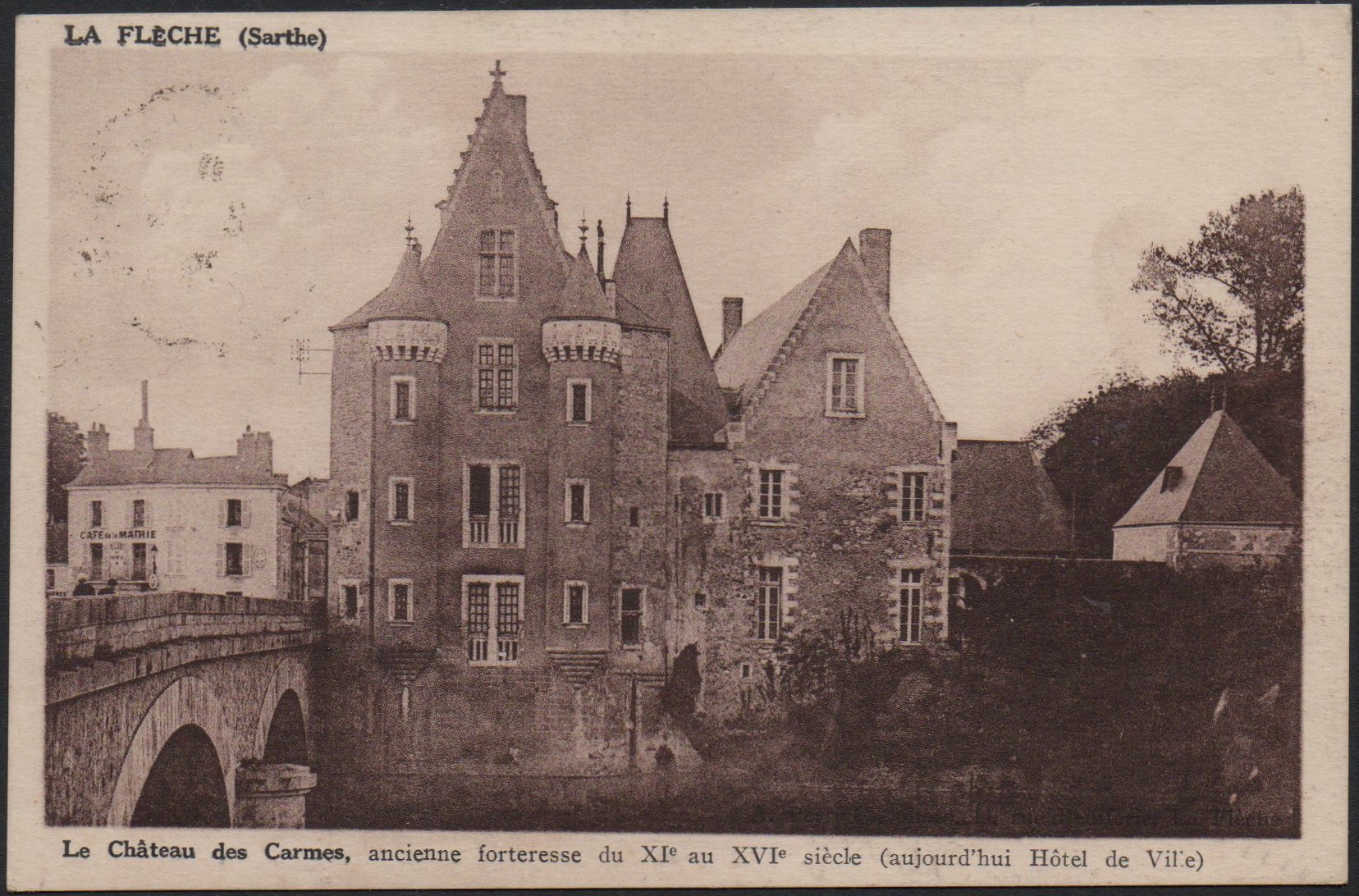
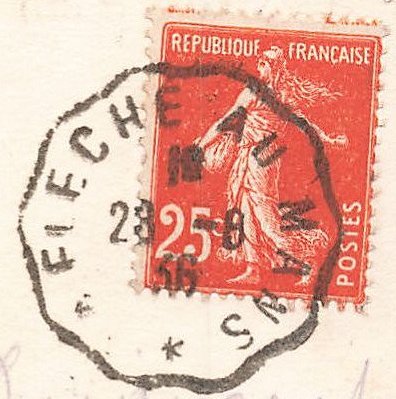 The only post-1932, hence post-tramway, example of the La Flèche railway line CCL that we have seen, 1936.
La Flèche au Mans : Railway [ . ] necessarily so from January 1933, 08/36 seen.
Le Mans à La Flèche : Railway [ . ] from January 1933 (none yet seen)
.
Statistical data on Railway Use of this CCL.
Although we have been unable to provide images of the CCL in the Le Mans à La Flèche direction in the post-tram era, we do not currently read much into this as, in this direction, one would expect it to be notably scarcer at all periods.
On the main line between La Suze and Le Mans, we have seen cards with the La Flèche au Mans CCL from Roëzé and Etival-lès-Mans. Note, though, that we have also seen cards of Roëzé with a Mayet au Mans CCL. These were probably consigned to the tramway at Fillé, only a few kilometres distant and, thanks to the tramway bridge at Fillé, on the same bank of the River Sarthe.
From 1908 to 1916 inclusive, we have seen the following railway CCL:
La Flèche au Mans RAILWAY CCL 1908-1916:
La Flèche au Mans : 20
Le Mans à La Flèche : 2 (from Malicorne and from Villaines-sous-Malicorne)
Breakdown of apparent towns of origin of these 20 La Flèche au Mans CCL :
La Flèche : 7
Villaines-sous-Malicorne : 1
Malicorne : 5
Mézeray : 1
La Suze : 1 (Note: Most mail from La Suze has other CCL, notably Angers au Mans)
Roëzé : 1
Voivres : 1
Etival-lès-Mans : 1
also:
Cérans-Foulletourte : 2 (1911 and 1913)
The presence of two postcards of Cérans-Foulletourte bearing the railway CCL in 1911 and 1913 - despite the town being some distance from the railway - can be juxtaposed with the two examples of this CCL from Cérans-Foulletourte in 1917 which we have provisionally put forward as possible early examples of the tramway CCL in the main article. A date around that time can reasonably be assumed for the first tramway use of this CCL but the two 1917 examples from Cérans-Foulletourte in 1917 provide insufficient evidence to make any bold statements.
General Note on updating these two articles: The complexity of updating two linked articles is such that, over time, inconsistencies between the two web-pages may arise. Generally, the main page will be updated as a priority and this page is likely to start to contain contradictions, if only because your author (with nearly 70 articles to maintain) simply forgets! Another point on the same general theme is that internal, and especially external, links can become obsolete. Please email us if a link fails.
.
Likely Railway use of this CCL : 1917-1932:
The breakdown by year of TEN likely examples we have seen between these two dates is curious:
1917 : 2 (Malicorne & Mézeray)
1919 : 1 (Malicorne)
1921 : 1 (Malicorne - the only example in direction Le Mans à La Flèche)
1923-1925 : 5 (all Malicorne)
1932 : 1 (Malicorne)
We would have liked to have had more material that helped to separate out railway and tramway use of this CCL more neatly - but perhaps there is no neatness to be found. The difficulty of analysing this postmark is accentuated by the close proximity of the railway and tram lines to each other at various points along their respective routes.
.
That concludes our observations on those railway CCL cancellations which we deemed worthy of study in relation to our understanding of the tramway CCL in La Sarthe.
.
Nostalgia ..... 1 ..... The tramways in their heyday:
The only post-1932, hence post-tramway, example of the La Flèche railway line CCL that we have seen, 1936.
La Flèche au Mans : Railway [ . ] necessarily so from January 1933, 08/36 seen.
Le Mans à La Flèche : Railway [ . ] from January 1933 (none yet seen)
.
Statistical data on Railway Use of this CCL.
Although we have been unable to provide images of the CCL in the Le Mans à La Flèche direction in the post-tram era, we do not currently read much into this as, in this direction, one would expect it to be notably scarcer at all periods.
On the main line between La Suze and Le Mans, we have seen cards with the La Flèche au Mans CCL from Roëzé and Etival-lès-Mans. Note, though, that we have also seen cards of Roëzé with a Mayet au Mans CCL. These were probably consigned to the tramway at Fillé, only a few kilometres distant and, thanks to the tramway bridge at Fillé, on the same bank of the River Sarthe.
From 1908 to 1916 inclusive, we have seen the following railway CCL:
La Flèche au Mans RAILWAY CCL 1908-1916:
La Flèche au Mans : 20
Le Mans à La Flèche : 2 (from Malicorne and from Villaines-sous-Malicorne)
Breakdown of apparent towns of origin of these 20 La Flèche au Mans CCL :
La Flèche : 7
Villaines-sous-Malicorne : 1
Malicorne : 5
Mézeray : 1
La Suze : 1 (Note: Most mail from La Suze has other CCL, notably Angers au Mans)
Roëzé : 1
Voivres : 1
Etival-lès-Mans : 1
also:
Cérans-Foulletourte : 2 (1911 and 1913)
The presence of two postcards of Cérans-Foulletourte bearing the railway CCL in 1911 and 1913 - despite the town being some distance from the railway - can be juxtaposed with the two examples of this CCL from Cérans-Foulletourte in 1917 which we have provisionally put forward as possible early examples of the tramway CCL in the main article. A date around that time can reasonably be assumed for the first tramway use of this CCL but the two 1917 examples from Cérans-Foulletourte in 1917 provide insufficient evidence to make any bold statements.
General Note on updating these two articles: The complexity of updating two linked articles is such that, over time, inconsistencies between the two web-pages may arise. Generally, the main page will be updated as a priority and this page is likely to start to contain contradictions, if only because your author (with nearly 70 articles to maintain) simply forgets! Another point on the same general theme is that internal, and especially external, links can become obsolete. Please email us if a link fails.
.
Likely Railway use of this CCL : 1917-1932:
The breakdown by year of TEN likely examples we have seen between these two dates is curious:
1917 : 2 (Malicorne & Mézeray)
1919 : 1 (Malicorne)
1921 : 1 (Malicorne - the only example in direction Le Mans à La Flèche)
1923-1925 : 5 (all Malicorne)
1932 : 1 (Malicorne)
We would have liked to have had more material that helped to separate out railway and tramway use of this CCL more neatly - but perhaps there is no neatness to be found. The difficulty of analysing this postmark is accentuated by the close proximity of the railway and tram lines to each other at various points along their respective routes.
.
That concludes our observations on those railway CCL cancellations which we deemed worthy of study in relation to our understanding of the tramway CCL in La Sarthe.
.
Nostalgia ..... 1 ..... The tramways in their heyday:
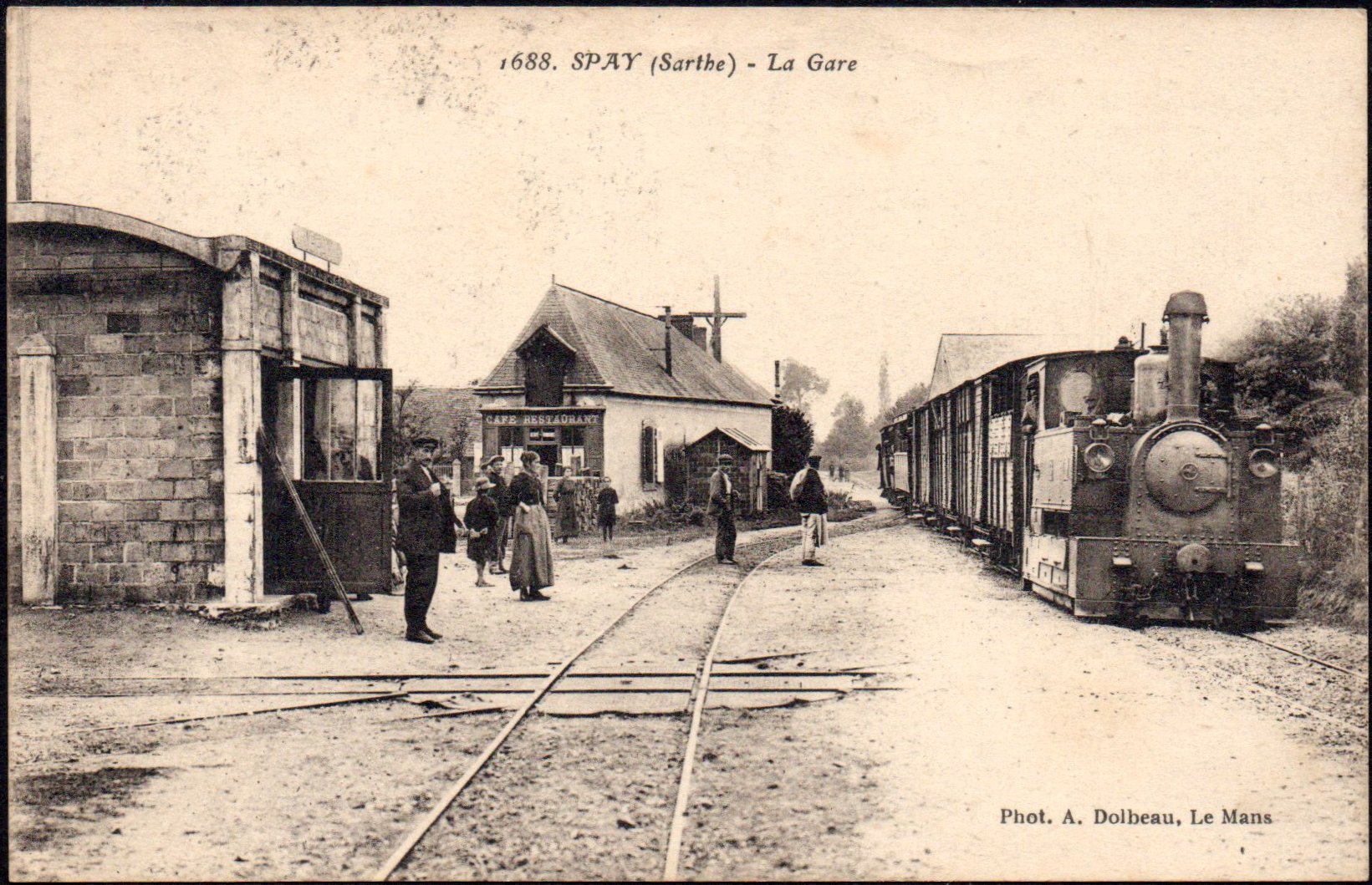 A superb view of the Gare de Spay on the Le Mans - Cérans-Foulletourte section of the Mayet / La Flèche lines.
Nostalgia ..... 2 ..... The tramways slowly overtaken by time:
A superb view of the Gare de Spay on the Le Mans - Cérans-Foulletourte section of the Mayet / La Flèche lines.
Nostalgia ..... 2 ..... The tramways slowly overtaken by time:
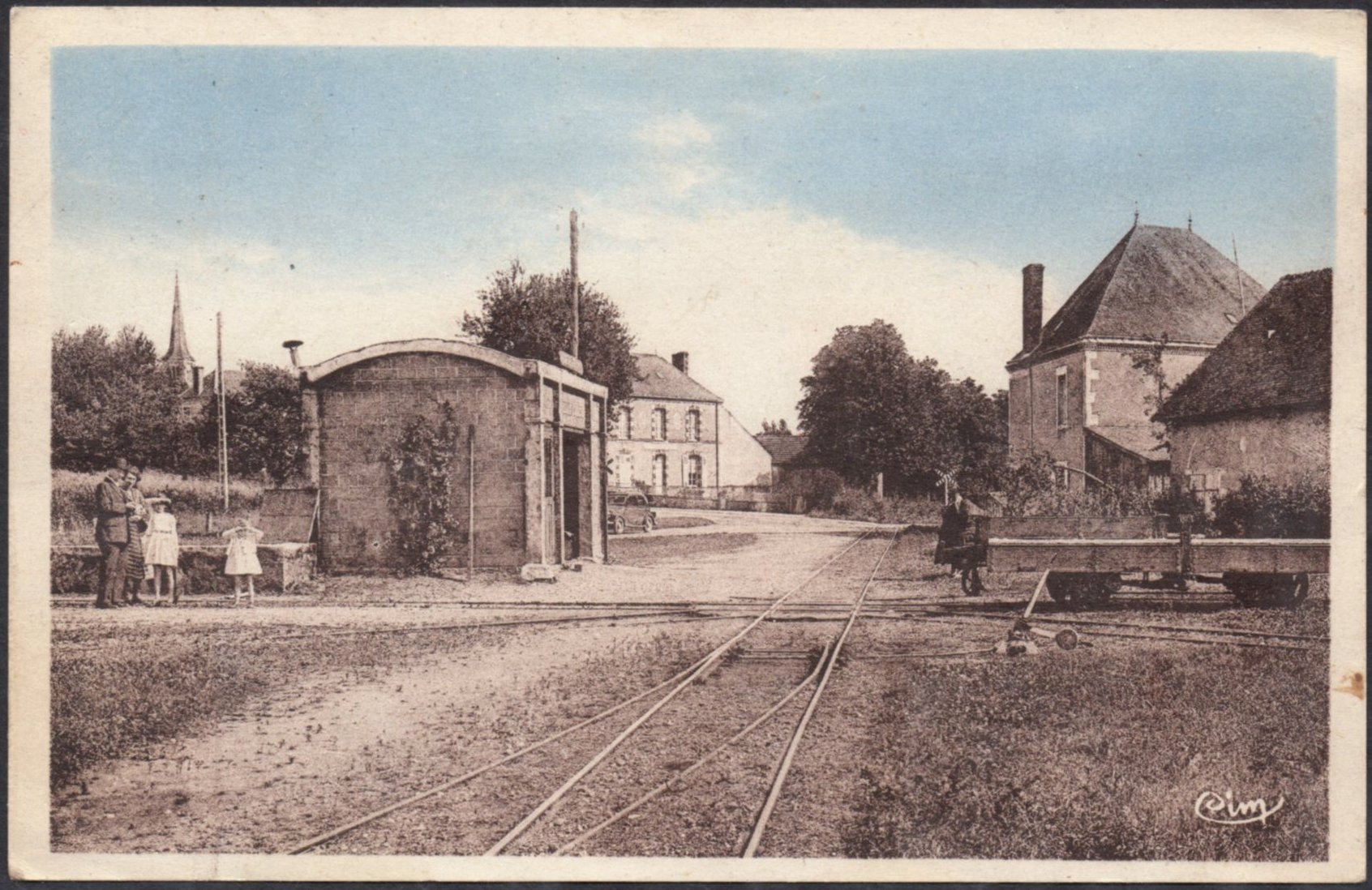 Nogent-le-Bernard: There is somehow a forlorn feel to this view, despite the presence of a family; one rather doubts that they are waiting for the tram. The postcard is in a style of the 1930s with a car, probably that of the photographer, in the background. However, it was posted in September 1951, 4½ years after the Mamers line closed; one wonders what reminiscences may have been stirred in the sender's mind.
Other T.S. Lines
Just to complete the round-up of Sarthois CCL cancellations and Les Tramways de la Sarthe, we list below T.S. routes for which no CCL cancellation is reported - and therefore for which, almost certainly, none exist.
Fresnay-sur-Sarthe à Alençon
La Ferté-Bernard à Montmirail (extension of La Détourbe branch, discussed higher up)
Le Grand-Lucé à Saint-Calais
Le Mans à Ségrie
Saint Jean d'Assé - Montbizot - Ballon
Nogent-le-Bernard: There is somehow a forlorn feel to this view, despite the presence of a family; one rather doubts that they are waiting for the tram. The postcard is in a style of the 1930s with a car, probably that of the photographer, in the background. However, it was posted in September 1951, 4½ years after the Mamers line closed; one wonders what reminiscences may have been stirred in the sender's mind.
Other T.S. Lines
Just to complete the round-up of Sarthois CCL cancellations and Les Tramways de la Sarthe, we list below T.S. routes for which no CCL cancellation is reported - and therefore for which, almost certainly, none exist.
Fresnay-sur-Sarthe à Alençon
La Ferté-Bernard à Montmirail (extension of La Détourbe branch, discussed higher up)
Le Grand-Lucé à Saint-Calais
Le Mans à Ségrie
Saint Jean d'Assé - Montbizot - Ballon
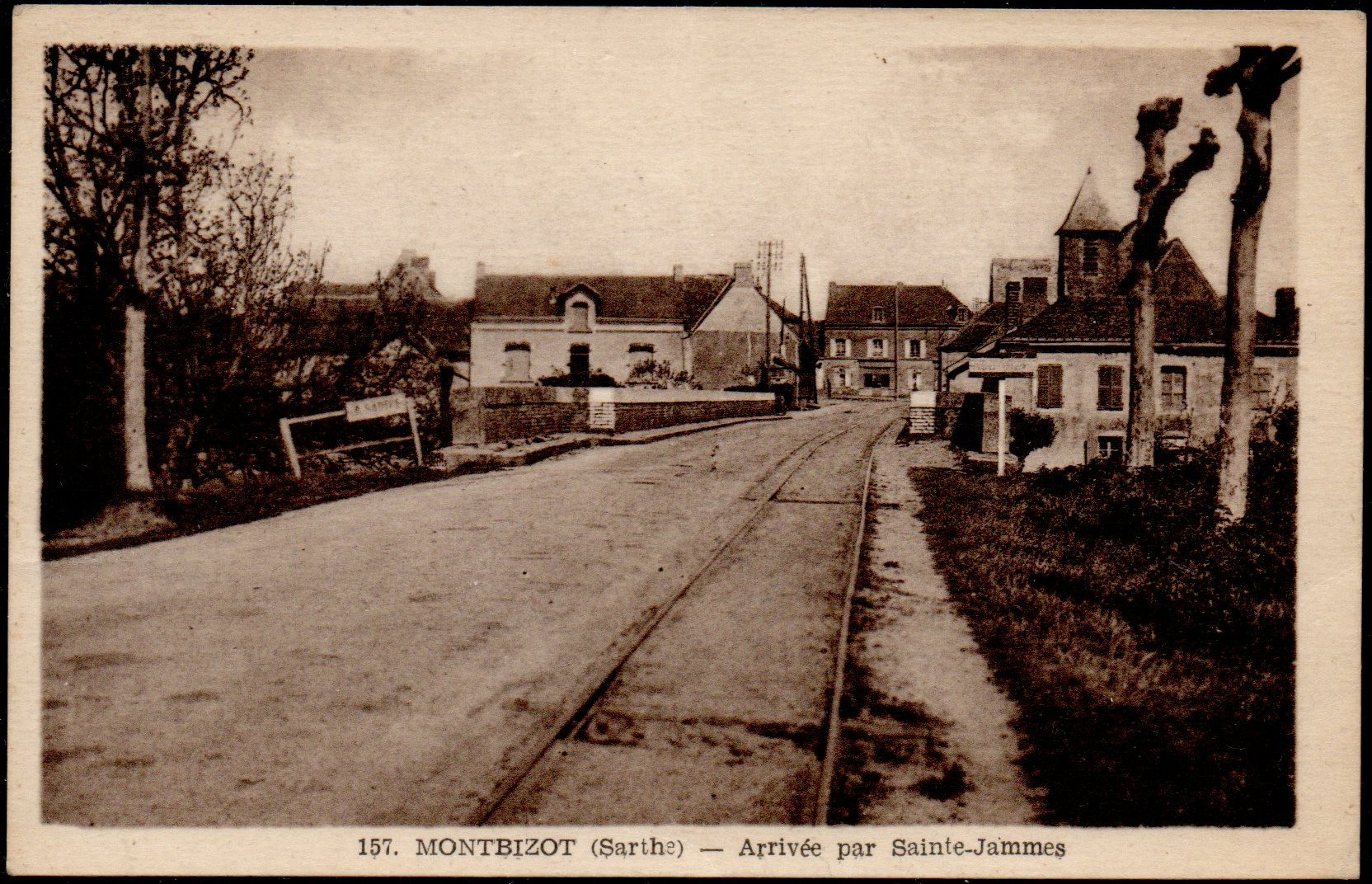 In the main article, we showed an early view (c.1910) of the tram tracks next to the railway station in Montbizot. Above is a post-WWII view showing the tracks at the other end of the village, still used by an occasional freight tram, and still steam-hauled at this date. It was posted in May 1950, by airmail to Morocco with the military sender commenting 'Retour cet après-midi hélas!' (returning this afternoon, sadly!). 40 years of rapid transport evolution but this freight-only steam tramway, isolated now from any network, was still soldiering on!
.
.
5. Modern Cinderella Stamps of the Pont en X & the former Tramways de la Sarthe network.
These stamps are mentioned briefly in the main article. Here, we provide extensive detail about them and, subject unsold, offer some of them for sale.
These cinderellas were produced in 2022 or 2023 to mark the centenary of the celebrated Le Mans 24-hour motor race, the 125th anniversary of the Pont en X and the 75th anniversary of the demise of the Tramways de la Sarthe. They are five basic designs plus variations on them, printed on ungummed paper, in quite a complex sheet format producing the following:
Designs 1-4 (numbers added to scan - in blue - for ease of reference):
In the main article, we showed an early view (c.1910) of the tram tracks next to the railway station in Montbizot. Above is a post-WWII view showing the tracks at the other end of the village, still used by an occasional freight tram, and still steam-hauled at this date. It was posted in May 1950, by airmail to Morocco with the military sender commenting 'Retour cet après-midi hélas!' (returning this afternoon, sadly!). 40 years of rapid transport evolution but this freight-only steam tramway, isolated now from any network, was still soldiering on!
.
.
5. Modern Cinderella Stamps of the Pont en X & the former Tramways de la Sarthe network.
These stamps are mentioned briefly in the main article. Here, we provide extensive detail about them and, subject unsold, offer some of them for sale.
These cinderellas were produced in 2022 or 2023 to mark the centenary of the celebrated Le Mans 24-hour motor race, the 125th anniversary of the Pont en X and the 75th anniversary of the demise of the Tramways de la Sarthe. They are five basic designs plus variations on them, printed on ungummed paper, in quite a complex sheet format producing the following:
Designs 1-4 (numbers added to scan - in blue - for ease of reference):
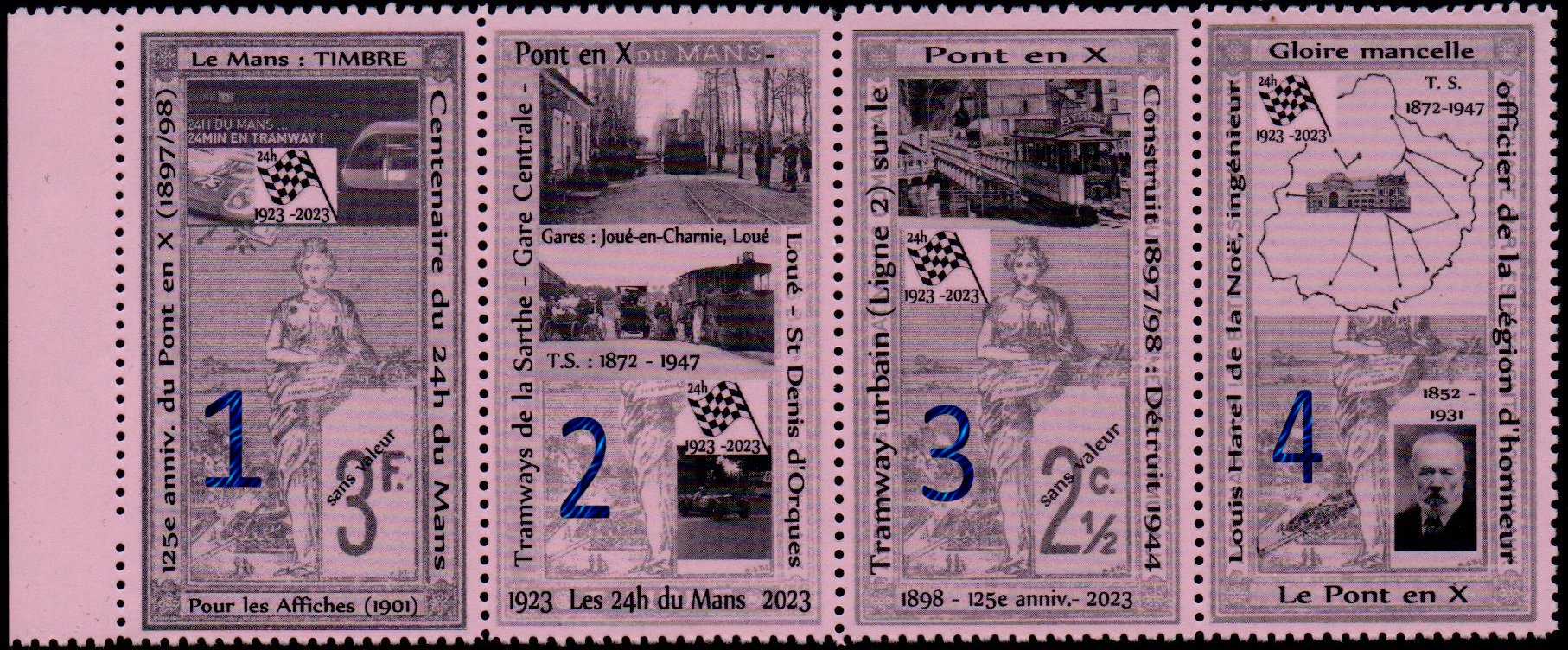 All four stamps show the Pont en X and the Le Mans 24h flag. Additional design content as follows:
Stamp #1 : Modern Le Mans tramcar.
Stamp #2 : 75th Anniversary of the Tramways de la Sarthe; Gare de Joué-en-Charnie; Gare de Loué.
Stamp #3 : Le Mans city electric tramcar on the Pont en X.
Stamp #4 : Harel de la Noë, Gare Centrale and Map of T.S. network.
Pane Arrangement:
All four stamps show the Pont en X and the Le Mans 24h flag. Additional design content as follows:
Stamp #1 : Modern Le Mans tramcar.
Stamp #2 : 75th Anniversary of the Tramways de la Sarthe; Gare de Joué-en-Charnie; Gare de Loué.
Stamp #3 : Le Mans city electric tramcar on the Pont en X.
Stamp #4 : Harel de la Noë, Gare Centrale and Map of T.S. network.
Pane Arrangement:
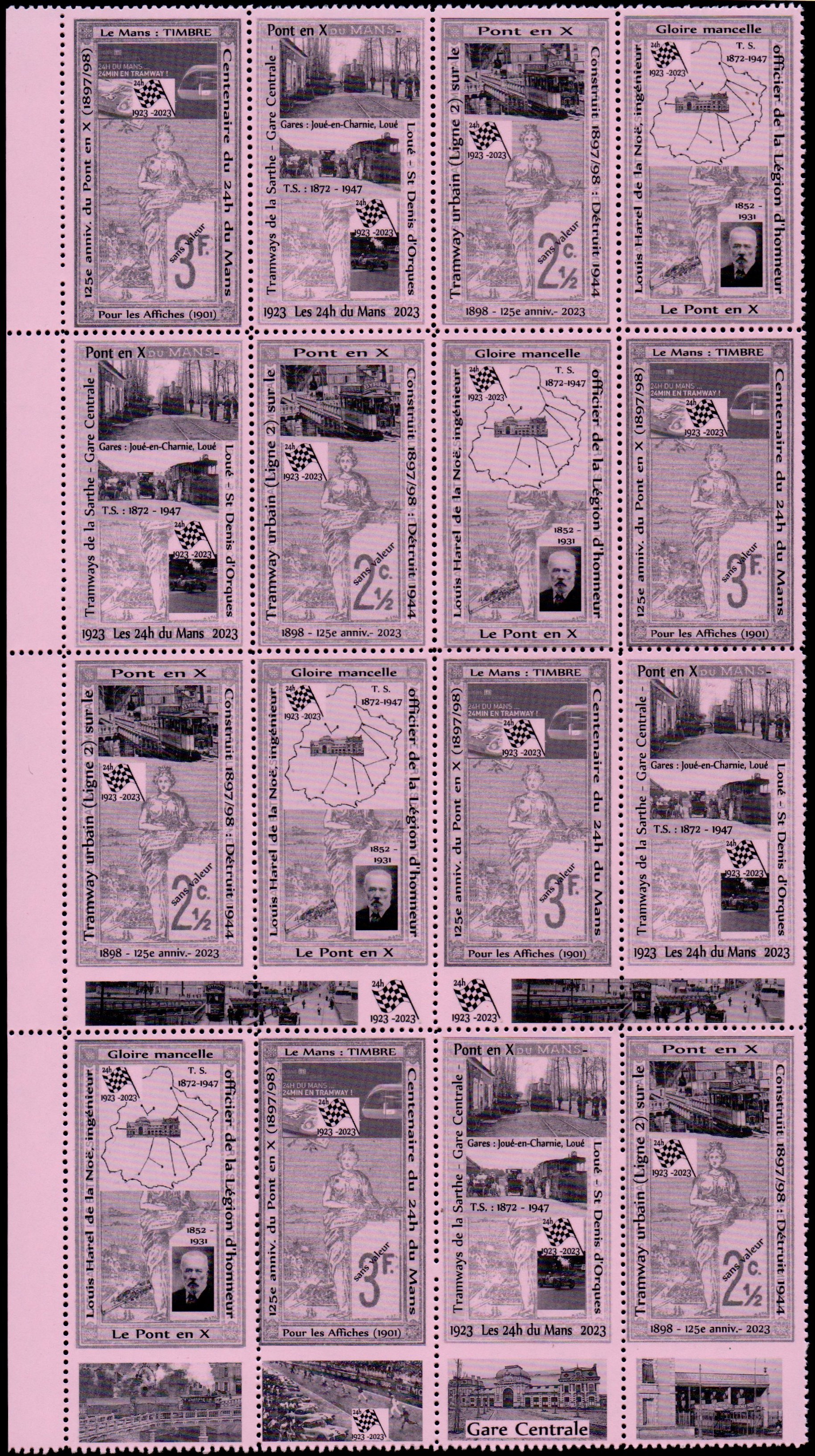 1-2-3-4 arrangement
2-3-4-1
3-4-1-2 + long thin labels (2 of the same labels, perforated through the centre)
4-1-2-3 + taller labels (4 different labels)
Enlarged: The labels, always integral to the stamp above it, (i.e. not separated by perfs) :
1-2-3-4 arrangement
2-3-4-1
3-4-1-2 + long thin labels (2 of the same labels, perforated through the centre)
4-1-2-3 + taller labels (4 different labels)
Enlarged: The labels, always integral to the stamp above it, (i.e. not separated by perfs) :
 Electric tram on Pont en X and the Pont Yssoir (below the third row of stamps).
 The four labels below the 4th row of stamps:
1. Pont en X & steam tram. 2. Start of Le Mans race. 3. T.S. Gare Centrale. 4. Le Mans tram depot (city trams).
Designs 1-4 in Perf miniature sheet; Designs 1-5 in imperforate miniature sheet + label:
The four labels below the 4th row of stamps:
1. Pont en X & steam tram. 2. Start of Le Mans race. 3. T.S. Gare Centrale. 4. Le Mans tram depot (city trams).
Designs 1-4 in Perf miniature sheet; Designs 1-5 in imperforate miniature sheet + label:
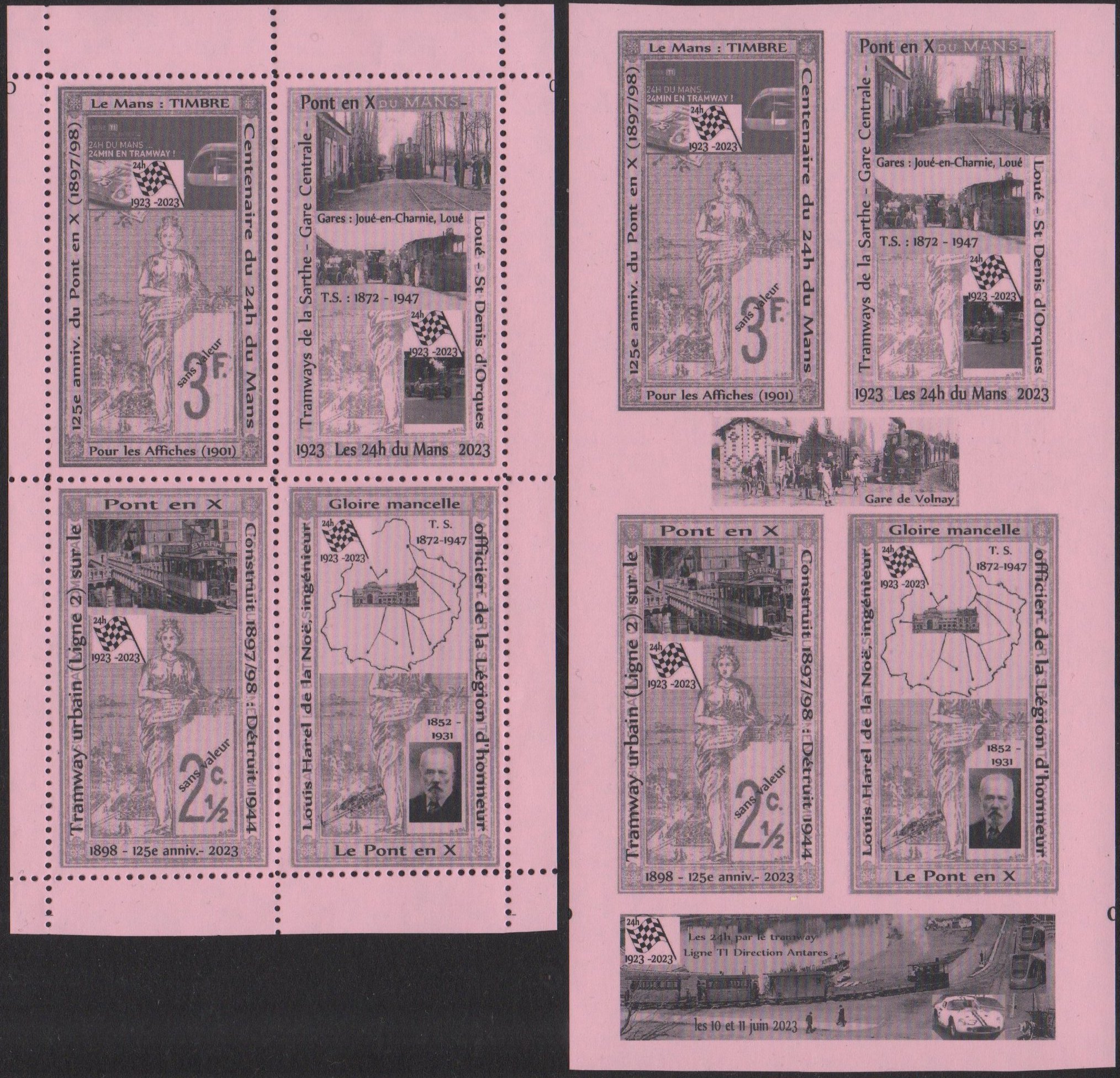 Central label on imperforate m/s shows the Gare de Volnay (T.S.)
Designs 1-4 in tête-bêche pairs :
Central label on imperforate m/s shows the Gare de Volnay (T.S.)
Designs 1-4 in tête-bêche pairs :
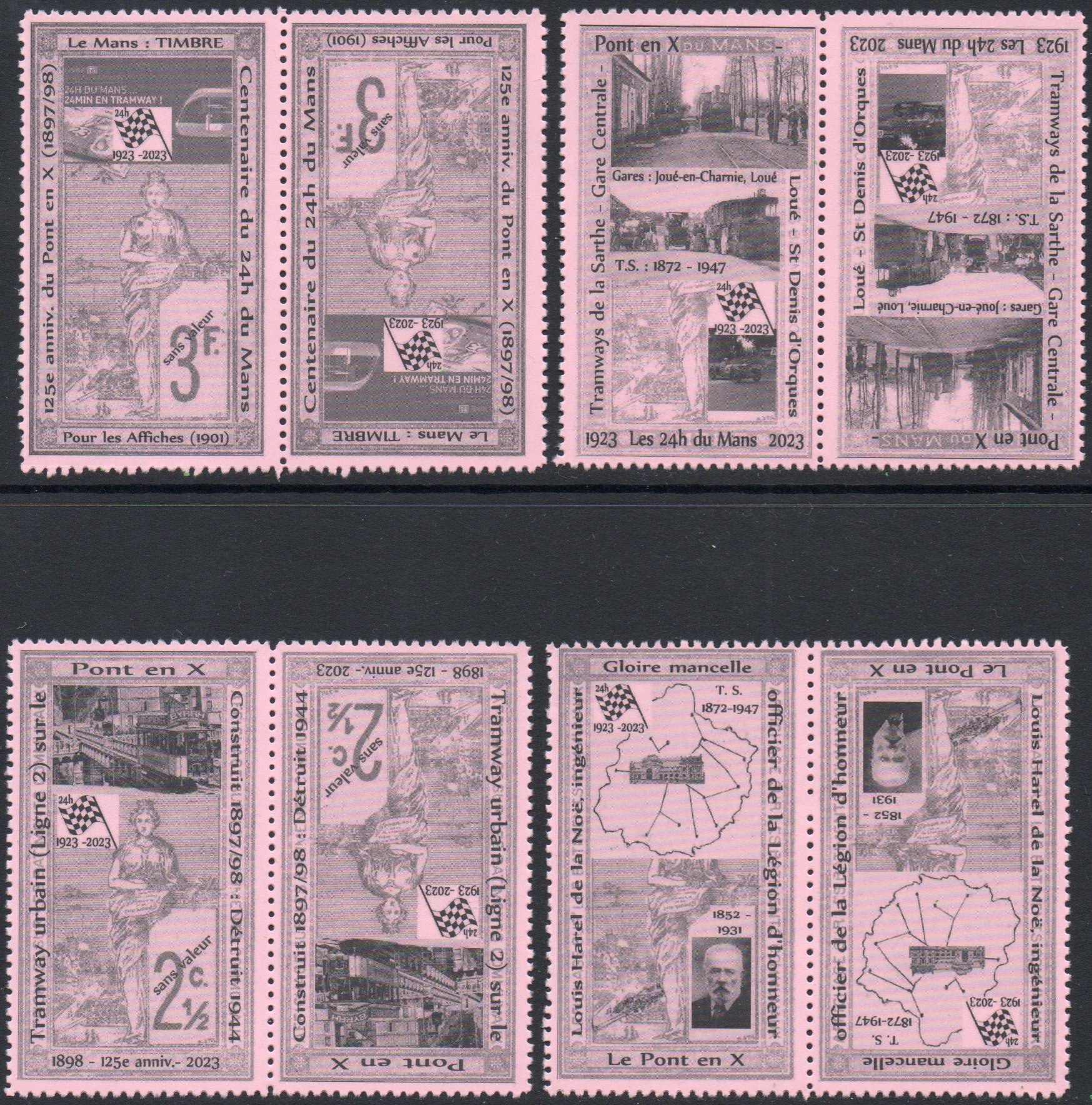 Stamps are the same size, image reduced. Design 5 does not exist in tête-bêche pairs.
Design 5 :
Stamps are the same size, image reduced. Design 5 does not exist in tête-bêche pairs.
Design 5 :
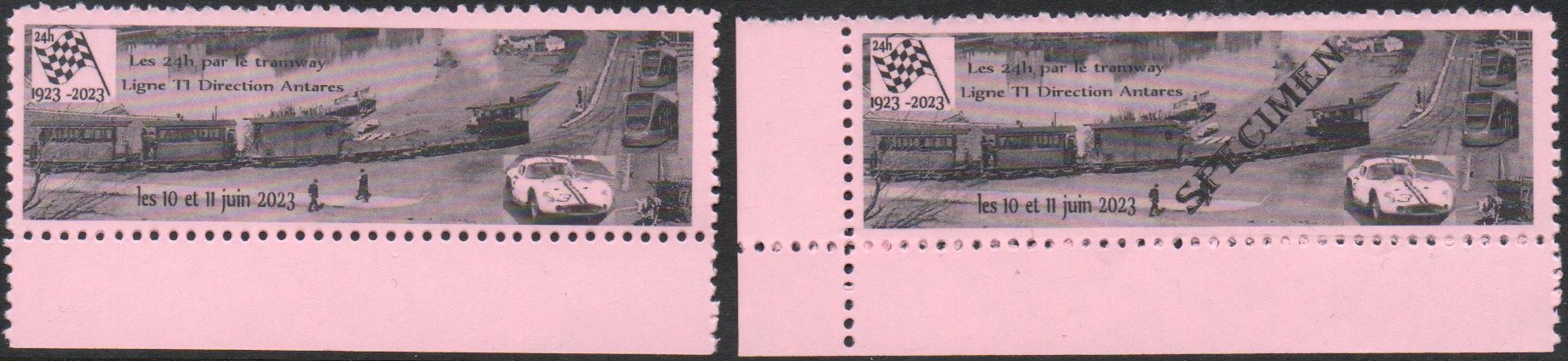 Left: Design #5. . . Right: Design #5S (the word SPECIMEN is integral to the stamp, not added later).
Design of #5 & #5S : T.S. steam tram approaching La Gare Centrale (in a location often called the Port of Le Mans), with superimposed racing car and modern trams at right.
Designs 2A & 4A : Larger stamps :
Left: Design #5. . . Right: Design #5S (the word SPECIMEN is integral to the stamp, not added later).
Design of #5 & #5S : T.S. steam tram approaching La Gare Centrale (in a location often called the Port of Le Mans), with superimposed racing car and modern trams at right.
Designs 2A & 4A : Larger stamps :
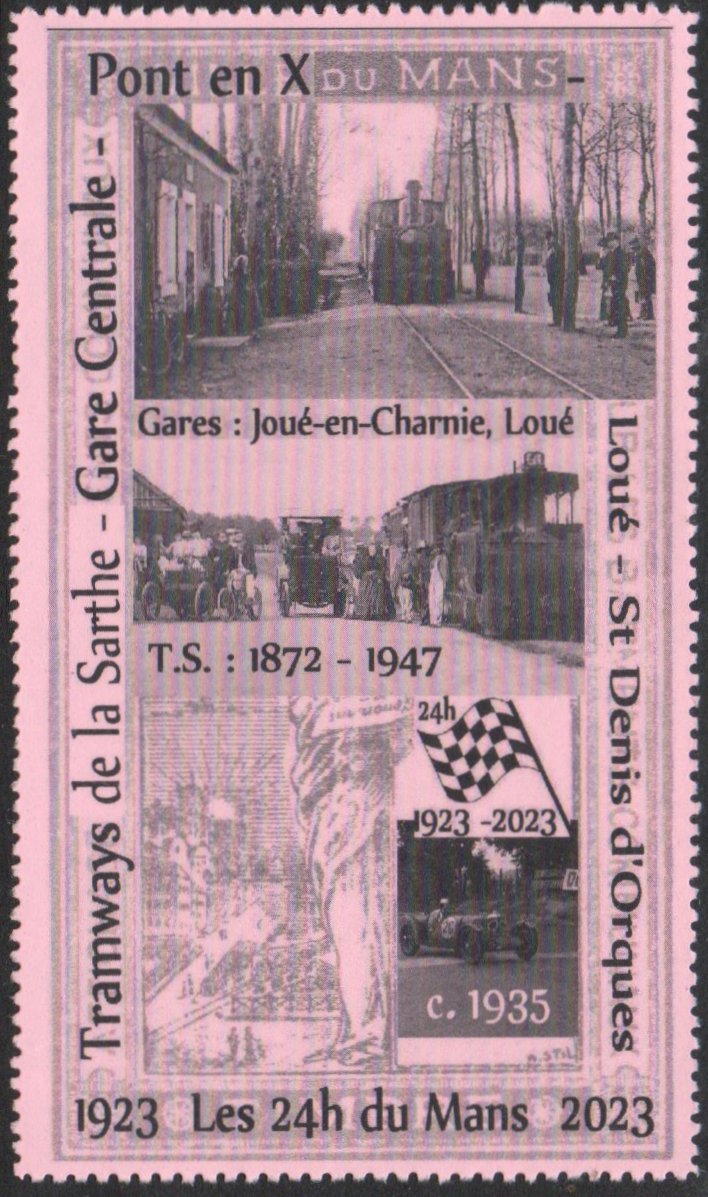
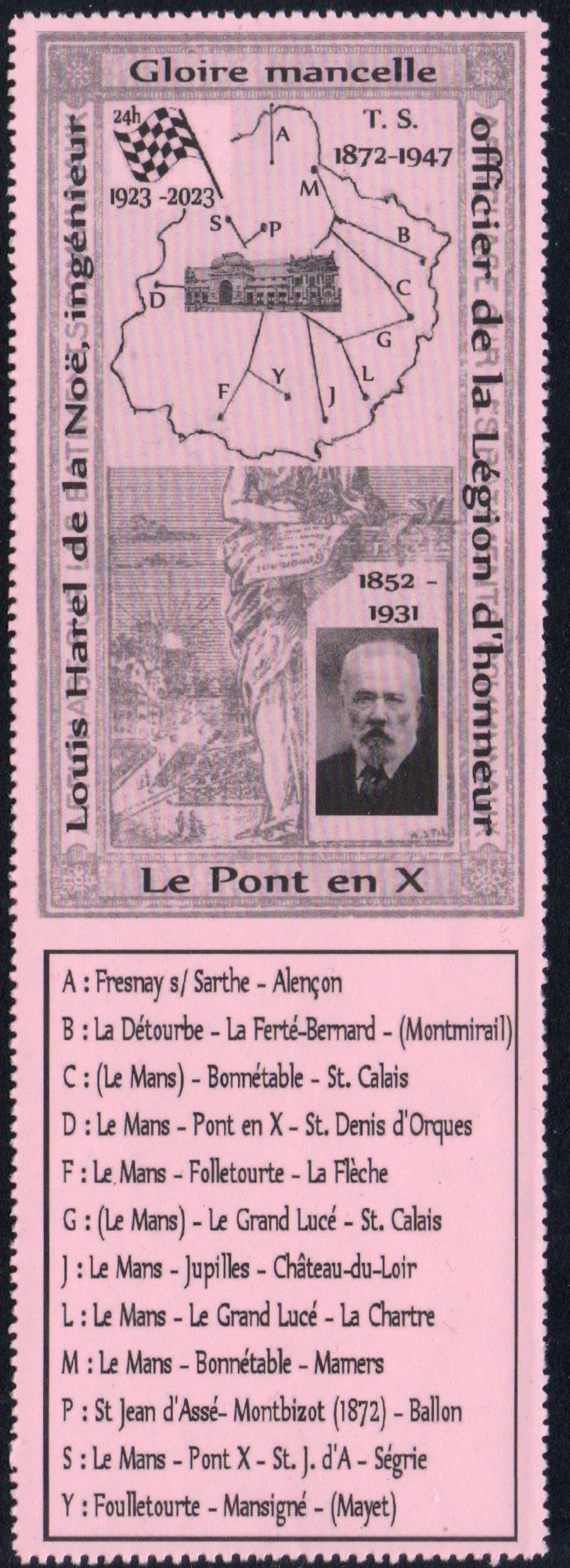 Designs :
Stamp #2A : Larger than #2 and some small design variations, such as 'de la Sarthe' in left margin on a clear background.
Stamp #4A : Design 4 has code letters representing the Tramways de la Sarthe termini added to the map, with a key to the codes tacked on below. The building in the middle of the map is the system hub, the Gare Centrale of the T.S. in Le Mans. There is an error on this stamp, line 'C' Bonnétable to St. Calais was a railway, not part of the T.S. network. We see no reason to have (Mayet) in brackets.
.
Sheet Format:
Each full sheet contains:
4 strips of Designs #1 to #4 (as shown above, some with labels)
1 set/4 tête-bêche pairs (Designs #1 to #4)
4 stamps in Design #5
1 stamp in Design #5S (inscribed SPECIMEN)
1 perforated miniature sheet
1 imperforate miniature sheet (with label)
1 #2A (98 mms rather than 60 mms high)
1 #4A (with integral label, 162 mms rather than 60 mms high)
You will note from the sheet contents description above that several stamps only occur once in an entire sheet.
.
Ink and Paper Colour Combinations of these stamps :
We know of 12 different combinations of print colour and paper that have been released. We also know the print quantities for these, which we describe below in terms of full sheets printed. Some of the ink / paper combinations have very small printings, as low as ten sheets, with the result that only a maximum of ten examples can exist for quite a few of these stamps!
We have provided a check list in table format below of these 12 colour combinations; the colours in italics are the PAPER colours, e.g. Black /rose means printed in Black on Rose Paper. The second column indicates the print run of full sheets for that ink / paper combination.
Abbreviation Code for the Table:
Run : Print Run (of sheets) for that ink / paper combination
#1-4 : strip/4 (#1-4) without label. (format #1-2-3-4 or #2-3-4-1)
1-4s : #1-4 with small label; 1-4L : #1-4 with Large label
TB4 : tête-bêche pairs (one check box for the set/4 pairs)
D#5 : Long thin design (#5) D5S : The same but with 'Specimen'
Pms and Ims : Perf and Imperf miniature sheets
#2A and #4A : As described above.
Designs :
Stamp #2A : Larger than #2 and some small design variations, such as 'de la Sarthe' in left margin on a clear background.
Stamp #4A : Design 4 has code letters representing the Tramways de la Sarthe termini added to the map, with a key to the codes tacked on below. The building in the middle of the map is the system hub, the Gare Centrale of the T.S. in Le Mans. There is an error on this stamp, line 'C' Bonnétable to St. Calais was a railway, not part of the T.S. network. We see no reason to have (Mayet) in brackets.
.
Sheet Format:
Each full sheet contains:
4 strips of Designs #1 to #4 (as shown above, some with labels)
1 set/4 tête-bêche pairs (Designs #1 to #4)
4 stamps in Design #5
1 stamp in Design #5S (inscribed SPECIMEN)
1 perforated miniature sheet
1 imperforate miniature sheet (with label)
1 #2A (98 mms rather than 60 mms high)
1 #4A (with integral label, 162 mms rather than 60 mms high)
You will note from the sheet contents description above that several stamps only occur once in an entire sheet.
.
Ink and Paper Colour Combinations of these stamps :
We know of 12 different combinations of print colour and paper that have been released. We also know the print quantities for these, which we describe below in terms of full sheets printed. Some of the ink / paper combinations have very small printings, as low as ten sheets, with the result that only a maximum of ten examples can exist for quite a few of these stamps!
We have provided a check list in table format below of these 12 colour combinations; the colours in italics are the PAPER colours, e.g. Black /rose means printed in Black on Rose Paper. The second column indicates the print run of full sheets for that ink / paper combination.
Abbreviation Code for the Table:
Run : Print Run (of sheets) for that ink / paper combination
#1-4 : strip/4 (#1-4) without label. (format #1-2-3-4 or #2-3-4-1)
1-4s : #1-4 with small label; 1-4L : #1-4 with Large label
TB4 : tête-bêche pairs (one check box for the set/4 pairs)
D#5 : Long thin design (#5) D5S : The same but with 'Specimen'
Pms and Ims : Perf and Imperf miniature sheets
#2A and #4A : As described above.
| Ink / paper |
Run |
#1-4 |
1-4s |
1-4L |
TB4 |
D#5 |
D5S |
Pms |
Ims |
#2A |
#4A |
| Black / white |
175 |
[ . ] |
[ . ] |
[ . ] |
[ . ] |
[ . ] |
[ . ] |
[ . ] |
[ . ] |
[ . ] |
[ . ] |
| Grey-Green / white |
30 |
[ . ] |
[ . ] |
[ . ] |
[ . ] |
[ . ] |
[ . ] |
[ . ] |
[ . ] |
[ . ] |
[ . ] |
| Blue/ white |
42 |
[ . ] |
[ . ] |
[ . ] |
[ . ] |
[ . ] |
[ . ] |
[ . ] |
[ . ] |
[ . ] |
[ . ] |
| Black / yellow |
23 |
[ . ] |
[ . ] |
[ . ] |
[ . ] |
[ . ] |
[ . ] |
[ . ] |
[ . ] |
[ . ] |
[ . ] |
| Black / rose |
20 |
[ . ] |
[ . ] |
[ . ] |
[ . ] |
[ . ] |
[ . ] |
[ . ] |
[ . ] |
[ . ] |
[ . ] |
| Black / blue |
10 |
[ . ] |
[ . ] |
[ . ] |
[ . ] |
[ . ] |
[ . ] |
[ . ] |
[ . ] |
[ . ] |
[ . ] |
| Black / pale green* |
10 |
[ . ] |
[ . ] |
[ . ] |
[ . ] |
[ . ] |
[ . ] |
[ . ] |
[ . ] |
[ . ] |
[ . ] |
| Black / emerald |
10 |
[ . ] |
[ . ] |
[ . ] |
[ . ] |
[ . ] |
[ . ] |
[ . ] |
[ . ] |
[ . ] |
[ . ] |
| Blue / yellow |
12 |
[ . ] |
[ . ] |
[ . ] |
[ . ] |
[ . ] |
[ . ] |
[ . ] |
[ . ] |
[ . ] |
[ . ] |
| Blue / rose |
10 |
[ . ] |
[ . ] |
[ . ] |
[ . ] |
[ . ] |
[ . ] |
[ . ] |
[ . ] |
[ . ] |
[ . ] |
| Blue / blue |
20 |
[ . ] |
[ . ] |
[ . ] |
[ . ] |
[ . ] |
[ . ] |
[ . ] |
[ . ] |
[ . ] |
[ . ] |
| Blue / pale green* |
20 |
[ . ] |
[ . ] |
[ . ] |
[ . ] |
[ . ] |
[ . ] |
[ . ] |
[ . ] |
[ . ] |
[ . ] |
Ink / paper |
Run |
#1-4 |
1-4s |
1-4L |
TB4 |
D#5 |
D5S |
Pms |
Ims |
#2A |
#4A |
* The 'pale green' paper is very thick.
.
Retail Sales of the above :
At the time of writing, we could provide all of the above stamps, some available in tiny quantities (as low as 'three'). Subject unsold, they are available at the following prices (postage extra, with or without insurance, by agreement). Prices are in Pounds Sterling. Minimum order £6.00 please. (Link to Payment Terms & Conditions on the Home Page).
A horizontal line in the table contains all the stamp designs and arrangements available in that ink/paper colour combination. We have two options for a 'set' from each horizontal line, named 'SET' and 'SET-p', differing only in what is included from columns headed by Roman numerals i-iv.
SET : This option includes #1-4, #1-4s & #1-4L. We would typically send these se-tenant (viz. rows 2-4 of the pane/16).
SET-p : This option adds one more strip of #1-4 to the above, so that you receive se-tenant panes/16 of stamps #1-4 (column iv in the table) instead of #1-4, 1-4s & 1-4L (columns i-iii).
Both SET and SET-p include the columns with Roman numerals v-x.
The set prices are typically priced at only about 60%-70% of the sum of individual items in the row.
For any ink/paper combination with a print run of 12 or lower, there is a limit of one SET or SET-p per person.
| ColumnIdentifier |
|
i |
ii |
iii |
iv |
v |
vi |
vii |
viii |
viii |
ix |
x |
xi |
xii |
Prices in Sterling |
Print Run |
#1-4 |
1-4s |
1-4L |
1-4pane |
TB4 |
D#5 |
D5S |
Pms |
Ims |
#2A |
#4A |
SETi-iii, v-x |
SET-piv to x |
| Black / white |
175 |
0.25 |
0.50 |
0.50 |
2.00 |
1.25 |
0.25 |
0.50 |
1.25 |
1.50 |
1.00 |
1.50 |
£5.50 |
£6.00 |
| Grey-Green/white |
30 |
0.50 |
0.50 |
0.50 |
2.25 |
1.50 |
0.50 |
0.75 |
1.50 |
1.75 |
1.25 |
1.75 |
£6.75 |
£7.00 |
| Blue/ white |
42 |
0.50 |
0.50 |
0.50 |
2.25 |
1.50 |
0.25 |
0.50 |
1.50 |
1.50 |
1.25 |
1.50 |
£6.25 |
£6.75 |
| Black / yellow |
23 |
0.50 |
0.75 |
0.75 |
2.50 |
2.00 |
0.50 |
0.75 |
1.75 |
1.75 |
1.50 |
1.75 |
£8.75 |
£9.50 |
| Black / rose |
20 |
0.75 |
1.00 |
1.00 |
2.75 |
2.25 |
0.50 |
0.75 |
1.75 |
2.00 |
1.50 |
2.00 |
£9.50 |
£10.25 |
| Black / blue |
10 |
1.50 |
2.00 |
2.00 |
5.00 |
4.00 |
0.75 |
1.25 |
3.25 |
4.00 |
2.75 |
4.00 |
£15.00 |
£16.50 |
| Black / pale green* |
10 |
1.50 |
2.00 |
2.00 |
5.00 |
4.00 |
0.75 |
1.25 |
3.25 |
4.00 |
2.75 |
4.00 |
£15.00 |
£16.50 |
| Black / emerald |
10 |
1.50 |
2.00 |
2.00 |
5.00 |
4.00 |
0.75 |
1.25 |
3.25 |
4.00 |
2.75 |
4.00 |
£15.00 |
£16.50 |
| Blue / yellow |
12 |
1.25 |
1.75 |
1.75 |
4.50 |
3.75 |
0.75 |
1.25 |
3.00 |
3.50 |
2.75 |
3.50 |
£13.50 |
£14.50 |
| Blue / rose |
10 |
1.50 |
2.00 |
2.00 |
5.00 |
4.00 |
0.75 |
1.25 |
3.25 |
4.00 |
2.75 |
4.00 |
£15.00 |
£16.50 |
| Blue / blue |
20 |
0.75 |
1.00 |
1.00 |
2.75 |
2.25 |
0.50 |
0.75 |
1.75 |
2.00 |
1.50 |
2.00 |
£9.50 |
£10.25 |
| Blue / pale green* |
<20 |
0.75 |
1.00 |
1.00 |
2.75 |
2.25 |
0.50 |
0.75 |
1.75 |
2.00 |
1.50 |
2.00 |
£9.50 |
£10.25 |
Prices by Column |
-- |
£8.50Gp.1 |
|
|
|
|
£4.25Gp.2 |
|
|
|
|
|
£97.00Gp.3 |
£105.-Gp.4 |
Prices in Sterling |
PrintRun |
#1-4 |
1-4s |
1-4L |
Pane |
TB4 |
D#5 |
D5S |
Pms |
1-4pane |
#2A |
#4A |
SET |
SET-piv to x |
Prices per vertical column are special offers and provide very substantial savings:
Group Offer 1 (Gp.1) : is for a strip/4 (#1-4) of all twelve ink/paper combinations, either the first or second row (which have no labels attached). (48 stamps)
Group Offer 2 (Gp.2) : is for stamp #5, one each of the twelve ink / paper combinations. (12 stamps)
Group Offer 3 (Gp.3) : is for a full collection of all 12 'SETS' with the #1-4, 1-4s and 1-4L option, rather than the 1-4 Pane option. This adds up to 288 stamps and 24 miniature sheets (effectively 396 stamps).
Group Offer 4 (Gp.4) : This is for those who prefer Panes/16, the 'SET-p' option. It provides 336 stamps and 24 miniature sheets, effectively 444 stamps.
.
A few cancellations (CCL) FOR SALE :
We have a few surplus CCL from La Sarthe, acquired whilst researching this article, which we can offer below at the prices indicated (+ ordinary postage at cost price).
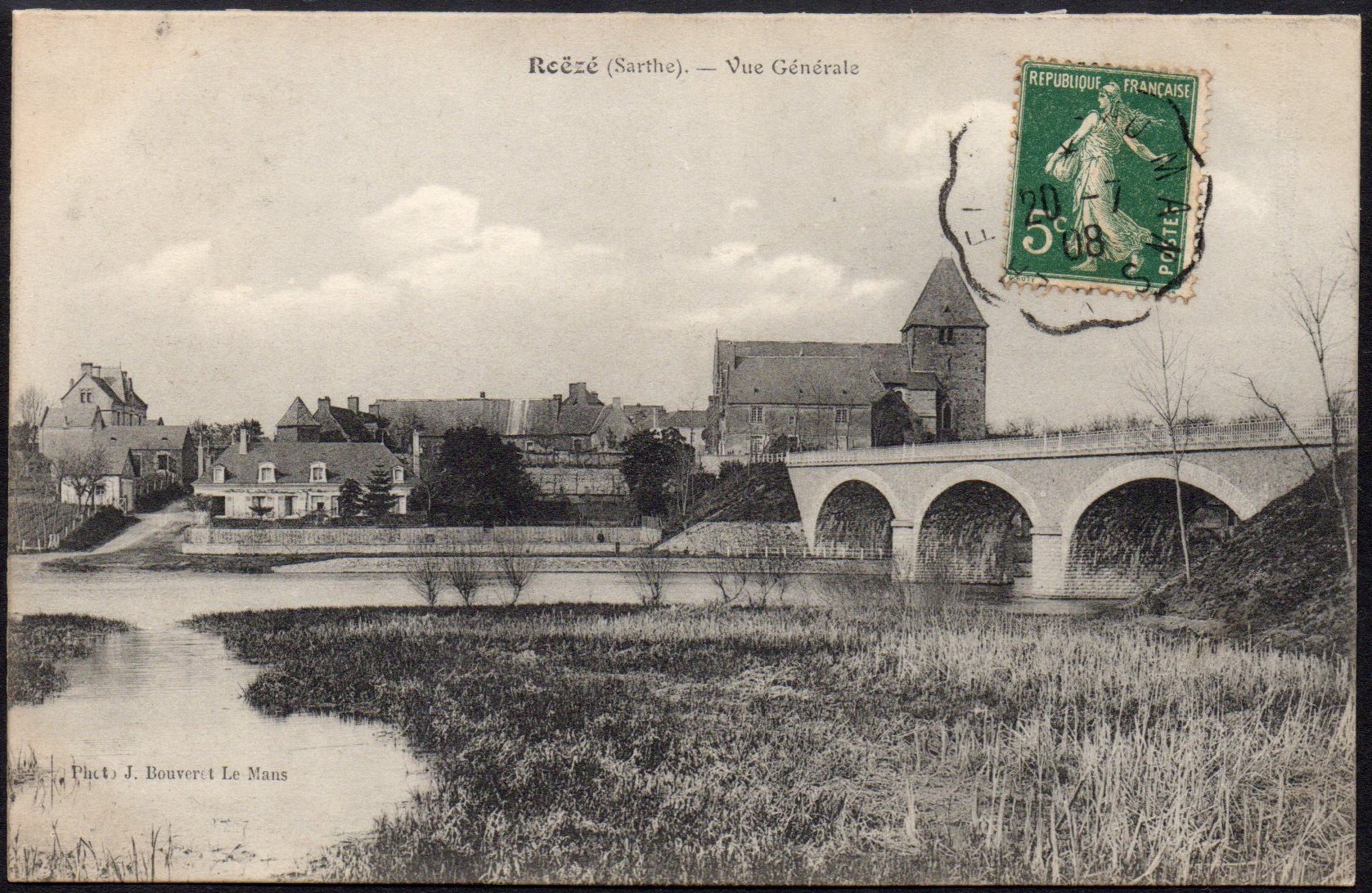
 Card of Roeze, Railway CCL (Type III) La Flèche au Mans 20/07/1908 £ 3.75
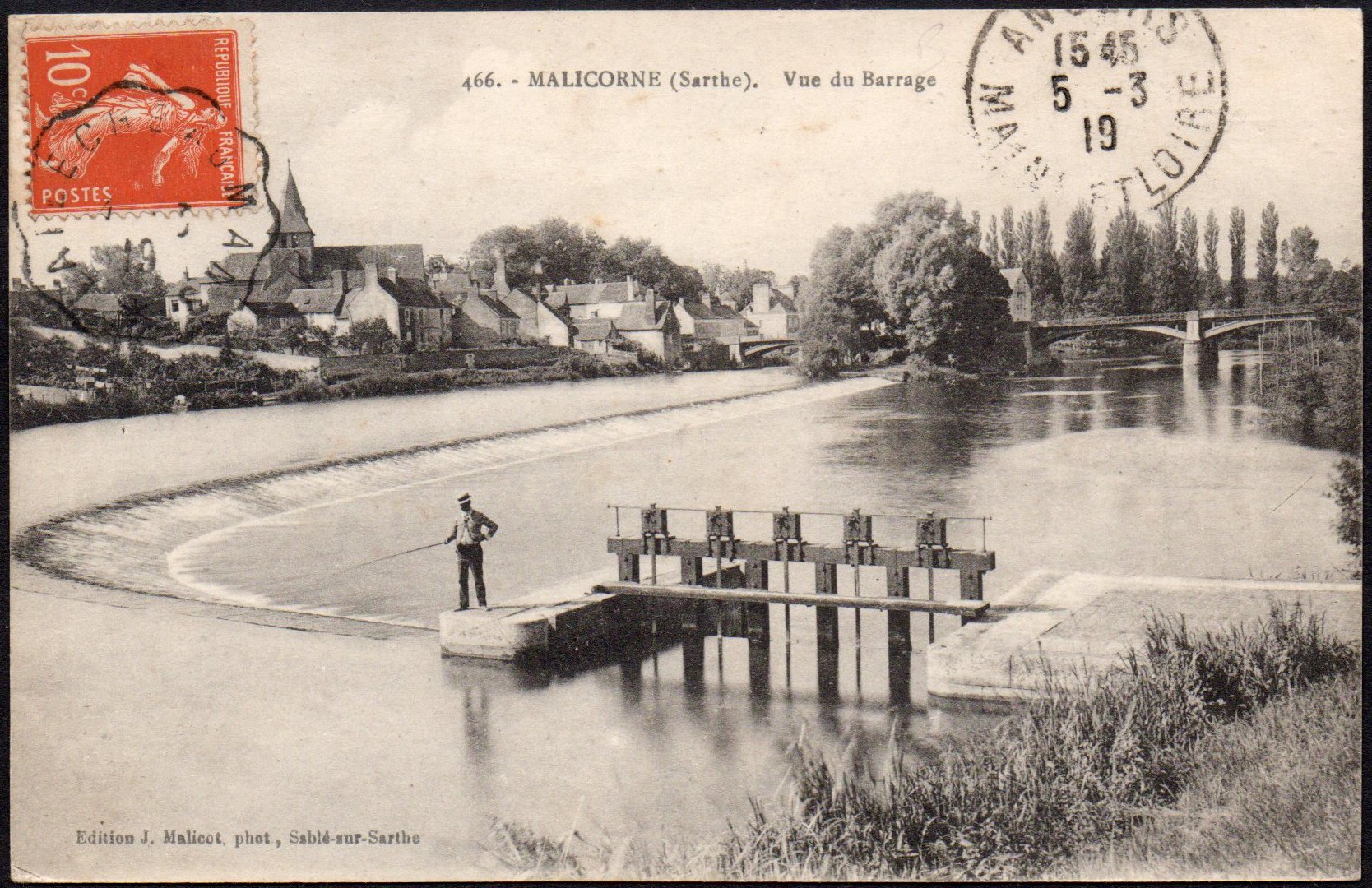
 Card of Malicorne, CCL La Flèche au Mans Type III 05/03/1919 : Card of a railway location and probably a railway CCL, but only a few kms from the tramway. £ 4.50
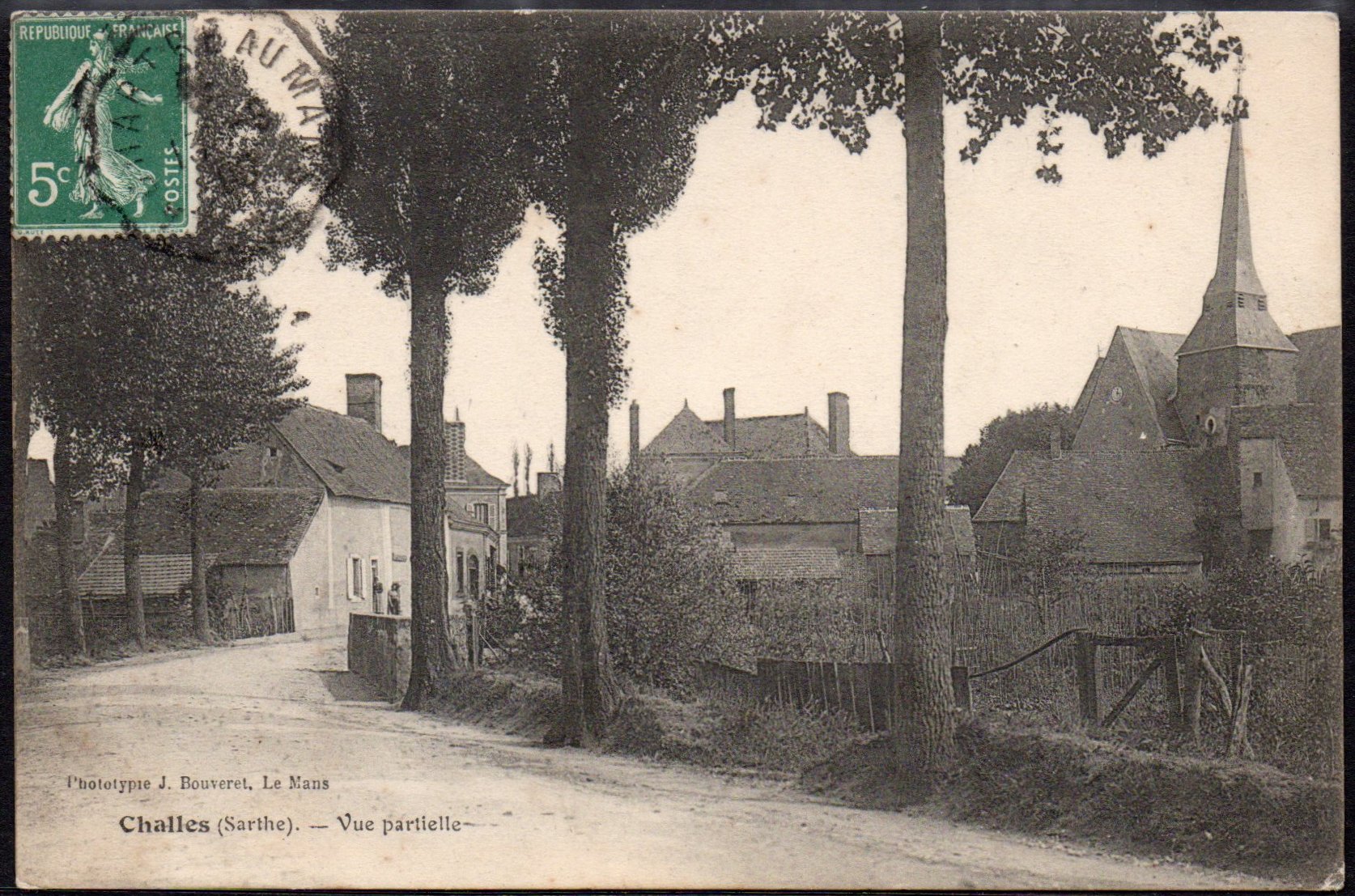
 Card of Challes, Tramway CCL (Type III) La Chartre au Mans 13/09/1908 £ 5.50
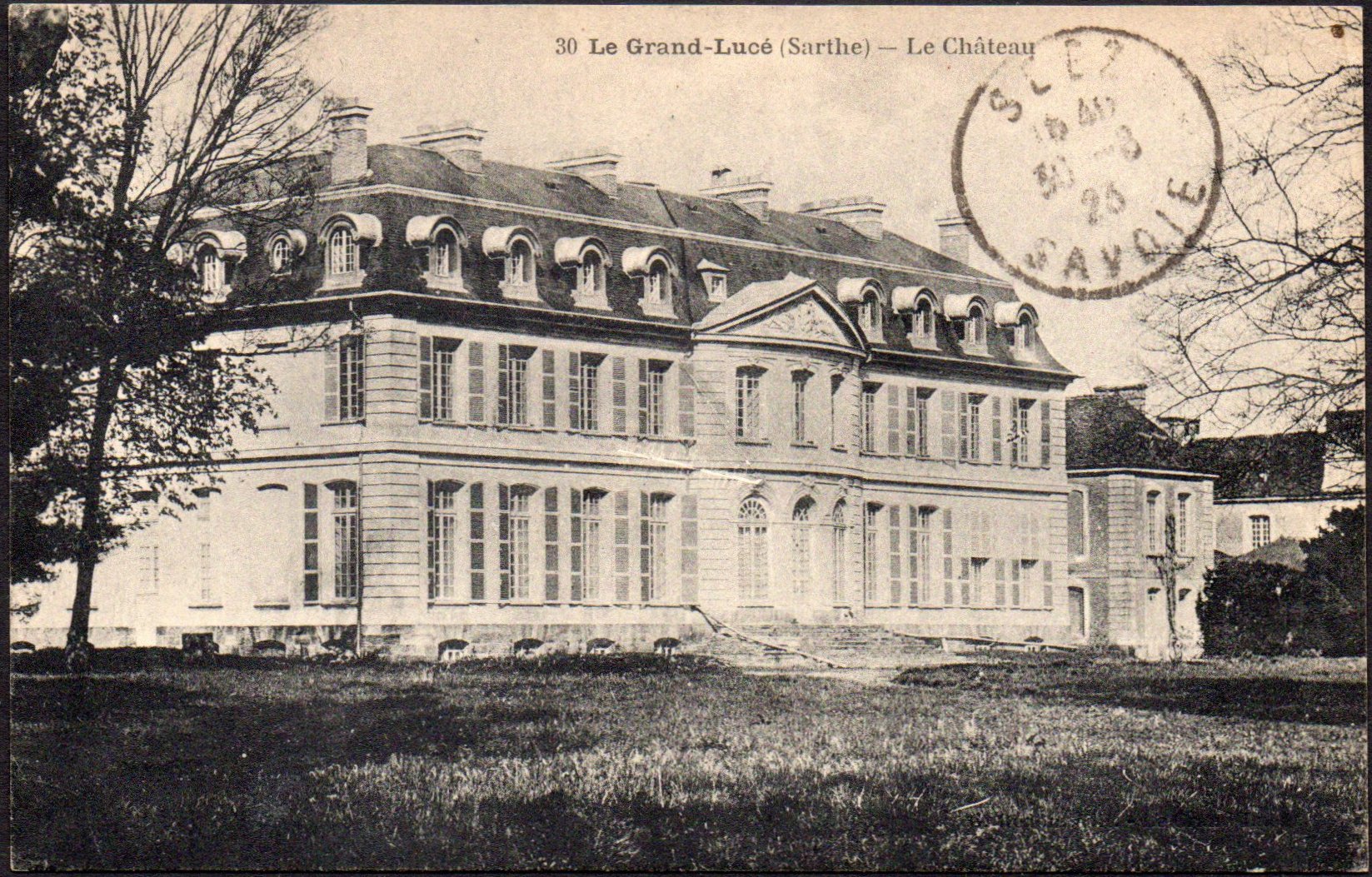
 Card of Le Grand-Lucé, Tramway CCL (Type III) La Chartre au Mans 28/04/1923 £ 2.25
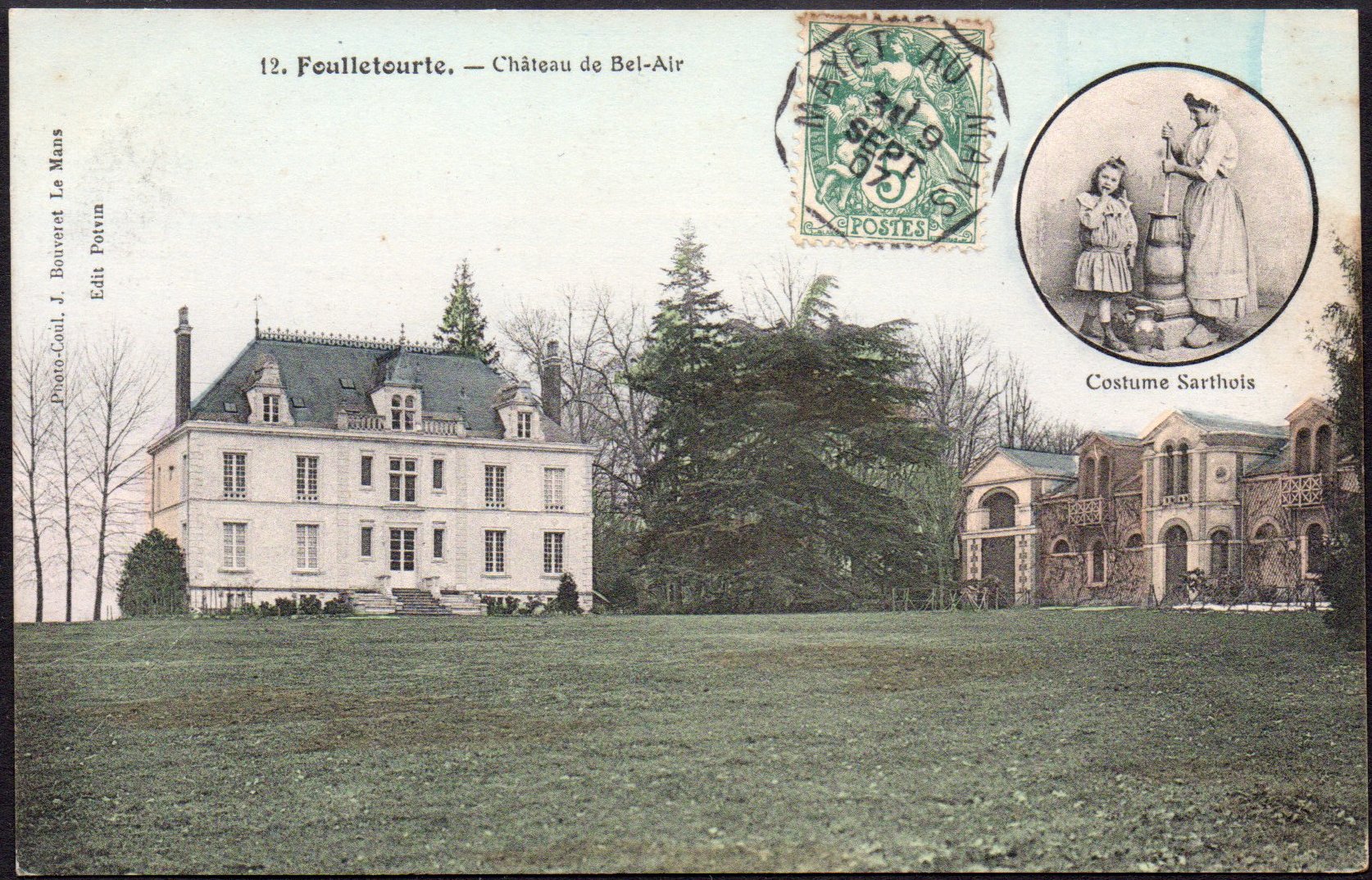
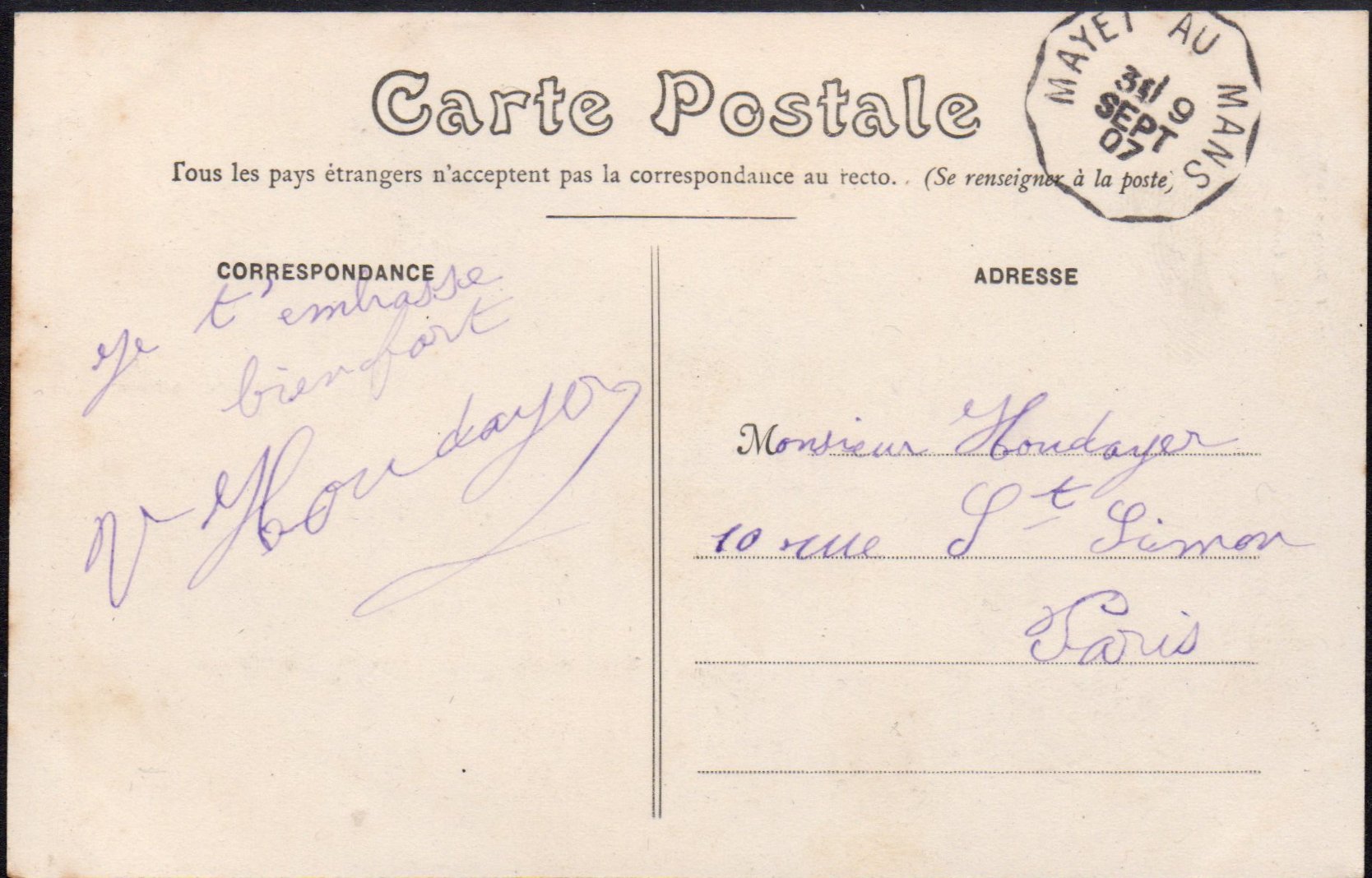 Card of Foulletourte, Tramway CCL (Type II) Mayet au Mans 09/09/1907 £ 3.00
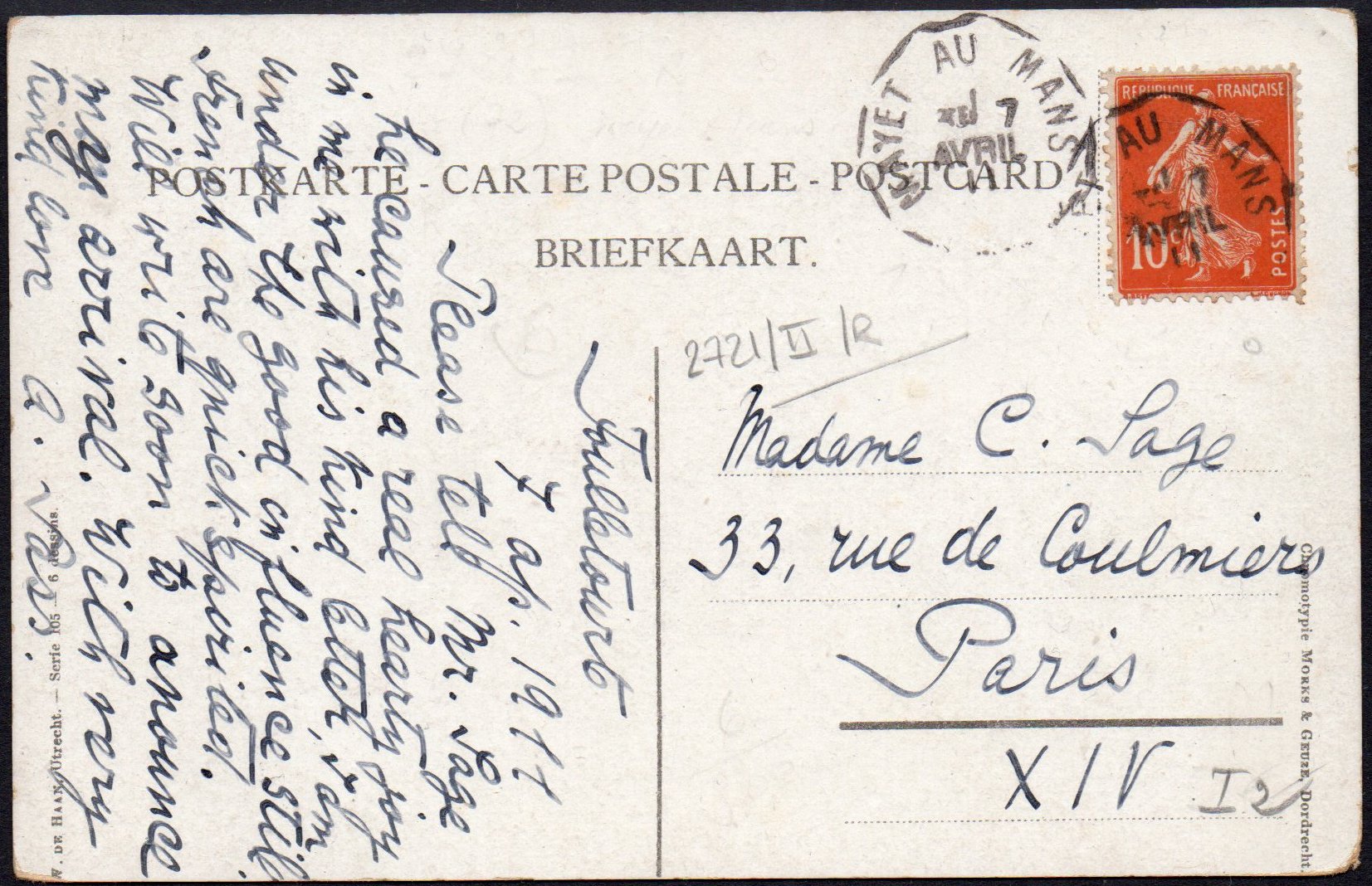
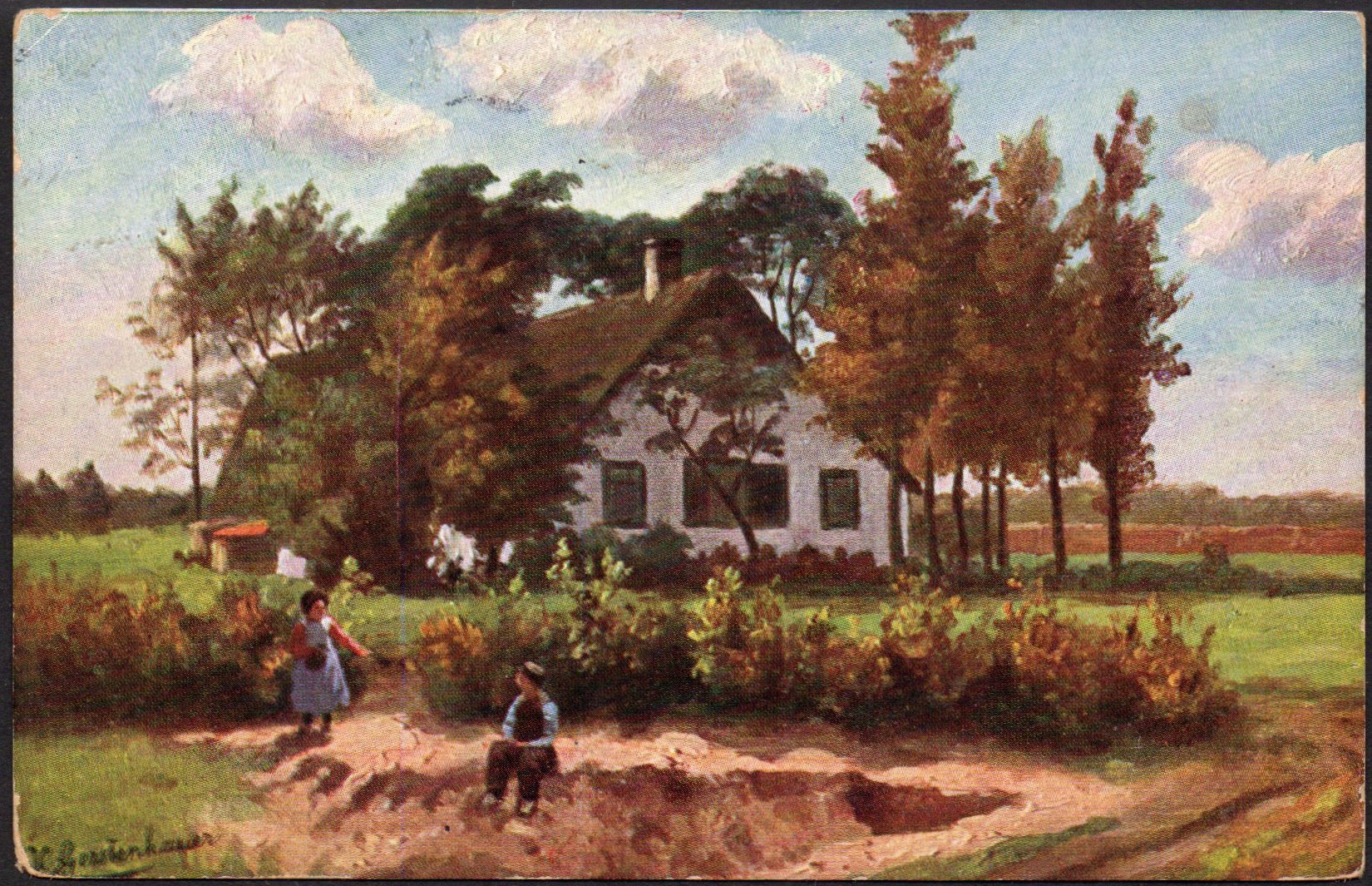 Artistic Card, Tramway CCL (Type II) Mayet au Mans 07/04/1911 £ 2.50
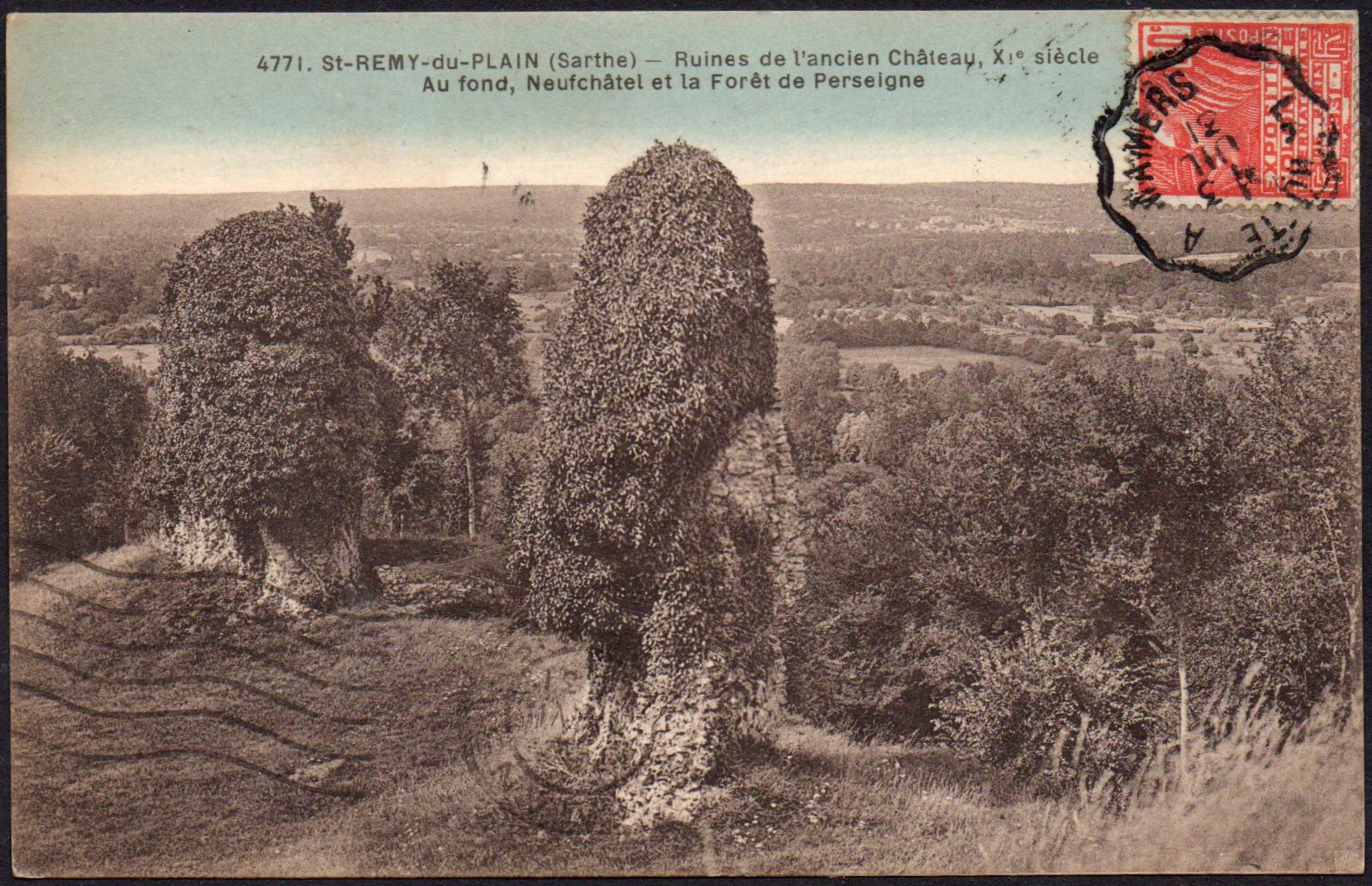
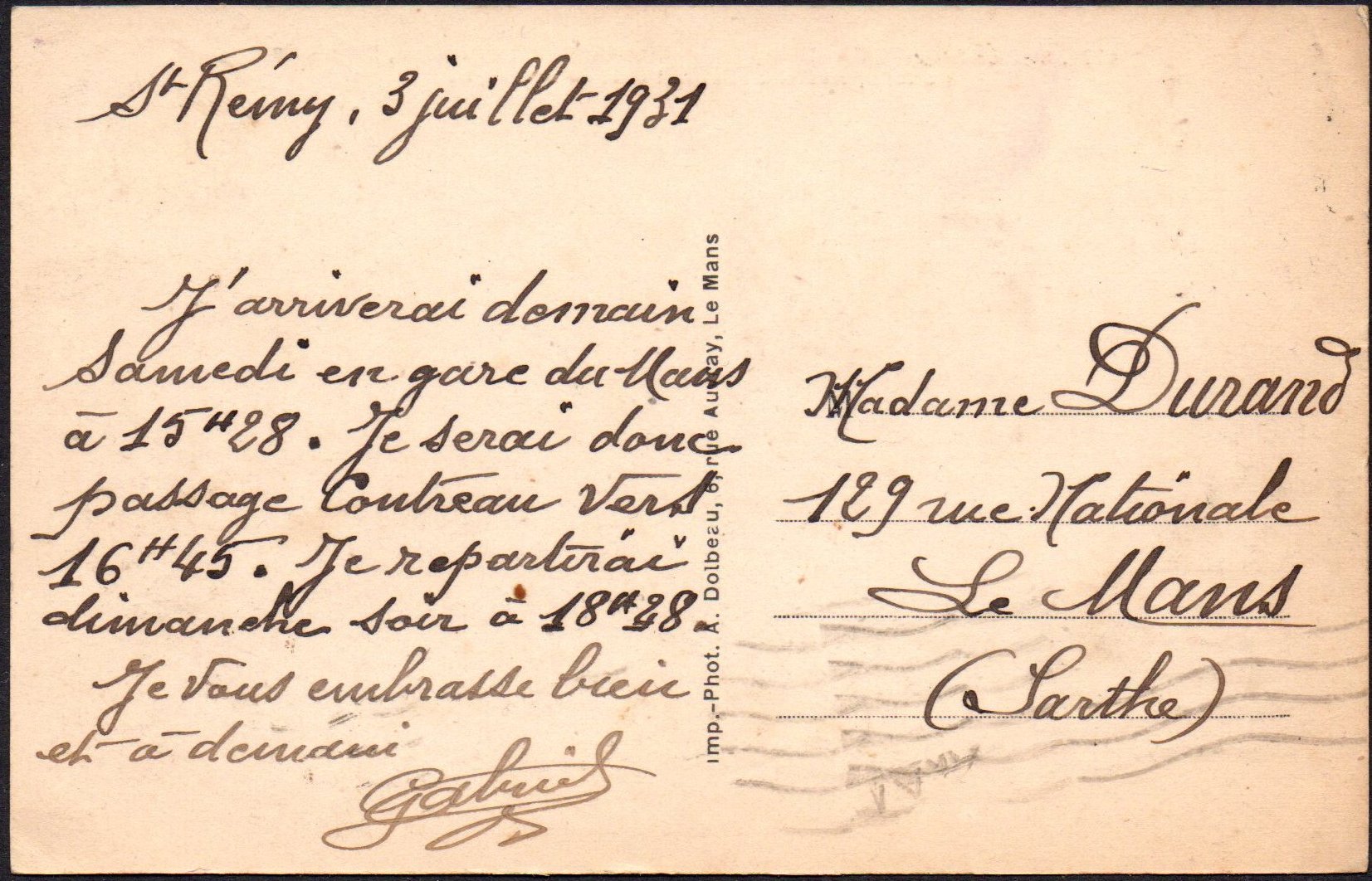 St-Rémy-du-Plan, Railway CCL (Type II) La Hutte à Mamers 03/07/1931 (Pothion 2358 IIA, indice 9, scarce). Message provides train times! £ 16.00
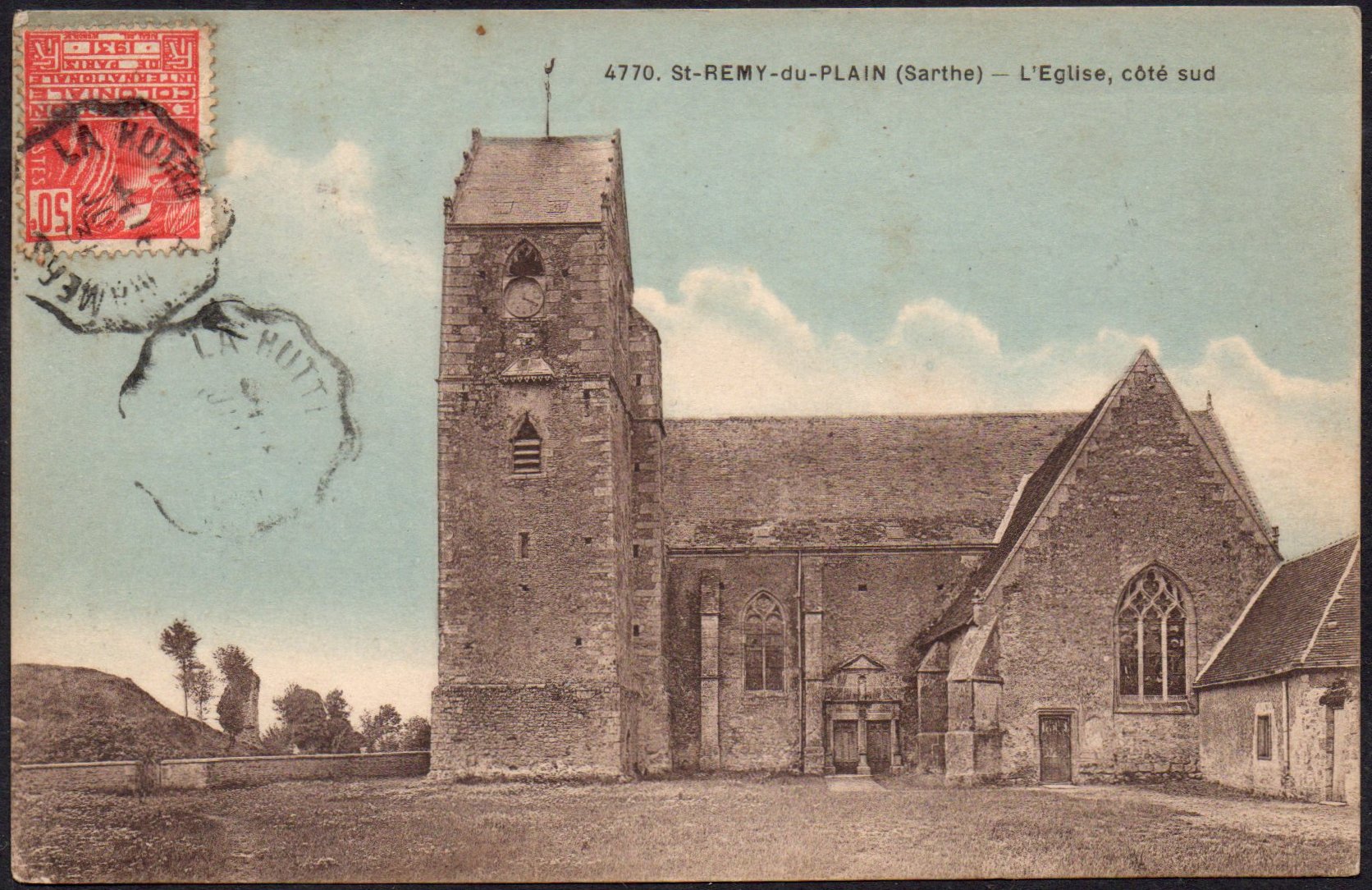
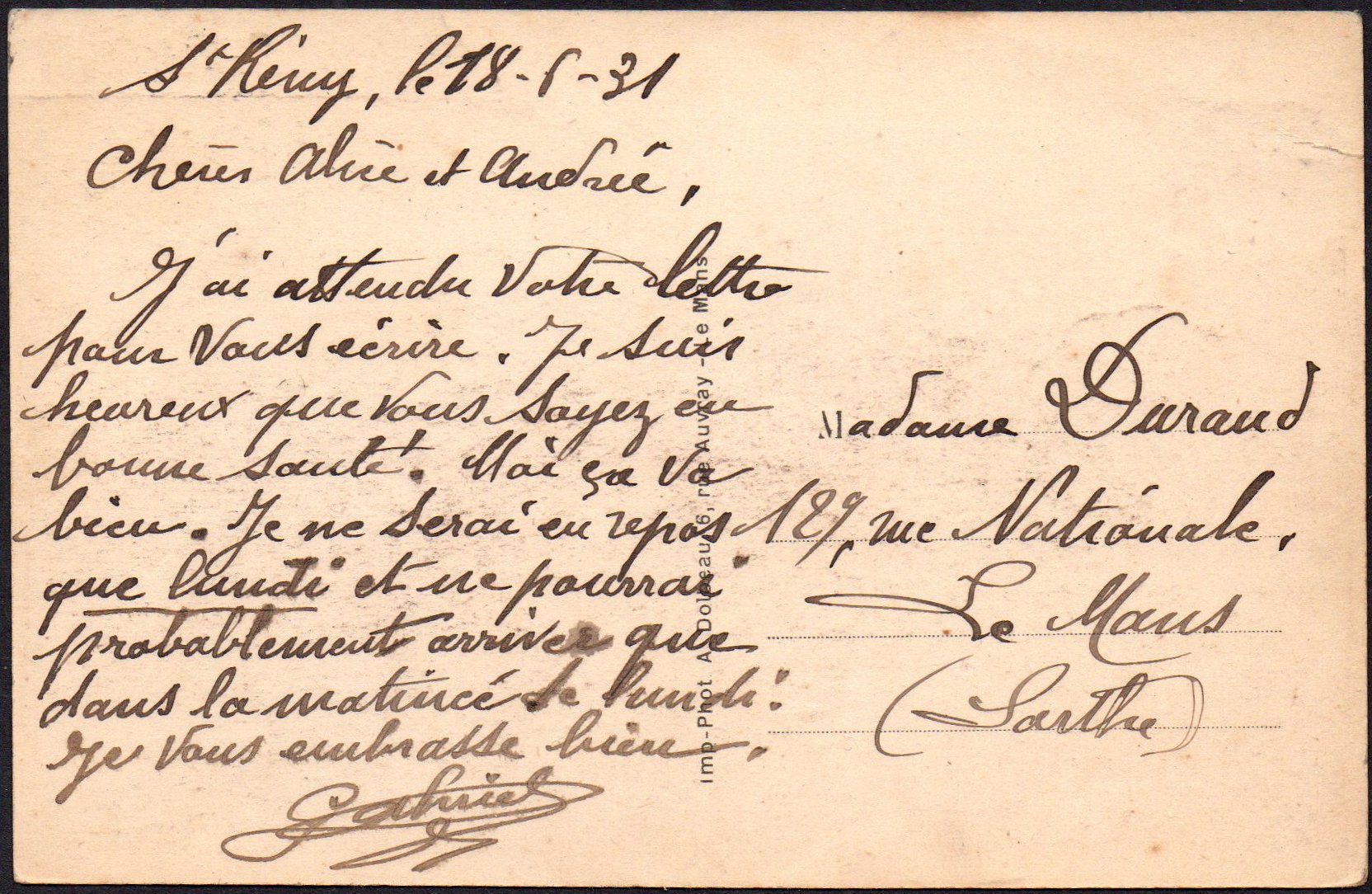 St-Rémy-du-Plan, Railway CCL (Type II) La Hutte à Mamers 18/06/1931 (Pothion 2358 IIA, indice 9, scarce, stamp damaged) £ 11.50
Perilous Presumptions: We bought the card below, having seen only the picture side, confident that it would prove to be a late usage of the La Flèche au Mans tramway CCL. When we turned it over, we were pleased to see a repeat of the strike - until we saw that the anticipated 'MANS' ended in the letter 'E'! We are fairly certain that, complete, it would read 'AUBIGNE'.
St-Rémy-du-Plan, Railway CCL (Type II) La Hutte à Mamers 18/06/1931 (Pothion 2358 IIA, indice 9, scarce, stamp damaged) £ 11.50
Perilous Presumptions: We bought the card below, having seen only the picture side, confident that it would prove to be a late usage of the La Flèche au Mans tramway CCL. When we turned it over, we were pleased to see a repeat of the strike - until we saw that the anticipated 'MANS' ended in the letter 'E'! We are fairly certain that, complete, it would read 'AUBIGNE'.
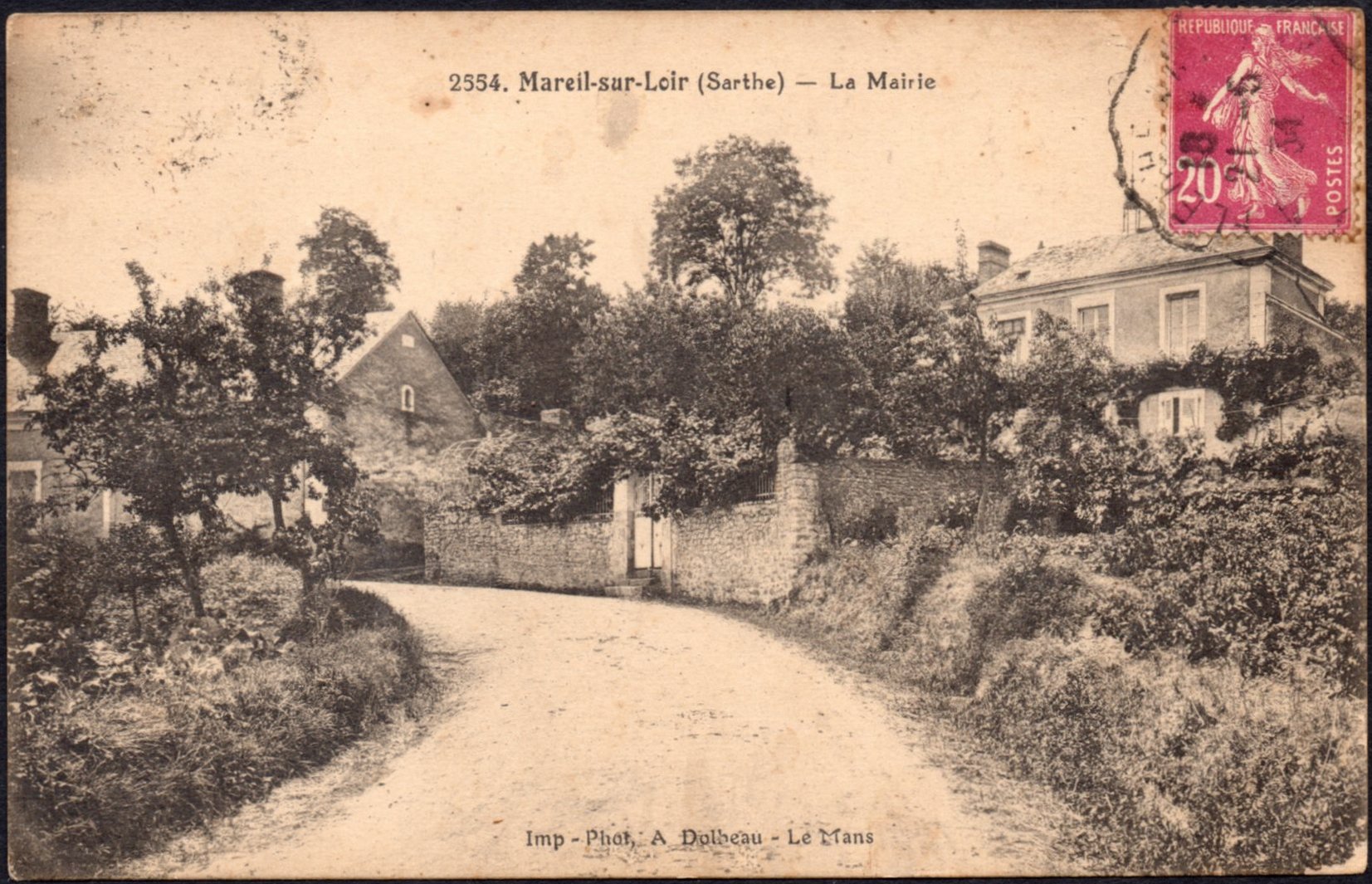
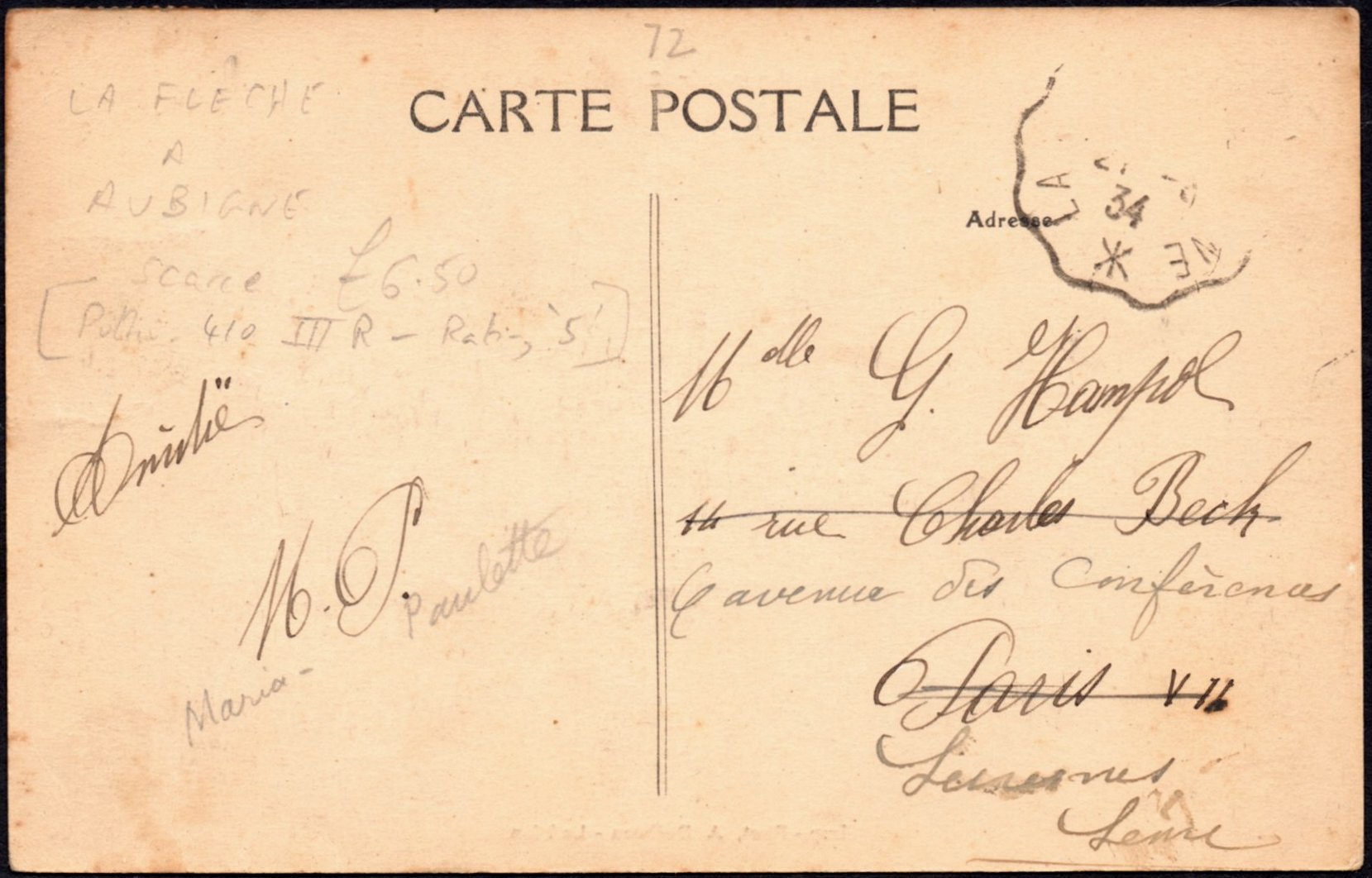 PPC Mareil-sur-Loir, with 21/05/1934 Railway CCL 'La Flèche à Aubigné (Pothion 410 IIIR, Indice '5', scarce.) £ 3.50
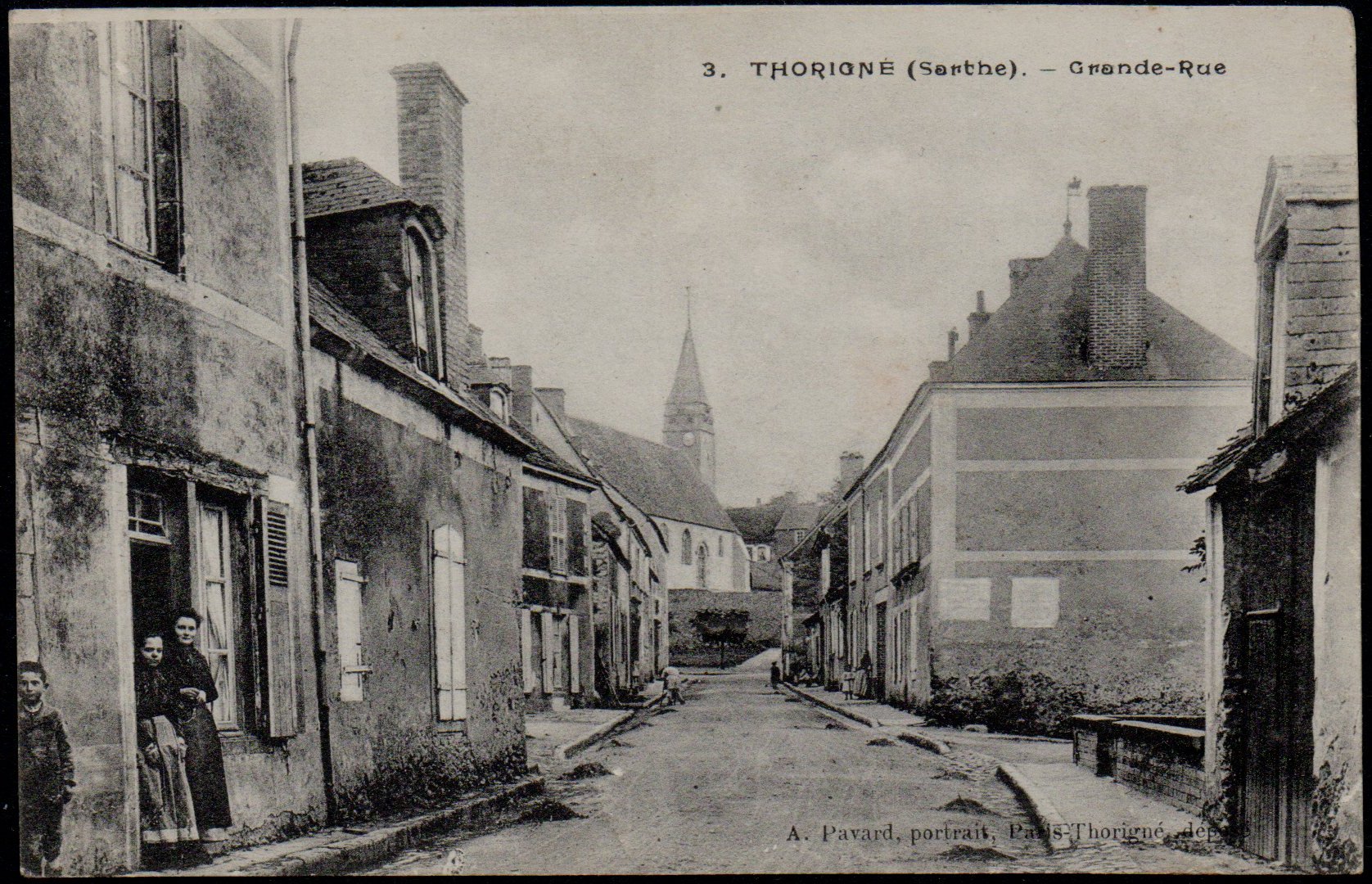
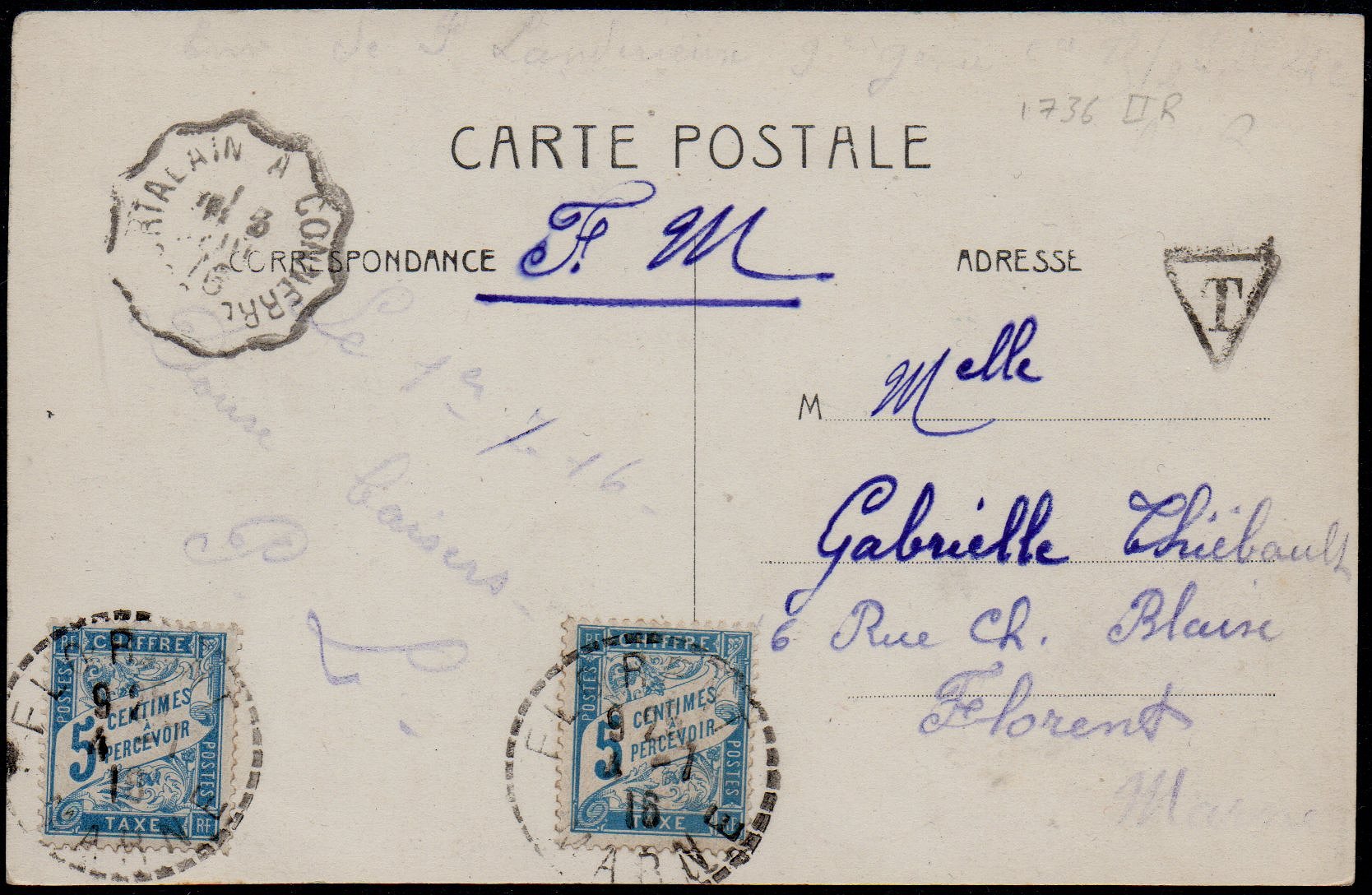 Thorigné, Railway CCL (Type II) Courtalain à Connerré 5?/07/1916 (Pothion 1736 IIR), Franchise Militaire, Taxed (2 x 5c) one assumes for incorrect F.M. use or procedure. £ 4.50
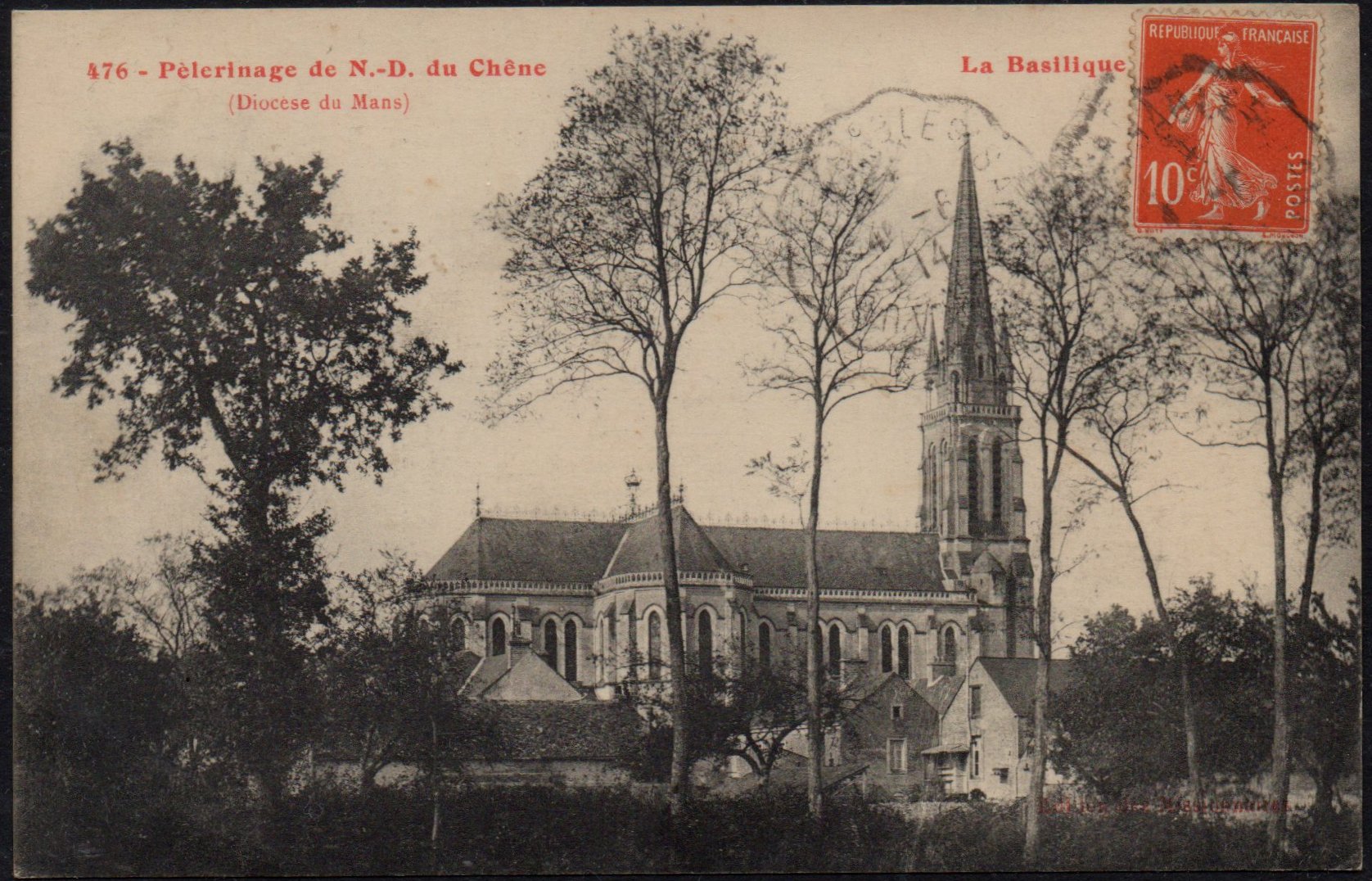
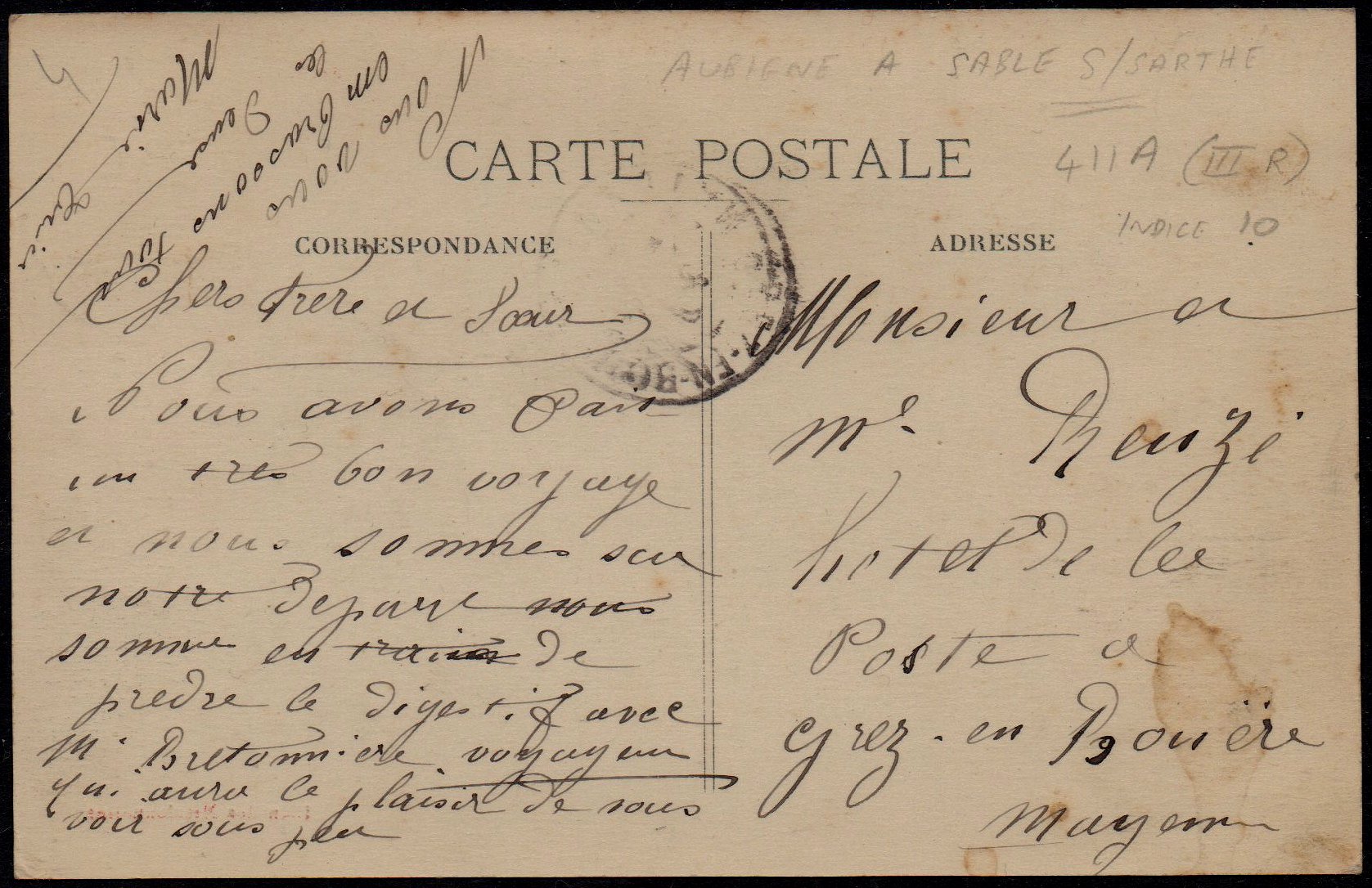
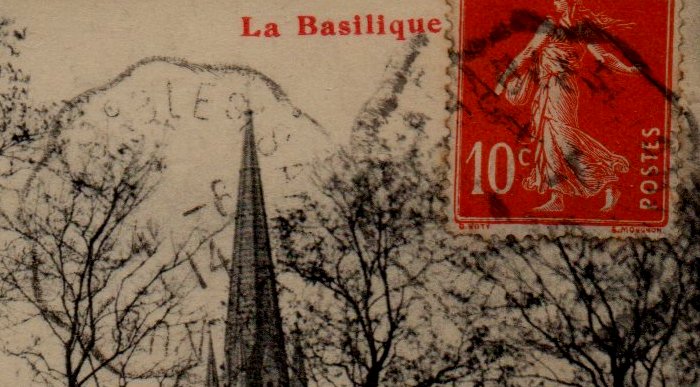 Railway cancel : Aubigné à Sable S/Sarthe June 1914 (Pothion 411A IIIR, scarce, Indice 10) : £ 15.00
.
Railway cancel : Aubigné à Sable S/Sarthe June 1914 (Pothion 411A IIIR, scarce, Indice 10) : £ 15.00
.
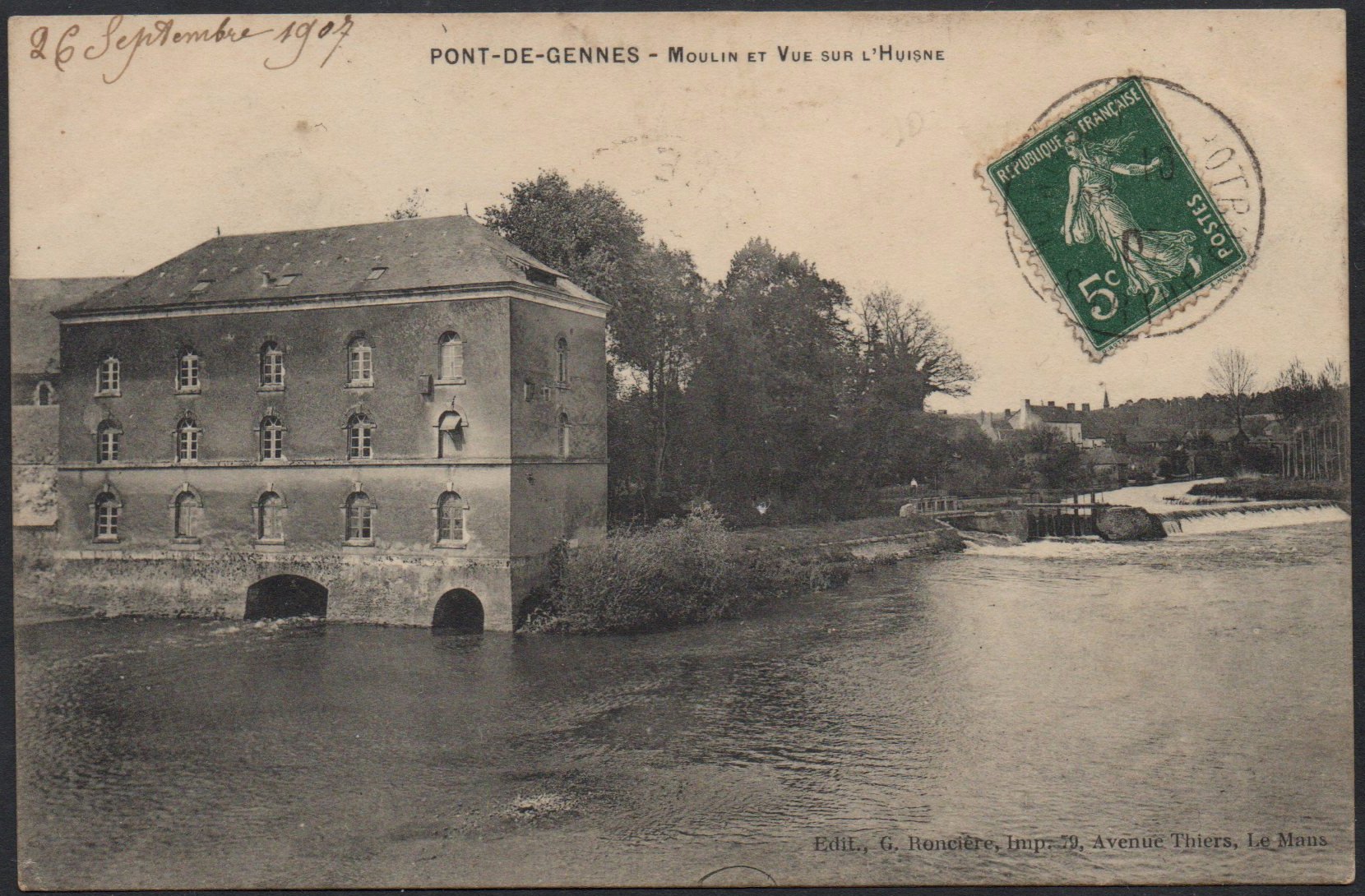
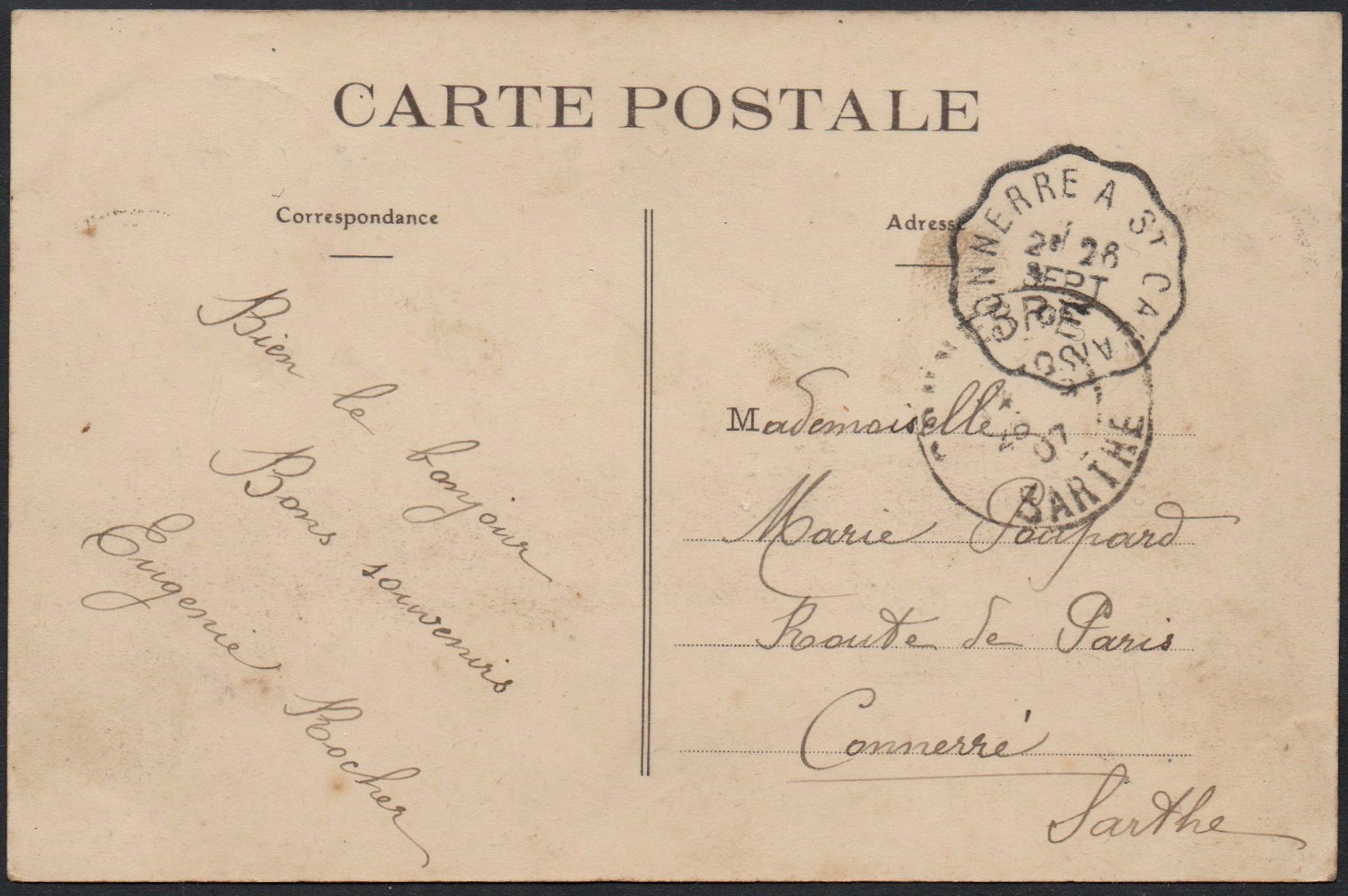 Pont de Gennes ppc, stamp cancelled Nogent-le-Rotrou, TRANSIT Railway CCL 'CONNERRE A ST CALAIS' Type III (Pothion 1738 IIIA, Indice 6 cancelling a stamp, much scarcer as a transit mark). September 1907, also has CONNERRE arrival backstamp. £ 17.00
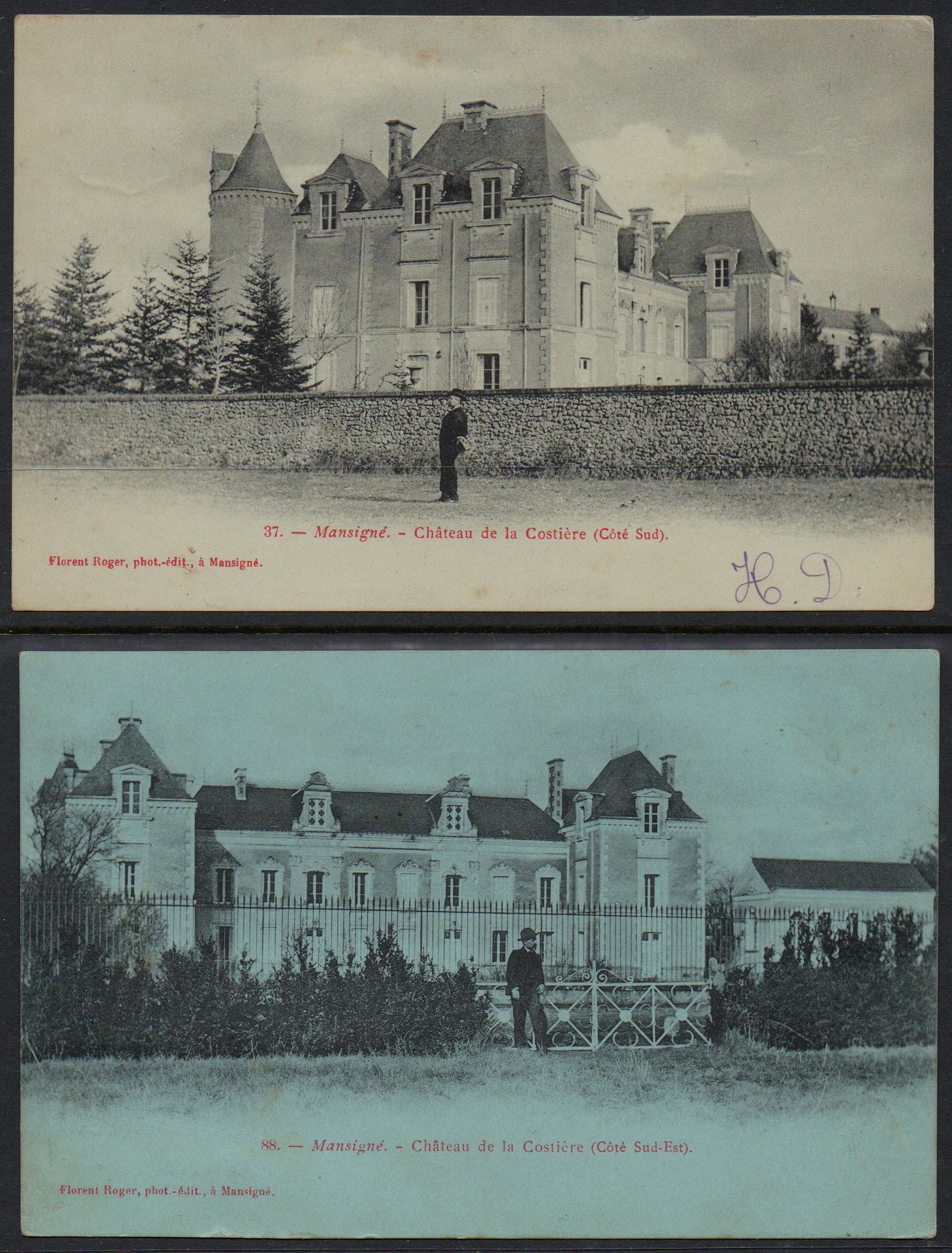
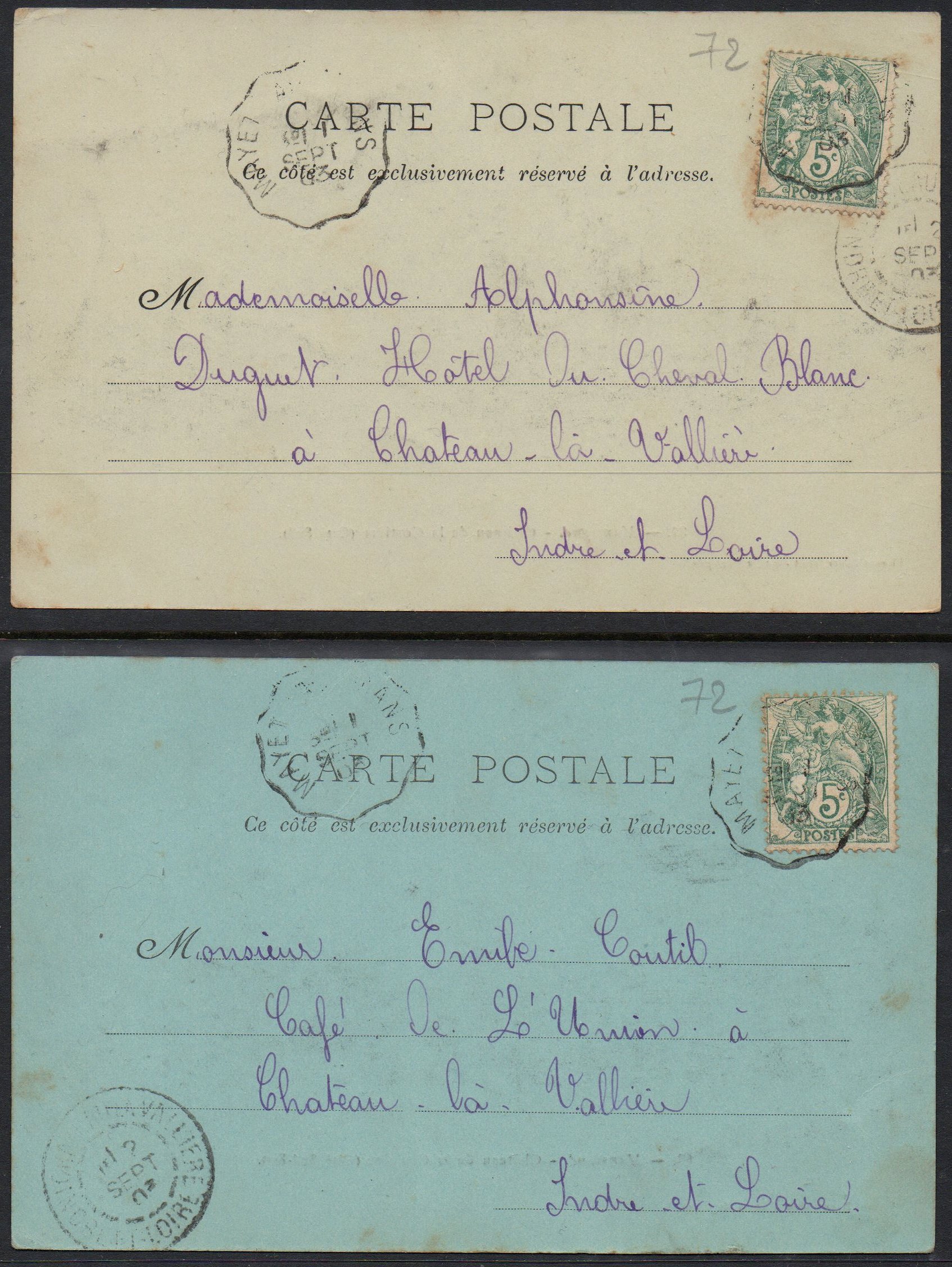 A pair of very early Mayet au Mans Tramway CCL, both Sept 1st 1903, less than two weeks after the earliest we have seen (19/08/1903). Different views of the same château, sent by the same sender on the same date to two different people in the same town, one at a café, one at an hotel, the two cards now curiously brought together again. Both have Sept 2nd arrival marks. Price for this unusual pair £ 16.00
.
A pair of very early Mayet au Mans Tramway CCL, both Sept 1st 1903, less than two weeks after the earliest we have seen (19/08/1903). Different views of the same château, sent by the same sender on the same date to two different people in the same town, one at a café, one at an hotel, the two cards now curiously brought together again. Both have Sept 2nd arrival marks. Price for this unusual pair £ 16.00
.
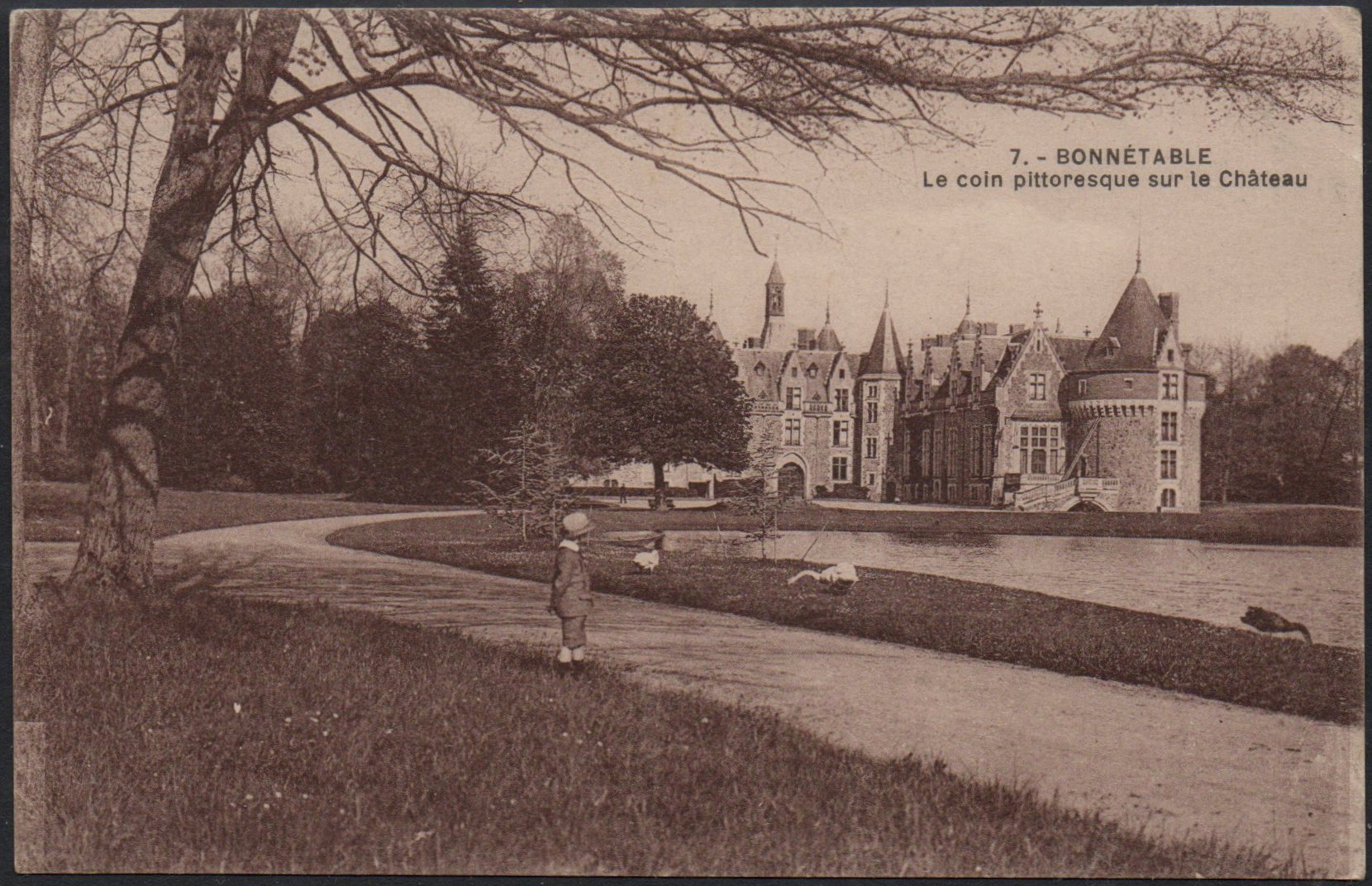
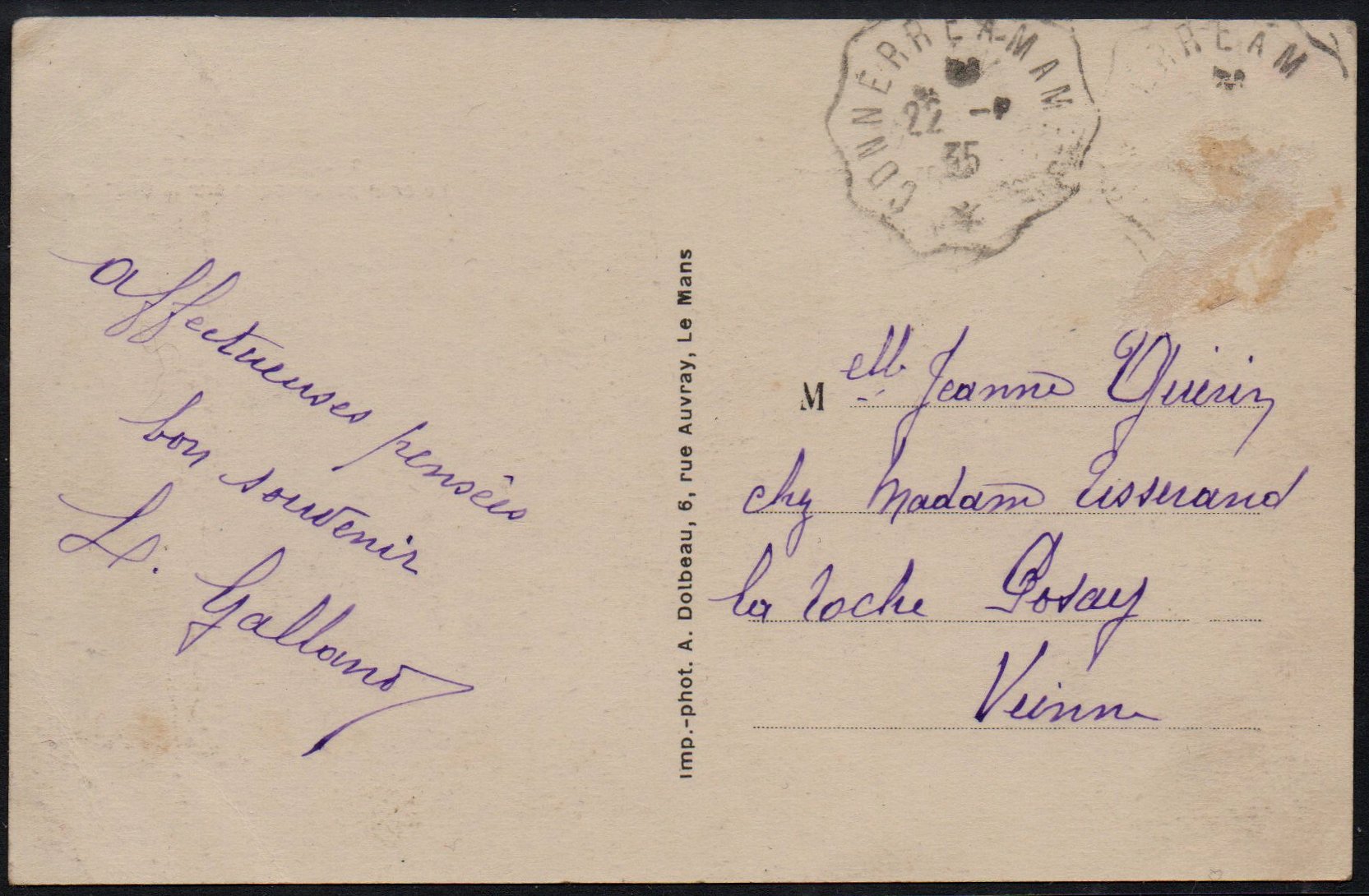 CONNERRE A MAMERS Type III (Pothion 1737 IIIA, Indice 5) 1935 Railway cancel, the stamp on this Bonnétable postcard removed, hence the low price. £ 2.50
.
CONNERRE A MAMERS Type III (Pothion 1737 IIIA, Indice 5) 1935 Railway cancel, the stamp on this Bonnétable postcard removed, hence the low price. £ 2.50
.
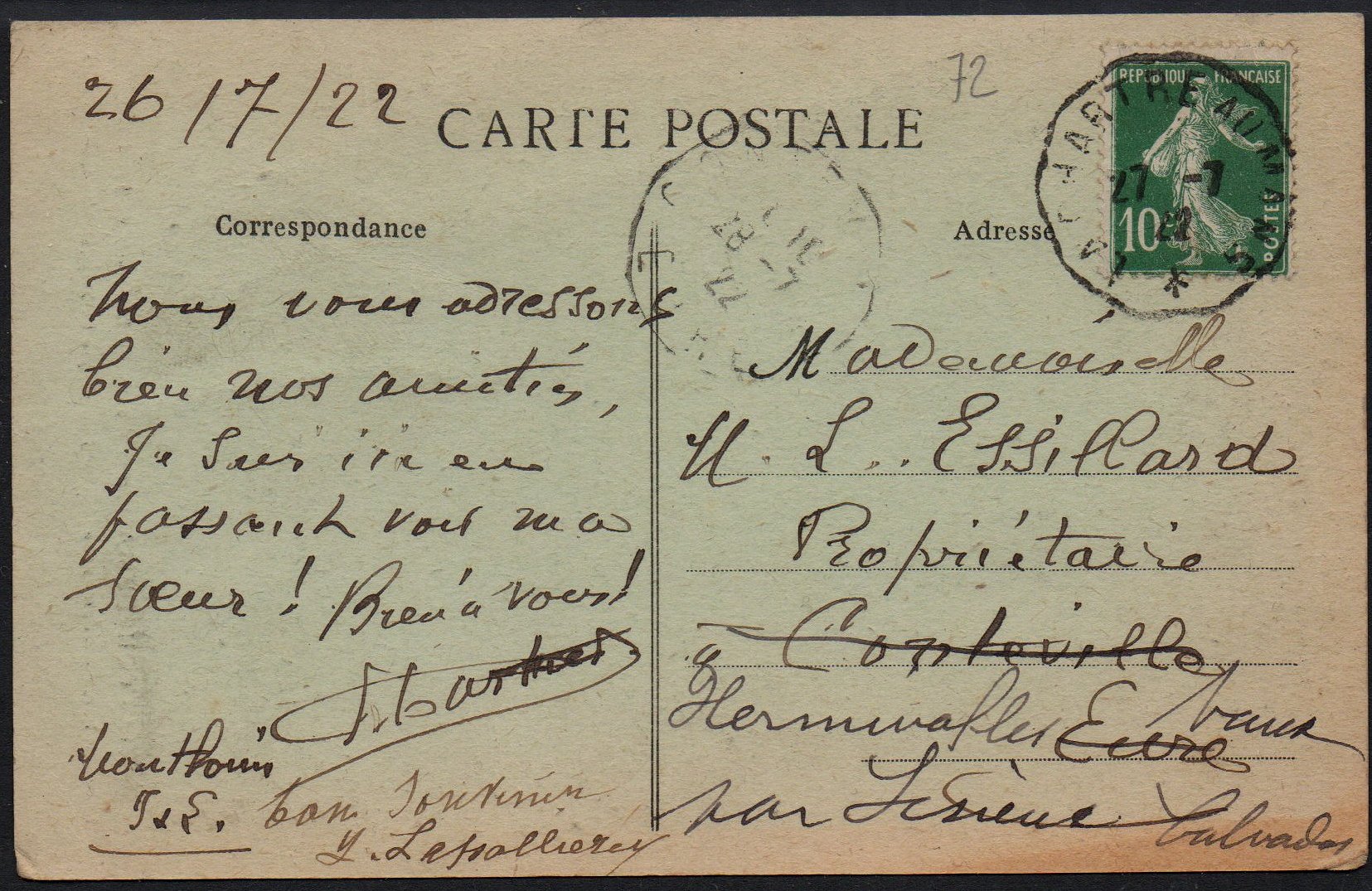 La Chartre au Mans Type III Tramway CCL 27/07/1922 on a card of Courdemanche. £ 2.50
.
La Chartre au Mans Type III Tramway CCL 27/07/1922 on a card of Courdemanche. £ 2.50
.
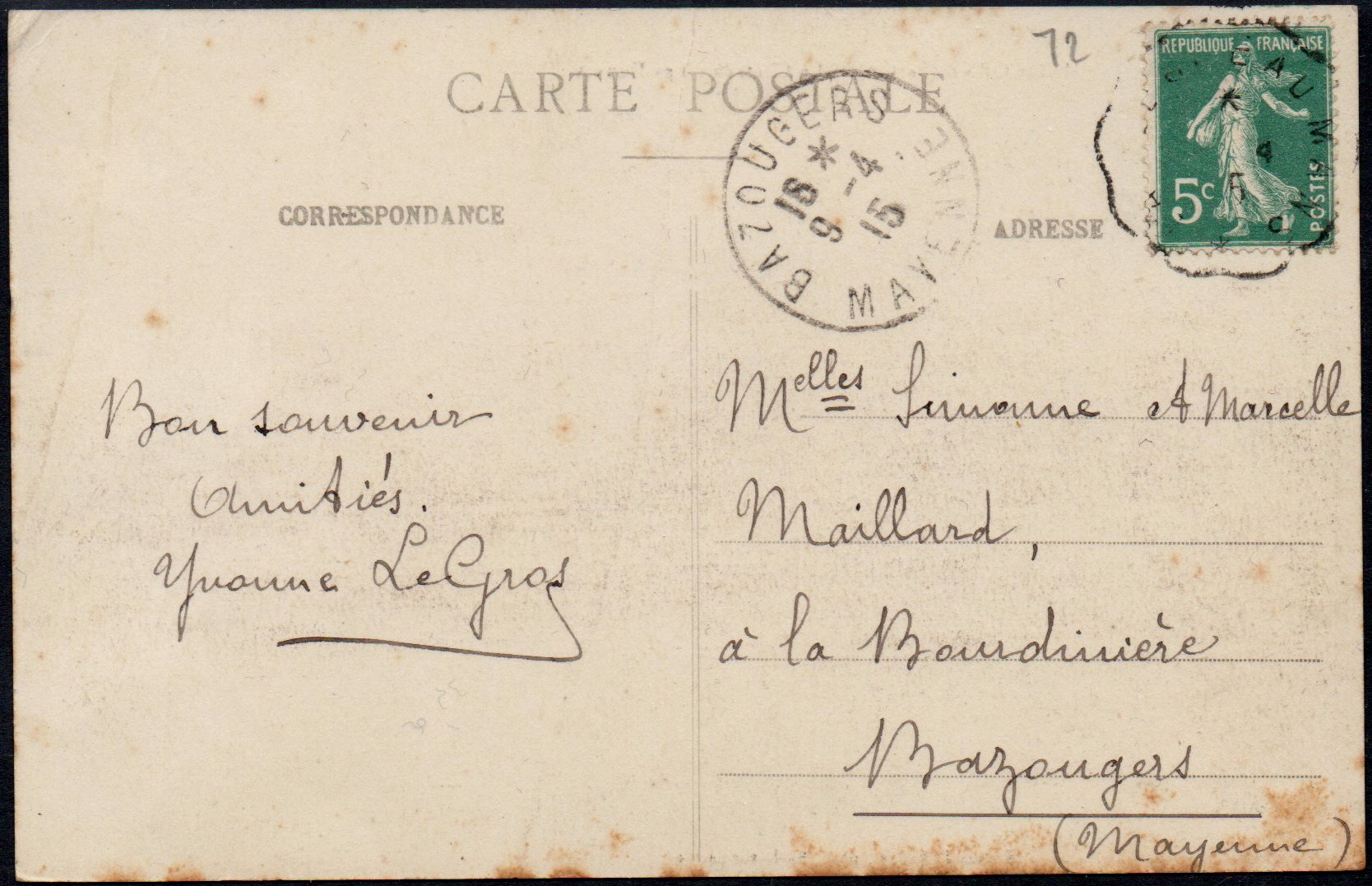
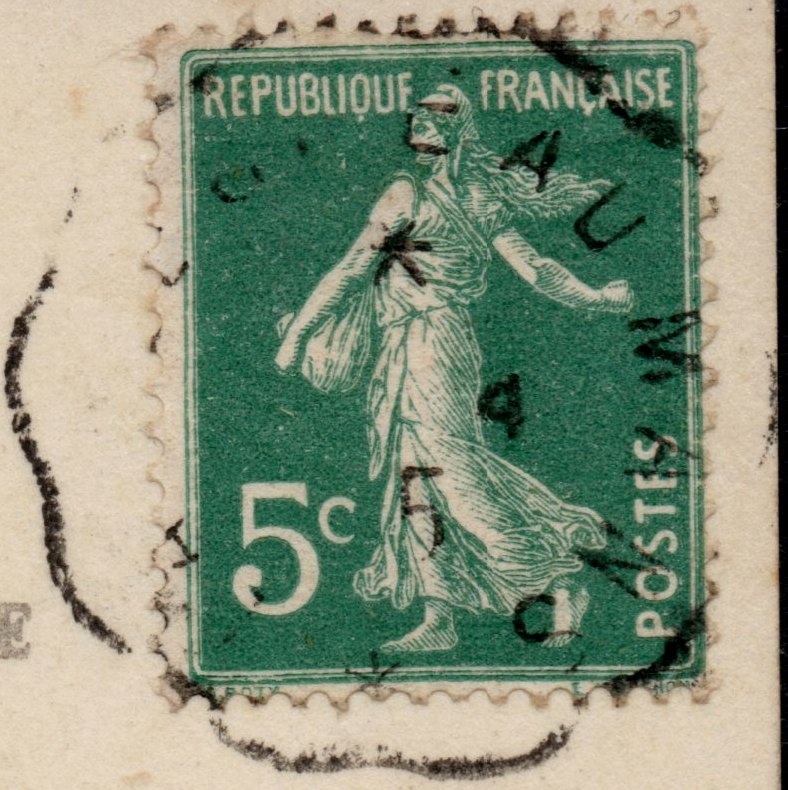 Card of Malicorne. A poor strike of the La Flèche au Mans Railway CCL (April 1915) a late pre-tram railway usage. Examples of this CCL between 1913 and 1916 seem to be quite scarce. £ 3.50
.
Card of Malicorne. A poor strike of the La Flèche au Mans Railway CCL (April 1915) a late pre-tram railway usage. Examples of this CCL between 1913 and 1916 seem to be quite scarce. £ 3.50
.
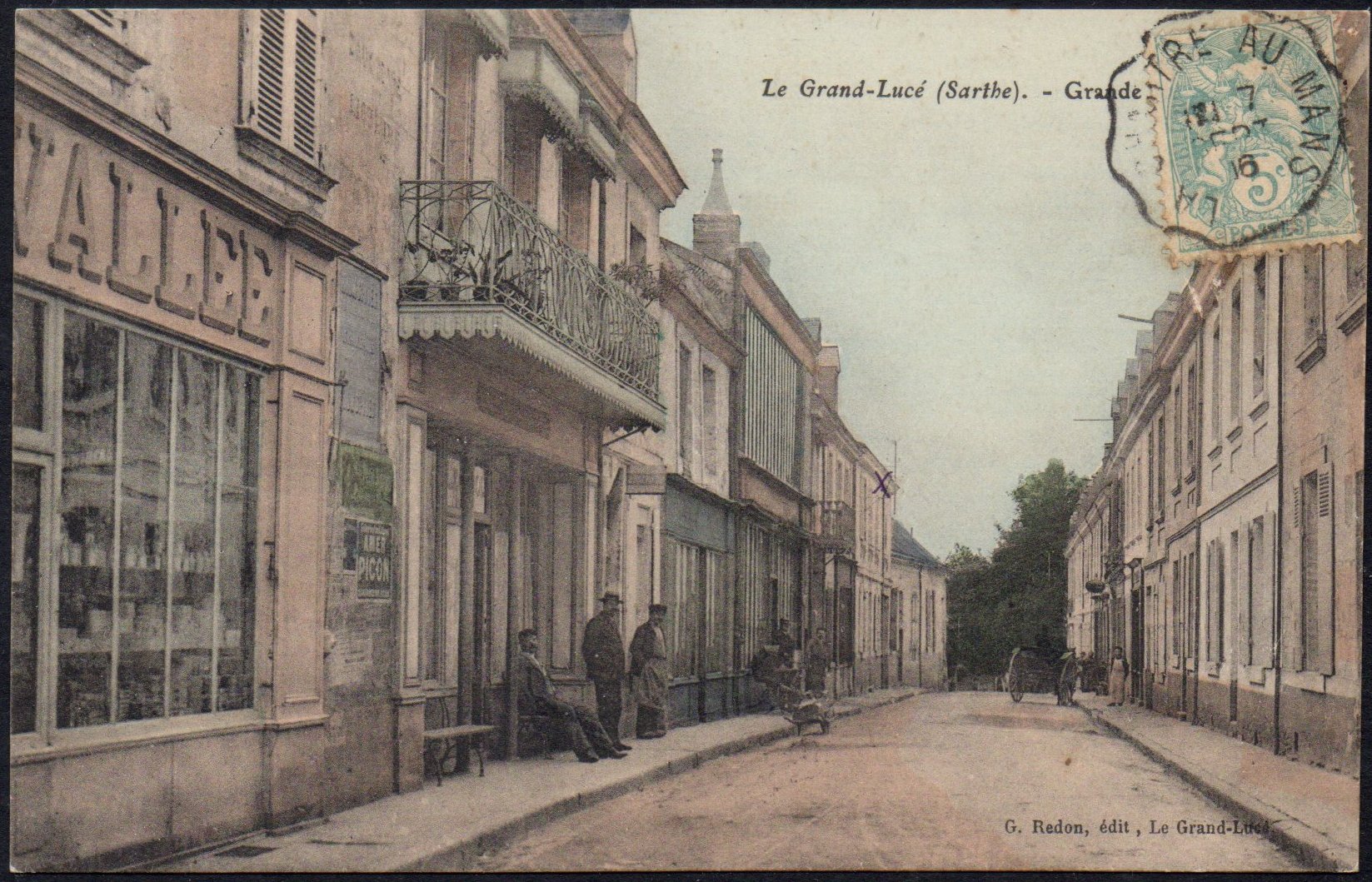
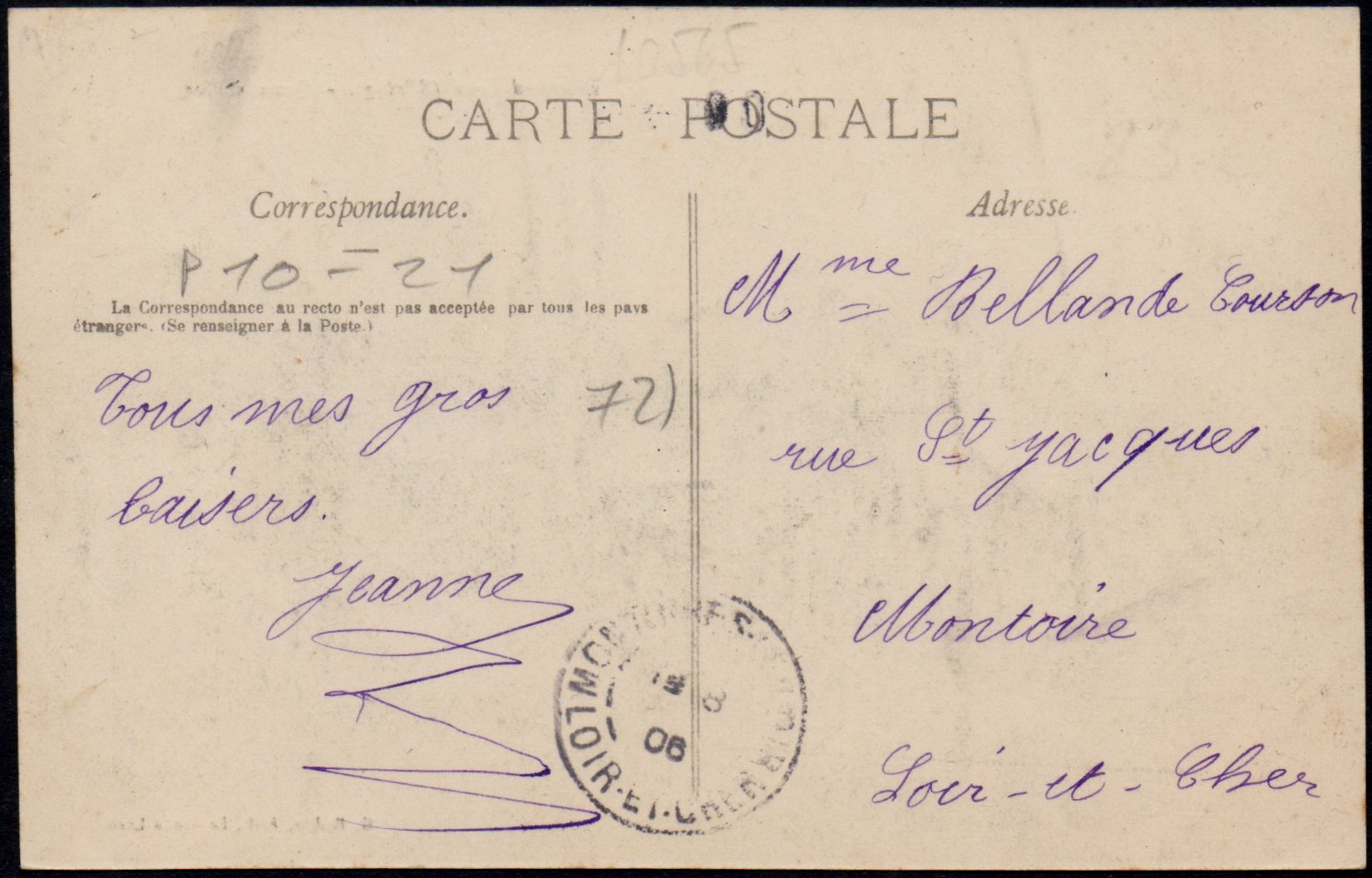 La Chartre au Mans Type II, card of Le Grand-Lucé sent to Montoire, Loir-et-Cher, Sept. 7th, 1906. Pothion 1415 IIA (Indice 2 - but Type II are scarcer than that). £ 7.50
.
To order, or to make enquiries, for cinderella stamps or for CCL, please use the 'Contact Us' link in the side panel at left. Enquiries may be made in French or English.
Pour commander ou demander des informations concernant les vignettes ou CCL, veuillez utiliser le lien « Contact Us » dans le panneau latéral à gauche. Les demandes peuvent être formulées en français ou en anglais.
.
.
Further vignettes for the Paris Exposition of 1900:
In Section 6 of the main article, we looked briefly at one design of vignettes for the Gold Medal in Paris. As we have some scans likely to be of interest to collectors of these cinderellas, we have put them on view here for reference purposes, concentrating principally on the stamps carrying the names of medal winning companies. We have done some basic research into some of these companies, adding their location and/or business activity, but these details are not guaranteed correct. Given the nature of such cinderellas, none of these scans will represent a complete range, and in most cases will not be a truly representative selection.
La Chartre au Mans Type II, card of Le Grand-Lucé sent to Montoire, Loir-et-Cher, Sept. 7th, 1906. Pothion 1415 IIA (Indice 2 - but Type II are scarcer than that). £ 7.50
.
To order, or to make enquiries, for cinderella stamps or for CCL, please use the 'Contact Us' link in the side panel at left. Enquiries may be made in French or English.
Pour commander ou demander des informations concernant les vignettes ou CCL, veuillez utiliser le lien « Contact Us » dans le panneau latéral à gauche. Les demandes peuvent être formulées en français ou en anglais.
.
.
Further vignettes for the Paris Exposition of 1900:
In Section 6 of the main article, we looked briefly at one design of vignettes for the Gold Medal in Paris. As we have some scans likely to be of interest to collectors of these cinderellas, we have put them on view here for reference purposes, concentrating principally on the stamps carrying the names of medal winning companies. We have done some basic research into some of these companies, adding their location and/or business activity, but these details are not guaranteed correct. Given the nature of such cinderellas, none of these scans will represent a complete range, and in most cases will not be a truly representative selection.
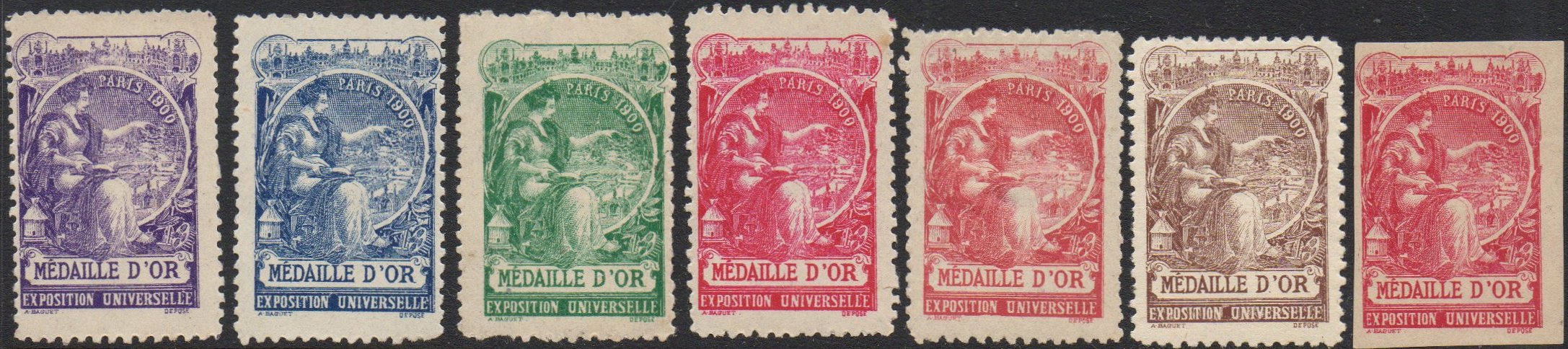 Above: Repeated from the main article
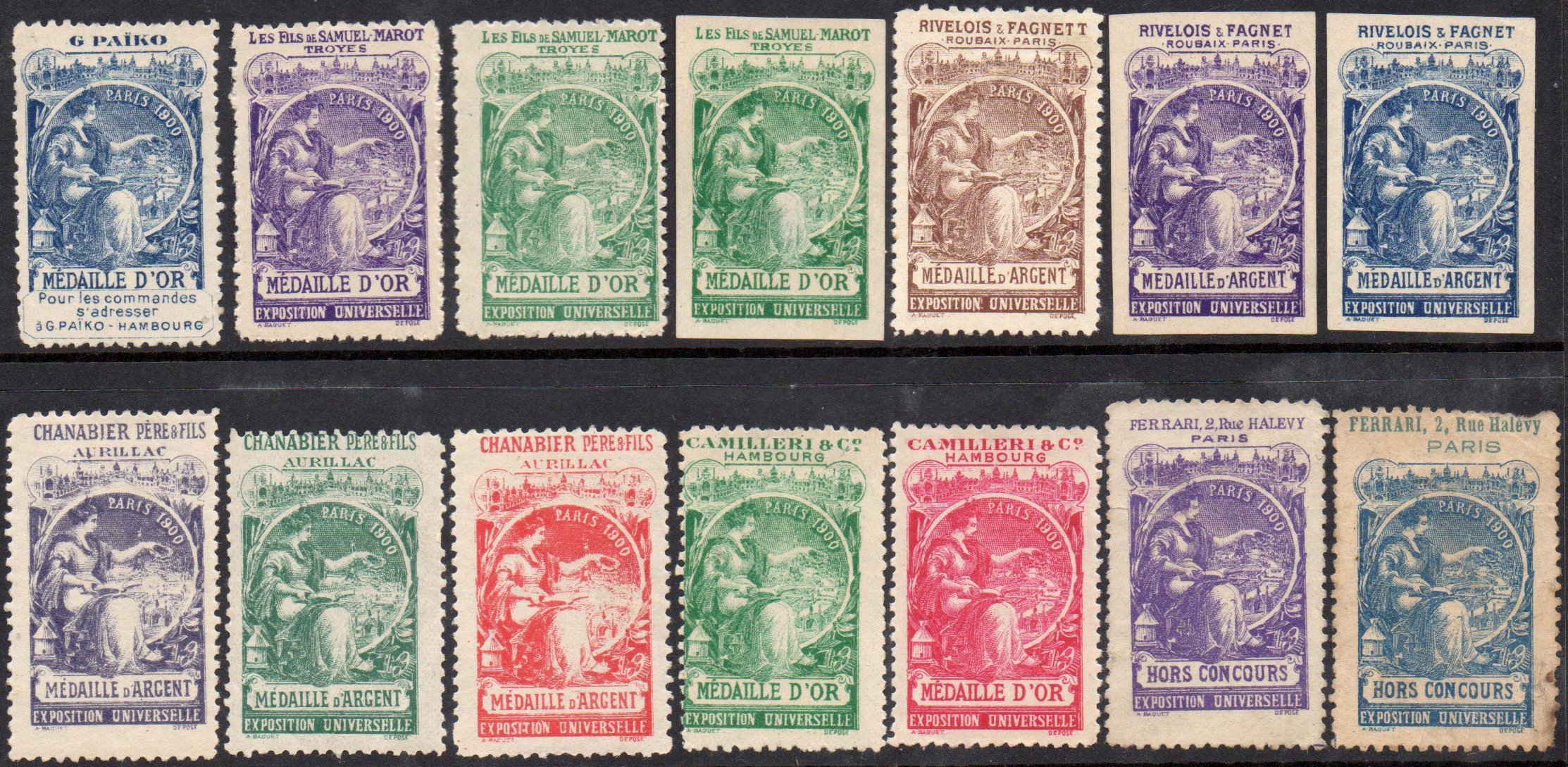 Examples of stamps lauding companies' awards : Medal Winners G.Paiko, Hamburg : Les Fils de Samuel-Marot, Troyes : Rivelois & Fagnett, Roubaix (rubber & asbestos industry) : Chanabier Père & Fils, Aurillac (distillery; liqueurs) : Camilleri & Co, Hamburg : Ferrari, 2 Rue Halevy Paris (noodles / pasta), the last-named being for a 'non-competitive' participant (hors concours).
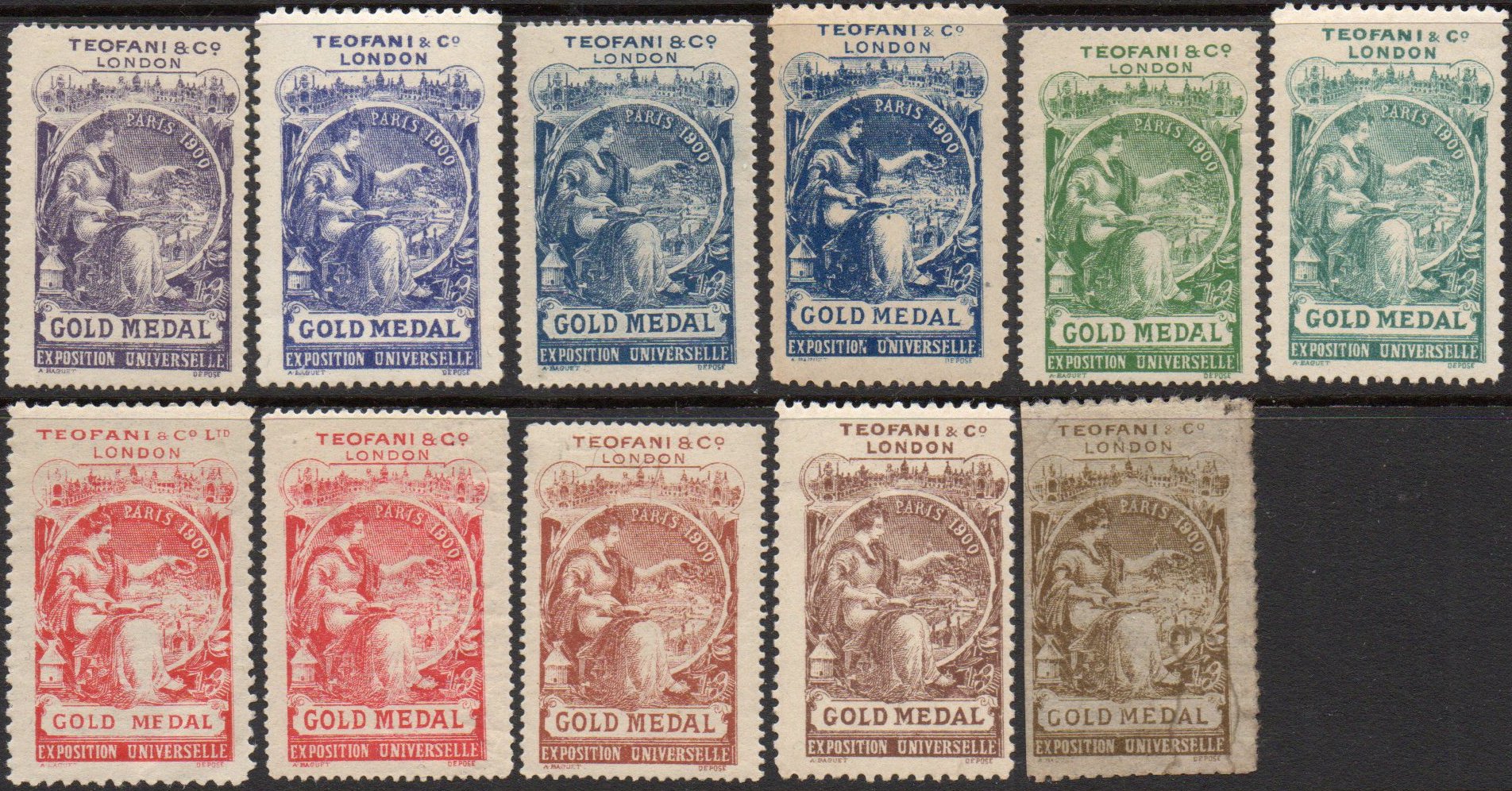
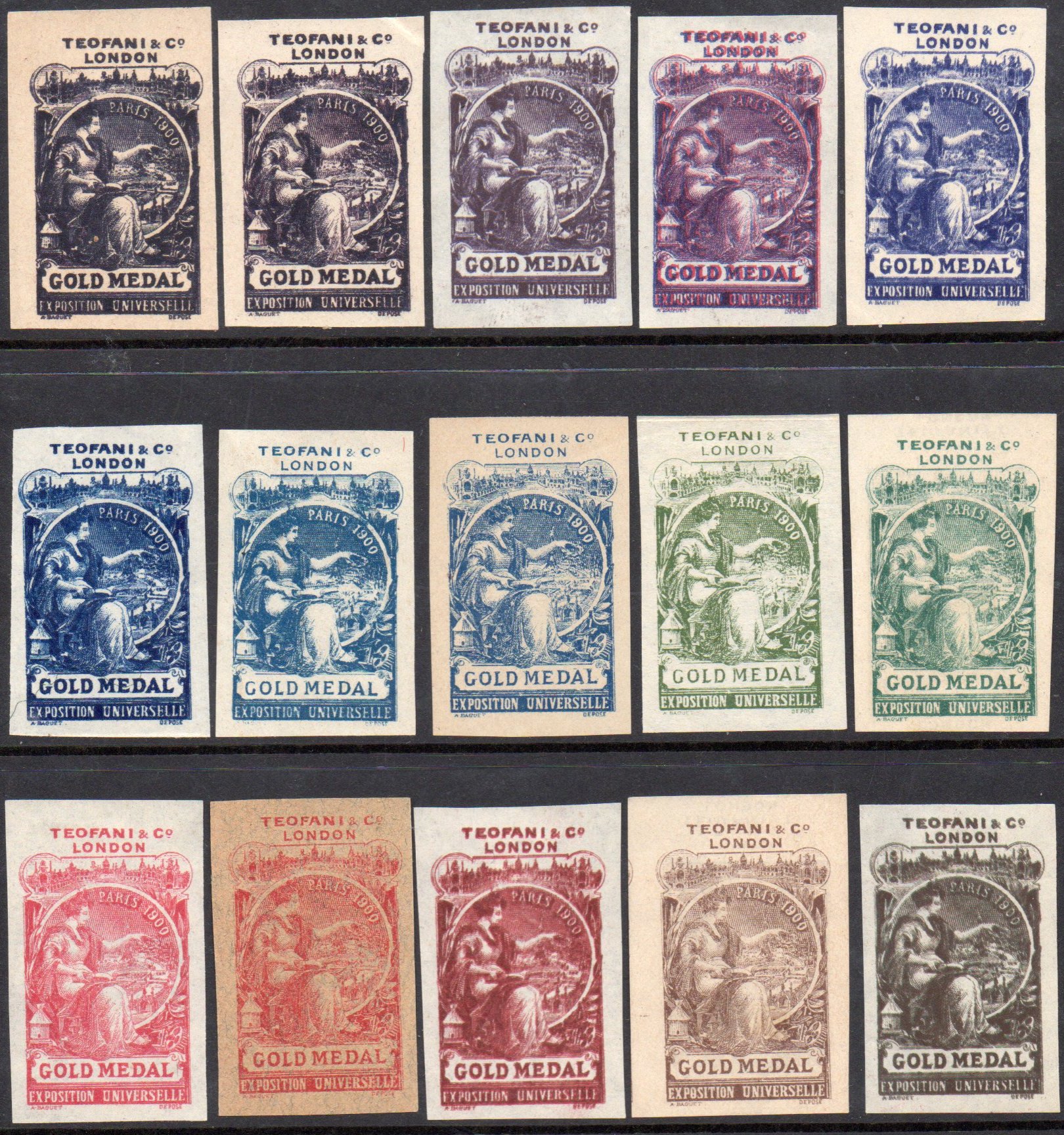 An extraordinary range of colours for the Gold Medal winner Teofani & Co., a London-based importer of Turkish tobacco. They are inscribed 'Gold Medal' in English. Examples of winners' vignettes are much less common and each individual colour amongst them is consequently quite scarce.
We note the presence here of colours outside the standard five shades for this design, notably amongst the imperforate stamps in the colour range deep violet to black or brownish-black. These have inferior definition of the design, suggesting an additional later printing, perhaps made in London by the Company itself using a lithographic copying process.
.
An extraordinary range of colours for the Gold Medal winner Teofani & Co., a London-based importer of Turkish tobacco. They are inscribed 'Gold Medal' in English. Examples of winners' vignettes are much less common and each individual colour amongst them is consequently quite scarce.
We note the presence here of colours outside the standard five shades for this design, notably amongst the imperforate stamps in the colour range deep violet to black or brownish-black. These have inferior definition of the design, suggesting an additional later printing, perhaps made in London by the Company itself using a lithographic copying process.
.
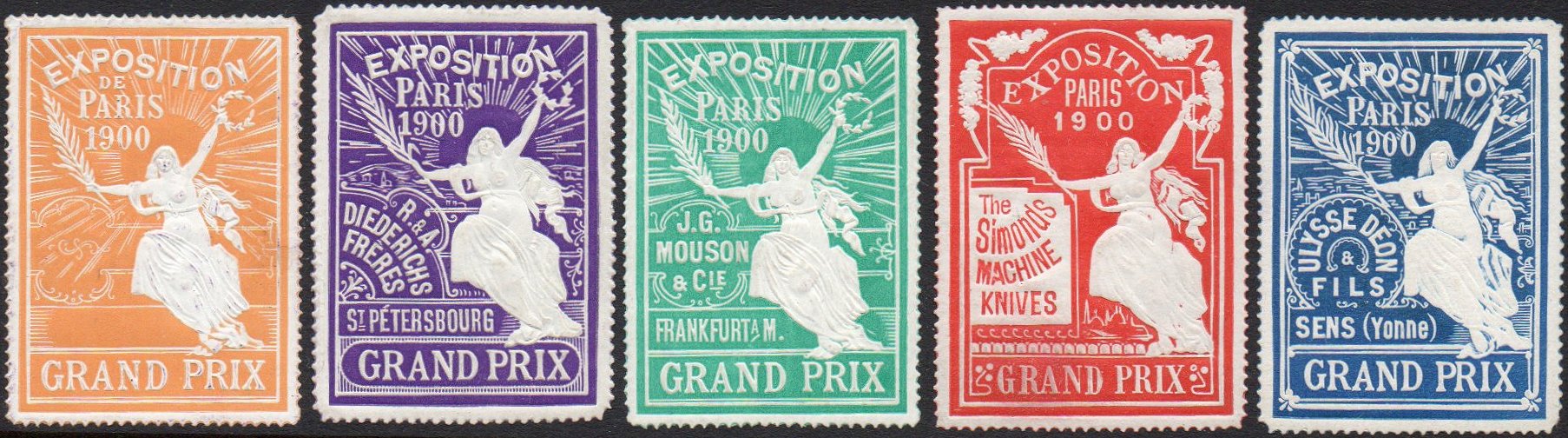 An embossed design, showing one of the many colours of 'Grand Prix' stamps in this design and four commercial winners.
Participants shown : Diederichs Frères, St. Petersburg (piano manufacturers) : J. G. Mouson & Cie, Frankfurt am Main (soap and perfume) : The Simonds Machine Knives (Illinois) : Ulysse Déon & Fils, Sens (Yonne).
An embossed design, showing one of the many colours of 'Grand Prix' stamps in this design and four commercial winners.
Participants shown : Diederichs Frères, St. Petersburg (piano manufacturers) : J. G. Mouson & Cie, Frankfurt am Main (soap and perfume) : The Simonds Machine Knives (Illinois) : Ulysse Déon & Fils, Sens (Yonne).
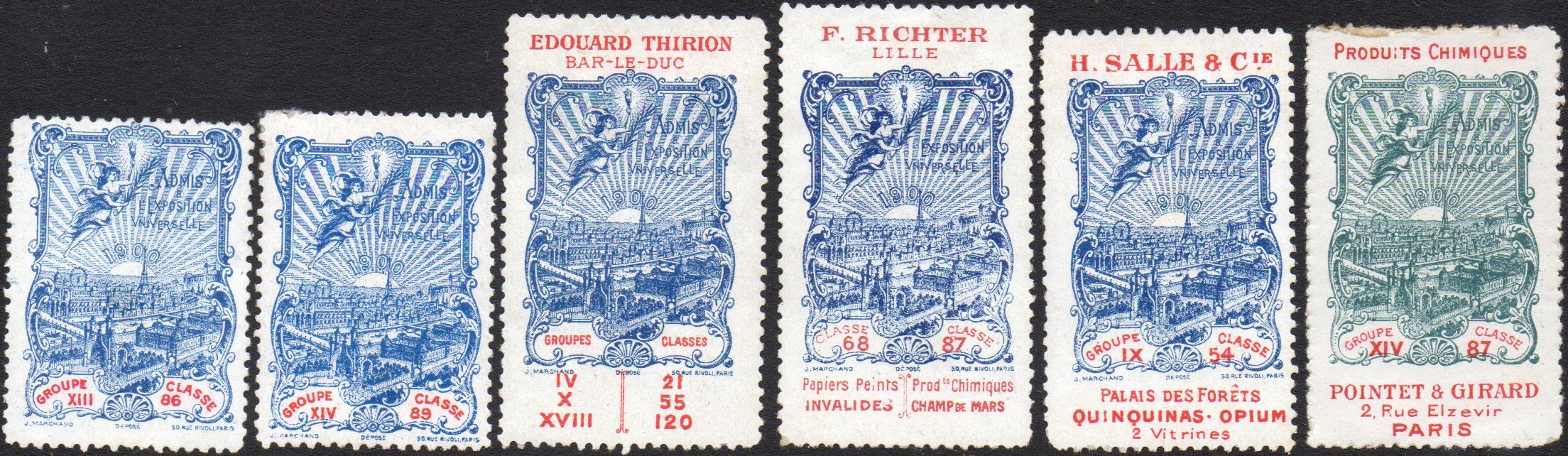 These are part of a very large group of stamps in this basic design. The first two are 'general' vignettes for various combinations of 'Groupe' and 'Classe'; the last four are printings carrying a participant's name. The vast majority of these stamps are in blue & red, other colours all being scarce.
Participants shown : Edouard Thirion, Bar-le-Duc (artist, later Mayor of Bar-le-Duc) : F. Richter, Lille (Wallpaper & Chemical Products) : H. Salle & Cie, Paris (Quinine & Opium) : Pointet & Girard, Paris (Chemical Products)
These are part of a very large group of stamps in this basic design. The first two are 'general' vignettes for various combinations of 'Groupe' and 'Classe'; the last four are printings carrying a participant's name. The vast majority of these stamps are in blue & red, other colours all being scarce.
Participants shown : Edouard Thirion, Bar-le-Duc (artist, later Mayor of Bar-le-Duc) : F. Richter, Lille (Wallpaper & Chemical Products) : H. Salle & Cie, Paris (Quinine & Opium) : Pointet & Girard, Paris (Chemical Products)
 To conclude, an example of another design of Paris 1900 vignette. It can be found inscribed for Gold, Silver or Bronze Medals. There are many, many more designs. Paris 1900 coincided with the start of an explosion in the production of cinderella stamps in the developed world.
.
6. The Pont en X : A photographic tour .
To conclude, an example of another design of Paris 1900 vignette. It can be found inscribed for Gold, Silver or Bronze Medals. There are many, many more designs. Paris 1900 coincided with the start of an explosion in the production of cinderella stamps in the developed world.
.
6. The Pont en X : A photographic tour .
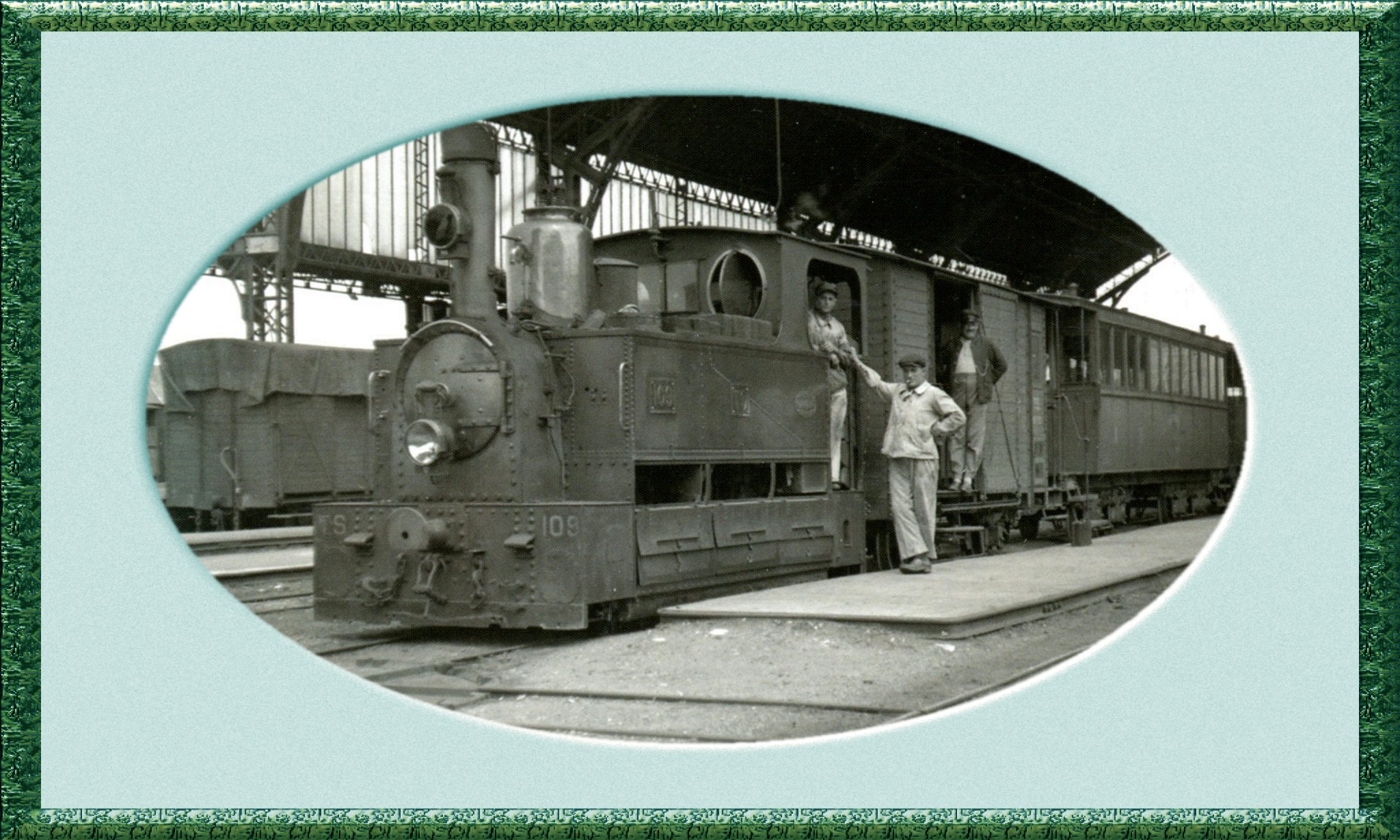 An image said to date from 1946 of a T.S. tram waiting to depart from the Gare Centrale, a scene soon to be swept away in its entirety. Just over a kilometre away, the Pont en X has already been destroyed but we return to it now for a final visit, a photographic circumnavigation using old postcards. Could the fourgon in the image be a former postal van, re-purposed?
.
If analysing views of the bridge, be aware that some postcard manufacturers appear to have continued to reproduce some photographs of the Pont en X for years, maybe even decades, after the photograph was taken, which can mislead.
An image said to date from 1946 of a T.S. tram waiting to depart from the Gare Centrale, a scene soon to be swept away in its entirety. Just over a kilometre away, the Pont en X has already been destroyed but we return to it now for a final visit, a photographic circumnavigation using old postcards. Could the fourgon in the image be a former postal van, re-purposed?
.
If analysing views of the bridge, be aware that some postcard manufacturers appear to have continued to reproduce some photographs of the Pont en X for years, maybe even decades, after the photograph was taken, which can mislead.
 A T.S. passenger service on the Pont en X, heading for the country, circa 1905.
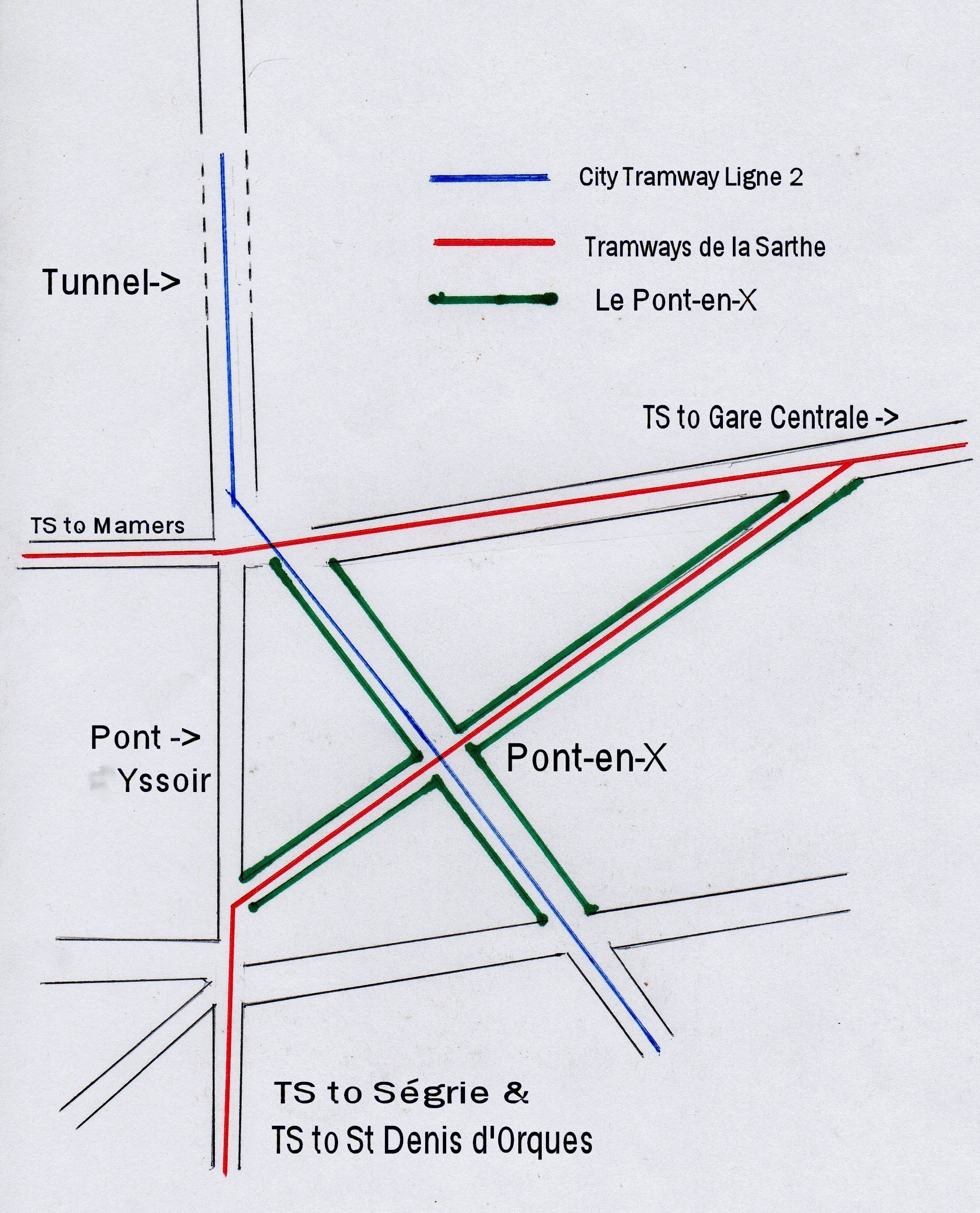 A simple drawing showing the Pont en X with the city's electric tram tracks shown in blue and the T.S. tracks in red. The Pont en X is outlined in green. Not to scale.
Due to the broad symmetry of the structure, we will take a pictorial tour of the Pont en X, in order to provide help with orientation. Below is an anti-clockwise circuit of the bridge using old postcard views.
For the first card, the photographer is standing at roughly the north-west corner of the bridge, which is at the bottom left corner of our sketch map. On this first card (below), in the foreground we can just faintly see the tracks for T.S. trams arriving from St Denis d'Orques curving onto the Pont en X in the direction of the Gare Centrale. There is an electric tram on Ligne 2 crossing the bridge.
A simple drawing showing the Pont en X with the city's electric tram tracks shown in blue and the T.S. tracks in red. The Pont en X is outlined in green. Not to scale.
Due to the broad symmetry of the structure, we will take a pictorial tour of the Pont en X, in order to provide help with orientation. Below is an anti-clockwise circuit of the bridge using old postcard views.
For the first card, the photographer is standing at roughly the north-west corner of the bridge, which is at the bottom left corner of our sketch map. On this first card (below), in the foreground we can just faintly see the tracks for T.S. trams arriving from St Denis d'Orques curving onto the Pont en X in the direction of the Gare Centrale. There is an electric tram on Ligne 2 crossing the bridge.
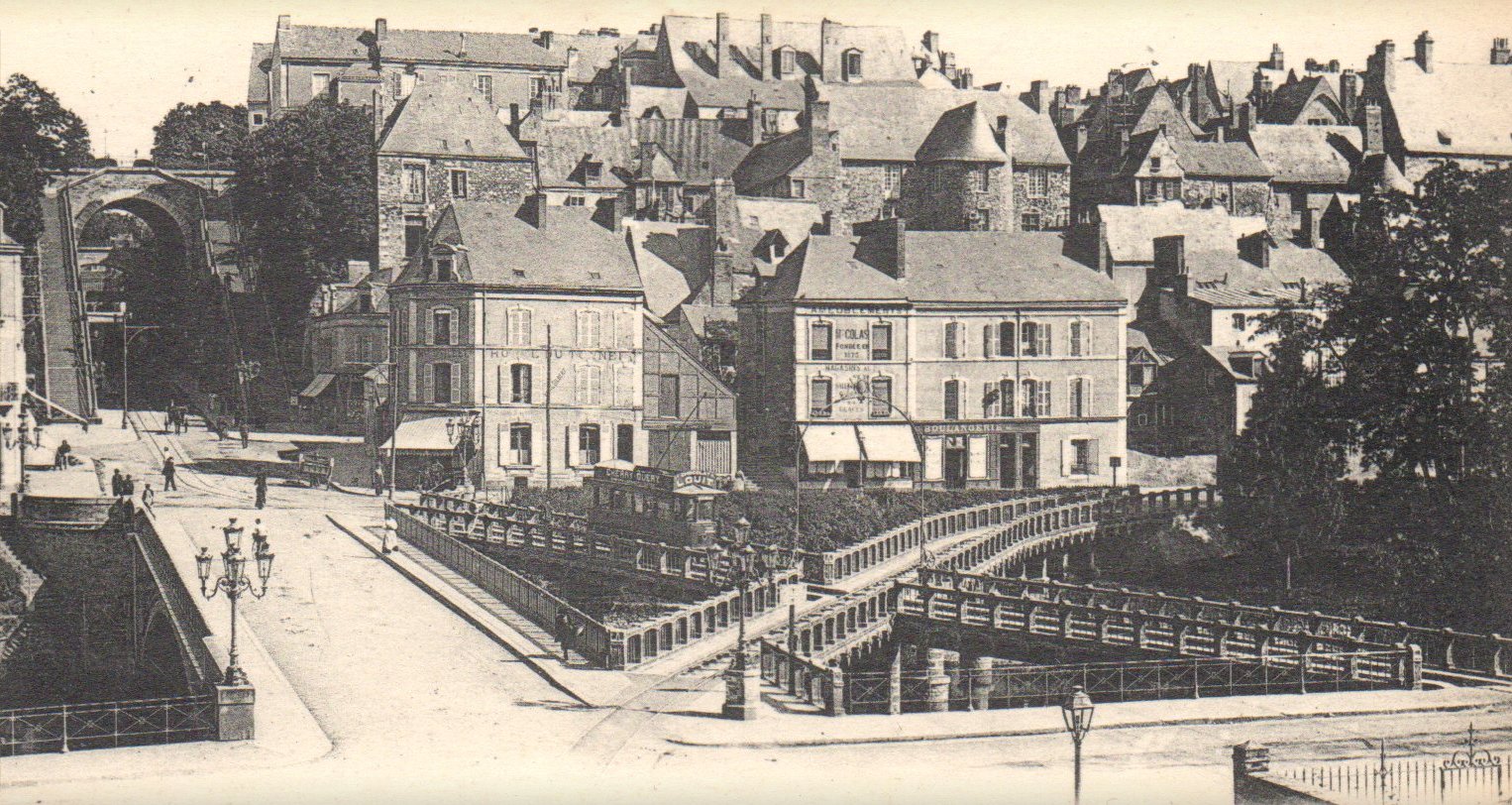
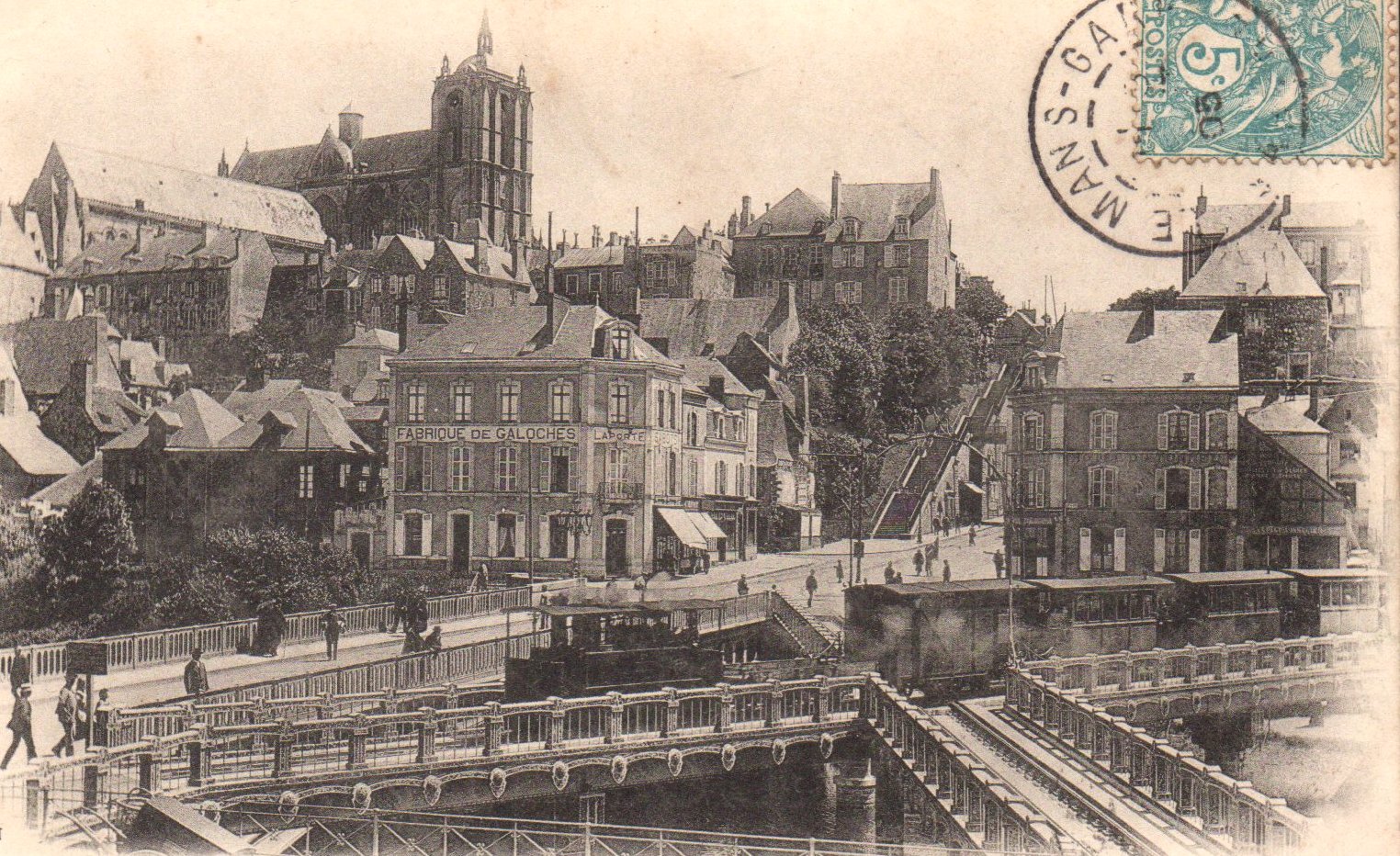 Above: We have seen an early version of this card sent on Jan. 13th 1901, dating this photograph to 1900 or earlier.
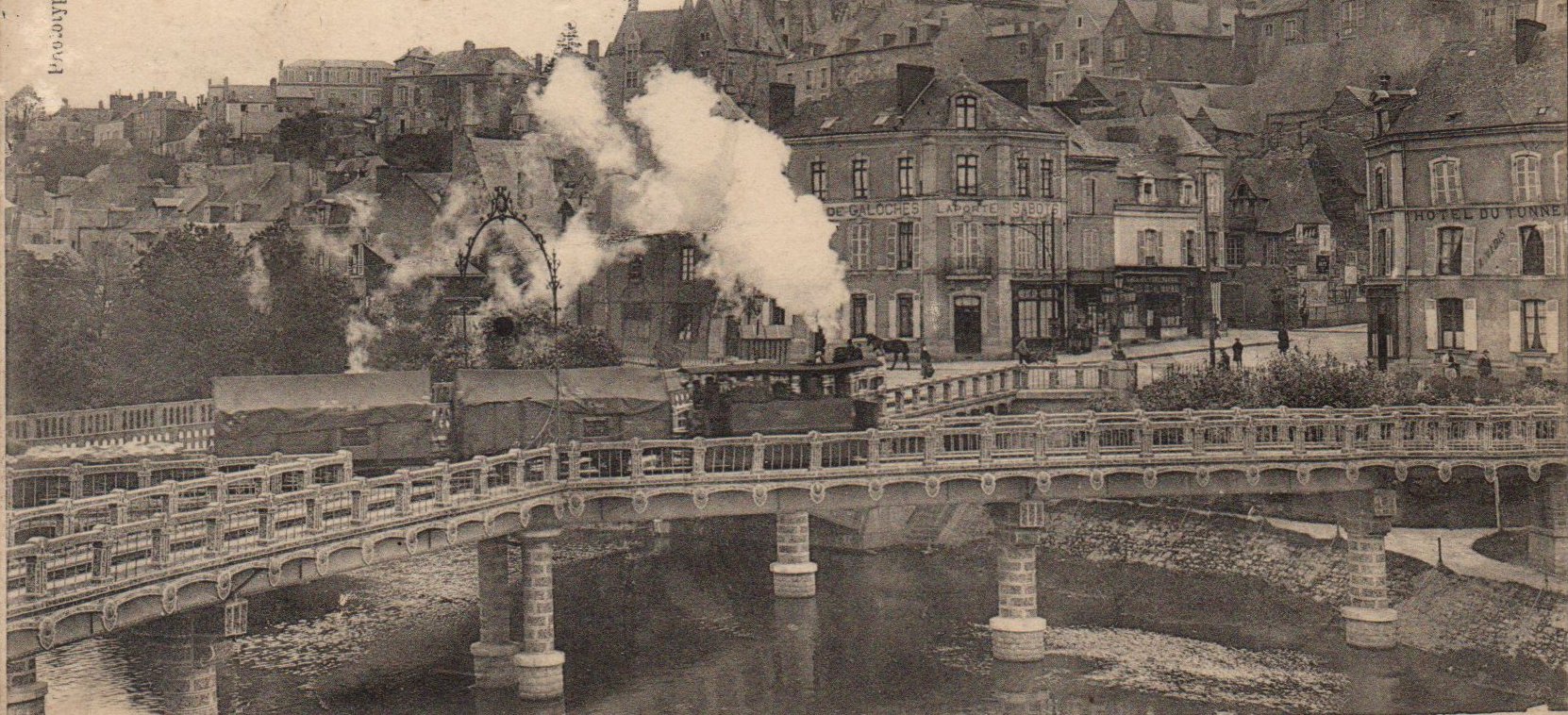
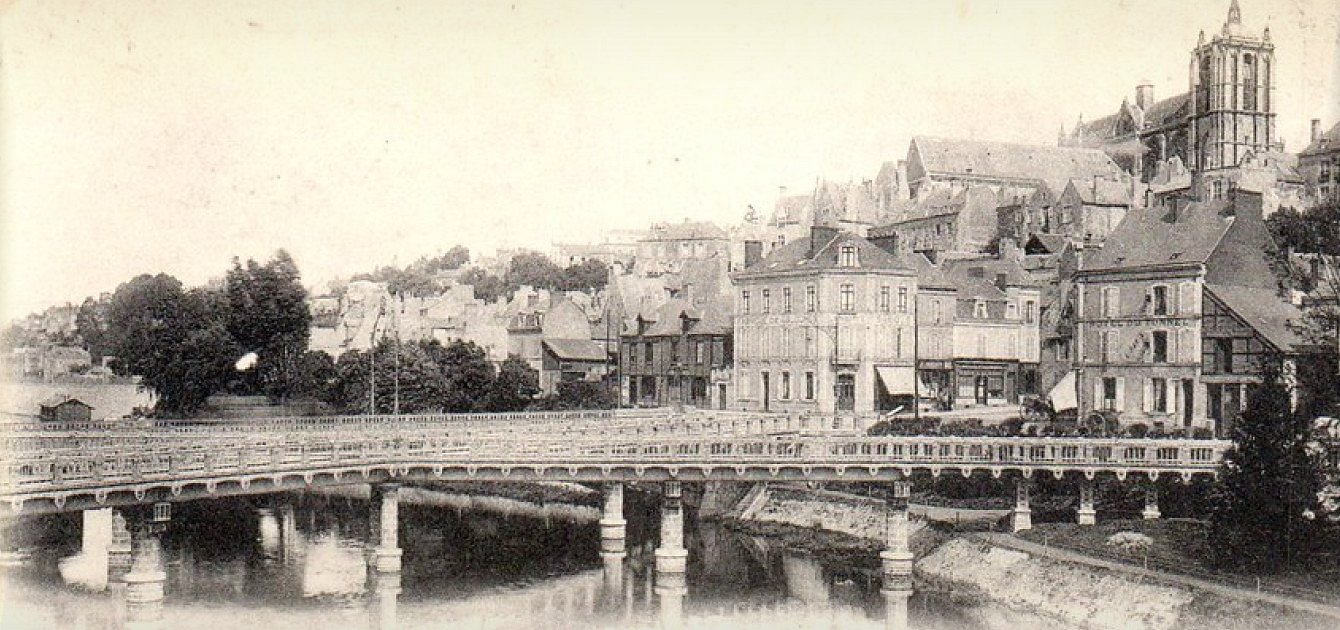
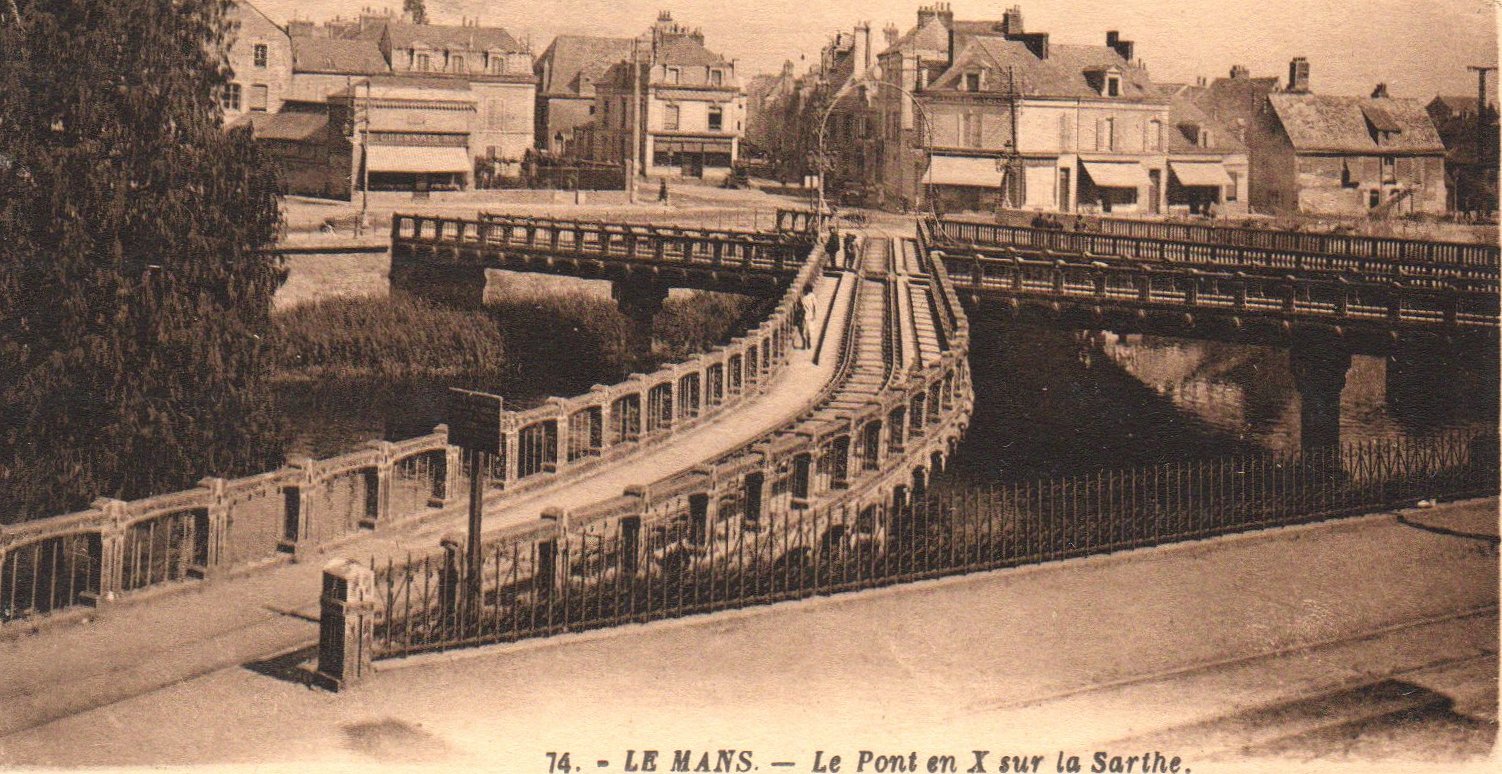 Above: We have now crossed the River Sarthe onto Quai Louis Blanc and this is quite an uncommon angle for a photographer to choose. The tracks in the right foreground are the Mamers line, which has just diverged from the St Denis d'Orques tracks heading out over the Pont en X.
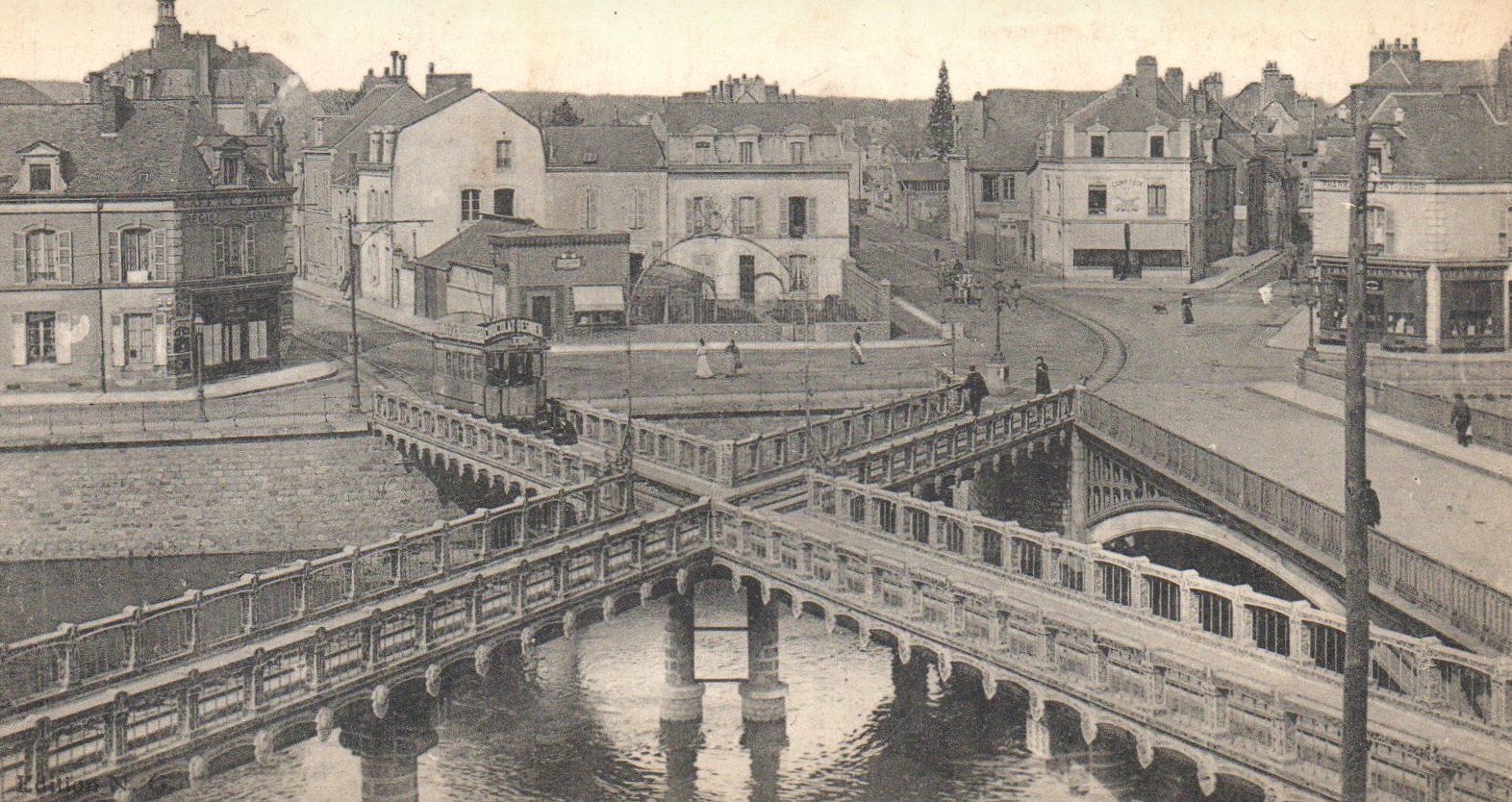
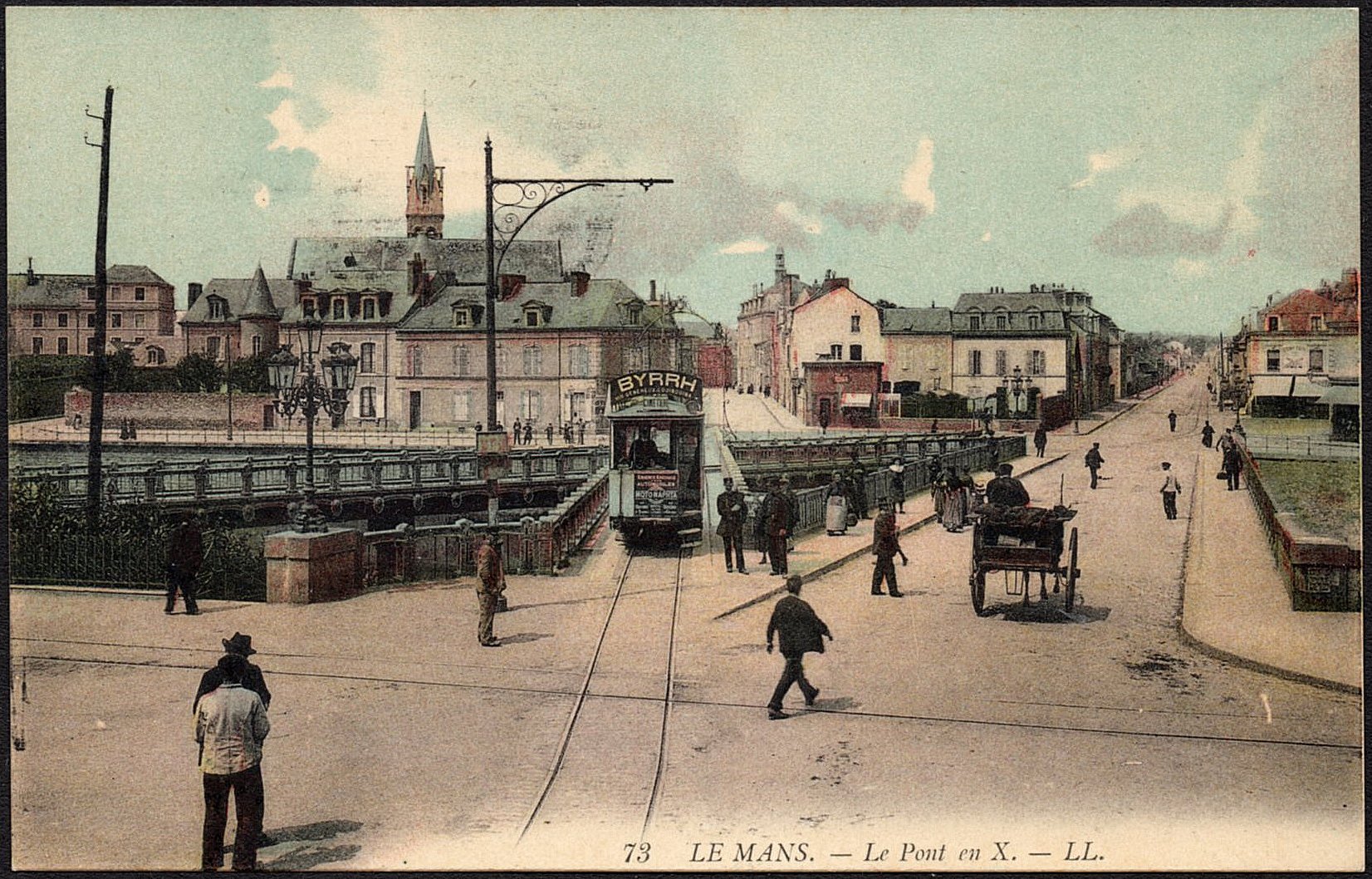 Above: This coloured view shows a tram on Ligne 2 on the bridge. In the foreground, crossing the city tram's tracks, are the rails of the Mamers line, left to the Gare Centrale, right to Mamers. The tracks of the St Denis d'Orques line can just be discerned on the other side of the Pont Yssoir heading out to the country on the Rue du Tunnel (extension), today's Rue Voltaire.
The photographer who took the image above did so with his back to the tunnel. The photo below was taken from above the tunnel and shows a steam tram from St. Denis d'Orques** heading for the Gare Centrale, with many passers-by pausing to take in the scene.
** Tram services across the Pont en X to/from Ségrie only commenced much later.
Above: This coloured view shows a tram on Ligne 2 on the bridge. In the foreground, crossing the city tram's tracks, are the rails of the Mamers line, left to the Gare Centrale, right to Mamers. The tracks of the St Denis d'Orques line can just be discerned on the other side of the Pont Yssoir heading out to the country on the Rue du Tunnel (extension), today's Rue Voltaire.
The photographer who took the image above did so with his back to the tunnel. The photo below was taken from above the tunnel and shows a steam tram from St. Denis d'Orques** heading for the Gare Centrale, with many passers-by pausing to take in the scene.
** Tram services across the Pont en X to/from Ségrie only commenced much later.
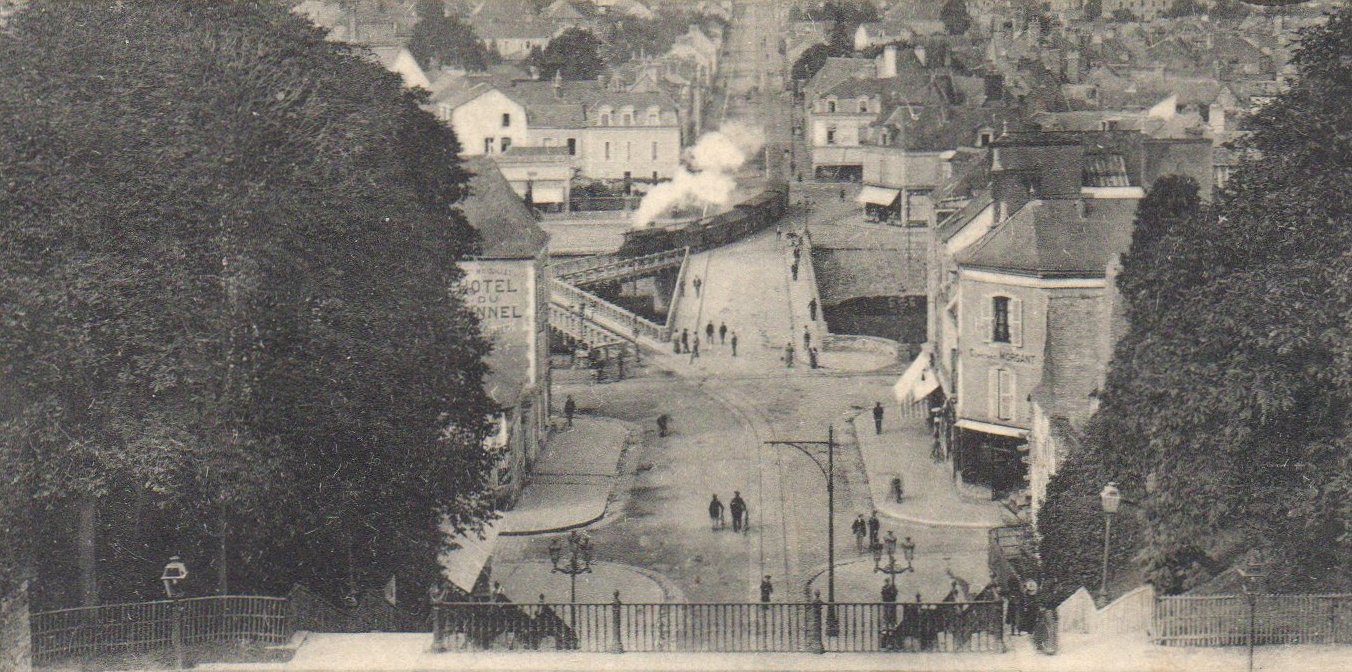 This view looks down the length of the Pont Yssoir; the fourth carriage is located approximately at the point where we started our circular tour of the Pont en X.
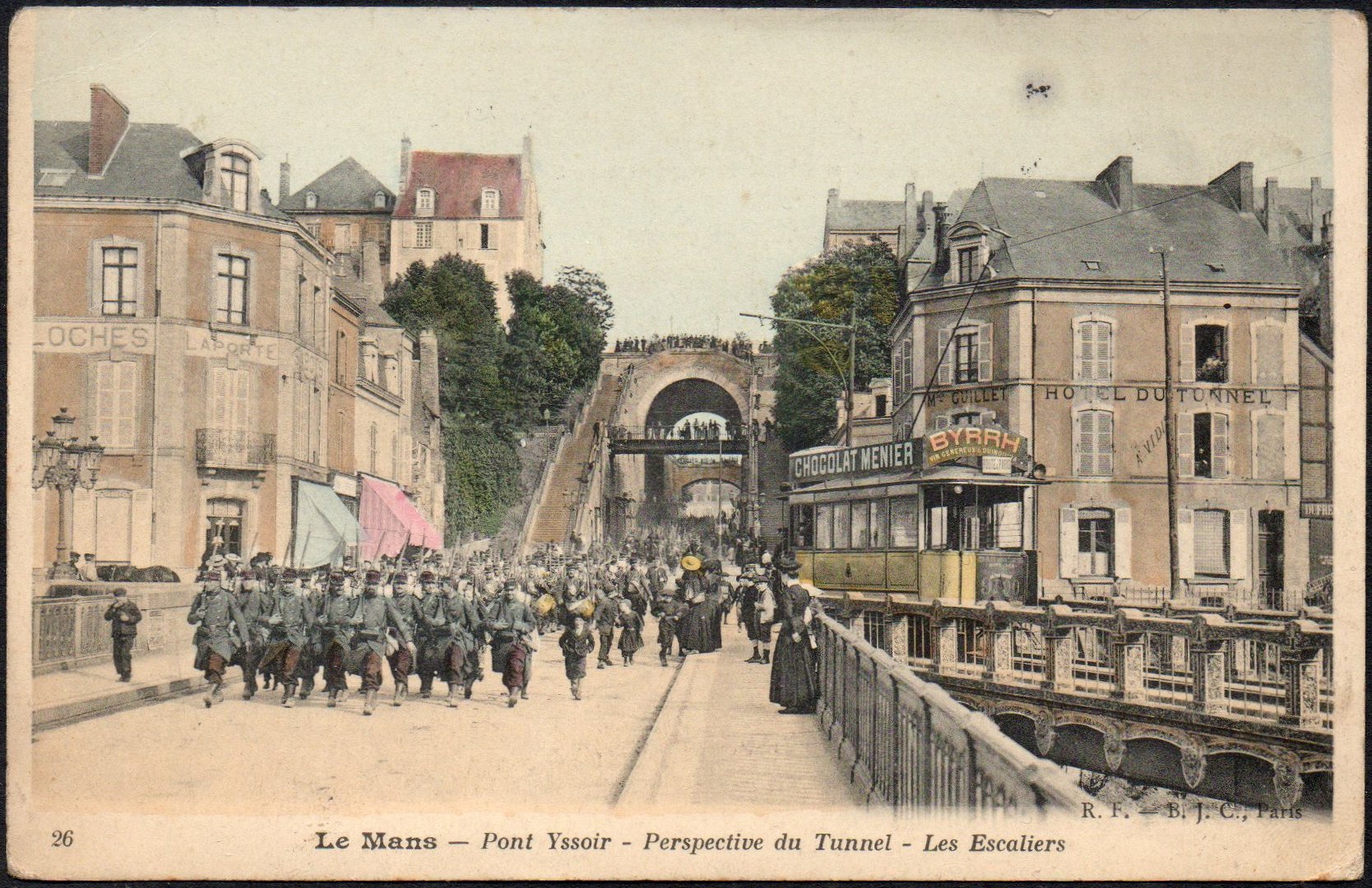 Looking back the other way, this splendid, and seemingly very scarce, card shows a large crowd watching a military procession approaching the Pont Yssoir, posted in February, 1906. The driver and at least one passenger on the tramcar, brought to a halt on the exit from the Pont en X, wait for the procession to pass and have a grandstand view. This may perhaps be a Bastille Day celebration.
Return to Listing of all Railway Articles (with links). Note: You may already have an open tab