 As a guide to this map's scale, the distance from Cannes to Bordighera is approximately 80 kms (50 miles).
The map essentially shows the Côte d'Azur. The border between France and Italy is between Menton and Ventimiglia (known in French as Vintimille) and shown on the map thus: +++++++++. The dark black line hugging the coastline on the map is the final stretch of the main line railway from Marseille to Italy which also carries numerous through trains, TGV, from Paris. From Paris, these trains use the High-Speed line as far as Marseille but proceed from there on older tracks built to standard engineering norms at normal speeds. The TGV services typically terminate at Nice but the stopping services usually run though to Ventimiglia.
The 1860 acquisition of the new lands prompted the creation of a new département of Alpes Maritimes into which was incorporated a small eastern part of the département of the Var, including the towns of Cannes and Antibes and their hinterland including Grasse, long famous for its perfume industry. It is this 'new' French département of Alpes Maritimes that has subsequently bordered Monaco on all the landward sides. However, Italian linguistic influence in the entire region is still very evident today, for example in the heavily-accentuated endings to words in spoken French locally, which is even more pronounced than in much of the rest of Provence.
In matters of defence and in many matters political, Monaco looks to France, with whom its independence is guaranteed in law. Whilst closely-aligned with the European Union, Monaco's status is complex in its relations with that body. It uses the Euro by agreement and accepts many, but not all, of the bloc's trading rules. The Wikipedia page on 'Monaco–European Union relations' explains the relationship more fully. Indeed, the entire history and current status of Monaco is fascinating and its survival as a separate principality, through the upheavals of the 18th and 19th centuries in particular, is somewhat surprising. For philatelists, its survival along with that of, for example, San Marino and Liechtenstein, adds much to the tableau of European philately.
.
The Railway in Monaco:
When examining the history of the railway in Monaco, its population density and wealth are not of mere peripheral interest. The roughly three kilometres of track that represent the line's passage from west to east across the principality have twice been the subject of radical revision, each time involving the boring of an expensive tunnel. The old right-of-way of the railway has principally served to provide a new road through much of the principality whilst some adjacent railway land also provided opportunity for property development.
Routing and re-routing of the railway through Monaco :
As a guide to this map's scale, the distance from Cannes to Bordighera is approximately 80 kms (50 miles).
The map essentially shows the Côte d'Azur. The border between France and Italy is between Menton and Ventimiglia (known in French as Vintimille) and shown on the map thus: +++++++++. The dark black line hugging the coastline on the map is the final stretch of the main line railway from Marseille to Italy which also carries numerous through trains, TGV, from Paris. From Paris, these trains use the High-Speed line as far as Marseille but proceed from there on older tracks built to standard engineering norms at normal speeds. The TGV services typically terminate at Nice but the stopping services usually run though to Ventimiglia.
The 1860 acquisition of the new lands prompted the creation of a new département of Alpes Maritimes into which was incorporated a small eastern part of the département of the Var, including the towns of Cannes and Antibes and their hinterland including Grasse, long famous for its perfume industry. It is this 'new' French département of Alpes Maritimes that has subsequently bordered Monaco on all the landward sides. However, Italian linguistic influence in the entire region is still very evident today, for example in the heavily-accentuated endings to words in spoken French locally, which is even more pronounced than in much of the rest of Provence.
In matters of defence and in many matters political, Monaco looks to France, with whom its independence is guaranteed in law. Whilst closely-aligned with the European Union, Monaco's status is complex in its relations with that body. It uses the Euro by agreement and accepts many, but not all, of the bloc's trading rules. The Wikipedia page on 'Monaco–European Union relations' explains the relationship more fully. Indeed, the entire history and current status of Monaco is fascinating and its survival as a separate principality, through the upheavals of the 18th and 19th centuries in particular, is somewhat surprising. For philatelists, its survival along with that of, for example, San Marino and Liechtenstein, adds much to the tableau of European philately.
.
The Railway in Monaco:
When examining the history of the railway in Monaco, its population density and wealth are not of mere peripheral interest. The roughly three kilometres of track that represent the line's passage from west to east across the principality have twice been the subject of radical revision, each time involving the boring of an expensive tunnel. The old right-of-way of the railway has principally served to provide a new road through much of the principality whilst some adjacent railway land also provided opportunity for property development.
Routing and re-routing of the railway through Monaco :
 This simple map immediately above, from Wikipedia's page on the railway in Monaco, is most informative.
The RED line shows the original, almost entirely surface, route through the principality.
The BLUE line shows the tunnel opened at the end of 1964 which replaced the surface tracks in the East of the principality.
The GREEN line shows the additional tunnel completed in 1999 which replaced the surface tracks in the West of the principality.
Work started in 1864 on extending the railway from Nice to the Gare de Monaco which opened in 1868, by which time further works had already been initiated (in 1866) to extend to the Gare de Monte-Carlo and to Menton. The Gare de Monte-Carlo opened in 1869.
Station Names in Monaco: There have been three stations in Monaco. The first was the Gare de Monaco, opened in 1868, followed by the Gare de Monte-Carlo. The Gare de Monaco was re-named Gare de Monaco-Monte Carlo in the 1950s or 1960s but, to avoid confusion, we stick with the name Gare de Monaco for the station at that location throughout the article. In 1999, a new replacement station was constructed (underground and at a new location) and we use its name, the Gare de Monaco Monte-Carlo, only for this 1999 station.
In 1958, work started on a new tunnel eastwards from just east of the Gare de Monaco. This line by-passed the Gare de Monte-Carlo and the tracks only re-emerged into the daylight after crossing back into France. With the opening of what we shall call this 'Eastern Tunnel' in December 1964, the surface line in the eastern half of the principality along with the Gare de Monte-Carlo were closed to all traffic, all activity being transferred to the remaining station, the Gare de Monaco.
A film taken from one of the last trains to take the old line can be accessed here (opens in a new tab). As links can be transitory, here's a second link to the same film: an alternative link (with adverts). Other than for the last few seconds, the film starts just within France to the east and we travel westwards. The film appears to be wrongly titled 1954 instead of 1964. First we glimpse the eastern portal of the new tunnel with workmen apparently ready to start work on connecting up the tracks into it. We catch several glimpses of the Mediterranean before passing through the Gare de Monte-Carlo at 1 min 10 seconds and the camera pans upwards and to the right to catch sight of the ornate towers of the casino. After passing the port, we cross the bridge / viaduct of Saint Dévote and the camera captures the top of the famous church on our right at 1 min 58 secs. Shortly thereafter, workmen may be seen at the western portal of the new tunnel before the film ends with a glimpse of the Gare de Monaco and, a little confusingly, by travelling back in the opposite direction for a few seconds.
In 1999, a second new 'Western' Tunnel was constructed, which completed the entombment of the railway throughout Monaco, the tracks only emerging well into French territory near the Gare de Cap d'Ail. Within Monaco, the Western Tunnel was joined into the Eastern Tunnel, although not directly end-on-end, a small western stub of the Eastern Tunnel being abandoned.
October 2022 update to this article:
We have added two French-language videos, both related to the railway in the western part of Monaco. The first is another 1960s film, which focuses on the opening of the 1964 tunnel. It includes a night-time view of a DMU about 2 minutes, 45 seconds into the film, probably one of the last eastbound trains to bypass the western portal of this tunnel and continue eastwards on the old surface alignment towards the Gare de Monte Carlo and Italy.
The video also shows the refurbishment of the Gare de Monaco, which in 1964 became the sole station in the principality, 1400 metres west of the Gare de Monte Carlo, which closed at this date: The video can be accessed here (opens in a new tab).
Our second additional video is a driver's view of the surface line in both directions between Monaco (Sainte Dévote) and the Gare de Cap d'Ail, taken prior to the opening of the second tunnel under the western half of Monaco (the 'Western Tunnel') in 1999. The filming starts (in rain) just beyond the (unseen) western portal of the 1964 Eastern Tunnel and we follow the train westward in this February 1991 view, calling at a busy Gare de Monaco and then on to the Gare de Cap d'Ail. We then make the same journey in reverse, filmed in better weather and four years later (May 1995) and the western portal of the 1999 Western Tunnel, already under construction, is clearly seen shortly after leaving Cap d'Ail. This return train enters the Principality 4 minutes, 45 seconds into the video and the film ends at the western portal of the Eastern Tunnel immediately after crossing the Pont Sainte Dévote:
The Cap d'Ail to Monaco (and back) video can be accessed here (opens in a new tab) and may be preceded by a youtube advert.
With the opening of the second tunnel, the Gare de Monaco on the surface was now closed and demolished, replaced by the new and spacious subterranean Gare de Monaco - Monte-Carlo, located to the north-east, high above the ravine of Sainte-Dévote and immediately adjacent to the border with France, indeed partly beneath Beausoleil, which is French territory. The station's location is shown on the map above as a green dot.
This simple map immediately above, from Wikipedia's page on the railway in Monaco, is most informative.
The RED line shows the original, almost entirely surface, route through the principality.
The BLUE line shows the tunnel opened at the end of 1964 which replaced the surface tracks in the East of the principality.
The GREEN line shows the additional tunnel completed in 1999 which replaced the surface tracks in the West of the principality.
Work started in 1864 on extending the railway from Nice to the Gare de Monaco which opened in 1868, by which time further works had already been initiated (in 1866) to extend to the Gare de Monte-Carlo and to Menton. The Gare de Monte-Carlo opened in 1869.
Station Names in Monaco: There have been three stations in Monaco. The first was the Gare de Monaco, opened in 1868, followed by the Gare de Monte-Carlo. The Gare de Monaco was re-named Gare de Monaco-Monte Carlo in the 1950s or 1960s but, to avoid confusion, we stick with the name Gare de Monaco for the station at that location throughout the article. In 1999, a new replacement station was constructed (underground and at a new location) and we use its name, the Gare de Monaco Monte-Carlo, only for this 1999 station.
In 1958, work started on a new tunnel eastwards from just east of the Gare de Monaco. This line by-passed the Gare de Monte-Carlo and the tracks only re-emerged into the daylight after crossing back into France. With the opening of what we shall call this 'Eastern Tunnel' in December 1964, the surface line in the eastern half of the principality along with the Gare de Monte-Carlo were closed to all traffic, all activity being transferred to the remaining station, the Gare de Monaco.
A film taken from one of the last trains to take the old line can be accessed here (opens in a new tab). As links can be transitory, here's a second link to the same film: an alternative link (with adverts). Other than for the last few seconds, the film starts just within France to the east and we travel westwards. The film appears to be wrongly titled 1954 instead of 1964. First we glimpse the eastern portal of the new tunnel with workmen apparently ready to start work on connecting up the tracks into it. We catch several glimpses of the Mediterranean before passing through the Gare de Monte-Carlo at 1 min 10 seconds and the camera pans upwards and to the right to catch sight of the ornate towers of the casino. After passing the port, we cross the bridge / viaduct of Saint Dévote and the camera captures the top of the famous church on our right at 1 min 58 secs. Shortly thereafter, workmen may be seen at the western portal of the new tunnel before the film ends with a glimpse of the Gare de Monaco and, a little confusingly, by travelling back in the opposite direction for a few seconds.
In 1999, a second new 'Western' Tunnel was constructed, which completed the entombment of the railway throughout Monaco, the tracks only emerging well into French territory near the Gare de Cap d'Ail. Within Monaco, the Western Tunnel was joined into the Eastern Tunnel, although not directly end-on-end, a small western stub of the Eastern Tunnel being abandoned.
October 2022 update to this article:
We have added two French-language videos, both related to the railway in the western part of Monaco. The first is another 1960s film, which focuses on the opening of the 1964 tunnel. It includes a night-time view of a DMU about 2 minutes, 45 seconds into the film, probably one of the last eastbound trains to bypass the western portal of this tunnel and continue eastwards on the old surface alignment towards the Gare de Monte Carlo and Italy.
The video also shows the refurbishment of the Gare de Monaco, which in 1964 became the sole station in the principality, 1400 metres west of the Gare de Monte Carlo, which closed at this date: The video can be accessed here (opens in a new tab).
Our second additional video is a driver's view of the surface line in both directions between Monaco (Sainte Dévote) and the Gare de Cap d'Ail, taken prior to the opening of the second tunnel under the western half of Monaco (the 'Western Tunnel') in 1999. The filming starts (in rain) just beyond the (unseen) western portal of the 1964 Eastern Tunnel and we follow the train westward in this February 1991 view, calling at a busy Gare de Monaco and then on to the Gare de Cap d'Ail. We then make the same journey in reverse, filmed in better weather and four years later (May 1995) and the western portal of the 1999 Western Tunnel, already under construction, is clearly seen shortly after leaving Cap d'Ail. This return train enters the Principality 4 minutes, 45 seconds into the video and the film ends at the western portal of the Eastern Tunnel immediately after crossing the Pont Sainte Dévote:
The Cap d'Ail to Monaco (and back) video can be accessed here (opens in a new tab) and may be preceded by a youtube advert.
With the opening of the second tunnel, the Gare de Monaco on the surface was now closed and demolished, replaced by the new and spacious subterranean Gare de Monaco - Monte-Carlo, located to the north-east, high above the ravine of Sainte-Dévote and immediately adjacent to the border with France, indeed partly beneath Beausoleil, which is French territory. The station's location is shown on the map above as a green dot.
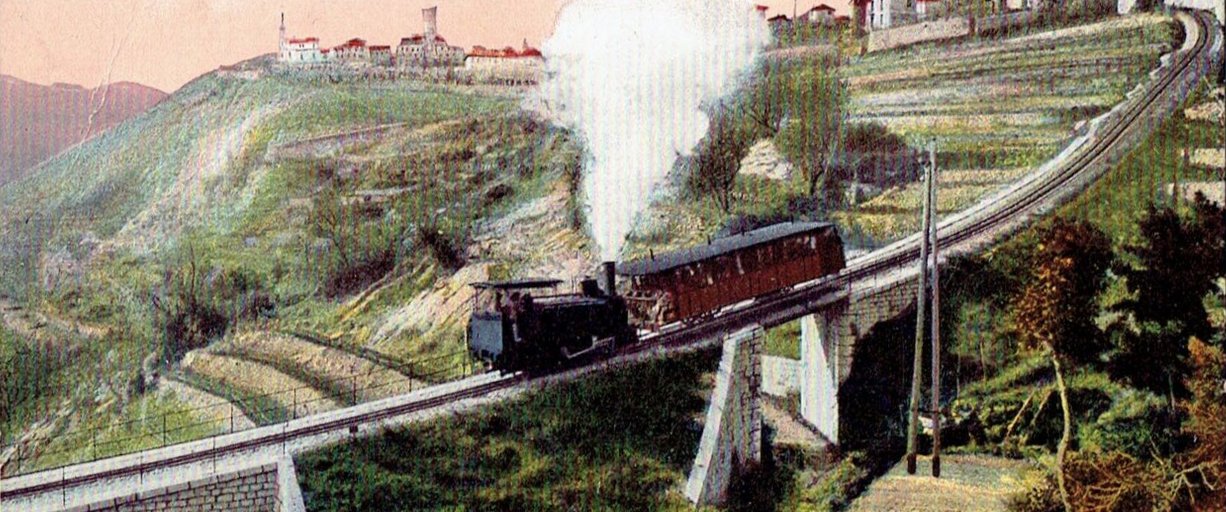 Also shown on the map is the Gare de la Turbie, terminus of a rack railway opened in 1894 which joined the village of La Turbie to the very border of the principality, but the line lay wholly within French territory. The railway closed in 1932 following a serious accident although it was not dismantled, it seems, until after World War II. We look at stamps showing the southern terminus of this railway later in this article but above is a postcard view of the line just below the village of La Turbie.
With regards to stations very close to Monaco, there is also, near the eastern exit of the Eastern Tunnel and just inside French territory, the French-operated 'Halte de Monte-Carlo-Country-Club', which is only open in April each year for the Monte-Carlo Tennis Masters' Tournament. This rather curious railway halt is outside the scope of this article.
.
Philately :
from the: 'Convention du 18/05/1963 relative aux relations postales, télégraphiques et téléphoniques' . . .
. . . and the . . . 'Protocole du 18/05/1963 de signature'
Although a sovereign state, the postal accords between the Principality and France define clearly who sets all the key parameters. Monaco must adhere to all French postal regulations and the face values on its definitive stamps must mirror those of the French Republic. Even commemoratives must adhere to one of the existing French postal rates. French and Monegasque citizens may take up employment in each other's postal services, subject to certain conditions. One unusual extra provision is that Monaco must have all its postage stamps printed in France and this is very noticeable not only in such features as the patterned and dated sheet borders but also by the presence of imperforate stamps, colour trials and proofs (épreuves de luxe) in styles that are wholly French in origin. The full text of the agreement (in French) can be viewed here (opens in a new tab).
Also shown on the map is the Gare de la Turbie, terminus of a rack railway opened in 1894 which joined the village of La Turbie to the very border of the principality, but the line lay wholly within French territory. The railway closed in 1932 following a serious accident although it was not dismantled, it seems, until after World War II. We look at stamps showing the southern terminus of this railway later in this article but above is a postcard view of the line just below the village of La Turbie.
With regards to stations very close to Monaco, there is also, near the eastern exit of the Eastern Tunnel and just inside French territory, the French-operated 'Halte de Monte-Carlo-Country-Club', which is only open in April each year for the Monte-Carlo Tennis Masters' Tournament. This rather curious railway halt is outside the scope of this article.
.
Philately :
from the: 'Convention du 18/05/1963 relative aux relations postales, télégraphiques et téléphoniques' . . .
. . . and the . . . 'Protocole du 18/05/1963 de signature'
Although a sovereign state, the postal accords between the Principality and France define clearly who sets all the key parameters. Monaco must adhere to all French postal regulations and the face values on its definitive stamps must mirror those of the French Republic. Even commemoratives must adhere to one of the existing French postal rates. French and Monegasque citizens may take up employment in each other's postal services, subject to certain conditions. One unusual extra provision is that Monaco must have all its postage stamps printed in France and this is very noticeable not only in such features as the patterned and dated sheet borders but also by the presence of imperforate stamps, colour trials and proofs (épreuves de luxe) in styles that are wholly French in origin. The full text of the agreement (in French) can be viewed here (opens in a new tab).
 From a railway philatelic viewpoint, the stamps issued by Monaco at a time when the railway was on the surface are generally the most interesting. Unlike the film, linked above, this article will follow the line from West to East using stamps where possible, often supported by old postcard views, as we seek to paint a picture of the railway traversing Monaco in former times. In our detailed progression along the erstwhile surface line, for simplicity of form we have sometimes used the present tense below. However, with the exception of a dated monumental rock, described later, and the entrances to the new (1999) station, there is little evidence on the surface today that Monaco is served by a railway at all.
Most of the postcards views that we have used for this article are pre-WWI, towards the end of what is termed 'la Belle Epoque'. This seems particularly appropriate to this article; in this period there were few places more stylish and elegant than Cannes, Nice and Monaco / Monte-Carlo.
Scope of the Article :
Although we have provided a catalogue-style listing with check-boxes, this article is not intended, nor remotely close to being, a full listing of the railway thematic issues of Monaco. Its purpose is solely to provide some clarity as to why certain stamps are listed in railway catalogues as so much has changed on the ground since the majority of these stamps were issued.
Almost all Monaco stamps exist imperforate, sourced from limited printings of the normal sheets. We have not listed the imperforate stamps in this article. In recent decades, similar to the practice in Germany, many commemorative stamps have been issued in small sheetlets, typically of 10 identical stamps. We have limited our listings in such cases to a single stamp from the sheetlet.
From a railway philatelic viewpoint, the stamps issued by Monaco at a time when the railway was on the surface are generally the most interesting. Unlike the film, linked above, this article will follow the line from West to East using stamps where possible, often supported by old postcard views, as we seek to paint a picture of the railway traversing Monaco in former times. In our detailed progression along the erstwhile surface line, for simplicity of form we have sometimes used the present tense below. However, with the exception of a dated monumental rock, described later, and the entrances to the new (1999) station, there is little evidence on the surface today that Monaco is served by a railway at all.
Most of the postcards views that we have used for this article are pre-WWI, towards the end of what is termed 'la Belle Epoque'. This seems particularly appropriate to this article; in this period there were few places more stylish and elegant than Cannes, Nice and Monaco / Monte-Carlo.
Scope of the Article :
Although we have provided a catalogue-style listing with check-boxes, this article is not intended, nor remotely close to being, a full listing of the railway thematic issues of Monaco. Its purpose is solely to provide some clarity as to why certain stamps are listed in railway catalogues as so much has changed on the ground since the majority of these stamps were issued.
Almost all Monaco stamps exist imperforate, sourced from limited printings of the normal sheets. We have not listed the imperforate stamps in this article. In recent decades, similar to the practice in Germany, many commemorative stamps have been issued in small sheetlets, typically of 10 identical stamps. We have limited our listings in such cases to a single stamp from the sheetlet.
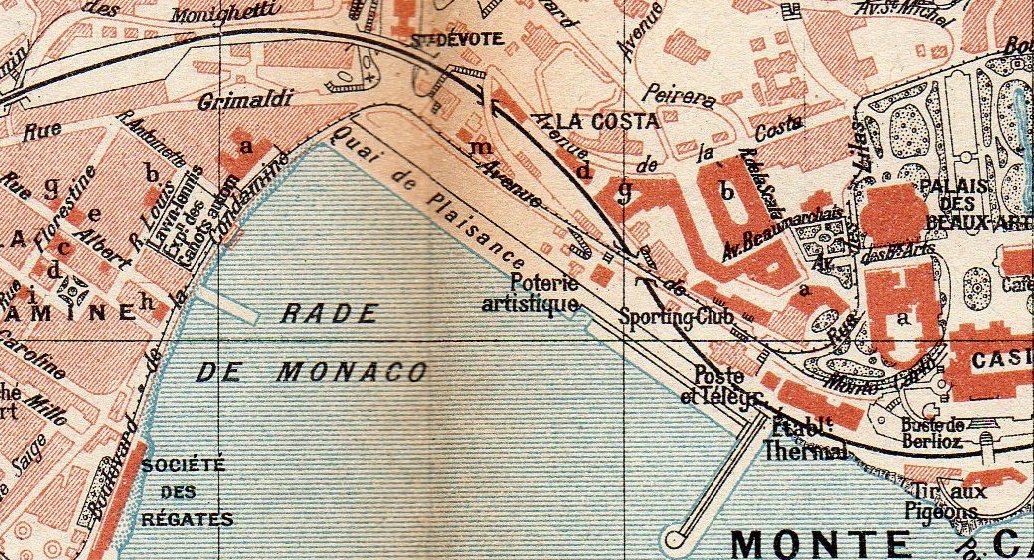
 We shall use the circa 1920 map above as our main geographic guide through the principality, whose border with France is shown as a line of crosses (+++++++), which are most noticeable across the top of the map. To the West and East, as a map of Monaco it is incomplete, with around 300 metres omitted to the West (left), thus excluding Fontvieille and rather more missing to the East, around 500-600 metres of an increasingly narrow coastal strip up to the French border. We use selected enlargements of parts of this map through the article.
.
To avoid interrupting our largely pre-1964 journey across Monaco, stamps showing the 1999-built subterranean Gare de Monaco-Monte-Carlo, the only real point of interest on today's hidden railway, are examined at the end of our journey. We have used the postcard image below, a stylized Gare de Monaco, as a divider between locations, as we work from from West to East.
.
We shall use the circa 1920 map above as our main geographic guide through the principality, whose border with France is shown as a line of crosses (+++++++), which are most noticeable across the top of the map. To the West and East, as a map of Monaco it is incomplete, with around 300 metres omitted to the West (left), thus excluding Fontvieille and rather more missing to the East, around 500-600 metres of an increasingly narrow coastal strip up to the French border. We use selected enlargements of parts of this map through the article.
.
To avoid interrupting our largely pre-1964 journey across Monaco, stamps showing the 1999-built subterranean Gare de Monaco-Monte-Carlo, the only real point of interest on today's hidden railway, are examined at the end of our journey. We have used the postcard image below, a stylized Gare de Monaco, as a divider between locations, as we work from from West to East.
.
 1. Railway Lines on Maps :
A small number of stamps provide an overview of the railway's route through the principality, all issued during the era when the entire course of the railway was largely above ground, viz. before 1965. Between 1942 and 1946, six stamps were issued based on one design, an aerial map of Monaco in which the railway is highlighted with a line in a more intense colour.
1. Railway Lines on Maps :
A small number of stamps provide an overview of the railway's route through the principality, all issued during the era when the entire course of the railway was largely above ground, viz. before 1965. Between 1942 and 1946, six stamps were issued based on one design, an aerial map of Monaco in which the railway is highlighted with a line in a more intense colour.
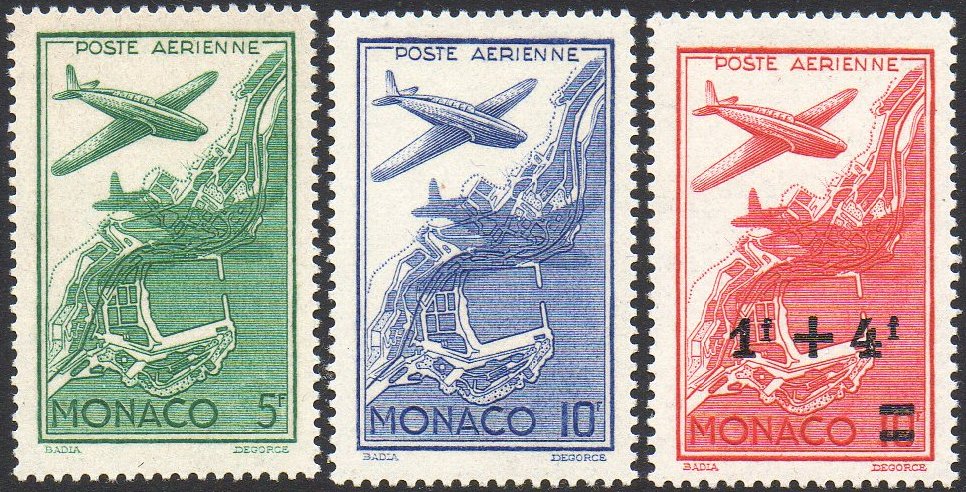
 One stamp is shown sideways, better to match the orientation of the map above.
1942 : Airmail : 5f Green [ . ] [ . ]
1942 : Airmail : 10f Blue [ . ] [ . ]
1945 : Airmail : 1f / 10f Red [ . ] [ . ]
The 10fr Red was not issued without surcharge.
.
One stamp is shown sideways, better to match the orientation of the map above.
1942 : Airmail : 5f Green [ . ] [ . ]
1942 : Airmail : 10f Blue [ . ] [ . ]
1945 : Airmail : 1f / 10f Red [ . ] [ . ]
The 10fr Red was not issued without surcharge.
.

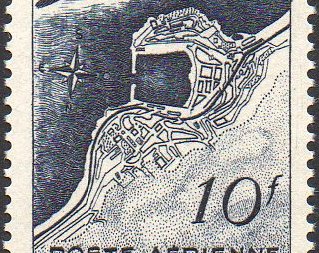 The second scan shows a detail from the 10f which is a mirror image of the 1f and 3f of this issue and of the 1942 design.
Franklin D. Roosevelt Commemoration:
1946 : 1f Brown [ . ] [ . ]
1946 : 3f Violet [ . ] [ . ]
1946 : 10f Deep Indigo (airmail) [ . ] [ . ]
.
The second scan shows a detail from the 10f which is a mirror image of the 1f and 3f of this issue and of the 1942 design.
Franklin D. Roosevelt Commemoration:
1946 : 1f Brown [ . ] [ . ]
1946 : 3f Violet [ . ] [ . ]
1946 : 10f Deep Indigo (airmail) [ . ] [ . ]
.
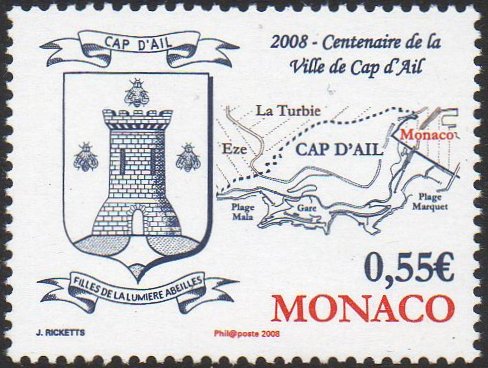
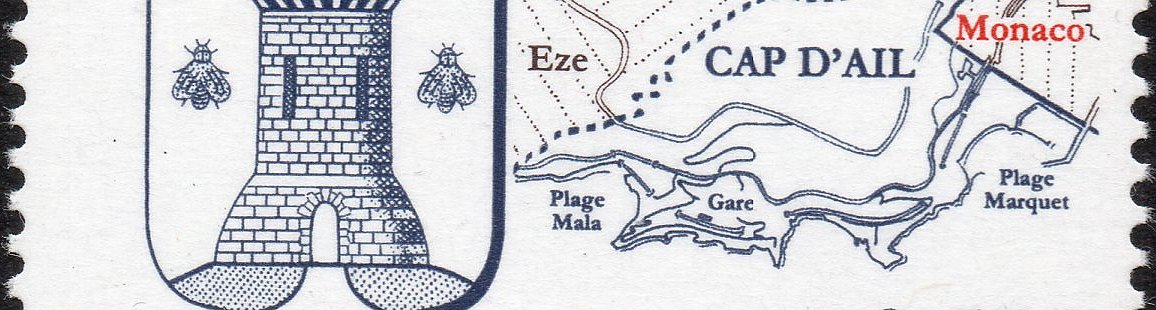 The above stamp, issued by Monaco in 2008, commemorates the village of Cap d'Ail which is in France but the stamp includes the western edge of Monaco (part of Fontvieille) in its design. Since 1999, the railway has been in tunnel from a little to the east of Cap d'Ail station until it emerges back into France beyond the eastern border of Monaco. However, aided by a detailed 1991 road atlas, a close study of the stamp reveals that the map shows the pre-1999 railway, on the surface apart from two short tunnels.
2008 : Euros 0.55 : Centenary of Cap d'Ail (map with station) & part of Fontvieille [ . ] [ . ]
.
2. Fontvieille :
The above stamp, issued by Monaco in 2008, commemorates the village of Cap d'Ail which is in France but the stamp includes the western edge of Monaco (part of Fontvieille) in its design. Since 1999, the railway has been in tunnel from a little to the east of Cap d'Ail station until it emerges back into France beyond the eastern border of Monaco. However, aided by a detailed 1991 road atlas, a close study of the stamp reveals that the map shows the pre-1999 railway, on the surface apart from two short tunnels.
2008 : Euros 0.55 : Centenary of Cap d'Ail (map with station) & part of Fontvieille [ . ] [ . ]
.
2. Fontvieille :
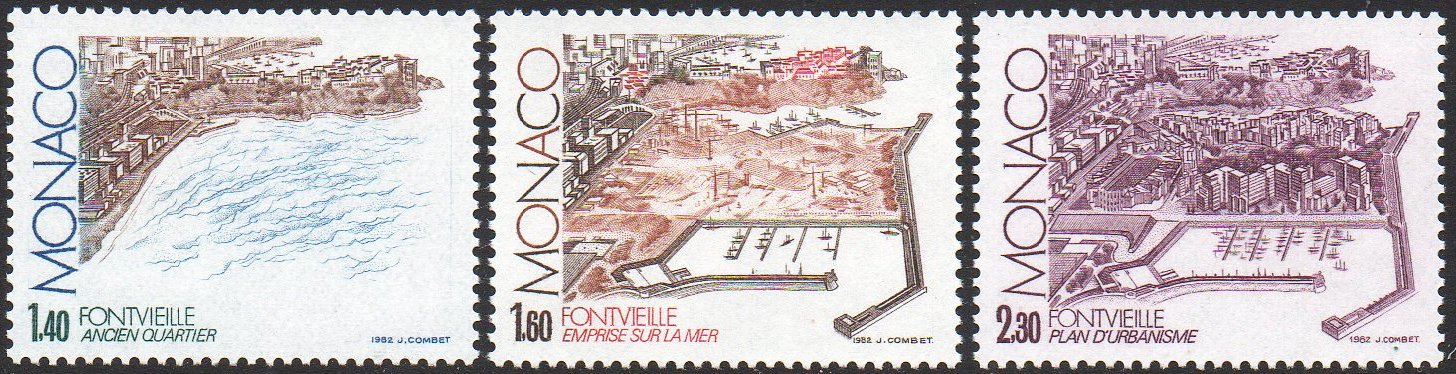
 Fontvieille is a suburb at the western edge of Monaco through which the railway was routed on the surface until 1999. The first stamp shows the original coastline, the last two stamps the land extension before and after property development on the new land. The railway appears on all three stamps with only the tiniest detail changes.
1982 : 1f40 : Fontvieille : Ancien Quartier [ . ] [ . ]
1982 : 1f60 : Fontvieille : Emprise sur la Mer [ . ] [ . ]
1982 : 2f30 : Fontvieille : Plan d'Urbanisme [ . ] [ . ]
Fontvieille is a suburb at the western edge of Monaco through which the railway was routed on the surface until 1999. The first stamp shows the original coastline, the last two stamps the land extension before and after property development on the new land. The railway appears on all three stamps with only the tiniest detail changes.
1982 : 1f40 : Fontvieille : Ancien Quartier [ . ] [ . ]
1982 : 1f60 : Fontvieille : Emprise sur la Mer [ . ] [ . ]
1982 : 2f30 : Fontvieille : Plan d'Urbanisme [ . ] [ . ]
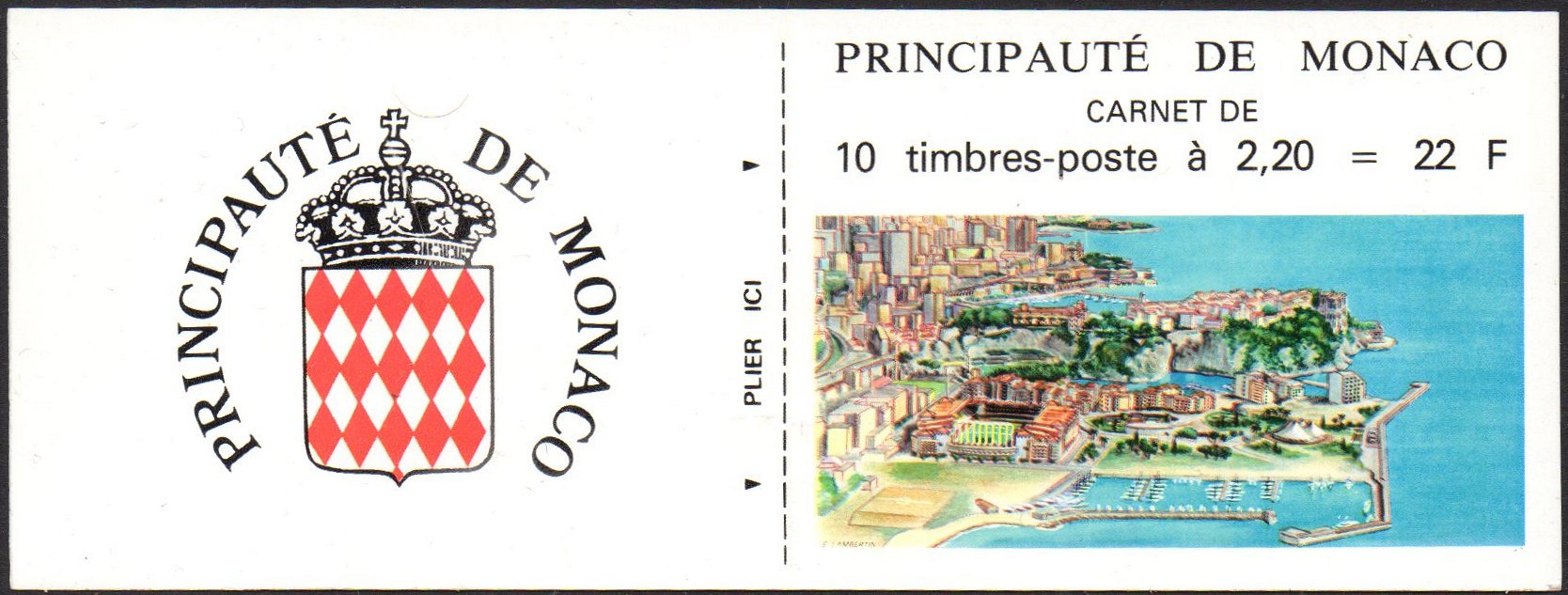
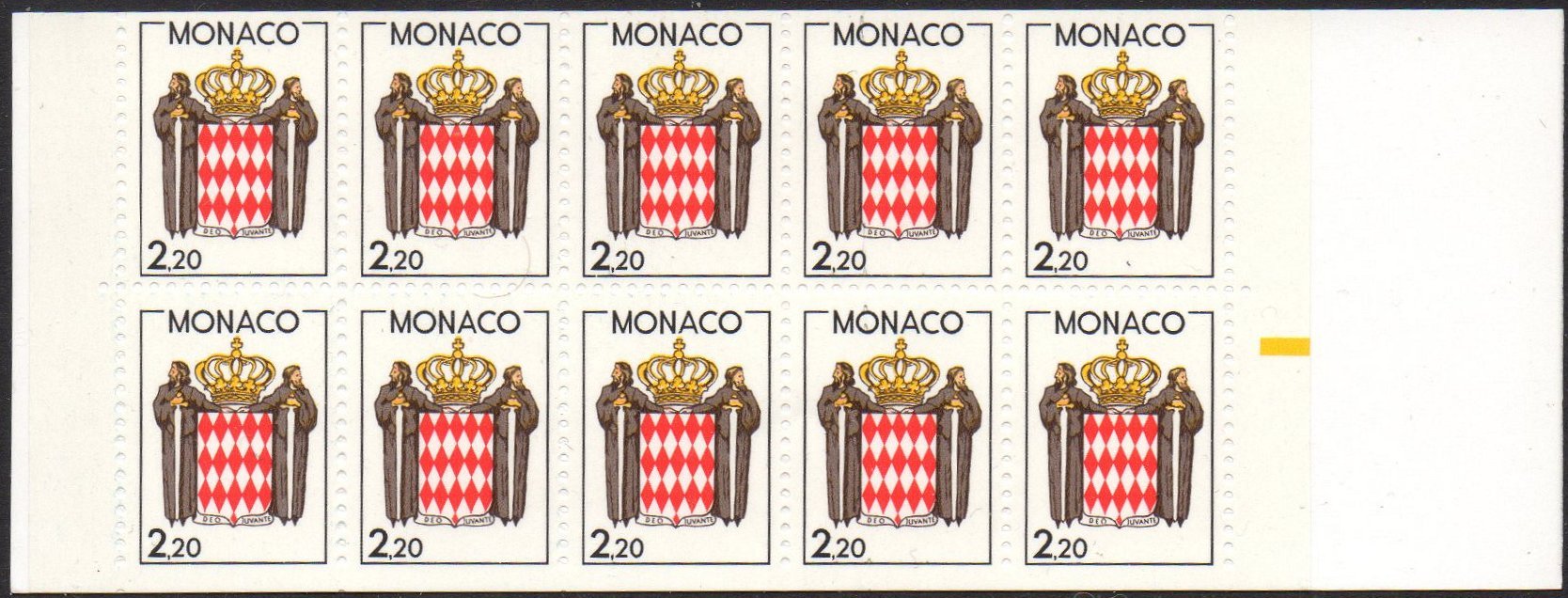
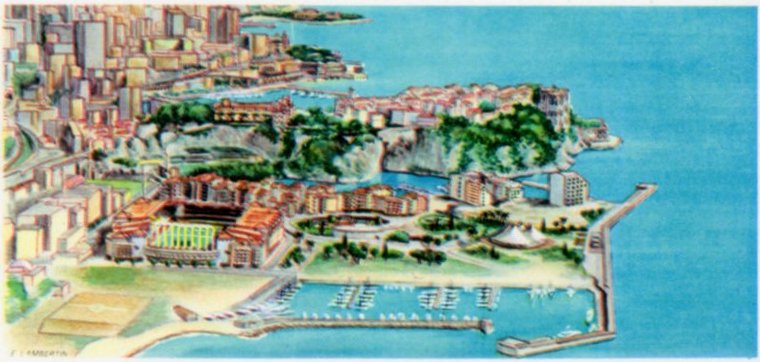
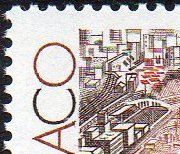
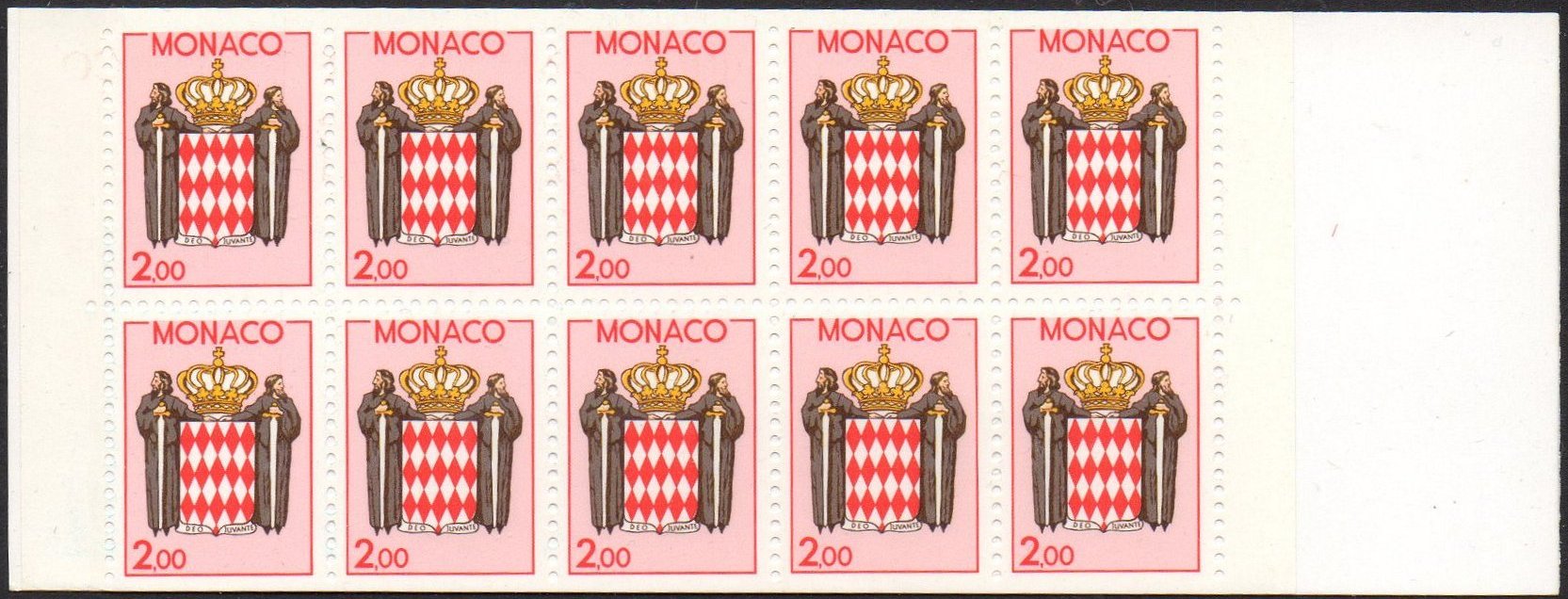 Booklet cover with a hint of the railway at Fontvieille, visible on the extreme left of the detail scan. We have seen this identical cover containing two different panes of stamps.
1987 (Nov. 11) : Booklet 2f20 Pane/10 (Mi.1832) [ . ]
1988 (Jan. 15) : Booklet 2f00 Pane/10 (Mi.1850) [ . ]
Booklet cover with a hint of the railway at Fontvieille, visible on the extreme left of the detail scan. We have seen this identical cover containing two different panes of stamps.
1987 (Nov. 11) : Booklet 2f20 Pane/10 (Mi.1832) [ . ]
1988 (Jan. 15) : Booklet 2f00 Pane/10 (Mi.1850) [ . ]
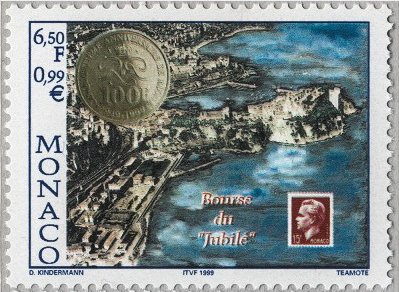
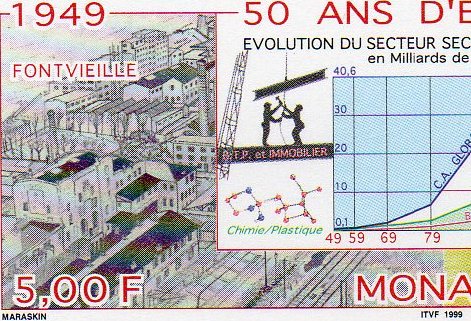 Left : 1999 issue for the Postcard, Coin & Stamp Exhibition in Fontvieille.
Right : A further 1999 issue, this one for the 'Economic Jubilee', It shows Fontvieille in 1949 juxtaposed to the soon-to-be-opened subterranean Gare de Monaco-Monte-Carlo. We list this stamp later under that banner.
1999: 6Fr50 / 0€99 : Railway Tracks at Fontvieille [ . ] [ . ]
This stamp was issued in the final year of operation of the railway through Fontvieille, all surface lines being closed in that year. Monaco issued stamps in dual currency (French Francs & Euros) from early 1999 in preparation for the currency conversion, although this was only introduced on January 1st, 2002. From that date all stamps were denominated solely in Euros but stamps denominated in French Francs remain valid today at the fixed parity (for stamps issued after the 1960 revaluation) of €1 = 6.55957 French Francs.
3. Approaches to the Gare de Monaco :
The mountains typically start to rise almost from the sea-shore along this coast, providing many vantage points overlooking Monaco that have been popular with postcard editors and stamp designers alike. The steep slopes also provide the principality with rather more surface area in reality than the cartographer's 2.1 sq. kms.
Shown below are whole and detail scans from two postcards views of the promontory on which the Royal Palace stands, this outcrop being known as Le Rocher:
Left : 1999 issue for the Postcard, Coin & Stamp Exhibition in Fontvieille.
Right : A further 1999 issue, this one for the 'Economic Jubilee', It shows Fontvieille in 1949 juxtaposed to the soon-to-be-opened subterranean Gare de Monaco-Monte-Carlo. We list this stamp later under that banner.
1999: 6Fr50 / 0€99 : Railway Tracks at Fontvieille [ . ] [ . ]
This stamp was issued in the final year of operation of the railway through Fontvieille, all surface lines being closed in that year. Monaco issued stamps in dual currency (French Francs & Euros) from early 1999 in preparation for the currency conversion, although this was only introduced on January 1st, 2002. From that date all stamps were denominated solely in Euros but stamps denominated in French Francs remain valid today at the fixed parity (for stamps issued after the 1960 revaluation) of €1 = 6.55957 French Francs.
3. Approaches to the Gare de Monaco :
The mountains typically start to rise almost from the sea-shore along this coast, providing many vantage points overlooking Monaco that have been popular with postcard editors and stamp designers alike. The steep slopes also provide the principality with rather more surface area in reality than the cartographer's 2.1 sq. kms.
Shown below are whole and detail scans from two postcards views of the promontory on which the Royal Palace stands, this outcrop being known as Le Rocher:
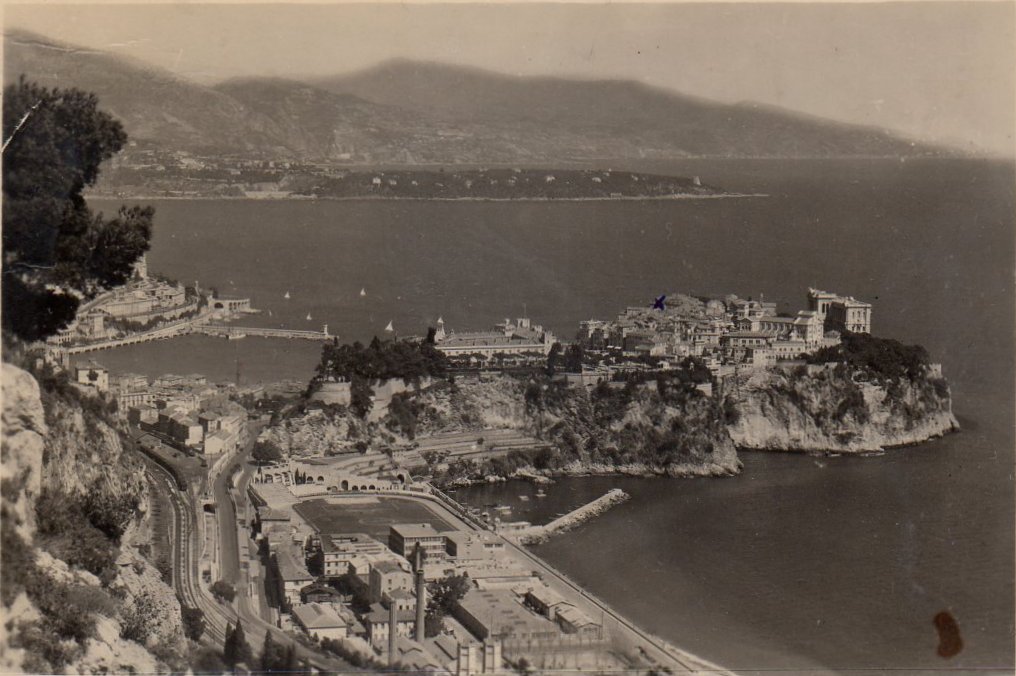
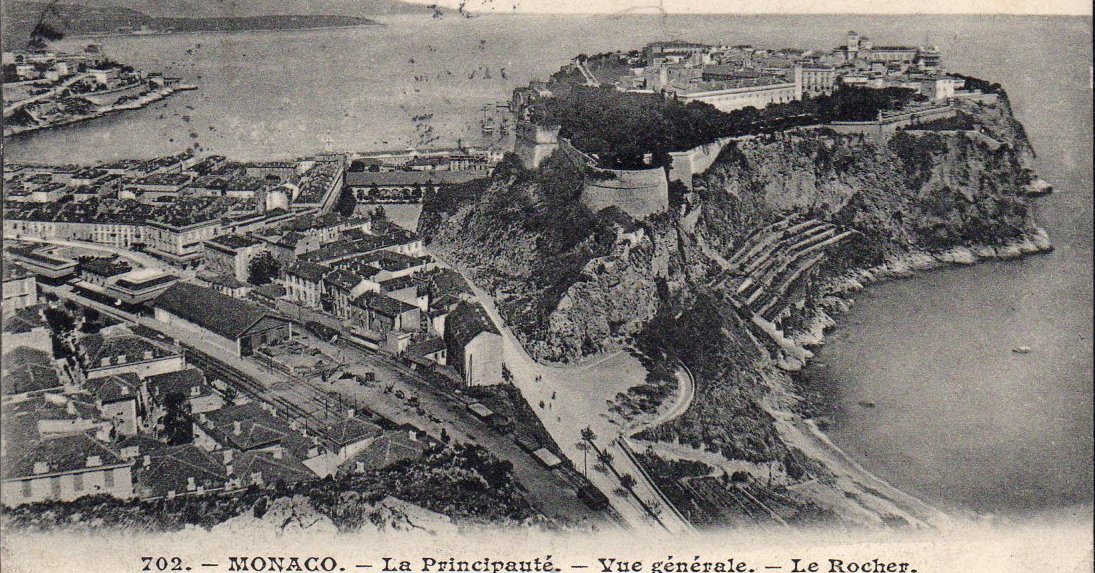 The first view, posted in 1951, shows the railway tracks and part of the Goods Station of the Gare de Monaco. The second view, taken almost above the station, was posted in 1904 and shows both the Goods and Passenger stations. Both views also show the tracks in the distance on the far side of the Port of Monaco. On the early card, only the embankment is defined and there is no road tunnel between the embankment and the sea. In the post-war view, the tracks are discernible just above the mouth of the road tunnel to the left of the arched colonnade adjoining the sea, formerly serving as the 'Tir aux Pigeons' (clay pigeon shooting platform). The detail views below make these features a little clearer.
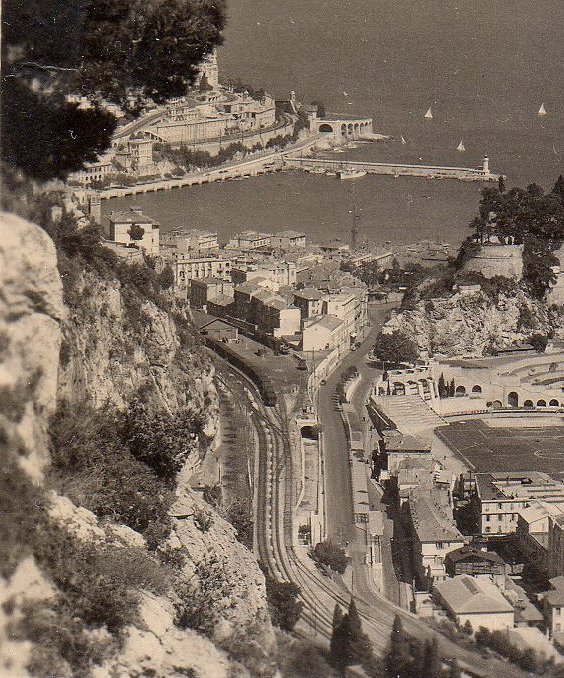
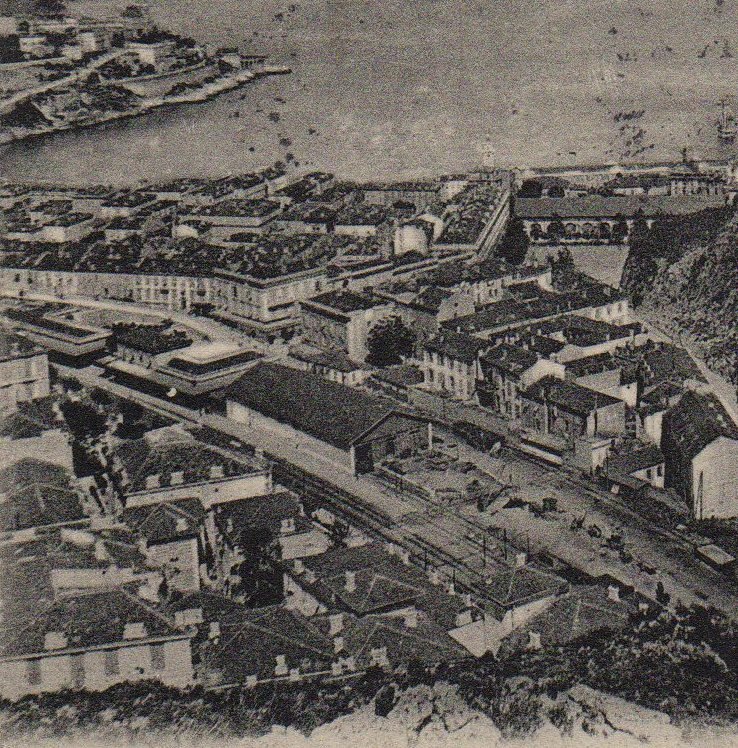 Left : Detail view from the postcard posted in 1951.
Right : Detail view from the postcard posted in 1904.
One of the 1922 definitive designs shows Le Rocher de Monaco and what appears to be railway track sketched in, although in a geographically imprecise location.
Left : Detail view from the postcard posted in 1951.
Right : Detail view from the postcard posted in 1904.
One of the 1922 definitive designs shows Le Rocher de Monaco and what appears to be railway track sketched in, although in a geographically imprecise location.
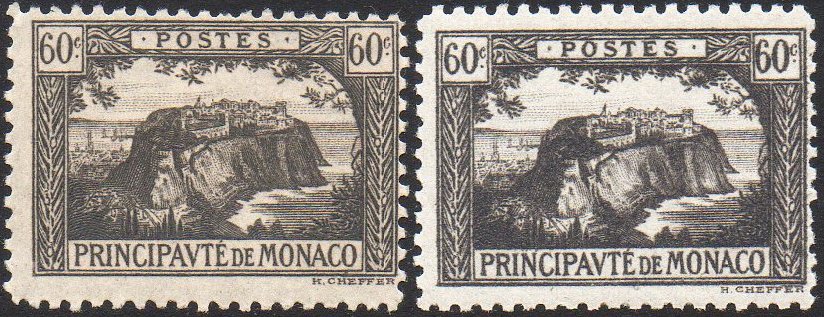
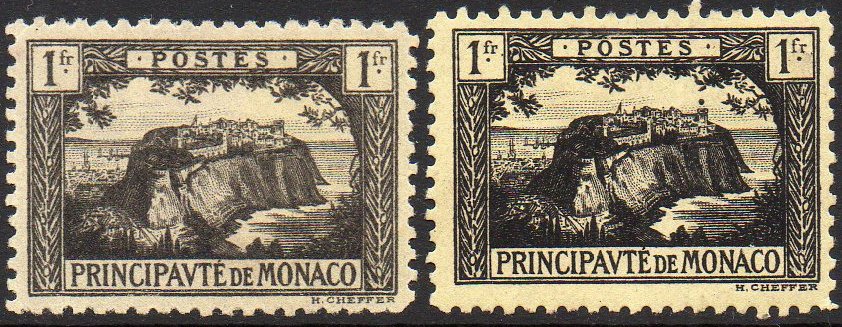
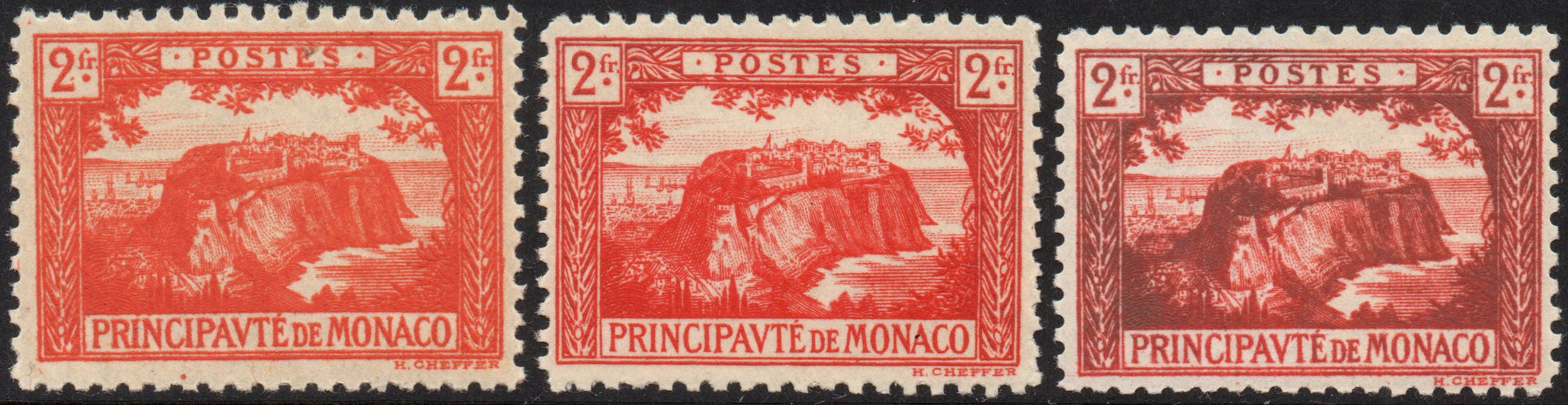
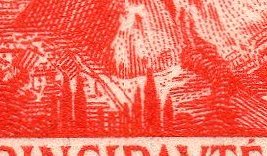 The scan of the 2Fr values above does not properly display the depth of the centre stamp's deep rich carmine shade.
1922 : Sheets/25 (5x5) :
1922 60c Brownish Grey-Black [ . ] [ . ]
- ditto - Black [ . ] [ . ]
1922 1 Fr. Grey-Black / pale yellow [ . ] [ . ]
- ditto - Black / yellow [ . ] [ . ]
1922 2 Fr. Dull Vermilion-Red [ . ] [ . ]
- ditto - Deep Carmine [ . ] [ . ]
- ditto - Deep Brownish-Red [ . ] [ . ]
The Deep Carmine is much scarcer that the Dull Vermilion-Red printing.
The Deep Brownish-Red shade (right-hand 2Fr in the scan) is not typically catalogued. It may be the result of poor quality control at the printers' with some residual ink from another print run adulterating the colour. If so, the 50c blue from this set might be a candidate. Only a few sheets would have been affected, each sheet less tainted than the first.
All values are reported to exist imperforate and some values in the full set (of 11 values) are known part-perforated. We have seen the 60c and 1Fr imperforate. Occasionally, stamps from this set may be found displaying part of the paper-maker's sheet watermark.
.
A later definitive design, issued at various dates between 1939 and 1959, shows the railway tracks snaking around the base of the hillside opposite Le Rocher. Stamp catalogues group these stamps differently. We have adopted Michel's groups for these stamps although no particular grouping, other than the Red Cross surcharges, has any special merit in our opinion.
The 1938/39 Group :
The scan of the 2Fr values above does not properly display the depth of the centre stamp's deep rich carmine shade.
1922 : Sheets/25 (5x5) :
1922 60c Brownish Grey-Black [ . ] [ . ]
- ditto - Black [ . ] [ . ]
1922 1 Fr. Grey-Black / pale yellow [ . ] [ . ]
- ditto - Black / yellow [ . ] [ . ]
1922 2 Fr. Dull Vermilion-Red [ . ] [ . ]
- ditto - Deep Carmine [ . ] [ . ]
- ditto - Deep Brownish-Red [ . ] [ . ]
The Deep Carmine is much scarcer that the Dull Vermilion-Red printing.
The Deep Brownish-Red shade (right-hand 2Fr in the scan) is not typically catalogued. It may be the result of poor quality control at the printers' with some residual ink from another print run adulterating the colour. If so, the 50c blue from this set might be a candidate. Only a few sheets would have been affected, each sheet less tainted than the first.
All values are reported to exist imperforate and some values in the full set (of 11 values) are known part-perforated. We have seen the 60c and 1Fr imperforate. Occasionally, stamps from this set may be found displaying part of the paper-maker's sheet watermark.
.
A later definitive design, issued at various dates between 1939 and 1959, shows the railway tracks snaking around the base of the hillside opposite Le Rocher. Stamp catalogues group these stamps differently. We have adopted Michel's groups for these stamps although no particular grouping, other than the Red Cross surcharges, has any special merit in our opinion.
The 1938/39 Group :
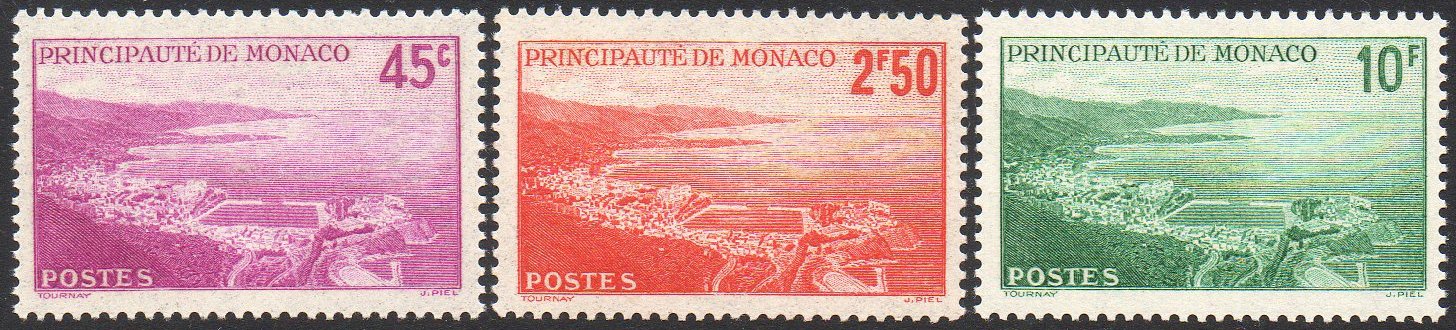 45c : Bright Violet ( 1939, Mi.168 ) [ . ] [ . ]
2Fr50 : Scarlet-Vermilion ( 1939, Mi.182 ) [ . ] [ . ]
10 Fr. : Bright Green ( 1939, Mi.185 ) [ . ] [ . ]
The 1940 Red Cross Surcharges (stamps printed in new colours) :
45c : Bright Violet ( 1939, Mi.168 ) [ . ] [ . ]
2Fr50 : Scarlet-Vermilion ( 1939, Mi.182 ) [ . ] [ . ]
10 Fr. : Bright Green ( 1939, Mi.185 ) [ . ] [ . ]
The 1940 Red Cross Surcharges (stamps printed in new colours) :
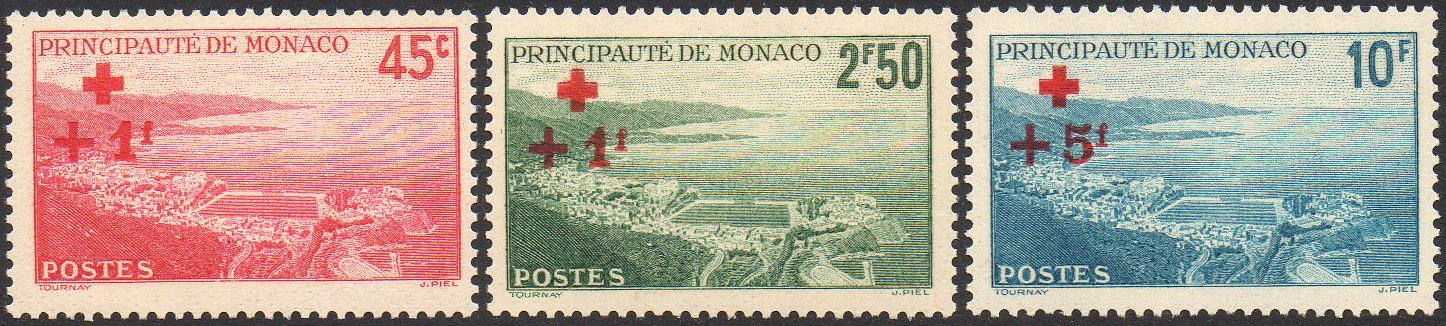 45c + 1 Fr. : Rose-Carmine ( Mi.209 ) [ . ] [ . ]
2Fr50 + 1 Fr. : Deep Green( Mi.215 ) [ . ] [ . ]
10 Fr. + 5 Fr. : Turquoise ( Mi.218 ) [ . ] [ . ]
The 1940-46 Group :
45c + 1 Fr. : Rose-Carmine ( Mi.209 ) [ . ] [ . ]
2Fr50 + 1 Fr. : Deep Green( Mi.215 ) [ . ] [ . ]
10 Fr. + 5 Fr. : Turquoise ( Mi.218 ) [ . ] [ . ]
The 1940-46 Group :
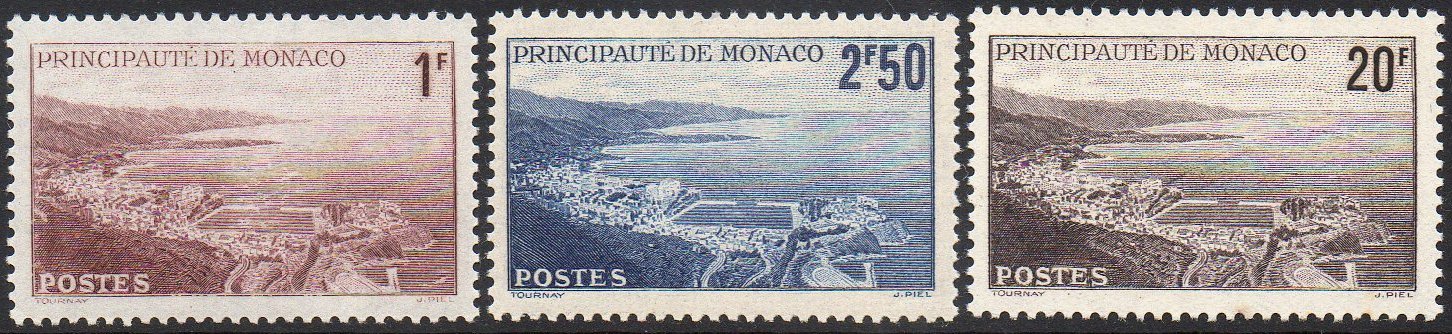 1 Fr. : Purple-Brown ( 1943, Mi.230 ) [ . ] [ . ]
2Fr50 : Deep Ultramarine ( 1940, Mi.236 ) [ . ] [ . ]
20 Fr. : Deep Lilac-Brown ( 1943, Mi.244 ) [ . ] [ . ]
The 1948/49 Group :
1 Fr. : Purple-Brown ( 1943, Mi.230 ) [ . ] [ . ]
2Fr50 : Deep Ultramarine ( 1940, Mi.236 ) [ . ] [ . ]
20 Fr. : Deep Lilac-Brown ( 1943, Mi.244 ) [ . ] [ . ]
The 1948/49 Group :
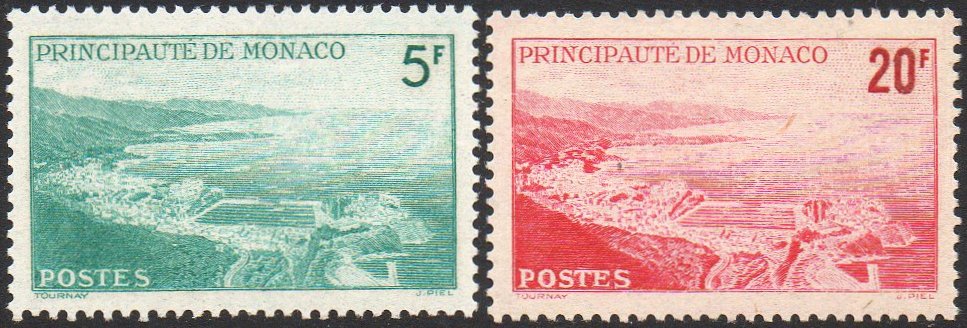 5 Fr. : Blue-Green( 1949, Mi.385 ) [ . ] [ . ]
20 Fr. : Carmine-Rose( 1948, Mi.389 ) [ . ] [ . ]
1957 : One value, 65c (which we enlarged to show more clearly the railway tracks just left of centre at the bottom.) :
5 Fr. : Blue-Green( 1949, Mi.385 ) [ . ] [ . ]
20 Fr. : Carmine-Rose( 1948, Mi.389 ) [ . ] [ . ]
1957 : One value, 65c (which we enlarged to show more clearly the railway tracks just left of centre at the bottom.) :
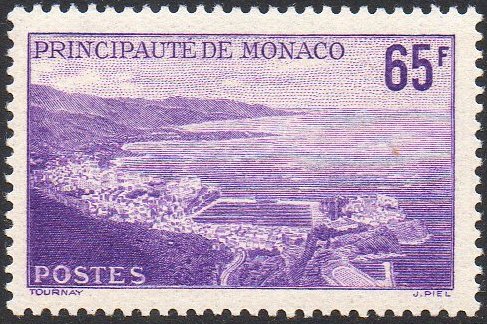 65 Fr. : Violet ( 1957, Mi.585 ) [ . ] [ . ]
The 1959 Issue :
65 Fr. : Violet ( 1957, Mi.585 ) [ . ] [ . ]
The 1959 Issue :
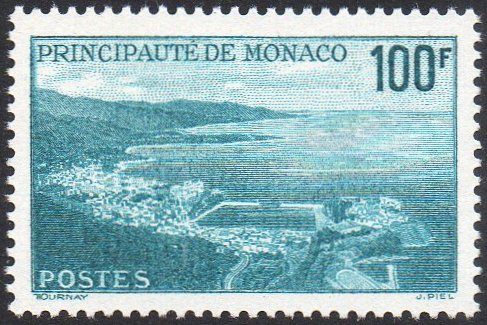 100 Fr. : Deep Turquoise ( 1959, Mi.621 ) [ . ] [ . ]
.
1946 Roosevelt Memorial Issue (a similar design but lacking in detail and accuracy) :
100 Fr. : Deep Turquoise ( 1959, Mi.621 ) [ . ] [ . ]
.
1946 Roosevelt Memorial Issue (a similar design but lacking in detail and accuracy) :
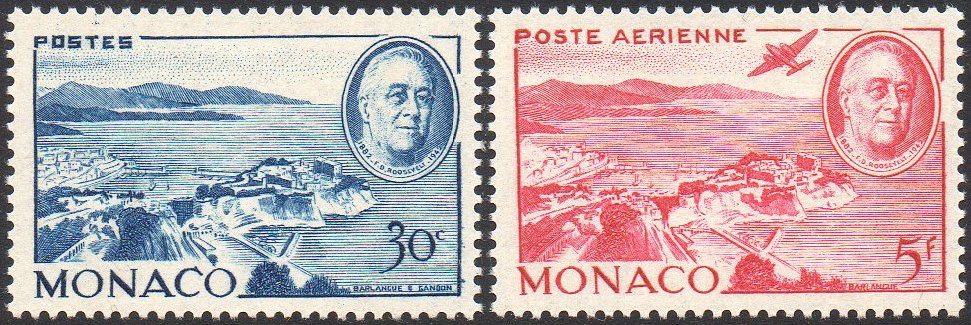 30c : Blue [ . ] [ . ]
5 Fr. : Red [ . ] [ . ]
.
1998 (May 6) : Junior Chamber of Commerce European Conference - tracks just outside Gare de Monaco
30c : Blue [ . ] [ . ]
5 Fr. : Red [ . ] [ . ]
.
1998 (May 6) : Junior Chamber of Commerce European Conference - tracks just outside Gare de Monaco
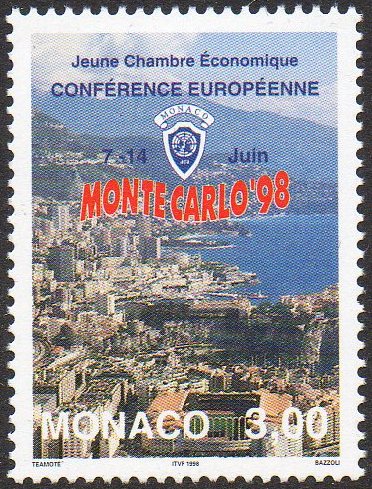
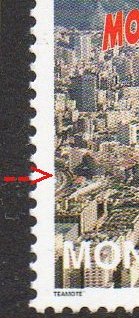 3 Fr : Multicoloured [ . ] [ . ]
.
4. La Gare de Monaco :
.
3 Fr : Multicoloured [ . ] [ . ]
.
4. La Gare de Monaco :
.
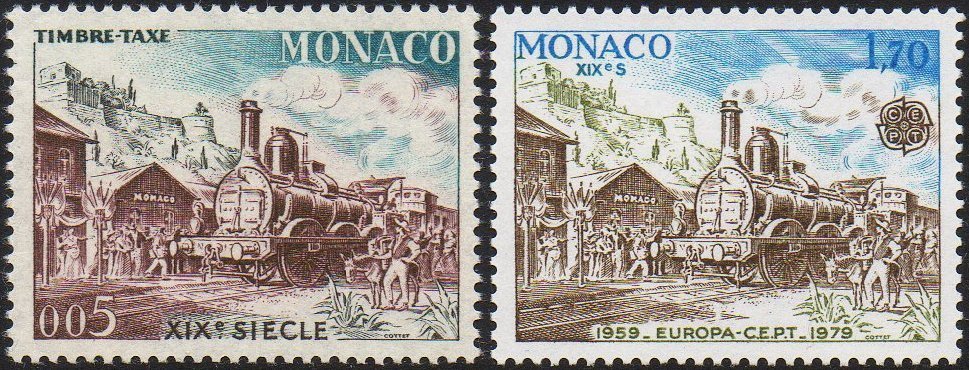
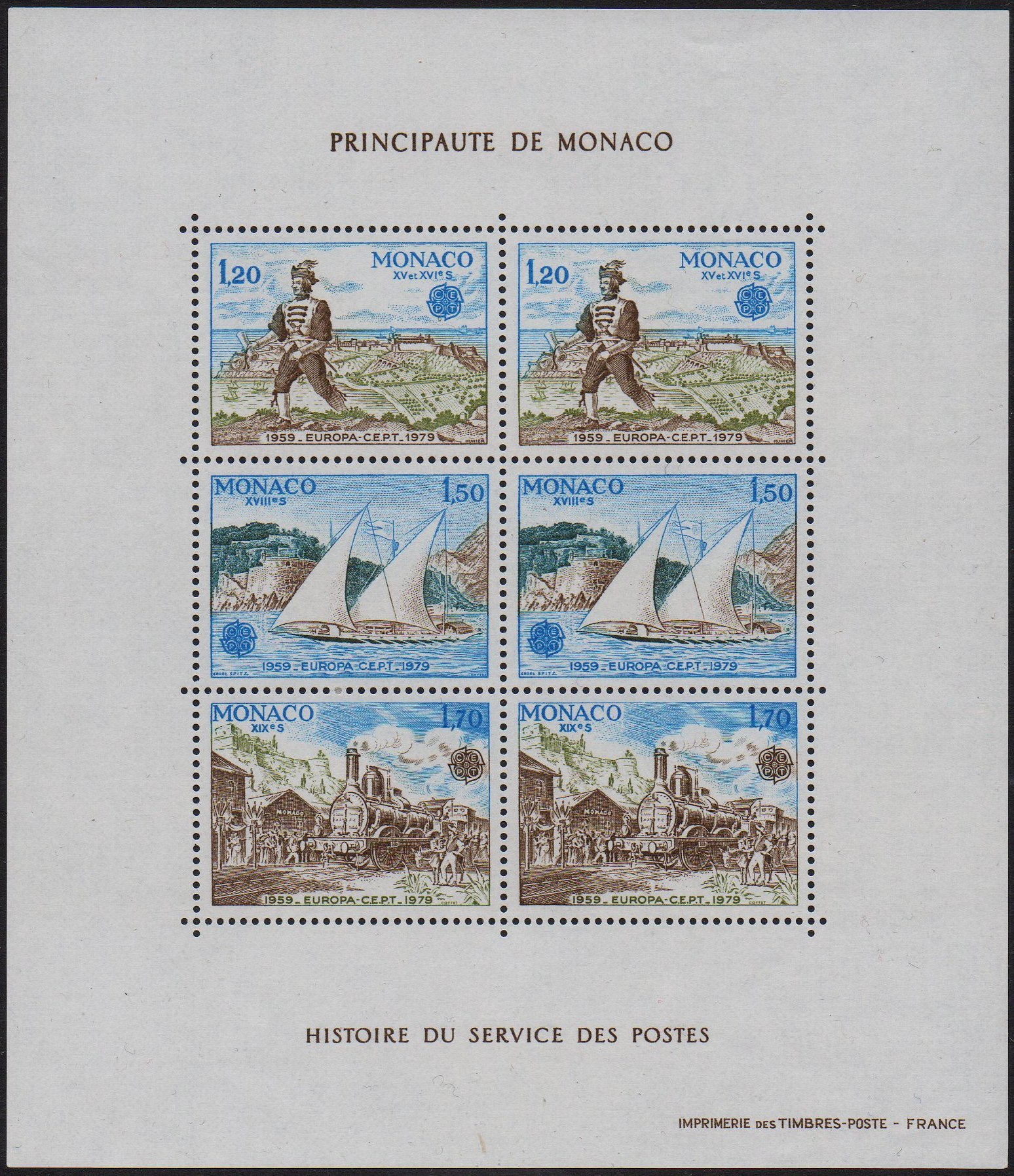 A 19th century version of the station, this design first used in 1960 as a Postage Due, then for Postage in 1979.
1960 : 5c Postage Due : Gare de Monaco in the 19th century [ . ] [ . ]
1979 : 1Fr70 Postage : Gare de Monaco in the 19th century [ . ] [ . ]
- ditto - In a Miniature Sheet of 6 Values [ . ] [ . ]
The 1979 'Europa' issue reproduced three of the designs from the 1960 Postage Due set, printed in revised colours. The stamps were issued in normal sheet format in addition to the miniature sheet, which is illustrated much reduced in size.
A 19th century version of the station, this design first used in 1960 as a Postage Due, then for Postage in 1979.
1960 : 5c Postage Due : Gare de Monaco in the 19th century [ . ] [ . ]
1979 : 1Fr70 Postage : Gare de Monaco in the 19th century [ . ] [ . ]
- ditto - In a Miniature Sheet of 6 Values [ . ] [ . ]
The 1979 'Europa' issue reproduced three of the designs from the 1960 Postage Due set, printed in revised colours. The stamps were issued in normal sheet format in addition to the miniature sheet, which is illustrated much reduced in size.
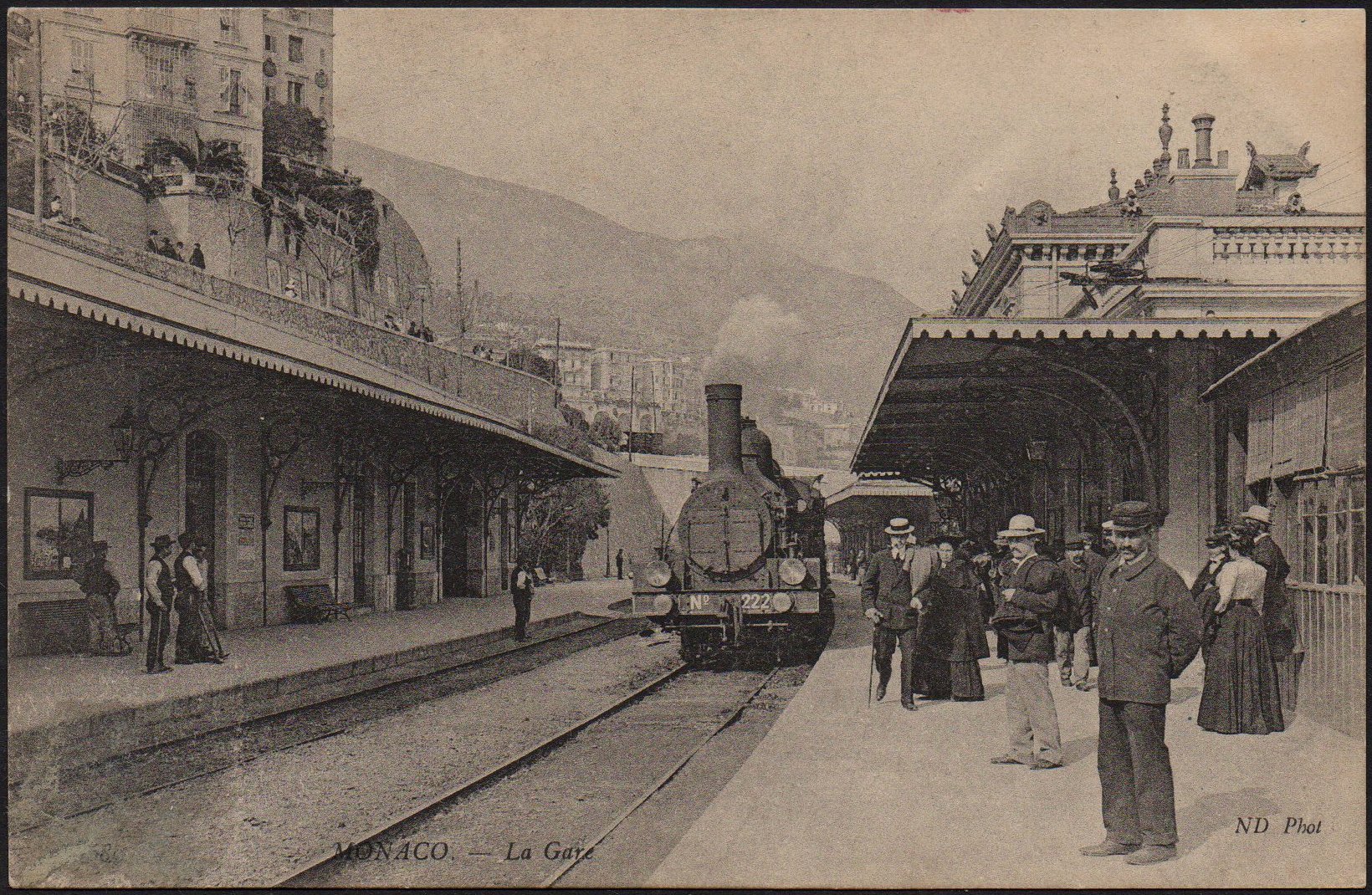
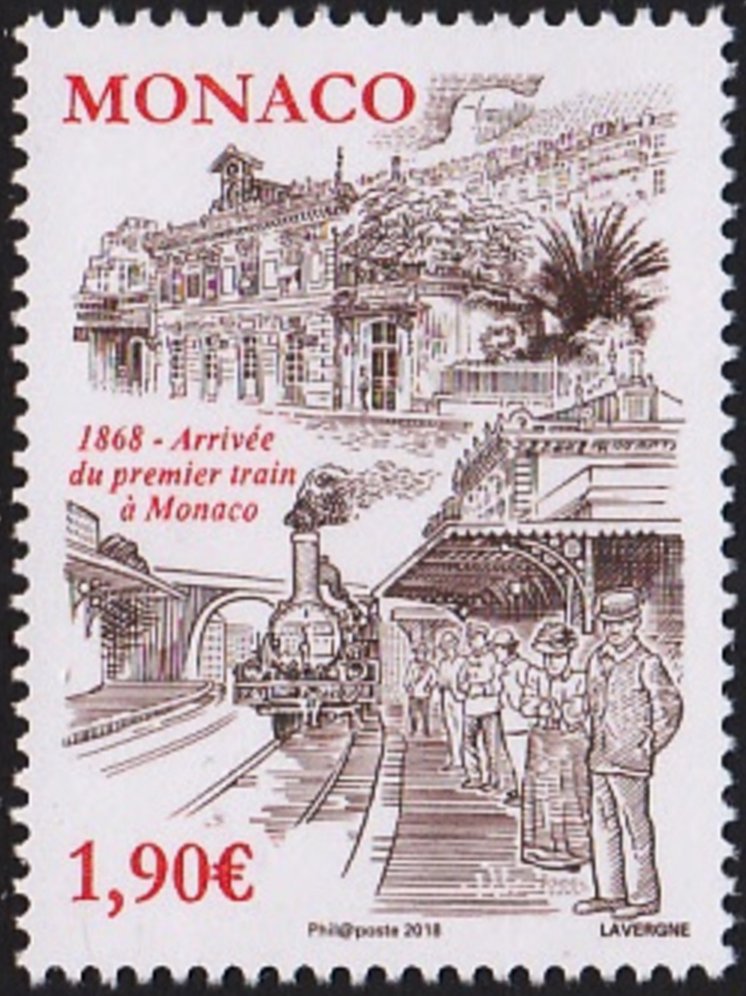
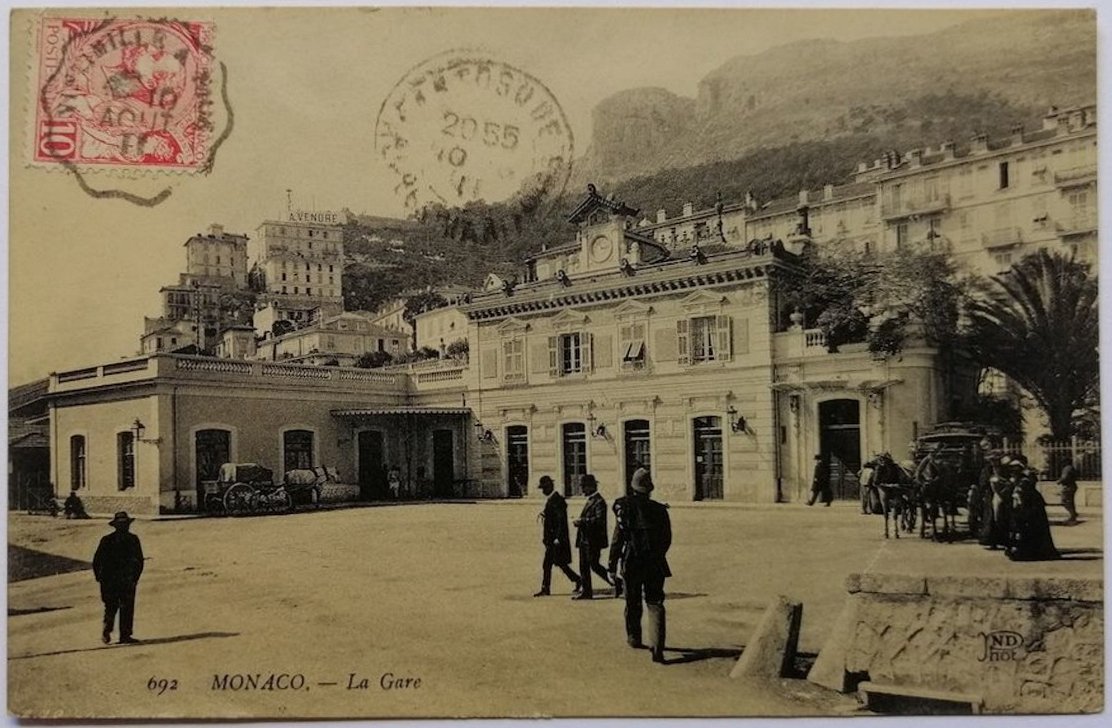 Internal and External Views of the Gare de Monaco (opened in 1868, closed in 1999). The postcard at left, which is a relatively common one, was certainly the artist's source material for the 1€90 stamp below and it may also have influenced two more.
.
Interior Views:
Internal and External Views of the Gare de Monaco (opened in 1868, closed in 1999). The postcard at left, which is a relatively common one, was certainly the artist's source material for the 1€90 stamp below and it may also have influenced two more.
.
Interior Views:
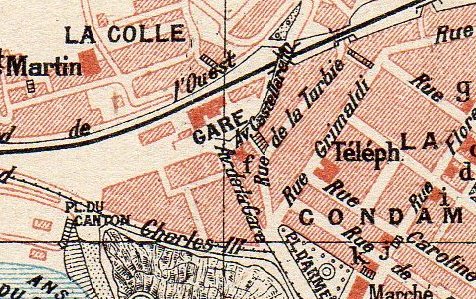 The map shows the road layout around the Gare de Monaco c.1920.
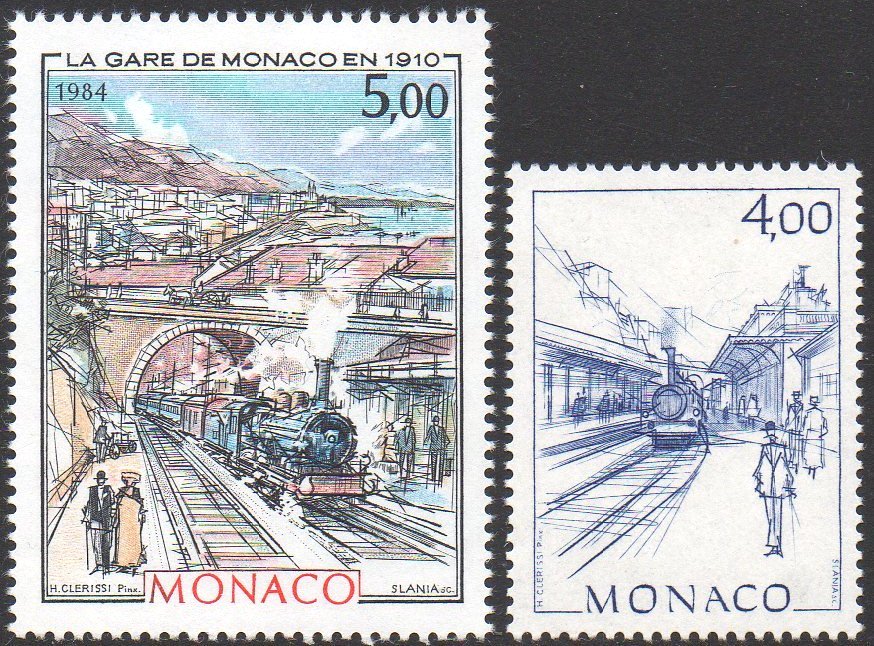
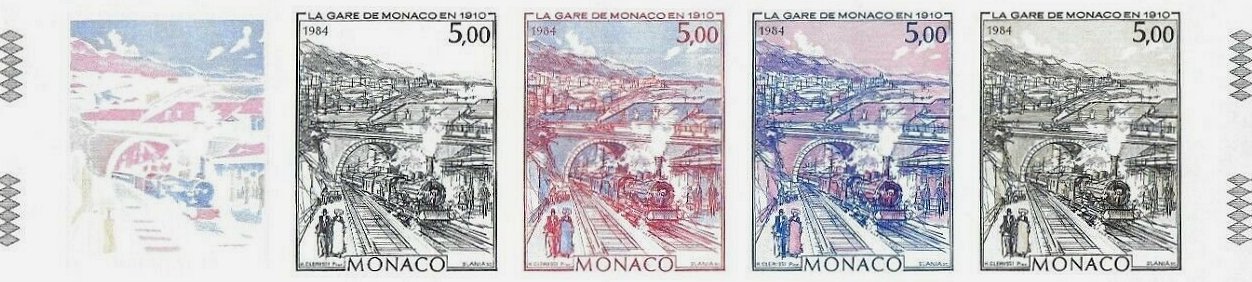
 1984 : 5 Fr. : Views from La Belle Epoque : Gare de Monaco [ . ] [ . ]
1986 : 4 Fr. : 'Monaco of Yesteryear' series : Gare de Monaco [ . ] [ . ]
2018 : 1€90 : Exterior & Interior : Gare de Monaco [ . ] [ . ]
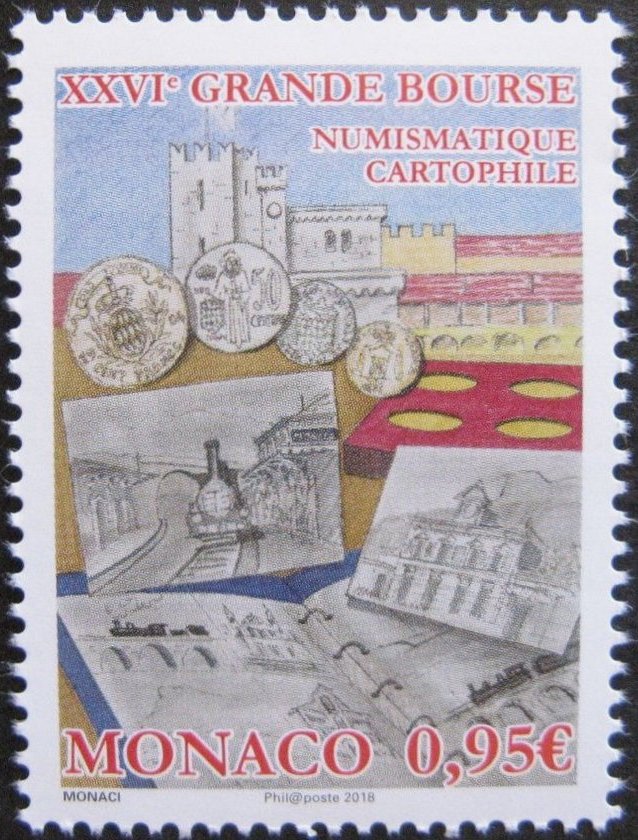
2018 : 0€95 : Postcard View : Gare de Monaco (promoting the coin & postcard bourse) [ . ] [ . ]
.
Exterior Views :
1984 : 5 Fr. : Views from La Belle Epoque : Gare de Monaco [ . ] [ . ]
1986 : 4 Fr. : 'Monaco of Yesteryear' series : Gare de Monaco [ . ] [ . ]
2018 : 1€90 : Exterior & Interior : Gare de Monaco [ . ] [ . ]
2018 : 0€95 : Postcard View : Gare de Monaco (promoting the coin & postcard bourse) [ . ] [ . ]
.
Exterior Views :
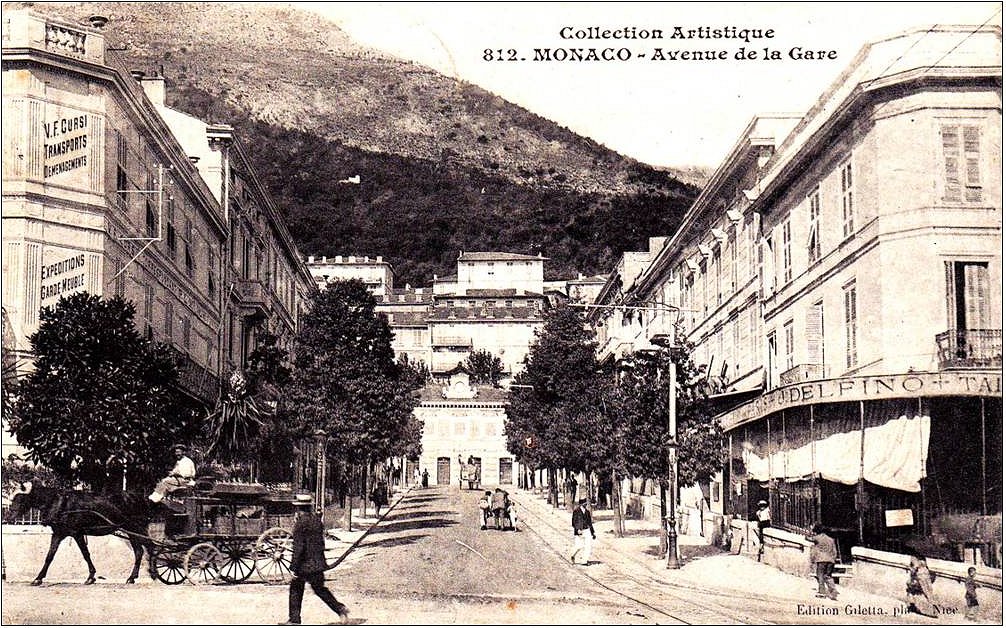
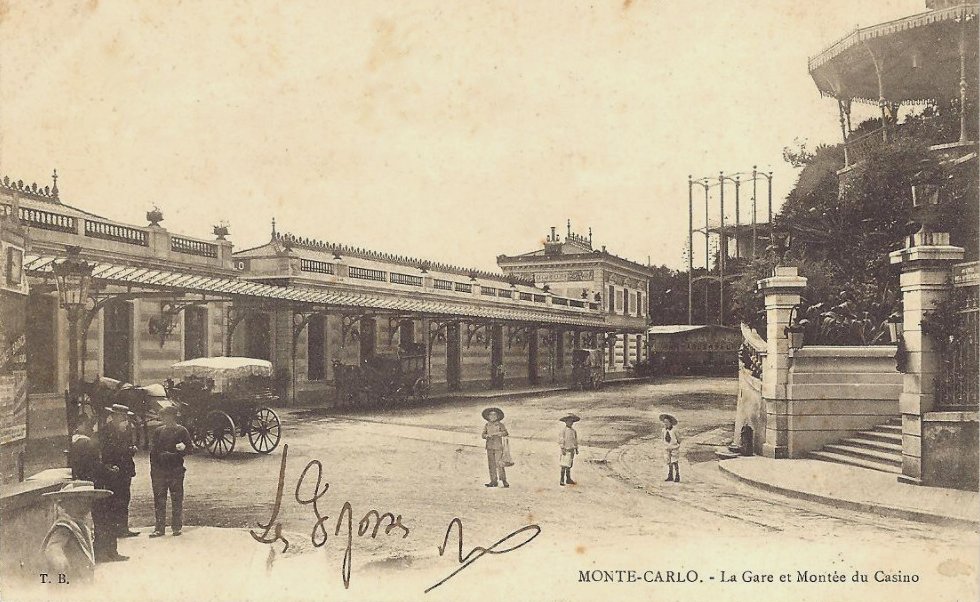
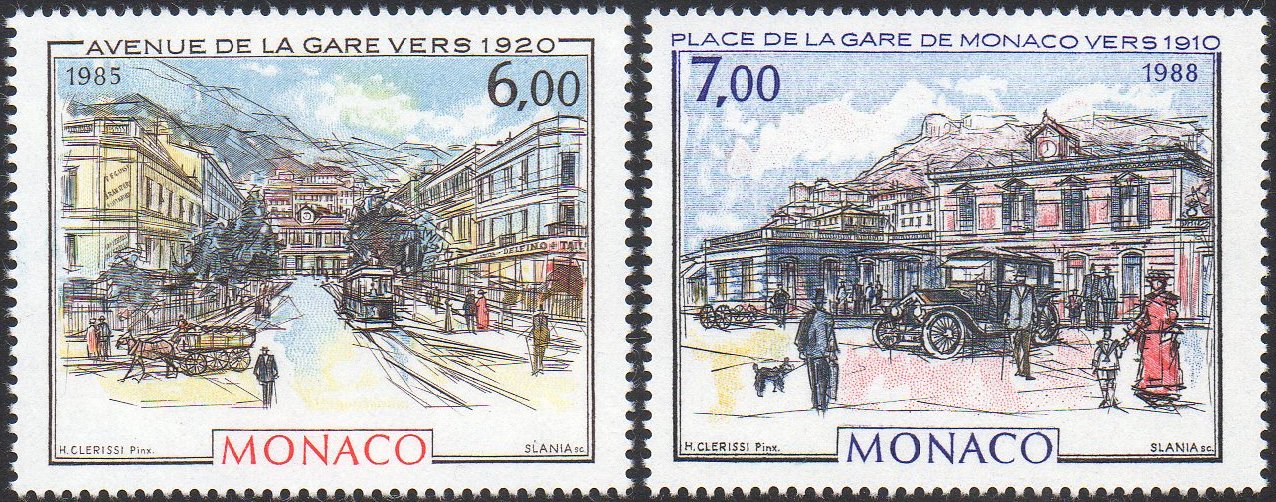 The postcard view shown appears to be the source of the inspiration for the 1985 stamp shown alongside but with features modified / modernised to advance the view from c.1905 to c.1920. The station building can be seen at the end of the street.
1985 : 6 Fr. : Views from La Belle Epoque : Avenue de la Gare [ . ] [ . ]
1988 : 7 Fr. : Views from La Belle Epoque : Place de la Gare [ . ] [ . ]
.
5. Pont Sainte Dévote :
.
The postcard view shown appears to be the source of the inspiration for the 1985 stamp shown alongside but with features modified / modernised to advance the view from c.1905 to c.1920. The station building can be seen at the end of the street.
1985 : 6 Fr. : Views from La Belle Epoque : Avenue de la Gare [ . ] [ . ]
1988 : 7 Fr. : Views from La Belle Epoque : Place de la Gare [ . ] [ . ]
.
5. Pont Sainte Dévote :
.
 1922 : Sheets/25 (5x5) :
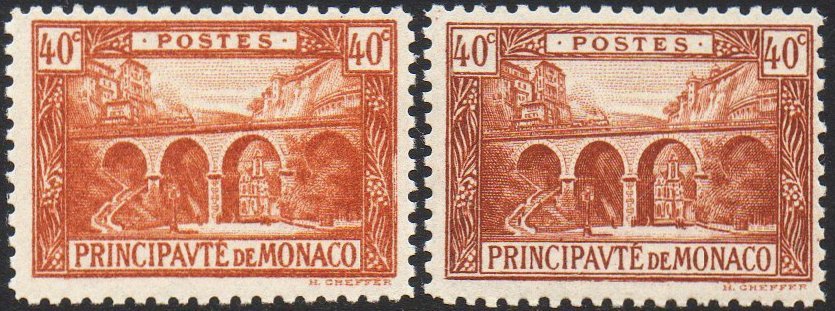
1922 : 40c : Bright Orange-Brown [ . ] [ . ]
- ditto - Pale Chestnut-Brown [ . ] [ . ]
.
1922 : Sheets/25 (5x5) :
1922 : 40c : Bright Orange-Brown [ . ] [ . ]
- ditto - Pale Chestnut-Brown [ . ] [ . ]
.
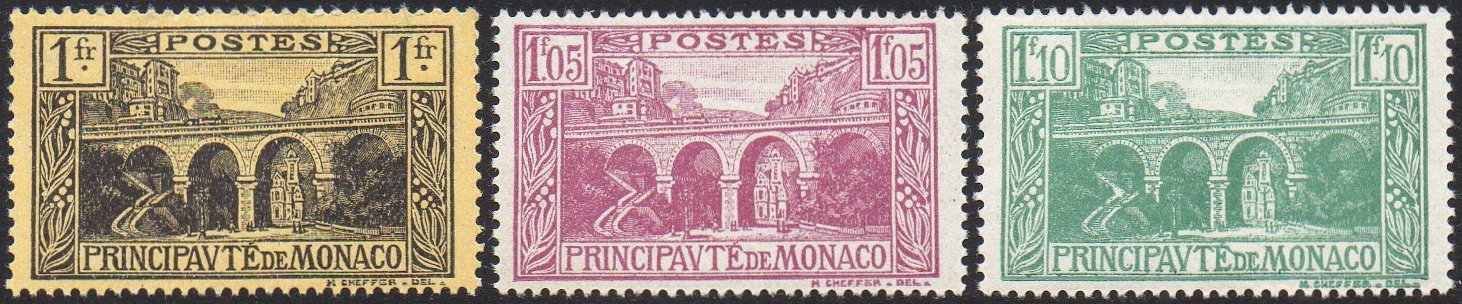
 1925-27 :
1925 : 1 Fr : Black / yellow [ . ] [ . ]
1925 : 1Fr05 : Magenta [ . ] [ . ]
1927 : 1Fr10 : Blue-Green [ . ] [ . ]
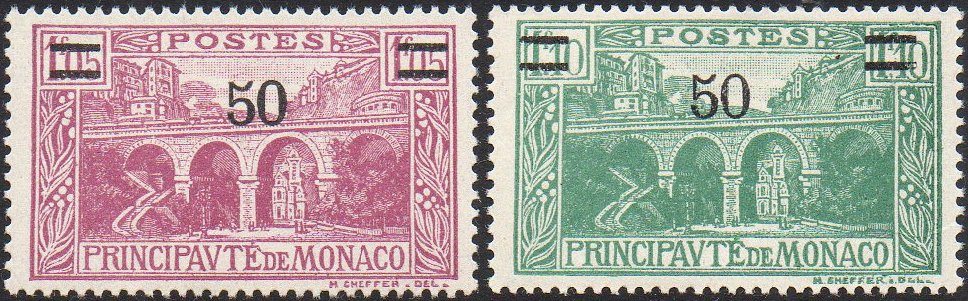
1928-31 Surcharges :
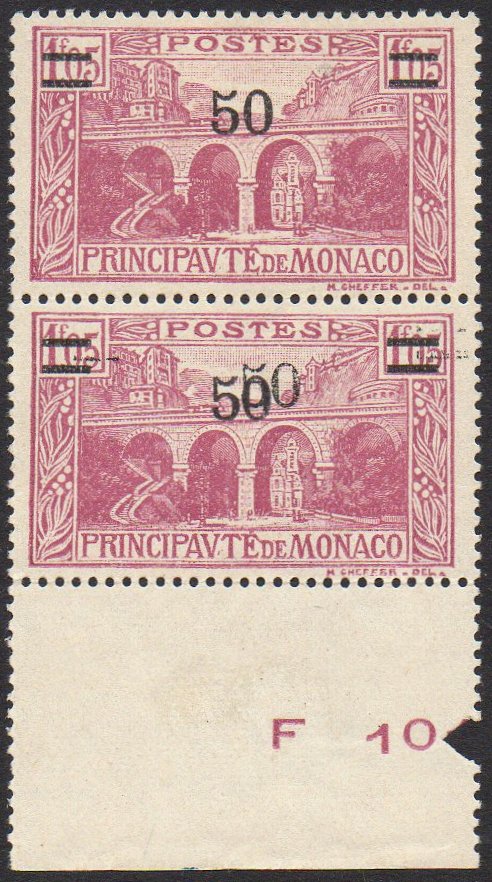
1928 : 50c / 1Fr05 Magenta [ . ] [ . ]
- ditto - Surcharge Double [ . ] [ . ]
1931 : 50c / 1F10 Blue-Green [ . ] [ . ]
The Double Surcharge on the 1Fr05 is a rare stamp. It is listed in Scott (#95a). We only know of the one example, shown above in vertical pair with normal, and suspect that the number of copies produced of this variety may well be limited to the bottom row of a single sheet of stamps. If so, the number surviving today could probably be counted on one hand.
.
1925-27 :
1925 : 1 Fr : Black / yellow [ . ] [ . ]
1925 : 1Fr05 : Magenta [ . ] [ . ]
1927 : 1Fr10 : Blue-Green [ . ] [ . ]
1928-31 Surcharges :
1928 : 50c / 1Fr05 Magenta [ . ] [ . ]
- ditto - Surcharge Double [ . ] [ . ]
1931 : 50c / 1F10 Blue-Green [ . ] [ . ]
The Double Surcharge on the 1Fr05 is a rare stamp. It is listed in Scott (#95a). We only know of the one example, shown above in vertical pair with normal, and suspect that the number of copies produced of this variety may well be limited to the bottom row of a single sheet of stamps. If so, the number surviving today could probably be counted on one hand.
.
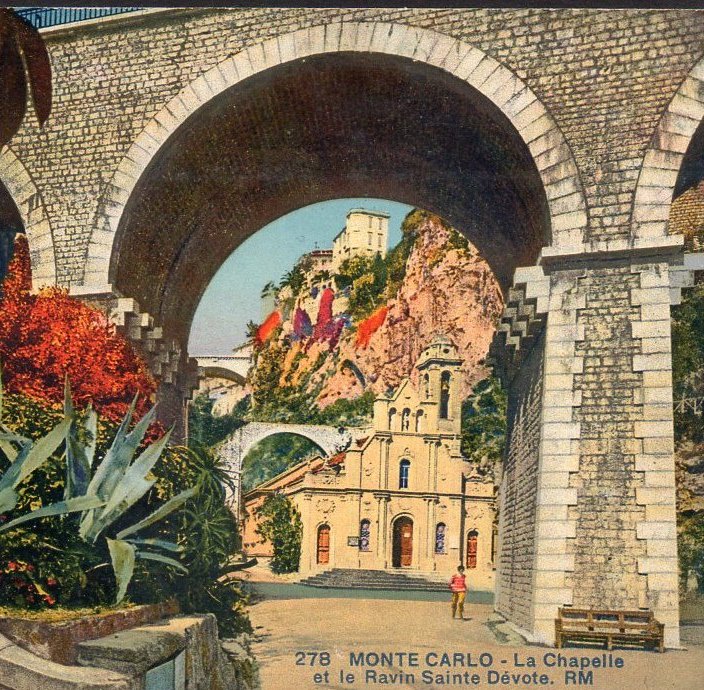
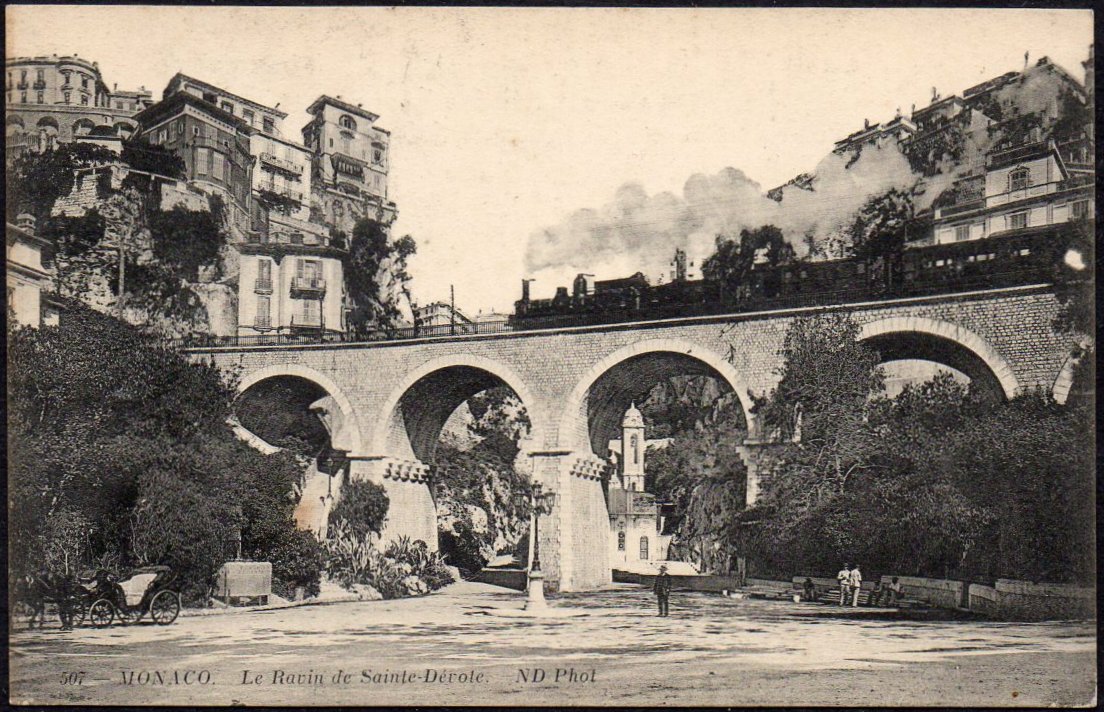
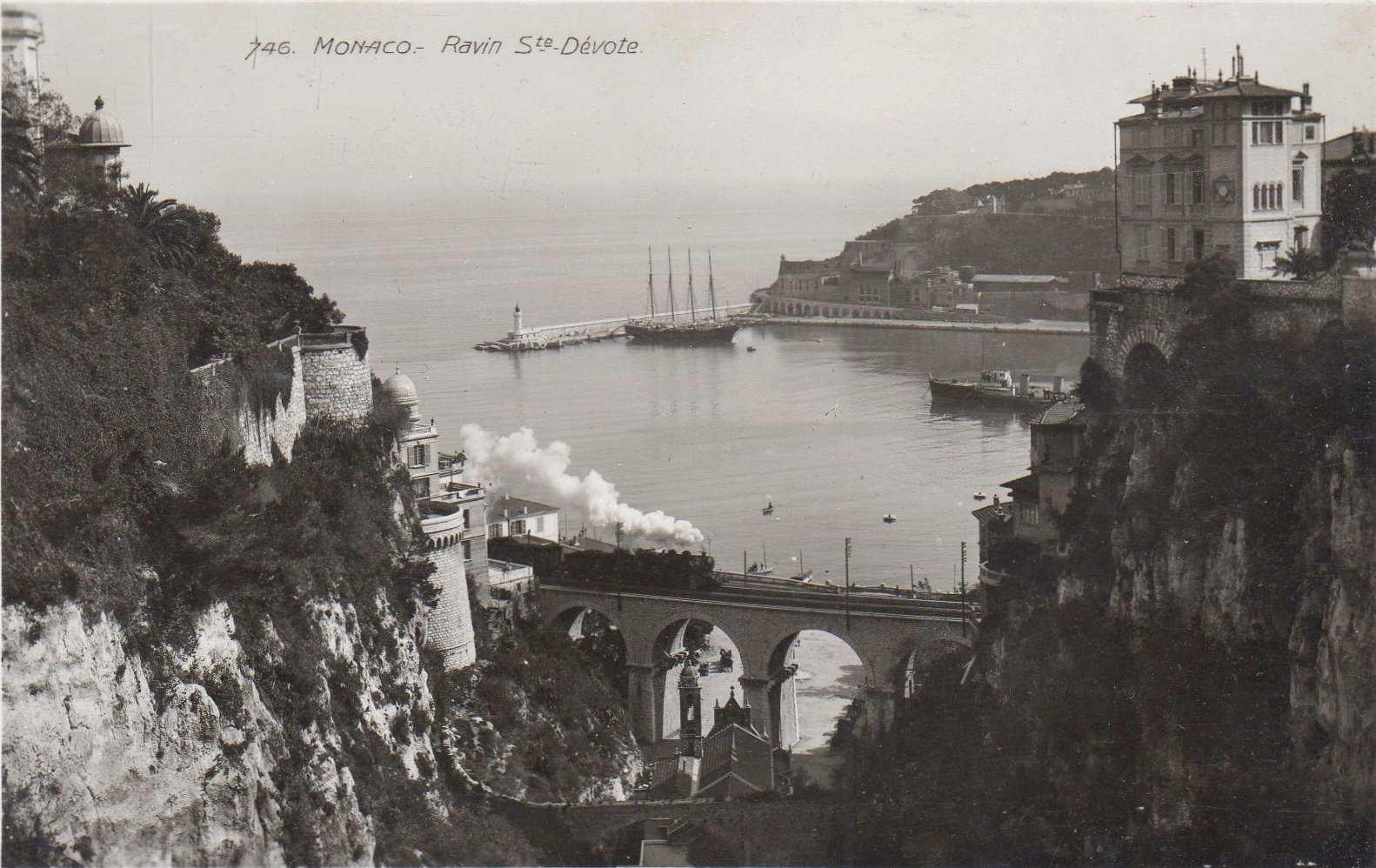
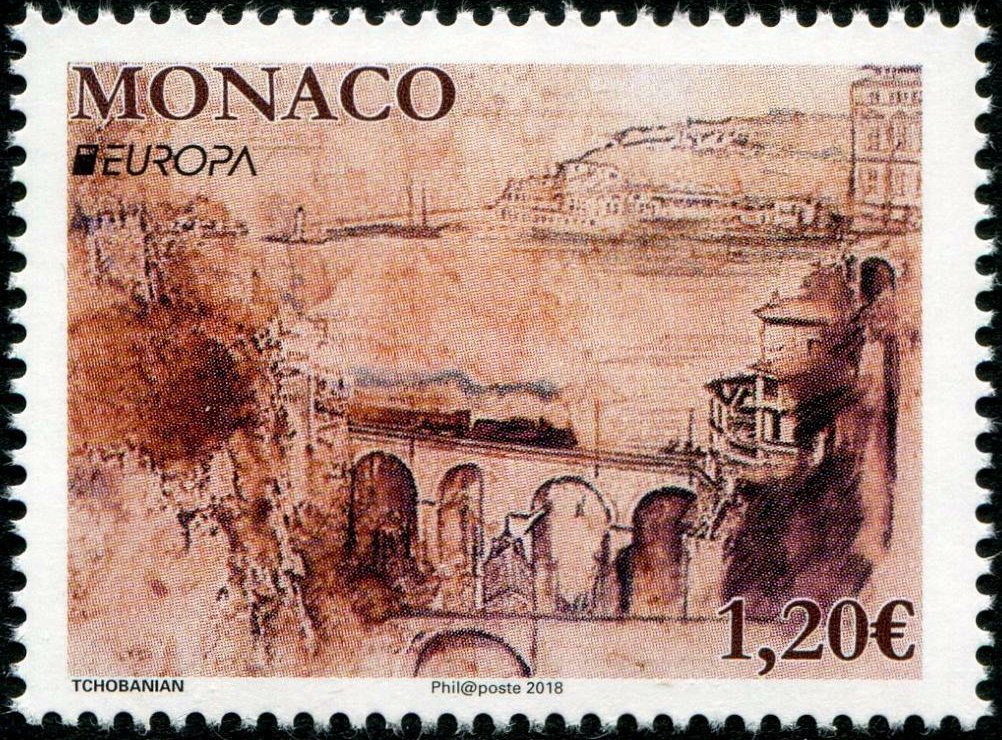
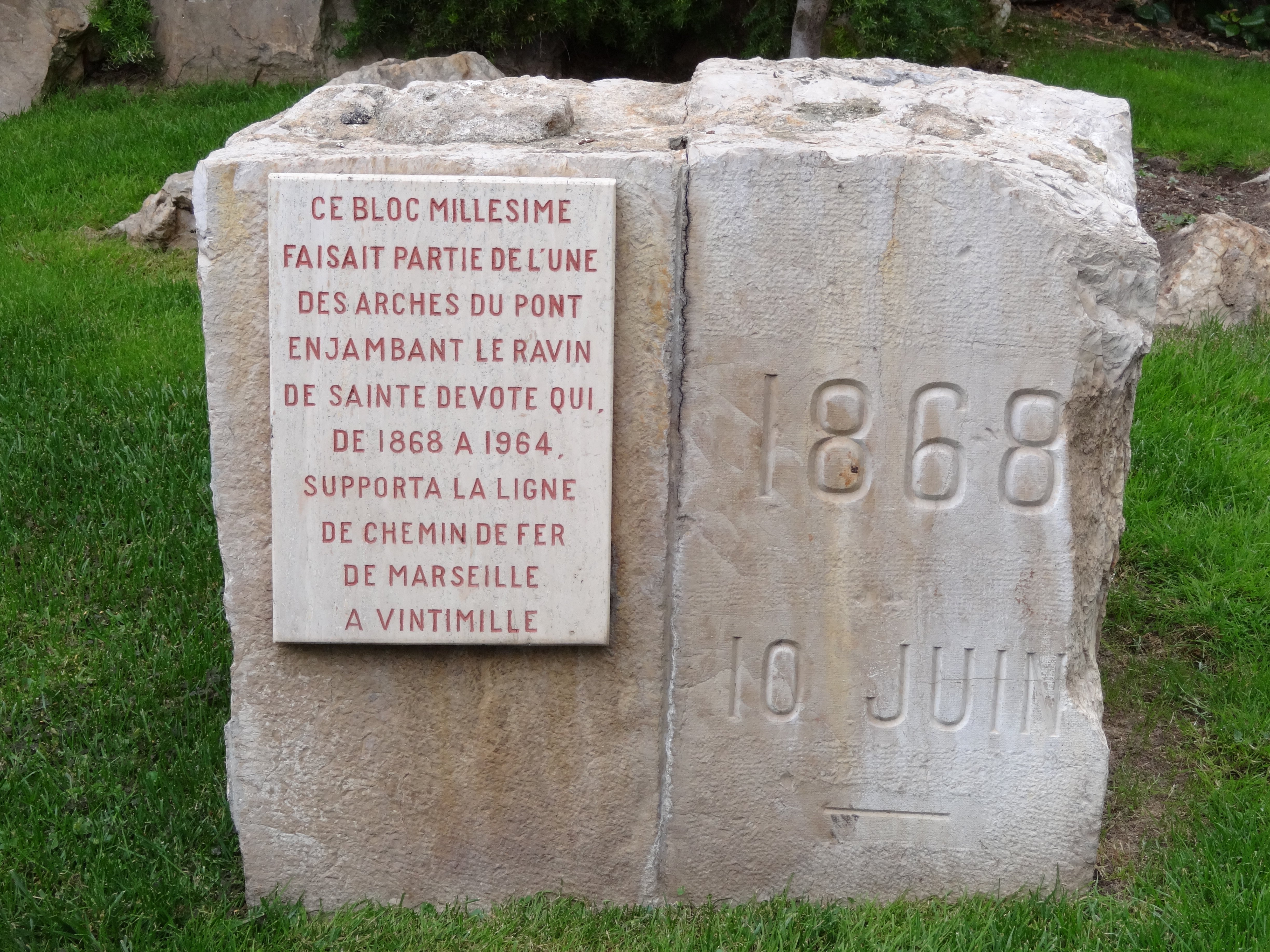 Only the bridge in the foreground of this view is railway. A dated stone block from the bridge was retrieved during demolition and it has been erected as a memento adjacent to where the bridge once stood. The French text reads: 'This dated block was formerly a part of one of the arches that spanned the ravine of Sainte Dévote and carried the Marseille to Ventimiglia railway from 1868 to 1964.' The arch of the bridge, including detail of the brickwork, was used to frame several stamps depicting the Chapelle de Sainte Dévote, also known as the Eglise de Sainte Dévote, whose origins go back to at least the 11th Century.
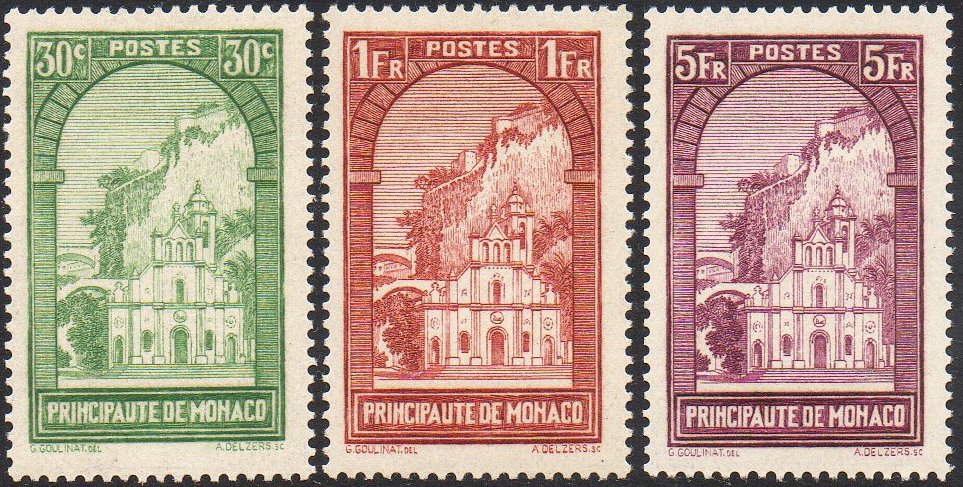 1933-1939 Definitives : Frames formed from pattern of bridge's brickwork :
1933 (Jan) : 30c : Green [ . ] [ . ]
1933 (June) : 1 Fr. : Red-Brown [ . ] [ . ]
1933 (Jan) : 5 Fr. : Purple [ . ] [ . ]
1933-1939 Definitives : Frames formed from pattern of bridge's brickwork :
1933 (Jan) : 30c : Green [ . ] [ . ]
1933 (June) : 1 Fr. : Red-Brown [ . ] [ . ]
1933 (Jan) : 5 Fr. : Purple [ . ] [ . ]
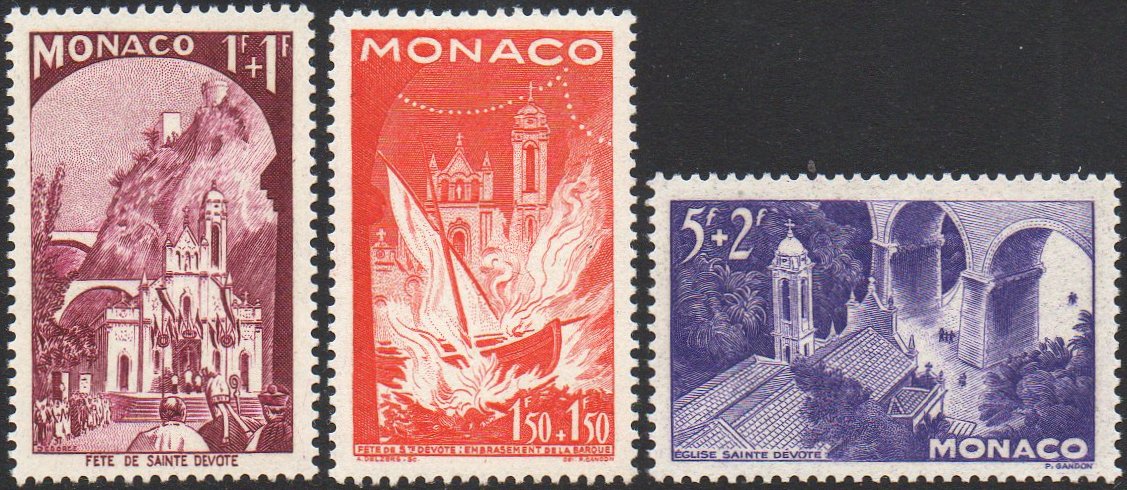 1944 : Festival of Sainte Dévote : Arch of bridge as a frame (vertical stamps) or as a backdrop (horizontal design) :
1 Fr + 1 Fr : Purple [ . ] [ . ]
1Fr50 + 1Fr50 : Scarlet-Vermilion [ . ] [ . ]
5 Fr + 2 Fr : Violet [ . ] [ . ]
.
1944 : Festival of Sainte Dévote : Arch of bridge as a frame (vertical stamps) or as a backdrop (horizontal design) :
1 Fr + 1 Fr : Purple [ . ] [ . ]
1Fr50 + 1Fr50 : Scarlet-Vermilion [ . ] [ . ]
5 Fr + 2 Fr : Violet [ . ] [ . ]
.
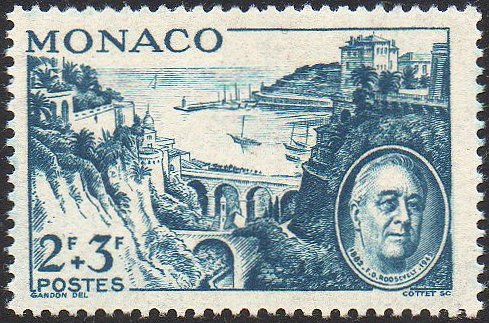
 1946 President Roosevelt Commemoration :
2Fr + 3Fr : Greenish-Blue [ . ] [ . ]
.
2018 Europa :
1€20 : Pont Ste Dévote (artist : Joël Tchobanian) [ . ] [ . ]
.
1946 President Roosevelt Commemoration :
2Fr + 3Fr : Greenish-Blue [ . ] [ . ]
.
2018 Europa :
1€20 : Pont Ste Dévote (artist : Joël Tchobanian) [ . ] [ . ]
.
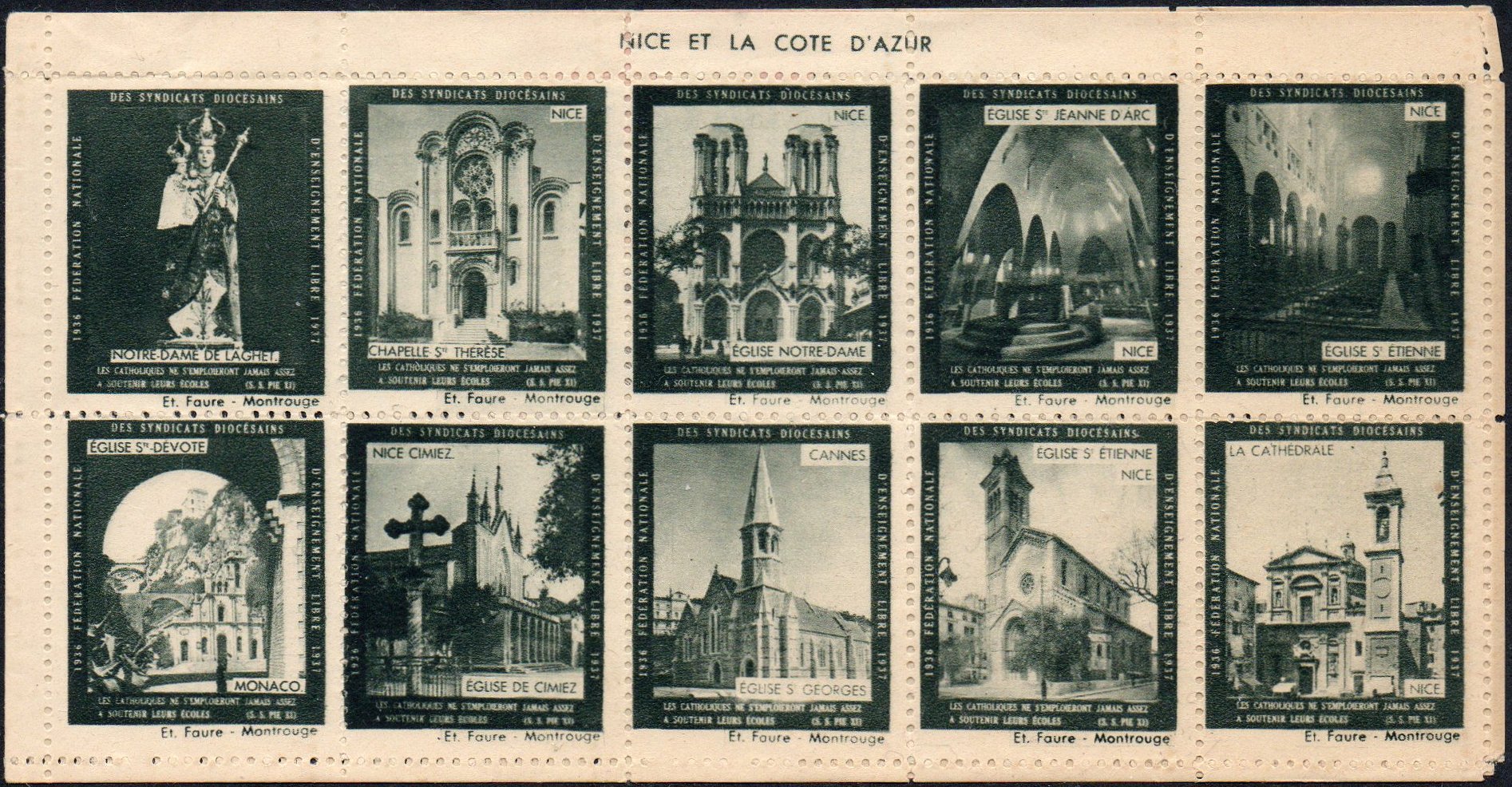
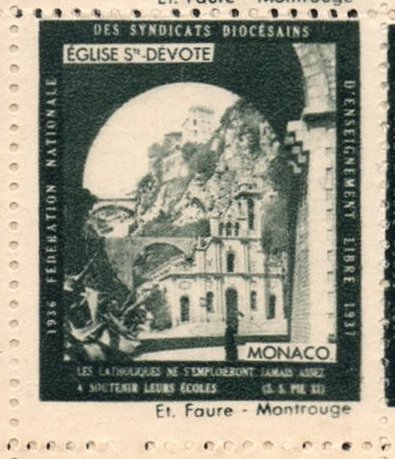
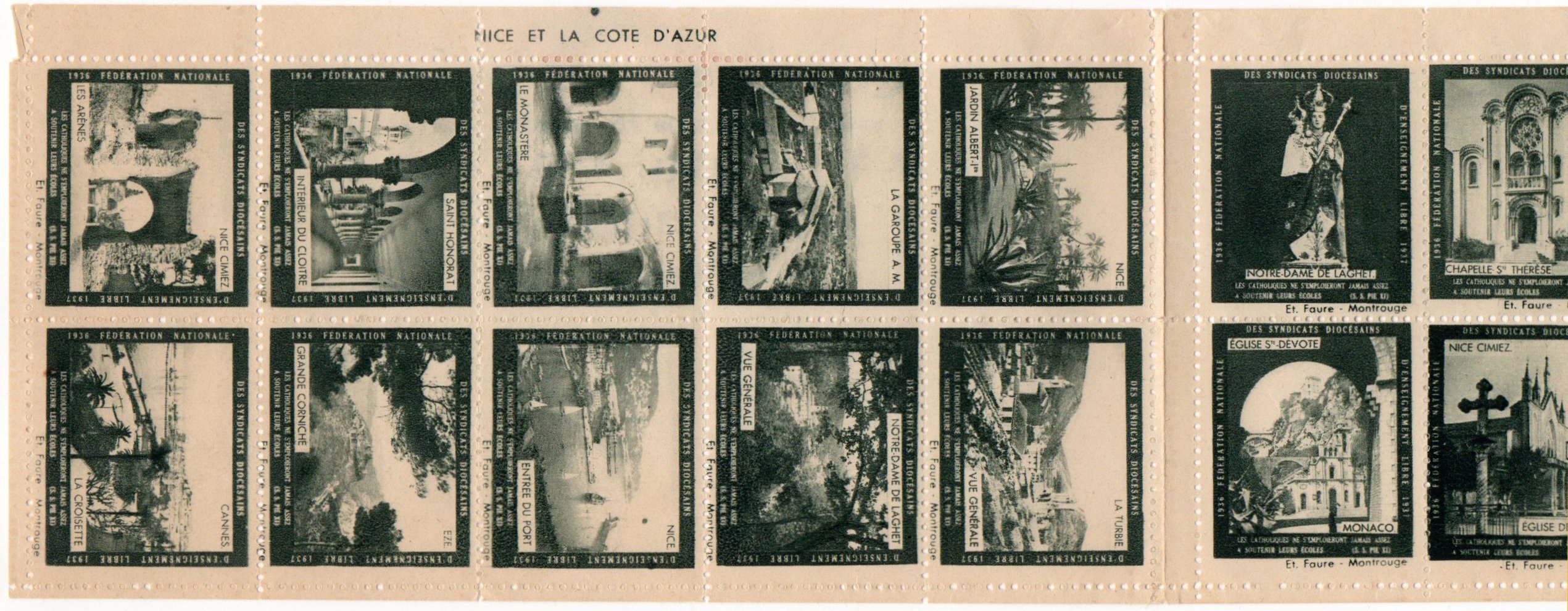 A booklet of 20 vignettes in a sheetlet of 20 (in two panes/10 with interpanneau divide, one pane in landscape and one in portrait format) was issued by the National Federation of Diocesan Free Education Unions, each pane inscribed 'NICE ET LA COTE D'AZUR'. The vignettes perhaps date from the 1930s, to our knowledge in at least two colours, 'Deep Green' (as here), and 'Deep Brown'. We suspect they may also exist in 'Dark Blue'.
All twenty stamps are inscribed (in French): 'Catholics will never do enough to support their schools' (Les Catholiques ne s'emploieront jamais assez à soutenir leurs écoles.).
One vignette (right-hand scan, top) shows an arch of the railway viaduct at Ste Dévote.
.
We provide some images below to extend our story from the Pont Sainte Dévote to the approaches to the Gare de Monte-Carlo:
A booklet of 20 vignettes in a sheetlet of 20 (in two panes/10 with interpanneau divide, one pane in landscape and one in portrait format) was issued by the National Federation of Diocesan Free Education Unions, each pane inscribed 'NICE ET LA COTE D'AZUR'. The vignettes perhaps date from the 1930s, to our knowledge in at least two colours, 'Deep Green' (as here), and 'Deep Brown'. We suspect they may also exist in 'Dark Blue'.
All twenty stamps are inscribed (in French): 'Catholics will never do enough to support their schools' (Les Catholiques ne s'emploieront jamais assez à soutenir leurs écoles.).
One vignette (right-hand scan, top) shows an arch of the railway viaduct at Ste Dévote.
.
We provide some images below to extend our story from the Pont Sainte Dévote to the approaches to the Gare de Monte-Carlo:
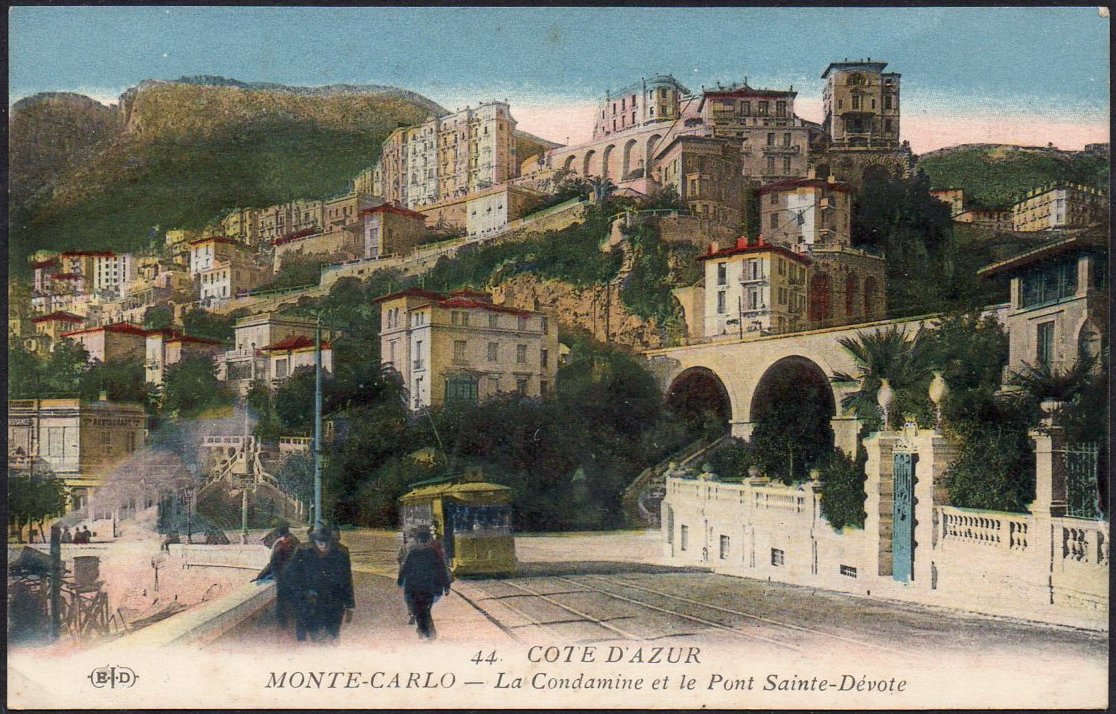 After crossing the Pont Sainte Dévote, shown on the map slightly left of centre at the top, in the eastwards direction the tracks passed under the road which climbs towards the Hotel de Paris and Casino. The postcard view above shows the foot of the incline from Sainte Dévote to the Casino, with a tram about to climb the hill.
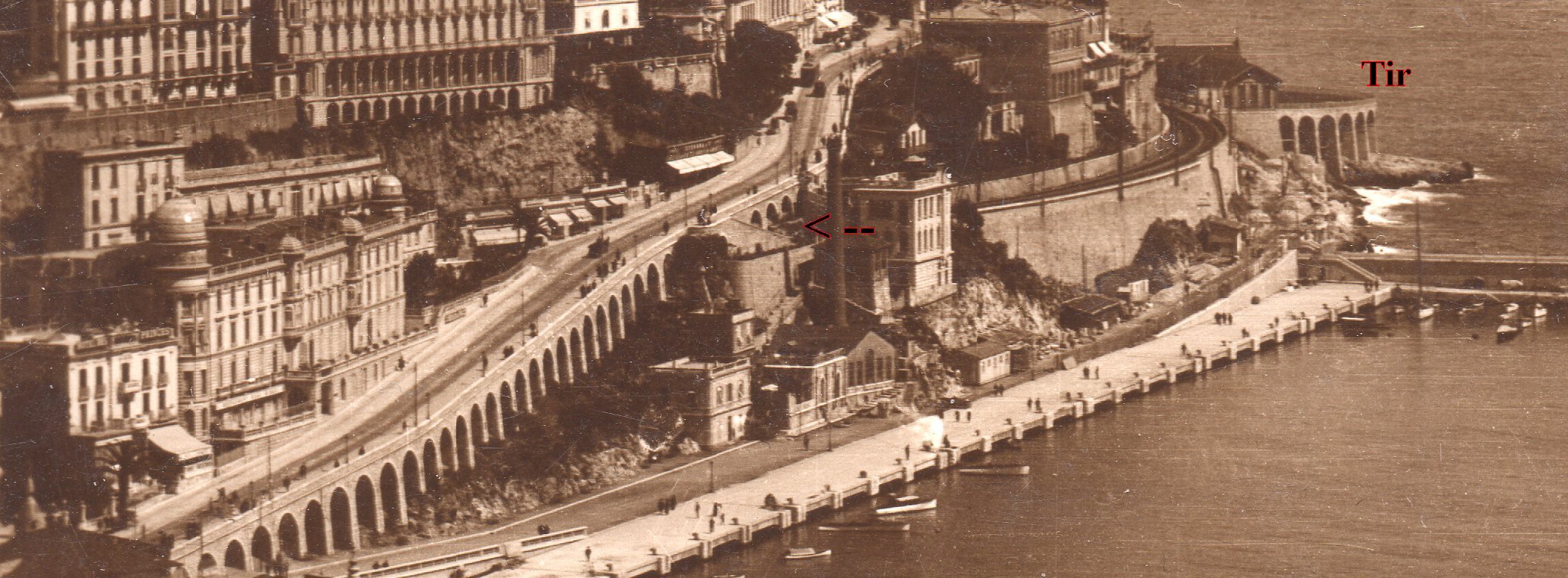 This second view shows the steep climb towards the Casino, familiar to F1 motor-racing fans. There is a tram visible at the top, about to descend. The railway passes under the arches indicated above by the red & black arrow and then skirts the sea before rounding the point immediately behind the Tir aux Pigeons, identified by the word 'Tir' on the image. The Gare de Monte-Carlo was a short distance beyond.
Some of the 1964 set/16 for the 50th Anniversary of the First Aerial Rally at Monte-Carlo shows the same location, although the 1c stamp only displays the retaining wall of the embankment. On the other six values, one can make out the railway tracks fairly clearly.
This second view shows the steep climb towards the Casino, familiar to F1 motor-racing fans. There is a tram visible at the top, about to descend. The railway passes under the arches indicated above by the red & black arrow and then skirts the sea before rounding the point immediately behind the Tir aux Pigeons, identified by the word 'Tir' on the image. The Gare de Monte-Carlo was a short distance beyond.
Some of the 1964 set/16 for the 50th Anniversary of the First Aerial Rally at Monte-Carlo shows the same location, although the 1c stamp only displays the retaining wall of the embankment. On the other six values, one can make out the railway tracks fairly clearly.
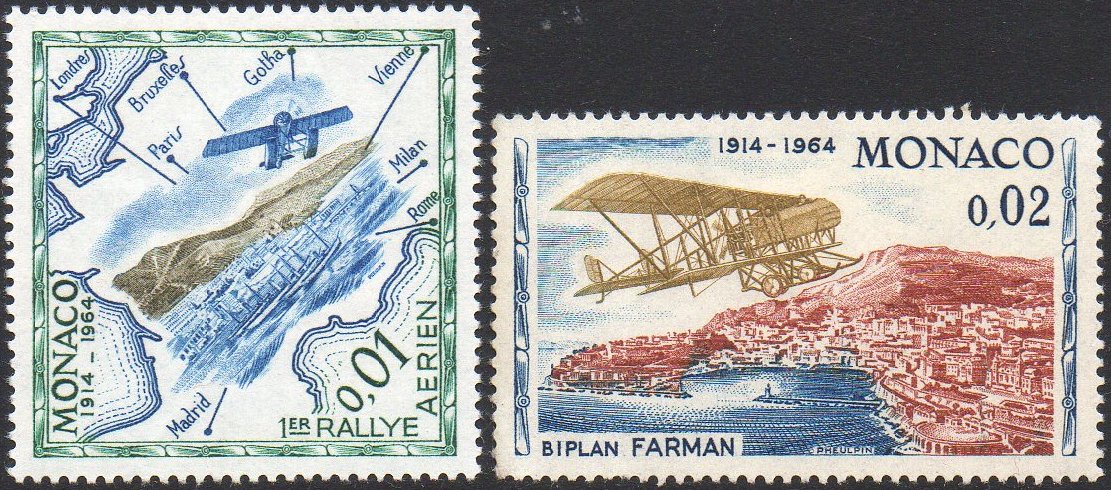
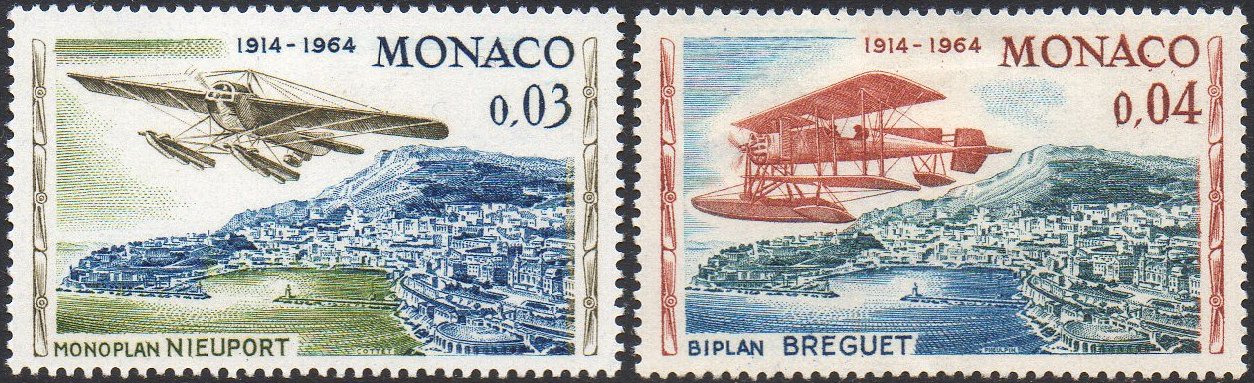
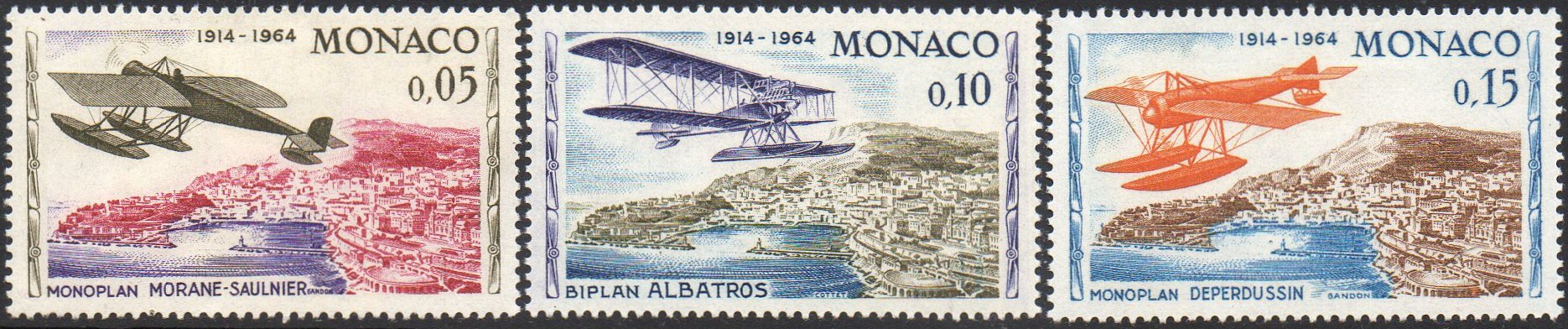
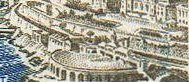 1964 Air Rally : Embankment and Tir aux Pigeons :
1c Embankment Wall [ . ] [ . ]
2c Tracks and Tir aux Pigeons [ . ] [ . ]
3c Tracks and Tir aux Pigeons [ . ] [ . ]
4c Tracks and Tir aux Pigeons [ . ] [ . ]
5c Tracks and Tir aux Pigeons [ . ] [ . ]
10c Tracks and Tir aux Pigeons [ . ] [ . ]
15c Tracks and Tir aux Pigeons [ . ] [ . ]
.
A promotional vignette of 1907 for a powerboat race also shows the Tir aux Pigeons with the wall supporting the raised railway behind (and to the left) of it. The vignette exists in at least six colours, Dull Blue, Burgundy, Greyish Brown-Violet, Grey (with a hint of lilac), Grey-Green, Red-Orange.
1964 Air Rally : Embankment and Tir aux Pigeons :
1c Embankment Wall [ . ] [ . ]
2c Tracks and Tir aux Pigeons [ . ] [ . ]
3c Tracks and Tir aux Pigeons [ . ] [ . ]
4c Tracks and Tir aux Pigeons [ . ] [ . ]
5c Tracks and Tir aux Pigeons [ . ] [ . ]
10c Tracks and Tir aux Pigeons [ . ] [ . ]
15c Tracks and Tir aux Pigeons [ . ] [ . ]
.
A promotional vignette of 1907 for a powerboat race also shows the Tir aux Pigeons with the wall supporting the raised railway behind (and to the left) of it. The vignette exists in at least six colours, Dull Blue, Burgundy, Greyish Brown-Violet, Grey (with a hint of lilac), Grey-Green, Red-Orange.
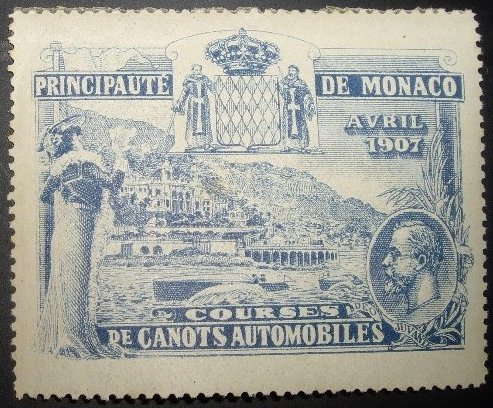
 A new, but similar, vignette was produced for the 1908 race.
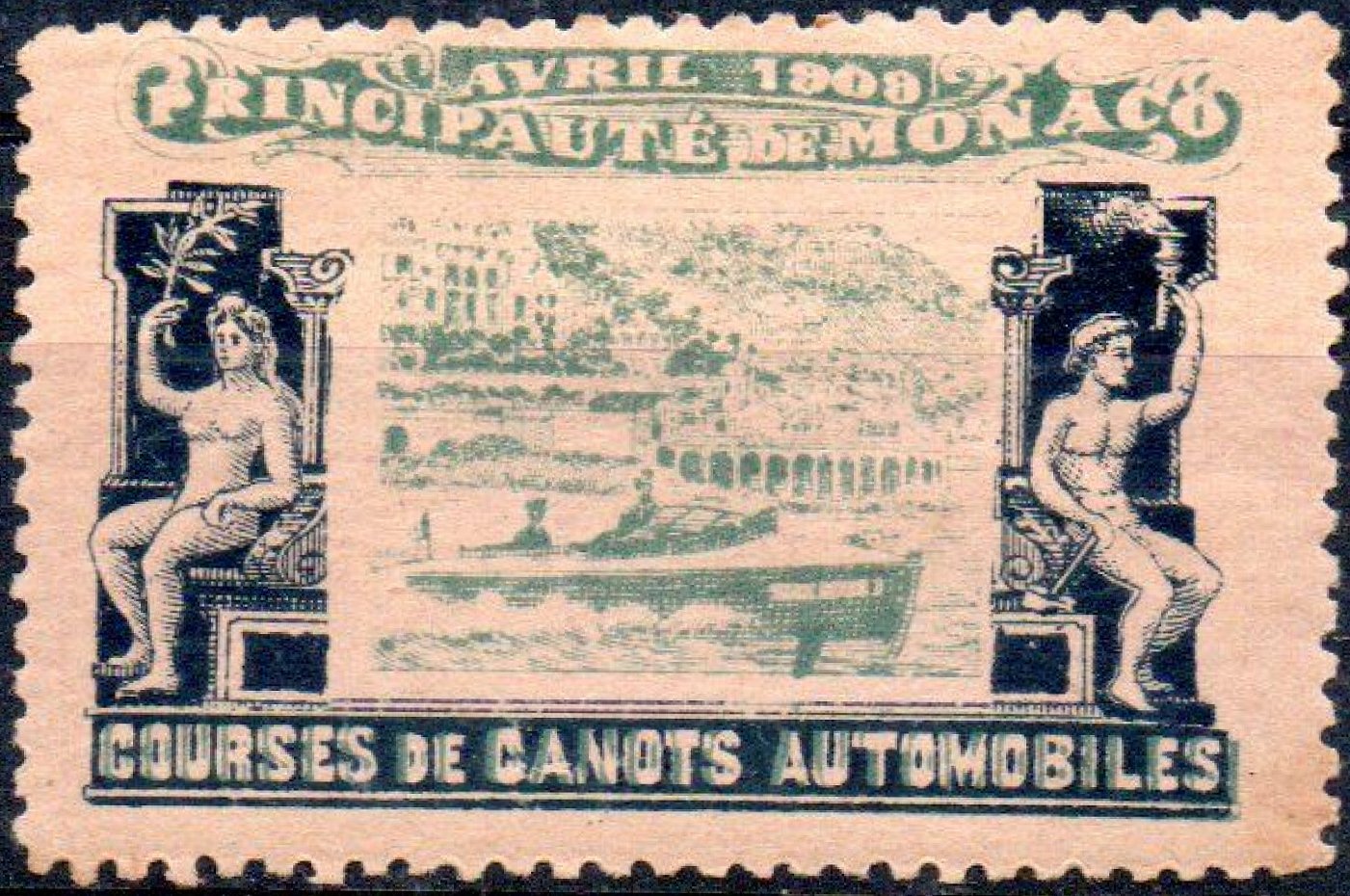 We have no record of how many colours may have been used for these vignettes.
.
6. La Gare de Monte-Carlo :
.
Curiously it seems that there are no Monaco stamps which show the interior of the Gare de Monte-Carlo and only one which shows the exterior. We have compensated with some extra postcards, some of the railway itself, some a social commentary on the destination of many of the railway's passengers, which changed so dramatically the fortunes of the Grimaldi family and the social and economic direction of the whole principality.
We have no record of how many colours may have been used for these vignettes.
.
6. La Gare de Monte-Carlo :
.
Curiously it seems that there are no Monaco stamps which show the interior of the Gare de Monte-Carlo and only one which shows the exterior. We have compensated with some extra postcards, some of the railway itself, some a social commentary on the destination of many of the railway's passengers, which changed so dramatically the fortunes of the Grimaldi family and the social and economic direction of the whole principality.
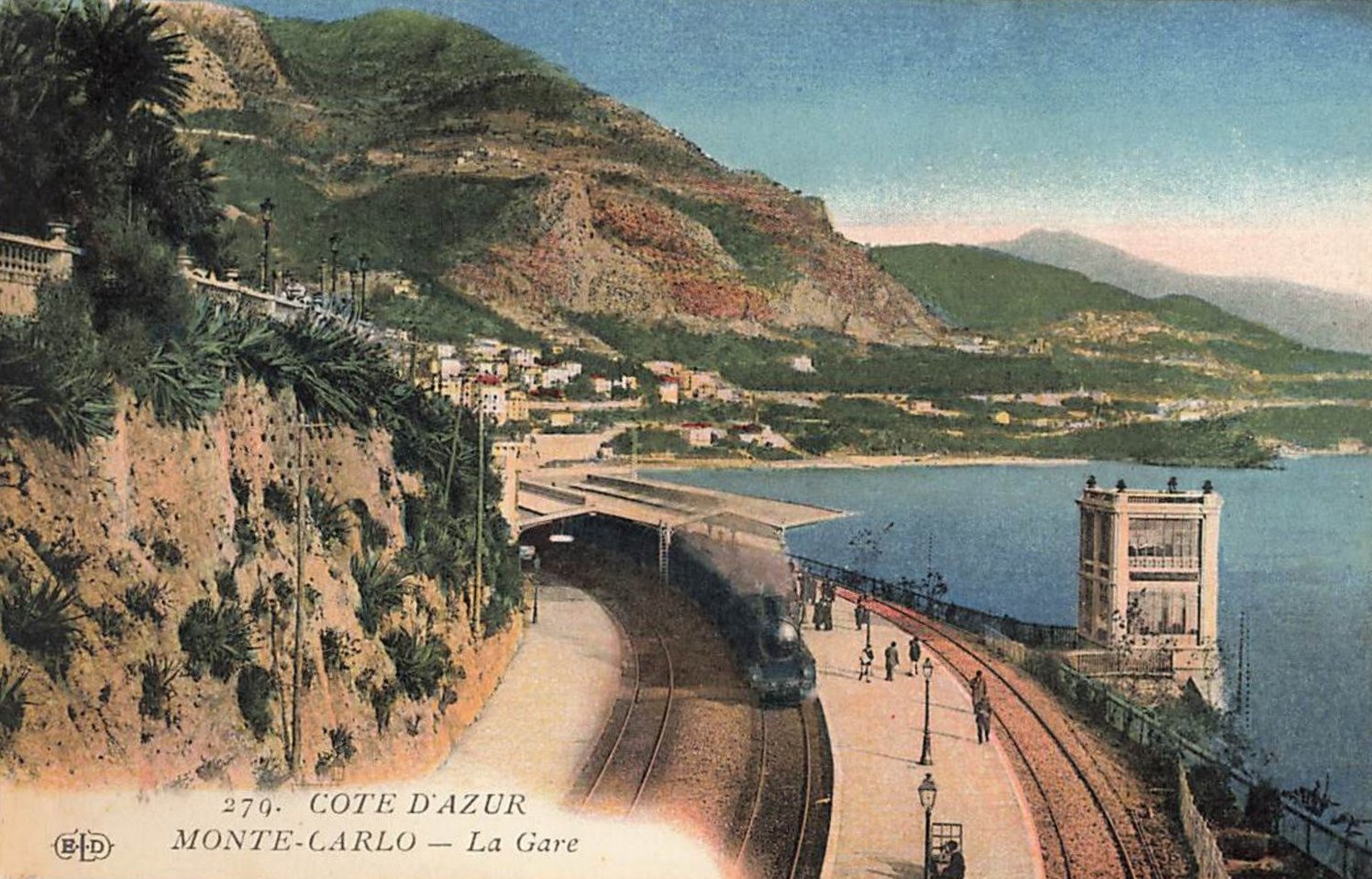
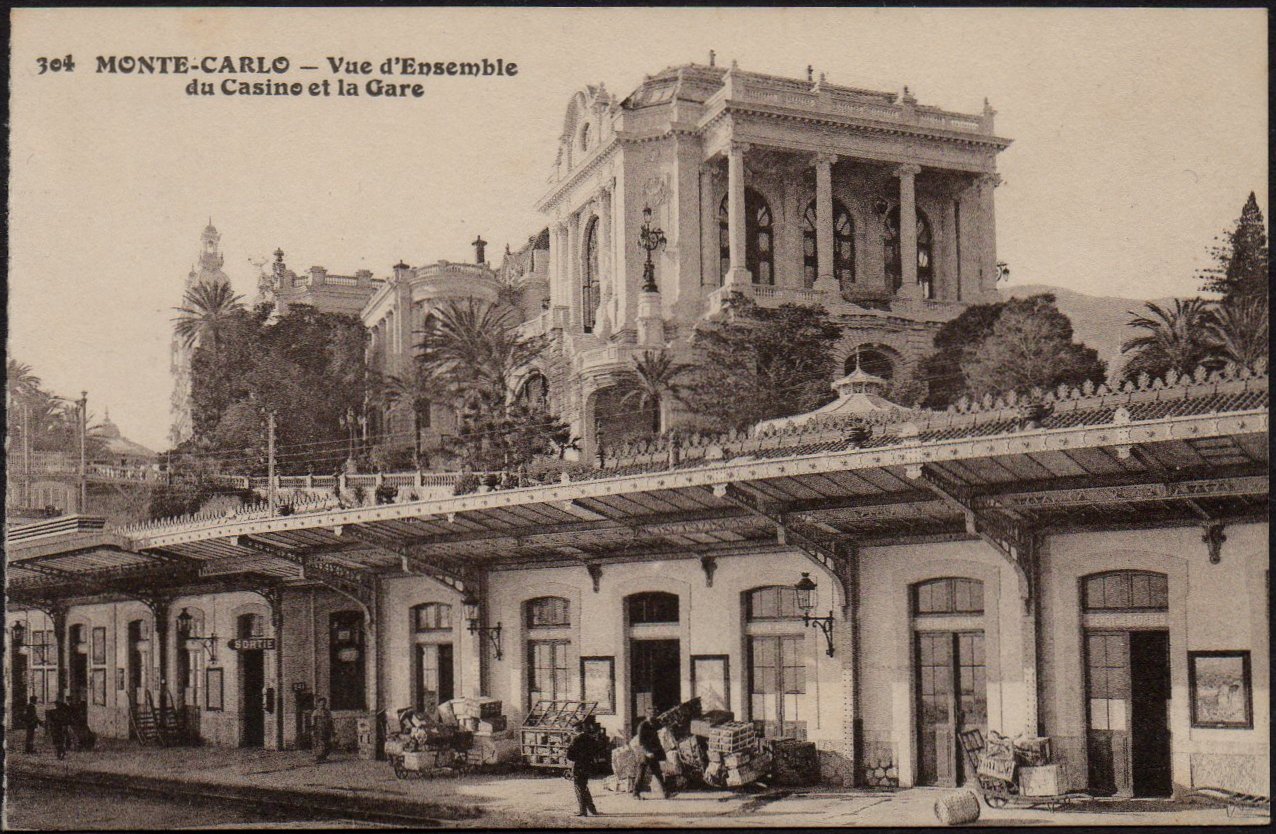 The first card shows a westbound train arriving in the Gare de Monte-Carlo from the Ventimiglia direction. The two main running tracks are on the left. Note: French trains 'drive' on the left, a historical legacy that stems from the study visit to Britain by the two French engineers who built the first railway in France, Louis de Gallois and Louis-Antoine Beaunier. Exceptionally though, in much of Alsace-Lorraine, the railway network was largely established under German rule (1871-1918), with trains consequently running on the right, as in Germany. When France re-acquired the region after WWI, the cost of conversion to left-hand running was deemed far too costly.
The second card shows the eastbound platform, viz. the one on the left in the first image. It seems improbable that a station would ever have been located here but for the Casino.
The first card shows a westbound train arriving in the Gare de Monte-Carlo from the Ventimiglia direction. The two main running tracks are on the left. Note: French trains 'drive' on the left, a historical legacy that stems from the study visit to Britain by the two French engineers who built the first railway in France, Louis de Gallois and Louis-Antoine Beaunier. Exceptionally though, in much of Alsace-Lorraine, the railway network was largely established under German rule (1871-1918), with trains consequently running on the right, as in Germany. When France re-acquired the region after WWI, the cost of conversion to left-hand running was deemed far too costly.
The second card shows the eastbound platform, viz. the one on the left in the first image. It seems improbable that a station would ever have been located here but for the Casino.
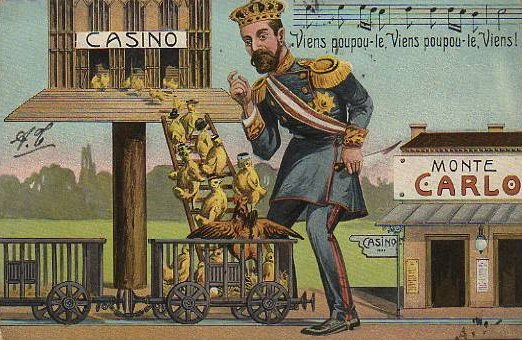 Exterior view of the station (north side) during La Belle Epoque and (right) a funny, if somewhat scurrilous, dig at the Prince and the huge financial benefits brought in by the Casino. The text could be loosely translated as 'Come on now, baby, come on little baby, come on'.
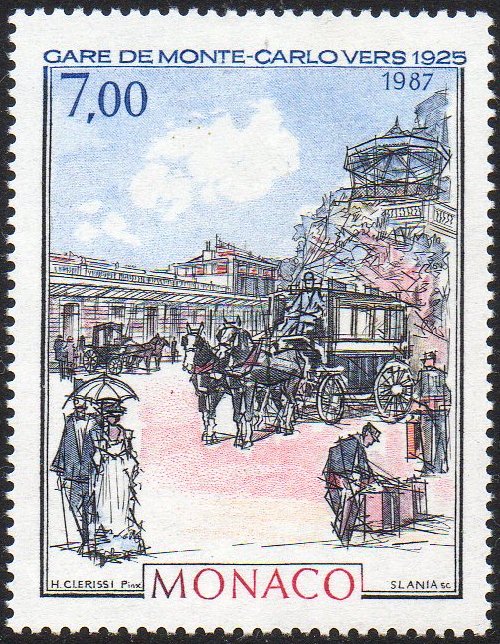
 The station forecourt c.1925, about two decades later than the postcard view above.
1987 : 7 Fr. : Views from La Belle Epoque : Gare de Monte-Carlo [ . ] [ . ]
The station forecourt c.1925, about two decades later than the postcard view above.
1987 : 7 Fr. : Views from La Belle Epoque : Gare de Monte-Carlo [ . ] [ . ]
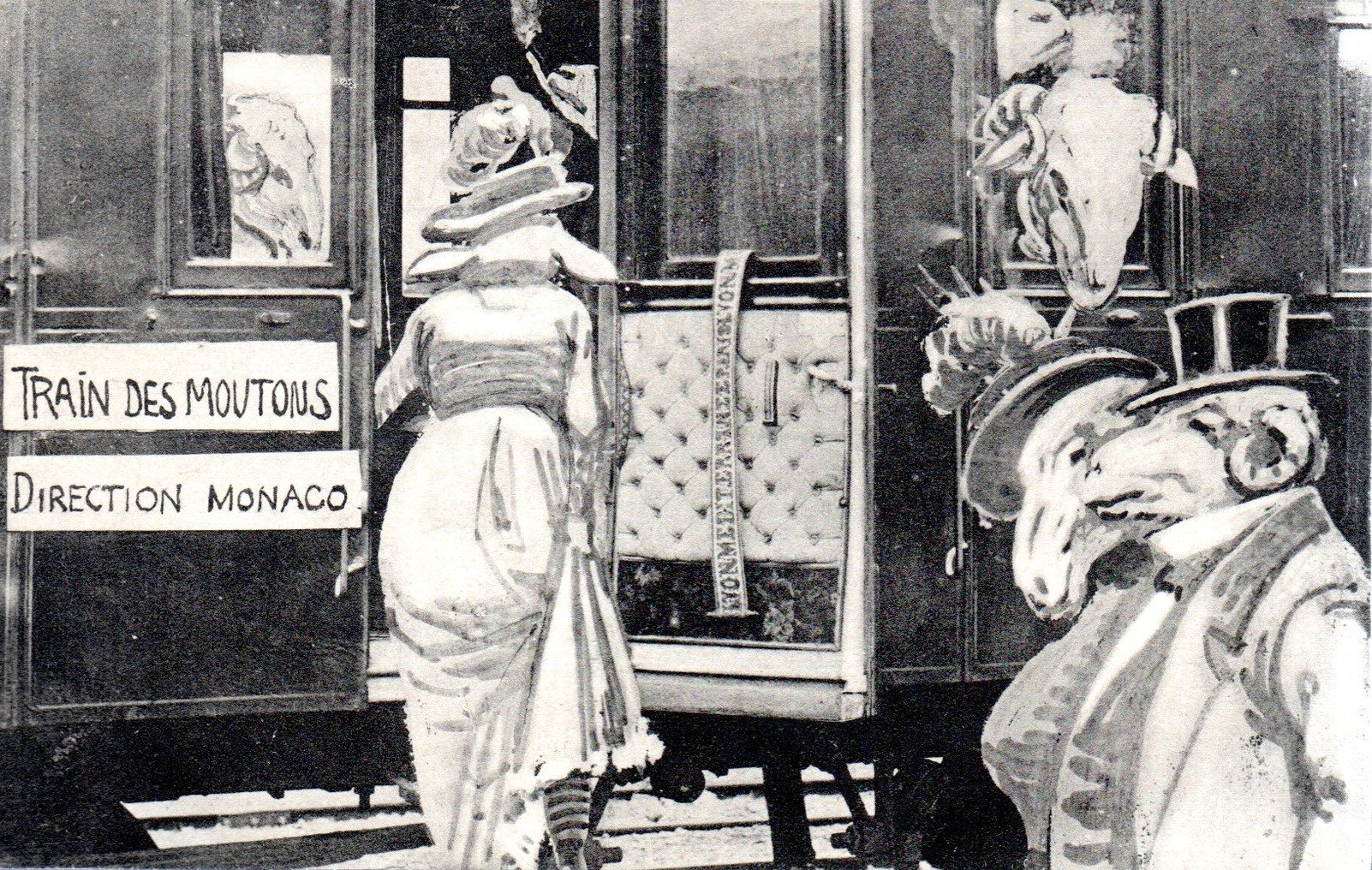
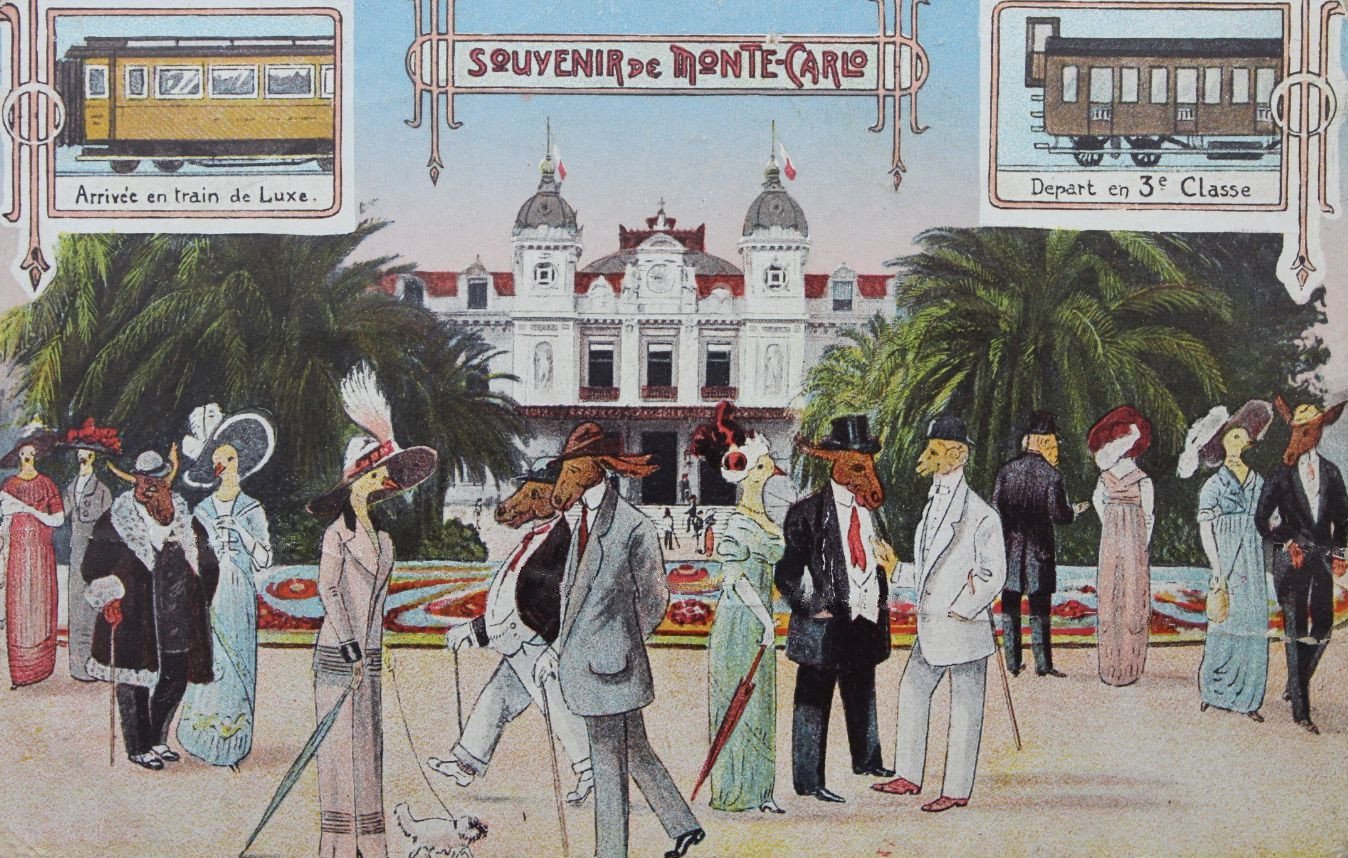 In France, gambling, and especially casinos, have long been strictly regulated, if permitted at all. For a long time, Catholic values ensured that gambling was all but banned. Even today, opening a casino is subject to geographic location and strict cultural rules. In La Belle Epoque, Monte Carlo's casino was a huge draw for those with a gambling spirit and many in France, and in Monaco as well no doubt, were appalled by its presence and the crowds of mainly well-heeled French citizens constantly making the journey to Monte-Carlo.
A common theme on postcards was one depicting the gamblers as sheep being led to their doom. The cards have a much more cautionary, even more censorious, tone than the more comic and less didactic tone of the card showing the Prince. The left-hand card reads 'Train for Sheep, Direction Monaco'. The right-hand card justaposes 'Arrival by Train de Luxe' with 'Departure in 3rd Class'.
The cynicism and opprobrium evident in the cards is not without some justification. The casino opened in 1863 and it was clear that the railway was an ideal vehicle for luring wealthy tourists. The owners of the casino had little difficulty in lobbying successfully for a station highly convenient to their customers, though rather less well-sited for most resident Monegasques. Relatively soon after the Gare de Monte-Carlo opened in 1869, technological advances would permit the installation of lifts to carry passengers effortlessly from the station directly up to the level of the Casino. Tellingly perhaps, at the time (1958) when the decision was made to close part of the surface line, few wealthy customers were still arriving by train at the Gare de Monte-Carlo. By the end of 1964 when the first tunnel project had been completed, the car had conquered all and the station's raison d'être had evaporated.
In France, gambling, and especially casinos, have long been strictly regulated, if permitted at all. For a long time, Catholic values ensured that gambling was all but banned. Even today, opening a casino is subject to geographic location and strict cultural rules. In La Belle Epoque, Monte Carlo's casino was a huge draw for those with a gambling spirit and many in France, and in Monaco as well no doubt, were appalled by its presence and the crowds of mainly well-heeled French citizens constantly making the journey to Monte-Carlo.
A common theme on postcards was one depicting the gamblers as sheep being led to their doom. The cards have a much more cautionary, even more censorious, tone than the more comic and less didactic tone of the card showing the Prince. The left-hand card reads 'Train for Sheep, Direction Monaco'. The right-hand card justaposes 'Arrival by Train de Luxe' with 'Departure in 3rd Class'.
The cynicism and opprobrium evident in the cards is not without some justification. The casino opened in 1863 and it was clear that the railway was an ideal vehicle for luring wealthy tourists. The owners of the casino had little difficulty in lobbying successfully for a station highly convenient to their customers, though rather less well-sited for most resident Monegasques. Relatively soon after the Gare de Monte-Carlo opened in 1869, technological advances would permit the installation of lifts to carry passengers effortlessly from the station directly up to the level of the Casino. Tellingly perhaps, at the time (1958) when the decision was made to close part of the surface line, few wealthy customers were still arriving by train at the Gare de Monte-Carlo. By the end of 1964 when the first tunnel project had been completed, the car had conquered all and the station's raison d'être had evaporated.
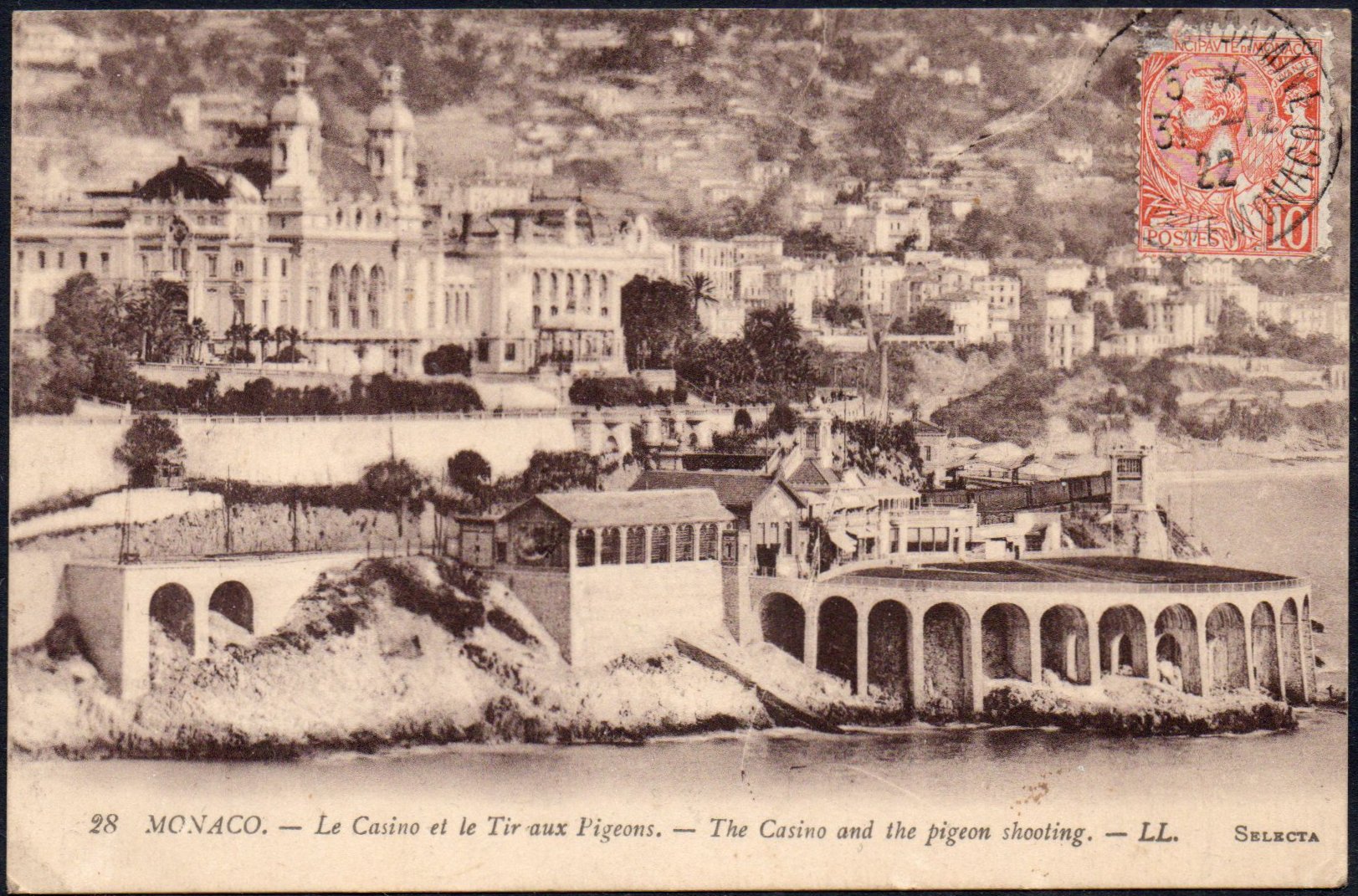
 A postcard view taken from an aircraft over the sea looking down on the Tir aux Pigeons. The card was sent to Isère on New Year's Eve 1922 and includes the Gare de Monte Carlo with a train just departing in the Ventimiglia direction. On the left, one can just about discern the western end of the platforms and a buffer stop at the end of a siding, the mainline tracks continuing towards St. Dévote behind the wall at the extreme bottom left of the detail scan.
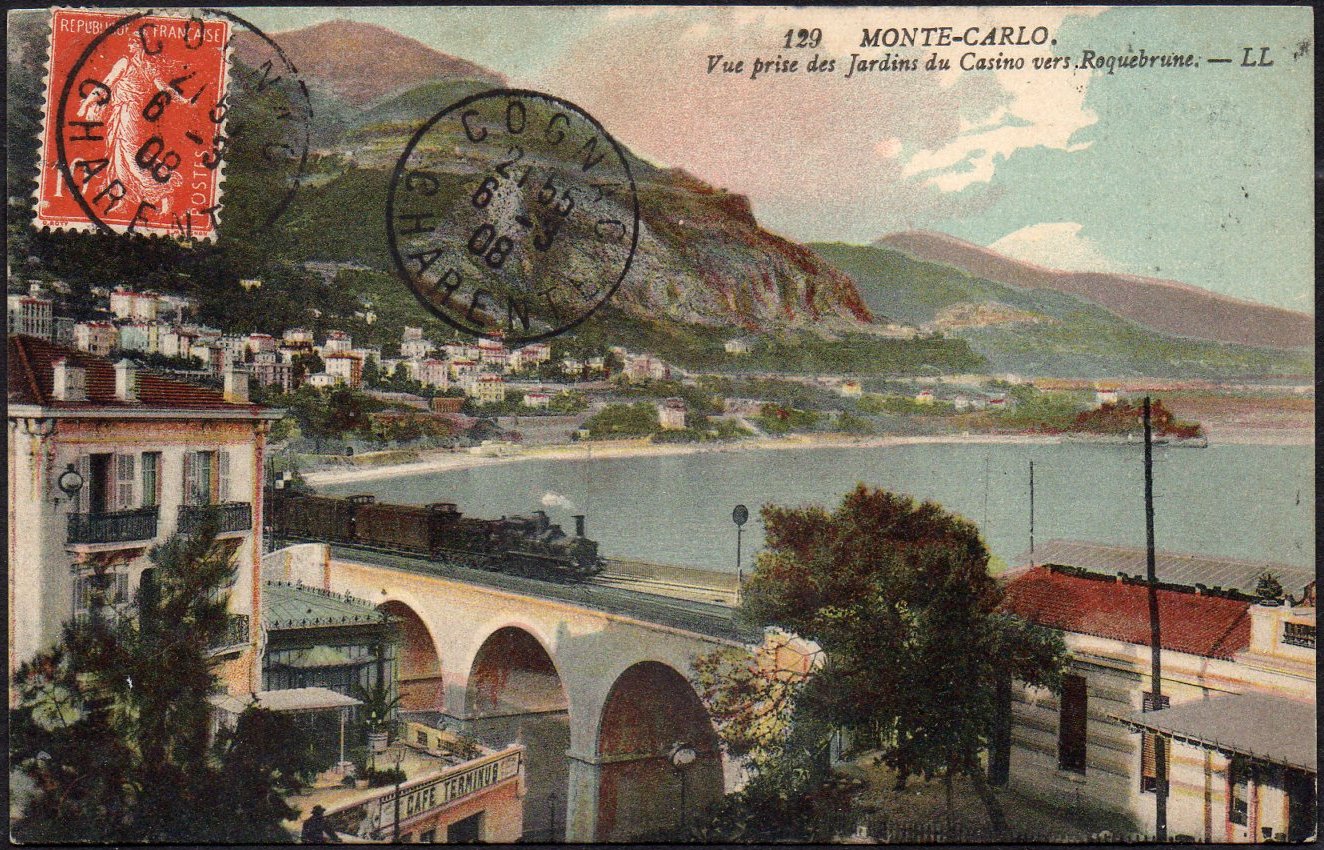
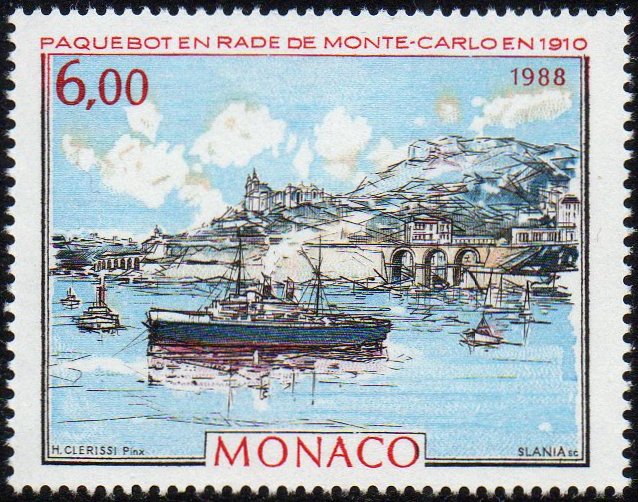 Another card showing a train arriving from the Ventimiglia direction with the roof of part of the station buildings at bottom right. The casino is located behind the photographer. The stamp from the seaward side shows the same viaduct but, applying plenty of somewhat bucolic artistic licence, all the station buildings below the casino have the appearance, to use modern parlance, of being 'airbrushed out'. The arches of the Tir aux Pigeons are visible on the left of the picture.
1988 : 6 Fr. : Paquebot en Rade de Monte-Carlo (1910) and railway viaduct [ . ] [ . ]
Another card showing a train arriving from the Ventimiglia direction with the roof of part of the station buildings at bottom right. The casino is located behind the photographer. The stamp from the seaward side shows the same viaduct but, applying plenty of somewhat bucolic artistic licence, all the station buildings below the casino have the appearance, to use modern parlance, of being 'airbrushed out'. The arches of the Tir aux Pigeons are visible on the left of the picture.
1988 : 6 Fr. : Paquebot en Rade de Monte-Carlo (1910) and railway viaduct [ . ] [ . ]
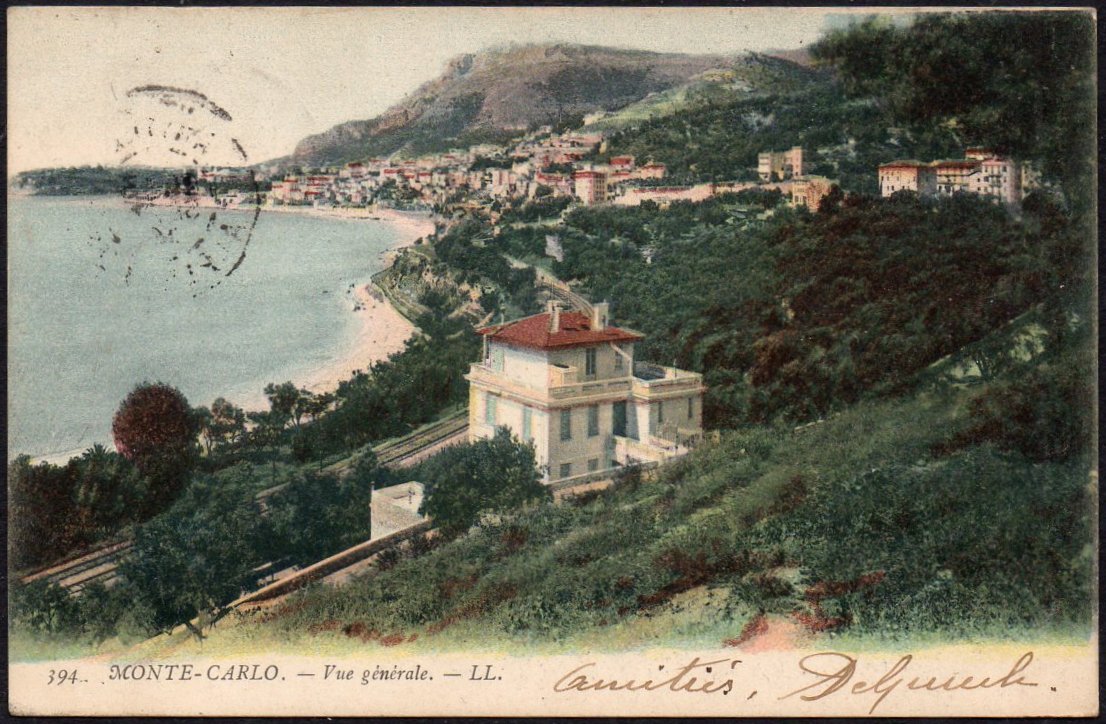 Although there remained perhaps 800 metres from the Gare de Monte-Carlo to the French border, there are no further stamps nor postcards of great interest with which to describe the transit. So much construction has obliterated the landscape of a century ago that identifying locations today is difficult. We think that the card above shows what today is known as Monte-Carlo-Beach & Country Club which is within French territory, and that the photographer is standing, approximately, on top of where the 1958/64 tunnel would be bored, perhaps 100 metres from its eastern portal.
Other :
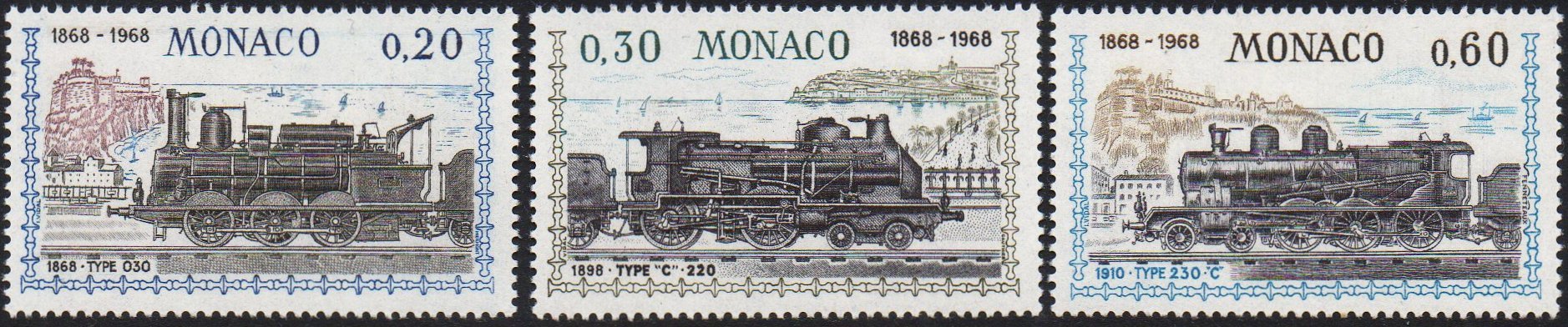
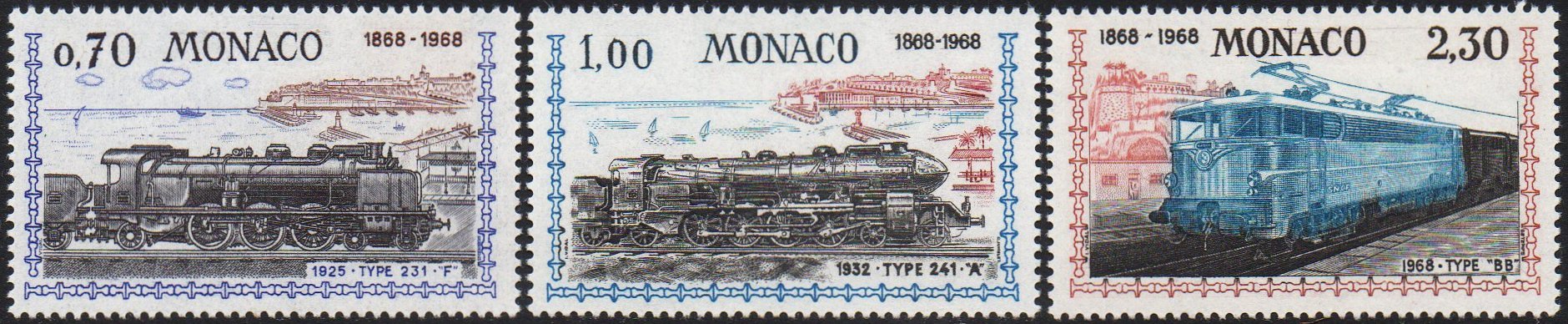
The 1968 set/6 for the Centenary of the Nice-Monaco Railway shows locomotives against various Monegasque backdrops. The composition of the designs includes considerable artistic licence and none of the scenes appear to represent specific locations on the railway.
Although there remained perhaps 800 metres from the Gare de Monte-Carlo to the French border, there are no further stamps nor postcards of great interest with which to describe the transit. So much construction has obliterated the landscape of a century ago that identifying locations today is difficult. We think that the card above shows what today is known as Monte-Carlo-Beach & Country Club which is within French territory, and that the photographer is standing, approximately, on top of where the 1958/64 tunnel would be bored, perhaps 100 metres from its eastern portal.
Other :
The 1968 set/6 for the Centenary of the Nice-Monaco Railway shows locomotives against various Monegasque backdrops. The composition of the designs includes considerable artistic licence and none of the scenes appear to represent specific locations on the railway.
 .
That completes our journey on the old line from west to east. The line eastwards was opened as far as Menton in the same year that the Gare de Monte-Carlo opened (1869) and reached Ventimiglia on the Italian side of the border in 1872 where it connected with the recently-completed and picturesque Italian coastal line through Liguria. Since that time, it has generally been the French trains which make the border crossing to terminate at Ventimiglia, thus enabling international rail travel by a simple change of train.
.
7. La Gare de Monaco-Monte-Carlo (from 1999) :
.
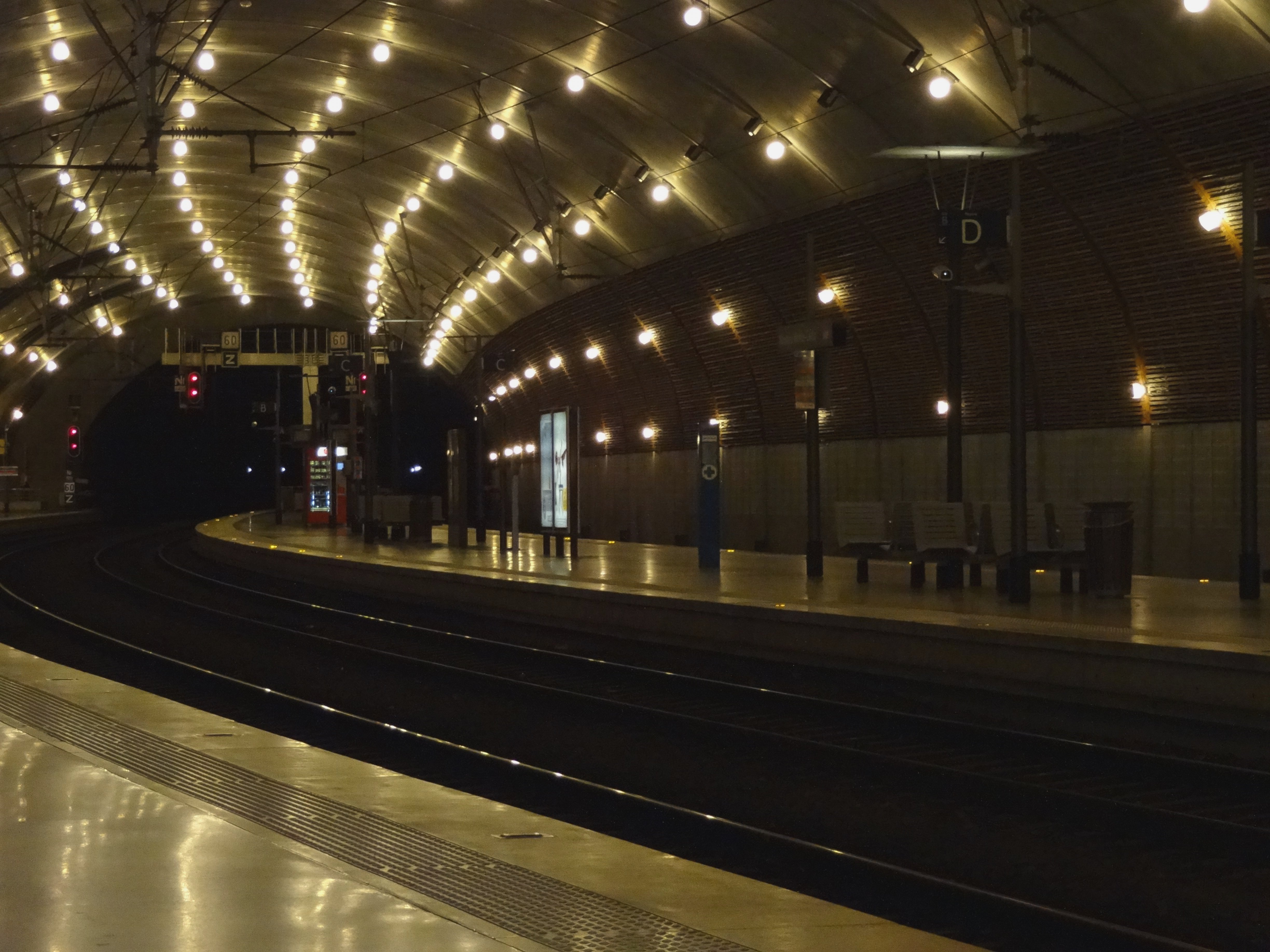
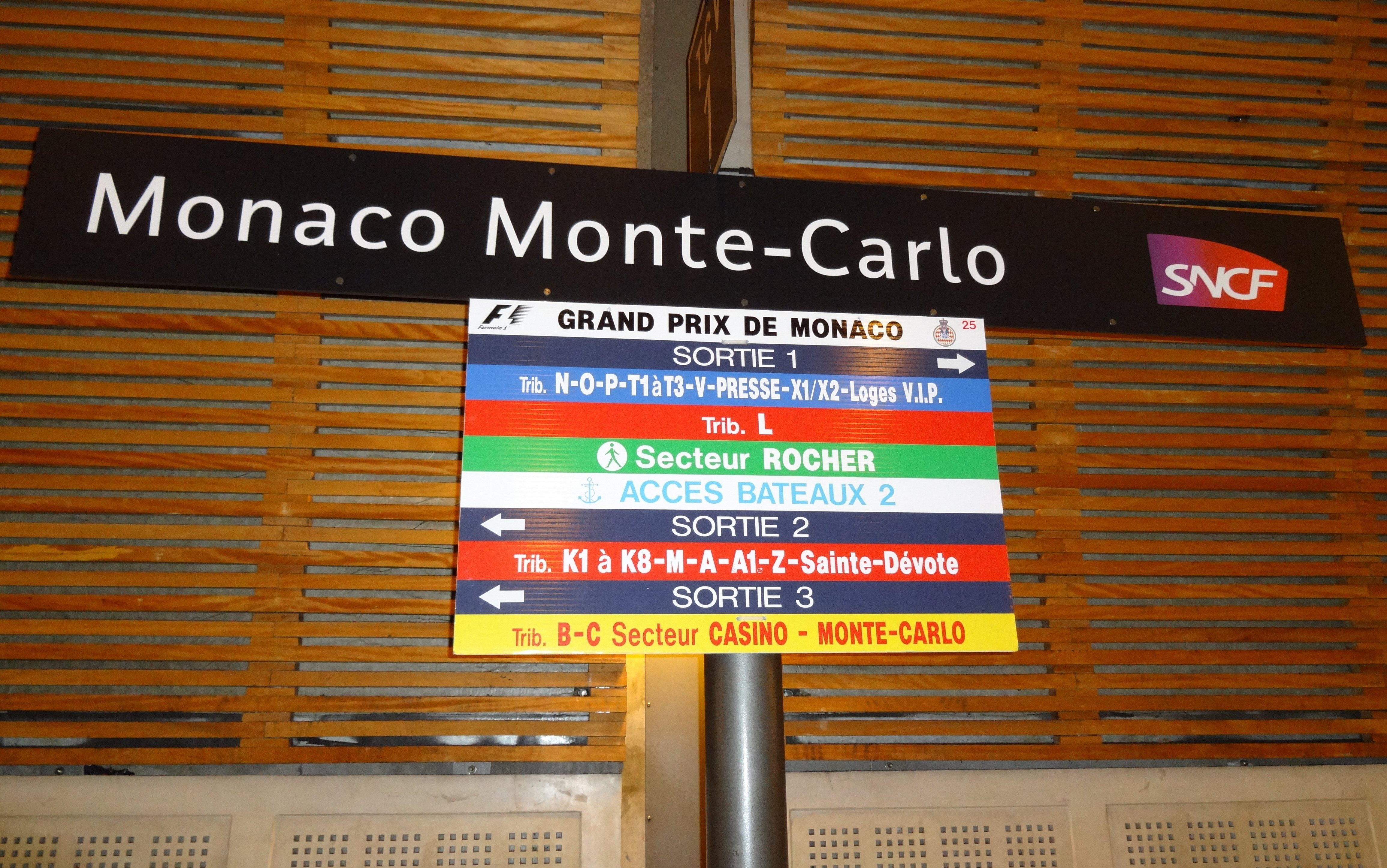
Whilst one may well mourn the passing of the surface line with its glimpses of sun, sea and history, it must be said that the new Gare de Monaco-Monte Carlo, opened in 1999, is a splendid cathedral of a station with high ceilings, geometric curves and elegant, slightly moody lighting.
.
That completes our journey on the old line from west to east. The line eastwards was opened as far as Menton in the same year that the Gare de Monte-Carlo opened (1869) and reached Ventimiglia on the Italian side of the border in 1872 where it connected with the recently-completed and picturesque Italian coastal line through Liguria. Since that time, it has generally been the French trains which make the border crossing to terminate at Ventimiglia, thus enabling international rail travel by a simple change of train.
.
7. La Gare de Monaco-Monte-Carlo (from 1999) :
.
Whilst one may well mourn the passing of the surface line with its glimpses of sun, sea and history, it must be said that the new Gare de Monaco-Monte Carlo, opened in 1999, is a splendid cathedral of a station with high ceilings, geometric curves and elegant, slightly moody lighting.
 The opening of the new station was commemorated in 1999 on stamps that formed part of two separate issues devoted to the principality's economy and its achievements.
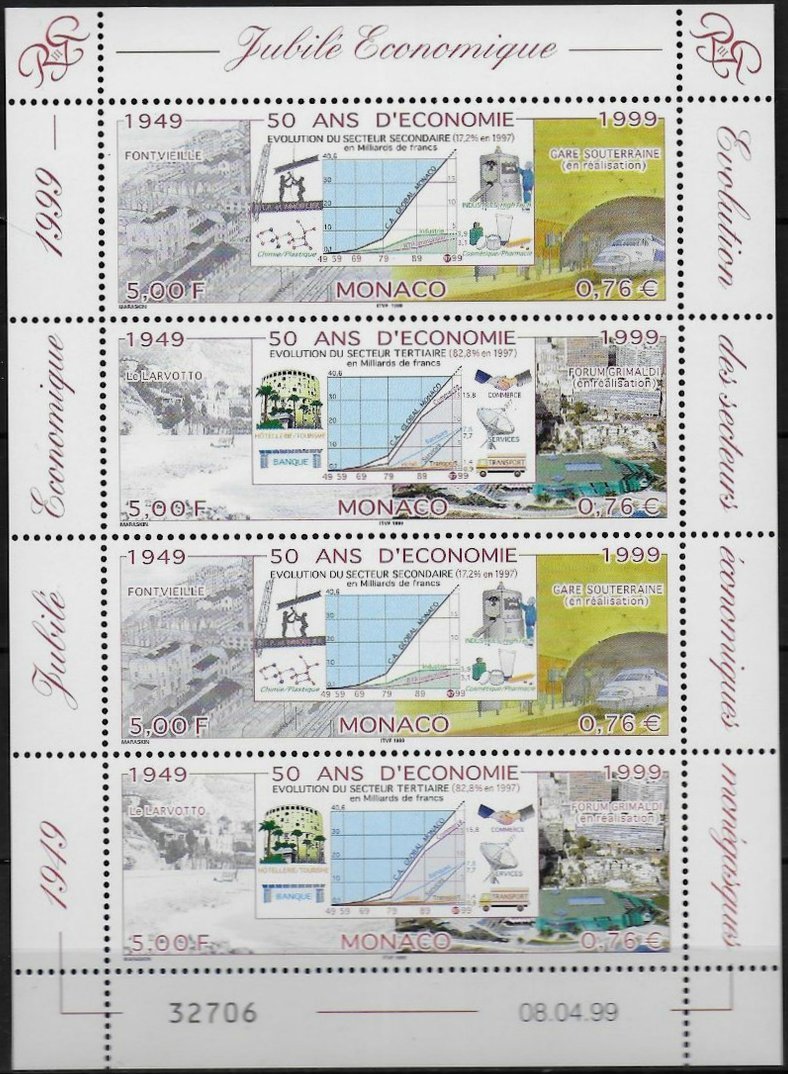
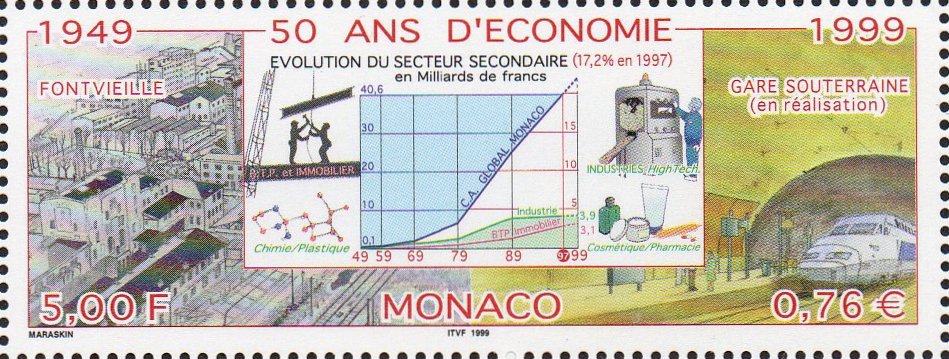 1999 (May) : 50 Years of the Economy : Two designs, one non-railway, both appearing twice in a sheetlet/4 :
5 Fr. (0€76) Fontvieille (tracks) in 1949 . . . Subterranean Station 1999 [ . ] [ . ]
- ditto - sheetlet/4 (2 x above + 2 x 5Fr. Le Larvotto & Grimaldi Forum) [ . ] [ . ]
These stamps were only issued in sheetlets/4, as shown.
1999 (May) : 50 Years of the Economy : Two designs, one non-railway, both appearing twice in a sheetlet/4 :
5 Fr. (0€76) Fontvieille (tracks) in 1949 . . . Subterranean Station 1999 [ . ] [ . ]
- ditto - sheetlet/4 (2 x above + 2 x 5Fr. Le Larvotto & Grimaldi Forum) [ . ] [ . ]
These stamps were only issued in sheetlets/4, as shown.
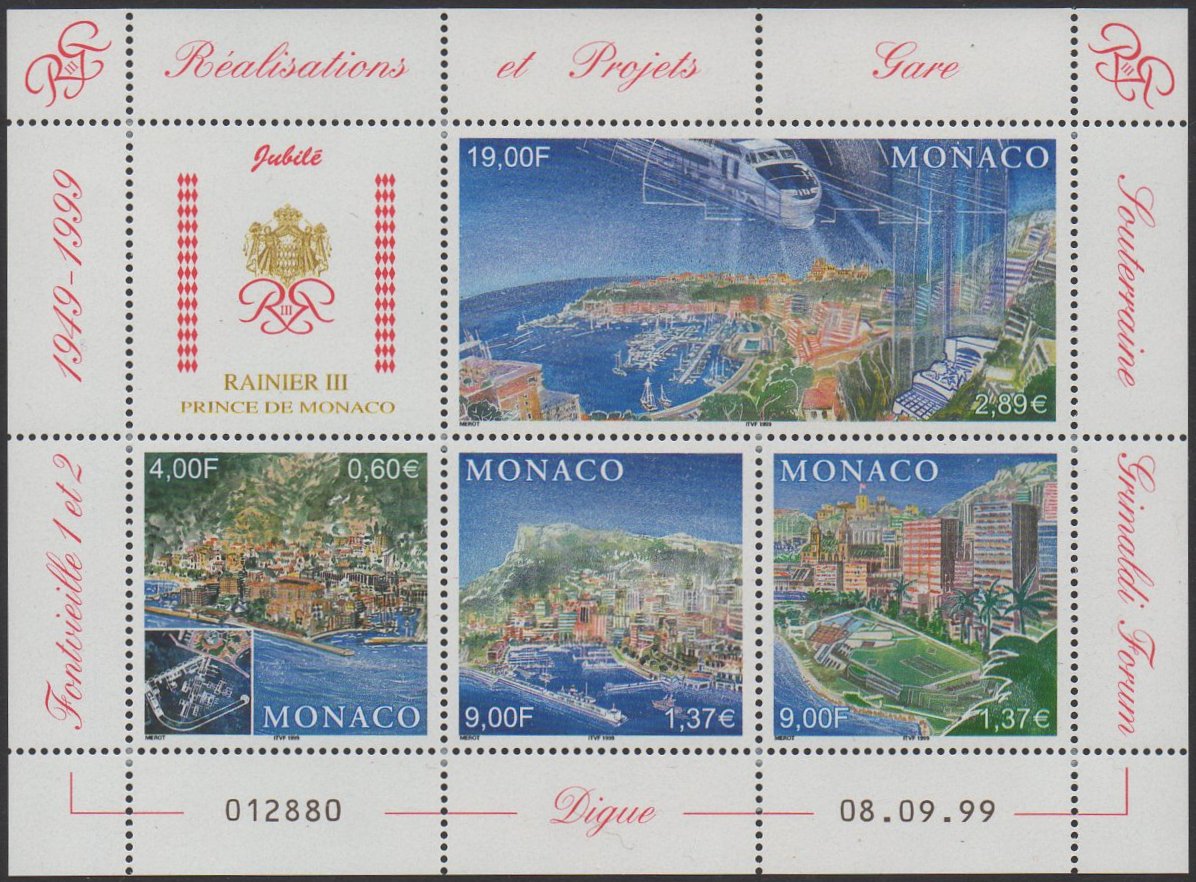
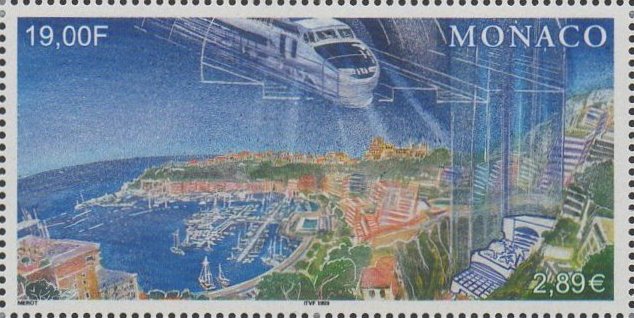 1999 (Sept) : Achievements : Fontvieille, New Station, Harbour Mole, Grimaldi Forum
19 Fr (3€89) TGV in the 1999 station [ . ] [ . ]
- ditto - miniature sheet of four values (only one is railway) [ . ] [ . ]
These stamps were only issued as a miniature sheet.
1999 (Sept) : Achievements : Fontvieille, New Station, Harbour Mole, Grimaldi Forum
19 Fr (3€89) TGV in the 1999 station [ . ] [ . ]
- ditto - miniature sheet of four values (only one is railway) [ . ] [ . ]
These stamps were only issued as a miniature sheet.
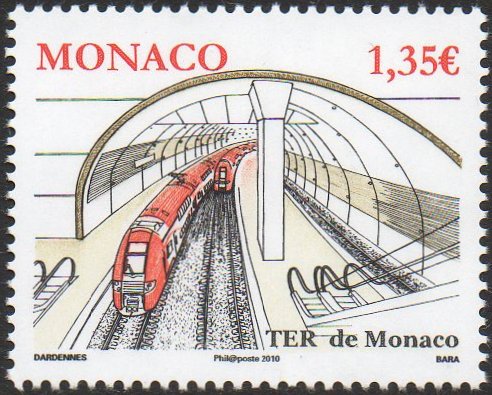 The stamp shows a Transport Express Régional (TER) train, a brand name used by the SNCF for trains operated under its wing by regional councils. At the time of writing, all services serving Monaco-Monte-Carlo appear to be TER trains, some of which have good connections at Nice or Marseille for TGV services to Lyon and Paris.
2010 : 1€35 : TER trains crossing in the Gare de Monaco-Monte-Carlo [ . ] [ . ]
For further views inside the new station, there is a Youtube video, produced by MonacoInfo, reporting on a tunnel strengthening project costing 34 Million Euros. It commenced in 2013, with repairs being made a little at a time, necessitated primarily by damage to the infrastructure due to water penetration. One wonders whether any benefit that may have accrued from burying the railway underground will quickly be outstripped by the costs of maintaining a tunnel in an exceptionally difficult topography. The video, which is in French,
can be viewed here (opens in a new tab).
.
8. Gare pour (station for rack railway to) La Turbie :
.
The stamp shows a Transport Express Régional (TER) train, a brand name used by the SNCF for trains operated under its wing by regional councils. At the time of writing, all services serving Monaco-Monte-Carlo appear to be TER trains, some of which have good connections at Nice or Marseille for TGV services to Lyon and Paris.
2010 : 1€35 : TER trains crossing in the Gare de Monaco-Monte-Carlo [ . ] [ . ]
For further views inside the new station, there is a Youtube video, produced by MonacoInfo, reporting on a tunnel strengthening project costing 34 Million Euros. It commenced in 2013, with repairs being made a little at a time, necessitated primarily by damage to the infrastructure due to water penetration. One wonders whether any benefit that may have accrued from burying the railway underground will quickly be outstripped by the costs of maintaining a tunnel in an exceptionally difficult topography. The video, which is in French,
can be viewed here (opens in a new tab).
.
8. Gare pour (station for rack railway to) La Turbie :
.
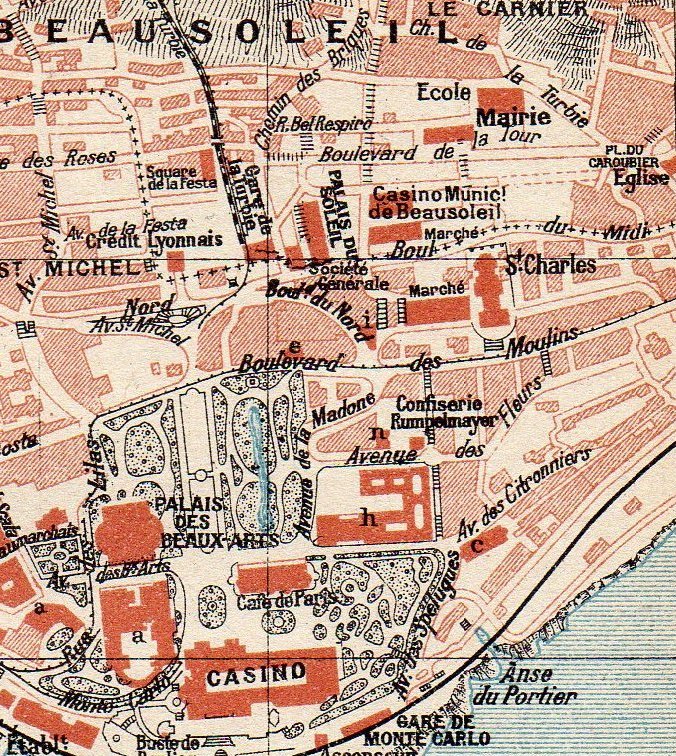
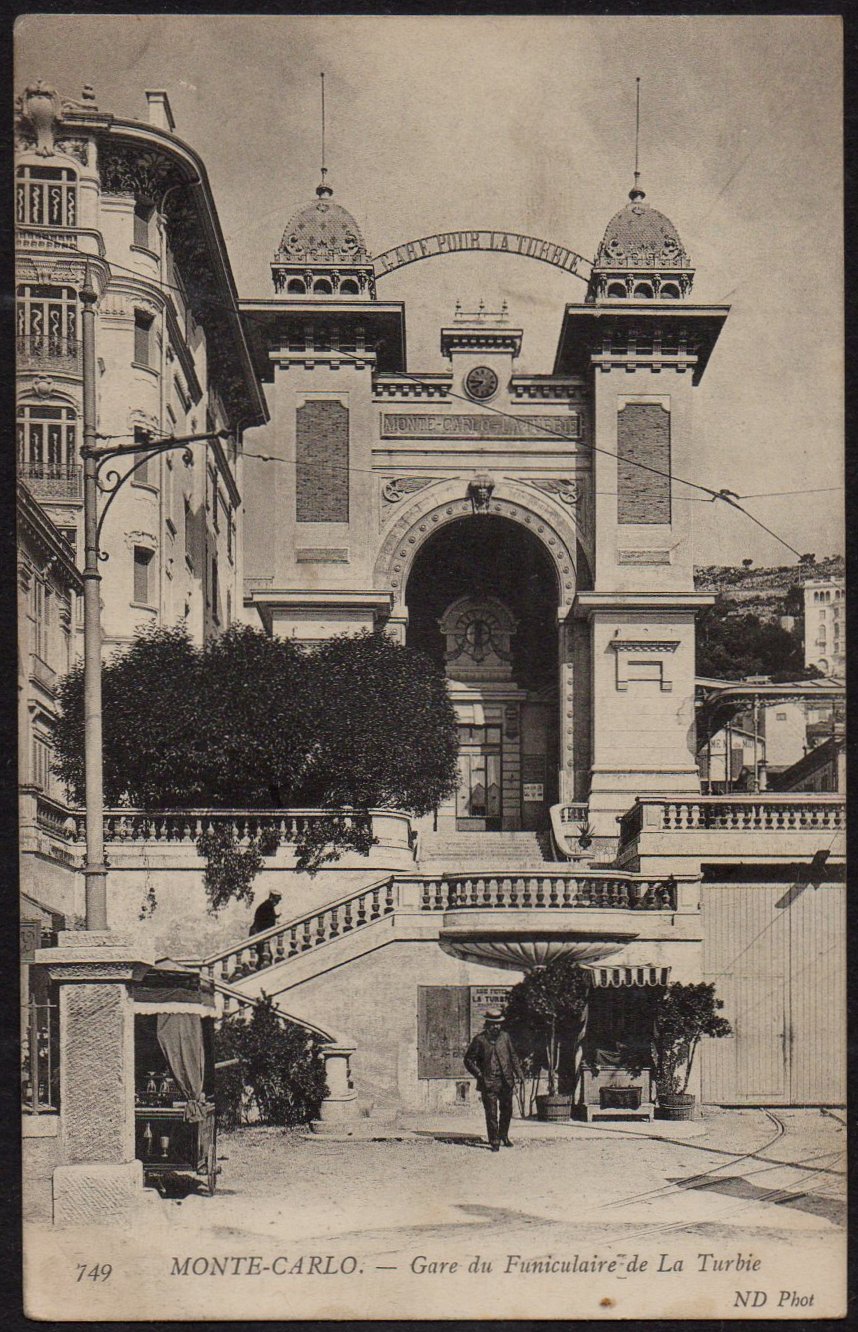 The map provides much useful information. The station for the rack railway to La Turbie (Gare de la Turbie) is slightly left of centre just over halfway up the map. To its left, and immediately below it, is a line of crosses ++++++++ which mark the border between Monaco (below) and France (above). From this, it will be seen that the Gare pour La Turbie lies wholly within France (in Beausoleil) although the photographer in the postcard view alongside, which shows the station entrance, is probably standing in Monaco.
We are fairly confident that the tracks in the foreground are not related to the rack railway but to a short, private electric tramway which was built specifically to carry the wealthy patrons of the Riviera-Palace Hotel down the steep slope into Monaco, their clientele often, no doubt, headed for the Casino. Most of the line's mere circa 600-metre length was in France with the track terminating less than 100 metres inside the Monaco boundary. The service had a short life, 1903-1914. A careful study of the map shows a very thin 'spiked' line (of an electrified railway / tramway) parallel to, and almost touching, the rack railway's track from the terminus northwards, with the tramway diverging to the east of the rack railway at the top left centre of the map between the letters 'U' and 'S' of 'BEAUSOLEIL'. The complete route of the tramway is visible on the 2021 stamp (illustrated after the next paragraph).
Roger Farnsworth's pages on railways and tramways in this part of the world are beautifully written and illustrated and for information on the La Turbie railway we recommend this page to you unreservedly (opens in a new tab).
The map provides much useful information. The station for the rack railway to La Turbie (Gare de la Turbie) is slightly left of centre just over halfway up the map. To its left, and immediately below it, is a line of crosses ++++++++ which mark the border between Monaco (below) and France (above). From this, it will be seen that the Gare pour La Turbie lies wholly within France (in Beausoleil) although the photographer in the postcard view alongside, which shows the station entrance, is probably standing in Monaco.
We are fairly confident that the tracks in the foreground are not related to the rack railway but to a short, private electric tramway which was built specifically to carry the wealthy patrons of the Riviera-Palace Hotel down the steep slope into Monaco, their clientele often, no doubt, headed for the Casino. Most of the line's mere circa 600-metre length was in France with the track terminating less than 100 metres inside the Monaco boundary. The service had a short life, 1903-1914. A careful study of the map shows a very thin 'spiked' line (of an electrified railway / tramway) parallel to, and almost touching, the rack railway's track from the terminus northwards, with the tramway diverging to the east of the rack railway at the top left centre of the map between the letters 'U' and 'S' of 'BEAUSOLEIL'. The complete route of the tramway is visible on the 2021 stamp (illustrated after the next paragraph).
Roger Farnsworth's pages on railways and tramways in this part of the world are beautifully written and illustrated and for information on the La Turbie railway we recommend this page to you unreservedly (opens in a new tab).
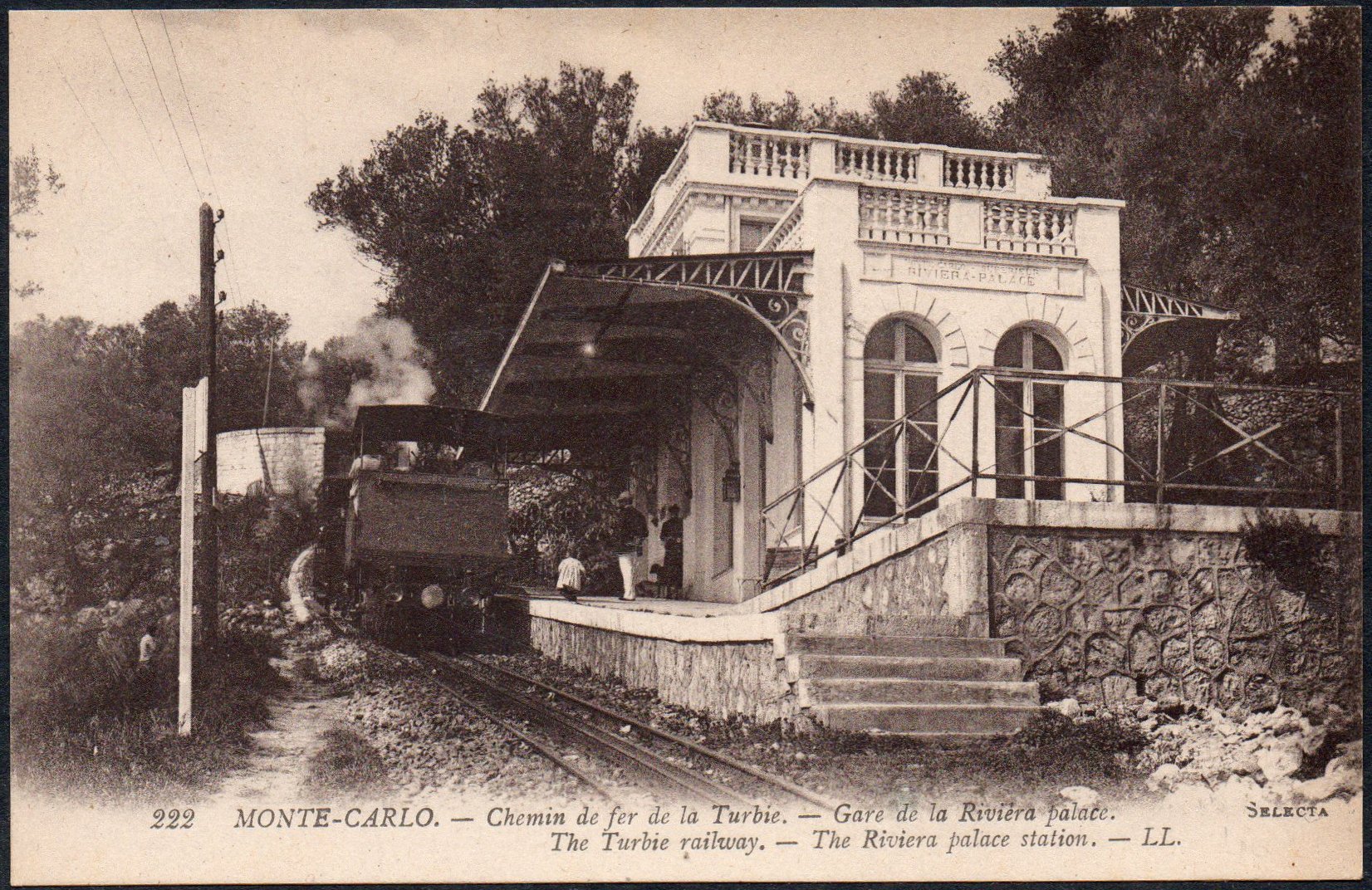
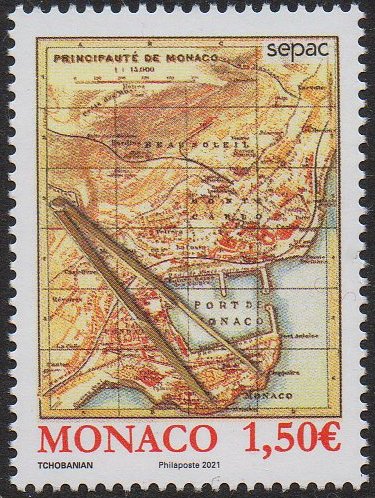 Roger Farnsworth's webpage (link above) shows a very similar LL card of the Gare de la Riviera-Palace. That card has the same printer's reference (222) but the postcard view shown above was shot a few seconds later than that on the Farnsworth webpage. On the right is a 2021 stamp of Monaco showing the main line near the coast, the southen end of the line to La Turbie and the whole of the tramway to the Riviera-Palace Hotel. A detail from the stamp, illustrating the private tramway's route more specifically, can be found in the next group of images.
Tramways in Monaco :
This article does not attempt to cover public trams in Monaco, which ran from 1898 to 1931, but there is a small hand-drawn map showing the tram routes in Monaco very near the top of Roger Farnsworth's La Turbie Railway page that we already linked above. Additional to that, the same author also has a page devoted to the TNL, the principal (Nice-based) tramway company that served Monaco and that page can be viewed via this link (opens in a new tab).
Roger Farnsworth's webpage (link above) shows a very similar LL card of the Gare de la Riviera-Palace. That card has the same printer's reference (222) but the postcard view shown above was shot a few seconds later than that on the Farnsworth webpage. On the right is a 2021 stamp of Monaco showing the main line near the coast, the southen end of the line to La Turbie and the whole of the tramway to the Riviera-Palace Hotel. A detail from the stamp, illustrating the private tramway's route more specifically, can be found in the next group of images.
Tramways in Monaco :
This article does not attempt to cover public trams in Monaco, which ran from 1898 to 1931, but there is a small hand-drawn map showing the tram routes in Monaco very near the top of Roger Farnsworth's La Turbie Railway page that we already linked above. Additional to that, the same author also has a page devoted to the TNL, the principal (Nice-based) tramway company that served Monaco and that page can be viewed via this link (opens in a new tab).
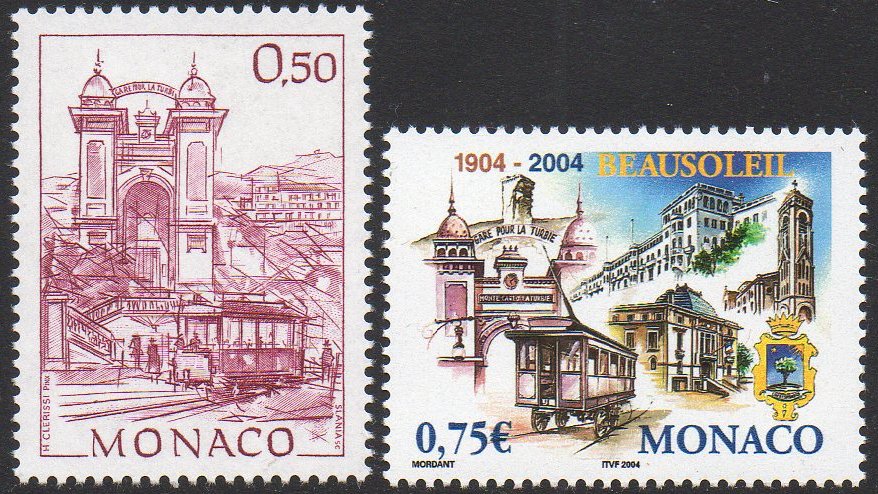
 The sign on the top of the station reads 'Gare pour La Turbie' (Station FOR La Turbie, the terminus at the other end of the line) rather than the station name itself. Whilst we can easily discover the names of intermediate stations on the line, the name used for the southern terminus hardly ever seems to be quoted. Monte-Carlo Supérieure and Beausoleil are both candidates as is plain Monte-Carlo, but that could only have been used alone in context. Perhaps many locals ended up calling it the Gare pour La Turbie as it proclaimed on the sign! In the final section of this article, we illustrate a postal cancellation 'Gare de Monte-Carlo-Beausoleil', which would support the view that this was the station's official title.
Monaco of Yesteryear Series :
1991 : 0f50 : Place de la Crémaillère and Tramcar [ . ] [ . ]
Crémaillère means 'rack and pinion' and refers to the railway, of course.
Centenary of the Municipalité de Beausoleil :
2004 : 0€75 : Place de la Crémaillère and Tramcar [ . ] [ . ]
Old Map of Monaco :
2021 : 1€50 : Map showing Main Line, rack railway to La Turbie and Riviera-Palace Hotel tramway [ . ] [ . ]
.
.
9. Railway Cancellations - Monaco / Monte-Carlo : Ambulant.
.
There have been several different types of handstamp applied to mail posted on, or sorted in, trains in France (and Monaco). By the time the railway reached Ventimiglia, 1872, the earlier styles of international (cross-border) Travelling Post Office (TPO) markings were being phased out and we know of none that can be directly associated with mail to or from Monaco. It may be that, in the late 1860s, some mail travelled Torino-Cuneo-Fontan by rail and then by some mixture of horse-drawn traffic and rail routings along the coast towards Marseille, perhaps even by train through Monaco in the late 1860s/early 1870s, but we have nothing concrete to support this suggestion.
Ambulants :
The fully-fledged TPO, in French 'Ambulant', was a common sight in much of France for nearly 150 years but very few have been scheduled to travel any further east on the coastal line than Nice. Even the ones that were finally scheduled to pass through Monaco in relatively recent times may only have operated in one direction, east-to-west, Vintimille-Nice and Vintimille-Marseille. Jean Pothion's catalogue lists one, a Type III Ambulant which is in the night-time style of a simple circle (and for which we are looking for an illustration). We can, however, show one ambulant that is not in Pothion and probably only introduced after publication of his 1978 catalogue on Ambulants and Gares. There may be further modern ones relevant to Monaco of which we are unaware.
Ambulants : Vintimille à Marseille & Vintimille à Nice :
The sign on the top of the station reads 'Gare pour La Turbie' (Station FOR La Turbie, the terminus at the other end of the line) rather than the station name itself. Whilst we can easily discover the names of intermediate stations on the line, the name used for the southern terminus hardly ever seems to be quoted. Monte-Carlo Supérieure and Beausoleil are both candidates as is plain Monte-Carlo, but that could only have been used alone in context. Perhaps many locals ended up calling it the Gare pour La Turbie as it proclaimed on the sign! In the final section of this article, we illustrate a postal cancellation 'Gare de Monte-Carlo-Beausoleil', which would support the view that this was the station's official title.
Monaco of Yesteryear Series :
1991 : 0f50 : Place de la Crémaillère and Tramcar [ . ] [ . ]
Crémaillère means 'rack and pinion' and refers to the railway, of course.
Centenary of the Municipalité de Beausoleil :
2004 : 0€75 : Place de la Crémaillère and Tramcar [ . ] [ . ]
Old Map of Monaco :
2021 : 1€50 : Map showing Main Line, rack railway to La Turbie and Riviera-Palace Hotel tramway [ . ] [ . ]
.
.
9. Railway Cancellations - Monaco / Monte-Carlo : Ambulant.
.
There have been several different types of handstamp applied to mail posted on, or sorted in, trains in France (and Monaco). By the time the railway reached Ventimiglia, 1872, the earlier styles of international (cross-border) Travelling Post Office (TPO) markings were being phased out and we know of none that can be directly associated with mail to or from Monaco. It may be that, in the late 1860s, some mail travelled Torino-Cuneo-Fontan by rail and then by some mixture of horse-drawn traffic and rail routings along the coast towards Marseille, perhaps even by train through Monaco in the late 1860s/early 1870s, but we have nothing concrete to support this suggestion.
Ambulants :
The fully-fledged TPO, in French 'Ambulant', was a common sight in much of France for nearly 150 years but very few have been scheduled to travel any further east on the coastal line than Nice. Even the ones that were finally scheduled to pass through Monaco in relatively recent times may only have operated in one direction, east-to-west, Vintimille-Nice and Vintimille-Marseille. Jean Pothion's catalogue lists one, a Type III Ambulant which is in the night-time style of a simple circle (and for which we are looking for an illustration). We can, however, show one ambulant that is not in Pothion and probably only introduced after publication of his 1978 catalogue on Ambulants and Gares. There may be further modern ones relevant to Monaco of which we are unaware.
Ambulants : Vintimille à Marseille & Vintimille à Nice :
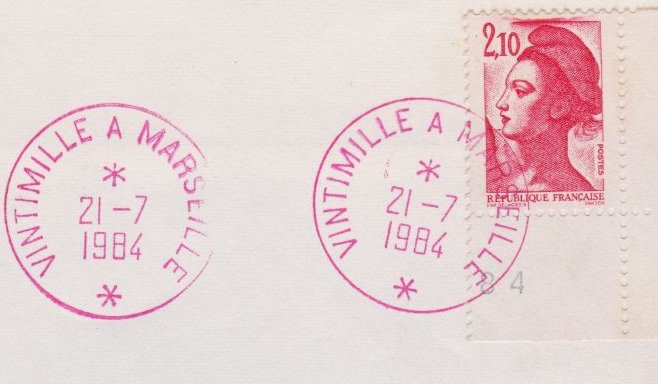 Vintimille à Marseille : Night-time TPO in Black [ . ]
- ditto - in Magenta [ . ]
Vintimille à Nice : Night-time TPO (in Black) [ . ]
.
Anomalous Nice à Marseille 'Ambulant' cancellations on Monaco stamps :
Vintimille à Marseille : Night-time TPO in Black [ . ]
- ditto - in Magenta [ . ]
Vintimille à Nice : Night-time TPO (in Black) [ . ]
.
Anomalous Nice à Marseille 'Ambulant' cancellations on Monaco stamps :
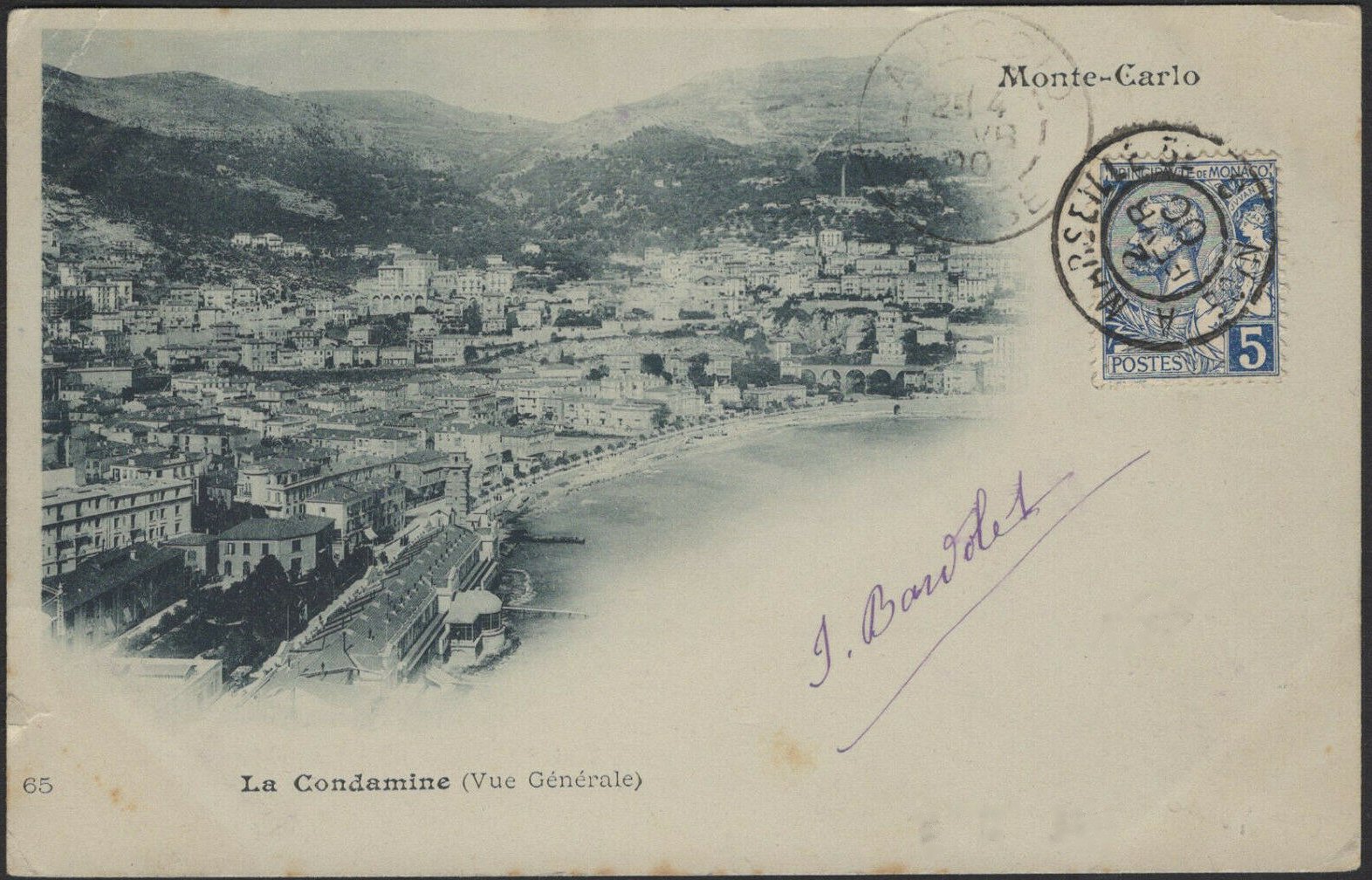 Postcard to Ajaccio, Corsica, Feb 2 1900, Monaco 5c stamp cancelled with Nice-Marseille night-time Ambulant. The Pont Ste Dévote can be seen at bottom right of the image.
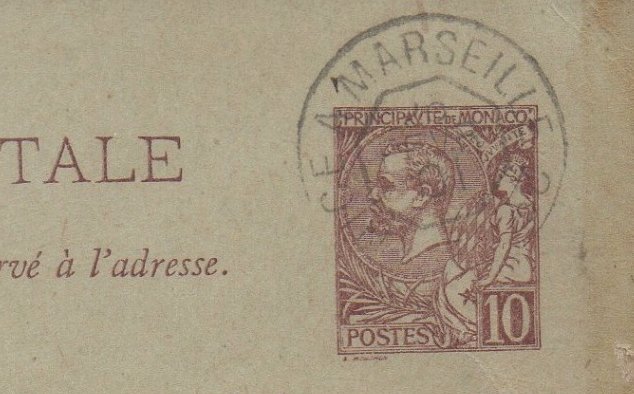
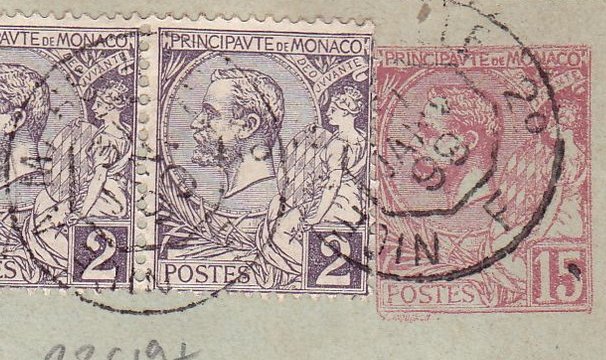
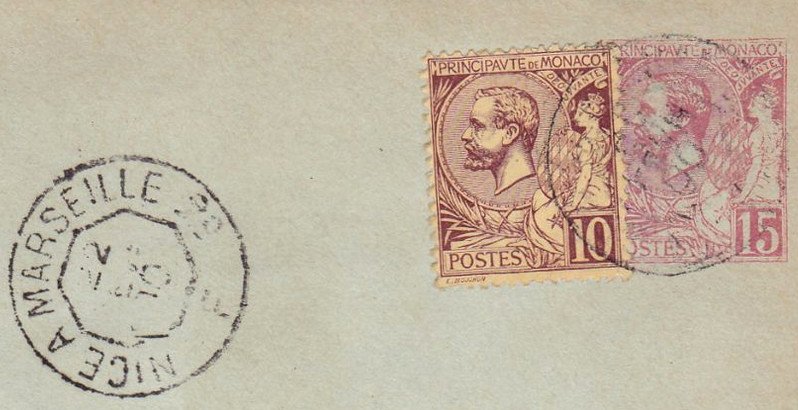
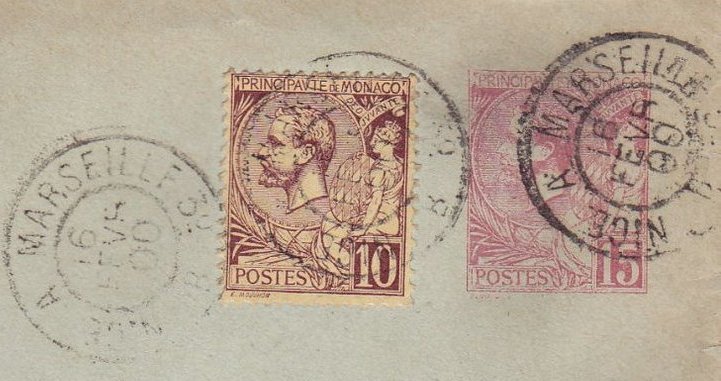 One regularly sees Monaco stamps cancelled with the Nice à Marseille Ambulant marking. All the above date from 1899-1901, suggesting a short-lived period when either the TPO route was extended perhaps as far as Menton but with no new cancellation manufactured, which seems unlikely, or, more plausibly, a period when mails were carried uncancelled from Monaco to Nice and transferred there onto the TPO to Marseille.
.
10. Railway Cancellations - Monaco / Monte-Carlo : Courrier-Convoyeur-Station.
.
Courrier-Convoyeur (Station and Ligne) :
Whilst there have been few TPO carriages scheduled east of Nice (and hence passing through Monaco), by contrast there are Courrier-Convoyeur (CC) railway markings aplenty. A courrier-convoyeur was a postal clerk who travelled on a train, in his own compartment, and received mail at each station at which the train stopped. Mail from the local post office was passed to him in a sealed bag which he was neither able nor authorised to open. Additional to the sealed bag, the contents of the posting box at the station was handed to him. He was required to apply a handstamp to each such item received, as proof of origin. At the end of the journey, this mail, along with the sealed bags, would be passed either to a sorting office or, presumably at times, directly to postal employees on a connecting 'Ambulant'.
Courrier-Convoyeur Station :
At first, the CC clerks had a handstamp for each station on the line, forming quite an arsenal of handstamps. Such markings are termed Courrier-Convoyeur-Station (CCS). The central part of each handstamp was an abbreviated form of the two ends of the courrier-convoyeur service, such as 'VINT. M.' for Vintimille-Marseille. Movable type would allow this to be reversed for the return journey.
One regularly sees Monaco stamps cancelled with the Nice à Marseille Ambulant marking. All the above date from 1899-1901, suggesting a short-lived period when either the TPO route was extended perhaps as far as Menton but with no new cancellation manufactured, which seems unlikely, or, more plausibly, a period when mails were carried uncancelled from Monaco to Nice and transferred there onto the TPO to Marseille.
.
10. Railway Cancellations - Monaco / Monte-Carlo : Courrier-Convoyeur-Station.
.
Courrier-Convoyeur (Station and Ligne) :
Whilst there have been few TPO carriages scheduled east of Nice (and hence passing through Monaco), by contrast there are Courrier-Convoyeur (CC) railway markings aplenty. A courrier-convoyeur was a postal clerk who travelled on a train, in his own compartment, and received mail at each station at which the train stopped. Mail from the local post office was passed to him in a sealed bag which he was neither able nor authorised to open. Additional to the sealed bag, the contents of the posting box at the station was handed to him. He was required to apply a handstamp to each such item received, as proof of origin. At the end of the journey, this mail, along with the sealed bags, would be passed either to a sorting office or, presumably at times, directly to postal employees on a connecting 'Ambulant'.
Courrier-Convoyeur Station :
At first, the CC clerks had a handstamp for each station on the line, forming quite an arsenal of handstamps. Such markings are termed Courrier-Convoyeur-Station (CCS). The central part of each handstamp was an abbreviated form of the two ends of the courrier-convoyeur service, such as 'VINT. M.' for Vintimille-Marseille. Movable type would allow this to be reversed for the return journey.
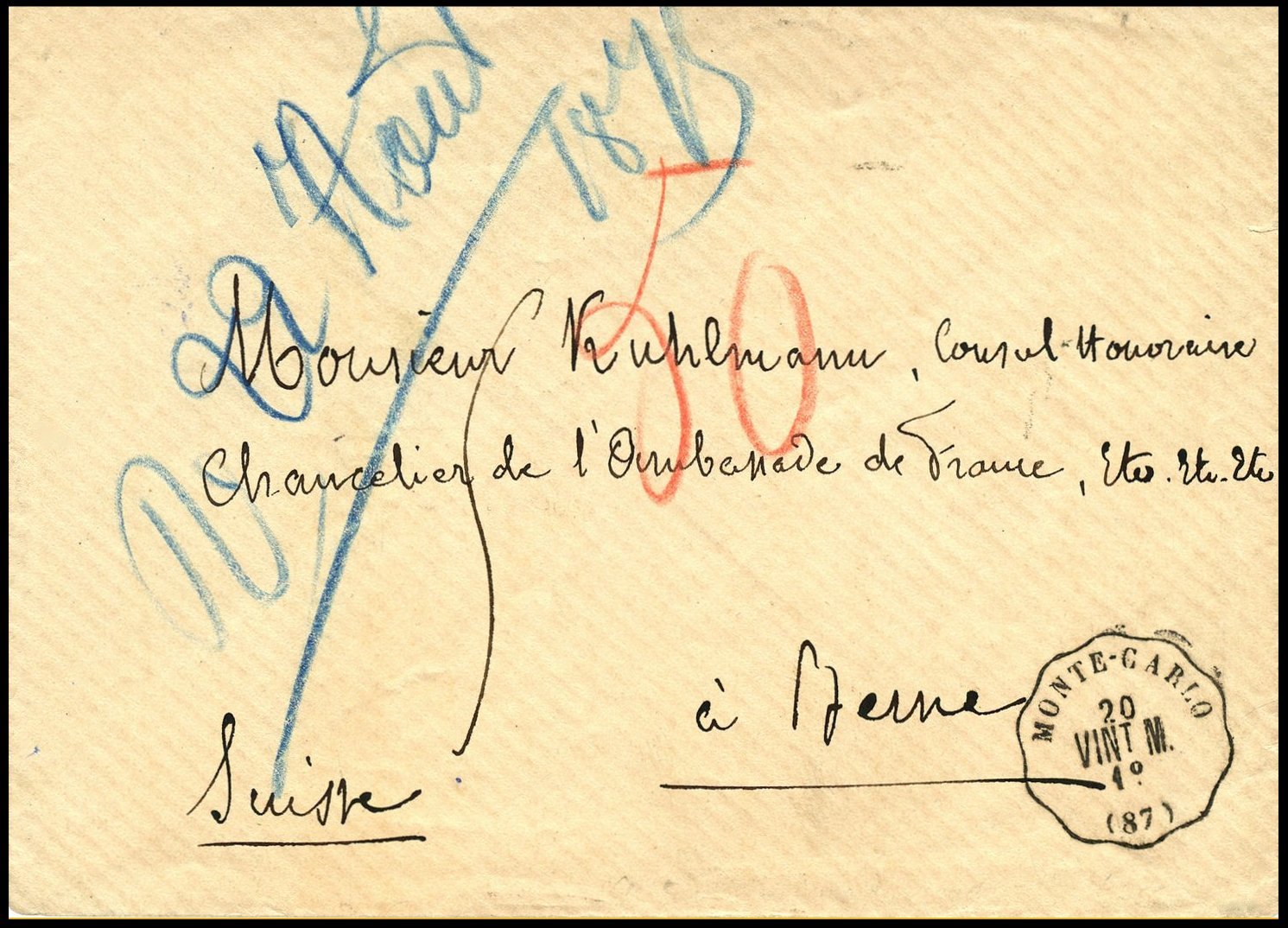
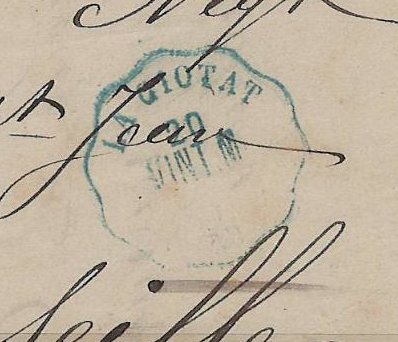 Courrier-Convoyeur markings have the form of a single circle with scalloped edges. This superb strike of the rare Monaco CCS is on an 1875 unfranked letter to Switzerland with a tax (postage due) marking of 5 décimes converted by the Swiss Post Office to a charge of 50c. The CCS marking carries the following information:
MONTE-CARLO : Station at which the cover was handed to the postal employee on the train.
20 : 20th of the month.
VINT M : Abbreviated Route : Vintimille to Marseille .(viz. westbound)
1 (o) : Train Number (1st), this numbering relating only to the postal service, not to the railway company's train numbers.
(87) : The Département number for Alpes Maritimes (which is 06 today, not 87).
Courrier-Convoyeur markings have the form of a single circle with scalloped edges. This superb strike of the rare Monaco CCS is on an 1875 unfranked letter to Switzerland with a tax (postage due) marking of 5 décimes converted by the Swiss Post Office to a charge of 50c. The CCS marking carries the following information:
MONTE-CARLO : Station at which the cover was handed to the postal employee on the train.
20 : 20th of the month.
VINT M : Abbreviated Route : Vintimille to Marseille .(viz. westbound)
1 (o) : Train Number (1st), this numbering relating only to the postal service, not to the railway company's train numbers.
(87) : The Département number for Alpes Maritimes (which is 06 today, not 87).
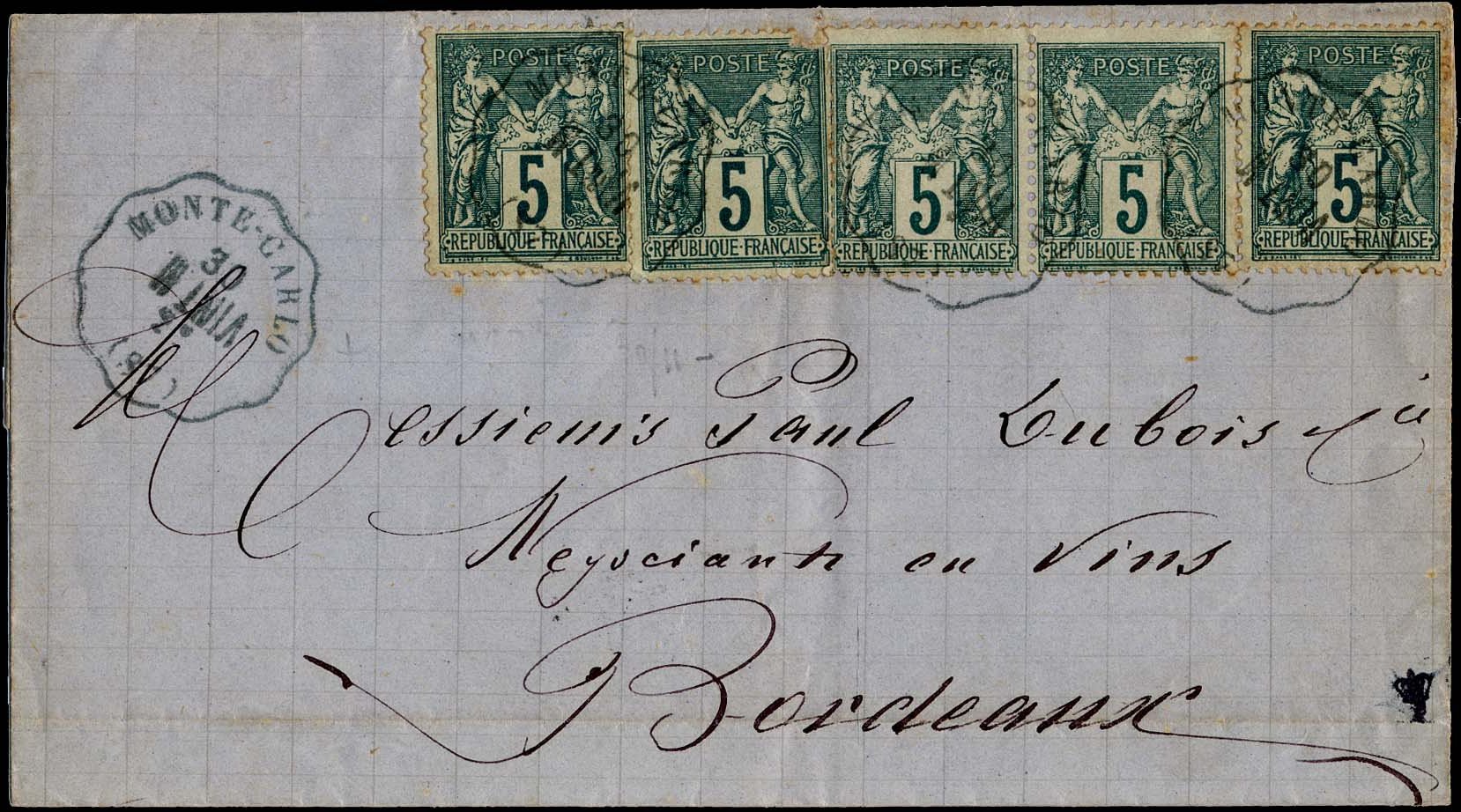
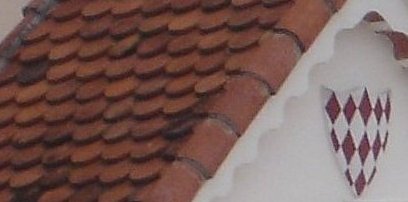 . . . CC-Station : MONTE-CARLO : Image Source: 'Collection de S.A.S. le prince Albert II de Monaco.'
We are advised that movable type was almost certainly used for all the features of the handstamp except the station name. The cover above provides evidence of this movable typeface, with the routing slug (VINT.M.) inverted. Even with the reversible working manageable with the same handstamps, between Cannes and Menton alone, a clerk would have required 15 of them for the 15 stations. From Vintimille to Marseille (VINT.M), 51 handstamps would have been required. However, if the train or courrier-convoyeur presence only started at Menton, which is one station west of Vintimille, either each station handstamp would have had to be changed to MENT.M. or, alternatively, a second set of station handstamps provided for this revised routing, entailing another set of 50 handstamps.
The Jean Pothion catalogue gives the dates of use of both the Vintimille-Marseille and Menton-Marseille CCS services as 1872-1878, suggesting that they were in use concurrently. If so, it makes the existence of separate sets of station handstamps for the two routes much the more likely arrangement. The logistics of sharing handstamps between the two services, even if timetabling had permitted it, would surely have been considered too complex and prone to shortcomings.
Whilst it is easy to find images and descriptive text associated with the rolling stock and postal practices of 'ambulants', far less has been written on the life of the courrier-convoyeur in his compartment, whether under the early CCS regime or the much more widespread CC-Ligne arrangement that followed. Until the formation of the SNCF in 1938, many different railway companies would have needed to provide the PTT with the facilities they required and it seems resonable to suppose that, especially in the 19th century, such arrangements may have been very varied. We have been able to discover almost nothing about the detailed arrangements for the clerks, such as whether their compartment was part of a passenger carriage or the guard's van, how postal security and employee accountability was maintained at all times, whether (on longer services) they ever needed to overnight in a distant town within the course of their duties - and so much more besides.
. . . CC-Station : MONTE-CARLO : Image Source: 'Collection de S.A.S. le prince Albert II de Monaco.'
We are advised that movable type was almost certainly used for all the features of the handstamp except the station name. The cover above provides evidence of this movable typeface, with the routing slug (VINT.M.) inverted. Even with the reversible working manageable with the same handstamps, between Cannes and Menton alone, a clerk would have required 15 of them for the 15 stations. From Vintimille to Marseille (VINT.M), 51 handstamps would have been required. However, if the train or courrier-convoyeur presence only started at Menton, which is one station west of Vintimille, either each station handstamp would have had to be changed to MENT.M. or, alternatively, a second set of station handstamps provided for this revised routing, entailing another set of 50 handstamps.
The Jean Pothion catalogue gives the dates of use of both the Vintimille-Marseille and Menton-Marseille CCS services as 1872-1878, suggesting that they were in use concurrently. If so, it makes the existence of separate sets of station handstamps for the two routes much the more likely arrangement. The logistics of sharing handstamps between the two services, even if timetabling had permitted it, would surely have been considered too complex and prone to shortcomings.
Whilst it is easy to find images and descriptive text associated with the rolling stock and postal practices of 'ambulants', far less has been written on the life of the courrier-convoyeur in his compartment, whether under the early CCS regime or the much more widespread CC-Ligne arrangement that followed. Until the formation of the SNCF in 1938, many different railway companies would have needed to provide the PTT with the facilities they required and it seems resonable to suppose that, especially in the 19th century, such arrangements may have been very varied. We have been able to discover almost nothing about the detailed arrangements for the clerks, such as whether their compartment was part of a passenger carriage or the guard's van, how postal security and employee accountability was maintained at all times, whether (on longer services) they ever needed to overnight in a distant town within the course of their duties - and so much more besides.
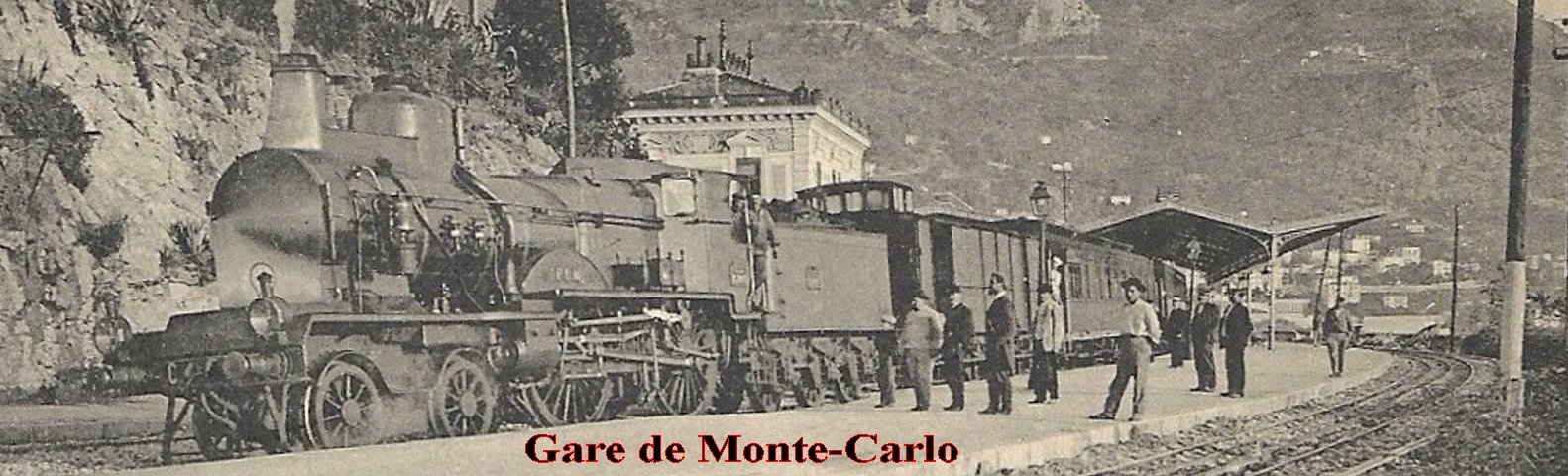 The precision in the mail handling provided by this system of individual station handstamps would have enabled almost forensic letter tracking, especially as, at that period, mail was handstamped at almost every stage of a letter's journey. It worked as a system, despite being somewhat wasteful and onerous, when there was relatively little mail. However, the rapid spread of the railways led to massive increases in 'business at a distance' and generated ever larger volumes of mail. From 1876 onwards, the postal authorities issued decrees that progressively reduced and simplified mail handling procedures. CCS handstamps only survived this rationalization for a short period thereafter, soon giving way to the simpler Courrier-Convoyeur-Ligne cancellers (on which more in a moment).
With only a few exceptions, CC-Station markings fall into the categories scarce, rare or 'should theoretically exist but are unrecorded'. We list below all the CC-Station markings that should theoretically have been available for use on mail from the Principality of Monaco. We have assumed that where Jean Pothion priced the handstamps in his 1977 catalogue they were definitely known to him and that where he did not price them, they were not. We have described stamps as 'known' or 'not recorded', based on that assumption. The publication of catalogues tends to help bring to the surface unreported items, so there may well have been some new discoveries since Pothion was published. We would be delighted to hear from anyone who can update the list of known items.
The smaller scan alongside the cover above is an example of a CCS handstamp in blue, here applied at a station further along the same route (as evidenced by the VINT. M.). CCS are usually applied in black ink but blue was quite widely used on this particular part of the rail system. Note that these trains would typically pass through more than one département and that the département number would match the town, that for Le Ciotat in the 1870s being '12' for Bouches-du-Rhône (13 today, due to the 1943 update to the alphabetical order of département numbers). The (12) at the foot of the cancel is absent in the scan above due to a poor impression, which is unsurprising on a moving train.
Digressing briefly, La Ciotat, near Marseille, would be the location a couple of decades later for the Lumière Brothers very early film, perhaps the world's first ever publicly-shown film, of a train entering the station. The showing was reported to have terrified some of the first cinema-goers who, in a darkened theatre, believed the train was about to come out of the screen into the room.
The precision in the mail handling provided by this system of individual station handstamps would have enabled almost forensic letter tracking, especially as, at that period, mail was handstamped at almost every stage of a letter's journey. It worked as a system, despite being somewhat wasteful and onerous, when there was relatively little mail. However, the rapid spread of the railways led to massive increases in 'business at a distance' and generated ever larger volumes of mail. From 1876 onwards, the postal authorities issued decrees that progressively reduced and simplified mail handling procedures. CCS handstamps only survived this rationalization for a short period thereafter, soon giving way to the simpler Courrier-Convoyeur-Ligne cancellers (on which more in a moment).
With only a few exceptions, CC-Station markings fall into the categories scarce, rare or 'should theoretically exist but are unrecorded'. We list below all the CC-Station markings that should theoretically have been available for use on mail from the Principality of Monaco. We have assumed that where Jean Pothion priced the handstamps in his 1977 catalogue they were definitely known to him and that where he did not price them, they were not. We have described stamps as 'known' or 'not recorded', based on that assumption. The publication of catalogues tends to help bring to the surface unreported items, so there may well have been some new discoveries since Pothion was published. We would be delighted to hear from anyone who can update the list of known items.
The smaller scan alongside the cover above is an example of a CCS handstamp in blue, here applied at a station further along the same route (as evidenced by the VINT. M.). CCS are usually applied in black ink but blue was quite widely used on this particular part of the rail system. Note that these trains would typically pass through more than one département and that the département number would match the town, that for Le Ciotat in the 1870s being '12' for Bouches-du-Rhône (13 today, due to the 1943 update to the alphabetical order of département numbers). The (12) at the foot of the cancel is absent in the scan above due to a poor impression, which is unsurprising on a moving train.
Digressing briefly, La Ciotat, near Marseille, would be the location a couple of decades later for the Lumière Brothers very early film, perhaps the world's first ever publicly-shown film, of a train entering the station. The showing was reported to have terrified some of the first cinema-goers who, in a darkened theatre, believed the train was about to come out of the screen into the room.
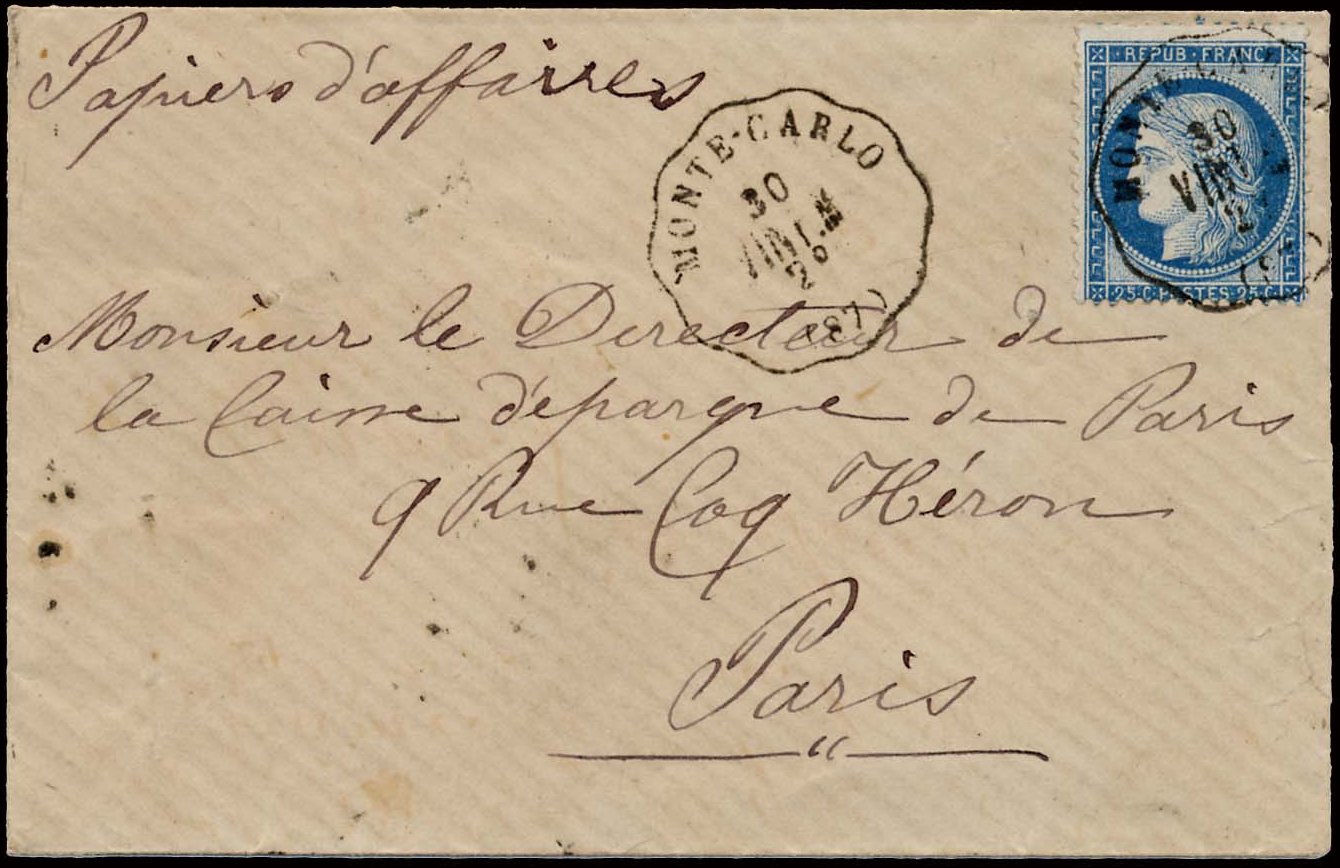 . . CC-Station : MONTE-CARLO : Image Source: 'Collection de S.A.S. le prince Albert II de Monaco.'
MARSEILLE A MENTON :
M. MENT. : MONACO (87) : Not recorded
M. MENT. : MONTE-CARLO (87) : Not recorded
MENTON A MARSEILLE :
MENT. M. : MONTE-CARLO (87) : Yes, known. [ in black ]
MENT. M. : MONACO (87) : Not recorded
.
MARSEILLE A VINTIMILLE :
M. VINT. : MONACO (87) : Not recorded
M. VINT. : MONTE-CARLO (87) : Yes, known. [ in black ] [ in blue ]
VINTIMILLE A MARSEILLE :
VINT. M. : MONTE-CARLO (87) : Yes, known. [ in black ] [ in blue ]
VINT. M. : MONACO (87) : Not recorded
.
One is struck by the fact that the known markings above do not include a single 'MONACO' handstamp. We have no firm evidence for why this should be the case but it is possible that, in such a small geographical area, it was felt unnecessary to provide a labour-intensive letter-posting service at both Monagasque stations. If true, MONACO CCS markings will not exist at all. If any reader can advance our knowledge, please send an email.
One assumes that the postal employee charged with handing over the sealed bag would also have accessed the station letter-box and sorted the mail there for either the eastbound or westbound service, handing them to the CC clerk on the appropriate train. Internal mail from the principality would presumably have been passed to a CC-clerk travelling eastwards only if the mail were for the stations of Cabbe-Roquebrune and Menton or, as seems more likely, just for handing over at Menton. International mail would probably have been routed eastwards to Ventimiglia only if it were for a destination within Italy. We would therefore expect eastbound MONTE-CARLO CCS handstamps to be much rarer than their westbound counterparts, even though this is not reflected in Pothion's pricing. However, all these markings are so scarce that it is unlikely that Jean Pothion would have had sufficient examples with which to establish prices with any such 'directional' precision.
. . CC-Station : MONTE-CARLO : Image Source: 'Collection de S.A.S. le prince Albert II de Monaco.'
MARSEILLE A MENTON :
M. MENT. : MONACO (87) : Not recorded
M. MENT. : MONTE-CARLO (87) : Not recorded
MENTON A MARSEILLE :
MENT. M. : MONTE-CARLO (87) : Yes, known. [ in black ]
MENT. M. : MONACO (87) : Not recorded
.
MARSEILLE A VINTIMILLE :
M. VINT. : MONACO (87) : Not recorded
M. VINT. : MONTE-CARLO (87) : Yes, known. [ in black ] [ in blue ]
VINTIMILLE A MARSEILLE :
VINT. M. : MONTE-CARLO (87) : Yes, known. [ in black ] [ in blue ]
VINT. M. : MONACO (87) : Not recorded
.
One is struck by the fact that the known markings above do not include a single 'MONACO' handstamp. We have no firm evidence for why this should be the case but it is possible that, in such a small geographical area, it was felt unnecessary to provide a labour-intensive letter-posting service at both Monagasque stations. If true, MONACO CCS markings will not exist at all. If any reader can advance our knowledge, please send an email.
One assumes that the postal employee charged with handing over the sealed bag would also have accessed the station letter-box and sorted the mail there for either the eastbound or westbound service, handing them to the CC clerk on the appropriate train. Internal mail from the principality would presumably have been passed to a CC-clerk travelling eastwards only if the mail were for the stations of Cabbe-Roquebrune and Menton or, as seems more likely, just for handing over at Menton. International mail would probably have been routed eastwards to Ventimiglia only if it were for a destination within Italy. We would therefore expect eastbound MONTE-CARLO CCS handstamps to be much rarer than their westbound counterparts, even though this is not reflected in Pothion's pricing. However, all these markings are so scarce that it is unlikely that Jean Pothion would have had sufficient examples with which to establish prices with any such 'directional' precision.
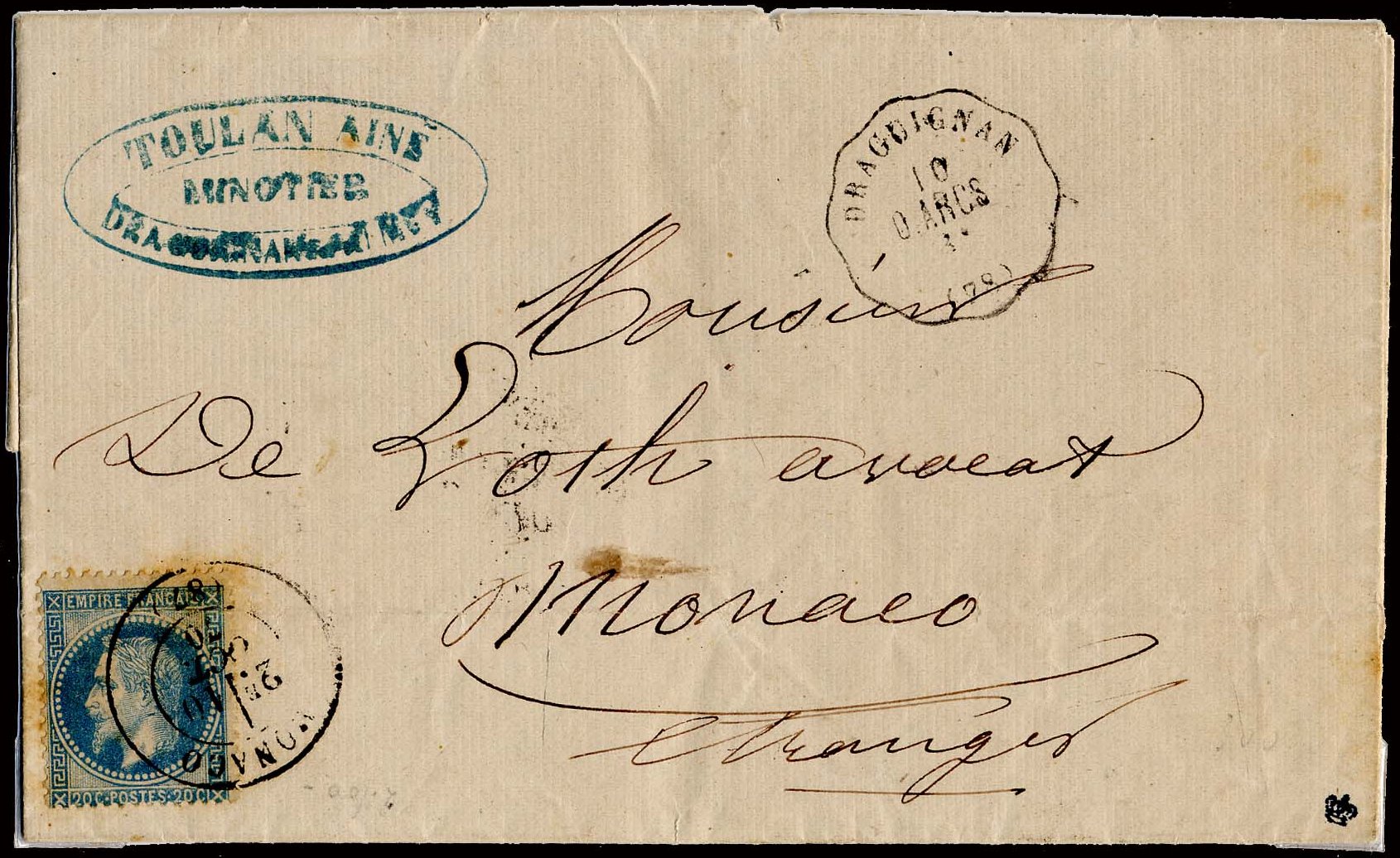 . . CC-Station : DRAGUIGNAN : Image Source: 'Collection de S.A.S. le prince Albert II de Monaco.'
We have been careful in describing the CCS as handstamps, not cancellations, as the CCS clerks were initially not permitted to cancel the stamps, only to handstamp the letter, as illustrated in the cover above from Draguignan to Monaco, the letter handstamped with the Draguignan aux Arcs CCS, the stamp cancelled by the Monaco double-ring datestamp. It seems likely that the letter was transferred to an eastbound train in the care of a CC-clerk on the Marseille-Menton or Marseille-Vintimille service since the stamp did not pass through the hands of any office with authority to cancel the stamp until it arrived in Monaco. After a few years of the CCS system, it became clear that, for practical purposes, authority to cancel the stamps needed to be passed down the employee grades.
On Ambulants, stamps for many years had to be cancelled with a lozenge of dots (containing initials of the TPO route) and the Ambulant marking applied separately to the cover. Initially, when CCS-handstamped items were handled on an Ambulant, the lozenge was again used to cancel the stamps and the Ambulant marking was placed alongside. Then, at the end of March 1876, there was a major simplification with all employees being instructed instead to forego the lozenge and simply cancel the stamps with the double-ringed ambulant marking.
It was just over a month later that the authority to cancel stamps was extended to the Courrier-Convoyeurs. From this point onwards in this article, therefore, the terms 'canceller' and 'handstamp' become interchangeable. Throughout France, an interesting by-product of this authorization by stages was that for perhaps 5 or 6 weeks in April/May of 1876 one can find the combination of an envelope handstamped (clear of the stamps) with a CCS but with the stamps cancelled with an Ambulant double-ring, rather than a lozenge of dots, as illustrated below:
. . CC-Station : DRAGUIGNAN : Image Source: 'Collection de S.A.S. le prince Albert II de Monaco.'
We have been careful in describing the CCS as handstamps, not cancellations, as the CCS clerks were initially not permitted to cancel the stamps, only to handstamp the letter, as illustrated in the cover above from Draguignan to Monaco, the letter handstamped with the Draguignan aux Arcs CCS, the stamp cancelled by the Monaco double-ring datestamp. It seems likely that the letter was transferred to an eastbound train in the care of a CC-clerk on the Marseille-Menton or Marseille-Vintimille service since the stamp did not pass through the hands of any office with authority to cancel the stamp until it arrived in Monaco. After a few years of the CCS system, it became clear that, for practical purposes, authority to cancel the stamps needed to be passed down the employee grades.
On Ambulants, stamps for many years had to be cancelled with a lozenge of dots (containing initials of the TPO route) and the Ambulant marking applied separately to the cover. Initially, when CCS-handstamped items were handled on an Ambulant, the lozenge was again used to cancel the stamps and the Ambulant marking was placed alongside. Then, at the end of March 1876, there was a major simplification with all employees being instructed instead to forego the lozenge and simply cancel the stamps with the double-ringed ambulant marking.
It was just over a month later that the authority to cancel stamps was extended to the Courrier-Convoyeurs. From this point onwards in this article, therefore, the terms 'canceller' and 'handstamp' become interchangeable. Throughout France, an interesting by-product of this authorization by stages was that for perhaps 5 or 6 weeks in April/May of 1876 one can find the combination of an envelope handstamped (clear of the stamps) with a CCS but with the stamps cancelled with an Ambulant double-ring, rather than a lozenge of dots, as illustrated below:
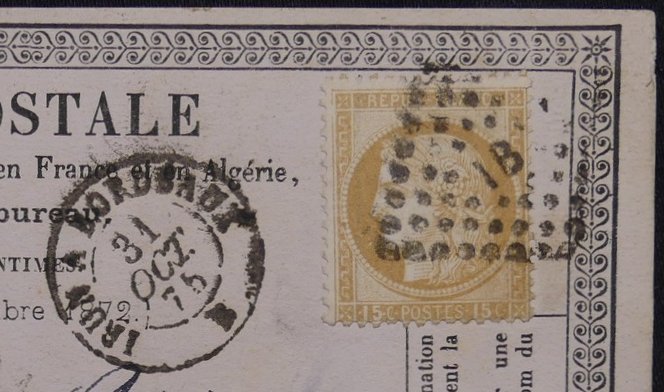
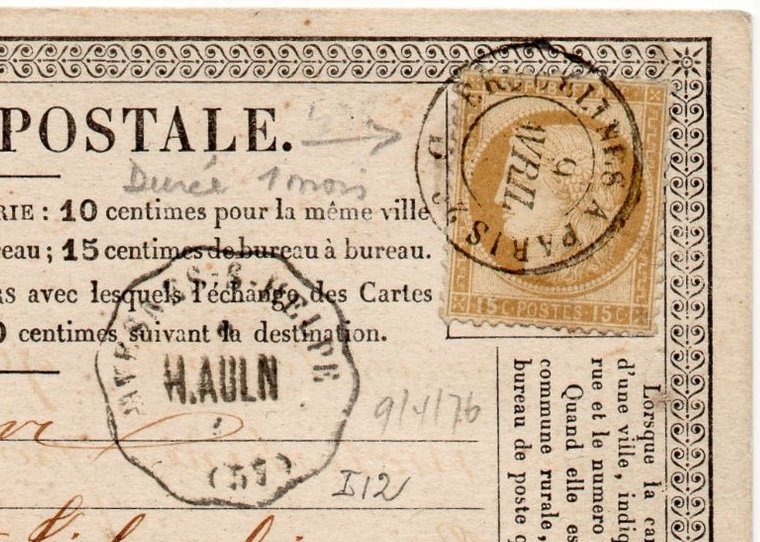
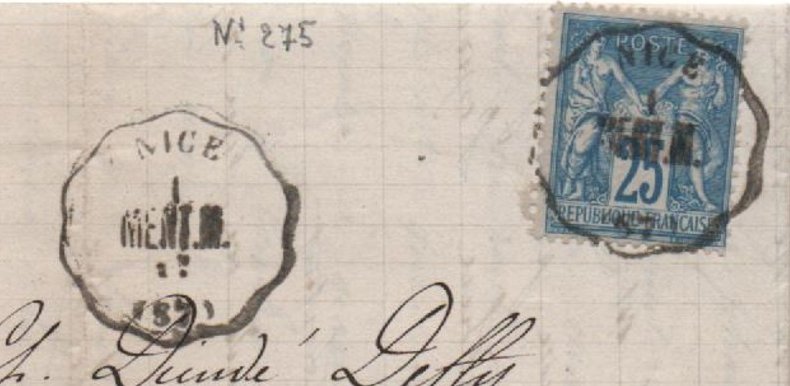 Covers above (from various parts of France) :
1. Before April 1876 : Stamp cancelled with lozenge (letters IB = Irun to Bordeaux); TPO handstamp alongside.
2. c. April / May 1876 (here April 9th) : CCS applied clear of stamp but Ambulant clerks now instructed to use just their date canceller (EREQUELINES A PARIS) to cancel the stamp.
3. From May 1876 : CCS clerks now authorized to cancel the stamps, here at NICE on a Menton-Marseille (MENT.M.) train.
Three covers from the same correspondence below also illustrate beautifully the progression, this time with all three coves bearing the same CCS handstamp. Sadly, they are not examples from Monte-Carlo. It is doubtful that a similar trio will exist from there.
Covers above (from various parts of France) :
1. Before April 1876 : Stamp cancelled with lozenge (letters IB = Irun to Bordeaux); TPO handstamp alongside.
2. c. April / May 1876 (here April 9th) : CCS applied clear of stamp but Ambulant clerks now instructed to use just their date canceller (EREQUELINES A PARIS) to cancel the stamp.
3. From May 1876 : CCS clerks now authorized to cancel the stamps, here at NICE on a Menton-Marseille (MENT.M.) train.
Three covers from the same correspondence below also illustrate beautifully the progression, this time with all three coves bearing the same CCS handstamp. Sadly, they are not examples from Monte-Carlo. It is doubtful that a similar trio will exist from there.
 1875/76 CCS Covers from Pauillac on the Gironde estuary in south-west France. Pauillac still has a station :
1. Before April 1876 (July 1875): Stamp cancelled with Ambulant lozenge (letters BP 2 = BORDEAUX A PARIS, second postal team); no TPO circular handstamp applied to the cover.
2. April / May 1876 (Apr 19 1876) : CCS applied clear of stamp, Ambulant double-ring date-stamp cancels the stamp.
3. From May 1876 : CCS clerks now authorized to cancel the stamps, handstamp usually applied twice as here.
11. Railway Mail from and through Monaco : Courrier-Convoyeur-Ligne.
.
Once it became clear that the plethora of cancellers required under the CC-Station system, and indeed the whole labour-intensive handling system for mail in general, had become unsustainable, the decision was taken to provide a much simpler canceller which just showed the first and last stations on the CC routing. Separate handstamps were provided for each direction and each could have its date and train number amended. The train number allowed the approximate time of posting to be determined as well as permitting the authorities to identify the clerks who may have handled the mail, useful no doubt where an employee was mostly working unsupervised. The new CCL handstamps were introduced from 1877 but CCS handstamps lingered on into 1878 on some routes, including the two routings through Monaco.
Courrier-Convoyeur Ligne (English: 'line') :
The new cancellers, known as Courrier-Convoyeur-Ligne (CCL) are found in three styles, progressively larger in diameter and in text size. Known as Types I, II & III, they were introduced from 1877, 1886 and 1904 respectively, but there was much overlap with, for example, some Type I cancellers still in use on low-volume routes after the Second World War.
As with the CCS, listings may have omissions, as the catalogue which lists them is, again, old. In general, thought, CCL are much commoner than CCS and omissions are therefore likely to be far fewer in number. There are two routings through Monaco giving rise to the two CCL: Marseille-Vintimille (and vice-versa) AND Nice-Vintimille (and vice-versa).
We illustrate and provide images and check-boxes for all three Types on both these routings, and in both directions. We have essentially chosen to show clear examples of these cancellations, irrespective of whether they are applied to the stamps of France or Monaco, although, if a Monaco collection is the aim, one would of course seek out examples on letters franked with Monegasque stamps.
Marseille - Vintimille :
1875/76 CCS Covers from Pauillac on the Gironde estuary in south-west France. Pauillac still has a station :
1. Before April 1876 (July 1875): Stamp cancelled with Ambulant lozenge (letters BP 2 = BORDEAUX A PARIS, second postal team); no TPO circular handstamp applied to the cover.
2. April / May 1876 (Apr 19 1876) : CCS applied clear of stamp, Ambulant double-ring date-stamp cancels the stamp.
3. From May 1876 : CCS clerks now authorized to cancel the stamps, handstamp usually applied twice as here.
11. Railway Mail from and through Monaco : Courrier-Convoyeur-Ligne.
.
Once it became clear that the plethora of cancellers required under the CC-Station system, and indeed the whole labour-intensive handling system for mail in general, had become unsustainable, the decision was taken to provide a much simpler canceller which just showed the first and last stations on the CC routing. Separate handstamps were provided for each direction and each could have its date and train number amended. The train number allowed the approximate time of posting to be determined as well as permitting the authorities to identify the clerks who may have handled the mail, useful no doubt where an employee was mostly working unsupervised. The new CCL handstamps were introduced from 1877 but CCS handstamps lingered on into 1878 on some routes, including the two routings through Monaco.
Courrier-Convoyeur Ligne (English: 'line') :
The new cancellers, known as Courrier-Convoyeur-Ligne (CCL) are found in three styles, progressively larger in diameter and in text size. Known as Types I, II & III, they were introduced from 1877, 1886 and 1904 respectively, but there was much overlap with, for example, some Type I cancellers still in use on low-volume routes after the Second World War.
As with the CCS, listings may have omissions, as the catalogue which lists them is, again, old. In general, thought, CCL are much commoner than CCS and omissions are therefore likely to be far fewer in number. There are two routings through Monaco giving rise to the two CCL: Marseille-Vintimille (and vice-versa) AND Nice-Vintimille (and vice-versa).
We illustrate and provide images and check-boxes for all three Types on both these routings, and in both directions. We have essentially chosen to show clear examples of these cancellations, irrespective of whether they are applied to the stamps of France or Monaco, although, if a Monaco collection is the aim, one would of course seek out examples on letters franked with Monegasque stamps.
Marseille - Vintimille :
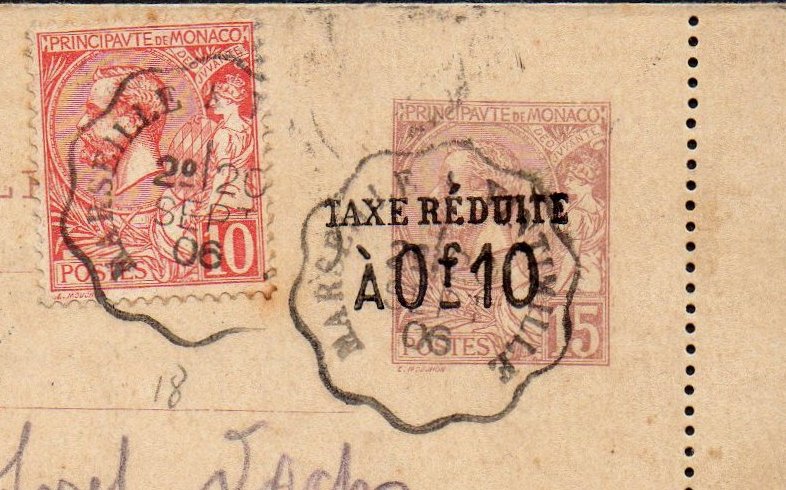
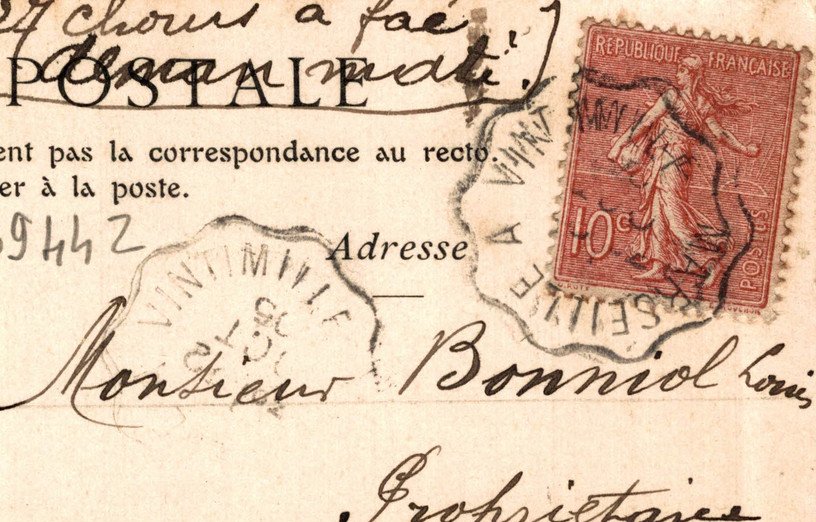
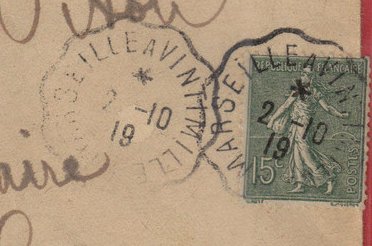
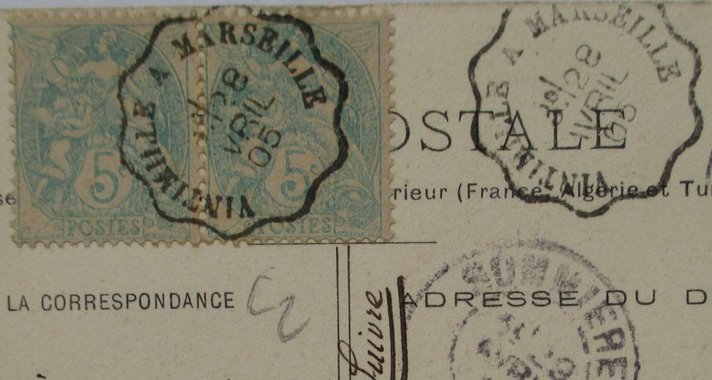
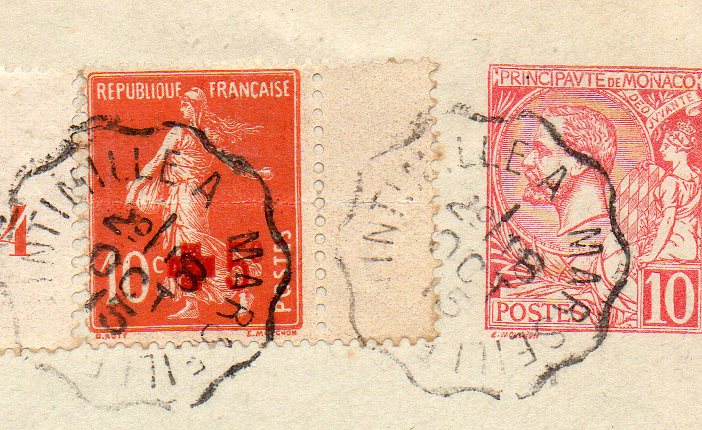 We have been unable to find an image for a Vintimille-Marseille Type III CCL but it is reported to exist.

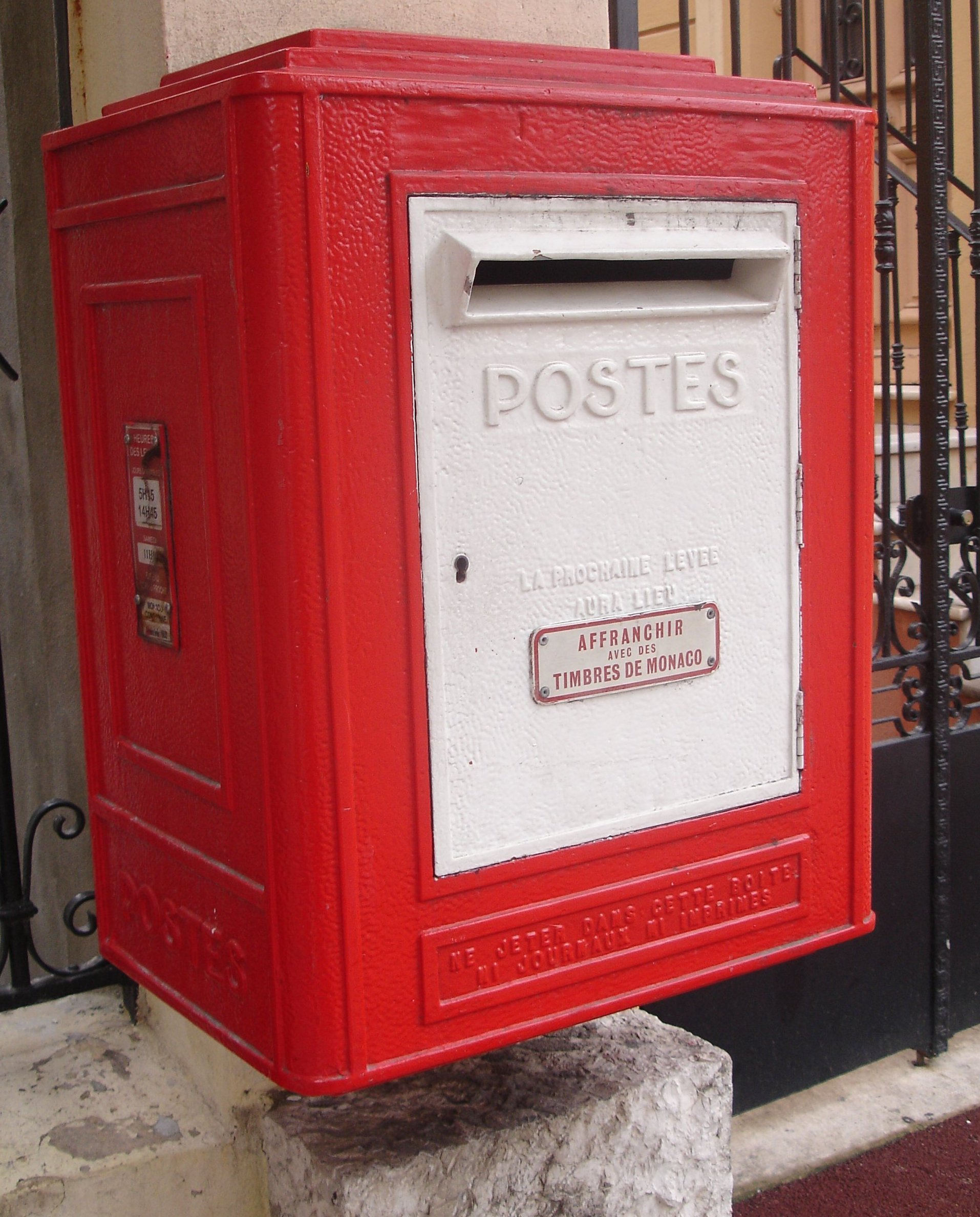
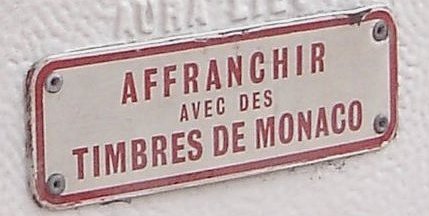 Left : A typical, yellow, French posting box. Centre & Right : A Monaco posting box (text reads 'Frank with stamps of Monaco').
.
Nice - Vintimille :
Left : A typical, yellow, French posting box. Centre & Right : A Monaco posting box (text reads 'Frank with stamps of Monaco').
.
Nice - Vintimille :
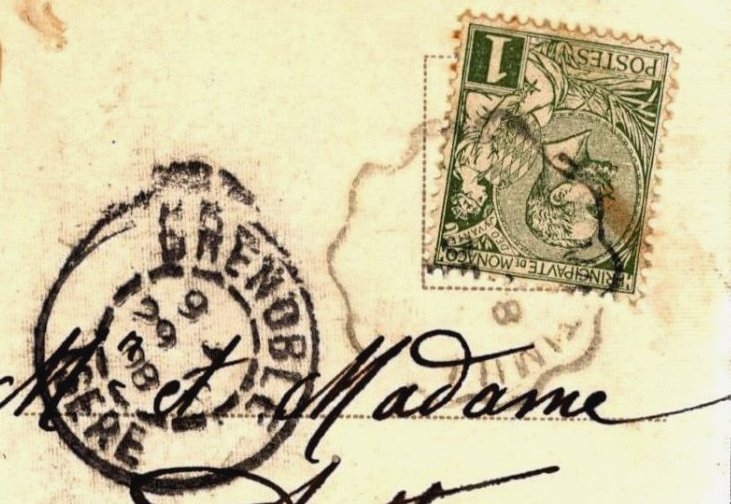
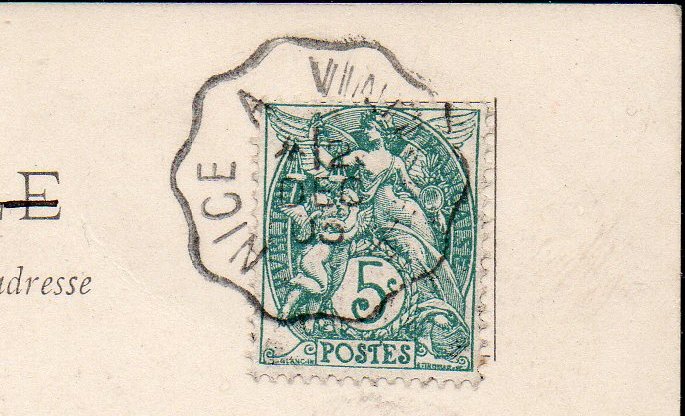
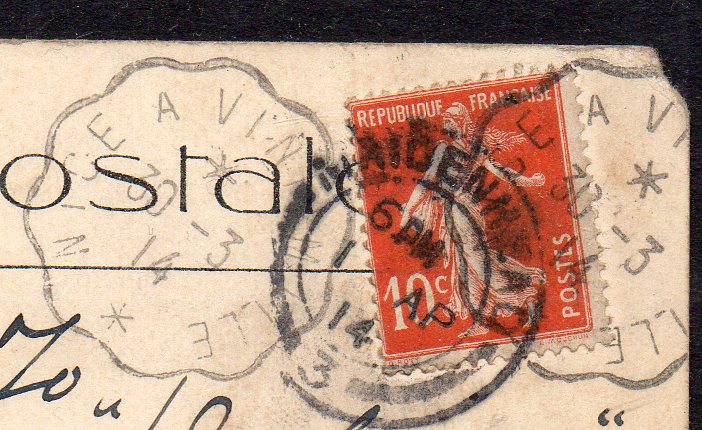
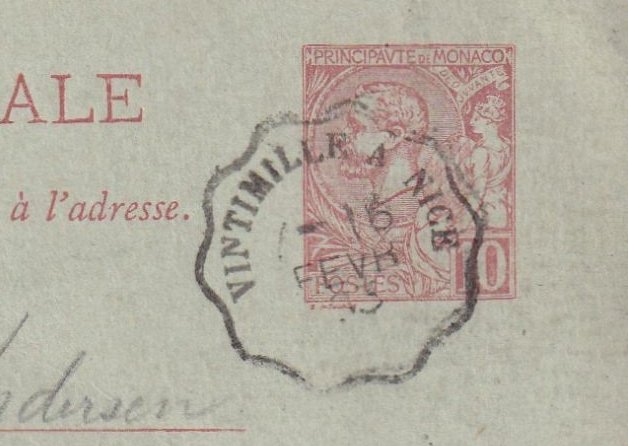
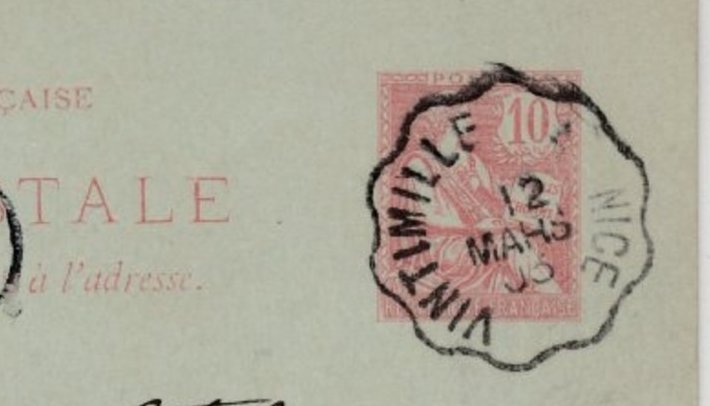
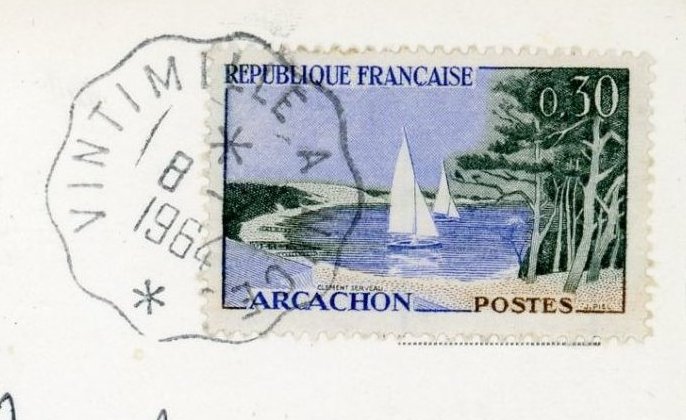
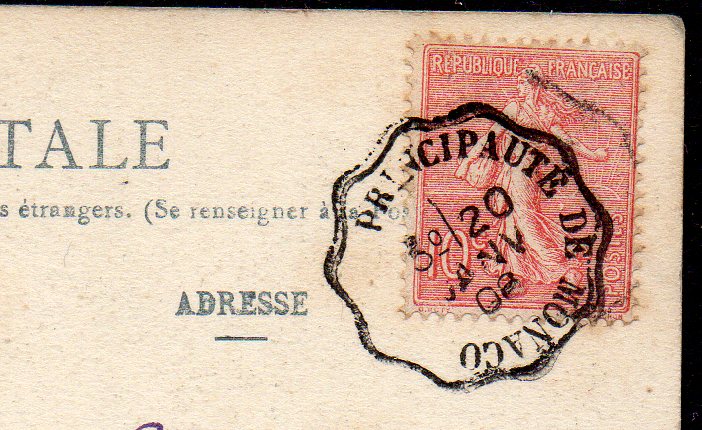
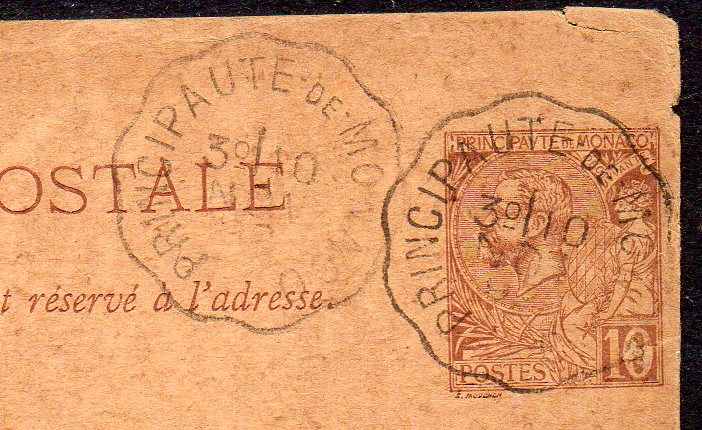 Type I : PRINCIPAUTE DE MONACO [ . ]
Type II : PRINCIPAUTE - DE - MONACO [ . ]
.
Type I : PRINCIPAUTE DE MONACO [ . ]
Type II : PRINCIPAUTE - DE - MONACO [ . ]
.
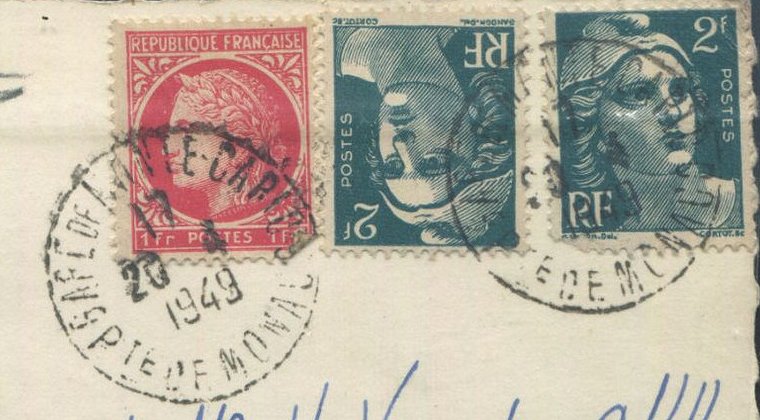
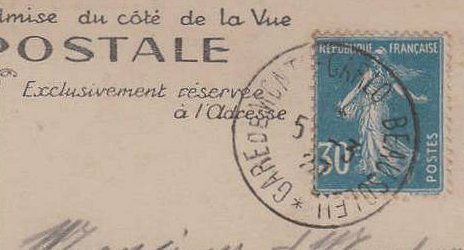
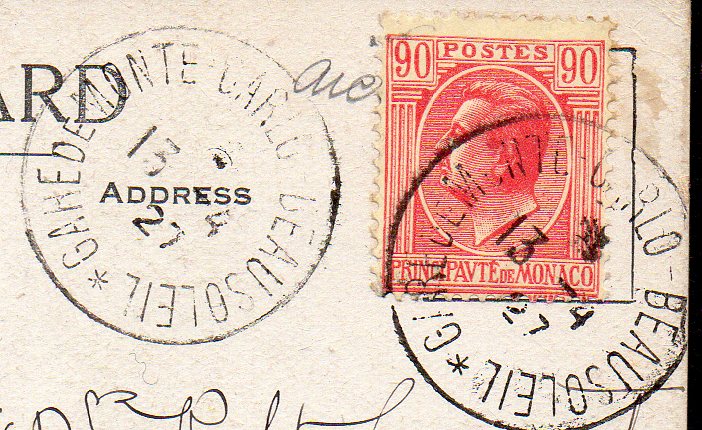 Gare de Monte-Carlo Pte de Monaco [ . ]
Monte-Carlo Gare Pte de Monaco [ . ]
Gare de Monte-Carlo-Beausoleil [ . ]
The cancellation 'Gare de Monte-Carlo-Beausoleil' was presumably applied by a post office, or postal centre, in or adjacent to the southern terminus of the La Turbie rack railway, presumably on the French side of the border. We have seen three examples of this cancellation, two on postcards franked with French stamps, one on a postcard with a Monegasque adhesive.
.
Gare de Monte-Carlo Pte de Monaco [ . ]
Monte-Carlo Gare Pte de Monaco [ . ]
Gare de Monte-Carlo-Beausoleil [ . ]
The cancellation 'Gare de Monte-Carlo-Beausoleil' was presumably applied by a post office, or postal centre, in or adjacent to the southern terminus of the La Turbie rack railway, presumably on the French side of the border. We have seen three examples of this cancellation, two on postcards franked with French stamps, one on a postcard with a Monegasque adhesive.
.
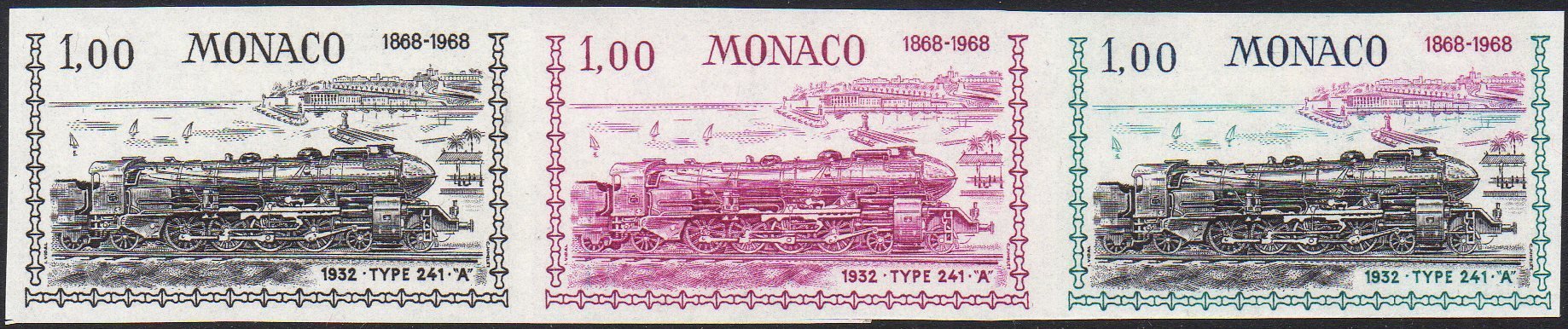
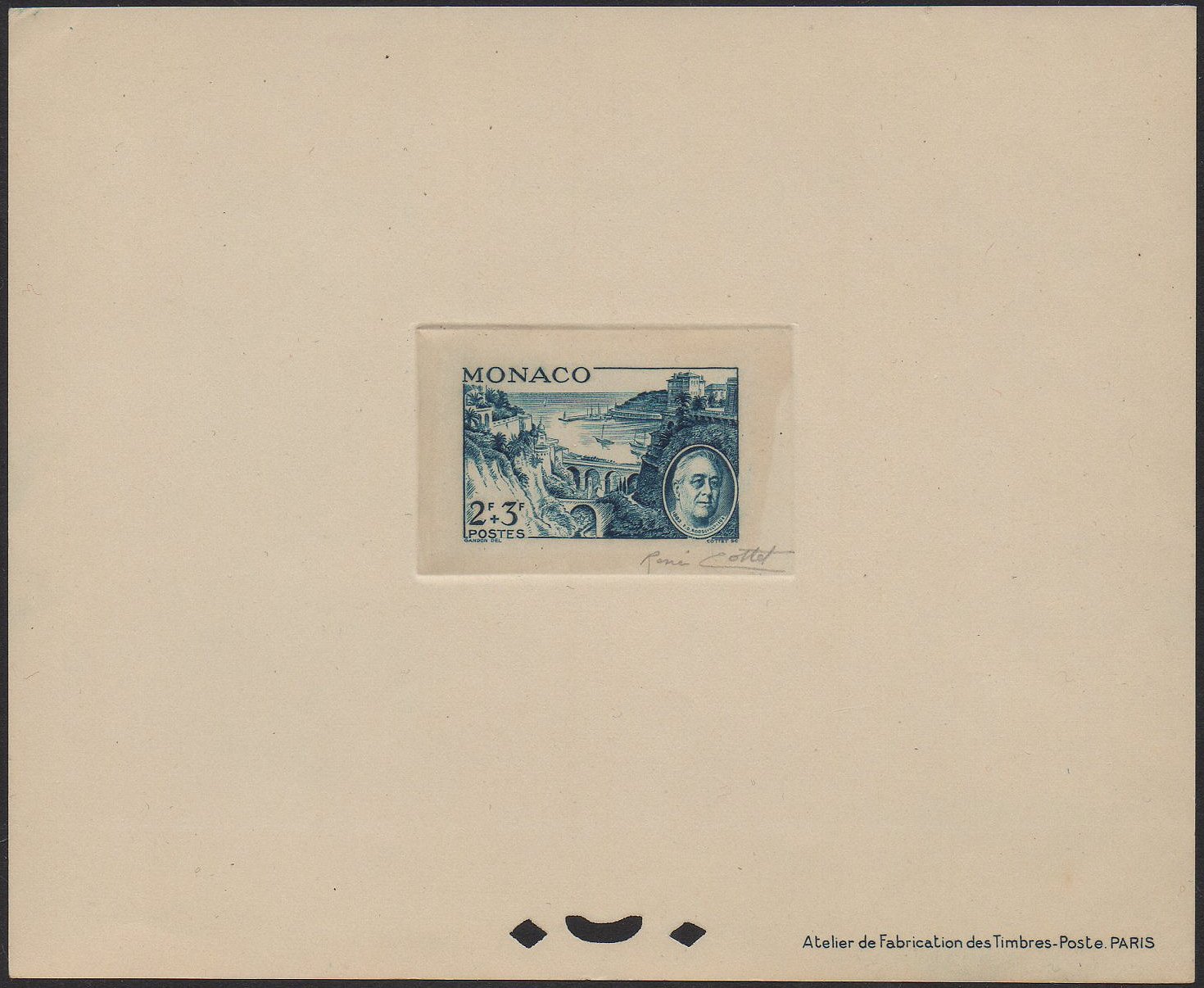
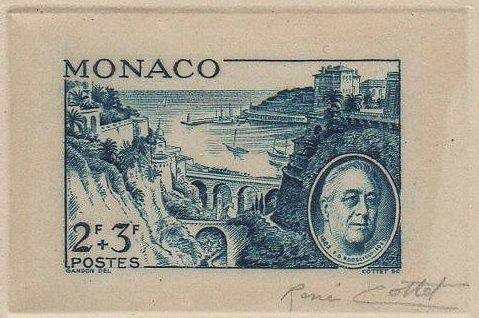 .
.