| Stations | Alpha A | Alpha B | Alpha C | Total | Notes | Image at : | Stations | Value | Stns
|
| Albany | 17 | 8 | 10 | 35 | | M1 | Albany | c | 1
|
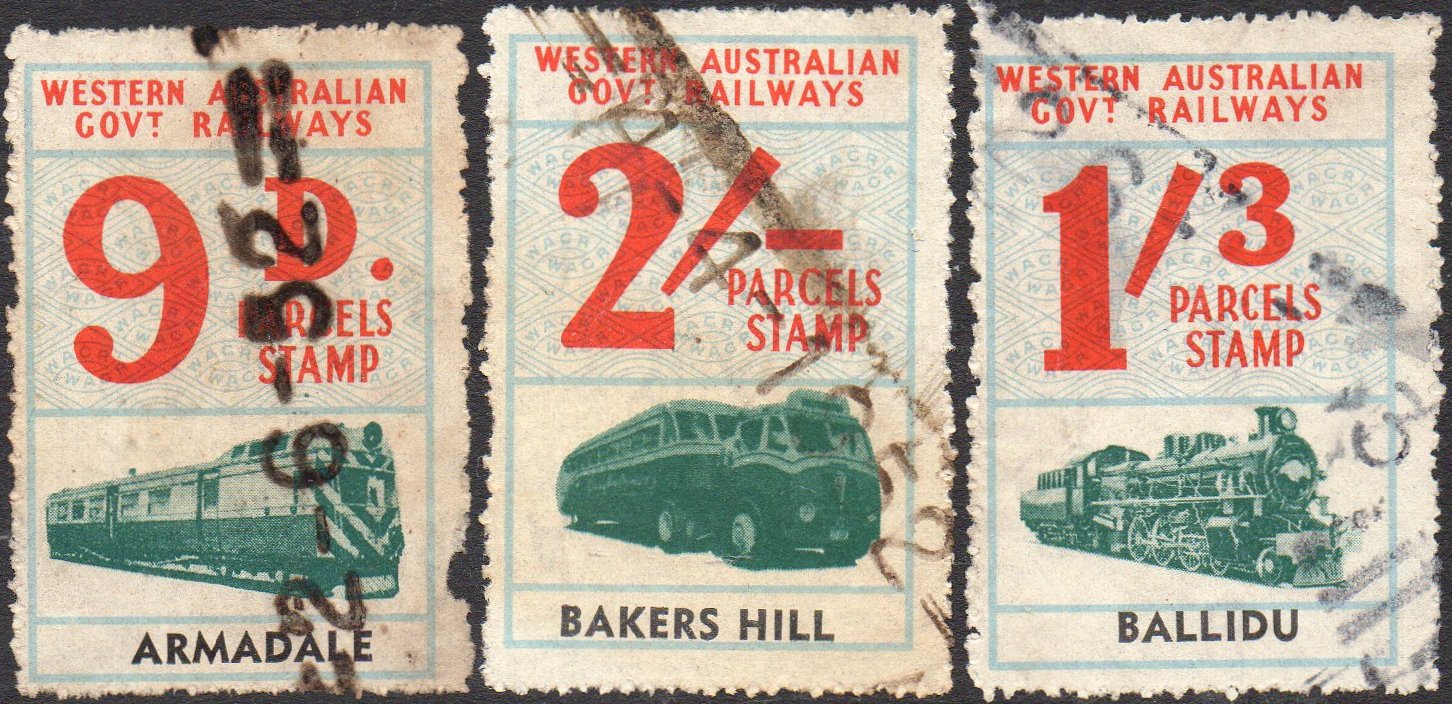
| Armadale | 2 | | | 2 | | Apx.1 | Armadale | RR | 1
|
| Bakers Hill | 1 | | | 1 | | Apx.1 | Bakers Hill | RR | 1
|
| Ballidu | 1 | 3 | | 4 | | Apx.1 | Ballidu | RR | 1
|
| Bassendean | | | 1 | 1 | | M2 | Bassendean | RRR | 1
|
| Bencubbin | | 2 | | 2 | | Apx.4(ix) | Bencubbin | RRR | 1
|
| Beverley | 4 | | 1 | 5 | | M3 | Beverley | s | 1
|
| Bridgetown | 19 | 15 | 5 | 39 | | M1 | Bridgetown | c | 1
|
| Brookton | 13 | 5 | 1 | 19 | | M1 | Brookton | c | 1
|
| Bruce Rock | 2 | | 2 | 4 | | M3 | Bruce Rock | R | 1
|
| Brunswick Jn* | | | | | On Alpha A : 6d | Appx 3 | Brunswick JN* | RRR | 1
|
| Bunbury | 26 | 25 | 26 | 77 | | M2 | Bunbury | c | 1
|
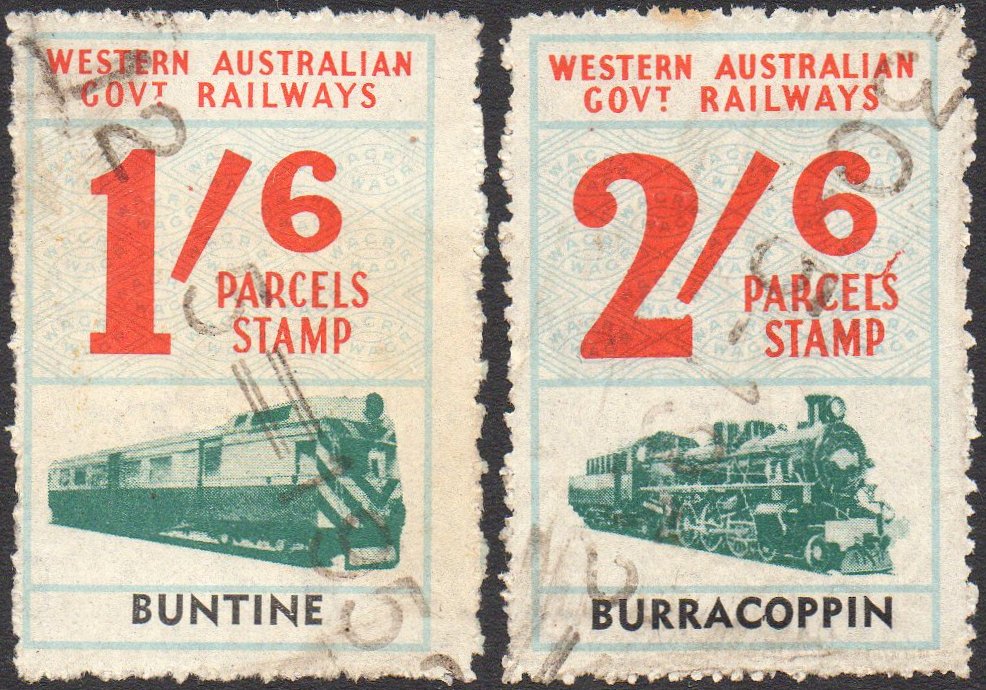
| Buntine | 1 | 1 | | 2 | | Apx.1 | Buntine | RR | 1
|
| Burracoppin | 2 | | 2 | 4 | | Apx.1 | Burracoppin | RR | 1
|
| Busselton | 31 | 32 | | 63 | | M2 | Busselton | c | 1
|
| Cannington * | | | | | On Alpha C : 6d | Apx.1 | Cannington * | RRR | 1
|
| Capel | 4 | 2 | | 6 | | M1 | Capel | R | 1
|
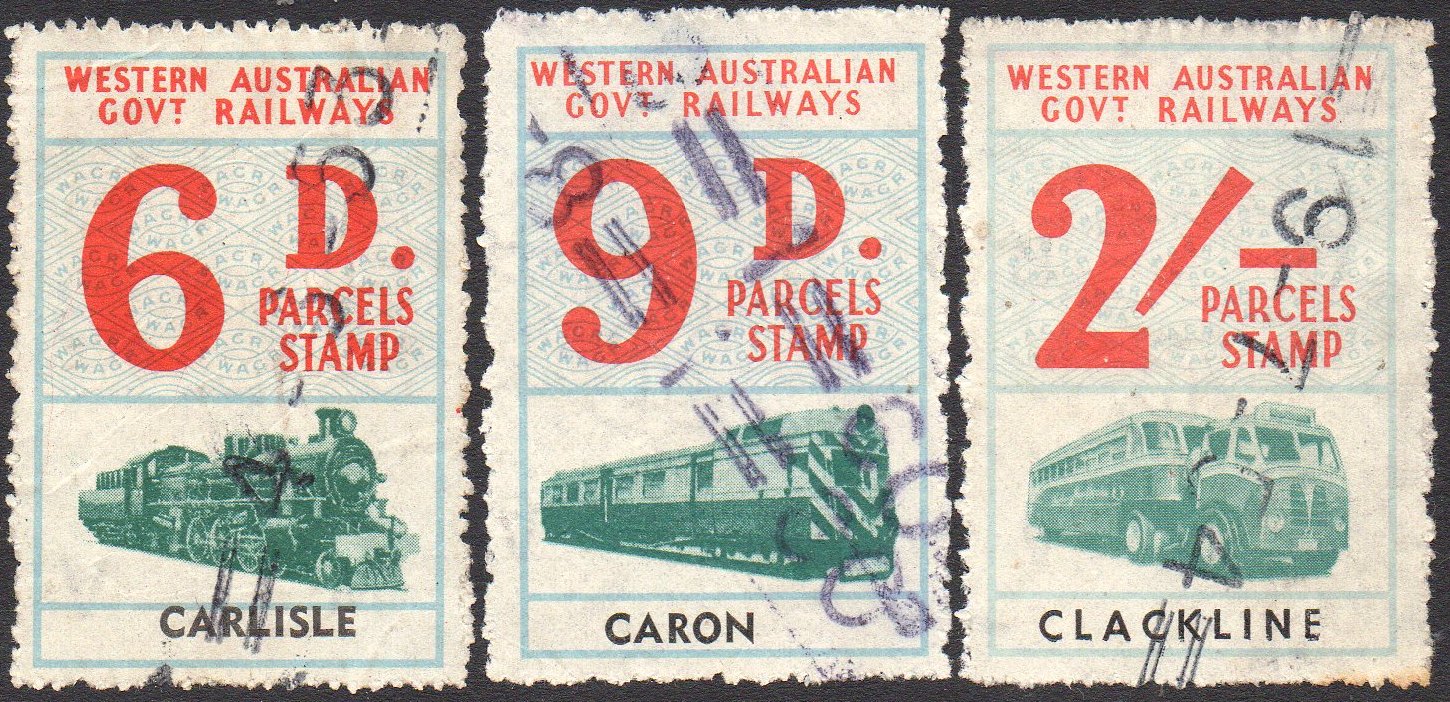
| Carlisle | 2 | | | 2 | | Apx.1 | Carlisle | RR | 1
|
| Caron | 1 | | 2 | 3 | Diags are a pair | Apx.1 | Caron | RR | 1
|
| Clackline | | 1 | | 1 | | Apx.1 | Clackline | RRR | 1
|
| Stations | Alpha A | Alpha B | Alpha C | Total | Notes | | Stations | |
|
| Claremont* | | | | | On Alpha C: 2/- | Apx.1 | Claremont* | RRR | 1
|
| Collie | 60 | 41 | 9 | 110 | | M2 | Collie | c | 1
|
| Coolgardie | | | 3 | 3 | A strip/3 | M3 | Coolgardie | RR | 1
|
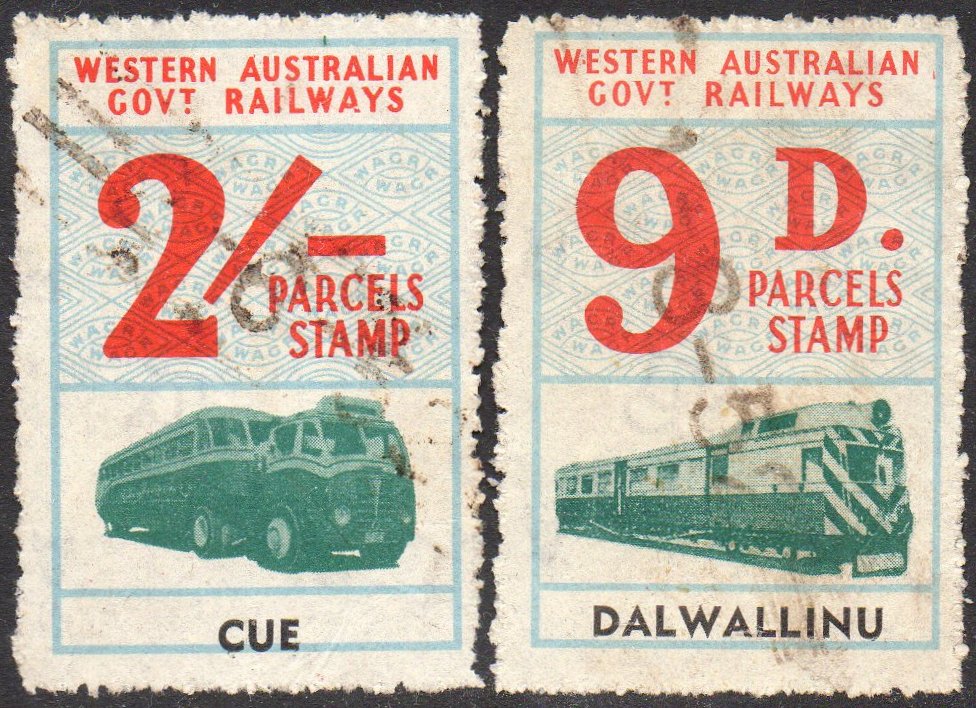
| Cue | 4 | | | 4 | | Apx.1 | Cue | R | 1
|
| Cunderdin | 27 | 13 | 1 | 41 | | M2 | Cunderdin | c | 1
|
| Dalwallinu | 2 | | | 2 | | Apx.1 | Dalwallinu | RR | 1
|
| Denmark * | | | | | On Alpha A: 1/3 | Apx.1 | Denmark * | RRR | 1
|
| Donnybrook | 4 | 7 | | 11 | | M1 | Donnybrook | lc | 1
|
| Doodlakine | 5 | | | 5 | | M1 | Doodlakine | R | 1
|
| Dumbleyung | 3 | | 1 | 4 | | M3 | Dumbleyung | R | 1
|
| Dwellingup | | 3 | | 3 | | Apx.4(xi) | Dwellingup | RR | 1
|
| East Perth * | | | | | On Alpha C : 4/- | Apx.1 | East Perth * | RRR | 1
|
| Esperance | 12 | 3 | 2 | 17 | | Intro | Esperance | c | 1
|
| Fremantle | 2 | 2 | 6 | 10 | | M3 | Fremantle | s | 1
|
| Geraldton | 10 | 4 | | 14 | | M1 | Geraldton | lc | 1
|
| Gnowangerup | | 4 | | 4 | 3 are same date | M2 | Gnowangerup | RR | 1
|
| Goomalling | 3 | 2 | | 5 | | Apx.1 | Goomalling | R | 1
|
| Greenbushes | 15 | 3 | | 18 | | M2 | Greenbushes | c | 1
|
| Guildford | | 2 | | 2 | | Apx.1 | Guildford | R | 1
|
| Gwalia | | 3 | | 3 | | Apx.4(x) | Gwalia | RR | 1
|
| Harvey | 10 | 20 | 3 | 33 | | M2 | Harvey | c | 1
|
| Stations | Alpha A | Alpha B | Alpha C | Total | Notes | | Stations | |
|
| Kalgoorlie | 35 | 17 | 21 | 73 | | Intro | Kalgoorlie | c | 1
|
| Katanning | 63 | 33 | 6 | 102 | | M1 | Katanning | c | 1
|
| Kellerberrin | 20 | 29 | 7 | 56 | | Intro | Kellerberrin | c | 1
|
| Kendenup | 1 | | | 1 | | Apx.1 | Kendenup | RRR | 1
|
| Kirup | 2 | | | 2 | | Apx.3 | Kirup | RR | 1
|
| Kojonup | 8 | | | 8 | | M1 | Kojonup | s | 1
|
| Kondinin | 9 | 3 | | 12 | | Apx.1 | Kondinin | lc | 1
|
| Koorda | 4 | 3 | | 7 | | M2 | Koorda | lc | 1
|
| Kulin | 7 | 8 | | 15 | | Apx.1 | Kulin | c | 1
|
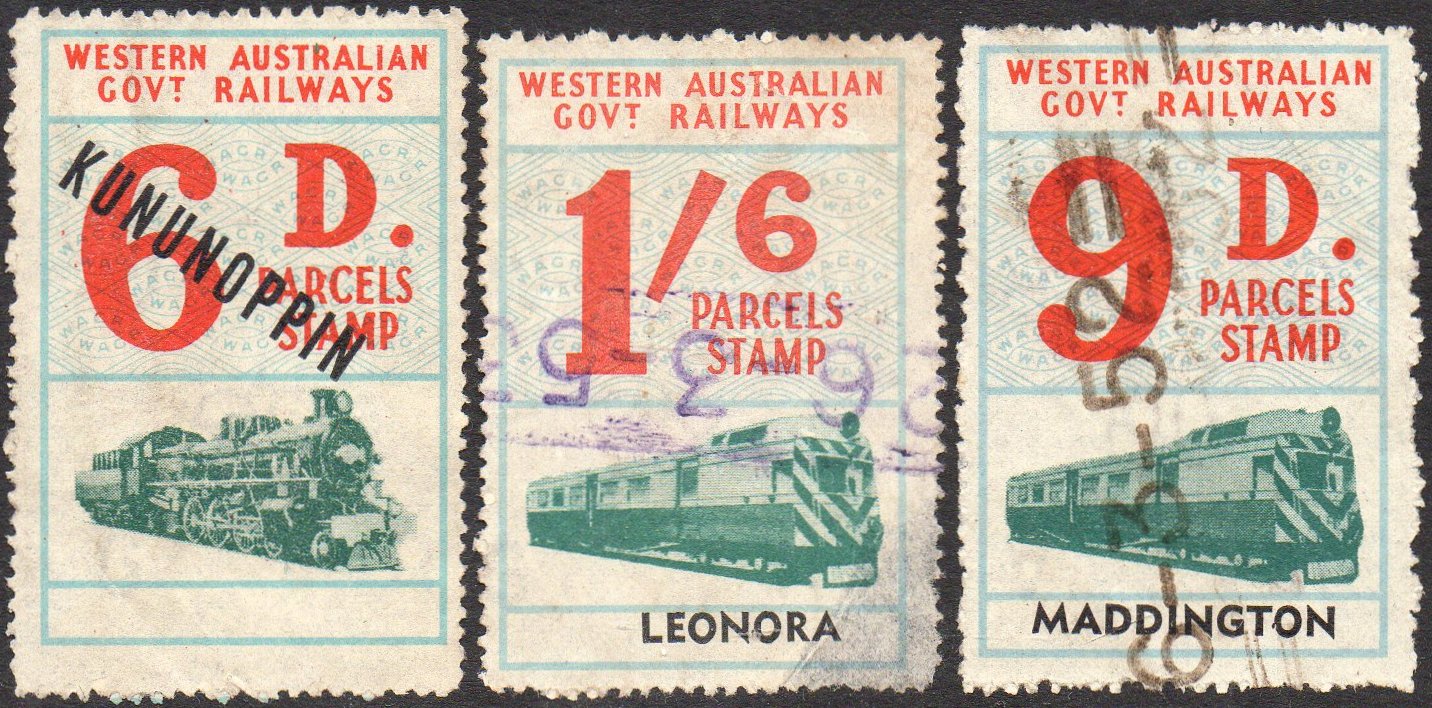
| Kununoppin | | | 1 | 1 | | Apx.1 | Kununoppin | RRR | 1
|
| Lake Grace | 3 | 4 | 2 | 9 | | M3 | Lake Grace | s | 1
|
| Leonora | 1 | | | 1 | | Apx.1 | Leonora | RRR | 1
|
| Maddington | 2 | | | 2 | | Apx.1 | Maddington | RRR | 1
|
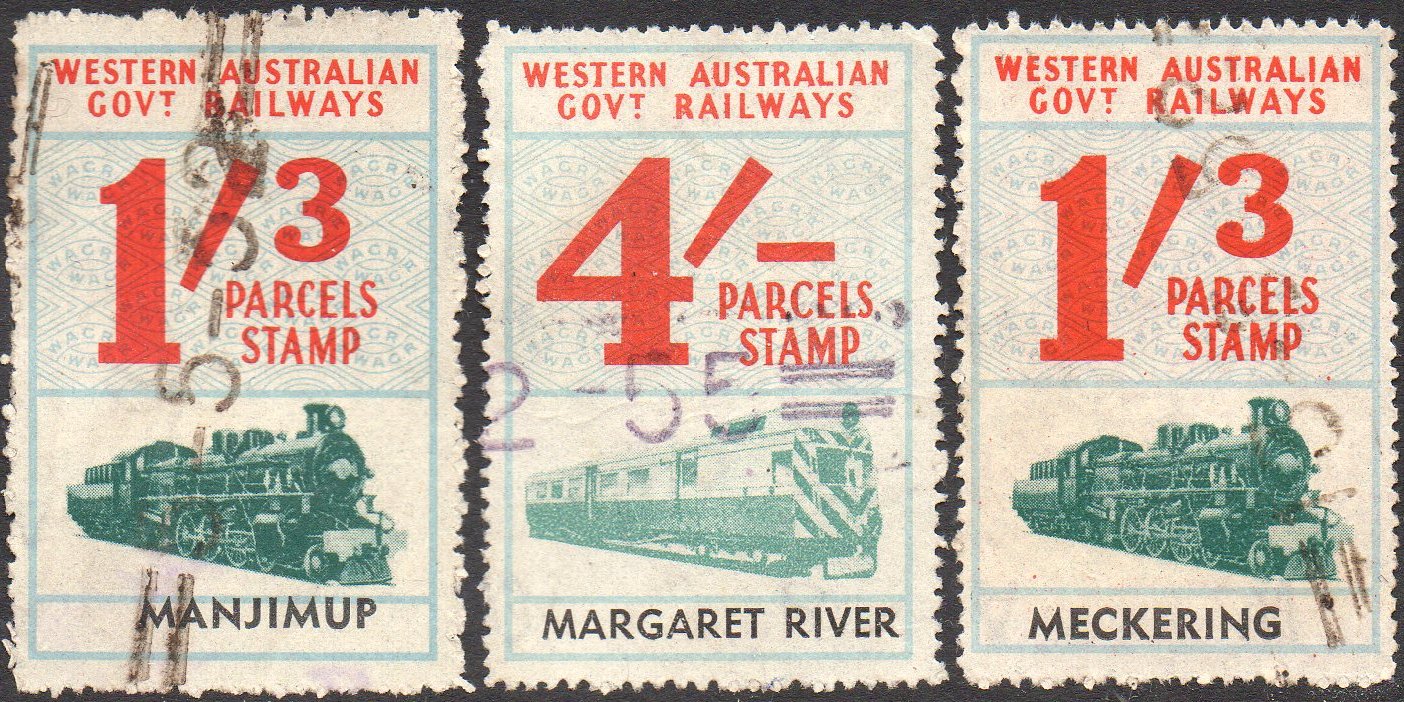
| Manjimup | 5 | 7 | | 12 | | Apx.1 | Manjimup | lc | 1
|
| Margaret River | | 1 | | 1 | | Apx.1 | Margaret River | RRR | 1
|
| Maylands | 4 | | | 4 | | Intro | Maylands | RR | 1
|
| Meckering | 2 | | | 2 | | Apx.1 | Meckering | RRR | 1
|
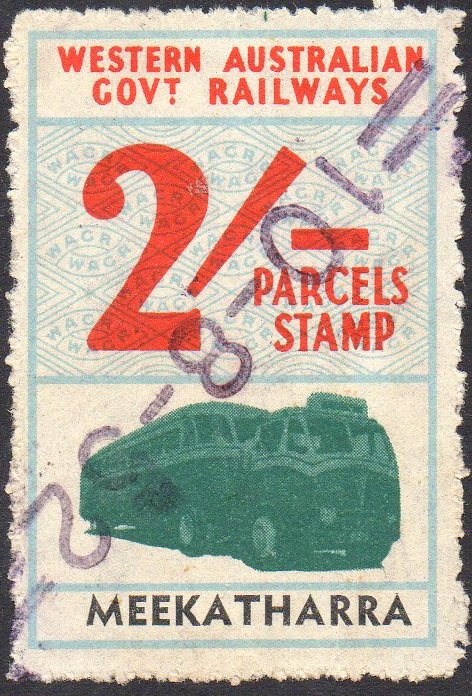
| Meekatharra | 1 | | | 1 | | Apx.1 | Meekatharra | RRR | 1
|
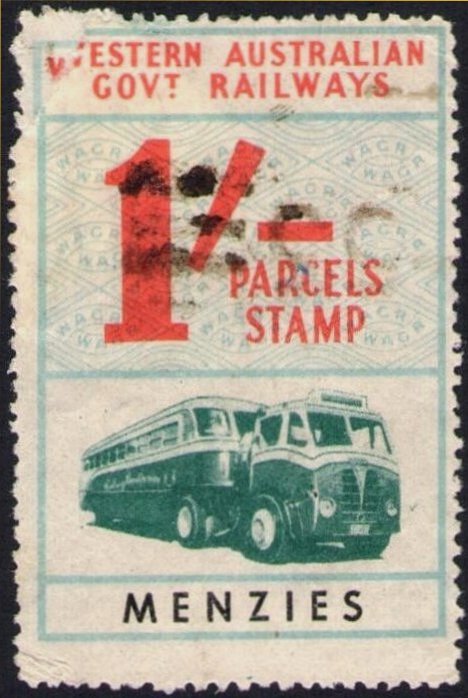
| Menzies * | | | | | On Alpha B : 1/- | Apx.1 | Menzies * | RRR | 1
|
| Stations | Alpha A | Alpha B | Alpha C | Total | Notes | | Stations | |
|
| Merredin | 17 | 11 | 4 | 32 | | Intro | Merredin | c | 1
|
| Midland Jtcn. | 1 | | | 1 | | Apx.1 | Midland Jtcn. | RRR | 1
|
| Morawa | 4 | 2 | | 6 | | Apx.4(ix) | Morawa | R | 1
|
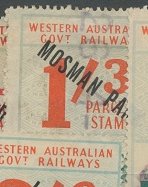
| Mosman Park* | | | | | On Alpha C : 1/3 | Apx.1 | Mosman Park* | RRR | 1
|
| Mount Barker | 19 | 5 | 2 | 26 | | Apx.4(viii) | Mount Barker | c | 1
|
| Mt. Magnet | 18 | 2 | 6 | 26 | | M1 | Mt. Magnet | c | 1
|
| Mukinbudin | 1 | | 2 | 3 | | Apx.4(v) | Mukinbudin | R | 1
|
| Mullewa | 8 | 9 | | 17 | | M2 | Mullewa | c | 1
|
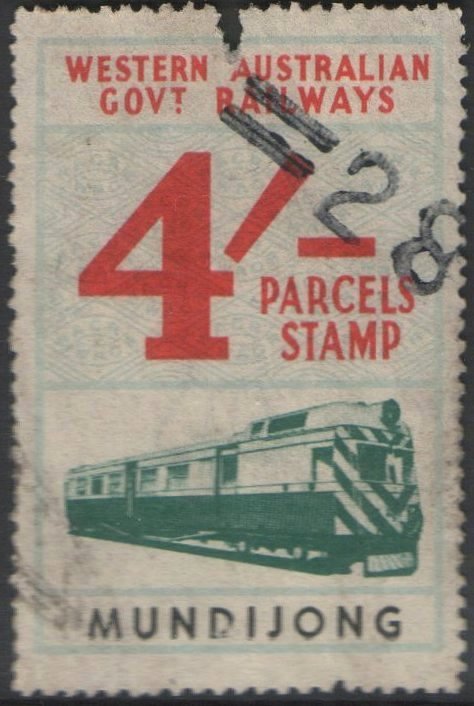
| Mundijong * | | | | | On Alpha B : 4/- | Apx.1 | Mundijong * | RRR | 1
|
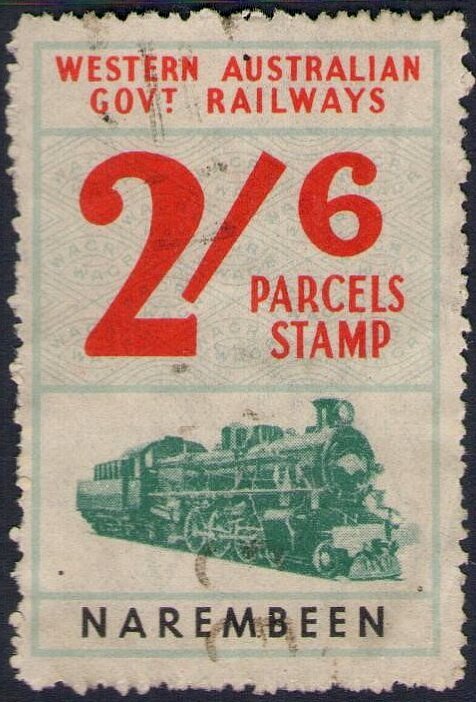
| Narembeen * | | | | | On Alpha B: 2/6 | Apx.1 | Narembeen * | RRR | 1
|
| Narrogin | 7 | 15 | 11 | 33 | | M3 | Narrogin | c | 1
|
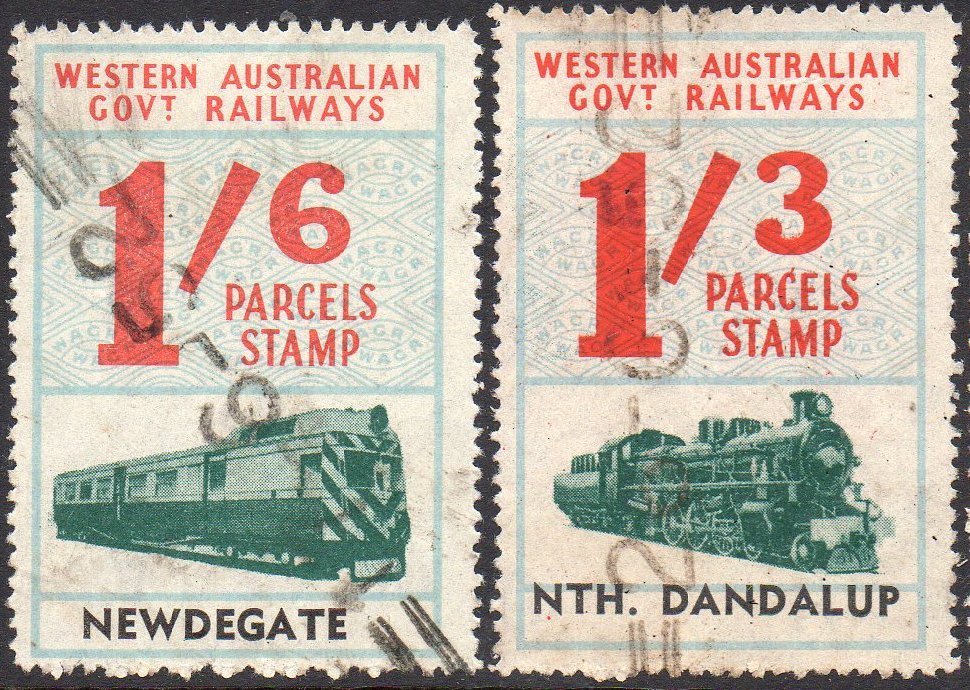
| Newdegate | 2 | | | 2 | Both 17-6-52 | Apx.1 | Newdegate | RRR | 1
|
| Norseman | 9 | 5 | | 14 | | M1 | Norseman | lc | 1
|
| Northam | 14 | 13 | 2 | 29 | | M2 | Northam | c | 1
|
| Northampton | 3 | | | 3 | | M1 | Northampton | RR | 1
|
| Nth. Dandalup | 4 | | | 4 | | Apx.1 | Nth. Dandalup | RR | 1
|
| Nth. Fremantle | | 1 | 8 | 9 | | M3 | Nth. Fremantle | s | 1
|
| Pemberton | 3 | 13 | | 16 | | Apx.4(xi) | Pemberton | c | 1
|
| Perenjori* | | | | | On Alpha B : 2/- | Apx.1 | Perenjori* | RRR | 1
|
| Perth (in Black) | 158 | 10** | 4 | 162 | | M1 | Perth (in Black) | c ** | 1
|
| Perth (in Green) | | 240 | | 240 | | M2 | Perth (in Green) | c |
|
| Perth Roul x Perf | | 13 | | 13 | AlphaB variety | M2 | Perth Roul x Perf | s |
|
| Stations | Alpha A | Alpha B | Alpha C | Total | Notes | | Stations | |
|
| Picton Jctn./Jnct | 1 | | 4 | 5 | Alpha C: Block/4 | Apx.4(i) | Picton Jctn./Jnct | RRR | 1
|
| Pingelly | 18 | 7 | | 25 | | Apx.4(xi) | Pingelly | c | 1
|
| Pinjarra | 1 | | | 1 | | M1 | Pinjarra | RRR | 1
|
| Quairading* | | | | | AlphaA: 6d & 2/- | Apx.1 | Quairading* | RRR | 1
|
| Serpentine | 1 | 1 | | 2 | | Apx.1 | Serpentine | RR | 1
|
| Sthrn Cross (A) | 7 | 2 | | 9 | | M2 | Southern Cross(B) | s | 1
|
| Subiaco* | | | | | On Alpha C : 9d | Apx.1 | Subiaco* | RRR | 1
|
| Tambellup | | 4 | 1 | 5 | | Apx.1 | Tambellup | R | 1
|
| Tammin | 4 | 3 | | 7 | | M2 | Tammin | s | 1
|
| Toodyay | | 3 | | 3 | | Apx.1 | Toodyay | RR | 1
|
| Wagin | 26 | 18 | 1 | 45 | | Apx.4(xi) | Wagin | c | 1
|
| Waroona | 9 | 4 | | 13 | | Apx.3 | Waroona | c | 1
|
| Welshpool* | | | | | On Alpha A : 9d | Apx.4(v) | Welshpool* | RRR | 1
|
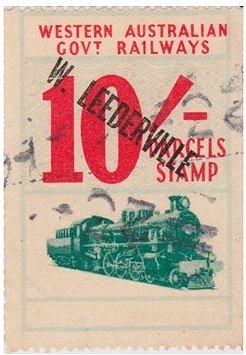
| W(est) Leederville | | | | | On Alpha C : 10s | Apx.1 | W(est) Leederville | RRR | 1
|
| West Perth | 18 | 75 | 3 | 96 | | M2 | West Perth | c | 1
|
| Williams | 1 | 1 | | 2 | | Apx.1 | Williams | RR | 1
|
| Wongan Hills | 27 | 17 | 2 | 46 | | M1 | Wongan Hills | c | 1
|
| Wubin | 10 | 3 | | 13 | | Apx.1 | Wubin | c | 1
|
| Wyalkatchem | | | 5 | 5 | | M3 | Wyalkatchem | R | 1
|
| Yalgoo | 1 | | | 1 | | M1 | Yalgoo | RRR | 1
|
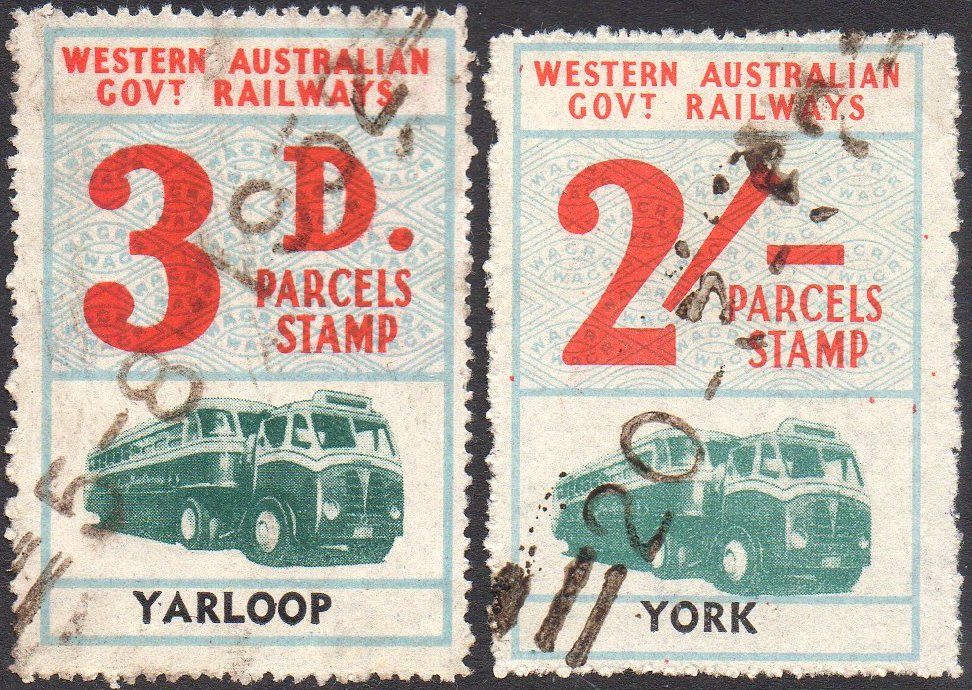
| Yarloop | 8 | 8 | 2 | 18 | | Apx.1 | Yarloop | c | 1
|
| York | 4 | 3 | 1 | 8 | | Apx.1 | York | lc | 1
|
| TOTALS | 854 | 794 | 170 | 1818 | All 1818 'used' | | | |
|
| BOANS LTD. * | | | | | See Appx4(vii) | Apx.4(vii) | BOANS LTD. | RR |
|
| . | Alpha A | Alpha B | Alpha C | Total | Notes | | Station Count: | Stns: | 102
|
** PERTH Second Issue with name in Black are scarce and we treat them separately to those with PERTH in Green. In the section on the Second Issue higher up, we have assigned prices to those values that we know to exist in the catalogue-style listing.
Key to Column 9 above : Valuation of Station Names :
The penultimate column in the above table is a suggested rarity rating, using the following codes:
c : common (in relative terms; few of these stamps are truly common.)
lc : less common
s : scarce
R : Probably fewer than 15 exist
RR : Probably fewer than 10 exist
RRR : Probably fewer than 6 exist (some may well be unique survivors)
As already discussed, precise comparative rarity between many of these stations are, necessarily, based on tiny stamp numbers and therefore subjective estimates. We have thought better of trying to put an actual value to any of these categories as we have minimal direct information on how much collectors might be willing to pay for a rare station. However, extrapolation from (very few) auction realizations may well point to a figure comfortably in excess of A$100.- for a rare station, which would not seem unreasonable. Indeed, such a price could be greatly exceeded at auction with two determined bidders.
Importantly, please note that we have not attempted to price stations by Issue, only across the SERIES. A station may be unknown or very rare on one Issue whilst quite common on another Issue of the Third SERIES stamps.
We have marked BOANS LTD stamps with an 'RR' rarity code. We think its survival numbers on Third SERIES stamps may be a little higher than 'RR' suggests but BOANS is likely to have a valuation considerably greater than its scarcity, due to its unique status in WA RPS as the only Company Overprint. See Appendix 4(vii) for more.
As ever in philately, if you have a rare stamp combined with a rare cancellation, the value is not really something that can be reached via some magic formula. We would suggest that where a station name value exceeds that of the stamp, the value typically will simply be that of the station, maybe with a small premium added if the stamp is itelf one of the scarcer ones too. Conversely, where the stamp itself already commands a high price, a scarce station may have little or no impact on the valuation.
Observations on the Perception of Rarity :
Where just one or two stamps are found from a station in this collection, it naturally suggests a very high level of rarity, which will often be true, occasionally perhaps not. Such a collection cannot be representative to that level of accuracy. On the other hand, there are a few examples of stations represented by 4 or 5 stamps in this collection which have clearly come from no more than two parcels. Considering the exceptionally large sample being used as a basis for this article, these 4 or 5 stamps could quite conceivably be all the surviving Third SERIES stamps from a few such stations.
Locating images of all the Stations in this article.
Due to the unknown, indeed unknowable, numbers of each station name in existence, we have taken the opportunity, wherever possible, to include a scan from every station listed in this article, in order to provide a useful resource for everyone in the future. Where we have had a choice of stamps to illustrate a station name, one has been taken at random and can be from any Alphabet.
The 7th column in the table shows the location of the FIRST instance of a scan of this station appearing in the article; several images exist for a few stations. The location 'codes' used in that table column are as follows:
Key to Column 7 above : Location of First Scans of each Station :
Intro : In the Introduction
M1 : Main Section 1 (The First Issue)
M2 : Main Section 2 (The Second Issue)
M3 : Main Section 3 (The Third Issue)
Apx. : Appendix (with section & sub-section number)
We have already mentioned the declining number of stations by the Third Issue. The number of stations in the table for each Issue in this collection that are unique to one Alphabet are as follows :
Only found on Alphabet A : 23 Stations
Only found on Alphabet B : 12 Stations
Only found on Alphabet C : 9 Stations
Please note that the above figures applied when this table was first published in late September 2022. We may since have added to the table further stations advised to us, but we shall NOT be updating the brief analysis above. However, it all supports a picture of a rapid decline in the number of parcel-handling stations, especially as the issuing period of the First Issue stamps was significantly shorter than that for stamps of the Second Issue.
Subsequently-advised (Third SERIES) Stations not yet added to the 'Summary of Stations' Table :
None currently
.
APPENDIX 1 : Scans of Other Stations :
In the previous section, we provided a table of all the different station names known to us of Third SERIES stamps. There are scans of a large number of them scattered through this article. However, well over one-third of stations are not shown at all, so we have illustrated below ONE example of every station not scanned elsewhere in this article. More could be done; we could have tried to illustrate one example of each 'Issue' from each station, in many ways worthwhile, but this article is already rather large!
Not all the scans below are from the collection. Some come from external sources, from helpful correspondents. Several are included by kind permission of Abacus Auctions of Melbourne. If you own any stations NOT on the Station List in the previous section, please help add to the scans. Just send us an email, ideally a .jpg with a scan at 300 dpi resolution, and, for so long as we maintain the page, we will be happy to add new stations below. The images are arranged alphabetically.
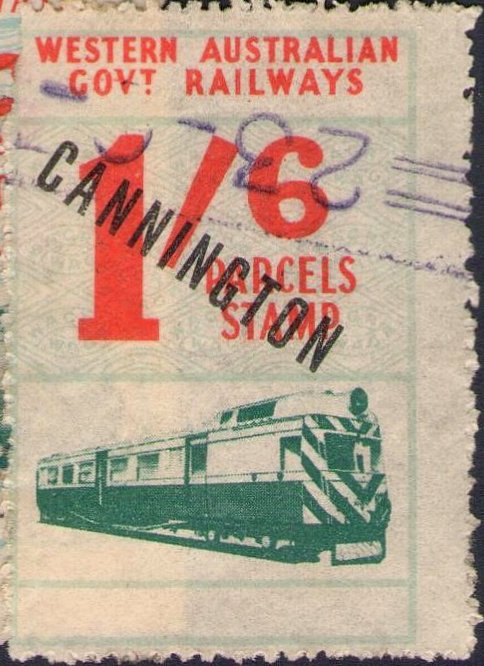
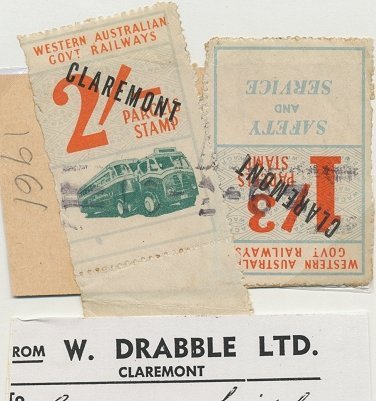 A Claremont Third SERIES (Third Issue) 2/- alongside a Fourth SERIES 1/3, on piece, 1961 (Source : Abacus.)

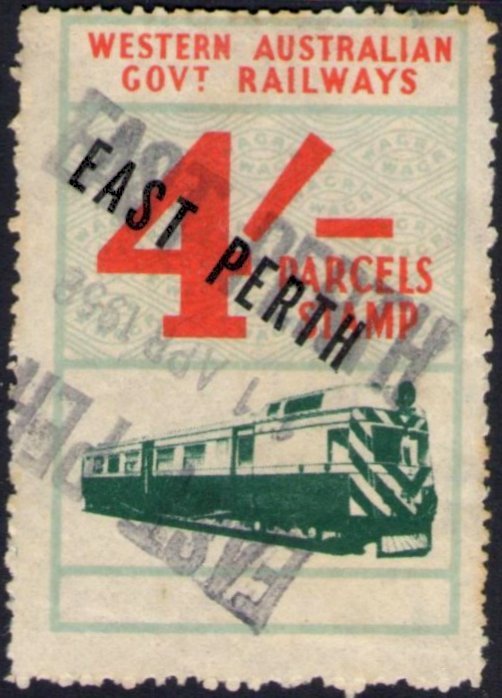
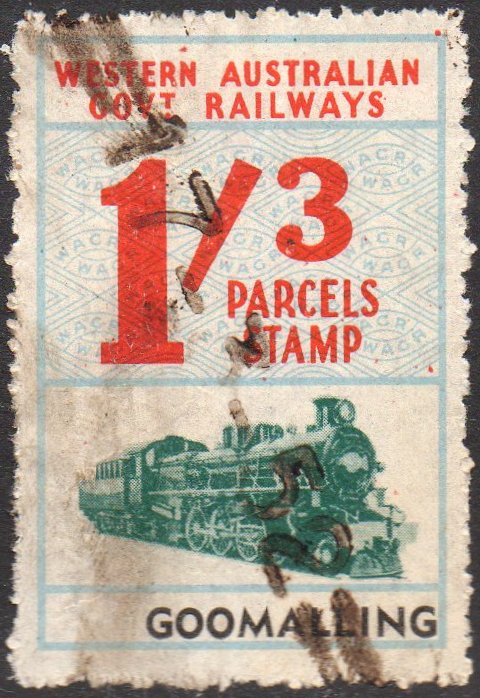
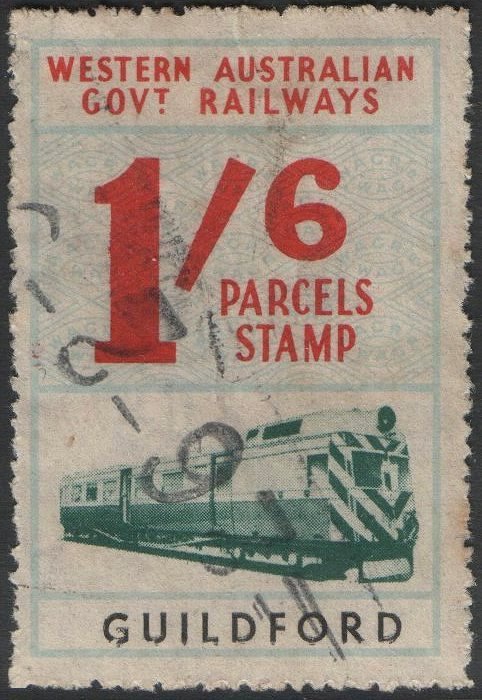
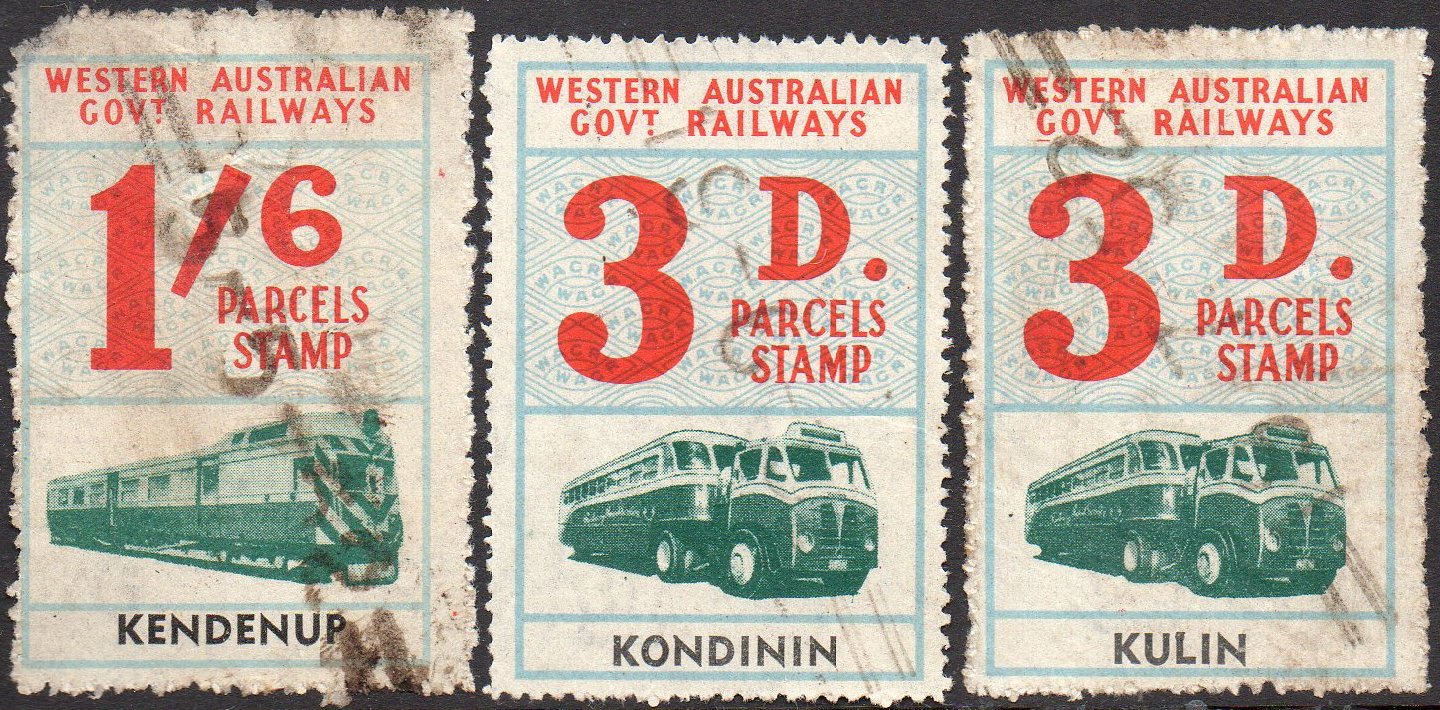

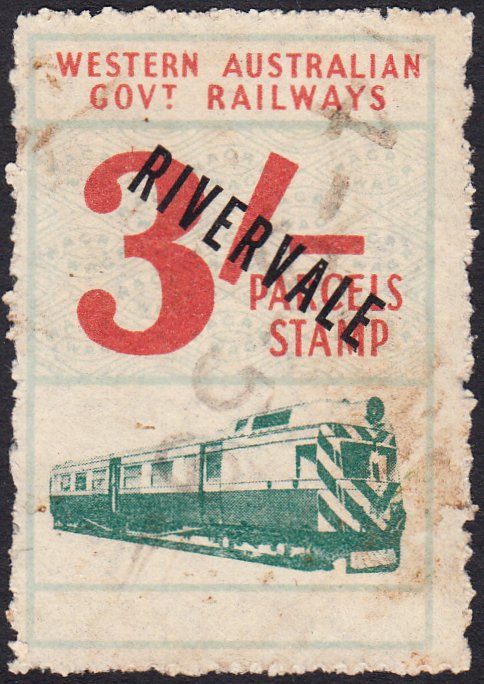
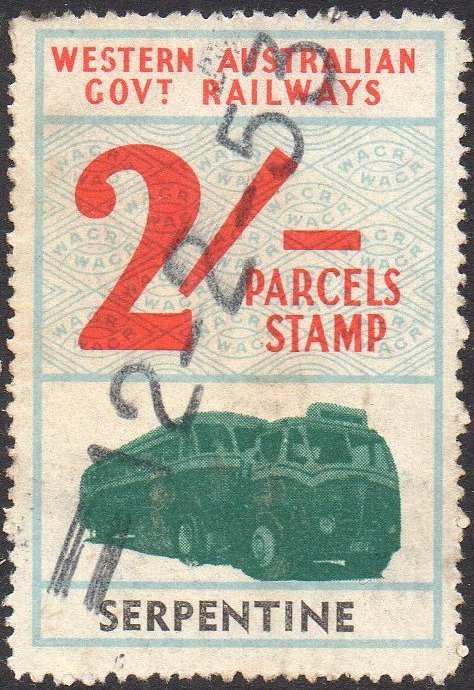
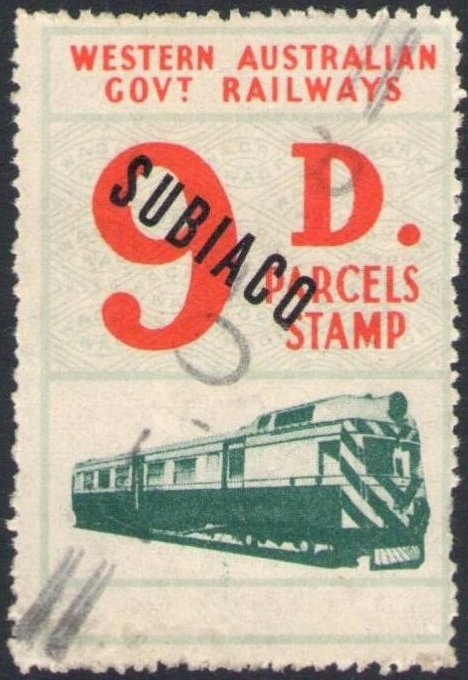
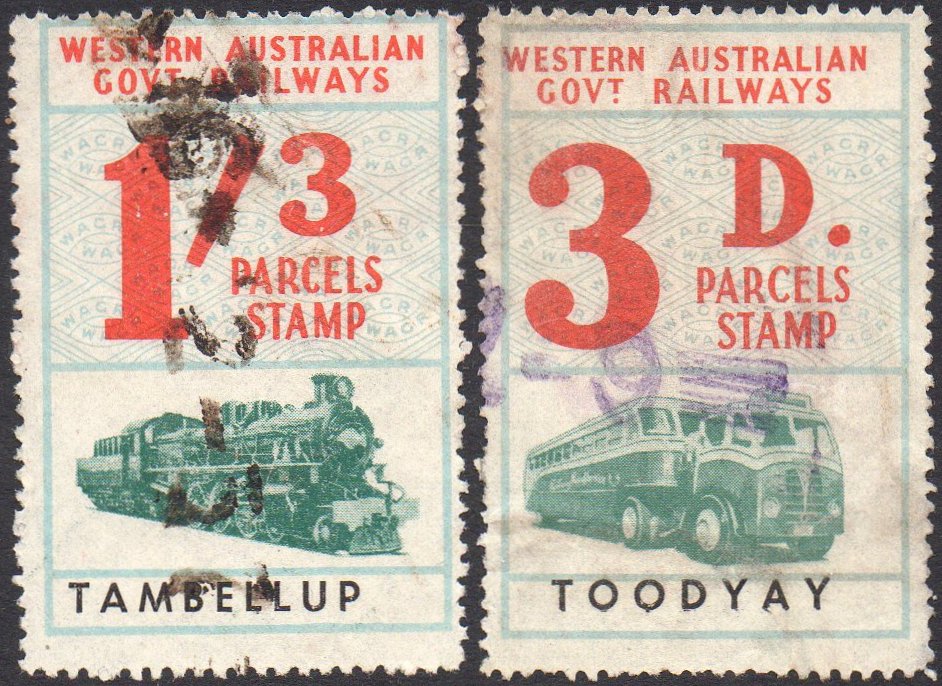
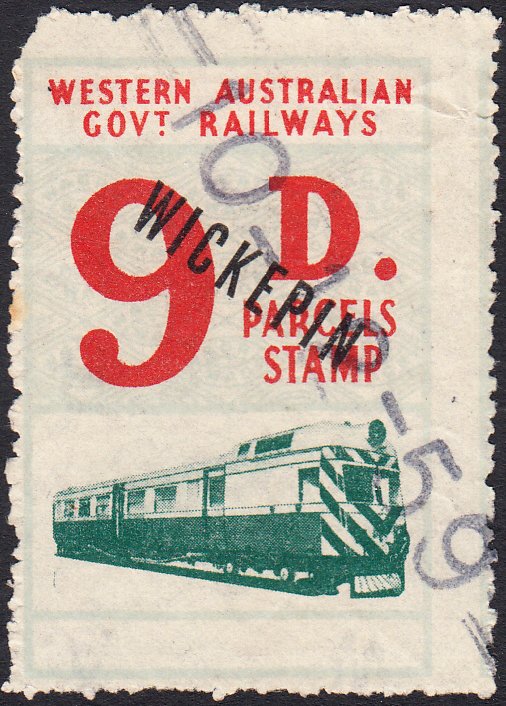
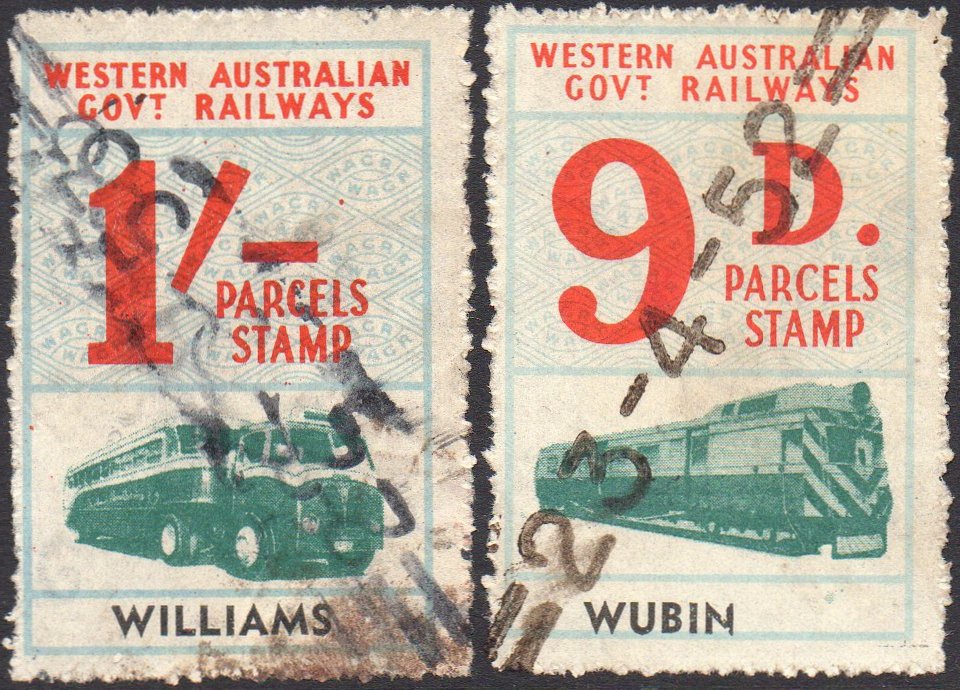
 .
End of Appendix 1
.
.
APPENDIX 2 : The Stamp Designs :
.
End of Appendix 1
.
.
APPENDIX 2 : The Stamp Designs :
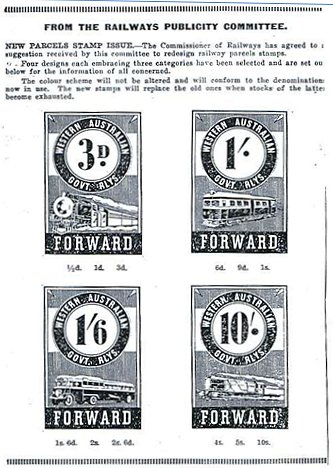
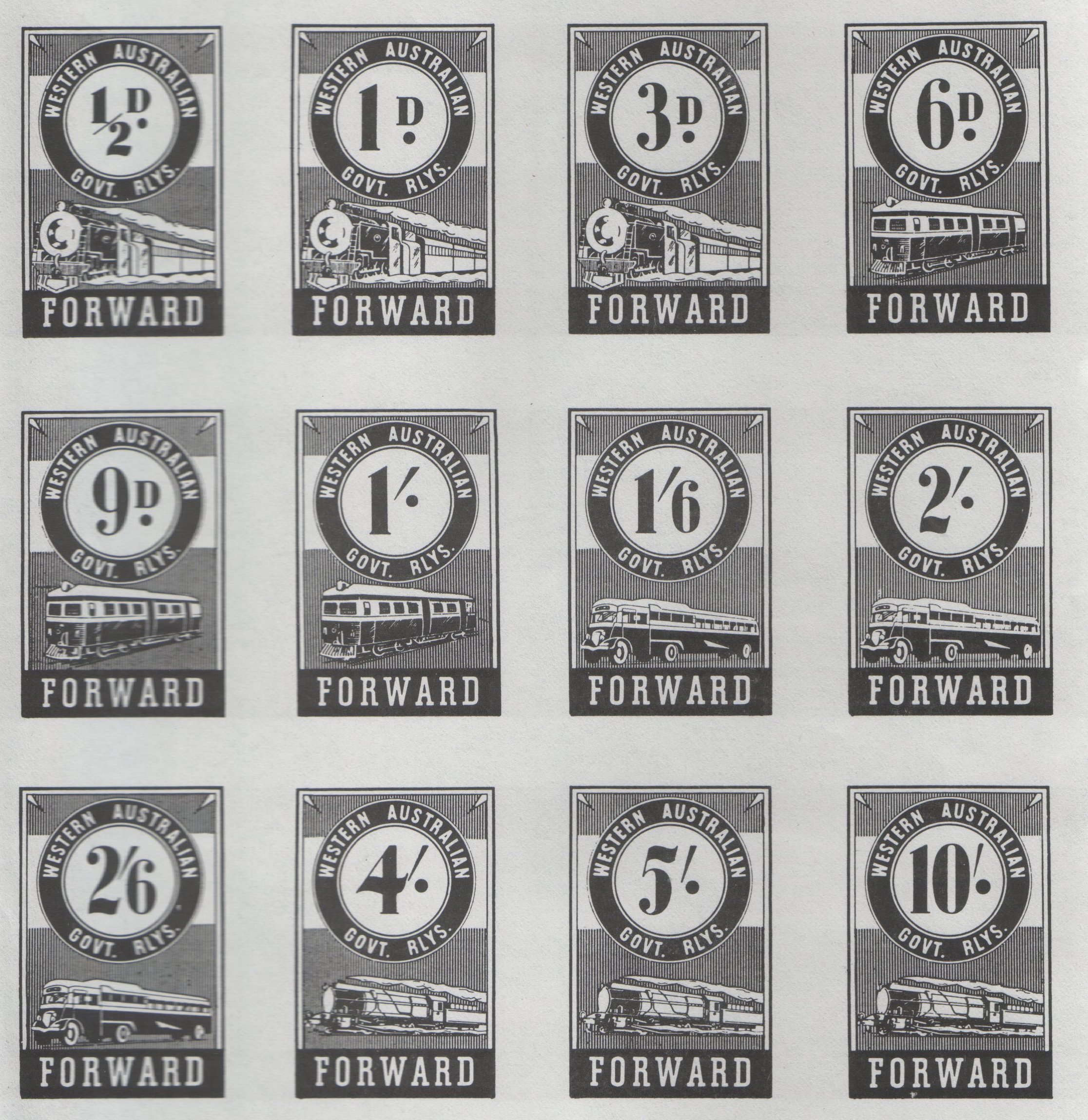 Left : c.1946 WAGR Proof Designs (see text below). . . . Right : Later private reproductions (Cinderellas).
Shown above are FOUR designs for this SERIES proposed to the Commissioner of Railways in 1946. Note that the text includes the mention that the new stamps are to be distributed only once the old designs have been exhausted, which seems to have been a permanent economic management policy at the WAGR. These four designs were never made public but were shown for the benefit of employees in Railway Weekly. By the time the stamps finally appeared in 1951, this had been reduced to three stamps, extensively modified from the original designs. It appears that the 3d design was dropped and really just the broad concepts from the other three designs picked up for the new stamps.
In the case of the bus design, this would anyway have been forced upon the company. The bus shown in the 1948 proposed designs, a 'semi-trailer' attached to a 'White' tractor unit, had a serious accident in 1948 and, although the trailer was repaired, it did not remain long in railway ownership. The new Foden + semi-trailer combination adopted by the Railway was very different, and much more modern in appearance, and it is this which appears on the issued stamps.
The later private (unapproved) reproductions shown above exist in Red and in Purple as well as in Black, all imperforate. On the cinderellas, the designs are matched to the values suggested below each of the 1940s proofs, whereas on the issued stamps, the First Issue are in the sequence steam-diesel-bus . . steam-diesel-bus from the ½d for the 13 values up to the 10/-. The 1/9, 3/- and £1 values introduced later break the sequence.
.
The Articulated Bus is, to European eyes certainly, a curious contraption. It is a Western Australian Government Railway (WAGR) articulated Railway Road Service (RRS) vehicle, usually called a ‘semi-trailer’ bus in Australia. We would like to express our thanks to Ian Kerr for the information that the tractor unit is a Foden FG and the trailer section is converted from a Fowler Cheetah. Ian adds that the actual vehicle shown is almost surely the vehicle that carried the fleet number F3.
He also pointed us to the website of the BPSWA/Perthbus and, rather than download the image and information there, it is altogether better to provide you with this link . . . . (opens in a new tab) You will note that the composition of the stamp is all but identical to the website image.
Another correspondent, John Young, kindly expanded on this, including a useful history of some of these buses as well as of the ill-fated 'White' tractor unit mentioned above. Whilst this is an article on stamps and railways, there is a relevance in that these railway-operated buses took over some parcel duties, serving numerous stations that had lost their passenger trains. We start with a brief look at the fleet in general:
There were originally three Landliner /Cheetah buses (RV41, RV42 and RV43) in use with the WAGR in 1947/8 but they proved very unsatisfactory and had all been converted to semi-trailers buses by Christmas 1948, re-numbered F1,F2 & F3. The conversion proved highly successful.
They were then used in time-tabled passenger service until 1961/63 at which point two of them, F1 and F3, were used as employee transport and sleeper transport, at some periods probably in connection with rail-gauge conversion. (Numerous gauges, and gauge-breaks, were a long-term feature - and headache - across Australia.) In total, the WAGR had a fleet of 25 Foden buses, 21 as standard buses, 4 running as semi-trailer tugs. The Foden semi-trailers were kept busy all through their life up until their withdrawal from passenger service.
So, why did the WAGR need a fleet of buses operating the Railway Road Service, which, for much of its life, and still today, has required WA Government subsidy? As in Britain, the war years took their toll on the railways, with investment on maintenance a low priority. This was aggravated in Western Australia by the fact that many of the most recent railways had been built on a shoe-string whilst providing work in the Great Depression and such lines were very high maintenance.
Left : c.1946 WAGR Proof Designs (see text below). . . . Right : Later private reproductions (Cinderellas).
Shown above are FOUR designs for this SERIES proposed to the Commissioner of Railways in 1946. Note that the text includes the mention that the new stamps are to be distributed only once the old designs have been exhausted, which seems to have been a permanent economic management policy at the WAGR. These four designs were never made public but were shown for the benefit of employees in Railway Weekly. By the time the stamps finally appeared in 1951, this had been reduced to three stamps, extensively modified from the original designs. It appears that the 3d design was dropped and really just the broad concepts from the other three designs picked up for the new stamps.
In the case of the bus design, this would anyway have been forced upon the company. The bus shown in the 1948 proposed designs, a 'semi-trailer' attached to a 'White' tractor unit, had a serious accident in 1948 and, although the trailer was repaired, it did not remain long in railway ownership. The new Foden + semi-trailer combination adopted by the Railway was very different, and much more modern in appearance, and it is this which appears on the issued stamps.
The later private (unapproved) reproductions shown above exist in Red and in Purple as well as in Black, all imperforate. On the cinderellas, the designs are matched to the values suggested below each of the 1940s proofs, whereas on the issued stamps, the First Issue are in the sequence steam-diesel-bus . . steam-diesel-bus from the ½d for the 13 values up to the 10/-. The 1/9, 3/- and £1 values introduced later break the sequence.
.
The Articulated Bus is, to European eyes certainly, a curious contraption. It is a Western Australian Government Railway (WAGR) articulated Railway Road Service (RRS) vehicle, usually called a ‘semi-trailer’ bus in Australia. We would like to express our thanks to Ian Kerr for the information that the tractor unit is a Foden FG and the trailer section is converted from a Fowler Cheetah. Ian adds that the actual vehicle shown is almost surely the vehicle that carried the fleet number F3.
He also pointed us to the website of the BPSWA/Perthbus and, rather than download the image and information there, it is altogether better to provide you with this link . . . . (opens in a new tab) You will note that the composition of the stamp is all but identical to the website image.
Another correspondent, John Young, kindly expanded on this, including a useful history of some of these buses as well as of the ill-fated 'White' tractor unit mentioned above. Whilst this is an article on stamps and railways, there is a relevance in that these railway-operated buses took over some parcel duties, serving numerous stations that had lost their passenger trains. We start with a brief look at the fleet in general:
There were originally three Landliner /Cheetah buses (RV41, RV42 and RV43) in use with the WAGR in 1947/8 but they proved very unsatisfactory and had all been converted to semi-trailers buses by Christmas 1948, re-numbered F1,F2 & F3. The conversion proved highly successful.
They were then used in time-tabled passenger service until 1961/63 at which point two of them, F1 and F3, were used as employee transport and sleeper transport, at some periods probably in connection with rail-gauge conversion. (Numerous gauges, and gauge-breaks, were a long-term feature - and headache - across Australia.) In total, the WAGR had a fleet of 25 Foden buses, 21 as standard buses, 4 running as semi-trailer tugs. The Foden semi-trailers were kept busy all through their life up until their withdrawal from passenger service.
So, why did the WAGR need a fleet of buses operating the Railway Road Service, which, for much of its life, and still today, has required WA Government subsidy? As in Britain, the war years took their toll on the railways, with investment on maintenance a low priority. This was aggravated in Western Australia by the fact that many of the most recent railways had been built on a shoe-string whilst providing work in the Great Depression and such lines were very high maintenance.
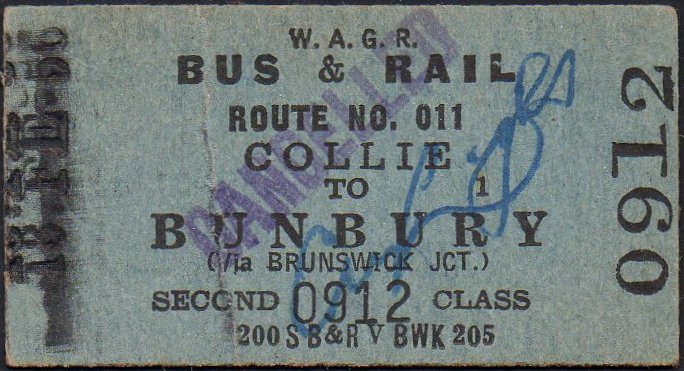 The WAGR bus replacement began on 24/11/ 1941 with the Perth/Kojonup service, a 159 mile journey with a Ford V8 towing a charcoal gas producer. This trend accelerated at the war's end, the highpoint (or is it lowpoint?) for bus replacement coming in 1953. The RRS had 60 to 70 buses at times during the 50’s. Quite a few were Passenger/Freighters that carried passengers, “Roadside Freight”, Royal Mail and Newspapers. The scan of a ticket above, from 1956, is headed 'BUS & RAIL', showing that integrated (one-company) passenger transport, and no doubt freight transport as well, was now well-established. A WAGR 'Map of Railway Road Services' can be found in Appendix 5, after the railway map.
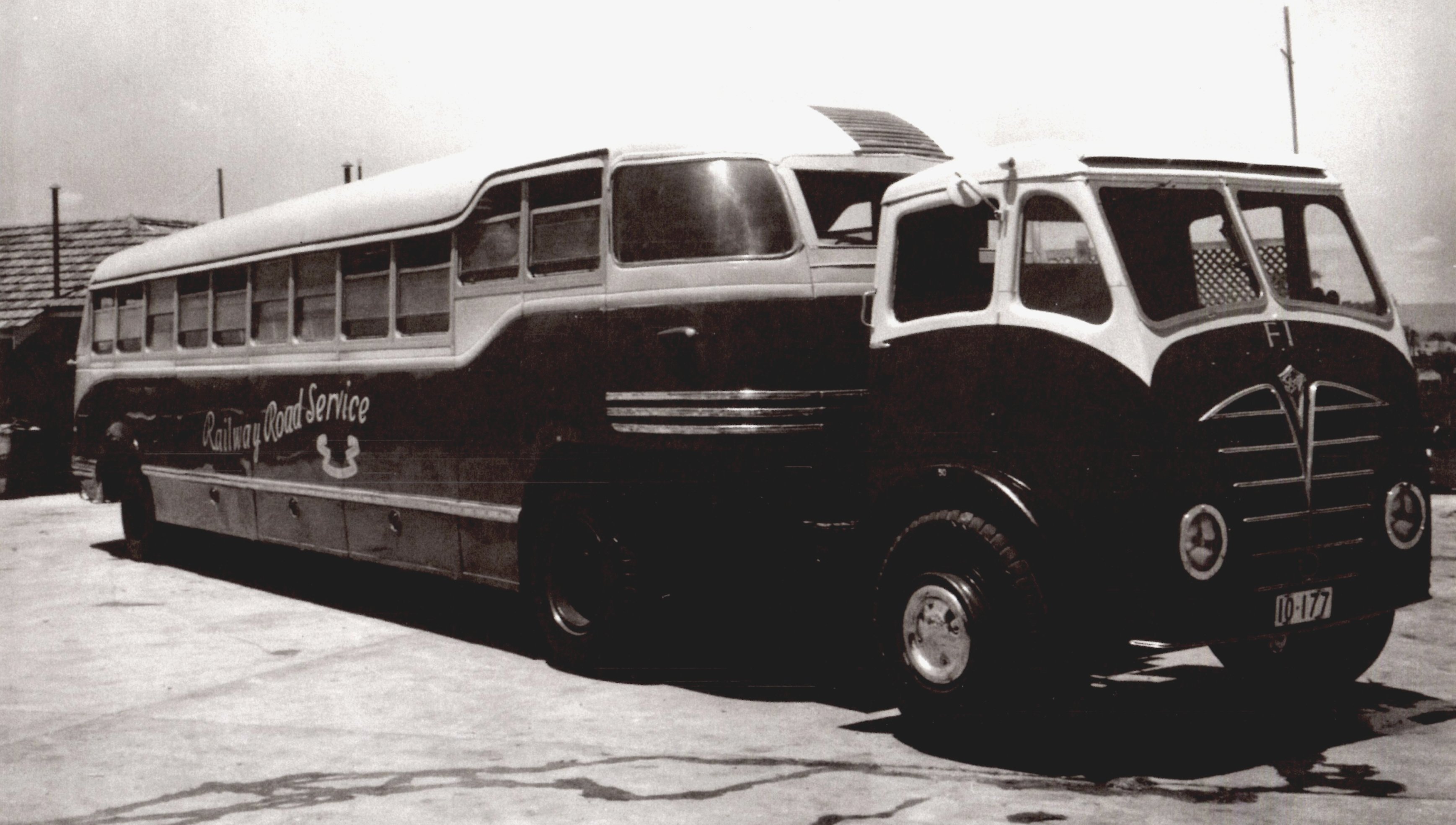 The image shows #F1, a sister bus to #F3 shown on the stamp. Image WAGR. . The bus body is not identical to that of #F3 found via the link higher up in this section, but it is broadly similar.
Railway parcels were carried by these 'replacement' buses for many years. However, in many cases, the closure of the railway to passengers led to the demise of the smaller towns and hamlet-size communities that the lines served and, as a consequence, their stations were closed entirely, leading to an ever-diminishing number of station names through the Third SERIES stamps.
With the rearrangement that led to the 'Total West' road freight contract in 1982, a joint Government / Private undertaking, the remaining WAGR Passenger/Freighter buses and road truck services were withdrawn and the WAGR's face-to-face handling of parcels with the public came to an end. Government owned Railway Road Coaches continue to operate as we write this in 2022, but it is now 40 years since 'railway parcels' were last carried.
.
The Diesel Railcar on the stamp is an ADE Class 446 (also known as Governor Class) diesel-electric railcar introduced circa 1930 on low passenger volume, mostly rural, lines. As far as we can ascertain, based on various online sources including this excellent one . . . . (opens in a new tab)
, there may only have been six in Western Australia Government Railways (WAGR) service - and they were named, with one word of each name being painted either side of the passenger door (the rearmost door on the train as seen on the stamp). These railcars were capable of hauling trailer cars, when required. The names, reproduced from the same webpage, which includes numerous images of the class, were:
ADE Class Railcar Names:
#446 : Governor Stirling
#447 : Governor Lawley
#448 : Governor Hutt
#449 : Governor Weld
#450 : Governor Hampton
#451 : Governor Bedford
The actual railcar illustrated cannot be identified through examination of the stamp.
.
The Steam Locomotive, in contrast to the railcar, was of a brand new (1950) addition to the WAGR fleet, the Pm Class. The class numbered 18 along with an additional 17 sister engines of the Pmr Class. Two of the Pm Class are preserved, #701 at the Bassendean Railway Museum in Perth and an image of it in situ is reproduced below:
The image shows #F1, a sister bus to #F3 shown on the stamp. Image WAGR. . The bus body is not identical to that of #F3 found via the link higher up in this section, but it is broadly similar.
Railway parcels were carried by these 'replacement' buses for many years. However, in many cases, the closure of the railway to passengers led to the demise of the smaller towns and hamlet-size communities that the lines served and, as a consequence, their stations were closed entirely, leading to an ever-diminishing number of station names through the Third SERIES stamps.
With the rearrangement that led to the 'Total West' road freight contract in 1982, a joint Government / Private undertaking, the remaining WAGR Passenger/Freighter buses and road truck services were withdrawn and the WAGR's face-to-face handling of parcels with the public came to an end. Government owned Railway Road Coaches continue to operate as we write this in 2022, but it is now 40 years since 'railway parcels' were last carried.
.
The Diesel Railcar on the stamp is an ADE Class 446 (also known as Governor Class) diesel-electric railcar introduced circa 1930 on low passenger volume, mostly rural, lines. As far as we can ascertain, based on various online sources including this excellent one . . . . (opens in a new tab)
, there may only have been six in Western Australia Government Railways (WAGR) service - and they were named, with one word of each name being painted either side of the passenger door (the rearmost door on the train as seen on the stamp). These railcars were capable of hauling trailer cars, when required. The names, reproduced from the same webpage, which includes numerous images of the class, were:
ADE Class Railcar Names:
#446 : Governor Stirling
#447 : Governor Lawley
#448 : Governor Hutt
#449 : Governor Weld
#450 : Governor Hampton
#451 : Governor Bedford
The actual railcar illustrated cannot be identified through examination of the stamp.
.
The Steam Locomotive, in contrast to the railcar, was of a brand new (1950) addition to the WAGR fleet, the Pm Class. The class numbered 18 along with an additional 17 sister engines of the Pmr Class. Two of the Pm Class are preserved, #701 at the Bassendean Railway Museum in Perth and an image of it in situ is reproduced below:
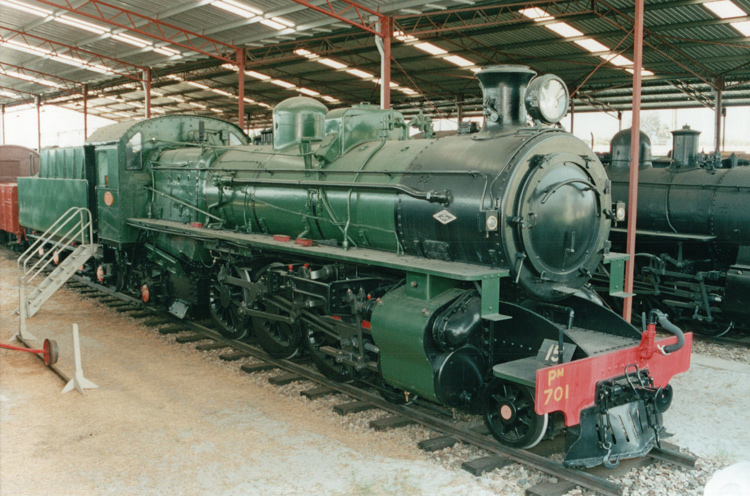 These Pacific locomotives were intended for fast passenger trains but, due to poor riding, were soon relegated to less glamorous duties. The first was withdrawn in 1970 and none saw service into 1973. Four of the Pmr class are also still extant at various locations.
End of Appendix 2
.
.
These Pacific locomotives were intended for fast passenger trains but, due to poor riding, were soon relegated to less glamorous duties. The first was withdrawn in 1970 and none saw service into 1973. Four of the Pmr class are also still extant at various locations.
End of Appendix 2
.
.
APPENDIX 3 : Dates of Issue Analysis through Dated Cancellations. (Also : Cancellation Styles)
Ideally, one would have the WAGR paperwork to help establish what was ordered / printed when, but this seems to be lacking. The blank stamps would have been printed in quantity and we do not know how many reprints of these were done. Quite when the value and red text were added is not clear either. Even with this red text added, this would still be a blank, just more advanced. It is with the adding of the station name and its dispatch to a station that the stamp is 'issued'.
This is naturally, therefore, the date we need, but the issue dates for the Third SERIES have traditionally been rather vague in most philatelic literature - and especially in catalogues. However, much can be established with reasonable confidence through a study of the postmarks. It does require quite a quantity of them, though, since not all clerks were either correct or tidy with their cancelling.
In order to establish the likely dates of the three Issues, we home in principally on the EARLIEST dates known in each case. From that we can extrapolate. The rate at which a new Issue is found cancelled with early-date postmarks over a wide expanse of territory and on different face values provides good evidence. The earliest date discovered for a new Issue probably all but mirrors the last date of issue for the previous issue. Proof of this is impossible without headquarters paperwork, since the previous issue's stamps could, and did, remain in use for months in many case and occasionally for years.
Through a study of legibly-dated stamps on each new issue, one finds that from the time that the first stamp of a new issue appears, they are becoming quite common after 4-6 months. Within a year, they may significantly outnumber the previous issue. This may sound slow but this is not a market where huge quantities of parcels are being handled evenly across the network. With stamps scattered over a large number of offices with wildly varying parcel traffic, it is a reasonably rapid progression.
Orders for new stamps from some stations would not have been a frequent occurrence, as stocks were ofted depleted only very slowly. Indeed, aberrant (late) dates on all Issues of the Third SERIES stamps are found, typically of course from low-volume locations with the good fortune to have survived the cull of stations.
The overall picture appears to be one of conformity, once a new font was selected. We note that when the date-stamps were changed in late February / early March 1952, they were being used, virtually without exception, network-wide within a few weeks. This suggests that once a policy was adopted, it was efficiently implemented by the WAGR. The study of postmarks also points strongly towards a structured, rather than a random, changeover between Issues.
Based on this, we have suggested dates of issue for the Three Issues of the Third SERIES down to within one month. This is not, and can perhaps never be, written in stone. A month earlier for the Second Issue is quite plausible but a little less certainty surrounds our Third Issue dates.
Whilst we recognize that it would have been possible to issue stamps concurrently using more than one Alphabet, there is little to support such a theory. However, the door is open to greater doubt about the transition from the Third Issue of the Third SERIES to the First Issue of the Fourth SERIES because they used the same Alphabet, as shown in the CLAREMONT piece in Appendix 1. It is hard to find evidence that blanks of both designs were not being printed with station names concurrently, at least for a time, albeit acknowledging that WAGR generally appears to have been run more strictly than that.
To add one final comment, we should mention that PERTH station stamps and cancellations may have more information to give up than we have had time to investigate.
First & Second SERIES Cancellations.
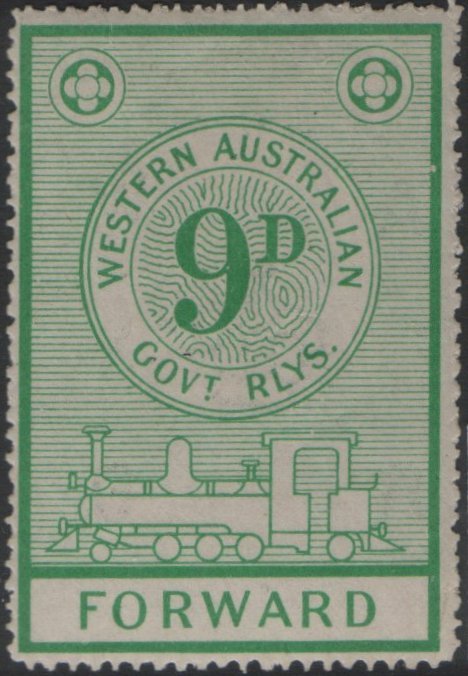

 The 2nd, 3rd & 5th (used) stamps above are from the 1st and 2nd SERIES cancelled with a station numeral postmark. None of these three stamps are dated, which is true of a large majority of the used examples in these designs. The 3d with a simple 'CANCELLED' is, Dave Elsmore advises us, a specially-produced obliterator for stamps known to have been prepared, inter alia, for privilege packs to be presented to dignitaries.
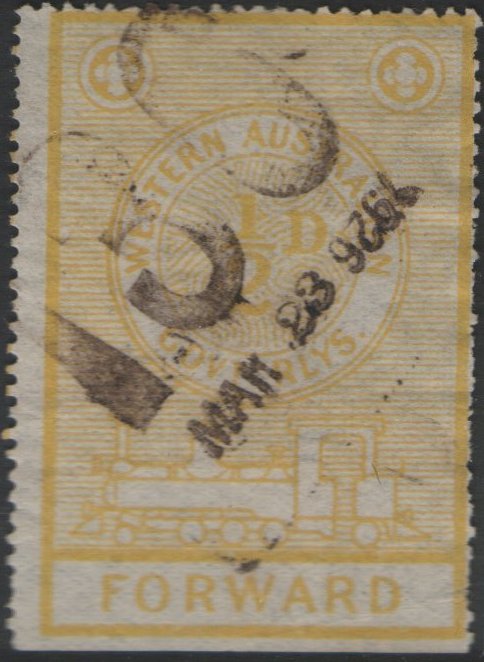

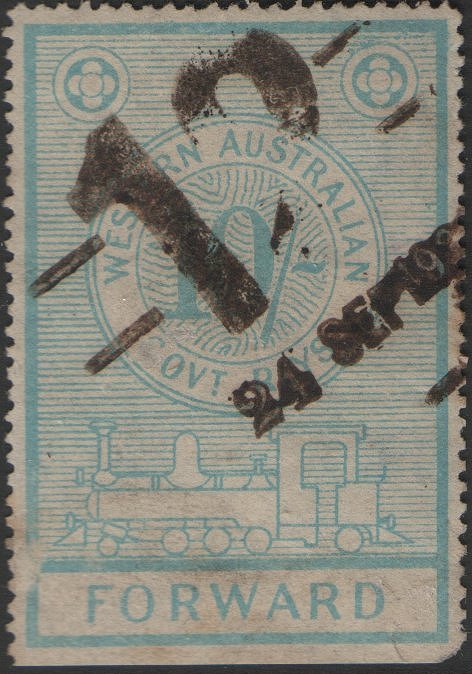 Displayed a little larger, all the above First/Second SERIES stamps have both the station numeral cancel AND a small dated handstamp. Why only a small proportion of the stamps have additional date-stamp is unclear, but we have not had access to sufficient material of the earlier SERIES to investigate this more deeply. It is possible that many clerks did not see the need to add the date to all the stamps on a parcel.
Third SERIES stamps are more complex to produce, requiring regular printings of station names in response to requests from the stations. Whilst this might have added to the workload at Head Office and at the Government Printers' where the station names were added on instruction from the WAGR Head Office, it should immediately have simplified the work of clerks out in the field. There was no longer any need to identify the station of origin by use of the numeral obliterator, at least on the new stamps.
It may well have been the significant numbers of Second SERIES stamps remaining in use at many stations that prompted a delay of many months in issuing new (larger) date stamps, since station obliterators would still have been needed on old Second SERIES adhesives. Having two types of cancellation in service together, to be used according to the stamp design, would no doubt have led both to inconvenience and error. This led to the continuation of the old two-stage cancelling system on the new Third SERIES stamps for over six months and they are more interesting than the rather uninspiring large date-stamps that followed, from Spring 1952 becoming the norm for the rest of the life of the First Issue and for all Second and Third Issue stamps of the Third SERIES.
We have found no example of a Second Issue (Alphabet B) stamp with the 'obliterator + dater' cancellation combination; all such markings are limited to First Issue stamps and only quite a small percentage of those have the old-style obliterations. In fact, statistically, if the roll-out of the new designs was immediate and universal, it seems, at first sight, that we might be looking at a shortfall in First Issue stamps in the period August 1951 to November / December 1951. We suspect two factors may account for this:
Factor 1. Pieces such as the one shown immediately below, few of which, sadly, seem to have survived:
Displayed a little larger, all the above First/Second SERIES stamps have both the station numeral cancel AND a small dated handstamp. Why only a small proportion of the stamps have additional date-stamp is unclear, but we have not had access to sufficient material of the earlier SERIES to investigate this more deeply. It is possible that many clerks did not see the need to add the date to all the stamps on a parcel.
Third SERIES stamps are more complex to produce, requiring regular printings of station names in response to requests from the stations. Whilst this might have added to the workload at Head Office and at the Government Printers' where the station names were added on instruction from the WAGR Head Office, it should immediately have simplified the work of clerks out in the field. There was no longer any need to identify the station of origin by use of the numeral obliterator, at least on the new stamps.
It may well have been the significant numbers of Second SERIES stamps remaining in use at many stations that prompted a delay of many months in issuing new (larger) date stamps, since station obliterators would still have been needed on old Second SERIES adhesives. Having two types of cancellation in service together, to be used according to the stamp design, would no doubt have led both to inconvenience and error. This led to the continuation of the old two-stage cancelling system on the new Third SERIES stamps for over six months and they are more interesting than the rather uninspiring large date-stamps that followed, from Spring 1952 becoming the norm for the rest of the life of the First Issue and for all Second and Third Issue stamps of the Third SERIES.
We have found no example of a Second Issue (Alphabet B) stamp with the 'obliterator + dater' cancellation combination; all such markings are limited to First Issue stamps and only quite a small percentage of those have the old-style obliterations. In fact, statistically, if the roll-out of the new designs was immediate and universal, it seems, at first sight, that we might be looking at a shortfall in First Issue stamps in the period August 1951 to November / December 1951. We suspect two factors may account for this:
Factor 1. Pieces such as the one shown immediately below, few of which, sadly, seem to have survived:
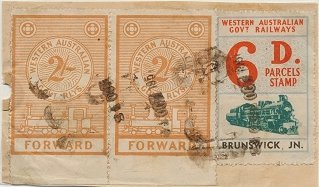
 Left : October 1951 : Scan from the online archive of Abacus Auctions of Melbourne, Sale 168, reproduced by kind permission. A combination franking of a Second SERIES 2/- pair and a Third SERIES First Issue 6d, demonstrating that the changeover was gradual and dual franking tolerated, possibly until all old stocks were used up. Note the wide bottom margin on the Second SERIES pair, an occasional feature on WAGR stamps that continued into the Third SERIES.
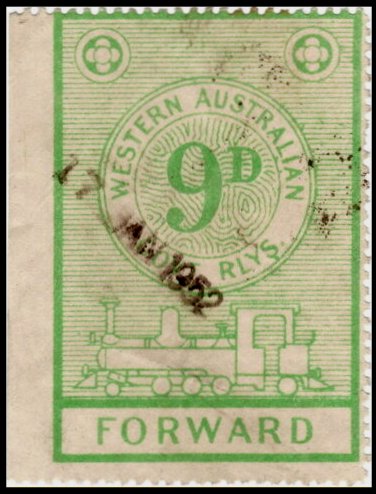
Right : WAGR 'No Waste' philosophy : A Second SERIES 9d finding employment into 1952 (17 Jan).
Factor 2. There are a number of First Issue (Third SERIES) stamps in the collection obliterated with black splodges of ink that would appear to originate from old station numeral cancellers, indecipherable in any detail and with no sign of a small date-stamp.
.
Third SERIES Cancellations.
The earliest date that we have found, and that is beyond question, for usage of a Third SERIES issue is September 4th 1951 on a Welshpool 9d stamp, an image sent to us by a correspondent and shown in Appendix 4(v).
Left : October 1951 : Scan from the online archive of Abacus Auctions of Melbourne, Sale 168, reproduced by kind permission. A combination franking of a Second SERIES 2/- pair and a Third SERIES First Issue 6d, demonstrating that the changeover was gradual and dual franking tolerated, possibly until all old stocks were used up. Note the wide bottom margin on the Second SERIES pair, an occasional feature on WAGR stamps that continued into the Third SERIES.
Right : WAGR 'No Waste' philosophy : A Second SERIES 9d finding employment into 1952 (17 Jan).
Factor 2. There are a number of First Issue (Third SERIES) stamps in the collection obliterated with black splodges of ink that would appear to originate from old station numeral cancellers, indecipherable in any detail and with no sign of a small date-stamp.
.
Third SERIES Cancellations.
The earliest date that we have found, and that is beyond question, for usage of a Third SERIES issue is September 4th 1951 on a Welshpool 9d stamp, an image sent to us by a correspondent and shown in Appendix 4(v).
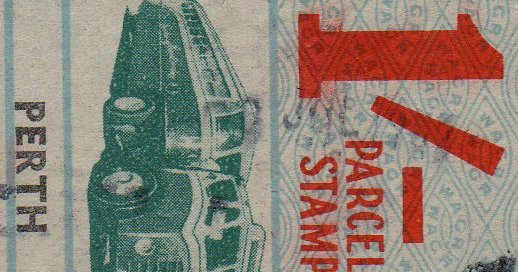
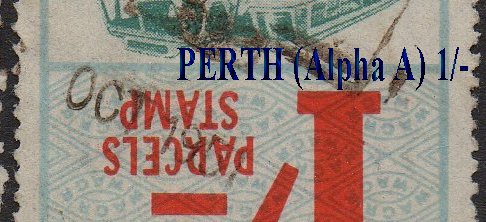
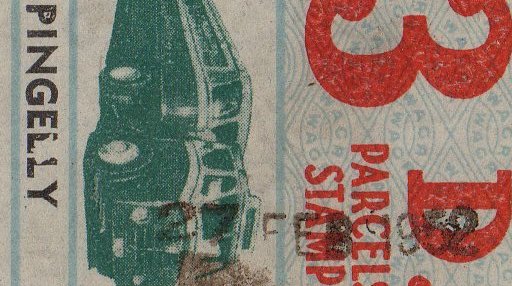 Within the collection, there are numerous old-style date cancellations but many of them are partially illegible, the year in particular. There is a PERTH stamp with very poorly defined year (shown , left, above) which may be from July 28th 1951 but close examination favours a very late usage of such a cancel, July 1952. There was also a Perth 1/- with a very clear 27 AUG but a complete blank in place of the year. We strongly suspect this will be a 1951 usage, and, although this cannot be proved, we think it very likely that clear August usages will exist somewhere. The centre stamp in the scan is from October 1951 whilst the third scan shows what we believe was one of the very last official days for this form of cancellation, 27th February 1952.
First Issue (Alphabet A) EARLIEST Stamps with small date-stamps : Sample Size 854 stamps:
Reported Date of Issue : 1st August 1951. We have been sent an old photocopy from an article but neither our corespondent nor we have been able to discover the source, which quotes the date of Issue for the First Issue as August 1st 1951. As mentioned above, the earliest 100% certain date of use of which we are aware is 4 Sep 1951 on a Welshpool 9d, a stamp NOT in this collection.
We have found the following small date-stamps in this collection on First Issue stamps, where at least the month was legible:
July (year not legible) : Qty 1 : on Perth 1/- (20th, maybe 30th July, but year more likely to be 1952);
August (no year shown) : Qty 1 : on Perth 1/- (27th Aug, space for year completely blank);
October 1951 : Qty 5 : on Perth 3d (29 Oct); on Perth 9d (19 Oct); on Perth 1/- (Oct 6, 16 or 26);
November 1951 : Qty 1 : on Brookton 1/3 (uncertain);
December 1951 : Qty 5 : on Perth 3d; on Maylands 9d (12th) ; on Maylands 2/- (12th); on Perth 2/-; on Maylands 4/- (12th)
January 1952 : Qty 6 : on Bunbury 6d; on Bunbury 1/-; on Perth 2/- (3); on Perth 4/- ;
February 1952 : Qty 11 : on Bridgetown 3d(2); on Pingelly 3d (27th); on Perth 9d pair; on Perth 1/-; on Perth 1/6; on Fremantle 2/-; on Pingelly 2/- pair (27th); on Perth 4/-
March 1952 : Qty 4 : on Perth 9d (19? March); on Perth 1/- (19? March);
Illegible on : West Perth 3d; on Perth 9d;
Most information points to August 1951 as the most likely month of issue for these stamps and we have used this throughout.
During their early reign, First Issue stamps can be found just with station numeral cancels in somewhat greater numbers than those with station cancel AND small date-stamp.
From March 3rd 1952 onwards, a Monday, we find examples of the new LARGE DATED canceller and this is the cancellation on the vast majority of stamps from mid-March 1952 onwards. Indeed, by April, the small date-stamp is scarcely found at all, suggesting rapid and widespread distribution of the new cancellers. Looking at the stamps in this collection, it seems fair to suggest that the official changeover to the large dated canceller took place over the weekend of March 1st/2nd 1952. This was a leap year, so the preceding Friday would have been February 29th, a neat end-of-week, end-of-month changeover target.
Only on Perth stamps do we see any evidence that the old-style cancellers may have been used occasionally beyond April 1952 but on all these stamps the year has been hard to confirm. Perth, in fact, seems to be the source of many of the exceptions in the methods of cancelling the stamps.
Within the collection, there are numerous old-style date cancellations but many of them are partially illegible, the year in particular. There is a PERTH stamp with very poorly defined year (shown , left, above) which may be from July 28th 1951 but close examination favours a very late usage of such a cancel, July 1952. There was also a Perth 1/- with a very clear 27 AUG but a complete blank in place of the year. We strongly suspect this will be a 1951 usage, and, although this cannot be proved, we think it very likely that clear August usages will exist somewhere. The centre stamp in the scan is from October 1951 whilst the third scan shows what we believe was one of the very last official days for this form of cancellation, 27th February 1952.
First Issue (Alphabet A) EARLIEST Stamps with small date-stamps : Sample Size 854 stamps:
Reported Date of Issue : 1st August 1951. We have been sent an old photocopy from an article but neither our corespondent nor we have been able to discover the source, which quotes the date of Issue for the First Issue as August 1st 1951. As mentioned above, the earliest 100% certain date of use of which we are aware is 4 Sep 1951 on a Welshpool 9d, a stamp NOT in this collection.
We have found the following small date-stamps in this collection on First Issue stamps, where at least the month was legible:
July (year not legible) : Qty 1 : on Perth 1/- (20th, maybe 30th July, but year more likely to be 1952);
August (no year shown) : Qty 1 : on Perth 1/- (27th Aug, space for year completely blank);
October 1951 : Qty 5 : on Perth 3d (29 Oct); on Perth 9d (19 Oct); on Perth 1/- (Oct 6, 16 or 26);
November 1951 : Qty 1 : on Brookton 1/3 (uncertain);
December 1951 : Qty 5 : on Perth 3d; on Maylands 9d (12th) ; on Maylands 2/- (12th); on Perth 2/-; on Maylands 4/- (12th)
January 1952 : Qty 6 : on Bunbury 6d; on Bunbury 1/-; on Perth 2/- (3); on Perth 4/- ;
February 1952 : Qty 11 : on Bridgetown 3d(2); on Pingelly 3d (27th); on Perth 9d pair; on Perth 1/-; on Perth 1/6; on Fremantle 2/-; on Pingelly 2/- pair (27th); on Perth 4/-
March 1952 : Qty 4 : on Perth 9d (19? March); on Perth 1/- (19? March);
Illegible on : West Perth 3d; on Perth 9d;
Most information points to August 1951 as the most likely month of issue for these stamps and we have used this throughout.
During their early reign, First Issue stamps can be found just with station numeral cancels in somewhat greater numbers than those with station cancel AND small date-stamp.
From March 3rd 1952 onwards, a Monday, we find examples of the new LARGE DATED canceller and this is the cancellation on the vast majority of stamps from mid-March 1952 onwards. Indeed, by April, the small date-stamp is scarcely found at all, suggesting rapid and widespread distribution of the new cancellers. Looking at the stamps in this collection, it seems fair to suggest that the official changeover to the large dated canceller took place over the weekend of March 1st/2nd 1952. This was a leap year, so the preceding Friday would have been February 29th, a neat end-of-week, end-of-month changeover target.
Only on Perth stamps do we see any evidence that the old-style cancellers may have been used occasionally beyond April 1952 but on all these stamps the year has been hard to confirm. Perth, in fact, seems to be the source of many of the exceptions in the methods of cancelling the stamps.
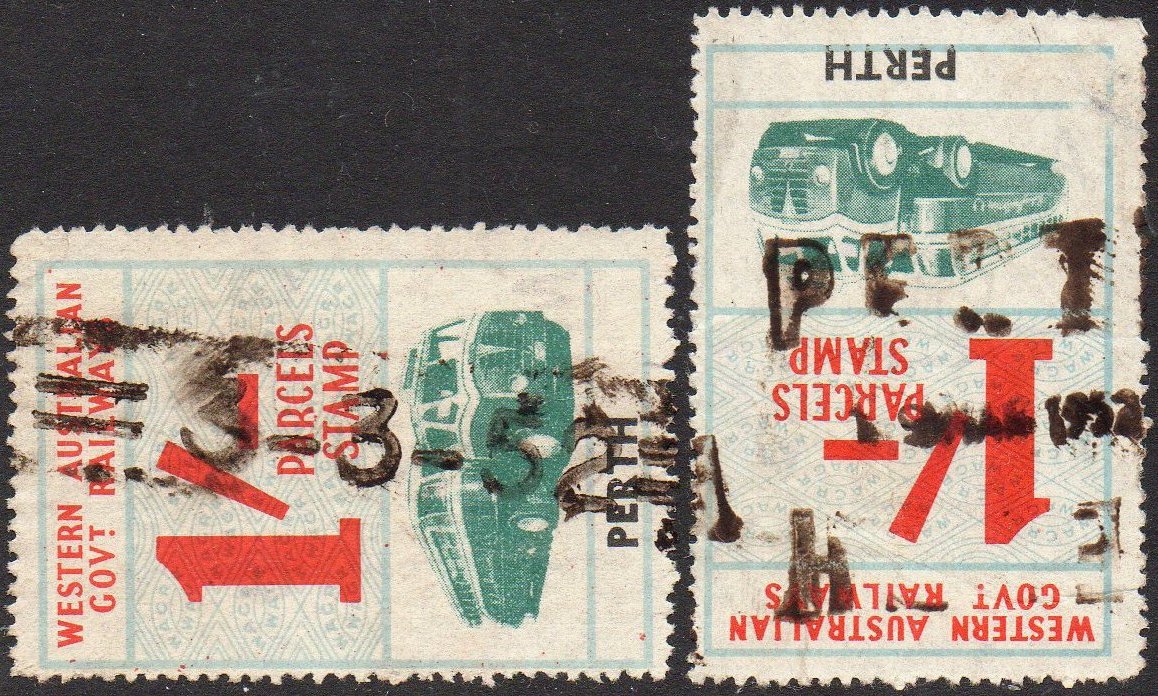 Above are two further First Issue PERTH stamps. The left stamp (Monday) 3-3-52 is the earliest example we have found of the new canceller in use. The right-hand stamp is used on 19 MAR 1952 and is one of a number of stamps from Perth (and also one from West Perth) in the collection using a combined town-name and date stamp. This style appears occasionally over quite an extended period. It is a non-standard format and is discussed more fully in Appendix 4(ii).
As one would expect, we have not found any stamps with a combination of both a small dated handstamp and the newly-introduced large dated canceller brought into use from early March 1952. The few small date-stamps lingering on after March 1952 have all been on stamps obliterated using old-style station numeral cancels.
.
Second Issue (Alphabet B) Stamps : EARLIEST found dates (all cancelled with the Large Dated Canceller) : Sample Size 781 Stamps
Donnybrook 2/6 : 27/11/52 & 16/12/52 & 15/1/53
Albany 1/- (?/12/52)
Yarloop 1/3 (15?/1/53 - two stamps);
Bunbury 6d (28/1/53)
Harvey 1/3 (2/2/53); (probably also 27/1/53);
Perth 9d (19/2/53)
Above are two further First Issue PERTH stamps. The left stamp (Monday) 3-3-52 is the earliest example we have found of the new canceller in use. The right-hand stamp is used on 19 MAR 1952 and is one of a number of stamps from Perth (and also one from West Perth) in the collection using a combined town-name and date stamp. This style appears occasionally over quite an extended period. It is a non-standard format and is discussed more fully in Appendix 4(ii).
As one would expect, we have not found any stamps with a combination of both a small dated handstamp and the newly-introduced large dated canceller brought into use from early March 1952. The few small date-stamps lingering on after March 1952 have all been on stamps obliterated using old-style station numeral cancels.
.
Second Issue (Alphabet B) Stamps : EARLIEST found dates (all cancelled with the Large Dated Canceller) : Sample Size 781 Stamps
Donnybrook 2/6 : 27/11/52 & 16/12/52 & 15/1/53
Albany 1/- (?/12/52)
Yarloop 1/3 (15?/1/53 - two stamps);
Bunbury 6d (28/1/53)
Harvey 1/3 (2/2/53); (probably also 27/1/53);
Perth 9d (19/2/53)
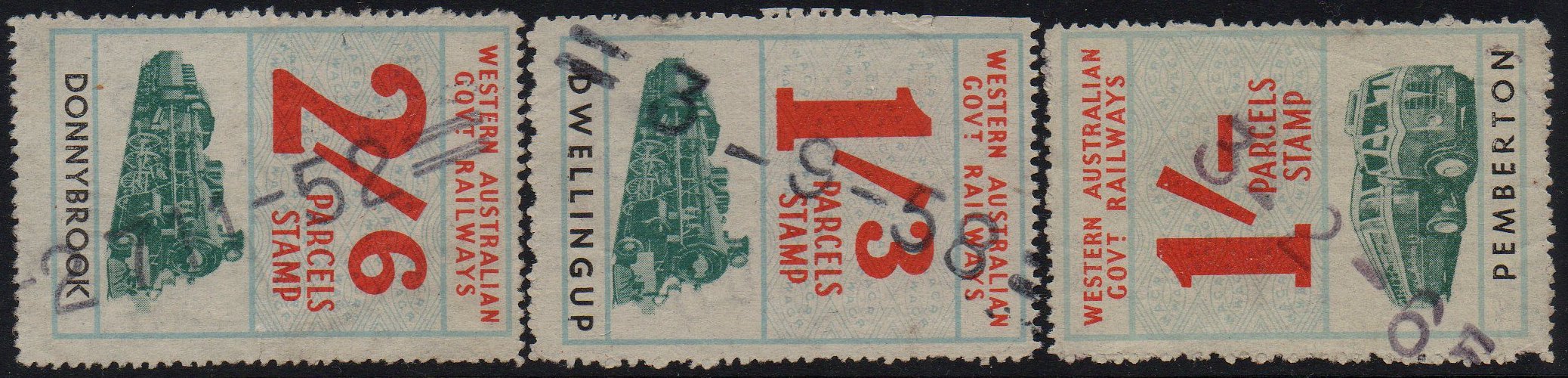 The earliest date found on a Second Issue stamp in the collection (left, 27-11-52), a typical late date (centre, 9/58) and a very late outlier, February 1965. Clerical errors are always a suspicion with dates that are so far out of field as the last one but, equally, it may very well be a true date of use.
Second Issue Variety : ROULETTED x PERF : Sample Size 13 stamps
All the legible cancellations we have seen (large dated canceller) cover the period January 1960 to January 1961 but the sample size is small at six stamps
.
Third Issue (Alphabet C, diagonal) Stamps : EARLIEST found dates (again all cancelled with the Large Dated Canceller) :
Sample Size 170 Stamps
Bunbury 1/9 (?/7/57)
West Perth 1/6 (16/12/57) (day not fully clear)
Freemantle 1/6 (22/2/58)
Northam 4/- (25/2/58 probably)
Harvey 1/3 (?/2/58)
Mt. Magnet 1/- (19/3/58)
The earliest date found on a Second Issue stamp in the collection (left, 27-11-52), a typical late date (centre, 9/58) and a very late outlier, February 1965. Clerical errors are always a suspicion with dates that are so far out of field as the last one but, equally, it may very well be a true date of use.
Second Issue Variety : ROULETTED x PERF : Sample Size 13 stamps
All the legible cancellations we have seen (large dated canceller) cover the period January 1960 to January 1961 but the sample size is small at six stamps
.
Third Issue (Alphabet C, diagonal) Stamps : EARLIEST found dates (again all cancelled with the Large Dated Canceller) :
Sample Size 170 Stamps
Bunbury 1/9 (?/7/57)
West Perth 1/6 (16/12/57) (day not fully clear)
Freemantle 1/6 (22/2/58)
Northam 4/- (25/2/58 probably)
Harvey 1/3 (?/2/58)
Mt. Magnet 1/- (19/3/58)
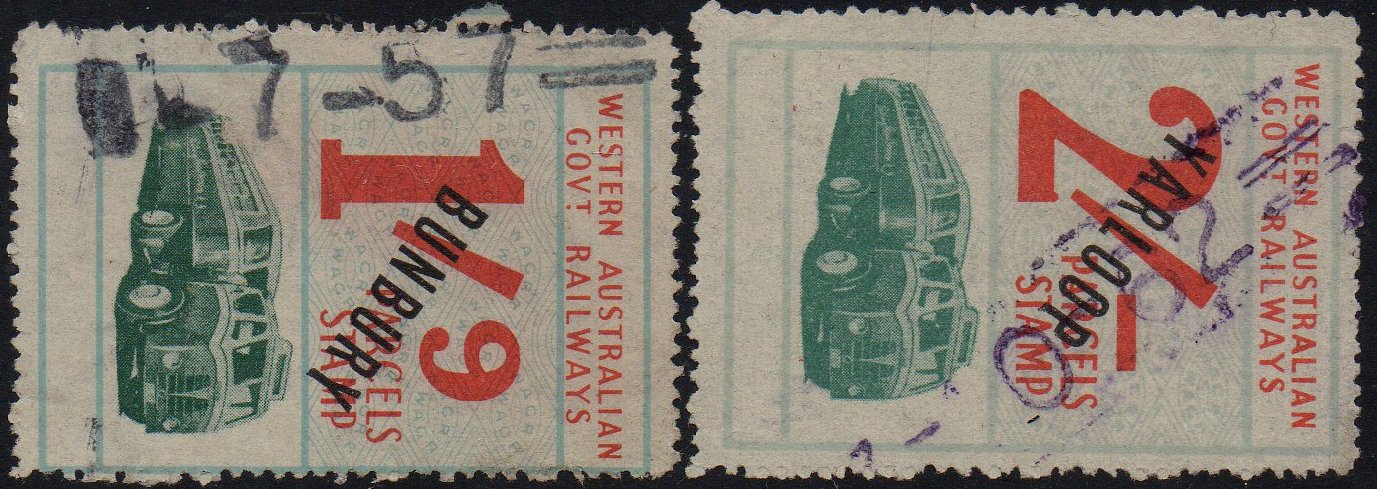 The earliest cancellation found in the collection and quite a late one from October 1962. Once again there is one big outlier, a Picton Junction 3d block/4 used 22-6-65, a block that is illustrated in Appendix 4(i).
Here is a list of the LATEST dates seen in the Collection for the Three Issues of the Third SERIES:
First Issue : LATEST Usage :
We have stamps used from Koorda (5/7/54) and Wagin (8/8/54) but even 1953 usages are surprisingly thin on the ground.
Second Issue : LATEST Usage :
Whilst cancellations up to 1957/58 are fairly plentiful, the numbers drop off sharply thereafter, with just the odd 1960 date noted. Exceptionally, we have the stamp from Pemberton shown above (3/2/65).
Third Issue: LATEST Usage :
We spotted only three legible cancellations after 1960, Beverley 4/- (26/1/61), Yarloop 2/- (?/10/62) and a Block/4 3d stamps from Picton Junction (22/6/65)
.
ESTIMATED DATES OF ISSUE FOR ALL THREE ISSUES OF THE THIRD SERIES :
First Issue : c. August 1951 - c. November 1952
Second Issue : c. November 1952 - c. July 1957
Third Issue : c. July 1957 - c. late 1959/early 1960
We think it unlikely any stocks with the station name separately printed would have been held in readiness, even for the high-usage stations. The multiplicity of possible combinations of face value and station would seem to preclude such a practice. Therefore a change of alphabet could in theory have been achieved almost overnight for all values and stations, but this would not have been reflected in the stamp usage, as each station used up old stock before applying for replacements.
.
Cancellation Colours & Styles :
Cancellations are typically in Black, though not infrequently in shades of Violet. Magenta is occasionally found and is quite scarce. The violet cancellations are not very frequent on First Issue stamps but widespread thereafter.
The style of the cancellation, as already discussed, moves quickly from the station numeral obliterator + small dated handstamp (where applied) to the large dated handstamp in widespread use within about seven months of the first stamps in this Third SERIES appearing. They are often faded and illegible either in whole or in part, some of them clearly becoming worn over time.
These new handstamps exist both framed and unframed, with the unframed version becoming increasingly common over the three issues. Indeed, framed cancellations like those shown below on the First Issue are uncommon by the Third Issue.
The earliest cancellation found in the collection and quite a late one from October 1962. Once again there is one big outlier, a Picton Junction 3d block/4 used 22-6-65, a block that is illustrated in Appendix 4(i).
Here is a list of the LATEST dates seen in the Collection for the Three Issues of the Third SERIES:
First Issue : LATEST Usage :
We have stamps used from Koorda (5/7/54) and Wagin (8/8/54) but even 1953 usages are surprisingly thin on the ground.
Second Issue : LATEST Usage :
Whilst cancellations up to 1957/58 are fairly plentiful, the numbers drop off sharply thereafter, with just the odd 1960 date noted. Exceptionally, we have the stamp from Pemberton shown above (3/2/65).
Third Issue: LATEST Usage :
We spotted only three legible cancellations after 1960, Beverley 4/- (26/1/61), Yarloop 2/- (?/10/62) and a Block/4 3d stamps from Picton Junction (22/6/65)
.
ESTIMATED DATES OF ISSUE FOR ALL THREE ISSUES OF THE THIRD SERIES :
First Issue : c. August 1951 - c. November 1952
Second Issue : c. November 1952 - c. July 1957
Third Issue : c. July 1957 - c. late 1959/early 1960
We think it unlikely any stocks with the station name separately printed would have been held in readiness, even for the high-usage stations. The multiplicity of possible combinations of face value and station would seem to preclude such a practice. Therefore a change of alphabet could in theory have been achieved almost overnight for all values and stations, but this would not have been reflected in the stamp usage, as each station used up old stock before applying for replacements.
.
Cancellation Colours & Styles :
Cancellations are typically in Black, though not infrequently in shades of Violet. Magenta is occasionally found and is quite scarce. The violet cancellations are not very frequent on First Issue stamps but widespread thereafter.
The style of the cancellation, as already discussed, moves quickly from the station numeral obliterator + small dated handstamp (where applied) to the large dated handstamp in widespread use within about seven months of the first stamps in this Third SERIES appearing. They are often faded and illegible either in whole or in part, some of them clearly becoming worn over time.
These new handstamps exist both framed and unframed, with the unframed version becoming increasingly common over the three issues. Indeed, framed cancellations like those shown below on the First Issue are uncommon by the Third Issue.
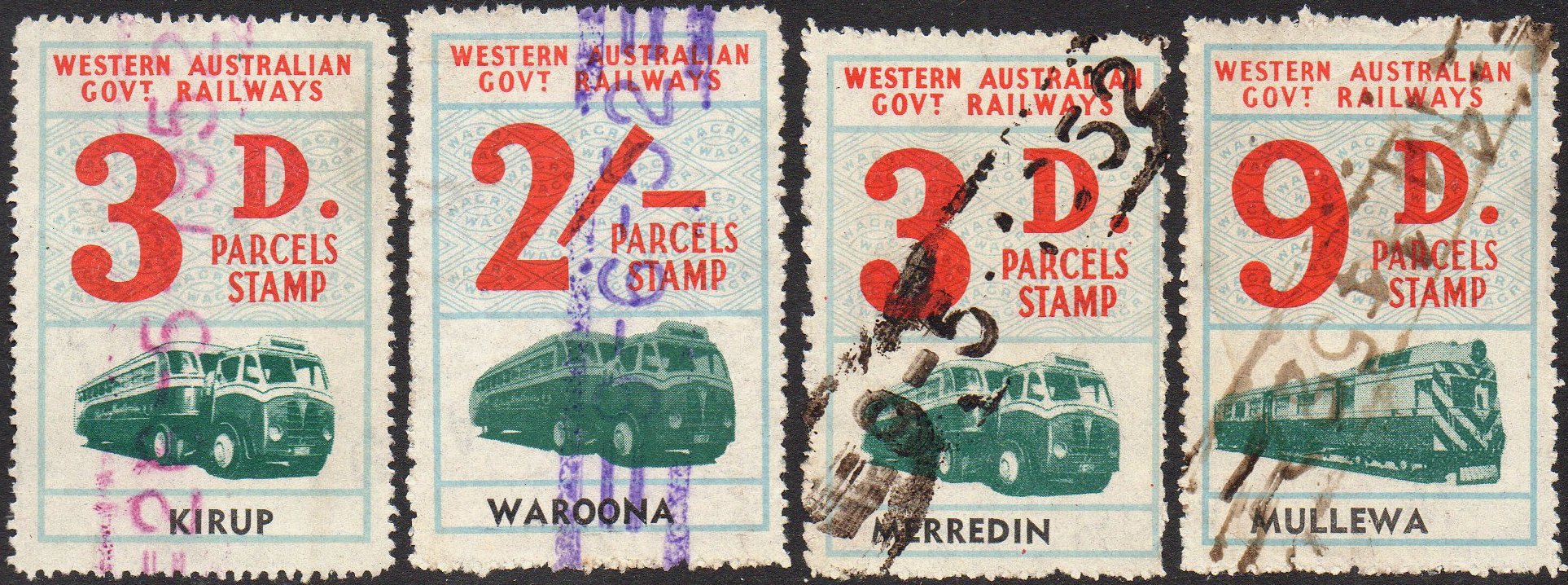
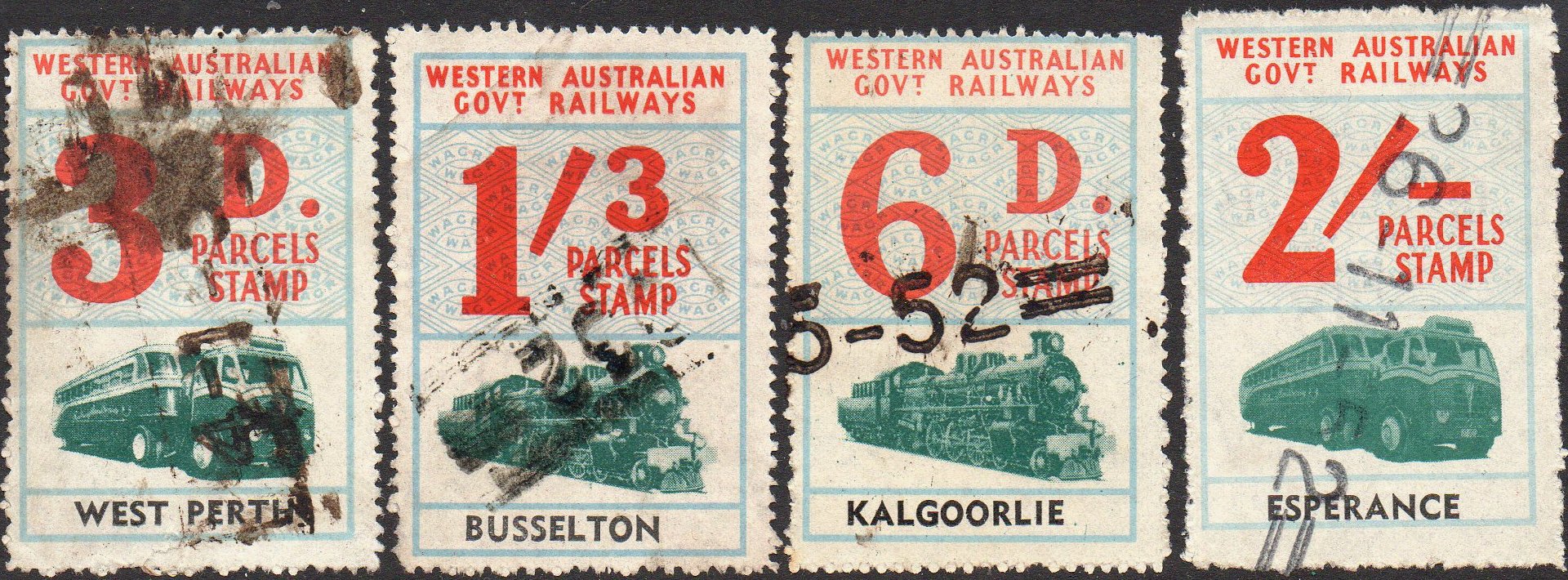 Eight stamps of the First Issue but the comments apply to all three issues. The first two stamps show Magenta and Violet cancels, both framed, and this is followed by four more framed cancels. The first two stamps on the bottom row show that the ends were also closed, although this may not have been universal for 'framed' cancels. The last two stamps show examples of unboxed cancels, found on the majority of the stamps.
Overall, other than for their dates, cancellation styles are generally not particularly interesting but there are a few very notable exceptions, which are described in Appendix 4, along with several other curiosities.
End of Appendix 3
Eight stamps of the First Issue but the comments apply to all three issues. The first two stamps show Magenta and Violet cancels, both framed, and this is followed by four more framed cancels. The first two stamps on the bottom row show that the ends were also closed, although this may not have been universal for 'framed' cancels. The last two stamps show examples of unboxed cancels, found on the majority of the stamps.
Overall, other than for their dates, cancellation styles are generally not particularly interesting but there are a few very notable exceptions, which are described in Appendix 4, along with several other curiosities.
End of Appendix 3
.
.
Appendix 4 : Curiosities & Private Company Stamps
Appendix 4 examines, fairly briefly, several more aspects of these stamps. Although it is likely that only a few of them will be of interest to most collectors, especially for those for whom this Third SERIES is just one small part of their wide-ranging collection, we present these curiosities, anomalies, observations and general nibbles to you whilst we have the chance.
The following features, in many cases found on just a few stamps in the collection or only reported to us by correspondents, are examined in the following order. For some selected features, we have included price suggestions:
(i) . Stamps in Multiples
(ii) . PERTH dated cancels
(iii) . Manuscript cancels
(iv) . Date Errors on cancels
(v) . STATION MASTER cancels
(vi) . Company Perfins
(vii) . BOANS LTD
(viii) . Wide left-hand margins on stamps
(ix) . Green Shades on Stamps
(x) . Red & Blue Shades on Stamps
(xi) . Text & Design Shifts (Register Errors of Green & Red colours.)
(xii) . Railway Parcel Rates Table (1951)
(xiii) . Specimen Stamps & Mint Stamps
(xiv) . Individual Station Names : Varieties
Note : In order to show cancellations more clearly in this Appendix, some stamp scans have been darkened.
(i) . Stamps in Multiples
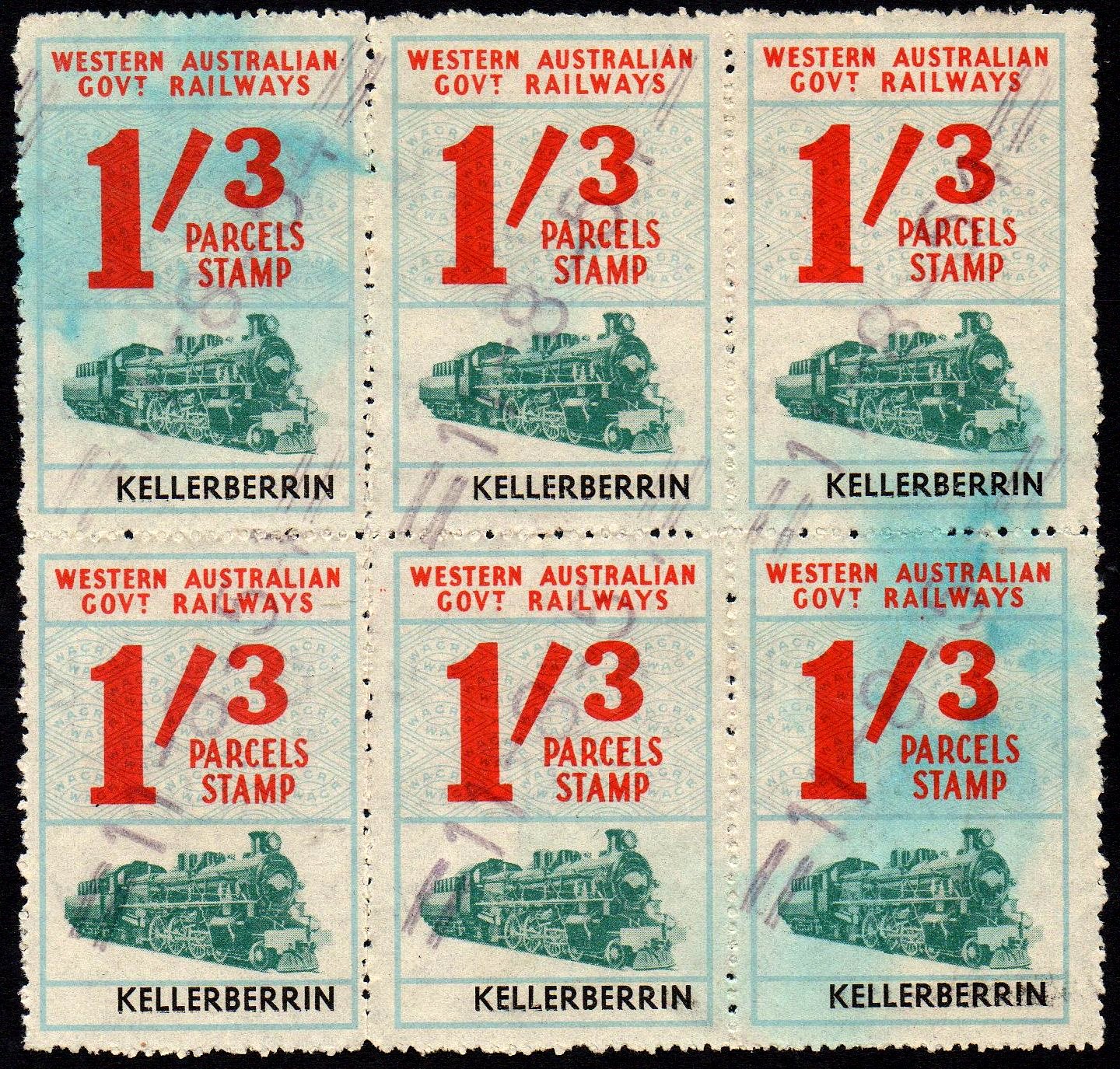
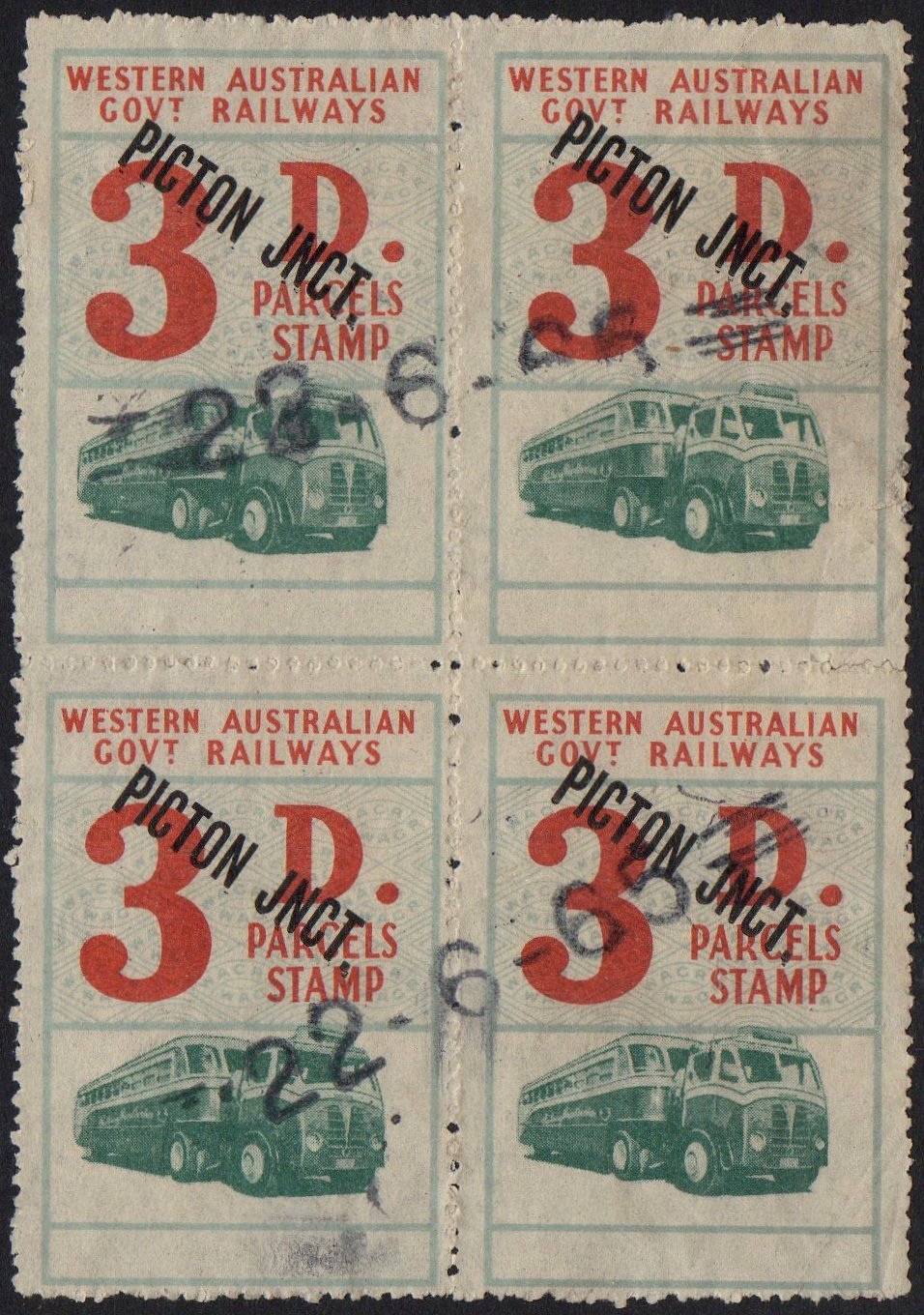 A Second Issue block/6 (11-8-54) and a Third Issue block/4, the latter with an exceptionally late usage, 22-6-65.
Previously in this article we have used scans of other multiples as section headings. Large multiples are not common, especially for any station other than Perth. They command a premium, relatively modest for pairs, perhaps 10%, rising perhaps to 15% for strips/3. A block/4 is always a favourite and may merit, say, an extra 33% with a similar premium on a block/6.
.
(ii) . PERTH dated cancels
We have already commented on the fact that more research may be worthwhile on the stamps and cancellations of Perth. The left stamp shown below is a West Perth stamp cancelled with a large size PERTH, presumably part of a WEST PERTH cancellation. The date stamp, although 1955, appears the same as that used per Feb/Mar 1952 when the station numeral + separate small date-stamp was in use. Strange.
The second stamp is one of several from PERTH in the collection which appear to be cancelled PERTH + Date in one strike, even though a station name is not required on the cancellation of these stamps. However, the vast majority of stamps from Perth are not cancelled with anything other than the date after March 1952, yet this one is used in 1959.
A Second Issue block/6 (11-8-54) and a Third Issue block/4, the latter with an exceptionally late usage, 22-6-65.
Previously in this article we have used scans of other multiples as section headings. Large multiples are not common, especially for any station other than Perth. They command a premium, relatively modest for pairs, perhaps 10%, rising perhaps to 15% for strips/3. A block/4 is always a favourite and may merit, say, an extra 33% with a similar premium on a block/6.
.
(ii) . PERTH dated cancels
We have already commented on the fact that more research may be worthwhile on the stamps and cancellations of Perth. The left stamp shown below is a West Perth stamp cancelled with a large size PERTH, presumably part of a WEST PERTH cancellation. The date stamp, although 1955, appears the same as that used per Feb/Mar 1952 when the station numeral + separate small date-stamp was in use. Strange.
The second stamp is one of several from PERTH in the collection which appear to be cancelled PERTH + Date in one strike, even though a station name is not required on the cancellation of these stamps. However, the vast majority of stamps from Perth are not cancelled with anything other than the date after March 1952, yet this one is used in 1959.
 These cancellations are not common - and may have been used in error. Valuation for clear cancels: WEST PERTH add 40% (minimum value A$65.00); PERTH add 20% (minimum value A$30.00).
.
(iii) . Manuscript cancels
These cancellations are not common - and may have been used in error. Valuation for clear cancels: WEST PERTH add 40% (minimum value A$65.00); PERTH add 20% (minimum value A$30.00).
.
(iii) . Manuscript cancels
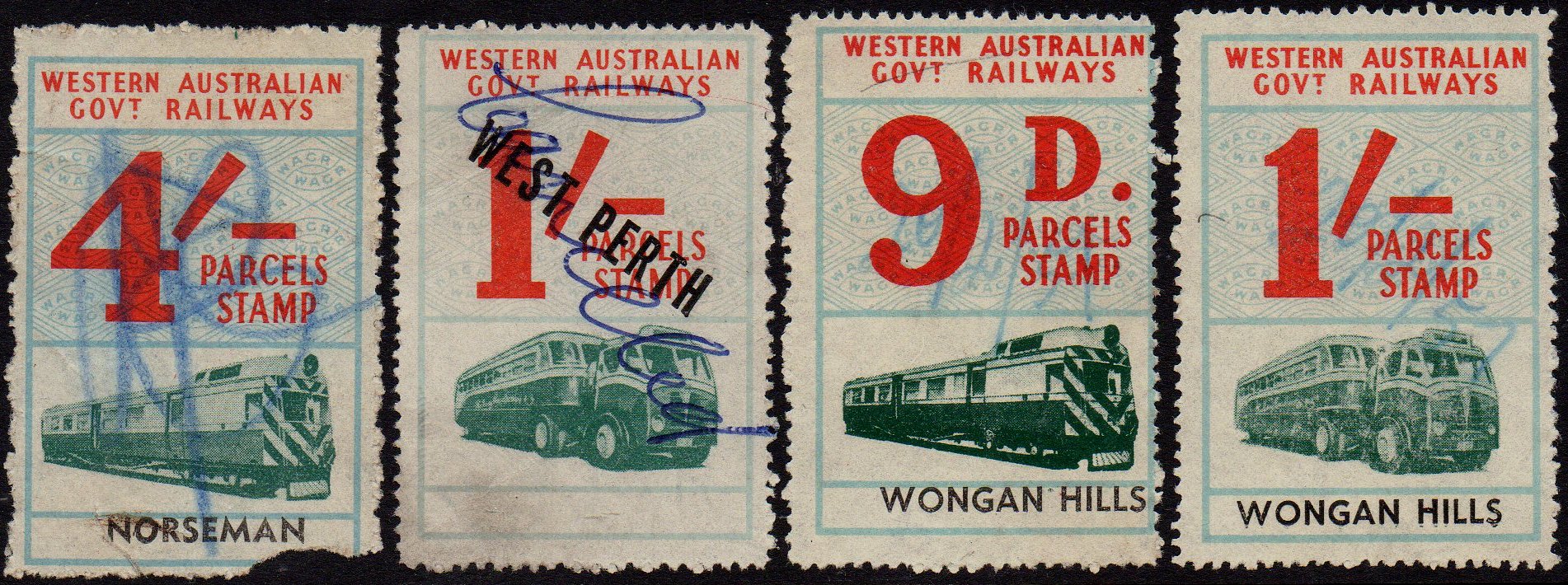 Stamps with manuscript cancellations in addition to some handstamped form of canceller are found occasionally. It is very unusual, though, to encounter manuscript cancellations only and just a handful were found in the collection. The Wongan Hills 9d and 1/- have the same date and were no doubt once united on the same parcel.
.
(iv) . Date Errors on cancels
Stamps with manuscript cancellations in addition to some handstamped form of canceller are found occasionally. It is very unusual, though, to encounter manuscript cancellations only and just a handful were found in the collection. The Wongan Hills 9d and 1/- have the same date and were no doubt once united on the same parcel.
.
(iv) . Date Errors on cancels
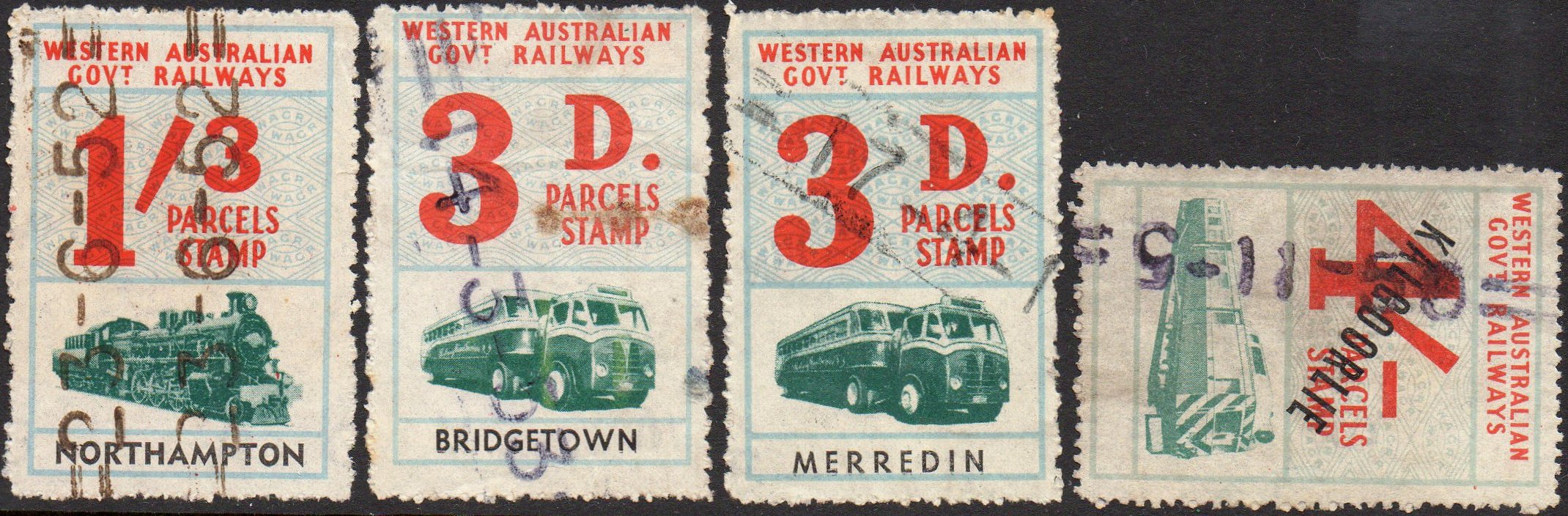
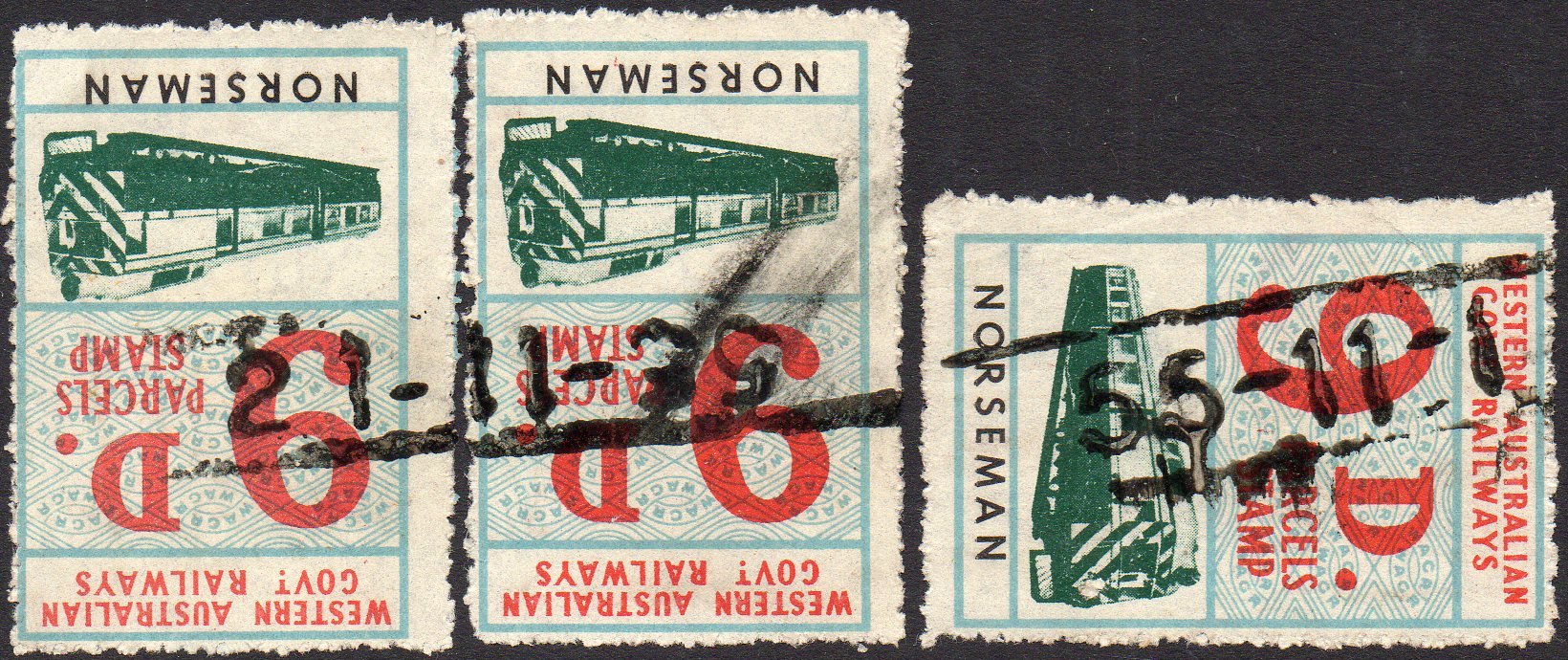 The first stamp is not an error, but it is a little unusual in that the date-stamp is applied twice and exceptionally neatly. Applied vertically, the date-stamp can be made to fit thus over a single stamp. It is frequently applied diagonally, which requires slightly less accuracy. Many parcels were franked with multiple stamps and with the cancellation straddling two stamps.
All the other stamps have numeral errors on the canceller. Bridgetown has an inverted '1' in '14', Merredin appears to end in an impossible 17 for the year, Kalgoorlie has the day '5' inverted (in 5-11-59). The second line of scans is all from Norseman, possibly all from the same parcel, especially if we have correctly pieced together the first two stamps. It would appear that the date has been set at 21-11-55 with the digits 11-55 all inverted. Such errors do not really merit a premium but they add a little extra interest.
.
(v) . STATION MASTER cancels
The first stamp is not an error, but it is a little unusual in that the date-stamp is applied twice and exceptionally neatly. Applied vertically, the date-stamp can be made to fit thus over a single stamp. It is frequently applied diagonally, which requires slightly less accuracy. Many parcels were franked with multiple stamps and with the cancellation straddling two stamps.
All the other stamps have numeral errors on the canceller. Bridgetown has an inverted '1' in '14', Merredin appears to end in an impossible 17 for the year, Kalgoorlie has the day '5' inverted (in 5-11-59). The second line of scans is all from Norseman, possibly all from the same parcel, especially if we have correctly pieced together the first two stamps. It would appear that the date has been set at 21-11-55 with the digits 11-55 all inverted. Such errors do not really merit a premium but they add a little extra interest.
.
(v) . STATION MASTER cancels

 There were just three of these in the collection, the rectangular examples in the scan above, all from the Third Issue. The first stamp shown is a scan from a correspondent and of great interest, being the sole such cancel we have seen, from a rare station and the earliest date we have seen for a Third SERIES non-Perth stamp, 4-SEPT-1951. Such cancellations do merit a substantial valuation, although they are likely to appear mostly from low-volume stations that will already have commanded a premium. A further example, from a correspondent, shows an EAST PERTH Third Issue 4/- with Station Master cancellation. An image will be found in Appendix 1.
Valuations :
1. An oval-style cancellation such as this is clearly very rare and we think might easily fetch at auction A$200-A$250, perhaps more in this superb quality.
2. The rectangular station cancellations are not as rare but nonetheless scarce and desirable. We would not be surprised to see one fetch upwards of A$100 at auction on a stamp otherwise of modest value.
.
.
(vi) . Company Perfins
There were just three of these in the collection, the rectangular examples in the scan above, all from the Third Issue. The first stamp shown is a scan from a correspondent and of great interest, being the sole such cancel we have seen, from a rare station and the earliest date we have seen for a Third SERIES non-Perth stamp, 4-SEPT-1951. Such cancellations do merit a substantial valuation, although they are likely to appear mostly from low-volume stations that will already have commanded a premium. A further example, from a correspondent, shows an EAST PERTH Third Issue 4/- with Station Master cancellation. An image will be found in Appendix 1.
Valuations :
1. An oval-style cancellation such as this is clearly very rare and we think might easily fetch at auction A$200-A$250, perhaps more in this superb quality.
2. The rectangular station cancellations are not as rare but nonetheless scarce and desirable. We would not be surprised to see one fetch upwards of A$100 at auction on a stamp otherwise of modest value.
.
.
(vi) . Company Perfins
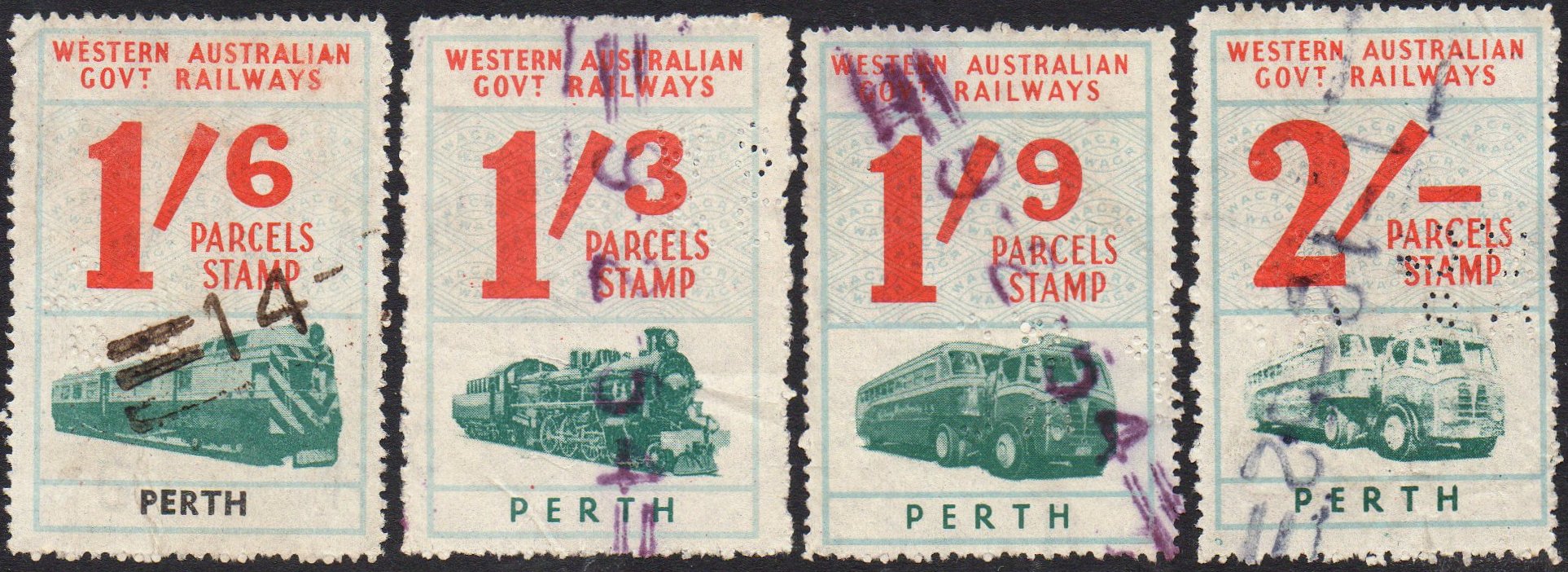
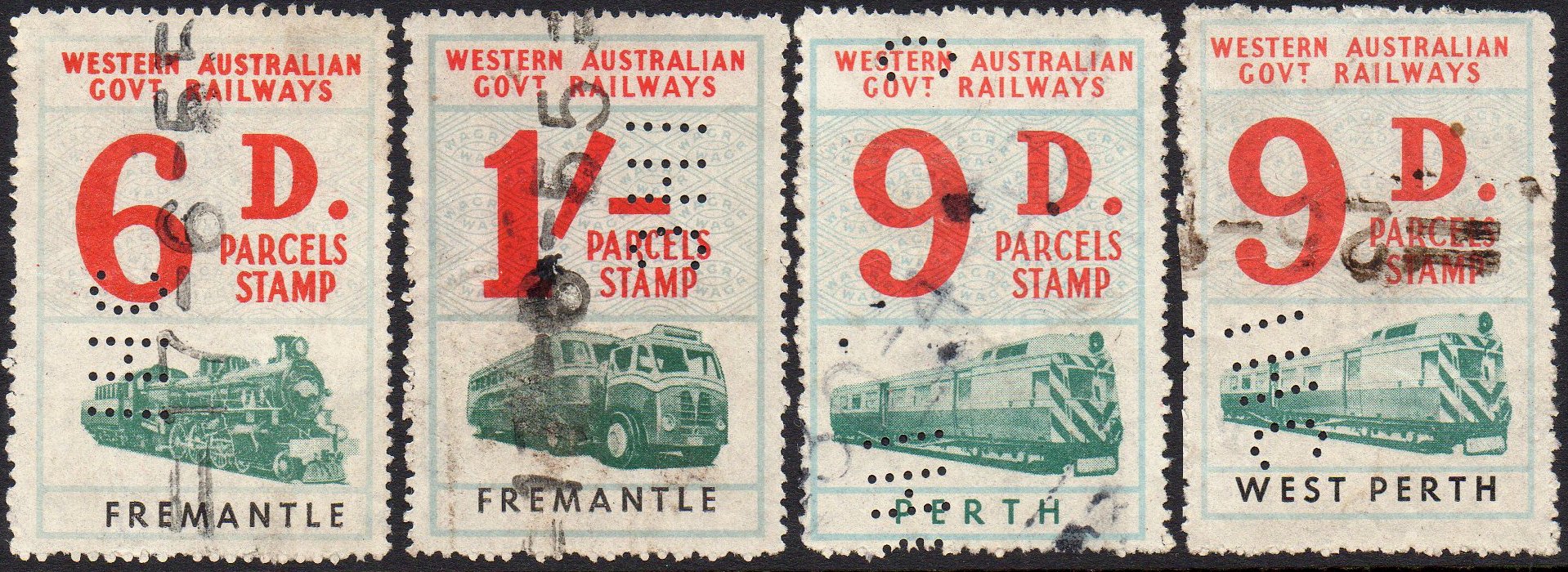 Top Row : W S & Co (all four, all PERTH, mostly blind punches).
Bottom Row : I H C (all four, mixed stations, clean punches)
We know of only two different businesses that applied company-initial security punches on these WAGR stamps.
WS&Co (William Sandover & Co.) was a Perth-based business that applied punches to numerous values; we have seen examples from both the First and Second Issues. We list five of them below, all but the first of them from this collection:
First Issue : Perth 3d ; Perth 1/6
Second Issue : Perth 1/3, Perth 1/9, Perth 2/-
Part of a lot in an Abacus Sale (#168, Lot 937) included, as best as we can see further WS&Co perfins :
First Issue : Perth 2/-
Second Issue : Perth 1/-
Dave Elsmore has a whole webpage devoted to each Company's perfins, these pages aided by the input from two perfin aficianados, David Coath (President of the Perfin Society of Australia and New Zealand) and the Tasmanian-based perfin collector, Greg Howard. Dave's WS&Co page . . .
can be found here (opens in a new tab).
.
IHC (International Harvester Co.) : The following punches are known to us, three in the collection, one* with a correspondent:
Second Issue : Fremantle 6d ; Fremantle 1/-; Perth 9d* ; West Perth 9d.
In the same Abacus lot as mentioned above (Lot 937), the following further values can be seen:
Second Issue : Fremantle 2/-; Fremantle 10/-
Second Issue : West Perth 2/-.
Additionally, the lot contained three more IHC perfins (2 x 6d and 1 x 1/3) but we cannot see whether they are First or Second Issue.
Dave Elsmore's separate webpage for IHC Perfins can be found here . . (opens in a new tab).
.
Valuations (both companies) :
They are interesting and they do appear to command a premium. The seven stamps in the 2013 Abacus Auctions of Melbourne sale realized A$ 1400 but, with the inclusion of a 10/- in the lot, a scarce stamp even though thinned, it renders any pro-rata valuation attempt per stamp highly unreliable, but there is certainly a good market for them.
We would suggest that perhaps A$80-$120 for a perfin on a fairly common face value might be a reasonable level. WS&Co stamps seem consistently to have perfin holes that are largely NOT punched through (blind), whereas the IHC perfins are usually clean punches.
.
(vii) . BOANS LTD
Top Row : W S & Co (all four, all PERTH, mostly blind punches).
Bottom Row : I H C (all four, mixed stations, clean punches)
We know of only two different businesses that applied company-initial security punches on these WAGR stamps.
WS&Co (William Sandover & Co.) was a Perth-based business that applied punches to numerous values; we have seen examples from both the First and Second Issues. We list five of them below, all but the first of them from this collection:
First Issue : Perth 3d ; Perth 1/6
Second Issue : Perth 1/3, Perth 1/9, Perth 2/-
Part of a lot in an Abacus Sale (#168, Lot 937) included, as best as we can see further WS&Co perfins :
First Issue : Perth 2/-
Second Issue : Perth 1/-
Dave Elsmore has a whole webpage devoted to each Company's perfins, these pages aided by the input from two perfin aficianados, David Coath (President of the Perfin Society of Australia and New Zealand) and the Tasmanian-based perfin collector, Greg Howard. Dave's WS&Co page . . .
can be found here (opens in a new tab).
.
IHC (International Harvester Co.) : The following punches are known to us, three in the collection, one* with a correspondent:
Second Issue : Fremantle 6d ; Fremantle 1/-; Perth 9d* ; West Perth 9d.
In the same Abacus lot as mentioned above (Lot 937), the following further values can be seen:
Second Issue : Fremantle 2/-; Fremantle 10/-
Second Issue : West Perth 2/-.
Additionally, the lot contained three more IHC perfins (2 x 6d and 1 x 1/3) but we cannot see whether they are First or Second Issue.
Dave Elsmore's separate webpage for IHC Perfins can be found here . . (opens in a new tab).
.
Valuations (both companies) :
They are interesting and they do appear to command a premium. The seven stamps in the 2013 Abacus Auctions of Melbourne sale realized A$ 1400 but, with the inclusion of a 10/- in the lot, a scarce stamp even though thinned, it renders any pro-rata valuation attempt per stamp highly unreliable, but there is certainly a good market for them.
We would suggest that perhaps A$80-$120 for a perfin on a fairly common face value might be a reasonable level. WS&Co stamps seem consistently to have perfin holes that are largely NOT punched through (blind), whereas the IHC perfins are usually clean punches.
.
(vii) . BOANS LTD
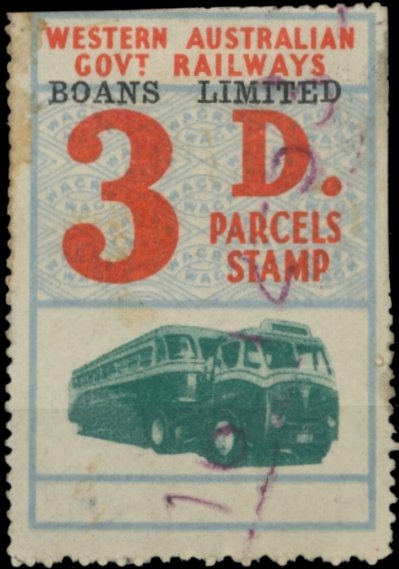
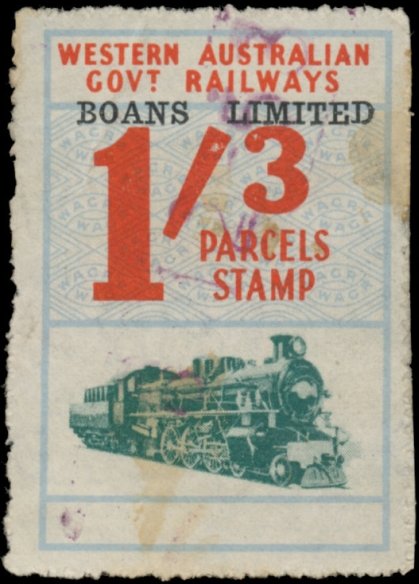
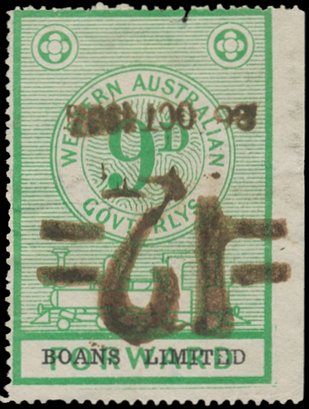
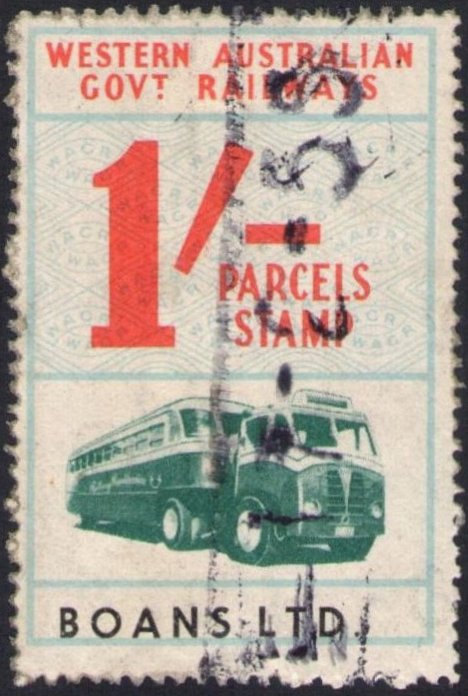
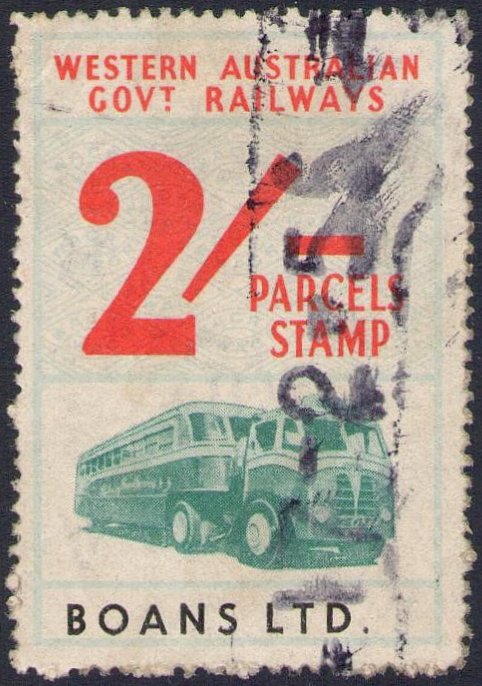 The images for the above again come from the Abacus Auctions of Melbourne website sale 168, reproduced here by permission. BOANS overprints on the Second SERIES stamps are even rarer than on the Third SERIES. It has been suggested that this 9d Green is a unique example.
Boans was a large department store in Perth that went out of business in 1986. Unlike, say, Queensland, where several companies arranged for the railway company to overprint stamps with their company names, it seems that Boans Ltd. was the only company to come to this arrangement with the WAGR.
We have not handled any of these stamps, all of which are scarce. The Elsmore catalogue lists four values for these stamps, all priced at A$ 300.-, roughly reflecting the price these same four stamps fetched in the Abacus Auctions sale. We repeat Dave's listing here for convenience.
3d : Overprinted BOANS LIMITED : A$ 300.00 [ . ] [ . ]
1/3d : Overprinted BOANS LIMITED : A$ 300.00 [ . ] [ . ]
1/- : Overprinted BOANS LTD. A$ 300.00 [ . ] [ . ]
2/- : Overprinted BOANS LTD. A$ 300.00 [ . ] [ . ]
On the 3d & 1/3, the cancellations are probably the same, 16-12-53, so far as we can see. The 1/- and 2/- both appear to be dated 17-2-55, another illustration that numerous stamps were frequently recovered from one parcel. The 1/- and 2/- are in Alphabet B and fit neatly into the Second Issue period.
The 3d & 1/3 have an overprint which had long been in use for Boans, evident on the Second SERIES locomotive 9d shown alongside, which appears to be dated 1937, a plausible date for this Company. The point at which the Alphabet B style replaced this older style is unclear, but, unless the 3d and 1/3 had both been languishing for about a year in the Company's offices, it does not appear that Boans' stamp orders were changed as soon as the new font was introduced for stations.
.
.
(viii) . Wide left-hand margins on stamps
The images for the above again come from the Abacus Auctions of Melbourne website sale 168, reproduced here by permission. BOANS overprints on the Second SERIES stamps are even rarer than on the Third SERIES. It has been suggested that this 9d Green is a unique example.
Boans was a large department store in Perth that went out of business in 1986. Unlike, say, Queensland, where several companies arranged for the railway company to overprint stamps with their company names, it seems that Boans Ltd. was the only company to come to this arrangement with the WAGR.
We have not handled any of these stamps, all of which are scarce. The Elsmore catalogue lists four values for these stamps, all priced at A$ 300.-, roughly reflecting the price these same four stamps fetched in the Abacus Auctions sale. We repeat Dave's listing here for convenience.
3d : Overprinted BOANS LIMITED : A$ 300.00 [ . ] [ . ]
1/3d : Overprinted BOANS LIMITED : A$ 300.00 [ . ] [ . ]
1/- : Overprinted BOANS LTD. A$ 300.00 [ . ] [ . ]
2/- : Overprinted BOANS LTD. A$ 300.00 [ . ] [ . ]
On the 3d & 1/3, the cancellations are probably the same, 16-12-53, so far as we can see. The 1/- and 2/- both appear to be dated 17-2-55, another illustration that numerous stamps were frequently recovered from one parcel. The 1/- and 2/- are in Alphabet B and fit neatly into the Second Issue period.
The 3d & 1/3 have an overprint which had long been in use for Boans, evident on the Second SERIES locomotive 9d shown alongside, which appears to be dated 1937, a plausible date for this Company. The point at which the Alphabet B style replaced this older style is unclear, but, unless the 3d and 1/3 had both been languishing for about a year in the Company's offices, it does not appear that Boans' stamp orders were changed as soon as the new font was introduced for stations.
.
.
(viii) . Wide left-hand margins on stamps
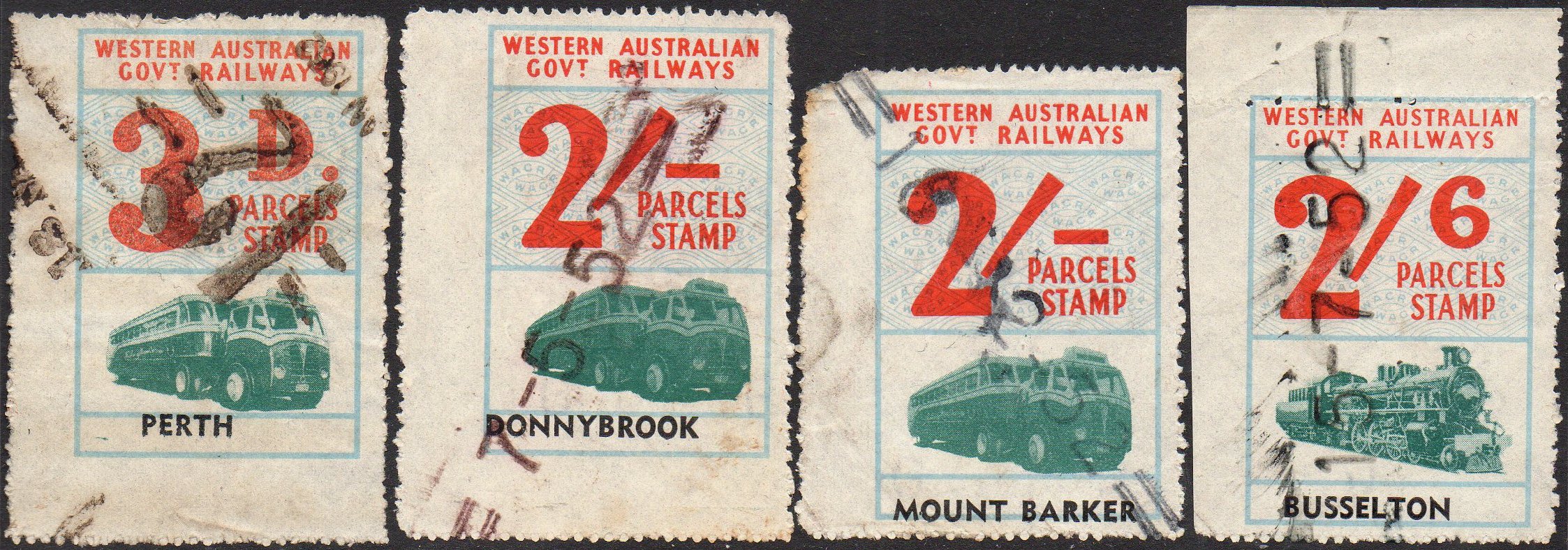 Shown above are the only four stamps in the 1,818 stamps studies with very wide left margins. None had a similarly wide right margin. We have already listed in the main sections of the 1st & 2nd Issues the wide bottom margins that are found in modest numbers.
All four stamps in the scan above are from 1952, or maybe in the case of the first stamp 1951, and it therefore quite possible that this wide left margin variety is limited on Third SERIES stamps to the First Issue. The right-hand stamp may be imperf at left, but if so it would be the only one seen; it may simply have a cut-down wide left margin. (It has top perforations but they are mostly blind.)
Wide left margins are significantly scarcer than wide bottom margins and worth a reasonable premium of, we would suggest, 40%, and subject to a minimum value of A$60.00
.
(ix) . Green Shades on Stamps
There would presumably have been several print-runs of these stamps, ordered when stocks of blanks (prepared but without station name) were exhausted at intervals. The red stage of the printing generally produces more variation of shade than the green, where it is mainly the intensity of the colour which changes, rather than the hue.
There seem to be no significant Green shades that belong solely to any particular Issue of the Third SERIES stamps. We have chosen to illustrate the shades with a selection of Second Issue stamps.
Bus Design : All Issues : Greens :
Shown above are the only four stamps in the 1,818 stamps studies with very wide left margins. None had a similarly wide right margin. We have already listed in the main sections of the 1st & 2nd Issues the wide bottom margins that are found in modest numbers.
All four stamps in the scan above are from 1952, or maybe in the case of the first stamp 1951, and it therefore quite possible that this wide left margin variety is limited on Third SERIES stamps to the First Issue. The right-hand stamp may be imperf at left, but if so it would be the only one seen; it may simply have a cut-down wide left margin. (It has top perforations but they are mostly blind.)
Wide left margins are significantly scarcer than wide bottom margins and worth a reasonable premium of, we would suggest, 40%, and subject to a minimum value of A$60.00
.
(ix) . Green Shades on Stamps
There would presumably have been several print-runs of these stamps, ordered when stocks of blanks (prepared but without station name) were exhausted at intervals. The red stage of the printing generally produces more variation of shade than the green, where it is mainly the intensity of the colour which changes, rather than the hue.
There seem to be no significant Green shades that belong solely to any particular Issue of the Third SERIES stamps. We have chosen to illustrate the shades with a selection of Second Issue stamps.
Bus Design : All Issues : Greens :
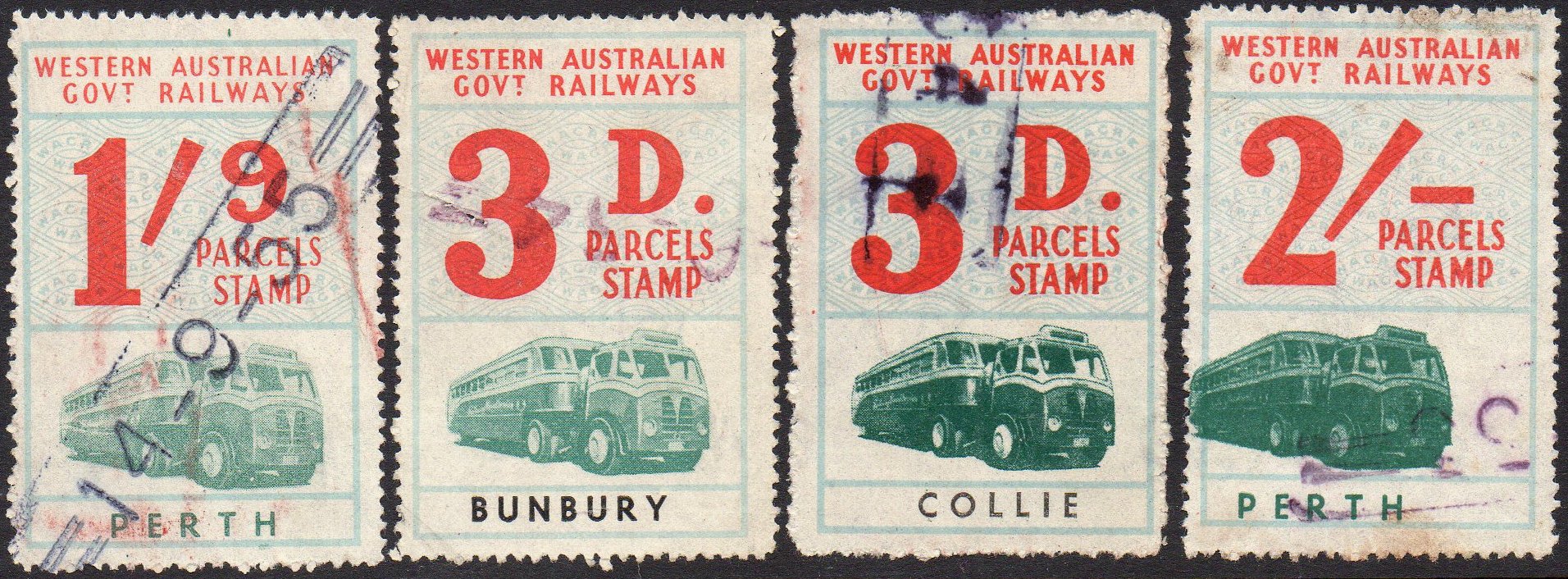 The majority of stamps are similar in shade and intensity to the Bunbury stamp above. The first three stamps are much the same colour but with increasing intensity whilst the last stamp is unusual in being more towards bluish-green than the normal grey-green and has overall shading over the white livery trim of the bus. This shading feature is found on other examples of this stamp but typically it is not so obvious to the naked eye.
Diesel Design : All Issues : Greens :
The majority of stamps are similar in shade and intensity to the Bunbury stamp above. The first three stamps are much the same colour but with increasing intensity whilst the last stamp is unusual in being more towards bluish-green than the normal grey-green and has overall shading over the white livery trim of the bus. This shading feature is found on other examples of this stamp but typically it is not so obvious to the naked eye.
Diesel Design : All Issues : Greens :
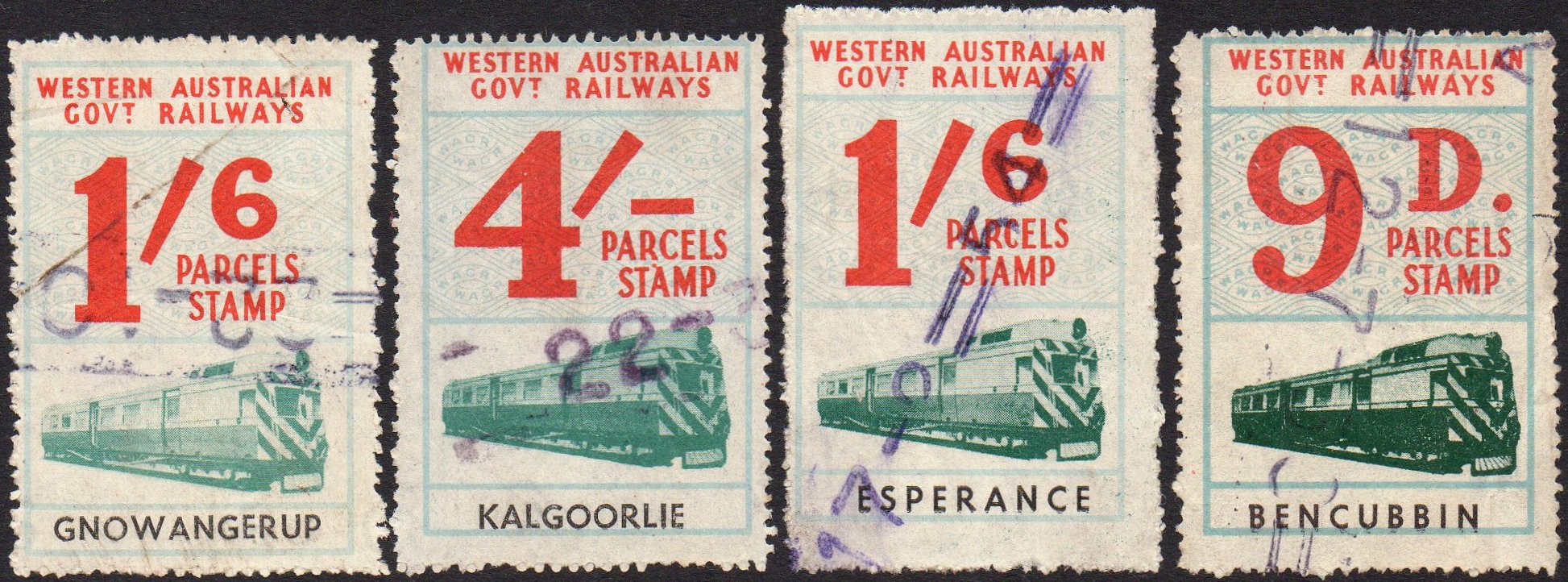 The first three stamps are within the typical colour range, the second stamp heading a little more towards the blue. The last stamp is an exceptionally intense colour and only a few of this hue were found in the collection, including some from Norseman as shown in Section (iv) of this Appendix. Suggested additional value for this level of intensity of colour, A$ 20.00
Steam Design : All Issues : Greens :
The first three stamps are within the typical colour range, the second stamp heading a little more towards the blue. The last stamp is an exceptionally intense colour and only a few of this hue were found in the collection, including some from Norseman as shown in Section (iv) of this Appendix. Suggested additional value for this level of intensity of colour, A$ 20.00
Steam Design : All Issues : Greens :
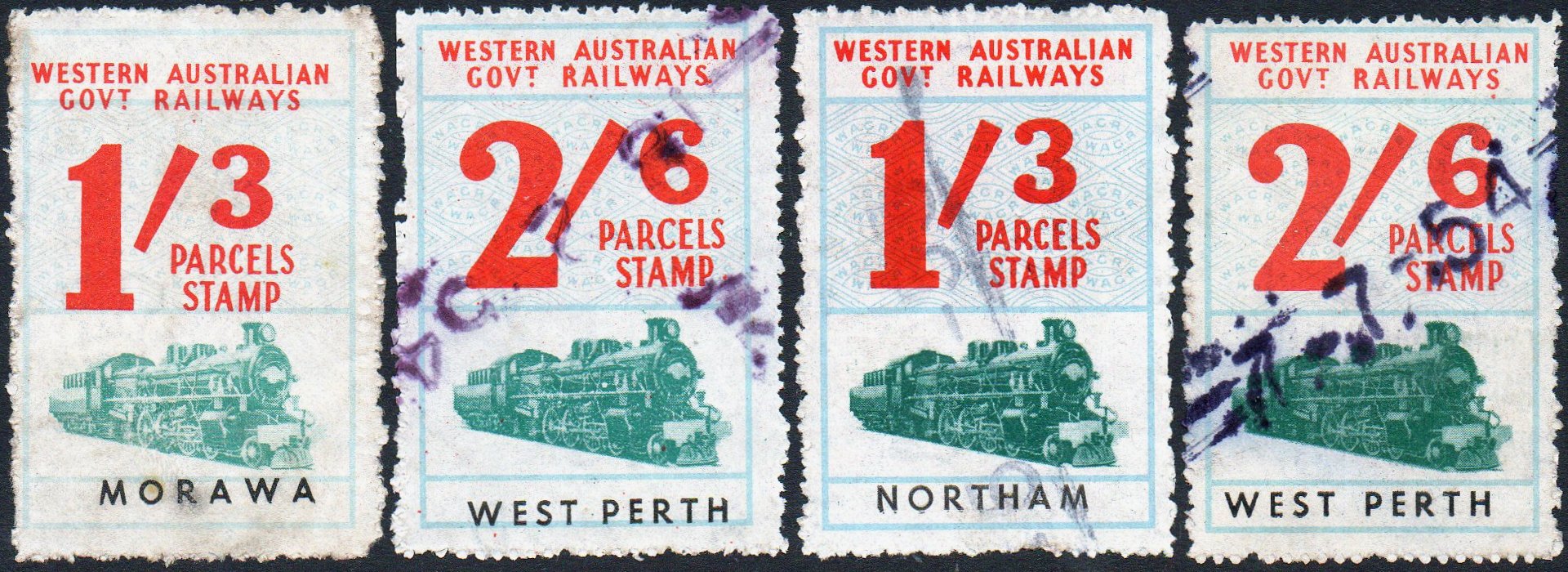 The first three stamps are in greater intensities of a blue-green shade, the first stamp unusually pale, but not the result of a worn plate. The final stamp is in a different shade, slightly towards yellow-green and is a scarce shade. Without a large collection of these stamps, however, this would be difficult to identify based on scans which tend to reproduce colours inconsistently.
(x) . Red & Blue Shades on Stamps
Red Colour Shifts :
Unlike the Green shades, where we studied the shades of the bus, diesel and steam locomotive separately, the Reds can be studied together. The common shade is Vermilion for the text and value with almost all stamps being in some shade of vermilion moving towards scarlet-vermilion, albeit in many different intensities.
The first three stamps are in greater intensities of a blue-green shade, the first stamp unusually pale, but not the result of a worn plate. The final stamp is in a different shade, slightly towards yellow-green and is a scarce shade. Without a large collection of these stamps, however, this would be difficult to identify based on scans which tend to reproduce colours inconsistently.
(x) . Red & Blue Shades on Stamps
Red Colour Shifts :
Unlike the Green shades, where we studied the shades of the bus, diesel and steam locomotive separately, the Reds can be studied together. The common shade is Vermilion for the text and value with almost all stamps being in some shade of vermilion moving towards scarlet-vermilion, albeit in many different intensities.
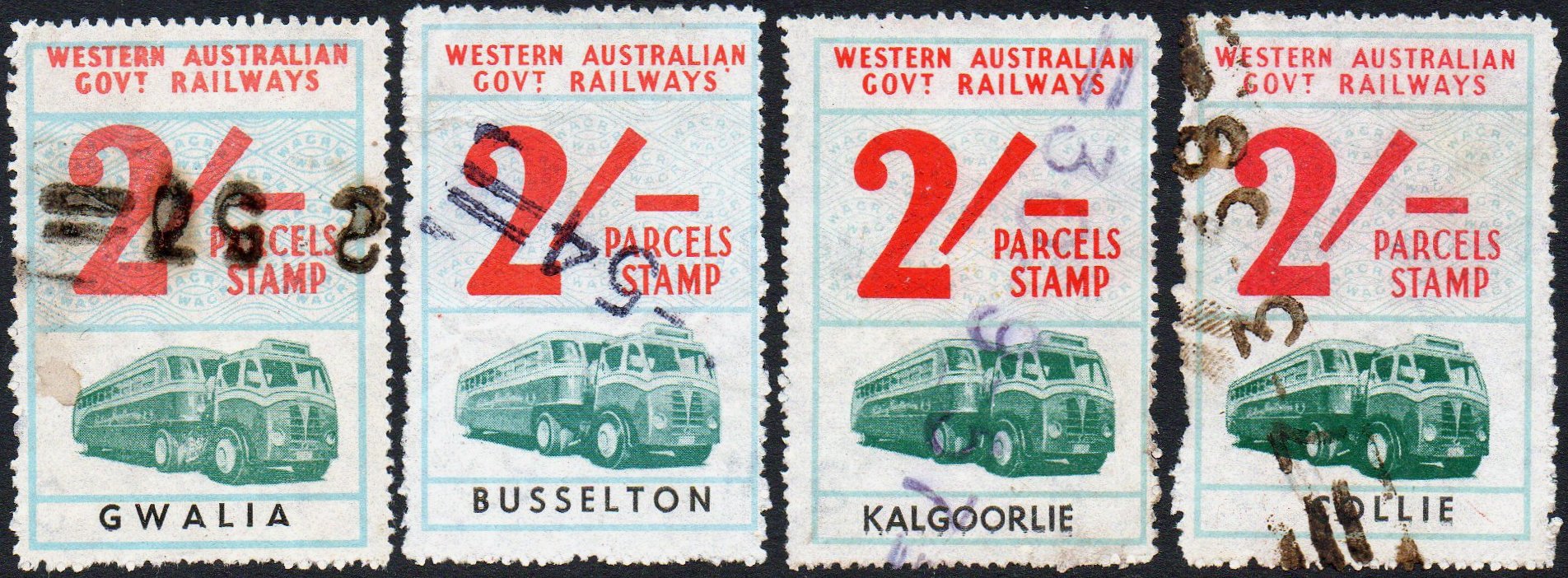 The first stamp is in a pale and dull vermilion, representing one end of the vermilion scale; the second stamp is a typical mid-range vermilion. The third stamp is moving more towards scarlet-vermilion and the more the shade moves away from vermilion and towards scarlet, the scarcer that shade becomes, though not enough typically to affect any pricing. The one exception in the entire collection of 1,818 stamps is the COLLIE 2/- which is a Deep Cerise, although its stand-out difference in true light is hard to reproduce with an image from a scanner. A suggested valuation for this rare shade is A$150.00.
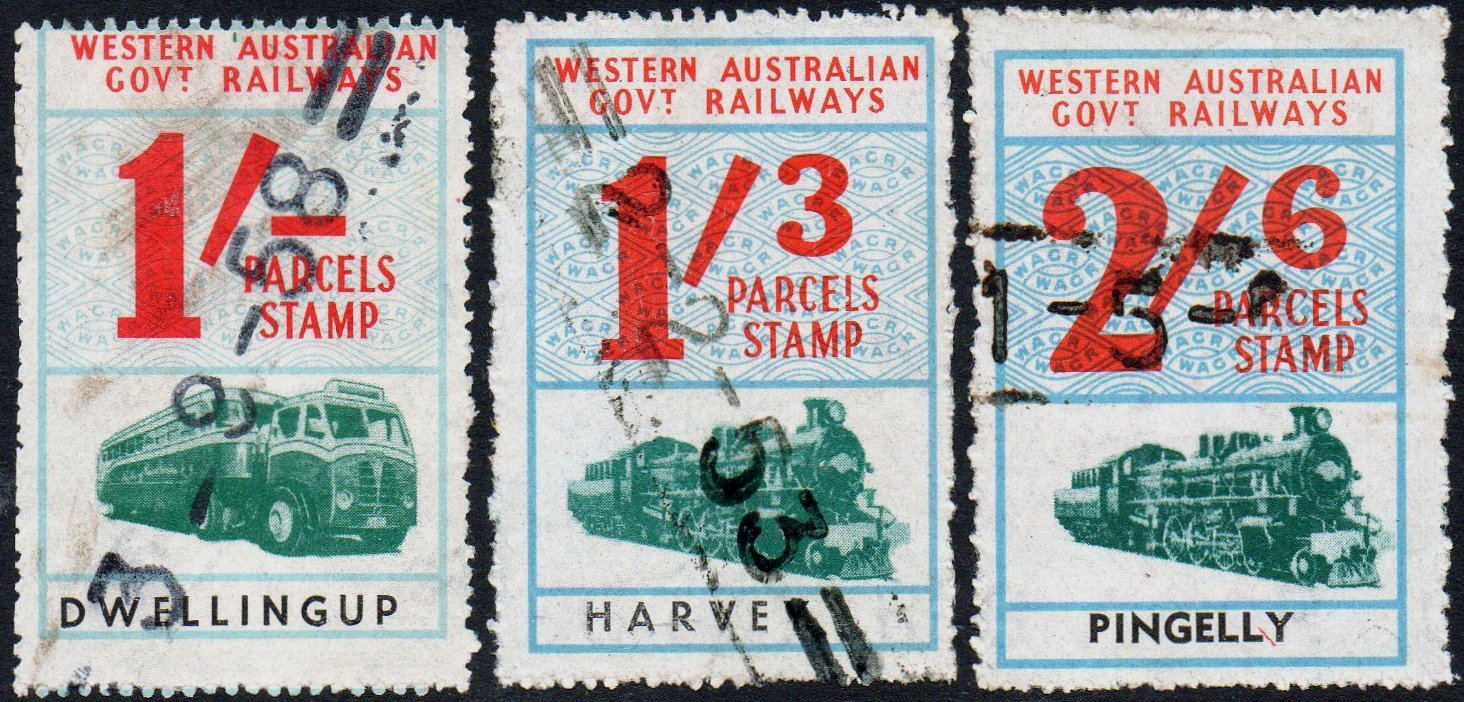 Blue Colour Shifts :
There is not much to say about the blue frame and background. For the most part, it covers the pale to medium intensity of blue shown on the first and second stamps above. Exceptionally, in this whole collection, a few stamps stood out from the rest in a much deeper blue than normal, including a Pingelly 2/6. However, it is not a new colour, simply one of greater intensity.
.
(xi) . Text & Design Shifts (Register Errors of Green & Red colours.)
General Observations : Station Name centring has already been discussed. We look now at the tolerances for the printer in centring the text sections (in red) and image (in green) within the spaces provided. Tolerances were about 1mm - 2mms before the frame lines would be broken. In many cases, we do not believe these small shifts worthy of a price premium and only an occasional variety in this section is priced.
First Issue Shifts of Green :
Remarkably, having examined all 800+ First Issue stamps, we have only found a few examples where the green colour (vehicle) just touches at top or bottom, representing only a 1mm shift, and just three identical examples of a visually-obvious sideways shift, a 2 mm shift of the Bus Design to the left, resulting in the rear of the bus just touching the left frame-line (an example shown below).
Blue Colour Shifts :
There is not much to say about the blue frame and background. For the most part, it covers the pale to medium intensity of blue shown on the first and second stamps above. Exceptionally, in this whole collection, a few stamps stood out from the rest in a much deeper blue than normal, including a Pingelly 2/6. However, it is not a new colour, simply one of greater intensity.
.
(xi) . Text & Design Shifts (Register Errors of Green & Red colours.)
General Observations : Station Name centring has already been discussed. We look now at the tolerances for the printer in centring the text sections (in red) and image (in green) within the spaces provided. Tolerances were about 1mm - 2mms before the frame lines would be broken. In many cases, we do not believe these small shifts worthy of a price premium and only an occasional variety in this section is priced.
First Issue Shifts of Green :
Remarkably, having examined all 800+ First Issue stamps, we have only found a few examples where the green colour (vehicle) just touches at top or bottom, representing only a 1mm shift, and just three identical examples of a visually-obvious sideways shift, a 2 mm shift of the Bus Design to the left, resulting in the rear of the bus just touching the left frame-line (an example shown below).
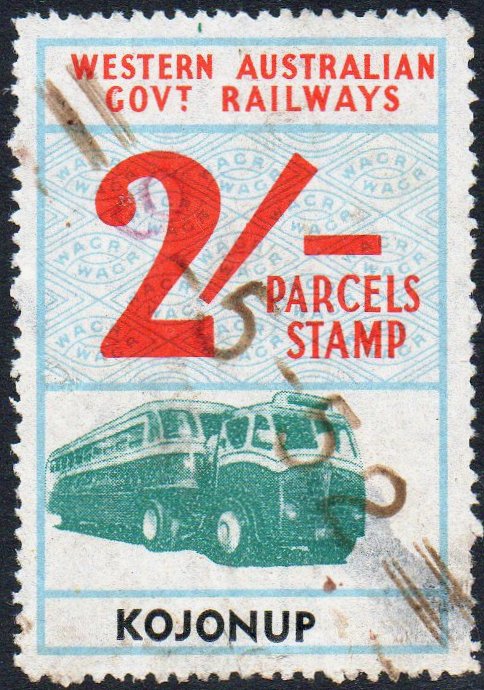
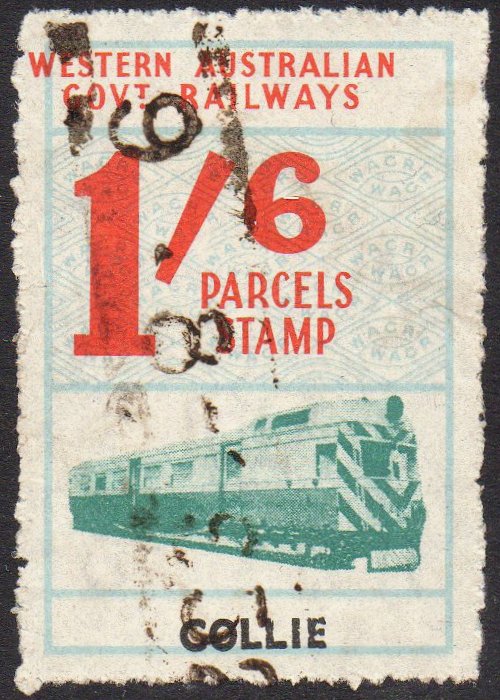 Left : The 'worst' example we could find of a vehicle shift sideways on the First Issue; bravo the printer.
First Issue Shifts of Red :
The second scan above shows the only stamp we observed in the whole collection where any letter of the text 'WESTERN AUSTRALIAN / GOVT. RAILWAYS' is outside the border to the LEFT. It is unusual for this text to do more than just touch the lines of the frame. This LEFT SHIFT exception is so rare as to merit a significant premium and we would suggest a valuation of around A$80 for it.
.
Second Issue Shifts of Green :
Left : The 'worst' example we could find of a vehicle shift sideways on the First Issue; bravo the printer.
First Issue Shifts of Red :
The second scan above shows the only stamp we observed in the whole collection where any letter of the text 'WESTERN AUSTRALIAN / GOVT. RAILWAYS' is outside the border to the LEFT. It is unusual for this text to do more than just touch the lines of the frame. This LEFT SHIFT exception is so rare as to merit a significant premium and we would suggest a valuation of around A$80 for it.
.
Second Issue Shifts of Green :
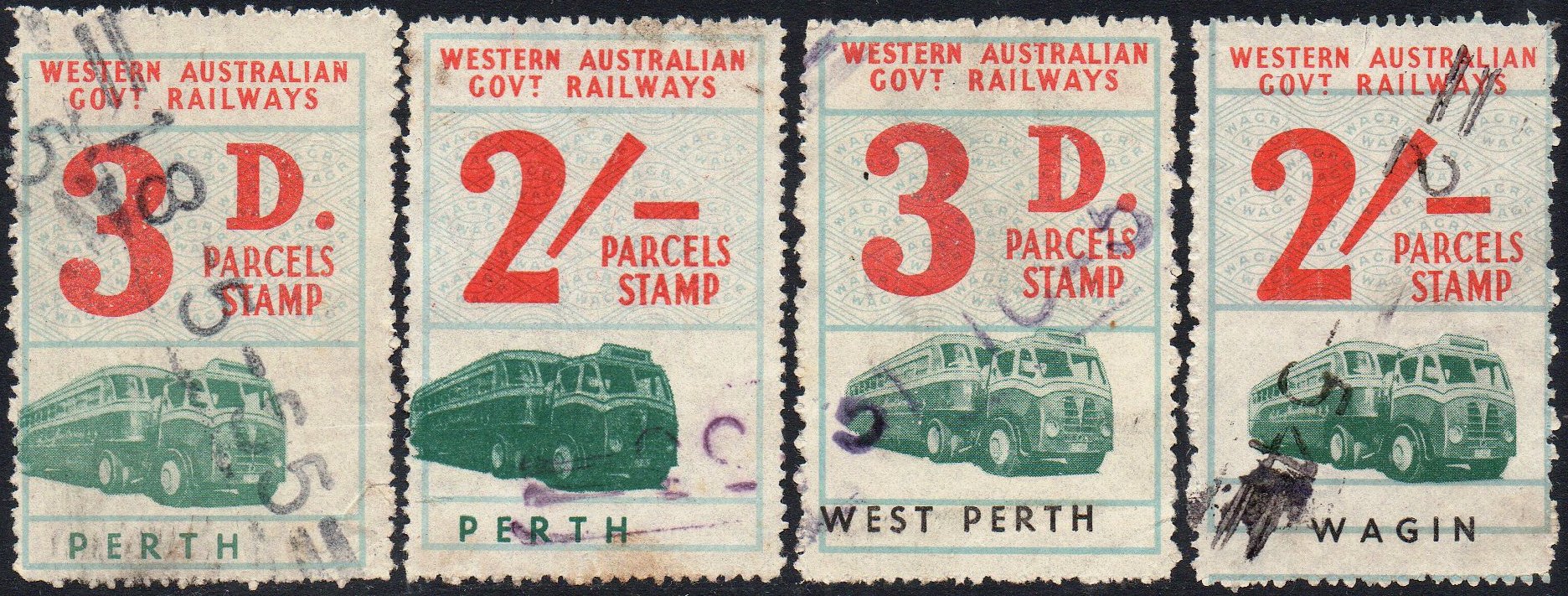
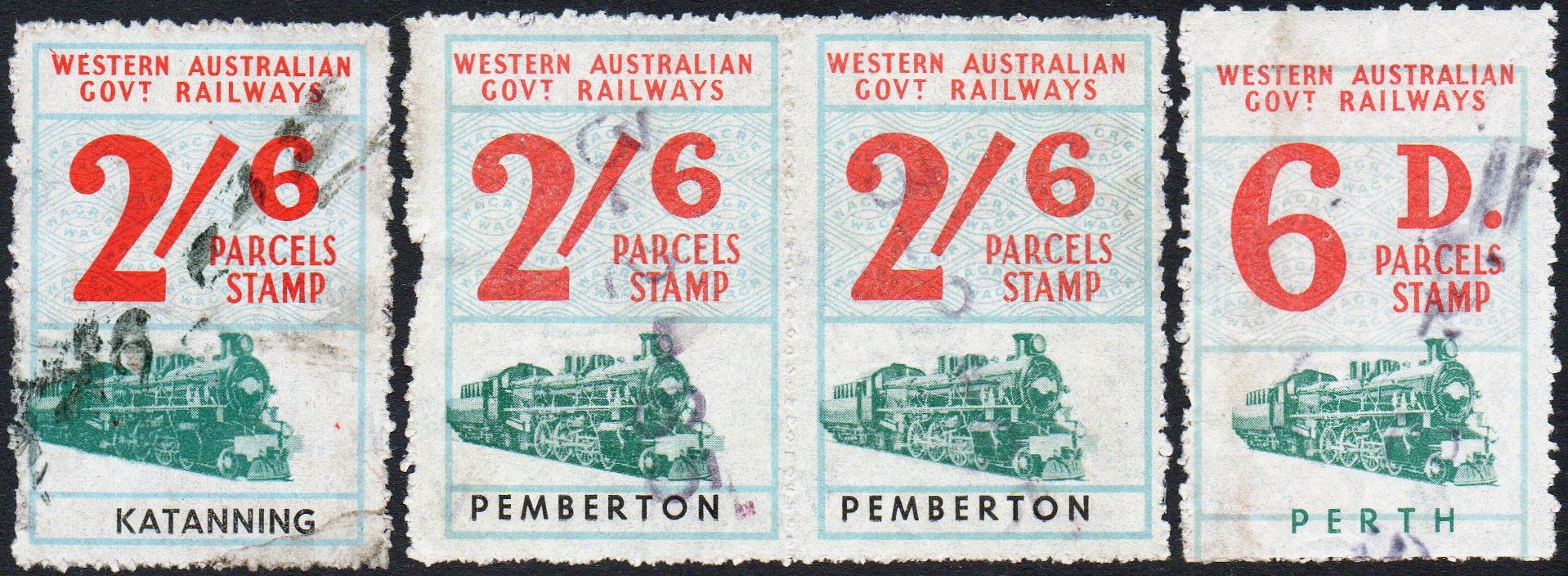 Whilst the quality falls off a little for the Second Issue, overall the stamps remain well-executed. There are two groups of Green shifts to consider, those on PERTH stamps in Green - and The Rest. On PERTH stamps the only shifts we have seen are to the Left with the Bus Design (R1, 1&2 above), and upwards on the Locomotive Design (R2,4 above), naturally in each case taking the station name in the same direction. Note: The Perth 2/- above is Type B, despite at first appearance (due to its dark hue) resembling a Type A stamp.
On non-Perth stamps, we have seen one shift up (R1,3) and one shift down (R1,4), whilst on the three Locomotive designs, Katanning and the Pemberton pair, the shift is to the left. On all these non-Perth stamps except Katanning, the station name has shifted similarly to the design but this is not inevitable. It is likely to be due to a slight paper size variant which holds the sheet wrongly for both runs through the presses (Green and Black Inks). The Katanning stamp demonstrates that the vehicle and any station name in black will not automatically shift together.
Note that on the Second Issue Diesel Designs, other than the design occasionally just touching the top frame-line, we have seen no examples of the design outside of its frame.
Second Issue Shifts of Red :
Whilst the quality falls off a little for the Second Issue, overall the stamps remain well-executed. There are two groups of Green shifts to consider, those on PERTH stamps in Green - and The Rest. On PERTH stamps the only shifts we have seen are to the Left with the Bus Design (R1, 1&2 above), and upwards on the Locomotive Design (R2,4 above), naturally in each case taking the station name in the same direction. Note: The Perth 2/- above is Type B, despite at first appearance (due to its dark hue) resembling a Type A stamp.
On non-Perth stamps, we have seen one shift up (R1,3) and one shift down (R1,4), whilst on the three Locomotive designs, Katanning and the Pemberton pair, the shift is to the left. On all these non-Perth stamps except Katanning, the station name has shifted similarly to the design but this is not inevitable. It is likely to be due to a slight paper size variant which holds the sheet wrongly for both runs through the presses (Green and Black Inks). The Katanning stamp demonstrates that the vehicle and any station name in black will not automatically shift together.
Note that on the Second Issue Diesel Designs, other than the design occasionally just touching the top frame-line, we have seen no examples of the design outside of its frame.
Second Issue Shifts of Red :
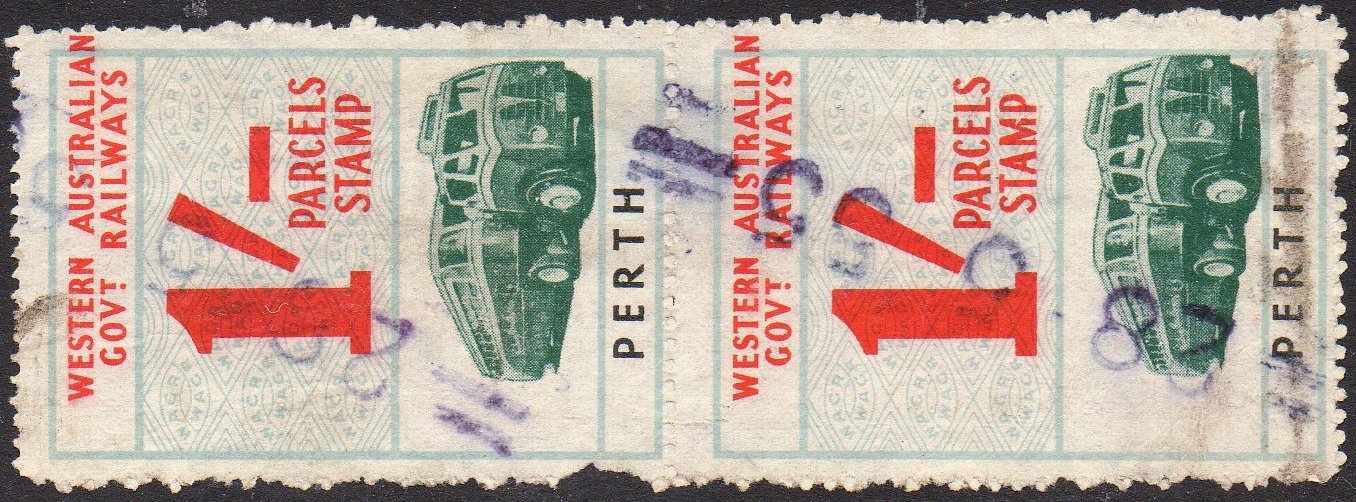 Having found the red text misplaced outside the box (to the left) on just one First Issue stamp, we now show a pair of PERTH Second Issue 1/- with name in BLACK, already a scarce stamp, each with the 'N' of 'AUSTRALIAN' outside the border to the RIGHT. We discovered just four stamps in the collection which had the red text outside the border to the RIGHT, and they appear all to come from the same sheet. Curiously, they comprise four of the five examples of Second Issue PERTH 1/- stamps with the station name in BLACK in the collection.
.
Third Issue Shifts of Green and Red
On the Third Issue, we have seen only one shift outside the frame, on the 3d Picton Jnct block/4 in which the Bus Design is shifted up. This block/4 is illustrated in Appendix 8(i).
.
.
(xii) . Railway Parcel Rates Table (1951)
The image below comes from the Western Australia Government Gazette issued on May 1st 1951 and is a table of parcel rates. This edition of the Gazette is full of rates, some of them quite quirky such as shunting rates per wagon in private sidings, and a fascinating read. This link takes you to the source of the table. . . (opens in a new tab).
Having found the red text misplaced outside the box (to the left) on just one First Issue stamp, we now show a pair of PERTH Second Issue 1/- with name in BLACK, already a scarce stamp, each with the 'N' of 'AUSTRALIAN' outside the border to the RIGHT. We discovered just four stamps in the collection which had the red text outside the border to the RIGHT, and they appear all to come from the same sheet. Curiously, they comprise four of the five examples of Second Issue PERTH 1/- stamps with the station name in BLACK in the collection.
.
Third Issue Shifts of Green and Red
On the Third Issue, we have seen only one shift outside the frame, on the 3d Picton Jnct block/4 in which the Bus Design is shifted up. This block/4 is illustrated in Appendix 8(i).
.
.
(xii) . Railway Parcel Rates Table (1951)
The image below comes from the Western Australia Government Gazette issued on May 1st 1951 and is a table of parcel rates. This edition of the Gazette is full of rates, some of them quite quirky such as shunting rates per wagon in private sidings, and a fascinating read. This link takes you to the source of the table. . . (opens in a new tab).
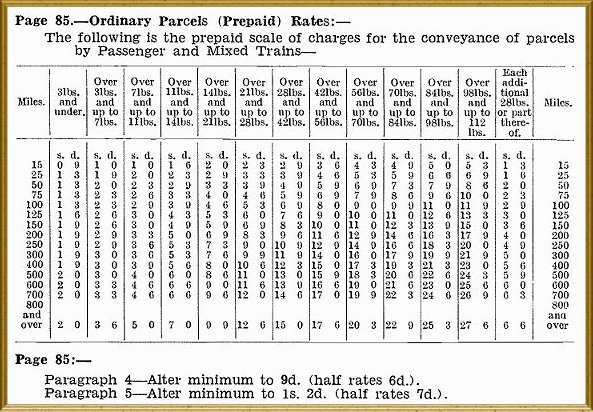 For those of you unfamiliar, the 's' stands for Shillings and the 'd' for Pence. There were Twelve Pence in One Shilling, making all the main parcel rates multiples of 3d. The footnote below the table mentions an amendment to a previously published table and includes half-rates, including one at 7d. It would explain the need for 1d stamps, both for the 1/2 (1s2d) and 7d rates. Other half rates at various periods may well have required ½d stamps to be produced.
The previously published table may have been the one dated 1941 that we cannot find online. However, the following passage appears immediately below the table in the 1951 price chart shown above and reads:
Page 89.-Ice Cream:- Alter rate to *one half. (The * is in the original text)
* Ice cream despatched from Perth in tubs and/or canvas packs shall be charged half
parcels rates plus 9d. per container for distances up to 150 miles and half parcels
rates plus ls.6d per container for distances exceeding 150 miles, to cover cost of conveying returned empties to Perth by goods and mixed trains. If returned by passenger train by special arrangement, then the ordinary empty return rate is payable.
Yes, really, ice-cream by railway parcel! One rather suspects that refrigerated road transport would have devoured most of that market by 1951. If that really was the sole possible source of rates requiring ½d and 1d stamps, the 1d is almost certainly due a price rise in catalogues!
In this collection, the only three Second Issue 1d stamps are all from Cunderdin and all appear to be dated 18-11-54, indicating that they were being used simply to make up another 3d step. Perhaps, after they had sat there for months, the clerk just wanted them out of his book to simplify balancing the account at the end of every day. The genuine need for any ½d and 1d stamps by the 1950s would appear to have been all but non-existent and this is borne out by the rarity of these stamps.
However, the collection did have a pair of 1d stamps from Bunbury of the Third Issue, maybe still making up that rare 1/2 rate?
.
(xiii) . Specimen Stamps & Mint Stamps
We have seen scans of auction lots with complete sets of Specimen stamps but we have not researched these in any depth. They can be useful in at least suggesting whether ½d stamps and some other values were planned for any particular issue in those cases where issued examples may not have been seen. Note, however, that it does not automatically follow that all the values for which there are Specimens were also subsequently printed and distributed.
Dave Elsmore's online catalogue (link in our introduction) gives valuations for Specimen stamps and also suggested premiums for mint examples of any stamp from the Third SERIES and we recommend these to you. We have not sought out, or researched MINT stamps, but, for the record, we have seen the following Mint (non-Specimen) stamps. There must be many, many more:
A list of MINT stamps seen :
First Issue :
None
Second Issue :
Bakers Hill 6d
Donnybrook 3d
Norseman 3d
Northam 1d
Third Issue :
Newdegate 3d
Fremantle £1
Perth 1d (on Dave Elsmore's webpage)
Wagin 9d, 1/-, 1/3 (the 9d and 1/- seen on Abacus Website, archive sale 168)
Dave Elsmore kindly sent us a scan believed to come from the Commissioner of Railways' reference series, all rubber-handstamped PERTH, and presumed to have been the proofs for approval of the (First) issue. The scan is shown below:
For those of you unfamiliar, the 's' stands for Shillings and the 'd' for Pence. There were Twelve Pence in One Shilling, making all the main parcel rates multiples of 3d. The footnote below the table mentions an amendment to a previously published table and includes half-rates, including one at 7d. It would explain the need for 1d stamps, both for the 1/2 (1s2d) and 7d rates. Other half rates at various periods may well have required ½d stamps to be produced.
The previously published table may have been the one dated 1941 that we cannot find online. However, the following passage appears immediately below the table in the 1951 price chart shown above and reads:
Page 89.-Ice Cream:- Alter rate to *one half. (The * is in the original text)
* Ice cream despatched from Perth in tubs and/or canvas packs shall be charged half
parcels rates plus 9d. per container for distances up to 150 miles and half parcels
rates plus ls.6d per container for distances exceeding 150 miles, to cover cost of conveying returned empties to Perth by goods and mixed trains. If returned by passenger train by special arrangement, then the ordinary empty return rate is payable.
Yes, really, ice-cream by railway parcel! One rather suspects that refrigerated road transport would have devoured most of that market by 1951. If that really was the sole possible source of rates requiring ½d and 1d stamps, the 1d is almost certainly due a price rise in catalogues!
In this collection, the only three Second Issue 1d stamps are all from Cunderdin and all appear to be dated 18-11-54, indicating that they were being used simply to make up another 3d step. Perhaps, after they had sat there for months, the clerk just wanted them out of his book to simplify balancing the account at the end of every day. The genuine need for any ½d and 1d stamps by the 1950s would appear to have been all but non-existent and this is borne out by the rarity of these stamps.
However, the collection did have a pair of 1d stamps from Bunbury of the Third Issue, maybe still making up that rare 1/2 rate?
.
(xiii) . Specimen Stamps & Mint Stamps
We have seen scans of auction lots with complete sets of Specimen stamps but we have not researched these in any depth. They can be useful in at least suggesting whether ½d stamps and some other values were planned for any particular issue in those cases where issued examples may not have been seen. Note, however, that it does not automatically follow that all the values for which there are Specimens were also subsequently printed and distributed.
Dave Elsmore's online catalogue (link in our introduction) gives valuations for Specimen stamps and also suggested premiums for mint examples of any stamp from the Third SERIES and we recommend these to you. We have not sought out, or researched MINT stamps, but, for the record, we have seen the following Mint (non-Specimen) stamps. There must be many, many more:
A list of MINT stamps seen :
First Issue :
None
Second Issue :
Bakers Hill 6d
Donnybrook 3d
Norseman 3d
Northam 1d
Third Issue :
Newdegate 3d
Fremantle £1
Perth 1d (on Dave Elsmore's webpage)
Wagin 9d, 1/-, 1/3 (the 9d and 1/- seen on Abacus Website, archive sale 168)
Dave Elsmore kindly sent us a scan believed to come from the Commissioner of Railways' reference series, all rubber-handstamped PERTH, and presumed to have been the proofs for approval of the (First) issue. The scan is shown below:
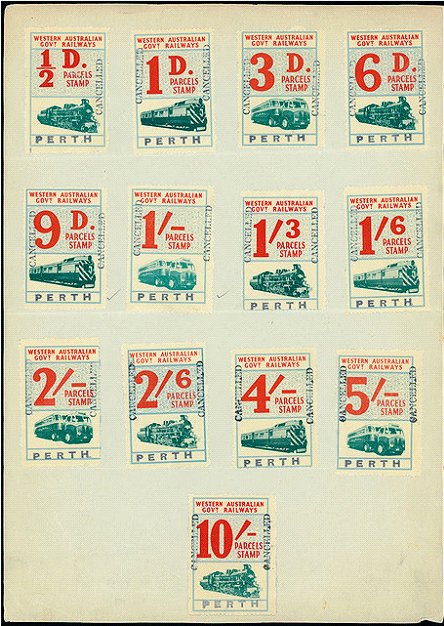 Note the absence of the 1/9 and £1 values, unknown for the First Issue, and also of the 3/-, a very late addition to this First Issue. Dave advises us that the same group are also known with blank station tablets, also Commissioner's proofs.
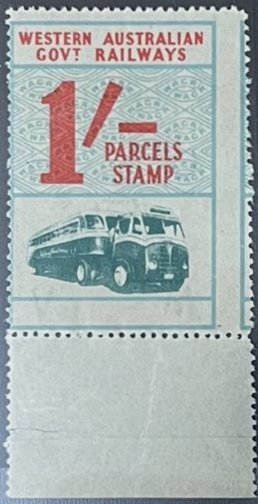 We show above, a Third SERIES 1/- without Station Name with remarkably bad perforating. This is a Progressive Proof, its production linked to the First Issue. Typically, one might expect such stamps to be produced to a higher quality than this but it's purpose is as a record, not as publicity material, and it would only ever be seen in-house (unless it escapes into philatelic hands!)
(xiv) . Individual Station Names : Varieties
We close Appendix 4 with a look at one or two varieties affecting individual station names, with possible valuations.
We show above, a Third SERIES 1/- without Station Name with remarkably bad perforating. This is a Progressive Proof, its production linked to the First Issue. Typically, one might expect such stamps to be produced to a higher quality than this but it's purpose is as a record, not as publicity material, and it would only ever be seen in-house (unless it escapes into philatelic hands!)
(xiv) . Individual Station Names : Varieties
We close Appendix 4 with a look at one or two varieties affecting individual station names, with possible valuations.
 A pair of Second Issue 2/- from LAKE GRACE, the right stamp with Broken 'L' in 'LAKE' variety.
Second Issue 2/- from LAKE GRACE with Broken 'L' variety (priced as a single) A$ 120 [ . ]
A pair of Second Issue 2/- from LAKE GRACE, the right stamp with Broken 'L' in 'LAKE' variety.
Second Issue 2/- from LAKE GRACE with Broken 'L' variety (priced as a single) A$ 120 [ . ]
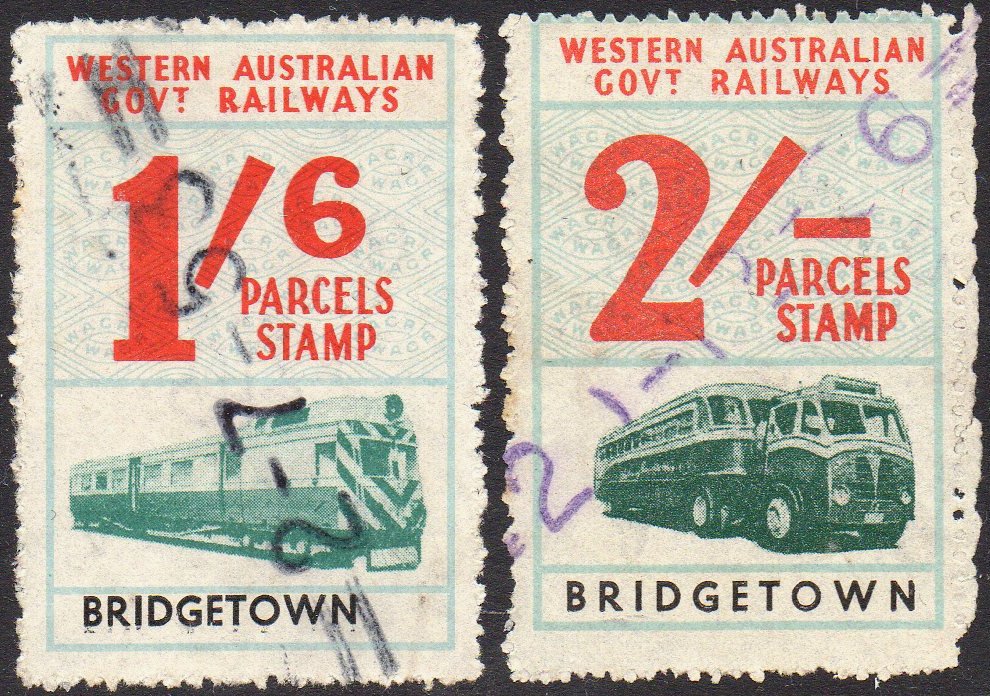 The normal BRIDGETOWN stamps of the Second Issue have a narrow-spaced station name (as in the left stamp above). Exceptionally, in this collection we have encountered two examples in the same Alphabet (Alphabet B) but with a wide-spaced BRIDGETOWN, as shown in the right stamp above.
Amongst several Second Issue 1/6 stamps, there was just one with the wide spacing of the station name. The 2/- shown above was the only Second Issue Bridgetown 2/- in the collection and has the wide station name. It seems quite likely that the 2/- also exists in narrow-spacing, probably in greater numbers, but we would welcome confirmation of this.
These two wide-spaced stamps are used with quite late dates within a month of each other, 18/1/57 (for the 1/6) and 20/12/56 (for the 2/-). We think this wide-setting was only used to fill one order from Bridgetown for replacement stamps, probably involving quite a limited number of face values. Our understanding is this would have been a photolithographic procedure, achieved by repeating the station name onto a negative, then printing the name onto a sheet of stamps. Once an order was completed, the negative would be retained for future orders from that station. This method of printing would avert the risk of mis-spellings of station names that would arise with a type-setting system.
If these wider-spaced Bridgetown stamps were produced as late as seems likely, very close to the point of changeover to the Third Issue, one wonders if the original Second Issue negative for Bridgetown had been damaged, or even destroyed, at the time these stamps were urgently required, whilst the new (diagonal) printings were not yet ready to be introduced. It would not be too complex to make a new (emergency) negative using the same Alphabet letters as before, but the spacing of those letters would not come out the same.
It is not inconceiveable that all the Alphabet B station negatives were destroyed (or archived) a little prematurely prior to the introduction of the Third Issue. If so, a small number of other stations might be found with two versions of the Alphabet B station name, but we have found no other such stations in the collection and BRIDGETOWN may well be a unique case.
Second Issue (Alphabet B) Bridgetown 1/6 with wide-spaced station name A$ 140 [ . ]
Second Issue (Alphabet B) Bridgetown 2/- with wide-spaced station name A$ 140 [ . ]
.
Sheet Size : Some thoughts (with limited facts!):
We have only one source, Derek Pocock, quoting a sheet size of 100 (10x10). We have no reason to reject this but, on the other hand, we have no corroborating evidence either.
These are large stamps. A sheet of 100 stamps (10x10) with wide margins would measure in excess of 40 cms wide x 60cms high (roughly 17 x 24 inches). The sheer weight of the printing stone would certainly be a problem, even in the main print room of the Government Printing Works.
When the orders came in from the individual stations to the WAGR Head Office for stamps, the orders would be collated and sent up to the Goverment Printers, where the nearly-finished sheets would be removed from stores in the denominations required and the station names then added. The stamps, once completed with the station name, would be returned to the WAGR Head Office for checking and then sent out to those stations that had placed the orders.
This task of adding the station name was no doubt delegated to staff with more basic training than a Government Printer as well as being performed in a less 'exalted' domain than the main Print Room. In such circumstances, sheets/100 would have been very unwieldy. Add to that the fact that many small stations would surely never have required anything remotely approaching one hundred stamps in the same denomination and everything points to a smaller sheet size than 100.
The largest number of joined stamps that we have seen are four horizontally and only two vertically. We cannot find any strip or block that allows us to identify the number of stamps either across or down. The smaller they were, the more likely a whole sheet would have survived; we do not know of one.
Unwilling to dismiss Pocock off-hand, though, we considered the possibility that the stamps were printed in sheets/100 and then split prior to adding the station name, something that might present register problems if there are no margins to use as guides. This prompted us to look again at the collection of over 1800 stamps and we discovered that it does not contain a single stamp with a right margin! In this article, we have looked at several wide left margins and wide bottom margins but they all have one thing in common; they end in a perforation, not a perforation and an outer selvedge.
In fact the only stamps we found with an outer selvedge beyond the perforation were a very small number of top marginal copies such as the 2/6 below:
The normal BRIDGETOWN stamps of the Second Issue have a narrow-spaced station name (as in the left stamp above). Exceptionally, in this collection we have encountered two examples in the same Alphabet (Alphabet B) but with a wide-spaced BRIDGETOWN, as shown in the right stamp above.
Amongst several Second Issue 1/6 stamps, there was just one with the wide spacing of the station name. The 2/- shown above was the only Second Issue Bridgetown 2/- in the collection and has the wide station name. It seems quite likely that the 2/- also exists in narrow-spacing, probably in greater numbers, but we would welcome confirmation of this.
These two wide-spaced stamps are used with quite late dates within a month of each other, 18/1/57 (for the 1/6) and 20/12/56 (for the 2/-). We think this wide-setting was only used to fill one order from Bridgetown for replacement stamps, probably involving quite a limited number of face values. Our understanding is this would have been a photolithographic procedure, achieved by repeating the station name onto a negative, then printing the name onto a sheet of stamps. Once an order was completed, the negative would be retained for future orders from that station. This method of printing would avert the risk of mis-spellings of station names that would arise with a type-setting system.
If these wider-spaced Bridgetown stamps were produced as late as seems likely, very close to the point of changeover to the Third Issue, one wonders if the original Second Issue negative for Bridgetown had been damaged, or even destroyed, at the time these stamps were urgently required, whilst the new (diagonal) printings were not yet ready to be introduced. It would not be too complex to make a new (emergency) negative using the same Alphabet letters as before, but the spacing of those letters would not come out the same.
It is not inconceiveable that all the Alphabet B station negatives were destroyed (or archived) a little prematurely prior to the introduction of the Third Issue. If so, a small number of other stations might be found with two versions of the Alphabet B station name, but we have found no other such stations in the collection and BRIDGETOWN may well be a unique case.
Second Issue (Alphabet B) Bridgetown 1/6 with wide-spaced station name A$ 140 [ . ]
Second Issue (Alphabet B) Bridgetown 2/- with wide-spaced station name A$ 140 [ . ]
.
Sheet Size : Some thoughts (with limited facts!):
We have only one source, Derek Pocock, quoting a sheet size of 100 (10x10). We have no reason to reject this but, on the other hand, we have no corroborating evidence either.
These are large stamps. A sheet of 100 stamps (10x10) with wide margins would measure in excess of 40 cms wide x 60cms high (roughly 17 x 24 inches). The sheer weight of the printing stone would certainly be a problem, even in the main print room of the Government Printing Works.
When the orders came in from the individual stations to the WAGR Head Office for stamps, the orders would be collated and sent up to the Goverment Printers, where the nearly-finished sheets would be removed from stores in the denominations required and the station names then added. The stamps, once completed with the station name, would be returned to the WAGR Head Office for checking and then sent out to those stations that had placed the orders.
This task of adding the station name was no doubt delegated to staff with more basic training than a Government Printer as well as being performed in a less 'exalted' domain than the main Print Room. In such circumstances, sheets/100 would have been very unwieldy. Add to that the fact that many small stations would surely never have required anything remotely approaching one hundred stamps in the same denomination and everything points to a smaller sheet size than 100.
The largest number of joined stamps that we have seen are four horizontally and only two vertically. We cannot find any strip or block that allows us to identify the number of stamps either across or down. The smaller they were, the more likely a whole sheet would have survived; we do not know of one.
Unwilling to dismiss Pocock off-hand, though, we considered the possibility that the stamps were printed in sheets/100 and then split prior to adding the station name, something that might present register problems if there are no margins to use as guides. This prompted us to look again at the collection of over 1800 stamps and we discovered that it does not contain a single stamp with a right margin! In this article, we have looked at several wide left margins and wide bottom margins but they all have one thing in common; they end in a perforation, not a perforation and an outer selvedge.
In fact the only stamps we found with an outer selvedge beyond the perforation were a very small number of top marginal copies such as the 2/6 below:
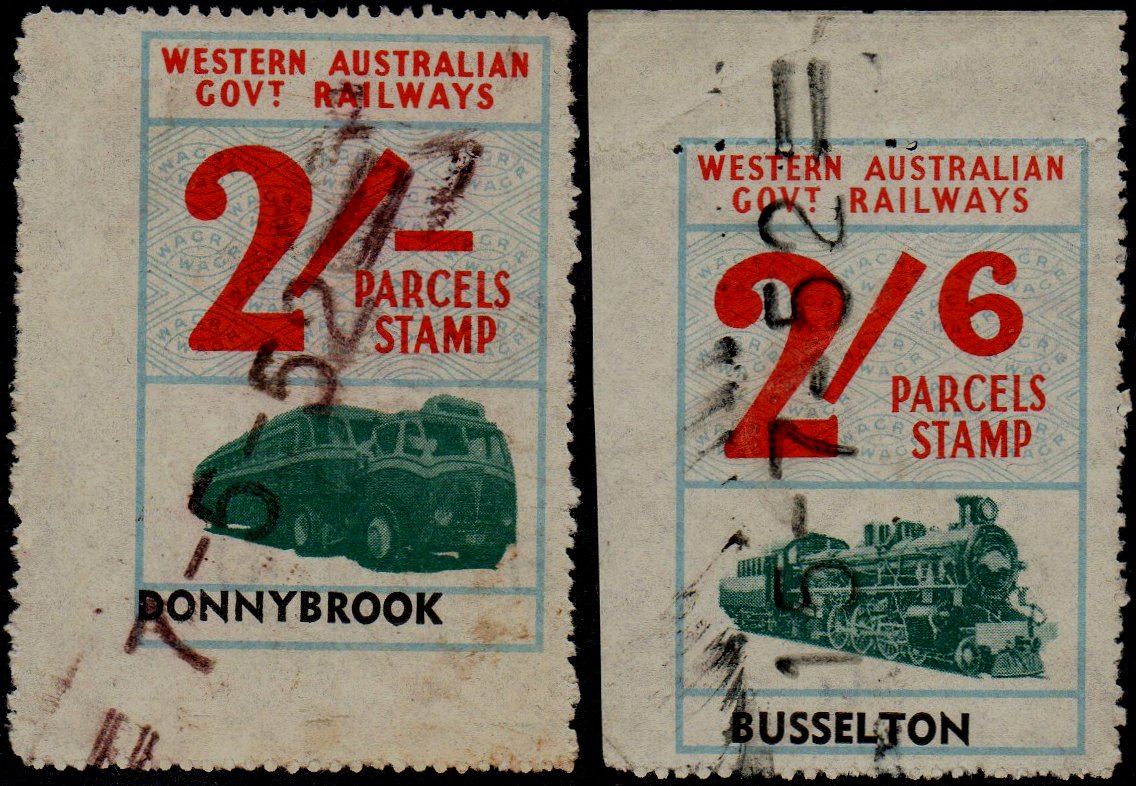 This image has been darkened to help show the horizontal perfs across the top that pass through the upper frame-line of the 2/6, and are mostly blind perfs.
We are struggling to put this curious discovery about marginal copies into a workable theory but it does increase the chances that, for the final procedure (station name printing), sheets were separated into smaller panes and the station names added using lithographic negatives of those dimensions. Perhaps there are retired former employees from the WA Government Printing Works who know what the procedure was - but have never been asked?!
This image has been darkened to help show the horizontal perfs across the top that pass through the upper frame-line of the 2/6, and are mostly blind perfs.
We are struggling to put this curious discovery about marginal copies into a workable theory but it does increase the chances that, for the final procedure (station name printing), sheets were separated into smaller panes and the station names added using lithographic negatives of those dimensions. Perhaps there are retired former employees from the WA Government Printing Works who know what the procedure was - but have never been asked?!
.
End of Appendix 4
.
.
.
Appendix 5 : Rail and Railway Road Service Maps of Western Australia :
We conclude with a couple of maps, the first an open source (Wikipedia) railway map of Western Australia, showing much of the network, circa 1935, when the network was at close to its greatest extent, following the building of many (optimistic) lines to provide work during the Great Depression. We rather doubt that some of these stations ever handled a parcel outward.
1. RAILWAY Map of the WAGR :
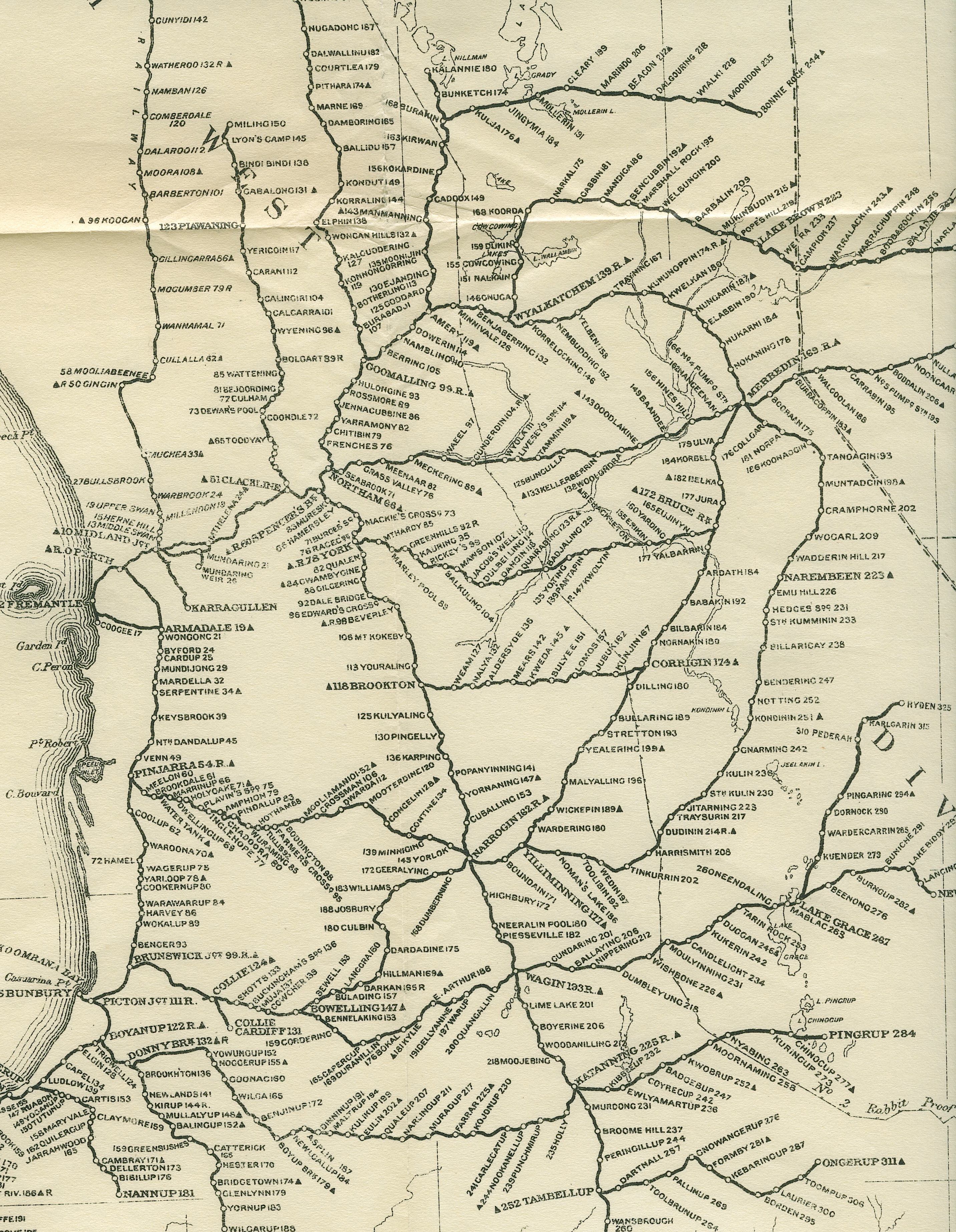 .
2. BUS Map of the WAGR, Railway Road Services :
.
2. BUS Map of the WAGR, Railway Road Services :
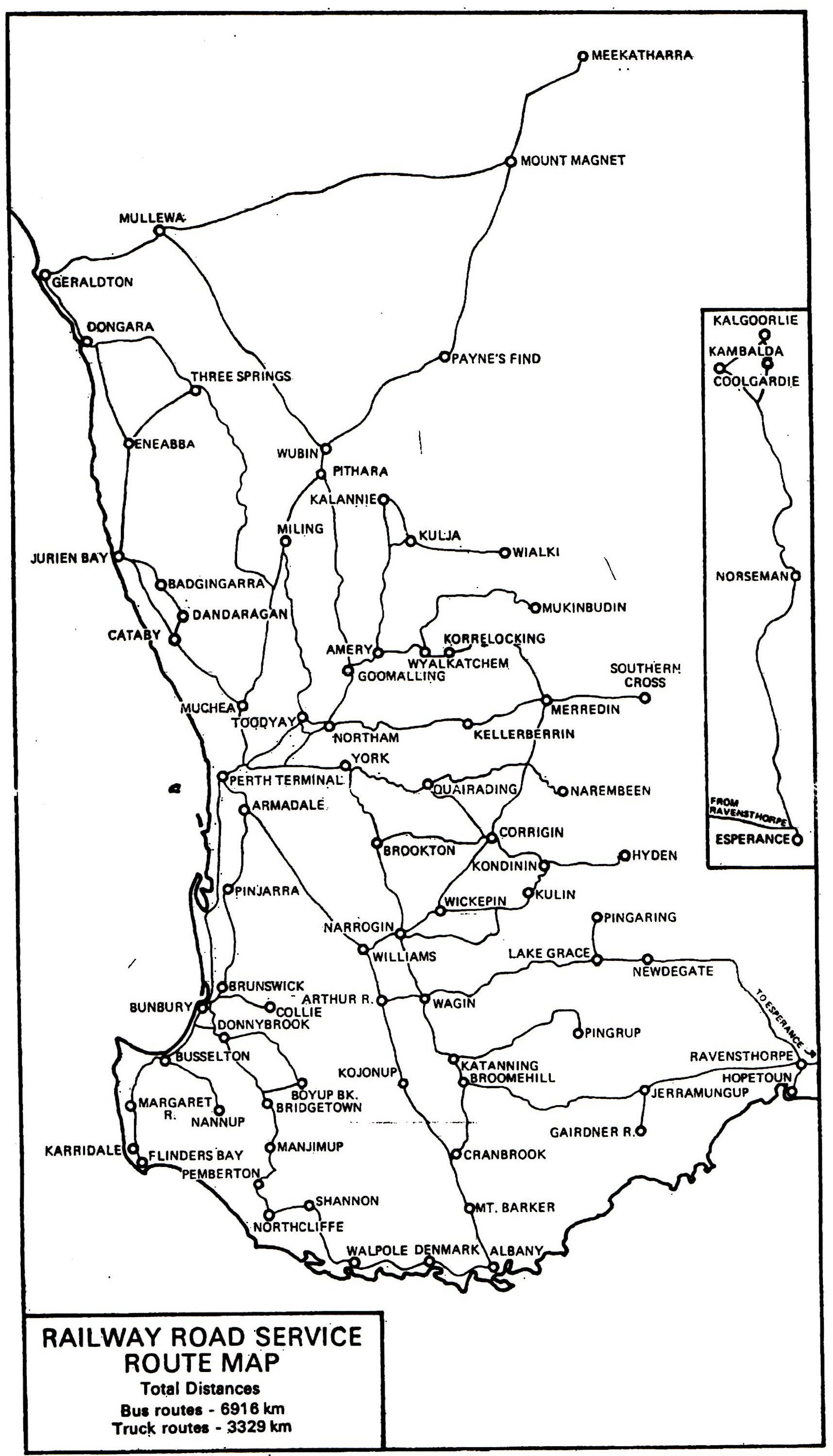 Map of the Railway-Operated Passenger/Parcel Bus Routes, issued by the WAGR, probably in the early 1950s.
.
Station Names on Later WAGR Parcel Stamps :
This article does not include any Fourth SERIES or Fifth SERIES stamps but, in common with the Third SERIES, both had special printings for PERTH separately. Our only interest in these later stamps is in listing any station names that we have not seen on Third SERIES stamps. The presence of 'new' stations in the two lists below does not prove that any Third SERIES stamps for those stations were produced, but it seems likely that they were. Whether any survived is an open question.
Map of the Railway-Operated Passenger/Parcel Bus Routes, issued by the WAGR, probably in the early 1950s.
.
Station Names on Later WAGR Parcel Stamps :
This article does not include any Fourth SERIES or Fifth SERIES stamps but, in common with the Third SERIES, both had special printings for PERTH separately. Our only interest in these later stamps is in listing any station names that we have not seen on Third SERIES stamps. The presence of 'new' stations in the two lists below does not prove that any Third SERIES stamps for those stations were produced, but it seems likely that they were. Whether any survived is an open question.
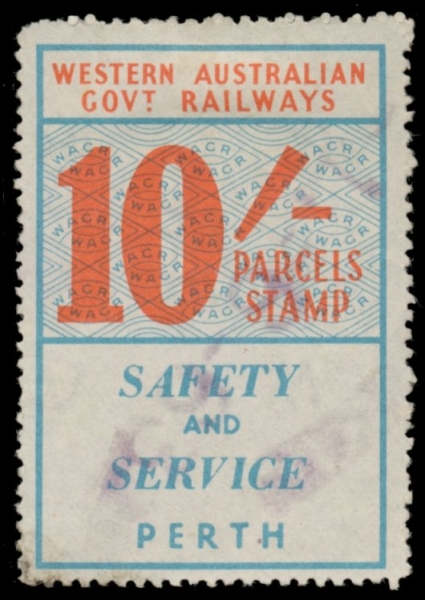
 Fourth SERIES : Values in Sterling. Station names applied as on Third SERIES, Third Issue - diagonally.
Fourth Issue 'New' Stations seen :
Meltham
.
.
Fourth SERIES : Values in Sterling. Station names applied as on Third SERIES, Third Issue - diagonally.
Fourth Issue 'New' Stations seen :
Meltham
.
.
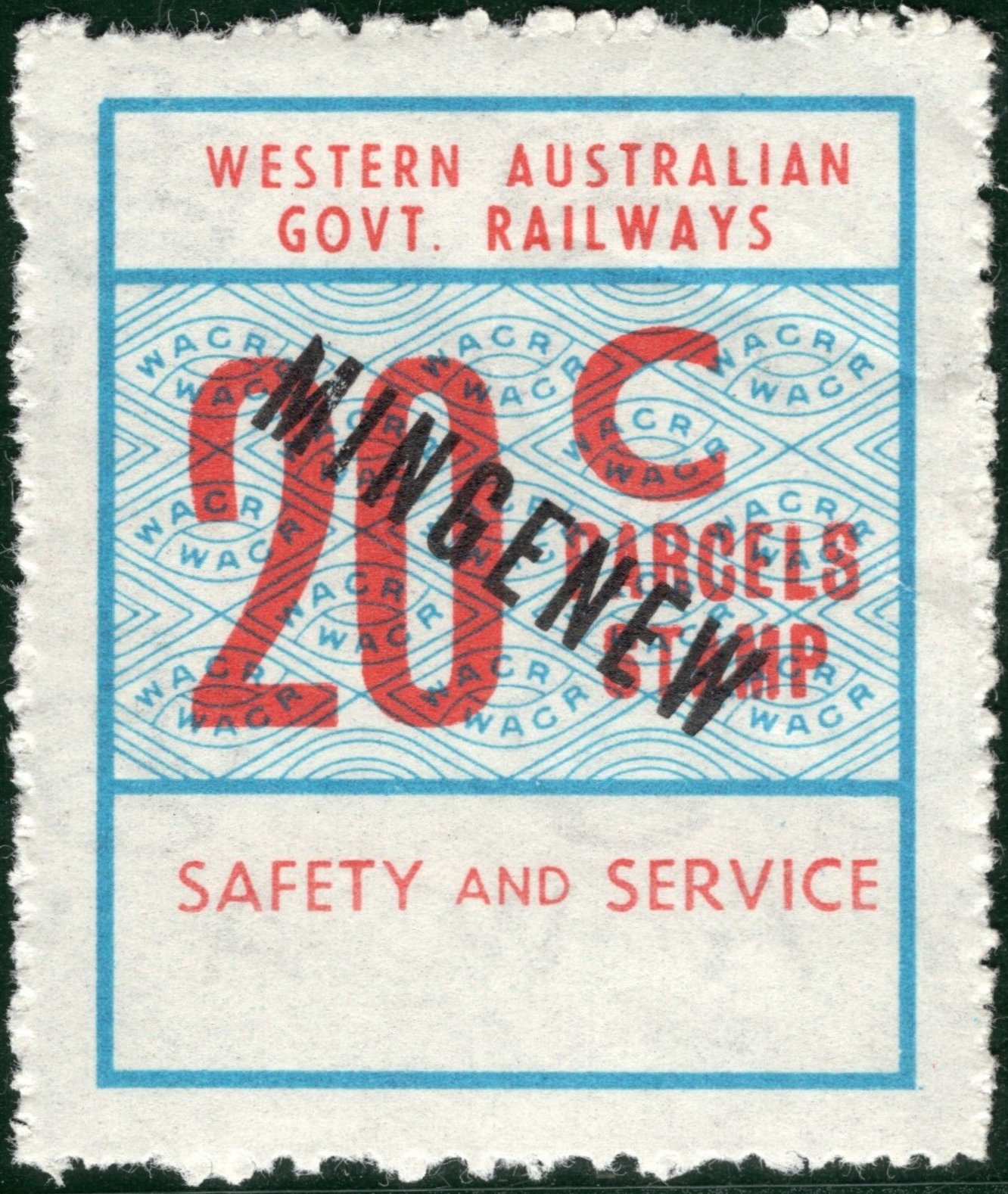 Fifth SERIES : Decimal Currency. Station names applied as on Third SERIES, Third Issue - diagonally.
Fifth Issue 'New' Stations seen :
Bullsbrook (only seen as remainders, mint)
Corrigin
Gingin (10c mint & 20c mint seen)
Grass Valley (only seen as Specimens, mint)
Kewdale
Midland, not a new station, but without the 'Junction', 10c used
Mingenew
.
Fifth SERIES : Decimal Currency. Station names applied as on Third SERIES, Third Issue - diagonally.
Fifth Issue 'New' Stations seen :
Bullsbrook (only seen as remainders, mint)
Corrigin
Gingin (10c mint & 20c mint seen)
Grass Valley (only seen as Specimens, mint)
Kewdale
Midland, not a new station, but without the 'Junction', 10c used
Mingenew
.
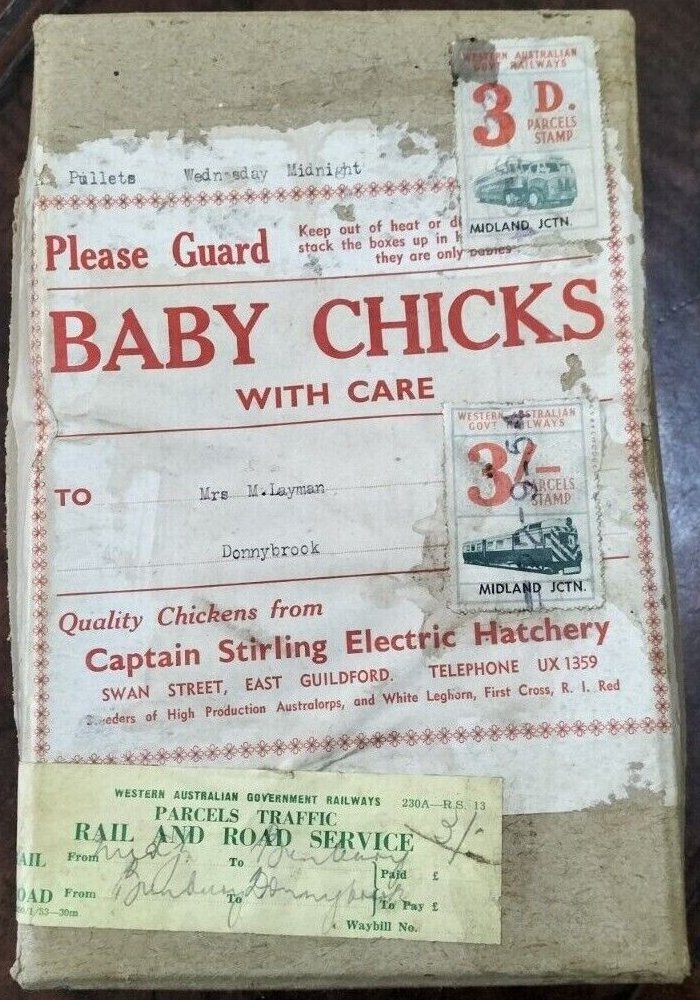 Shown above is a lot sold on Ebay in October 2022 for A$370.-, a shoe box with, on the lid, two Midland Junction Second Issue stamps (3d and 3/-), cancelled 22-9-54, accompanied by a (not previously recorded) WAGR Road & Rail Service waybill. Not the most practical item to add to a collection but, despite not really being from so long ago, it feels like a relic of a bygone age.
.
Epilogue :
It is quite unusual for stamps that are neither very old nor standard post office issues to receive the kind of examination that the Third SERIES of stamps has received here. It can even be disheartening, since so many of these stamps may prove highly elusive, should one seek to acquire them.
However, opportunities to investigate an under-studied area of philately whilst (briefly) in possession of a very high proportion of the surviving stamps are exceptionally rare. Yes, in places we have delved unusually deeply into elements that are not typically catalogued, listed or price-assessed, such as letters outside their frames or wide margins; such things will certainly not be for everyone. There may equally be other aspects that we have not discussed that some collectors might see as important omissions.
If you are a long-time specialist collector in this specific field, you are likely to have encountered several stations, varieties, anomalies etc. that we have not listed here and you may have drawn alternative conclusions about the WAGR's practices in the 1950s. We do not claim by any stretch that we have found all there is to find, nor even that what we have found has always been correctly interpreted.
One thing we have provided here is much raw data that is open to further analysis in many different ways, for example in comparing the station distribution in this Third SERIES with that identifiable on earlier stamps through a study of the station numeral cancellations. A new discovery is rarely far way in those areas of philately that lack a massive following. It is this incomplete picture that is one of the joys of collecting outside the mainstream, in additon, at times, to being one of the drawbacks. We hope this article will inspire further enthusiasm and a useful resource to you.
Finally, to repeat the request in Appendix 1, we do think it would be good to try and have as good a record as possible of the known stations on Third SERIES stamps (one from any Issue), ideally with an image. It is not practical for us to keep adding to all the other facts and figures, but adding new stations to the summary table of stations, together with a scan in Appendix 1, is something we would be prepared to do, at least for a time. Additionally on stations, if anyone has an example of a town other than BRIDGETOWN with two different versions in the same Alphabet (as in Appendix xiv), that would be most interesting to add as well. Good hunting!
Shown above is a lot sold on Ebay in October 2022 for A$370.-, a shoe box with, on the lid, two Midland Junction Second Issue stamps (3d and 3/-), cancelled 22-9-54, accompanied by a (not previously recorded) WAGR Road & Rail Service waybill. Not the most practical item to add to a collection but, despite not really being from so long ago, it feels like a relic of a bygone age.
.
Epilogue :
It is quite unusual for stamps that are neither very old nor standard post office issues to receive the kind of examination that the Third SERIES of stamps has received here. It can even be disheartening, since so many of these stamps may prove highly elusive, should one seek to acquire them.
However, opportunities to investigate an under-studied area of philately whilst (briefly) in possession of a very high proportion of the surviving stamps are exceptionally rare. Yes, in places we have delved unusually deeply into elements that are not typically catalogued, listed or price-assessed, such as letters outside their frames or wide margins; such things will certainly not be for everyone. There may equally be other aspects that we have not discussed that some collectors might see as important omissions.
If you are a long-time specialist collector in this specific field, you are likely to have encountered several stations, varieties, anomalies etc. that we have not listed here and you may have drawn alternative conclusions about the WAGR's practices in the 1950s. We do not claim by any stretch that we have found all there is to find, nor even that what we have found has always been correctly interpreted.
One thing we have provided here is much raw data that is open to further analysis in many different ways, for example in comparing the station distribution in this Third SERIES with that identifiable on earlier stamps through a study of the station numeral cancellations. A new discovery is rarely far way in those areas of philately that lack a massive following. It is this incomplete picture that is one of the joys of collecting outside the mainstream, in additon, at times, to being one of the drawbacks. We hope this article will inspire further enthusiasm and a useful resource to you.
Finally, to repeat the request in Appendix 1, we do think it would be good to try and have as good a record as possible of the known stations on Third SERIES stamps (one from any Issue), ideally with an image. It is not practical for us to keep adding to all the other facts and figures, but adding new stations to the summary table of stations, together with a scan in Appendix 1, is something we would be prepared to do, at least for a time. Additionally on stations, if anyone has an example of a town other than BRIDGETOWN with two different versions in the same Alphabet (as in Appendix xiv), that would be most interesting to add as well. Good hunting!
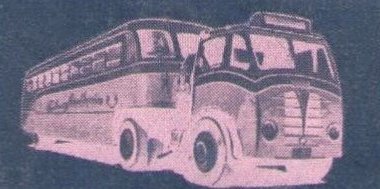
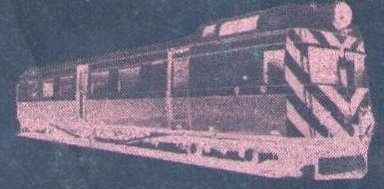
Return to Listing of all Railway Articles (with links). Note: You may already have an open tab
 Maylands, a station in the North-East suburbs of Perth, is represented by just four examples in the collection. All three in this scan have the same date and it is implausible that they do not come from the same parcel, indicating that Maylands probably handled very few parcels during the life of the stamps of this SERIES. Note the cancelling of the stamps with a well-centred station numeral strike (14) and the date neatly placed below using a simple office handstamp. This conscientiousness is not something one typically sees with cancellations from stations handling large numbers of parcels. The presence of dates in the style above on a relatively small number of stamps has proved valuable in our research into the earliest usage of the First Issue, as discussed in detail in Appendix 3.
The quite small numbers of surviving parcel stamps is largely explained by the size of the population of Western Australia. Entering the 1950s, it was only around 500,000. However, when one considers that the survival chances of parcel stamps are typically quite low, perhaps we are lucky to have as many as we do. Indeed, were it not for the fact that most parcels seem to have been franked with several adhesives, the Maylands trio above being an example, the surviving numbers would be considerably smaller. Even at stations which handled the largest volumes of parcels and which, unlike smaller stations, ought to have had many face values in stock, we see clear evidence of the use of multiples of stamps where a single higher value ought to have been a simple, and available, alternative.
The collection is, we believe, a reasonably representative selection by station name but it is not fully representative by face value. We understand that the previous owner disposed of a small number of rarer stamps separately, the rarest values being the ½d, 10/- and £1 values, whilst the 1d and 5/- are also very scarce. If he did not dispose of any 1d values, then this value too should perhaps be added to the 'rare' categorization. We return to the subject of the 1d (and the ½d) in Appendix 4(xii), since both the ½d and 1d stamps may have had an extraordinarily limited application, if the one regulation that we have found requiring their use really was their sole raison d'être.
In the case of stamps reportèdly extracted, we do not believe the numbers involved, with the possible exception of the 5/-, would have amounted even to a handful or so of each of those face values. Indeed, it is possible that no other ½d stamp, beyond the one found in this collection, was ever present. It is also possible that there was never a £1 stamp in the collection. To date, we have been unable to trace any details of these few stamps that were apparently sold separately. Based on the quantities seen in other collections and auction sales, it seems more likely than not that there would have been a few 5/- values, and probably a 10/- value or two, in a collection of this size.
For all the other face values, viz. from 3d to 4/-, on which this article necessarily concentrates, we believe the relative proportions (by face value, by station and by issue), evident in the 1,818 stamps tabulated in this article, can reasonably be expected to be as reliable a guide as any.
Usually, when writing articles, it is on subjects that we have studied in detail over time, but this is not true here. We have sought out help from several sources, both for the philatelic and non-philatelic. On the philatelic side, we should like to mention the help received from Chris Hayter, including several scans of stamps from stations which we would otherwise have been unable to display. We have also been greatly assisted by Dave Elsmore and we wish to express our thanks to him for the extensive assistance provided to us in the form both of information and of numerous scans of scarce items.
For those who do not know it, the online Elsmore catalogue is an amazing reference for all things Revenue and Railway in Australia but, understandably, given the breadth of its coverage, it does not seek to provide a highly detailed listing of the Western Australia RPS.
This is a link to Dave Elsmore’s free online catalogue. . . (opens in a new tab).
.
Quick Guide to Key Limitations in this Article :
1. Where we have not seen a particular value in any set, nor been assured by a reliable source that it exists, with only the odd exception we have NOT listed it. However, this does not always mean that it is unknown, simply that it is unknown to us.
2. Consequently, to underline the above, neither a blank space or ‘0’ against a face value in a table should necessarily be taken as meaning that the value does not exist.
3. Any conjecture relating to the ½d, 1d, 5/-, 10/- and £1 values of the Third SERIES based solely on the statistical information in this article would be inadvisable.
.
Overview of the Third SERIES : 1951 - c. 1960
Production of all three Issues of the Third SERIES stamps typically required a three-stage procedure, taking the printing of the blue and green colours, common to all values, as one 'stage'.
Stage 1: Two runs through the presses: Printing of the frame and moiré security pattern in Blue in the top half of the stamp, followed by the transport image in the lower half of the stamp in Green. The register between these colours is usually quite good, the bus or train only rarely slipping outside the confines of its frame.
Stage 2 : Printing the face value and all the red text. This text exists in two types / fonts, with one font always found on one group of face values and the other font always found on the remaining values of the set. The most obviously different letter is the 'C' of the word 'PARCELS' but there are many other, smaller differences. However, even when there is a change of Issue with a new form of the Station name, there is no change with regard to which face values come in which red text font. Consequently, we do not examine this red text font variation further.
For the record, the following values have the font with the narrower ‘C’, the list being applicable to all Printings : Narrow C etc. : ½d, 1d, 1/-, 1/3, 1/6, 10/-, £1.
Once again the workmanship is conscientious with little by way of significant register shift of the red text. WESTERN AUSTRALIAN / GOVT. RAILWAYS rarely even touches the frame-lines with only the occasional errant placement partially outside the text box.
The only reference we have seen to the sheet size is from an article by the late Dr. Derek Pocock, in which he says he believes the sheet size was 100 (10 x 10). (We have doubts about this and examine the question further at the end of the article). The Melbourne-based auction house, Abacus Auctions, sold Derek Pocock's collection and we reference this sale (#168) many times in this article - and provide a link to it. There are some useful pencilled notes by Derek Pocock on the album leaves in that sale covering many aspects of WA Railway Philately.
Stage 3 : Adding the Station Name in BLACK (other than on most Second Issue PERTH stamps).
Within probably less than two years of the introduction of the Third SERIES stamps, it was clearly deemed simpler and more cost-effective to make special stones for the high-usage PERTH stamps, with the station name included as part of the original stamp production. Adding the name at Stage 1 in the Green was the chosen option and the station name on PERTH stamps is consequently found in Green for much of the life of these stamps. For all other stations, the name is consistently in Black.
As with, for example, Queensland RPS, the printing of stamps for myriad stations opens up an interesting avenue for collectors. The number of stations in Western Australia is far smaller, and altogether more manageable, than for Queensland. We are not aware of any complete record in existence of all the stations for which Third SERIES stamps were produced and, even if one were to hand, it is by no means certain that at least one example from every station will have survived.
Note : It is NOT our intention to continually update all the facts in this article; time does not permit. However, we would be interested to be told about any stamp from the THIRD SERIES as a whole that is from a station that we have not recorded in this article. There will almost certainly be several.
Maylands, a station in the North-East suburbs of Perth, is represented by just four examples in the collection. All three in this scan have the same date and it is implausible that they do not come from the same parcel, indicating that Maylands probably handled very few parcels during the life of the stamps of this SERIES. Note the cancelling of the stamps with a well-centred station numeral strike (14) and the date neatly placed below using a simple office handstamp. This conscientiousness is not something one typically sees with cancellations from stations handling large numbers of parcels. The presence of dates in the style above on a relatively small number of stamps has proved valuable in our research into the earliest usage of the First Issue, as discussed in detail in Appendix 3.
The quite small numbers of surviving parcel stamps is largely explained by the size of the population of Western Australia. Entering the 1950s, it was only around 500,000. However, when one considers that the survival chances of parcel stamps are typically quite low, perhaps we are lucky to have as many as we do. Indeed, were it not for the fact that most parcels seem to have been franked with several adhesives, the Maylands trio above being an example, the surviving numbers would be considerably smaller. Even at stations which handled the largest volumes of parcels and which, unlike smaller stations, ought to have had many face values in stock, we see clear evidence of the use of multiples of stamps where a single higher value ought to have been a simple, and available, alternative.
The collection is, we believe, a reasonably representative selection by station name but it is not fully representative by face value. We understand that the previous owner disposed of a small number of rarer stamps separately, the rarest values being the ½d, 10/- and £1 values, whilst the 1d and 5/- are also very scarce. If he did not dispose of any 1d values, then this value too should perhaps be added to the 'rare' categorization. We return to the subject of the 1d (and the ½d) in Appendix 4(xii), since both the ½d and 1d stamps may have had an extraordinarily limited application, if the one regulation that we have found requiring their use really was their sole raison d'être.
In the case of stamps reportèdly extracted, we do not believe the numbers involved, with the possible exception of the 5/-, would have amounted even to a handful or so of each of those face values. Indeed, it is possible that no other ½d stamp, beyond the one found in this collection, was ever present. It is also possible that there was never a £1 stamp in the collection. To date, we have been unable to trace any details of these few stamps that were apparently sold separately. Based on the quantities seen in other collections and auction sales, it seems more likely than not that there would have been a few 5/- values, and probably a 10/- value or two, in a collection of this size.
For all the other face values, viz. from 3d to 4/-, on which this article necessarily concentrates, we believe the relative proportions (by face value, by station and by issue), evident in the 1,818 stamps tabulated in this article, can reasonably be expected to be as reliable a guide as any.
Usually, when writing articles, it is on subjects that we have studied in detail over time, but this is not true here. We have sought out help from several sources, both for the philatelic and non-philatelic. On the philatelic side, we should like to mention the help received from Chris Hayter, including several scans of stamps from stations which we would otherwise have been unable to display. We have also been greatly assisted by Dave Elsmore and we wish to express our thanks to him for the extensive assistance provided to us in the form both of information and of numerous scans of scarce items.
For those who do not know it, the online Elsmore catalogue is an amazing reference for all things Revenue and Railway in Australia but, understandably, given the breadth of its coverage, it does not seek to provide a highly detailed listing of the Western Australia RPS.
This is a link to Dave Elsmore’s free online catalogue. . . (opens in a new tab).
.
Quick Guide to Key Limitations in this Article :
1. Where we have not seen a particular value in any set, nor been assured by a reliable source that it exists, with only the odd exception we have NOT listed it. However, this does not always mean that it is unknown, simply that it is unknown to us.
2. Consequently, to underline the above, neither a blank space or ‘0’ against a face value in a table should necessarily be taken as meaning that the value does not exist.
3. Any conjecture relating to the ½d, 1d, 5/-, 10/- and £1 values of the Third SERIES based solely on the statistical information in this article would be inadvisable.
.
Overview of the Third SERIES : 1951 - c. 1960
Production of all three Issues of the Third SERIES stamps typically required a three-stage procedure, taking the printing of the blue and green colours, common to all values, as one 'stage'.
Stage 1: Two runs through the presses: Printing of the frame and moiré security pattern in Blue in the top half of the stamp, followed by the transport image in the lower half of the stamp in Green. The register between these colours is usually quite good, the bus or train only rarely slipping outside the confines of its frame.
Stage 2 : Printing the face value and all the red text. This text exists in two types / fonts, with one font always found on one group of face values and the other font always found on the remaining values of the set. The most obviously different letter is the 'C' of the word 'PARCELS' but there are many other, smaller differences. However, even when there is a change of Issue with a new form of the Station name, there is no change with regard to which face values come in which red text font. Consequently, we do not examine this red text font variation further.
For the record, the following values have the font with the narrower ‘C’, the list being applicable to all Printings : Narrow C etc. : ½d, 1d, 1/-, 1/3, 1/6, 10/-, £1.
Once again the workmanship is conscientious with little by way of significant register shift of the red text. WESTERN AUSTRALIAN / GOVT. RAILWAYS rarely even touches the frame-lines with only the occasional errant placement partially outside the text box.
The only reference we have seen to the sheet size is from an article by the late Dr. Derek Pocock, in which he says he believes the sheet size was 100 (10 x 10). (We have doubts about this and examine the question further at the end of the article). The Melbourne-based auction house, Abacus Auctions, sold Derek Pocock's collection and we reference this sale (#168) many times in this article - and provide a link to it. There are some useful pencilled notes by Derek Pocock on the album leaves in that sale covering many aspects of WA Railway Philately.
Stage 3 : Adding the Station Name in BLACK (other than on most Second Issue PERTH stamps).
Within probably less than two years of the introduction of the Third SERIES stamps, it was clearly deemed simpler and more cost-effective to make special stones for the high-usage PERTH stamps, with the station name included as part of the original stamp production. Adding the name at Stage 1 in the Green was the chosen option and the station name on PERTH stamps is consequently found in Green for much of the life of these stamps. For all other stations, the name is consistently in Black.
As with, for example, Queensland RPS, the printing of stamps for myriad stations opens up an interesting avenue for collectors. The number of stations in Western Australia is far smaller, and altogether more manageable, than for Queensland. We are not aware of any complete record in existence of all the stations for which Third SERIES stamps were produced and, even if one were to hand, it is by no means certain that at least one example from every station will have survived.
Note : It is NOT our intention to continually update all the facts in this article; time does not permit. However, we would be interested to be told about any stamp from the THIRD SERIES as a whole that is from a station that we have not recorded in this article. There will almost certainly be several.
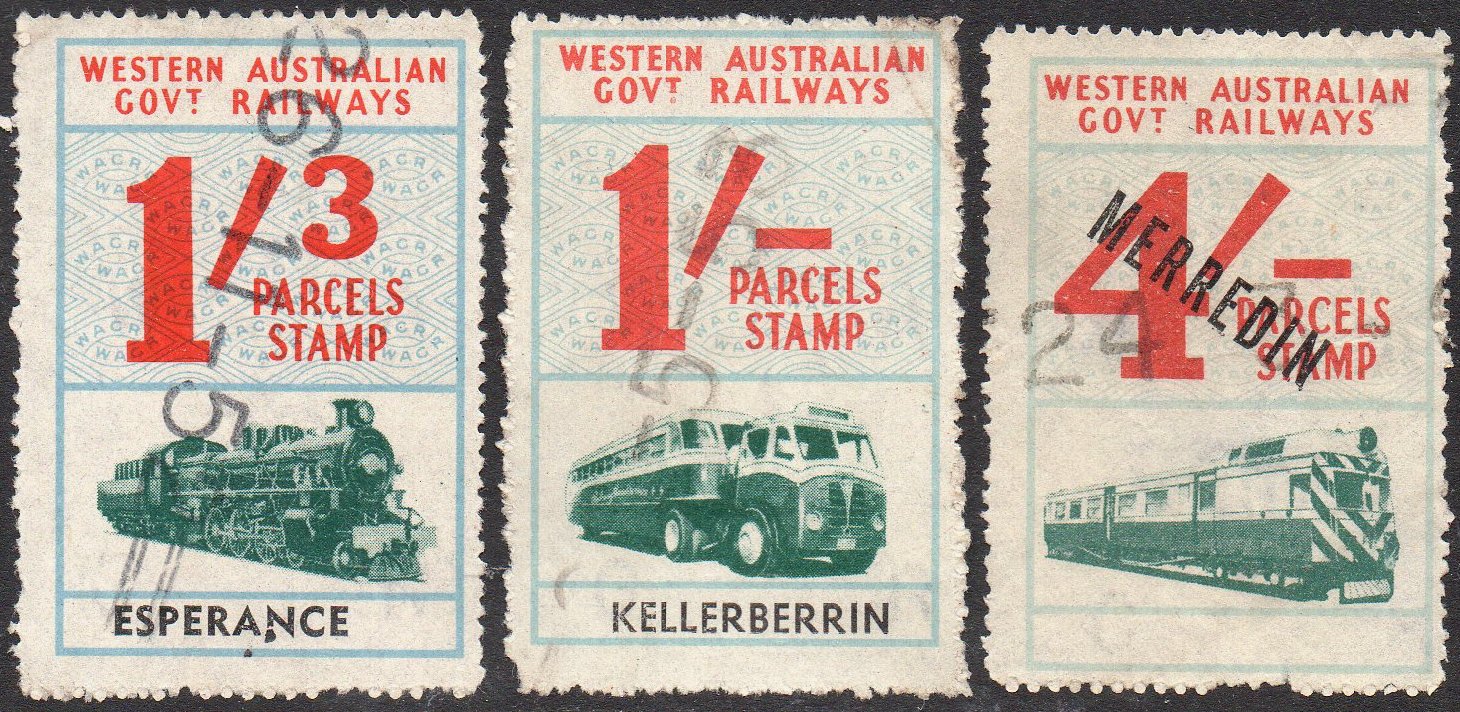 Shown above are the three designs for these c.1951-1960 Third SERIES stamps, Steam Locomotive, Articulated Bus and Diesel Railcar. These vehicles, one on which is quite eccentric, are described more fully in Appendix 2.
Mint examples of all these stamps, of whatever face value and from whichever issue, are rare.
The three stamps shown in the scan above are, left-to-right, from the First, Second and Third Issues of this SERIES. Much of this article is devoted to dating these three issues and to listing and illustrating the known stations.
Navigation : We have colour-coded the three Issues (and a summary section) in this article to aid the reader. The principal sections for the First, Second and Third Issues and the Summary Tables section have all been framed. The links in the left panel and the Headings of the Tables for each Issue have also been coloured to match:
First Issue is colour-coded Red
Second Issue is colour-coded Green.
Third Issue is colour-coded Violet
Summaries of the 3 Issues combined (the SERIES) are colour-coded Blue
The Appendices occupy half the article and carry much additional information. The subject matter of each appendix can be seen in the left panel. Navigation is further aided in the Appendices as follows:
Appendix 3 (analysis around dates of issue) has also been given a frame in this colour.
Appendix 4 is large and wide-ranging and has therefore been box-framed as well, in this colour. Due to its size, we have also provided some mid-table short-cuts within Appendix 4 in the left panel :
Sub-Sections of Appendix 4:
(i) . Stamps in Multiples
(ii) . PERTH dated cancels
(iii). Manuscript cancels
(iv). Date Errors on cancels
(v) . STATION MASTER cancels
extra short-cut (left panel) to:
(vi). Company Perfins
vii). BOANS LTD.
extra short-cut (left panel) to:
(viii).Wide left-hand margins on stamps
(ix) . Green Shades on Stamps
(x) . Red & Blue Shades on Stamps
(xi) . Text & Design Shifts (Register Errors of Green & Red Colours)
extra short-cut (left panel) to:
(xii) . Railway Parcel Rates Table (1951)
(xiii). Mint Stamps & Specimen Stamps
(xiv) . Individual Station Names : Varieties
.
WATERMARKS :
We have identified the watermark orientation of all 1,818 stamps in this collection and have reported the actual number in each orientation in the catalogue-style listing for each Issue. In our separate price tables for each Issue, we have provided prices for 'Watermark Upright' and 'Watermark Inverted' for each face value.
On the rarest face values, one is working on such tiny numbers that a study of the watermark will not produce much by way of usable results. In several such cases, we have not offered more than one price, whereas for all the commoner values we have had sufficient numbers to draw conclusions that allow a reasonable assessment of likely scarcity of each orientation of the watermark, and hence to posit values for them. For the Rouletted x Perf stamps of the Second Issue, q.v., again the numbers we have seen are quite small and insufficient to draw any conclusions about relative watermark scarcity.
Of the watermark itself, a Crown surrounded by the letters W A at top and G R at foot, we observed that the letter 'R' varies from a well-formed letter to something approaching a mis-shapen, rounded 'A' or a camping cooking-pot on two legs. The most aberrant examples can almost look like a Reversed 'R'.
The 'GR' in the watermark stands for 'Government Railways' rather than George Rex. For all but the first few months of these issues, Elizabeth II was on the throne and, in any case, a regnal number would normally be expected in a Royal Cypher (GviR).
.
Shown above are the three designs for these c.1951-1960 Third SERIES stamps, Steam Locomotive, Articulated Bus and Diesel Railcar. These vehicles, one on which is quite eccentric, are described more fully in Appendix 2.
Mint examples of all these stamps, of whatever face value and from whichever issue, are rare.
The three stamps shown in the scan above are, left-to-right, from the First, Second and Third Issues of this SERIES. Much of this article is devoted to dating these three issues and to listing and illustrating the known stations.
Navigation : We have colour-coded the three Issues (and a summary section) in this article to aid the reader. The principal sections for the First, Second and Third Issues and the Summary Tables section have all been framed. The links in the left panel and the Headings of the Tables for each Issue have also been coloured to match:
First Issue is colour-coded Red
Second Issue is colour-coded Green.
Third Issue is colour-coded Violet
Summaries of the 3 Issues combined (the SERIES) are colour-coded Blue
The Appendices occupy half the article and carry much additional information. The subject matter of each appendix can be seen in the left panel. Navigation is further aided in the Appendices as follows:
Appendix 3 (analysis around dates of issue) has also been given a frame in this colour.
Appendix 4 is large and wide-ranging and has therefore been box-framed as well, in this colour. Due to its size, we have also provided some mid-table short-cuts within Appendix 4 in the left panel :
Sub-Sections of Appendix 4:
(i) . Stamps in Multiples
(ii) . PERTH dated cancels
(iii). Manuscript cancels
(iv). Date Errors on cancels
(v) . STATION MASTER cancels
extra short-cut (left panel) to:
(vi). Company Perfins
vii). BOANS LTD.
extra short-cut (left panel) to:
(viii).Wide left-hand margins on stamps
(ix) . Green Shades on Stamps
(x) . Red & Blue Shades on Stamps
(xi) . Text & Design Shifts (Register Errors of Green & Red Colours)
extra short-cut (left panel) to:
(xii) . Railway Parcel Rates Table (1951)
(xiii). Mint Stamps & Specimen Stamps
(xiv) . Individual Station Names : Varieties
.
WATERMARKS :
We have identified the watermark orientation of all 1,818 stamps in this collection and have reported the actual number in each orientation in the catalogue-style listing for each Issue. In our separate price tables for each Issue, we have provided prices for 'Watermark Upright' and 'Watermark Inverted' for each face value.
On the rarest face values, one is working on such tiny numbers that a study of the watermark will not produce much by way of usable results. In several such cases, we have not offered more than one price, whereas for all the commoner values we have had sufficient numbers to draw conclusions that allow a reasonable assessment of likely scarcity of each orientation of the watermark, and hence to posit values for them. For the Rouletted x Perf stamps of the Second Issue, q.v., again the numbers we have seen are quite small and insufficient to draw any conclusions about relative watermark scarcity.
Of the watermark itself, a Crown surrounded by the letters W A at top and G R at foot, we observed that the letter 'R' varies from a well-formed letter to something approaching a mis-shapen, rounded 'A' or a camping cooking-pot on two legs. The most aberrant examples can almost look like a Reversed 'R'.
The 'GR' in the watermark stands for 'Government Railways' rather than George Rex. For all but the first few months of these issues, Elizabeth II was on the throne and, in any case, a regnal number would normally be expected in a Royal Cypher (GviR).
.
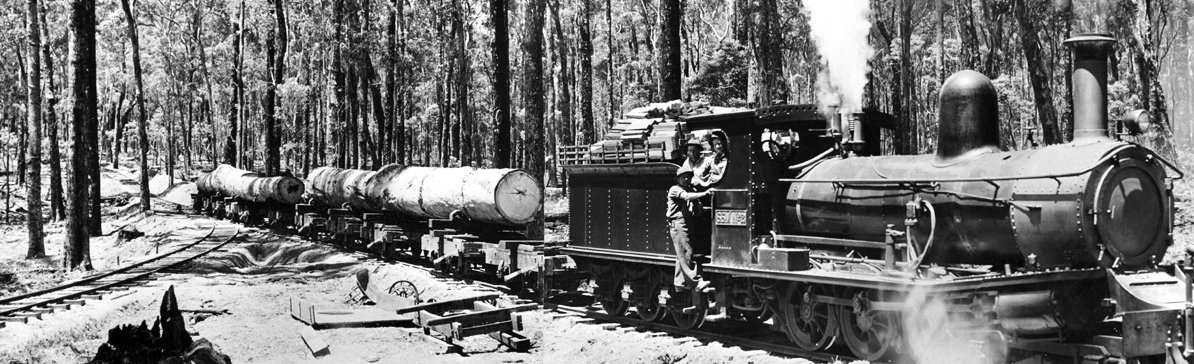 Logging train in the Manjimup / Pemberton area around the 1940s. Many of the rural railways in WA were built both for freight and to encourage (unsuccessfully) people and businesses to spread out from the urban areas - and from Perth in particular.
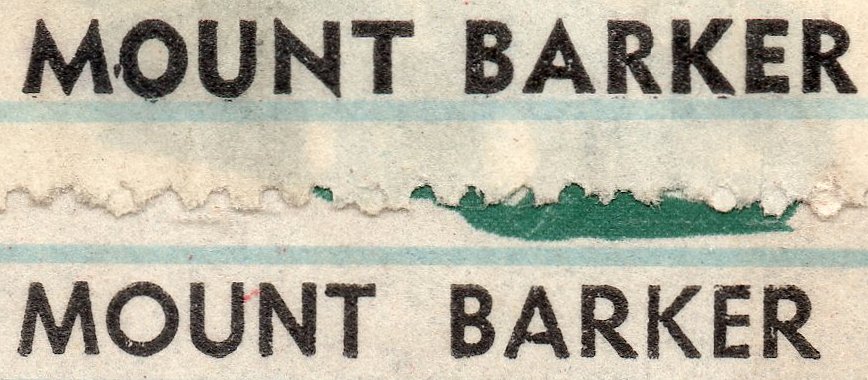 Top : Alphabet A (1st Issue) . . . . . Bottom : Alphabet B (2nd Issue)
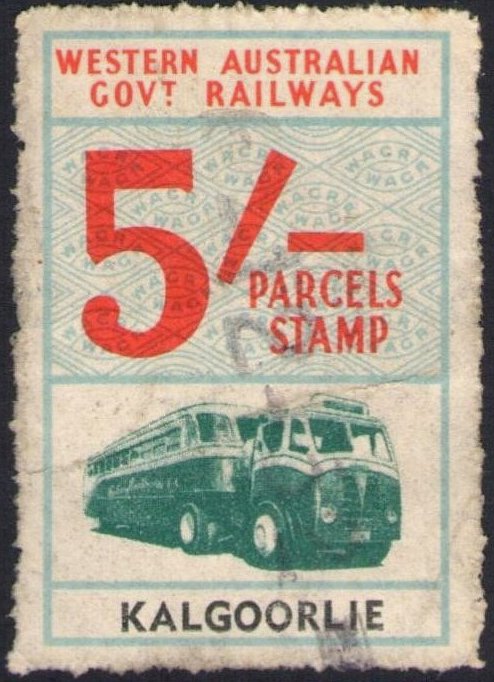
 Another comparison of First Issue (left) & Second Issue(right), from a town where the distinction is less obvious than usual. The pointed and flat-topped 'A', the different shape of the letters 'O' and especially the middle bar of the 'E' are the clearest indicators. First Issue 5/- do not seem at all common; this one is cancelled in December 1952, which is approaching the end of the First Issue period. Although the 5/- was present among the proofs for the First Issue, we have yet to see a clear early use of it. It is possible that it was not initially put into circulation or, equally, it may have been available from the start but simply saw little use.
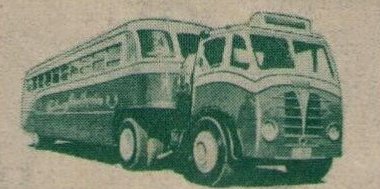
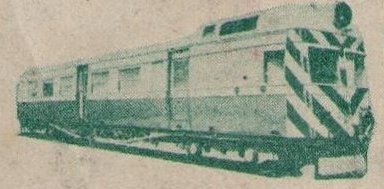
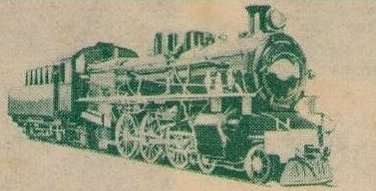 .
.

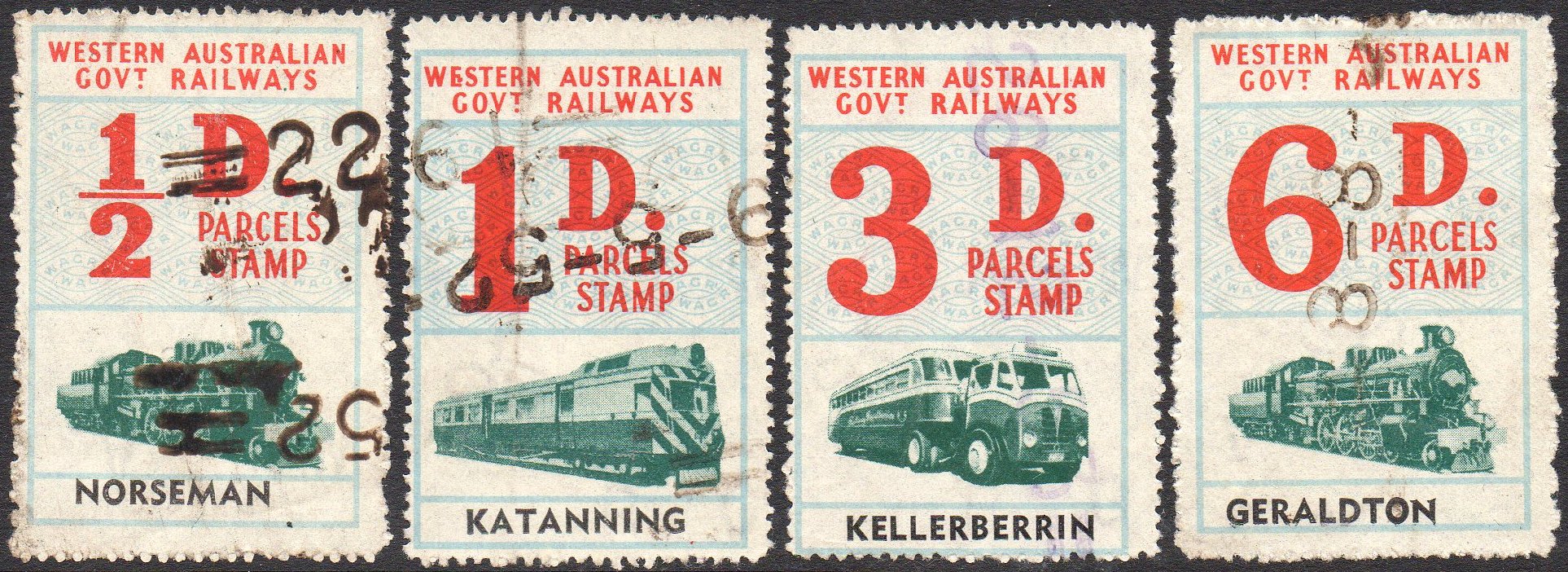
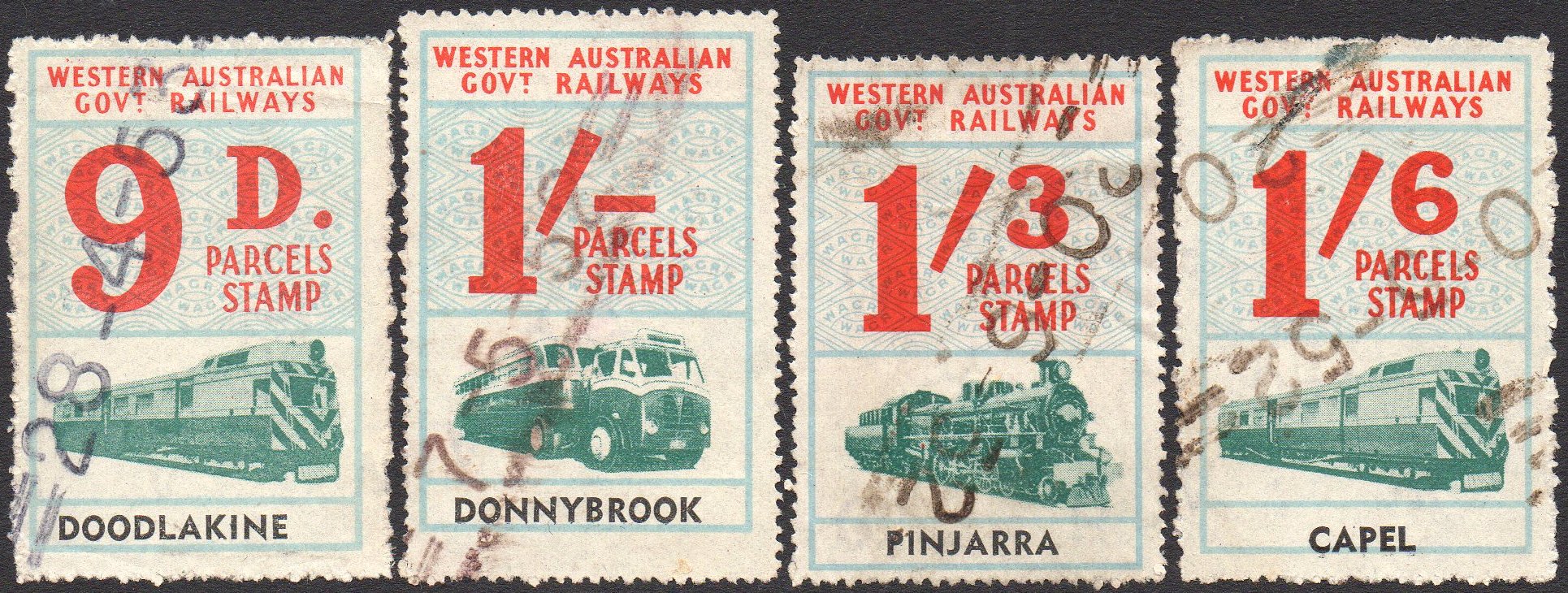
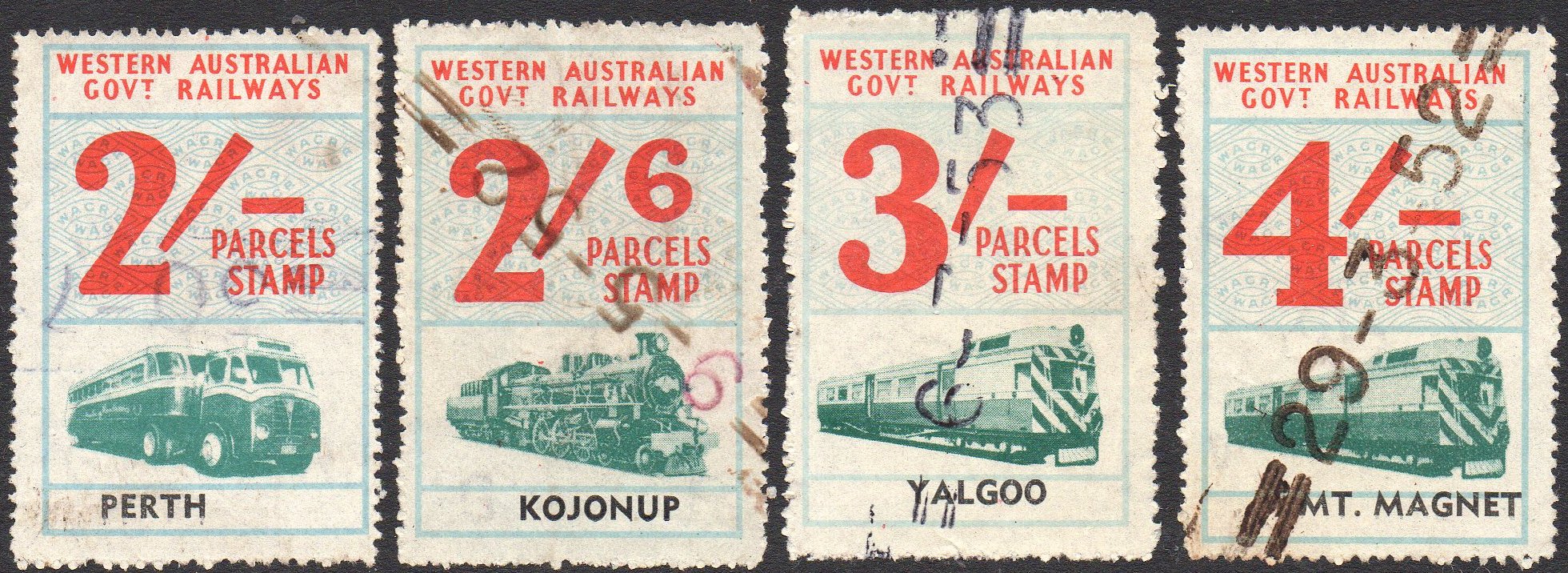

 The image of the 10/- is from a Prestige Philately auction in 2011. The ½d and the First Issue 10/- are particularly rare stamps, as is the 3/-. The dates of the two 3/- in the collection suggest the value was a fairly late addition, the Bridgetown being used on 2-10-52 and Yalgoo on 6-7-53, having presumably been in stock at the station for several months prior. We have found no evidence of a 1/9 or a £1 stamp in the First Issue, nor have we seen these two values listed elsewhere.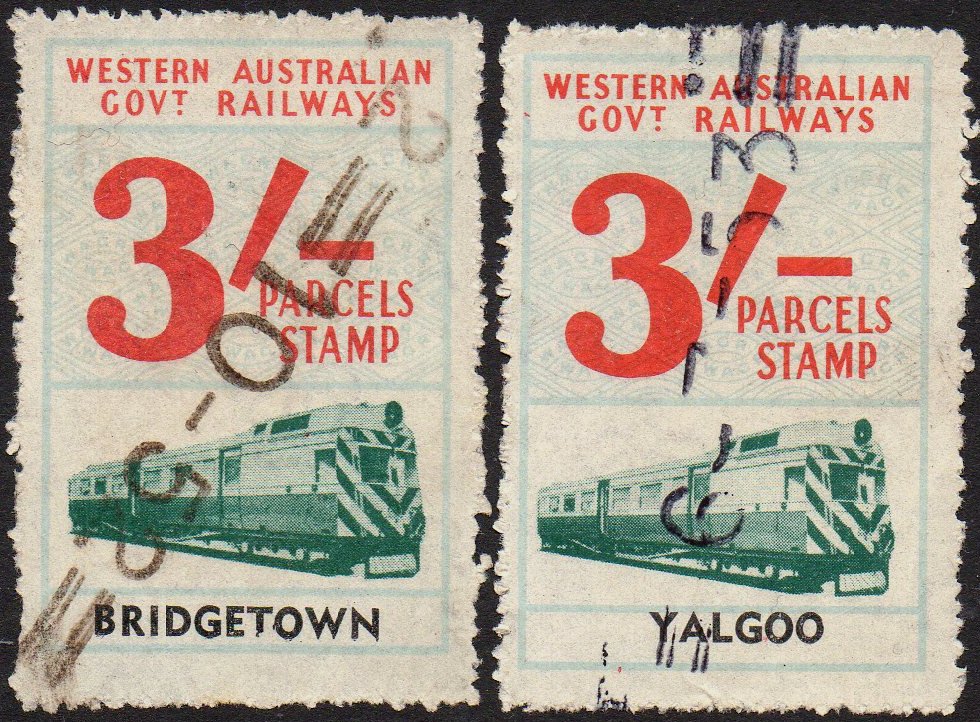
 We show the two examples of the rare 3/- of the First Issue in the collection. We know of no other 3/- of this issue to have been reported, although others may yet be identified.
Listing :
We show the two examples of the rare 3/- of the First Issue in the collection. We know of no other 3/- of this issue to have been reported, although others may yet be identified.
Listing : 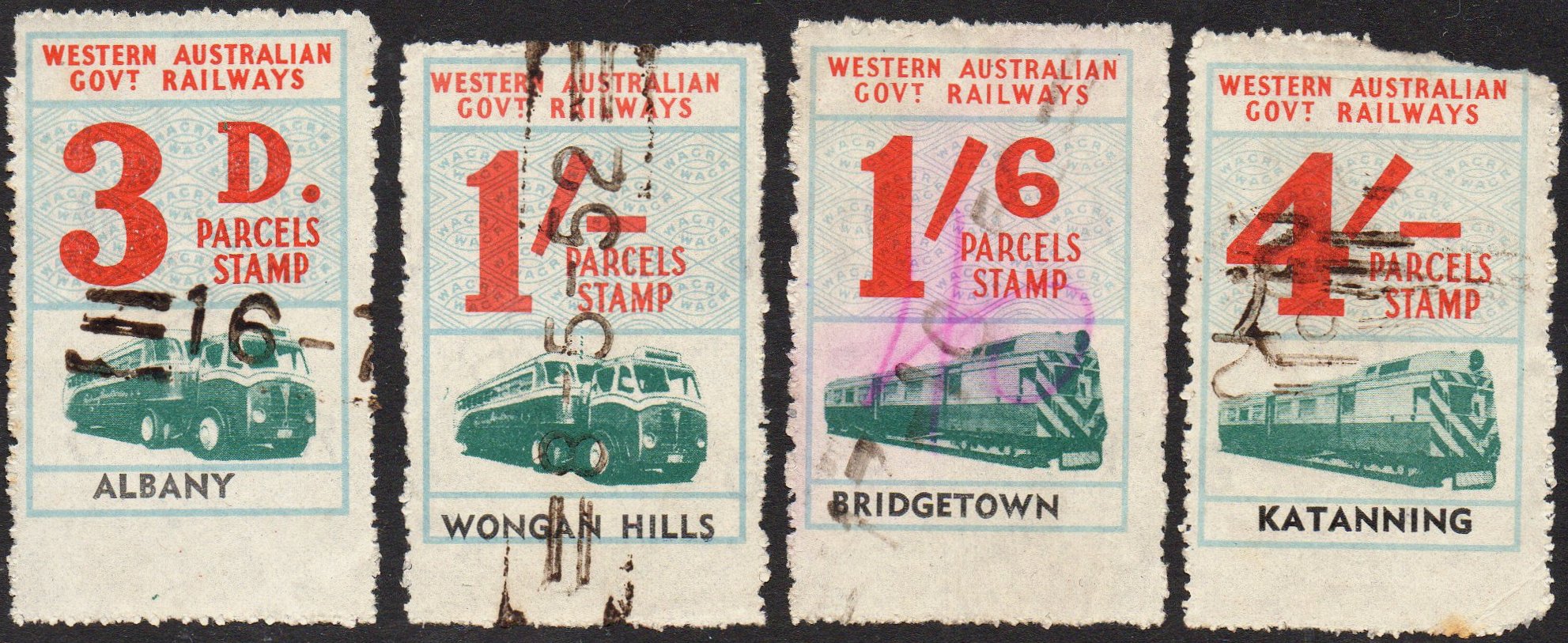 Variety : Wide Bottom Margin : It measures 8 mms or more between the bottom frame-line of the stamp and the lower perforations. This is a variety seen almost exclusively with First Issue stamps and is uncommon.
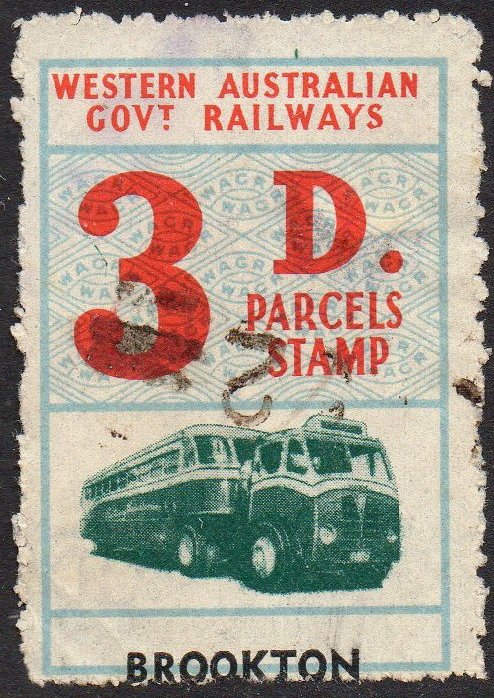
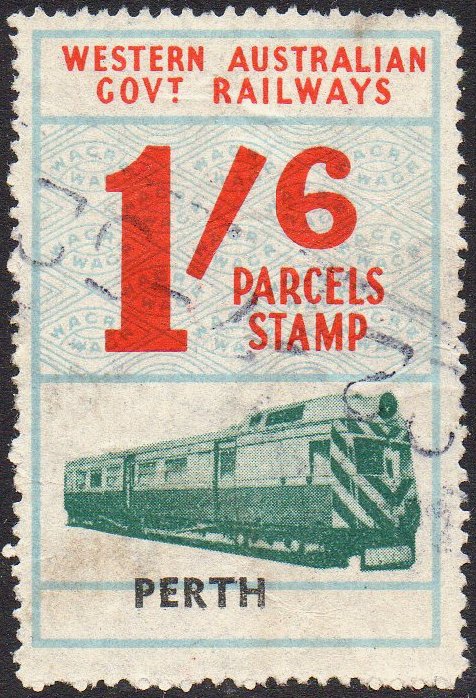
 Variety : Station Name Shifts : We have seen no extreme shifts and the general care in this part of the printing is usually fair-to-fine. It is not uncommon for the station name just to touch the frame but it only breaks the frame significantly on a relatively few stamps. Too low is a little commoner than too high on stamps with a vertical shift of the name. Since horizontal shifts that break the frame-line are likely to be limited to the longest station names, these are few in number.
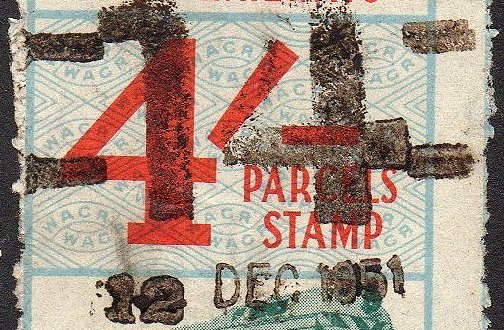 Early Usage & Dates :
The final feature listed in the table below is the combination of old-style station NUMERAL obliterator accompanied by a small straight date-stamp (of a standard office off-the-shelf design) which would typically be dated between August 1951 and February, occasionally up to April, 1952. However, with the year frequently illegible, and apparently some occasional even later usage of the old style datestamps, prices are for stamps where both the month and year are legible.
This 'obliterator + dater' combination was used frequently on earlier SERIES. As these stamps did not carry station names, the numeral obliterator served a geographical function. For the Third SERIES, with the station name now printed on the stamps, simply a date cancellation would suffice and this was introduced in late February/early March 1952 and it supplanted the old twin-cancel procedure across the network within a few weeks, indeed largely, it seems, within a few days. For more on cancellations, please see Appendix 3.
Early Usage & Dates :
The final feature listed in the table below is the combination of old-style station NUMERAL obliterator accompanied by a small straight date-stamp (of a standard office off-the-shelf design) which would typically be dated between August 1951 and February, occasionally up to April, 1952. However, with the year frequently illegible, and apparently some occasional even later usage of the old style datestamps, prices are for stamps where both the month and year are legible.
This 'obliterator + dater' combination was used frequently on earlier SERIES. As these stamps did not carry station names, the numeral obliterator served a geographical function. For the Third SERIES, with the station name now printed on the stamps, simply a date cancellation would suffice and this was introduced in late February/early March 1952 and it supplanted the old twin-cancel procedure across the network within a few weeks, indeed largely, it seems, within a few days. For more on cancellations, please see Appendix 3.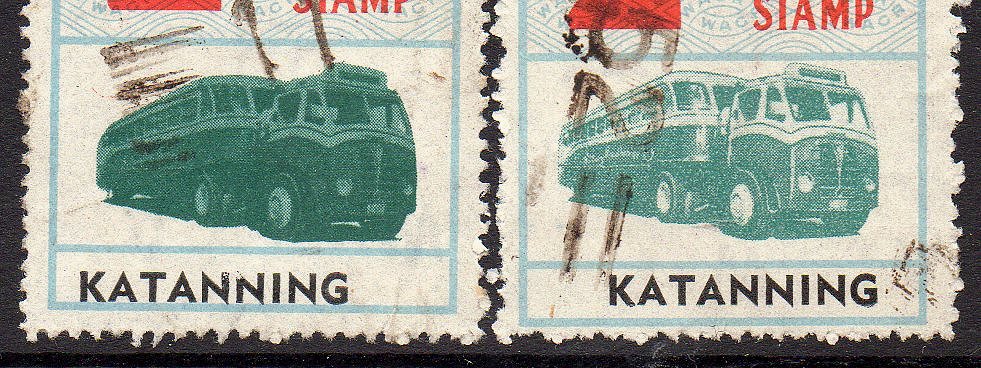
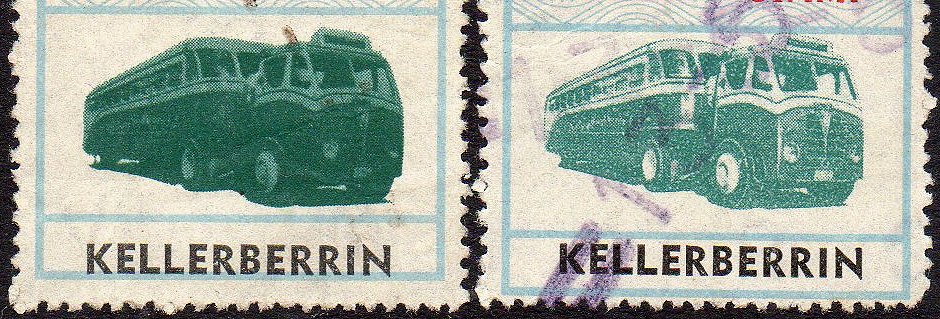
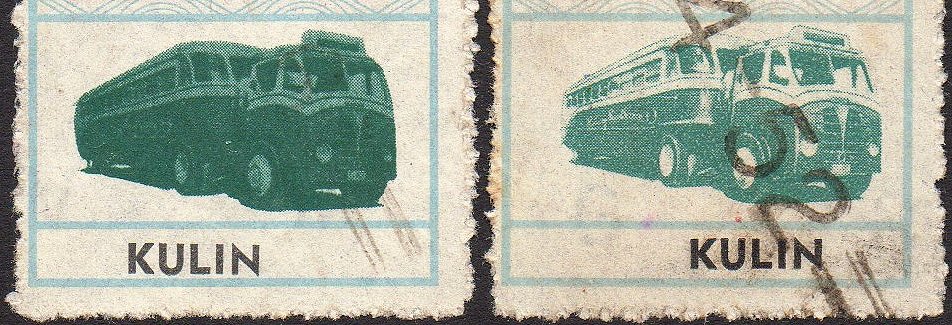
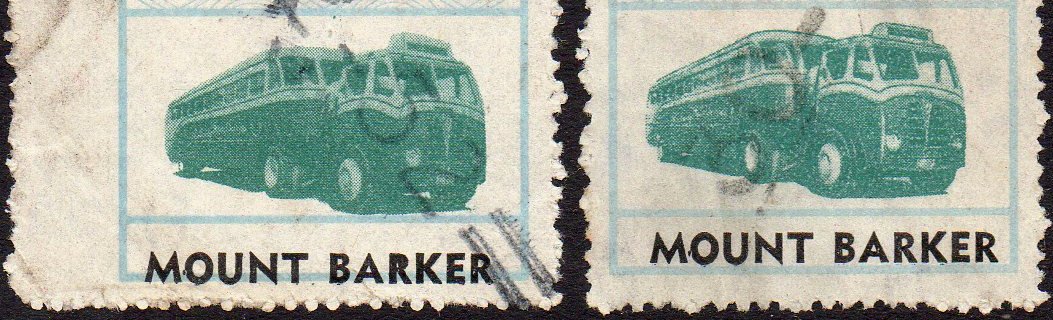

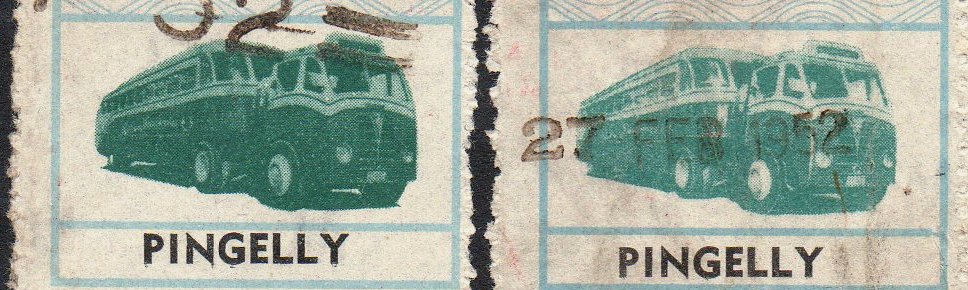
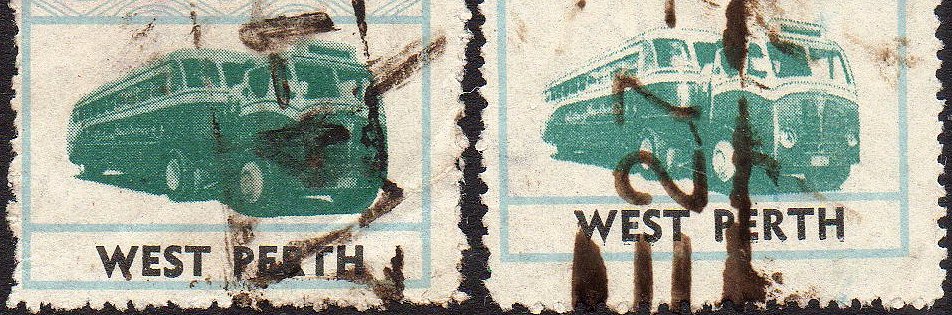
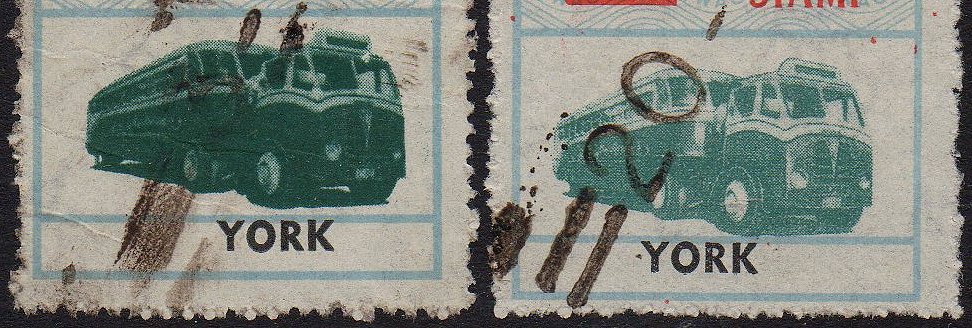 In each case, Type A is on the left of each station pair. Note the heavy printing screen on Mount Barker Type 'B', which makes the trim less white and the line behind the back wheel quite evident. However, the outline of the top of the semi-trailer is clearly Type 'B' as is the roof-box centring.
Katanning 2/- : Type 'A' : [ . ] [ . ]
- ditto - Type 'B' [ . ] [ . ]
Kellerberrin 2/- : Type 'A' : [ . ] [ . ]
- ditto - Type 'B' [ . ] [ . ]
Kulin 2/- : Type 'A' : [ . ] [ . ]
- ditto - Type 'B' [ . ] [ . ]
Mount Barker 2/- : Type 'A' : [ . ] [ . ]
- ditto - Type 'B' [ . ] [ . ]
Perth 2/- : Type 'A' : [ . ] [ . ]
- ditto - Type 'B' [ . ] [ . ]
Pingelly 2/- : Type 'A' : [ . ] [ . ]
- ditto - Type 'B' [ . ] [ . ]
West Perth 2/- : Type 'A' : [ . ] [ . ]
- ditto - Type 'B' [ . ] [ . ]
York 2/- : Type 'A' : [ . ] [ . ]
- ditto - Type 'B' [ . ] [ . ]
There will doubtless be a few further stations on the First Issue 2/- where both Types exist.
Taken overall, we would not suggest any price distinction between Types 'A' and 'B'; there is a breakdown of c.58% / 42% respectively in this collection. Station by station, though, relative scarcity will vary considerably. We have provided the Type distribution by station in an additional data column, located alongside the 2/- column in the 'First Issue Stations' table near the top of this section.
The question of 'which came first?' of the two Types is not easily answered. One would expect it to be Type 'A' and that is partially supported by the Perth Type 'A' above which has the office-style date handstamp of 28(23?)- Dec - 1951 (not visible in the scan). However, there is a Pingelly Type B with the early cancellation 27-FEB-1952 and the dates of use suggest that the Type 'B' stamps were delivered first at several stations. We think both Types were produced concurrently, probably throughout, or very nearly throughout, the life of the First Issue with two stones being made for the 2/- at a very early stage, most likely in recognition of the high demand on this stamp; nearly one-fifth of all the stamps in this collection are the 2/- value.
In each case, Type A is on the left of each station pair. Note the heavy printing screen on Mount Barker Type 'B', which makes the trim less white and the line behind the back wheel quite evident. However, the outline of the top of the semi-trailer is clearly Type 'B' as is the roof-box centring.
Katanning 2/- : Type 'A' : [ . ] [ . ]
- ditto - Type 'B' [ . ] [ . ]
Kellerberrin 2/- : Type 'A' : [ . ] [ . ]
- ditto - Type 'B' [ . ] [ . ]
Kulin 2/- : Type 'A' : [ . ] [ . ]
- ditto - Type 'B' [ . ] [ . ]
Mount Barker 2/- : Type 'A' : [ . ] [ . ]
- ditto - Type 'B' [ . ] [ . ]
Perth 2/- : Type 'A' : [ . ] [ . ]
- ditto - Type 'B' [ . ] [ . ]
Pingelly 2/- : Type 'A' : [ . ] [ . ]
- ditto - Type 'B' [ . ] [ . ]
West Perth 2/- : Type 'A' : [ . ] [ . ]
- ditto - Type 'B' [ . ] [ . ]
York 2/- : Type 'A' : [ . ] [ . ]
- ditto - Type 'B' [ . ] [ . ]
There will doubtless be a few further stations on the First Issue 2/- where both Types exist.
Taken overall, we would not suggest any price distinction between Types 'A' and 'B'; there is a breakdown of c.58% / 42% respectively in this collection. Station by station, though, relative scarcity will vary considerably. We have provided the Type distribution by station in an additional data column, located alongside the 2/- column in the 'First Issue Stations' table near the top of this section.
The question of 'which came first?' of the two Types is not easily answered. One would expect it to be Type 'A' and that is partially supported by the Perth Type 'A' above which has the office-style date handstamp of 28(23?)- Dec - 1951 (not visible in the scan). However, there is a Pingelly Type B with the early cancellation 27-FEB-1952 and the dates of use suggest that the Type 'B' stamps were delivered first at several stations. We think both Types were produced concurrently, probably throughout, or very nearly throughout, the life of the First Issue with two stones being made for the 2/- at a very early stage, most likely in recognition of the high demand on this stamp; nearly one-fifth of all the stamps in this collection are the 2/- value.
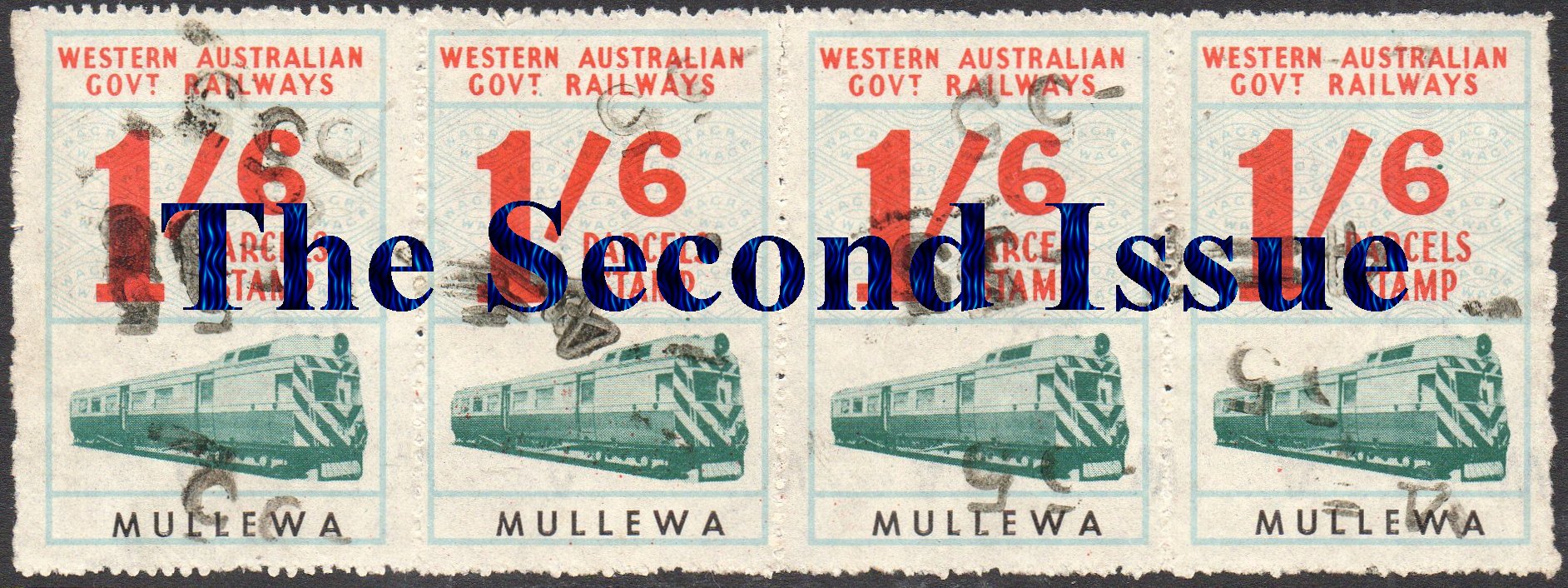 The following scans show images of all the face values for the Second Issue except the ½d, which is generally reported to exist in publications, but we are unsure how fact-based some of these catalogues were. In all our tables and listings for the Second Issue, we have included the ½d, but its existence really does require confirmation.
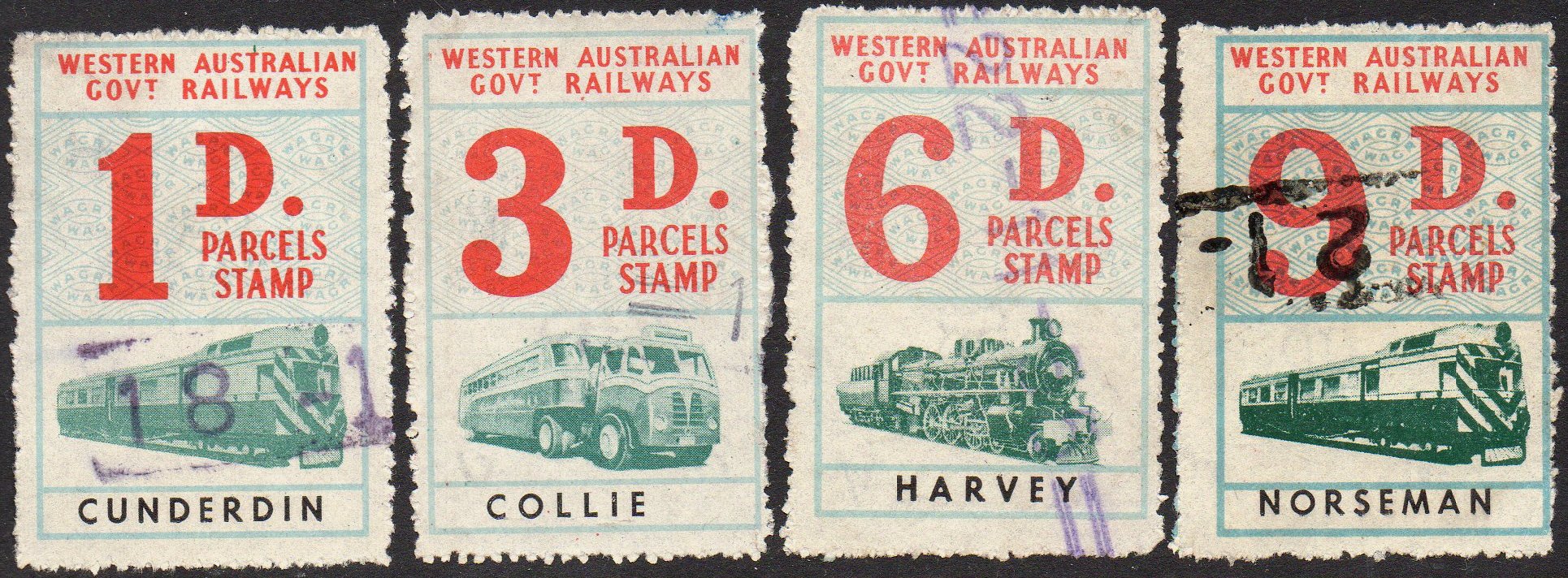


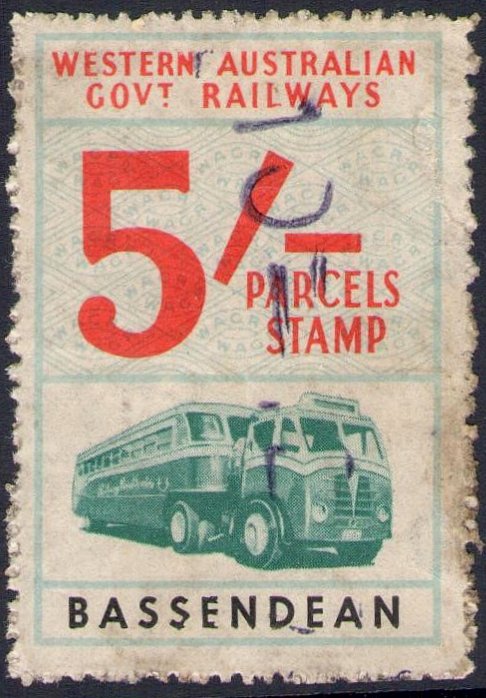
 The £1 shown is a Specimen. We have seen no issued example of this stamp but again it is widely listed. We include it, but would appreciate confirmation of this value for public use.
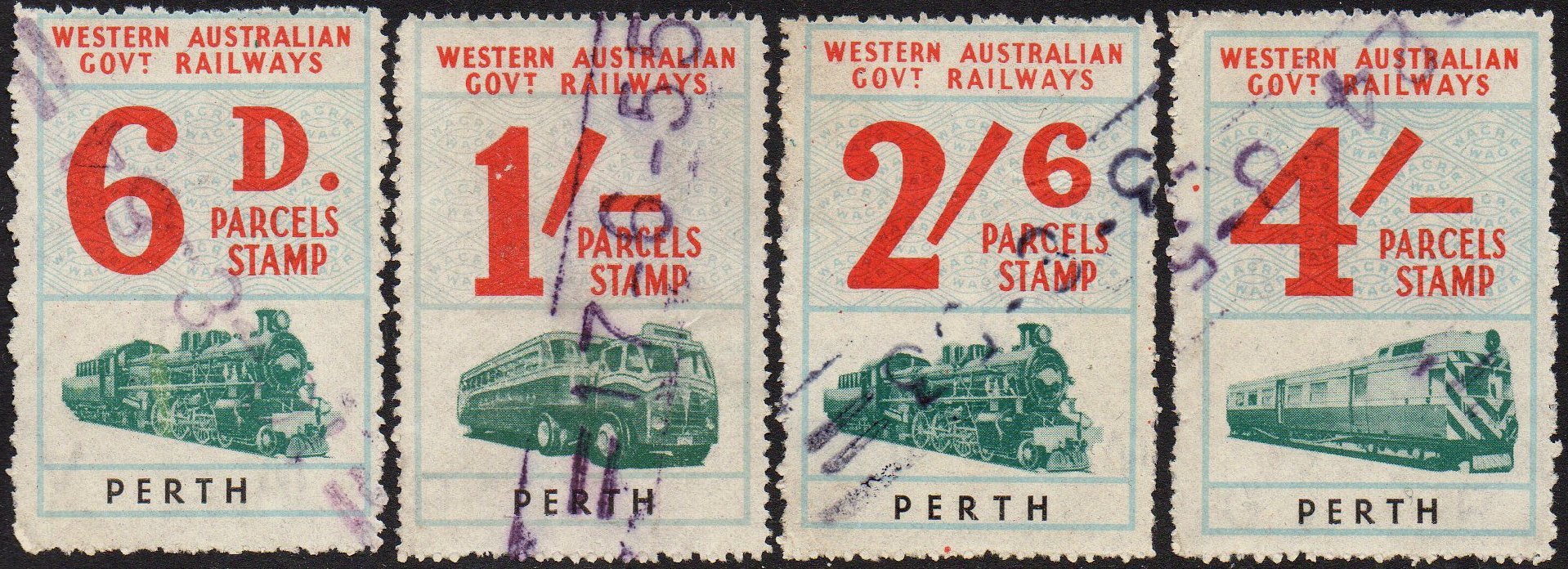 All Station names are in BLACK, other than PERTH which is now usually in GREEN. Exceptionally, a small number of PERTH stamps of the Second Issue appear with BLACK station name, scan above, the name added rather than produced from the bespoke plates. They are scarce. We have seen five different face values with PERTH in Black; there may well be others. We have added suggested prices for these in the 'catalogue listing' below, rather than within the pricing table for the Second Issue, which will be found a little lower down.
As for the First Issue, the check-boxes supplied are for used stamps with Watermark Upright and Watermark Inverted. The numbers after the check-boxes indicate the quantity of Second Issue stamps in the collection for that face value that had Watermark Upright (shown first), followed by Watermark Inverted.
½d .Alphabet B [ . ] [ . ]
1d . Alphabet B [ . ] [ . ] 0 / 3
3d . Alphabet B [ . ] [ . ] 32 / 35
6d . Alphabet B [ . ] [ . ] 18 / 38
- ditto - PERTH in Black (Alphabet B) [ . ] [ . ] 0 / 1 : Used A$130.-
9d . Alphabet B [ . ] [ . ] 42 / 46
1/- . Alphabet B [ . ] [ . ] 62 / 64
- ditto - PERTH in Black (Alphabet B) [ . ] [ . ] 5 / 0 : Used A$70.-
1/3 .Alphabet B [ . ] [ . ] 46 / 33
1/6 .Alphabet B [ . ] [ . ] 28/ 64
1/9 .Alphabet B [ . ] [ . ] 11 / 4
2/- . Alphabet B [ . ] [ . ] 67 / 71
- ditto - PERTH in Black (Alphabet B) [ . ] [ . ] (seen online) : Used A$130
2/6 .Alphabet B [ . ] [ . ] 29 / 36
- ditto - PERTH in Black (Alphabet B) [ . ] [ . ] 0 / 2 : Used A$110.-
3/- . Alphabet B [ . ] [ . ] 16 / 4
4/- . Alphabet B [ . ] [ . ] 13 / 7
- ditto - PERTH in Black (Alphabet B) [ . ] [ . ] 2 / 0 Used A$110.-
5/- . Alphabet B [ . ] [ . ] 0 / 2
10/- Alphabet B [ . ] [ . ]
£1 . Alphabet B [ . ] [ . ]
The Second Issue has two additional values, the 1/9 and the £1.
The Price Table below includes prices for the same varieties as on the First Issue. The large margin at the foot of a stamp is much scarcer on this Issue and we give no listing at all for the old Station Numeral cancel combined with a small date-stamp, as we have not seen a single example of this on Second Issue stamps. As with the first issue, several of the varieties listed may well exist on more values than are priced in the table below:
All Station names are in BLACK, other than PERTH which is now usually in GREEN. Exceptionally, a small number of PERTH stamps of the Second Issue appear with BLACK station name, scan above, the name added rather than produced from the bespoke plates. They are scarce. We have seen five different face values with PERTH in Black; there may well be others. We have added suggested prices for these in the 'catalogue listing' below, rather than within the pricing table for the Second Issue, which will be found a little lower down.
As for the First Issue, the check-boxes supplied are for used stamps with Watermark Upright and Watermark Inverted. The numbers after the check-boxes indicate the quantity of Second Issue stamps in the collection for that face value that had Watermark Upright (shown first), followed by Watermark Inverted.
½d .Alphabet B [ . ] [ . ]
1d . Alphabet B [ . ] [ . ] 0 / 3
3d . Alphabet B [ . ] [ . ] 32 / 35
6d . Alphabet B [ . ] [ . ] 18 / 38
- ditto - PERTH in Black (Alphabet B) [ . ] [ . ] 0 / 1 : Used A$130.-
9d . Alphabet B [ . ] [ . ] 42 / 46
1/- . Alphabet B [ . ] [ . ] 62 / 64
- ditto - PERTH in Black (Alphabet B) [ . ] [ . ] 5 / 0 : Used A$70.-
1/3 .Alphabet B [ . ] [ . ] 46 / 33
1/6 .Alphabet B [ . ] [ . ] 28/ 64
1/9 .Alphabet B [ . ] [ . ] 11 / 4
2/- . Alphabet B [ . ] [ . ] 67 / 71
- ditto - PERTH in Black (Alphabet B) [ . ] [ . ] (seen online) : Used A$130
2/6 .Alphabet B [ . ] [ . ] 29 / 36
- ditto - PERTH in Black (Alphabet B) [ . ] [ . ] 0 / 2 : Used A$110.-
3/- . Alphabet B [ . ] [ . ] 16 / 4
4/- . Alphabet B [ . ] [ . ] 13 / 7
- ditto - PERTH in Black (Alphabet B) [ . ] [ . ] 2 / 0 Used A$110.-
5/- . Alphabet B [ . ] [ . ] 0 / 2
10/- Alphabet B [ . ] [ . ]
£1 . Alphabet B [ . ] [ . ]
The Second Issue has two additional values, the 1/9 and the £1.
The Price Table below includes prices for the same varieties as on the First Issue. The large margin at the foot of a stamp is much scarcer on this Issue and we give no listing at all for the old Station Numeral cancel combined with a small date-stamp, as we have not seen a single example of this on Second Issue stamps. As with the first issue, several of the varieties listed may well exist on more values than are priced in the table below:
 Bottom margin measuring 8 mms or more between the bottom frame-line of the stamp and the lower perforations, the best (of the small number of) examples in the collection of this variety on Second Issue stamps.
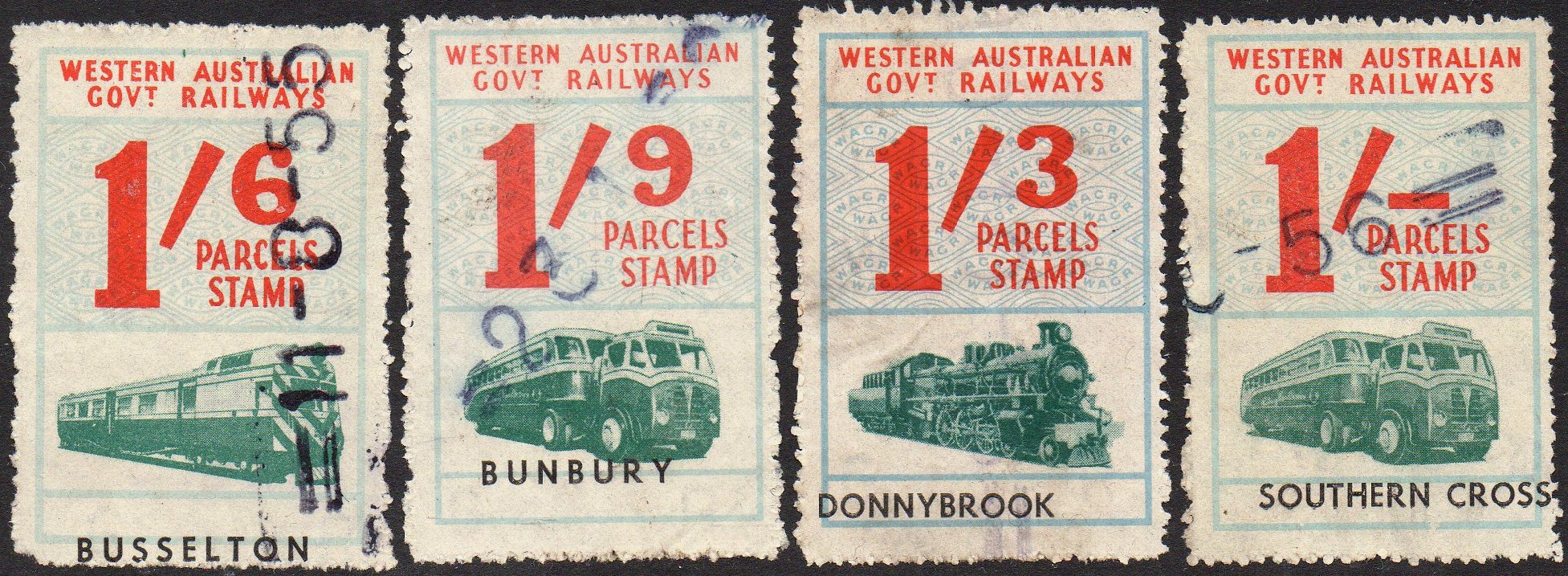 Station Name Shifts : By the Second Issue, horizontal shifts of the name to the extent that the name touches the frame are very uncommon. Vertical shifts are perhaps slightly less common than on the First Issue but amongst those that do appear are some of the most eye-catching of all.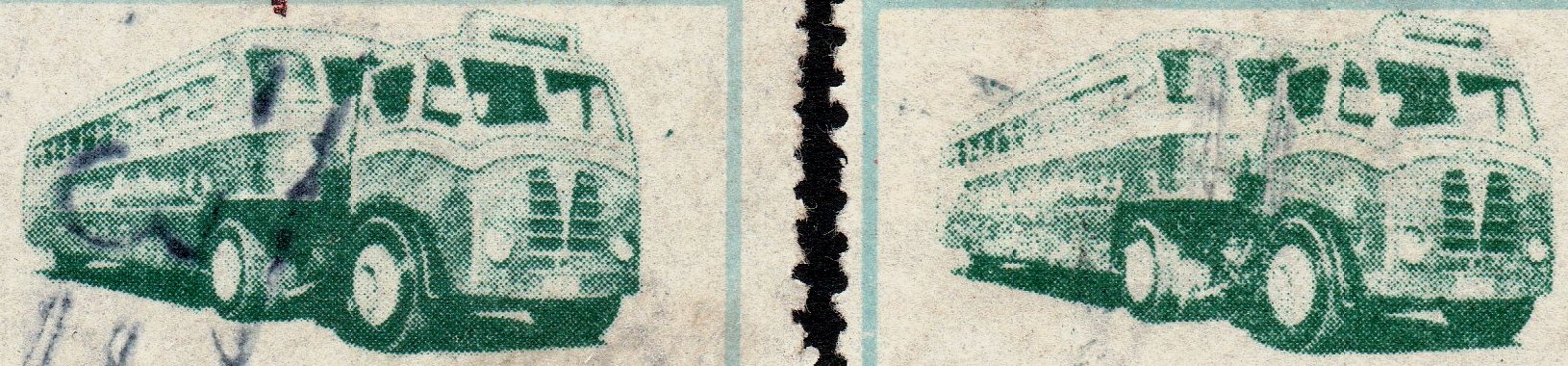
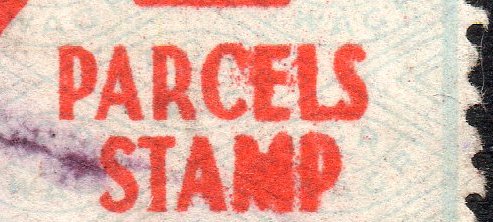 The following varieties were found, all on the Second Issue
 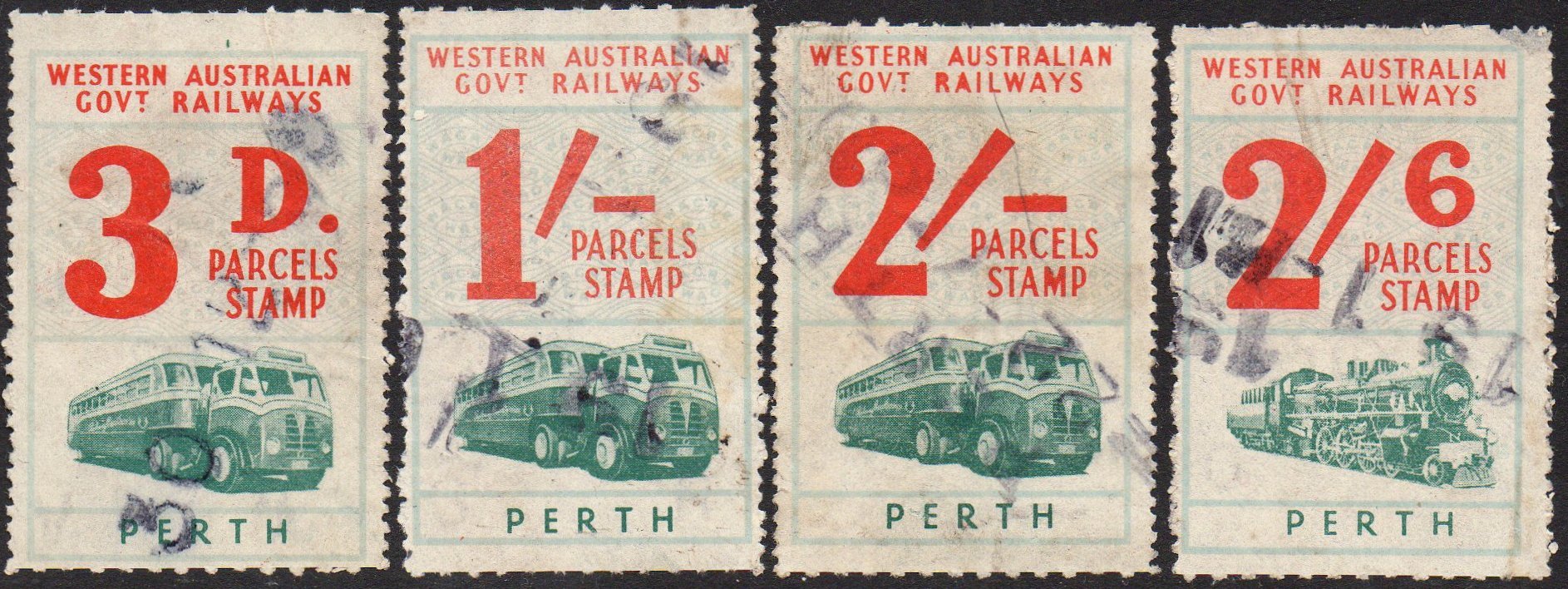 Four examples above of Rouletted x Perf stamps. We have only seen examples of this from Perth. It is reported that the rouletting was carried out locally on stamps delivered with sub-standard perforating. Given the relative scarcity of these stamps, our assumption would be that the perforating pins used for the horizontal perforating were shorter than those used for the vertical perforating. With several sheets being perforated in one pull, short pins will affect only perhaps 1 or 2 sheets at the bottom of the pile, resulting in just a relatively small part of a delivery in need of in-house amelioration.
 The first three stamps in the larger scan above have clean rouletting at top and bottom but the 2/6, whilst cleanly rouletted at the bottom, appears to be both poorly perforated and subsequently rouletted at the top. Unusually, the damage to the top right corner (a surface rub) actually helps to tell the story, revealing a clear perforation hole at the back, neatly juxtaposed to the clear roulette in the opposite (top left) corner. For most of its length, the top of this stamp shows evidence of a dual attempt at separation, Perforation plus Roulette.
 In general, the perforating of all the Third SERIES is remarkably good for railway parcel stamps. The perforations rarely touch the frame-lines and we have seen no imperforate-between pairs or completely indisputable missing lines of perforation at top, bottom or sides. An occasional double perforation is found, but these are rare and no doubt worth a premium, but we have no data with which to assign any valuation.
The scan above shows a couple of examples where the horizontal perforating is poor. In the first stamp, the top line of text has been cut; in the second example, the frame of the stamp below has been captured. Similar misperfs from any of the three Issues might command, say, a 30% premium but probably only on stamps in the lower price ranges, as they are quite uncommon. On the higher value stamps, though, poor perforating might slightly diminish the value, except in the most extreme cases.
In general, the perforating of all the Third SERIES is remarkably good for railway parcel stamps. The perforations rarely touch the frame-lines and we have seen no imperforate-between pairs or completely indisputable missing lines of perforation at top, bottom or sides. An occasional double perforation is found, but these are rare and no doubt worth a premium, but we have no data with which to assign any valuation.
The scan above shows a couple of examples where the horizontal perforating is poor. In the first stamp, the top line of text has been cut; in the second example, the frame of the stamp below has been captured. Similar misperfs from any of the three Issues might command, say, a 30% premium but probably only on stamps in the lower price ranges, as they are quite uncommon. On the higher value stamps, though, poor perforating might slightly diminish the value, except in the most extreme cases. 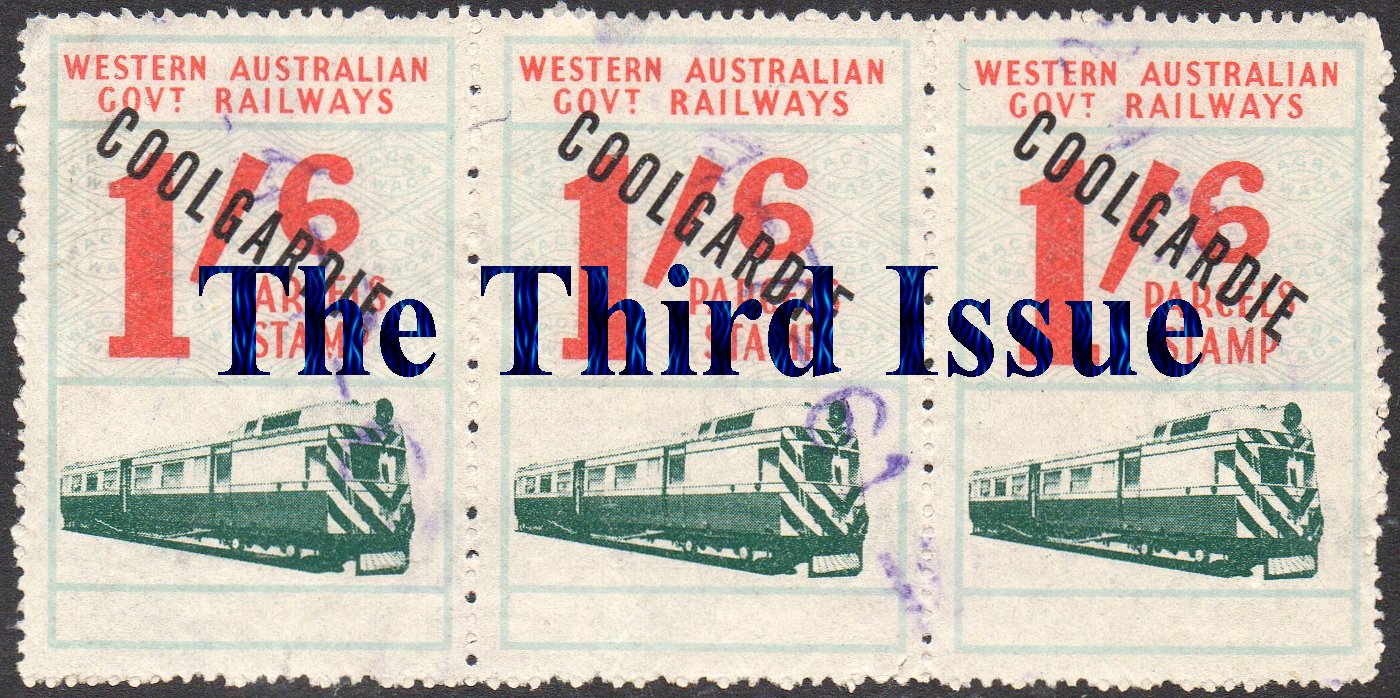
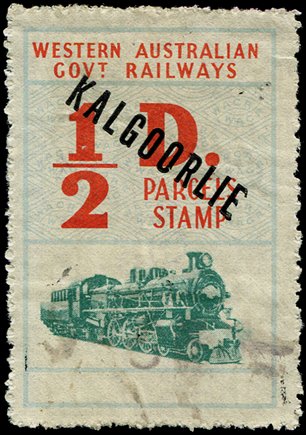
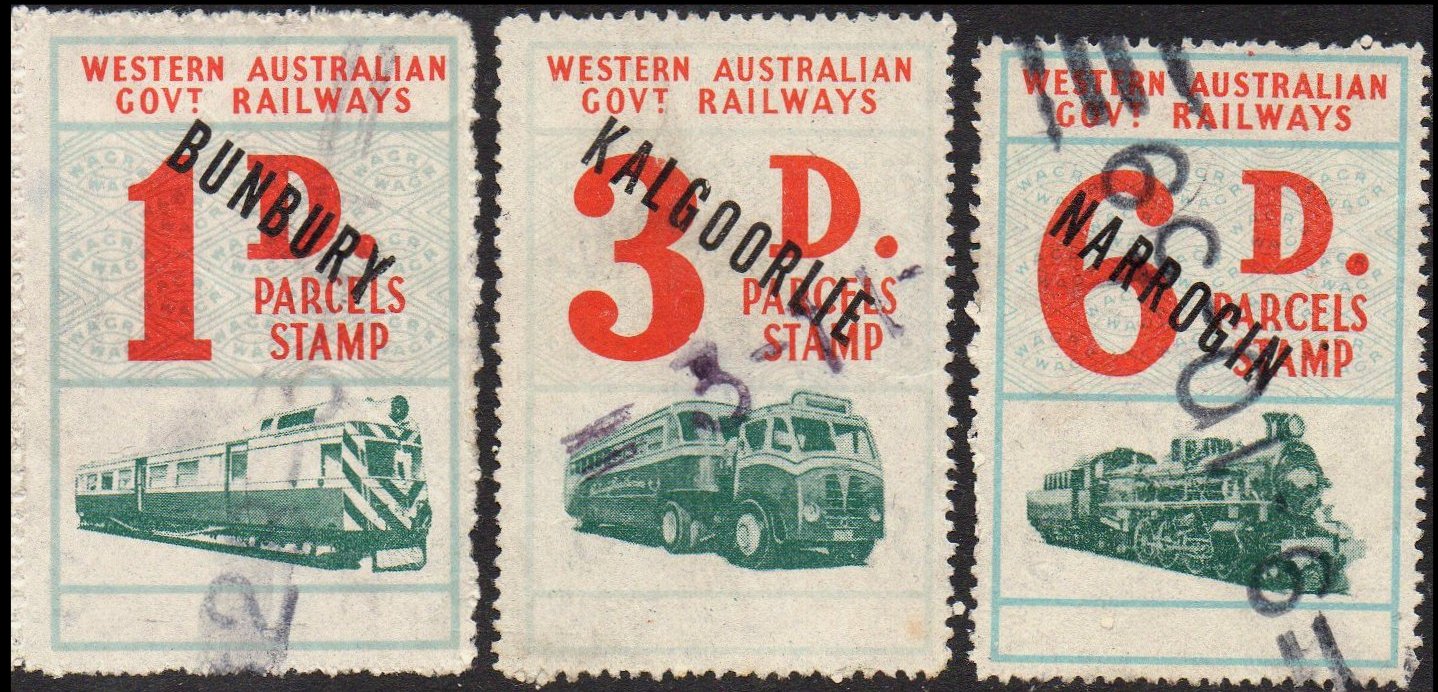
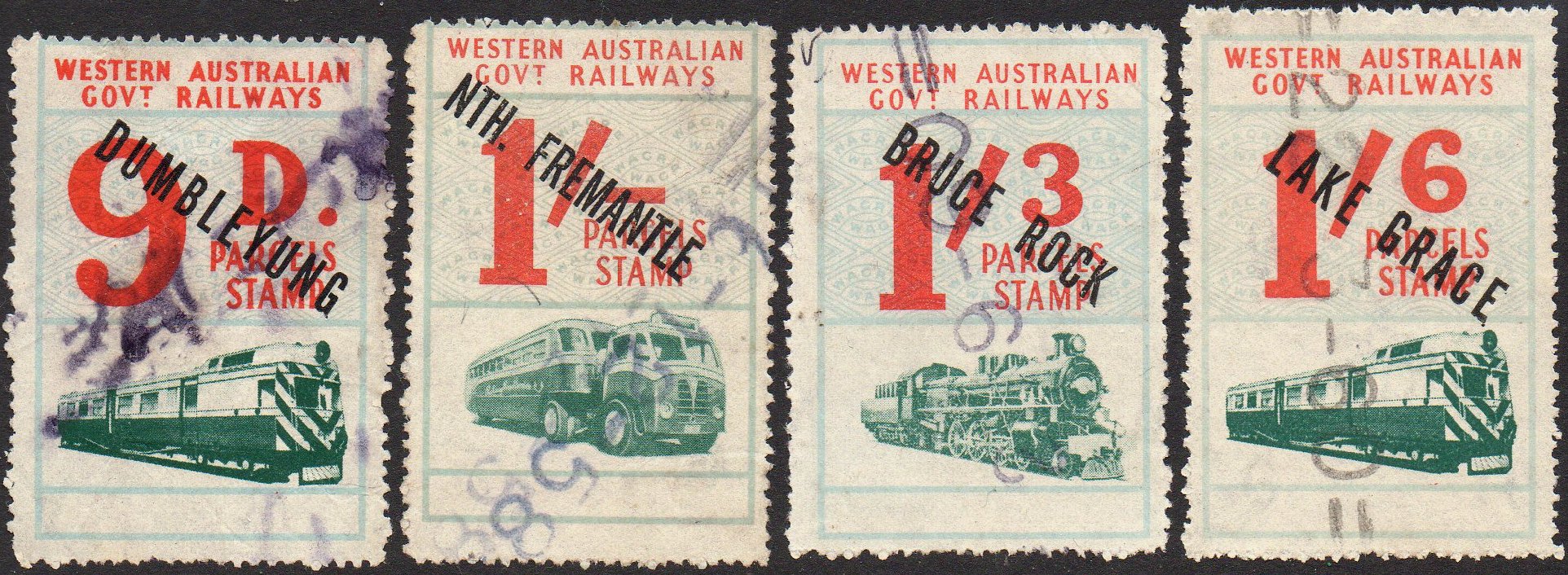
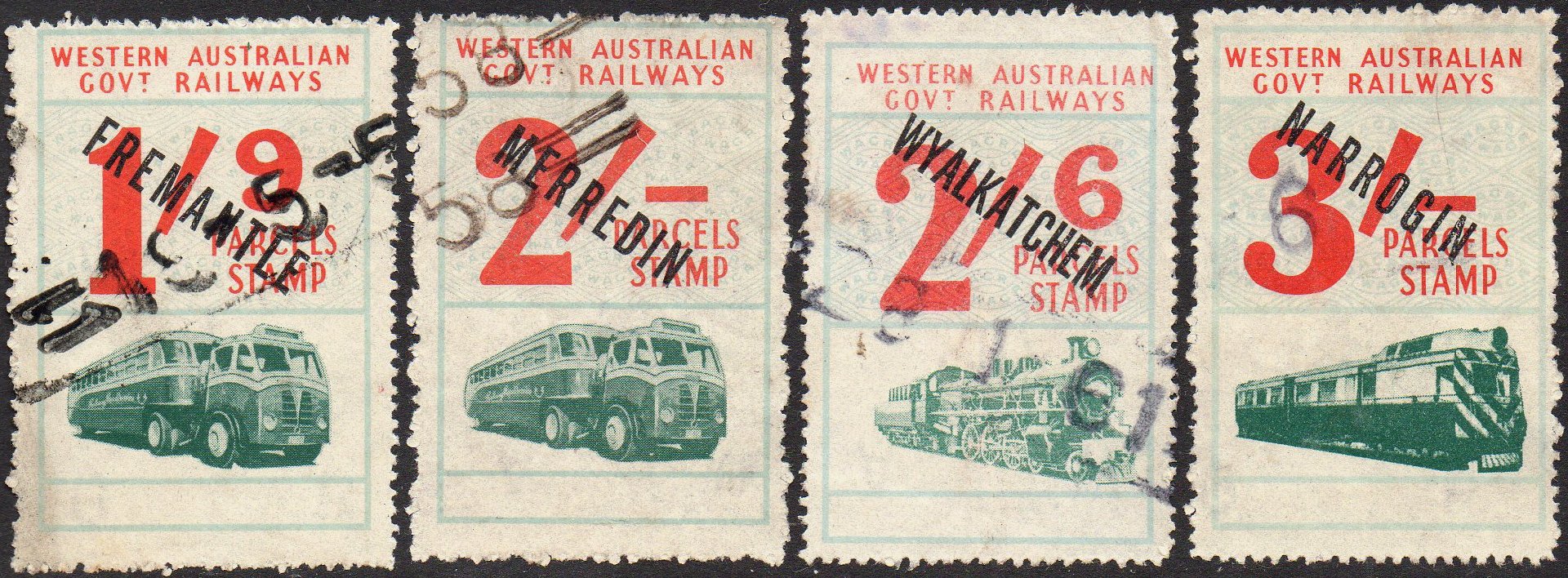
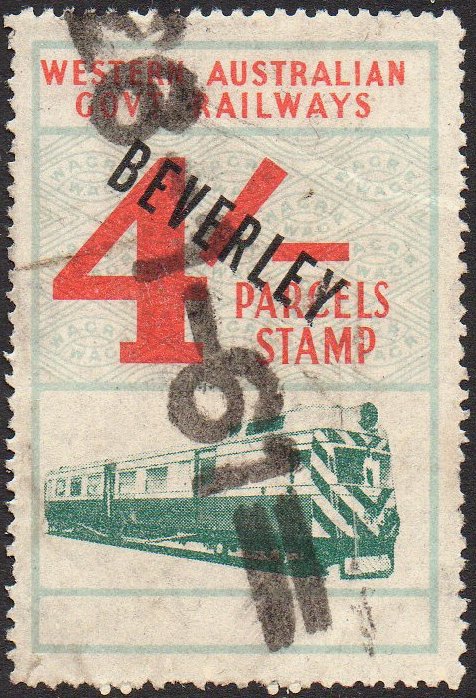
 Our thanks to Dave Elsmore for scans of several stamps from this Issue, including the rare ½d and the unique Fremantle £1.
The choice of a diagonal station name is an inelegant change. We wonder whether the in-house printing equipment used for the station names on the two previous issues was no longer available. Whatever the reason, the change is certainly not aesthetically pleasing. We note that there are almost no PERTH stamps of the Third Issue, which is unsurprising, as continuing with the Second Issue PERTH stamps, produced from bespoke plates, would have remained the better option.
Curiously though, four PERTH stamps with diagonal station names (in the Third Issue style) were found in the collection, all with late 1958 or 1959 cancellations. This is late enough to wonder whether some (perhaps all) of the Third SERIES printing plates had by then been damaged, destroyed or archived, and the remaining Third SERIES blanks without station name were being used up to meet all remaining demand, either pending the introduction of the Fourth SERIES or even in tandem with it as an exercise in good economic housekeeping.
Our thanks to Dave Elsmore for scans of several stamps from this Issue, including the rare ½d and the unique Fremantle £1.
The choice of a diagonal station name is an inelegant change. We wonder whether the in-house printing equipment used for the station names on the two previous issues was no longer available. Whatever the reason, the change is certainly not aesthetically pleasing. We note that there are almost no PERTH stamps of the Third Issue, which is unsurprising, as continuing with the Second Issue PERTH stamps, produced from bespoke plates, would have remained the better option.
Curiously though, four PERTH stamps with diagonal station names (in the Third Issue style) were found in the collection, all with late 1958 or 1959 cancellations. This is late enough to wonder whether some (perhaps all) of the Third SERIES printing plates had by then been damaged, destroyed or archived, and the remaining Third SERIES blanks without station name were being used up to meet all remaining demand, either pending the introduction of the Fourth SERIES or even in tandem with it as an exercise in good economic housekeeping.
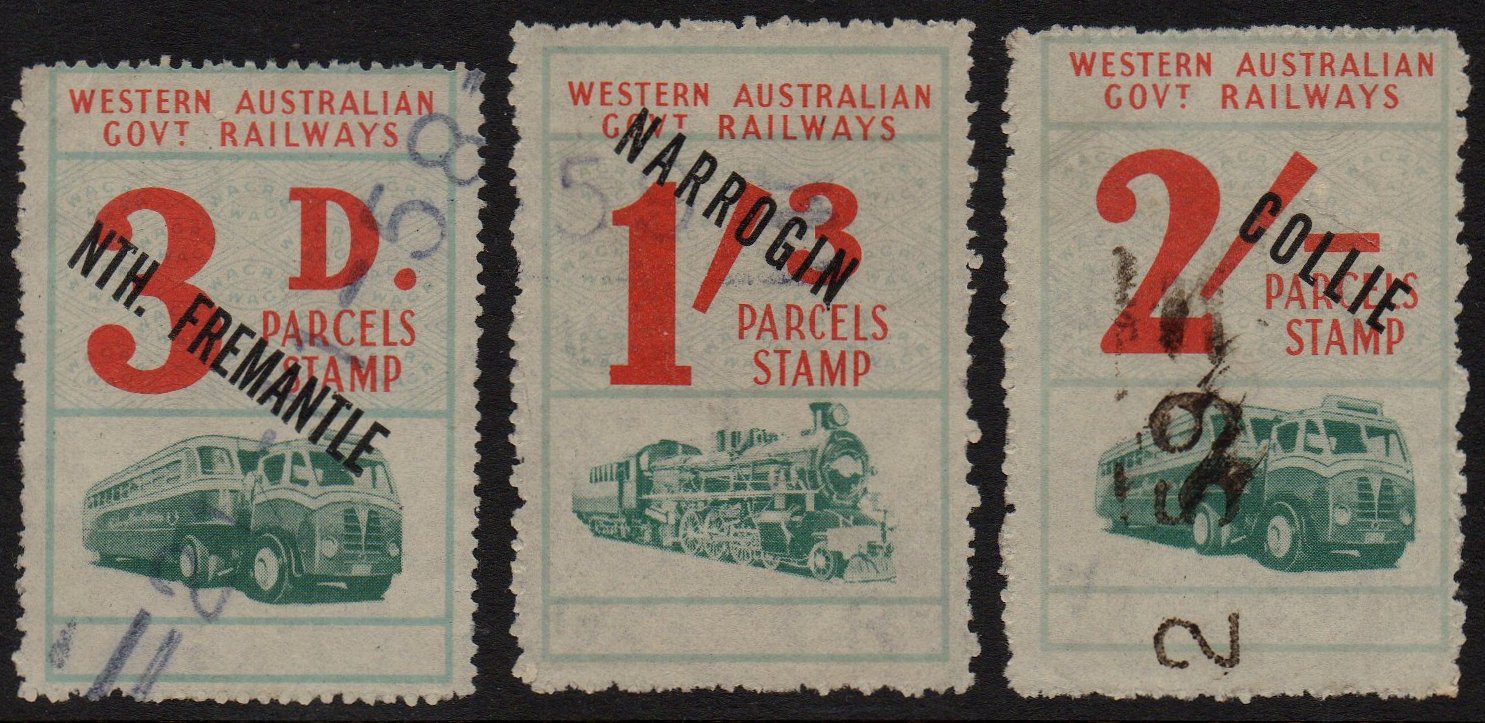 We do not include station name shifts as a 'listed variety' in our price table for the Third Issue (lower down). They occur, although major shifts are scarce, but it is quite a subjective matter to decide at what point they become really significant. In the scan above, we have shown significant shifts from stations with long, medium and short names.
Long station names frequently fall a little outside the 'value box' but this North Fremantle example is certainly exceptionally badly-centred, shifted down about 5 mms from optimum. Narrogin could fit comfortably into the 'value box' but does not, although at about 3-4 mms mis-alignment (upwards) it is not visually impressive as a shift. Collie by contrast, although entirely in the 'value box' is a major shift of approximately 7-8 mms to the right and noteworthy. Major shifts such as the North Fremantle and Collie are scarce enough to merit a price in excess of A$100 each, whilst the Narrogin would perhaps not command much of a premium at all.
.
Catalogue Listing : Third Issue c. August 1951 - c. late 1959 / early 1960s (used seen to 1961 plus one outlier - 1965!)
All Station Names in Black :
½d .Alphabet C [ . ] [ . ]
1d . Alphabet C [ . ] [ . ] 2 / 0
3d . Alphabet C [ . ] [ . ] 16 / 2 : Invtd: Kalgoorlie (1); Mount Barker (1)
6d . Alphabet C [ . ] [ . ] 14 / 3 : Invtd: Bunbury (1); Mukinbudin (1); Perth (1)
9d . Alphabet C [ . ] [ . ] 6 / 3
1/- . Alphabet C [ . ] [ . ] 5 / 8
1/3 .Alphabet C [ . ] [ . ] 2 / 9 : Upright: Harvey (1); Narrogin (1);
1/6 .Alphabet C [ . ] [ . ] 4 / 14
1/9 .Alphabet C [ . ] [ . ] 12 / 4
2/- . Alphabet C [ . ] [ . ] 11 / 21
2/6 .Alphabet C [ . ] [ . ] 1 / 6 : Upright: Bunbury (1)
3/- . Alphabet C [ . ] [ . ] 3 / 12 : Upright: Albany(1); Bridgetown (1); Narrogin (1)
4/- . Alphabet C [ . ] [ . ] 6 / 6
5/- . Alphabet C [ . ] [ . ]
10/- Alphabet C [ . ] [ . ]
£1 . Alphabet C [ . ] [ . ]
Of the sixteen 1/9 stamps in the collection, ten are from Bunbury (Wmk : 8 upright, 2 inverted). Most appear to come from different parcels, so this is an unusually strong representation from one town. Or, from the reverse angle, non-Bunbury 1/9 Third Issue stamps are scarce!
We have not seen any stamps with wide bottom margins in this issue. The other varieties shown in the price tables for Issues 1 & 2 (misplaced names and early postmarks) also do not apply to this issue.
We do not include station name shifts as a 'listed variety' in our price table for the Third Issue (lower down). They occur, although major shifts are scarce, but it is quite a subjective matter to decide at what point they become really significant. In the scan above, we have shown significant shifts from stations with long, medium and short names.
Long station names frequently fall a little outside the 'value box' but this North Fremantle example is certainly exceptionally badly-centred, shifted down about 5 mms from optimum. Narrogin could fit comfortably into the 'value box' but does not, although at about 3-4 mms mis-alignment (upwards) it is not visually impressive as a shift. Collie by contrast, although entirely in the 'value box' is a major shift of approximately 7-8 mms to the right and noteworthy. Major shifts such as the North Fremantle and Collie are scarce enough to merit a price in excess of A$100 each, whilst the Narrogin would perhaps not command much of a premium at all.
.
Catalogue Listing : Third Issue c. August 1951 - c. late 1959 / early 1960s (used seen to 1961 plus one outlier - 1965!)
All Station Names in Black :
½d .Alphabet C [ . ] [ . ]
1d . Alphabet C [ . ] [ . ] 2 / 0
3d . Alphabet C [ . ] [ . ] 16 / 2 : Invtd: Kalgoorlie (1); Mount Barker (1)
6d . Alphabet C [ . ] [ . ] 14 / 3 : Invtd: Bunbury (1); Mukinbudin (1); Perth (1)
9d . Alphabet C [ . ] [ . ] 6 / 3
1/- . Alphabet C [ . ] [ . ] 5 / 8
1/3 .Alphabet C [ . ] [ . ] 2 / 9 : Upright: Harvey (1); Narrogin (1);
1/6 .Alphabet C [ . ] [ . ] 4 / 14
1/9 .Alphabet C [ . ] [ . ] 12 / 4
2/- . Alphabet C [ . ] [ . ] 11 / 21
2/6 .Alphabet C [ . ] [ . ] 1 / 6 : Upright: Bunbury (1)
3/- . Alphabet C [ . ] [ . ] 3 / 12 : Upright: Albany(1); Bridgetown (1); Narrogin (1)
4/- . Alphabet C [ . ] [ . ] 6 / 6
5/- . Alphabet C [ . ] [ . ]
10/- Alphabet C [ . ] [ . ]
£1 . Alphabet C [ . ] [ . ]
Of the sixteen 1/9 stamps in the collection, ten are from Bunbury (Wmk : 8 upright, 2 inverted). Most appear to come from different parcels, so this is an unusually strong representation from one town. Or, from the reverse angle, non-Bunbury 1/9 Third Issue stamps are scarce!
We have not seen any stamps with wide bottom margins in this issue. The other varieties shown in the price tables for Issues 1 & 2 (misplaced names and early postmarks) also do not apply to this issue.