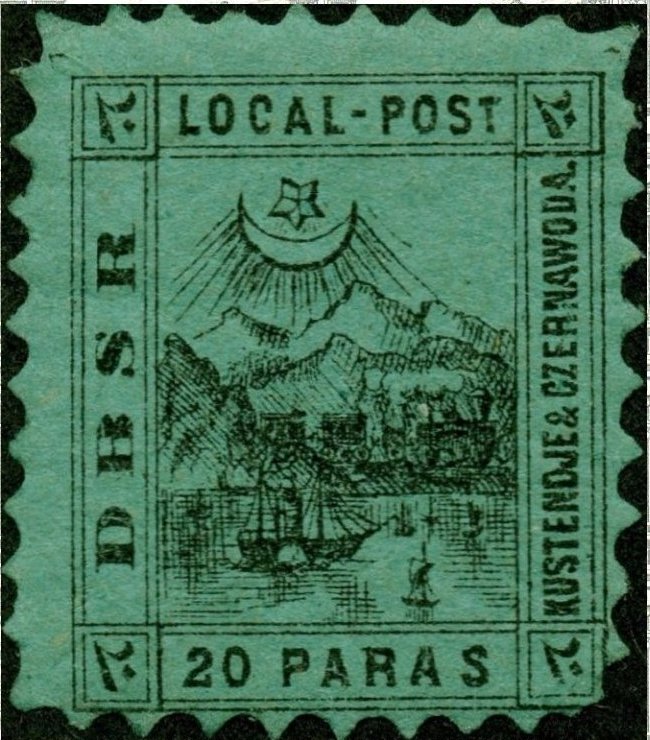
 The control and influence of the Ottoman Empire was already on the wane in what we today recognize as Romania when, in 1857, the Danube & Black Sea Railway was incorporated very much as a private railway to transfer passengers and mail from the Danube Steam Navigation Company's vessels at Cernavoda (various spellings used) to the Black Sea port of Constanta, 46 miles (74 kms) to the East. The rail transfer saved a day's travel for those wishing to connect with Austrian Lloyd Line ships at Constanta. The railway opened fully in 1860 and operated on a daily basis.
A Local Post was established on this railway in 1867 and a 20 paras stamp was printed by lithography in Vienna by M. Kaiser. These stamps, although locals, are important enough to appear in both the Yvert and Michel catalogues. Surviving covers are rare with probably fewer than a dozen in existence. Billig mentions that the stamps can be found mis-sent in combination with Austrian Levant stamps of 1863 and 1867, no doubt extremely rare.
Authentic postmarks will usually be in the single circle style reading either Lloyd Agency Czernawoda or Kustendje. Postmarks show only the day and month, not the year. The stamps were valid from 1867-1871. Whilst covers are very scarce, stamps are more plentiful, but the majority are reprints or forgeries. This article examines and identifies the printings.
The Printing of ALL stamps is in BLACK on coloured paper. However, for ease of reference, we shall refer to the stamps only by the colour of the paper. All original stamps are in blue-green or green, but some reprints (the 3rd reprints) and forgeries exist in four other colours in addition to green. The existence of so many reprints has probably held down the catalogue value of originals, which are scarce, to around 100 Euros for mint stamps at the time of writing this article (2018). This restrained price may well be the result of many collectors unwittingly holding reprints or forgeries. Used stamps are rare and we have not seen a used reprint or forgery.
Perforations : These are unusual. They are a scalloped punch and are always uneven on the sides (except for Fournier forgeries). We will describe them unconventionally by counting the number of teeth on each side but not counting any teeth (whether present or not) at the four corner points in any of the measurements. Both Originals and Reprints, clockwise from the top, exist Perf 8x9x8x10 and Perf 8x10x8x9, whereas the Fournier perforated forgeries are Perf 8x9x8x9.
Note: Shades of Scans : We have found it necessary to enhance some scans in order to display certain features but this has resulted at times in an inaccurate reproduction of colours.
Hurt & Williams mention a dangerous forgery in which the design dimensions are 18.25x22.25 mms instead of 18.5x22 mms. The star is also reported to be closer by about ½mm to the line above it.
We think we have finally managed to locate the forgery they mention, shown below:
'Hurt & Williams'-described Forgery:
The control and influence of the Ottoman Empire was already on the wane in what we today recognize as Romania when, in 1857, the Danube & Black Sea Railway was incorporated very much as a private railway to transfer passengers and mail from the Danube Steam Navigation Company's vessels at Cernavoda (various spellings used) to the Black Sea port of Constanta, 46 miles (74 kms) to the East. The rail transfer saved a day's travel for those wishing to connect with Austrian Lloyd Line ships at Constanta. The railway opened fully in 1860 and operated on a daily basis.
A Local Post was established on this railway in 1867 and a 20 paras stamp was printed by lithography in Vienna by M. Kaiser. These stamps, although locals, are important enough to appear in both the Yvert and Michel catalogues. Surviving covers are rare with probably fewer than a dozen in existence. Billig mentions that the stamps can be found mis-sent in combination with Austrian Levant stamps of 1863 and 1867, no doubt extremely rare.
Authentic postmarks will usually be in the single circle style reading either Lloyd Agency Czernawoda or Kustendje. Postmarks show only the day and month, not the year. The stamps were valid from 1867-1871. Whilst covers are very scarce, stamps are more plentiful, but the majority are reprints or forgeries. This article examines and identifies the printings.
The Printing of ALL stamps is in BLACK on coloured paper. However, for ease of reference, we shall refer to the stamps only by the colour of the paper. All original stamps are in blue-green or green, but some reprints (the 3rd reprints) and forgeries exist in four other colours in addition to green. The existence of so many reprints has probably held down the catalogue value of originals, which are scarce, to around 100 Euros for mint stamps at the time of writing this article (2018). This restrained price may well be the result of many collectors unwittingly holding reprints or forgeries. Used stamps are rare and we have not seen a used reprint or forgery.
Perforations : These are unusual. They are a scalloped punch and are always uneven on the sides (except for Fournier forgeries). We will describe them unconventionally by counting the number of teeth on each side but not counting any teeth (whether present or not) at the four corner points in any of the measurements. Both Originals and Reprints, clockwise from the top, exist Perf 8x9x8x10 and Perf 8x10x8x9, whereas the Fournier perforated forgeries are Perf 8x9x8x9.
Note: Shades of Scans : We have found it necessary to enhance some scans in order to display certain features but this has resulted at times in an inaccurate reproduction of colours.
Hurt & Williams mention a dangerous forgery in which the design dimensions are 18.25x22.25 mms instead of 18.5x22 mms. The star is also reported to be closer by about ½mm to the line above it.
We think we have finally managed to locate the forgery they mention, shown below:
'Hurt & Williams'-described Forgery:
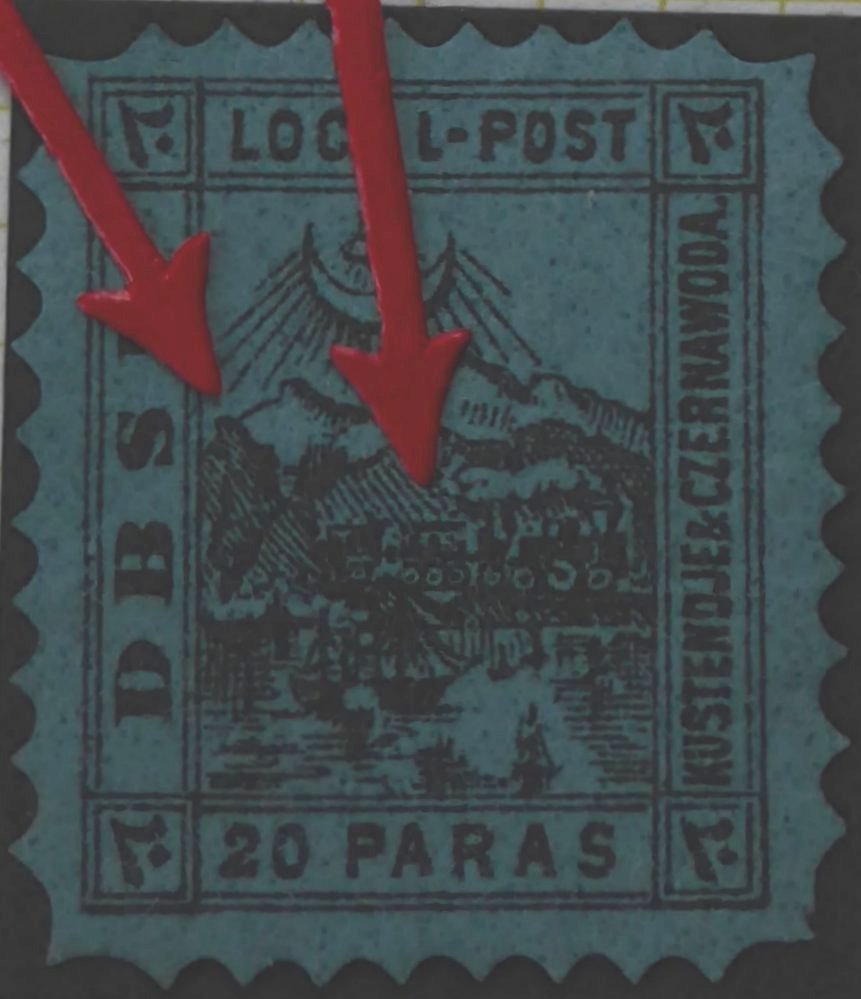
 It shares one feature otherwise found only on Fournier forgeries (see lower down): The mountain at top left is joined to the heavily shaded hill to its left. It differs, though, from Fournier forgeries (and genuine stamps) in other ways:
1. The locomotive boiler is narrower, making the locomotive appear elogated.
2. The top of the carriage at left is joined to the hillside by an extension of the roof-line.
3. The hill just mentioned is exceptionally heavily shaded, even on a stamp as lightly printed as this one.
4. The left point of the star at top is only 0.5 mms from the frame-line (as mentioned by Hurt & Williams).
5. The downstroke of the arabic numeral '2' at bottom left appears more vertical.
6. There is some evidence of shading on the locomotive's wheels, a feature of genuine stamps, often absent on forgeries.
Please note that we have only examined one stamp like the above and some of these features may not be constant. This example perfs 8.75 x 9.5 x 8.75 x 8.75. We do not believe it exists in colours other than Green. It is lightly printed on paper that is a pale bluish-green and there is some evidence that it was once gummed. We have not found the dimensions of the design, mentioned by Hurt & Williams, to be a useful tool for identification.
Hurt & Willams-reported style of forgery [ . ] Scarce
.
Fournier Forgery:
A well-known forgery, by the arch-forger Fournier, is fairly easily spotted and quite common. Although it is unusual to start an article mainly with the forgeries, rather than end with them, by eliminating the forgeries now, one can then concentrate on originals and reprints, which all come directly or indirectly from the original lithographic stones.
It shares one feature otherwise found only on Fournier forgeries (see lower down): The mountain at top left is joined to the heavily shaded hill to its left. It differs, though, from Fournier forgeries (and genuine stamps) in other ways:
1. The locomotive boiler is narrower, making the locomotive appear elogated.
2. The top of the carriage at left is joined to the hillside by an extension of the roof-line.
3. The hill just mentioned is exceptionally heavily shaded, even on a stamp as lightly printed as this one.
4. The left point of the star at top is only 0.5 mms from the frame-line (as mentioned by Hurt & Williams).
5. The downstroke of the arabic numeral '2' at bottom left appears more vertical.
6. There is some evidence of shading on the locomotive's wheels, a feature of genuine stamps, often absent on forgeries.
Please note that we have only examined one stamp like the above and some of these features may not be constant. This example perfs 8.75 x 9.5 x 8.75 x 8.75. We do not believe it exists in colours other than Green. It is lightly printed on paper that is a pale bluish-green and there is some evidence that it was once gummed. We have not found the dimensions of the design, mentioned by Hurt & Williams, to be a useful tool for identification.
Hurt & Willams-reported style of forgery [ . ] Scarce
.
Fournier Forgery:
A well-known forgery, by the arch-forger Fournier, is fairly easily spotted and quite common. Although it is unusual to start an article mainly with the forgeries, rather than end with them, by eliminating the forgeries now, one can then concentrate on originals and reprints, which all come directly or indirectly from the original lithographic stones.
 Fournier Forgery shown at left above; original (viz.genuine) at right.
The most obvious feature, found only on the Hurt & Williams and Fournier forgeries, is the mountain at top left being joined to the hill to its left. Another property of these forgeries is the much heavier shading of the hill above the train with the lines of shading touching the first carriage, whereas the lines are lighter and generally stop short of the carriage on originals and reprints, but this final detail is hard to see in the scan of an original stamp alongside. These forgeries may be found perf or imperf in all the same colours as reprints. Perforated copies are all Perf 8x9x8x9.
Fournier Forgery Perf : Green [ . ] Yellow [ . ] Blue [ . ] Pink [ . ] Orange* [ . ]
Fournier Forgery Imperf : Green [ . ] Yellow [ . ] Blue [ . ] Pink [ . ] Orange [ . ]
* : Not seen by us but presumed to exist.
.
Other Forgeries :
We have seen the forgery shown below, but only Imperforate. It is not at all well executed (single shown below at left, again with the genuine stamp at right) :
Fournier Forgery shown at left above; original (viz.genuine) at right.
The most obvious feature, found only on the Hurt & Williams and Fournier forgeries, is the mountain at top left being joined to the hill to its left. Another property of these forgeries is the much heavier shading of the hill above the train with the lines of shading touching the first carriage, whereas the lines are lighter and generally stop short of the carriage on originals and reprints, but this final detail is hard to see in the scan of an original stamp alongside. These forgeries may be found perf or imperf in all the same colours as reprints. Perforated copies are all Perf 8x9x8x9.
Fournier Forgery Perf : Green [ . ] Yellow [ . ] Blue [ . ] Pink [ . ] Orange* [ . ]
Fournier Forgery Imperf : Green [ . ] Yellow [ . ] Blue [ . ] Pink [ . ] Orange [ . ]
* : Not seen by us but presumed to exist.
.
Other Forgeries :
We have seen the forgery shown below, but only Imperforate. It is not at all well executed (single shown below at left, again with the genuine stamp at right) :
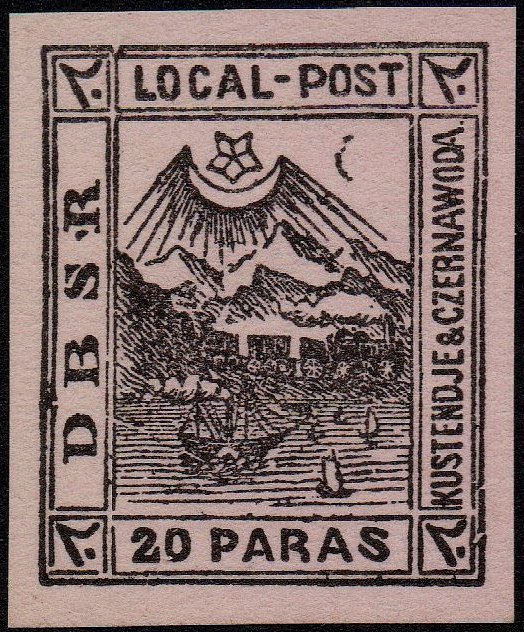 Obvious features of this forgery are :
Arabic figures of value in all four corners too large.
No small rays from star.
Locomotive has stove-pipe chimney (straight vertical sides).
Sail on small boat in foreground completely different.
Letter 'S' in 'PARAS' very slanted.
We have seen this imperforate forgery in five colours, the colours mostly along the lines of the stamps reprinted from original plates, which are described later. The name of the forger is not known to us. The scan below shows the 5 colours we have seen:
Obvious features of this forgery are :
Arabic figures of value in all four corners too large.
No small rays from star.
Locomotive has stove-pipe chimney (straight vertical sides).
Sail on small boat in foreground completely different.
Letter 'S' in 'PARAS' very slanted.
We have seen this imperforate forgery in five colours, the colours mostly along the lines of the stamps reprinted from original plates, which are described later. The name of the forger is not known to us. The scan below shows the 5 colours we have seen:
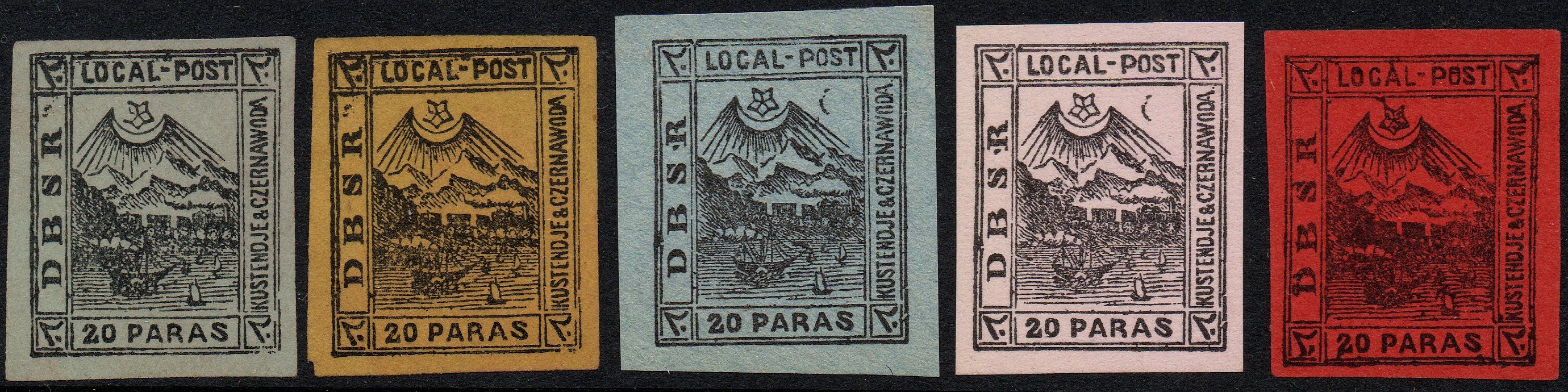 Forgery as above: Grey-Green [ . ] Orange [ . ] Grey-Blue [ . ] Pale Pink [ . ] Scarlet [ . ]
.
Finally for the forgeries, we have seen one example of the stamp shown below:
Forgery as above: Grey-Green [ . ] Orange [ . ] Grey-Blue [ . ] Pale Pink [ . ] Scarlet [ . ]
.
Finally for the forgeries, we have seen one example of the stamp shown below:
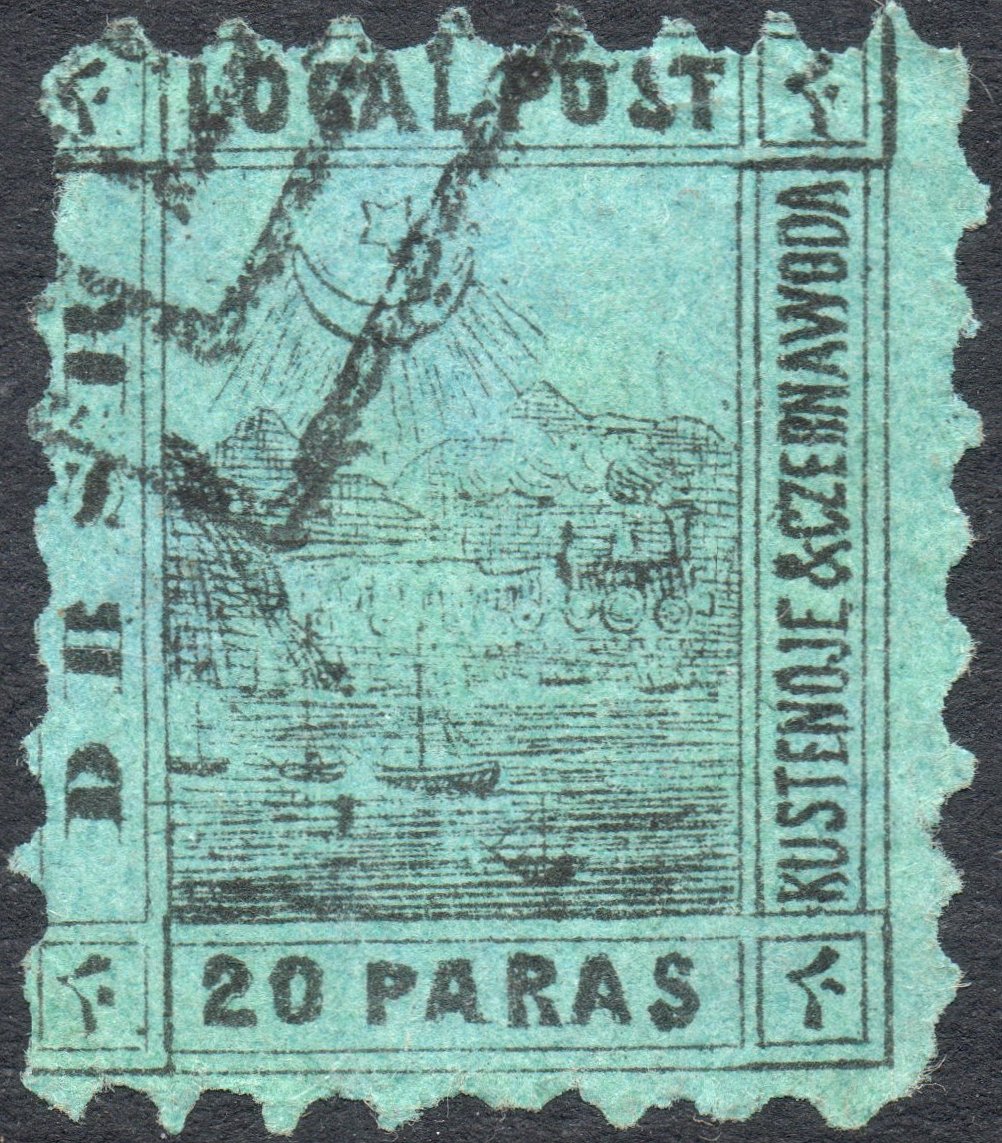 This is an easy forgery to identify, although to our knowledge not previously described anywhere. The large ship has only one mast and the ampersand between the two town names at right is too large. There is no stop (period) after CZERNAWODA and many other differences.
Forgery with One Mast etc. - Green [ . ]
.
Originals
This is an easy forgery to identify, although to our knowledge not previously described anywhere. The large ship has only one mast and the ampersand between the two town names at right is too large. There is no stop (period) after CZERNAWODA and many other differences.
Forgery with One Mast etc. - Green [ . ]
.
Originals
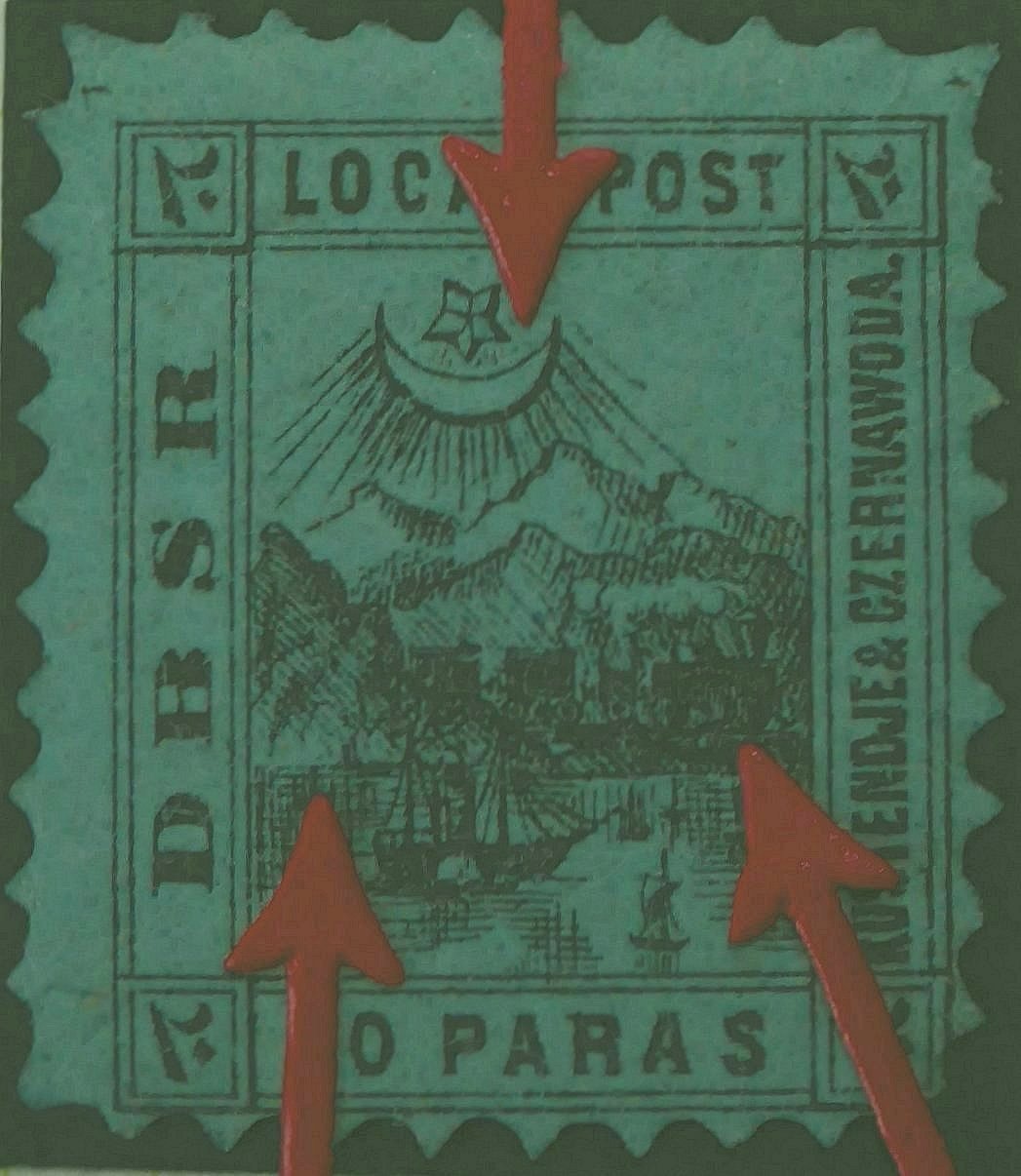
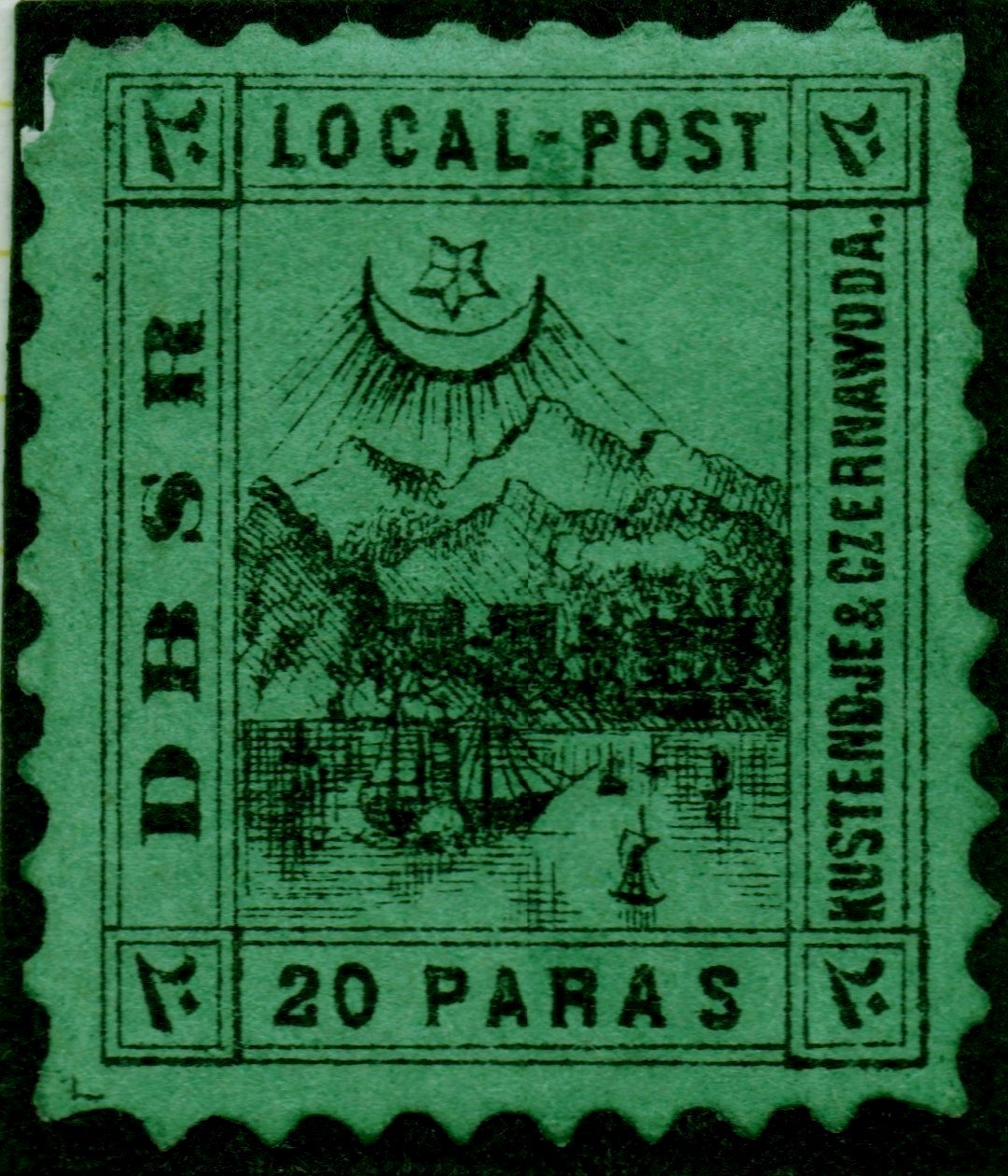
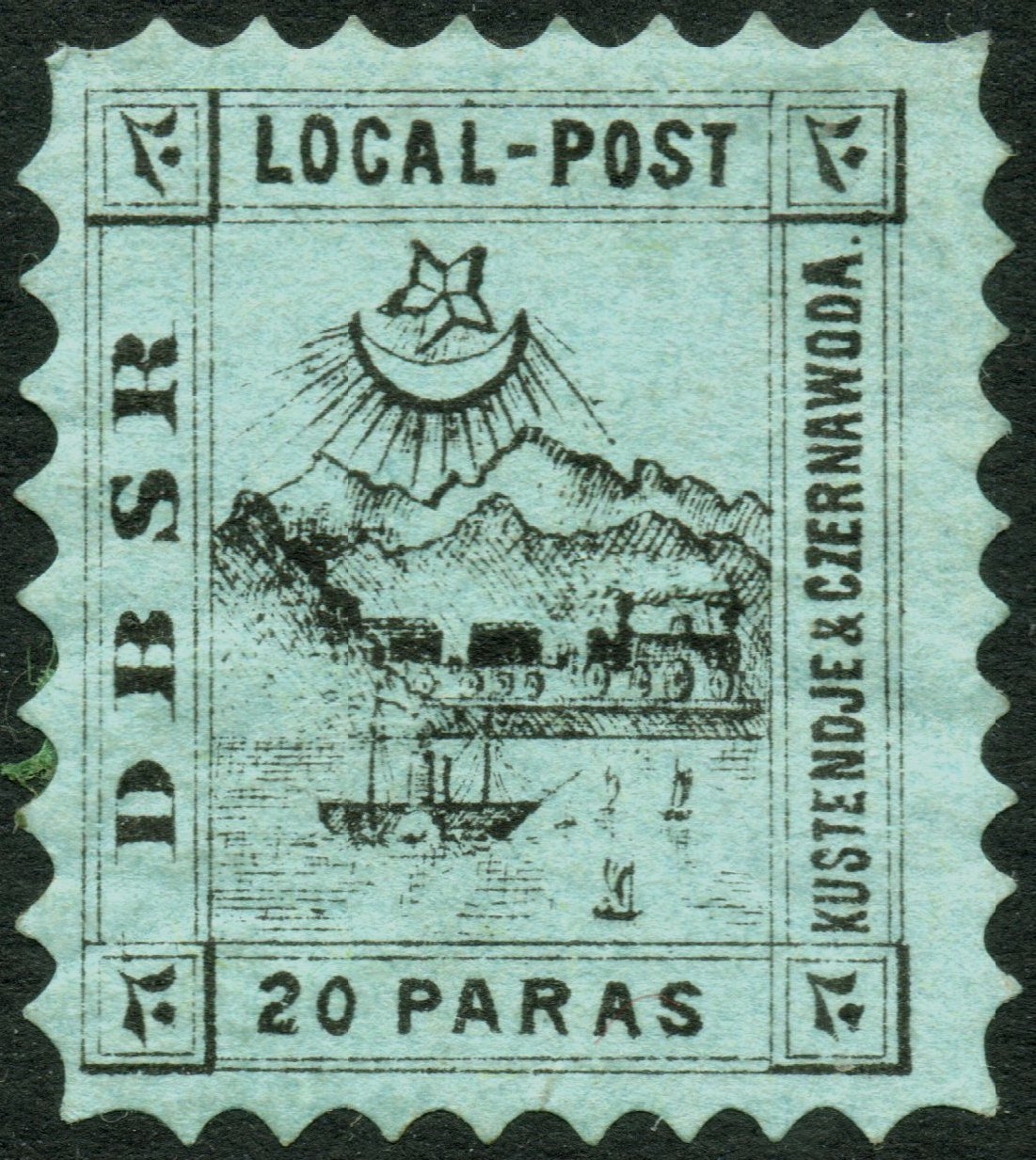
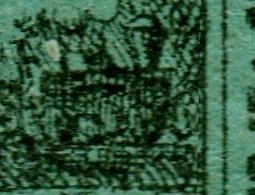 The Blue-Green (large) and Green (medium scan) and a detailed scan of the locomotive wheels (small scan).
Features of Originals:
1. Several short lines between the star and crescent but they are VERY lightly drawn.
2. There is a clear horizontal line for the edge of the sea at the base of the hill on the left.
3. Best Test for Originals : There are quite strong vertical lines of shading on the wheels of the locomotive. This detail is shown (as best we can manage) in the small scan above. A few First Reprints sometimes also show remnants of this feature but much less boldly.
DBSR 20p Train ORIGINAL in Blue-Green Perf 8x10x8x9 [ . ]
- ditto - but Perf 8x9x8x10 [ . ]
DBSR 20p Train ORIGINAL in Green Perf 8x10x8x9 [ . ]
- ditto - but Perf 8x9x8x10 [ . ]
This, the original printing, seems to be the only one where a distinct shade is discernible. Hurt & Willams also reports an imperforate stamp (possibly a proof) as well as a black print on white card and a black print on yellow gummed paper, both of which we saw a few years ago in a London auction. They may be unique?
.
Siegel Auctions sold two examples of this stamp on cover in 2009, which can be viewed on their website.
Click here (opens in a new tab) to see DBSR covers on Siegel's website.
.
June 2024 (Sale 328, Romania) : Corinphila sold two used single stamps from this issue, Lots 6368 and 6369, shown below:
The Blue-Green (large) and Green (medium scan) and a detailed scan of the locomotive wheels (small scan).
Features of Originals:
1. Several short lines between the star and crescent but they are VERY lightly drawn.
2. There is a clear horizontal line for the edge of the sea at the base of the hill on the left.
3. Best Test for Originals : There are quite strong vertical lines of shading on the wheels of the locomotive. This detail is shown (as best we can manage) in the small scan above. A few First Reprints sometimes also show remnants of this feature but much less boldly.
DBSR 20p Train ORIGINAL in Blue-Green Perf 8x10x8x9 [ . ]
- ditto - but Perf 8x9x8x10 [ . ]
DBSR 20p Train ORIGINAL in Green Perf 8x10x8x9 [ . ]
- ditto - but Perf 8x9x8x10 [ . ]
This, the original printing, seems to be the only one where a distinct shade is discernible. Hurt & Willams also reports an imperforate stamp (possibly a proof) as well as a black print on white card and a black print on yellow gummed paper, both of which we saw a few years ago in a London auction. They may be unique?
.
Siegel Auctions sold two examples of this stamp on cover in 2009, which can be viewed on their website.
Click here (opens in a new tab) to see DBSR covers on Siegel's website.
.
June 2024 (Sale 328, Romania) : Corinphila sold two used single stamps from this issue, Lots 6368 and 6369, shown below:
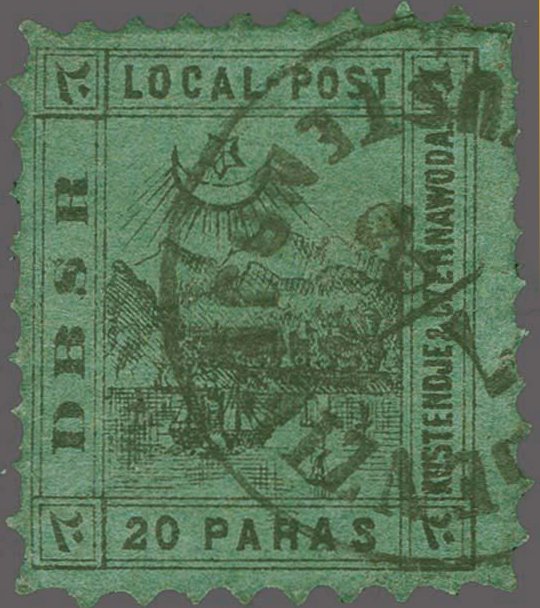
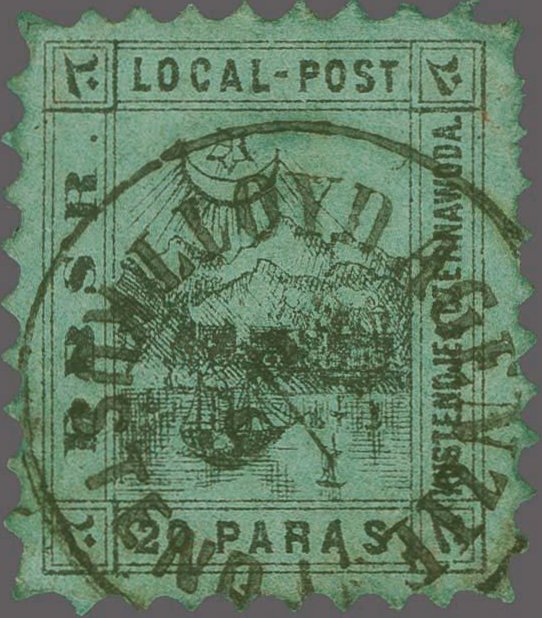 The stamp at left sold for CHF 575, the stamp at right for CHF 687.50, both prices including buyers' premium.
.
In the same sale was a fascinating entire letter, shown below with the auction house's description.
The stamp at left sold for CHF 575, the stamp at right for CHF 687.50, both prices including buyers' premium.
.
In the same sale was a fascinating entire letter, shown below with the auction house's description.
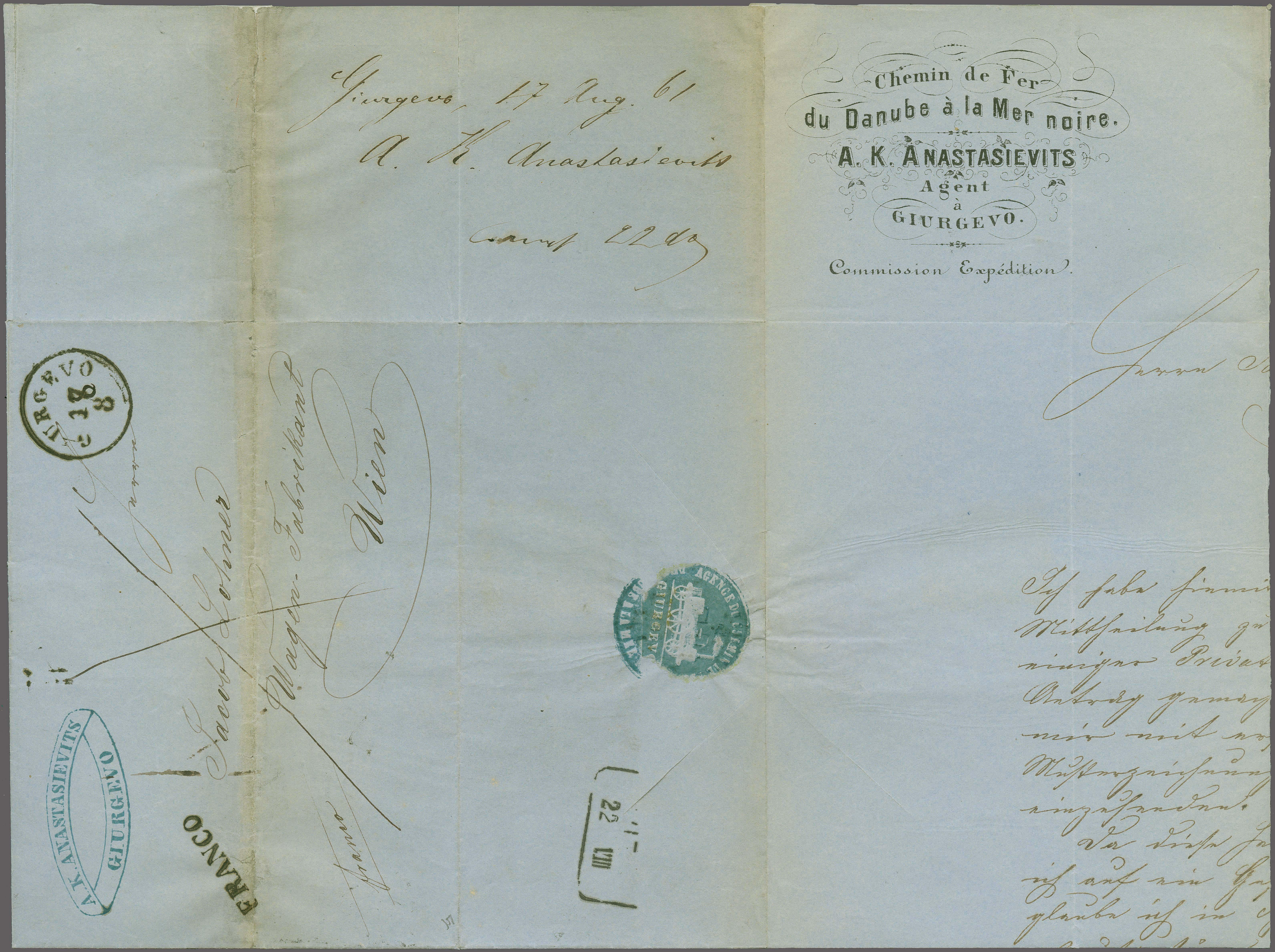
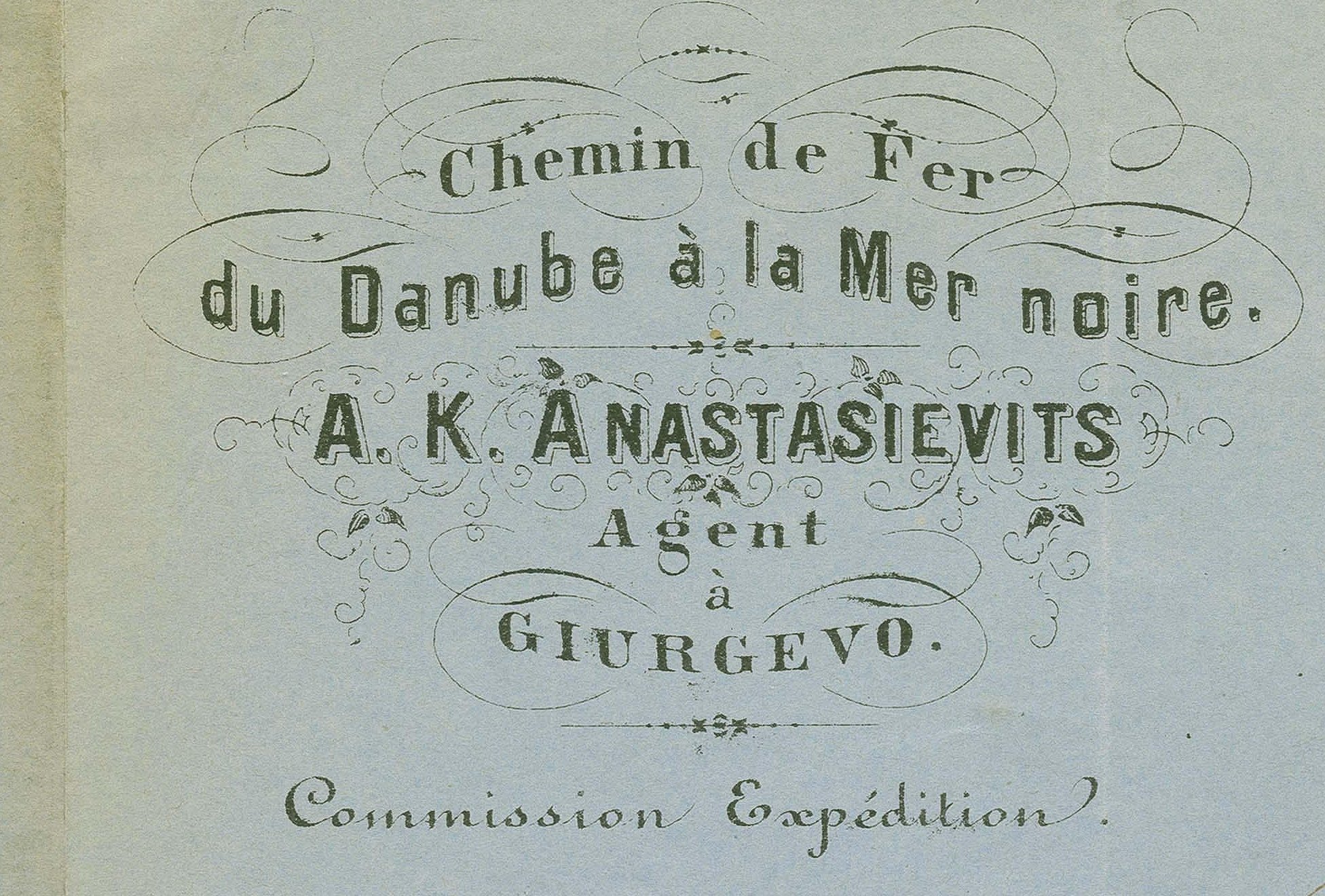
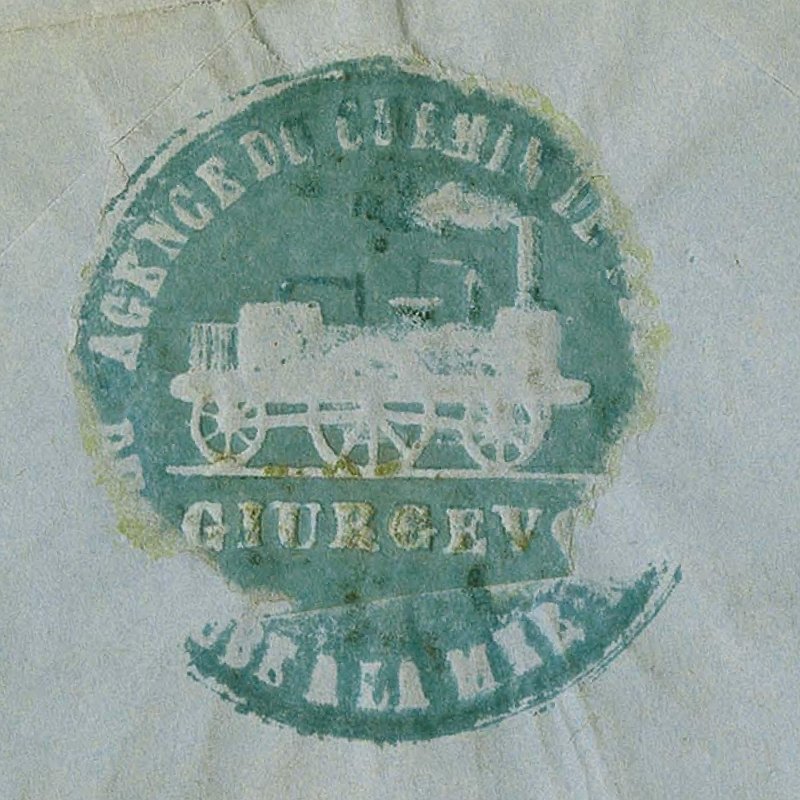 Danube & Black Sea Railway, Austrian PO's 1861: Printed entire letter from Giurgevo to Vienna on paper headed "Chemin de Fer / du Danube à la Mer noire / Agent à Giurgevo", prepaid with "GIURGEVO" circular datestamp (altered from '17' to '18' August) in black (Tchilinghirian fig. 748) and unlisted straight line "FRANCO" at left. Reverse with Vienna arrival and large part impressed seal with Locomotive illustration "Chemin de Fer / du Danube à la Mer noire / Agent à Giurgevo" in blue. File folds but most unusual. Ex collection Sassower.
Lot 6368 : Realized : CHF 2000 (CHF 2500 including buyers' premium).
.
First Reprint
Danube & Black Sea Railway, Austrian PO's 1861: Printed entire letter from Giurgevo to Vienna on paper headed "Chemin de Fer / du Danube à la Mer noire / Agent à Giurgevo", prepaid with "GIURGEVO" circular datestamp (altered from '17' to '18' August) in black (Tchilinghirian fig. 748) and unlisted straight line "FRANCO" at left. Reverse with Vienna arrival and large part impressed seal with Locomotive illustration "Chemin de Fer / du Danube à la Mer noire / Agent à Giurgevo" in blue. File folds but most unusual. Ex collection Sassower.
Lot 6368 : Realized : CHF 2000 (CHF 2500 including buyers' premium).
.
First Reprint
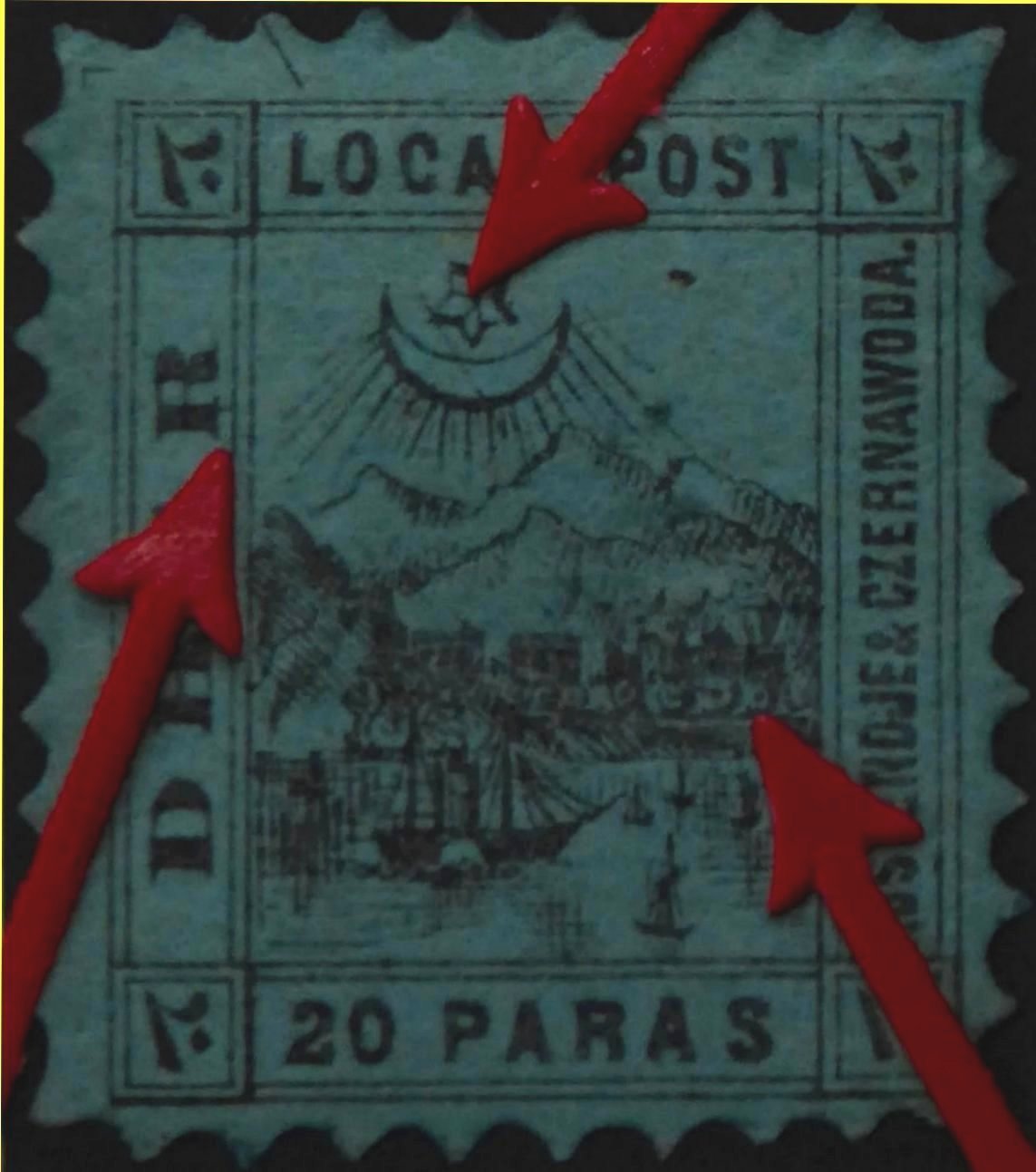 Features of First Reprint:
1. No lines (rays) between star and crescent but in most cases a large plate scratch through the left point of the star.
2. Best Test for First Reprint : In the left margin, there is a line between the base of the first downstroke of the 'R' and the frame-line below it.
3. No lines of shading to locomotive wheels (occasionally a few very light lines are discernible).
DBSR 20p Train First Reprint in Blue-Green Perf 8x10x8x9 [ . ]
- ditto - but Perf 8x9x8x10 [ . ]
.
.
Second Reprint
Features of First Reprint:
1. No lines (rays) between star and crescent but in most cases a large plate scratch through the left point of the star.
2. Best Test for First Reprint : In the left margin, there is a line between the base of the first downstroke of the 'R' and the frame-line below it.
3. No lines of shading to locomotive wheels (occasionally a few very light lines are discernible).
DBSR 20p Train First Reprint in Blue-Green Perf 8x10x8x9 [ . ]
- ditto - but Perf 8x9x8x10 [ . ]
.
.
Second Reprint
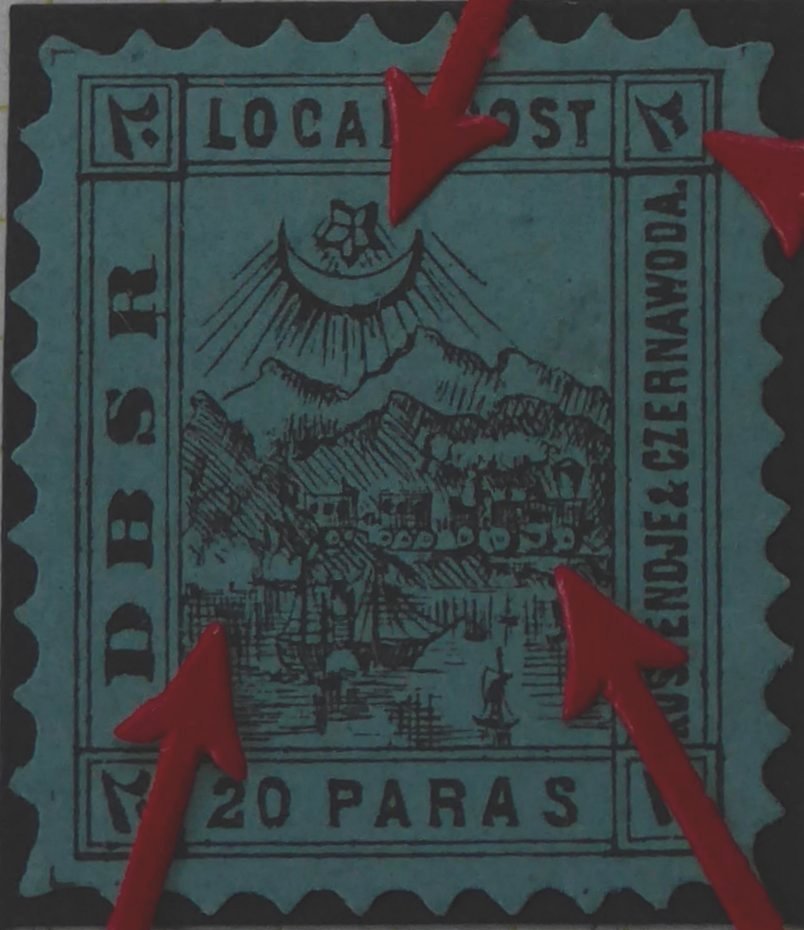 Features of Second Reprint:
1. Now with rays again between the star and the crescent but much stronger than in the originals.
2. Best Test for Second Reprint: The Turkish numeral '20' in the TOP RIGHT value box has the Turkish '0' attached to the '2', almost producing a Greek letter 'Pi'.
3. There is no line between the edge of the sea and the base of the hill on the left.
4. No shading to locomotive wheels.
DBSR 20p Train Second Reprint in Blue-Green Perf 8x10x8x9 [ . ]
- ditto - but Perf 8x9x8x10 [ . ]
.
.
Third Reprint
Features of Second Reprint:
1. Now with rays again between the star and the crescent but much stronger than in the originals.
2. Best Test for Second Reprint: The Turkish numeral '20' in the TOP RIGHT value box has the Turkish '0' attached to the '2', almost producing a Greek letter 'Pi'.
3. There is no line between the edge of the sea and the base of the hill on the left.
4. No shading to locomotive wheels.
DBSR 20p Train Second Reprint in Blue-Green Perf 8x10x8x9 [ . ]
- ditto - but Perf 8x9x8x10 [ . ]
.
.
Third Reprint
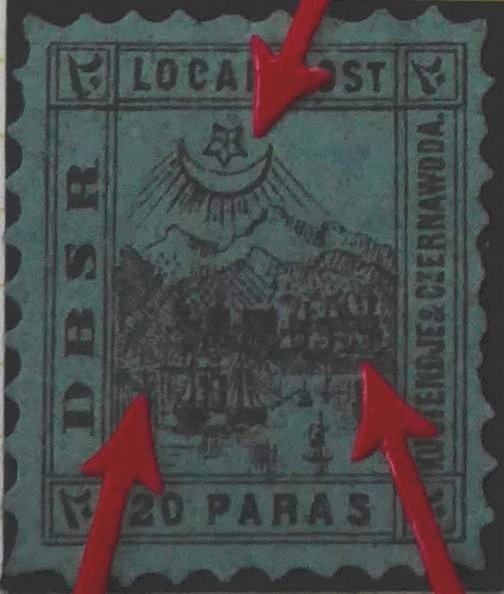 If it is not Green, it is a Third Reprint (or Forgery); if it is Green, then:
The Features of the Third Reprint are:
1. No rays between the star and the crescent.
2. No shading to locomotive wheels.
3. Best (Double) Test for Third Reprint: There are no rays between star and crescent AND no line joining base of 'R' to frame-line (as is present in First Reprint). There is sometimes the tiny remains of a line, not much more than a dot, on the frameline below the R but never a complete line joining the R to the frameline in these Third Reprints.
These THIRD REPRINTS were made from a new lithographic stone and an intermediate stone of six transfers was used. Due to the worn nature of the transfers, each one was retouched, allowing the collector to plate the six (repeated) positions. We have provided a catalogue-style listing for the two basic perforations, and chosen the blue-green for this, but provided only one check-box for each of the six Transfer Types by colour, although they should all exist in both perforations, like the blue-green.
Below is a tabular check-list for the Third Reprint with its FIVE colours and SIX transfers. Note: These are the same five colours which were later copied by Fournier for his forgeries.
Basic Listing:
DBSR 20p Train Third Reprint in Blue-Green Perf 8x10x8x9 [ . ]
- ditto - but Perf 8x9x8x10 [ . ]
.
The Six Transfers of the Third Reprints:
If it is not Green, it is a Third Reprint (or Forgery); if it is Green, then:
The Features of the Third Reprint are:
1. No rays between the star and the crescent.
2. No shading to locomotive wheels.
3. Best (Double) Test for Third Reprint: There are no rays between star and crescent AND no line joining base of 'R' to frame-line (as is present in First Reprint). There is sometimes the tiny remains of a line, not much more than a dot, on the frameline below the R but never a complete line joining the R to the frameline in these Third Reprints.
These THIRD REPRINTS were made from a new lithographic stone and an intermediate stone of six transfers was used. Due to the worn nature of the transfers, each one was retouched, allowing the collector to plate the six (repeated) positions. We have provided a catalogue-style listing for the two basic perforations, and chosen the blue-green for this, but provided only one check-box for each of the six Transfer Types by colour, although they should all exist in both perforations, like the blue-green.
Below is a tabular check-list for the Third Reprint with its FIVE colours and SIX transfers. Note: These are the same five colours which were later copied by Fournier for his forgeries.
Basic Listing:
DBSR 20p Train Third Reprint in Blue-Green Perf 8x10x8x9 [ . ]
- ditto - but Perf 8x9x8x10 [ . ]
.
The Six Transfers of the Third Reprints:
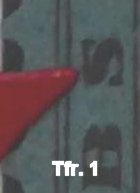
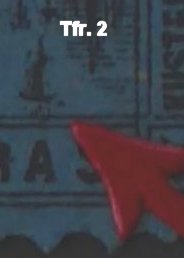
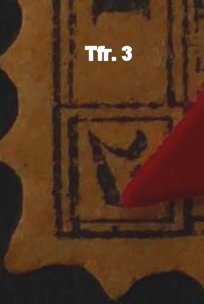
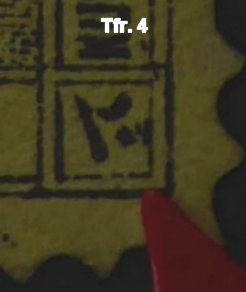
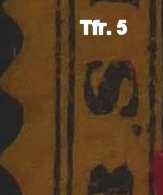
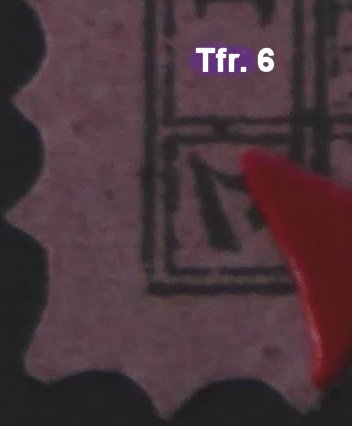 Descriptions of Third Reprint Transfers :
Transfer 1 : Flattening of 'S' at left in 'DBSR'. Additional : Small dot over 'S' in 'PARAS'.
Transfer 2 : Dot to South-East of bottom sailing boat.
Transfer 3 : Bottom left corner : Inner frame-line of value box, left-side, extended down to bottom frame-line.
Transfer 4 : Turkish '200' for '20' in bottom right value box (= extra dot).
Transfer 5 : Dot at South-West corner of 'S' in 'DBSR'.
Transfer 6 : Bottom Left Value Box : Small black dot (centrally) between frame lines above Turkish '2'.
.
Descriptions of Third Reprint Transfers :
Transfer 1 : Flattening of 'S' at left in 'DBSR'. Additional : Small dot over 'S' in 'PARAS'.
Transfer 2 : Dot to South-East of bottom sailing boat.
Transfer 3 : Bottom left corner : Inner frame-line of value box, left-side, extended down to bottom frame-line.
Transfer 4 : Turkish '200' for '20' in bottom right value box (= extra dot).
Transfer 5 : Dot at South-West corner of 'S' in 'DBSR'.
Transfer 6 : Bottom Left Value Box : Small black dot (centrally) between frame lines above Turkish '2'.
.
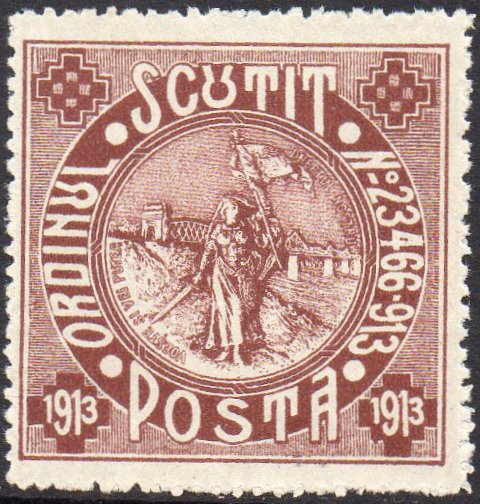 Romania 1913 Franchise Stamp - King Carol I Bridge. [ . ]

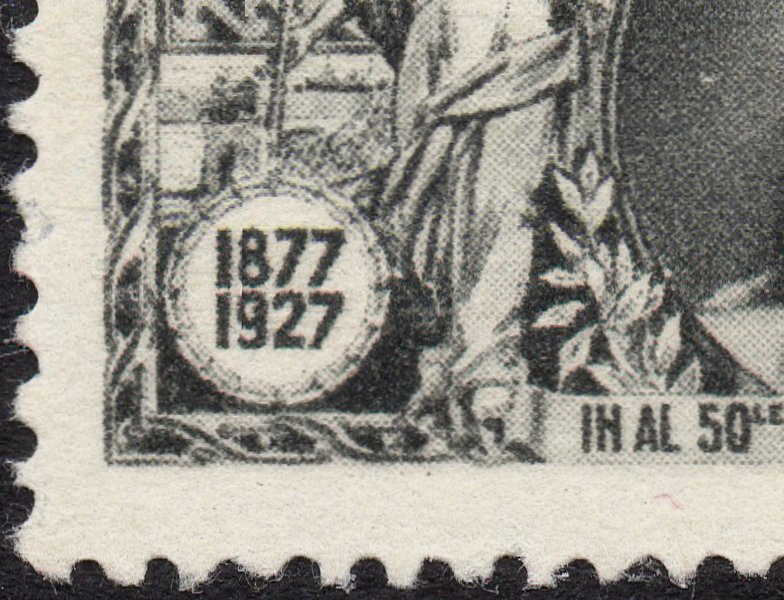 The bridge portal and first arch of the bridge are depicted immediately above the dates.
Romania 1927 30b Black 50th Anniversary of Independence King Carol I Bridge. [ . ]
Romania 1927 2L Green 50th Anniversary of Independence King Carol I Bridge. [ . ]
Romania 1927 3L Purple 50th Anniversary of Independence King Carol I Bridge. [ . ]
Romania 1927 5L Chestnut 50th Anniversary of Independence King Carol I Bridge. [ . ]
.
The bridge portal and first arch of the bridge are depicted immediately above the dates.
Romania 1927 30b Black 50th Anniversary of Independence King Carol I Bridge. [ . ]
Romania 1927 2L Green 50th Anniversary of Independence King Carol I Bridge. [ . ]
Romania 1927 3L Purple 50th Anniversary of Independence King Carol I Bridge. [ . ]
Romania 1927 5L Chestnut 50th Anniversary of Independence King Carol I Bridge. [ . ]
.
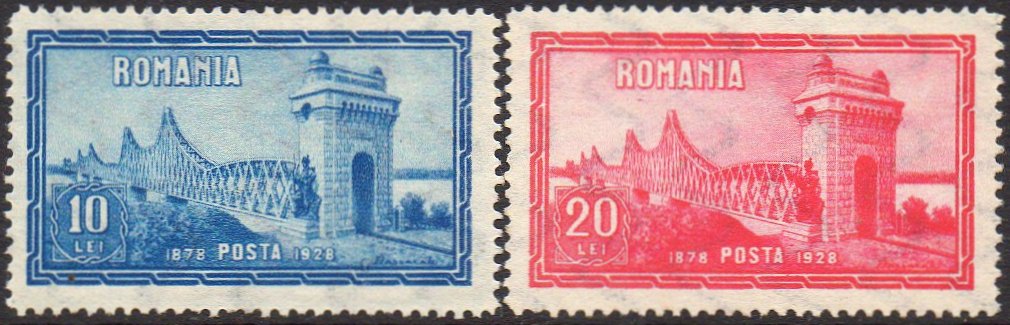
 Romania 1928 10L Blue 50th Anniversary of Acquisition of Northern Dobruja. [ . ]
Romania 1928 20L Red 50th Anniversary of Acquisition of Northern Dobruja. [ . ]
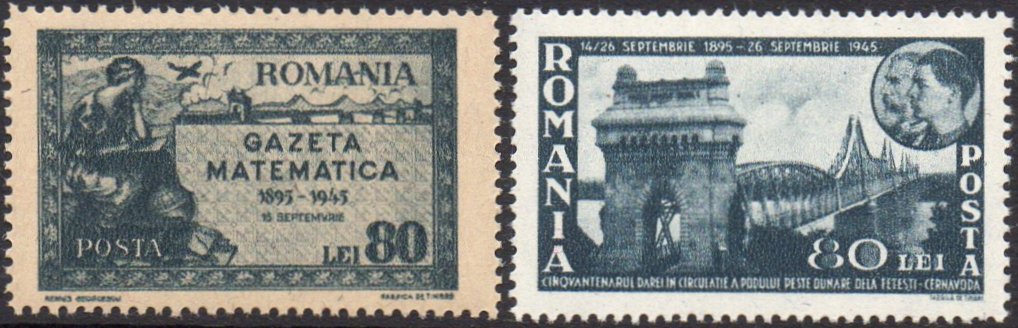
Romania 1945 80L 50th Anniversary of Journal of Mathematics Cernavoda Bridge [ . ]
Romamia 1945 80L 50th Anniversary of Building (Opening) of Cernavoda Bridge [ . ]
Romania 1928 10L Blue 50th Anniversary of Acquisition of Northern Dobruja. [ . ]
Romania 1928 20L Red 50th Anniversary of Acquisition of Northern Dobruja. [ . ]
Romania 1945 80L 50th Anniversary of Journal of Mathematics Cernavoda Bridge [ . ]
Romamia 1945 80L 50th Anniversary of Building (Opening) of Cernavoda Bridge [ . ]
 Romania 1947 12L Violet Cernavoda Bridge. [ . ]
Romania 1947 36L Deep Carmine Cernavoda Bridge. [ . ]
Romania 1948 12L Violet Cernavoda Bridge optd RPR. [ . ]
Romania 1948 36L Deep Carmine Cernavoda Bridge optd RPR. [ . ]
Romania 1947 12L Violet Cernavoda Bridge. [ . ]
Romania 1947 36L Deep Carmine Cernavoda Bridge. [ . ]
Romania 1948 12L Violet Cernavoda Bridge optd RPR. [ . ]
Romania 1948 36L Deep Carmine Cernavoda Bridge optd RPR. [ . ]
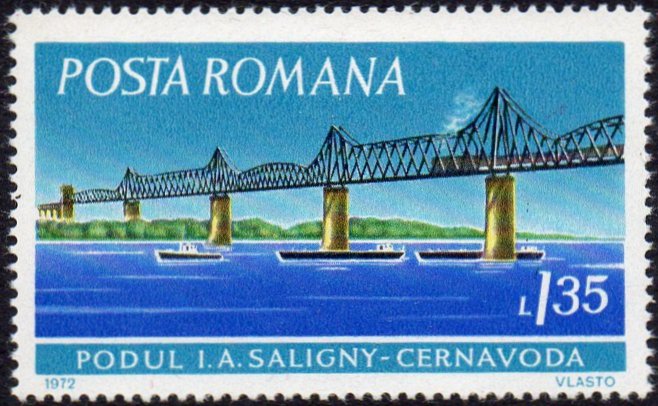 Romania 1972 1L35, by now named the Anghel Saligny Bridge [ . ]
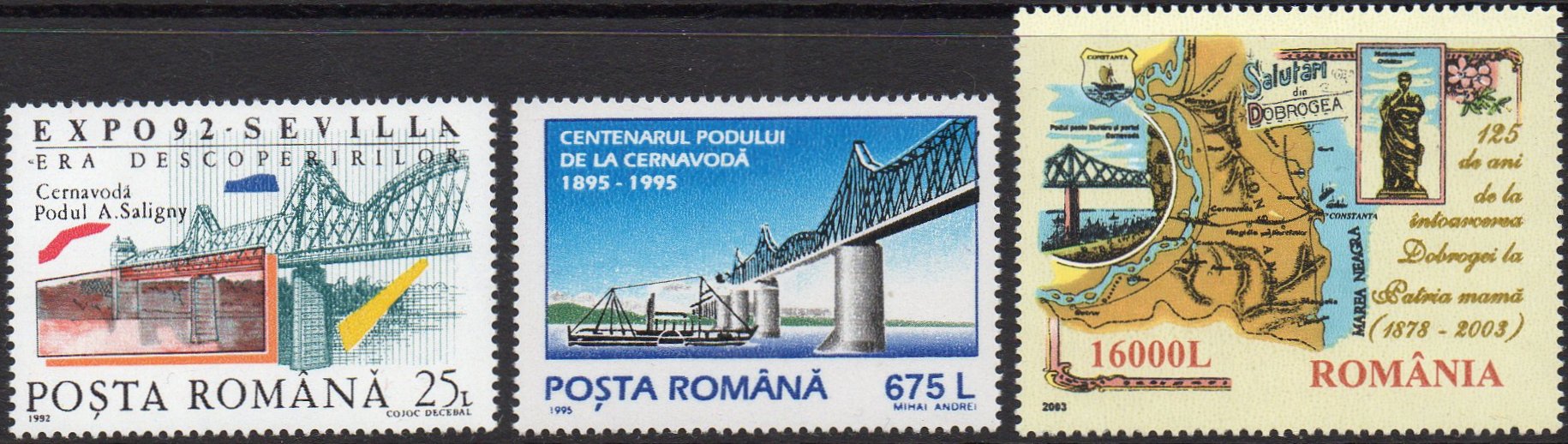 Romania 1992 25L Expo 1992 Seville, Saligny Bridge [ . ]
Romania 1995 675L Centenary of Anghel Saligny Bridge [ . ]
Romania 2003 16000L 125th Anniv. of Berlin Treaty - Saligny Bridge [ . ]
.
Romania 1992 25L Expo 1992 Seville, Saligny Bridge [ . ]
Romania 1995 675L Centenary of Anghel Saligny Bridge [ . ]
Romania 2003 16000L 125th Anniv. of Berlin Treaty - Saligny Bridge [ . ]
.
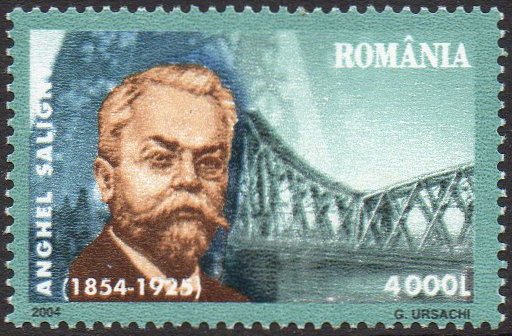
 2004 4000L Anghel Saligny : 150th Anniversary of his Birth and Cernavoda Bridge [ . ]
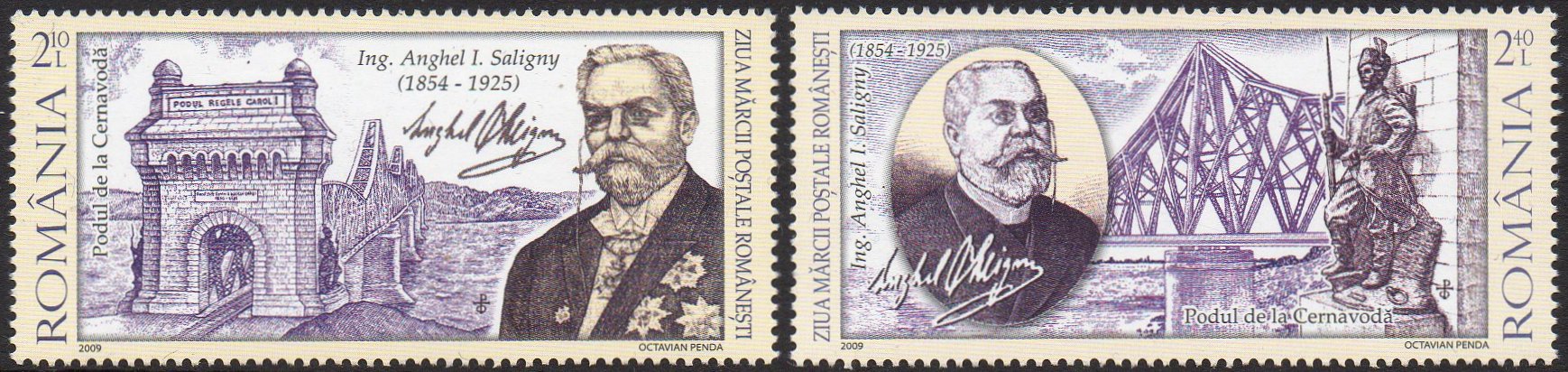
2009 2L10 Anghel Saligny & Cernavoda Bridge [ . ]
2009 2L40 Anghel Saligny & Cernavoda Bridge (different) [ . ]
.
There are also a few stamps which show the new rail-road bridge which is adjacent to the old bridge. Please refer to any railway thematic catalogue for those.
Romania has also produced a large number of postal stationery items, most of them pictorial, including several which shown the 1895 bridge. We have not attempted to show or list these here.
.
.
3. Express d'Orient stamps, circa 1883 :
2004 4000L Anghel Saligny : 150th Anniversary of his Birth and Cernavoda Bridge [ . ]
2009 2L10 Anghel Saligny & Cernavoda Bridge [ . ]
2009 2L40 Anghel Saligny & Cernavoda Bridge (different) [ . ]
.
There are also a few stamps which show the new rail-road bridge which is adjacent to the old bridge. Please refer to any railway thematic catalogue for those.
Romania has also produced a large number of postal stationery items, most of them pictorial, including several which shown the 1895 bridge. We have not attempted to show or list these here.
.
.
3. Express d'Orient stamps, circa 1883 :
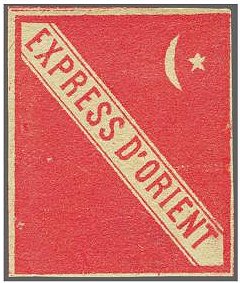 Issued in about 1883, these stamps were used to prepay a surcharge due on letters sent by way of the Orient Express. There are two Dies (I and II) with different settings of the simple diagonal inscription. The dies can be separated simply by stamp colour but the detail is that only Die I has a full stop after 'EXPRESS' as well as thinner lettering than Die II.
The normal use of the Express d'Orient stamps was on covers franked with stamps either of Turkey, British Levant or German Levant, normally cancelled 'CONSTANTINOPLE', but occasionally with other cancels, such as in Stamboul 'CONSTANTINOPLE S' and, very rarely and highly desirably, with an Orient Express cancellation.
The image above comes from a May 2022 Corinphila auction which had three lots (
Issued in about 1883, these stamps were used to prepay a surcharge due on letters sent by way of the Orient Express. There are two Dies (I and II) with different settings of the simple diagonal inscription. The dies can be separated simply by stamp colour but the detail is that only Die I has a full stop after 'EXPRESS' as well as thinner lettering than Die II.
The normal use of the Express d'Orient stamps was on covers franked with stamps either of Turkey, British Levant or German Levant, normally cancelled 'CONSTANTINOPLE', but occasionally with other cancels, such as in Stamboul 'CONSTANTINOPLE S' and, very rarely and highly desirably, with an Orient Express cancellation.
The image above comes from a May 2022 Corinphila auction which had three lots (