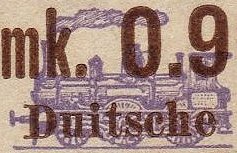
 In the early part of the 20th century, there was an agreement, little known today, under which passengers in The Netherlands buying international train tickets for travel from their country into Germany were to pay the German Reich's Railway Ticket Tax in The Netherlands before they travelled.
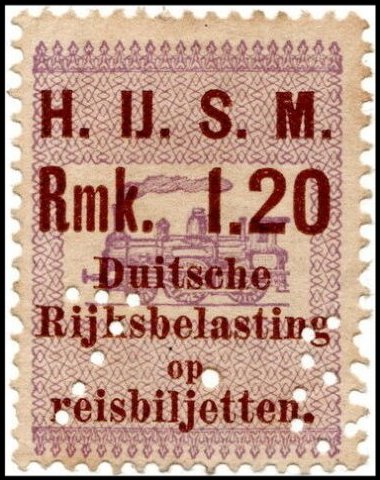
The tax collected in The Netherlands was by means of revenue stamps expressly printed for two railway companies. The text on these stanmps is in Dutch but the tax due is expressed in German currency, the Reichsmark. Few detailed records appear to have been retained relating to this arrangement but one presumes that the participating Dutch railways collected the fee from the passenger in local currency, either at a semi-fixed price in Gulden or at the current exchange rate with the German Mark. The accounting methodology by which the ticket taxes collected in The Netherlands reached the German Treasury, perhaps via some form of railway clearing house which included the German railway company or companies involved, is unknown to us.
Within Germany, the tax was not limited to travel by train and certainly included shipping company tickets, as the scan lower down proves, but, to our knowledge, journeys between The Netherlands and Germany that incurred the tax were only by rail.
Before examining the Dutch ticket tax stamps, we shall look briefly at the Ticket Tax table for Germany, which is instructive for Germany, although not 100% illuminating for The Netherlands. Note that the tax is based on ticket price, not distance travelled.
Railway Ticket Tax stamps issued in Germany
Different stamps to those used in The Netherlands were employed in Germany, the design for these being the German Eagle with the inscription 'FAHRKARTENSTEMPEL' (Travel Ticket Revenue Stamp) and the value in Marks and Pfennigs.
In the early part of the 20th century, there was an agreement, little known today, under which passengers in The Netherlands buying international train tickets for travel from their country into Germany were to pay the German Reich's Railway Ticket Tax in The Netherlands before they travelled.
The tax collected in The Netherlands was by means of revenue stamps expressly printed for two railway companies. The text on these stanmps is in Dutch but the tax due is expressed in German currency, the Reichsmark. Few detailed records appear to have been retained relating to this arrangement but one presumes that the participating Dutch railways collected the fee from the passenger in local currency, either at a semi-fixed price in Gulden or at the current exchange rate with the German Mark. The accounting methodology by which the ticket taxes collected in The Netherlands reached the German Treasury, perhaps via some form of railway clearing house which included the German railway company or companies involved, is unknown to us.
Within Germany, the tax was not limited to travel by train and certainly included shipping company tickets, as the scan lower down proves, but, to our knowledge, journeys between The Netherlands and Germany that incurred the tax were only by rail.
Before examining the Dutch ticket tax stamps, we shall look briefly at the Ticket Tax table for Germany, which is instructive for Germany, although not 100% illuminating for The Netherlands. Note that the tax is based on ticket price, not distance travelled.
Railway Ticket Tax stamps issued in Germany
Different stamps to those used in The Netherlands were employed in Germany, the design for these being the German Eagle with the inscription 'FAHRKARTENSTEMPEL' (Travel Ticket Revenue Stamp) and the value in Marks and Pfennigs.
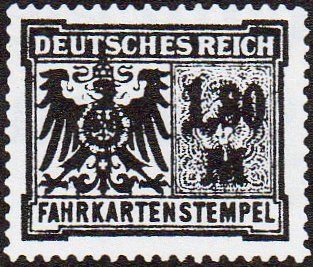
 The black and white scan of the 1M80 German Ticket Tax stamp comes from the American Revenuer article.
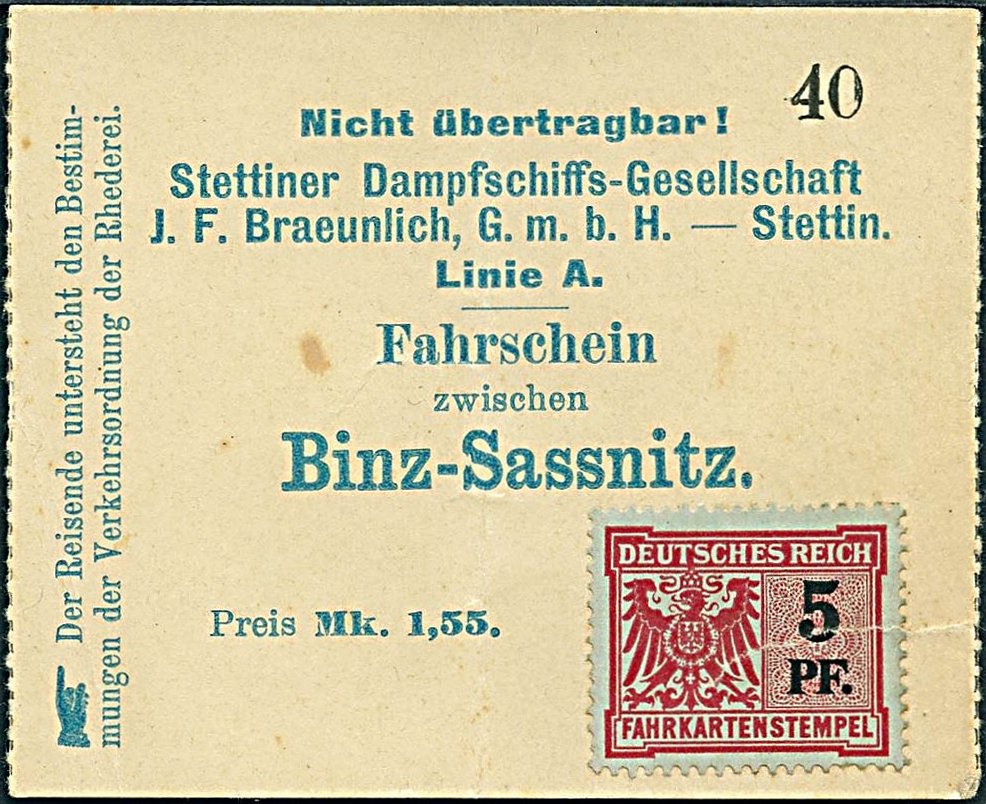
The interesting shipping company ticket with tax stamp affixed is reproduced here by kind permission of Bjarne of Fyns Frimaerke Service. Binz to Sassnitz is a straightforward journey within Germany on the island of Rügen, a distance of 16 kms by road. At the time however, Rügen was still an island without fixed connection to the mainland and road transport on the island would have been very limited. The local ferry from the mainland carrying freight and calling at several ports on the island would have proved a useful passenger transport link as well.
The ticket price of Mk 1,55 and the ticket tax charged of 5pf indicates that this is a third-class ticket (see charges table below.) Note the low serial number on the ticket, suggesting perhaps quite low passenger numbers were carried, and that a blank space has been left on the ticket for affixing the revenue stamp.
These German stamps were produced for 1st, 2nd and 3rd class passengers and there were eight tariffs for each class of passenger, the tariffs based on the price of the ticket, not the distance travelled, although these are typically closely related. The tax table applicable to wholly German tickets is shown below.
We have found no equivalent table for The Netherlands, but one may have been produced. However, if the international ticket price was simply the price from the departure station in The Netherlands to the first station inside Germany plus the price of an internal German ticket, then access to a German train ticket price list would have been sufficient for a ticket clerk in The Netherlands to calculate the ticket tax payable for the German section of a journey.
Tax Table on Railway Tickets : For GERMANY only.
Note : The 18 different tax rates shown in the table below exactly match the face value of the 18 stamps listed in the 1915 Forbin world catalogue of revenue stamps, shown as a 1905 issue, Forbin Germany Fahrkartenstempel #1-18. The Forbin catalogue shows no other issues for Fahrkartenstempel but anything issued after 1912, or, at latest, 1913 is not included in Forbin.
The black and white scan of the 1M80 German Ticket Tax stamp comes from the American Revenuer article.
The interesting shipping company ticket with tax stamp affixed is reproduced here by kind permission of Bjarne of Fyns Frimaerke Service. Binz to Sassnitz is a straightforward journey within Germany on the island of Rügen, a distance of 16 kms by road. At the time however, Rügen was still an island without fixed connection to the mainland and road transport on the island would have been very limited. The local ferry from the mainland carrying freight and calling at several ports on the island would have proved a useful passenger transport link as well.
The ticket price of Mk 1,55 and the ticket tax charged of 5pf indicates that this is a third-class ticket (see charges table below.) Note the low serial number on the ticket, suggesting perhaps quite low passenger numbers were carried, and that a blank space has been left on the ticket for affixing the revenue stamp.
These German stamps were produced for 1st, 2nd and 3rd class passengers and there were eight tariffs for each class of passenger, the tariffs based on the price of the ticket, not the distance travelled, although these are typically closely related. The tax table applicable to wholly German tickets is shown below.
We have found no equivalent table for The Netherlands, but one may have been produced. However, if the international ticket price was simply the price from the departure station in The Netherlands to the first station inside Germany plus the price of an internal German ticket, then access to a German train ticket price list would have been sufficient for a ticket clerk in The Netherlands to calculate the ticket tax payable for the German section of a journey.
Tax Table on Railway Tickets : For GERMANY only.
Note : The 18 different tax rates shown in the table below exactly match the face value of the 18 stamps listed in the 1915 Forbin world catalogue of revenue stamps, shown as a 1905 issue, Forbin Germany Fahrkartenstempel #1-18. The Forbin catalogue shows no other issues for Fahrkartenstempel but anything issued after 1912, or, at latest, 1913 is not included in Forbin.
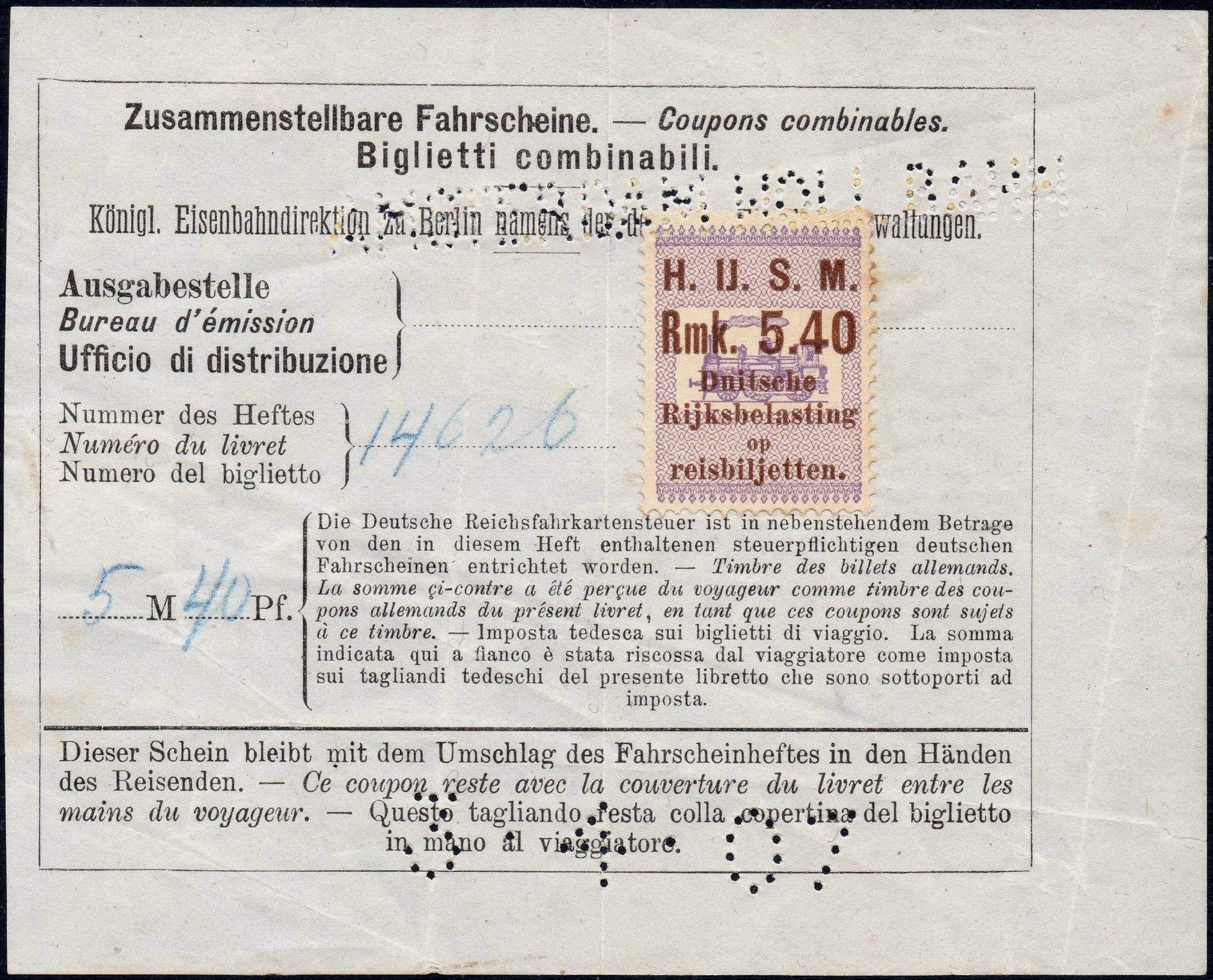 Note that the currency is expressed in Reichsmarks (Rmk). On the internal German stamps, it is simply Marks (M).
The first thing that strikes one about this receipt is that it is in German, French and Italian - but not Dutch. French has long been an international diplomatic standard language and an official language for documents, but not Italian.
Several fraud prevention / accounting measures are apparent on this receipt:
The amount due, Rmk 5.40, is shown in manuscript and it matches the value of the stamp.
The number of the folder containing the train ticket and receipt is shown in manuscript.
It is punched AMSTERDAM HOLLBAHN, the punch passing through the stamp.
The date is also punched into the foot of the receipt, here 3 4 07 (April 3rd 1907).
We imagine that the punch through the receipt (and stamp) obviated the need to write in the location of the issuing office. It is clear that the receipt itself was not designed with a view to affixing an adhesive stamp. We do not know whether other countries collected the ticket tax on behalf of Germany but it seems unlikely that The Netherlands would have been singled out for this process. We suspect that this same form was used in several countries to collect the German tax but, to our knowledge, it seems that only The Netherlands chose to affix stamps to it for their book-keeping purposes. The fact that the stamps were printed by Enschedé, security printers in Haarlem (Neths.), rather than in Germany, also suggests that the initiative to use revenue stamps for accounting purposes came purely from the two Dutch railway companies.
Note that the currency is expressed in Reichsmarks (Rmk). On the internal German stamps, it is simply Marks (M).
The first thing that strikes one about this receipt is that it is in German, French and Italian - but not Dutch. French has long been an international diplomatic standard language and an official language for documents, but not Italian.
Several fraud prevention / accounting measures are apparent on this receipt:
The amount due, Rmk 5.40, is shown in manuscript and it matches the value of the stamp.
The number of the folder containing the train ticket and receipt is shown in manuscript.
It is punched AMSTERDAM HOLLBAHN, the punch passing through the stamp.
The date is also punched into the foot of the receipt, here 3 4 07 (April 3rd 1907).
We imagine that the punch through the receipt (and stamp) obviated the need to write in the location of the issuing office. It is clear that the receipt itself was not designed with a view to affixing an adhesive stamp. We do not know whether other countries collected the ticket tax on behalf of Germany but it seems unlikely that The Netherlands would have been singled out for this process. We suspect that this same form was used in several countries to collect the German tax but, to our knowledge, it seems that only The Netherlands chose to affix stamps to it for their book-keeping purposes. The fact that the stamps were printed by Enschedé, security printers in Haarlem (Neths.), rather than in Germany, also suggests that the initiative to use revenue stamps for accounting purposes came purely from the two Dutch railway companies.
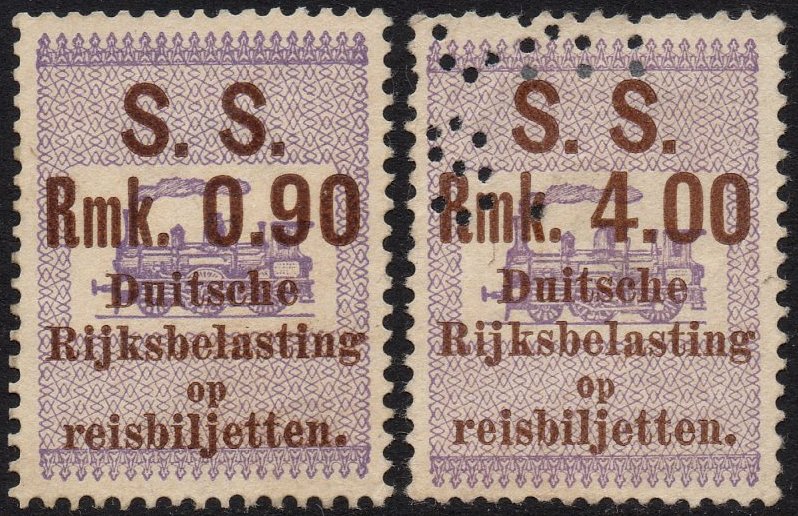 The Rmk 0.90 stamp shown above is Mint with full gum. The Rmk 4.00 is without gum and with part of a two-line punch at the top of the stamp, therefore clearly 'used'. The bottom line of the punch ends 'S.', perhaps the ending of 'S.S.'. There is only a small part of the top line present, but the part of the last three letters of the word that are visible might well be the base of the letters 'CHT', suggesting an issuing office such as 'UTRECHT', or perhaps Dordrecht but we do not have information with regard to which stations were on the S.S. network around 1910, nor which of them were authorised to issue international tickets.
Two sources plus Forbin (under Pays Bas - Netherlands - Impot sur les Billets de Chemin de Fer pour l'Allemagne, #1-23) provide identical lists of the 23 values that were issued. We have no reason to mistrust the listings of face values and therefore repeat them below, but Forbin's issue date of 1912 for these Dutch stamps is incorrect, as is clear from the 1907 receipt scanned into this article
The Rmk 0.90 stamp shown above is Mint with full gum. The Rmk 4.00 is without gum and with part of a two-line punch at the top of the stamp, therefore clearly 'used'. The bottom line of the punch ends 'S.', perhaps the ending of 'S.S.'. There is only a small part of the top line present, but the part of the last three letters of the word that are visible might well be the base of the letters 'CHT', suggesting an issuing office such as 'UTRECHT', or perhaps Dordrecht but we do not have information with regard to which stations were on the S.S. network around 1910, nor which of them were authorised to issue international tickets.
Two sources plus Forbin (under Pays Bas - Netherlands - Impot sur les Billets de Chemin de Fer pour l'Allemagne, #1-23) provide identical lists of the 23 values that were issued. We have no reason to mistrust the listings of face values and therefore repeat them below, but Forbin's issue date of 1912 for these Dutch stamps is incorrect, as is clear from the 1907 receipt scanned into this article
 .
.