North-West China Revenue (fiscal) Stamps : Railway Trains
. . . & Other Chinese Revenues + the Hankow-Peking Railway stamps.
Most collectors will be very familiar with the Transportation Revenue stamps of China, widely surcharged in order to produce postage stamps in 1949/50 in addition to their intended purpose as revenues, in which capacity they were also extensively employed, both in original form and with surcharges.
In another article we covered, in detail, the extensive range of postal surcharges on these 'transportation' designs. The revenue issues are often even more complex than the postal issues and we have no plans to cover them in any of our articles. However, there is a quite obscure Chinese revenue design, with trains, which we think would benefit from a study, hence this short article.
Background and Bibliography :
For use only in North-West China around 1946/47, the stamps reflect the circumstances of their issue, the immediate post-WWII period in the final years of the civil war between the Nationalist and Communist forces. The rapidly evolving, fast-moving conflict, in combination with minimal access to either quality paper or proper printing presses, spawned some short-lived, poorly-printed and often ill-recorded stamps.
We have had access to four sources for this article:
1. Wing Commander Padget's catalogue (editions in the 1970s/1980s).
2. 1990s Chinese Revenue Stamp Company's price lists and 1987 catalogue (authored by H.C.Paau).
3. A price list of Fan K. Chan of New York.
4. A range of stamps, including some from the Anthony Hopwood collection.
All authorities agree that the stamps should be seen as TWO issues. Certainly, there are two principal designs but what was issued when, and with how many printings, is far from clear. For some reason, Padget lists, and numbers, the presumed 1947 stamps before those stated as being from 1946. Paau does not date them but lists them in the same order. We think it unhelpful to interfere with such a long-established ordering and have followed the established pattern.
Identifying the TWO main types :
There is a very simple identifier for the main two issues, the number of characters in the top panel. We are introducing 'Types' for clarity and they are as follows:
 Type I : c.1947 : Six Chinese characters in the top panel
Type II : c.1946 : Seven Chinese characters in the top panel
Type I : c.1947 : Six Chinese characters in the top panel
Type II : c.1946 : Seven Chinese characters in the top panel
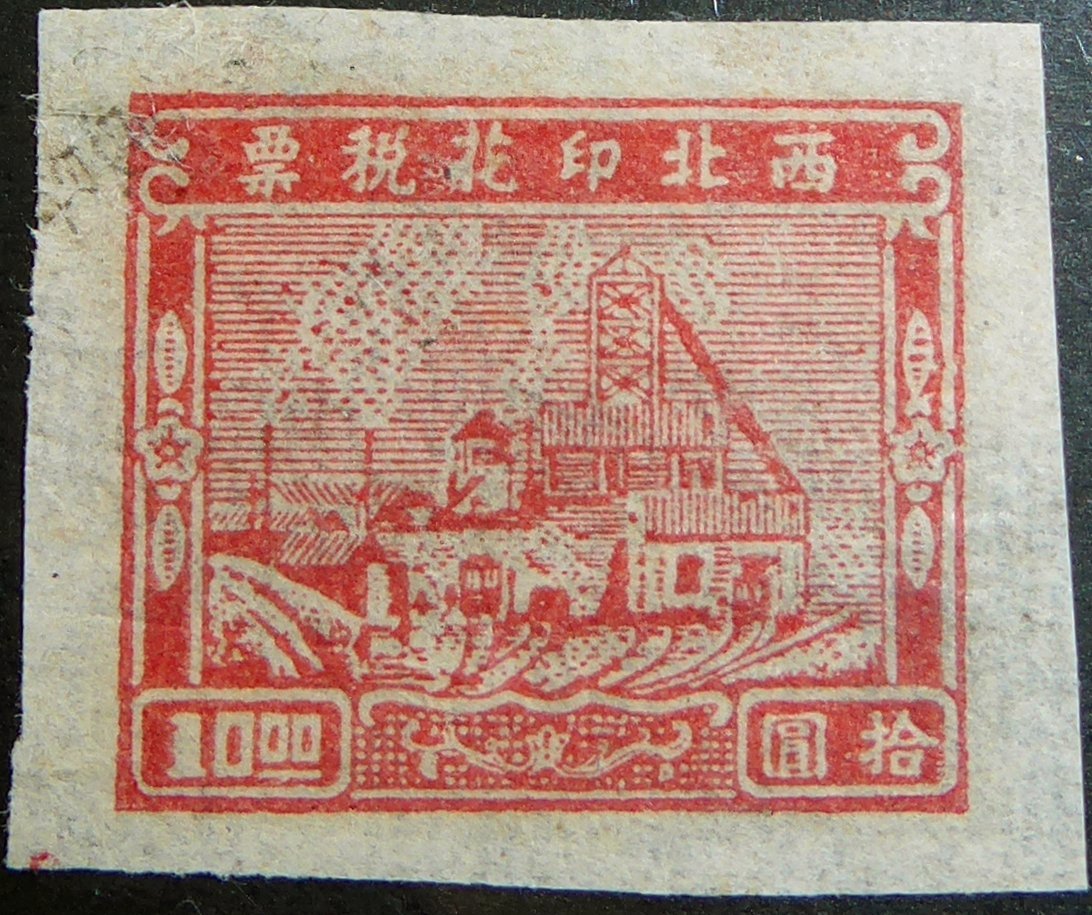 The clearest example we could find of the design. Few stamps have anything approaching this definition.
Paau describes the design as 'Field & Housing'. It seems more to us like 'Factory (or perhaps Farm) and Railway'. Whilst the sharpness of the design is never good, a few stamps are printed suffiently well to see clearly five sets of railway tracks leading up to a building. There appears to be part of a train on the left-hand set of tracks, possibly with another train on the fourth set of tracks (counting from the left).
The article is fairly simple in its construction, displaying all the images that we have for these stamps, Type I stamps first, then Type II, making brief observations on these scans and then attempting to list the stamps, in many cases with reservations and caveats!
Perforations and Perforating : Colours :
This is a nightmare subject on this design. For example, Padget lists the Type I as Perf only, Paau as Imperf only. Padget lists all the Type II both Perf and Imperf, except for the $10, whilst Paau only lists them Imperf, except for the $30 which it also lists Perf. We will make our own listing, as best we can, both for perforations and on colours, a subject on which there is also wild variation between the catalogues. Please bear in mind that all these listings, Padget's, Paau's and ours, are almost certainly far from being the final word on these stamps.
.
Type I stamps : Padget LA 108-12; Paau NW 34-38
The clearest example we could find of the design. Few stamps have anything approaching this definition.
Paau describes the design as 'Field & Housing'. It seems more to us like 'Factory (or perhaps Farm) and Railway'. Whilst the sharpness of the design is never good, a few stamps are printed suffiently well to see clearly five sets of railway tracks leading up to a building. There appears to be part of a train on the left-hand set of tracks, possibly with another train on the fourth set of tracks (counting from the left).
The article is fairly simple in its construction, displaying all the images that we have for these stamps, Type I stamps first, then Type II, making brief observations on these scans and then attempting to list the stamps, in many cases with reservations and caveats!
Perforations and Perforating : Colours :
This is a nightmare subject on this design. For example, Padget lists the Type I as Perf only, Paau as Imperf only. Padget lists all the Type II both Perf and Imperf, except for the $10, whilst Paau only lists them Imperf, except for the $30 which it also lists Perf. We will make our own listing, as best we can, both for perforations and on colours, a subject on which there is also wild variation between the catalogues. Please bear in mind that all these listings, Padget's, Paau's and ours, are almost certainly far from being the final word on these stamps.
.
Type I stamps : Padget LA 108-12; Paau NW 34-38
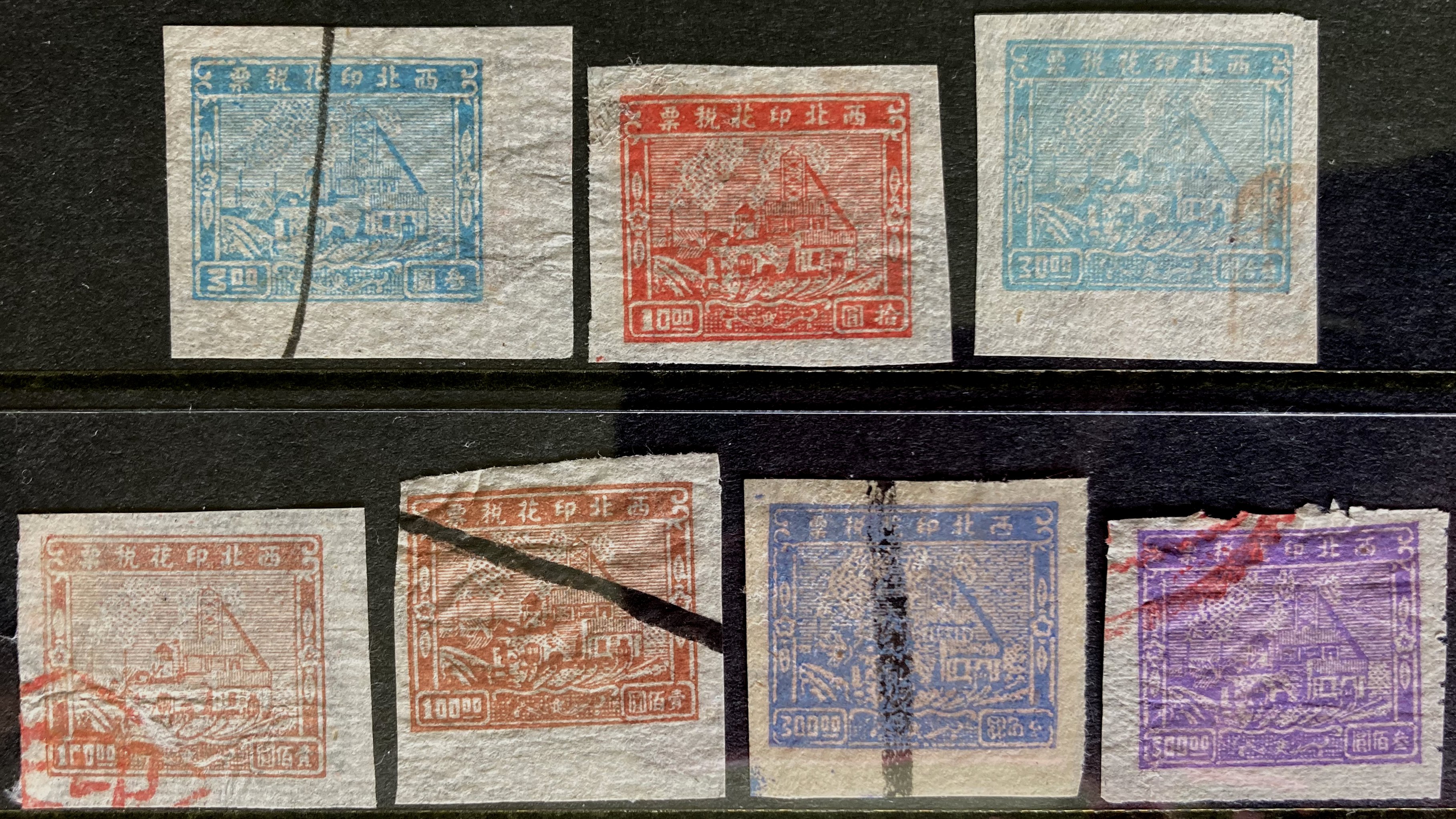 The five values with shades of the $100 and $300, one of the latter perforated.
We doubt that outer edges of the sheets were always perforated, if at all, so stamps perforated on two or three sides would not be unusual. We list below what we have seen but the presence of other shades is almost certain whilst the presence of other Type I values that are perforated seems more likely than not.
c.1947 Type I : Factory & Trains:
$3 : Type I : IMPERF : Greenish-Blue [ . ] [ . ] Padget LA108 but Imp.; Paau NW34
$10 : Type I : IMPERF : Red [ . ] [ . ] Padget LA109 but Imp.; Paau NW35
$30 : Type I : IMPERF : Pale Greenish-Blue [ . ] [ . ] Padget LA110 but Imp.; Paau NW36
$100 : Type I : IMPERF : Pale Lilac-Chestnut [ . ] [ . ] Padget LA111 but Imp.; Paau NW37
- do - : Chestnut [ . ] [ . ]
S300 : Type I : IMPERF : Dull lilac-ultramarine [ . ] [ . ] Padget LA112 but Imp.; Paau NW38
.
$300 : Type I : Perforated (rough perf) : Dull Purple [ . ] [ . ] Padget LA112
.
Type II stamps : Padget LA 171H etc.; Paau NWP 1, 4-8, 9
For the Type II design, Padget lists all values except the $10 as existing both Imperf and Rough Perf 9-10½ except for the $10 listed only as Imperf, but we have seen perforated examples. Padget also lists the $3, $10 and $1000 as existing in vertical tête-bêche pairs.
On Type II, Paau lists all values Imperforate but only the $30 perforated (12½).
In order best to show shades, for the Type II stamps, we have provided separate scans for each face value. For all these stamps, we are simply listing what we have seen. We think it might be misleading to list here the colours given by other authors, since people tend to see, or describe, colours very differently. However, one can be very confident that there will be several other significantly different colours amongst these stamps in the hands of collectors. These now are just your author's shades for the stamps seen in person.
We have given Padget and Paau numbers below. Where none are given, the stamps are not listed by that catalogue. In terms of the perforation gauge, other than a few clean perforations measuring between 11 and 12, accurate measurement is not, we think, of much value. We have limited our listing to 'Rough Perf' and/or 'Clean Perf', although 'Clean Perf' is a 'kind' description for the pair of the $30 shown.
.
Type II $3.00 :
The five values with shades of the $100 and $300, one of the latter perforated.
We doubt that outer edges of the sheets were always perforated, if at all, so stamps perforated on two or three sides would not be unusual. We list below what we have seen but the presence of other shades is almost certain whilst the presence of other Type I values that are perforated seems more likely than not.
c.1947 Type I : Factory & Trains:
$3 : Type I : IMPERF : Greenish-Blue [ . ] [ . ] Padget LA108 but Imp.; Paau NW34
$10 : Type I : IMPERF : Red [ . ] [ . ] Padget LA109 but Imp.; Paau NW35
$30 : Type I : IMPERF : Pale Greenish-Blue [ . ] [ . ] Padget LA110 but Imp.; Paau NW36
$100 : Type I : IMPERF : Pale Lilac-Chestnut [ . ] [ . ] Padget LA111 but Imp.; Paau NW37
- do - : Chestnut [ . ] [ . ]
S300 : Type I : IMPERF : Dull lilac-ultramarine [ . ] [ . ] Padget LA112 but Imp.; Paau NW38
.
$300 : Type I : Perforated (rough perf) : Dull Purple [ . ] [ . ] Padget LA112
.
Type II stamps : Padget LA 171H etc.; Paau NWP 1, 4-8, 9
For the Type II design, Padget lists all values except the $10 as existing both Imperf and Rough Perf 9-10½ except for the $10 listed only as Imperf, but we have seen perforated examples. Padget also lists the $3, $10 and $1000 as existing in vertical tête-bêche pairs.
On Type II, Paau lists all values Imperforate but only the $30 perforated (12½).
In order best to show shades, for the Type II stamps, we have provided separate scans for each face value. For all these stamps, we are simply listing what we have seen. We think it might be misleading to list here the colours given by other authors, since people tend to see, or describe, colours very differently. However, one can be very confident that there will be several other significantly different colours amongst these stamps in the hands of collectors. These now are just your author's shades for the stamps seen in person.
We have given Padget and Paau numbers below. Where none are given, the stamps are not listed by that catalogue. In terms of the perforation gauge, other than a few clean perforations measuring between 11 and 12, accurate measurement is not, we think, of much value. We have limited our listing to 'Rough Perf' and/or 'Clean Perf', although 'Clean Perf' is a 'kind' description for the pair of the $30 shown.
.
Type II $3.00 :
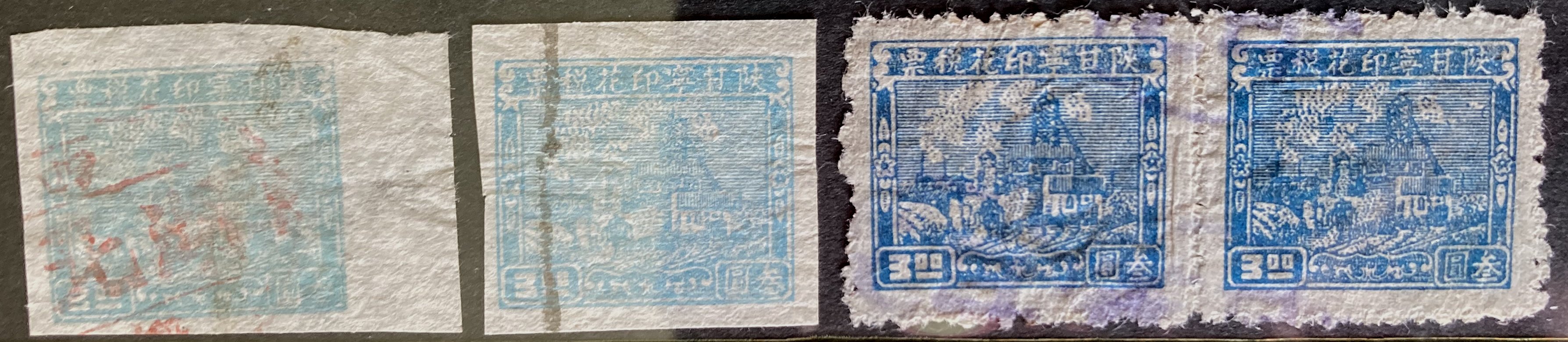 c.1946 : Type II : IMPERF : $3 Dull Milky Blue [ . ] [ . ] Padget LA 171H; Paau NWP 1
c.1946 : Type II : Imperf vertical tête-bêche pair : $3 (blue) [ . ] [ . ] Padget LA 171Ha
c.1946 : Type II : ROUGH PERF : $3 Dark Blue [ . ] [ . ] Padget LA 171Hb
Type II $10.00 :
c.1946 : Type II : IMPERF : $3 Dull Milky Blue [ . ] [ . ] Padget LA 171H; Paau NWP 1
c.1946 : Type II : Imperf vertical tête-bêche pair : $3 (blue) [ . ] [ . ] Padget LA 171Ha
c.1946 : Type II : ROUGH PERF : $3 Dark Blue [ . ] [ . ] Padget LA 171Hb
Type II $10.00 :
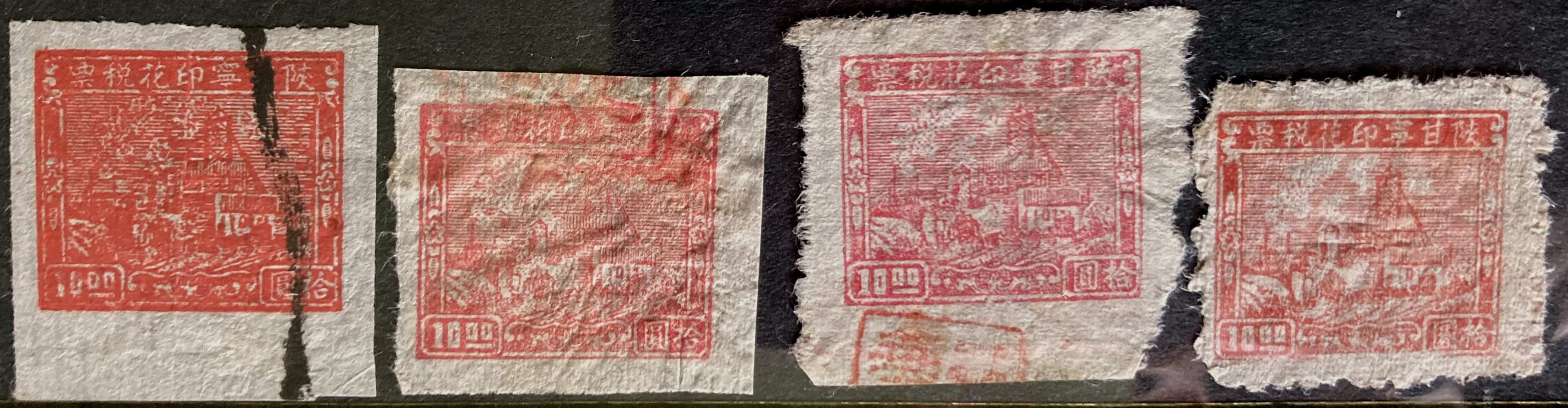 c.1946 : Type II : IMPERF : $10 Deep Red [ . ] [ . ] Padget LA 172A; Paau NWP4
- do - Pale Red [ . ] [ . ]
c.1946 : Type II : Imperf vertical tête-bêche pair : $10 (red) [ . ] [ . ] Padget LA 172Aa
c.1946 : Type II : ROUGH PERF : $10 Rose [ . ] [ . ]
- do - Pale Reddish-Vermilion [ . ] [ . ]
Type II $30.00 :
c.1946 : Type II : IMPERF : $10 Deep Red [ . ] [ . ] Padget LA 172A; Paau NWP4
- do - Pale Red [ . ] [ . ]
c.1946 : Type II : Imperf vertical tête-bêche pair : $10 (red) [ . ] [ . ] Padget LA 172Aa
c.1946 : Type II : ROUGH PERF : $10 Rose [ . ] [ . ]
- do - Pale Reddish-Vermilion [ . ] [ . ]
Type II $30.00 :
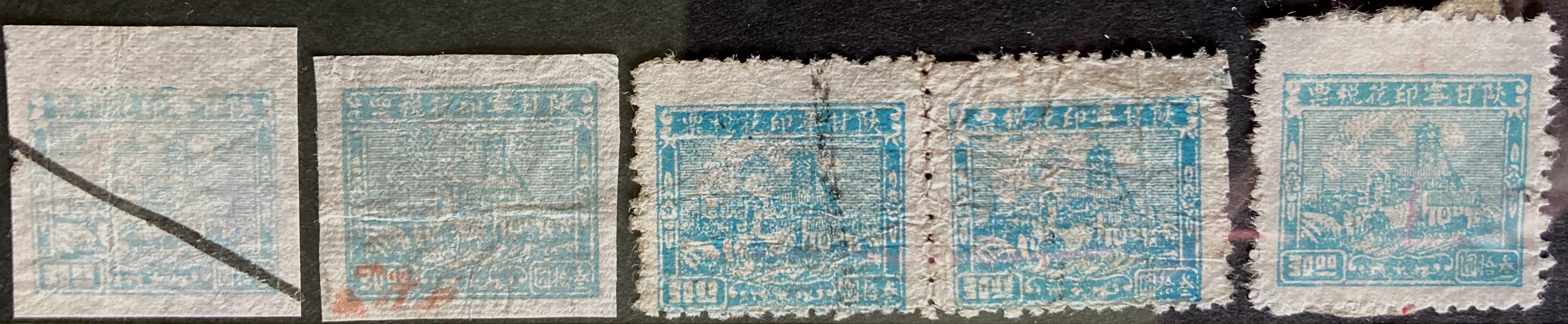 c.1946 : Type II : IMPERF : $30 Dull Milky Blue [ . ] [ . ] Padget LA 173; Paau NWP5
c.1946 : Type II : CLEAN PERF : $30 Turquoise [ . ] [ . ] Padget LA 173a; Paau NWP9
Type II $100.00 :
c.1946 : Type II : IMPERF : $30 Dull Milky Blue [ . ] [ . ] Padget LA 173; Paau NWP5
c.1946 : Type II : CLEAN PERF : $30 Turquoise [ . ] [ . ] Padget LA 173a; Paau NWP9
Type II $100.00 :
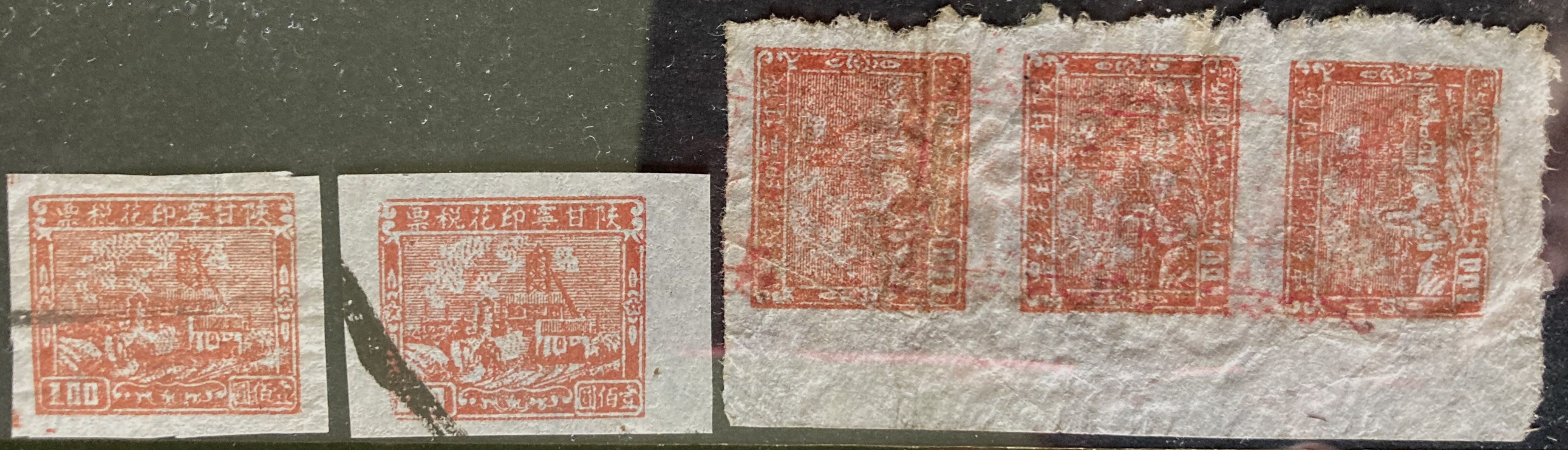
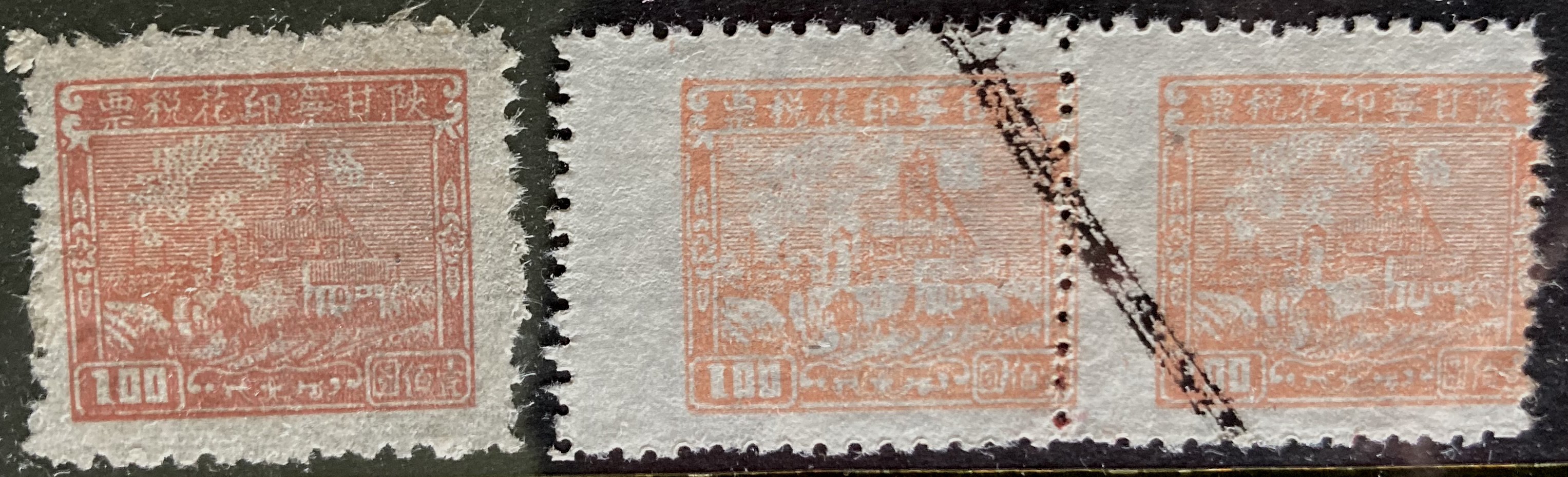 c.1946 : Type II : IMPERF : $100 Deep Chestnut [ . ] [ . ] Padget LA 174; Paau NWP6
- do - Reddish-Chestnut [ . ] [ . ]
c.1946 : Type II : CLEAN PERF : $100 Rosy-Brown [ . ] [ . ] Padget LA 174a
- do - Pale Dull Orange [ . ] [ . ]
- do - Error - Chestnut - Vertical strip/3 Imperf between stamps 1 & 2 and stamps 2 & 3 [ . ]
Type II $300.00 :
c.1946 : Type II : IMPERF : $100 Deep Chestnut [ . ] [ . ] Padget LA 174; Paau NWP6
- do - Reddish-Chestnut [ . ] [ . ]
c.1946 : Type II : CLEAN PERF : $100 Rosy-Brown [ . ] [ . ] Padget LA 174a
- do - Pale Dull Orange [ . ] [ . ]
- do - Error - Chestnut - Vertical strip/3 Imperf between stamps 1 & 2 and stamps 2 & 3 [ . ]
Type II $300.00 :
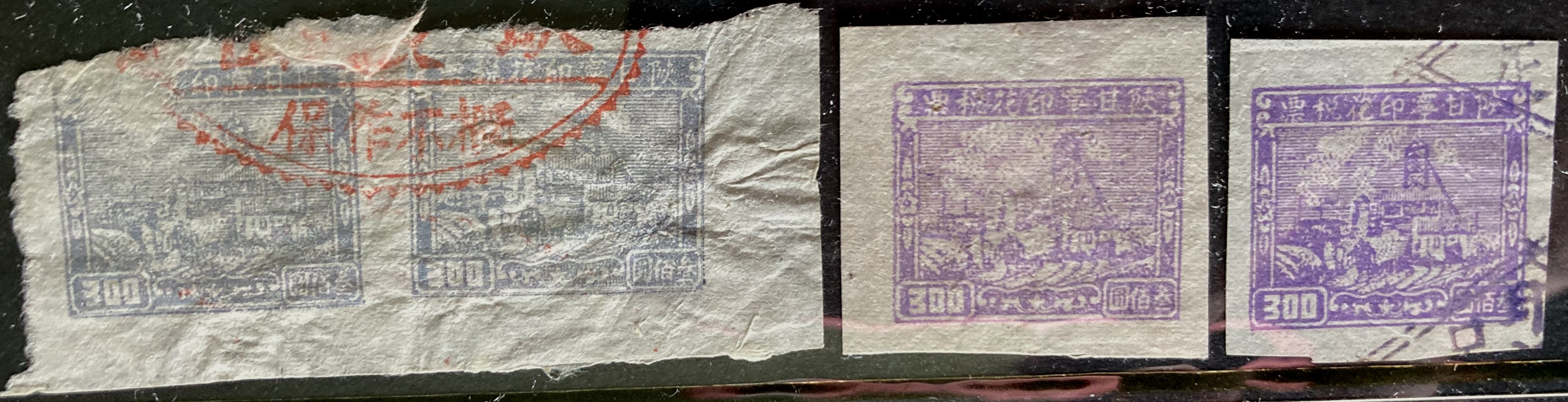
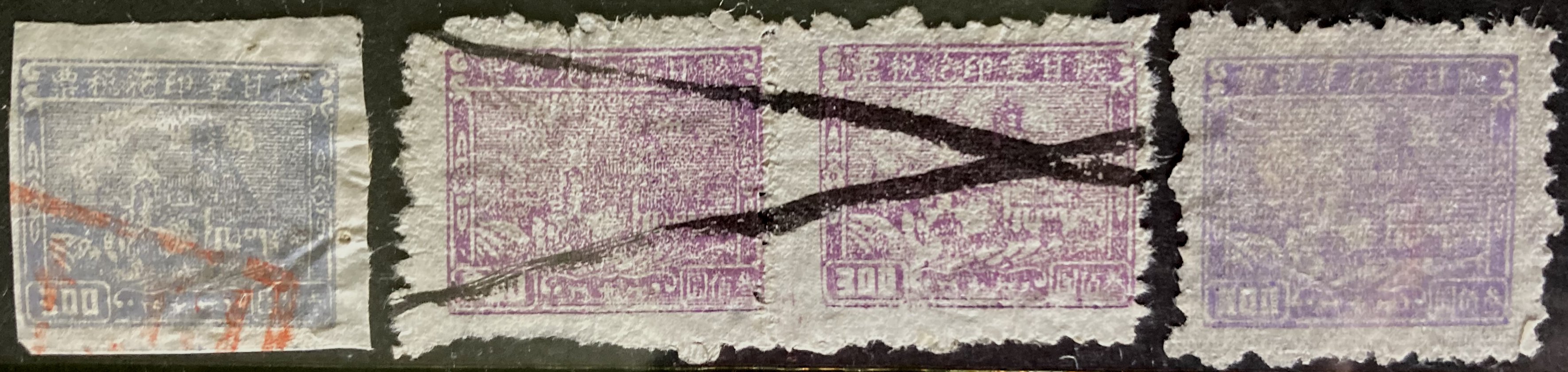 c.1946 : Type II : IMPERF : $300 Slate [ . ] [ . ] Padget LA 174A; Paau NWP7
- do - Pale Violet [ . ] [ . ]
- do - Violet [ . ] [ . ]
c.1946 : Type II : ROUGH PERF : $300 Bright Purple [ . ] [ . ] Padget LA 174Aa
- do - Dull Pale Violet [ . ] [ . ]
Type II $1000.00 :
c.1946 : Type II : IMPERF : $300 Slate [ . ] [ . ] Padget LA 174A; Paau NWP7
- do - Pale Violet [ . ] [ . ]
- do - Violet [ . ] [ . ]
c.1946 : Type II : ROUGH PERF : $300 Bright Purple [ . ] [ . ] Padget LA 174Aa
- do - Dull Pale Violet [ . ] [ . ]
Type II $1000.00 :
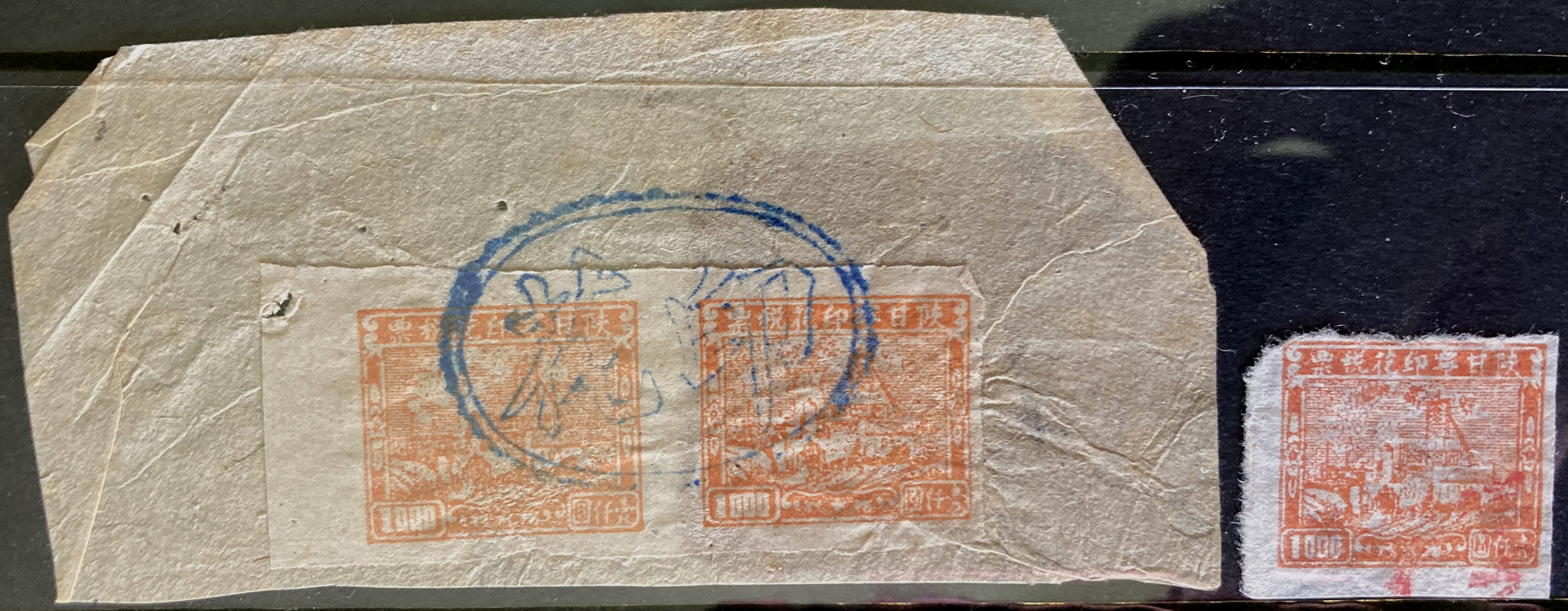 c.1946 : Type II : IMPERF : $1000 Orange [ . ] [ . ] Padget LA 175; Paau NWP8
There are suggestions around the margins on the pair in the scan that it may be part-perforated, albeit very poorly. However, we are confident that Imperforate examples of this stamp are found.
c.1946 : Type II : Imperf vertical tête-bêche pair : $1000 (orange) [ . ] [ . ] Padget LA 175a
c.1946 : Type II : ROUGH PERF : $1000 Reddish-Orange [ . ] [ . ]
.
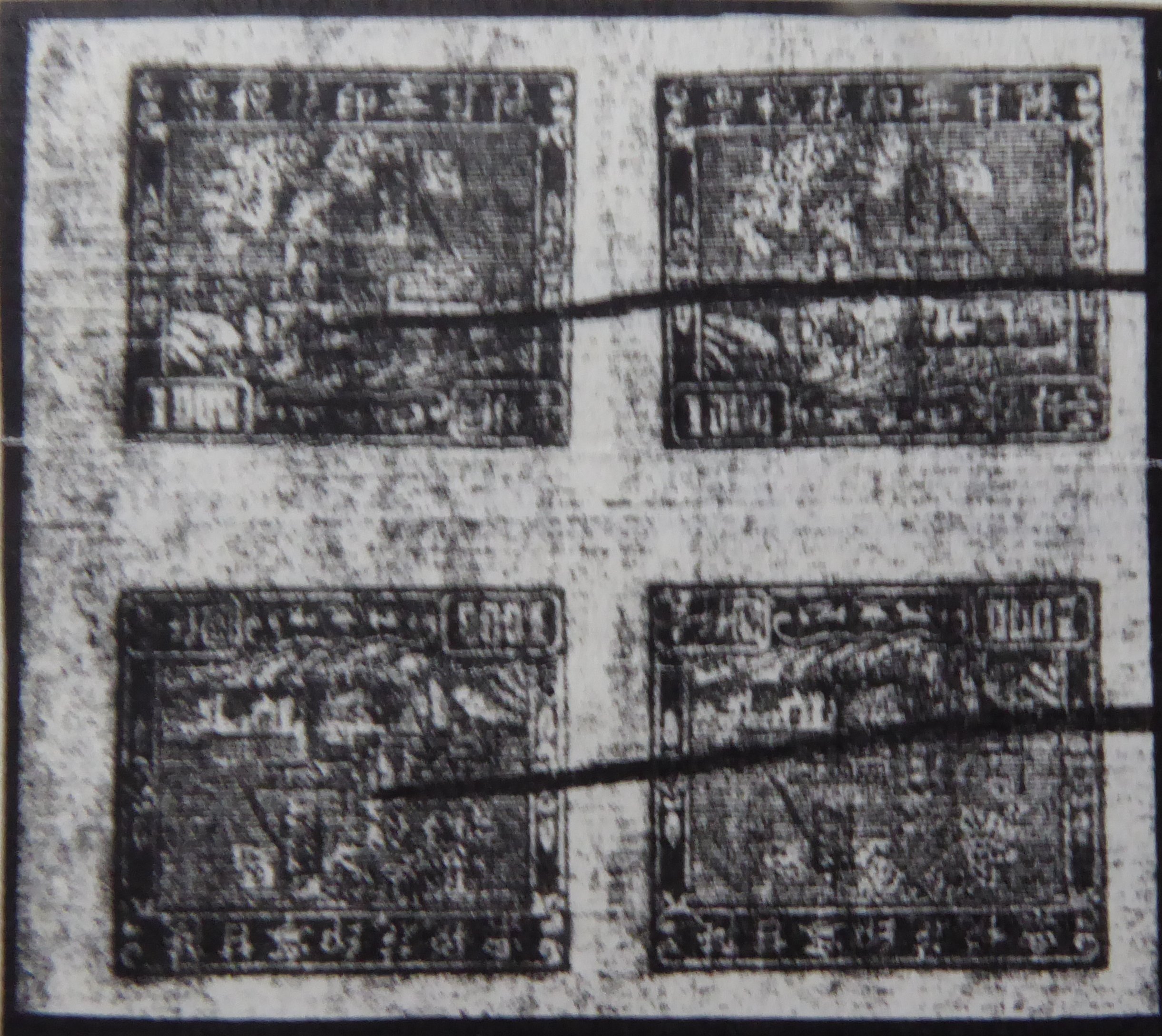
Tête-bêche Stamps : Padget lists the $3, $10 and $1000 in vertical tête-bêche pairs. We have no corroborating evidence for the $10 (though we have no reason to doubt the listing) but the $3 and $1000 tête-bêche blocks/4 were offered on a sales list by Fan K. Chan. Due to their rarity, we have reproduced below a poor copy in monochrome of the $1000 that he offered. We think his sales list may date from the 1980s or early 1990s when he offered it at USD 60.00, happy days!
c.1946 : Type II : IMPERF : $1000 Orange [ . ] [ . ] Padget LA 175; Paau NWP8
There are suggestions around the margins on the pair in the scan that it may be part-perforated, albeit very poorly. However, we are confident that Imperforate examples of this stamp are found.
c.1946 : Type II : Imperf vertical tête-bêche pair : $1000 (orange) [ . ] [ . ] Padget LA 175a
c.1946 : Type II : ROUGH PERF : $1000 Reddish-Orange [ . ] [ . ]
.
Tête-bêche Stamps : Padget lists the $3, $10 and $1000 in vertical tête-bêche pairs. We have no corroborating evidence for the $10 (though we have no reason to doubt the listing) but the $3 and $1000 tête-bêche blocks/4 were offered on a sales list by Fan K. Chan. Due to their rarity, we have reproduced below a poor copy in monochrome of the $1000 that he offered. We think his sales list may date from the 1980s or early 1990s when he offered it at USD 60.00, happy days!
 .
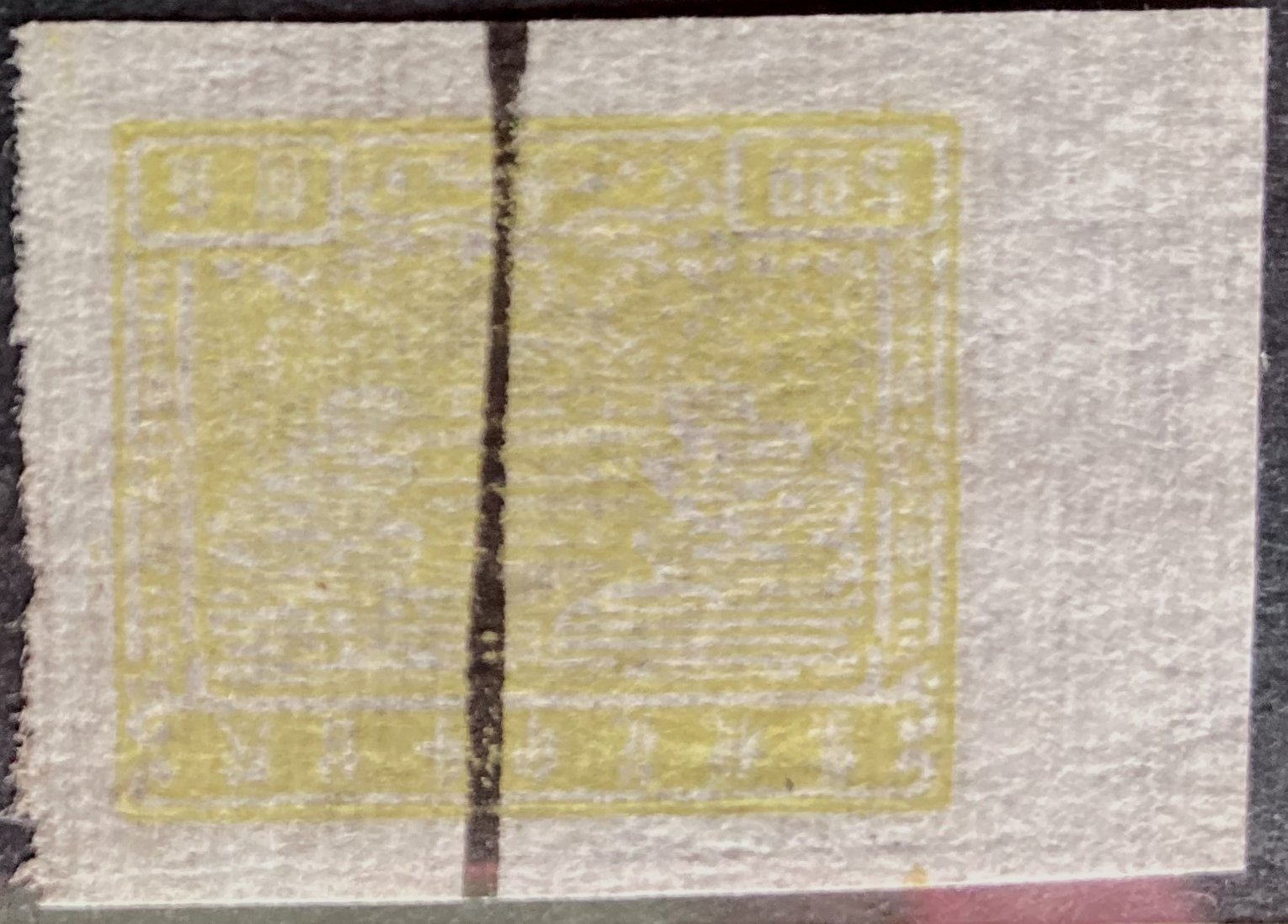
There is a further stamp, included by both Padget and Paau as part of the set with the Type II stamps, a $5 Yellow. It is reported that it does not show anything of railway interest but this is not something you can verify this from a study of the stamp, which is perhaps best described as 'anaemic'!
.
There is a further stamp, included by both Padget and Paau as part of the set with the Type II stamps, a $5 Yellow. It is reported that it does not show anything of railway interest but this is not something you can verify this from a study of the stamp, which is perhaps best described as 'anaemic'!
 .
.
Other pre-1950 Chinese Revenue Stamps related to railways.
Various non-mainstream Chinese stamps of railway interest have passed across your author's desk over the years. Rather randomly below are some more regional / local revenues of China, limited to stamps which are not in the very widely used 'Transportation Revenue' design. Snippets of information picked up along the way are included, although some of it is unverified.
North China - Shanghai :
.
.
Other pre-1950 Chinese Revenue Stamps related to railways.
Various non-mainstream Chinese stamps of railway interest have passed across your author's desk over the years. Rather randomly below are some more regional / local revenues of China, limited to stamps which are not in the very widely used 'Transportation Revenue' design. Snippets of information picked up along the way are included, although some of it is unverified.
North China - Shanghai :
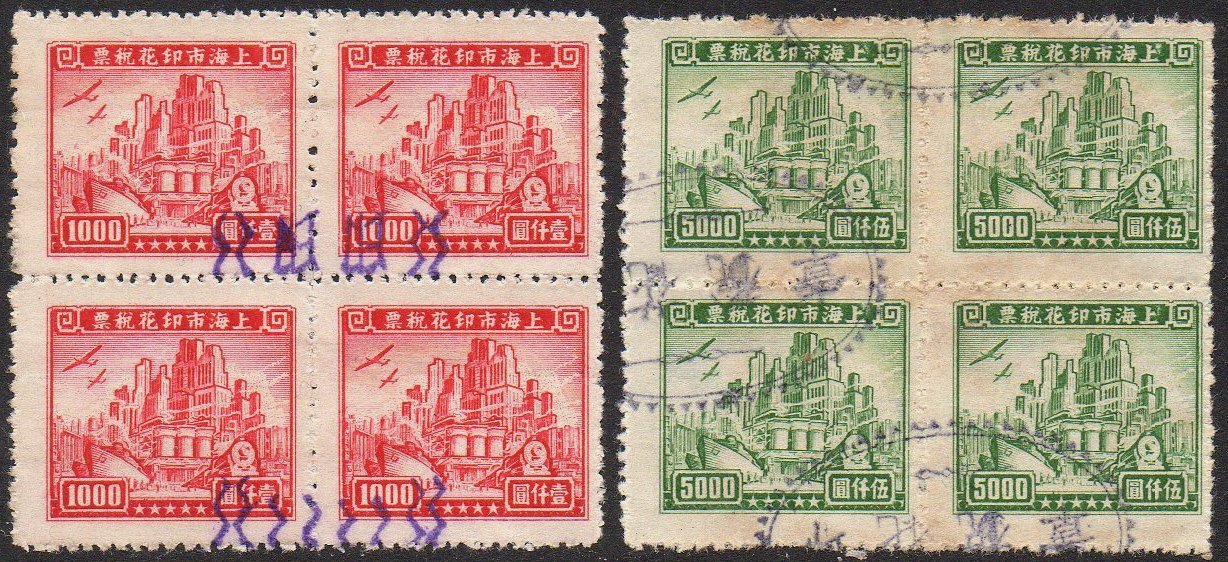 North China, for use in Shanghai, Padget LA 147/48; Paau ECP 139/140 - and fairly commonly encountered.
1949 Shanghai City Revenue : $1000 Red [ . ] [ . ]
1949 Shanghai City Revenue : $5000 Green [ . ] [ . ]
.
Russian Occupation of China:
North China, for use in Shanghai, Padget LA 147/48; Paau ECP 139/140 - and fairly commonly encountered.
1949 Shanghai City Revenue : $1000 Red [ . ] [ . ]
1949 Shanghai City Revenue : $5000 Green [ . ] [ . ]
.
Russian Occupation of China:
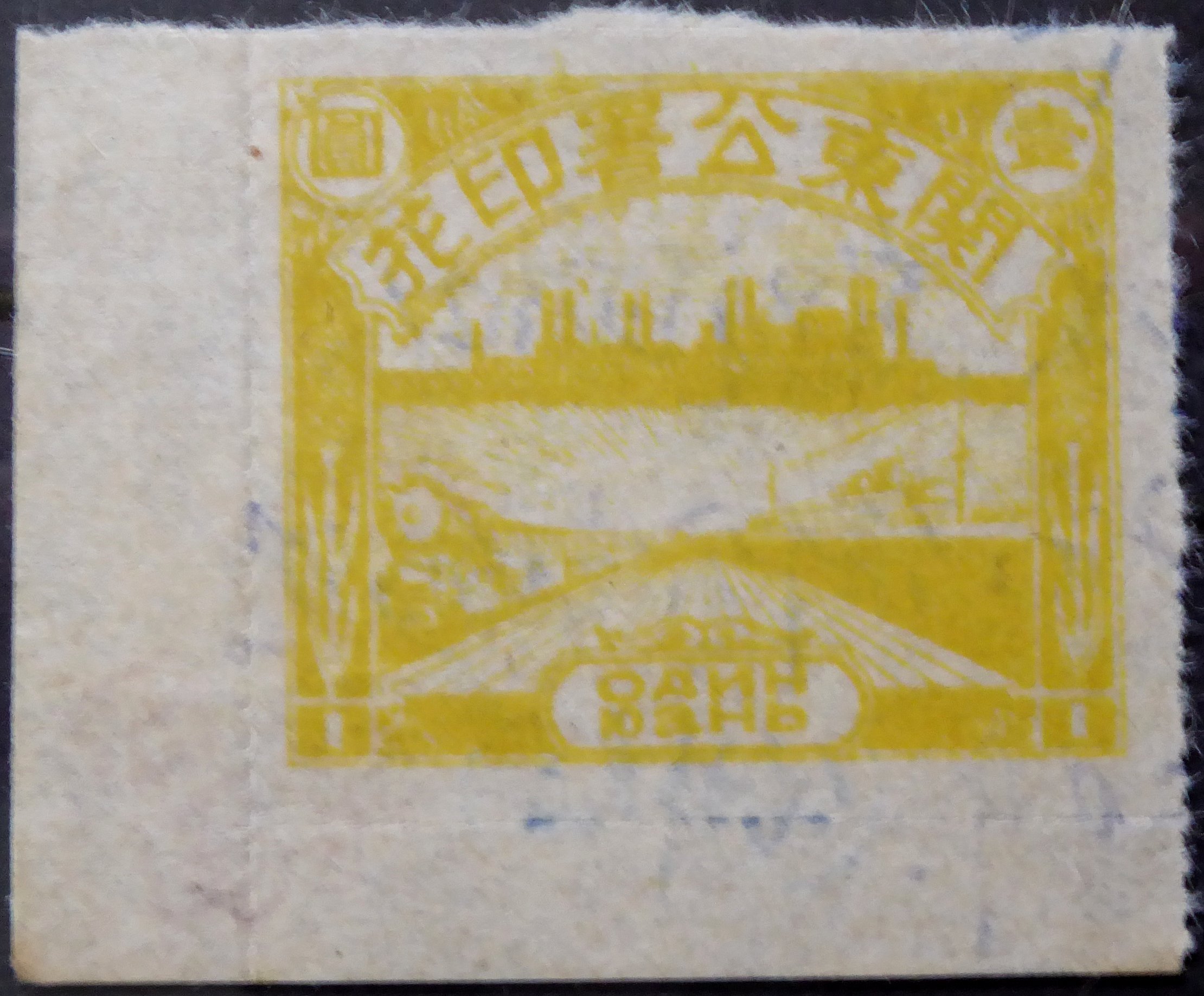
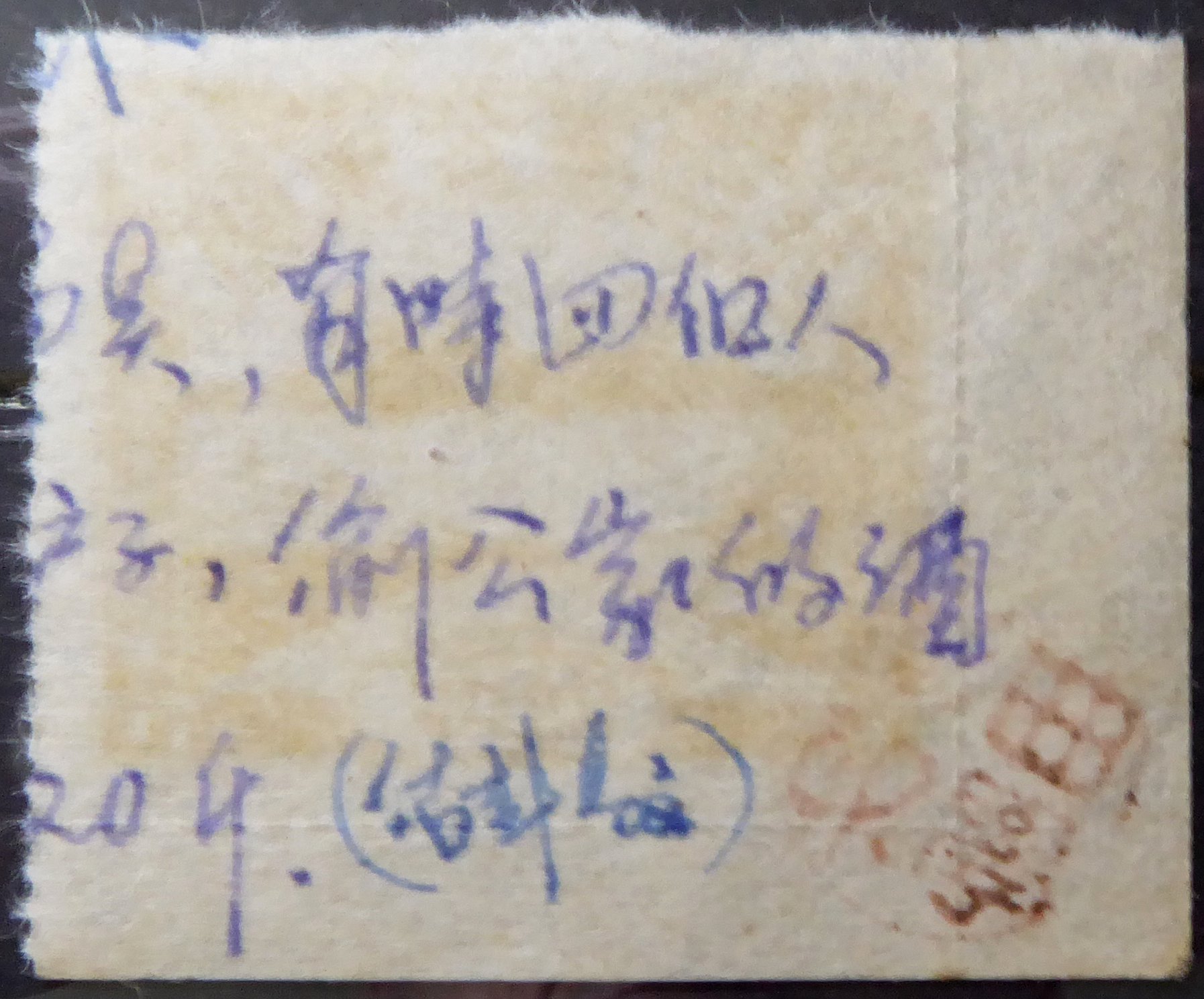 We have only seen this design in one colour and with this face value. We understand it to be a $1.00 Russian Occupation of China revenue issue. We are unsure of the geographic limitations of its use but have listed it below. It is printed on the back of old documents, see second scan (reduced in size). The ink from the document bleeds through partially to the front.
Russian Occupation $1 Revenue : Yellow : Steam Train [ . ] [ . ]
.
Jiadong & Shandong :
We have only seen this design in one colour and with this face value. We understand it to be a $1.00 Russian Occupation of China revenue issue. We are unsure of the geographic limitations of its use but have listed it below. It is printed on the back of old documents, see second scan (reduced in size). The ink from the document bleeds through partially to the front.
Russian Occupation $1 Revenue : Yellow : Steam Train [ . ] [ . ]
.
Jiadong & Shandong :
 This is a design, said to show a train but of really poor quality. There does appear to be a train at left in this design, which is listed twice by Paau, firstly under Jiaodong ($10 and $50), then under Shandong, apparently with 13 different face values.
However, none of the face values we show above match the face values in Paau's catalogue, for which we have no explanation. The face values in our scan are $5, $9 and $500. In the circumstances, we do not feel that we are sufficiently informed to make a listing of them.
.
Chili Province :
This is a design, said to show a train but of really poor quality. There does appear to be a train at left in this design, which is listed twice by Paau, firstly under Jiaodong ($10 and $50), then under Shandong, apparently with 13 different face values.
However, none of the face values we show above match the face values in Paau's catalogue, for which we have no explanation. The face values in our scan are $5, $9 and $500. In the circumstances, we do not feel that we are sufficiently informed to make a listing of them.
.
Chili Province :
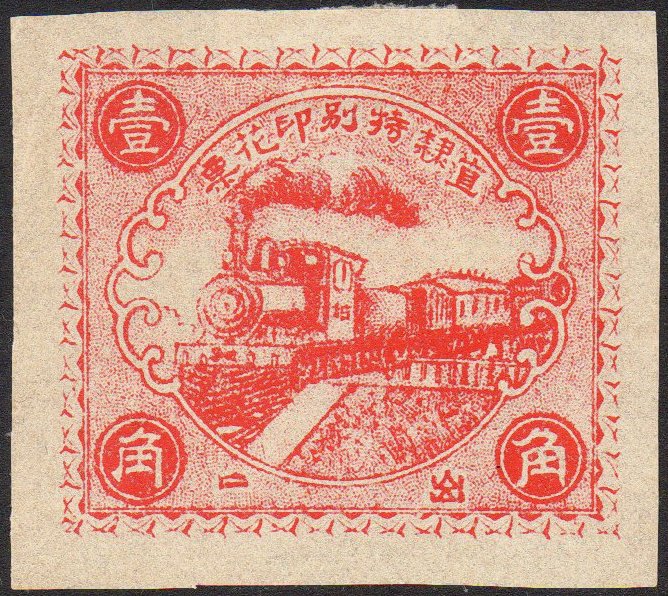 We describe this as per the note with which the stamp came, unverified.
Chili Province : Exports Revenue : Steam Loco : Red [ . ] [ . ]
.
Chinese Revenues :
We describe this as per the note with which the stamp came, unverified.
Chili Province : Exports Revenue : Steam Loco : Red [ . ] [ . ]
.
Chinese Revenues :
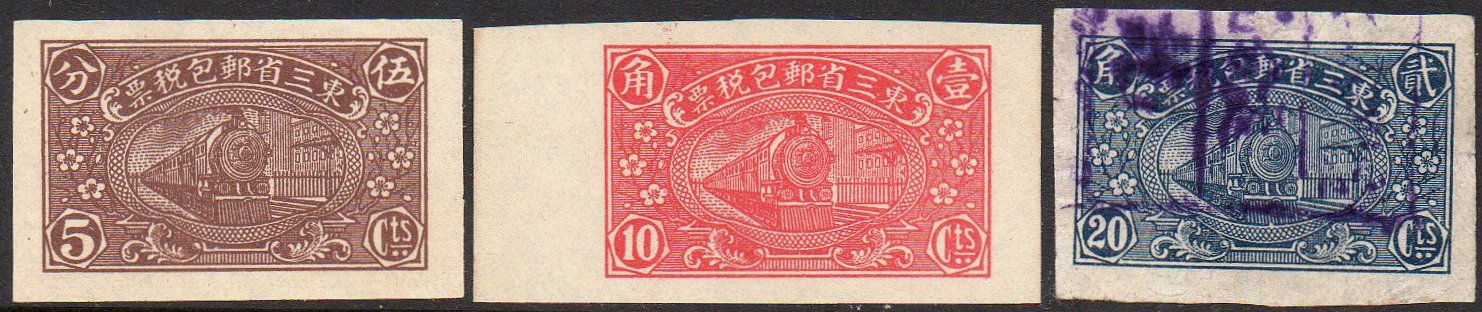
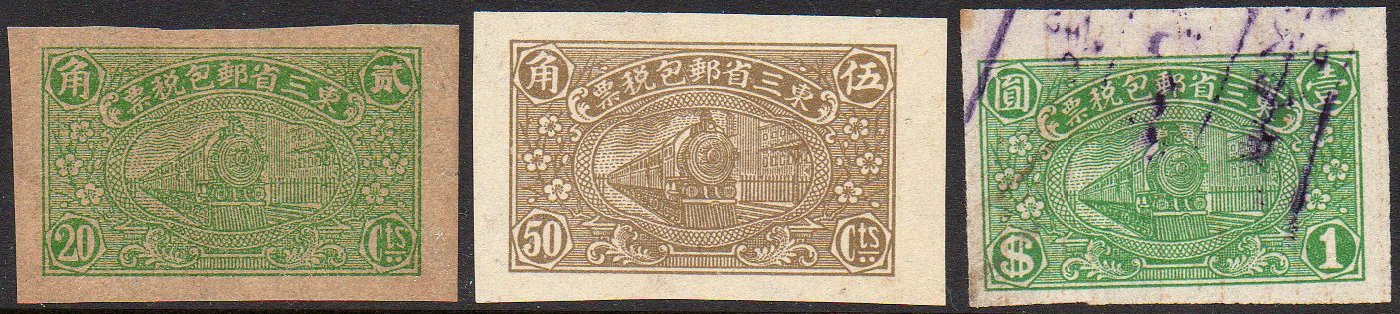 We do not have any information on these revenues beyond the fact that the $1 is believed to be very scarce.
5c Brown : Steam Train [ . ] [ . ]
10c Red : Steam Train [ . ] [ . ]
20c Blue : Steam Train [ . ] [ . ]
20c Green : Steam Train [ . ] [ . ]
50c Pale Grey-Brown : Steam Train [ . ] [ . ]
$1 Green : Steam Train [ . ] [ . ]
.
Jiaodong Cigarette Tax :
We do not have any information on these revenues beyond the fact that the $1 is believed to be very scarce.
5c Brown : Steam Train [ . ] [ . ]
10c Red : Steam Train [ . ] [ . ]
20c Blue : Steam Train [ . ] [ . ]
20c Green : Steam Train [ . ] [ . ]
50c Pale Grey-Brown : Steam Train [ . ] [ . ]
$1 Green : Steam Train [ . ] [ . ]
.
Jiaodong Cigarette Tax :
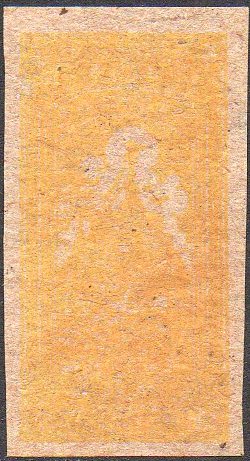
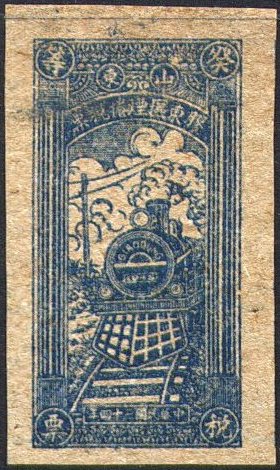
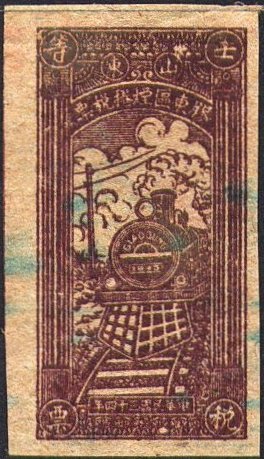
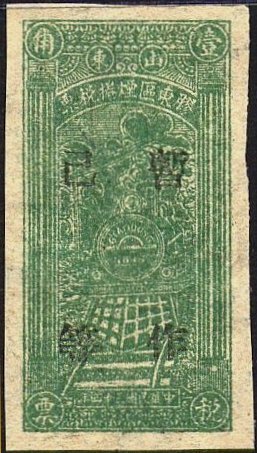 Examples of this locomotive-themed revenue. The yellow stamp is said to show a locomotive as well but, given the nature of the image, this rather needs to be taken on trust! We do not have a listing of known values, nor do we know whether the green stamp (and other stamps) exist both with and without the four-character overprint.
Jiaodong Cigarette Tax (face value?) Yellow-Orange : s.t.b. Locomotive [ . ] [ . ]
Jiaodong Cigarette Tax (face value?) Blue : Locomotive [ . ] [ . ]
Jiaodong Cigarette Tax (face value?) Deep Maroon : Locomotive [ . ] [ . ]
Jiaodong Cigarette Tax (face value?) Green with 4-character overprint [ . ] [ . ]
.
Eastern Three Provinces Parcel Tax :
Examples of this locomotive-themed revenue. The yellow stamp is said to show a locomotive as well but, given the nature of the image, this rather needs to be taken on trust! We do not have a listing of known values, nor do we know whether the green stamp (and other stamps) exist both with and without the four-character overprint.
Jiaodong Cigarette Tax (face value?) Yellow-Orange : s.t.b. Locomotive [ . ] [ . ]
Jiaodong Cigarette Tax (face value?) Blue : Locomotive [ . ] [ . ]
Jiaodong Cigarette Tax (face value?) Deep Maroon : Locomotive [ . ] [ . ]
Jiaodong Cigarette Tax (face value?) Green with 4-character overprint [ . ] [ . ]
.
Eastern Three Provinces Parcel Tax :
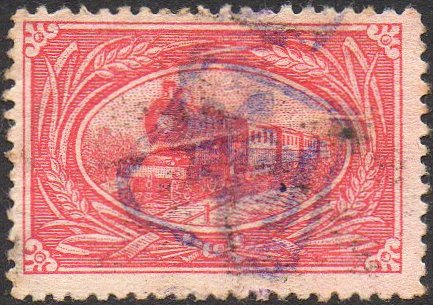 (NVI) Carmine-Rose: Steam Locomotive [ . ] [ . ]
.
The Peking - Hankow Railway :
This is an iconic railway design, rarely encountered and about which relatively little is known.
(NVI) Carmine-Rose: Steam Locomotive [ . ] [ . ]
.
The Peking - Hankow Railway :
This is an iconic railway design, rarely encountered and about which relatively little is known.

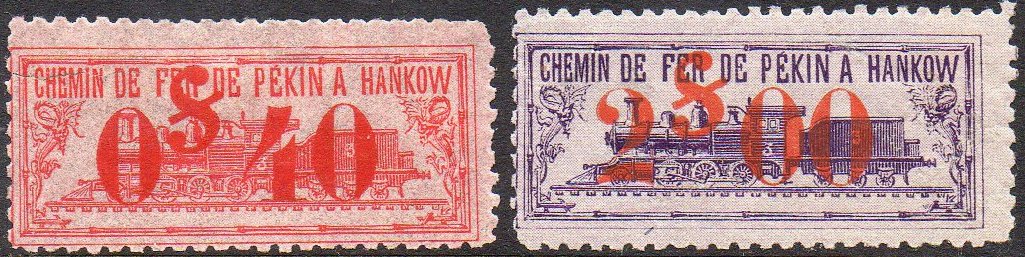 The Peking - Hankow Railway was a remarkably ambitious project, the first major railway line to be built in China and 1,200 kms in length. Financed by the French and built under Belgian supervision, in its time it was the most profitable railway in the world. The line was completed in 1905 and purchased by the Chinese Government on January 1st, 1909.
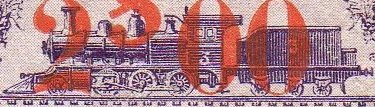 The stamp shows what appears to be a Baldwin-designed locomotive, of a class not too dissimilar from images we have found for locomotives on the Peking-Hankow Railway. The stamps are listed by Forbin (world revenue catalogue, 1915 edition) as Forbin 1-5 but their purpose and even their date of issue is uncertain. The 1909 given in Forbin was doubted by Padget who believed them to be earlier.
An important pointer comes from the fact that the stamps are watermarked in quite large block letters diagonally across and down the sheet. The watermark appears to read HANKOW - PEKIN, repeated in echelon with a shift of about two letters to the right on the next line down. 'PEKIN' is French for Peking and this strongly suggests that the stamps were printed in France, or possibly Belgium, on specially-produced paper, not at all a cheap exercise in stamp production.
Evidence, therefore, seems to point to a serious stamp issue, made by the Company for operational purposes. The stamps are in French currency (Francs) and, looking at their face values, we think they may have been intended as Railway Parcel Stamps, rather than as the oft-suggested revenue stamps.
It may well be that the unexpected purchase of the line by the Chinese Government put paid to the planned introduction of these stamps. If so, they were probably produced in 1908, but this is only speculation. No used examples have been recorded.
These are rare stamps, the high values very rare. Records of their purpose, how many were printed and where, and much other information has apparently been lost in the mists of time. The Company, or elements of it, could have become defunct almost overnight with the passing of the Railway into Chinese hands.
One may speculate whether there were only ever a few sample stamps produced or whether almost an entire print-run was destroyed when the Company's raison d'être evaporated. Well over a century on, we may have to accept that the mystery surrounding these highly-prized stamps may never be fully resolved but they provide a nostalgic legacy from the early days of this historically important railway.
0 f 10 Blue / greenish : Steam Locomotive [ . ]
0 f 20 Blue / pale blue : Steam Locomotive [ . ]
0 f 30 Yellow-Brown / yellow : Steam Locomotive [ . ]
0 f 40 Deep Rose / pale rose : Steam Locomotive [ . ]
2 f 00 Violet / greyish : Steam Locomotive [ . ]
The stamp shows what appears to be a Baldwin-designed locomotive, of a class not too dissimilar from images we have found for locomotives on the Peking-Hankow Railway. The stamps are listed by Forbin (world revenue catalogue, 1915 edition) as Forbin 1-5 but their purpose and even their date of issue is uncertain. The 1909 given in Forbin was doubted by Padget who believed them to be earlier.
An important pointer comes from the fact that the stamps are watermarked in quite large block letters diagonally across and down the sheet. The watermark appears to read HANKOW - PEKIN, repeated in echelon with a shift of about two letters to the right on the next line down. 'PEKIN' is French for Peking and this strongly suggests that the stamps were printed in France, or possibly Belgium, on specially-produced paper, not at all a cheap exercise in stamp production.
Evidence, therefore, seems to point to a serious stamp issue, made by the Company for operational purposes. The stamps are in French currency (Francs) and, looking at their face values, we think they may have been intended as Railway Parcel Stamps, rather than as the oft-suggested revenue stamps.
It may well be that the unexpected purchase of the line by the Chinese Government put paid to the planned introduction of these stamps. If so, they were probably produced in 1908, but this is only speculation. No used examples have been recorded.
These are rare stamps, the high values very rare. Records of their purpose, how many were printed and where, and much other information has apparently been lost in the mists of time. The Company, or elements of it, could have become defunct almost overnight with the passing of the Railway into Chinese hands.
One may speculate whether there were only ever a few sample stamps produced or whether almost an entire print-run was destroyed when the Company's raison d'être evaporated. Well over a century on, we may have to accept that the mystery surrounding these highly-prized stamps may never be fully resolved but they provide a nostalgic legacy from the early days of this historically important railway.
0 f 10 Blue / greenish : Steam Locomotive [ . ]
0 f 20 Blue / pale blue : Steam Locomotive [ . ]
0 f 30 Yellow-Brown / yellow : Steam Locomotive [ . ]
0 f 40 Deep Rose / pale rose : Steam Locomotive [ . ]
2 f 00 Violet / greyish : Steam Locomotive [ . ]
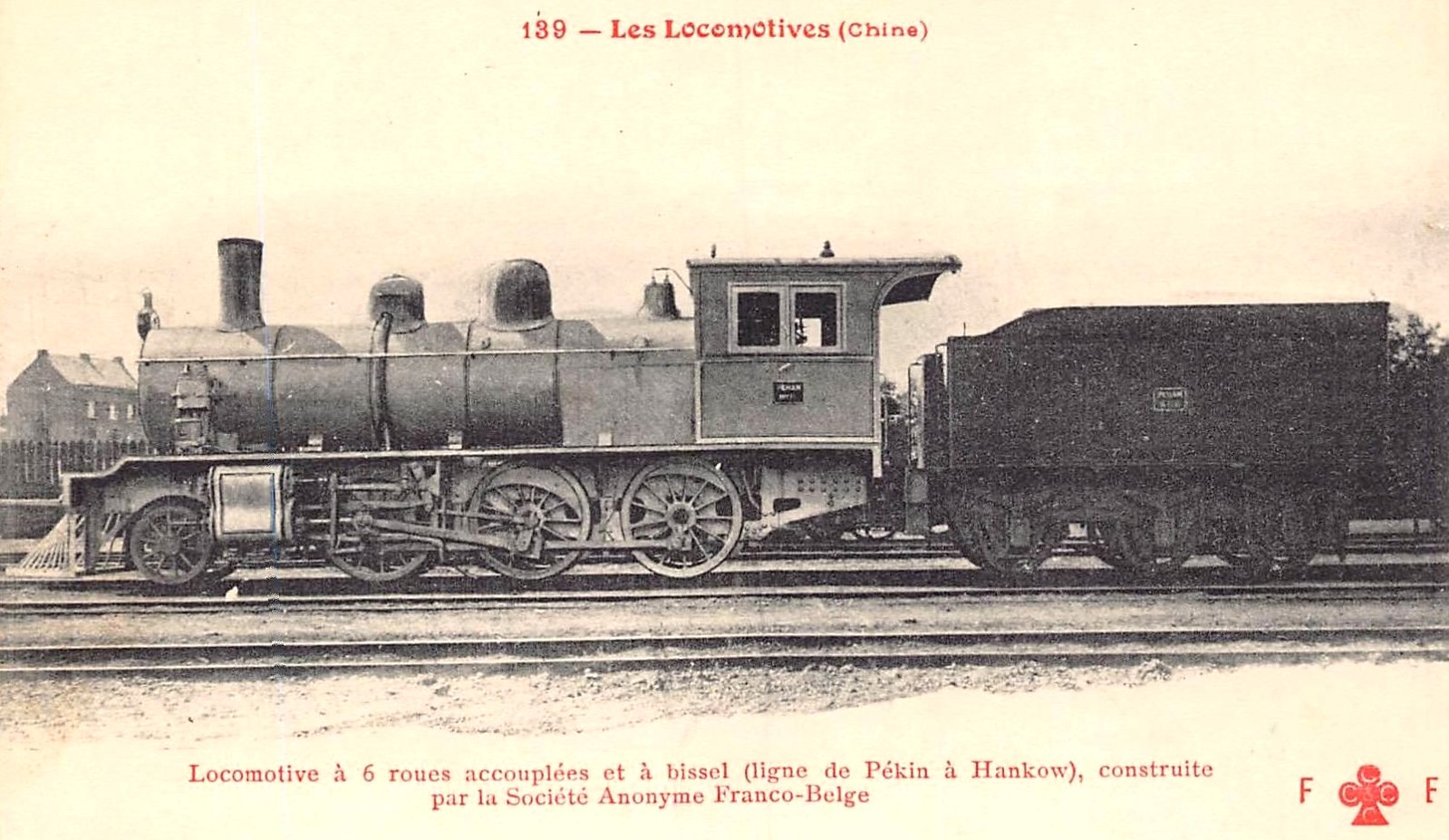 The postcard above, one of hundreds in the F. Fleury locomotive series, is very interesting. Based on this, it would seem highly likely that the Société Anonyme Franco-Belge produced locomotives for the Peking-Hankow Railway. It has every appearance of a Baldwin locomotive and would seem to have been either constructed or simply assembled in Belgium or in France under licence from Baldwin. There are only small design differences between the postcard and the stamp.
.
.
The postcard above, one of hundreds in the F. Fleury locomotive series, is very interesting. Based on this, it would seem highly likely that the Société Anonyme Franco-Belge produced locomotives for the Peking-Hankow Railway. It has every appearance of a Baldwin locomotive and would seem to have been either constructed or simply assembled in Belgium or in France under licence from Baldwin. There are only small design differences between the postcard and the stamp.
.
.
Return to Listing of all Railway Articles (with links). Note: You may already have an open tab