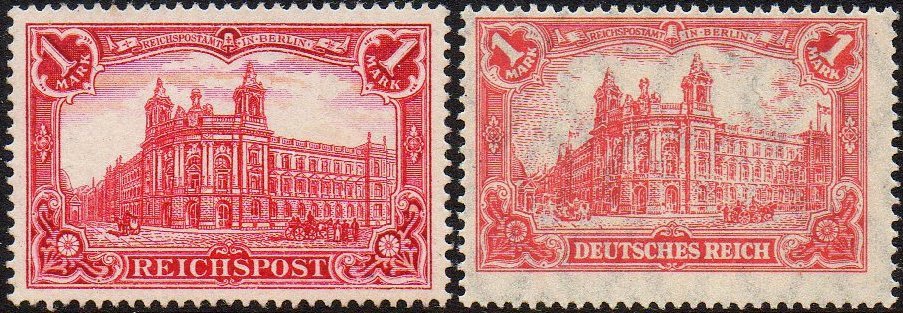
 Above : Left: Recess-engraved One Mark (1900- ) . . . . . . Right: Lithographed One Mark (1920- )
Note re. the 1900 design: There has been considerable dispute about whether there is a horse-tram or even indeed tramway tracks shown on the recess-engraved stamps, which were issued in 1900. The postcard, illustrated below, was posted on New Year's Day 1899 using the private Berlin Parcel Post service, and this card clearly shows a horse-drawn tram at precisely the location of the parallel lines to the left of the building on the recess-printed stamp, which confirms that this stamp shows tram tracks and, in all probability, the rear of a horse-tram as well, although a horse-bus which happens to be on the tram tracks, is an unlikely alternative for those who remain sceptical.
Above : Left: Recess-engraved One Mark (1900- ) . . . . . . Right: Lithographed One Mark (1920- )
Note re. the 1900 design: There has been considerable dispute about whether there is a horse-tram or even indeed tramway tracks shown on the recess-engraved stamps, which were issued in 1900. The postcard, illustrated below, was posted on New Year's Day 1899 using the private Berlin Parcel Post service, and this card clearly shows a horse-drawn tram at precisely the location of the parallel lines to the left of the building on the recess-printed stamp, which confirms that this stamp shows tram tracks and, in all probability, the rear of a horse-tram as well, although a horse-bus which happens to be on the tram tracks, is an unlikely alternative for those who remain sceptical.
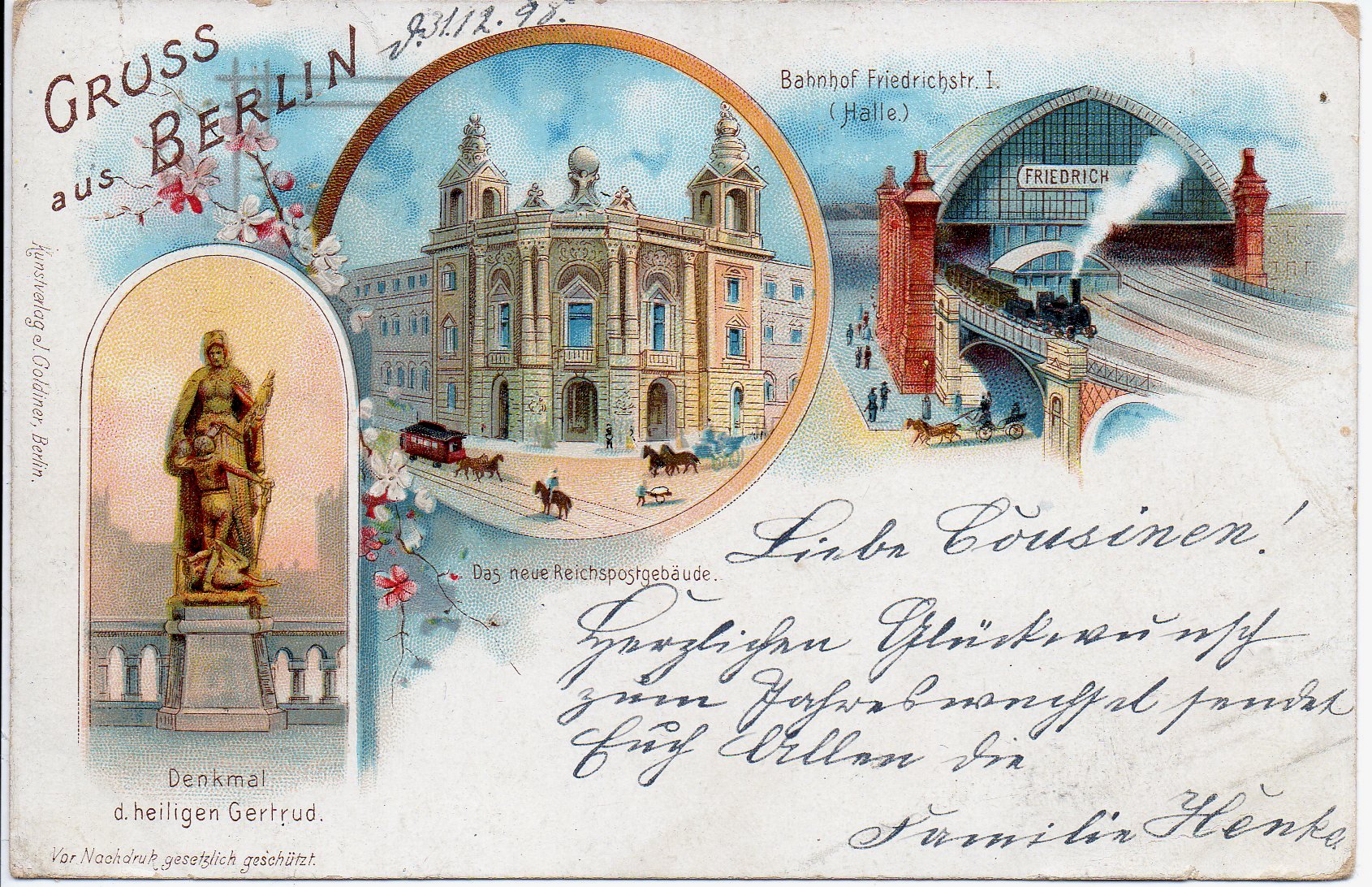
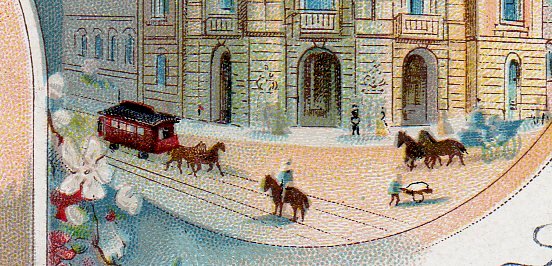
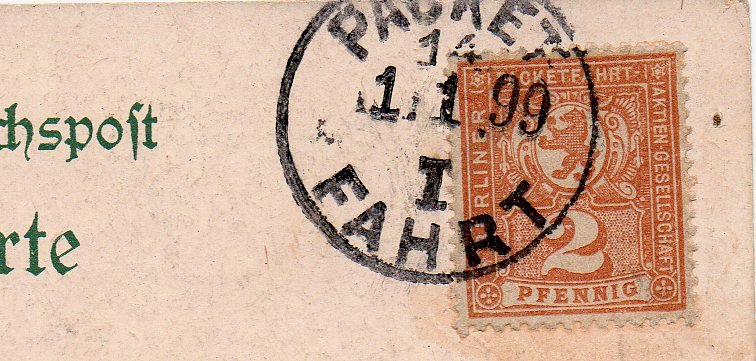 Front and back of the postcard, probably printed around 1898, of the Hauptpostamt, described as 'Das neue Reichspostgebäude' (Empire postal service building) on the card.
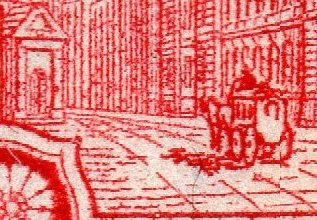
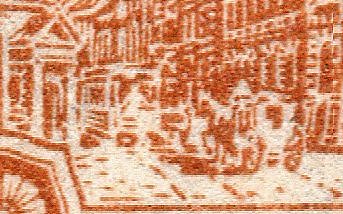 Above, we show detail scans of the recess-engraved stamp of 1900 (left) and the 1920 lithographed stamp (right). A notable feature is that the post-war artist, whilst amending the design for the lithographed stamps, may have been conscious how anachronistic the horse-tram would appear alongside an electric tramcar being added to the design twenty years on. The carriage has been re-drawn and the horse's front leg animated in an energetic manner one might not expect of a horse accustomed to pulling a tramcar, perhaps, although one can only surmise, in an effort to make it appear more like a private carriage than a tram.
.
Returning now to the recess-engraved stamps, there are several printings, some with changes to the inscriptions.
Most unusually, variations in perforation on this design are commonly described by the total number of holes on each side of the stamp and we have adopted this method here too. (The reason for this unusual practice is the tiny difference in perforation, 14¼ against 14). We have used Michel numbers, the commonest reference work for specialised German stamps.
Please be aware that these are not from a particularly recent edition of the catalogue and that, while principal numbers should be unchanged, some of the sub-numbers may have changed over time.
.
GERMANY (German Reich)
1900 (Recess) Inscribed REICHSPOST at the foot:
1 Mark Red (shades) (Mi. 63a) [ . ]
- ditto - Brownish-carmine (Mi. 63b) [ . ]
- ditto - Trial perforation 11½ - unissued. (Mi. 63B) [ . ]
1902 (Recess) Inscribed DEUTSCHES REICH at foot. No watermark.
1 Mark Red (brownish-orange appearance) 26x17 perforation holes (Mi. 78Aa) [ . ]
- ditto - Carmine-red (Mi. 78Ab)[ . ]
- ditto - Imperf (Mi. 78U) [ . ]
1 Mark Carmine-red : 25x16 perforation holes (Mi. 78 B) [ . ]
1906-17 (Recess) Inscribed DEUTSCHES REICH at foot. Watermark Lozenges.
1 Mark Carmine-red on white paper, clear impression, 26x17 holes. (1906) (Mi. 94 A I) [ . ]
- ditto - Carmine-red on greyish wartime paper, 26x17 holes. (1916/17) (Mi. 94 A II) [ . ]
- ditto - Red on greyish wartime paper, 25 x 17 holes. (1916/17) (Mi. 94 B II) [ . ]
Note: The paper is only marginally greyer, but this, combined with the brighter ink and sharper definition of the 1906 issue, does produce a stamp of different appearance.
.
Above, we show detail scans of the recess-engraved stamp of 1900 (left) and the 1920 lithographed stamp (right). A notable feature is that the post-war artist, whilst amending the design for the lithographed stamps, may have been conscious how anachronistic the horse-tram would appear alongside an electric tramcar being added to the design twenty years on. The carriage has been re-drawn and the horse's front leg animated in an energetic manner one might not expect of a horse accustomed to pulling a tramcar, perhaps, although one can only surmise, in an effort to make it appear more like a private carriage than a tram.
.
Returning now to the recess-engraved stamps, there are several printings, some with changes to the inscriptions.
Most unusually, variations in perforation on this design are commonly described by the total number of holes on each side of the stamp and we have adopted this method here too. (The reason for this unusual practice is the tiny difference in perforation, 14¼ against 14). We have used Michel numbers, the commonest reference work for specialised German stamps.
Please be aware that these are not from a particularly recent edition of the catalogue and that, while principal numbers should be unchanged, some of the sub-numbers may have changed over time.
.
GERMANY (German Reich)
1900 (Recess) Inscribed REICHSPOST at the foot:
1 Mark Red (shades) (Mi. 63a) [ . ]
- ditto - Brownish-carmine (Mi. 63b) [ . ]
- ditto - Trial perforation 11½ - unissued. (Mi. 63B) [ . ]
1902 (Recess) Inscribed DEUTSCHES REICH at foot. No watermark.
1 Mark Red (brownish-orange appearance) 26x17 perforation holes (Mi. 78Aa) [ . ]
- ditto - Carmine-red (Mi. 78Ab)[ . ]
- ditto - Imperf (Mi. 78U) [ . ]
1 Mark Carmine-red : 25x16 perforation holes (Mi. 78 B) [ . ]
1906-17 (Recess) Inscribed DEUTSCHES REICH at foot. Watermark Lozenges.
1 Mark Carmine-red on white paper, clear impression, 26x17 holes. (1906) (Mi. 94 A I) [ . ]
- ditto - Carmine-red on greyish wartime paper, 26x17 holes. (1916/17) (Mi. 94 A II) [ . ]
- ditto - Red on greyish wartime paper, 25 x 17 holes. (1916/17) (Mi. 94 B II) [ . ]
Note: The paper is only marginally greyer, but this, combined with the brighter ink and sharper definition of the 1906 issue, does produce a stamp of different appearance.
.
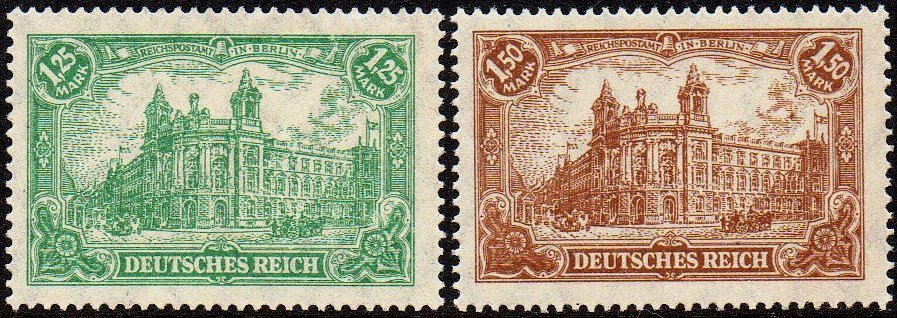 Lithographed stamps of 1920. The 1 Mark value is shown in the top scan on this page.
1920 (March) Lithographed (wmk lozenges)
1 Mark Red (Mi. A 113a) [ . ]
- ditto - Brownish-red (Mi. A1 113b) [ . ]
- ditto - var. lower half of flagstaff at extreme right missing (Mi. A 113 II) [ . ]
- ditto - var. right-hand rosette with damage to left side (Mi. A 113 III) [ . ]
- ditto - var. Closed lower half of ' E ' in ' DEUTSCHES ' (Mi. A 113 IV) [ . ]
1M25 Green (Mi. 113) [ . ]
1M50 Yellow-brown to orange-brown (Mi. 115a) [ . ]
- ditto - reddish-brown (Mi. 114b) [ . ]
- ditto - (dark)brown (Mi. 114c) [ . ]
Note: All three values (1M, 1M25 and 1M50) exist with double printing of the complete design.
.
Lithographed stamps of 1920. The 1 Mark value is shown in the top scan on this page.
1920 (March) Lithographed (wmk lozenges)
1 Mark Red (Mi. A 113a) [ . ]
- ditto - Brownish-red (Mi. A1 113b) [ . ]
- ditto - var. lower half of flagstaff at extreme right missing (Mi. A 113 II) [ . ]
- ditto - var. right-hand rosette with damage to left side (Mi. A 113 III) [ . ]
- ditto - var. Closed lower half of ' E ' in ' DEUTSCHES ' (Mi. A 113 IV) [ . ]
1M25 Green (Mi. 113) [ . ]
1M50 Yellow-brown to orange-brown (Mi. 115a) [ . ]
- ditto - reddish-brown (Mi. 114b) [ . ]
- ditto - (dark)brown (Mi. 114c) [ . ]
Note: All three values (1M, 1M25 and 1M50) exist with double printing of the complete design.
.

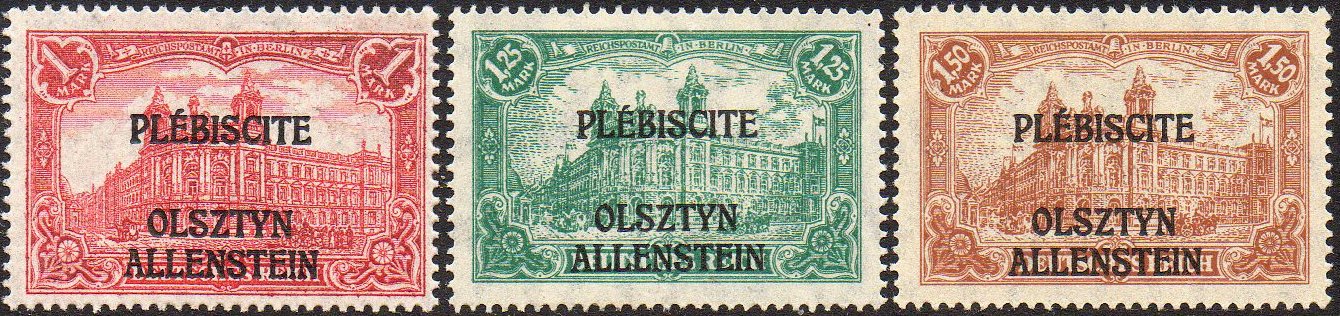 1920 (Apr) : Optd. PLEBISCITE / OLSZTYN / ALLENSTEIN
1 Mark Red (optd. on recess-engraved, Germany Mi. 94) (Mi. 10) [ . ]
- ditto - Overprint Double (Mi. 10 DD) [ . ]
1M25 Dark Blue-Green (Mi. 11a) [ . ]
- ditto - Blue-green (Mi. 11b) [ . ]
- ditto - Overprint Double (Not in Michel, SG 11a) [ . ]
1M50 Yellow-brown (Mi. 12a) [ . ]
- ditto - reddish-brown (Mi. 12b) [ . ]
- ditto - (dark)brown (Mi. 12c) [ . ]
1920 (Apr) : Optd. PLEBISCITE / OLSZTYN / ALLENSTEIN
1 Mark Red (optd. on recess-engraved, Germany Mi. 94) (Mi. 10) [ . ]
- ditto - Overprint Double (Mi. 10 DD) [ . ]
1M25 Dark Blue-Green (Mi. 11a) [ . ]
- ditto - Blue-green (Mi. 11b) [ . ]
- ditto - Overprint Double (Not in Michel, SG 11a) [ . ]
1M50 Yellow-brown (Mi. 12a) [ . ]
- ditto - reddish-brown (Mi. 12b) [ . ]
- ditto - (dark)brown (Mi. 12c) [ . ]
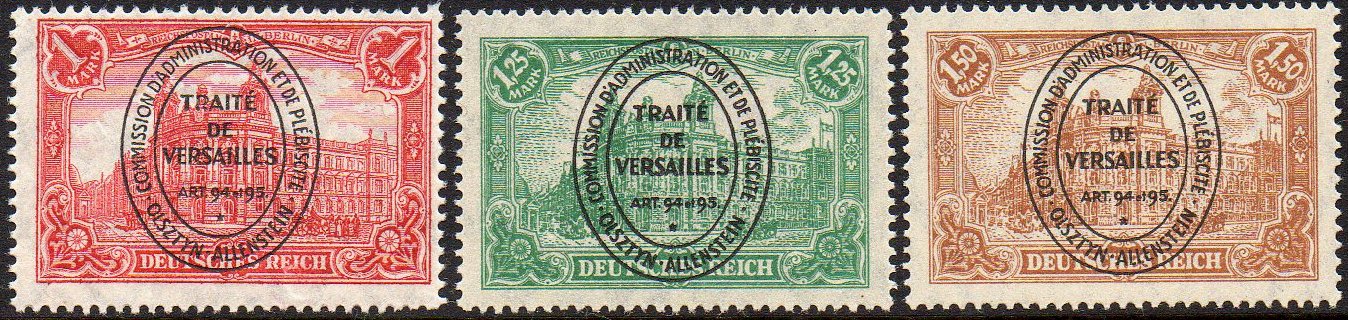 1920 (May-June) : Optd. TRAITE DE VERSAILLES etc. in an oval
1 Mark Carmine-red (optd on recess-engraved, Germany Mi. 94) (Mi. 24) [ . ]
- ditto - Overprint Inverted (Mi. 24K) [ . ]
1M25 Dark Blue-Green (Mi. 25a) [ . ]
- ditto - Blue-Green (Mi. 25b) [ . ]
1M50 Yellow-brown (Mi. 26a) [ . ]
- ditto - reddish-brown (Mi. 26b) [ . ]
- ditto - (dark)brown (Mi. 26c) [ . ]
.
BAVARIA (German State)
1920 (May-June) : Optd. TRAITE DE VERSAILLES etc. in an oval
1 Mark Carmine-red (optd on recess-engraved, Germany Mi. 94) (Mi. 24) [ . ]
- ditto - Overprint Inverted (Mi. 24K) [ . ]
1M25 Dark Blue-Green (Mi. 25a) [ . ]
- ditto - Blue-Green (Mi. 25b) [ . ]
1M50 Yellow-brown (Mi. 26a) [ . ]
- ditto - reddish-brown (Mi. 26b) [ . ]
- ditto - (dark)brown (Mi. 26c) [ . ]
.
BAVARIA (German State)
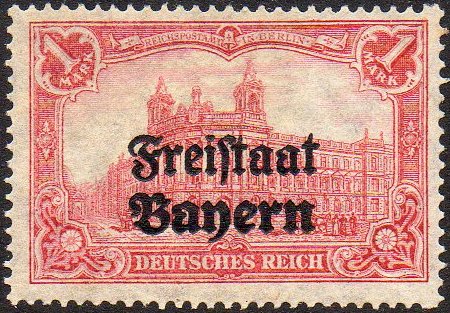 1919 : Optd. Freistaat Bayern in Germanic Script
1 Mark Carmine-red (optd. on recess-engraved , Germany Mi. 94) (Mi. 148 B) [ . ]
This stamp offered with Double Overprint, Rudolf Steltzer auction, Oct.2006, reserve price Euros 300.-
.
DANZIG (Free City)
The free city of Danzig was a product of the Versailles Conference and a flashpoint exploited politically by Hitler in the 1930s. See online sources such as Wikipedia for more on the complex background to these issues. The city today is Gdansk in Poland - with another historical claim to fame, that of the trades union Solidarinosc in the Gdansk shipyards, which may be viewed as the birthplace of the movements which eventually led to the disintegration of the Soviet empire.
1919 : Optd. Freistaat Bayern in Germanic Script
1 Mark Carmine-red (optd. on recess-engraved , Germany Mi. 94) (Mi. 148 B) [ . ]
This stamp offered with Double Overprint, Rudolf Steltzer auction, Oct.2006, reserve price Euros 300.-
.
DANZIG (Free City)
The free city of Danzig was a product of the Versailles Conference and a flashpoint exploited politically by Hitler in the 1930s. See online sources such as Wikipedia for more on the complex background to these issues. The city today is Gdansk in Poland - with another historical claim to fame, that of the trades union Solidarinosc in the Gdansk shipyards, which may be viewed as the birthplace of the movements which eventually led to the disintegration of the Soviet empire.
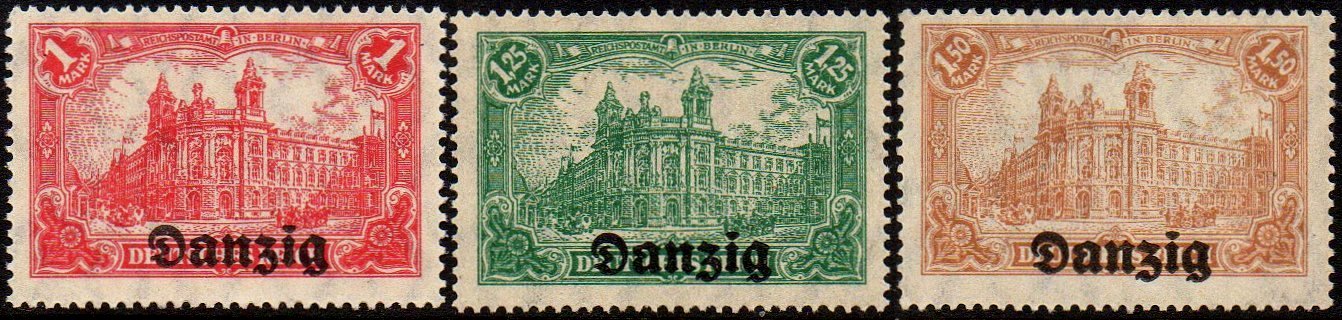 1920 : Optd. Danzig in Black in Germanic Script
1 Mark (optd on Litho, Mi. A113) (Mi. 8) [ . ]
- ditto- pair, one without overprint (Mi. 8 F) . ]
1M25 dark-to-blackish opal green (Mi. 9 a) [ . ]
- ditto - Dark Green (Mi. 9 b) [ . ]
1M50 yellow-brown to orange-brown (Mi. 10) [ . ]
1920 : Optd. Danzig in Black in Germanic Script
1 Mark (optd on Litho, Mi. A113) (Mi. 8) [ . ]
- ditto- pair, one without overprint (Mi. 8 F) . ]
1M25 dark-to-blackish opal green (Mi. 9 a) [ . ]
- ditto - Dark Green (Mi. 9 b) [ . ]
1M50 yellow-brown to orange-brown (Mi. 10) [ . ]
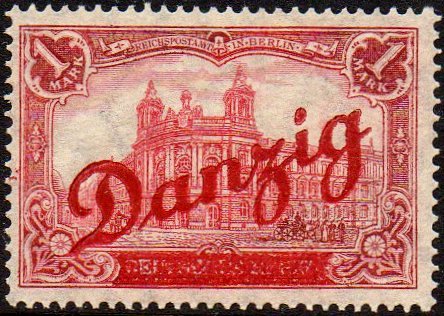 1920 : Optd. Danzig and thick bar in RED
1 Mark (optd on recess-engraved, Germany Mi. 94 B II) (Mi. 48) [ . ]
- ditto - Overprint Double (Mi. 48 DD) [ . ]
.
EASTERN MILITARY COMMAND AREA
1920 : Optd. Danzig and thick bar in RED
1 Mark (optd on recess-engraved, Germany Mi. 94 B II) (Mi. 48) [ . ]
- ditto - Overprint Double (Mi. 48 DD) [ . ]
.
EASTERN MILITARY COMMAND AREA
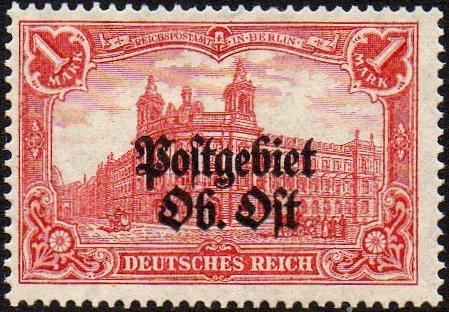 1916 : Overprinted Postgebeit / Ob. Ost in black.
1 Mark (optd on recess-printed Mi. 94) 26 x 17 perforation holes [ . ]
- ditto - 25 x 17 perforation holes [ . ]
.
GERMAN OCCUPATION OF BELGIUM (First World War)
1916 : Overprinted Postgebeit / Ob. Ost in black.
1 Mark (optd on recess-printed Mi. 94) 26 x 17 perforation holes [ . ]
- ditto - 25 x 17 perforation holes [ . ]
.
GERMAN OCCUPATION OF BELGIUM (First World War)
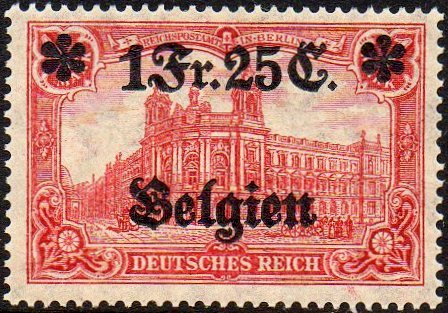 Note for this area: All the stars in the surcharges for Belgium are 'balanced' at their base, i.e.on a single point. For further explanation on this subject, see also the notes and footnotes below German P.O.'s in China and the Western Military Command Area.
1914 : Optd. 1 Fr.25C. / Belgien Centimes expressed as 'C.' and 'Fr.' for Franc. Opt in Black.
1Fr.25C./1 Mark ('Fr' for Franc, optd on engraved, Mi.94) (Mi.8) [ . ]
.
Note for this area: All the stars in the surcharges for Belgium are 'balanced' at their base, i.e.on a single point. For further explanation on this subject, see also the notes and footnotes below German P.O.'s in China and the Western Military Command Area.
1914 : Optd. 1 Fr.25C. / Belgien Centimes expressed as 'C.' and 'Fr.' for Franc. Opt in Black.
1Fr.25C./1 Mark ('Fr' for Franc, optd on engraved, Mi.94) (Mi.8) [ . ]
.
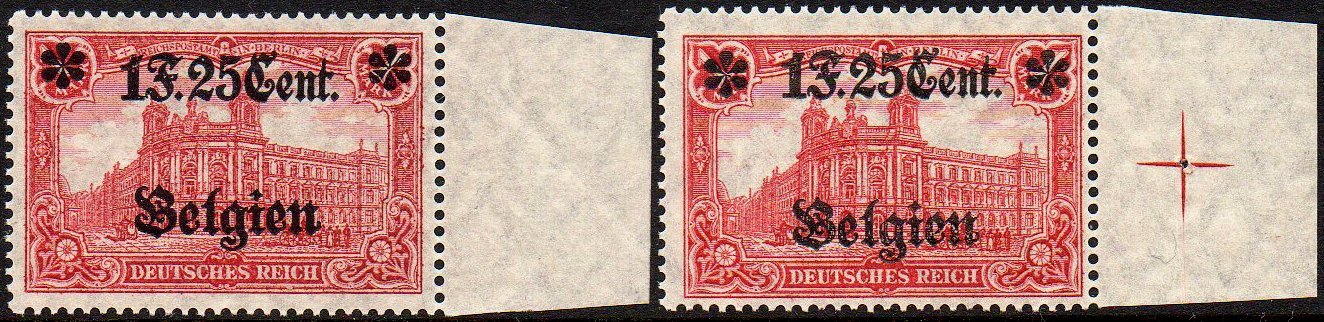 1916-18 : Optd. 1F.25Cent. / Belgien Centimes expressed as 'Cent.' and 'f.' for Franc. Alignment of surcharge value with base of stars varies.
1916-18: 1F.25C./1 Mark (optd. on Mi.94). Value below stars 26x17 holes (Mi.23 I A) [ . ]
- ditto - Value below stars again but 25x17 perforation holes (Mi.23 I B) [ . ]
1916-18: 1F.25C./1 Mark (optd. on Mi.94) Value now aligned with stars (Mi. 23 II) [ . ]
1916-18 : Optd. 1F.25Cent. / Belgien Centimes expressed as 'Cent.' and 'f.' for Franc. Alignment of surcharge value with base of stars varies.
1916-18: 1F.25C./1 Mark (optd. on Mi.94). Value below stars 26x17 holes (Mi.23 I A) [ . ]
- ditto - Value below stars again but 25x17 perforation holes (Mi.23 I B) [ . ]
1916-18: 1F.25C./1 Mark (optd. on Mi.94) Value now aligned with stars (Mi. 23 II) [ . ]
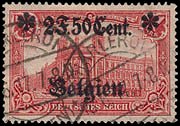 1916-18 : Optd. 2F.50Cent. / Belgien . Printed and Issued in error.
1916-18 : ERROR : 2F50 Cent/1 Mark. [ . ]
Only one sheet of 20 stamps was produced in error and the stamps were sold at Charleroi. 13 copies are known to have survived, all used. Catalogue Officiel Belge in 2008 : Catalogue Number: OC-23Er (cv. Euros 20,000.00)
Note: For stamps surcharged in similar fashion but without the word 'Belgien', see
under Western Military Command Area.
.
GERMAN POST OFFICES IN CHINA
German stamps can be found without overprint bearing cancellations of the German Post Offices in China. These were used for a very brief period pending the arrival of overprinted stamps. Examples of the 1 Mark so used are very scarce, even as loose stamps; they are rare on cover.
Stamps inscribed REICHSPOST, without overprint, used in China :
1 Mark : German P.O.s in China cancellation on stamp or piece [ . ]
- ditto - on cover [ . ]
.
1916-18 : Optd. 2F.50Cent. / Belgien . Printed and Issued in error.
1916-18 : ERROR : 2F50 Cent/1 Mark. [ . ]
Only one sheet of 20 stamps was produced in error and the stamps were sold at Charleroi. 13 copies are known to have survived, all used. Catalogue Officiel Belge in 2008 : Catalogue Number: OC-23Er (cv. Euros 20,000.00)
Note: For stamps surcharged in similar fashion but without the word 'Belgien', see
under Western Military Command Area.
.
GERMAN POST OFFICES IN CHINA
German stamps can be found without overprint bearing cancellations of the German Post Offices in China. These were used for a very brief period pending the arrival of overprinted stamps. Examples of the 1 Mark so used are very scarce, even as loose stamps; they are rare on cover.
Stamps inscribed REICHSPOST, without overprint, used in China :
1 Mark : German P.O.s in China cancellation on stamp or piece [ . ]
- ditto - on cover [ . ]
.
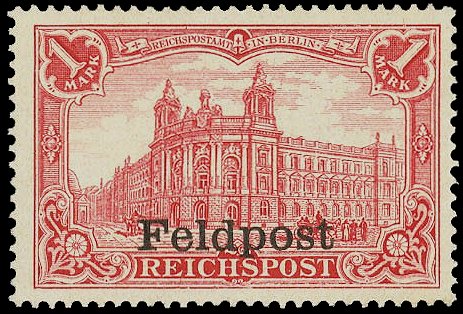 Trial Overprint : Feldpost (Field Post Office) (not issued) :
c. 1900 : 1 Mark : overprinted Feldpost [ . ] RARE
.
Trial Overprint : Feldpost (Field Post Office) (not issued) :
c. 1900 : 1 Mark : overprinted Feldpost [ . ] RARE
.
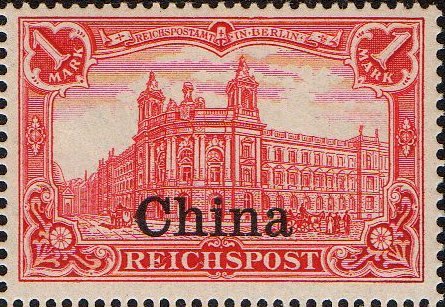 1901 : Overprinted : China in Black
1 Mark (optd. on Mi.62, inscribed REICHSPOST) (Mi.24) [ . ]
- ditto - special printing with ' i ' of ' China ' like a comma (Mi.VII k). Unissued - Rare [ . ]
(1905) 1 Mark (optd in Latin script on Mi. 94, inscribed DEUTSCHES REICH)
(Mi. VIII j). [ . ]
This last stamp issued only in Berlin in tiny numbers.
.
On the remaining issues for China, there is a six-pointed star either side of the new value. These are normally orientated such that they rest (at their base) on two points; some stamps, however, are found with one of the stars 'balanced' on a single point and these are indicated below, where they exist, as 'left star on point' or 'right star on point'.
Another feature of nearly all the stamps with this surcharge is that the new
value, ' ½ Dollar ' , is not centred, but located much nearer to the right star.
1901 : Overprinted : China in Black
1 Mark (optd. on Mi.62, inscribed REICHSPOST) (Mi.24) [ . ]
- ditto - special printing with ' i ' of ' China ' like a comma (Mi.VII k). Unissued - Rare [ . ]
(1905) 1 Mark (optd in Latin script on Mi. 94, inscribed DEUTSCHES REICH)
(Mi. VIII j). [ . ]
This last stamp issued only in Berlin in tiny numbers.
.
On the remaining issues for China, there is a six-pointed star either side of the new value. These are normally orientated such that they rest (at their base) on two points; some stamps, however, are found with one of the stars 'balanced' on a single point and these are indicated below, where they exist, as 'left star on point' or 'right star on point'.
Another feature of nearly all the stamps with this surcharge is that the new
value, ' ½ Dollar ' , is not centred, but located much nearer to the right star.
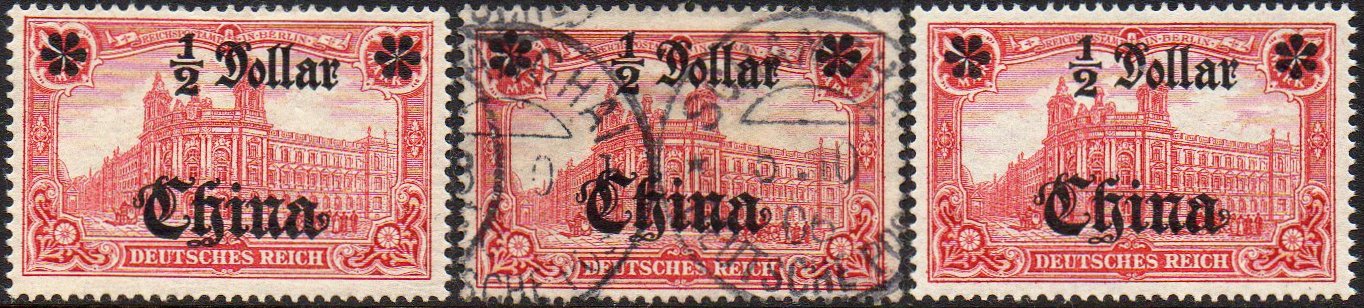 Above, left to right: Normal, Left Star on One Point, Right Star on One Point.
1905 : Surcharged * ½ Dollar * / China on UNWATERMARKED stamps
½ Dollar / 1 Mark (optd. on Mi. 78Aa) 26x17 perforation holes (Mi. 34A) [ . ]
- ditto - left star on point (Mi. 34 I A) [ . ]
- ditto - right star on point (Mi. 34 I A) [ . ]
½ Dollar / 1 Mark (optd. on Mi. 78 B) 25x16 perforation holes (Mi. 34B) [ . ]
- ditto - left star on point (Mi. 34 I B) [ . ]
- ditto - right star on point (Mi. 34 I B) [ . ]
.
Above, left to right: Normal, Left Star on One Point, Right Star on One Point.
1905 : Surcharged * ½ Dollar * / China on UNWATERMARKED stamps
½ Dollar / 1 Mark (optd. on Mi. 78Aa) 26x17 perforation holes (Mi. 34A) [ . ]
- ditto - left star on point (Mi. 34 I A) [ . ]
- ditto - right star on point (Mi. 34 I A) [ . ]
½ Dollar / 1 Mark (optd. on Mi. 78 B) 25x16 perforation holes (Mi. 34B) [ . ]
- ditto - left star on point (Mi. 34 I B) [ . ]
- ditto - right star on point (Mi. 34 I B) [ . ]
.
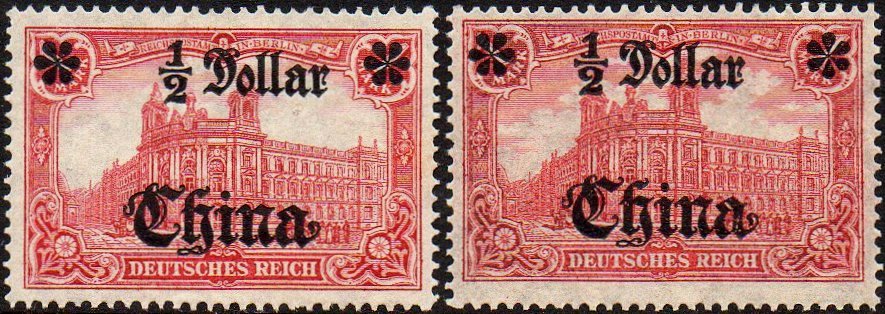 Above (left to right): ½ Dollar right of centre; ½ Dollar centred (example shown with right star on one point).
1905-19 : Surcharged * ½ Dollar * / China on WATERMARKED stamps
½ Dollar / 1 Mark carmine-red on white paper (optd. on Mi. 94 A I) ½ Dollar to right, 26x17 perforation holes (Mi.44A I b)** [ . ]
½ Dollar / 1 Mark red on greyish wartime paper (optd on Mi.94 B II) 25x17 holes, ½ Dollar centred (Mi. 44 B IIa) [ . ]
- ditto - right star on point (Mi. 44 B II aa) [ . ]
½ Dollar / 1 Mark red on greyish wartime paper 25x17 holes, ½ Dollar to right, white gum (optd on Mi.94 B II) (Mi.44 B I a) [ . ]
- ditto - as above but dark red with yellow gum (Mi. 44 B I b) [ . ]
** Note: stamp marked ** above also exists with a 9mm instead of a 9.5mm spacing between the lines of surcharge (Mi.44A I a)
.
GERMAN POST OFFICES IN MOROCCO
Above (left to right): ½ Dollar right of centre; ½ Dollar centred (example shown with right star on one point).
1905-19 : Surcharged * ½ Dollar * / China on WATERMARKED stamps
½ Dollar / 1 Mark carmine-red on white paper (optd. on Mi. 94 A I) ½ Dollar to right, 26x17 perforation holes (Mi.44A I b)** [ . ]
½ Dollar / 1 Mark red on greyish wartime paper (optd on Mi.94 B II) 25x17 holes, ½ Dollar centred (Mi. 44 B IIa) [ . ]
- ditto - right star on point (Mi. 44 B II aa) [ . ]
½ Dollar / 1 Mark red on greyish wartime paper 25x17 holes, ½ Dollar to right, white gum (optd on Mi.94 B II) (Mi.44 B I a) [ . ]
- ditto - as above but dark red with yellow gum (Mi. 44 B I b) [ . ]
** Note: stamp marked ** above also exists with a 9mm instead of a 9.5mm spacing between the lines of surcharge (Mi.44A I a)
.
GERMAN POST OFFICES IN MOROCCO
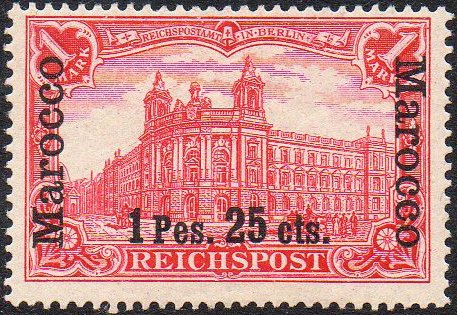
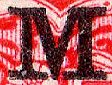
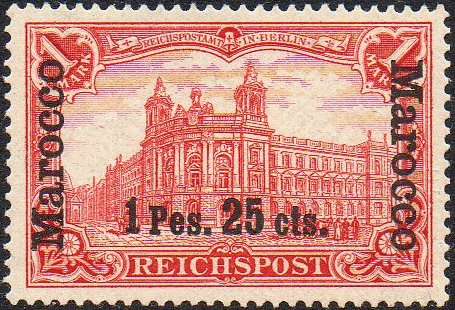
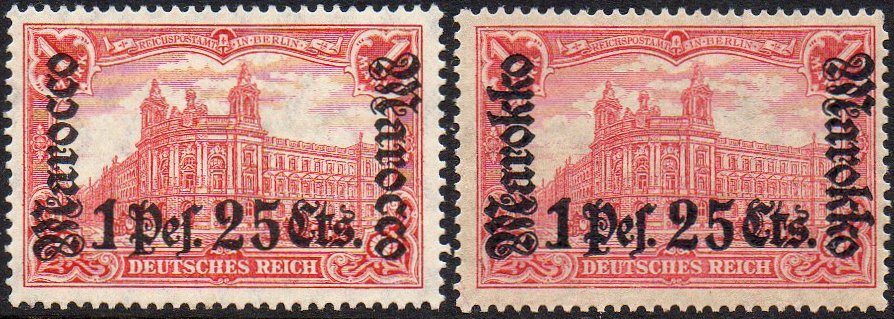
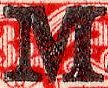 In the 1900 issue (left 2 scans), the feet of the letter 'M' meet the upstrokes almost at a right angle (90 degrees).
In the 1903 issue (right 2 scans), the feet of the letter 'M' are tapered upwards to meet the upstrokes.
1900 : Surcharged Marocco 1 Pes. 25 cts. Marocco 'M' as shown above at left.
1 Pes 25 / 1 Mark Red (optd on Mi. 63a) (Mi.16 I) [ . ]
1903 : Surcharged Marocco 1 Pes. 25 cts. Marocco, 'M' as shown above at right.
1 Pes 25 / 1 Mark Red (shades) (optd on Mi. 63a) (Mi.16 IIa) [ . ]
1 Pes 25 / 1 Mark Brownish-carmine (optd on Mi. 63 b) (Mi.16 IIb) [ . ]
In the 1900 issue (left 2 scans), the feet of the letter 'M' meet the upstrokes almost at a right angle (90 degrees).
In the 1903 issue (right 2 scans), the feet of the letter 'M' are tapered upwards to meet the upstrokes.
1900 : Surcharged Marocco 1 Pes. 25 cts. Marocco 'M' as shown above at left.
1 Pes 25 / 1 Mark Red (optd on Mi. 63a) (Mi.16 I) [ . ]
1903 : Surcharged Marocco 1 Pes. 25 cts. Marocco, 'M' as shown above at right.
1 Pes 25 / 1 Mark Red (shades) (optd on Mi. 63a) (Mi.16 IIa) [ . ]
1 Pes 25 / 1 Mark Brownish-carmine (optd on Mi. 63 b) (Mi.16 IIb) [ . ]
 1905/06 issues inscribed 'Marocco'. 1911-1919 issues inscribed 'Marokko'.
1905 : Surcharged 'Marocco' etc. in gothic script on UNWATERMARKED stamps.
1 Pes 25 / 1 Mark Carmine-red (optd on Mi. 78A) 26x17 perforation holes (Mi. 30A) [ . ]
1 Pes 25 / 1 Mark Carmine-red (optd on Mi. 78B) 25x16 perforation holes (Mi. 30B) [ . ]
1906 : Surcharged 'Marocco' etc. in gothic script on WATERMARKED stamps.
1 Pes 25 / 1 Mark Carmine-red (optd on Mi. 94 A I) (Mi. 43) [ . ]
1911-19 : Surcharged 'Marokko' etc. in gothic script
1 Pes 25 / 1 Mark Red on whitish paper (optd on Mi. 94 A I) (Mi. 55A) [ . ]
1 Pes 25 / 1 Mark red on greyish wartime paper with shiny surcharge (optd on Mi. 94 B II)(Mi. 55 B a) [ . ]
- ditto but with matt surcharge (Mi. 55 B b) [ . ]
.
GERMAN POST OFFICES IN THE TURKISH EMPIRE
1905/06 issues inscribed 'Marocco'. 1911-1919 issues inscribed 'Marokko'.
1905 : Surcharged 'Marocco' etc. in gothic script on UNWATERMARKED stamps.
1 Pes 25 / 1 Mark Carmine-red (optd on Mi. 78A) 26x17 perforation holes (Mi. 30A) [ . ]
1 Pes 25 / 1 Mark Carmine-red (optd on Mi. 78B) 25x16 perforation holes (Mi. 30B) [ . ]
1906 : Surcharged 'Marocco' etc. in gothic script on WATERMARKED stamps.
1 Pes 25 / 1 Mark Carmine-red (optd on Mi. 94 A I) (Mi. 43) [ . ]
1911-19 : Surcharged 'Marokko' etc. in gothic script
1 Pes 25 / 1 Mark Red on whitish paper (optd on Mi. 94 A I) (Mi. 55A) [ . ]
1 Pes 25 / 1 Mark red on greyish wartime paper with shiny surcharge (optd on Mi. 94 B II)(Mi. 55 B a) [ . ]
- ditto but with matt surcharge (Mi. 55 B b) [ . ]
.
GERMAN POST OFFICES IN THE TURKISH EMPIRE
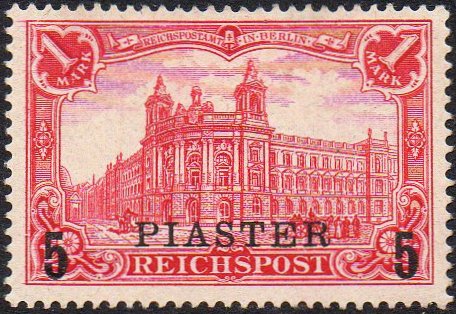

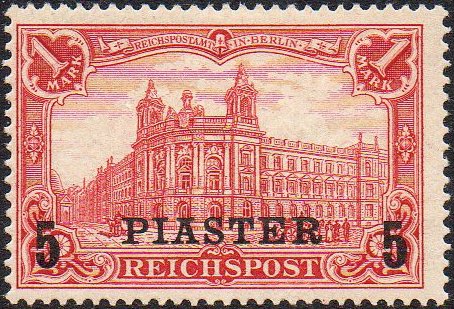
 1900 Issue (left) with pointed 'A'. 1902 issue (right): 'A' with a 'roof'.
1900 : Surcharged 5 PIASTER 5 (in capital letters) 'A' with pointed top
5 Pi / 1 Mark Red (optd. on Mi. 63a) (Mi. 20 I a) [ . ]
- ditto - but Brownish-carmine (optd on Mi. 63b) - rare (Mi. 20 I b) [ . ]
- ditto - but Brownish-rose - rare (Mi. 20 I c) [ . ]
Note: The base of the word 'PIASTER' is usually level with the top of the figures ' 5 '. but may also be found in higher and lower positions.
1902 : Surcharged 5 PIASTER 5 (in capital letters) 'A' topped with a horizontal line (roof). This surcharge was applied to a special printing of the 1 Mark, for use in Turkey, inscribed REICHSPOST.
5 Pi / 1 Mark Red (shades) (Mi. 20 II a) [ . ]
- ditto - but Brownish-carmine (Mi. 20 II b) [ . ]
1900 Issue (left) with pointed 'A'. 1902 issue (right): 'A' with a 'roof'.
1900 : Surcharged 5 PIASTER 5 (in capital letters) 'A' with pointed top
5 Pi / 1 Mark Red (optd. on Mi. 63a) (Mi. 20 I a) [ . ]
- ditto - but Brownish-carmine (optd on Mi. 63b) - rare (Mi. 20 I b) [ . ]
- ditto - but Brownish-rose - rare (Mi. 20 I c) [ . ]
Note: The base of the word 'PIASTER' is usually level with the top of the figures ' 5 '. but may also be found in higher and lower positions.
1902 : Surcharged 5 PIASTER 5 (in capital letters) 'A' topped with a horizontal line (roof). This surcharge was applied to a special printing of the 1 Mark, for use in Turkey, inscribed REICHSPOST.
5 Pi / 1 Mark Red (shades) (Mi. 20 II a) [ . ]
- ditto - but Brownish-carmine (Mi. 20 II b) [ . ]
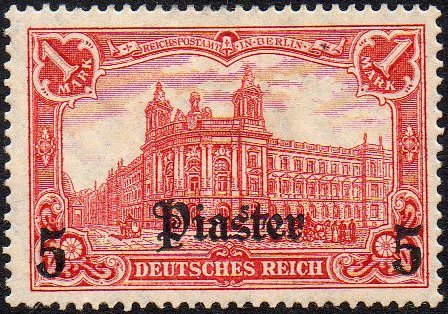 1905 : Surcharged 5 Piaster 5 in gothic script on UNWATERMARKED stamps
5 Pi / 1 Mark Carmine-red 26x17 perforation holes (optd on Mi. 78 A) (Mi. 32 A) [ . ]
- ditto - but 25x16 perforation holes (optd. on Mi. 78 B) (Mi. 32 B) [ . ]
1907 : Surcharged 5 Piaster 5 in gothic script on WATERMARKED stamps
5 Pi / 1 Mark Carmine-red (optd on Mi94 A I) (Mi. 44) [ . ]
.
MARIENWERDER - Plebiscite Issues
1905 : Surcharged 5 Piaster 5 in gothic script on UNWATERMARKED stamps
5 Pi / 1 Mark Carmine-red 26x17 perforation holes (optd on Mi. 78 A) (Mi. 32 A) [ . ]
- ditto - but 25x16 perforation holes (optd. on Mi. 78 B) (Mi. 32 B) [ . ]
1907 : Surcharged 5 Piaster 5 in gothic script on WATERMARKED stamps
5 Pi / 1 Mark Carmine-red (optd on Mi94 A I) (Mi. 44) [ . ]
.
MARIENWERDER - Plebiscite Issues
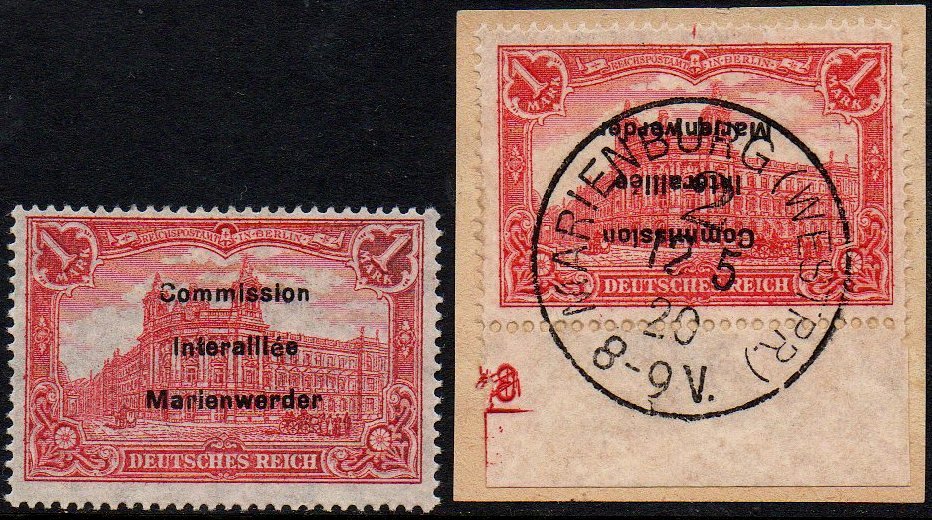 1920 : Overprinted Commission / Interalliée / Marienwerder
1 Mark Red (optd. on engraved stamp, Mi. 94 B) (Mi. 20) [ . ]
- ditto - Overprint Inverted (Mi. 20 K) [ . ]
1920 : Overprinted Commission / Interalliée / Marienwerder
1 Mark Red (optd. on engraved stamp, Mi. 94 B) (Mi. 20) [ . ]
- ditto - Overprint Inverted (Mi. 20 K) [ . ]
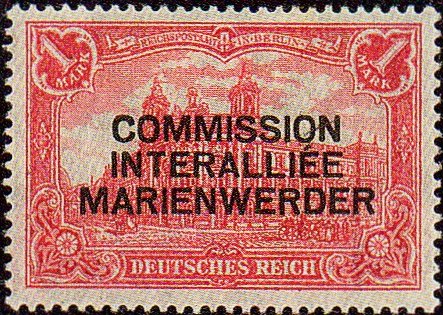
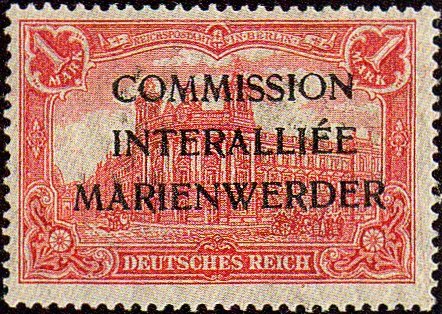
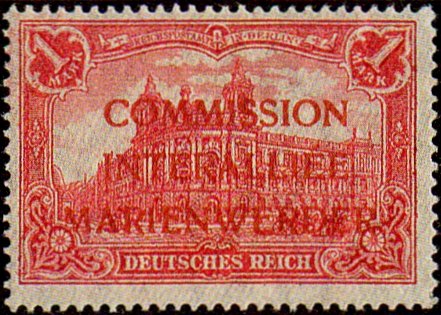 1920 : Overprinted COMMISSION / INTERALLIEE / MARIENWERDER in non-serif block capitals
1 Mark Red (optd. in black on Mi. 94 B II) Not Issued ( MI. 21 I ) [ . ]
See Note after next listing
1920 : Overprinted COMMISSION / INTERALLIEE / MARIENWERDER in angular serifed capitals
1 Mark Red (optd. in BLACK on Mi. 94 B II) Not Issued ( MI. 21 II a) [ . ]
1 Mark Red (optd. in RED on Mi. 94 B II) Not Issued ( MI. 21 II b) [ . ]
Note: Mi 21 I and 21 IIa/b come from official proof sheets. Of the three stamps above, only Mi.21 IIa is priced in used condition in the catalogue, although even this stamp appears only to have been released in Berlin, not in Marienwerder.
1920 : Overprinted COMMISSION / INTERALLIEE / MARIENWERDER in non-serif block capitals
1 Mark Red (optd. in black on Mi. 94 B II) Not Issued ( MI. 21 I ) [ . ]
See Note after next listing
1920 : Overprinted COMMISSION / INTERALLIEE / MARIENWERDER in angular serifed capitals
1 Mark Red (optd. in BLACK on Mi. 94 B II) Not Issued ( MI. 21 II a) [ . ]
1 Mark Red (optd. in RED on Mi. 94 B II) Not Issued ( MI. 21 II b) [ . ]
Note: Mi 21 I and 21 IIa/b come from official proof sheets. Of the three stamps above, only Mi.21 IIa is priced in used condition in the catalogue, although even this stamp appears only to have been released in Berlin, not in Marienwerder.
 1920 : Overprinted Commission / Interalliée / Marienwerder on Lithographed stamps.
1 Mark Red (optd. on Mi. A 113) (Mi. 26) [ . ]
The Michel Deutschland-Spezial catalogue lists the same three plate flaws for this stamp as for Germany Mi. A 113.
1 Mk.25 Green (optd. on Mi. 113) (Mi. 27) [ . ]
1 Mk.50 Yellow-brown to Brown (shades) (optd. on Mi. 114) (Mi. 28) [ . ]
Shades: You will notice from the scan that there are pronounced shades of the 1M50. However, whilst the different shades are indicated in Michel, they are not given separate sub-numbers, so we have not provided a separate listing. On other stamps of Germany and territories in the Hauptpostamt Berlin design, less distinct shades are sometimes given sub-numbers. We have generally adhered to the Michel level of 'recognition' of shades in this article.
.
MEMEL - German district under Allied Ocupation 1918-23
1920 : Overprinted Commission / Interalliée / Marienwerder on Lithographed stamps.
1 Mark Red (optd. on Mi. A 113) (Mi. 26) [ . ]
The Michel Deutschland-Spezial catalogue lists the same three plate flaws for this stamp as for Germany Mi. A 113.
1 Mk.25 Green (optd. on Mi. 113) (Mi. 27) [ . ]
1 Mk.50 Yellow-brown to Brown (shades) (optd. on Mi. 114) (Mi. 28) [ . ]
Shades: You will notice from the scan that there are pronounced shades of the 1M50. However, whilst the different shades are indicated in Michel, they are not given separate sub-numbers, so we have not provided a separate listing. On other stamps of Germany and territories in the Hauptpostamt Berlin design, less distinct shades are sometimes given sub-numbers. We have generally adhered to the Michel level of 'recognition' of shades in this article.
.
MEMEL - German district under Allied Ocupation 1918-23
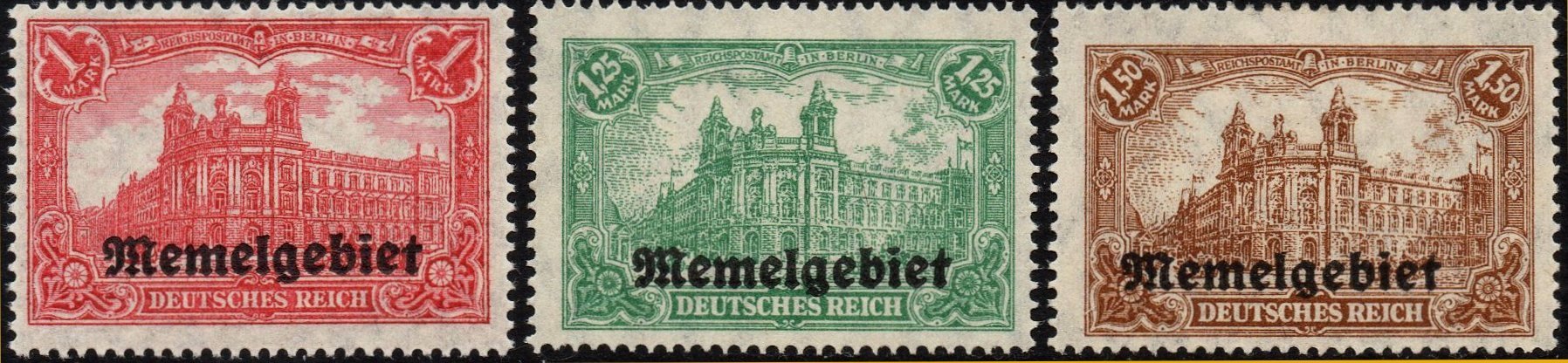 1920 : Overprinted Memelgebiet in black
1 Mark (optd. on engraved Mi. 94 B II) 25x17 perforation holes (Mi. 9)[ . ]
- ditto - but with inverted ' b ' (Mi. 9 II ) [ . ]
- ditto - but optd. on Mi. 94 A II with 26x17 perforation holes (Mi. 9 I ) [ . ]
1 Mk 25 Green (shades) (Mi. 10)[ . ]
1 Mk 50 Yellow-brown to bright orange-brown (Mi. 11 a) [ . ]
- ditto - bright brown-orange (Mi. 11 b) [ . ]
- ditto - dark to blackish brown-ochre (Mi. 11 c) [ . ]
.
SAAR
The Saar territory was placed under French administration in 1920 by the Treaty of Versailles for a 15-year period after which there was to be a plebiscite. In 1935, the population elected to rejoin Germany.
1920 : Overprinted Memelgebiet in black
1 Mark (optd. on engraved Mi. 94 B II) 25x17 perforation holes (Mi. 9)[ . ]
- ditto - but with inverted ' b ' (Mi. 9 II ) [ . ]
- ditto - but optd. on Mi. 94 A II with 26x17 perforation holes (Mi. 9 I ) [ . ]
1 Mk 25 Green (shades) (Mi. 10)[ . ]
1 Mk 50 Yellow-brown to bright orange-brown (Mi. 11 a) [ . ]
- ditto - bright brown-orange (Mi. 11 b) [ . ]
- ditto - dark to blackish brown-ochre (Mi. 11 c) [ . ]
.
SAAR
The Saar territory was placed under French administration in 1920 by the Treaty of Versailles for a 15-year period after which there was to be a plebiscite. In 1935, the population elected to rejoin Germany.
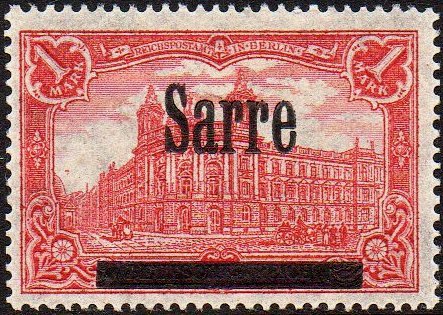 1920 : Overprinted Sarre in black:
1 Mark Carmine-Red to Red, 25x17 perforation holes (optd on Mi. 94) (Mi. 17 A) [ . ]
- ditto - variety pointed 'a' in 'Sarre ' (Mi. 17 A IV) [ . ]
1 Mark Carmine-Red to Red 26x17 perforation holes (Mi. 17 B) [ . ]
- ditto - variety pointed 'a' in 'Sarre ' (Mi. 17 B IV) [ . ]
Note: Further specialised varieties, including double and inverted overprints, all rare, are listed in the Michel Deutschland-Spezial catalogue.
.
1920 : Overprinted Sarre in black:
1 Mark Carmine-Red to Red, 25x17 perforation holes (optd on Mi. 94) (Mi. 17 A) [ . ]
- ditto - variety pointed 'a' in 'Sarre ' (Mi. 17 A IV) [ . ]
1 Mark Carmine-Red to Red 26x17 perforation holes (Mi. 17 B) [ . ]
- ditto - variety pointed 'a' in 'Sarre ' (Mi. 17 B IV) [ . ]
Note: Further specialised varieties, including double and inverted overprints, all rare, are listed in the Michel Deutschland-Spezial catalogue.
.
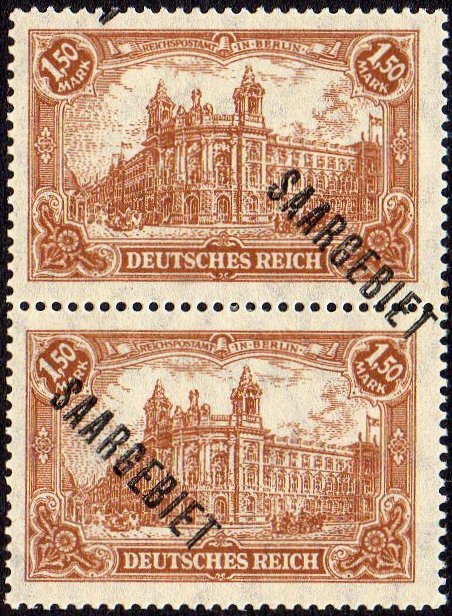
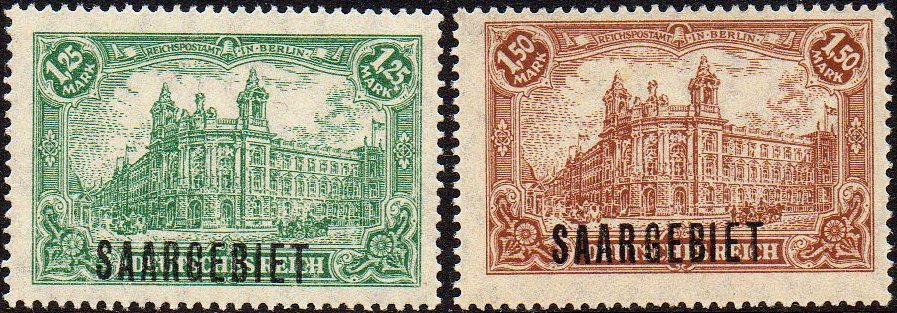 1920 : Overprinted SAARGEBIET in black :
1 Mk 25 Green (Mi. 41) [ . ]
- ditto - Inverted Overprint (Mi. 41 K) [ . ]
1 Mk 50 Brown (Mi. 42) [ . ]
- ditto - Inverted Overprint (Mi. 42 K) [ . ]
- ditto - Overprint à cheval [ . ]
The overprint à cheval is not listed in Michel and is reported to be unexpertised.
.
UPPER SILESIA - Plebiscite Issue
1920 : Overprinted SAARGEBIET in black :
1 Mk 25 Green (Mi. 41) [ . ]
- ditto - Inverted Overprint (Mi. 41 K) [ . ]
1 Mk 50 Brown (Mi. 42) [ . ]
- ditto - Inverted Overprint (Mi. 42 K) [ . ]
- ditto - Overprint à cheval [ . ]
The overprint à cheval is not listed in Michel and is reported to be unexpertised.
.
UPPER SILESIA - Plebiscite Issue
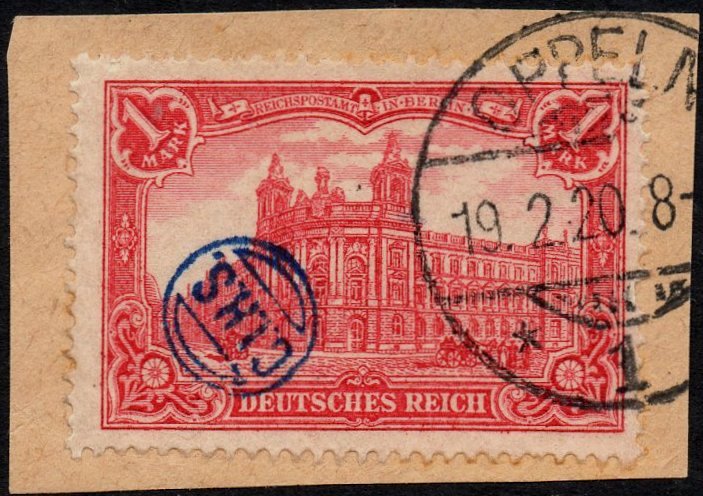 1920 Issue of the Inter-Allied Commission : Overprinted in blue C.I.H.S. in a circle
1 Mark Carmine-red (optd on Mi. 94 B II) (Mi.17) [ . ]
Note: Michel renumbers the territory from Mi.1 for this French/Allied Commission issue. This is a rare stamp, issued by the French Occupation Authority, not to be confused with the regular public postal service 15pf, Mi. 17, of the Upper Silesia standard issues.
.
WESTERN MILITARY COMMAND AREA : GERMAN POST OFFICES
1920 Issue of the Inter-Allied Commission : Overprinted in blue C.I.H.S. in a circle
1 Mark Carmine-red (optd on Mi. 94 B II) (Mi.17) [ . ]
Note: Michel renumbers the territory from Mi.1 for this French/Allied Commission issue. This is a rare stamp, issued by the French Occupation Authority, not to be confused with the regular public postal service 15pf, Mi. 17, of the Upper Silesia standard issues.
.
WESTERN MILITARY COMMAND AREA : GERMAN POST OFFICES
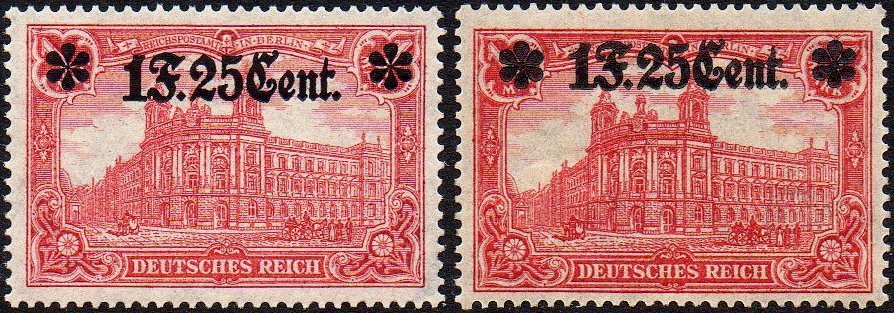 Left stamp with surcharge value aligned below stars. Right stamp aligned centrally.
1916 : Overprinted * 1F.25 Cent. * in black. Stars 'balanced' on one point. All are overprinted on Mi. 94.
1 F.25 / 1 Mark. Value aligned below stars, 26x17 perforation holes (Mi. 11 I A) [ . ]
- ditto - but 25x17 perforation holes (Mi. 11 I B) [ . ]
1 F.25 / 1 Mark with value now now centred between stars (Mi. 11 II) [ . ]
- ditto - var. Left star 'balanced' on two points (Mi. 11 II F) [ . ]
Note: For an explanation of the orientation of the stars, see under German P.O.'s in China. Note that whereas, for China, most stamps have the stars balanced on two points (balanced on one point being the variety), the opposite is true for the Western Military Command Area.
We should like to acknowledge the assistance of Jeremy Rayner in providing useful evidence with regard to the design detail of these stamps.
Left stamp with surcharge value aligned below stars. Right stamp aligned centrally.
1916 : Overprinted * 1F.25 Cent. * in black. Stars 'balanced' on one point. All are overprinted on Mi. 94.
1 F.25 / 1 Mark. Value aligned below stars, 26x17 perforation holes (Mi. 11 I A) [ . ]
- ditto - but 25x17 perforation holes (Mi. 11 I B) [ . ]
1 F.25 / 1 Mark with value now now centred between stars (Mi. 11 II) [ . ]
- ditto - var. Left star 'balanced' on two points (Mi. 11 II F) [ . ]
Note: For an explanation of the orientation of the stars, see under German P.O.'s in China. Note that whereas, for China, most stamps have the stars balanced on two points (balanced on one point being the variety), the opposite is true for the Western Military Command Area.
We should like to acknowledge the assistance of Jeremy Rayner in providing useful evidence with regard to the design detail of these stamps.