 .
.
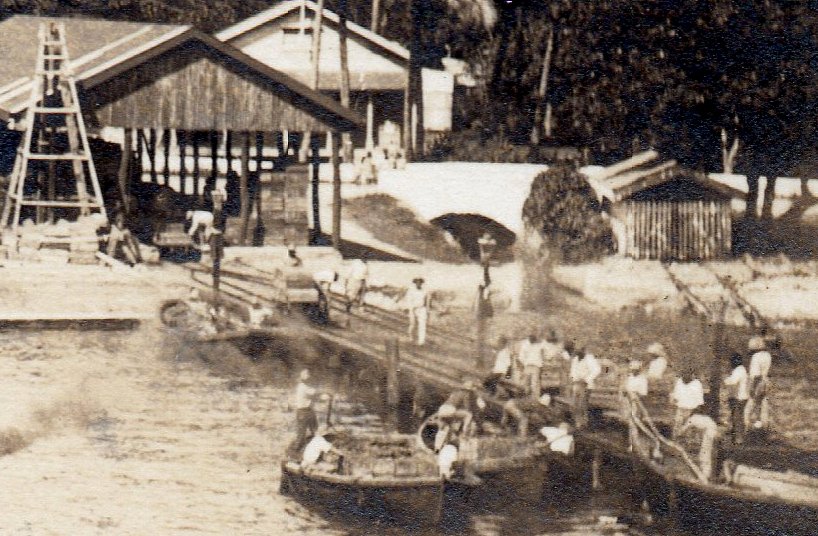 .
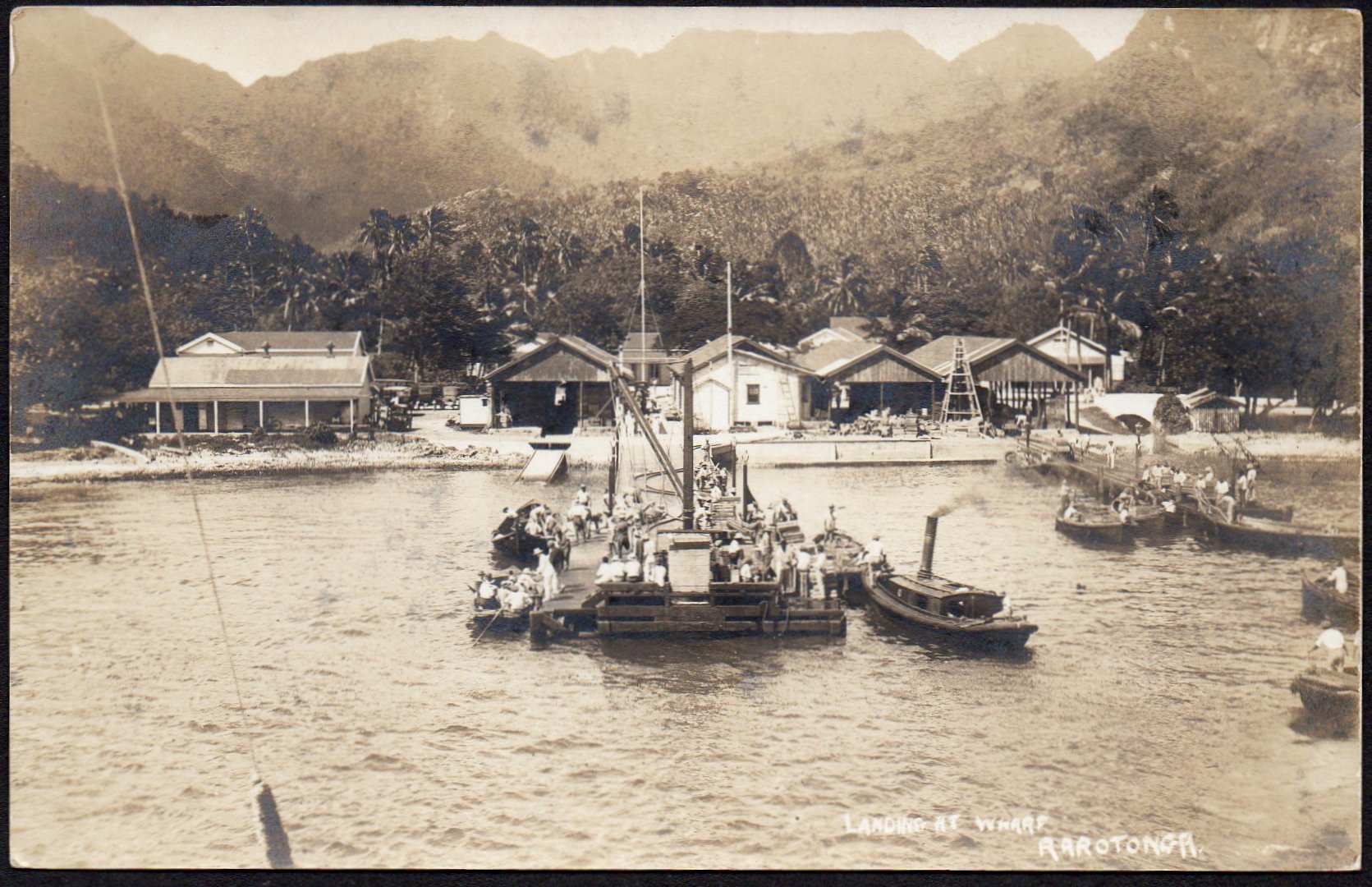
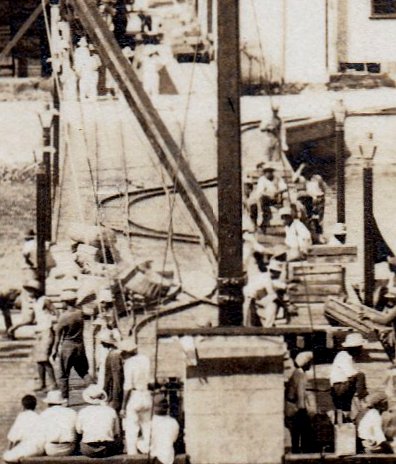
The three views above are all from the same postcard, described as 'Card 1' in this article.
Card 1 shows the two wharves (or piers) at Rarotonga. For the purposes of this article, we shall call them the 'left wharf' and the 'right wharf', left and right as seen from the sea. The postcard has a divided back and, on the address side, "Copyright series by Sydney Hopkins, Rarotonga, Cook Islands". Curiously, the address side has headings 'Correspondence' on the left and 'Address' on the right, but no dividing line between. A standard printing plate for the back of the card is such a basic feature of postcard production that its absence suggests that the publisher produced very few cards and/or may not have had access to lithographic printing on the islands.
Postcard Regulations (dating postcards) : For several decades from the early 1870s when postcards first appeared, postal regulations permitted only the address on one side and a short message, often from the 1890s with a picture, on the other side. Messages, typically, could not exceed 5 words if you wished to take advantage of the reduced postage rates for postcards. This regulation was waived first in Britain when, in 1902, the Royal Mail permitted the address side to be divided and longer messages to be sent at postcard rates. Recognizing the potential postal income from the rapid growth in the tourist postcard business at this time, other European countries quickly followed Britain's lead, France and Germany doing so almost immediately, although it was 1907 before the USA, for example, followed suit.
In Australia, the change came in January 1905 and it seems likely that Cook Islands would have adopted the new regulations at about the same time. This information allows us to date Card 1 as probably being printed after 1905, although it does not, of course, guarantee that the image is not earlier. The old steam-powered tender vessel suggests that this may be the oldest of the views that we have reproduced in this article, whilst the presence of several ancient cars in the background (between the two left-hand buildings) might permit car aficionados to provide a later minimum date than 1905. Our guess for this image is some time around 1908-1914, but it is a guess.
.
The three views above are all from the same postcard, described as 'Card 1' in this article.
Card 1 shows the two wharves (or piers) at Rarotonga. For the purposes of this article, we shall call them the 'left wharf' and the 'right wharf', left and right as seen from the sea. The postcard has a divided back and, on the address side, "Copyright series by Sydney Hopkins, Rarotonga, Cook Islands". Curiously, the address side has headings 'Correspondence' on the left and 'Address' on the right, but no dividing line between. A standard printing plate for the back of the card is such a basic feature of postcard production that its absence suggests that the publisher produced very few cards and/or may not have had access to lithographic printing on the islands.
Postcard Regulations (dating postcards) : For several decades from the early 1870s when postcards first appeared, postal regulations permitted only the address on one side and a short message, often from the 1890s with a picture, on the other side. Messages, typically, could not exceed 5 words if you wished to take advantage of the reduced postage rates for postcards. This regulation was waived first in Britain when, in 1902, the Royal Mail permitted the address side to be divided and longer messages to be sent at postcard rates. Recognizing the potential postal income from the rapid growth in the tourist postcard business at this time, other European countries quickly followed Britain's lead, France and Germany doing so almost immediately, although it was 1907 before the USA, for example, followed suit.
In Australia, the change came in January 1905 and it seems likely that Cook Islands would have adopted the new regulations at about the same time. This information allows us to date Card 1 as probably being printed after 1905, although it does not, of course, guarantee that the image is not earlier. The old steam-powered tender vessel suggests that this may be the oldest of the views that we have reproduced in this article, whilst the presence of several ancient cars in the background (between the two left-hand buildings) might permit car aficionados to provide a later minimum date than 1905. Our guess for this image is some time around 1908-1914, but it is a guess.
 For our motor car aficionado readers, if any!:
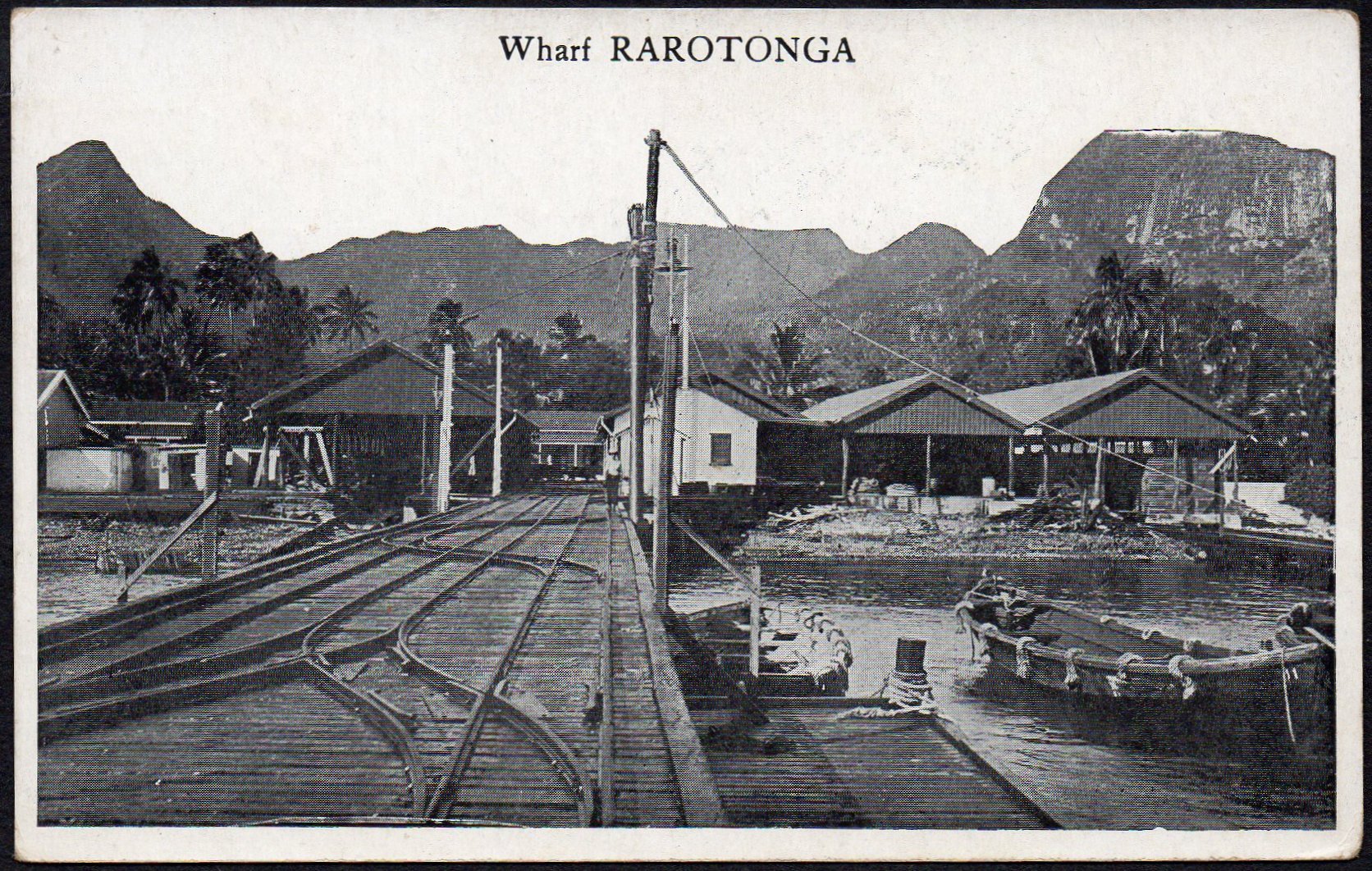 .
The postcard above is described as 'Card 2' in this article. It has a divided back.
.
The postcard above is described as 'Card 2' in this article. It has a divided back.
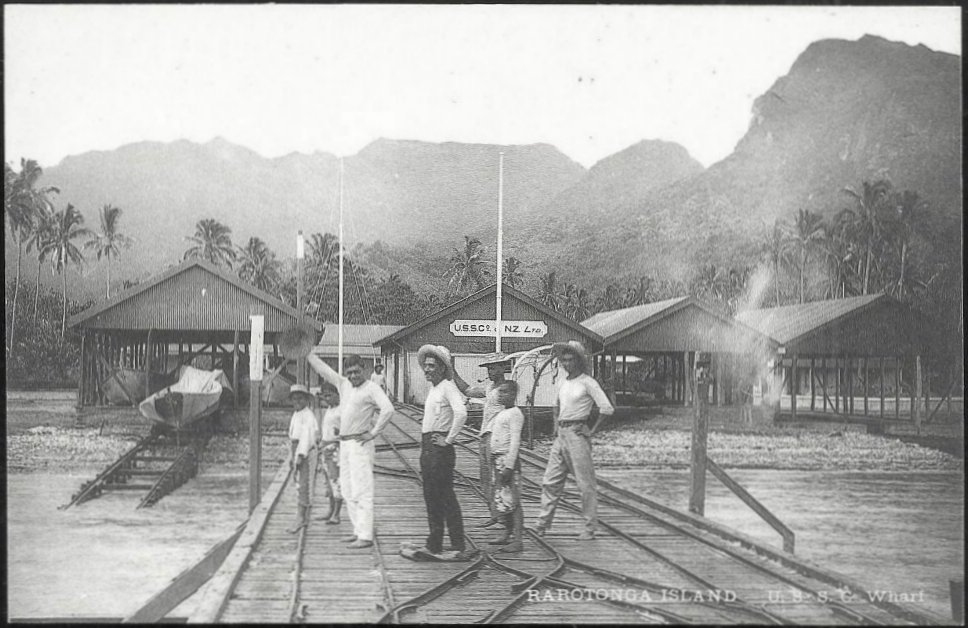 .
The postcard above is described as 'Card 3' in this article. It also has a divided back.
Above: Cards 2 and 3 both show the left wharf. Card 2 appears to be earlier of these two, judging by the extension added to the first building to the right of the wharf in the lower card.
Overview of the three postcards:
Card 1 : In the two detail scans of this first card, one can see railway tracks as well as small hand-operated railway flat-trucks on both wharves, these at the top centre of the left scan (left wharf) and at centre-left of the second scan (right wharf).
On Card 2 there are obvious tracks on the left wharf and, under a magnifying glass, at least one hand-operated flat-truck on the right wharf, although this is not clearly visible in the scan.
Card 3 adds extra human interest, but only the left wharf can be seen, with its intricate pattern of railway tracks.
Cranes : Only the first detail scan of Card 1 provides much in the way of useful evidence about the cranes. The crane on the left wharf does not appear to be mobile / rail-mounted. On the right wharf, the smaller double-armed crane could be rail-mounted but this is by no means clear.
.
The postcard above is described as 'Card 3' in this article. It also has a divided back.
Above: Cards 2 and 3 both show the left wharf. Card 2 appears to be earlier of these two, judging by the extension added to the first building to the right of the wharf in the lower card.
Overview of the three postcards:
Card 1 : In the two detail scans of this first card, one can see railway tracks as well as small hand-operated railway flat-trucks on both wharves, these at the top centre of the left scan (left wharf) and at centre-left of the second scan (right wharf).
On Card 2 there are obvious tracks on the left wharf and, under a magnifying glass, at least one hand-operated flat-truck on the right wharf, although this is not clearly visible in the scan.
Card 3 adds extra human interest, but only the left wharf can be seen, with its intricate pattern of railway tracks.
Cranes : Only the first detail scan of Card 1 provides much in the way of useful evidence about the cranes. The crane on the left wharf does not appear to be mobile / rail-mounted. On the right wharf, the smaller double-armed crane could be rail-mounted but this is by no means clear.
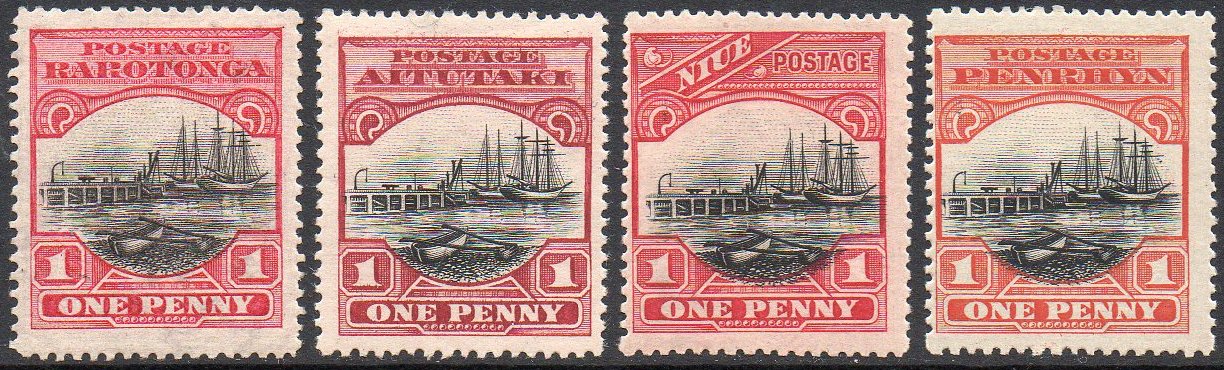 .
Turning now to the stamp design, of which issues appeared between 1920 and 1928, we are immediately struck by the fact that the view the engraver chose to copy appears considerably older than the stamp's first appearance in public in 1920; indeeed, it very probably pre-dates all the postcards. It illustrates the wharf looking to seaward, a view for which we have not been able to find any corresponding photograph or postcard. The antiquity of the ships suggests the engraver may have had access to something like a late 19th century engraving from a periodical. The view on the stamp possibly shows the right wharf (as seen from the seaward side on the postcards) and there could quite possibly have been only one wharf in existence at the time of the engraving (or source photo).
The stamp certainly appears to show one of the simple flat-trucks on rails (just to the right of the crane), which naturally implies tracks on the wharf, but the design of the crane is different and appears older than either of the cranes in Card 1. The crane is much more on the landward side than the cranes shown in any of the cards and it is not well-located for unloading any ships obliged to dock in deeper water. We consider, therefore, that the crane is very likely to have been mobile, which almost certainly means rail-mounted, in order for it to be practical and fully functional on the wharf.
.
Stamps Issued: For all four islands / island groups, there was a 1d (one penny) in this design both without watermark (1920, all islands) and with a New Zealand watermark (NZ over star repeated) in 1924 (Cook Islands & Aitutaki), 1925 (Niue) and 1928 (Penrhyn Island). Stanley Gibbons lists a variety, double-derrick, the derrick being the movable arm of the crane, for all four islands and in both watermarks. SG also recognizes and illustrates three different styles of double-derrick, although only applying one catalogue sub-number in each case. A further variety found is a break in the rope of the crane, we think is only due to worn printing plates. Note: Cook Islands stamps between 1919 and 1931 are inscribed (or overprinted) RAROTONGA.
Shades: There are various shades of this stamp, both across islands and within the stamps of the same island. The unwatermarked (1920) stamps of Penrhyn seem to be more a pale red than any of the many shades of rose-red usually encountered on all the other issues both of Penrhyn and the other islands, but we have not sought to extend this article to the shades of the stamps, although it is something worthy of study.
We do, however, list and illustrate the four crane varieties, and we list (and provide check-boxes) for the stamps with these varieties for all the islands, both with and without watermark in the table below.
The stamps were printed in sheets with a total face value of five shillings (5/-), viz. sheets/60 arranged 10x6 (10 across, 6 down). 60 (old) pence = 5 shillings. There were 20 shillings to one Pound Sterling. The double derrick varieties are illustrated below, along with their sheet positions.
.
.
Turning now to the stamp design, of which issues appeared between 1920 and 1928, we are immediately struck by the fact that the view the engraver chose to copy appears considerably older than the stamp's first appearance in public in 1920; indeeed, it very probably pre-dates all the postcards. It illustrates the wharf looking to seaward, a view for which we have not been able to find any corresponding photograph or postcard. The antiquity of the ships suggests the engraver may have had access to something like a late 19th century engraving from a periodical. The view on the stamp possibly shows the right wharf (as seen from the seaward side on the postcards) and there could quite possibly have been only one wharf in existence at the time of the engraving (or source photo).
The stamp certainly appears to show one of the simple flat-trucks on rails (just to the right of the crane), which naturally implies tracks on the wharf, but the design of the crane is different and appears older than either of the cranes in Card 1. The crane is much more on the landward side than the cranes shown in any of the cards and it is not well-located for unloading any ships obliged to dock in deeper water. We consider, therefore, that the crane is very likely to have been mobile, which almost certainly means rail-mounted, in order for it to be practical and fully functional on the wharf.
.
Stamps Issued: For all four islands / island groups, there was a 1d (one penny) in this design both without watermark (1920, all islands) and with a New Zealand watermark (NZ over star repeated) in 1924 (Cook Islands & Aitutaki), 1925 (Niue) and 1928 (Penrhyn Island). Stanley Gibbons lists a variety, double-derrick, the derrick being the movable arm of the crane, for all four islands and in both watermarks. SG also recognizes and illustrates three different styles of double-derrick, although only applying one catalogue sub-number in each case. A further variety found is a break in the rope of the crane, we think is only due to worn printing plates. Note: Cook Islands stamps between 1919 and 1931 are inscribed (or overprinted) RAROTONGA.
Shades: There are various shades of this stamp, both across islands and within the stamps of the same island. The unwatermarked (1920) stamps of Penrhyn seem to be more a pale red than any of the many shades of rose-red usually encountered on all the other issues both of Penrhyn and the other islands, but we have not sought to extend this article to the shades of the stamps, although it is something worthy of study.
We do, however, list and illustrate the four crane varieties, and we list (and provide check-boxes) for the stamps with these varieties for all the islands, both with and without watermark in the table below.
The stamps were printed in sheets with a total face value of five shillings (5/-), viz. sheets/60 arranged 10x6 (10 across, 6 down). 60 (old) pence = 5 shillings. There were 20 shillings to one Pound Sterling. The double derrick varieties are illustrated below, along with their sheet positions.
.
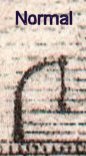
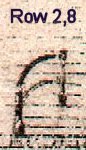
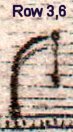
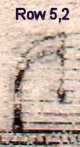
 Note that the additional arm (or derrick) is below the main arm at positions 2,8 and 3,6 but it is above the main arm (and much fainter than the main arm) at position 5,2. The final scan shows the broken rope variety.
.
Tabulated Check-List. SG assigns 'a' numbers to the Double Derrick variety (in any position)
Note that the additional arm (or derrick) is below the main arm at positions 2,8 and 3,6 but it is above the main arm (and much fainter than the main arm) at position 5,2. The final scan shows the broken rope variety.
.
Tabulated Check-List. SG assigns 'a' numbers to the Double Derrick variety (in any position)
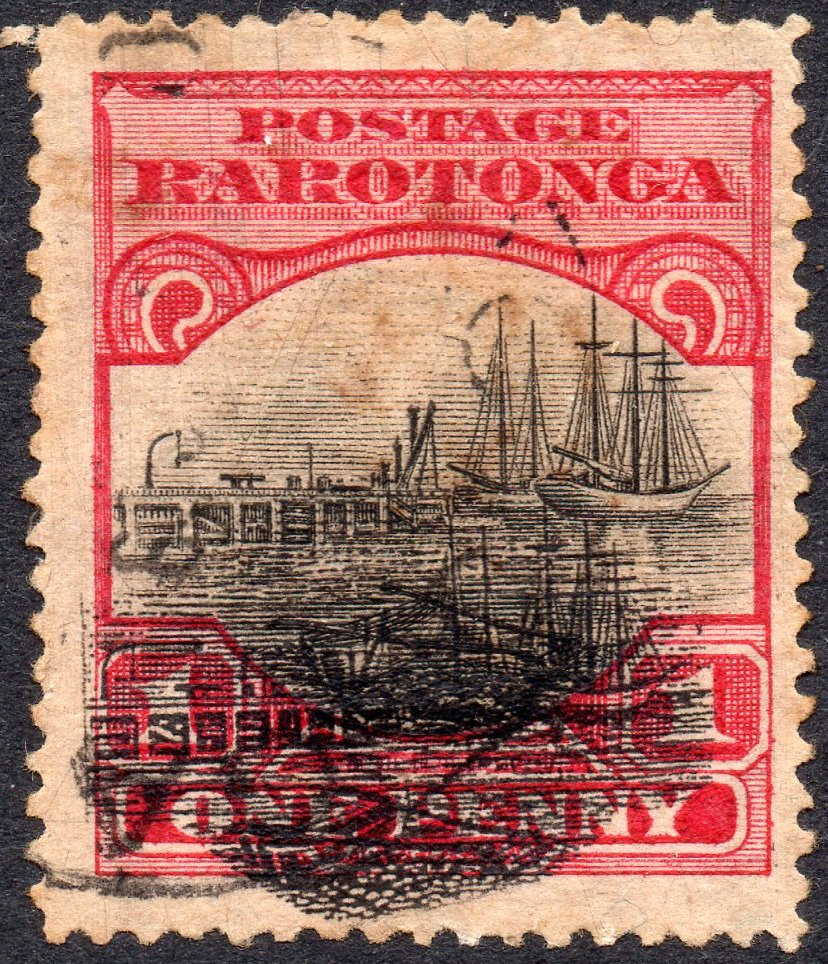
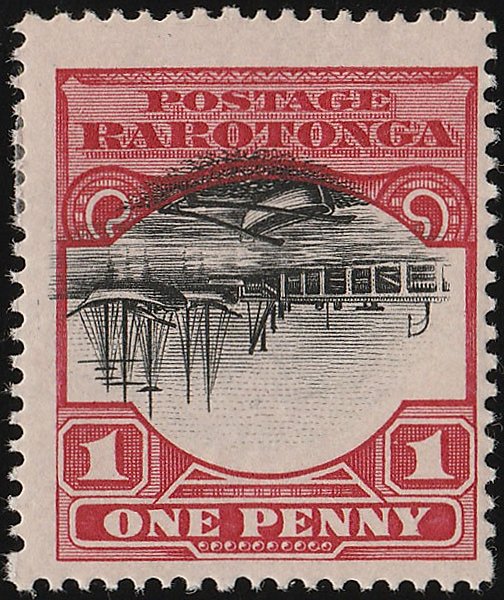 Left : Centre printed double, so far as we know an unlisted variety, commercially used, grubby but rare, possibly unique.
Right : Cook Islands with Inverted Centre, here the Double Derrick variety (Row 2,8). Only one sheet produced.
Cook Islands 1d with watermark : Centre Printed Double [ . . ]
Cook Islands 1d with watermark, wmk. reversed [ . . ]
Cook Islands 1d No Wmk : Centre Inverted (Not Issued) [ . . ]
Penrhyn Island 1d No Wmk Centre Inverted (Not Issued) [ . . ]
.
Left : Centre printed double, so far as we know an unlisted variety, commercially used, grubby but rare, possibly unique.
Right : Cook Islands with Inverted Centre, here the Double Derrick variety (Row 2,8). Only one sheet produced.
Cook Islands 1d with watermark : Centre Printed Double [ . . ]
Cook Islands 1d with watermark, wmk. reversed [ . . ]
Cook Islands 1d No Wmk : Centre Inverted (Not Issued) [ . . ]
Penrhyn Island 1d No Wmk Centre Inverted (Not Issued) [ . . ]
.
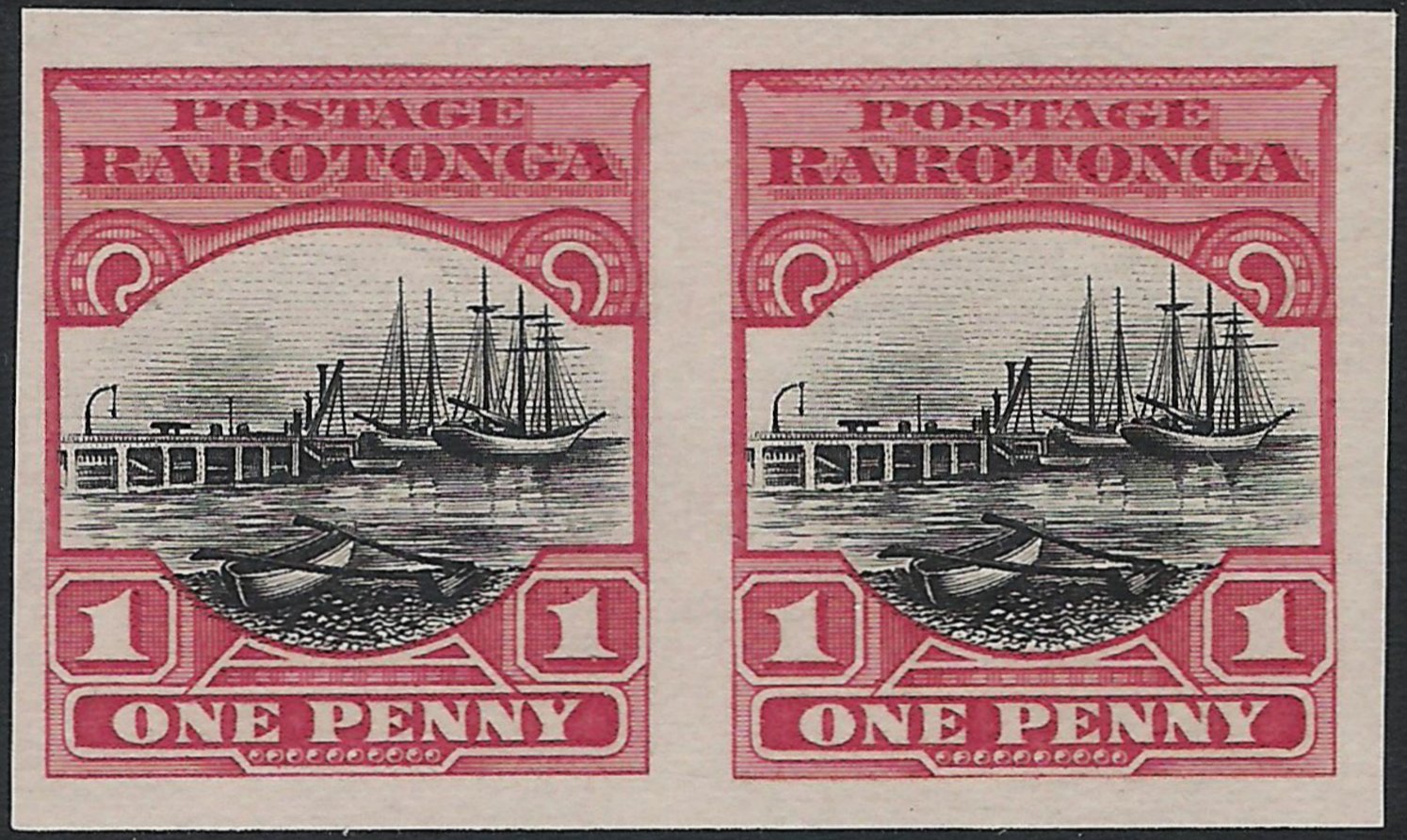 We have seen imperforate Plate Proof pairs offered for the Cook Islands 1d and are aware that Plate Proofs of other values in this set exist for Aitutaki. It is possible that Plate Proofs exist for the 1d from all four island groups.
.
Finally, we are able to show two of the three varieties in positional blocks/6; these are from Aitutaki:
We have seen imperforate Plate Proof pairs offered for the Cook Islands 1d and are aware that Plate Proofs of other values in this set exist for Aitutaki. It is possible that Plate Proofs exist for the 1d from all four island groups.
.
Finally, we are able to show two of the three varieties in positional blocks/6; these are from Aitutaki:
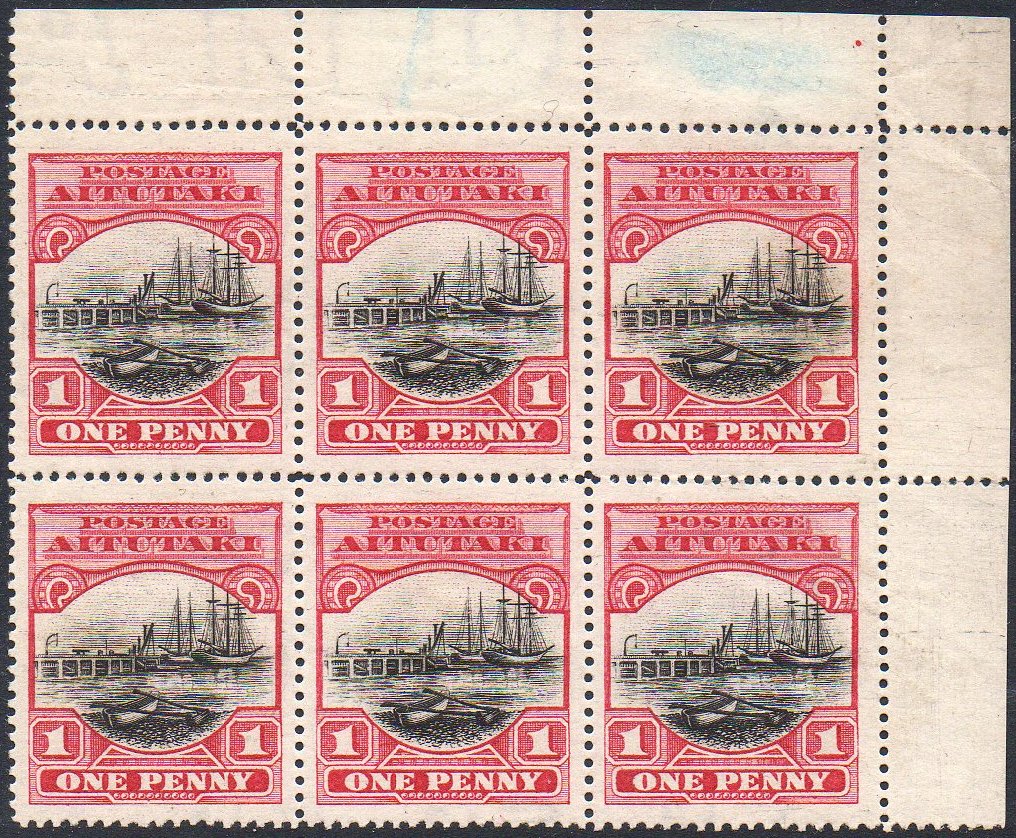 Above: Variety in Row 2,8 (bottom left stamp in scan)
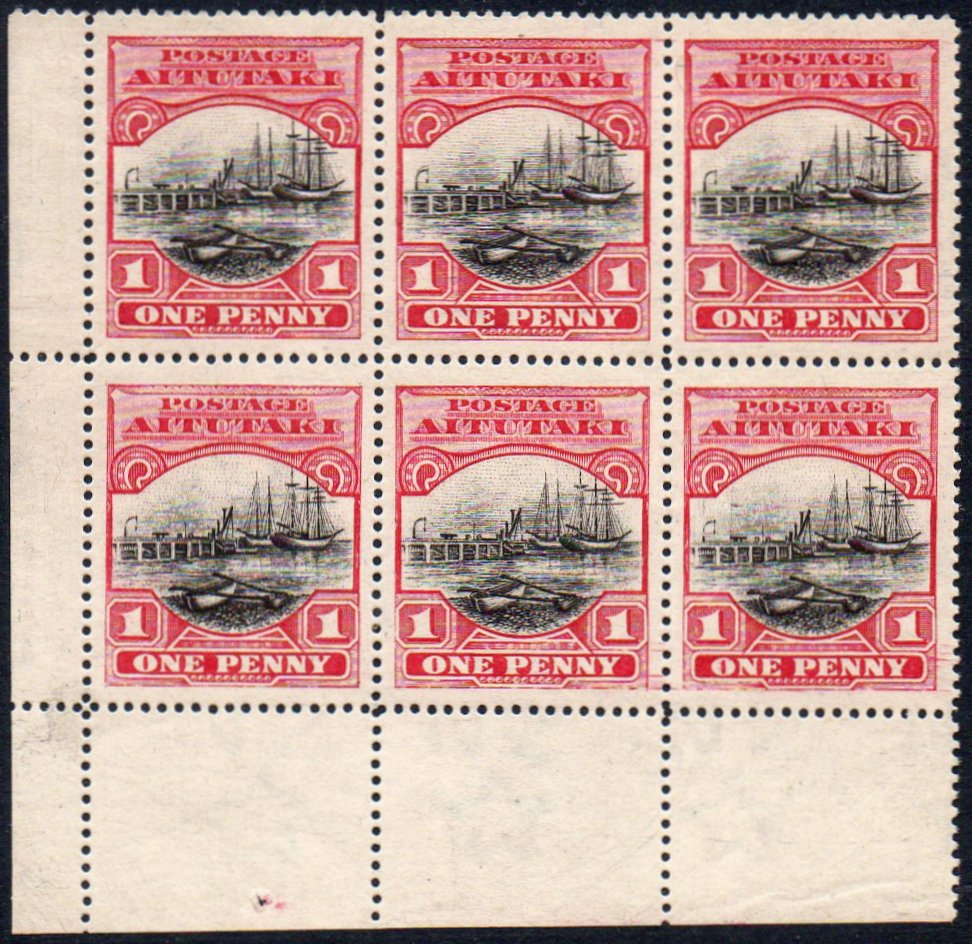 Above: Variety in Row 5,2 (top middle stamp in scan)